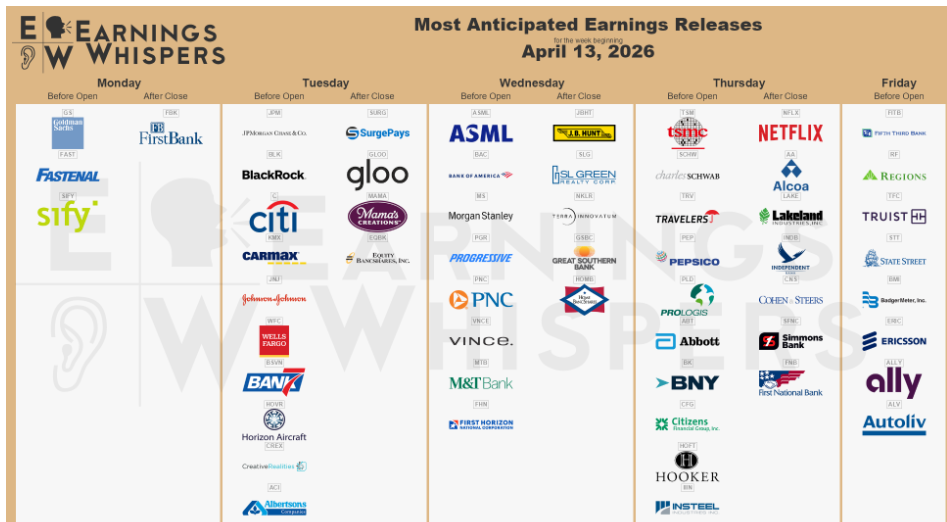
Week of April 10 ’26 Weekly Recap & The Week Ahead
“There is a time to go long, a time to go short and a time to go fishing.” – Jesse Livermore
1. Hegseth Declares ‘Decisive’ Victory as Cease-Fire Begins — The U.S. and Iran agreed to a cease-fire on Tuesday. But it’s still unclear whether the negotiations set to start Saturday and led by Vice President JD Vance will be based on the U.S.’s 15-point plan or Iran’s diametrically opposed 10-point plan. Israel said it had halted attacks on Iran but was continuing military operations in Lebanon against Hezbollah, prompting protests from Iran. Oil-tanker traffic was halted in the Strait of Hormuz after the Israeli attacks, according to Iran’s semi-official Fars News Agency, and Iran told mediators its participation in talks with U.S. officials in Islamabad is conditional on a cease-fire in Lebanon.
2. Trump Team Explores Punishment for NATO Countries That Didn’t Support Iran War — The proposal would involve moving U.S. troops out of North Atlantic Treaty Organization member countries deemed unhelpful to the Iran war effort and stationing them in countries that were more supportive. The proposal would fall far short of President Trump’s recent threats to fully withdraw the U.S. from the alliance, which by law he can’t do without Congress. The U.S. has around 84,000 troops stationed across Europe, though the exact number varies from military exercises and rotational deployments. U.S. bases in Europe serve as a critical hub of global U.S. military operations, as well as provide an economic boon to the host country through investment. Bases in Eastern Europe also serve as a deterrent against Russia. Beyond repositioning troops, the plan could also involve closing a U.S. base in at least one of the European countries, possibly Spain or Germany, according to the two administration officials.
3. US Consumer Sentiment Drops to Record Low on Price Concerns — The preliminary April sentiment index slumped to 47.6 from 53.3 in March, according to the University of Michigan data out Friday. The survey period includes responses from March 24 to April 7. That was below all but one estimate in a Bloomberg survey of economists. They saw costs rising at an annual rate of 3.4% over the next five to 10 years, up slightly from a month earlier. Gasoline prices, well above $4 a gallon and the highest since 2022, could persuade consumers to cut back on discretionary spending. Such an erosion of purchasing power risks slowing the economy at a time when employment prospects are limited and Americans are already anxious about a high cost of living.
4. Inflation Soared to 3.3% in March, Driven by Higher Gasoline Costs — Consumer prices were up 3.3% in March from a year earlier, the Labor Department said Friday, much hotter than February’s gain of 2.4%. Prices excluding food and energy categories—the so-called core measure economists watch in an effort to better capture inflation’s underlying trend—rose 2.6%, slightly below forecasts for a 2.7% increase. Energy prices jumped by 12.5% from a year earlier, a dramatic acceleration from 0.5% in February. Gasoline prices jumped 18.9% and fuel oil surged by 44.2%. The cost of transportation services, which is affected by fuel costs, rose 4.1% from a year earlier in March, a much faster increase than in February.
Friday’s report offers the first snapshot of how the Iran war affected U.S. inflation. The closure of the Strait of Hormuz snarled shipping and sent the price of crude oil and gasoline surging last month.
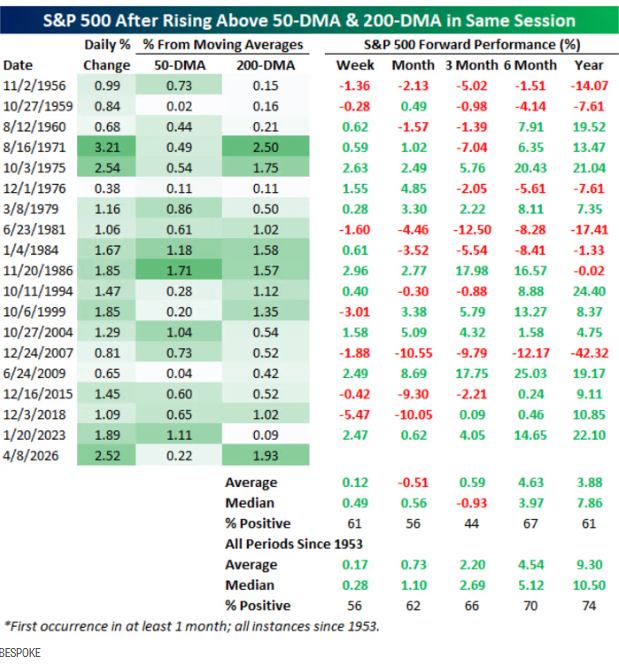
5. S&P 500 Smashes Back Above Two Key Moving Average Statistics — according to the team at Bespoke, Since 1953, when the modern five-day trading week was first adopted, this has only happened 18 times previously when the index break back above both trend lines on the same day is a pretty rare occurrence. hree months later, the index has been positive less than 50% of the time. And while returns six months and one year later have generally been strong, they have lagged the returns during all periods since 1953. “With all of this in mind, we would highlight that six-month and one-year performance following these instances has generally been positive since the 1990s,” the Bespoke team said in a note. See chart below.
The week ahead — Economic data from Econoday.com: