Archive for February, 2026

Week of Feb 20 ’26 Weekly Recap & The Week Ahead

Friday, February 27th, 2026

“Absorb what is useful, discard what is not, add what is uniquely your own”. — B. Lee

1. Fed Minutes Show Several Officials Nod to Rate-Hike Scenario — Federal Reserve officials signaled renewed worries over inflation with “several” policymakers suggesting the central bank may need to raise interest rates if inflation stays above their goal. Minutes of the Federal Open Market Committee’s Jan. 27-28 meeting released Wednesday also revealed that a “vast majority of participants judged that downside risks to employment had moderated in recent months while the risk of more persistent inflation remained.” Several officials saw the likelihood for more rate cuts if inflation declined as they expected, though most said inflation progress could be slower than generally forecast.
2. US Notches One of Its Biggest Annual Trade Gaps Since 1960 — The goods and services trade gap expanded from the prior month to $70.3 billion, Commerce Department data showed . The shortfall culminated in a full-year deficit of $901.5 billion, still one of the largest in data back to 1960. The December deficit — which was wider than all but one estimate in a Bloomberg survey of economists — reflected a 3.6% increase in the value of imports, including gains in computer accessories and motor vehicles. Exports of goods and services declined 1.7%, largely reflecting fewer outbound shipments of gold. After the report, several economists estimated trade would provide a smaller boost, or even a drag on fourth-quarter gross domestic product, which is due Friday. The latest GDPNow forecast from the Federal Reserve Bank of Atlanta reflected as much, predicting net exports will barely add to fourth-quarter growth, now estimated at 3%.
3. US GDP Grows 1.4%, Missing Forecasts on Shutdown, Trade — Inflation-adjusted gross domestic product increased an annualized 1.4% in the fourth quarter after rising 4.4% in the prior period, according to the government’s initial estimate. Overall, the economy expanded 2.2% last year, data from the Bureau of Economic Analysis showed.
The weak quarterly result — which was below all forecasts in a Bloomberg survey of economists — came as the US government was shut down for almost half of the three-month period. The BEA said the reduction in federal services during the shutdown subtracted about 1 percentage point from GDP, though the full impact couldn’t be estimated.Despite the year-end slowdown, the data still cap a solid year for the US economy, which shrank in the first quarter amid a monumental pre-tariff surge in imports, only to bounce back later in the year. The turnaround came after Trump backed off of his most punitive levies and the Federal Reserve lowered interest rates, helping drive the stock market to record highs and enabling wealthier Americans to keep spending.

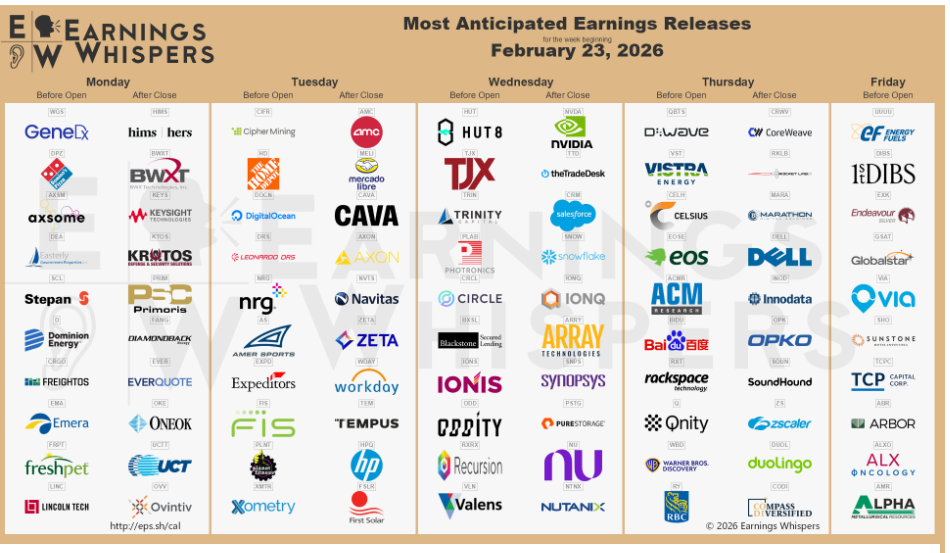
The week ahead — Economic data from Econoday.com:
Week of Feb 13 ’26 Weekly Recap & The Week Ahead

Wednesday, February 18th, 2026

“Do More of What Works & Less of What Does Not”

1. US Consumer Delinquencies Jump to Highest in Almost a Decade — Delinquency rates on loans ranging from mortgages to credit cards rose to 4.8% of all outstanding US household debt in the fourth quarter, the highest level since 2017, driven by higher defaults among low-income and young borrowers. While the overall share of loans in some stage of default is near pre-pandemic averages, the rise in delinquencies among the lowest earners adds to evidence of an increasingly bifurcated economy, data from the Federal Reserve Bank of New York’s Quarterly Report on Household Debt and Credit released showed. The rise in defaults was driven by delinquencies in mortgage payments, and New York Fed researchers found that they were particularly high in lower income zip codes. Student-loan delinquencies, which have surged following a pause in payment requirements during the pandemic, also contributed to the rise in defaults, the researchers said.
2. December Retail Sales Fell Short. Worries About the Economy Curbed Holiday Spending — Retail sales were virtually unchanged in December from November, according to data released Tuesday by the Census Bureau. Economists polled by FactSet expected a 0.4% increase. While that would have marked a slight deceleration from November’s 0.6% rise, it would have indicated that spending was healthy throughout the holiday season. The biggest drops came among retailers of miscellaneous goods and furniture stores, both with declines of 0.9% in December from November. Sales fell 0.7% and 0.4% at clothing stores and electronic stores, respectively. Car dealers, general merchandise stores, health and personal care stores, and restaurants also saw declines from November.
3. Fed’s Path to More Rate Cuts Challenged by Jobs Surprise — Worries about rising unemployment that prompted three rate cuts at the end of 2025, before a pause in January, were likely eased by numbers out Wednesday showing 130,000 jobs were added last month, and unemployment fell to 4.3%. Fed officials at last month’s policy meeting had already cited signs of stabilization as a reason to hold rates steady. Wednesday’s report from the Bureau of Labor Statistics prompted traders to pare the probability of a rate cut at the June meeting — previously eyed as the most likely timing of the next reduction — to under 50%. Economists cautioned that the upbeat January numbers could yet be revised lower, and that hiring continues to be dominated by a handful of sectors, primarily health care. Revisions to last year’s data showed job gains averaged just 15,000 a month, down from the initially reported 49,000 pace.
4. Home Sales in January Posted Biggest Monthly Decline in Nearly Four Years — Home sales fell 8.4% in January, the biggest monthly decline since February 2022, after snowstorms and low consumer confidence slowed a housing market that was showing signs of recovery. Sales of existing homes fell from the prior month to a seasonally adjusted annual rate of 3.91 million, the National Association of Realtors said. Home prices continued to rise, because the national supply of homes for sale remains below normal historical levels. The national median existing-home price in January rose to $396,800, a 0.9% increase from a year earlier, NAR said. Mortgage rates stand around 6.1%, down from about 6.9% a year ago. That is helping make purchases a little more affordable.
5. Consumer prices rose 2.4% annually in January — The consumer price index for January accelerated 2.4% from the same time a year ago, down 0.3 percentage point from the prior month, the Bureau of Labor Statistics reported Friday. That pulled the inflation rate down to where it was the month after President Donald Trump in April 2025 announced aggressive tariffs on U.S. imports. Excluding food and energy, the core CPI was up 2.5%, the lowest level since April 2021. Economists surveyed by Dow Jones had been looking for an annual rate of 2.5% for both readings. Elsewhere, food prices increased 0.2% as five of the six major grocery group categories posted gains. Energy fell 1.5% while vehicle prices also were muted, with new vehicles up just 0.1% and used cars and trucks falling 1.8%. Airline fares jumped 6.5% while egg prices fell 7% and are now down 34% over the past year after a meteoric surge.

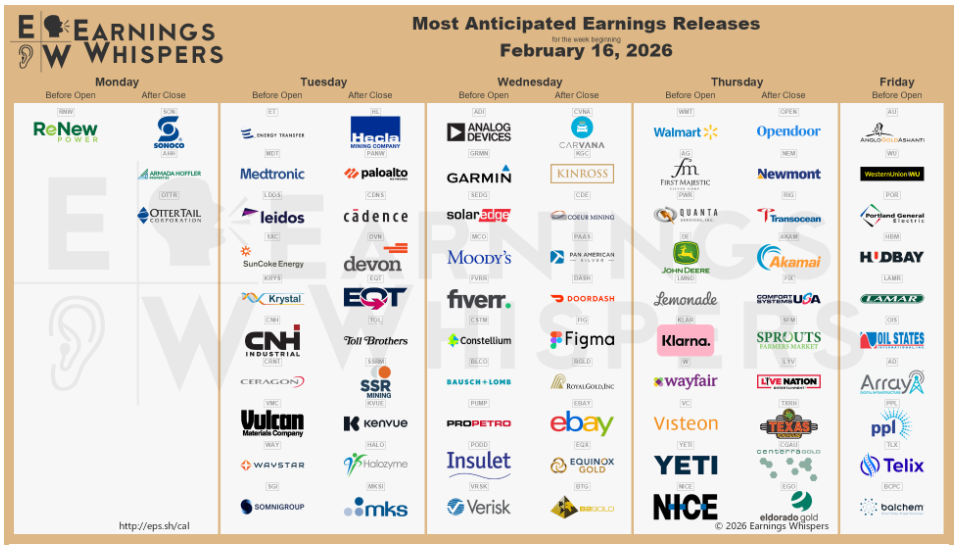
The week ahead — Economic data from Econoday.com:
Week of Feb 6’26 Weekly Recap & The Week Ahead

Tuesday, February 10th, 2026

“Trade what’s happening… not what you think is gonna happen. — Doug Gregory

1. U.S. Enlists Mexico, EU and Japan in Its Minerals Race With China — The U.S. has agreed to work with Japan, Mexico and the European Union on the development of critical minerals used in industries such as defense, the Trump administration said on Wednesday.
The move builds on President Trump’s efforts to combat China’s dominance in the sector. Under the proposed agreements, the nations will work together to identify critical minerals necessary for certain industries and develop policies to encourage their mining and processing into products like rare earth magnets, U.S. officials said. Such minerals are used in components critical for the production of high-end military technologies and consumer products such as cars.
2. Bitcoin Drops Below $70,000 as ‘Forced Deleveraging’ Accelerates — Bitcoin tumbled well below $70,000 as the unwinding of leveraged bets and broader market turbulence deepened a selloff that’s hammered cryptocurrencies over the past three weeks. The downturn has also erased all of Bitcoin’s gains since the election of President Donald Trump, whose crypto-friendly stance had fueled the token’s meteoric rise last year. But the market started cracking this month as rising geopolitical tensions sent tremors across global financial markets and curbed risk taking. That sparked Bitcoin’s precipitous decline from mid-January and set off a self-reinforcing cycle of selling as funds liquidated assets to meet redemptions and unwind leveraged bets.
3. Job Openings Sink to a Post Pandemic Low — The number of job openings in December fell to the lowest level in eight years, excluding the COVID-19 pandemic era, underscoring the fragility of the U.S. labor market in the new year. U.S. job openings dropped by 386,000 in December to 6.5 million, the government said in a report delayed by federal shutdowns. That’s the lowest total since 2017, excluding the 2020-21 time frame. The exceedingly small gap between hires and separations illustrates just how weak the labor market has gotten since last spring. The economy is barely adding net new workers.

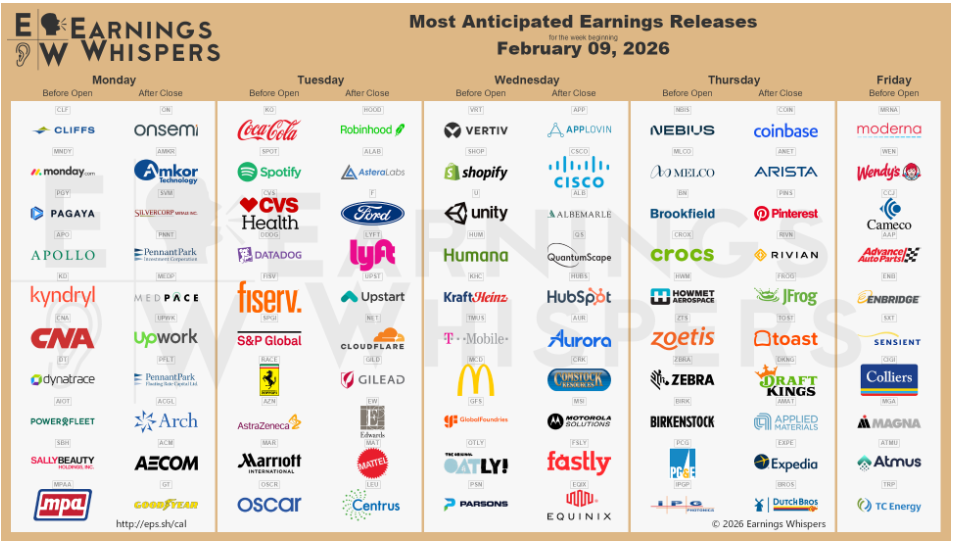
The week ahead — Economic data from Econoday.com:
Week of Jan 30 ’26 Weekly Recap & The Week Ahead

Wednesday, February 4th, 2026

“Do More of What Works and Less of What Doesn’t” — unknown

1. Fed Holds Rates Steady, Nods to Stabilization in Jobless Rate — Federal Reserve officials left interest rates unchanged and pointed to improvements in the US economy as they signaled a more cautious approach to potential future adjustments. The Federal Open Market Committee voted 10-2 Wednesday to hold the benchmark federal funds rate in a range of 3.5%-3.75%. Governors Christopher Waller and Stephen Miran dissented in favor of a quarter-point reduction. The upgraded assessment of the labor market is likely to hold expectations for a near-term rate cut at bay, despite escalating pressure from the Trump administration. Heading into the meeting, investors saw another cut as unlikely until at least June.
2. Meta Reports Record Sales, Massive Spending Hike on AI Buildout — The company said capital spending would reach up to $135 billion in 2026, about 20% higher than Wall Street expectations and nearly double last year’s investment level. Chief Executive Mark Zuckerberg plans to build new data centers around the globe, release new cutting edge AI models and further infuse the core advertising business with AI this year.
3. US Trade Gap Widens From Smallest Since 2009 as Imports Rise — The goods and services trade gap nearly doubled from the prior month to $56.8 billion, Commerce Department data showed Thursday. The 94.6% widening was the largest since 1992, while the shortfall for the month exceeded all projections in a Bloomberg survey of economists. That was the case again in November, with a surge in inbound shipments of pharmaceuticals and a slide in gold exports. Overall imports increased 5%, also boosted by capital goods, such as computers and semiconductors. The latest trade data will help economists firm up their estimates for fourth-quarter gross domestic product. After the figures, the Federal Reserve Bank of Atlanta’s GDPNow forecast net exports would add 0.65 percentage point to fourth-quarter growth, now estimated at 4.2%.
4. Trump Picks a Reinvented Warsh to Lead the Federal Reserve — Warsh, who served on the US central bank’s Board of Governors from 2006 to 2011 and has previously advised Trump on economic policy, would succeed Jerome Powell when his term at the helm ends in May. It marks a comeback for Warsh, 55, whom the president passed over for the top job in 2017 when he selected Powell. If confirmed by the Senate, the former Fed governor will take charge of US monetary policy at a time when many economists and investors see its traditional insulation from elected officials as being under threat from the White House. Warsh aligned himself with the president in 2025 by arguing publicly for lower interest rates, going against his longstanding reputation as an inflation hawk.

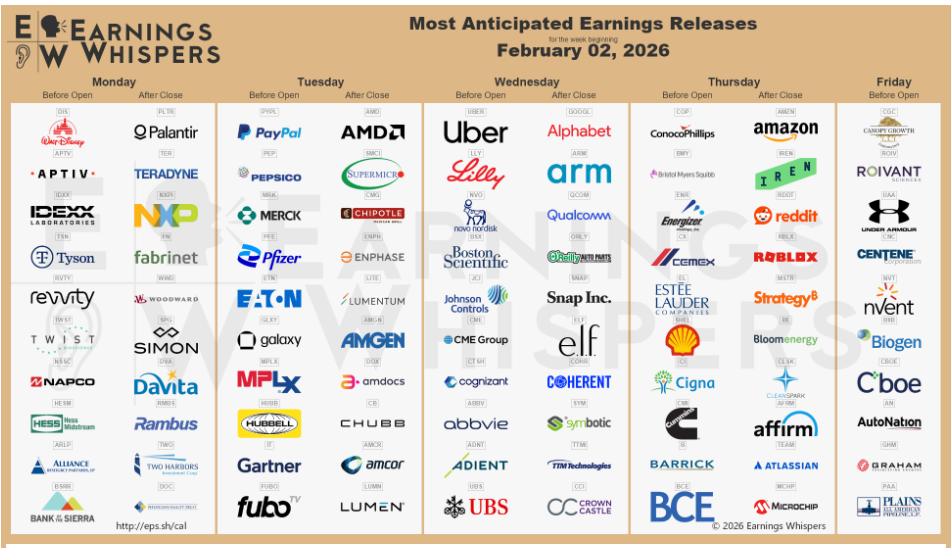
The week ahead — Economic data from Econoday.com:
Search
Calendar
February 2026
M T W T F S S
« Jan   Mar »
 1
2345678
9101112131415
16171819202122
232425262728  
Archives
Categories
The information provided by The EGS Blog is based on sources believed to be reliable, but it is not guaranteed to be accurate. There is no guarantee that the recommendations of The EGS Blog will be profitable or will not be subject to losses. The information provided by The EGS Blog is not a recommendation or a solicitation that any particular investor should purchase or sell any particular security in any amount, or at all. The investments discussed or recommended herein may be unsuitable for investors depending on their specific investment objectives and financial position. At any time EGS LLC and its principals may maintain positions that are contrary to positions announced within the subscription service. In no event will The EGS Blog be liable to you or anyone else for any incidental, consequential, special, or indirect damage (including but not limited to lost profits or trading losses). PAST PERFORMANCE IS NO GUARANTEE OF FUTURE RESULTS

© Copyright 2026 Market Outlook All Rights Reserved
Design by EGS Sponsored by Equity Guidance LLC