Week of Sept 19 Weekly Recap & The Week Ahead
Wednesday, September 23rd, 2026“If you don’t bet, you can’t win. If you lose all your chips, you can’t bet.” Larry Hite
1. Fed Delivers First Rate Hike in Years With Unanimous Vote — The increase, approved unanimously, will raise the benchmark federal-funds rate range by a quarter point to between 3.75% and 4%. The vast majority of officials penciled in one more hike this year in interest-rate projections released after their meeting. Chairman Kevin Warsh vowed shortly after taking office in May to end an overshoot of the Fed’s 2% target now in its sixth year and followed through with an increase that had been widely anticipated in recent days. It also followed a lost year in the Fed’s inflation fight. The central bank has made no progress toward its 2% goal since mid-2025, including after cutting rates three times late last year to guard against a labor-market slowdown. Instead, the Iran war has lifted energy prices, and the AI boom has driven an investment surge that has buoyed the economy and markets.
2. U.S. Retail Sales Rebound in Show of Consumer Strength — Retailers’ sales rose by 1.2% last month to $773.9 billion, versus the 0.5% decrease recorded in July. The August reading was higher than the 0.8% increase economists polled by The Wall Street Journal expected. Sales in the so-called “control-group” categories that feed into the formula for gross domestic product-rose rose by about 1.4%.
Meanwhile, sales at nonstore retailers rose by 2.6%. Spending in other discretionary categories, such as electronics and appliance stores rose by 1.6%.
3. GM to Produce Patriot Missile Parts as U.S. Faces Critical Arms Shortage — The automaker is supplying parts for Lockheed Martin’s LMT -2.05%decrease; red down pointing triangle Patriot missiles, the defense contractor said Thursday—a potential lift to America’s munitions supplies depleted by the conflicts in Ukraine and the Middle East. Lockheed, which faces Pentagon demands to sharply boost munitions production, said GM delivered an initial batch of missile-housing components for PAC-3 MSE interceptors in August. Lockheed has spent the past year rushing to assemble new suppliers for its Patriot interceptor, a high-end missile capable of knocking down a range of airborne attacks. Dwindling Patriot stockpiles have left Ukraine dangerously exposed to Russian missile barrages for months, while the U.S. war with Iran has severely depleted American inventories.
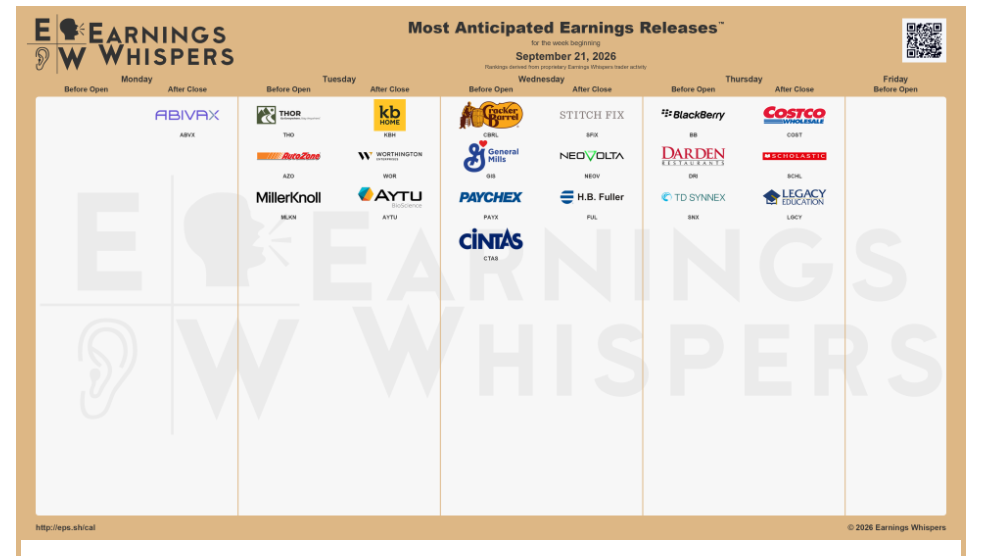
strong>The week ahead — Economic data from Econoday.com:
 Posted in
Week of Sept 12 Weekly Recap & The Week Ahead
Thursday, September 17th, 20261. Trump Plans to Ban Imports of Some Canadian Dairy, Alcohol — President Donald Trump signed a series of proclamations on Tuesday that included bans on motorcycles, whey, molasses, non-alcoholic beer, and a range of alcoholic beverages. The import bans for some Canadian dairy products and alcohol will take effect in three weeks, a senior administration official told reporters. Modifications to the Section 338 tariffs will go into place in one week. Canada is the largest supplier of dairy products to the US by volume, accounting for about 14% of the country’s imports, according to the US Department of Agriculture. Those shipments, totaling over 120,000 tons last year, were worth about $433 million. The US president’s actions are the latest salvo in a trade fight that has expanded well beyond tariffs. Talks between the US and Canada on a trade truce collapsed at the last minute in August, leading the Trump administration to follow through with a 50% tariff on billions in Canadian goods.
2. Treasury to buy back more government bonds than previously announced — This is the first buyback operation since Treasury said last month that it would at least double the size of its government-debt buybacks from $2 billion. The new figure is below the top range of what had been expected. Last month, Treasury Secretary Scott Bessent surprised markets with the expanded buyback plan, which he said was a response to the steep rise in 30-year Treasury yields
3. Wholesale Inflation Rose 0.4% in August as Diesel Costs Surge — The producer price index for total final demand rose 0.4% in August, translating to growth of 5.4% year over year, the Bureau of Labor Statistics reported. The continued persistence of wholesale inflation could make a stronger case for the Federal Reserve to raise interest rates at its policy meeting next week. Yet excluding the surge in fuel prices, the core reading was fairly benign. Core PPI, which excludes food and energy, climbed 0.2% month over month in August, a bit softer than the consensus call for a 0.3% advance and a deceleration from July’s revised 0.3% reading. Core producer prices rose 4.6% year over year, an acceleration from July’s revised 4.3% pace.
4. Home Sales Slump to Lowest Level in More Than a Year. High Mortgage Rates Are Biting Buyers — Existing-home sales dropped 2% in August to their slowest pace in more than a year as rising mortgage rates hurt already-slow demand. Previously owned homes were sold at a seasonally adjusted annual rate of 3.98 million in August, the National Association of Realtors said Thursday. The result is the slowest pace since June 2025, which it tied, according to historic data. The median home sales price rose 1.6% from one year prior to $429,100, while the number of homes on the market rose to 1.62 million units—the first time that count exceeded 1.6 million since November 2019, the trade group said.
5. US Core CPI Tops Forecasts, Bolstering Case for Rate Hike — The consumer price index, excluding food and energy, climbed 0.3% in August from a month earlier, according to Bureau of Labor Statistics data out Friday. The median estimate in a Bloomberg survey called for a 0.2% increase. On an annual basis, it advanced 2.4%. The report suggests inflation made little progress toward the Fed’s goal last month amid ongoing pressures from the Iran war, tariffs and the data center buildout. The US central bank will likely see the numbers as tipping the scale in favor of the first rate increase in three years after some officials suggested the Sept. 15-16 decision could come down to what the figures showed. Friday’s report showed the overall CPI was up 0.4% from the prior month and 3.4% from a year earlier. Energy prices rose 2.1% in August, while grocery prices were little changed and owners’ equivalent rent, the largest component of the CPI, advanced 0.2%.
strong>The week ahead — Economic data from Econoday.com:
 Posted in
Week of Sept 5 Weekly Recap & The Week Ahead
Thursday, September 10th, 20261. Private payrolls rose by 38,000 in August, less than expected, ADP reports — The payrolls processing firm said firms added 38,000 workers, fewer than the upwardly revised 46,000 in July and below the Dow Jones consensus estimate for 47,000. Though job creation held positive, August was the smallest gain since January and reflective of a broader slowdown in the labor market. Moreover, most of the jobs came from three sectors, with multiple others showing declines. Leisure and hospitality added 16,000 positions and construction was up 12,000. Outside of that, though, there were few growth areas. Manufacturing lost 17,000 jobs, professional and business services was off 16,000, and both natural resources and mining as well as trade, transportation and utilities reported declines of 5,000.
2. US Trade Gap Widens on Import Surge — The gap in goods and services trade grew 24.4% from the prior month to $88.6 billion, according to the Trump administration. The rapid rate of technology imports reflects the investment race in artificial intelligence, a key driver of current US economic growth. While many of Donald Trump’s tariffs, levied as part of his ongoing trade war, were struck down as unconstitutional earlier this year, the president is using other authorities to impose duties (moves which also have triggered litigation). Most recently, the US levied 50% duties on billions of dollars of Canadian goods, and Canada retaliated after trade talks fell apart last month. Meanwhile, the value of outbound US shipments of industrial supplies such as oil and petroleum products declined, according to the Commerce Department. Exports of non-monetary gold also fell. Trade in this category has been particularly volatile since early last year.
3. US Adds 162,000 Jobs, Topping All Estimates in Broad Advance — Nonfarm payrolls increased 162,000 last month and July’s job losses were revised away, according to Bureau of Labor Statistics data out Friday. The August increase topped all estimates in a Bloomberg survey. The unemployment rate remained at 4.1%. The broad advance in payrolls was led by a rebound in leisure and hospitality employment following big declines in June and July. Local government education also added about 42,000 jobs following outsize cuts last month. That category can be volatile in the summer as many teachers fall off of payrolls before returning again as the school year begins. Manufacturing payrolls rose by the most since 2023, while construction firms added the most jobs since January. Many economists have pointed to the data-center buildout as a driver of demand for construction labor this year.
The financial activities and information sectors — both of which are seen as particularly exposed to AI-related job displacement — shed a combined 34,000 positions.
4. U.S. Trade Deficit Widened in July — U.S. imports were higher than exports by $88.6 billion, versus $71.2 billion in June. Analysts polled by The Wall Street Journal were expecting a $90 billion deficit. The gap is the result of imports increasing 2.8% in July from the previous month, to $399.3 billion, while exports decreased 2.1% to $310.7 billion.
Imports of goods increased $11.4 billion in July, while exports of goods decreased $6.2 billion. Exports of crude oil decreased $4.5 billion. International commerce has been affected by volatile tariffs that put the U.S. at odds with traditional trade partners. More recently, negotiations with Canada have failed to yield a deal, opening the door for steep levies from both sides. Wars in the Middle East, Russia and Ukraine are also disrupting energy and food trade.
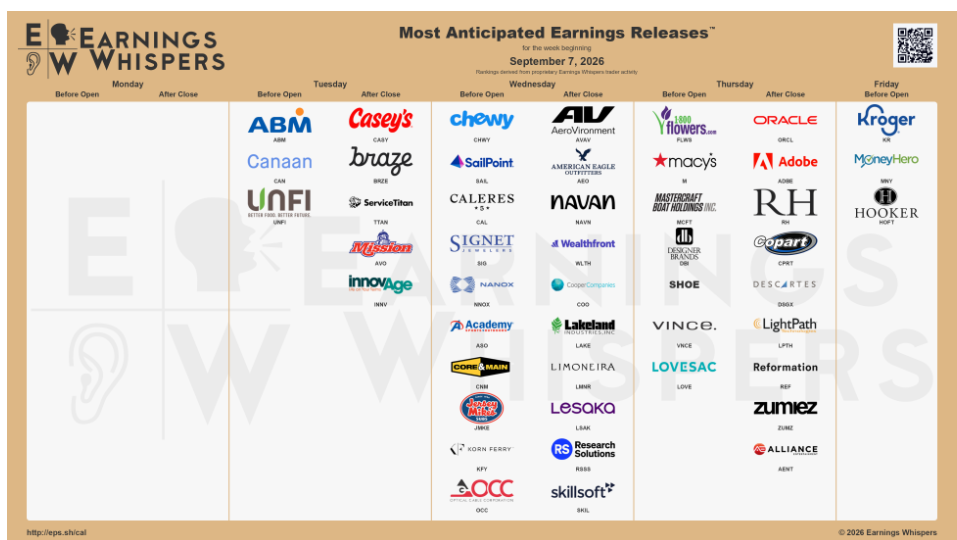
strong>The week ahead — Economic data from Econoday.com:
 Posted in
Week of Aug 29 Weekly Recap & The Week Ahead
Thursday, September 3rd, 2026“Buy the Dip & Sell the Rip” — trader
1. Carney Matches Trump Tariffs With 50% Tax on US Furniture, Steel — Canada will double its existing counter-tariffs on US steel and aluminum products to 50%. American-made furniture, clothing and apparel will also have new 50% tariffs applied, as will video-game consoles, smartphones and other electronics.
Overall, the retaliatory levies will affect about $20 billion worth of annual US imports, roughly matching the dollar value of the tariffs Trump put on Canadian products on Saturday under a never-before-used provision of the 1930 Tariff Act. That’s equal to about 6% of Canada’s goods imports from the US last year. Other US goods such as appliances, cheese, fish, seafood, and certain steel and aluminum derivative products will have new 25% tariffs applied. A range of US-made machinery, industrial tools and farm equipment will have 15% tariffs applied. The new duties are set to take effect Sept. 8.
2. US New-Home Sales Decline to Lowest Level Since January — Contract signings on new single-family homes decreased 10.5% last month to a 607,000 annual rate, according to government figures released Tuesday. Economists surveyed by Bloomberg expected a 620,000 annualized sales pace, based on the median estimate. Sales have fallen in three of the last four months, adding to evidence of a housing market burdened by elevated finance costs and prices. While builders have had some success bolstering demand with free upgrades, mortgage rate buydowns and price reductions, the entry-level market remains affordability-constrained.
3. Fed’s preferred inflation gauge shows core prices rose 3.3% annually in July — The personal consumption expenditures price index, which the Fed uses as its preferred forecasting tool, increased a seasonally adjusted 0.2% for the month, putting the annual inflation rate at 3.7%, the Commerce Department reported Wednesday. Both were 0.1 percentage point above the Dow Jones consensus. But stripping out volatile food and energy costs, core PCE posted respective gains of 0.2% and 3.3%, in line with forecasts. While the Fed considers both measures, policymakers generally see core inflation as the better measure of longer-term trends. The report comes with Fed officials weighing their next policy move as inflation, despite generally soft monthly readings this summer, is still well above the central bank’s 2% goal.
4. Warsh Says Fed May Not Be Done Fighting Inflation — In a sweeping speech, his first since becoming chairman of the central bank in May, Warsh reiterated that policymakers will return inflation to their 2% goal, which he said is a firm and fixed target. Warsh added that financial conditions are not currently restrictive and interest rates are the Fed’s “predominant tool” for achieving its mandate, though he stopped short of signaling he would support an interest-rate hike when Fed officials gather in September. Yields for two-year Treasuries rose by as much as nine basis points to 4.32%, while 30-year yields slipped two basis points to 5.17% — moves that signal an expectation that the Fed may need to raise short-term rates. The implied probability of a rate hike in September rose to above 50%, up from around 36% before the speech, based on federal funds futures.
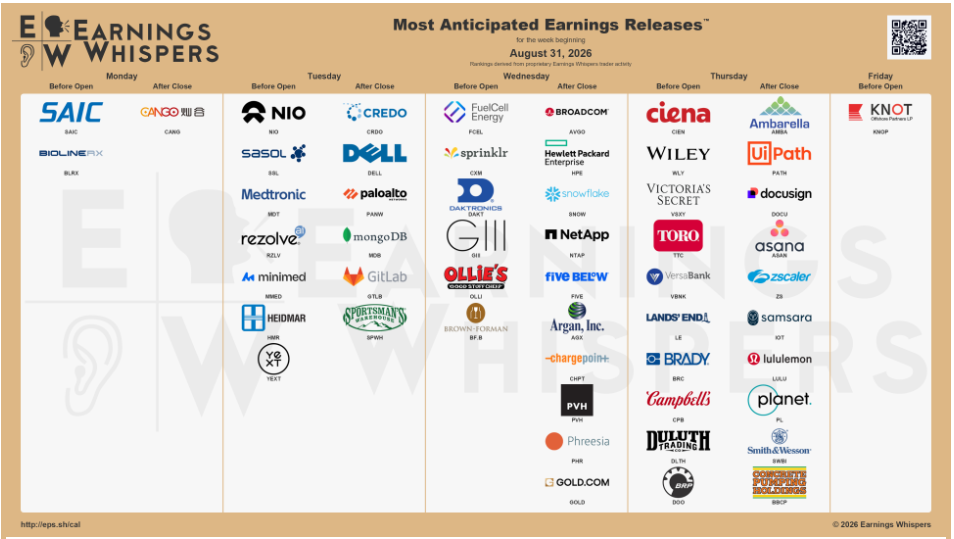
strong>The week ahead — Economic data from Econoday.com:
 Posted in