Week of Dec 20, 2024 Weekly Recap & The Week Ahead
December 30th, 2024“Yesterday’s home runs don’t win today’s games.” … — Unknown
1. US Retail Sales Strengthen on Jump in Motor Vehicle Purchases — The value of retail purchases, not adjusted for inflation, increased 0.7% after upward revisions to the prior two months, Census Bureau data showed Tuesday. Excluding autos, sales climbed a more modest 0.2% for a second month. E-commerce sales jumped 1.8%, as Black Friday and Cyber Monday promotions generated massive sales on platforms like Amazon.com Inc. and TikTok Shop. Receipts at building material stores rose 0.4%. Spending at restaurants and bars, the only service-sector category in the retail report, fell for the first time since March. Grocery store sales also declined. The data suggest consumers remained resilient during the crucial holiday shopping season, lured by discounts and bolstered by incomes that have been rising faster than prices. Measures of confidence have also been climbing since the November election, and some consumers have reported they could avoid higher prices from possible new tariffs imposed by the Trump administration by purchasing big-ticket items now.
2. Fed cuts by a quarter point, indicates fewer reductions ahead — In a move widely anticipated by markets, the Federal Open Market Committee cut its overnight borrowing rate to a target range of 4.25%-4.5%, back to the level where it was in December 2022 when rates were on the move higher. In delivering the 25 basis point cut, the Fed indicated that it probably would only lower twice more in 2025, according to the closely watched “dot plot” matrix of individual members’ future rate expectations. The two cuts indicated slice in half the committee’s intentions when the plot was last updated in September. Assuming quarter-point increments, officials indicated two more cuts in 2026 and another in 2027. Over the longer term, the committee sees the “neutral” funds rate at 3%, 0.1 percentage point higher than the September update as the level has drifted gradually higher this year.
3. Trump, Musk Throw Congress Into Chaos With US Shutdown Looming — With less than two days until federal agencies shutter, House Republicans huddled Thursday in Johnson’s office and struggled to write a Plan B that could appease Trump and his agitator-in-chief, Elon Musk. The last-minute dealmaking followed an extraordinary day Wednesday. Backroom spending discussions on Capitol Hill spilled out into an open clash on X, with Musk, the social media platform’s owner, denouncing the compromise Johnson had negotiated to keep funding going into next year.
The drama left Johnson, just days after sitting with the president-elect at the Army-Navy football outside Washington, meeting with allies in his Capitol office to come up with a new plan to keep the government financed and avoid the political pain of a shutdown before the funding deadline lapses on Friday night.
4. US Growth Revised to 3.1% on Stronger Consumer Spending, Exports — Gross domestic product increased at a 3.1% annualized rate in the July-to-September period, the third estimate of the figures from the Bureau of Economic Analysis showed Thursday. That compared to a previous projection of 2.8%. Growth in consumer spending was marked up to 3.7% — the fastest since early 2023 — and exports also grew faster than previously estimated, both thanks to services.
5. Fed’s Favored Inflation Gauge Cools to Slowest Pace Since May — The so-called core personal consumption expenditures price index, which excludes food and energy items, increased 0.1% from October and 2.8% from a year earlier, according to Bureau of Economic Analysis data out Friday. The monthly advance was the slowest since May. The data marks one of the first reports indicating renewed progress on inflation after stalling in recent months. That had prompted Fed officials to update forecasts earlier this week showing a higher path for prices and interest rates in 2025, which helped trigger a broad market selloff.
The week ahead — Economic data from Econoday.com:
 Posted in
 Week of Dec 13, 2024 Weekly Recap & The Week Ahead
December 16th, 2024“Knowledge born from actual experience is the answer to why one profits; lack of it is the reason one loses” — Gerald M. Loeb
1. Inflation Ticked Up to 2.7% in November — The consumer-price index rose 2.7% from a year earlier, the Labor Department said Wednesday, after climbing 2.6% in October. Core prices, which exclude volatile food and energy items, rising 3.3% over the previous 12 months. The CPI index rose 0.3% from the prior month, the strongest month-over-month increase since April. The increase was driven by persistent inflationary pressures in the cost of food, vehicles and medical care. The pace of housing-cost increases cooled slightly from the prior month, which economists said was a welcome development. But they voiced concerns about persistent inflation in the services sector, which makes up the lion’s share of U.S. economic activity. Core goods inflation also picked up from the prior month, led by a jump in vehicle prices.
2. OPEC Makes Deepest Cut Yet to 2024 World Oil Demand Forecast — The Organization of Petroleum Exporting Countries chopped projections for consumption growth in 2024 by 210,000 barrels a day to 1.6 million barrels a day, according to its monthly report. The cartel has slashed projections by 27% since July as it belatedly recognizes the deteriorating market picture. Last week, the OPEC+ alliance led by Saudi Arabia and Russia agreed for a third time to delay plans to restart halted crude production, while also slowing the pace of increases once they do begin next year. The first in a scheduled series of hikes was postponed to April from January. Oil prices have declined 17% since early July as China falters and supply from OPEC’s rivals in the Americas booms. Brent futures are trading near $73 a barrel, too low for the Saudis and many others in the coalition to cover government spending.
3. Wholesale prices rose 0.4% in November, more than expected — The producer price index, or PPI, which measures what producers get for their products at the final-demand stage, increased 0.4% for the month, higher than the Dow Jones consensus estimate for 0.2%. On an annual basis, PPI rose 3%, the biggest advance since February 2023. However, excluding food and energy, core PPI increased 0.2%, meeting the forecast. Also, subtracting trade services left the PPI increase at just 0.1%. The year-over-year increase of 3.5% also was the most since February 2023. Final-demand goods prices leaped 0.7% on the month, the biggest move since February of this year. Some 80% of the move came from a 3.1% surge in food prices, according to the BLS.
4. ‘Wanted’ Signs Targeting Wall Street and Healthcare Executives Pop Up in New York City — “Wanted” posters threatening healthcare and Wall Street executives have gone up around New York City, the latest escalation of vitriol since last week’s assassination of a UnitedHealth executive.
The posters seen around lower Manhattan this week showed the names and faces of Wall Street and healthcare executives. The signs encouraged violence against them. “Health care CEOs should not feel safe,” the posters said. One displayed Brian Thompson, the UnitedHealthcare chief who was killed, with a red X over his face. The posters dragged conversations about corporate violence from the internet into the real world. Some people online have said Thompson’s death outside a Midtown hotel was justified because he ran a company that denied patients lifesaving care. The same pockets are holding up Mangione as a quasi-folk hero who exposed long-simmering anger at the U.S. healthcare system.
The week ahead — Economic data from Econoday.com:
 Posted in
 Week of Dec 6, 2024 Weekly Recap & The Week Ahead
December 10th, 20241. US Job Openings Pick Up to 7.7 Million as Labor Demand Steadies — Available positions increased to 7.74 million from a revised 7.37 million reading in September, the Bureau of Labor Statistics Job Openings and Labor Turnover Survey, known as JOLTS, showed Tuesday. The median estimate in a Bloomberg survey of economists called for 7.52 million openings. The advance in openings was led nearly entirely by professional and business services and accommodation and food services. The overall uptick followed months of steep declines — including a big drop in September. The levels of layoffs decreased to the lowest since June, while quits picked up to the highest since May, indicating workers are more confident in their ability to find a new job.
2. UnitedHealth Exec Brian Thompson Killed in ‘Brazen, Targeted’ Shooting — the shooting took place early Wednesday morning outside a Manhattan hotel where UnitedHealth Group was scheduled to hold its investor conference. The conference began as scheduled at 8 a.m., but was abruptly canceled. Police officials said the suspect targeted Thompson specifically. “This does not appear to have been a random act of violence,” New York City’s police commissioner, Jessica Tisch, said at a press conference. “It appears the suspect was lying in wait for several minutes.”
Thompson was CEO of UnitedHealth Group’s UnitedHealthcare division since 2021. He had previously worked as a senior executive within the division since 2017. UnitedHealthcare is one of the largest insurers in the U.S., with plans covering medical services for 27.3 million people. Its revenue was $281.4 billion in 2023, accounting for 75% of UnitedHealth Group’s total revenue that year.
3. Payrolls increased 227,000 in November, more than expected; unemployment rate at 4.2% — Nonfarm payrolls increased by 227,000 for the month, compared with an upwardly revised 36,000 in October and the Dow Jones consensus estimate for 214,000. September’s payroll count also was revised upward, to 255,000, up 32,000 from the prior estimate. October’s number was held back by impacts from Hurricane Milton and the Boeing strike. The unemployment rate edged higher to 4.2%, as expected. The jobless figure rose as the labor force participation rate nudged lower and the labor force itself declined. A broader measure that includes discouraged workers and those holding part-time jobs for economic reasons moved slightly higher to 7.8%.
The week ahead — Economic data from Econoday.com:
 Posted in
 Week of Nov 29, 2024 Weekly Recap & The Week Ahead
December 4th, 2024It’s not whether you’re right or wrong that’s important, it’s how much money you make when you’re right and how much you lose when you’re wrong. George Soros
1. Fed Minutes Show Officials Prefer Future Rate Cuts to Be Gradual — Federal Reserve officials indicated broad support for a careful approach to future interest-rate cuts as the economy remains solid and inflation slowly cools, minutes from their latest policy meeting showed. The Fed lowered its benchmark interest rate by a quarter-percentage point earlier this month, to a range of 4.5%-4.75%, following a larger-than-usual, half-point reduction in September. Fed Chair Jerome Powell said earlier this month that the economy is not sending signals policymakers need to be in a hurry to lower rates. Fed officials will gather for their last policy meeting of the year on Dec. 17-18. The record of the November meeting showed some officials said the Fed could pause rate cuts and hold borrowing costs at a restrictive level if inflation remains elevated. Some noted reductions could be accelerated if the economy or labor market deteriorates.
2. US GDP Grows at Solid 2.8% Pace, Helped by Consumer Spending — Gross domestic product increased at a 2.8% annualized pace in the third quarter, the second estimate of the figures from the Bureau of Economic Analysis showed. The economy’s primary growth engine — consumer spending — advanced 3.5%, the most this year. While still strong, household spending was revised modestly lower from the initial reading, reflecting slightly less robust outlays for merchandise. At the same time, business investment in research and development was revised higher.
3. Fed’s Favored Inflation Gauge Picks Up, Backs Cautious Approach — The so-called core personal consumption expenditures price index, which strips out volatile food and energy items, increased 2.8% from October last year and 0.3% from a month earlier, according to Bureau of Economic Analysis data out Wednesday. A good part of that acceleration was due to the impact of higher stock prices on the calculation. On a three-month annualized basis — a metric economists say paints a more accurate picture of the trajectory of inflation — the core PCE price gauge advanced 2.8%. The figures support recent comments by many Fed officials that there’s no rush to cut interest rates so long as the labor market remains healthy and the economy continues to power ahead.
4. Canada Sues Google, Alleging Anticompetitive Online-Ad Practices — In a notice filed Thursday with Canada’s Competition Tribunal, the watchdog—known as the Competition Bureau—said it seeks to “put a decisive end to Google’s structural dominance and anticompetitive practice, [and] restore competition” in the country’s online-advertising marketplace.
The antitrust watchdog wants the tribunal to force the company to sell two crucial pieces of advertising-market software and pay a fine of as much as 3% of the company’s global revenue. The Canadian lawsuit is the latest legal challenge for Google on the antitrust front. Investigators for Canada’s antitrust watchdog started to look into Google’s online-advertising practices in 2020, to verify whether the digital company was impeding competitors, thereby resulting in higher prices and reduced choice. Google is dealing with the fallout from a U.S. federal judge’s ruling last August that the company engaged in illegal practices to preserve its search-engine monopoly.
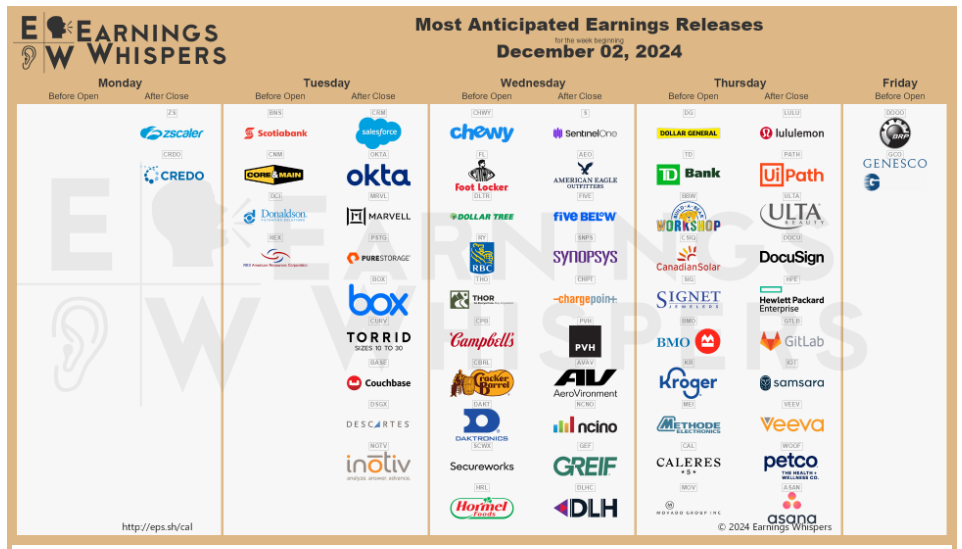
The week ahead — Economic data from Econoday.com:
 Posted in
 Week of Nov 22, 2024 Weekly Recap & The Week Ahead
November 26th, 2024“Rising Tide Lifts All Boat “ — unknown.
1. Google Should Be Forced to Sell Chrome Browser, Justice Department Says — The Justice Department on Wednesday said Google should have to sell off its popular Chrome browser as part of a court-ordered fix to its monopolization of the online search market. The request follows the government’s victory this year in an antitrust case against Google and is likely to kick off a heightened legal fight with wide-reaching implications for the tech giant’s core business.
Government lawyers said competition can only be restored if Google separates its search engine from products it has built to access the internet, such as Chrome and its Android mobile operating system. Chrome controls about two-thirds of the global browser market, according to the website Statcounter. Searches in the Chrome address bar go through Google unless a user changes the settings.
2. Indian Billionaire Gautam Adani Charged in $250 Million Bribery Scheme — Prosecutors announced a 54-page indictment Wednesday that alleges Adani, the chairman of the Adani Group, personally met with Indian officials to advance the illicit deal and secure contracts worth billions of dollars for a renewable-energy company owned by the conglomerate. Prosecutors also alleged that Gautam Adani, 62 years old, and two Adani Green Energy executives conspired to misrepresent the renewable-energy firm’s antibribery and corruption practices to U.S. investors and financial institutions to obtain financing. In total, eight executives were charged in the scheme. None of the defendants have been arrested and are believed to be at large overseas, according to a spokeswoman for the Brooklyn U.S. attorney’s office, which brought the case. One of the defendants is Sagar Adani, Gautam Adani’s nephew who oversees the Adani Group’s renewable-energy businesses.
3. Home Sales Rose in October Following Decline in Mortgage Rates — The average rate for a 30-year fixed mortgage slid throughout the summer and reached a two-year low in late September, according to Freddie Mac. Lower rates lured some home buyers off the sidelines and sparked some hope among real-estate agents that a boost in activity during the fall could salvage another slow year for sales activity. U.S. existing-home sales in October rose 3.4% from the prior month to a seasonally adjusted annual rate of 3.96 million, the National Association of Realtors said Thursday. Economists surveyed by The Wall Street Journal had estimated a monthly increase of 2.9%.
4. U.S. Private-Sector Activity Picks Up Pace as Firms Look Forward to a New Government — The S&P Global Flash U.S. Composite PMI—which gauges activity in the manufacturing and services sectors—rose to 55.3 in November from 54.1 in October, according to the surveys published Friday. That accelerates a previously climbing trend and suggests activity is expanding at its fastest rate in some two and a half years. Demand increased sharply over the month and companies set out a brighter view of their output as interest rates fall and expectations mount of more supportive business policies from Trump’s administration when it moves into the White House in January. The services sector continued to be the sole engine of growth, but the manufacturing industry contracted at its slowest rate in four months, suggesting a recovery could be on the cards in the months ahead. Manufacturing sentiment reached its most positive point for more than two and a half years, the surveys showed.
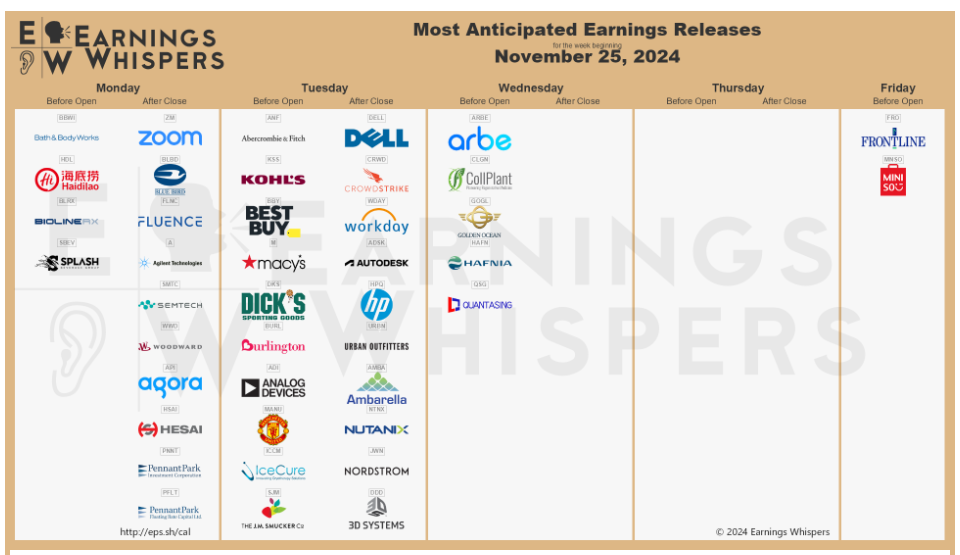
The week ahead — Economic data from Econoday.com:
 Posted in
 Week of Nov 15, 2024 Weekly Recap & The Week Ahead
November 19th, 2024“Losers average losers.” …unknown
1. US Inflation Stays Firm for Third Month With 0.3% Core CPI Gain — the so-called core consumer price index — which excludes food and energy costs — increased 0.3% for a third month, Bureau of Labor Statistics figures showed Wednesday. Over the last three months it rose at a 3.6% annualized rate, marking the fastest pace since April, according to Bloomberg calculations. Economists see the core gauge as a better indicator of the inflation trend than the overall CPI. The headline measure rose 0.2% for a fourth month and 2.6% from a year before, marking the first acceleration on an annual basis since March. The BLS said shelter accounted for over half of the overall monthly advance.
2. Wholesale prices rose 0.2% in October, in line with expectations — the producer price index, which measures what producers get for their products, increased a seasonally adjusted 0.2% for the month, up one-tenth of a percentage point from September though matching the Dow Jones consensus forecast. On a 12-month basis, headline wholesale inflation was at 2.4%.
Excluding food and energy, core PPI rose 0.3%, also one-tenth more than September and also matching expectations. The 12-month rate was at 3.1%.
3. Solid Retail Sales Show Strength of U.S. Consumer — the Census Bureau said Friday that retail sales gained 0.4% in October from September, better than economists’ forecasts for a 0.3% increase. Sales rose 2.8% on an annual basis.
Demand for cars and car parts helped push the headline figure higher. Spending at car and parts retailers rose by 1.6% in October from the prior month. Indeed, when stripping out the effects of car dealers and gasoline stations, sales ticked up by 0.1%, below expectations for a 0.3% increase. Categories that grew in October include electronics and appliances stores, which gained by 2.3%, and building material suppliers, up 0.5%, likely reflecting the beginning of hurricane-reconstruction efforts.
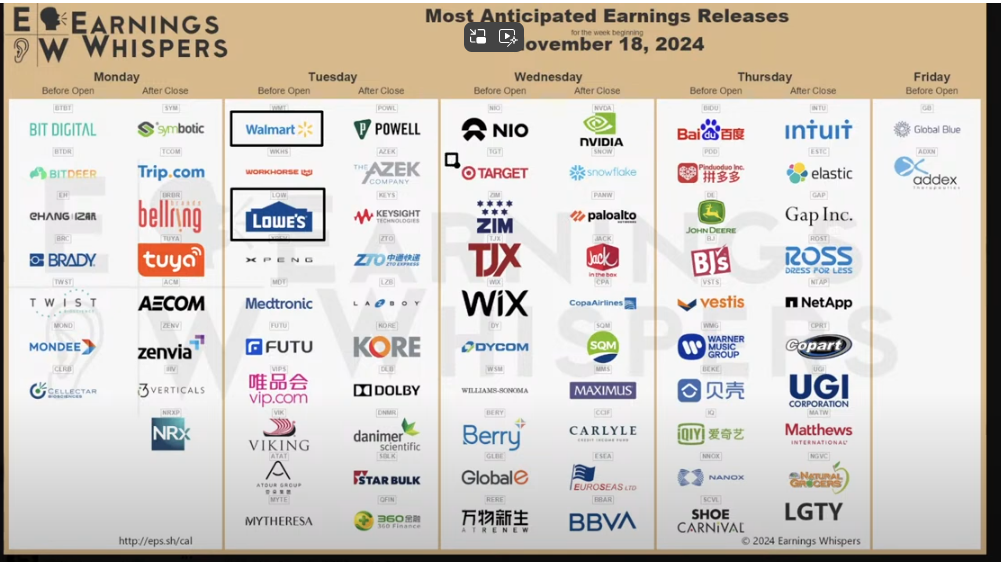
The week ahead — Economic data from Econoday.com:
Week of Nov 8, 2024 Weekly Recap & The Week Ahead
November 13th, 20241. U.S. Services Sector Accelerates on Employment Boost — the Institute for Supply Management’s services-activity index edged up to 56.0 in October from 54.9 in September, beating expectations of 53.7 expected in a poll of economists compiled by The Wall Street Journal. That marked the fourth-straight month of expansion, registered when the gauge is above the 50 no-change mark. The survey showed services employment expanding last month, after it contracted in September, though demand—as measured by new orders—slowed, despite still being in exclusionary territory, ISM said.
2. Trump Wins US Presidential Election in Extraordinary Comeback — Donald Trump was elected the 47th president of the United States, pulling off a stunning political comeback in one of the most polarized contests for the White House in US history. Trump, 78, won an unprecedented race during which he was convicted of felonies, survived two assassination attempts and crushed a challenge from Vice President Kamala Harris after she replaced an unpopular President Joe Biden in the campaign’s final months. He was elected by a country deeply at odds over immigration, abortion and foreign policy, and one still feeling the pinch after the biggest surge of inflation in four decades. Trump also helped Republicans recapture the Senate, underscoring his ability to seize on voter angst.
3. Fed Cuts Rates; Powell Says Wouldn’t Resign If Asked By Trump — Fed officials unanimously lowered the federal funds rate to a range of 4.5% to 4.75%. The second-straight rate cut followed a larger, half-point reduction in September, extending efforts to keep the US economic expansion on solid footing. Powell said the US presidential election will have “no effects” on the central bank’s policy decisions in the near-term, noting it’s too early to know the timing or substance of any potential fiscal policy changes. Federal Reserve Chair Jerome Powell said he would not resign from his role if asked to do so by a re-elected Donald Trump, following the Fed’s decision Thursday to lower interest rates by a quarter percentage point.
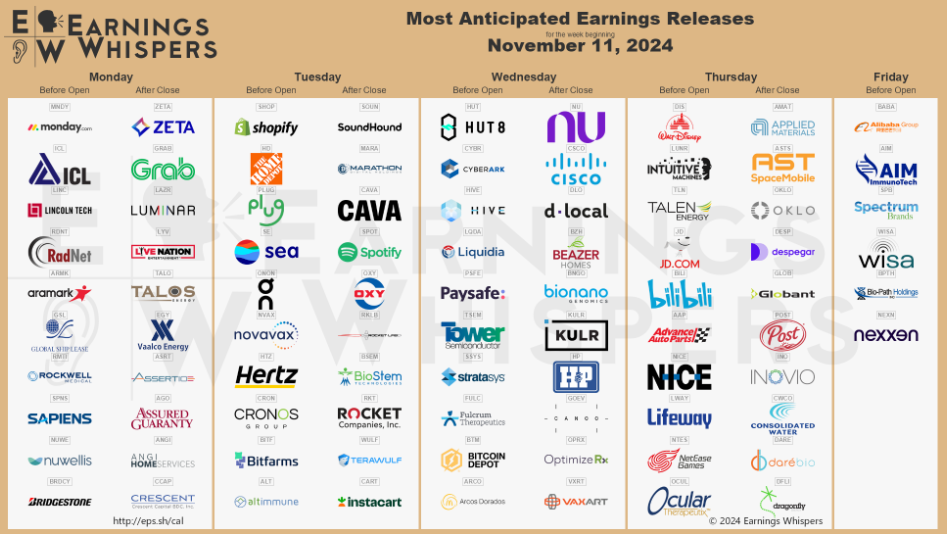
The week ahead — Economic data from Econoday.com:
Week of Nov 1, 2024 Weekly Recap & The Week Ahead
November 1st, 20241. US Economy Expands at 2.8% Rate, Powered by Resilient Consumer — Gross domestic product, a measure of all the goods and services produced during the three-month period from July through September, increased at a 2.8% annualized rate, according to a Commerce Department report Wednesday that is adjusted for inflation and seasonality.
Economists surveyed by Dow Jones had been looking for an increase of 3.1%. The economy accelerated at a 3% pace in the second quarter. However, resilient consumer spending, which accounts for about two-thirds of all activity, has helped keep the economy moving, as has a relentless wave of government spending that pushed the budget deficit to more than $1.8 trillion in fiscal 2024.
2. Key US Inflation Gauge and Spending Pick Up in Solid Economy — The so-called core personal consumption expenditures price index, which strips out volatile food and energy items, increased 0.3% in September, and 2.7% from a year earlier, according to Bureau of Economic Analysis data out Thursday. Overall inflation was 2.1%, the lowest since early 2021 and just above the central bank’s 2% goal. Thursday’s figures cap a month of upside surprises in key economic reports that will likely augur a cautious approach to rate cuts in the months ahead. The Fed is widely expected to authorize a second reduction at the conclusion of its Nov. 6-7 policy meeting following an initial cut in September.
3. US Payrolls Increase by Just 12,000, Hit by Storms and Strikes — Nonfarm payrolls increased 12,000 last month, and hiring over the previous two months was weaker than previously thought, suggesting the underlying labor market continues to cool. The unemployment rate held at 4.1% and hourly earnings ticked up, according to Bureau of Labor Statistics figures released Friday.
BLS said two hurricanes that hit the Southeast US likely affected hiring in some industries, but it wasn’t possible to quantify the net effect on the change in employment, hours or earnings last month. There was no discernible effect on the unemployment rate, however. The report also showed manufacturing jobs plunged, largely reflecting strike activity in October.
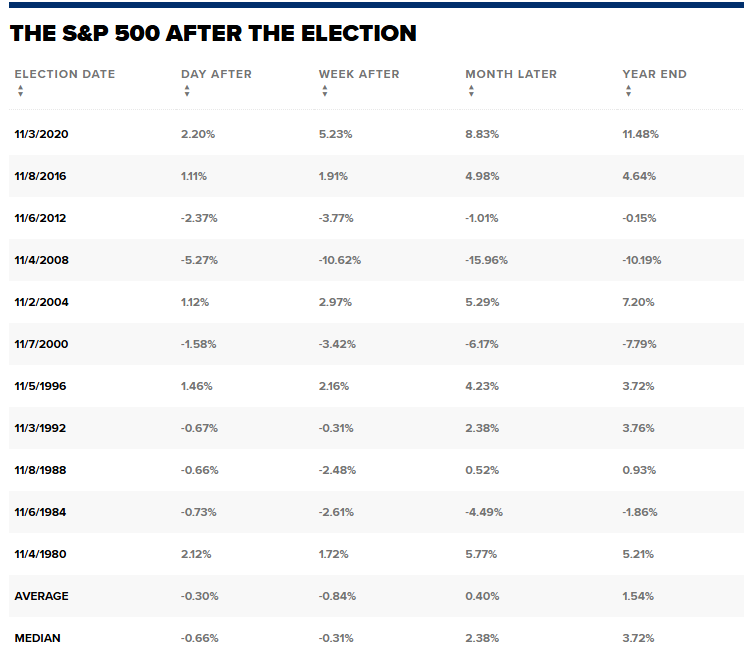
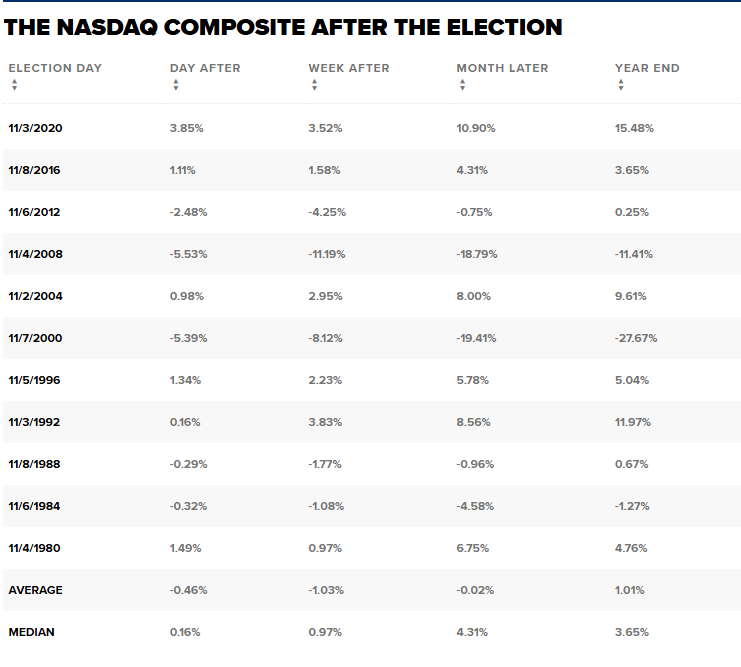
4. Post U.S. Election Market Stat — The major benchmarks on average have seen gains between Election Day and year-end in the presidential election year going back to 1980, according to CNBC data. However, the three indexes have all averaged declines in the session and week following those voting days. Stocks have tended to erase most or all of those losses within a month
The week ahead — Economic data from Econoday.com:
Week of Oct 25, 2024 Weekly Recap & The Week Ahead
October 30th, 2024“It is not the strongest or the most intelligent who will survive but those who can best manage change.”
– Charles Darwin
1. US Previously Owned Home Sales Fall to an Almost 14-Year Low — Contract closings decreased 1% from a month earlier to a 3.84 million annualized rate, according to figures released Wednesday from the National Association of Realtors. Economists surveyed by Bloomberg expected a 3.88 million pace, based on the median projection. Many buyers and sellers are waiting for home financing costs to fall from their current perch in the mid-6% range. Mortgage rates, which slid to a two-year low in September, have climbed after recent job market and inflation data boosted bets the Federal Reserve will take a more gradual approach to reducing borrowing costs. The resale market has largely been stuck for the past two years, barely moving much above or below an annualized rate of 4 million homes on a monthly basis. A major factor has been the so-called lock-in effect, or homeowners’ reluctance to list their homes and surrender their lower mortgage rate.
2. U.S. Economy Again Leads the World, IMF Reported — The International Monetary Fund highlights those divergent paths in its latest global scorecard, released Tuesday. In what has become something of a trend, the IMF upgraded the outlook for both U.S. and global growth, though more for the former.
The IMF projects U.S. gross domestic product to expand 2.5% in the fourth quarter from a year earlier—half a percentage point higher than a July forecast, which itself was an upgrade from a January estimate. U.S. output rose 3.2% in 2023. For 2025, the IMF projects the U.S. to grow 1.9%, versus 1.7% for all advanced economies and 3.1% for the global economy. China, the world’s second-largest economy, is expected to post 4.5% growth this year—a slight downgrade from a prior estimate—and 4.7% in 2025, after expanding 5.4% last year. The euro area’s economy is expected to grow 1.2% this year and 1.3% next year, after expanding 0.2% last year.
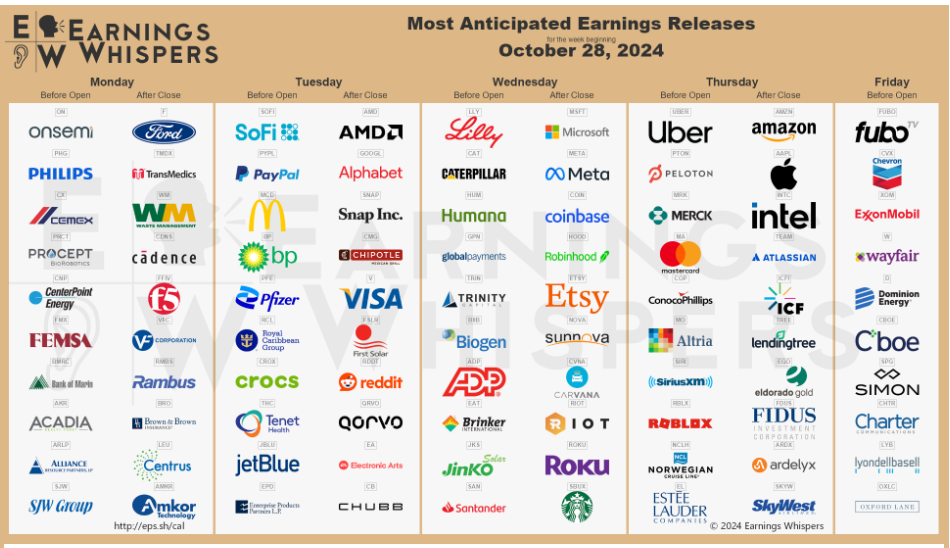
3. Tesla Reports Higher Profit in Third Quarter — The Austin, Texas-based automaker said it recognized its second-highest quarter of regulatory-credit revenue, which comes from other automakers buying them to keep up with emissions requirements. Its energy business also stood out, helping to offset a decline in selling prices for many of its models. Net income was $2.2 billion for the July-to-September period, a 17% increase from a year earlier and lifted in large part by higher sales of regulatory credits to other automakers and the strength of Tesla’s energy business. Global deliveries also rose in the third quarter, helping to boost revenue by 8% to $25.2 billion. The company’s closely watched operating margin was 10.8%, up from 7.6% a year earlier.
The week ahead — Economic data from Econoday.com:
Week of Oct 18, 2024 Weekly Recap & The Week Ahead
October 22nd, 2024“You need to know very well when to move away, or give up the loss, and not allow the anxiety to trick you into trying again.” – Warren Buffett
1. New York Manufacturing Contracts as Orders, Shipments Weaken — The Federal Reserve Bank of New York’s October general business conditions index slid 23.4 points to a five-month low of minus 11.9, figures issued Tuesday showed. Readings below zero indicate contraction, and the figure was weaker than all estimates in a Bloomberg survey of economists. At the same time, the six-month outlook for overall activity increased to a three-year high of 38.7, indicating the state’s manufacturers are more upbeat about the economy’s prospects. A measure of current new orders dropped nearly 20 points to minus 10.2 after climbing a month earlier to the highest since April 2023. The index of shipments decreased almost 21 points to minus 2.7.
The employment index, however, rebounded to 4.1 — the first expansion in a year — while a measure of hours worked also climbed.
2. China Security Group Urges Review of Intel’s Chips as Tech Tension With U.S. Rises — The CyberSecurity Association of China on Wednesday urged for the review by the nation’s regulator, claiming that Intel’s products have shown security vulnerabilities and high failure rates and pose a national-security threat to the country. The call could be a precursor to an official investigation in one of Intel’s most important markets by the powerful Cyberspace Administration of China, which last year conducted a cybersecurity review of another American chip maker, Micron Technology MU 4.72%increase; green up pointing triangle. That review identified “significant security risks” in Micron’s products, and the administration directed major operators of IT infrastructure in the country not to buy them. Micron estimated that the ban would reduce its sales by a low double-digit percentage.
3. Retail sales rose 0.4% in September, better than expected — Retail sales increased a seasonally adjusted 0.4% on the month, up from the unrevised 0.1% gain in August and better than the 0.3% Dow Jones forecast, according to the advance report. Excluding autos, sales accelerated 0.5%, better than the forecast for just a 0.1% rise. The numbers are adjusted for seasonal factors but not inflation, which rose 0.2% on the month as measured by the consumer price index.
In other economic news Thursday, initial unemployment claim filings totaled a seasonally adjusted 241,000, a decline of 19,000 and lower than the estimate for 260,000, the Labor Department reported. Together, the reports show that consumers, who power about two-thirds of all economic activity in the U.S., are still spending and the labor market is holding up after signs of weakening through the summer.
4. Chinese Growth Comes in Cooler as Investors Pin Hopes on Stimulus — The growth figure China released Friday will do little to buoy sentiments. China’s economy expanded 4.6% in the July-to-September quarter compared with the year-earlier period. That was a touch slower than the 4.7% year-over-year expansion in the second three months of the year..Pan Gongsheng, governor of the People’s Bank of China, said on Friday that benchmark interest rates could be cut as soon as Monday. In mainland China, the benchmark CSI 300 index closed up 3.6%. In Hong Kong, the Hang Seng Index also closed 3.6% higher. Expectations are high that a committee of China’s legislature, the National People’s Congress, will sign off on a big new fiscal package, possibly running into hundreds of billions of dollars of extra government borrowing, when it convenes later this month.
The week ahead — Economic data from Econoday.com: