April 11th, 2011
“In investing, the return you want should depend on whether you want to eat well or sleep well” — J Kenfield Morley
1. Moody’s downgrades Portugal on bailout fears — Moody’s cut Portugal’s rating by one notch to Baa1 from A3 and put the rating on review for a possible further cut. The move comes after Moody’s cut Portugal’s rating by two notches last month.
2. China Raises Interest Rates to Counter Inflation Pressure — China raised interest rates for the fourth time since the end of the global financial crisis to restrain inflation and limit the risk of asset bubbles in the fastest-growing major economy. The benchmark one-year lending rate will increase to 6.31 percent from 6.06 percent
3. European Central Bank hikes rates — The European Central Bank delivered its first rate hike to 1.25% from 1% since 2008 despite the euro zone’s newest debt woes in a bid to prevent rising inflation pressures from becoming entrenched.
4. Portugal seeks bailout, Europe debt crisis spreads — Portugal asked for a bailout to relieve its crushing debt, joining Greece and Ireland by becoming the third eurozone nation to seek outside help amid a bruising financial crisis.
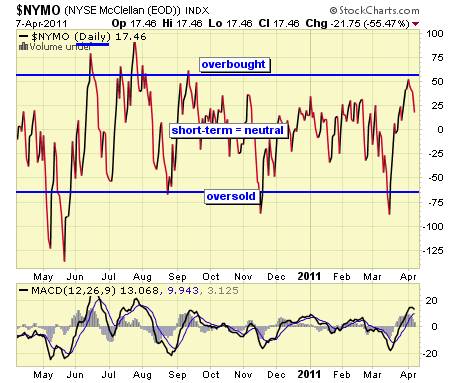
5. Market Breadth Indicator shows short-term overbought — The NYMO is a market breadth indicator that is based on the difference between the number of advancing and declining issues on the NYSE. When readings are +60/-60 markets are extended short-term.
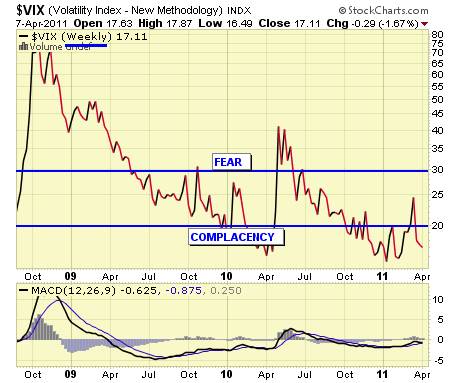
6. Investor Fear Gauge — The VIX is a widely used measure of market risk and is often referred to as the “investor fear gauge”. The VIX measures the level of put option activity over a 30-day period. Greater buying of put options (protection) causes the index to rise.
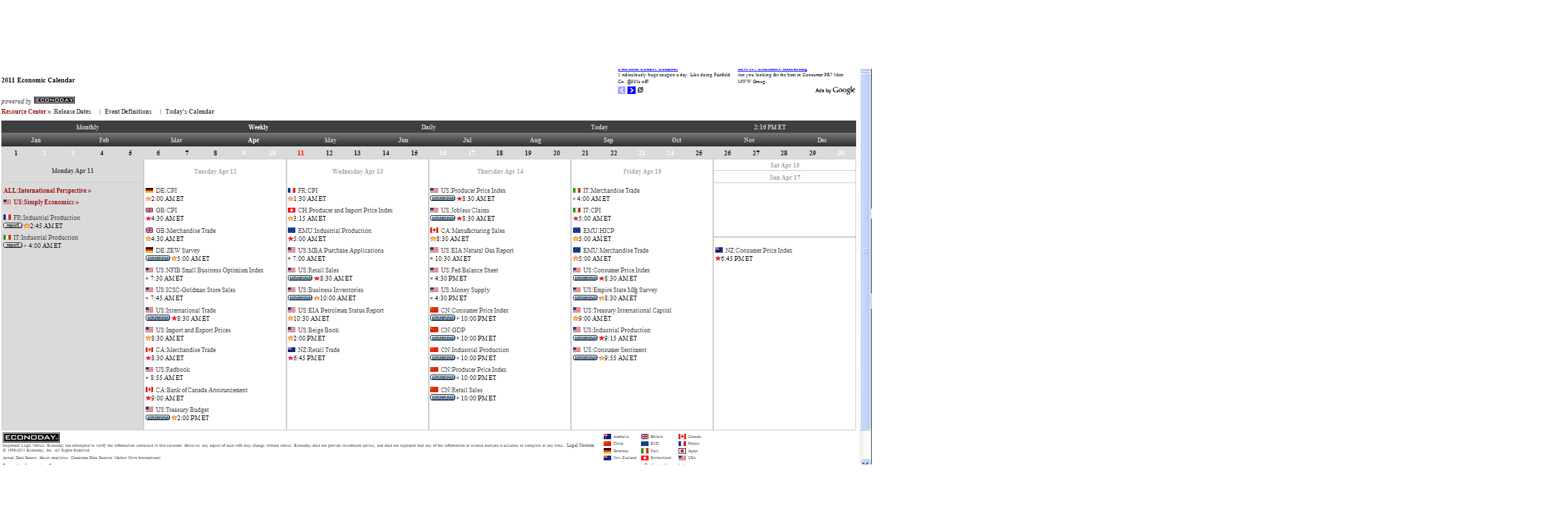
The week ahead — Economic data from Econoday.com:
Posted in Weekly Summary | No Comments »
April 4th, 2011
“Don’t confuse brains with a bull market” — Humphrey B. Neill (Investor)
1. Toyota restarts some Japan production — Toyota (TM) has resumed production at plants in Japan for the first time since the earthquake and tsunami brought manufacturing in the country to a complete halt. The carmaker began output at two factories that make three hybrid models and will gradually expand domestic production as its supply of parts recovers.
2. Japan mulls special tax for quake relief — The Japanese government is considering a special tax to help finance relief and recovery efforts in earthquake- and tsunami-hit Japan, according to a published report last Thursday.
3. G-8 to discuss nuclear safety — The Group of Eight industrialized countries will discuss nuclear safety and global safety standards for the industry at its next meeting in May.
4. Fed names banks that took emergency loans — the Fed identified the banks that utilized its discount window during the height of the financial crisis, with U.S. Bancorp (USB), Wachovia (now part of WFC), Morgan Stanley (MS) and several European banks among the largest users. U.S. Bancorp borrowed $3.35B on Sept. 10, 2008, Wachovia borrowed $29B on Oct. 6, Morgan Stanley borrowed over $3B on Oct. 9, and Washington Mutual took out a $2B loan on the day before it collapsed and another $2B the next day. On October 29, when lending peaked at $111B, Belgium’s Dexia took $26.5B and Germany’s Depfa $24.6B. Arab Banking Corp., which was then 29% part-owned by Libya, took 73 loans in an 18-month period, borrowing an aggregate of $35B.
5. Ireland to give banks another €24B — Ireland will pump another €24B ($34B) into its crippled banking sector as it again attempts to bring its three-year financial crisis to an end. The cash will come from Ireland’s emergency EU-IMF credit line and adds to €46.3B that the state has already pumped in. The government, which now controls almost the entire industry, intends to consolidate its holdings into two “pillar banks” based on market leaders Bank of Ireland (IRE) and Allied Irish Banks (AIB).
6. China’s factory-activity gains slow — HSBC’s privately compiled purchasing managers index rose to 51.8, falling below the long-run series average of 52.3, but up from February’s 51.7. Meanwhile, the government’s official PMI by the China Federation of Logistics & Purchasing rose to 53.4 in March, up from a reading of 52.2 in the previous month. However, this result was below a 54 forecast, according to a Reuters survey.
7. Plunge in 10 ETFs triggers “flash crash” memories — Nasdaq OMX Group Inc said it canceled trades in 10 new ETFs sponsored by Scottrade affiliate FocusShares, some of which briefly plummeted as much as 98 percent.
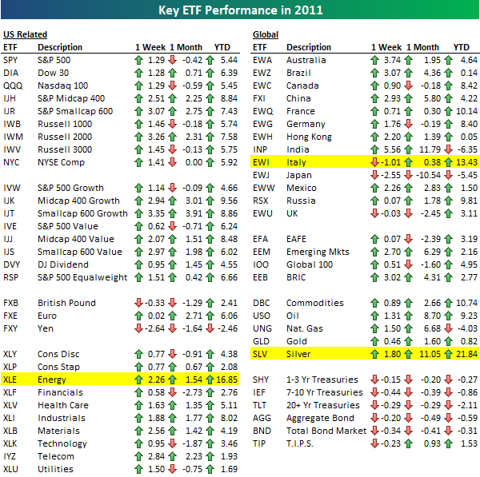
8. 2011 Q1 Performance — courtesy from the Bespoke Invest Group, below is the chart that shows key ETFs performance in Q1.
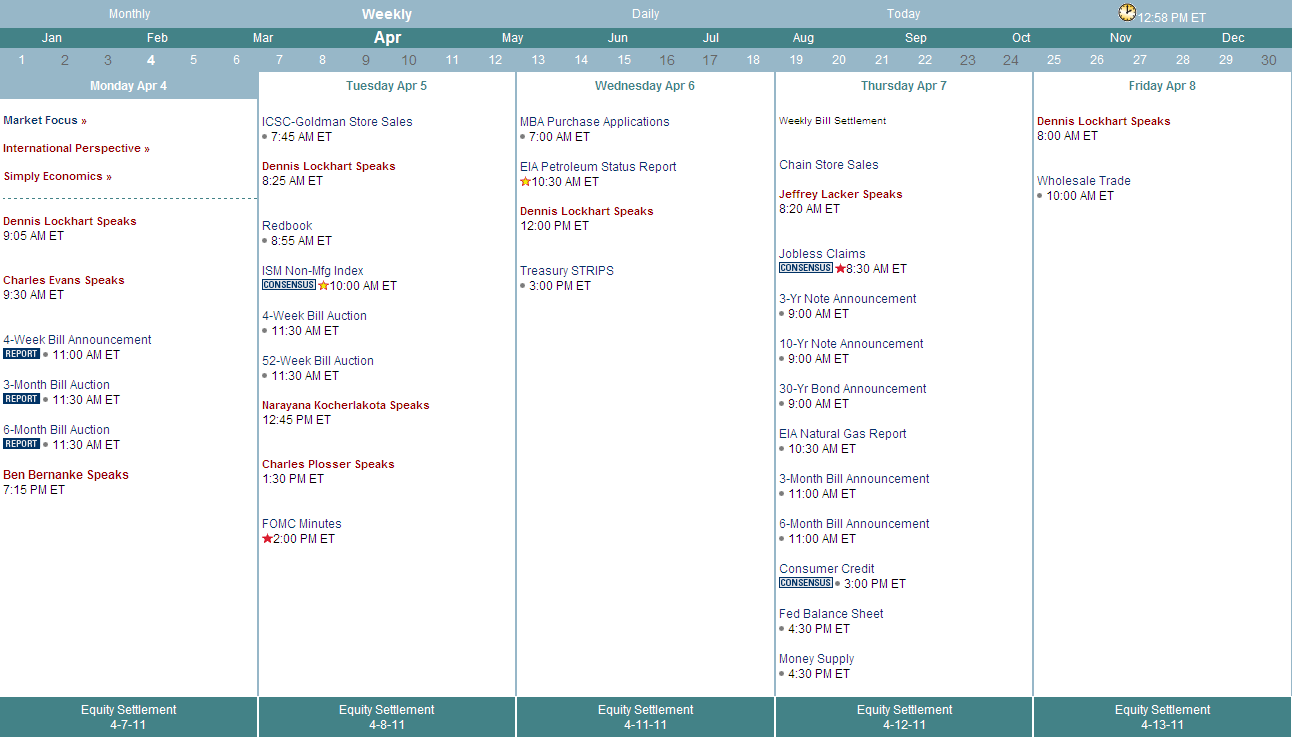
The week ahead — Economic data from Econoday.com:
Posted in Weekly Summary | No Comments »
March 28th, 2011
“Stocks are super-attractive when the fed is loosening and interests are falling. In sum: Don’t fight the fed” — Martin Zweig
1. Oil climbs as coalition attacks Libya — no-fly zone has effectively been established over Libya, said Vice Admiral Bill Gortney from the Pentagon, and the coalition’s aerial attacks have driven back Gaddafi’s offensive against the rebel stronghold at Benghazi. The coalition, which includes the U.S., U.K., France, Canada, Qatar and several other nations, has amassed at least 25 ships off the coast of Libya.
2. Boeing successfully tests 747 — Boeing’s (BA) newest 747 passenger jet had a successful maiden test flight yesterday; assuming flight-test certification goes smoothly, Boeing expects to deliver the first of the jets by the end of the year.
3. Nissan to resume Japan production — Nissan (NSANY.PK) will become the first automaker to resume regular parts production and vehicle assembly in Japan following the country’s devastating earthquake.
4. Portugal bailout nears after PM quits— Portugal Prime Minister Jose Socrates resigned yesterday after the country’s parliament rejected a fourth austerity plan within a year. The move threatens to push already-high government borrowing costs to unaffordable levels and force Lisbon to seek a bailout.
5. Toyota to curb North America production after quake — Toyota (TM) expects to suspend manufacturing at some of its North American factories due to the shortage of parts from Japan following the devastating earthquake. The carmaker is unsure which facilities will be affected or how long the shutdowns will last.
6. China to tax rare earths — China will impose a tax on rare earth minerals, beginning April 1. The tax has been set at 60 yuan ($9.1) per ton of light rare-earth minerals, and 30 yuan per ton of medium-and heavy-rare earth minerals.
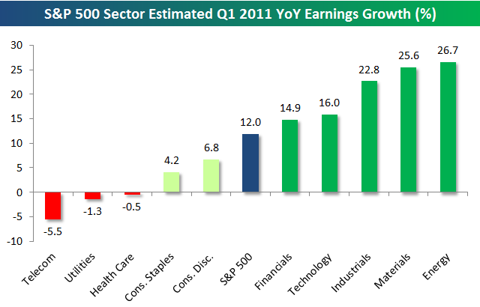
7. Sector Q1 Earnings Growth Estimates — according to Bespoke Investment Group, below is the chart of estimated year-over-year earnings growth for the first quarter for the ten S&P 500 sectors.
8. Fukushima No. 3 reactor core leaked — the core of the No. 3 reactor at Japan’s heavily damaged Fukushima Daiichi nuclear plant is likely the source of high-level radiation detected on Thursday, the government’s Nuclear and Industrial Safety Agency reportedly said Friday.
The week ahead — Economic data from Econoday.com:

Posted in Weekly Summary | No Comments »
March 21st, 2011
“The usual bull market successfully weathers a number of tests until it is considered invulnerable, whereupon it is ripe for a bust” George Soros
1. Markets quake as Japan faces nuclear crisis — Markets in Japan and across the world extended their losses as a third explosion hit the Fukushima Daiichi nuclear complex. The Nikkei 225 fell as much as 14% before closing -10.6% at 8,605.15 while the broader Topix index ended -9.5%. The falls came as The Tokyo Electric Power battled to avert a nuclear catastrophe at Fukushima, with “minute levels” of radiation detected as far away as Tokyo. In efforts to stabilize markets, the Bank of Japan added ¥20 trillion ($245B) of short-term liquidity to the record ¥15 trillion it pumped in yesterday.
2. Gaddafi gains momentum, Saudi Arabia intervenes in Bahrain — The Libyan airforce has attacked rebels in the town of Ajdabiya, just 100 miles from the opposition capital of Benghazi, as Muammar Gaddafi moves closer to regaining full control of the country. Elsewhere, Saudi Arabian troops moved into Bahrain after a request from the kingdom to help quell a popular uprising.
3. Moody’s cuts Portugal’s debt rating — Portugal’s ability to avoid a fiscal bailout remained under question Wednesday after Moody’s Investors Service cut the nation’s long-term debt rating by two notches to A3 from A1.
4. FOMC: Economy on firmer footing, no mention of Japan — the FOMC left its benchmark interest rate at 0.25% yesterday, as expected, and signaled that it’s unlikely to expand its $600B bond purchase plan.
5. India hikes rates; inflation, growth risks cited — The central bank increased both its lending and borrowing interest rates by 25 basis points, to 6.75% and 5.75%, respectively.
In a statement accompanying its move on rates, the RBI recognized new risks emerging from rising crude prices and the turmoil gripping parts of the Mideast and North Africa.
6. Congress to extend budget negotiations — the Senate is poised to pass a sixth stop-gap bill to keep the government running, buying Congress until April 8 to work out a budget deal that should have been in place months ago.
7. G-7 intervention puts brakes on the yen — the yen has fallen today after the G-7 agreed to concerted intervention in the currency markets for the first time since 2000. The yen, which was at 81.46 to the dollar midday in Europe, had surged to a record 76.25 yesterday in response to the earthquake, tsunami and nuclear crisis in Japan. This sparked fears about the country’s ability to use exports to help its economy recover from the triple blow. The Bank of Japan started proceedings with a reported purchase of $25B and was followed by its counterparts in the U.K., France and Germany.
8. U.N. approves Libya action; oil volatility to continue — the U.N. Security Council, by a vote of 10-0 with 5 abstentions, authorized yesterday evening a no-fly zone in Libya and approved ‘all necessary measures’ to protect Libyan civilians.
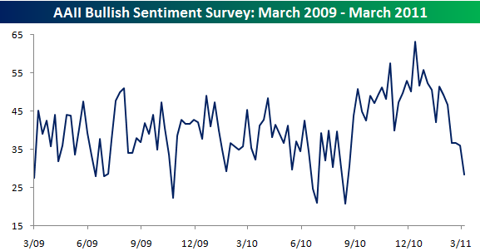
9. Individual Investor Sentiment Drops — According to this week’s survey from the American Association of Individual Investors (AAII), bullish sentiment now stands at 28.5%. This is the lowest optimism has been since August 26, 2010. It is also the fourth consecutive week that bullish sentiment has been below its historical average of 39%.
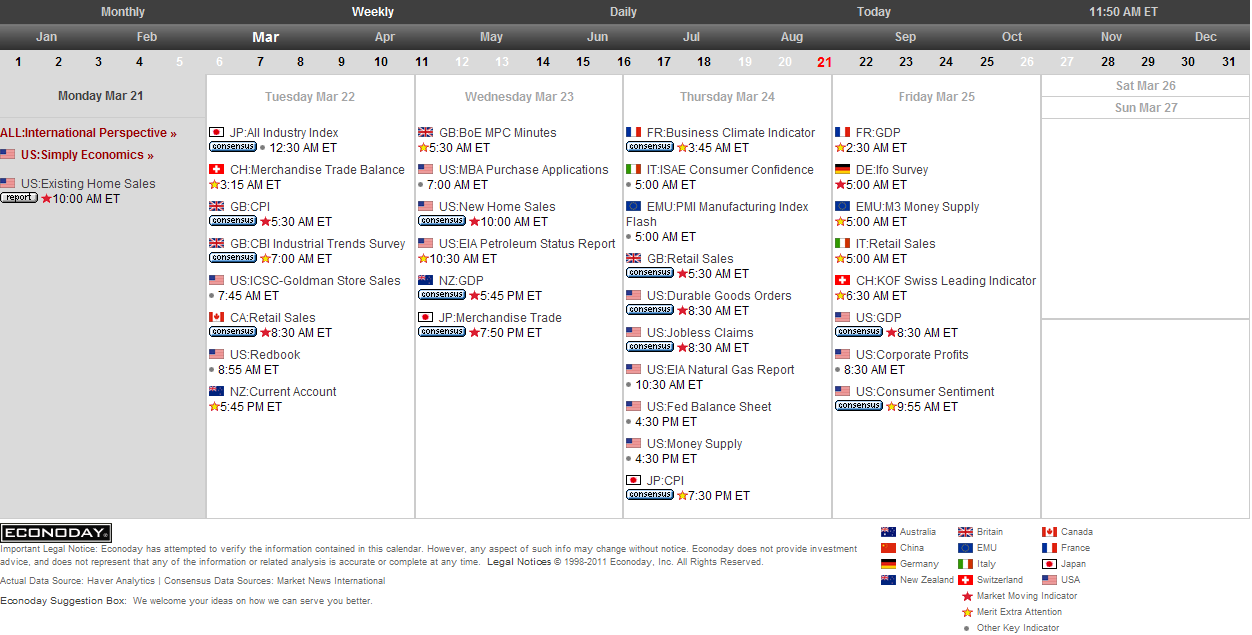
The week ahead — Economic data from Econoday.com:
Posted in Weekly Summary | No Comments »
March 14th, 2011
“Buy when you are scared to death; sell when you are tickled to death” — Market Maxim (Cabot Letter)
1. Nikkei tumbles 6.2% yen whipsaws in quake aftermath — the Nikkei closed -6.2% today to 9,620 on record volume of 4.88B shares, as investors had their first extended opportunity to sell Japanese stocks since the 8.9 magnitude earthquake on Friday. The Bank of Japan overnight offered to inject a record ¥7T ($183B) into money markets, and may further ease its ultra-loose monetary policy.
2. Moody’s cuts Greece rating, stokes debt fears — Moody’s Investors Service cut Greece’s sovereign-debt rating Monday by three notches to B1, infuriating the Greek government and temporarily denting the euro amid renewed worries about the ability of Greece and other debt-loaded euro-zone governments to avoid default.
3. Moody’s cuts Spain’s credit rating — the rating was downgraded one notch to Aa2 from Aa1, bringing it in line with the rating offered by Standard & Poor’s. Moody’s put the new rating on negative outlook, a signal that a further cut is possible.
4. US trade gap widens 15.1% in January — the U.S. trade deficit widened sharply in January to the highest level since the summer, as a surge in imports overwhelmed record levels of exports.
5. China posts trade deficit as exports slow — China unexpectedly posted a trade deficit in February. The slowdown swung the country’s trade balance to a deficit of $7.3 billion in February, more than offsetting January’s $6.5 billion trade surplus and giving China a net trade deficit in the first two months of the year.
6. Pimco sells off all US government holdings — The world’s largest bond investor has sold off all his fund’s U.S. government-related holdings, according to a published report. Bond giant Pimco confirmed it has unloaded all of its U.S. government holdings, including Treasurys, in the Total Return Fund. The $237B fund previously had 12% of its assets in U.S. government holdings, and had as much as 63% of its assets in U.S. government-related debt in late 2009. Bill Gross, the fund’s manager, is trying to get out ahead of the end of QE2, when he expects a rise in bond yields, and a concurrent fall in bond prices, would drive down the value of the fund’s holdings.
7. Libya’s oil terminal blazes — Gaddafi’s forces initiated air and artillery strikes on some of Libya’s oil facilities. The country’s largest crude processing plant was hit, while the nation’s largest oil terminal, at the port of Sidra, is in flames.
The week ahead — Economic data from Econoday.com:

Posted in Weekly Summary | No Comments »
March 7th, 2011
“I never buy at the bottom and I always sell too soon” — Barron Rothschild
1. China lowers growth target — China plans to lower its growth targets, as Premier Wen Jiabao says the country wants to avoid “unsustainable growth featuring industrial overcapacity and intensive resource consumption.” The official target for average GDP growth over the next five years will be 7%, down from the previous target of 7.5%.
2. Moody’s: €50 billion shortfall for Spain’s banks — Moody’s Investors Service on Monday said Spain’s banks could need up to €50 billion in recapitalization funds. That’s higher than the government’s own estimate that a maximum of €20 billion in recapitalization funds is needed and Moody’s prior estimate of €17 billion that it calculated at end-2010.
3. India’s economic growth slows to 8.2% — India’s economic growth slowed to 8.2% in the last three months of 2010 from the year-earlier period, as the manufacturing sector was held back in the wake of multiple interest-rate increases by the central bank amid rising prices.
4. U.K. freezes Gadhafi assets — The U.K. government said Sunday that it has frozen the assets of Libyan leader Moammar Gadhafi along with five of his children and people acting on their behalf, in line with a United Nations Security Council resolution.
5. Libyan rebels allow oil shipments to resume — Libyan rebels took control of a key city near Tripoli on Sunday, declared a provisional government and allowed oil shipments to resume in areas under their territory. There have been no oil shipments from the eastern territory in more than a week.
6. SEC probes bank lending — the SEC has asked for information from an unknown number of community and regional banks with large concentrations of commercial real estate loans. Regulators are reportedly trying to determine whether the banks restructured troubled loans in order to make them appear healthier than they really are, using a practice known as ‘extend and pretend’ or ‘amend and pretend.’
7. Beige Book: Continued expansion, climbing costs — in the latest Beige Book, all 12 Federal Reserve Districts reported overall economic activity continued to expand at a modest to moderate pace in January and early February, and 11 of 12 saw ‘solid growth in manufacturing production.’ Labor market conditions continued to ‘strengthen modestly’ in all districts.
8. European Central Bank President Jean-Claude Trichet warned Thursday that the bank could move as early as next month to hike interest rates in order to keep rising food and raw-material prices from stoking inflation.
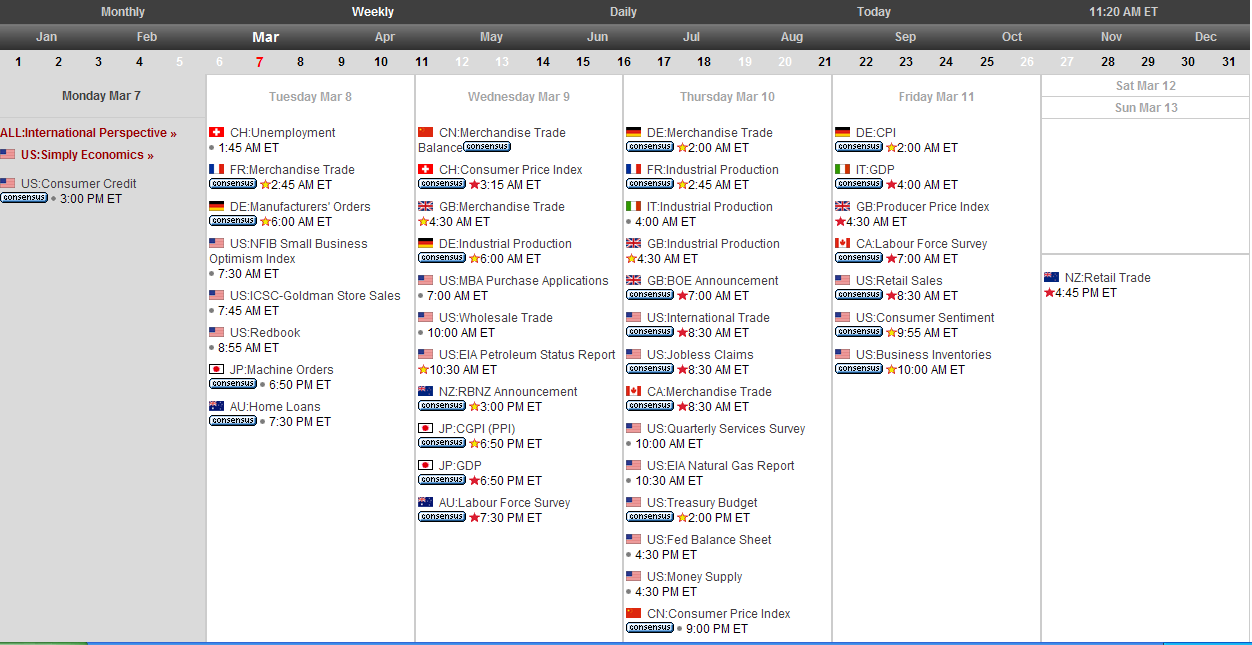
The week ahead — Economic data from Econoday.com:
Posted in Weekly Summary | No Comments »
February 28th, 2011
“To me, the “tape” is the final arbiter of any investment decision. I have a cardinal rule: NEVER FIGHT THE TAPE!!!” — Martin Zweig
1. Libyan unrest roils markets — a major oil producer, Libya has closed all its ports, and as many as 550K barrels per day of production, or a third of Libya’s normal production, may now be shut in. In the meantime, a growing number of oil companies have suspended their operations there, and Eni (E) shut down a pipeline that brings natural gas from Libya across the Mediterranean Sea to Italy.
2. Bullish Sentiment Declined based on the latest Sentiment Survey from AAII — 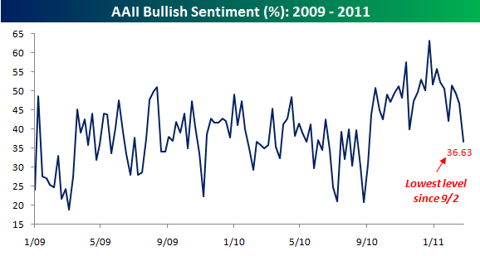
3. Consumer sentiment rises to a three-year high in February, according to a University of Michigan poll — the gauge rose to 77.5 in February from 74.2 in January. A prior estimate for sentiment in February was for 75.1.
4. Fourth-quarter GDP growth revised down to 2.8% — the U.S. economy grew at 2.8% pace in the final three months of 2010 — slower than the government initially projected — based on new data showing that consumers and state and local governments spent less than first estimated. Last month, the Commerce Department said gross domestic product climbed at a 3.2% annual rate in the fourth quarter.
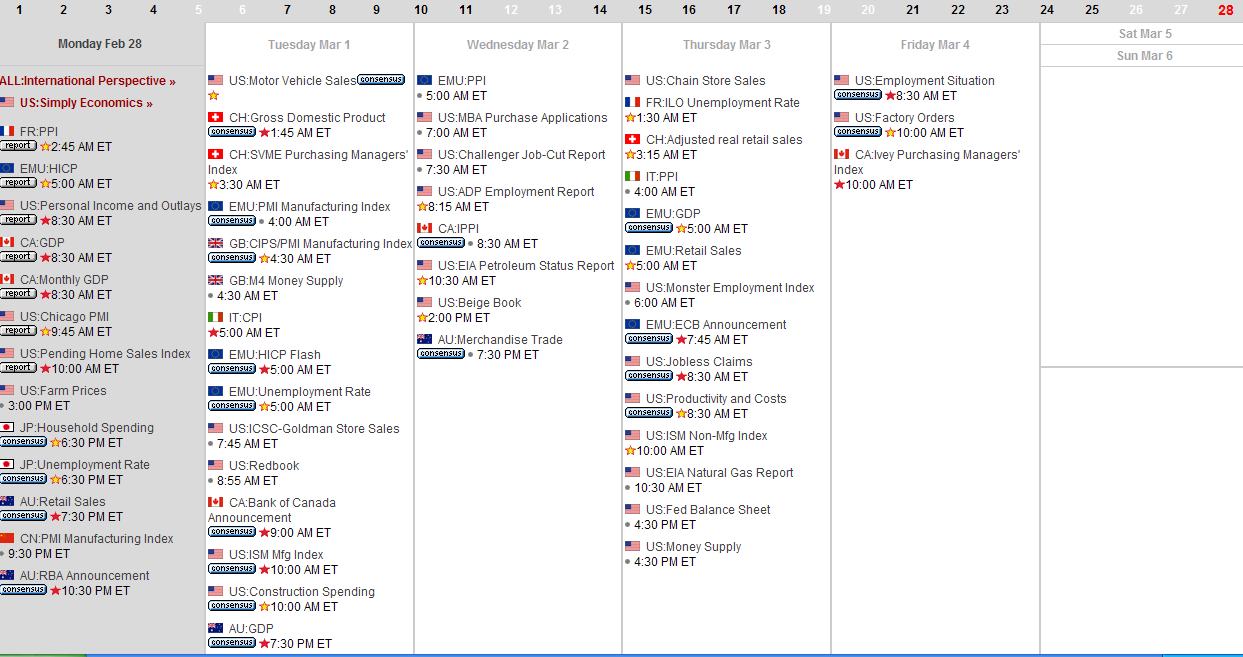
The week ahead — Economic data from Econoday.com:
Posted in Weekly Summary | No Comments »
February 21st, 2011
“There are two kinds of people who lose money: those who know nothing and those who know everything” — Henry Kaufman (Economist)
1. Japan’s GDP shrinks less than expected — Japan’s GDP fell an annualized 1.1% in Q4, as exports slowed and government stimulus programs faded. The contraction was less severe than the 2% drop economists had expected, and the pullback may prove to be temporary as foreign demand lifts Japan’s domestic production.
2. 2012 budget skirts big debt decisions — President Obama submitted a $3.7T budget for 2012 that contains spending cuts and increases along with tax cuts and increases intended to trim $1.1T over a decade from projected deficits. But it does not address Social Security nor rising health care costs via Medicare and Medicaid, and proposes only tiny cuts in military spending.
3.China inflation jumps almost 5% as food prices soar — China’s consumer price index rose 4.9% in January from a year ago, vs. a 4.6% gain in December and 5.1% in November.
4. Euro-zone to double its rescue fund to €500B — beginning in 2013, a permanent euro rescue mechanism will total €500B ($675B) as part of a package eurozone finance ministers hope will resolve the area’s debt woes. The European Stability Mechanism (ESM) is intended to replace the temporary euro rescue fund hurriedly set up in May to avert a collapse of the single currency in the wake of the Greek debt crisis.
5. Moody’s places Australia’s big four banks on review — Moody’s Investors Service placed Australia’s four largest banks under review for possible downgrades and reiterated a negative outlook for them Wednesday, warning the proportion of wholesale funding that the banks raise in offshore markets remains high in relation to their size.
6. China hikes reserve requirements — China raised its reserve requirements by 0.5% to 19.5%, the second hike this year. China raised its key interest rate by 0.25% last week, and is trying to tamp down inflation that appears to be accelerating.
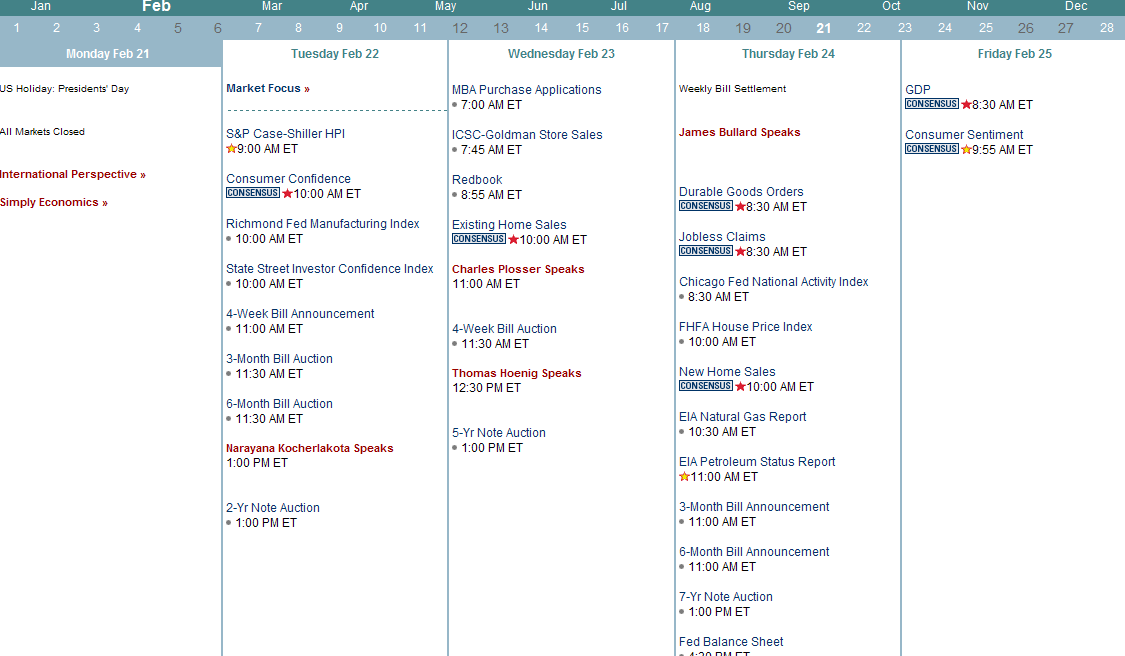
The week ahead — Economic data from Econoday.com:
Posted in Weekly Summary | No Comments »
February 14th, 2011
“If the models are telling you to sell, sell, sell, but only buyers are out there, don’t be a jerk. BUY!!!” — William Silber, Ph.D.
1. China hikes interest rates — China raised its key interest rates for the third time since October, as inflation remained above 4% for the third month in a row. The benchmark one-year lending rate will increase to 6.06% percent from 5.81%, effective 2/9/11. The one-year deposit rate will rise to 3% from 2.75%.
2. Treasury readies housing solutions — the Treasury is set to release a report today laying out three possible solutions for winding down Fannie Mae (FNMA.OB) and Freddie Mac (FMCC.OB), but won’t endorse any specific option. The decision to present the three solutions without backing any one in particular came from the White House, which hopes to jumpstart a discussion on the topic without locking President Obama into a single course of action. The report’s three scenarios are: 1) No government role in housing, except for existing agencies like the FHA; 2) An explicit government guarantee of mortgages only when the market is in trouble; and, 3) A government role in the housing market at all times, but not through government-sponsored entities.
3. Ford to cut debt — Ford (F) announced it will cut its debt by another $3B by redeeming all of its outstanding 6.5% cumulative convertible trust preferred securities on March 15.
4. U.S. consumer sentiment rises in February — A gauge of consumer sentiment rose in February, reaching the highest level since June, according to poll results released Friday by Thomson Reuters and the University of Michigan.
The gauge hit 75.1, up from a final January reading of 74.2.
5. Egypt’s President Mubarak steps down — A day after refusing to step down, Egypt’s President Hosni Mubarak has resigned, according to media reports Friday. Mubarak has delegated Egypt’s affairs to the army, the Wall Street Journal reported, citing Vice President Omar Suleiman.
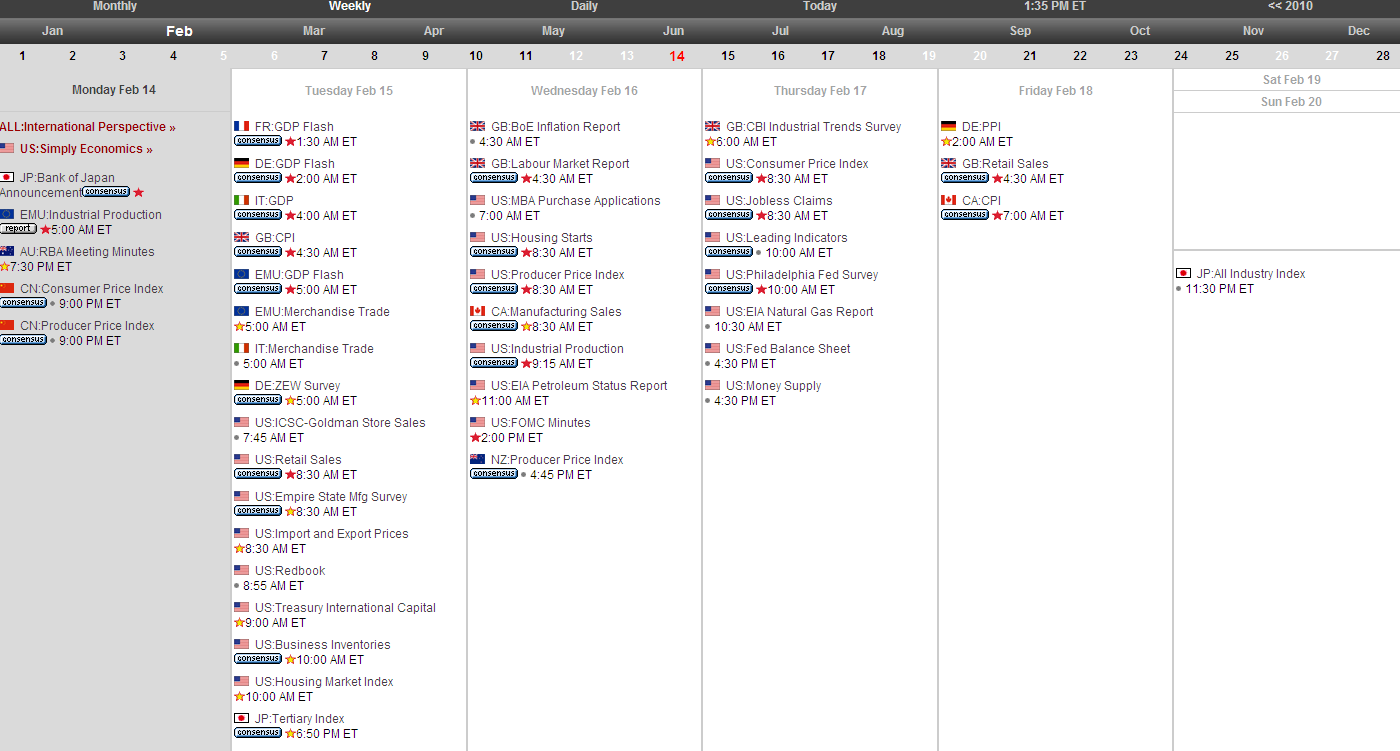
The week ahead — Economic data from Econoday.com:
Posted in Weekly Summary | No Comments »
February 7th, 2011
“The greatest safety lies in putting all your eggs in one basket and watching the basket” — Gerald M. Loeb
1. Moody’s downgrades Egypt’s bond ratings — Moody’s Investors Service on Monday downgraded Egypt’s government bond ratings, citing the sharp increase in political risk following several days of anti-government protests.
2. Court rules against healthcare reform — a federal judge in Florida became the second U.S. judge to declare the healthcare reform law unconstitutional, marking the biggest legal challenge yet to federal authority to enact the law.
3. S&P cuts Ireland — S&P cut Ireland’s credit rating to A-/A-2 from A/A-1 this morning, and maintains a negative outlook uncertainty over how much additional capital the country’s banks will need.
4. Fed passes China on Treasury holdings — the Federal Reserve is now the top holder of Treasury securities, pushing China to the number two slot. According to recent data, the New York Fed’s holdings of Treasurys in its System Open Market Account total $1.1T vs. China’s $896B holdings and Japan’s $877B.
5. Debt ceiling debacle delayed, a little — the U.S. is on track to hit its $14.29T debt limit by the end of May, slightly later than originally forecast because tax revenues have been stronger than expected. Lawmakers from both sides of the aisle agree a default would be a ‘financial disaster,’ and an increase in the debt ceiling is nearly guaranteed, but Republicans (and some Democrats) are demanding cuts in government spending as the price of approving an increase.
6. Fitch downgrades Egypt credit ratings — Fitch’s more pessimistic stance on the Egyptian government’s ability to pay its sovereign creditors follows ratings cuts by Standard & Poor’s and Moody’s Investors Service. Fitch now pegs Egypt’s long-term foreign-currency issuer-default rating at double-B instead of double-B-plus. The outlook is negative.
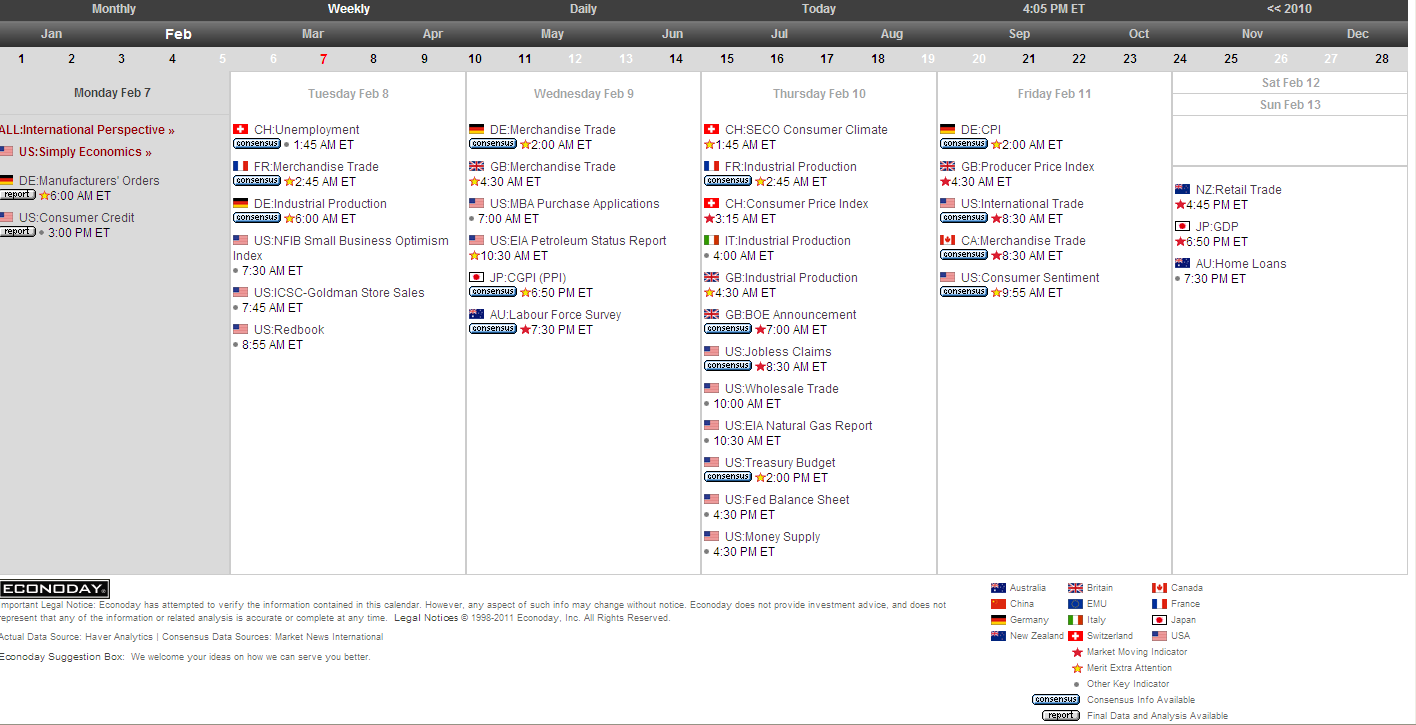
The week ahead — Economic data from Econoday.com:
Posted in Weekly Summary | No Comments »