April 25th, 2016
“The rarest thing on Wall Street is patience!” — unknown
1. Doha Disappoints as Saudi Arabia’s Refusal to Participate In The Deal Without Iran Agreement — the world’s largest oil exporters failed to reach an agreement in Doha to freeze output at January levels. The major sticking point during the meeting was the heightened tension between Saudi Arabia, the de facto OPEC leader, and Iran, which made a last-minute decision not to attend the gathering. Although no one expected Tehran to freeze production after its international sanctions were lifted, it wasn’t clear if the Saudis would demand that Iran immediately join the pact.
2. Mitsubishi Admits To Cheating In Fuel Economy Tests — Mitsubishi Motors Corp. reported late last week there were improprieties in its tests related to fuel-economy performance, affecting about 625,000 vehicles. The improper testing was conducted on four minicar models sold in Japan, Mitsubishi said. Two of the four models are manufactured by Mitsubishi and supplied to Nissan Motor Co. 7201, -0.97% NSANY, -1.27%.
3. SunEdison Files for Bankruptcy After Buying Spree Sours — SunEdison Inc. filed for bankruptcy protection after a two-year, $3.1 billion acquisition binge that drove its debt to unmanageable levels. SunEdison is one of the largest non-financial companies to do so in the past 10 years. Once the fastest-growing U.S. renewable energy developer, SunEdison embarked on an aggressive acquisition strategy that left it struggling with $12 billion in debt.
4. Volkswagen Posts Deep Loss After Taking $18.28 Billion Hit on Emissions Scandal — Volkswagen AG took a €16.2 billion ($18.28 billion) charge related to the emissions-cheating scandal, forcing it to slash its 2015 dividends and post a deep loss. The car maker took a major step toward resolving the scandal, agreeing to offer U.S. owners of nearly 500,000 vehicles a blend of car buybacks, repairs and compensation.
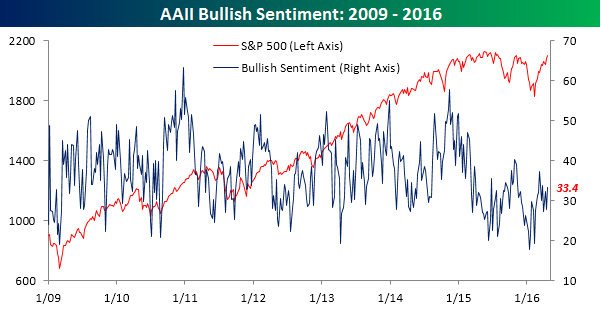
5. Bullish Sentiment Rebounds But Still Below 40% — courtesy of BIG, according to AAII, bullish sentiment increased from 27.9% up to 33.4%. After a huge rally off the February lows that has taken the S&P 500 back within a couple of percentage points from its all-time high. The subdued level of enthusiasm on the part of investors is a trend that has been in place for well over a year now, and one we have thoroughly documented. In fact, this week’s 33.4% reading in bullish sentiment represents the 25th straight week where bullish sentiment was below 40%, and outside of one week in late October, bullish sentiment has been below 40% for 59 of the last 60 weeks.
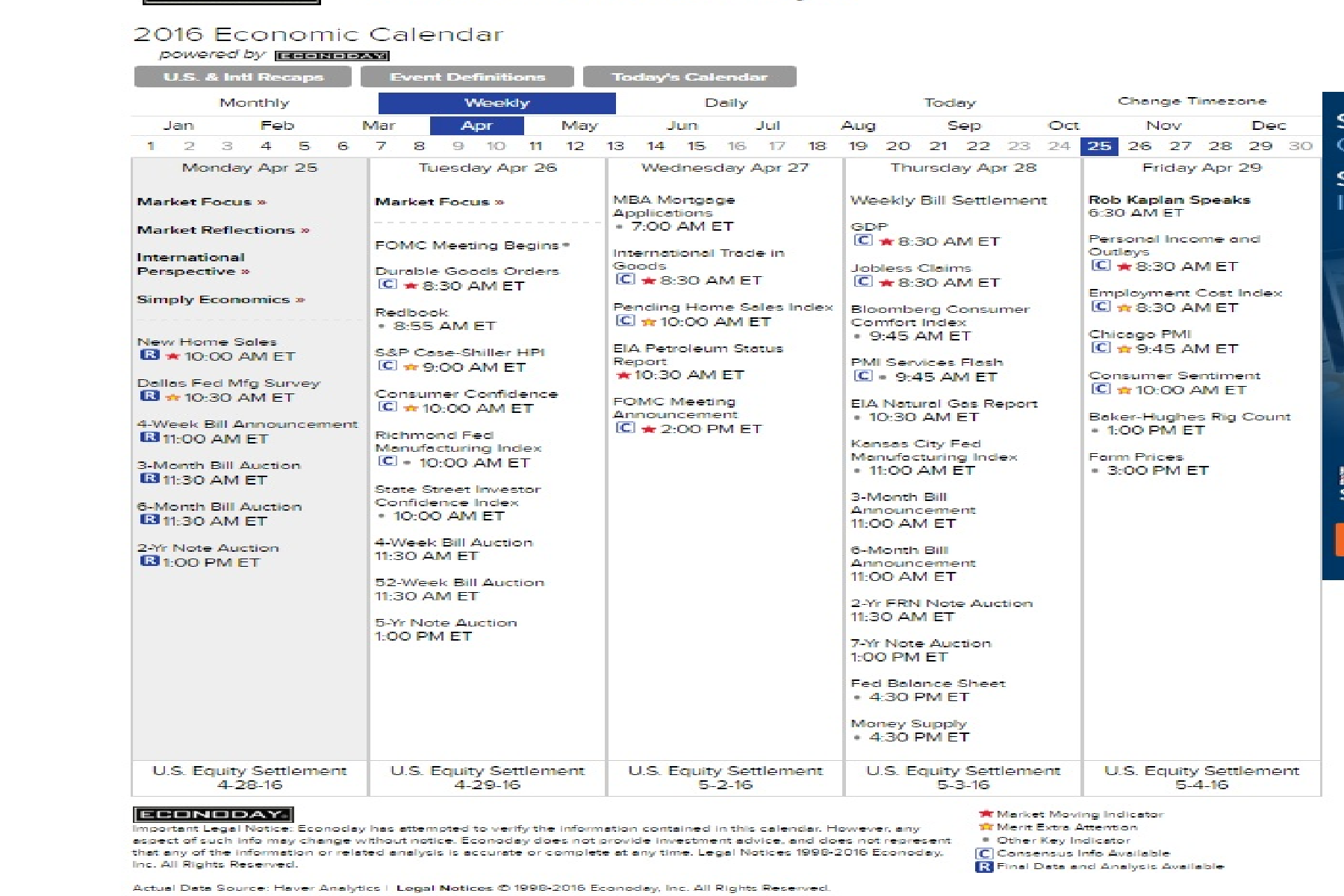
The week ahead — Economic data from Econoday.com:
Tags: AAII Sentiment, VW Recall
Posted in Weekly Summary | No Comments »
April 19th, 2016
“Investing has always been a game of alternatives. What do we do with our money? Cash is not a reasonable answer because it is depreciating all the time. Bonds are not the answer either – with a 1.8% yield, a 10-year U.S. government bond trades at roughly the equivalent of a stock selling at more than 80x after-tax earnings. In comparison, the S&P 500 trades at approximately 18x expected earnings with a current dividend yield of 2.2%. It is worth noting that the bond’s interest payments are fixed, while S&P 500 earnings and dividends are likely to increase over time. The nature of real estate has changed – a new world is unfolding with people shopping online and working from home – and you still have limited liquidity. Sometimes the obvious answer is also the correct answer. The stock market is the obvious answer. It has generated superior returns over time. But the volatility scares most investors. Ultimately we believe that a broad spectrum of investors will reach the same conclusion that we reached long ago. After seven years of generally rising stock prices, we still have not seen the broad, enthusiastic participation that generally indicates market tops. For investors of most stripes, the stock market remains the only viable game in town – a game which many natural participants may have forgotten, but we trust will remember soon enough. And while stocks may not be cheap relative to where they trade at stock market bottoms, they remain very cheap relative to the other outlets for our hard-earned cash.” — Frederick Rowe
1. Japan Might Intervene in the Yen Currency — according to Japanese Chief Cabinet Secretary Yoshihide Suga, the recent G20 agreement to avoid competitive currency devaluation does not mean Japan can’t intervene in response to the one-sided moves of the yen. The dollar hit a fresh 17-month low versus the yen last week on expectations that the U.S. Federal Reserve would raise interest rates very slowly.
2. CP Rail Ditched Norfolk bid and Consider Buyback or Dividend — Canadian Pacific (NYSE:CP) has abandoned efforts to combine with its American railroad counterpart Norfolk Southern (NYSE:NSC). “With no clear path to a friendly merger at this time, we will turn all of our focus and energy to serving our customers and creating long term value for CP shareholders,” CEO Hunter Harrison declared. Canadian Pacific’s (CP) board will meet next week to consider using the cash lying around for a possible buyback or dividend instead.
3. US Retail Sales Down 0.3% in March vs. 0.1% Increase Expected — the Commerce Department reported that retail sales declined 0.3 percent last month after being unchanged in February. Retail sales excluding automobiles, gasoline, building materials and food services ticked up 0.1 percent last month after an upwardly revised 0.1 percent gain in February.
4. IEA Sees Oil Oversupply Almost Gone in Second Half on Shale Drop — Bloomberg, global oil markets will “move close to balance” in the second half of the year as lower prices take their toll on production outside OPEC, the International Energy Agency said. OPEC and Russia are currently working on a plan to limit their crude production. The glut is also being tempered as Iran restores exports only gradually with financial barriers to sales persisting even after the lifting of international sanctions.
5. First-Quarter Growth Slows a Bit in China –the world’s second-largest economy grew 6.7% in Q1, the slowest pace of expansion since the financial crisis, according to official data released in Beijing. That was the slowest quarterly rate since the depths of the financial crisis in 2009, but it was also exactly what economists had forecast and it was in line with the government’s target this year for growth of 6.5 to 7 percent. Economists doubt the official figures as they are uncannily stable when compared with those of most other countries. The G.D.P. data is also increasingly out of step with other indicators that suggest an even sharper growth slowdown, economists say.
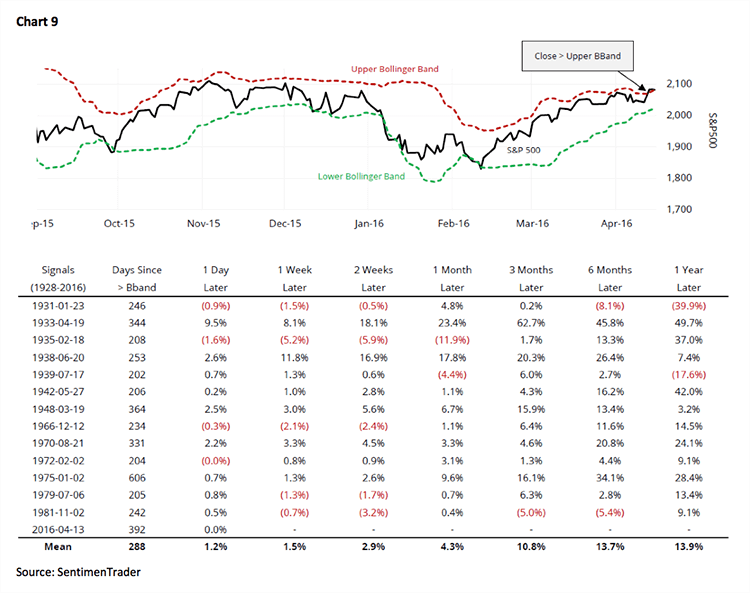
6. S&P 500 Setup for Respective All-Time High of 2130.82 — courtesy of SentimenTrader
stocks enjoyed a rare kind of breakout this week. As volatility compressed over the past month, the S&P 500’s Bollinger Bands started squeezing together, and this week the index broke out above its upper Band. That was the first time in nearly 400 days it was able to do so, the 2nd-longest streak in its history. Generally, stocks did well after triggering a breakout like this after having gone a long time without one. The small-cap Russell 2000 is nearly above its 200-day average. The last of the four major stock indexes to climb above its long-term average, when the Russell ended a streak of at least six months below its average, it tended to continue to rally going forward. A new high in the Advance/Decline Line tends to lead to gains. In response to some questions regarding Thursday’s Report on the A/D Line, when it moves to a multi-year high, the S&P 500’s maximum loss at its worst point over the next year has averaged -3.9%.
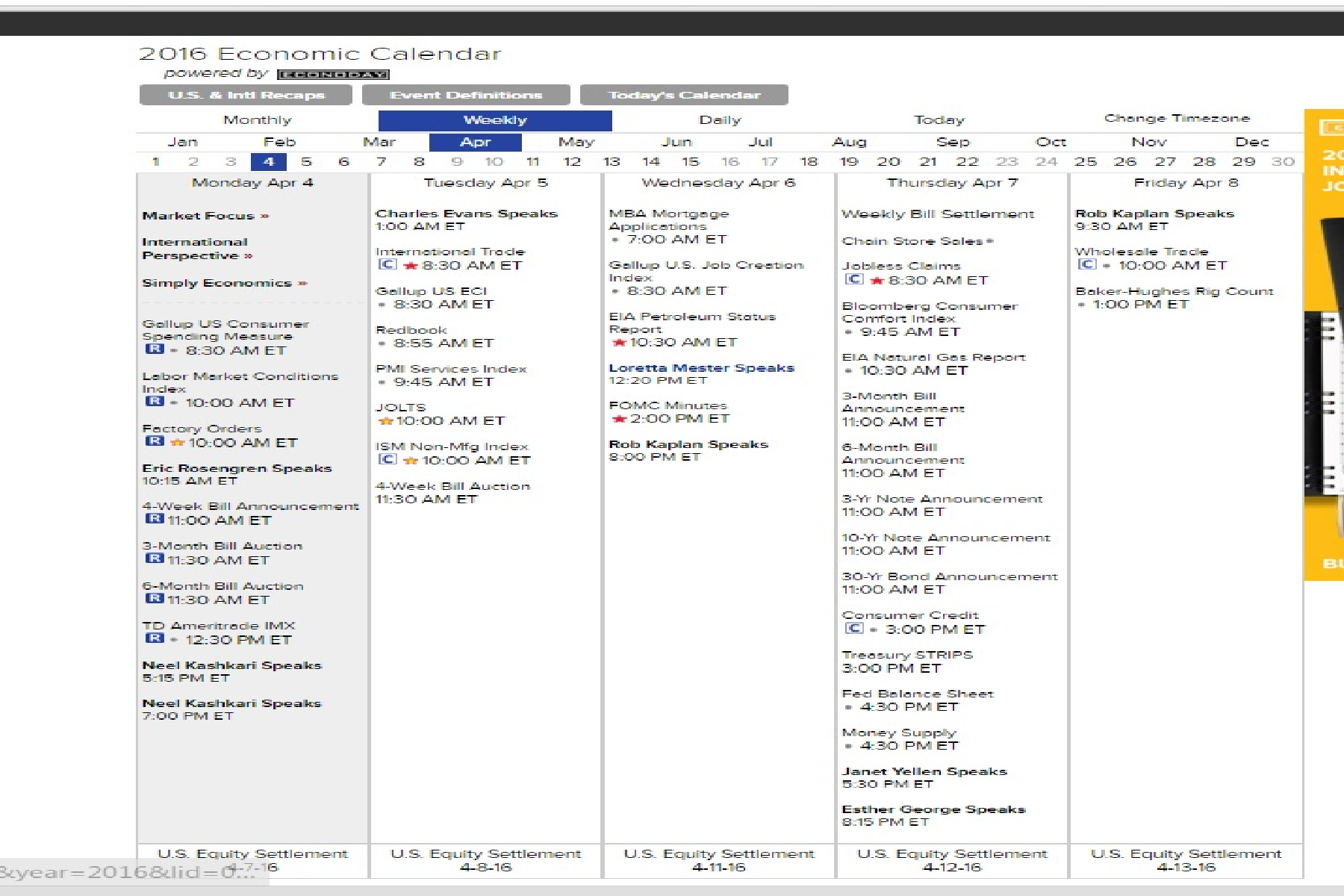
The week ahead — Economic data from Econoday.com:
Tags: China 1Q GDP, Oil Glut, sentimentrader
Posted in Weekly Summary | No Comments »
April 11th, 2016
“After talking to a guru or anyone with the holy grail, I always take a hot shower, burn the clothes I was wearing, and drink them out of my mind.” — unknown
1. Inversion Move Hits Allergan (AGN) — the Treasury moved to curb tax inversion deals, raising fears that it could thwart the planned merger of Ireland-based Allergan (AGN) and US based Pfizer (PFE). Allergan plummeted based on the news. Treasury is imposing limits on earnings stripping and “serial inverters”.
2. US Justice Dept Files Suit to Block Merger of Halliburton and Baker Hughes — the Dept Of Justice (DOJ) has sued to stop Halliburton Co. (HAL) from acquiring oilfield services rival Baker Hughes (BHI). The deal would combine two of the world’s three leading providers of those services to oil and gas companies. It would create a bigger rival to the industry leader, Schlumberger. DOJ officials say in their lawsuit that the Halliburton-Baker Hughes deal threatens to raise prices and eliminate competition.
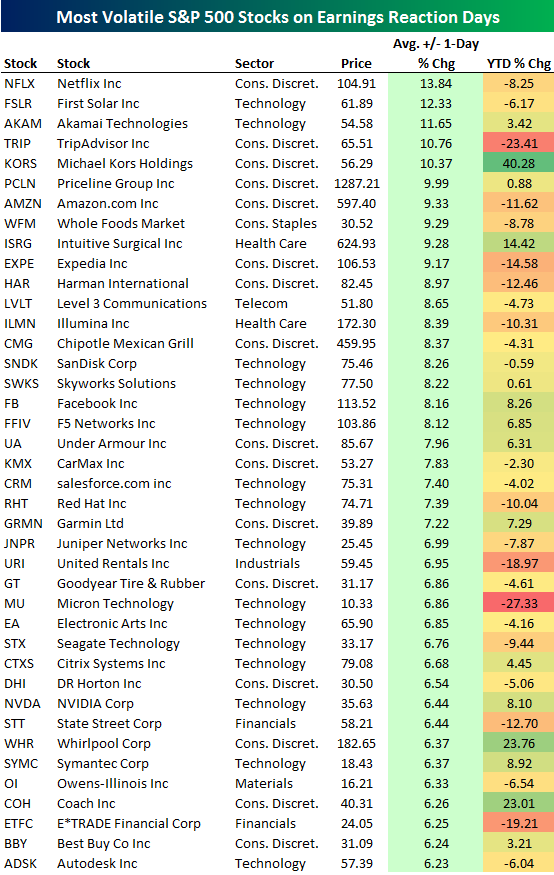
3. Most Volatile S&P 500 Stocks on Earnings — chart below courtesy of BIG shows the most volatile stocks on earnings in the S&P 500. Each stock listed below typically moves up or down at least 6.2% on its earnings reaction day.
4. Japan Finance Minister “Jaw-Boning” Japanese Currency — Japan’s Finance Minister has described the dollar’s recent falls vs. the yen as “one-sided movements” and vowed to intervene if necessary to continue the country’s fight against deflation. “We are watching moves with a sense of tension,” Taro Aso told a press conference after the greenback sank to a 17-month low of 107.67 yen late last week. “We will take necessary steps in accordance with circumstances.” The dollar has tumbled nearly 10% against the Japanese currency this year, with the past week accounting for roughly 3% of the move.
5. More Fallout From the “Panama Papers” — the “Panama Papers” scandal has claimed its first banking chief executive with the resignation of Michael Grahammer, CEO of Austrian lender Hypo Landesbank Vorarlberg. So far, the Prime Minister of Iceland resigned. With additional details of offshore accounts surfacing, more high profile and political figures are looking to come clean. U.K. Prime Minister David Cameron has admitted to benefiting from a fund of his late father, but said that it was not set up to avoid taxes, and he himself paid state dues on the shares he sold.
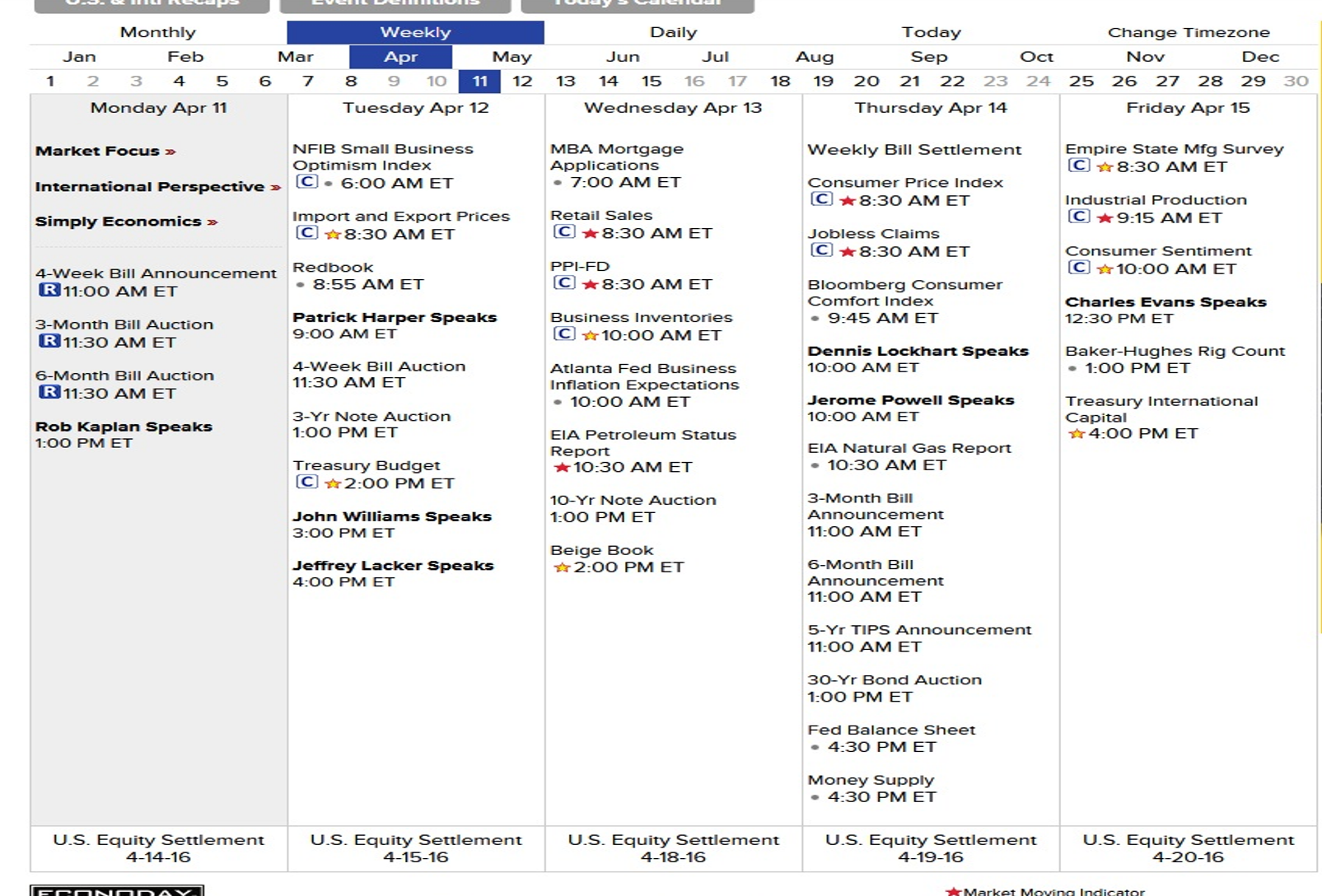
The week ahead — Economic data from Econoday.com:
Tags: Inversion Deal, Japanese Yen
Posted in Weekly Summary | No Comments »
April 4th, 2016
“Novice Traders trade 5 to 10 times too big. They are taking 5 to 10% risks on a trade they should be taking 1 to 2 percent risks.” – Bruce Kovner.
1. Warren Buffett’s Stake in Wells Fargo (NYSE:WFC) Increased to 9.9% as of Dec. 31 2015 — Warren Buffett’s stake in Wells Fargo (NYSE:WFC) hit 9.9% as of Dec. 31,most of which is held by Berkshire Hathaway (BRK.A, BRK.B). At 10%, Buffett would have to pass a review by the Federal Reserve in order to keep accumulating shares. While the central bank typically tries to limit the ties between non-financial companies and lenders, it has at times accepted a pledge by investors that they don’t plan to influence a bank; this happened in the ’90s when Buffett’s stake in AmEx (NYSE:AXP) rose above 10%.
2. Wages Fall and Spending Slow — the core PCE deflator, the Fed’s favorite inflation gauge, rose 1.7% vs. last year, matching Jan’s recent high but below views and policymakers 2% target. Actual wages and salaries fell 0.1%. Consumer spending rose 0.1% with Jan’s big initial gain revised down to 0.1%.
3. Google Announces Fiber Phone Service Starting At $10 A Month — Google ‘s product Manager John Shriver-Blake announced that Google (NASDAQ:GOOG)(NASDAQ:GOOGL) is introducing Fiber Phone, confirming rumors that it would be offering a home phone service in addition to its existing Fiber high-speed internet and cable TV offerings (and potentially a triple play package). The service is set to provide unlimited local and nationwide calls for $10 per month, while adopting the same international calls rates as Google Voice (GOOG, GOOGL). According to the company, a user’s Fiber number “lives in the cloud,” allowing them to use it on any phone, tablet, or laptop.
4. Fed Chair Woman Backs Dovish Stance — the Fed chair said global uncertainty has left policymakers making a coutious approach to rate hikes, adding that the US economy has been mixed. Manufacturers and exporters have suffered, but the job market is robust with housing and consumption adding a lift.
5. China Rating Outlook Cut to Negative From Stable by S&P — Standard & Poor’s has cut the outlook for China’s credit rating to negative from stable, saying the nation’s economic rebalancing is likely to proceed more slowly than the ratings firm had expected. The nation’s credit rating is AA- with a negative outlook, S&P said in a statement, which also affirmed the long-term and A-1+ short-term sovereign credit ratings. “We revised the outlook to reflect our expectation that the economic and financial risks to the Chinese government’s creditworthiness are gradually increasing,” S&P said.
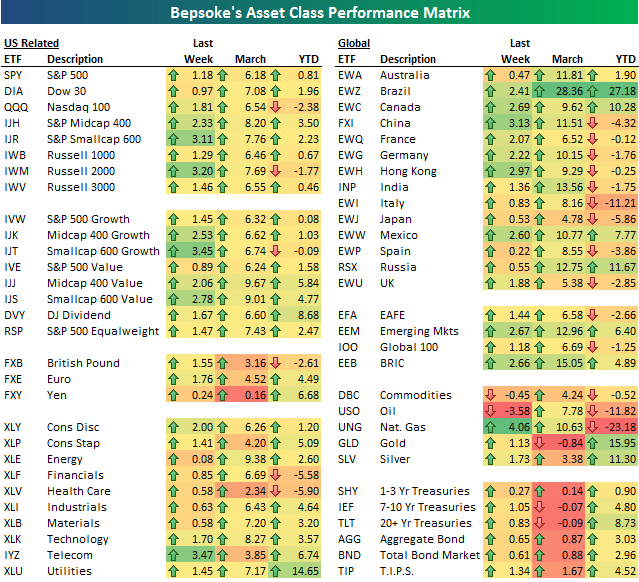
6. Key ETFs Asset Class Performance Matrix — Q1 2016 — courtesy of BIG, below is the asset class performance matrix for Q1 2016 using key ETFs traded on U.S. exchanges. A strong March propelled US stocks just barely into the green for the quarter. As shown, the S&P 500 SPY ETF finished Q1 up 0.81% year-to-date. The Dow 30 (DIA) more than doubled that at +1.96%, while the Tech and Biotech heavy Nasdaq 100 (QQQ) finished down 2.4%. Eight of ten sectors were up in Q1, led by Consumer Staples (XLP), Utilities (XLU), Telecom (IYZ), and Industrials (XLI). The two sectors in the red for the quarter were Financials (XLF) and Health Care (XLV) — both falling nearly 6%.
The week ahead — Economic data from Econoday.com:
Tags: Buffett 1Q2016, Wells Fargo
Posted in Weekly Summary | No Comments »
March 28th, 2016
“The goal of a successful trader is to make the best trades. Money is secondary.” – Alexander Elder
1. Islamic State Claimed Deadly Brussels Explosions — Islamic State has claimed responsibility for three explosions that rocked Brussels on last Tuesday morning, leaving 34 people dead and 136 wounded. The jihadist group said it was behind the attacks at the city’s international airport and metro system, according to media reports. The blasts are believed to be retaliation for the arrest of Salah Abdeslam, a suspect in the Paris terror killings, who was captured in Brussels.
2. Hawkish Fed Comments Send Dollar Higher, Gold to Lowest in Nearly a Month — St. Louis Fed Jim Bullard suggesting April could work for the next boost in interest rates even as the Fed may have slashed its expectation for rate hikes this year by 50 basis points last week. The dollar moved nicely higher, and gold sharply lower, with the metal falling to about its worst price in a month.
3. Electronic Payments Pick up Steam — Apple Pay will be available later this year on sites accessed via the Safari browser on iPhones/iPads containing a TouchID fingerprint sensor as reported by Re/code. Apple Pay already supports payments carried out via mobile apps, to go with its well-known support for NFC-based in-store payments. Current online payments leader PayPal handled $20B worth of mobile transactions last year (+45% Y/Y, and 25% of total volume).
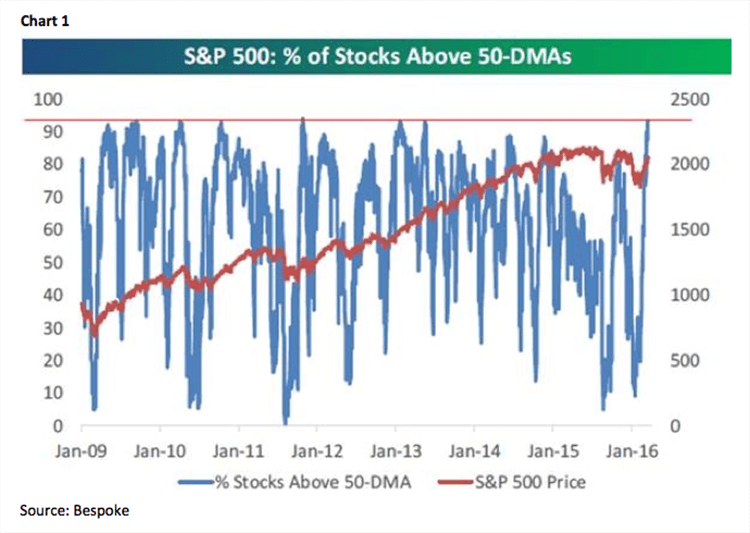
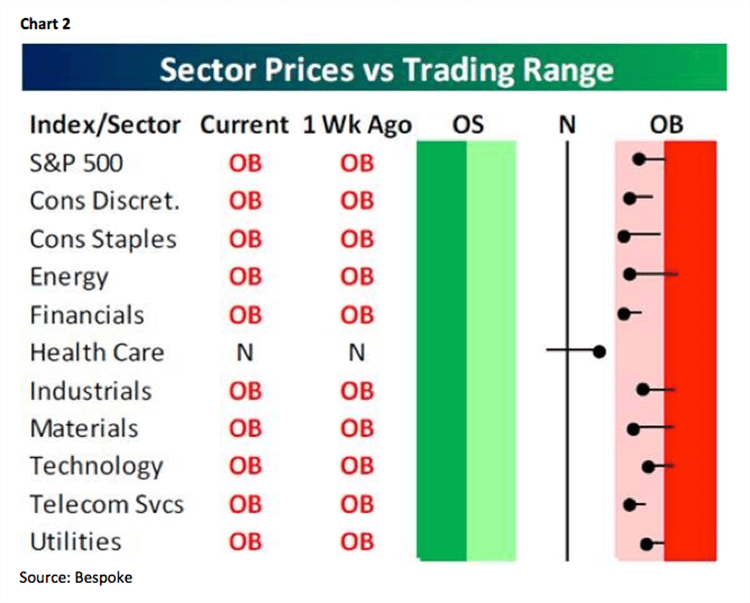
4. S&P500 Enters Overbought Territory — the equity markets are pretty extended on a trading basis, with all but one (healthcare) of the S&P macro sectors overbought. Charts below courtesy of Bespoke Investment Group.
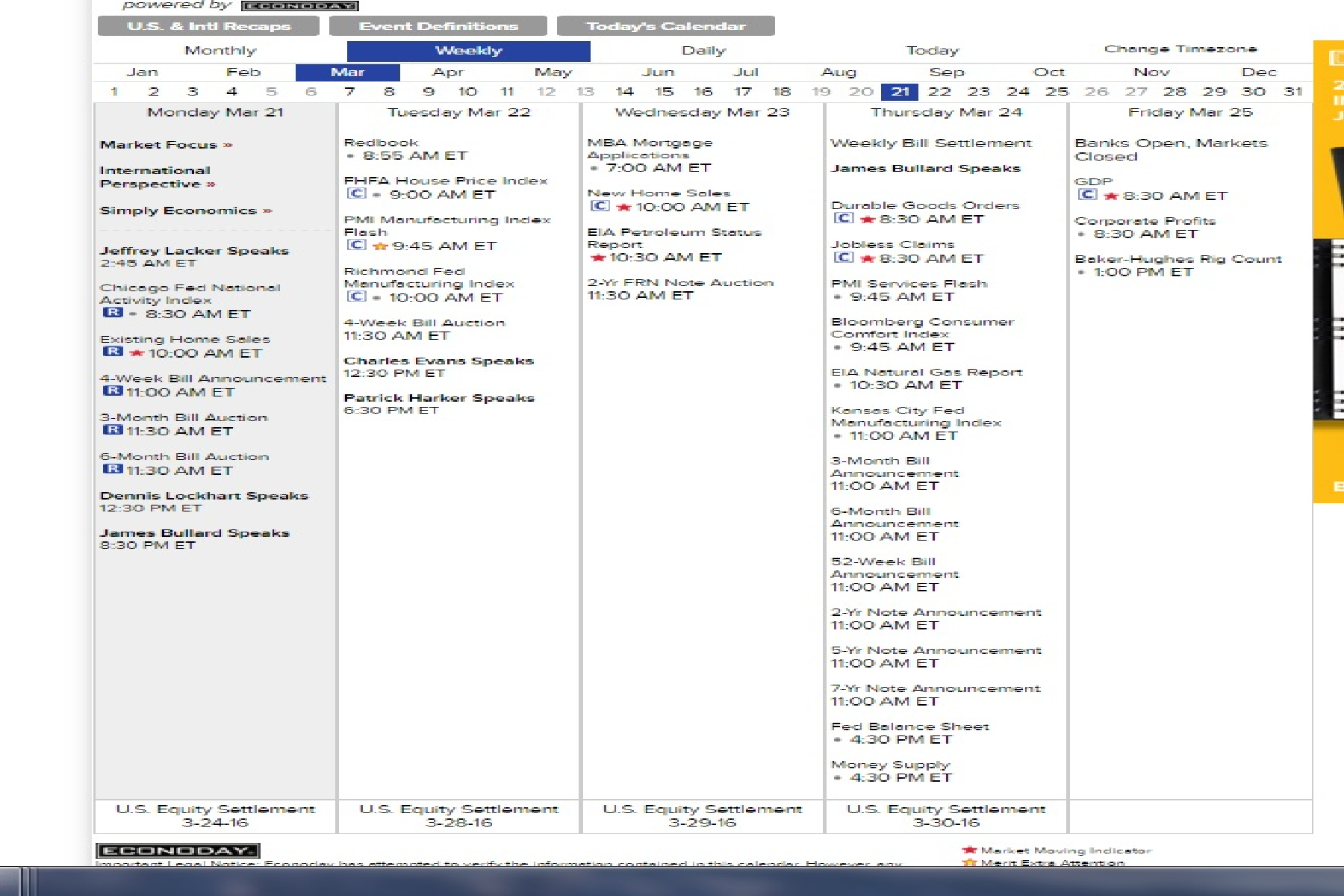
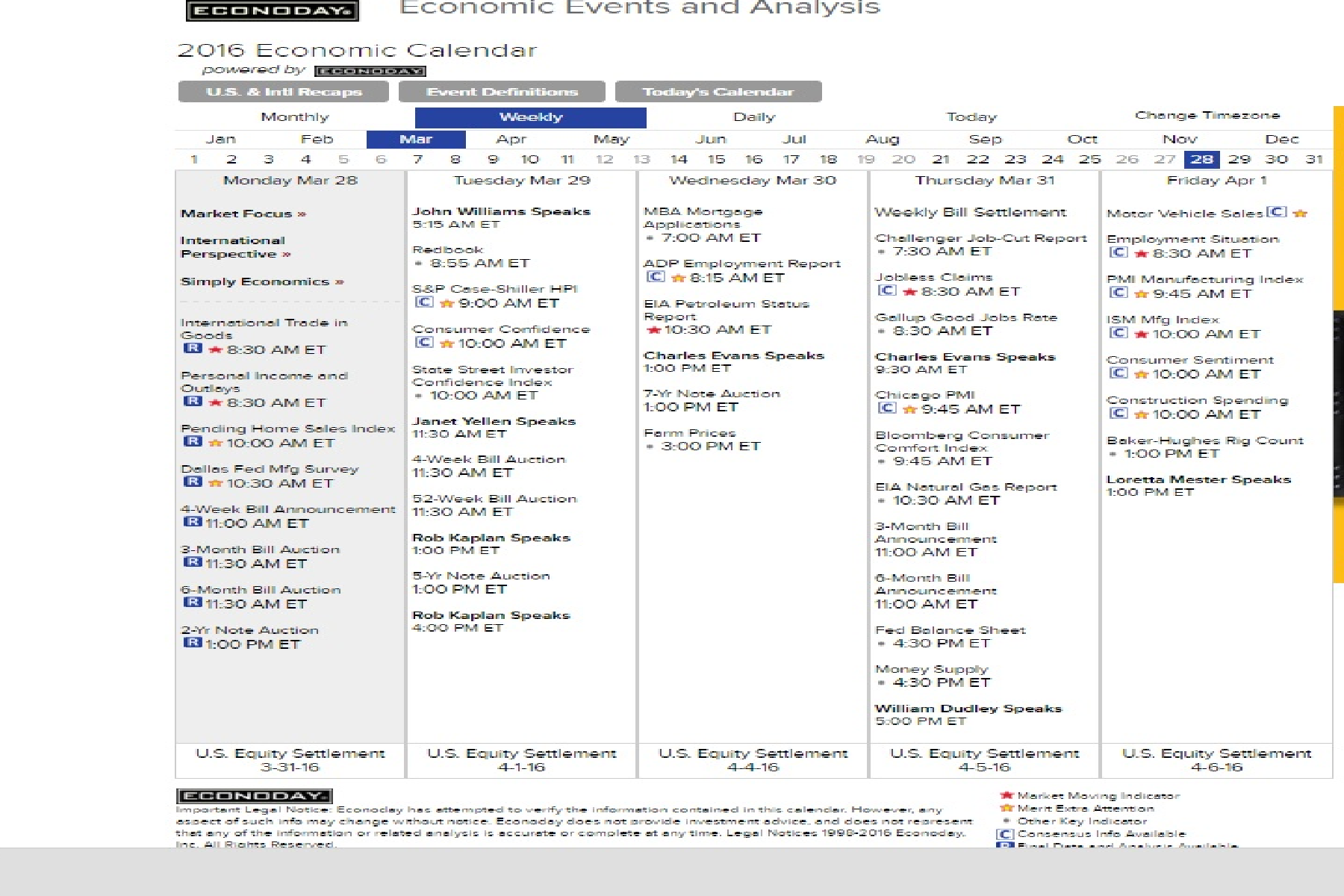
The week ahead — Economic data from Econoday.com:
Tags: Electronic Payment
Posted in Weekly Summary | No Comments »
March 21st, 2016
“In this business if you’re good, you’re right six times out of ten. You’re never going to be right nine times out of ten.” -Peter Lynch
1. US Retail Sales Dip in Feb — the Commerce Department said last week retail sales dipped 0.1 percent last month as automobile purchases slowed and cheaper gasoline undercut receipts at service stations. January’s sales were revised to show a 0.4 percent decline instead of the previously reported 0.2 percent increase. A sharp downward revision to January’s sales could reignite concerns about the economy’s growth prospects.
2. Bank of Japan (BOJ) Keeps Monetary Policy Steady — the BOJ kept its powder dry following the second day of its March policy meeting, but downgraded its assessment of the economy. Exports and production “have been sluggish due mainly to the effects of the slowdown in emerging economies,” while public expectations of future inflation have “recently weakened.” The central bank also maintained its pledge to increase base money at an annual pace of ¥80T ($700B) as widely expected, but clarified that money reserve funds would be excluded from the negative rates it introduced at the end of January.
3. Low Oil Prices Force Saudi Arabia Into New Austerity Drive — Reuters reported due to by low oil prices, Saudi Arabia is opening a fresh austerity drive by ordering ministries to cut their spending on contracts by at least 5%. The government ran a record budget deficit of nearly $100B last year and has been seeking ways to narrow the gap. It is laying plans to boost non-oil revenues with taxes, but that will take years to have much impact, leaving spending cuts as the main way to bring state finances under control.
4. Trump Wins the Super Tuesday, But Nomination Still Unclear –Donald Trump notched victories in the Republican presidential primaries Tuesday, winning Florida, the biggest delegate prize of the night, and driving home-state Sen. Marco Rubio out of the race. Trump also won in North Carolina and in Illinois. However, Ohio Gov. John Kasich prevailed in his home state. Hillary Clinton won the key states of Ohio and Florida Tuesday and seemed to pivot away from her Democratic opponent, Bernie Sanders.
5. FOMC Meeting — the central bank left interest rates unchanged, and scaled back the implied number of hikes that it expects from about four this year to just two. Policymakers said “Global economic and financial development continue to pose risks.”
6. US Crude Closes Above $40 — US oil closes above $40.02 a barrel, its 1st settlement above $40 in 2016 as the dollar fell, sinking to a 5-month low after the Fed cuts its rate-hike forecast. Qator oil minister said OPEC and Non-OPEC would meet in April.
The week ahead — Economic data from Econoday.com:
Tags: FOMC Meeting, Oil Above $40
Posted in Weekly Summary | No Comments »
March 14th, 2016
“Amateurs want to be right. Professionals want to make money.” — unknown
1. BOE Chief Stated Foreign investment In the U.K. At Risk if ‘Brexit’ Hits — the head of the Bank of England stated Britons should expect a drop in foreign direct investment into their country if the U.K. decides to cut membership ties with the European Union. The U.K. logged net FDI inflows of £44 billion ($62 billion) in 2014, according to a U.K. Trade & Investment department report published in June 2015. FDI is investments from overseas entities in a variety of assets, such as property, equipment and stock purchases. The U.S. and Europe are the largest investors in the U.K., according to a U.K. Trade & Investment department report published in June 2015. U.S. investors held the largest share of FDI stock at 27%, followed by the Netherlands and France, at 15% and 8%, respectively.
2. SEC’s Chairwoman: Stock-Market Overhaul Won’t Happen This Year — SEC Chairwoman Mary Jo White said the agency won’t advance any major changes this year to the fragmented system of trading U.S. stocks, after undertaking a “holistic review” of rules, including whether stock exchanges should retain the power to regulate their members.
3. ECB Cuts Rates and Expands Stimulus — the European Central Bank (ECB) delivered a surprise package of measures to kickstart Europe’s economy, cutting its main interest rates and expanding its massive bond-buying program. The ECB cut its main refinancing rate to 0.0 percent and its deposit rate to minus-0.4 percent. The bank also extended its monthly asset purchases to 80 billion euros ($87 billion), to take effect in April. In addition, the ECB will add corporate bonds to the assets it can buy — specifically, investment grade euro-denominated bonds issued by non-bank corporations. These purchases will start towards end of the first half of 2016.
4. Deutsche Bank Warns : First quarter Challenging for Entire Sector — Deutsche Bank (NYSE:DB) has warned that volatile financial markets in the first quarter, normally a strong season for banks, posed a challenge for the entire sector. Chief Executive John Cryan said in the lender’s annual report “Deutsche Bank is no exception to this,”.
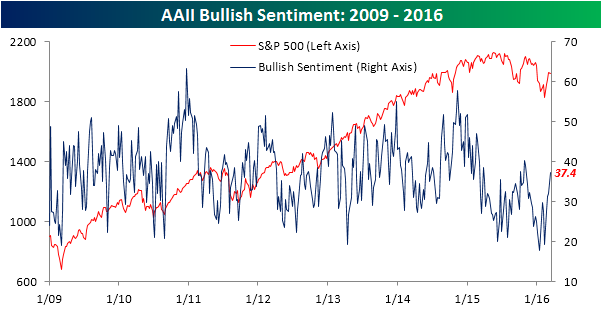
5. Latest AAII Bullish Sentiment — in the latest sentiment survey, bullish sentiment from increased from 32% up to 37.4%. While this is still below the bull market average, it is actually the highest weekly reading since November and represents the fourth straight week of increases. The last time bullish sentiment increased for four straight weeks was back in October 2013, and if sentiment manages to tick higher again next week, it would be the longest streak of increases since December 2012.
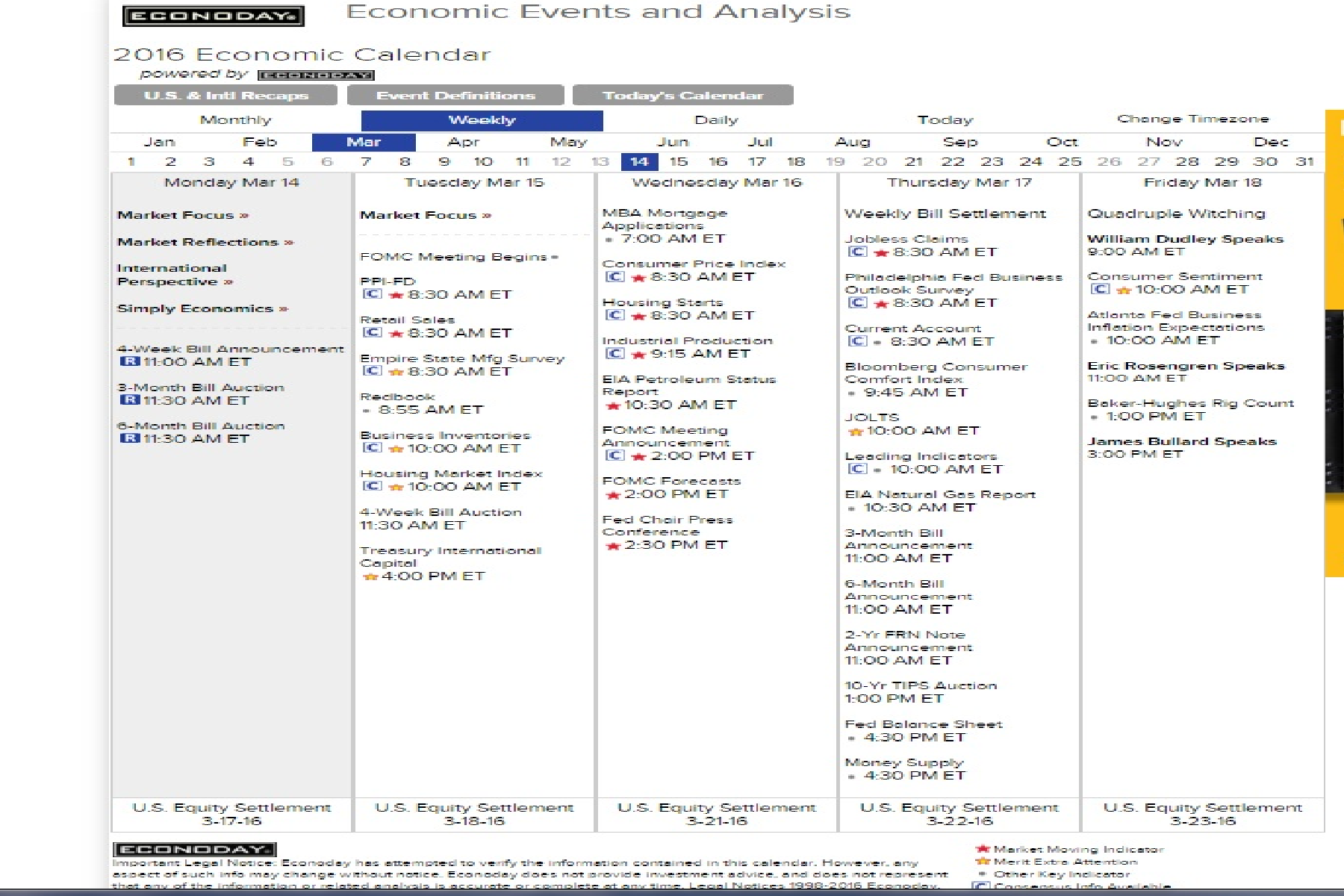
The week ahead — Economic data from Econoday.com:
Posted in Weekly Summary | No Comments »
March 7th, 2016
“The key to investing success is emotional discipline. If intelligent were the key, there would be a lot more people making money in trading” — Victor Sperandeo
1. G20 Meeting Conference in Shanghai Concluded — leaders from the world’s top economies declared “Monetary policies will continue to support economic activity and ensure price stability…but monetary policy alone cannot lead to balanced growth,”. Participants also repeated previous pledges not to engage in competitive currency devaluations and promised to “consult closely” on exchange markets.
2. China Eases Bank Lending — China’s central bank cut its reserve-requirement ration by another 0.5% point — its 5th cut in the past 12 months. The move shows further weakening of the yuan, which hit its weakest level vs. the US dollar in 3 weeks.
3. Moody’s Cuts China Outlook to Negative — Moody’s Investors Service has lowered the outlook on China’s credit rating from stable to negative, citing a weakening of fiscal metrics and a continuing fall in foreign exchange reserves. Moody’s current Aa3 rating on China is still seven notches above junk, so even if the agency were to follow up on its warning, investors wouldn’t have to suddenly start selling the country’s bonds.
4. Eurozone Recovery Loses Momentum – more deflationary pressures in the euro-zone are surfacing, raising the chances ECB President Mario Draghi will increase stimulus at a central bank meeting next week. Markit’s composite Purchasing Managers Index fell to 53 from 53.6 in January – its lowest level in 13 months – while the firm’s measure of output prices across manufacturing and services fell further below the key 50 level.
5. Auto Loans ‘s Size Hits Record — the avg amount financed for a new car or truck in Q4 rose 4.1% from last year to a record $29,551 per Experian Automotive. The avg monthly payment rose 2.3% TO $493, also a record, even as as loan terms got longer. New car loans for subprime lenders rose as well.
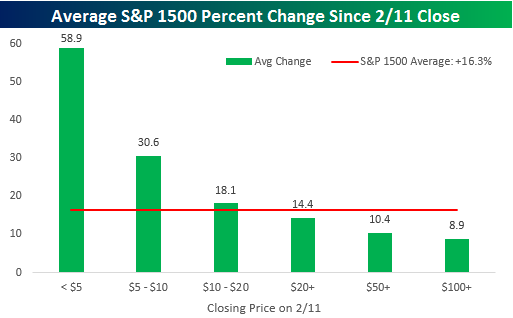
6. Low Priced Stocks Surge — courtesy of BIG, since 2/11, the average stock in the S&P 1500 is up an impressive 16.3%, but the performance of low priced stocks has trounced that. For example, on 2/11, there were 52 stocks in the S&P 1500 trading for less than $5 per share. Since then, the average return of those stocks is a gain of 58.9% with a median gain of 45%!
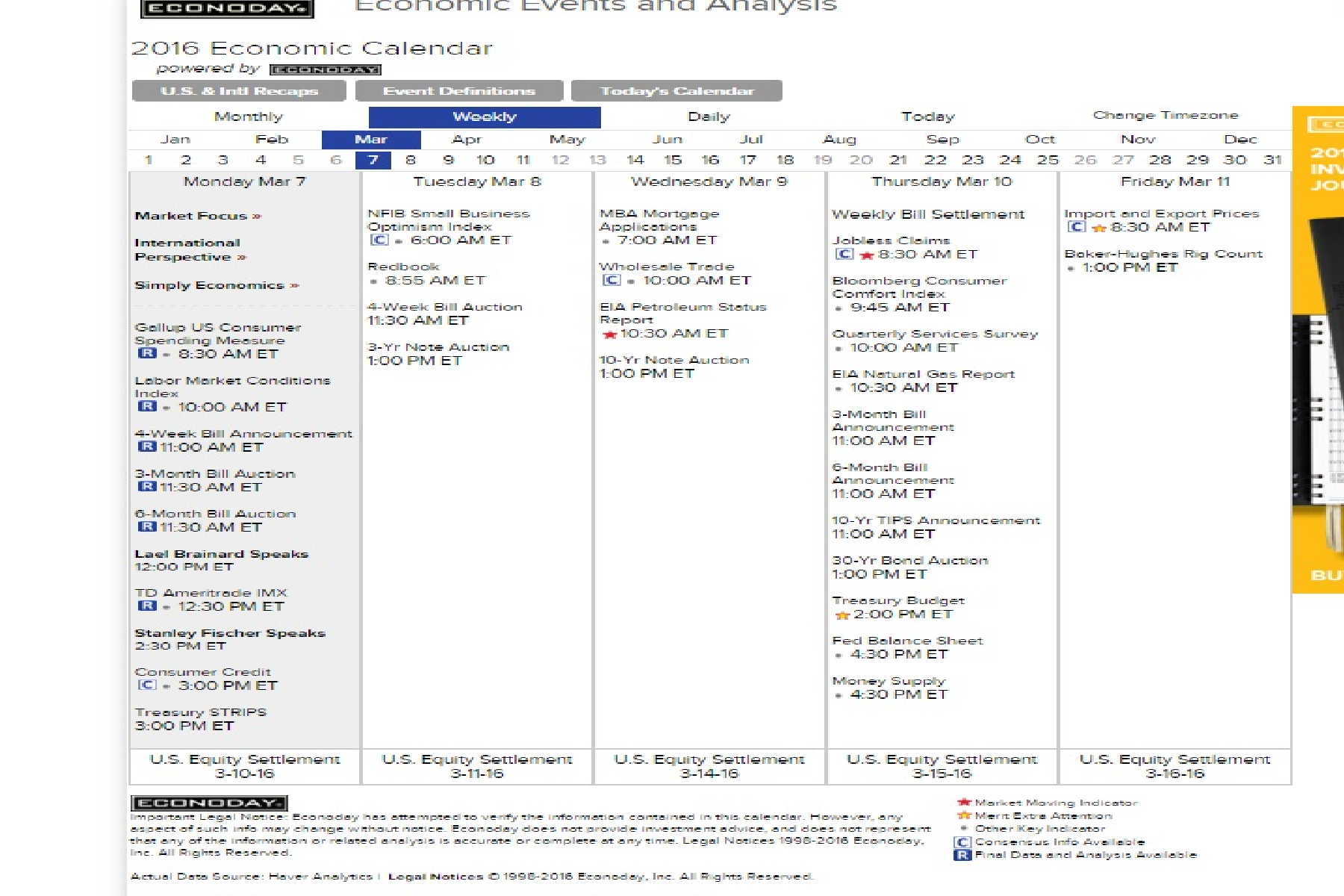
The week ahead — Economic data from Econoday.com:
Tags: G20 Meeting
Posted in Weekly Summary | No Comments »
February 29th, 2016
“I’m more concerned about controlling the downside. Learn to take the losses. The most important thing about making money is not to let your losses get out of hand.” – Marty Schwartz.
1. Trump Wins Nevada GOP Caucuses — Donald Trump won the Nevada caucuses last Tuesday night, adding a third straight victory in his drive for the Republican presidential nomination. “Markets are in a state of suspended disbelief. I don’t think they’ve seen anything like this. No one has seen anything like this,” said Mike Thompson, Chairman at S&P’s Investment Advisory Services.
2. JPMorgan (JPM) Warns On Energy Bad Loans — JPMorgan is adding another $500M to energy-related loan-loss reserves. This followed a $67M provision in Q4, which at the time brought total oil and gas loss reserves to $815M (vs. a portfolio with book value of $44B).In addition, the bank said it could need to add another $1.5B to reserves should oil hang around $25 per barrel over the next 18 months.
3. China Stocks Dive 6.4% Ahead of G20 Meeting — the Chinese market index dropped 6.4% late last week, extending its fall this year to 22%, as surging money-market rates signaled tighter liquidity and the offshore yuan weakened for a fifth day, while the country’s vice finance minister warned of pressure on exports. The plunge comes as world leaders gather for a G20 meeting in Shanghai, where current market turmoil and a global economic slowdown are expected to be key topics of discussion.
4. Moody’s Cuts Brazil’s Rating to Junk — Moody’s cuts Brazil’s sovereign credit rating to Ba2 from Baa3, two notches into junk territory, with a negative outlook, citing uncertainty over the effort to impeach Pres. President Rousseff and the corruption scandal that has paralyzed the country’s leadership and slowed efforts to shore up its crumbling finances. Samar Maziad, Moody’s lead analyst for Brazil stated “There’s very little visibility on what the future will be.”
5. 4Q GDP Revised to 1% from 0.7% — the U.S. economic growth in the fourth quarter was marked up slightly to 1%, but that was mainly because of a bigger stockpiling of inventories. The initial report was 0.7% rate. The value of inventories, which adds to GDP, rose by $81.7 billion instead of $68.6 billion as initially reported. Consumers boosted spending by 2% in the fourth quarter, but that was down from an initial 2.2% estimate and was much weaker compared with the spring and fall.
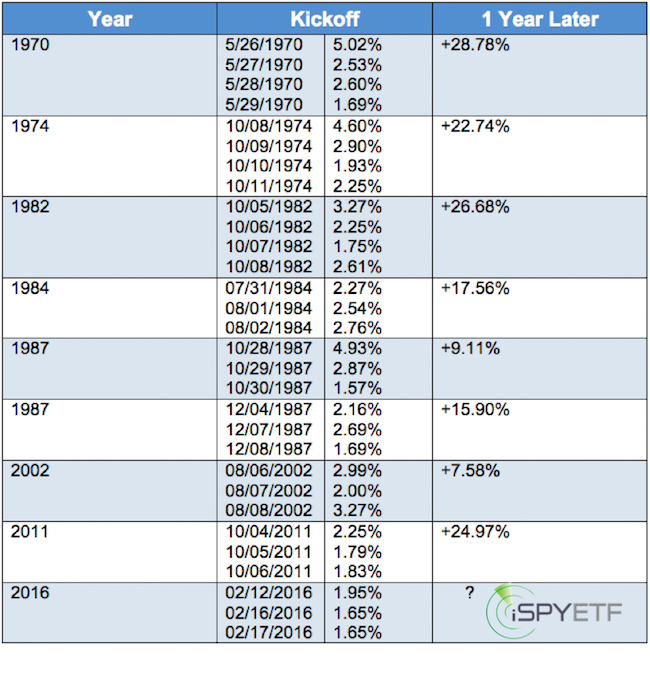
6. S&P 500 Gained More Than 1.5% a Day for Three Consecutive Days Historical Pattern — the chart below provides a snapshot of each kickoff rally (dashed green line) and how the S&P 500 did 60 trading days (about three months) prior, and 255 trading days (above one year) thereafter.
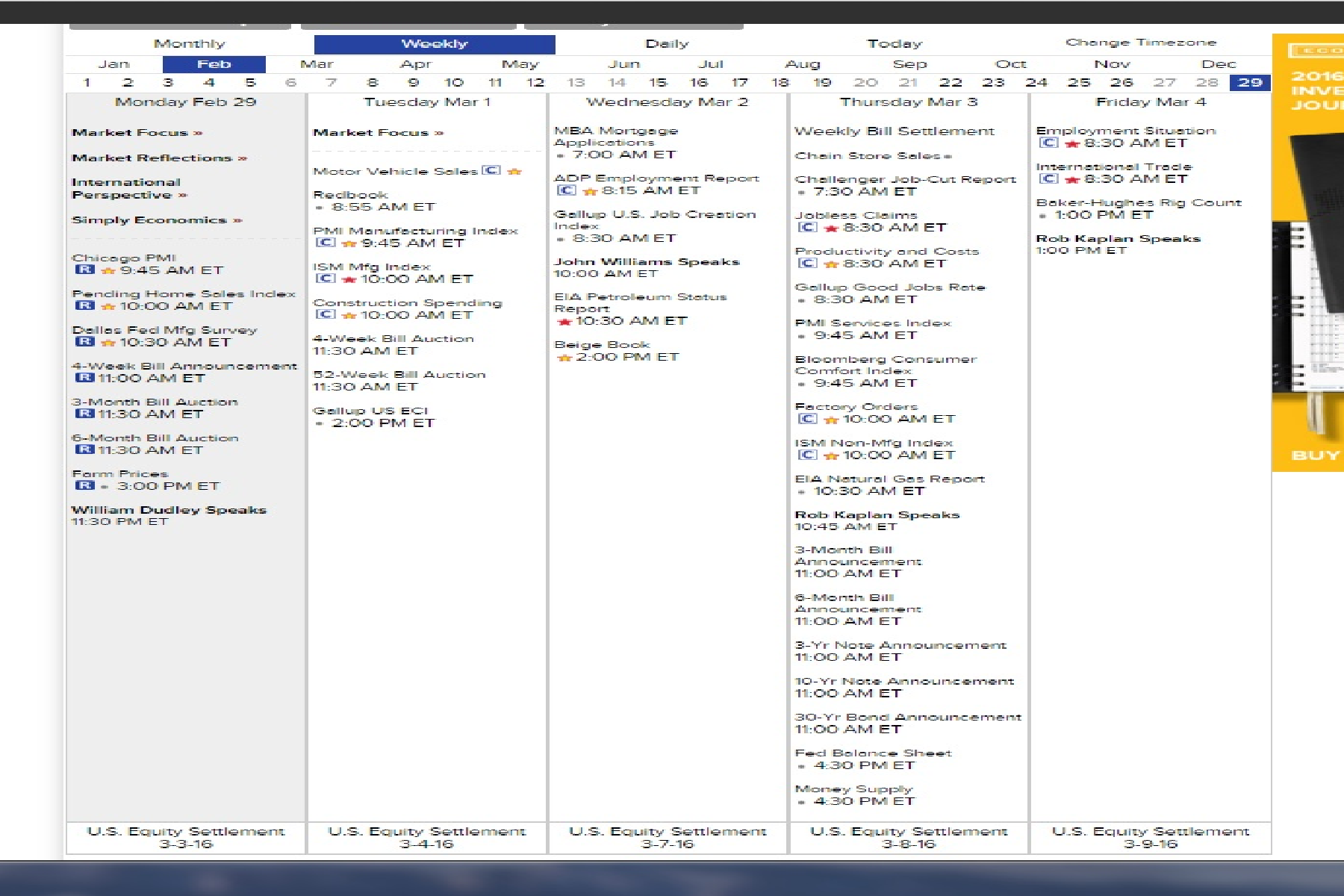
The week ahead — Economic data from Econoday.com:
Tags: 4Q GDP, Q1 GDP
Posted in Weekly Summary | No Comments »
February 24th, 2016
“I have been trading for decades and I am still standing. I have seen a lot of traders come and go. They have a system or a program that works in some specific environments and fails in others. In contrast, my strategy is dynamic and ever evolving. I constantly learn and change.” – Thomas Busby
1. Saudi Arabia, Russia, Qatar, Venezuela Agree to Freeze Oil Production — Saudi Arabia, Russia, Qatar and Venezuela reported that they wouldn’t increase crude-oil output above January’s levels as long as other major oil producers followed suit, in the first coordinated move to boost oil prices in years. The agreement came with a significant caveat: Iran and Iraq must also halt production increases.
2. Venezuela Hikes Fuel Prices, Devalues Bolivar — cash-strapped Venezuela has finally taken action to address its ailing economy, raising the price of the world’s cheapest gasoline and devaluing its currency by 37%. President Nicolas Maduro said the government would also “simplify” the country’s complex three-tier exchange rate system to just two rates: a protected official rate for food/medicine imports and a parallel “floating” rate for other transactions. The measures are meant to help shore up the OPEC nation’s finances as it battles a severe recession, triple-digit inflation and chronic product shortages.
3. Buffett Discloses Stake in Pipeline Operator Kinder Morgan (NYSE:KMI) — Berkshire Hathaway (BRK.A, BRK.B) opened a new 26.5M share stake in the energy infrastructure company during Q4, translating into stock worth roughly $395.9M at year end. This is a new investment in pipeline operator. George Soros also added 50.7K shares of Kinder Morgan (KMI) during the fourth quarter.
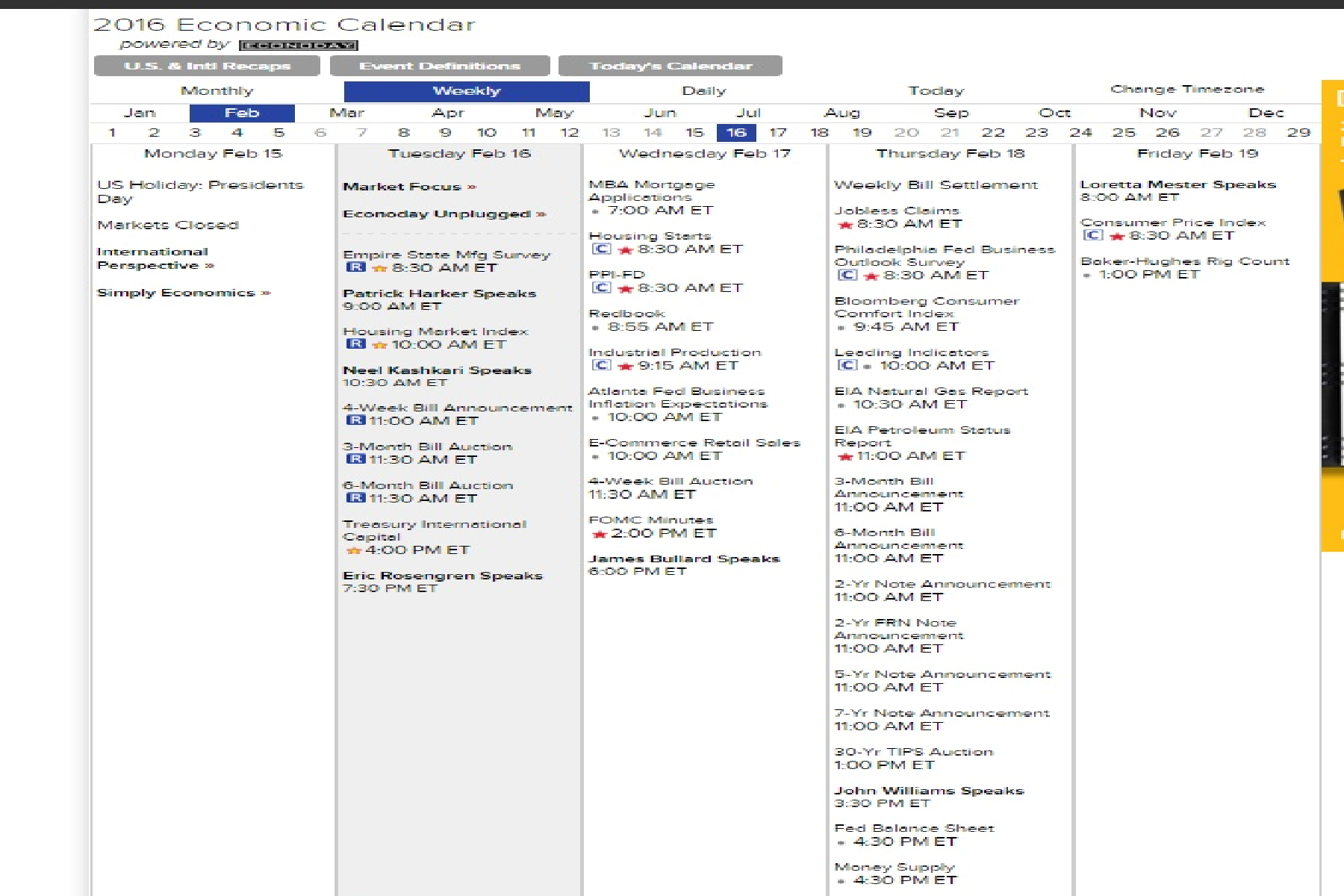
The week ahead — Economic data from Econoday.com:
Tags: Buffetts 4Q
Posted in Weekly Summary | No Comments »