October 30th, 2018
“I will tell you how to become rich. Close the doors. Be fearful when others are greedy. Be greedy when others are fearful.” — Warren Buffett
1. Foreign Buying of U.S. Treasurys Softens, Unsettling Financial Markets — foreign investors, traders and central bankers are buying fewer Treasurys. The foreign pullback has helped fuel a bond selloff this fall, which has driven the 10-year yield to 3.17% and has shaken the nine-year-long rally in U.S. stocks, and that continuing reductions in foreign appetite could further unsettle financial markets. China and Japan still both own more than $1 trillion of U.S. debt, according to the U.S. data.
2. Amazon, Qualcomm partner on Alexa headphones — Qualcomm is teaming up with Amazon (NASDAQ:AMZN) to spread the use of its voice assistant, releasing a set of chips that any maker of Bluetooth headphones can use to embed Alexa directly into the device. The functionality would be similar to Apple’s (NASDAQ:AAPL) AirPods, which let users tap the devices to talk to Siri.
3. Moody’s Decided Against Cutting Italian Debt Ratings to Junk — the euro is under pressure amid a bout of disappointing data on the eurozone’s two largest economies. German business activity was shown to have grown by its slowest rate for nearly three and a half years, while French manufacturing also struggled as its PMI index hit a 25-month low.
4. Target Ramps Up Same-Day Delivery Program and Offering Free Two-Day Shipping — In a bid to win shoppers over rivals like Walmart (NYSE:WMT) and Amazon (NASDAQ:AMZN), Target (NYSE:TGT) for the first time ever is offering free two-day shipping – with no minimum purchase required – this holiday season. Target said its “Drive Up” service – where shoppers can place their orders online and have them brought directly to their cars – will also be available at nearly 1,000 stores.
5. U.S. to China: No Trade Talks Without Firm Proposal — the U.S. is refusing to resume trade negotiations with China until Beijing comes up with a concrete proposal to address Washington’s complaints about forced technology transfers and other economic issues, officials told WSJ. The impasse threatens to undermine a meeting between President Trump and Xi Jinping at the G20 summit in November. Businesses have been counting on sufficient progress for the suspension of the next round of U.S. tariffs.
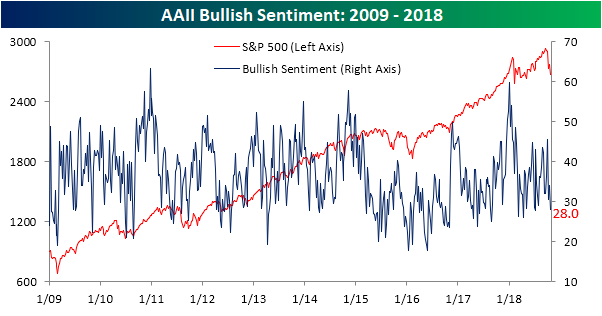
6. AAII Weekly Sentiment Survey — according to the latest weekly sentiment survey from AAII, bullish sentiment saw another decline this week falling from just under 34% to 27.97%. That’s low enough to rank as the fourth weakest reading in bullish sentiment this year.
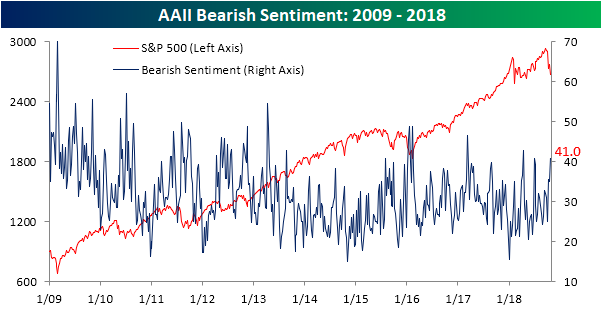
On the bearish side, negative sentiment rose by a similar amount that bullish sentiment declined, jumping from 35.0% up to 41.0%. That’s the highest reading since the last week of June, right before the July 4th rally, and the third highest reading in bearish sentiment of the year.
Posted in Weekly Summary | No Comments »
October 22nd, 2018
“I believe in analysis and not forecasting.” — Nicolas Darvas
1. Sears Files for Chapter 11 Bankruptcy — Sears has filed for bankruptcy after years of staying afloat through financial maneuvering, a merger with Kmart and relying on billions of CEO Eddie Lampert’s own money. It’s set to shutter 142 stores towards the end of the year and begin liquidation sales shortly. While Lampert will step down as CEO, he’ll remain Sears (NASDAQ:SHLD) chairman, as his ESL Investments negotiates a debtor in possession loan and other funding to support what was once the country’s biggest retailer through the bankruptcy process.
2. Italy Endorses Deficit-Hiking Budget — Italy’s government signed off on an expansionary 2019 budget late Monday – with planned measures that would boost welfare spending, lower the retirement age and cut taxes – in defiance of EU rules that require a shrinking deficit. The draft budget law has rattled financial markets in the past month, with investors demanding significantly higher interest rates to buy Italian bonds.
3. Fidelity Starts Crypto Unit — Fidelity Investments is getting into the crypto scene with a new unit called Fidelity Digital Assets Services. “Our goal is to make digitally-native assets, such as bitcoin, more accessible to investors,” announced CEO Abigail P. Johnson. “We expect to continue investing and experimenting, over the long-term, with ways to make this emerging asset class easier for our clients to understand and use.”
4. U.S. to Open Trade Talks with EU, UK, Japan — Just weeks after the retooling of NAFTA, the U.S. Trade Representative’s office has informed Congress it intends to open trade talks with the EU, U.K. and Japan, aiming to “address both tariff and non-tariff barriers and to achieve fairer, more balanced trade.” Under fast-track rules, the U.S. cannot start trade talks until 90 days after notifying Congress.
5. Canada Legalizes Marijuana Nationwide — Canada begins legalization of recreational marijuana sales in Canada, with provinces handling their own regulations for sale, growth and taxation. Adults will be allowed to carry and share up to 30 grams of legal marijuana in public, cultivate up to four plants in their households and make products such as edibles for personal use. Canadians can also order weed through the mail. Companies related are — TLRY, CRON, CGC, MJ
6. Fed Minutes Point to Continued, Gradual Interest-Rate Increases — the latest Fed minutes shows officials voted unanimously at the September meeting to raise their benchmark rate to a range between 2% and 2.25%. Projections released after the meeting show most officials expected they would need to raise rates one more time this year and around three times in 2019 if the economy performs in line with current forecasts.
The week ahead — Economic data from Econoday.com:
Posted in Weekly Summary | No Comments »
October 15th, 2018
There will not be any Weekly Re-Cap for the week of Oct 8 to Oct 12 2018. We are away for some needed R&R.
The staffs at EGS.
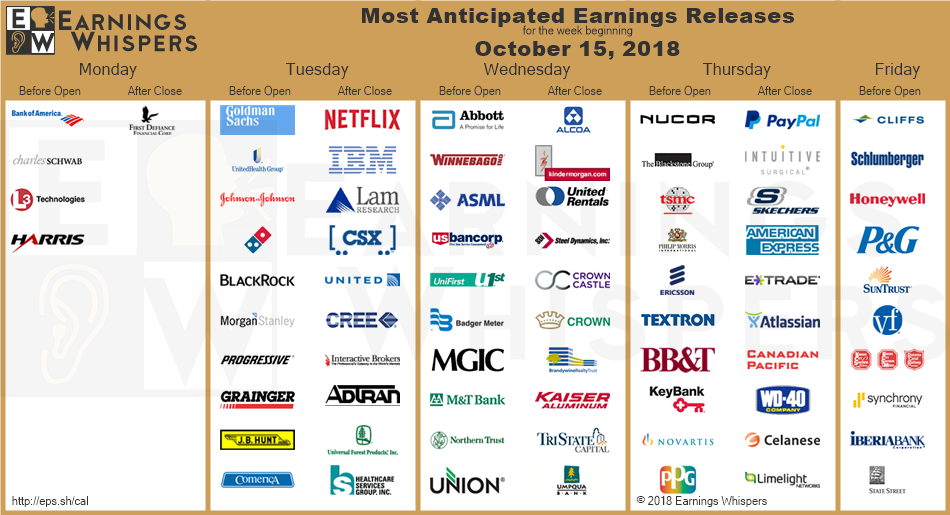
The week ahead — Economic data from Econoday.com:
Posted in Weekly Summary | No Comments »
October 9th, 2018
“I have learned through the years that after a good run of profits in the markets, it`s very important to take a few days off as a reward. The natural tendency is to keep pushing until the streak ends. But experience has taught me that a rest in the middle of the streak can often extend it.”– Martin Schwartz
1. Sharp Joins the OLED Revolution — Japan’s Sharp (OTCPK:SHCAY) has finally jumped into the organic light-emitting diode market as it looks to catch up to rivals. The long-awaited decision comes as the major iPhone supplier continues its recovery after being bought two years ago by Taiwan’s Foxconn (OTC:FXCOF). Sharp will offer the OLED panels in its new smartphones later this year and plans to sell the screens to other manufacturers.
2. Exxon Eyes Major Investment at Singapore Refinery — Exxon Mobil is considering a multi-billion dollar investment at its Singapore refinery, the company’s largest, as the shipping and oil refining industries scramble to prepare for new marine fuel regulations starting in 2020. New rules from the International Maritime Organization limit sulfur content to 0.5%, from 3.5% currently, to curb pollution produced by the world’s ships. Singapore is also home to Exxon’s (NYSE:XOM) biggest integrated petrochemical complex.
3. Shell Green Lights Canadian LNG Project — Royal Dutch Shell (RDS.A, RDS.B) is pressing ahead with Canada’s largest-ever infrastructure project, designed to send gas from Canada, where prices are relatively low, to demand centers in Asia. Construction of the 14M tons/year venture – which is expected to generate an internal rate of return of around 13% – will start immediately, with LNG production expected to begin before the mid-2020s. Minority partners include PetroChina (NYSE:PTR), Mitsubishi (OTCPK:MSBHY), Korea Gas and Malaysia’s Petroliam Nasional Bhd.
4. U.S. and Canada Reach Last-Minute Pact to Revise Nafta — the U.S. and Canada struck a deal at the last minute to revise the North American Free Trade Agreement just before a U.S-imposed deadline of October 1. The pact allows Canada to join the accord reached between the U.S. and Mexico in August. The new agreement, to be officially called the U.S.-Mexico-Canada Agreement, now includes rules for financial services and digital business that have emerged since Nafta was originally signed in 1994. Canada agreed to curb protection for its dairy industry, while the U.S. dropped demands to get rid of special Nafta courts that allow member states to challenge trade restrictions imposed by others.
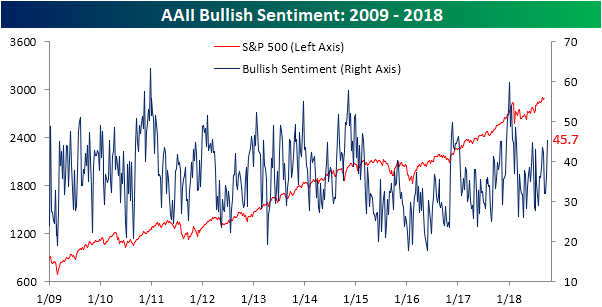
5. AAII Weekly Sentiment Survey — According to the weekly sentiment survey from AAII, bullish sentiment surged 9.4 percentage points to 45.66% from last week’s reading of 36.22%.
That move represents the largest one-week increase since early July and the highest weekly reading since mid-February. While we’re not quite at the 50% reading yet, we would note that the last time optimism in this survey neared the 50% level was in late December. That wasn’t the exact top of the market right before the correction, but it was close to it.
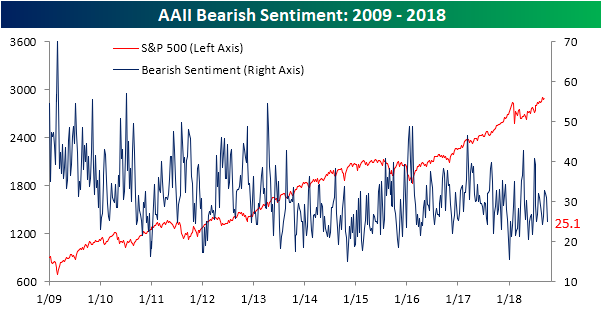
bearish sentiment is back down in the mid-20 percent range, which is a level it has seen repeatedly throughout the year.
6. Chinese Spy Chip Report Weighs on Apple Suppliers — shares in Apple’s suppliers saw a broad decline on the back of a bombshell report that alleged Chinese spy chips were discovered in data center equipment used by Amazon (NASDAQ:AMZN) and Apple (NASDAQ:AAPL). The tech giants have denied the allegations by Bloomberg Businessweek, which said the hack reached almost 30 U.S. companies and compromised America’s technology supply chain. Companies effected are: AMS,Largan, LG Display, Murata, Wistron, Hon Hai, AAC Tech, Merry, TDK, TSMC .
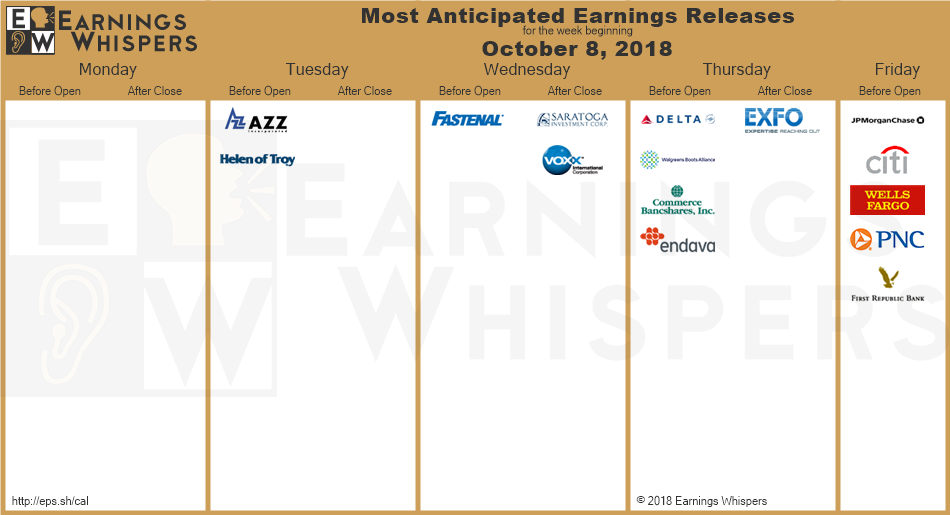
The week ahead — Economic data from Econoday.com:
Posted in Weekly Summary | No Comments »
October 3rd, 2018
“Prices are too high” is far from synonymous with “the next move will be downward.” Things can be overpriced and stay that way for a long time . . . or become far more so.” ― Howard Marks
1. Brent Crude Spikes to Fresh Four-Year High Near $81/bbl — brent crude jumped to its highest in four years overnight after the world’s biggest oil producers, led by Saudi Arabia and Russia, decided against further increases in production, despite calls from Pres. Trump for OPEC to lower prices. At its last meeting in Algiers, OPEC said it was satisfied “regarding the current oil market outlook, with an overall healthy balance between supply and demand.” Brent spiked as much as 2.6% higher to $80.94 per barrel to its loftiest levels since 2014, while U.S. WTI climbed 1.8% to $72.06 per barrel, its highest since this June.
2. EU Plans Route To Do Business with Iran Without U.S. Sanctions — the EU will establish a special payment channel allowing companies to legally continue financial transactions with Iran without exposure to U.S. sanctions. The mechanism would facilitate payments related to Iranian oil trade, exports, and imports. The details of the mechanism will come after future meetings with technical experts. The special purpose vehicle was jointly announced by EU foreign policy chief Federica Mogherini and Iranian Foreign Minister Javad Zarif.
3. Ontario Expected to Unveil Cannabis Law — expectations on Ontario that a new legalization law will be unveiled on Sept 28 ’18. Ontario is the only province that hasn’t created guidelines for how cannabis will be sold in brick-and-mortar retail shops, despite the province accounting for more than 40% of all cannabis usage in the nation last year. An announcement isn’t anticipated until after the market closes today, which could lead to more speculative trading on Aurora Cannabis (OTCQX:ACBFF), Canopy Growth (NYSE:CGC), Cronos Group (NASDAQ:CRON) and Tilray (NASDAQ:TLRY).
4. SEC Sues Elon Musk For Fraud, Seeks Removal from Tesla — the SEC sued Elon Musk for fraud and sought to remove him from Tesla Inc(TSLA). It sued Mr. Musk in Manhattan federal court, alleging he “had not even discussed, much less confirmed, key deal terms, including price, with any potential funding source,” according to the lawsuit. U.S. law forbids public-company executives from making false statements or misleading investors about information that is material to an investment decision.
5. U.S., Japan Agree to Trade Talks; Japan Avoids U.S. Auto Tariffs For Now — President Trump and Japanese Prime Minister Abe have agreed to start trade talks in an arrangement that for now protects Japanese automakers from further tariffs. As part of the agreement, Abe said the U.S. would not impose additional tariffs on the auto sector, while also protecting the politically important farm sector from access that goes beyond the terms in the Trans-Pacific Partnership agreement that Trump abandoned last year. U.S. Trade Representative Lighthizer said the talks would occur in two “tranches” with hopes for an “early harvest” from the initial talks on lowering trade barriers.
The week ahead — Economic data from Econoday.com:
Tags: Canabis
Posted in Weekly Summary | No Comments »
September 24th, 2018
“Always something new, always something I didn’t expect, and sometimes it isn’t horrible.” – Robert Jordan
1. U.S. LNG Deliveries to Germany by 2022 — U.S. companies expect to begin delivering LNG to Germany in four years at the latest, according to deputy U.S. energy secretary Dan Brouillette, and will challenge Russia which now accounts for 60% of German gas imports. In July, President Trump accused Germany of being a “captive” of Russia due to its energy reliance and urged it to halt work on the $11B, Russian-led Nord Stream 2 gas pipeline.
2. Aurora Cannabis(OTCQX:ACBFF) on talks with Coca-Cola on CBD drinks — Coca-Cola (NYSE:KO) said it was closely watching the fast-growing marijuana drinks market for a possible entry. Molson Coors (NYSE:TAP) has already announced a joint venture with Hydropothecary to develop cannabis drinks, while Diageo (NYSE:DEO) is in talks with at least three Canadian cannabis producers about a possible deal.
3. SEC subpoenas Goldman, Silver Lake in Tesla probe — the tension continues to build at Tesla (NASDAQ:TSLA) as a DOJ probe runs alongside a wide-ranging SEC investigation. Subpoenas have already been received by Goldman Sachs and Silver Lake, the two firms hired by Tesla to help the company explore Elon Musk’s go-private plan.
4. US/China Tarriff Escalate — President Trump ordered another $200 billion in 10% tariffs on Chinese goods, which could rise to 25% by year end. China retaliated with $60 billion in tariffs at 5% to 10% and Trump threatened $267 billion more.
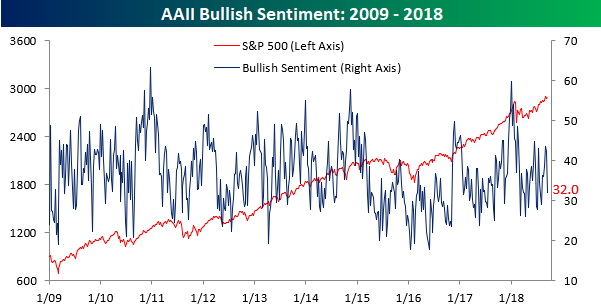
5. AAII Weekly Investor Sentiment — in the latest survey of individual investor sentiment from AAII, bullish sentiment declined (ever so slightly) for the third straight week, dropping from 32.09% down to 32.04%.
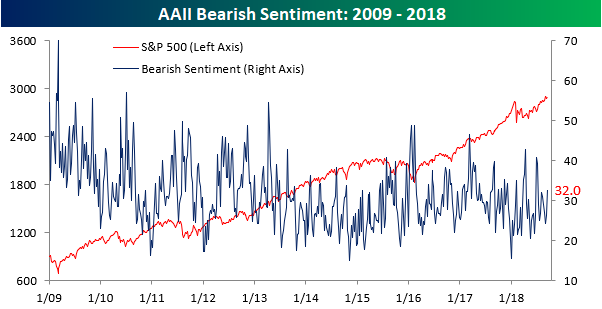
Meanwhile, bearish sentiment came in at the exact same level as bullish sentiment this week, dropping from 32.84% down to 32.04%. The last time both gauges of sentiment were at the exact same level was in June 2016.
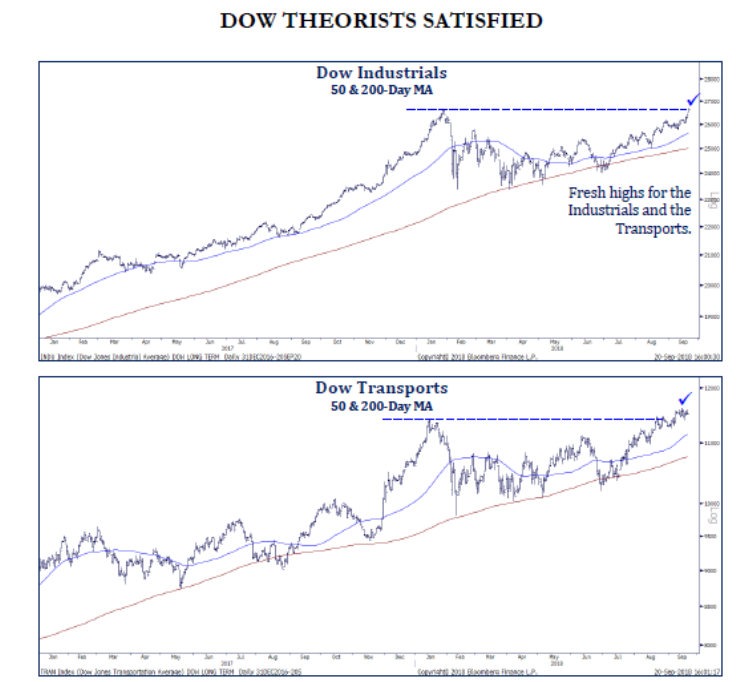
6. Dow Theory Generates Buy Signal for the Dow Theorist Followers — this occurs when the Dow Industrials sets a new high following a new high for Dow Transports. This happened over the last two weeks as industrials set their high on September 21 following transports on September 14. This signal did not work in 2008 as Dow Transports was the last average to peak when it topped out in May 2008 while Dow Industrials peaked in October 2007.
The week ahead — Economic data from Econoday.com:
Tags: AAII Weekly Sentiment, US/China Trade War
Posted in Weekly Summary | No Comments »
September 18th, 2018
“A simple rule dictates my buying: Be fearful when others are greedy, and be greedy when others are fearful,” Warren Buffett
1. Trump Says Apple Should Shift Production to U.S. to Avoid China Tariffs — President Trump tweeted that Apple (NASDAQ:AAPL) should make more of its products in the U.S. if it wants to avoid tariffs on Chinese imports. In the filing, Apple said the new proposed tariffs would affect prices for a “wide range” of products, including the Watch, AirPods headphones and Beats headphones. China has warned it will match any U.S. tariffs.
2. Trump Readies New Tariffs on Chinese Imports — the Trump administration reportedly set to announce a new round of tariffs on as much as $200B in Chinese goods, while Beijing considers scrapping upcoming trade talks in response. The duties will be set at 10%, below the 25% level announced in early August, to diminish the impact on U.S. consumers ahead of the holiday shopping season and before midterm elections. Global shares are edging down on the news, while the Shanghai Composite closed at its lowest level since 2014. former finance minister Lou Jiwei told a forum, besides retaliating with tariffs, China could also restrict export of goods, raw materials and components core to U.S. manufacturing supply chains.
3. EPA Set to Ease Rules On Methane Leaks for Oil and Gas Companies — the Environmental Protection Agency will reportedly announce a rollback of Obama-era methane emission rules. The EPA proposal wants to give oil and gas companies more time to assess and safely repair infrastructure that’s often found in remote areas. The changes would give drillers a year to perform leak inspections and 60 days to make repairs, double the current time frames.
4. Apple’s iPhone Launch — AAPL unveiled its biggest and most expensive iPhone at its fall launch event, with most of the buzz swirling around a rumored phablet (iPhone Xs Max?) that’s supposed to boast a 6.5-inch OLED screen. Two other models will likely be called the iPhone Xs (5.8-inch OLED) and Xr (6.1-inch LCD). the iPhone XR starting at $749, iPhone Xs starting at $999 and iPhone Xs Max starting at $1,099. More products anticipated include the Watch Series 4, third-gen iPad Pro, budget MacBook, and updated AirPods with a long-delayed charging mat.
5. More Strikes Entertainment Deals — Twitter has struck a host of new media partnerships, bringing “hundreds of hours” of entertainment to audiences in the Asia Pacific region. The deal includes game highlights from the UEFA Champions League, live-streaming from Formula One and live Red Carpet events. Twitter (TWTR) has seen double-digit audience growth in Asia Pacific and is “projecting by about 2020, we’ll be at about a billion views here in (Asia Pacific) alone.”
6. Gas explosions near Boston — NiSource’s (NYSE:NI) Columbia Gas explosions killed at least one person, injured 12 more and forced thousands to evacuate from three communities north of Boston. Some 70 fires, explosions or investigations of gas odor were reported, according to Massachusetts State Police. NiSource’s (NYSE:NI) Columbia Gas unit had said earlier that it would be upgrading gas lines in neighborhoods across the state.
The week ahead — Economic data from Econoday.com:
Tags: US/China Trade War
Posted in Weekly Summary | No Comments »
September 10th, 2018
“The secret to being successful from a trading perspective is to have an indefatigable and an undying and unquenchable thirst for information and knowledge.” — Paul Tudor Jones
1. EU Open to More U.S. Beef Imports — the EU is willing to start talks with Washington on increasing U.S. beef imports, a move aimed at cementing a trade truce agreed upon in July. The bloc already upped its U.S. soybean imports, which rose 283% Y/Y in July, bringing the EU’s total American soybean share to 37%, up from 9% a year ago. Both agricultural products have been hit by retaliatory tariffs from China and Mexico, with U.S. beef producers forced to stockpile meat in cold storage facilities.
2. China Warns of Retaliation Over New U.S. Tariffs — according to the country’s commerce ministry “If the U.S., regardless of opposition, adopts any new tariff measures, China will be forced to roll out necessary retaliatory measures,” . Due to China’s massive trade surplus over the U.S., many expect the nation could further devalue its currency or crack down on U.S. firms inside the country. The Trump administration is reportedly ready to move ahead with a next round of tariffs .
3. Emerging-Market Stocks Hover Near Bear Territory — Emerging markets were teetering on the verge of bear territory last week as a rising dollar and higher U.S. interest rates are siphoning money from the developing world and making their debts more expensive. The gauge of 24 emerging-market countries has now dropped by a fifth since its January high after steep falls in the Turkish and Argentine currencies sparked a wider selloff. The Shanghai Composite Index has fallen 24% from its peak in January, while the yuan is down around 6% since June. The recent bout of selling was partly triggered last month by sharp declines in the Turkish lira, which is down by more than 40% this year, and later the Argentine peso, which has fallen 51%. Elsewhere, the Indian rupee reached its weakest-ever levels this week, and the Indonesian rupiah is trading around two-decade lows.
4. Goldman Sachs Is Said to Cool to Crypto-Trading as Bitcoin Runs Cold — Crypto prices continue to tumble following a Business Insider report that stated Goldman Sachs was dropping plans to open a trading desk for cryptocurrencies. Bitcoin (BTC-USD) is down about 12% over the last 24 hours to a low of $6,279. The alts posted far worse during that time, with the price of Ethereum (ETH-USD) tumbling by 20%, Ripple (XRP-USD) dropping by 14% and Bitcoin Cash (BCH-USD) falling 19%.
5. Ebola Outbreak Spreading in Congo — Congo has confirmed its first Ebola death in the eastern city of Butembo, the first urban outbreak of the virus. The current wave has already killed 89 people and it’s close to becoming the eighth largest Ebola outbreak in history. A vaccination campaign has already been underway for weeks, with experimental treatments from companies like Merck (NYSE:MRK) and Gilead Sciences (NASDAQ:GILD).
The week ahead — Economic data from Econoday.com:
Tags: China/US Trade War
Posted in Weekly Summary | No Comments »
September 4th, 2018
“The core problem, however, is the need to fit markets into a style of trading rather than finding ways to trade that fit with market behavior.” – Brett Steenbarger
1. U.S., Canada Set for High-Stakes Trade Talks Under Cloud of White House Threat — Canadian Foreign Minister Chrystia Freeland traveled to Washington to continue trade negotiations. “We’ll give them a chance to have a separate deal, or we could put it into this,” President Trump declared, adding that the “simplest deal is more or less already made. White House Economic Adviser Larry Kudlow told CNBC “We may have to resort to auto tariffs if the U.S. and Canada can’t reach a fair deal,”.
2. Apple to Take iPhone X Design to New Phones — Apple plans to unveil three new phones using the edge-to-edge screen design of the iPhone X, sources told Bloomberg. The new “S year” devices, expected to be unveiled at Apple’s product event in September, will include updated features and cover a broader range of prices, colors and sizes. One will even include a 6.5-inch display, the largest Apple (NASDAQ:AAPL) has ever included on an iPhone.
3. U.S. to Pay Farmers $4.7 Billion to Offset Trade-Conflict Losses — the Trump administration pledged to pay farmers $4.7 billion to offset losses from trade disputes with foreign buyers of U.S. agricultural products. The payments would help protect farmers from “unjustified tariffs” some nations have applied in response to President Trump’s trade policies. China, Mexico, the European Union and other trade partners have levied tariffs on U.S. farm goods from soybeans to pork to apples, leaving growers vulnerable during a downturn in the agricultural economy. Soybean farmers are in line to get roughly three-fourths of the direct payments, or $3.6 billion, followed by producers of pork, cotton, sorghum, dairy and wheat.
4. India Set for Record Oil Demand Growth — India is set to overtake China as the biggest source of growth for oil demand by 2024, according to a forecast by Wood Mackenzie. The country’s expanding middle class will be a key factor, as well as its growing need for mobility. On the other hand, China – which overtook the U.S. as the biggest importer of crude oil in 2017 – is set to see a decline due to two trends: Alternative energy sources and a more efficient freight system.
5. Fresh Stress for Emerging Market Currencies — Argentina’s peso tanked 7.5% against the dollar late last week, bringing losses to nearly 50% over the past year, after President Macri asked the IMF to speed up delivery of a $50B bailout package. In response to the suffering peso, other fragile emerging market currencies sold off sharply overnight, with Turkey’s lira and the South African rand feeling heat, and India’s rupee slumping to a new record low. The tumult highlights a heavy international dependence on the dollar. Some 48% of the world’s $30T in cross-border loans are priced in the U.S. currency, up from 40% a decade ago.
6. Moody’s Lowers Rating on Ford — Moody’s has lowered Ford’s (NYSE:F) credit rating to one notch above junk bond status, and warned of further downgrades if it doesn’t make “clear progress” on its $11B turnaround plan. The second-largest U.S. auto manufacturer is faces weakening profit margins in North America, a retrenching business in China, and losses in South America and Europe.
The week ahead — Economic data from Econoday.com:
Tags: US/Canada Trade Talk
Posted in Weekly Summary | No Comments »
August 27th, 2018
“Amateurs think about how much money they can make. Professionals think about how much money they could lose.” – Jack Schwager
1. U.S. Proposed Sale from Strategic Oil Reserve to Reduce Global Oil Supplies — the U.S. Department of Energy is offering 11M barrels of crude for sale from the nation’s Strategic Petroleum Reserve ahead of sanctions on Iran that are expected to reduce global oil supplies and increase prices. The SPR was established in the 1970s after the U.S. economy was paralyzed by an oil embargo. As recently as 2011 it contained 727M barrels in caverns along the Texas and Louisiana coasts.
2. JPMorgan to Unveil New Investing App — JPMorgan (NYSE:JPM) is rolling out a digital investing service next week that comes bundled with free or discounted trades, a sophisticated portfolio-building tool and no-fee access to the bank’s stock research. “You Invest,” more than two years in the making, has a distinct advantage over many competitors: JPMorgan already has financial ties with half of American households.
3. Hospitals Shut At a Rate of 30 Annually — U.S. hospitals have been closing at a rate of about 30 a year, according to the American Hospital Association, and patients living far from major cities may be left with even fewer hospital choices as insurers push them toward online providers like Teladoc (NYSE:TDOC) and clinics such as CVS’s MinuteClinic (NYSE:CVS). The next year to 18 months could see a further increase in shutdowns, with the risks coming following years of mergers and acquisitions.
4. China Retaliates Against New U.S. Tariffs — a fresh round of U.S. tariffs on $16B worth of Chinese imports kicked in at last week, prompting Beijing to retaliate with its own levies on American goods worth the same amount. The world’s two largest economies, which are in the midst of trade talks, have now slapped tit-for-tat duties on a combined $100B of products since early July, with more in the pipeline. Economists reckon that every $100B of imports hit by tariffs would reduce global trade by around 0.5%.
5. SEC Dismisses More Bitcoin ETFs — the SEC has once again thwarted an attempt to build a bitcoin ETF, rejecting applications for nine separate bitcoin-based exchange-traded funds. Cboe Global Markets (NASDAQ:CBOE) and NYSE Arca (NYSE:ICE) would have listed the products. The commission leaned on the same reasoning as for the earlier rejections, mainly that there aren’t enough protections against fraud and market manipulations.
6. U.S.-China Trade Talks End with No Major Progress — Mid-level trade talks between the U.S. and China ended without any formal signs of progress, although Chinese officials said they plan to keep the lines of communication open. Sources indicated the two sides mainly swapped talking points without getting any detailed negotiations. Representatives from the U.S., European Union, and Japan plan to meet in Washington to extend talks on how to leverage the World Trade Organization and other ways pressure can be exerted on China.
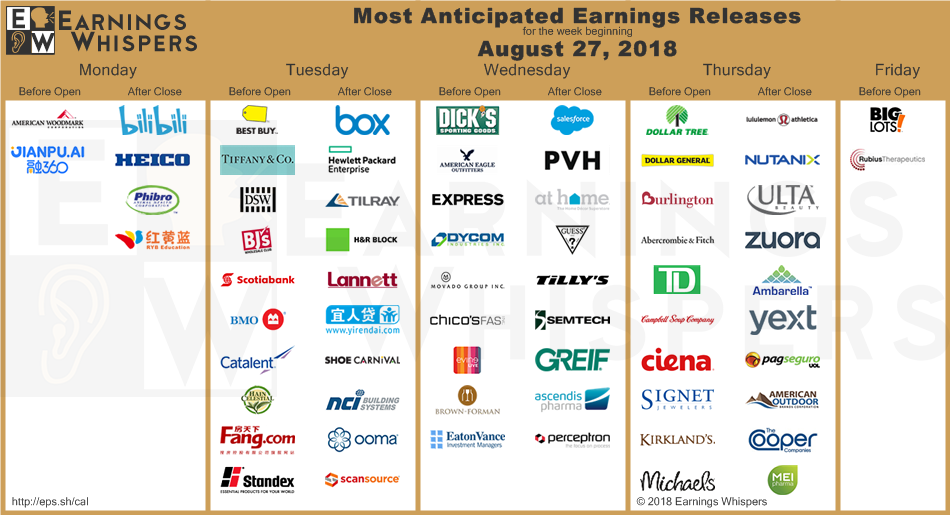
The week ahead — Economic data from Econoday.com:
Tags: Bitcoin, US/China Trade Talk
Posted in Weekly Summary | No Comments »