Search

Week of Jan 26, 2024 Weekly Recap & The Week Ahead

January 30th, 2024

I know where I’m getting out before I get in. — Bruce Kovner

1. Donald Trump Scores Decisive Win in New Hampshire Republican Primary — with his convincing win over Nikki Haley in the GOP primary, the former president showed that a dominating share of the Republican Party’s core voters are still with him and that his momentum toward the party nomination grows. With 77% of the estimated vote counted, Trump led Haley 55% to 44%, according to the Associated Press. But the New Hampshire results also signaled that Trump risks losing enough Republicans—as well as a substantial share of independent voters—to create a problem for him as a general-election candidate in November. The first task for any candidate is to unify the party. But 21% of Republicans who cast ballots in New Hampshire said they would be so dissatisfied with Trump as the nominee that they wouldn’t vote for him in November, according to AP VoteCast, a survey of primary voters. Similarly, 15% of Republicans who participated in Iowa’s caucuses last week said they wouldn’t support Trump in the general election.
2. US GDP Grew 3.3% Last Quarter, Capping Unexpectedly Strong Year — Gross domestic product increased at a 3.3% annualized rate, according to the government’s preliminary estimate out Thursday. For all of 2023, the economy expanded 2.5%. A closely watched measure of underlying inflation rose 2% for a second straight quarter, in line with the Federal Reserve’s target, the Bureau of Economic Analysis report showed. The S&P 500 opened higher while Treasury yields were lower as traders focused on the inflation figures and boosted the odds of a March rate cut.
3. Inflation’s Cooling Trend Extends Ahead of Fed Meeting — The Fed’s preferred inflation measure, the personal-consumption expenditures price index, rose 0.2% in December from the previous month, the Commerce Department said Friday. That was up from a 0.1% decline in November but still consistent with subdued inflation.
December closed out a year in which inflation declined markedly. Prices were up 2.6% on the year—well down from the 5.4% increase at the end of 2022. Core prices, which exclude volatile food and energy costs, rose 2.9% on the year, a slowdown from the prior month.
On a three-month annualized basis, core PCE inflation slipped to 1.5% in December from 2.2% in November. On a six-month basis, it was 1.9%, unchanged from November. Both figures are below the Fed’s 2% target.

The week ahead — Economic data from Econoday.com:
Week of Jan 19, 2024 Weekly Recap & The Week Ahead

January 24th, 2024

“Trade the market you got, NOT the one you wish you got” — LP

1. Retail sales rise 0.6% in December, topping expectations for holiday shopping — Retail sales increased 0.6% for the month, buoyed by a pickup in clothing and accessory stores as well as online nonstore businesses. The results were better than the 0.4% Dow Jones estimate. Excluding autos, sales rose 0.4%, which also topped the 0.2% estimate. On a year-over-year basis, retail sales ended 2023 up 5.6%. The numbers are not adjusted for inflation, so sales show that consumers are more than keeping up with an annual inflation rate of 3.4% as measured by the consumer price index. The CPI increased 0.3% in December, also lower than the retail sales increase.
Another measure of retail sales strength that excludes sales from auto dealers, building materials stores, gas stations, office suppliers, mobile homes and tobacco stores rose 0.8% for the month. The Commerce Department uses this so-called control group when computing gross domestic product.
2. Congress Passes Bill Keeping Government Open as Border, Spending Fights Rage — Congress cleared legislation extending government funding into March, a step that ensures federal workers will remain on the job but does nothing to alleviate underlying political pressures stemming from high U.S. debt levels, record crossings at the southern border and an enduring war in Ukraine. The Senate easily passed the measure 77 to 18, followed by the House, which approved the bill 314 to 108, sending it to President Biden’s desk with time to spare ahead of the weekend deadline. In a replay of recent votes that underscore the fragility of the GOP majority, House Speaker Mike Johnson (R., La.) relied heavily on Democrats to bring the continuing resolution across the finish line, with almost half of Republicans declining to back the measure. Thursday’s bill provides funding for the Transportation Department, the Energy Department, Agriculture Department, the Food and Drug Administration, and Veterans Affairs and military construction through March 1. The rest of the government would be funded through March 8. Under current law, funding was set to run out on Jan. 19 and Feb. 2, respectively.
3. December home sales slump to close out worst year since 1995 — Sales of previously owned homes fell 1% in December compared with November to a seasonally adjusted annualized rate of 3.78 million units, according to the National Association of Realtors. Sales were 6.2% lower than in December 2022, marking the lowest level since August 2010. Full-year sales for 2023 came in at 4.09 million units, the lowest tally since 1995.Regionally, on a month-to-month basis, sales were unchanged in the Northeast and fell 4.3% in the Midwest. Sales were down 2.8% in the South but rebounded 7.8% in the West. On a year-over-year basis, sales were lower in all regions.
4. US Consumer Sentiment Jumps, Price Outlook Hits Three-Year Low — Consumer sentiment surged 29% since November, the biggest two-month increase since 1991, the University of Michigan reported, adding to gauges showing improving moods. It’s a sharp turn after persistently high inflation, the lingering shock from the pandemic’s destruction and fears that a recession was around the corner had put a damper on feelings about the economy in recent years, despite solid growth and consistent hiring. Consumer sentiment leapt 13% in the first half of January from December, the Michigan survey said, after a sharp rise the prior month. The pickup in sentiment was broad-based, spanning consumers of different age, income, education and geography.

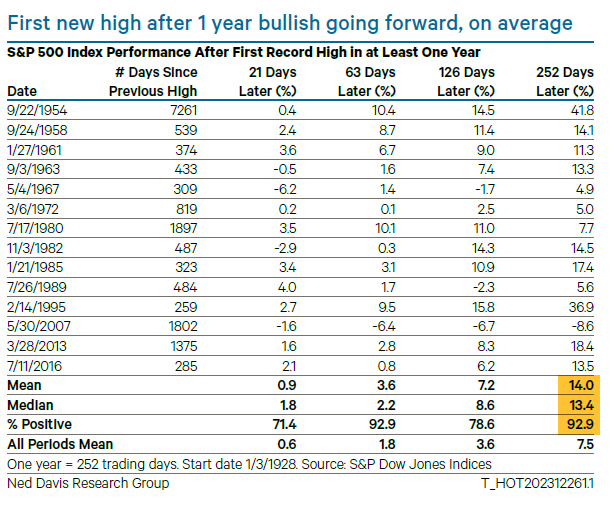
Market made a new high this week. History sides with further gains ahead. The S&P 500 went 512 trading days without a record through Thursday, which ranks as the sixth-longest streak since 1928, according to Ed Clissold, chief US strategist at Ned Davis Research. One year after hitting new highs, the index has risen 13 out of 14 times by a median of 13% in that span.
Below is the research from Ned Davis Research showing the stats on first new high after 1 year bullish going fowrard, on average:

The week ahead — Economic data from Econoday.com:
Week of Jan 12, 2024 Weekly Recap & The Week Ahead

January 16th, 2024

“It takes character to sit there with all that cash and do nothing. I didn’t get to where I am by going after mediocre opportunities.” — Charles Munger

1. SEC Authorizes Bitcoin-Spot ETFs in Crypto’s Big Breakthrough — US regulators for the first time approved exchange-traded funds that invest directly in Bitcoin, a move heralded as a landmark event for the roughly $1.7 trillion digital-asset sector that will broaden access to the largest cryptocurrency on Wall Street and beyond. The Securities and Exchange Commission, whose three-part mandate includes investor protection, authorized funds from industry heavyweights BlackRock, Invesco and Fidelity to smaller competitors including Valkyrie to begin trading late last week.
The approvals also mark a rare capitulation by the SEC following opposition that lasted for more than a decade, ever since Tyler and Cameron Winklevoss first proposed a Bitcoin ETF in 2013. BlackRock Inc.’s surprise application last June, followed by an appeals court ruling that called the denial of a different application “arbitrary and capricious,” triggered a blistering rally in the cryptocurrency as speculation that US regulators would finally give their blessing to the structure.
2. Inflation Edged Up in December After Rapid Cooling Most of 2023 — The consumer-price index climbed 0.3% in December from the prior month and increased 3.4% from a year earlier, the Labor Department said Thursday. That compares with November’s 0.1% monthly gain and marks an acceleration from that month’s 3.1% annual increase. Core prices, which strip out volatile food and energy items, rose 0.3% in December from the prior month—the same monthly increase as November and slightly faster than would be consistent with the Federal Reserve’s long-term inflation target of 2%. Core prices increased 3.9% from a year earlier, a modest slowing from November’s 4% annual increase. Thursday’s report isn’t likely to change the Fed’s near-term policy outlook.
3. PPI report shows U.S. wholesale prices declining for a third straight month — the decline in wholesale inflation last month offers a bit of relief after a hotter-than-expected increase in the consumer price index. The CPI posted the biggest gain in December in three months. A separate measure of “core” wholesale prices that strips out volatile food, energy and trade margins rose a mild 0.2%% last month, the government said. That matched the Wall Street forecast. The cost of goods fell 0.4% in December because of another decline in energy prices. Food prices also fell. The cost of wholesale services, where inflation is running the hottest, was flat in December.
4. SEC Approves Bitcoin ETFs for Everyday Investors — The SEC decision clears the way for the first U.S. exchange-traded funds that hold bitcoin to be sold to the public. Expectations of U.S. regulatory approval for such funds drove the price of bitcoin to the highest level in about two years. The digital currency traded just below $46,000 late Wednesday, up from $17,000 in January 2023. Until now, everyday investors who wanted to buy and sell digital currencies have had to either trade on crypto exchanges and incur hefty transaction fees or purchase products that track bitcoin in less direct ways. At least half a dozen bitcoin-futures ETFs are already on the market. Those funds use futures contracts to provide exposure to bitcoin price moves, though they have been criticized for often straying from bitcoin’s price.
All 11 applications filed by asset managers including BlackRock, Fidelity Investments, ARK Investment Management, Invesco, WisdomTree Bitwise Asset Management, Valkyrie and Grayscale Investments have been greenlighted to list. The new funds, known as spot-bitcoin ETFs because they buy and sell the digital currency itself, are expected to begin trading on Thursday.

The week ahead — Economic data from Econoday.com:
Week of Jan 5, 2024 Weekly Recap & The Week Ahead

January 8th, 2024

There isn’t a single formula. You need to know a lot about business and human nature and the numbers… It is unreasonable to expect that there is a magic system that will do it for you. — C Munger

1. Fed Minutes Suggest Rate Hikes Are Over, but Offer No Timetable on Cuts — At the meeting, the rate-setting Federal Open Market Committee agreed to hold its benchmark rate steady in a range between 5.25% and 5.5%. Members indicated they expect three quarter-percentage point cuts by the end of 2024. Officials noted the progress that has been made in the battle to bring down inflation. They said supply chain factors that contributed substantially to a surge that peaked in mid-2022 appear to have eased. In addition, they cited progress in bringing the labor market better into balance, though that also is a work in progress.
The “dot plot” of individual members’ expectations released following the meeting showed that participants expect cuts over the coming three years to bring the overnight borrowing rate back down near the long-run range of 2%.
2. U.S. Auto Sales Bounced Back in 2023 — The U.S. auto industry rebounded in 2023 with many car companies reporting double-digit sales gains, marking a return to normalcy for a sector that has been on a roller coaster since the start of the pandemic. Automakers’ results were boosted by pent-up demand and better availability on dealership lots. A six-week United Auto Workers strike this fall did little to dampen the industry’s momentum and electric-vehicle sales continued to rise, albeit at a slower rate than in the previous year. Analysts project industrywide sales of new cars in the U.S. could reach nearly 15.5 million in 2023, about a 13% increase from the prior year, once all car companies have released their figures.
3. Money-Market Fund Assets Rise to New All-Time High — Money-market fund assets rose to an all-time high, led by inflows into the government sector as investors sought to protect their cash at the end of the year. About $78.6 billion flowed into US money-market funds in the week through Jan. 3, according to Investment Company Institute data. Total assets rose to $5.965 trillion from $5.89 trillion the week prior. Retail investors have been piling into money funds since the Federal Reserve began one of the most-aggressive tightening cycles in decades in 2022. But last month, the Fed signaled that campaign is over and projected deeper interest-rate cuts this year.
4. Job Gains Picked Up in December, Capping Year of Healthy Hiring — The U.S. economy added 216,000 jobs last month, the Labor Department reported Friday. That was larger than November’s gain of 173,000, and better than forecasters were expecting. Hiring was revised down in both October and November. For all of 2023, employers added 2.7 million jobs, a slowdown from 2022, but a better gain than in the years preceding the pandemic. Hiring was broad-based last month, with healthcare and government leading job gains. Transportation and warehousing employers shed jobs. The unemployment rate in December held at 3.7%. The jobless rate began 2023 at 3.4%, matching lows not seen since the late 1960s, and remains low despite inching higher late last year.
Wages rose a healthy 4.1% last month from a year earlier. More broadly, there are signs the tight labor market conditions that prompted employers to offer robust pay raises in early 2023 continue to wane.

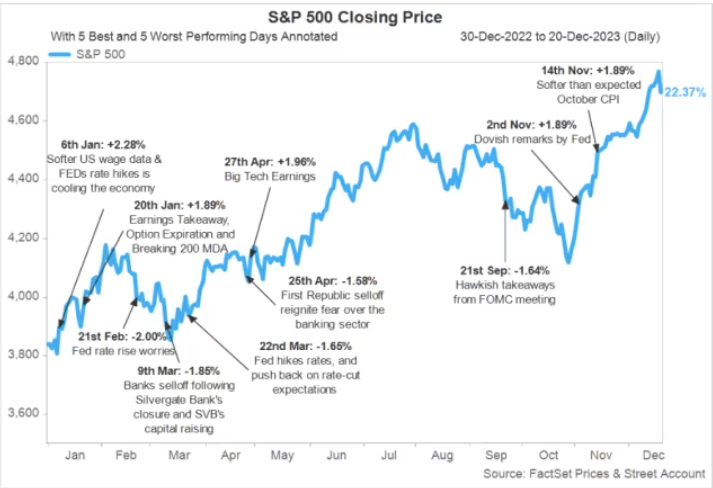
In a look back at 2023, data provider FactSet took a look at the biggest daily market moves in both directions.

The week ahead — Economic data from Econoday.com:
Week of Dec 22, 2023 Weekly Recap & The Week Ahead

December 27th, 2023

1. Fed Official Says Rate Cuts Could Be Needed Next Year to Prevent Overtightening — San Francisco Fed President Mary Daly said her outlook for interest rates and inflation was “very close” to the median of projections from 19 Fed officials last week. Most of them penciled in at least three rate cuts next year amid a faster decline in inflation than they anticipated. Daly said she is watching the effect that restrictive policy has on the labor market. When the unemployment rate starts to rise, it tends to go up by a lot and not by only a little bit, Daly said. As a result, “we have to be forward looking and make sure that we don’t give people price stability but take away jobs.”
Daly said she thought interest-rate policy was in a “good place” to achieve that result. In a notable shift, she said the Fed’s focus now needed to turn toward paying attention to both sides of its mandate.
2. Home Sales Ticked Up in November After 5 Months of Declines — home sales ticked up from 13-year lows in November after five consecutive months of declines, even as mortgage rates near their highest levels in two decades continued to weigh on sales.
Existing-home sales, which make up most of the housing market, increased 0.8% in November from the prior month to a seasonally adjusted annual rate of 3.82 million, the National Association of Realtors said Wednesday. November sales fell 7.3% from a year earlier. Existing-home sales for the full year in 2023 are on track to be the lowest since at least 2011. Affordability has improved slightly since then, as mortgage rates have declined for seven consecutive weeks and fell below 7% last week. That could spur more home-buying activity in early 2024, real-estate agents say.
3. U.S. third-quarter GDP growth trimmed to 4.9%, with consumer spending not quite as strong — growth of gross domestic product, the official scorecard for the economy, was reduced from a previously reported 5.2% in the government’s third estimate. It was still the biggest increase in GDP in a decade, however, excluding the pandemic years of 2020-21.
Yet while the economy is still growing, it’s cooled off quite a bit. GDP is forecast to increase by a mild 1% to 2% in the final three months of 2023. Business investment, the next biggest part of the economy, expanded at a slightly stronger 2.6% pace. Business profits, meanwhile, increased for the second quarter in a row. They rose 3.4%.
The annual rate of inflation in the third quarter was revised down to 2.6% from 2.8%. The increase in the core rate that excludes food and energy was marked down to 2% from 2.3%.
4. Prices Fell in November for the First Time Since 2020. Inflation Is Approaching Fed Target — the personal-consumption expenditures price index fell 0.1% in November from the previous month, the first decline since April 2020. It was up 2.6% on the year. Excluding food and energy prices, the index was up 0.1% on the month, same as in October. On the year, core inflation was up 3.2% in November, down from 3.4%. The Federal Reserve targets 2% annual inflation using the PCE price index.
On a six-month annualized basis, core inflation eased to 1.9%, suggesting the Fed is well on its way to reaching the target. Consumer spending, meanwhile, was up 0.2% on the month in November, higher than 0.1% in October and a sign of confidence in the economy on the part of American households. Overall personal income was up 0.4%, better than 0.3% in October.

Merry Xmas and wishing everyone a happy, healthy and prosperous New Year. The staffs at EGS Capital.

Week of Dec 15, 2023 Weekly Recap & The Week Ahead

December 18th, 2023

“To get what you want, you have to deserve what you want. The world is not yet a crazy enough place to reward a whole bunch of
undeserving people.”
― Charles T. Munger

1. Inflation slowed to a 3.1% annual rate in November — The consumer price index, a closely watched inflation gauge, increased 0.1% in November, and was up 3.1% from a year ago, the Labor Department reported. Economists surveyed by Dow Jones had been looking for no gain and a yearly rate of 3.1%.
While the monthly rate indicated a pickup from the flat CPI reading in October, the annual rate showed another decline after hitting 3.2% a month earlier. Excluding volatile food and energy prices, the core CPI increased 0.3% on the month and 4% from a year ago. Both numbers were in line with estimates and little changed from October.
The November numbers are still well above the Fed’s 2% target, though showing continuing progress. Policymakers focus more on core inflation as a signal for longer-term trends.
2. Fed holds rates steady, indicates three cuts coming in 2024 — The Federal Reserve on Wednesday held its key interest rate steady for the third straight time and set the table for multiple cuts to come in 2024 and beyond. With the inflation rate easing and the economy holding in, policymakers on the Federal Open Market Committee voted unanimously to keep the benchmark overnight borrowing rate in a targeted range between 5.25%-5.5%. Along with the decision to stay on hold, committee members penciled in at least three rate cuts in 2024, assuming quarter percentage point increments. That’s less than market pricing of four, but more aggressive than what officials had previously indicated.
3. US Producer-Price Inflation Cools to Below 1% as Energy Slides — The producer price index for final demand was unchanged from a month earlier. Excluding food and energy, the so-called core PPI was also flat, Bureau of Labor Statistics data showed.
From a year ago, the overall measure was up 0.9%, while the core gauge was up 2%, the least since January 2021. Services prices were unchanged for the second straight month. Goods prices were also unchanged after a steep decline in October. Energy costs fell 1.2% last month.
4. Strong Holiday Spending Adds to Signs U.S. May Beat Inflation Without Downturn — Signaling a strong start to the holiday season, retail sales rose a seasonally adjusted 0.3% in November from the month before, the Commerce Department said Thursday. That was a rebound from October’s downwardly revised 0.2% decline and a surprise to economists who had expected sales to fall again last month.
The data extended a week of positive readings for the U.S. economy. The unemployment rate fell in November, inflation cooled and the Federal Reserve pivoted Wednesday away from raising interest rates and toward considering when to cut them. The good tidings have ignited a rally on Wall Street, pushing the Dow Jones Industrial Average to a record high and caused yields on the 10-year Treasury note to fall below 4% on Thursday.

The week ahead — Economic data from Econoday.com:
Week of Dec 8, 2023 Weekly Recap & The Week Ahead

December 12th, 2023

“Spend each day trying to be a little wiser than you were when you woke up. Discharge your duties faithfully and well. Systematically you get ahead, but not necessarily in fast spurts. Nevertheless, you build discipline by preparing for fast spurts. Slug it out one inch at a time, day by day. At the end of the day – if you live long enough – most people get what they deserve.” — C Munger

1. Bank of Canada Expected to Hold Rates Steady on Deteriorating Outlook –Bank of Canada Gov. Tiff Macklem said interest rates may be at an appropriate level to wrestle inflation down further to the central bank’s 2% target. Economists say those remarks were prescient given new indicators measuring price increases, gross domestic product and the health of the labor market. Headline inflation in Canada cooled to 3.1% in October, from 3.8% in the prior month, and a peak of 8.1% in June 2022. More important, three-month measures of core consumer prices—which strip out volatile items like food and energy—fell to their lowest levels since early 2021. The Bank of Canada sets rate policy to achieve and maintain 2% inflation, and central bank officials have repeatedly said they need to see evidence of sustainable deceleration in core inflation before rate cuts can be entertained.
2. Moody’s Faces Growing Backlash Over Its Negative Outlook on China — New York-based Moody’s on lowered its outlook on China’s credit rating to negative from stable and kept its A1 investment-grade rating on the country—which it hasn’t changed since 2017. The credit rater said the growing debt problems of some cities and provinces would force China’s central government to provide financial support when economic growth is slowing. The country is also grappling with a deep property slump.
The change in Moody’s view led to a raft of similar changes to its outlooks for China’s state-owned banks, insurers and companies, including 22 local government financing vehicles that have issued international bonds. Moody’s also shifted to a negative credit-rating outlook for Hong Kong and Macau, both semiautonomous regions of China. That similarly cascaded down to its outlook for other companies, including the operator of Hong Kong’s subway system.
3. U.S. Wholesale Inventories Fell Again in October — Inventories at merchant wholesalers were 0.4% lower at the end of October than the same point a month earlier, according to adjusted Commerce Department figures released. Economists had expected inventories to slip by 0.2%, according to a poll carried out by The Wall Street Journal.
In September, inventories stayed at the same level as in August, according to revised figures that had previously shown a slight and unexpected rise.
Inventories of nondurable goods led the decrease in October, slipping 1.0%, with petroleum levels falling the fastest. Durable goods, on the other hand, increased slightly on the month, led by rising machinery stocks.
4. U.S. Consumer Confidence Jumps in December as Inflation Pressure Eases — A preliminary reading Friday of the University of Michigan’s consumer-confidence index show it surging to 69.4 points from 61.3 at the end of November. Economists polled by The Wall Street Journal had expected it to rise less sharply to 62.4.
The jump reverses four previous months of declines, though confidence remains well below levels before the Covid-19 pandemic, survey director Joanne Hsu said. Consumers are confident that inflation will fall more rapidly than previously expected, seeing it at 3.1% for the year ahead compared with 4.5% previously, the survey showed.

The week ahead — Economic data from Econoday.com:
Week of Nov 31, 2023 Weekly Recap & The Week Ahead

December 4th, 2023

‘Avoid crazy at all costs’– Charles Munger

1. Fed’s Waller, Bowman Open Door to Another Interest Rate Pause in December — Two Federal Reserve officials who led the push for higher interest rates to curb inflation last year signaled they could be comfortable holding rates steady for now, reinforcing expectations that the central bank’s current hiking cycle is done. While the remarks don’t fundamentally change expectations for the Fed’s December meeting, Waller’s comments in particular suggest support is widening among officials for an extended policy pause amid signs that economic activity, inflation and the labor market are cooling.
2. U.S. GDP grew at a 5.2% rate in the third quarter, even stronger than first indicated — Gross domestic product, a measure of all goods and services produced during the three-month period, accelerated at a 5.2% annualized pace, the department’s second estimate showed. The acceleration topped the initial 4.9% reading and was better than the 5% forecast from economists polled by Dow Jones. Primarily, the upward revision came from increases in nonresidential fixed investment, which includes structures, equipment and intellectual property. The category showed a rise of 1.3%, which still marked a sharp downward shift from previous quarters.
Government spending also helped boost the Q3 estimate, rising 5.5% for the July-through-September period.
However, consumer spending saw a downward revision, now rising just 3.6%, compared with 4% in the initial estimate.
3. Fed’s favorite gauge shows inflation rose 0.2% in October and 3.5% from a year ago, as expected — the personal consumption expenditures price index, excluding food and energy prices, rose 0.2% for the month and 3.5% on a year-over-year basis, the Commerce Department reported. Both numbers aligned with the Dow Jones consensus.
Headline inflation was flat on the month and at a 3% rate for the 12-month period, the release also showed. Energy prices fell 2.6% on the month, helping keep overall inflation in check, even as food prices increased 0.2%.
Goods prices saw a 0.3% decrease while services rose 0.2%. On the services side, the biggest gainers were international travel, health care and food services and accommodations. In goods, gasoline led the gainers.
Personal income and spending both rose 0.2% on the month, also meeting estimates and indicating that consumers are keeping pace with inflation.

The week ahead — Economic data from Econoday.com:
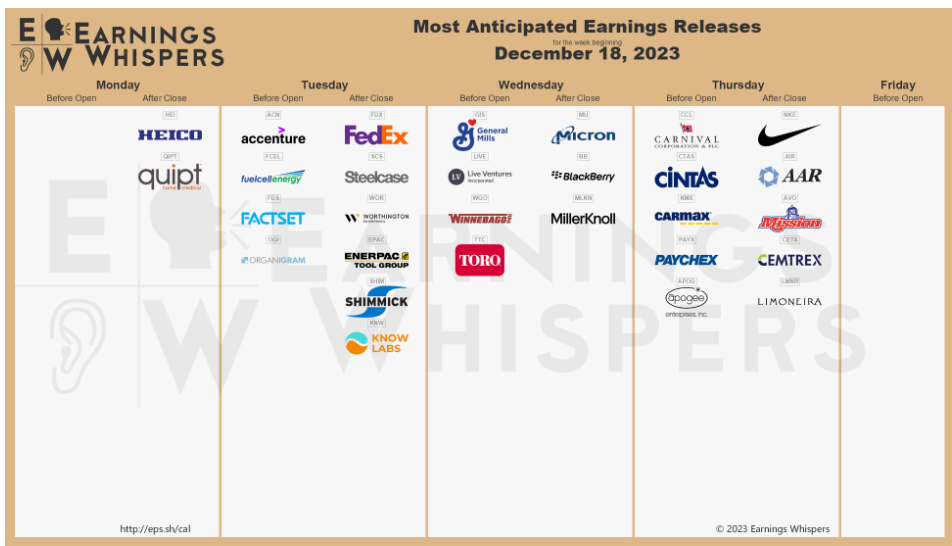
Week of Nov 24, 2023 Weekly Recap & The Week Ahead

November 27th, 2023

1. Home Sales Fell to a New 13-Year Low in October — Home-buying affordability sits near its lowest level in decades, pushing many buyers out of the market. Existing-home sales for the full year in 2023 are on track to be the lowest since at least 2011, according to economist forecasts.
Existing-home sales, which make up most of the housing market, decreased 4.1% in October from the prior month to a seasonally adjusted annual rate of 3.79 million, the lowest rate since August 2010, the National Association of Realtors said Tuesday. October sales fell 14.6% from a year earlier. Sales have been near 2010 levels in recent months.

Here is the market recap for the week
Sector Performance

Most sectors of the market were higher last week, with technology and communication services stocks leading the gains. The technology sector rose 2.1%, while the communication services sector advanced 1.9%. Other sectors that performed well included financials (up 1.3%) and consumer discretionary (up 1.2%).

Notable Developments

— In addition to the factors mentioned above, there were a few other notable developments in the market last week:
— Fed’s monetary policy outlook: Comments from Federal Reserve officials last week suggested that the Fed may be nearing the end of its rate-hiking cycle. This news was seen as positive for the market.
— Geopolitical tensions: Geopolitical tensions remained elevated last week, but they did not appear to have a significant impact on the market.

The week ahead — Economic data from Econoday.com:
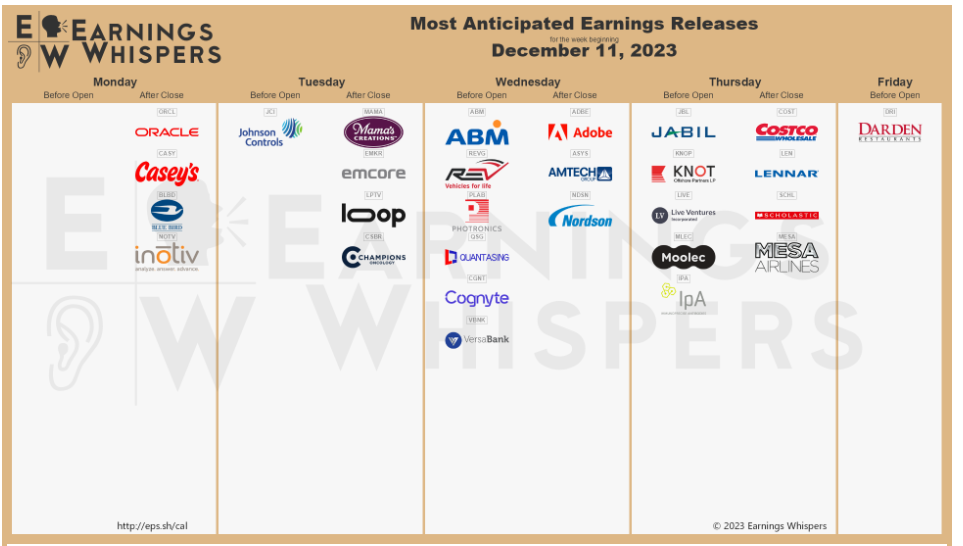
Week of Nov 17, 2023 Weekly Recap & The Week Ahead

November 20th, 2023

I know where I’m getting out before I get in. — Bruce Kovner

1. US Inflation Broadly Slows, Erasing Bets on More Fed Rate Hikes — The so-called core consumer price index, which excludes food and energy costs, increased 0.2% from September, according to government figures. Economists favor the core gauge as a better indicator of underlying inflation than the overall CPI. That measure was little changed, restrained by cheaper gasoline. The Bureau of Labor Statistics figures reflected increases in rent and personal-care products and services, as well as health insurance due to a methodological change in how the government calculates it. Meanwhile, airfares and used-car prices declined.
Shelter prices, which make up about a third of the overall CPI index, climbed 0.3%, half the prior month’s pace. Economists see a sustained moderation in this category as key to bring core inflation down to the Fed’s target. A key measure of rent as well as hotel stays stepped down.
Excluding housing and energy, services prices climbed 0.2% from September and 3.7% from a year ago — the lowest in nearly two years — according to Bloomberg calculations. While Powell and his colleagues have stressed the importance of looking at such a metric when assessing the nation’s inflation trajectory, they compute it based on a separate index.
2. US Producer Prices Decline by Most Since April 2020 on Gasoline — The producer price index for final demand decreased 0.5% from a month earlier, a sharp slowdown that’s largely reflective of a decline in gasoline prices. Excluding food and energy, the so-called core PPI was unchanged, government data showed.
From a year ago, the overall measure was up 1.3%, while the core gauge posted the smallest annual increase since the start of 2021. Over 80% of the decrease in goods prices was due to a 15.3% slump in the cost of gasoline, the government report. Services costs, meanwhile, were flat after rising six straight months.

The week ahead — Economic data from Econoday.com:
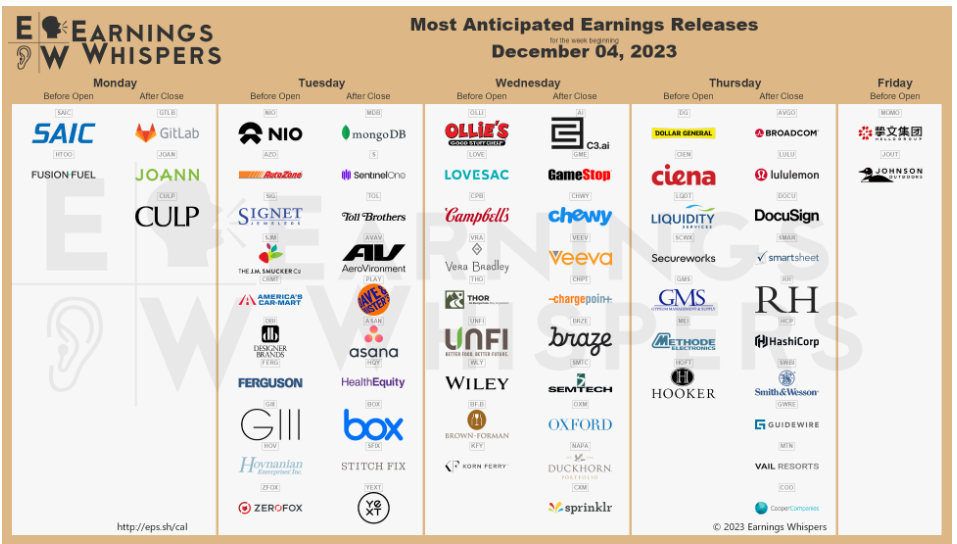
Search
Calendar
February 2026
M T W T F S S
« Jan    
 1
2345678
9101112131415
16171819202122
232425262728  
Archives
Categories
The information provided by The EGS Blog is based on sources believed to be reliable, but it is not guaranteed to be accurate. There is no guarantee that the recommendations of The EGS Blog will be profitable or will not be subject to losses. The information provided by The EGS Blog is not a recommendation or a solicitation that any particular investor should purchase or sell any particular security in any amount, or at all. The investments discussed or recommended herein may be unsuitable for investors depending on their specific investment objectives and financial position. At any time EGS LLC and its principals may maintain positions that are contrary to positions announced within the subscription service. In no event will The EGS Blog be liable to you or anyone else for any incidental, consequential, special, or indirect damage (including but not limited to lost profits or trading losses). PAST PERFORMANCE IS NO GUARANTEE OF FUTURE RESULTS

© Copyright 2026 Market Outlook All Rights Reserved
Design by EGS Sponsored by Equity Guidance LLC