Search

Week Oct 29 2011 – Weekly Recap & The Week Ahead

November 3rd, 2011

DUE TO POWER OUTAGES, LAST WEEK ‘S BLOG WAS POSTED LATE. SORRY FOR ANY INCONVENIENCES.

1. White House to ease home refinancing — In an effort to boost the economy, President Obama is set to today announce an overhaul of the underused HARP program to make it easier for underwater homeowners to refinance their mortgages. The changes will include allowing borrowers to obtain cheaper loans regardless of how far their homes have dropped in value, thereby eliminating previous limits.
2. German parliament backs more EFSF firepower — the German Bundestag passed a motion effectively giving Chancellor Angela Merkel permission to work toward a plan to boost the lending power of the 440 billion euro ($613 billion) European Financial Stability Facility. The measure outlined two strategies for levergaing the fund that won’t require additional contributions from member states.
3. Italian government on the brink as EU plan stalls — the Italian government and a broad European plan to save the euro were both at risk, with Premier Silvio Berlusconi locked in a high-stakes battle with coalition partners to muster support for emergency growth measures demanded by the European Union.
4. U.S. economy grows 2.5% in third quarter — U.S. growth accelerated in the third quarter as consumers and businesses ramped up spending, a report that shows the economy remained resilient in the face of strong headwinds. Gross domestic product in the July-through-September period expanded at a 2.5% annual rate. That’s nearly double the 1.3% rate of growth in the second quarter and much faster than the first quarter’s tepid increase of 0.4%.
5. EU agrees debt deal; 50% Greek debt haircut — Europe will also boost rescue fund firepower, recapitalize banks; European leaders announced a deal in which private investors in Greek government debt will take a 50% writedown on the value of their holdings as part of a wide-ranging package of measures designed to stem the euro-zone debt crisis. Additionally, the European Financial Stability Facility will be increased by as much as five-fold or about €1 trillion. At present, the €440-billion fund has between €250 billion and €275 billion available after the bailouts of Greece, Ireland and Portugal.
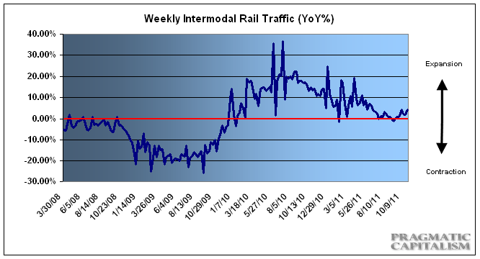
6. Rail Traffic expand Year-over-Year — according to the weekly rail traffic, rail traffic continues to expand despite persistent fears of a renewed downturn. Chart courtesy from the Pragmatic Group.

7. Portugal enters ‘Grecian vortex’ — according to the UK Telegraph Data released by the European Central Bank show that real M1 deposits in Portugal have fallen at an annualised rate of 21pc over the past six months. The M1 data – cash and current accounts – is watched by experts as a leading indicator for the economy six months to a year ahead. It has been an accurate warning signal for each stage of the crisis since 2007.

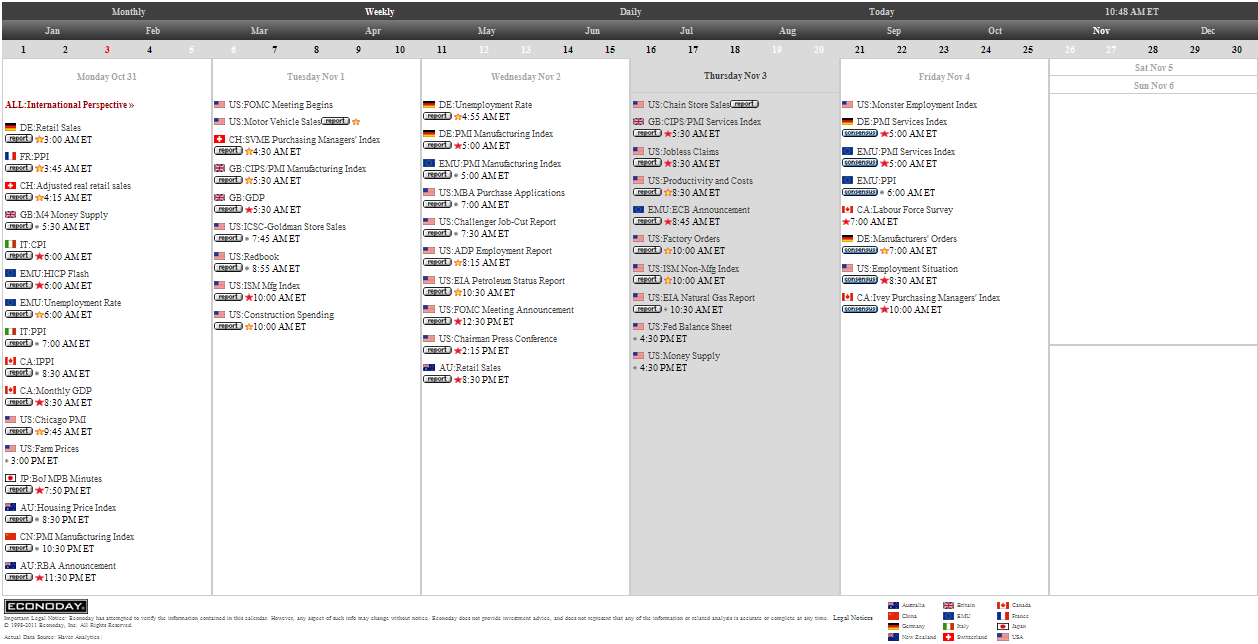
The week ahead — Economic data from Econoday.com:

Week Oct 22 2011 – Weekly Recap & The Week Ahead

October 21st, 2011

“I made my money by selling too soon & never lost money by turning a profit” Bernard Baruch

1. China growth slows — China’s Q3 GDP rose 9.1% Y/Y, shy of expectations for 9.3%, and down from 9.5% in Q2. Though the numbers are relatively healthy, it marks the country’s slowest growth since 2009 and raises concerns that the eurozone debt crisis and general global malaise are taking their toll on China’s momentum.
2. New Mortgage Plan Floated by the government — State and federal officials are pushing a plan that could help some “underwater” borrowers get refinancing assistance in the latest government bid to break a legal impasse with big banks over alleged foreclosure abuses and ease problems in the housing market. The proposal was raised in a meeting last week between government negotiators and giant lenders as part of an effort to settle allegations of questionable foreclosure practices.
3. Lack of liquidity spooks traders — according to the WSJ, Hedge-fund traders and other professional investors are finding that a lack of liquidity is making it increasingly difficult to trade individual stocks without causing large price swings.
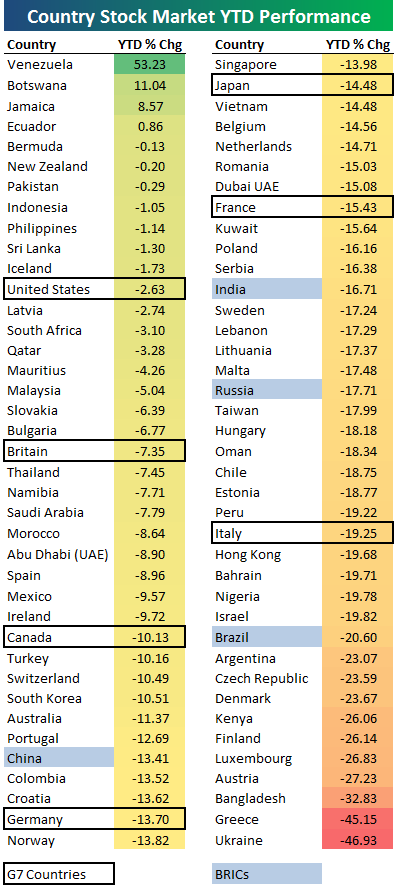
4. Country YTD performance — below is the chart of 78 countries performance courtesy of the Bespoke Investment Group.

5. Draft Proposes Fast, Flexible Bailout Fund — A draft of the guidelines seen by The Wall Street Journal outlines how the €440 billion ($605.44 billion) European Financial Stability Facility would implement the basic principles agreed by European leaders at the July 21 summit. The guidelines provide the EFSF with the ability to purchase sovereign debt directly from countries issuing new bonds or on the open market.
6. Citigroup settles with the SEC — Citigroup (C) will pay $285M to settle charges brought by the SEC that it misled investors in its sale of a mortgage bond deal. The SEC had been investigating whether Citigroup misled investors in the deal, a CDO created from other CDOs backed by subprime mortgages.

The week ahead — Economic data from Econoday.com:

Week Oct 15 2011 – Weekly Recap & The Week Ahead

October 17th, 2011

“Never pay the slightest attention to what a company president ever says about his stock. “Bernard Baruch

1. Dexia bank rescued — Dexia agreed to the nationalization of its Belgian retail bank and secured 90 billion euros ($121 billion) in state guarantees, in a rescue that raises pressure on other euro zone countries to strengthen their banks.
2. Greece likely to get aid tranche in November — Greece is likely to receive an 8 billion euro ($10.9 billion) tranche of aid in early November from its international lenders. This allows the troubled euro-zone nation to avert a near-term default.
3. Senate OKs bill pressuring China over yuan — the Senate approved a bill that would allow new duties on goods from China and other countries that lawmakers say manipulate their currencies.
4. Obama’s jobs bill falls in the Senate — as expected, the Senate late yesterday blocked consideration of President Obama’s $447B jobs plan, with the chamber voting 50-49 in favor of advancing the package, well short of the 60 needed to overcome procedural hurdles.
5. China Export Growth Dwindles to Slowest Pace in Seven Months as Yuan Gains — China ‘s Exports rose a less-than-forecast 17.1 percent in September from a year earlier, the bureau’s data showed in Beijing. The trade surplus was $14.51 billion, the smallest since May. Growth in shipments to Europe, China’s biggest export market, slumped to 9.8 percent, from 22 percent, amid the sovereign-debt crisis in euro-region nations.
6. Fitch Ratings downgraded UBS AG and placed seven other U.S. and European banks on credit watch negative — The ratings agency lowered UBS’s long-term issuer default rating to A from A+. Fitch is also reviewing ratings for Barclays Bank Plc BARCBB.UL, BNP Paribas (BNPP.PA), Credit Suisse Group AG (CSGN.VX), Deutsche Bank AG (DBKGn.DE), Societe Generale SOGNNY.UL, Bank of America Corp (BAC.N), Morgan Stanley (MS.N) and Goldman Sachs Group Inc (GS.N) for further possible downgrades.
7. G20 finance chiefs meet as S&P downgrades Spain — Spain is once again the center of attention after S&P downgraded the country’s long-term debt to “AA-” from “AA” following a similar move from Fitch last week.

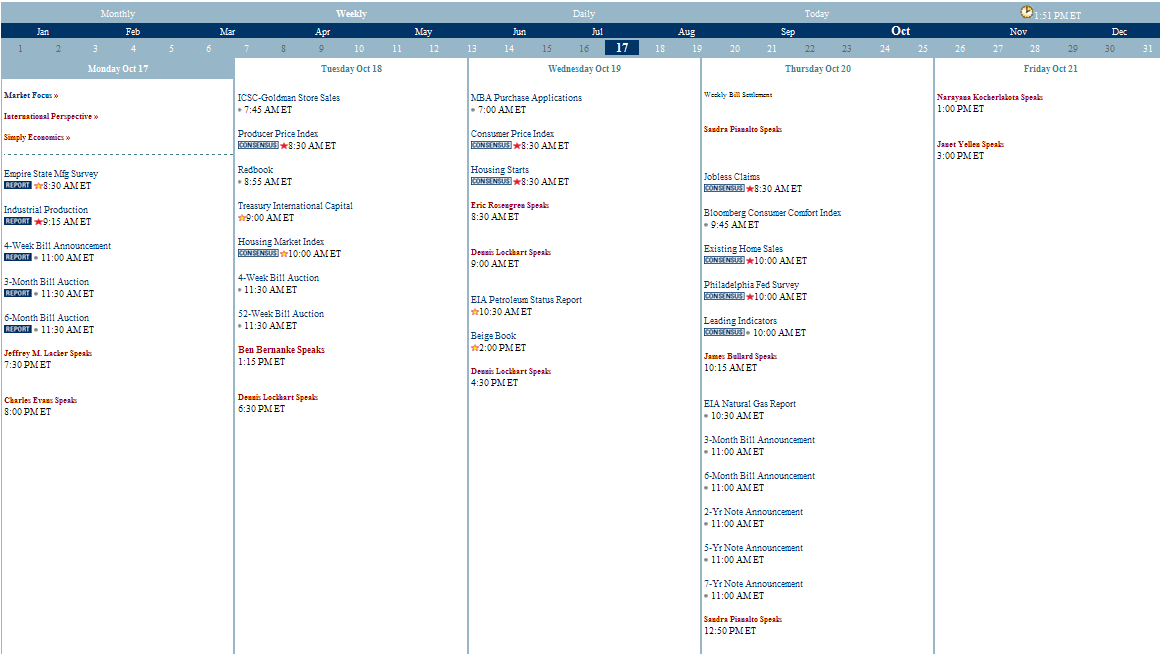
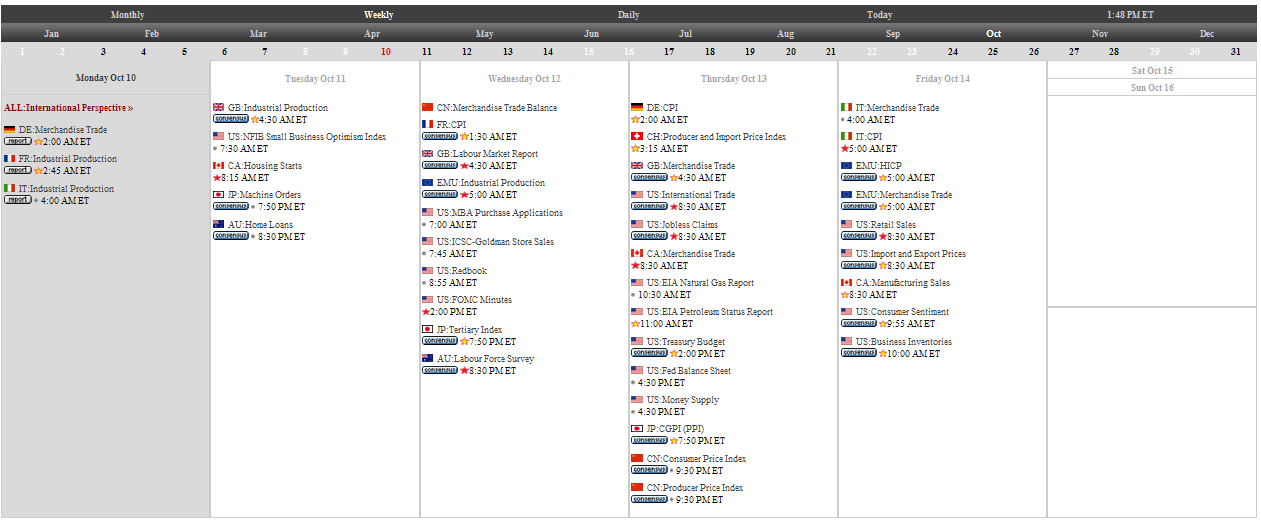
The week ahead — Economic data from Econoday.com:

Week Oct 7 2011 – Weekly Recap & The Week Ahead

October 10th, 2011

“A speculator is a man who observes the future, and acts before it occurs”. Bernard Baruch

1. Greece will miss deficit targets — the Greek cabinet approved the draft 2012 budget and will present it to parliament; However, but while the government agreed to an additional €6.6B ($8.8B) of austerity measures demanded by the troika, the country won’t meet its deficit target this year. Greece’s 2011 deficit is now expected to be 8.5% of GDP vs. its 7.6% target; for 2012, the deficit is set to fall to 6.8%, still above the 6.5% target.
2. China says U.S. yuan bill may spark trade war — China criticized a U.S. Senate decision to move ahead with a bill designed to pressure Beijing on its currency policy, saying the move fosters distrust and could spark a trade war.
3. Moody’s Downgrades Italy — the ratings agency cut Italy’s sovereign debt by 3 notches to A2 with a negative outlook.
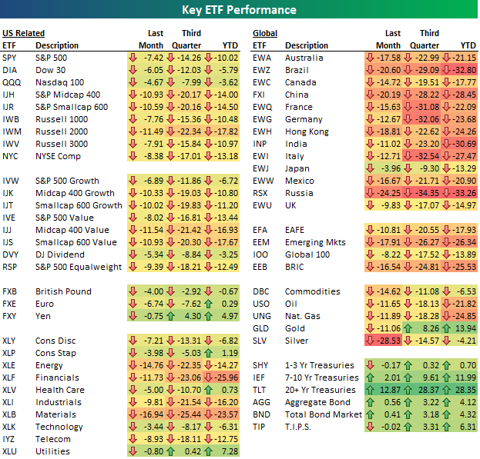
4. Q3 key ETFs performance — below is the table depicting 3Q 2011 performance of selected ETFs courtesy of the Bespoke Investment Group.

5. EU’s President wants coordinated bank recapitalization — the European Union’s executive proposed coordinated recapitalization of banks as the bloc’s regulators met to review capital buffers of stressed lenders.
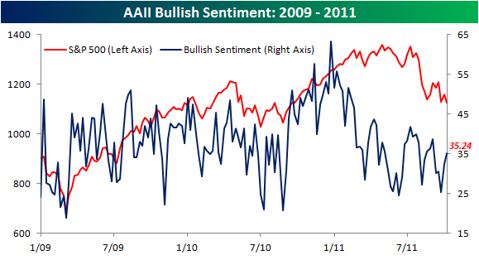
6. AAII Bullish Sentiment Rises
7. Fitch downgrades Italian, Spanish debt ratings — The Fitch agency downgraded its sovereign credit rating for Italy and Spain on Friday and said its long-term outlook for both countries was negative, citing high debt and poor prospects for growth.
Separately, Fitch also said it was keeping Portugal’s debt rating on watch for a possible downgrade, with a decision due by the end of the year.

The week ahead — Economic data from Econoday.com:

Week Sept 30 2011 – Weekly Recap & The Week Ahead

October 3rd, 2011

“The market is better at predicting news than the news at predicting the market” Gerald Loeb.

1. Multi-trillion plan to save the eurozone being prepared — reported by The Telegraph European officials are working on a grand plan to restore confidence in the single currency area that would involve a massive bank recapitalisation, giving the bail-out fund several trillion euros of firepower, and a possible Greek default.
2. Senate approves budget stop-gap — the Senate approved, in a 79-12 vote, stop-gap measures to fund the government for an additional six weeks and avert a shutdown. It also approved, on a voice vote, a one-week extension to give the House time to consider the funding bill; House approval is expected.
3. German parliament approves expanded EU bailout fund — Chancellor Merkel achieved her majority after intense lobbying. A large majority in the German parliament has approved expanded powers for the EU’s main bailout fund. All 17 countries that use the euro must ratify the commitment to expand the powers of the EFSF and boost its bailout guarantees to 440bn euros (£383bn). So far, 10 have approved the measure.
4. Italy and Spain extended their bans on short-selling due to ongoing volatility, according to European regulator ESMA — Italy extended until Nov. 11, while Spain didn’t set a date, saying its decision was based on “protracted instability in European securities markets.”
5. Justice Department probing Chinese accounting — The U.S. Justice Department is investigating accounting irregularities at Chinese companies listed on U.S. stock exchanges, said an official with the Securities and Exchange Commission, suggesting criminal charges may be brought in addition to civil proceedings.

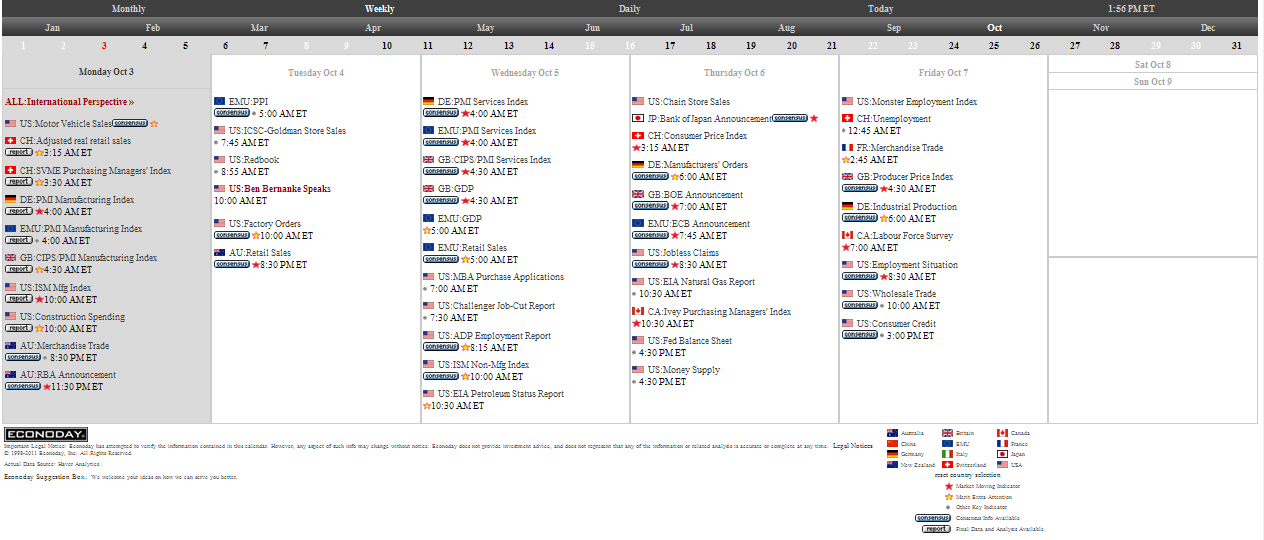
The week ahead — Economic data from Econoday.com:

Week Sept 23 2011 – Weekly Recap & The Week Ahead

September 26th, 2011

“If everyone is thinking alike, then somebody isn’t thinking.” George S. Patton

1. S&P cuts Italy’s sovereign credit ratings — S&P lowered Italy’s long-term credit rating to A from A-plus and cut its short-term rating to A-1 from A-1-plus, citing a weak economic outlook and ongoing political gridlock. S&P also said the outlook for Italy’s ratings is negative, meaning a further cut is possible.
2. Japan’s trade deficit widens — Japan’s trade deficit gapped wider than expected in August, coming in at ¥775.3B ($10.1B) vs. July’s ¥72.5B surplus, as growth in exports weakened. Exports rose 2.8% Y/Y and imports jumped 19.2%.
3. Fed decides on $400 billion bond swap — the Fed said it will buy $400 billion of Treasury securities in the 6- to 30-year range and sell an equal amount of maturities of 3 years or less. The purchases would be completed by the end of June 2012.
The Fed also announced a new plan to purchase agency mortgage-backed securities with proceeds of maturing securities.
4. Moody’s downgrades BAC, WFC & C — Moody’s downgraded Bank of America (BAC) to Baa1 from A2. The move comes from a decrease in the probability the government would support the bank, if necessary, but “do(es) not reflect a weakening of the intrinsic credit quality of BofA.” Moody’s cut Wells Fargo (WFC) to A2 from A1 for the same reason. With Citigroup (C), Moody’s confirmed the company’s long-term rating, saying the bank’s stand-alone credit profile has improved, but downgraded the holding company’s short-term rating to Prime-2 from Prime-1.
5. Moody’s Cuts Eight Greek Bank Ratings by 2 Notches — in a widely expected move, Moody cuts The agency cut National Bank of Greece, EFG Eurobank Ergasias, Alpha Bank, Piraeus Bank, Agricultural Bank of Greece and Attica Bank downgraded to Caa2 from B3.

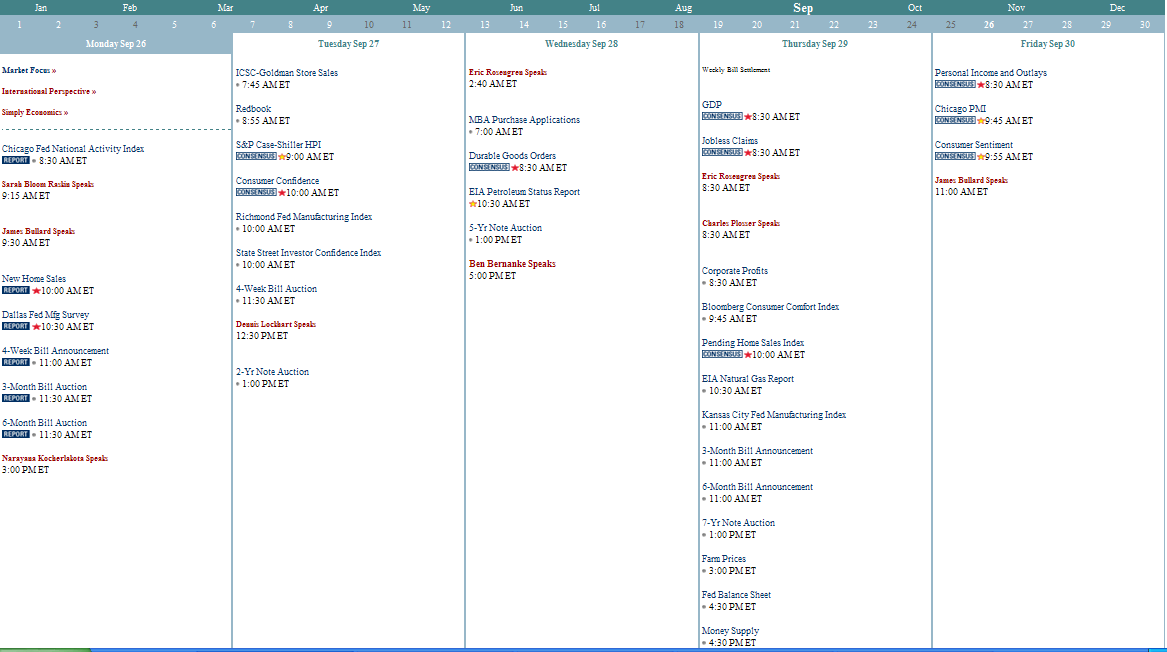
The week ahead — Economic data from Econoday.com:

Week Sept 16 2011 – Weekly Recap & The Week Ahead

September 19th, 2011

“Do you know the only thing that gives me pleasure? It’s to see my dividends coming in”John D. Rockefeller

1. Talks of China to make investment in Italy — The Wall Street Journal and Financial Times said Italy’s finance minister met last week with a delegation of Chinese officials — including the head of China’s sovereign-wealth fund — in an attempt to persuade Beijing to buy a large amount of Italian sovereign debt.
2. Moody downgraded French banks — Moody’s downgraded Credit Agricole’s (CRARY.PK) credit rating to Aa2 from Aa1 and Societe Generale’s (SCGLY.PK) to Aa3 from Aa2, but maintained its Aa2 rating on BNP Paribas (BNPQY.PK), saying the bank’s “profitability and capital base currently provide an adequate cushion to support its Greek, Portuguese, and Irish
3. Treasury to Accommodate Fed on ‘Twist’ — according to sources, “Operation Twist”, the central bank would buy more longer-term Treasury securities to drive down long-term interest rates by reducing the amount of such debt available to other investors. Operation Twist is one of a number of options the Fed will consider when it next meets on Sept. 20.
4. Central Banks Pour Dollars Into Europe — The European Central Bank said it would coordinate with the U.S. Federal Reserve, Bank of England, Bank of Japan and Swiss National Bank to ensure banks unlimited dollar funding through the end of the year to quell fears that the region’s lenders could fall victim to the euro-zone’s government debt crisis.
5. Economists say recession more likely — A WSJ poll of 53 economists sees a 1-in-3 chance – the highest ratio since the start of the recovery – of the economy slipping into recession over the next year.

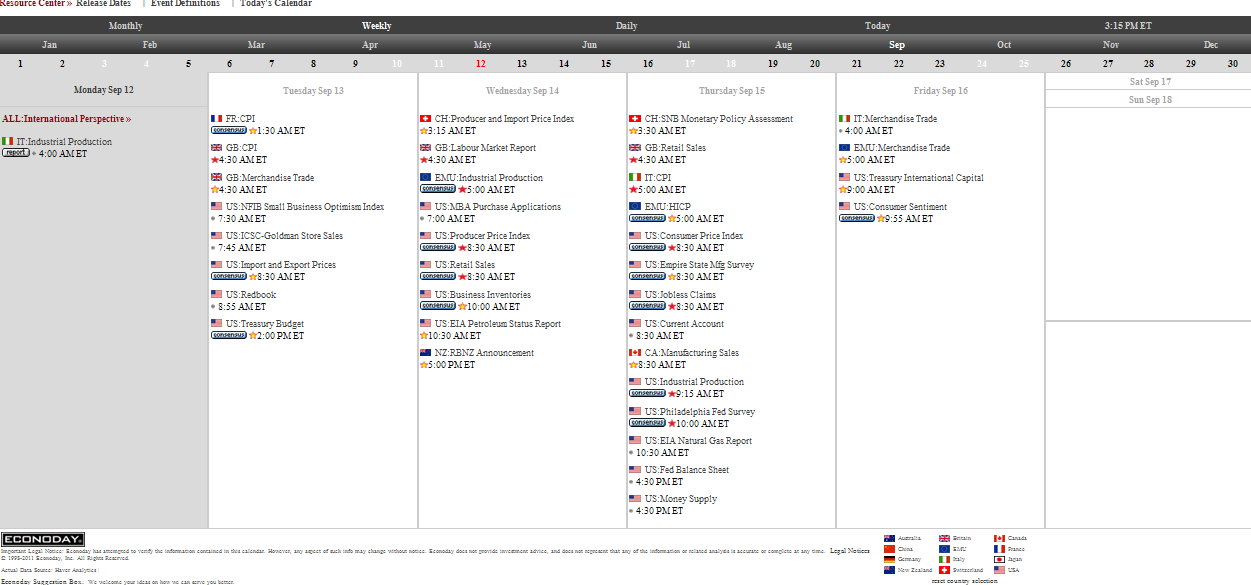
The week ahead — Economic data from Econoday.com:

Mobile Payment Updates — VeriFone(PAY) & NXP Semi (NXPI)

September 16th, 2011

As a follow up to Mobile Payment – Near Field Communications analysis, this article updates the latest events for the two companies mentioned; Verifone (PAY) and NXP Semiconducdor (NXPI).

VeriFone (PAY) (via Yahoo)
VeriFone Systems, Inc. designs, markets, and services electronic payment solutions that enable secure electronic payments among consumers, merchants, and financial institutions worldwide. The company provides countertop electronic payment systems that accept magnetic, smart card, and contactless/radio frequency identification cards; and support credit, debit, check, electronic benefits transfer, and various pre-paid products, as well as offers wireless system solutions.

Reader can access the full Q3 2011 earnings transcript PAY — Q3 Transcript

On Sept 6 2011, VeriFone (PAY) announced Q3 2011 earnings (via Reuter – Q3 2011 earnings release – Sept 6 2011):
* Q3 adj EPS $0.49 vs est $0.46
* Q3 rev up 21 pct
* Sees Q4 adj EPS $0.49-$0.50 vs est $0.49
* Sees Q4 rev $395-$400 mln vs est $395.9 mln
• VeriFone, whose customers are primarily financial institutions, payment processors, petroleum companies and retailers, is seeing growing demand for these mobile payment technologies in the United Kingdom ahead of the 2012 Olympics.
• “In London we have now signed nearly 6000 taxis to five-year processing agreements. UK retailers continue to embrace contactless systems,” Chief Executive Douglas Bergeron said on a conference call with analysts.
• The company continues to work with Google Inc to roll out the Google Wallet mobile payment service, which uses wireless NFC technology on mobile handsets.
• “The next big phase of the Google rollout is currently planned for the end of the month where we go from hundreds of locations to tens of thousands of locations,” CEO Bergeron said on the call.
• Verifone is also working with ISIS — an NFC-based mobile payment joint venture between AT&T , T-Mobile and Verizon Wireless; and PayPal Inc bring mobile payments to point-of-sale terminals in 2012.
• It has also won a $6.9 million contract with the Metropolitan Transportation Authority of New York City to depoly 1000 of its TransitPAY systems on buses which allow NFC-enabled smartphone-based payments.
• If initial rollouts lead to widescale deployment across the industry, the company’s revenue would grow by $100-$150 million in the U.S. and internationally.
Guidance:
• The company expects fourth-quarter adjusted earnings of 49-50 cents per share on sales of $395-$400 million. Analysts were expecting a fourth-quarter profit of 49 cents, on revenue of $395.9 million, according to Thomson Reuters I/B/E/S.
• Growth in North America will likely remain flat in the fourth quarter and will pick up next year, VeriFone said. It expects higher growth from Europe – especially from UK, France and Germany – and from emerging markets.
• Verifone raised its full-year adjusted profit outlook to $1.88-$1.89 a share on sales of $1.289-$1.29 billion, from its prior forecast of an adjusted profit of $1.80-$1.83 a share on sales of $1.17-$1.18 billion.
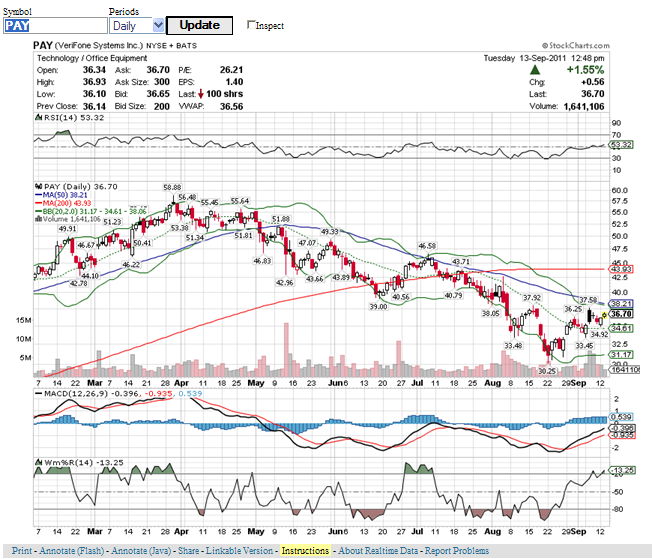
Technical Analysis:
• Expect PAY to encounter the 50-SMA resistance at around $38 range. The stock displayed a “death-cross” figure back in mid-July 2011 around $43. Looking forward, Mid-October is a better month for PAY.

NXP Semiconductor (NXPI) — As profile inYahoo –
NXP Semiconductors N.V., through its subsidiary NXP B.V., provides mixed signal solutions and semiconductor components primarily in Japan, Europe, South Korea, Rest of Asia Pacific, and the Americas. It offers small signal, power, and integrated discretes; and amplifiers, bipolar transistors, data converters, diodes, rectifiers, microcontrollers, sensors, and thyristors. The company’s products are used principally in automotive, identification, mobile, consumer, computing, wireless infrastructure, lighting, and industrial applications. It also develops audio and video multimedia software solutions for mobile phones. The company, formerly known as KASLION Acquisition B.V, was founded in 2006 and is headquartered in Eindhoven, the Netherlands.
News Updates:
• Marketwire -08/30/11 EINDHOVEN, NETHERLANDS- NXP Semiconductors N.V. (NASDAQ: NXPI – News) today announced that Turkcell (NYSE: TKC – News) (ISE: TCELL), the leading communications and technology company in Turkey, has selected the PN544 near field communication (NFC) radio chip for Turkcell’s recently launched T20 smartphone. The T20 handset, manufactured by Huawei, is one of the world’s first commercially available low-cost Android NFC-enabled smartphones.
On August 17, 2011, NXP Semiconductor (NXPI) announced increase in share buy back to 8,000,000 shares from 5,000,000 previouly.
Marketwire – 08/17/11 EINDHOVEN, NETHERLANDSNXP Semiconductors N.V. (NASDAQ: NXPI – News) announced today that its Board of Directors resolved to increase the number of shares to be repurchased under its stock repurchase plan as announced on July 29, 2011, from 5,000,000 shares to 8,000,000 shares.
On July 30, 2011, NXP Semiconductor (NXPI) announced Q2 2011 earnings (via Bloomberg – July 30 2011):
• Second quarter non-GAAP EPS of $0.51 missed the consensus estimate of $0.52 (GAAP EPS was $0.33). Revenue of $1.1 billion was flat year-over-year.
• NXP, based in Eindhoven, Netherlands, now sees NFC deliveries at the lower end or “perhaps even slightly below” an initially predicted range of 40 million to 100 million units, Chief Executive Officer Richard Clemmer said on an analyst conference call.
• The shortfall is caused by a combination of “formulation and agreement on the specific business models to support the ecosystem,” as well as business challenges some handset makers are experiencing
• “Carriers continue to try to figure out an economic proposition,” Clemmer said in a conference call today. The company still believes a substantial increase in mobile transactions will occur, albeit with a delay of one to two quarters, he said. For 2012, NXP expects a doubling of the number of units.
Guidance:
• Product revenue may fall as much as 5 percent in the third quarter versus the second quarter, the company said, and earnings per share will be in the range of 47 cents to 56 cents.
• For the third quarter, management guided non-GAAP EPS to $0.47 to $0.56, nowhere near the $0.66 consensus estimate and potentially falling short of non-GAAP EPS of $0.49 in the year-earlier quarter. In an ominous sign for the outlook beyond the third quarter, the company reduced its 2011 forecast of near-field communication chip shipments, explaining that mobile-phone operators are not expanding wireless payment systems as quickly as previously anticipated.
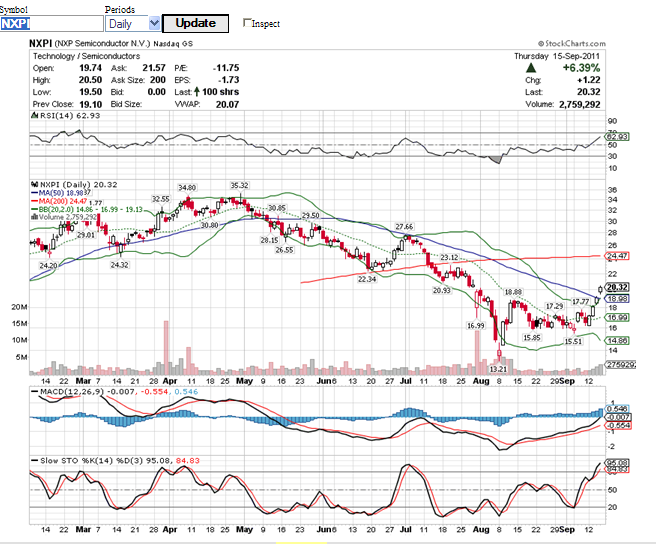
Technical Analysis:
• NXPI moved above the 50-SMA resistance at around $19 range on higher volume. The next level of resistance is around $25 (18% higher from the current price $20.23).

Disclosure: the author owns NXP Semiconductor (NXPI).
Week Sept 9 2011 – Weekly Recap & The Week Ahead

September 12th, 2011

“In the business world, the rearview mirror is always clearer than the windshield”. Warren Buffett

1. ISM services-sector index rises to 53.3% in August — The Institute for Supply Management stated its service-sector index rose to 53.3% in August from 52.7% in July. Economists surveyed by MarketWatch expected the services index to drop to 51.0%.
2. 25 German MPs rebel in prelim European Financial Stability Facility votes — twenty-five lawmakers from Germany’s ruling coalition refused to back a draft law that would boost the powers of the euro zone’s rescue mechanism, underscoring the risk that Chancellor Angela Merkel might fail to secure a conservative majority for the measure.
3. New York subpoenas investors in Goldman securities — New York prosecutors investigating Goldman Sachs (GS) over its mortgage bonds have reportedly subpoenaed Morgan Stanley (MS), hedge funds and other parties that invested in the securities.
4. ECB, Bank of England on hold — The European Central Bank left its key lending rate unchanged at 1.5%; the Bank of England also left its key interest rate on hold at 0.5% and kept its quantitative-easing program on pause.
5. Obama outlines $447B program to reduce unemployment — President Obama unveiled a $447B plan to bring down unemployment, including $240B in payroll tax relief, $49B for extending unemployment insurance, and $50B for transport infrastructure.
6. BofA mulls plan to axe 40,000 jobs — just as President Obama looks to create jobs, Bank of America (BAC) is considering a plan to slash 40,000 positions over a number of years, The Wall Street Journal reported.

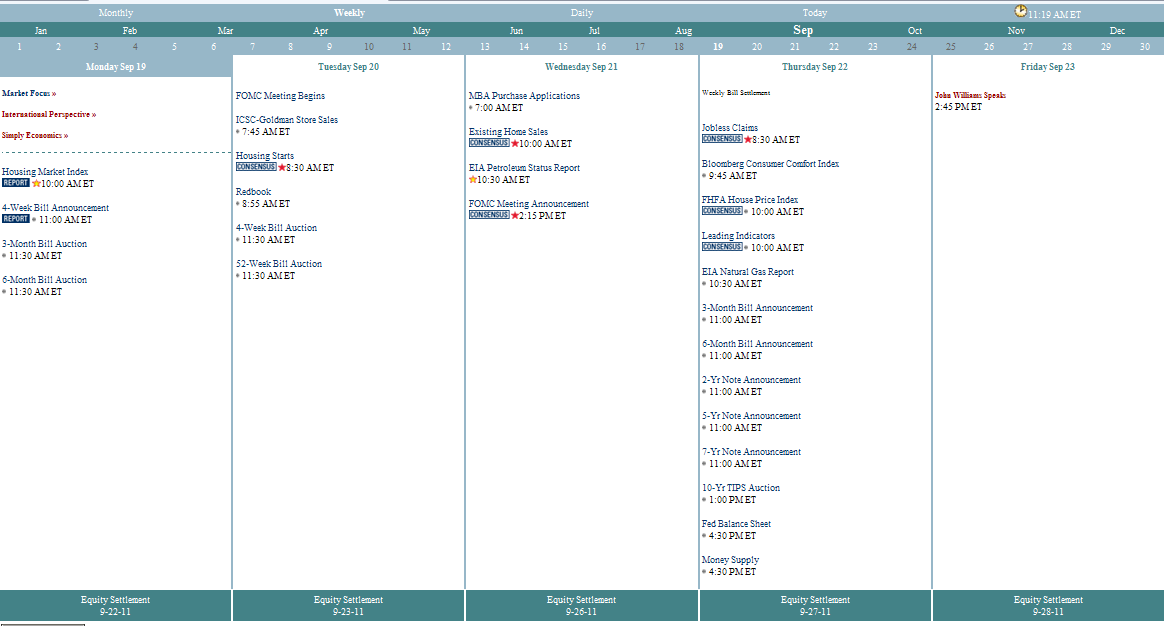
The week ahead — Economic data from Econoday.com:

Week Sept 2 2011 – Weekly Recap & The Week Ahead

September 6th, 2011

“Markets can remain irrational a lot longer than you or I can remain solvent.” John Maynard Keynes.

1. Yoshihiko Noda to be Japan’s new prime minister — Finance Minister and fiscal conservative Yoshihiko Noda will replace Naoto Kan as Japan’s next prime minister after beating Trade Minister Banri Kaieda in a run-off vote for the leadership of the ruling Democratic Party.
2. Obama to choose Alan Krueger to top economic post — Barack Obama today plans to nominate Princeton University’s Alan Krueger to replace Austan Goolsbee as Chairman of the White House Council of Economic Advisers.
3. China Widens Reserve Ratio to Limit Inflation — China broadened the base of reserves it requires commercial lenders to deposit with the central bank to control liquidity and limit inflation, economists said.
4. QE3 expectations rise after FOMC minutes — expectations for more bond buying have increased after the minutes from the FOMC’s August 9 meeting showed that some policy makers were in favor of the move in order to help spur the economy, for which the Fed painted a gloomy picture.
5. The U.S. government sued to block Deutsche Telekom’s $39 billion sale to AT&T Inc of T-Mobile USA — the U.S. government citing concerns it will harm competition in the wireless market and lead to higher prices.
6. IMF pours further doubt on strength of EU banks — an IMF analysis shows that marking the sovereign bonds of six highly indebted eurozone countries to market would reduce the tangible common equity of EU banks by about €200B ($287B), or 10%-12%. The countries concerned are the usual suspects of Ireland, Greece, Portugal, Italy and Spain plus Belgium.
7. UAW workers OK strike option — in advance of a contract expiration on September 14, UAW workers in Detroit have voted to give union leaders the option of calling a strike against Ford (F).
8. U.S. said ready to sue big banks over mortgages — a federal U.S. agency is ready to sue more than a dozen major banks, arguing that they misrepresented the quality of mortgage securities they put together and sold in the run-up to the bursting of the housing bubble, according to a published report. The suits are aimed at Bank of America Corp., Goldman Sachs Group Inc., J.P. Morgan Chase & Co., Deutsche Bank AG and others, the report said, citing three unidentified individuals briefed on the matter.
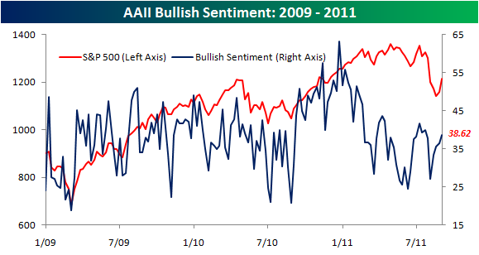
9. Bullish Sentiment Up Again — According to AAII’s weekly poll of investor sentiment, bullish sentiment rose to 38.62% in the latest week. This represents the fourth straight week where bullish sentiment has improved. Chart courtesy from the Bespoke Investment Group.

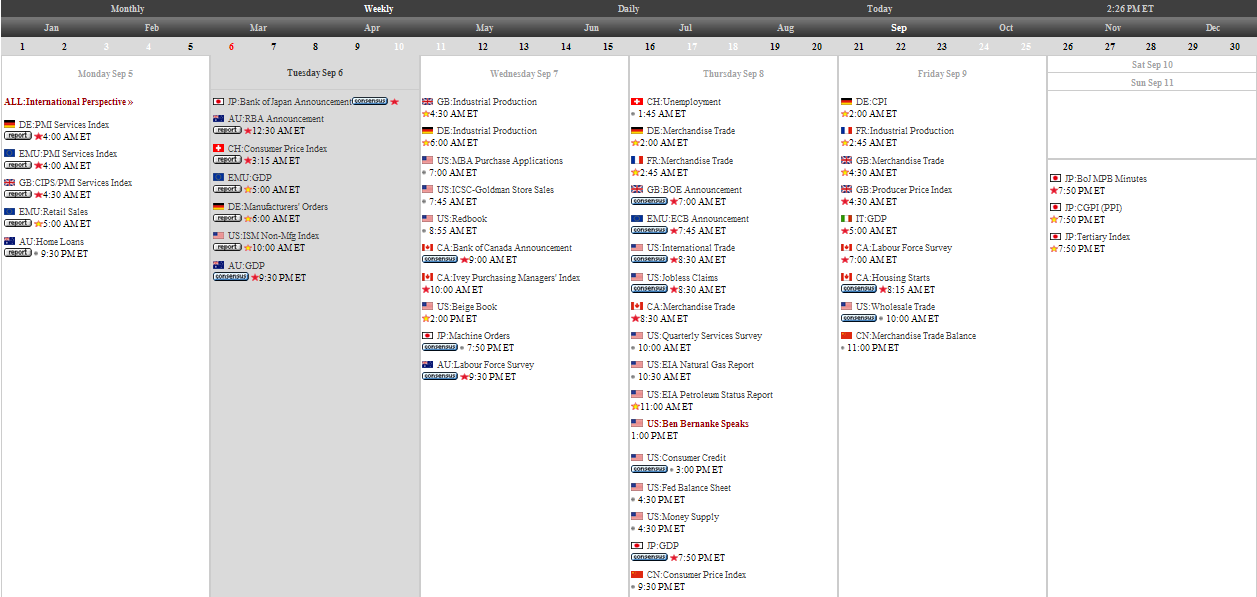
The week ahead — Economic data from Econoday.com:

Search
Calendar
June 2026
M T W T F S S
« May    
1234567
891011121314
15161718192021
22232425262728
2930  
Archives
Categories
The information provided by The EGS Blog is based on sources believed to be reliable, but it is not guaranteed to be accurate. There is no guarantee that the recommendations of The EGS Blog will be profitable or will not be subject to losses. The information provided by The EGS Blog is not a recommendation or a solicitation that any particular investor should purchase or sell any particular security in any amount, or at all. The investments discussed or recommended herein may be unsuitable for investors depending on their specific investment objectives and financial position. At any time EGS LLC and its principals may maintain positions that are contrary to positions announced within the subscription service. In no event will The EGS Blog be liable to you or anyone else for any incidental, consequential, special, or indirect damage (including but not limited to lost profits or trading losses). PAST PERFORMANCE IS NO GUARANTEE OF FUTURE RESULTS

© Copyright 2026 Market Outlook All Rights Reserved
Design by EGS Sponsored by Equity Guidance LLC