Search

Week of Jan 25 2013 – Weekly Recap & The Week Ahead

January 28th, 2013

“For all the sad words of tongue and pen, the saddest are these: It might have been.” — John Whittier; an influential American Quaker poet

1. GlaxoSmithKline (GSK) flu vaccine linked to narcolepsy — per Reuters, GlaxoSmithKline’s (GSK) Pandemrix H1N1 swine flu vaccine, which was given to over 30M people in 47 countries during the 2009-2010 H1N1 swine flu pandemic, has been linked with hundreds of cases of the incurable sleep disorder narcolepsy in Europe.
2. China factory activity improves further in JanuaryMarketWatch, according to HSBC, the so-called “flash” manufacturing Purchasing Managers’ Index (PMI) for January climbed to a 24-month high of 51.9, rising from a final reading of 51.5 in December and 50.5 in November. A reading above 50 signals an expansion in manufacturing activity.
The final reading of HSBC’s PMI, as well as the results from an official survey jointly conducted by China’s National Bureau of Statistics and the China Federation of Logistics & Purchasing, are slated for release on Feb. 1.
3. Apple Shares Plummeted as Sales Missed — Apple (AAPL) shares FQ1 revenue missed Street forecasts for the third consecutive quarter despite climbing 18% to $54.51B. iPhone sales jumped 29% to 47.8M, the figure was below predictions of 50M. Net profit was flat at $13.07B due to higher manufacturing costs as gross margins slid, while EPS came in at $13.81 and beat consensus.
4. Spanish unemployment hits record — Spanish 10-year bond yields may be only just above 5%, but the crisis in the real economy continued unabated in Q4, with unemployment rising to a record 26.02% from 25.01% in Q3. The number of people out of work reached 6M, or a third of the eurozone’s jobless citizens.
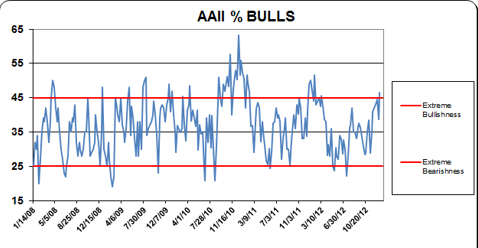
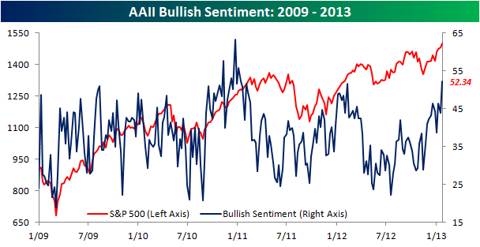
5. AAII Bullish Sentiment Jumps To A 2-Year High — the weekly sentiment survey from the American Association of Individual Investors (AAII), bullish sentiment saw its largest weekly increase since June 2011.

6. U.K. economy returns to contraction — U.K. preliminary Q4 GDP fell a greater-than-expected 0.3% on quarter vs +0.9% in Q3. The economy is 3.3% smaller than at its peak in Q1 2008 and has only recovered about half the output lost during the financial crisis.

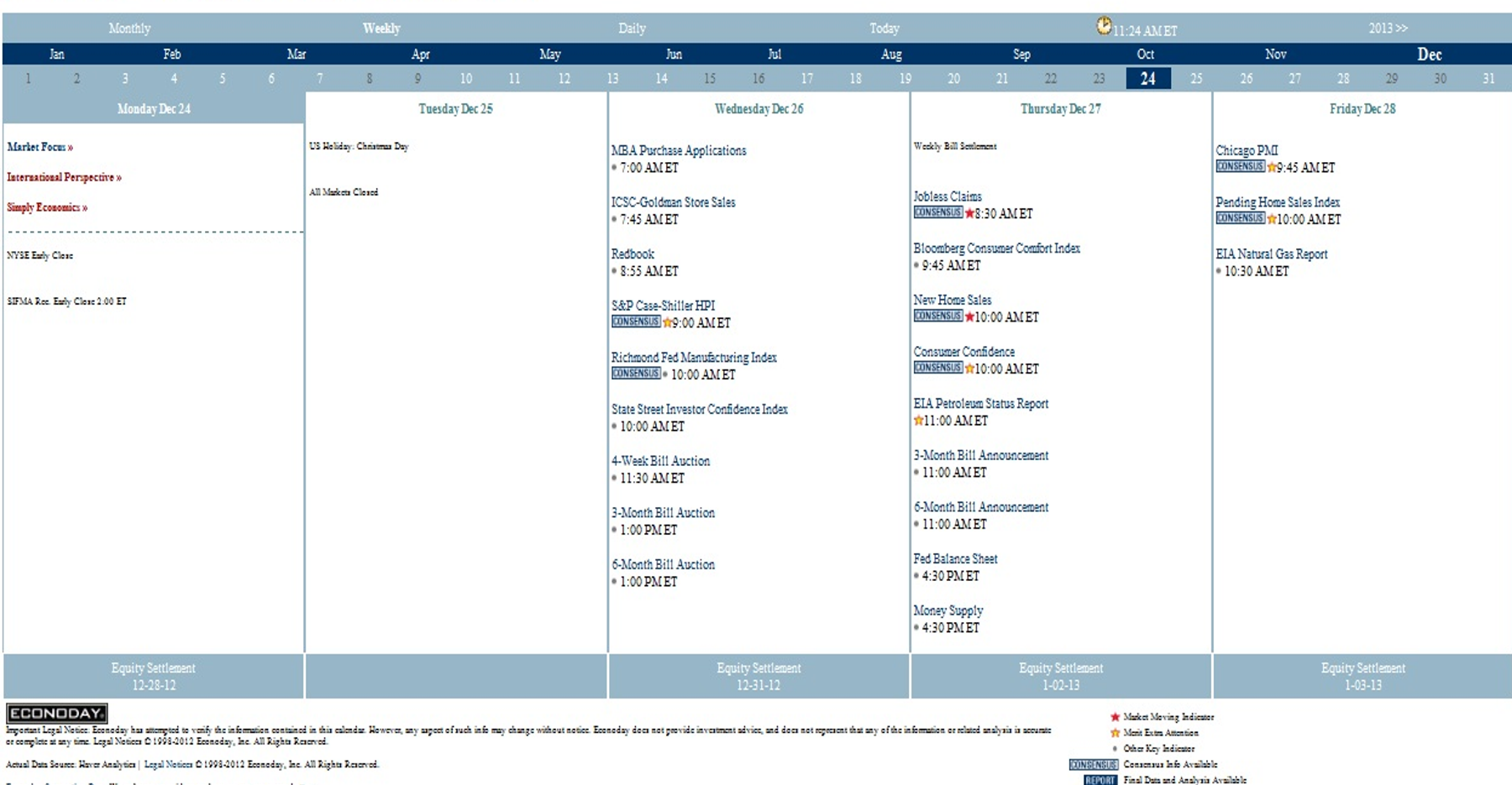
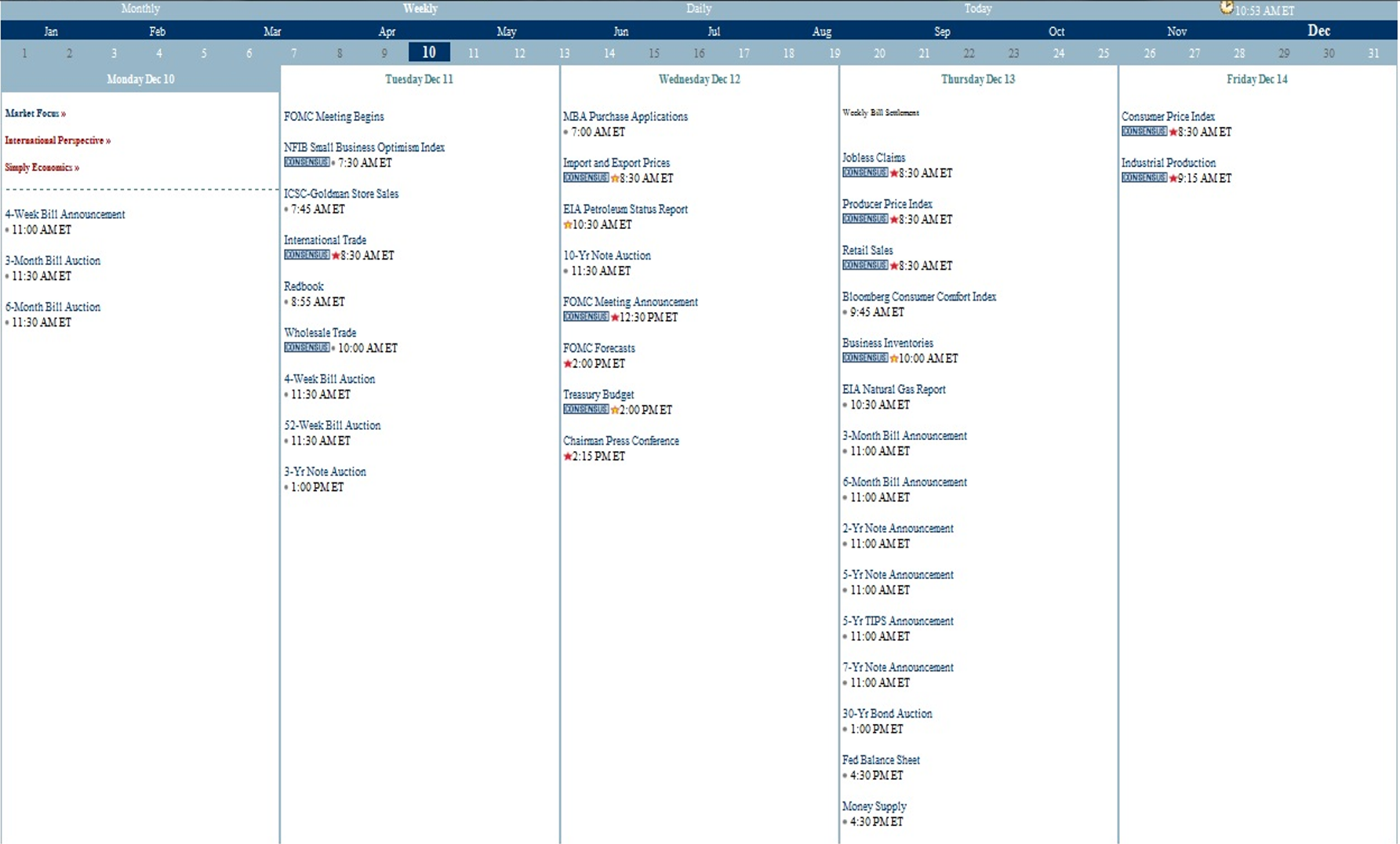
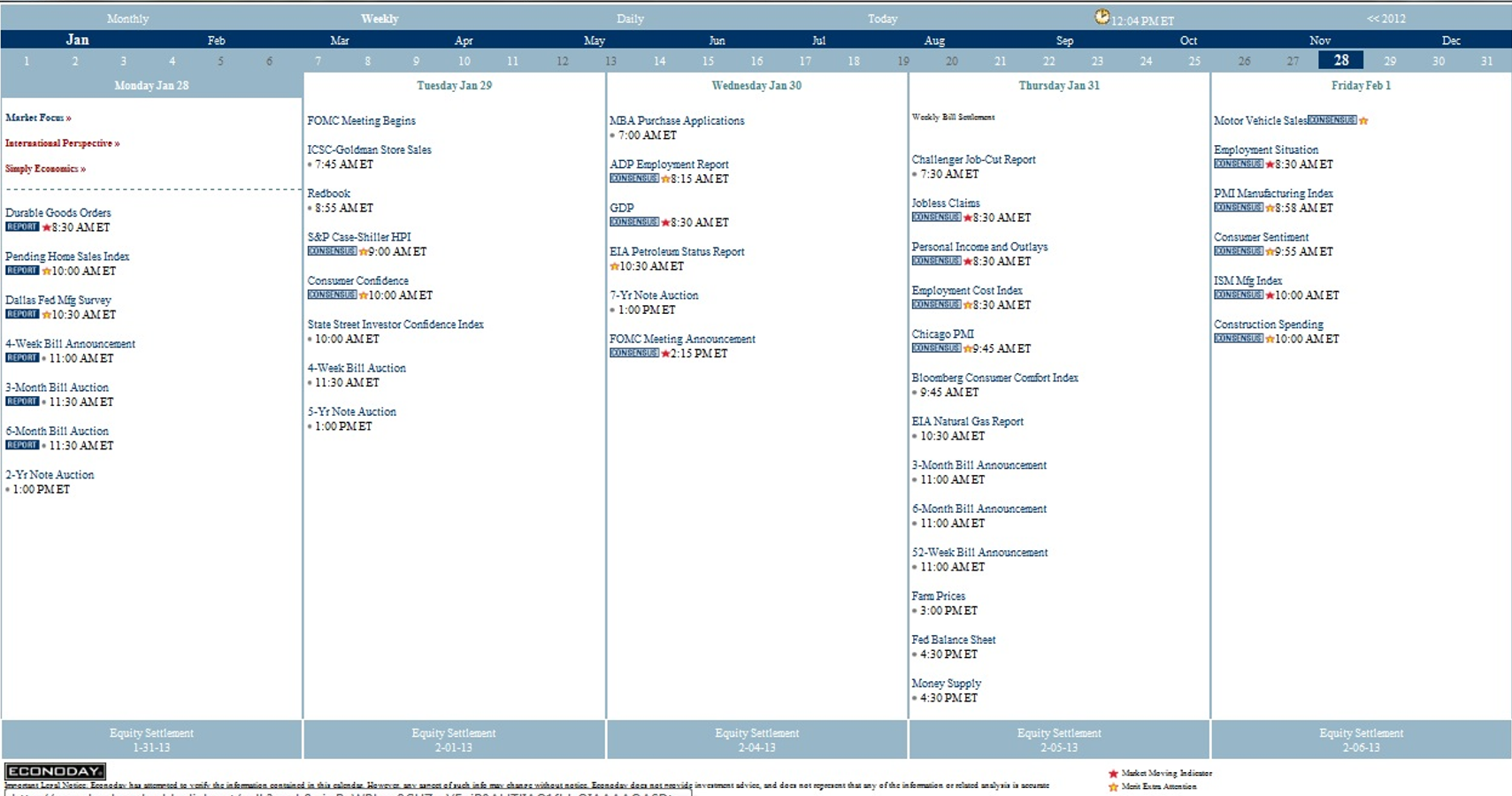
The week ahead — Economic data from Econoday.com:

Ray Dalio, Soros — Interviews from Davos

January 24th, 2013

Ray Dalio is the founder of the investment firm Bridgewater Associates, the company is the largest hedge fund in the world with nearly $120 billion under management based in Westport, CT.

Part 1 — Dalio’s Perspective on Deleveraging: Davos from CNBC

Part 2 — Dalio on Policy & Productivity: Davos

http://video.cnbc.com/gallery/?video=3000143315

Soros Interview

http://www.cnbc.com/id/100401701

Week of Jan 18 2013 – Weekly Recap & The Week Ahead

January 21st, 2013

“It never was my thinking that made the big money for me. It always was my sitting. Got that? My sitting tight! It is no trick at all to be right on the market. You always find lots of early bulls in bull markets and early bears in bear markets. I’ve known many men who were right at exactly the right time, and began buying or selling stocks when prices were at the very level which should show the greatest profit. And their experience invariably matched mine–that is, they made no real money out of it. Men who can both be right and sit tight are uncommon.” — Jesse Livermore

1. China May Open Capital Markets Further — per WSJ, the Chinese government could substantially increase the amount of money foreign institutional investors can invest in the nation’s capital markets, its top securities regulator said. China could boost quotas for foreign investment in its capital markets by 9-10 times, Guo Shuqing, the chairman of the China Securities Regulatory Commission stated.
2. PC sales fall as Windows 8 fails to make impact — Global PC shipments fell 4.3% to 90.3M units in Q4, Gartner said, due to the rise and rise of tablets, although the firm’s estimate is slightly less pessimistic than that of IDC.
3. Chicago Fed President Charles Evans “Fed could end QE if 1M-1.5M jobs created” — Chicago Fed President Charles Evans has said that the Fed could end its bond-buying if the economy creates another 1M-1.5M jobs over the next six months to a year. “That would be indicative that we could stop,” said Evans.
4. AAII Bull/Bear Sentiment — below a chart depicting Bull/Bear Sentiment indicating the market is short-term overbought;

5. Rio Tinto approved iron-ore expansion plan — Rio Tinto (RIO) has approved a major expansion of its Australian iron ore mines, in the latest sign that a roughly 80% rebound in the price of the steelmaking commodity since September is rekindling mining investment in the resource-rich country. Rio Tinto, the world’s second-largest producer of iron ore after Brazil’s Vale (VALE), said it aims to increase production capacity in the remote Pilbara region to 360 million metric tons a year by mid-2015. The Anglo-Australian miner had already approved lifting capacity to 290 million tons by the end of this year.
6. Global regulators ground Boeing’s Dreamliners — the FAA and regulators in Europe, Japan, India and Qatar have ordered the airlines under their jurisdictions to ground their 787 jets until Boeing (BA) can resolve problems with the aircraft’s lithium-ion batteries.
7. Chinese economy re-accelerates — China’s GDP rose 7.9% on year in Q4, slightly beating forecasts and topping Q3 growth of 7.4%. The re-acceleration confirms that the government’s stimulus policies and a boost in trade have started to pull the economy out of its slowdown, although the full-year growth of 7.8% was the lowest since 1999.

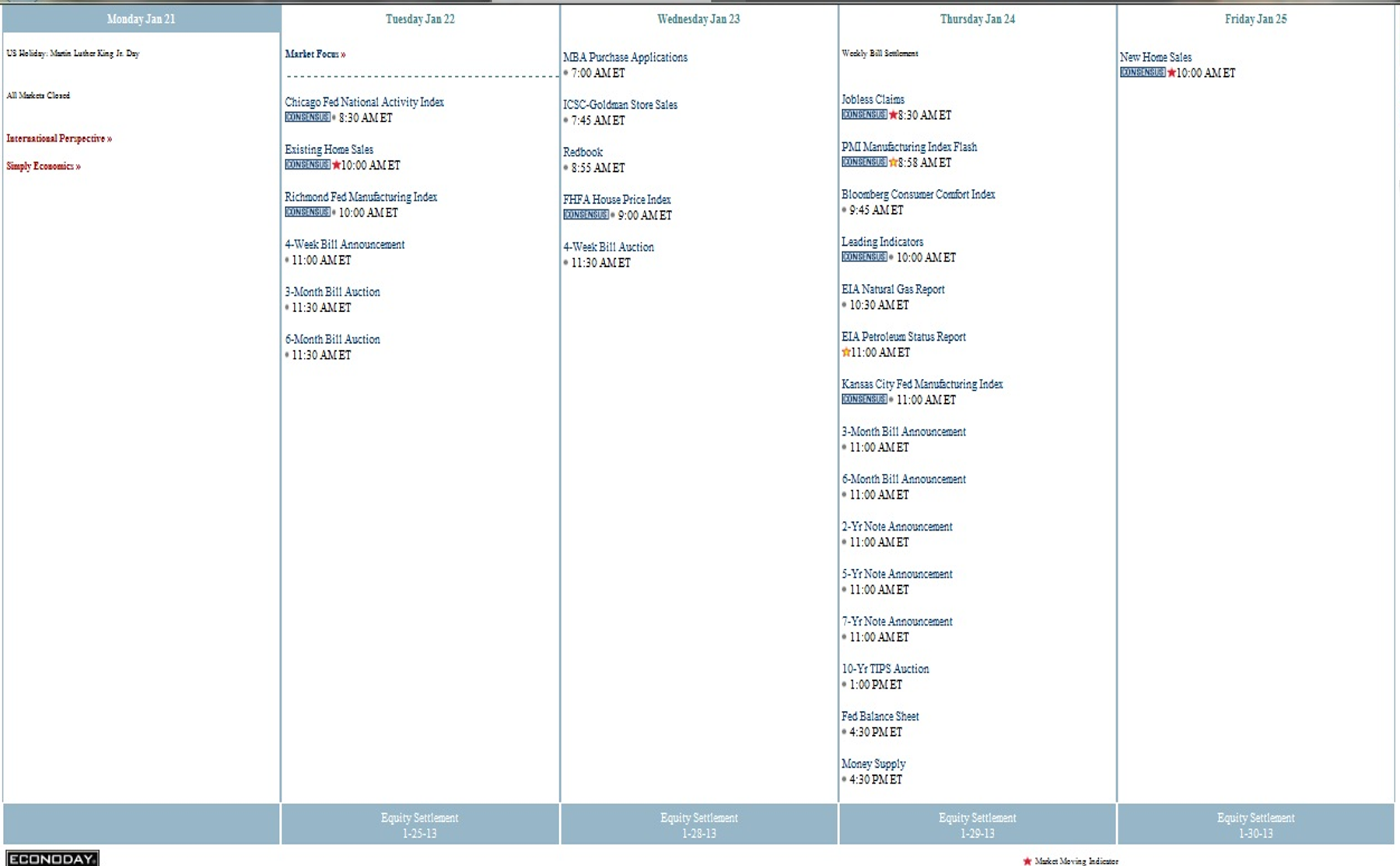
The week ahead — Economic data from Econoday.com:

Week of Jan 11 2013 – Weekly Recap & The Week Ahead

January 14th, 2013

“Never make predictions, especially about the future.” — Casey Stengel

1. Japan to Buy European Debt With Currency Reserves to Weaken the YenBloomberg, Japan plans to use its foreign- exchange reserves to buy bonds issued by the European Stability Mechanism and euro-area sovereigns, as the nation seeks to weaken its currency, Finance Minister Taro Aso said. The purchase amount is undecided.
2. Growth in healthcare expenditure remains slack — Healthcare spending rose at a record low pace of 3.9% to $2.7T in 2011 as patients continued to cut back on medical services amid the economic slump. The growth was the same as in 2010 and 2009, and well below the 8% prior to the financial crisis. However, there are signs that the rise in spending could be speeding up again, with expenditure on drugs increasing by 2.9% in 2011 vs 0.4% in 2010, and on doctors’ visits by 4.3%.
3. China’s exports surged in December, Boosting Trade Surplus — per MarketWatch, China’s December exports jumped 14.1% from a year earlier, up from a 2.9% gain in November, while imports were up 6%, following on from zero growth the previous month, according to data released Thursday by the General Administration of Customs. Bank of America-Merrill Lynch noted shipments to the U.S. leapt 9.6% on year, while those to the euro zone edged up 1.9%, reversing from shrinking trade conditions in November, when the value of shipments contracted 2.6% and 18%, respectively.
4. China annual inflation slows in 2012 — According to the data from the National Bureau of Statistics in China, the Chinese consumers price index grew 2.5 per cent in the month, year-on-year. The producer price index, however, which is reflective of wholesale prices, dropped at a more-than-expected 1.9%.
5. Ford to hire 2,200 salaried staff in U.S. in 2013 — Ford (F) intends to recruit 2,200 white-collar workers this year in what would be the car-maker’s biggest expansion of new salaried positions in over ten years. Three-quarters of the jobs will be in engineering, manufacturing and IT as Ford expands and refreshes its product line-up globally, including in China, where the company plans to triple the number of models sold to 15.

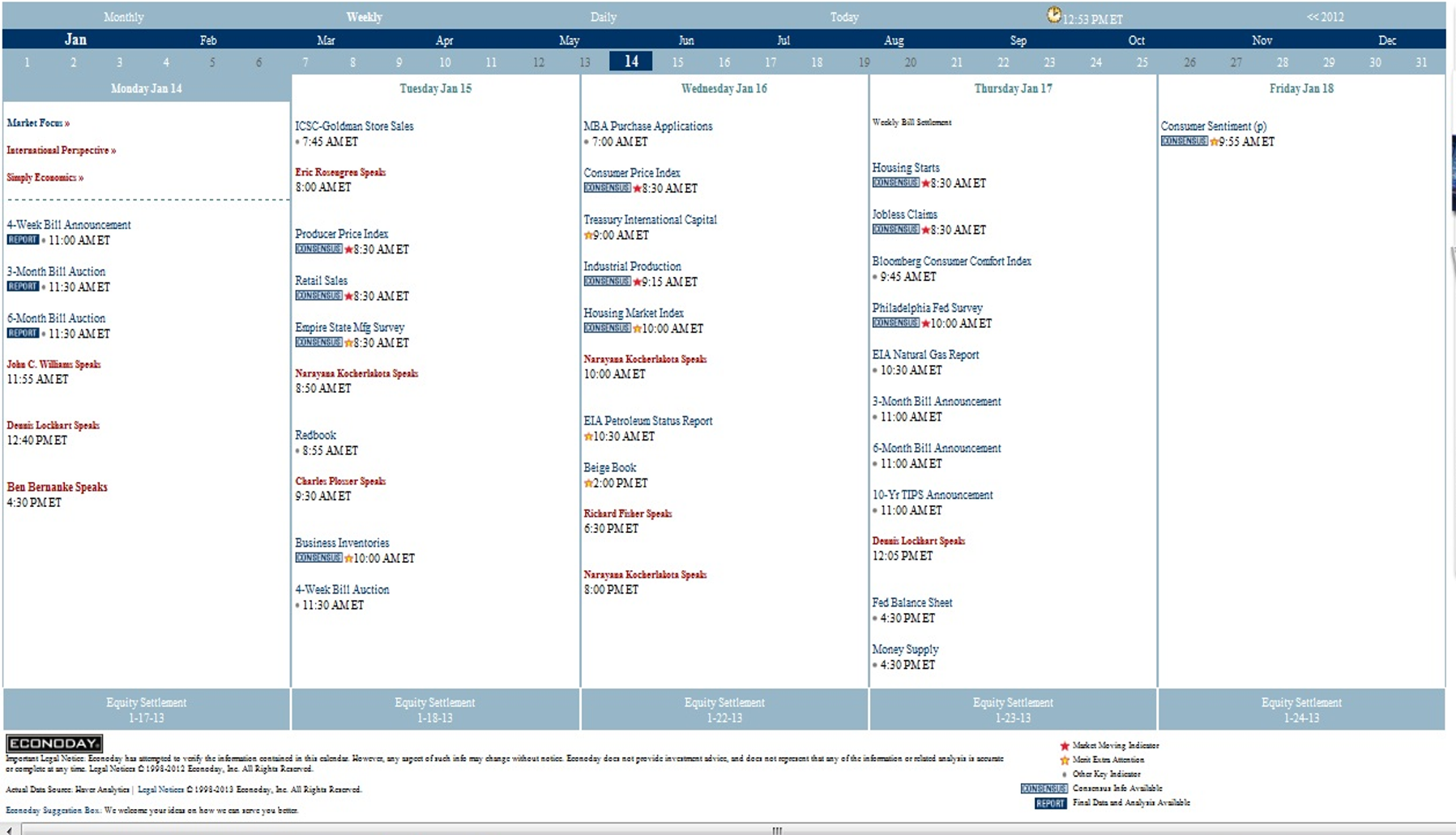
The week ahead — Economic data from Econoday.com:

Week of Jan 4 2013 – Weekly Recap & The Week Ahead

January 7th, 2013

Adios 2012! — Happy New Year from Equity Guidance!
“The market will do what it does to embarass a large group of investors” — Leon Cooperman

1. US fiscal cliff deal averted — the deal has averted most of these measures, including:
– making permanent tax cuts dating back to George W Bush’s presidency, for individuals earning less than $400,000
– postponing the $65bn of automatic spending cuts for two months
– keeping benefits available for the long-term unemployed, worth $26bn, for another year
– postponing for another year an $11bn cut in Medicare payments

However, the deal did also allow some tax rises to go ahead, namely:
– the expiry of a payroll tax holiday, expected to raise $95bn in additional annual revenue
– allowing the Bush-era income tax cuts for individuals earning over $400,000 to come to an end, with the top rate increasing from 35% to 40%
– higher taxes on dividend income, capital gains and inheritance for these same top earners
– phasing out certain income tax deductions for individuals earning more than $200,000
2. Growth in China’s services industries speeds up – China’s non-manufacturing PMI rose to 56.1 in December from 55.6 in November, with the construction services sub-index increasing to 61.9 from 61.3. That’s consistent with a recovery in the property sector, which supports 40 other industries.
3. Investors swap stock-pickers for ETFsWSJ, Investors are jumping out of mutual funds managed by professional stock pickers and shifting massive amounts of money into lower-cost funds that echo the broader market. Investors pulled $119.3B out of actively managed vehicles in January-November and poured $154B into stock and bond exchange-traded funds, with both figures the largest since 2008. The trends reflect the under-performance and higher fees of the stock pickers. Companies benefiting include Vanguard, BlackRock (BLK) and Pimco.
4. Some FOMC members turn hawkish, QE to end at 2013 — Fed policy officials “were approximately evenly divided” between those who want endless QE and those who surprisingly want to end it by the middle of this year, the minutes of the latest meeting show.
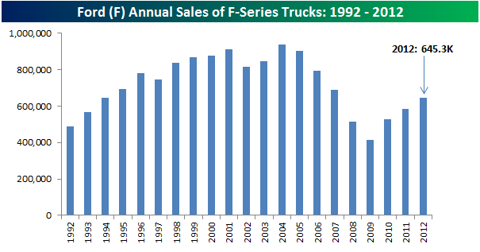
5. Ford F-Series Truck Sales Highest Since 2007 — courtesy of BIG, For the month of December, Ford sold 68.8K F-Series trucks, which was a slight increase from December 2011. For the entire year, total sales of F-Series trucks were 645.3K, representing a 10.3% increase from 2012, and the third straight year of annual increases.
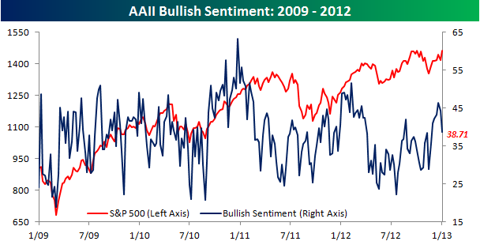
6. American Association of Individual Investors (AAII) sentiment report — after five straight weeks of increases, bullish sentiment declined for the second week in a row, falling from 44.4% down to 38.7%.

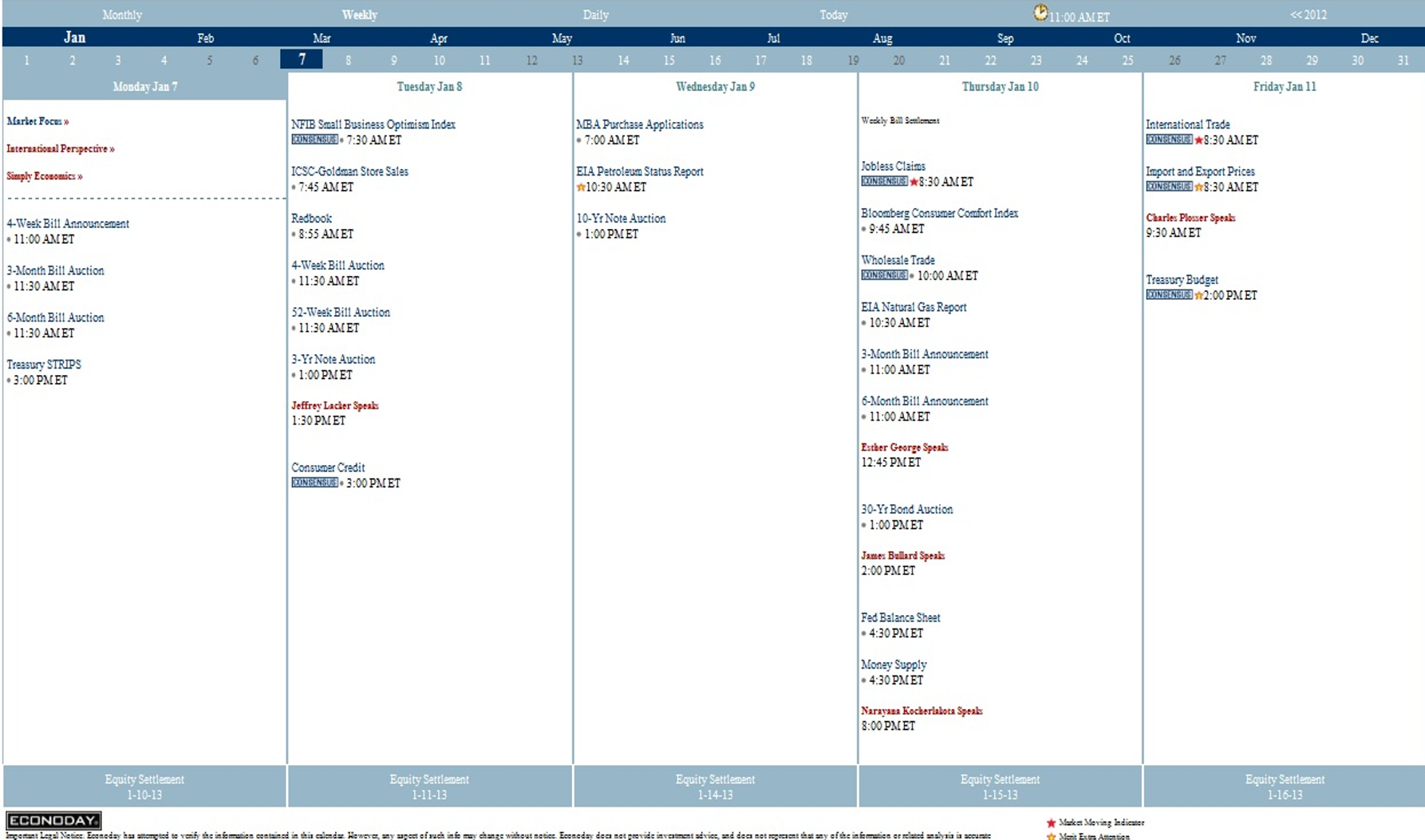
The week ahead — Economic data from Econoday.com:

Byron Wien Announces Predictions for Ten Surprises for 2013

January 3rd, 2013

Byron started the tradition in 1986 when he was the Chief U.S. Investment Strategist at Morgan Stanley. Byron joined Blackstone in September 2009 as a Senior Advisor to both the firm and its clients in analyzing economic, political, market and social trends.
Byron’s Ten Surprises for 2013 are as follows:

1.Iran announces it has adequate enriched uranium to produce a nuclear-armed missile and the International Atomic Energy Agency confirms the claim. Sanctions, the devaluation of the currency, weak economic conditions and diplomacy did not stop the weapons program. The world must deal with Iran as a nuclear threat rather than talk endlessly about how to prevent the nuclear capability from happening. Both the United States and Israel shift to a policy of containment rather than prevention.

2.A profit margin squeeze and limited revenue growth cause 2013 earnings for the Standard & Poor’s 500 to decline below $100, disappointing investors. The S&P 500 trades below 1300. Companies complain of limited pricing power in a slow, highly competitive world economic environment.

3.Financial stocks have a rough time, reversing the gains of 2012. Intense competition in commercial and investment banking, together with low trading volumes, puts pressure on profits. Layoffs continue and compensation erodes further. Regulation increases and lawsuits persist as an industry burden.

4.In a surprise reversal the Democrats sponsor a vigorous program to make the United States independent of Middle East oil imports before 2020. The price of West Texas Intermediate crude falls to $70 a barrel. The Administration proposes easing restrictions on hydraulic fracking for oil and gas in less populated areas and allowing more drilling on Federal land. They see energy production, infrastructure and housing as the key job creators in the 2013 economy.

5.In a surprise reversal the Republicans make a major effort to become leaders in immigration policy. They sponsor a bill that paves the way for illegal immigrants to apply for citizenship if they have lived in the United States for a decade, have no criminal record, have a high school education or have served in the military, and can pass an English proficiency test. Their goal for 2016 is to win the Hispanic vote, which they believe has a naturally conservative orientation and which put the Democrats over the top in 2012.

6.The new leaders in China seem determined to implement reforms to root out corruption, to keep the economy growing at 7% or better and to begin to develop improved health care and retirement programs. The Shanghai Composite finally comes alive and the “A” shares are up more than 20% in 2013, in contrast with the previous year when Chinese stocks were down and some developing markets, notably India, rose.

7.Climate change contributes to another year of crop failures, resulting in grain and livestock prices rising significantly. Demand for grains in developing economies continues to increase as the standard of living rises. More investors focus on commodities as an investment opportunity and increase their allocation to this asset class. Corn rises to $8.00 a bushel, wheat to $9.00 a bushel and cattle to $1.50 a pound.

8.Although inflation remains tame, the price of gold reaches $1,900 an ounce as central bankers everywhere continue to debase their currencies and the financial markets prove treacherous.

9.The Japanese economy remains lackluster and the yen declines to 100 against the dollar. The Nikkei 225 continues the strong advance that began in November and trades above 12,000 as exports improve and investors return to the stocks of the world’s third largest economy.

10.The structural problems of Europe remain largely unresolved and the mild recession that began there in 2012 continues. Civil unrest subsides as the weaker countries adjust to austerity. Greece proves successful in implementing policies that reduce wasteful government expenditures and raise revenues from citizens who had been evading taxes. European equities, however, decline 10% in sympathy with the U.S. market.

“Every year there are always a few Surprises that do not make the Ten because either I do not believe they are as relevant as those on the basic list or I am not comfortable with the idea that they are “probable.” Below are several “also rans” which did not make the Ten Surprises.”
“Also Rans”
11.Having traded below 20 for most of 2012 the VIX Volatility Index surges 33% to 30, providing a bonanza for traders. The decline in the S&P 500 increases market volatility.

12.The Newtown, Connecticut, massacre finally convinces Congress to do something about gun control. As a first step they ban future civilian purchases of automatic weapons, including handguns, with clips of more than ten rounds and require more extensive background checks on all gun purchases. “It should not be easier to buy a gun than rent a car” becomes a slogan.

13.Frustrated by an inability to increase revenues through raising income taxes, Congress begins to consider different approaches. There is more talk of a value-added tax as well as a wealth tax, and these ideas appear to be slowly gathering momentum.

14.Congress decides that high-frequency and other computerized algorithmic-based trading practices are putting the individual investor at a disadvantage.
A transaction fee designed to slow down frenetic activity and protect against “flash crashes” and glitches is imposed on intra-day trades.

15.The planet finds itself saturated with technology. Semiconductor companies, software providers, social media favorites and personal computer manufacturers all report disappointing earnings and provide discouraging guidance. They lead the overall market lower. Users finally agree the present state of the art is fast enough and connected enough, and that they have more “apps” than they know what to do with. Apple bucks the trend and trades above $700 as its products continue to enjoy enormous success abroad.
Week Dec 28 2012 – Weekly Recap & The Week Ahead

December 31st, 2012

“While markets often make double bottoms, three pushes to a high is the most common topping patterns” — J. Bollinger

1. Government Eyed Refi Program Expansion — The Obama administration is considering expanding its mortgage-refinancing programs to include borrowers whose mortgages aren’t backed by the government and who owe more than their homes are worth, according to people familiar with the discussions. Currently only borrowers on loans held by Fannie Mae (FNMA.OB) or Freddie Mac (FMCC.OB) can qualify for the HAMP, leaving about 50% of the nation’s 10.8M underwater mortgages locked out of the program.
2. Holiday sales season looked weak — the early results suggest it’s been a weak holiday season for retailers, with MasterCard’s SpendingPulse reporting sales just 0.7% higher than last year. “It’s a lost season,” says the group’s Michael McNamera.
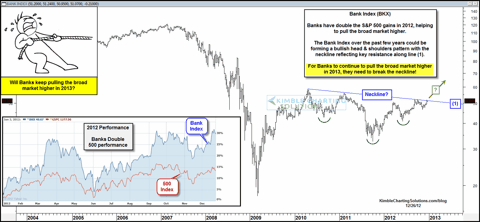
3. Bank Index (XLF) for 2013 — Will XLF moves higher for 2013? The technical chart below shows a bullish inverse Head-and-Shoulder pattern.

4. Home Prices Post Gain in 2012, Hit a Milestone — Home prices are on track to notch their first yearly gain since 2006, the strongest performance since the housing bust and a development that could accelerate the real-estate rebound even as the broader economy stutters. Since January, prices are up 6.9% so far this year, the largest year-to-date.
5. Ford to invest $773M on Michigan facilities — Ford (F) said it intends to invest more than $773M to upgrade and expand 6 Michigan manufacturing plants. It’s part of a pledge to invest $6.2B in U.S. facilities through the end of 2015.
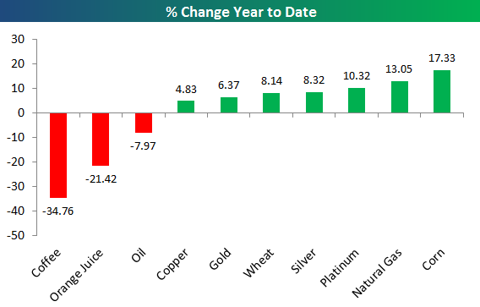
6. 2012 Commodity Performance — courtesy of Bespoke, below is a chart of Commodity Performance in 2012 YTD.

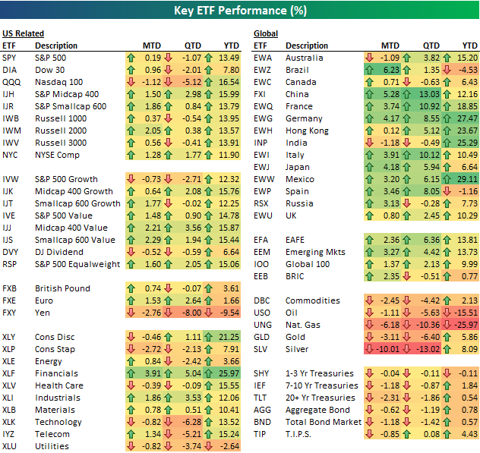
7. Key ETFs YTD Performance in 2012 — chart highlights the month-to-date, quarter-to-date and year-to-date performance of selected ETFs.

8. Hewlett-Packard Says Justice Department Probing AutonomyBloomberg, The U.S. Justice Department opened an investigation relating to Autonomy Corp. after Hewlett- Packard Co. (HPQ) accused the software company of misrepresenting its performance before being bought last year.

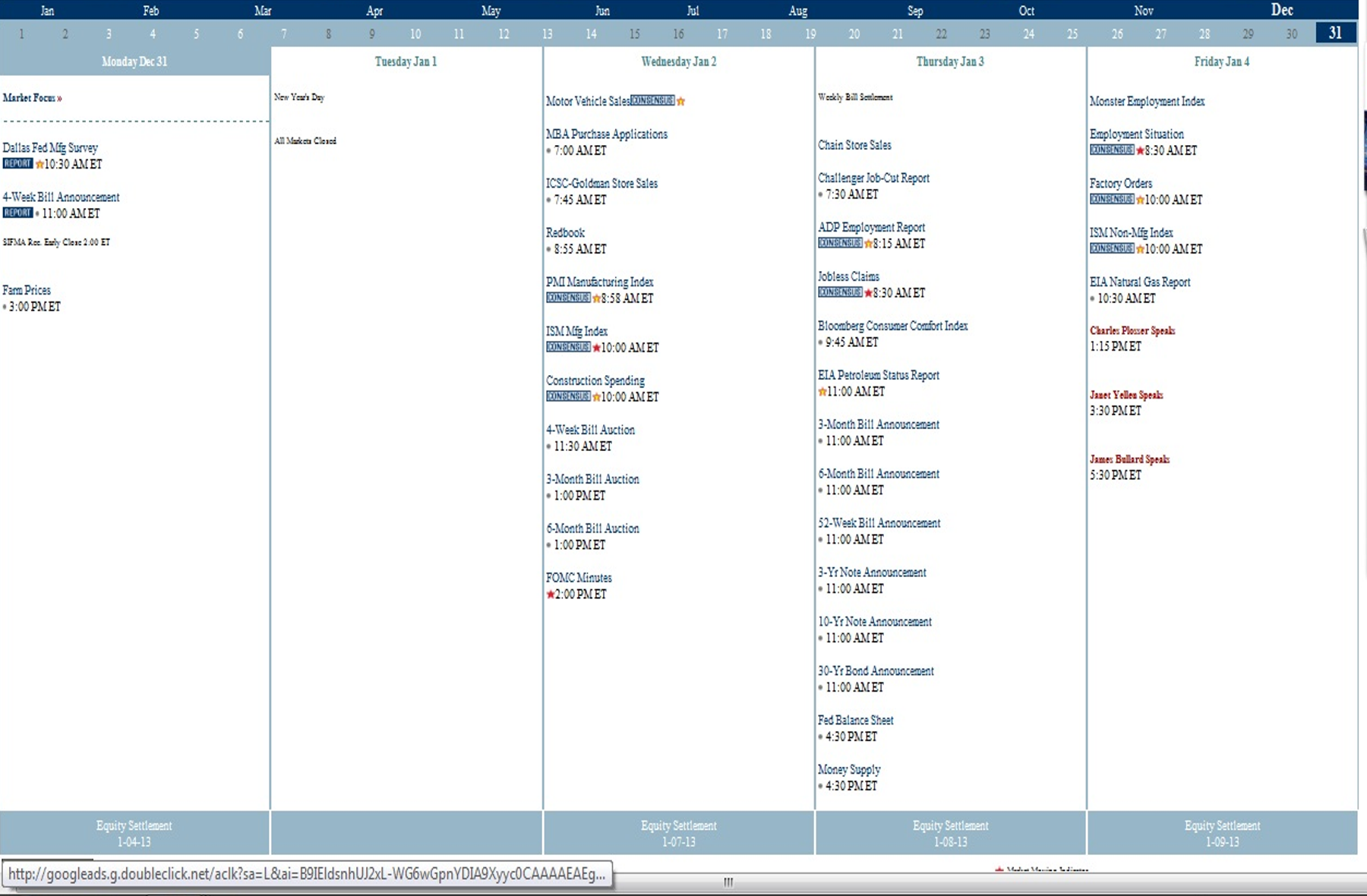
The week ahead — Economic data from Econoday.com:

Week Dec 18 2012 – Weekly Recap & The Week Ahead

December 24th, 2012

“Genius is the ability to put into effect what is in your mind” — F. Scott Fitzgerald

1. Fitch Rating Agency threatens downgrade if U.S. falls off cliff — Fitch has warned that a failure to avert the fiscal cliff will increase the likelihood that it will strip the U.S. of its AAA rating.
2. House-Senate Defense Conference Agrees on $640.7 Billion — per Bloomberg, House and Senate negotiators reached a deal over a $640.7B defense budget for the current fiscal year, including $88.5B for operations in Afghanistan. However, the spending doesn’t account for the automatic cuts that are due to take place if the fiscal cliff is not averted.
3. BOJ adds to QE but doesn’t increase inflation target — the Bank of Japan has bowed to the demands of incoming Prime Minister Shinzo Abe and increased the size of its asset-purchase program by ¥10T ($119B) to ¥76T, the third hike in the last four months.
4. U.S. unveils plan to manage huge Alaskan oil reserve Reuter, Interior Secretary Ken Salazar yesterday presented a plan under which the government will open up 11.8M acres of Alaska’s North Slope for energy drilling. The area holds an estimated 549M barrels of economically recoverable oil, or 72% of the crude in the 23M-acre reserve, and 8.7T cubic feet of economically recoverable natural gas.
5. Boehner’s Plan B fiscal cliff bill pulled amid dissension in GOP caucus — House Speaker John Boehner’s proposal to avert the looming fiscal cliff’s automatic tax increases failed to gain enough Republican support. The House will recess until after Christmas with Speaker John Boehner saying it’s now up to the president to work with Senator Reid to create legislation to help the U.S. avert the cliff.
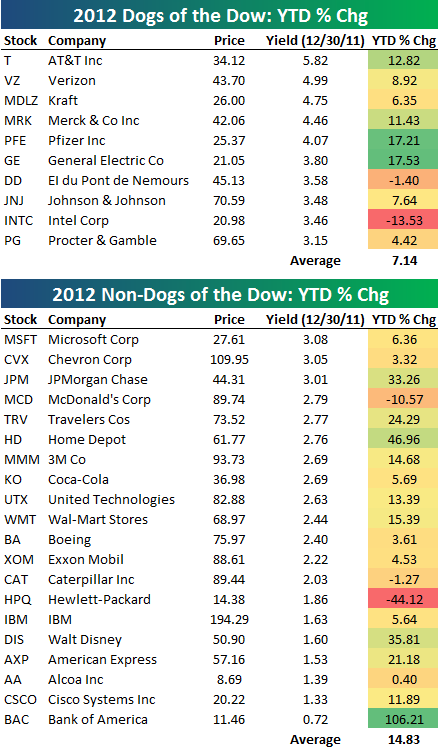
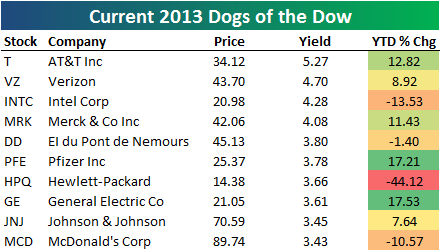
6. Dogs of the Dow strategy in 2012 — per Bespoke, the Dogs of the Dow strategy says to buy the ten highest yielding Dow Jones Industrial Average at the start of each year. YTD, this strategy underperformed the major averages.

The week ahead — Economic data from Econoday.com:

Week Dec 12 2012 – Weekly Recap & The Week Ahead

December 16th, 2012

“The market is a voting machine, whereas countless individuals register choices which are the product partly of reason and partly of emotion” — Graham & Dodd

1. Monti’s plan to quit sends markets into turmoil — Italian shares have sunk 3.3% and 10-year bond yields soared 36 bps to 4.88% after Prime Minister Mario Monti said he plans to resign once the 2013 budget is authorized.
2. Japan slips back into recession — Japan’s Q3 GDP fell an annualized 3.5%, worse than a forecast of -3.3%. With the government revising Q2 from growth to slight contraction, the country technically slipped into a recession in the last quarter.
3. Ingersoll to Spin Off Security Unit in Peltz Accord— per WSJ, Ingersoll-Rand PLC (IR) is expected to announce a plan to spin off its security-technology business, launch a share-buyback program and increase its dividend as part of a compromise reached with Trian Fund Management LP.
4. Obama offers to revamp tax code — the White House has reportedly offered to include an overhaul of the corporate tax code in any deal on the fiscal cliff, although it didn’t provide specifics, such as how the reform would affect the overall tax burden. The Administration also cut its goal for new tax revenue to $1.4T from $1.6T.
5. Fed Sets Jobless Rate, Inflation Targets and to Purchase More BondsFed Chairman Ben Bernanke and his colleagues agreed, for the first time, they would hold rates close to zero while the unemployment rate is above 6.5% as long as inflation is not projected to rise above 2.5%. As expected, the Fed announced a new $45 billion bond-buying program in fresh action to keep the recovery going in the languishing jobs market.
6. China manufacturing data show further improvementMarketWatch, Business conditions for Chinese manufacturers improved further in December. HSBC’s so-called “flash” manufacturing PMI for December — a closely watched indicator of the world’s second-largest economy — came in at 50.9, compared to a final print of 50.5 for November and 49.5 for October. A reading above 50 signals an improvement in activity, while one under 50 represents contraction.

The week ahead — Economic data from Econoday.com:

Week Dec 6 2012 – Weekly Recap & The Week Ahead

December 10th, 2012

“Winners never quit and quitters never win” — Vince Lombardi

1. China PMI GrowsMarketWatch, The privately compiled version of China’s manufacturing Purchasing Managers’ Index (PMI) rose to 50.5. The official PMI increased to 50.6 from 50.2, marking a seven-month high for the index.
2. House, White House aim for $32-$35 billion in farm bill cutsReuters, both sides believe that spending in the 2012 farm bill should be slashed by $32-35B, with major cuts for subsidies and soil conservation. However, the GOP wants reductions for food stamps, a move the White House is opposed to. Under the fiscal cliff, money for farm programs would fall by up to $10B.
3. Senate Passes $631 Billion U.S. Defense LegislationBloomberg, the Senate passed unanimously a measure authorizing $631.4 billion for U.S. defense programs this fiscal year. Huntington Ingalls Industries Inc., Boeing Co. (BA) and General Dynamics Corp. (GD) are among defense contractors that would benefit because the legislation increases funding over this year’s levels for fighter jets, missiles, submarines and other programs.
4. Germany faces possible recession — the Bundesbank has warned that Germany may be entering recession, saying that the economy could contract in FQ4 and FQ1. The bank also cut its 2012 and 2013 GDP predictions to +0.7% and +0.4% respectively from prior forecasts of +1% and +1.6%.
5. Generic Drug Accords Face Review by U.S. Supreme Court — per Bloomberg, the Supreme Court could say today whether it will review a case involving a “pay for delay” agreement in which a pharmaceutical company pays generic rivals tens of millions of dollars to hold off from launching copycat versions of medicines. The FTC says the practice costs customers $3.5B a year, while drug firms argue that it protects innovation. Companies that could be affected include Abbott (ABT), Watson (WPI), Merck (MRK), Bristol-Myers Squibb (BMY) and Teva (TEVA).

The week ahead — Economic data from Econoday.com:

Search
Calendar
June 2026
M T W T F S S
« May    
1234567
891011121314
15161718192021
22232425262728
2930  
Archives
Categories
The information provided by The EGS Blog is based on sources believed to be reliable, but it is not guaranteed to be accurate. There is no guarantee that the recommendations of The EGS Blog will be profitable or will not be subject to losses. The information provided by The EGS Blog is not a recommendation or a solicitation that any particular investor should purchase or sell any particular security in any amount, or at all. The investments discussed or recommended herein may be unsuitable for investors depending on their specific investment objectives and financial position. At any time EGS LLC and its principals may maintain positions that are contrary to positions announced within the subscription service. In no event will The EGS Blog be liable to you or anyone else for any incidental, consequential, special, or indirect damage (including but not limited to lost profits or trading losses). PAST PERFORMANCE IS NO GUARANTEE OF FUTURE RESULTS

© Copyright 2026 Market Outlook All Rights Reserved
Design by EGS Sponsored by Equity Guidance LLC