August 20th, 2013
“Markets are constantly in a state of uncertainty and flux, and money is made by discounting the obvious and betting on the unexpected.” — Soros
1. Japan’s Q2 GDP growth slows and misses estimates — Japan’s economic expansion decelerated in Q2 to an annualized 2.6% from 3.8% in Q1 and missed consensus of 3.6%. Growth was dragged down by an unexpected drop in capex, although private consumption topped forecasts.
2. U.S. Regulator & CFTC Subpoenas Banks Over Long Warehouse Queues— Reuters, U.S. derivatives regulator subpoenaed Goldman Sachs Group Inc. (GS) and JPMorgan Chase & Co. (JPM) for documents relating to their warehouses for aluminum and other metals. The speculation comes amid allegations that warehouse companies artificially boosted the price of metals, particularly aluminum. Other companies that are being probed include Glencore (GLNCY.PK) and Noble Group (NOBGF.PK).
3. Eurozone exits recession as Germany, France, Portugal grow — Eurozone GDP expanded 0.3% on quarter in Q2, signaling an end to the region’s recession. The growth represented a recovery from contraction of 0.3% in Q1 and topped consensus of +0.2%. Germany expanded again in Q2 after GDP was flat in Q1, boosted by domestic demand, fixed capital formation and a trade surplus. France exited recession, as did – most surprisingly – Portugal, whose economy grew 1.1%.
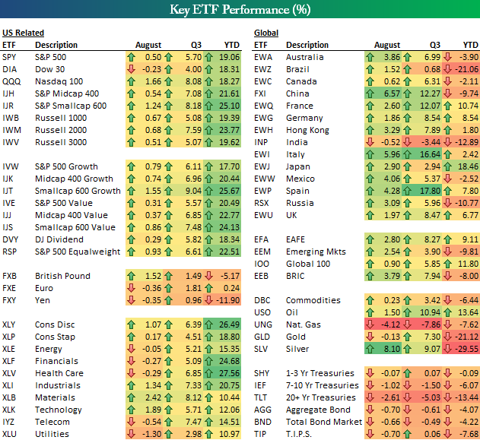
4. Asset Class Performance YTD — from BIG, below is an updated look at the performance of various asset classes (ETFs) during the month of August.
ETFs Aug 14 2013
—
BBC, Facebook (FB), the world’s largest social networking company, is planning to test a new mobile payment feature. It will use payment details added by users to their Facebook account to automatically fill in forms when they make purchases on mobile applications.
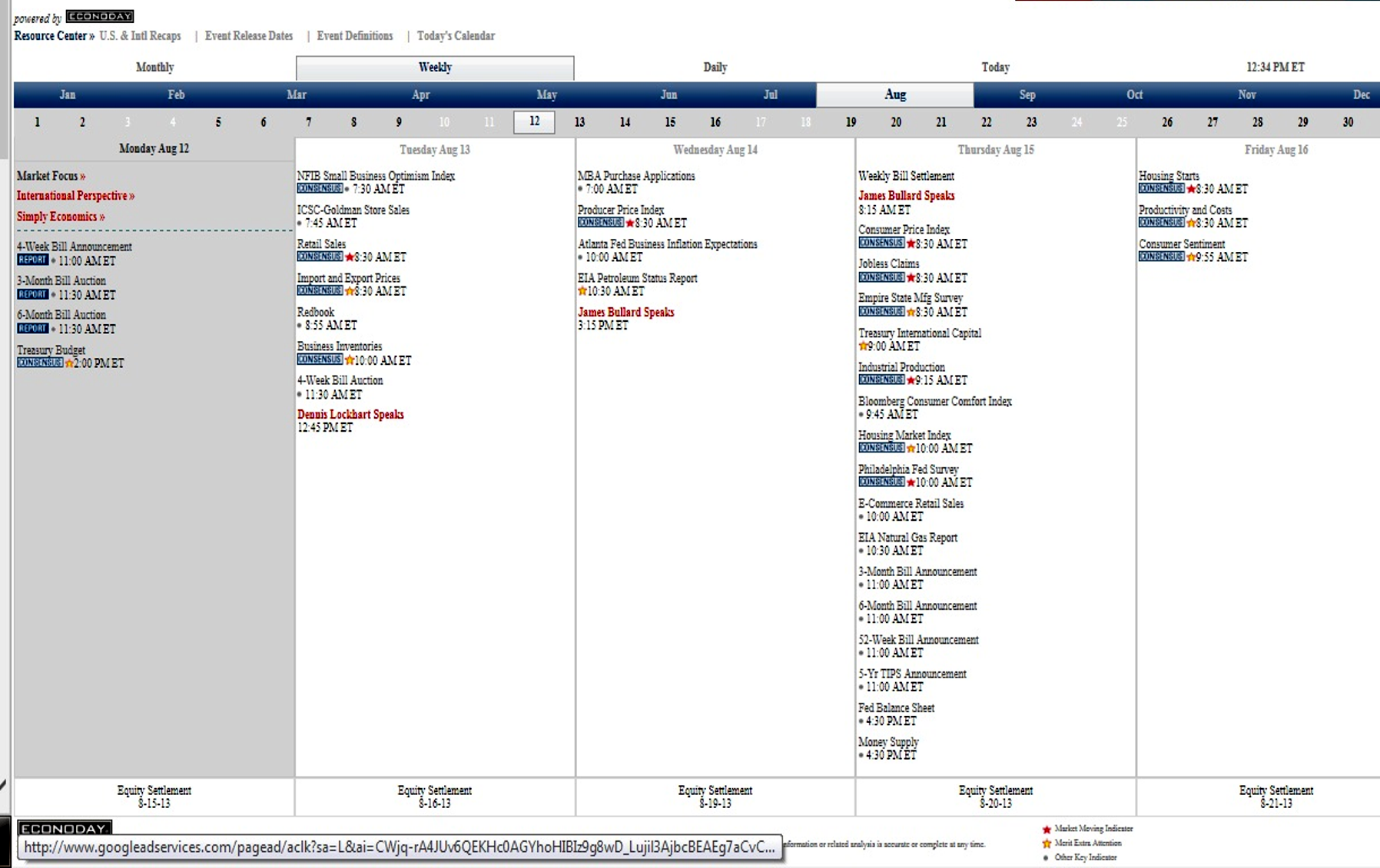
The week ahead — Economic data from Econoday.com:
Posted in Weekly Summary | No Comments »
August 12th, 2013
1. China seeks recall of two Abbott infant formula products — MarketWatch, China has asked Abbott Laboratories (ABT) to recall some infant formula products after the New Zealand embassy said that two batches produced by the company could have been tainted by bacteria that can cause botulism.
2. Chinese trade data beats estimates — China’s trade data for July topped expectations and provided evidence that the economy might be stabilizing after over two years of slowing growth. Imports surged 10.9% on year vs expectations of +2.1%, while exports rose 5.1% vs +3%.
3. BOJ leaves monetary policy unchanged — the Bank of Japan (BOJ) has maintained its pledge to expand the monetary base by ¥60T to ¥70T a year. The BOJ also kept its assessment of the economy unchanged, saying that it’s “starting to recover moderately,” and the bank noted that “inflation expectations appear to be rising.”
4. Japan’s Debt Exceeds 1 Quadrillion Yen — Bloomberg, the country’s outstanding public debt including borrowings reached a record 1,008.6 trillion yen ($10.46 trillion) as of June 30, up 1.7 percent from three months earlier, the finance ministry said in Tokyo. Larger than the economies of Germany, France and the U.K. combined, the amount includes 830.5 trillion yen in government bonds. The world’s heaviest debt burden will weigh on Abe when he decides next month whether to implement a two-step plan to double the tax on consumers in a nation with ballooning welfare costs.
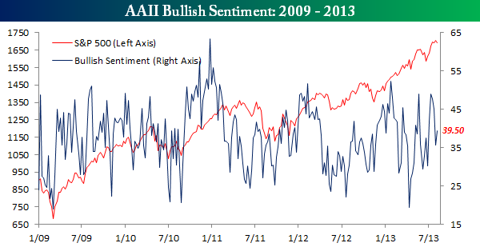
5. AAII Bullish Sentiment — from BIG, according to the weekly survey from American Association of Individual Investors (AAII), bullish sentiment increased from 35.6% up to 39.5%. At this level, even though the S&P 500 is within 1% of an all-time high, bullish sentiment is only one percentage point above its historical average for the current bull market (38.3%).
The week ahead — Economic data from Econoday.com:
Posted in Weekly Summary | No Comments »
August 5th, 2013
“After all these years, I know one thing for certain: the PERFECT trading system does not exist and never will” — Jake Berstein
1. Treasury Secretary to avoid Detroit bailout — ABCNews, Treasury Secretary Jacob Lew appears to have dismissed union calls to provide bankrupt Detroit with financial assistance. “Detroit’s economic problems have been a long time in developing,” he said. “I think Detroit’s going to have to work with its creditors on this.” In the Senate, Texas’ John Cornyn has filed an amendment that would ban the federal government from bailing out financially troubled cities, while Lindsey Graham is also opposed to such rescues.
2. Japanese industrial output drops in June — Japanese industrial production unexpectedly dipped in June by 3.3% on month, trailing expectations for a 1.7% drop. A decline in the production of transport equipment, including autos, led the fall, followed by electronics and machinery.
3. China’s official Purchasing Managers’ Index (PMI) for July 2013 shows gain — MarketWatch, China’s official(PMI), registered a surprise gain for July, rising to 50.3 from 50.1 the previous month. However, a separate PMI published by HSBC and Markit said activity was contracting, with the index sinking to an 11-month low of 47.7, down from June’s final reading of 48.2. Any reading above 50 indicates activity is expanding, and the result beat expectations for a drop to 49.8, according to estimates reported by Dow Jones Newswires.
4. Fed downgrades economic view — FederalReserve, The FOMC slightly downgraded its view of the U.S. economy. The Fed stated the US economy expanding at a “modest” pace vs. “moderate” at the last meeting. However, the Fed didn’t provide any hint about any alteration to the future course of QE.
5. Eurozone economy stabilizes as German recovery accelerates and downturns ease in France, Italy and Spain — Markiteconomics, Eurozone business activity expanded for the first time in 18 months in July as composite PMI increased to 50.5 from 48.7 in June, while services PMI rose to 49.8 from 48.3. Germany’s recovery gained momentum and the downturns in major economies such as France, Italy and Spain eased further.
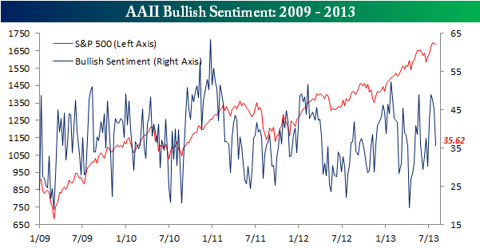
6. Bullish Sentiment Drops For 3rd Straight Week — courtesy of BIG, as market makes new highs, individual investors actually turned moderately more cautious in the latest week According to the weekly survey from the American Association of Individual Investors (AAII).
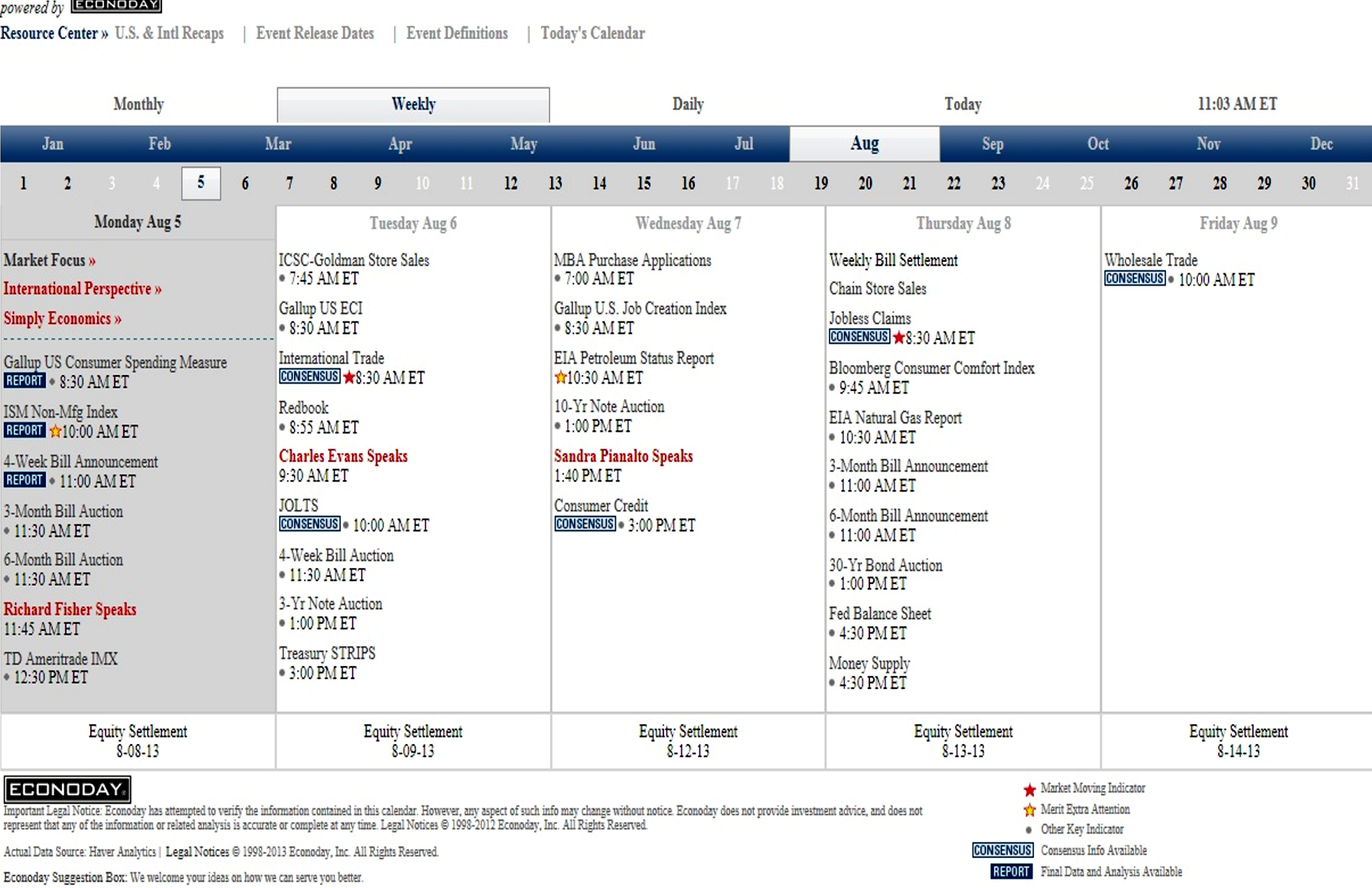
The week ahead — Economic data from Econoday.com:
Posted in Weekly Summary | No Comments »
July 29th, 2013
“Never bet that things that aren’t happening will start happening. Bet instead that things that are already happening will keep happening” — Jesse Livermore
1. Shinzo Abe’s LDP wins big in election — the Liberal Democratic Party (LDP) of Prime Minister Shinzo Abe won a big majority in an election for the country’s upper house, giving the LDP control of both chambers of parliament. The victory in the vote for parliament’s upper house gives Abe a stronger mandate for his prescription for reviving the stagnant economy.
2. U.S. Weighs Inquiry Into Big Banks’ Storage of Commodities — NYTimes, the Commodity Futures Trading Commission has taken the first step in an examination of warehouse operations that are controlled by Goldman Sachs (GS), Glencore Xstrata, the Noble Group and major banks such as JPMorgan (JPM) and Morgan Stanley (MS) used to store vast amounts of aluminum. Legislators are expected to explore whether banks should be allowed to continue to store metal, transport oil and operate mines, and possibly how prices have been affected by the companies’ activities.
3. Eurozone stabilises as PMI hits one-and-a-half year high — Manufacturers reported the largest monthly increase in output since June 2011, registering an expansion for the first time since February of last year. “The best (composite) PMI reading for 1 1/2 years provides encouraging evidence to suggest that the euro area could – at long last – pull out of its recession in the third quarter,” says Markit.
4. Japanese export growth slows — Japanese exports increased for a fourth consecutive month in June, rising 7.4% on year, although that marked a slowdown from +10.1% in May, while the reading also missed consensus of +10.3%. Imports grew 11.8% and the trade deficit widened to ¥180.8B ($1.81B) from ¥996.4B. Exports to the U.S., China and even the EU increased.
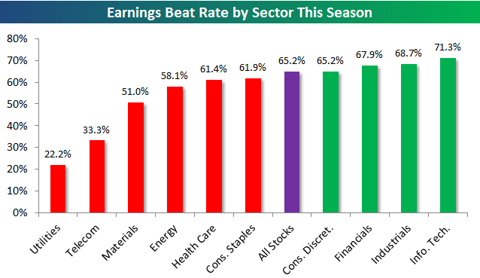
5. Earnings Beat Rate for 2Q 2013 — courtesy of BIG, the earnings beat rate for the second quarter of 2013 has actually increased to 65.2%. Below is a look at the earnings beat rate by sector.
6. China boosts railway budget to keep growth on track — Bloomberg, China increased its 2010-2015 budget for railway spending by 500B yuan (81.48B) to 3.3T yuan as the government looks to accelerate construction as part of a bid to prevent GDP growth from slowing too much. The State Council also approved tax breaks for small companies and reduced fees for exporters to boost growth.
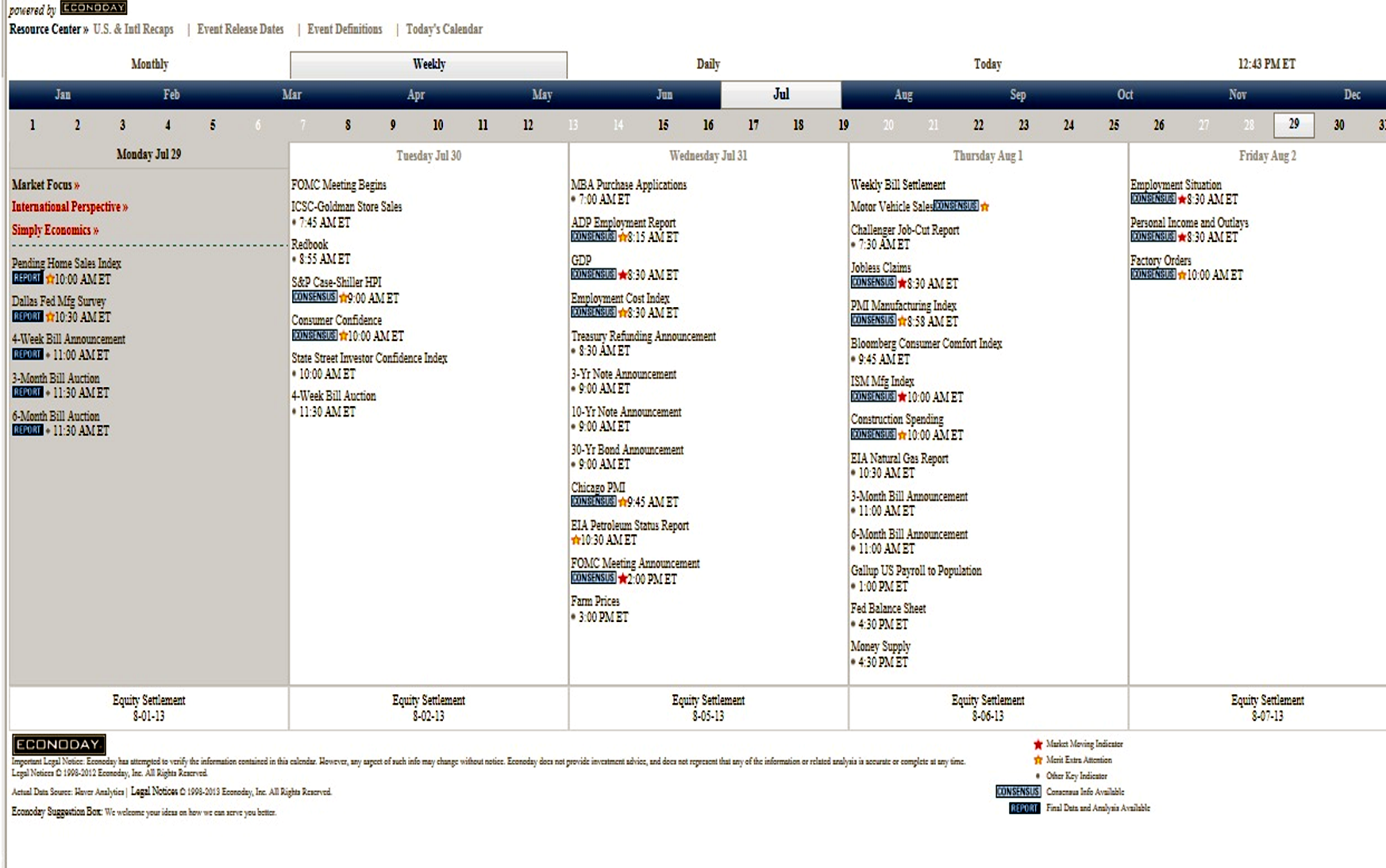
The week ahead — Economic data from Econoday.com:
Posted in Weekly Summary | No Comments »
July 22nd, 2013
“Know What Kind of Investor You Are” — Benjamin Graham
1. Chinese Q2 GDP grows 7.5% — China’s economy matched forecasts and expanded 7.5% on year in Q2, although that was down from 7.7% in Q1.
2. Restaurants, bars act to avoid cost of Obamacare — the WSJ has found anecdotal evidence that restaurants and bars have been converting much of their staff to part-time from full time so that they don’t have to provide health insurance as mandated by the Affordable Care Act.
3. Mexico unveils $316B infrastructure plan — Mexican President Enrique Pena Nieto has announced a “transformational” plan for 4T peso ($316B) of government and private infrastructure investments from 2013 to 2018, including in roads, railways, telecom, ports and energy. The spending could add up to 5% of GDP. Companies that could benefit include cement maker Cemex (CX) and construction firm Empresas (ICA).
4. U.S. Shale Boom Threatens Australian Gas Projects — WSJ, the surge in natural gas output in North America has reduced the appeal of projects in Australia, where major international companies such as Chevron (CVX), Exxon Mobil (XOM) and Shell (RDS.A) are investing over $160B. With U.S. prices low and the country beginning to increase exports, another $100B of spending in Australia is at risk, especially as the high Aussie dollar and labor shortages have helped cause costs to balloon.
5. Greece approves scheme to fire thousands of public workers — Reuters, Greece’s parliament has narrowly approved the latest set of Troika-mandated austerity plans, paving the way for the country to receive the next tranche of its bailout. The bill includes deeply divisive plans for a transfer and layoff scheme for 25,000 public workers – mainly teachers and municipal police – that had triggered a week of almost daily marches, rallies and strikes in protest.
6. U.K. offers tax breaks to boost shale-gas industry — the U.K. government has introduced a tax break for shale-gas producers, to attract investment into what it hopes will be a major new industry for Britain. Taxes on fracking profits will be lowered to 30%, compared with a top rate of 62% on new North Sea oil operations and up to 81% for older offshore oilfields, according to media reports.
7. Detroit files for record bankruptcy — Detroit filed the largest municipal bankruptcy in U.S. history late last week, setting the stage for a costly court battle with creditors and opening a new chapter in the long struggle to revive the city that was the cradle of the American auto industry. Detroit’s creditors are expected to face huge losses, and the future of retiree pension and health benefits for thousands of city workers hangs in the balance.
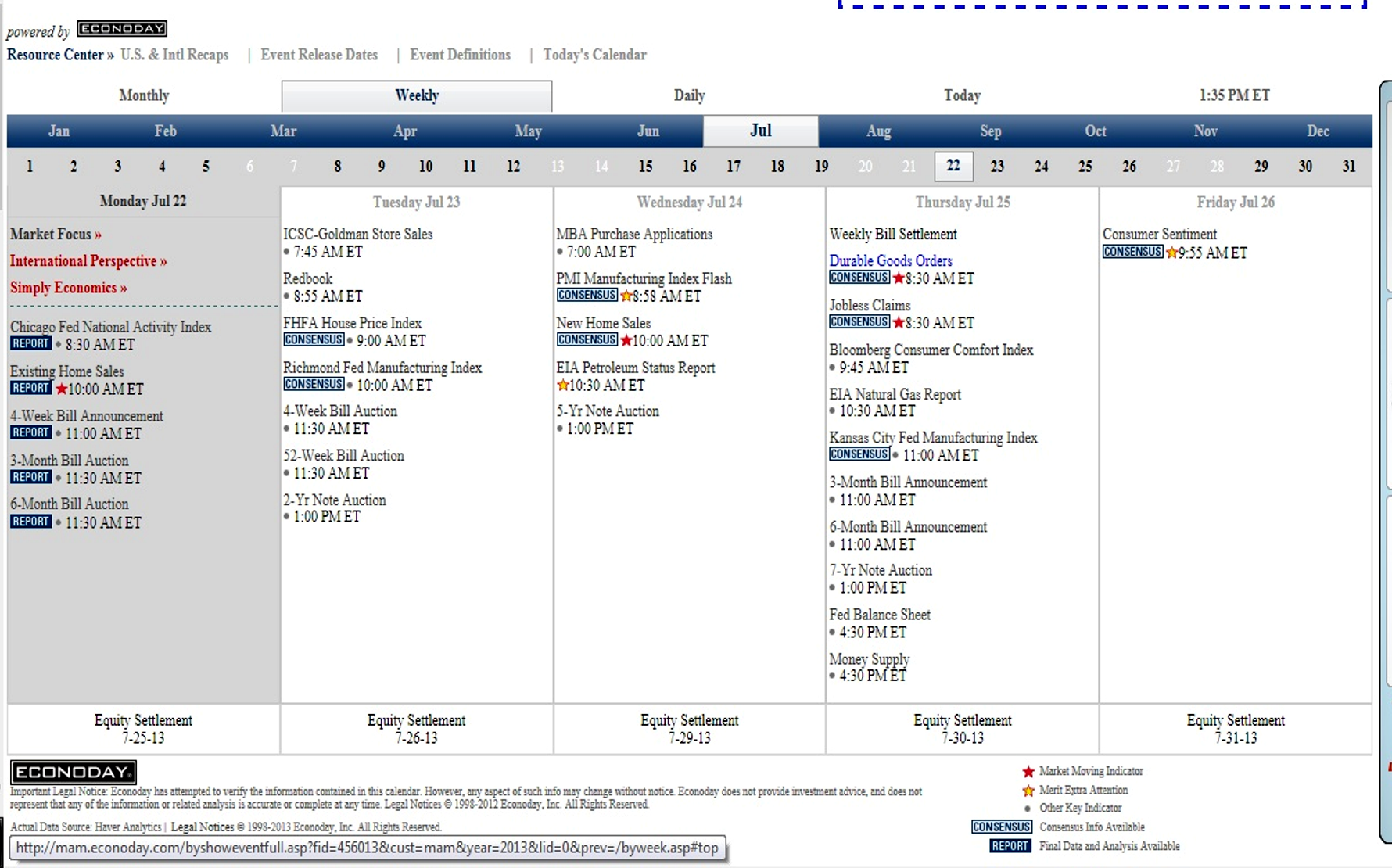
The week ahead — Economic data from Econoday.com:
Posted in Weekly Summary | No Comments »
July 15th, 2013
“Expect Volatility and Profit From It” — Benjamin Graham
1. Deadly Quebec crash raises doubts about oil trains — the blast, which killed at least five people in Quebec town of Lac-Megantic, is the most serious in a series of accidents involving freight trains. Those include Canadian Pacific (CP) and Berkshire Hathaway’s (BRK.A) BNSF. The accident could strengthen the case for approving TransCanada’s (TRP) Keystone oil pipeline.
2. German exports, industrial output slump — German exports dropped at the sharpest rate since 2009 in May, sliding 2.4% vs -1.4% in April and consensus of -0.4%. Imports grew 1.7% vs +1.2% previously, while the trade surplus tumbled 19.4% on month to €14.1B. The factors hurting German exports include the eurozone debt crisis and the slowdown in China. Meanwhile, industrial production dropped 1% in May vs growth of 2% in April and consensus of -0.5%.
3. Chinese Exports Signal Slowing — CNBC, China’s consumer inflation accelerated in June, driven by a rise in food prices. However, exports in June unexpectedly fell 3.1% vs. a year earlier, the worst drop in years; Chinese imports also sank 0.7%. The data reflect weakness both at home and overseas.
4. White House cuts GDP, deficit forecasts — the Obama administration has trimmed its economic outlook, predicting that GDP will grow 2% this year vs a prior forecast of 2.3%, and 3.1% in 2014 vs 3.2%. The White House’s Office of Management & Budget cited “serious headwinds” for the reduced estimate, such as sequestration, European austerity and China’s slowdown.
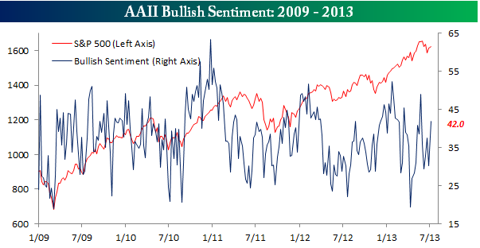
5. American Association of Individual Investors (AAII) bullish sentiment — courtesy of BIG, bullish sentiment increased from 30.3% to 42.0%. This is the largest weekly reading since 5/23 and the largest one-week increase since 3/14.
6. BOJ holds steady, cuts inflation outlook — the Bank of Japan has kept its monetary policy unchanged, leaving interest rates at minimum levels and maintaining its pledge to increase base money at an annual pace of ¥60-70T ($600-700B). The BOJ said the economy is “starting to recover moderately,” but cut its FY 2014 real growth forecast to 2.8% from 2.9% and median inflation outlook to 0.6% from 0.7%.
7. China Finance Minister Expects GDP Growth of 7% in 2013 — CNBC, China GDP expanded 7.5% on year in Q2, although that was down from 7.7% in Q1. China’s government has continued to dial down expectations for the country’s economy, with Finance Minister Lou Jiwei forecasting that GDP will rise 7% this year, below official targets of 7.5% and the 7.7% achieved in 2012.
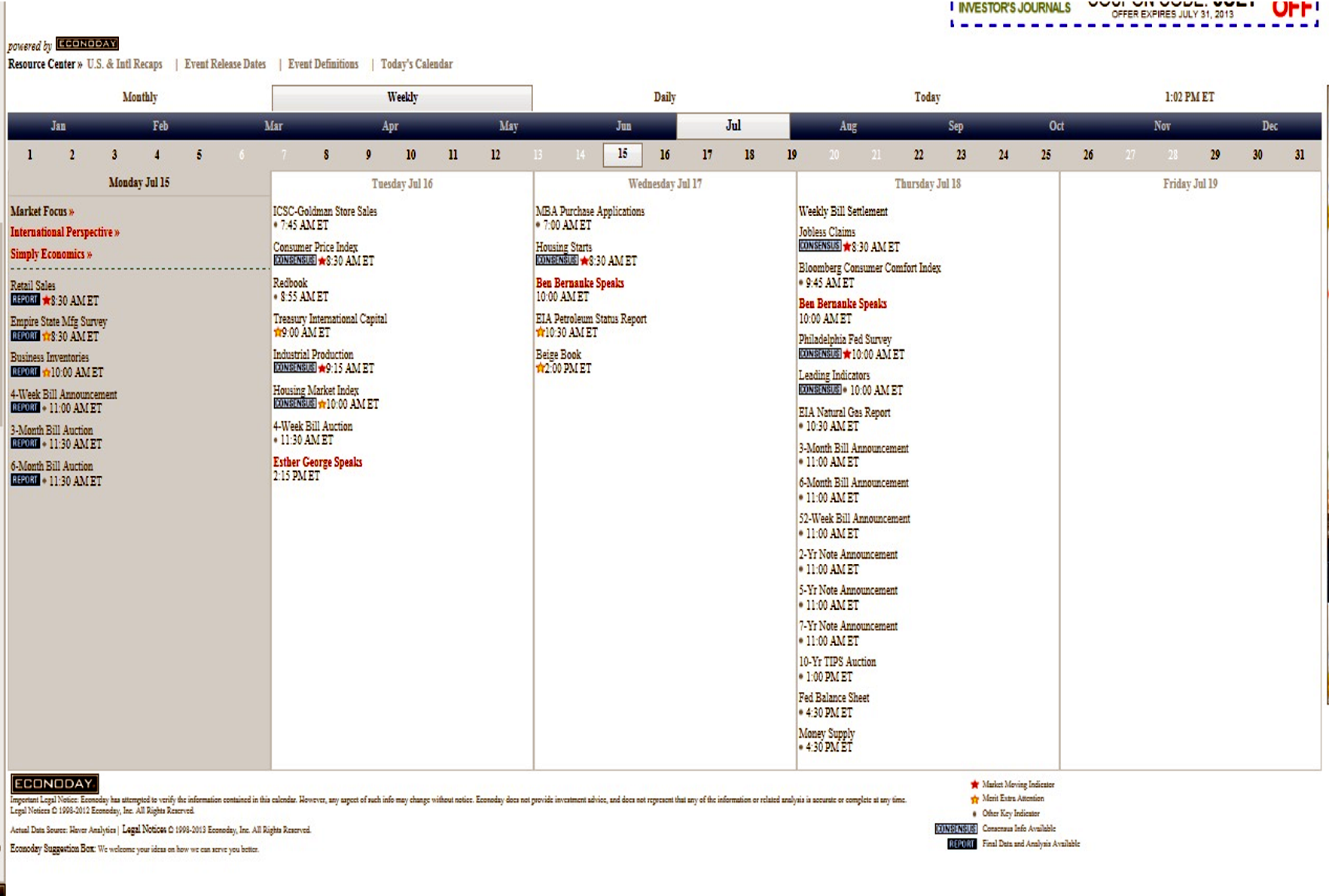
The week ahead — Economic data from Econoday.com:
Tags: AAII Sentiment
Posted in Weekly Summary | No Comments »
July 8th, 2013
“When they start running the ‘dogs,’ it’s time to begin looking over your shoulder.” — unknown
1. EU officials ratchets up pressure on Greece — Reuters, EU officials has reportedly warned Greece that it has three days to show it can meet its bailout conditions in order to receive the next €8.1B of its rescue loans. The Troika could refuse to transfer the full amount, or break it up into three monthly payments if Greece fails to impress.
2. Egyptian army removed President Mohamed Mursi — in order to end widespread unrest, Egypt’s army removed President Mursi, suspended the constitution and installed an interim government pending new elections.
3. U.S. to impose stricter rules on large banks –the FDIC will introduce a draft of leverage limits for major banks (XLF) early next week. Banks affected are JPMorgan (JPM), Morgan Stanley (MS), Bank of America (BAC) and Citigroup (C). The regulations are expected to require banks to hold 3-6% of their total assets in capital compared with Basel III requirement of 3%. The Fed also eased rules on mortgates and community banks compared to earlier proposals.
4. Portuguese markets plunge on political turmoil — Portuguese markets have gone into meltdown as an austerity induced political crisis has threatened the government’s existence. Ministers from the CDS-PP, the ruling coalition’s junior partner resigned.
5. US health mandate delayed till 2015 — BBC, the Treasury Department will delay penalties for large employers who fail to provide workers with health insurance after being inundated by questions from firms about the healthcare overhaul. The requirements were initially scheduled to begin when the bulk of the law takes effect next year, but the administration will now wait until 2015 before enforcing mandatory employer and insurer reporting guidelines.
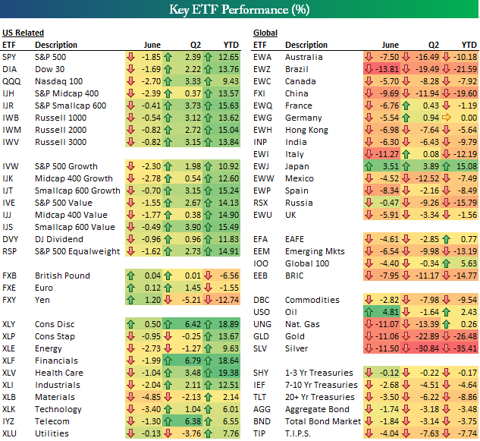
6. Major Asset Classes Final First Half Performance — courtesy of BIG, below is the performance numbers are for the various US-listed ETFs that cover those asset classes in the first half of 2013.
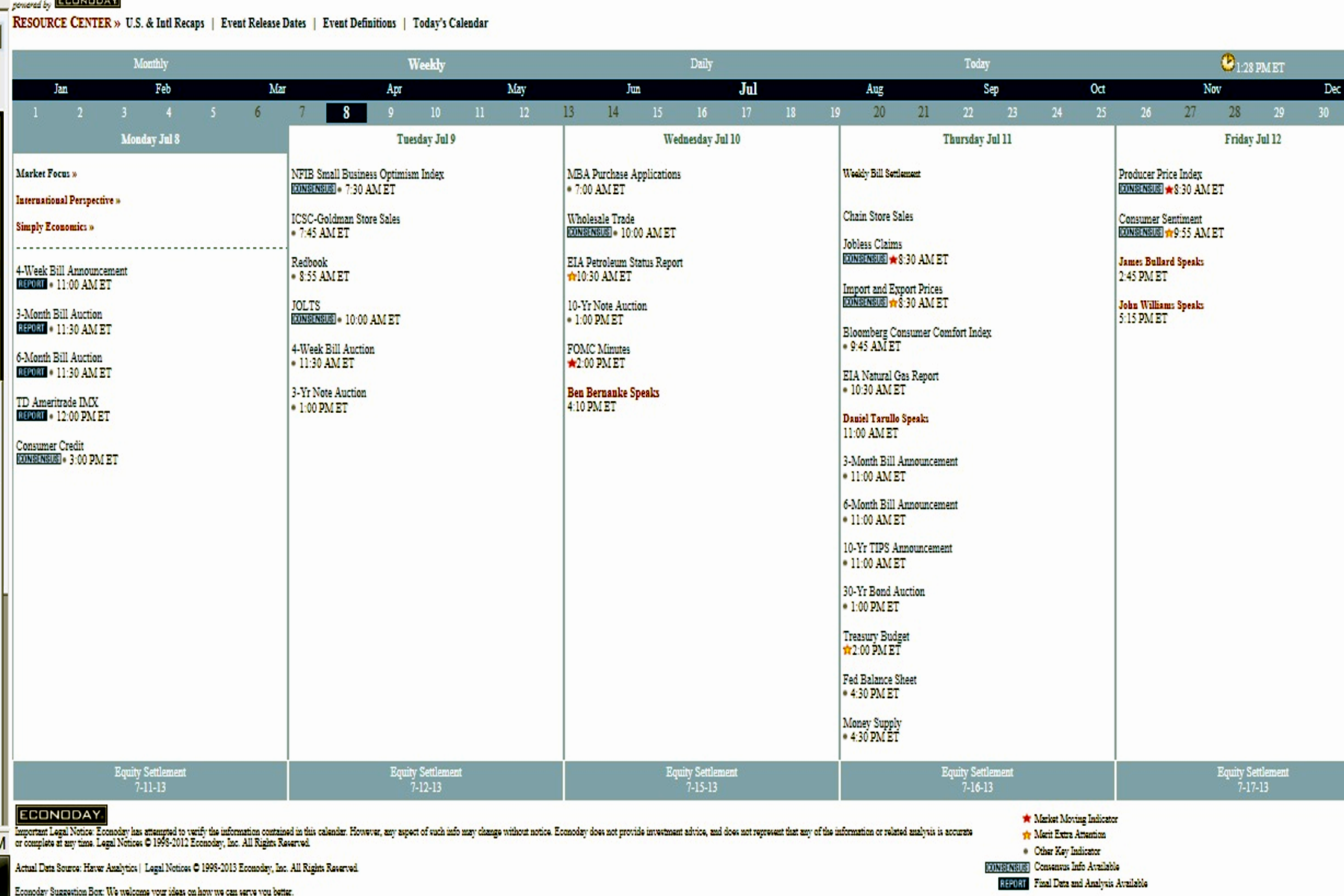
The week ahead — Economic data from Econoday.com:
Posted in Weekly Summary | No Comments »
July 1st, 2013
“The difference between perception and reality is where our opportunities lie.” — unknown
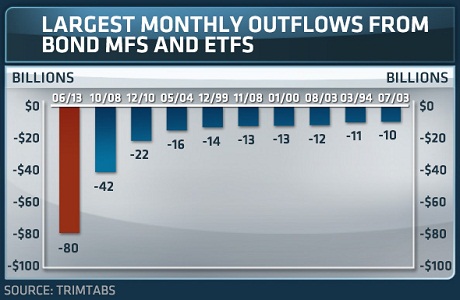
1. Bond Fund Outflows Hit Record Level on the Fed Tapering Fears — CNBC, “Mutual and exchange-traded funds are unloading bonds at a record pace. The combined outflow of $47.2 billion in Junes is the highest in any month on record, handily eclipsing the previous record of $41.8 billion in October 2008,” reported by TrimTabs Investment Research.
2. EU Finance Mininsters agree on rules for bank rescues — EU Finance Ministers have agreed on measures to deal with failing banks. The proposals include imposing losses of up to 8% of a bank’s total liabilities on shareholders, creditors and then deposits of over €100,000, after which governments will be able to supply funds of up to 5% of liabilities.
3. New Rules Expected for Insurance Accounting May Lead to Erratic Earnings — NYTimes, The Financial Accounting Standards Board (FASB) stated that it will propose new rules for insurance accounting that seem likely to increase volatility in reported profits for many insurers and lower reported revenue for rapidly growing companies. Under the new rule, Insurers would have to recognize premium revenue over time, when insurance is being provided, rather than when it is received, while the reporting of costs might be delayed as well.
4. China Credit crunch spreads to China’s “Main Street.” — WSJ reported businesses turn to alternatives such as bankers’ acceptances to pay their bills instead of cash despite efforts by the People’s Bank of China to ease the credit crunch in the country’s financial markets.
5. Rising bond yields hurt bank balance sheets — falling bond prices and rising yields are threatening the recovery in the balance sheets of global banks, which have built up huge portfolios of liquid securities. i.e. Bank of America’s (BAC) $315B portfolio comprises of 90% in mortgage bonds and Treasurys. However some analysts believe that QE tapering should lead to an increase in interest margins and offset the one-time hit to book values because of rising bond yields.
6. EU agrees to the first budget cut in its history — The EU has agreed a seven-year €960B budget that represents the first spending cut in its history. The bloc also approved plans to invest €6B on tackling youth unemployment and for the European Investment Bank to lend hundreds of billions of euros to small and medium-sized businesses.
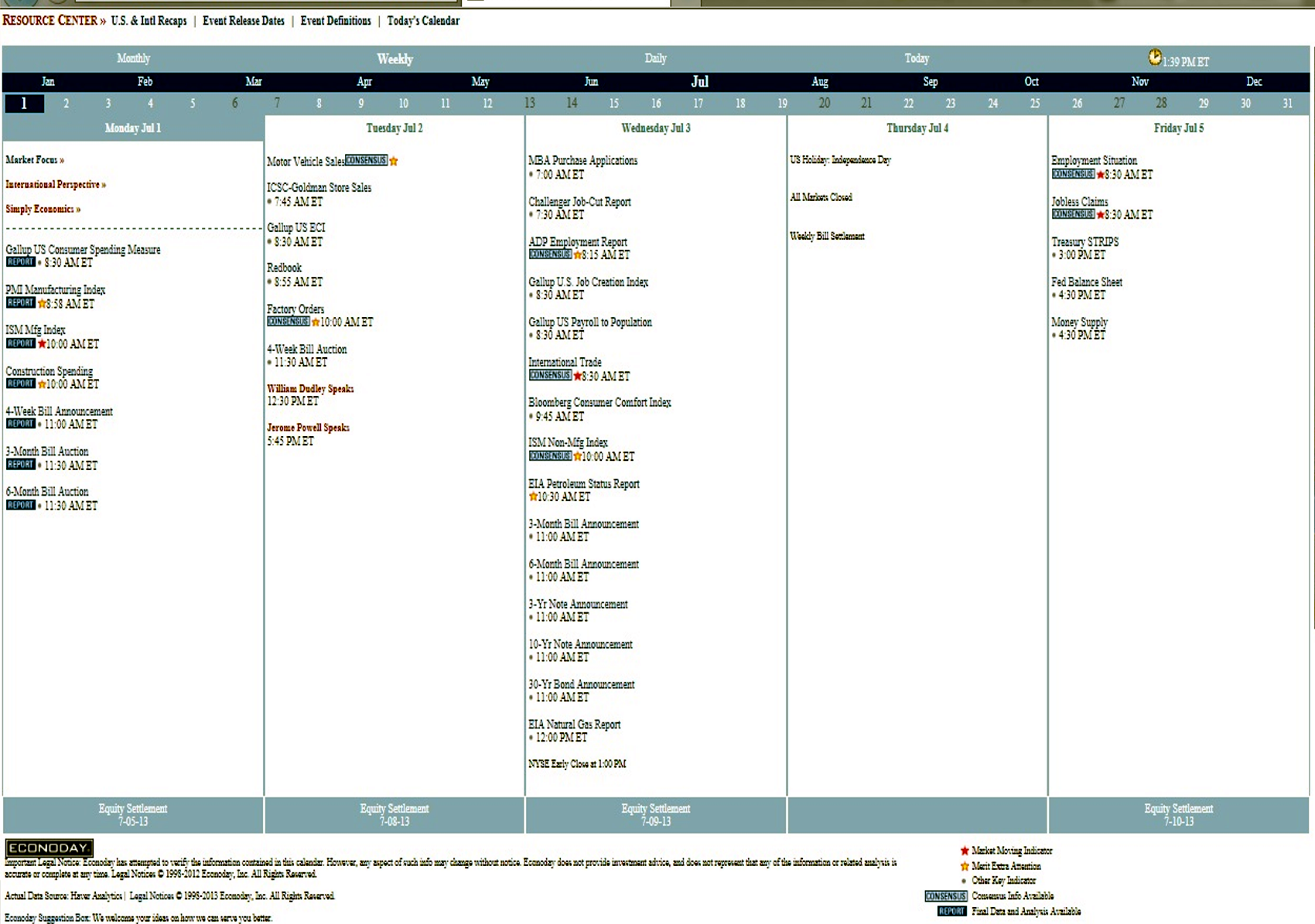
The week ahead — Economic data from Econoday.com:
Posted in Weekly Summary | No Comments »
June 24th, 2013
“Sometimes paranoia’s just having all the facts.” — William S. Burroughs
1. Weyerhaeuser (WY), forest products comp., names new CEO — Weyerhaeuser (WY) appointed Doyle Simons, the former head of Temple-Inland, to replace retiring CEO Dan Fulton. Weyerhaeuser is also acquiring 645,000 acres of high-quality timberlands in Washington and Oregon from Brookfield Asset Management (BAM) for $2.65B. Weyerhaeuser will explore “strategic alternatives” for WRECO, its homebuilding and real-estate development business, including a merger, sale, or spin-off.
2. Obama indicates that FOMC Chief Bernanke’s time is drawing to an end — Bloomberg, reported President Obama told Charlie Rose that the chairman has already stayed “a lot longer than he wanted or he was supposed to.” Bernanke’s second four-year stint at the central bank is due to end on January 31.
3. Japan Exports Surge Most Since 2010 — Bloomberg, Japan’s exports rose more than forecast in May as a weaker yen boosted the value of overseas sales, underscoring the profit boon for manufacturers from Prime Minister Shinzo Abe’s reflation campaign. With imports climbing 10%, Japan generated a trade deficit for the 11th consecutive month as the figure widened 13% on month to ¥993.9B ($10.4B).
4. Chinese manufacturing PMI shrinks further — HSBC Chinese manufacturing PMI has fallen to a nine-month low of 48.3 in June from 49.2 in May and vs consensus of 49.4. “Manufacturing sectors are weighed down by deteriorating external demand, moderating domestic demand and rising de-stocking,” says HSBC. Because of Beijing’s preference for reform over stimulus, the bank expects “slightly weaker growth in Q2.”
5. More trouble in store for mortgage-bond investors — Holders of mortgage bonds may be facing billions of dollars of undisclosed losses after a review of investor documents showed that individual houses are being reported as being in foreclosure long after they’ve been sold or the loans paid off. The reporting lag has enabled banks and servicers to continue charging investors monthly fees, and could lead to new litigation. The companies involved include Bank of New York Mellon (BK), Wells Fargo (WFC), Ocwen Financial (OCN) and Bank of America (BAC).
6. FOMC Chairman Bernanke signals the end of QE — Reuter, Global markets across multiple sectors sold off after Ben Bernanke signaled that the Fed may soon start turning down the money printing presses, saying that the bond-buying could end in mid-2014.
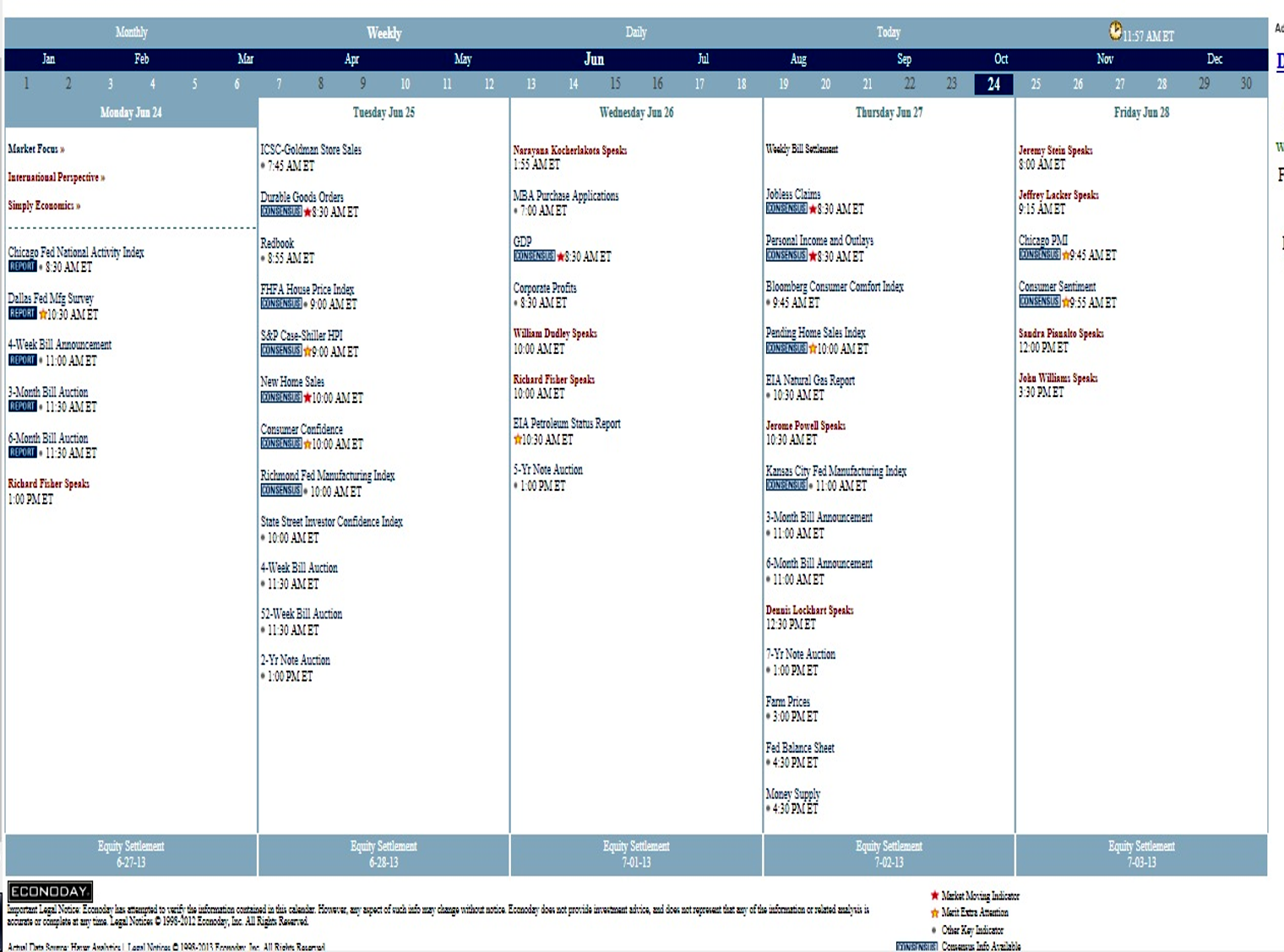
The week ahead — Economic data from Econoday.com:
Posted in Weekly Summary | No Comments »
June 17th, 2013
“To win you have to risk loss.” — Jean-Claude Killy (skier)
1. S&P revises U.S. outlook to stable from negative — MarketWatch, Standard & Poor’s revised its long-term outlook on its U.S. credit rating to stable from negative. The rating agency downgraded the sovereign rating to AA+ from its top rating of AAA in 2011. The rating agency cited economic strength and the dollar’s status as a reserve currency as the primary drivers of the outlook revision.
2. Germany’s top court weighs ECB bond buys — Germany’s Federal Constitutional Court has started a two-day hearing today over the compatibility of the ECB’s Outright Monetary Transactions (OMT) program, which allows the bank to buy government bonds in the secondary market, with German law.
3. Senate Passes Bill to End Direct Payments to Farmers — the Senate overwhelmingly passed a $955B agriculture bill that would reduce farm spending by $18B over the next decade, partly by ending the practice of making direct payments to farmers irrespective of crop yields, market prices and the economy.
4. Nikkei (DXJ) plunges into bear market — The Nikkei’s 6.4% drop put it 21.9% off from its intraday peak reached on May 23. Uncertainty about the Fed’s QE program continues to grip global markets.
5. Fed Likely to Push Back on Market Expectations of Rate Increase — WSJ’s Hilsenrath, quoted officials as saying that a tapering of asset purchases doesn’t mean an end to asset purchases, and a hike in short-term interest rates isn’t anywhere close to being on the radar at this point.
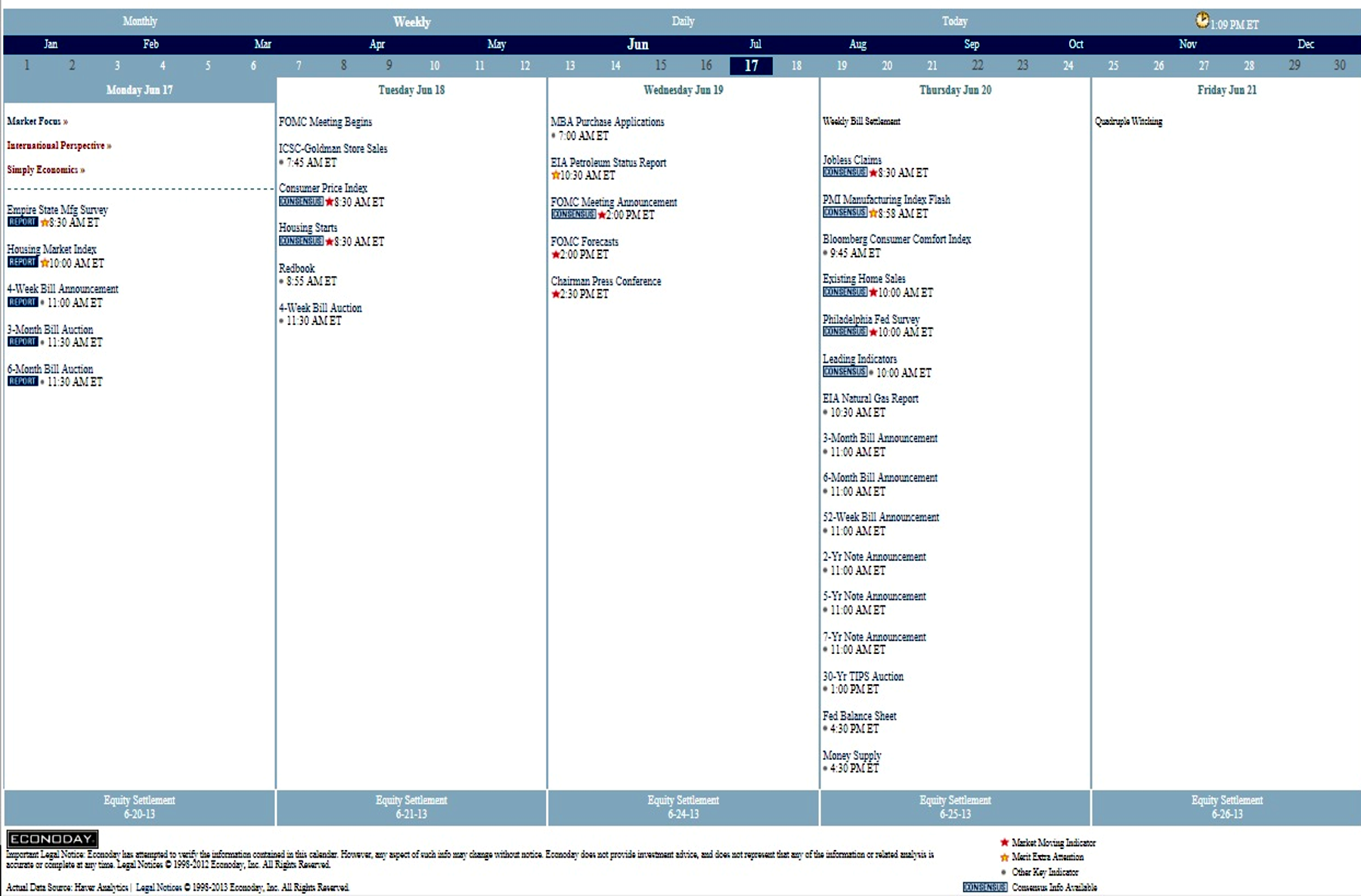
The week ahead — Economic data from Econoday.com:
Posted in Weekly Summary | No Comments »