March 10th, 2014
“You cannot ignore the market – ignoring a source of investment opportunities would obviously be a mistake – but you must think for yourself and not allow the market to direct you.” — Seth Klarman
1. World stocks recover as Putin downshift tensions — Global equity markets recovered from sharp losses early in the week in what could be interpreted as a de-escalation of tensions by the Russian as some military units are back to their bases after a surprise training exercise. Some of the drills took place near the border with Ukraine, exacerbating fears about a possible Russian invasion of its neighbor.
2. Obama looks to expand tax break for the low-paid — President Obama is due to propose expanding the Earned Income Tax Credit to 13.5M childless workers when he unveils his annual $1.014T budget plan today. The 10-year $60B cost would be met by closing two tax loopholes for some self-employed professionals and investment-fund managers. Obama also wants to spend $302B on highways, bridges and transit projects, and increase the minimum wage.
3. China maintains growth goal of 7.5% — Reuters, in an address to the annual meeting of the National People’s Congress, Chinese Premier Li Keqiang reiterated his commitment to reform to make growth more sustainable to the goal of 7.5%. The government main goals were to focus on reforming the economy and reining in the ‘shadowing banking’ system.
4. Ukraine Crisis Pressures U.S. on Gas Exports — WSJ, the crisis in Ukraine has sparked renewed calls among Republicans and energy state Democrats for an easing of restrictions on foreign sales of natural gas. Russia supplies Europe with 30% of its gas, so there are those who are wary of imposing major sanctions on the country. Increasing U.S. gas exports could reduce that reliance and give the West a freer hand in dealing with Russia, particularly in the long term.
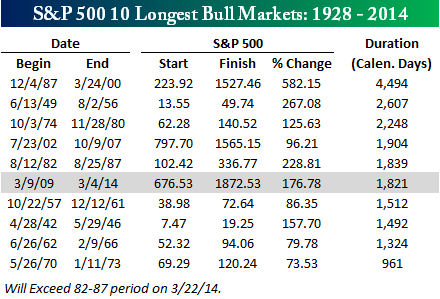
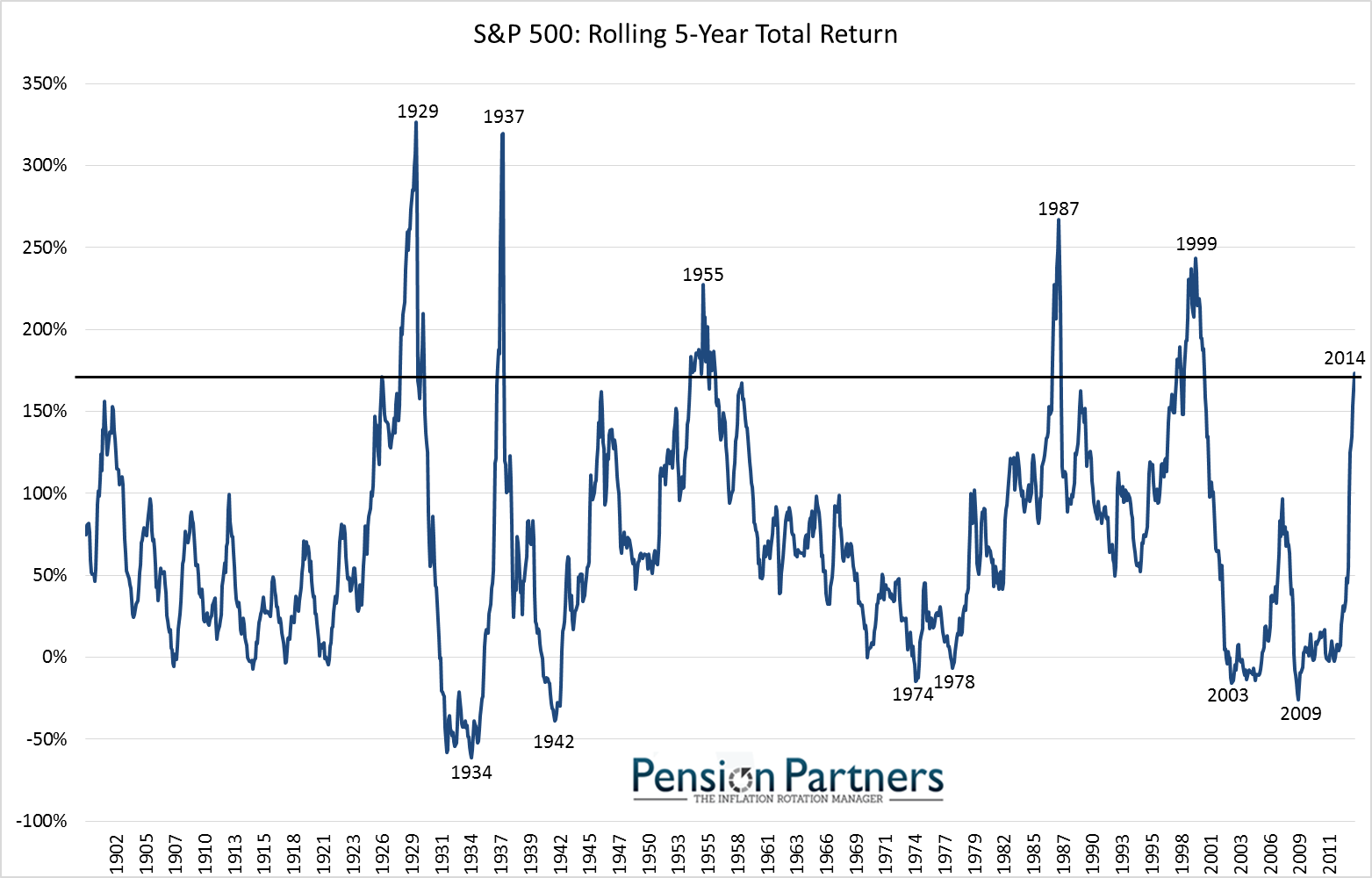
5. Histical Bull Markets — courtesy of BIG, and PensionPartners, the tables below provide an update of where the current bull market stands in comparison to prior bull markets in terms of duration and magnitude. The S&P500 is less than three weeks away from taking out the 1982 – 1987 period as the fifth longest bull market of all time.
6. China suffers first corporate-bond default — Bloomberg, China’s onshore bond market experienced its first default as a solar-cell maker failed to pay full interest on its bonds. The number of Chinese companies whose debt is double their equity has surged since the global financial crisis, suggesting this first onshore bond default won’t be the nation’s last. Publicly traded non-financial companies with debt-to-equity ratios exceeding 200 percent have jumped 57 percent since 2007.
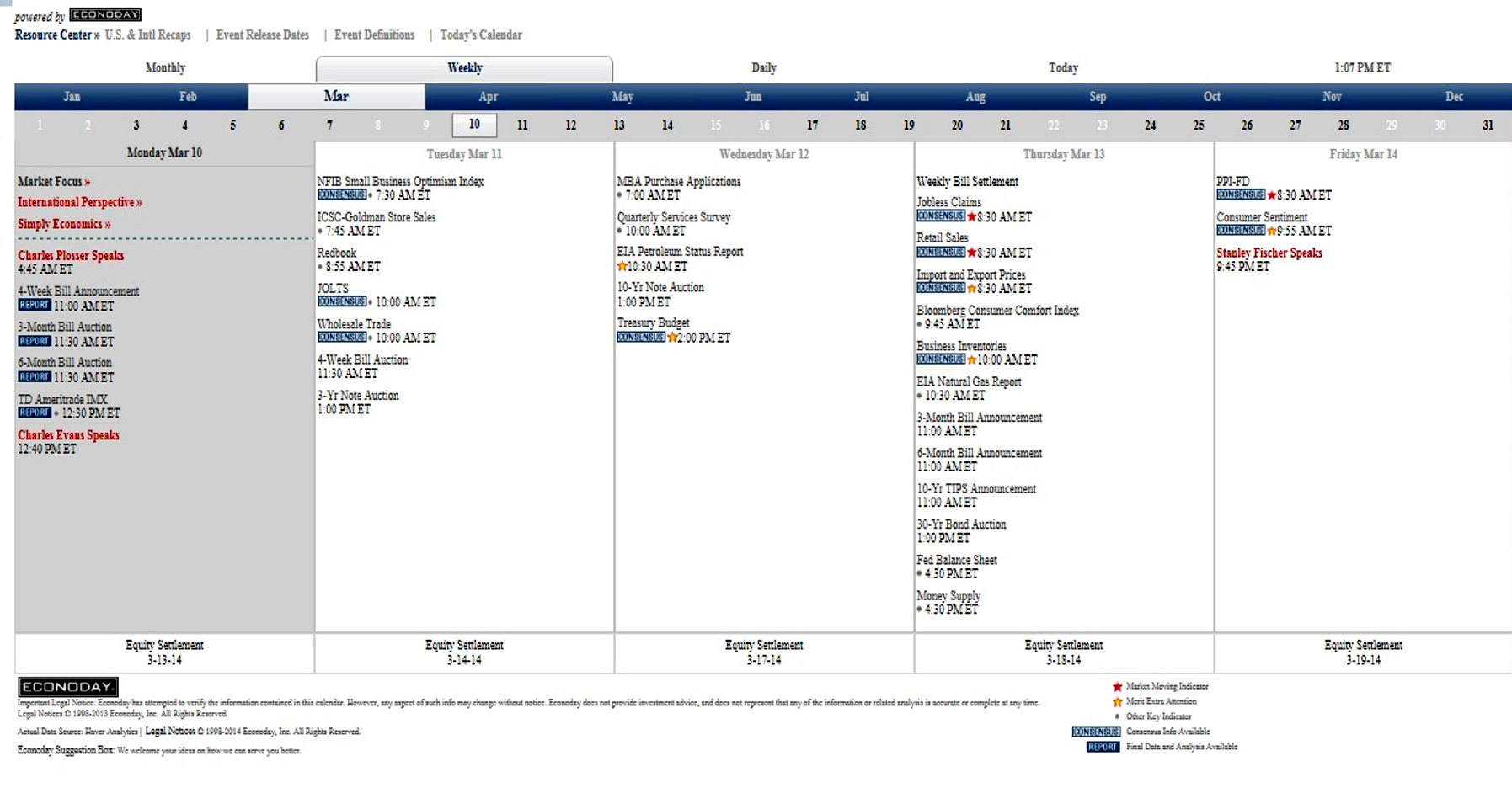
The week ahead — Economic data from Econoday.com:
Posted in Weekly Summary | No Comments »
March 3rd, 2014
“‘A bull market is like sex. It feels best just before it ends.'” — Barton Biggs
1. Ukraine calls for urgent aid after Yanukovich ousted — per Reuters, cash-strapped Ukraine appealed for urgent financial assistance to prevent a default, saying it needed $35 billion over two years to stop the economy “heading into the abyss”. Ukraine has called for a donor’s conference that will involve the EU, the U.S. and the IMF. The plea for a bailout comes after parliament ousted President Viktor Yanukovych. A warrant has been put out for Yanukovych’s arrest after he fled the capital before his removal. Acting President Oleksandr Turchinov said yesterday that Ukraine was close to default, with the economy facing an abyss.
2. JPMorgan (JPM) to cut thousands of extra jobs at its mortgage business — FT reports JPMorgan (JPM) plans to slash thousands more jobs at its mortgage business and at its branches amid plummeting demand for home loans and the increased automation of clerical jobs,. The cuts would be part of a new efficiency program and would add to the 10,000-15,000 positions that JPMorgan has already axed.
3. Japan Sees Key Role for Nuclear Power — WSJ, Japan intends to revive nuclear energy as a major source of electricity, the government disclosed in a draft document about its long-term energy strategy. Japan’s nuclear plants were idled following the Fukushima disaster almost three years ago, which has caused the country to significantly increase its energy imports.
4. Russian troops put on alert amid Ukraine crisis — MarketWatch, Russian President Vladimir Putin ordered a test of combat readiness for troops stationed in a region that touches Ukraine’s northern border. The move comes amid growing tension between Russia and Ukraine, whose pro-Russian president, Viktor Yanukovych, was ousted by European-leaning protesters at the weekend following violence in which more than 80 people were killed. A warrant for his arrest was issued this week.
5. Japanese economic activity bumps up ahead of sales-tax hike. Japanese industrial production grew at the fastest pace since June 2011 in January, jumping 4% on month after a drop of 0.9% in December. Retail sales leapt 4.4% vs +2.5%. The strong figures are not a total surprise, as a bump in economic activity has been expected ahead of a rise in sales tax in April, which is forecast to then drag on the economy. Core inflation held steady at 1.3% on year in January, while the unemployment rate was unchanged at 3.7%.
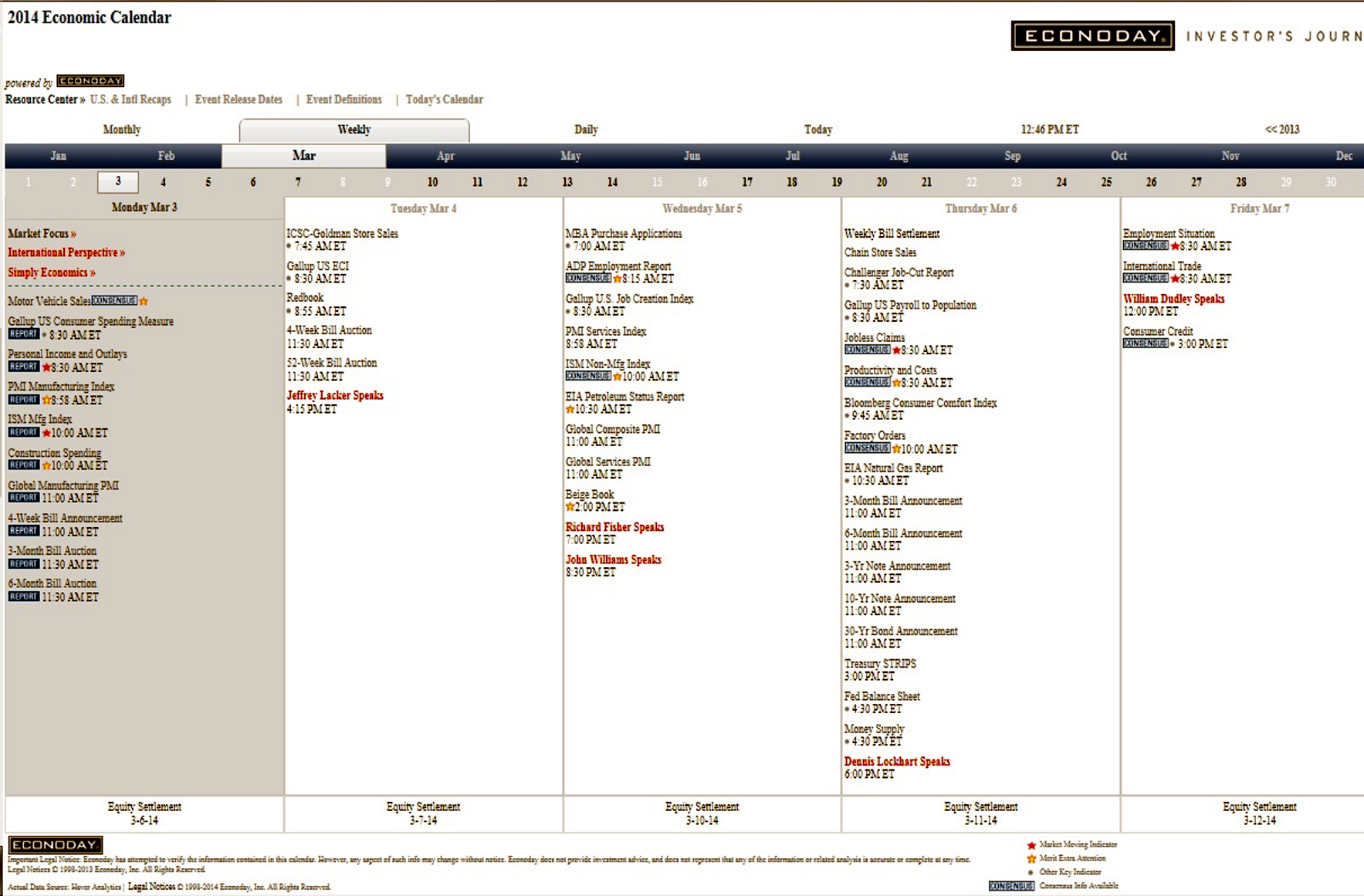
The week ahead — Economic data from Econoday.com:
Posted in Weekly Summary | No Comments »
February 25th, 2014
“Rule No.1: Never lose money. Rule No.2: Never forget rule No.1.” — Warren Buffett
1. PBOC drains $7.9B from financial system — the People’s Bank of China has drained $7.9B from the country’s financial system by selling 48B yuan in repurchase contracts, the first such transaction since June of 2013. The PBOC made the tightening move after the recent data showed that aggregate financing soared to a record 2.58T yuan ($425B) in January from 1.23T yuan in December despite the bank’s attempts to rein in lending.
2. Fed Reserve Sets Rules for Foreign Banks — the Federal Reserve has passed regulations for foreign banks on capital, debt levels and annual “stress tests” that could force 15-20 of them to raise billions of dollars in capital. Overseas banks with U.S. assets of over $50B would have to form special holding companies in the country and maintain higher capital buffers than other nations require.
3. U.S. Household Debt Begins to Rise Again — NYTimes, total household debt in the U.S. increased 2.1 percent, the largest quarterly increase since before the recession, according to a new report from the Federal Reserve Bank of New York. Mortgages rose by $16B on year to $8.05T following four consecutive years of declines. Retail analyst David Strasser says “We’re still over-leveraged by any historical measure.”
4. Chinese factory activity contracts at faster pace — China’s flash manufacturing PMI tumbled to a seven-month low of 48.3 in February from 49.5 in January and missed consensus of 49.4. The sub-indexes for output, new orders, new export orders and employment contracted. The fall in overall PMI adds to other data that provides a mixed picture of China’s economy. The latest figures may have been hampered by the Lunar New Year holiday.
5. Latest FOMC minutes — in the latest FOMC meeting chaired by Ben Bernanke, a few policy makers saw a chance of rate hikes “relatively soon.”
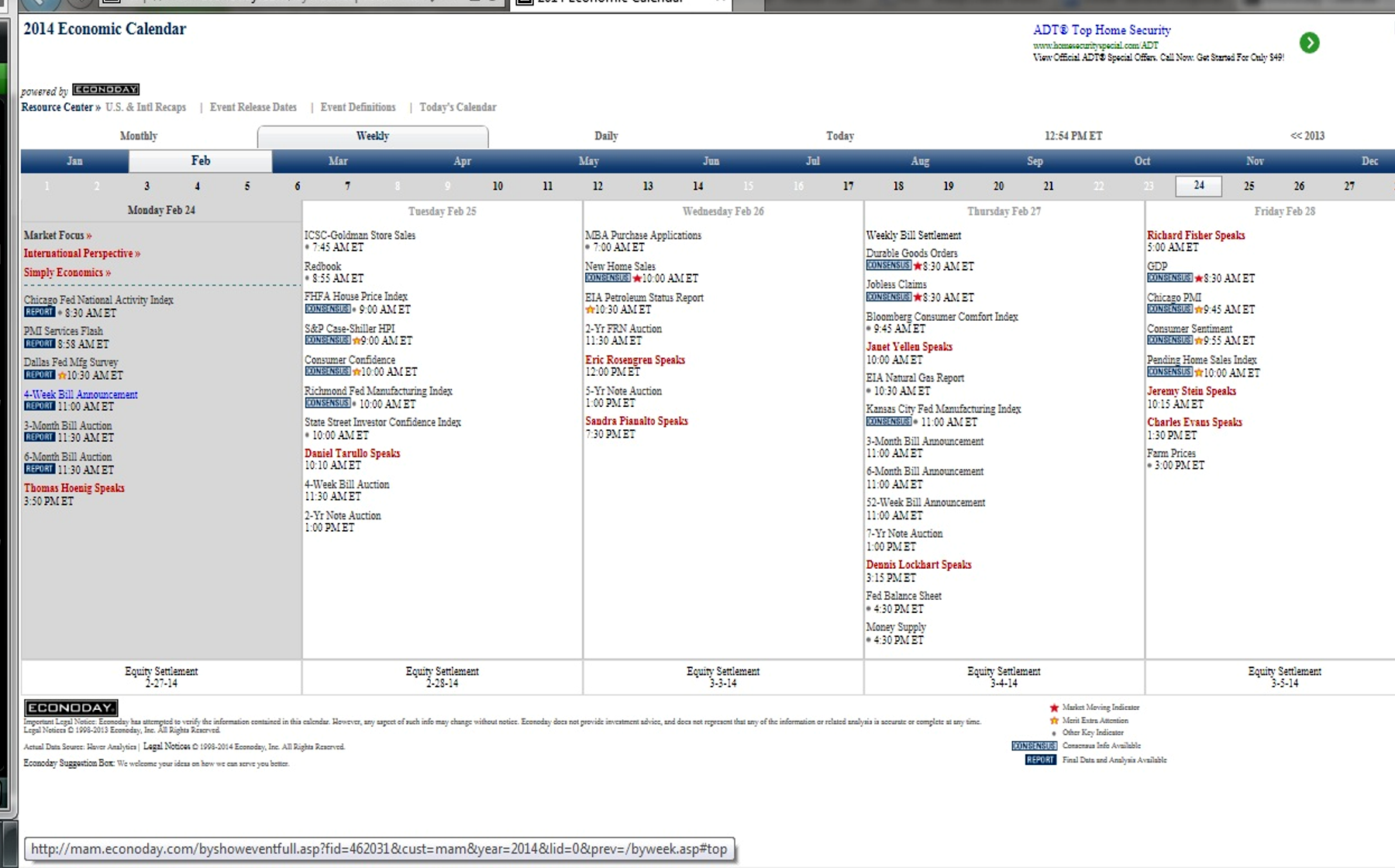
The week ahead — Economic data from Econoday.com:
Posted in Weekly Summary | No Comments »
February 18th, 2014
“The test of success is not what you do when you are on top. Success is how high you bounce when you hit bottom.” – George S. Patton
1. Millions Trapped in Health-Law Coverage Gap — WSJ reported that millions of Americans earn too tittle for health-law subsidies but ineligible for benefits under Existing Medicaid Programs. Around 4.8M people aged 18-64 get no government help to buy medical insurance – because they earn too little to qualify for federal subsidies. However, they earn too much to receive benefits under state programs. The gap is the result of 24 states deciding not to expand Medicaid coverage under the Affordable Care Act.
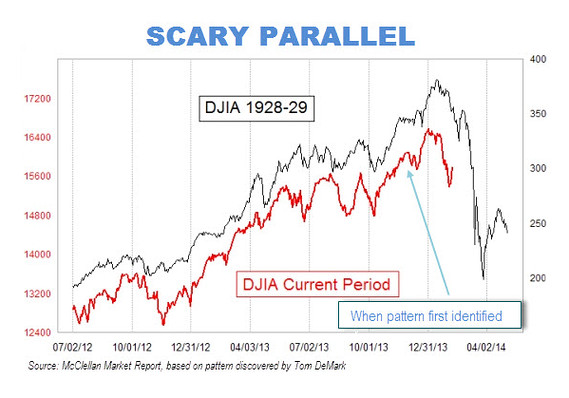
2. Dow Jones Average (DJIA) Chart Similar to 1929?? — below is a chart of the DJIA which displays a scary correlation to the 1928-1929 depression courtesy of McClellan Market Report. Will the pattern repeat is anyone guess???
3. White House again delays healthcare mandate for employers — Reuters, the government has announced yet another delay to a crucial part of Obamacare. The latest is that businesses with 50-99 full-time workers won’t have to provide health insurance to their workers until 2016. Larger firms will have to cover at least 70% of employees by 2015 and 95% a year later. The original plan was for companies to offer coverage in July 2014. That was delayed until 2015.
4. House approved suspension of debt limit for a year until March 16, 2015 — the House has authorized a one-year extension to the government’s borrowing authority – until March 16, 2015 – without any conditions by a vote of 221-201. There had been plans to link the debt-cap vote to restoring cuts to military pensions, but the battle-fatigued Republican leadership dropped its demands in order to keep the political focus on Obamacare.
5. German CPI in deflation territory — German CPI fell 0.6% on month in January following an increase of 0.4% in December. The drop in prices comes amid increasing concern that the eurozone faces the threat of deflation, although European Central Bank chief Mario Draghi has so far been sanguine about the prospect.
6. China’s Inflation Rate Holds Steady — WSJ, China’s CPI held steady at +2.5% on year in January, while PPI dropped for the 23rd consecutive month with a fall of 1.6%. The benign inflation could give the People’s Bank of China room to loosen monetary policy should the economy slow further, although the PBOC is also concerned about reining in soaring debt.
7. Twitter (TWTR) Insiders Get First Chance to Sell Shares as Lockup Ends — Bloombers, about 9.87 million of non-executive employees’ shares will become eligible for sale as agreements that locked them up after the IPO expire, according to filings with the U.S. Securities and Exchange Commission. That would boost the number of shares available for trading by 12 percent to about 90 million, according to data compiled by Bloomberg. More stock will start to become available for trading in May.
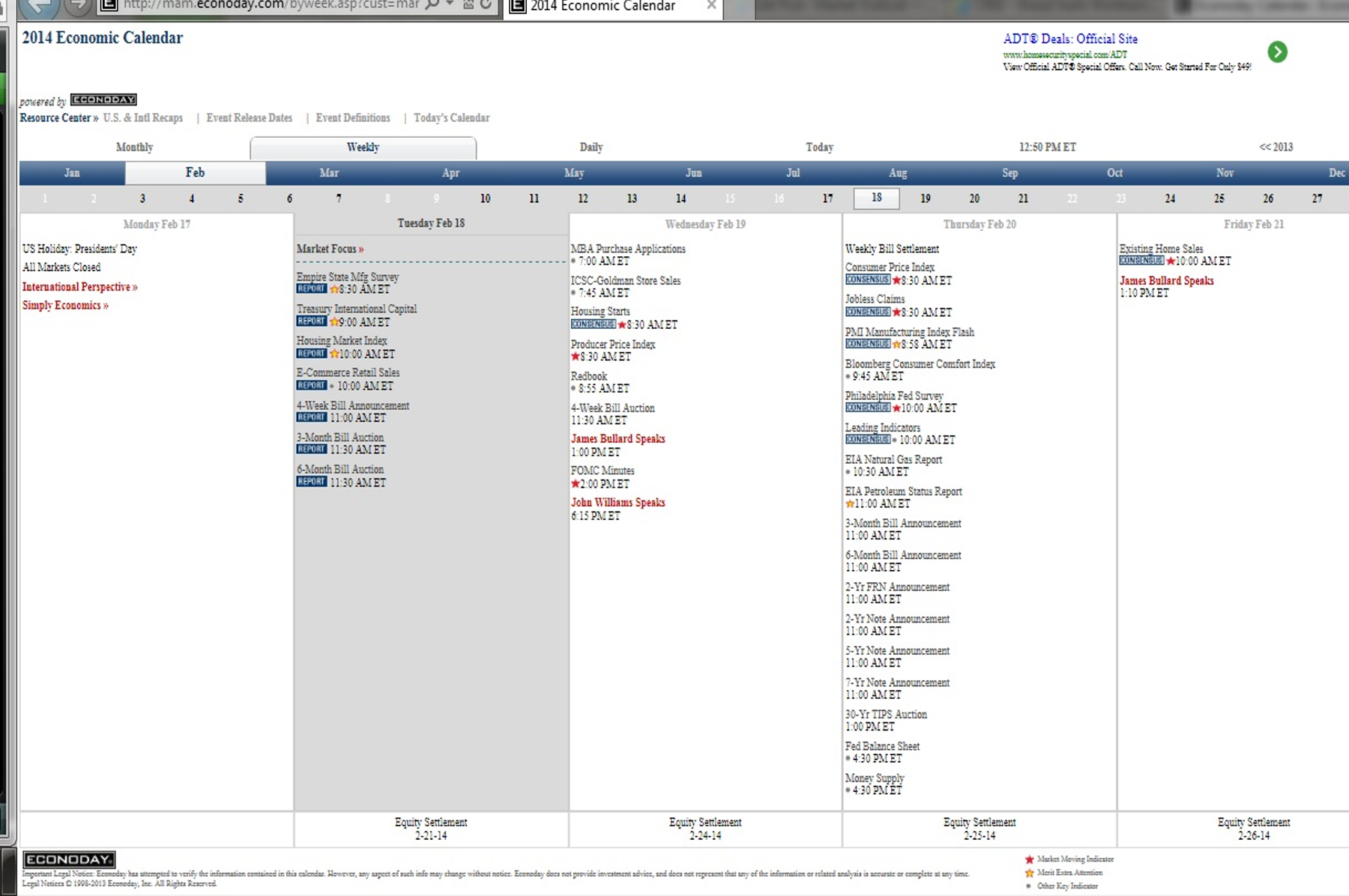
The week ahead — Economic data from Econoday.com:
Posted in Weekly Summary | No Comments »
February 10th, 2014
There will not be any re-cap for the week of Feb 7 2014. We are away for some needed R&R.
Have a good week.
The staffs at EGS.
Posted in Weekly Summary | No Comments »
February 3rd, 2014
“Only when the tide goes out do you discover who’s been swimming naked.” — Warren Buffett
1. Apple building mobile-payments business — WSJ reported Apple (AAPL) is working to expand its mobile-payments service to enable users to buy goods and services. AAPL ‘S iTunes havE 575M registered users, it poses a serious threat to the likes of PayPal (EBAY) and Square.
2. British economy grows at fastest pace since financial crisis — U.K. GDP increased 1.9% in 2013 in what was the quickest growth since 2007. However, GDP slowed a bit to +0.7% on quarter in Q4 from +0.8% in Q3 and the economy was still 1.3% below its pre-recession peak.
3. Congress forges deal on farm bill — Bloomberg reported the House and Senate negotiators have agreed to a five-year farm bill that would save up to $24B over the next ten years. The bill will reduce spending on food stamps by $8B and ending direct payments to farmers. That’s the third bill that legislators have negotiated in recent weeks.
4. FOMC Maintains QE Tapering Pace — Policymakers scaled back the bond purchase program by another $10bil a month, matching the prior cut despite the weak Dec. jobs report and upheaval in emerging markets. Central bankers noted mixed labor data and some slowing in housing.
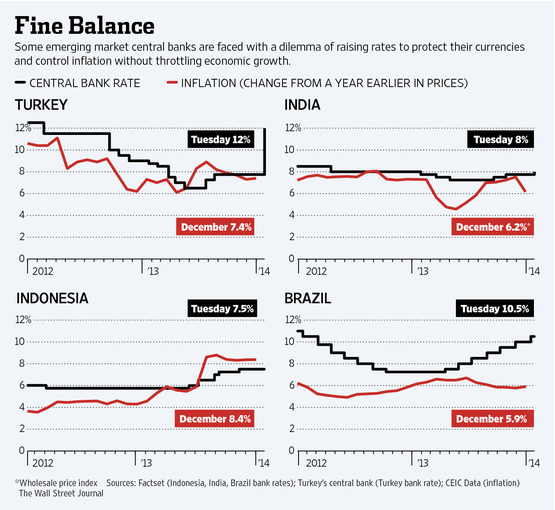
5. Emerging Markets raised interest rates to calm market — Turkey raised rate on one-week Interbank Rates, from 4.5% all the way to 10% as an attempts to get it’s plummeting currency and runaway inflation under control. Others did the same, see chart below courtesy of the WSJ.
6. Investors yank $9 billion from emerging market funds — Reuters, investors yanked $9 billion from emerging stock and bond funds during a turbulent past week, with equities seeing their biggest outflow in 2-1/2 years according to Boston-based fund tracker EPFR Global. This past week has seen some major falls in emerging currencies’ exchange rates, with central banks forced into rate rises or market interventions to limit the swings. Those currency losses and rate rises have put pressure on bond and stock holdings, forcing exits.
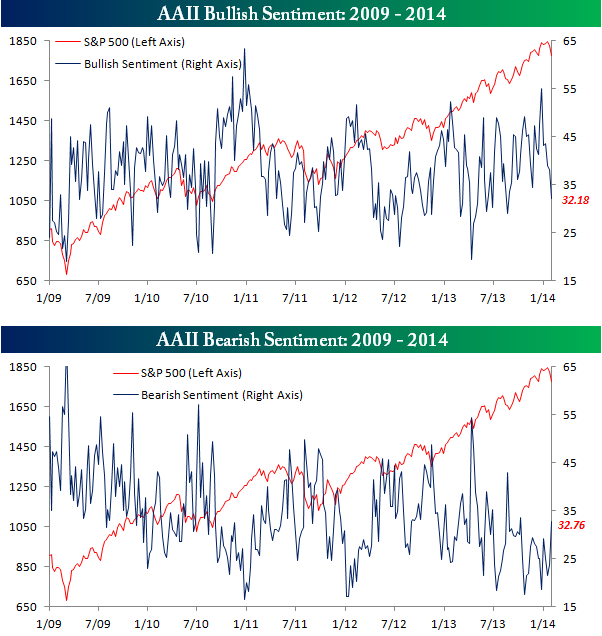
7. Individual Investors Rushed for the Exit — courtesy of BIG, According to the American Association of Individual Investors(AAII), bearish sentiment is now greater than bullish sentiment for the first time since mid-August. The last time bullish sentiment was above the 50% mark was back in late January. This represents the fourth weekly decline in the five weeks since bullish sentiment peaked on 12/26/13 at 55.06%. While bullish sentiment declined, the bearish camp became more crowded rising from 23.76% to 32.76%.
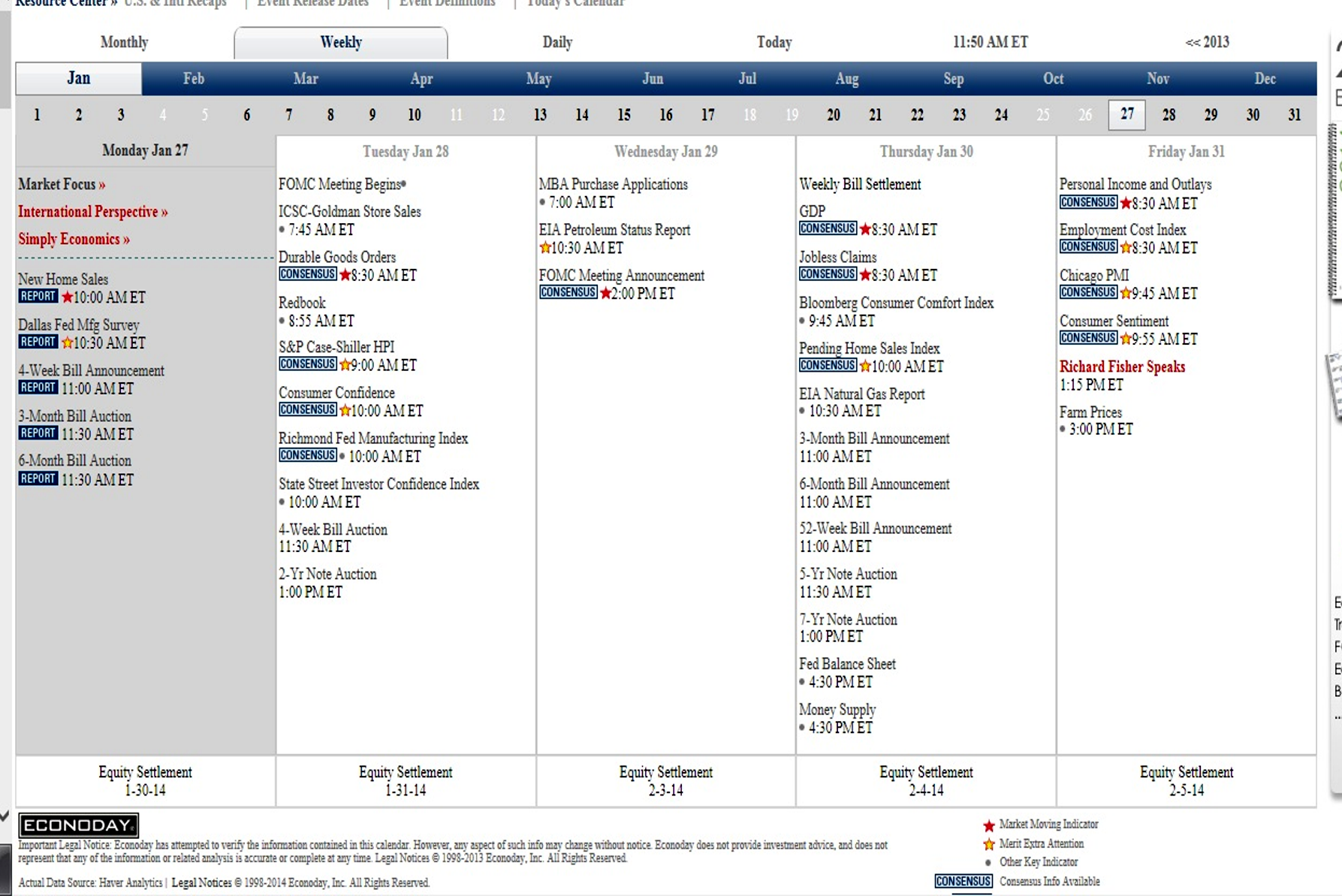
The week ahead — Economic data from Econoday.com:
Posted in Weekly Summary | No Comments »
January 27th, 2014
“Any idiot can face a crisis – it’s day to day living that wears you out.” – Anton Chekhov
1. Fed could cut bond-buying even further — Jon Hilsenrath from WSJ, reported that the Federal Reserve could reduce its monthly bond purchases to $65B from $75B at a next FOMC meeting. The Fed cut $10B from the QE program in December. Despite a weak jobs report last month, policy makers still bullish about the U.S.’s economic prospects.
2. Bank of Japan keeps ultra-loose policy unchanged — as expected, the Bank of Japan has left its key interest rate at 0.1%, and maintained its program of expanding the monetary base by ¥60-70T a year. The BOJ expects the economy to continue recovering moderately, although it will be affected by an upcoming hike in sales tax.
3. China (FXI) factory contraction shows weak start for economy in 2014 — Reuters, activity in China’s factory sector contracted in January for the first time in six months. It points to a weak start for the economy in 2014 as policymakers seek to curb high debt levels to head off financial risks. The flash Markit/HSBC Purchasing Managers’ Index (PM) fell to 49.6 in January from December’s final reading of 50.5, dropping below the 50 line which separates expansion of activity from contraction.
4. U.S. has until late February to increase debt limit — Congress has until late February to lift the $16.7T debt ceiling and avert a U.S. default, Treasury Secretary Jacob Lew stated. The cap is suspended until February 7, after which the Treasury can juggle the money about for a bit before running out of cash.
5. China’s Industrial & Commercial Bank of China Ltd concern of a default — Bloomberg, Chinese investors were asked to sink at least 3 million yuan ($496,000) in the 3 billion-yuan Credit Equals Gold No. 1 product amid guarantees that it was “100 percent safe,”. However, the owner was arrested after its coal mining company that collapsed.
6. Emerging-market currencies deepen drop — Marketwatch, Emerging-market currencies such as the Turkish lira, South African rand, Argentina Peso fell further against the dollar. Also, worries about a Chinese slowdown and prospects of rising U.S. rates triggered a broad flight out of emerging-markets assets.
The week ahead — Economic data from Econoday.com:
Posted in Weekly Summary | No Comments »
January 21st, 2014
“Men who can be right and sit tight are uncommon” — Jesse Livermore
1. Google Moves into Home Automation — Google announced a $3.2 billion deal to buy smart thermostat and smoke alarm-maker Nest Labs Inc, led by the “godfather” of the iPod. The Nest acquisition gives Google a stepping stone into an important new market at a time when consumer appliances and Internet services are increasingly merging.
2. World Bank bullish about global prospects — the World Bank expects global economic growth to accelerate to 3.2% in 2014 from 2.4% in 2013, led by advanced economies that seem “to be finally turning the corner” following the financial crisis. In its Global Economic Prospects report, the bank also forecast that the U.S. will expand 2.8% this year vs 1.8% last year.
3. Alaska to provide $5.75B for LNG export project — Bloomberg, Alaska plans to jump-start a $45B natural gas export project by pitching in more than 10% of the cost and joining Exxon Mobil (XOM), BP (BP), ConocoPhillips (COP) and TransCanada (TRP) as an equity partner. The agreement between the state and the four companies outlines a framework in which Alaska would take as much as a 25 percent stake in a proposed gas processing plant, an 800-mile (1,287-kilometer) pipeline from Alaska’s North Slope and a liquefaction facility in the Kenai Peninsula. NatGas tanker Navigator Holdings (NVGS) and GasLog (GLOG) are two of the leaders in LNG shipper.
4. House approves $1.1 trillion measure to fund government through Sept 30, 2014 — Reuters, the U.S. House of Representatives overwhelmingly approved a $1.1 trillion spending bill. As a next step, Congress will need to turn its attention to the $16.7T debt limit.
5. Luxury in China loses luster as the wealthy flee — Bloomberg, wealthy Chinese are likely to buy fewer luxury goods again in 2014 after the steepest cut-back on spending in at least five years. Overall spending by wealthy Chinese fell by 15 percent in 2013, the third consecutive year of decline. The shrinking ranks of wealthy residents in China has also reduced luxury spending. One in three so-called high net worth individuals have already left, or are planning to leave, the country, the report showed, mostly to seek better opportunities for their children’s education.
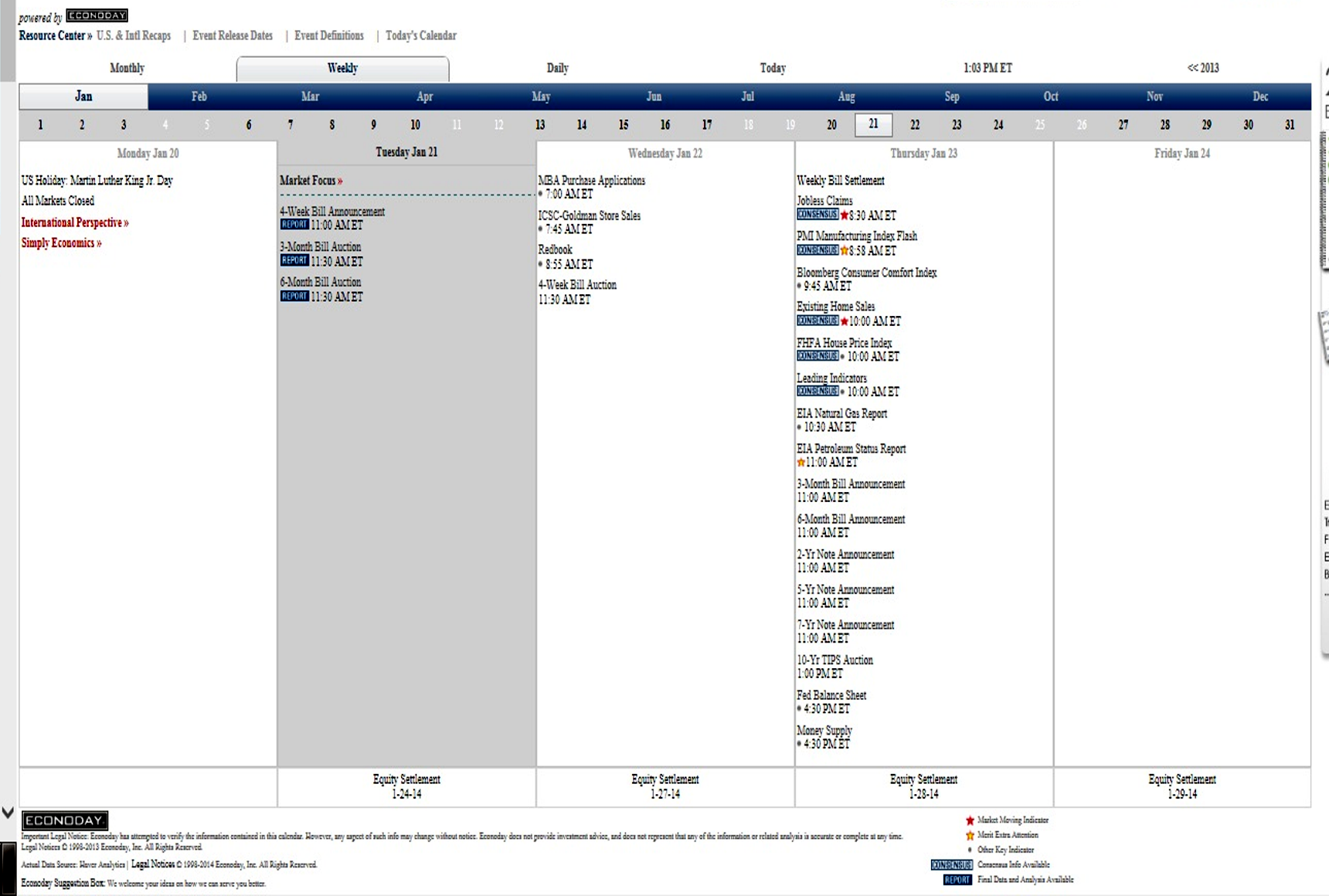
The week ahead — Economic data from Econoday.com:
Posted in Weekly Summary | No Comments »
January 14th, 2014
“Nothing is perfect. Life is messy. Relationships are complex. Outcomes are uncertain. People are irrational.” – Hugh Mackay
1. Senate confirms Yellen to lead the Federal Reserve — the Senate approved the nomination of Janet Yellen to become the first woman to head the Federal Reserve. The chamber voted 56-26 in favor.
2. Another train carrying oil derails and catches fire in New Brunswick, Canada — A Canadian National Railway train carrying propane and crude oil derailed and caught fire in northwest New Brunswick, Canada in the latest in a string of train accidents that have put the surging crude-by-rail business under heavy scrutiny. A series of disastrous derailments has reignited the push for tougher regulation.
3. Chinese CPI drops more than expected — China’s inflation fell to 2.5% on year in December from 3% in November and came in below forecasts of 2.7%. The PPI dropped for the 22nd month in a row – the longest streak since the 1990s – with a decline of 1.4%.
4. FOMC minutes – QE benefit declining over time — according the latest minutes from the Federal Reserve, the majority of Fed policy makers argued that the marginal efficacy of QE was declining over time at the FOMC’s last meeting in December. Few members want a larger-than-announced taper.
5. China ‘overtakes’ US as world’s largest goods trader — BBC, China appears to have become the world’s largest trading country last year after the value of its imports and exports increased 7.6% to $4.16T. The U.S., which has held the crown until now, hasn’t released its 2013 figures yet, but its trade in January-November totaled $3.5T. In December, China’s export growth slowed to 4.3% from 12.7%; However, there have been concerns in recent months over the speculation that some Chinese exporters may be overstating their shipments in an attempt to bypass restrictions on bringing funds into the country.
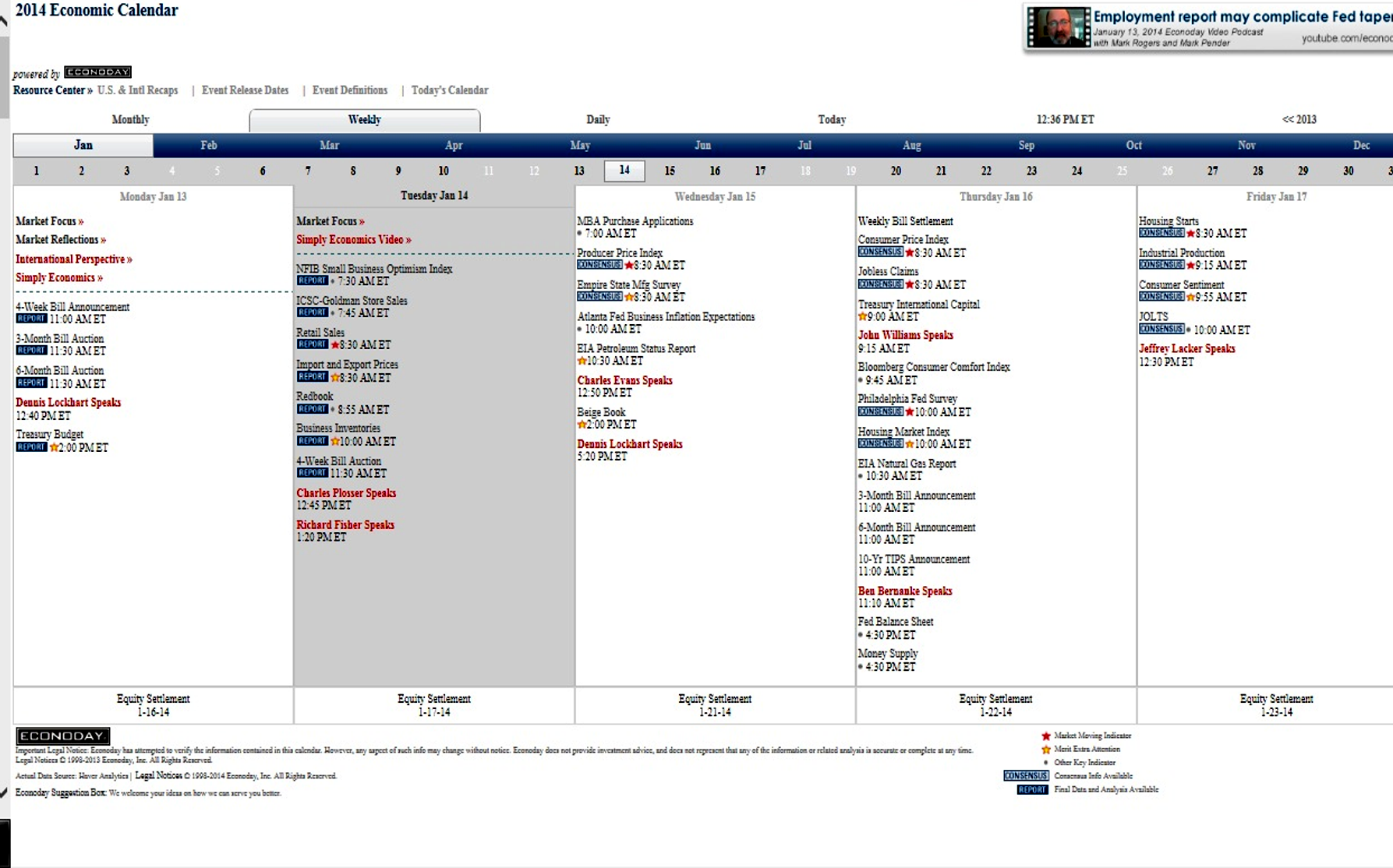
The week ahead — Economic data from Econoday.com:
Tags: New Year 2014
Posted in Weekly Summary | No Comments »
January 6th, 2014
“There’s only one growth strategy: work hard.” – William Hague
1. Masses of healthcare enrollments incomplete — As of last week, only around half of those who had signed up for healthcare coverage offered by over 100 insurers in 17 states under Obamacare had paid for their plans. Uncertainly now focus on whether insurers can process those payments and issue membership when the coverage takes effect in January 2014 .
2. China’s factory activity continues slows — the latest two surveys have indicated that China’s manufacturing sector slowed in December, with the official PMI falling to 51 from 51.4 in November and the HSBC print slipping to 50.5 from 50.8. New export orders disappointed in both readings, while employment contracted further in the official index. “Domestic and overseas demand was weaker than expected,” says economist Li Heng.
3. Improvement in Spanish (EWP) jobs situation better than expected — Spanish jobless claims dropped by 107,600 to 4.7M in December, the second-largest fall ever recorded after the June figure plummeted by over 127,000. The decline in December was far greater than the drop of 2,500 in November and consensus for -24,300. The improvement in unemployment adds to evidence that Spain is slowly digging itself out of its massive recession.
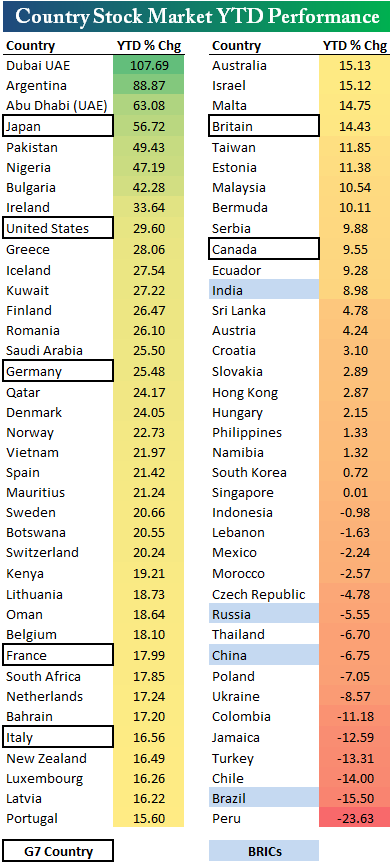
4. Final 2013 Country Stock Market Performance — courtesy of BIG, below is a look at the final stock market performance numbers for 76 countries around the world (% chg in local currencies).
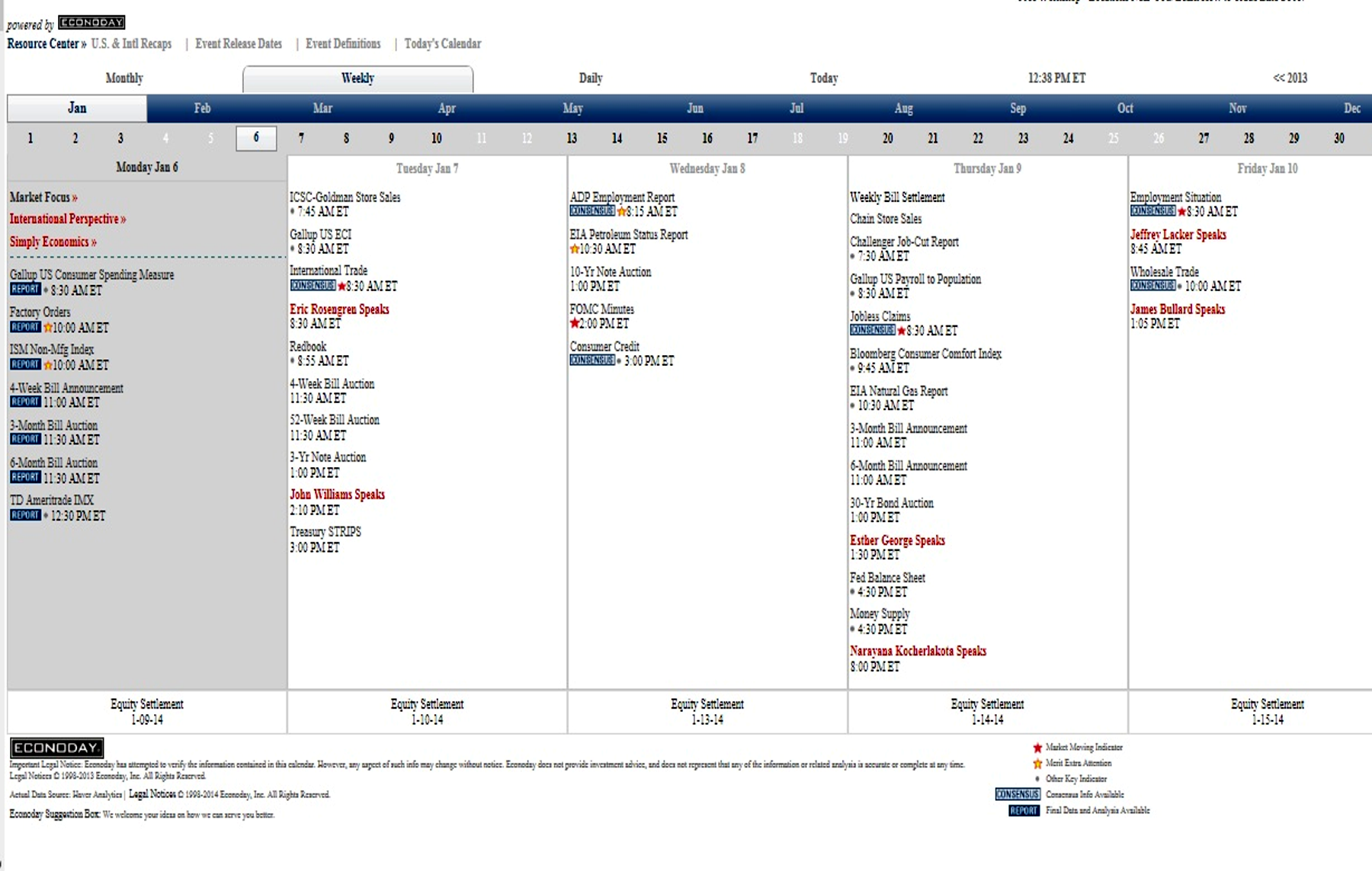
The week ahead — Economic data from Econoday.com:
Posted in Weekly Summary | No Comments »