October 13th, 2014
“In bear markets, stocks usually open strong and close weak. In bull markets, they tend to open weak and close strong.” – William J. O’Neill
1. Hewlett-Packard Plans to Break in Two — WSJ, H-P (NYSE:HPQ) plans to spin off its PC and printer ops into a separate publicly-traded company. If the H-P (NYSE:HPQ) division goes off as planned, it would give rise to two publicly traded companies, each with more than $50B in annual revenue.
2. First Ebola case Transmitted in Spain — a nurse in Spain became the first person to contract Ebola after treating a Spanish missionary flown in from Sierra Leone. The priest died Sept. 25. Furthermore, the Obama administration has called for new protocols to help stop the spread of Ebola, including additional passenger screening at airports and increased efforts to educate medical providers on how to handle cases.
3. Symantec is in “advanced talks” to split its security and storage software operations — Bloomberg a source adds the post-breakup companies could draw M&A interest, given firms such as EMC (NYSE:EMC) and H-P (NYSE:HPQ) have shown interest in one half or the other. Symantec’s (NASDAQ:SYMC) two security software units, enterprise security and PC/mobile security, respectively grew 3% and 1% Y/Y in calendar Q2, while its storage software unit grew 1%. The security units accounted for 63% of revenue and 80% of segment operating profit.
4. David Darst (Advisor to Morgan Stanley) Shows a Useful Bear Market and Healthy Correction Checklists — via video from CNBC. Click here for link
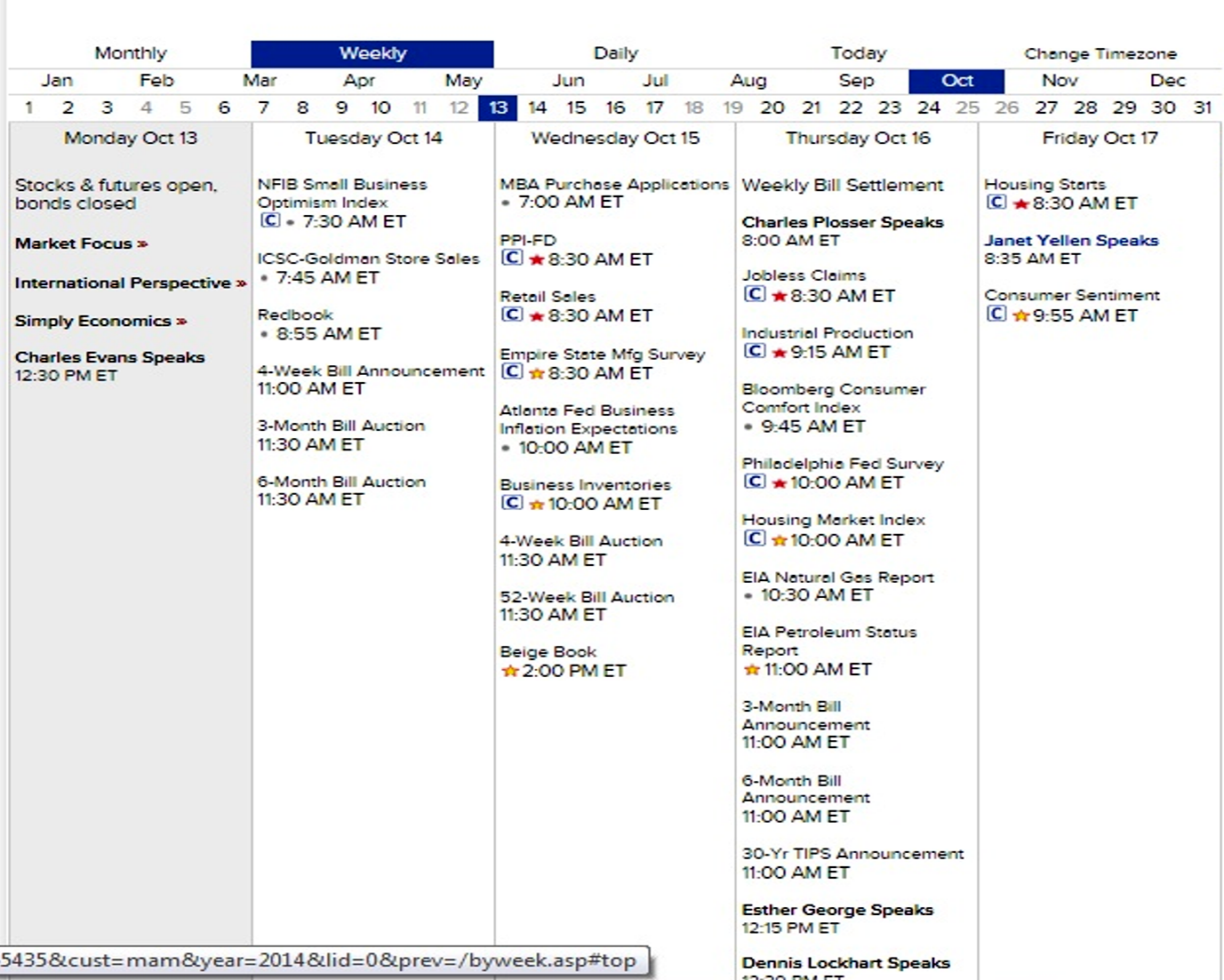
The week ahead — Economic data from Econoday.com:
Tags: Bear Mkt Checklist
Posted in Weekly Summary | No Comments »
October 6th, 2014
“This can be very difficult because admitting that the wrong trade was executed (or the right trade, but at the wrong time) is admitting that you were wrong. It is human nature to not like being wrong.” — unknown
1. Pioneer Natural Resources plans to double US oil exports in 2015 — Reuters, Pioneer Natural Resources (NYSE:PXD) expects to double its U.S. exports of condensate to 50K barrels per day next year. The U.S. shale resources explorer, along with Enterprise Product Partners (NYSE:EPD), received permits in June to export the ultra-light oil, after the country eased its 40-year ban on oil exports. Pioneer (NYSE:PXD) sells condensate from its Eagle Ford shale site to Enterprise, which markets the oil to foreign buyers.
2. NiSource to separate into two publicly traded companies — NiSource Inc (NYSE:NI) announced its board had approved plans to split into two publicly traded companies, separating its utilities and pipeline businesses. NiSource plans to list its natural gas pipeline division as Columbia Pipeline Group, which is expected to trade on the NYSE under the ticker “COLP.”
3. Hong Kong Protests Swell as Demonstrators Press Demands — Protestors continue to block many central roads and highways in Hong Kong, as pro-democracy demonstrations extend into their fifth day. Leaders have now issued a warning that the standoff would escalate in coming days if their demands aren’t met. The number of protestors have swelled into the tens of thousands, calling for Chief Executive Leung Chun-ying to resign and for the government in Beijing to drop plans to control the 2017 leadership election.
4. U.S. poised to become the world’s largest oil producer — FT, US oil output likely to exceed Saudi Arabia’s this month or next for the first time since 1991. U.S. production of oil and related liquids such as ethane and propane was level with Saudi Arabia in June and again in August at about 11.5M barrels a day, according to the International Energy Agency. U.S. crude production in August was still lower than both Saudi Arabia and Russia.
5. CDC confirms first case of Ebola in US— The Centers for Disease Control and Prevention has confirmed that a patient being treated at a Dallas hospital has tested positive for Ebola, the first case diagnosed in the U.S. The patient was placed under strict isolation, and CDC and Texas health officials are working to identify and monitor anyone who may have come into contact with the patient. Ebola is known to be incurable. Currently, there are a few pharma companies working on vaccines, drugs and other treatments for Ebola. These are Glaxo (GSK), Tekmira (TKMR), BioCryst (BCRX) and Sarepta (SRPT).
6. Pimco Total Return Fund outflows estimated at $23.5B in September — Pimco’s flagship Total Return Fund saw an estimated $23.5 billion in outflows in September as longtime Chief Investment Officer Bill Gross announced last week that he left for Janus Capital Group. This means the fund saw a drain of more than 10 percent of its total net assets in one month, according to data from Morningstar, which assessed it at $221.61 billion as of Aug. 31.
7. Exxon sees some disruption from Ebola outbreak — Reuters, Exxon Mobil is one of the first major U.S. companies to address the business impact of the Ebola outbreak in west Africa, with CEO Rex Tillerson announcing that the company is delaying plans to start offshore drilling in some areas. Exxon Mobil (NYSE:XOM) acquired an 80% stake in an oil prospect off the coast of Liberia last year, and has spent more than a year planning and preparing to drill there.
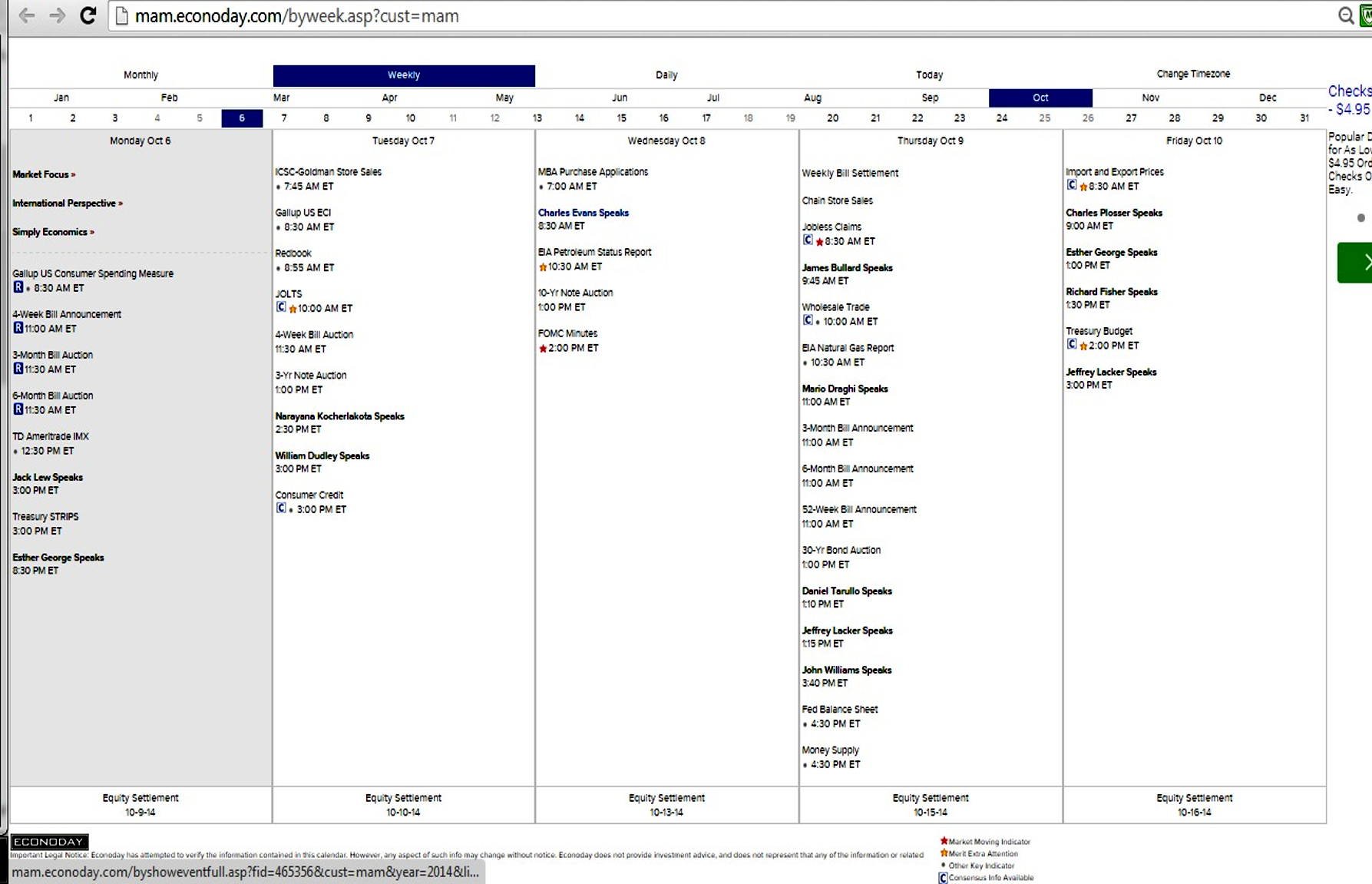
The week ahead — Economic data from Econoday.com:
Tags: HK Protest, NI Split
Posted in Weekly Summary | No Comments »
September 29th, 2014
“Losing money is the least of my troubles. A loss never troubles me after I take it. I forget it overnight. But being wrong – not taking the loss – that is what does the damage to the pocket book and to the soul.” – Jesse Livermore
1. Obama Administration Issues New Rules to Combat Tax Inversions — WSJ, the Treasury Department announced new tax rules late yesterday to deter U.S. companies from moving their domicile to countries with lower tax rates. The tax changes make it harder for companies to complete overseas mergers, and should they choose to invert, companies will face a hard time using the cash accumulated abroad. The new rules are effective immediately and apply to all deals that had not closed as of late last week.
2. US and allies attack Isis in Syria — FT, the U.S., joined by five Arab allies, launched the first air strikes on Islamic State targets in Syria last Monday, marking the first U.S. military intervention in Syria since the start of the country’s civil war. The U.S.-led strikes opens the war’s new front, and is on top of the extra funding approved by Congress last week to train Syrian rebels.
3. Pimco ETF Draws Probe by SEC — WSJ, the SEC is investigating whether the way bond giant Pimco values bond holdings may artificially boost the returns of its flagship fund. For the past several months, regulators have been probing Bill Gross’s $3.6B Total Return Fund (NYSEARCA:BOND), seeing if the ETF bought bonds at discounted prices, but then relied on higher valuations for the assets when calculating the holdings’ value.
4. Business spending lifts second-quarter GDP to 4.6% — MarketWatch, Gross Domestic Product (GDP) the value of all goods and services produced by the U.S. — grew at a real 4.6% annual rate in the second quarter, the Commerce Department reported. The even faster pace of growth stemmed from stronger exports and business investment than the government originally calculated. Spending on structures such as plants and office buildings was revised up to 12.6% from 9.4%, while spending on equipment was raised to 11.2% from 10.7%.
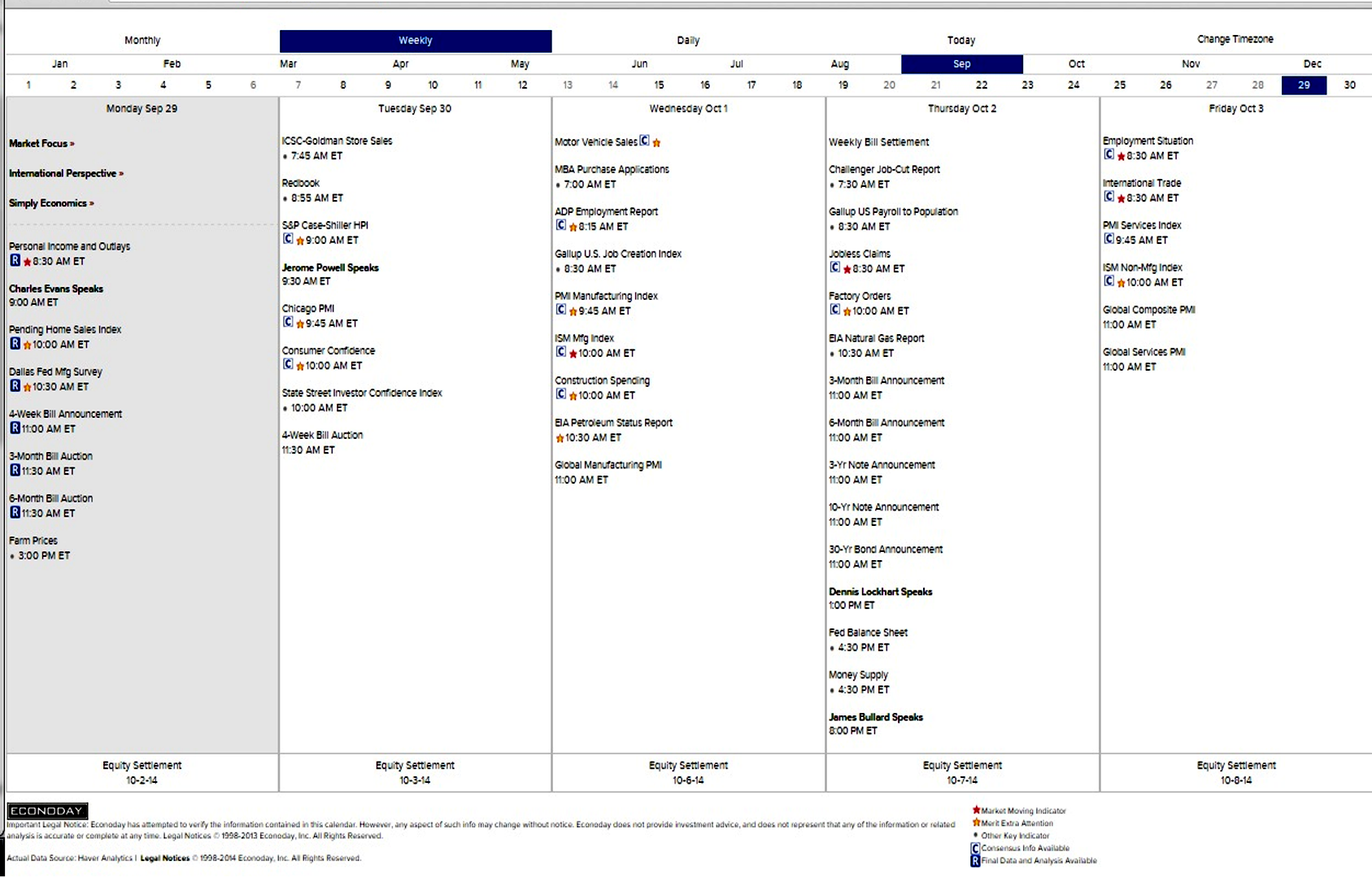
The week ahead — Economic data from Econoday.com:
Posted in Weekly Summary | No Comments »
September 22nd, 2014
“I have learned through the years that after a good run of profits in the markets, it`s very important to take a few days off as a reward. The natural tendency is to keep pushing until the streak ends. But experience has taught me that a rest in the middle of the streak can often extend it.”“- Martin Schwartz
1. U.S. to export condensate for third month to Europe, South Korea — Reuters, export of ultra light oil, or condensate, from the United States are set to continue for a third month, with two cargoes due to load in September for shipment to Europe and South Korea. Oil producers are looking to export a growing surplus of condensate due to the shale boom, while consumers, such as refiners, have lobbied to keep exports forbidden to ensure lower energy costs in the U.S. Washington has still held back on issuing more permits to export the minimally refined oil, despite growing international pressure to soften the ban.
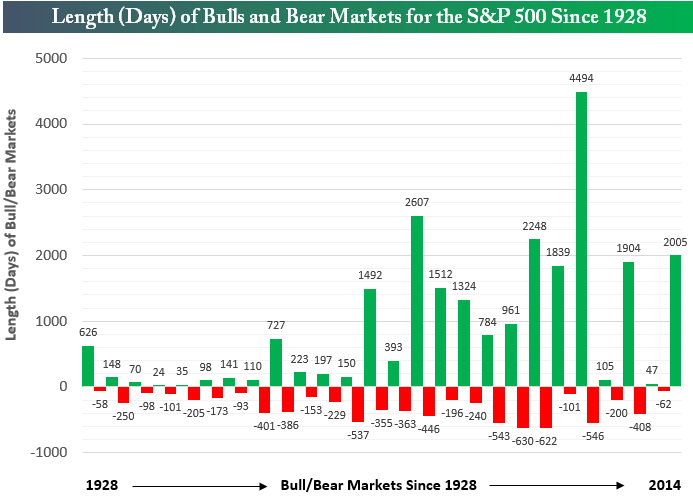
2. Bull Market Crosses The 2,000 Day Mark — courtesy of BIG, below is a chart showing the length (calendar days) of bull and bear markets for the S&P 500 as they have occurred from 1928 through today. As noted, only three other bull markets have lasted longer than current market.
3. FOMC Meeting — the Fed renewed its pledge to keep interest rates near zero for a “considerable time,” reassuring investors who might have been worried that the statement would point to an earlier than anticipated rate increase. As expected, the Fed said it would move to end its most recent asset purchase program at its next policy meeting in October.
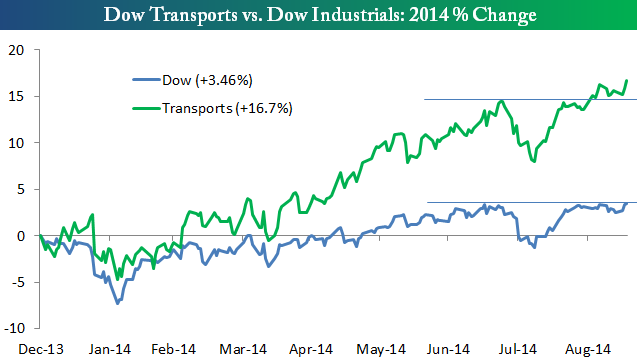
4. “Dow Theory” Shows Bullish Move — courtesy of BIG, the Dow Transports index has broken out to a new high as well as the the Dow Industrial’s.
5. Scotland spurns independence in historic vote but demand new powers — Scotland spurned independence in a historic referendum that threatened to rip the United Kingdom apart. Opponents of independence won 55 percent of the vote while separatists won 45 percent with all 3.6 million votes – a record 85 percent turnout – counted.
6. Alibaba IPO prices at top of range, raising $21.8 billion — Alibaba raised $21.8B and shattering records as the largest U.S. IPO in history. The sale places Alibaba (NYSE:BABA) in the ranks of the most valuable Internet companies with a market capitalization of $168B, 20x FY14 (ended March ’14) sales and 45x FY14 earnings.
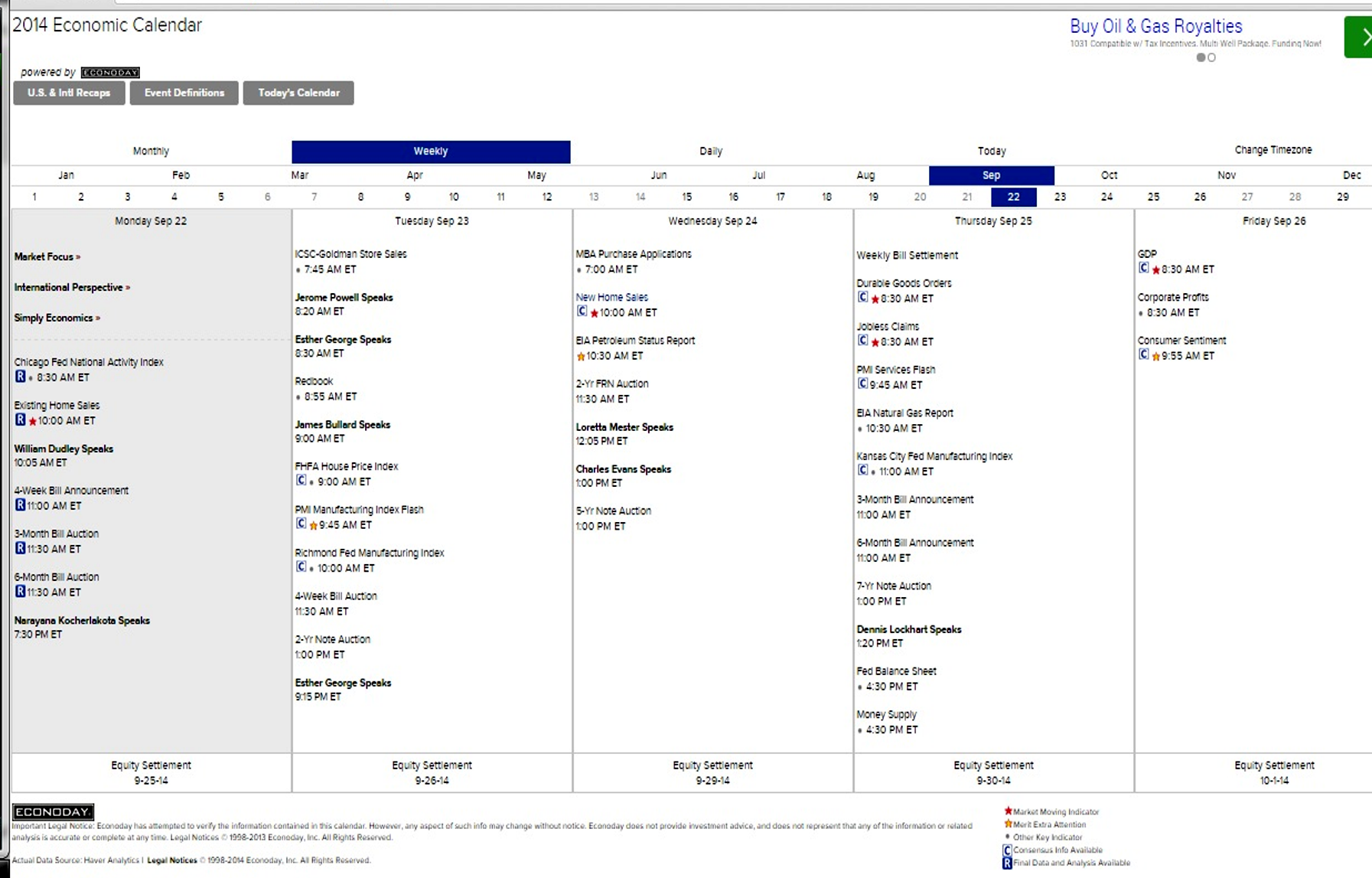
The week ahead — Economic data from Econoday.com:
Tags: Alibaba IPO, FOMC Meeting
Posted in Weekly Summary | No Comments »
September 15th, 2014
“Investing is no different. It is a game of repetition where hundreds of small actions result in one larger result. But most importantly, it is a game of risk management. It is not the home run hitter who wins in the long-run. Rather, it is that strategist who devises the best long-term plan who ultimately wins. While hitting home runs is sexy it is rarely a recipe for success in the investment world. Aim high, but play small. Over time, good risk management and patience wins. Power is no substitute for precision and patience. The same is true in the world of investing.” – The Prag Cap
1. Vodafone to Launch a New Mobile Payments Service with Visa — Vodafone is developing a new mobile payments service with Visa (NYSE:V) which will allow for contactless payments via SIM cards embedded with NFC technology. Launching the service later this year, Vodafone (NASDAQ:VOD) will probably be beaten to the market by Apple (NASDAQ:AAPL), which is expected to integrate mobile payments into its new iPhone due to be unveiled this week.
2. GM to offer connected car, automated driving technology in 2016 — Reuters, General Motors is planning to launch cars by 2016 with a hands-free automated driving system and vehicle-to-vehicle communications designed to help avoid collisions. While commercializing a fully automated vehicle may take until the next decade, the new GM (NYSE:GM) vehicles will still require drivers to pay attention to the road. One company which targeted this technology is Mobileye (MBLY).
3. EBay’s PayPal Unit to Start Accepting Bitcoin Payments — Bloomberg, eBay will start processing payments in bitcoin at its Braintree payments subsidiary, part of its PayPal (NASDAQ:EBAY) unit. Braintree will roll out the capability in the coming months, and will work with bitcoin exchange Coinbase to enable payments in the virtual currency. The move could potentially allow PayPal’s 152M accounts to use the currency as payment.
4. Visa and Apple Opening a New Era of Payments on Mobile Devices — Visa has announced it will debut a new payment service in conjunction with Apple’s (NASDAQ:AAPL) launch of Apple Pay. The new payment system will be available on all devices Apple unveiled last week, including the curved 4.7-inch and 5.5-inch iPhone 6 and Apple Watch. Visa (NYSE:V) says Token Service will allow Visa cards to be added to Apple Pay through the use of a digital account number (token) which can be stored on devices.
5. U.S. retail sales rose in August as Americans bought automobiles and a range of other goods — Reuters, “core sales” – which strip out automobiles, gasoline, building materials and food services, and correspond most closely with the consumer spending component of gross domestic product, increased 0.4 percent in August. July sales revised upward to 0.4 percent, which was previously reported as a 0.1 percent rise. The increase in retail sales, which account for a third of consumer spending, was in line with economists’ expectations.
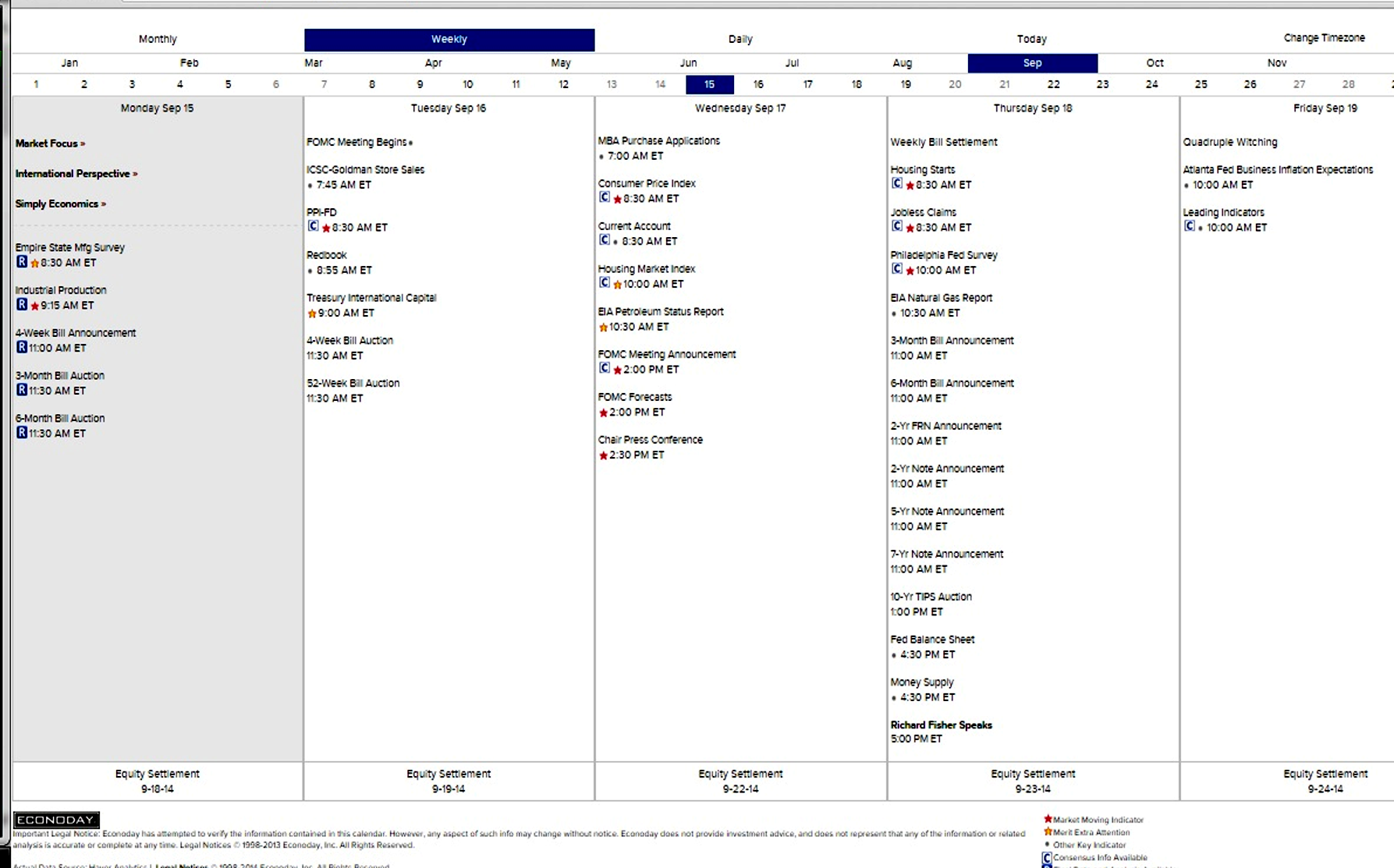
The week ahead — Economic data from Econoday.com:
Tags: Apple Pay, Mobile Payment, NFC
Posted in Weekly Summary | No Comments »
September 8th, 2014
“I have been trading for decades and I am still standing. I have seen a lot of traders come and go. They have a system or a program that works in some specific environments and fails in others. In contrast, my strategy is dynamic and ever evolving. I constantly learn and change.” – Thomas Busby
1. Apple Teaming Up With Visa, MasterCard on IPhone Wallet — Bloomberg, Apple Inc. (AAPL) plans to turn its next iPhone into a mobile wallet through a partnership with major payment networks, banks and retailers. Apple is planning a new partnership with major payment networks, including Visa (NYSE:V), MasterCard (NYSE:MA) and American Express (NYSE:AXP) to transform the next iPhone into a mobile wallet. The announcement follows earlier reports that the iPhone 6 will feature NFC and support a mobile payments platform. Original article was written back in Sept 2011. CLICKHERE FOR THE ARTICLE.
2. Putin: Outline of Cease-Fire Is Reached With Ukraine — WSJ, Russian President Vladimir Putin confirmed last week that he and his Ukrainian counterpart had agreed to the outlines of a cease-fire plan between Kiev’s forces and pro-Russian rebels fighting in eastern Ukraine. The seven-point plan calls for the separatists to end their offensive against Ukrainian forces around the rebel strongholds of Donetsk and Luhansk, while Kiev would pull its forces back, Mr. Putin said in Mongolia.
3. U.S. regulators adopt tighter rules for banks’ cash needs — Reuters, regulators adopted final rules for banks to hold enough high-quality liquid assets (cash-like) to last 30-days in crisis. The 6-big banks would need $2.5 trillion cash combined, or $100 bil more than they now have reserved. Banks have until 2017 to comply with the new rule.
4. Hiring slows as U.S. adds 142,000 jobs in August — the deceleration in hiring last month ended a six-month streak in which the U.S. added at least 200,000 jobs a month, the best stretch of job creation since 2006. The number of jobs created also fell well short of Wall Street’s forecast calling for a 228,000 gain. The dropoff stemmed in large part from a decline in jobs in the retail and auto sectors.
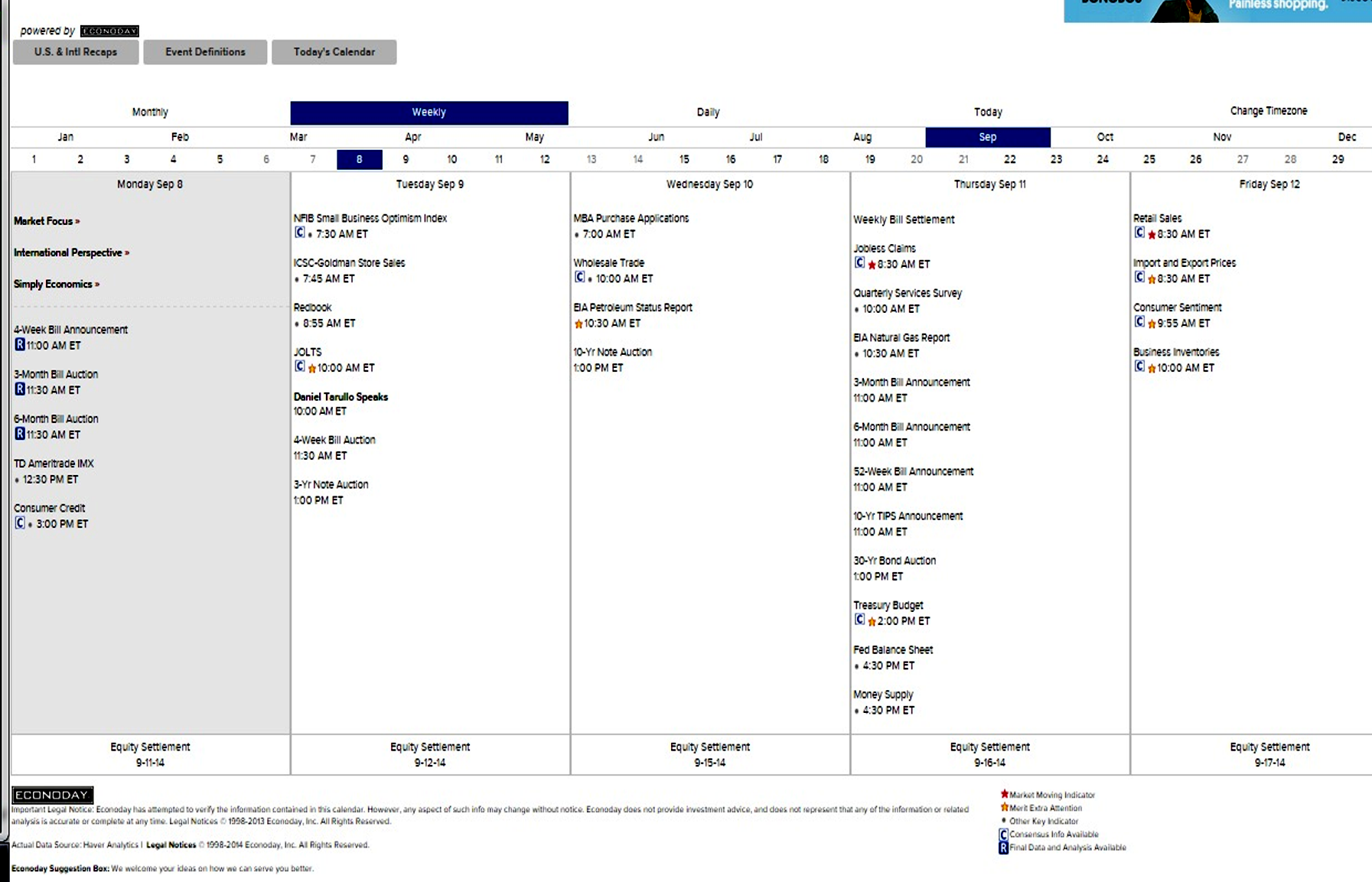
The week ahead — Economic data from Econoday.com:
Tags: Mobile Payment, NFC
Posted in Weekly Summary | No Comments »
September 2nd, 2014
“Every trader has strengths and weakness. Some are good holders of winners, but may hold their losers a little too long. Others may cut their winners a little short, but are quick to take their losses. As long as you stick to your own style, you get the good and bad in your own approach.” – Michael Marcus
1. Burger King in Talks to Buy Tim Hortons in Canada Tax Deal — WSJ, Burger King Worldwide is in talks to buy Tim Hortons (NYSE:THI) in a deal that would create the 3rd largest quick-service restaurant company in the world. The deal is being structured as a tax inversion, in which the new company would be headquartered in Canada. Tim Hortons and Burger King (NYSE:BKW) are expected to remain distinct brands if the merger is finalized.
2. Apple Preparing New 12.9-Inch IPad for Early 2015 — Bloomberg, Apple is preparing to manufacture the company’s largest iPad to date at 12.9″ (current versions are 9.7″ and 7.9″), with production set to start early next year. The move comes as sales for iPads have declined for two straight quarters, and suggests that Apple (NASDAQ:AAPL) is going to go after enterprise customers where the larger device could replace the traditional laptop.
3. Second-quarter GDP revised up to 4.2% — the U.S. economy grew at a 4.2% annual pace in the second quarter as businesses sharply increased spending on buildings and equipment and consumers spent more after huddling inside during the winter.
4. Ebola vaccine from GSK to begin U.S. clinical trials within weeks — Reuters, a new announcement by U.S. health officials today will state that a human study for the Ebola vaccine made by GlaxoSmithKline (NYSE:GSK) will begin within a couple of weeks instead of later this year as the company originally estimated. Glaxo’s vaccine contains a common cold virus that has been engineered to carry two genes of the virus.
5. Americans cut spending in July — MarketWatch, consumer spending dropped a seasonally adjusted 0.1% last month, the Commerce Department reported. The reduction in spending in the first month of the third quarter suggests the U.S. will fall well short of the second-quarter growth rate of 4.2% unless outlays rise much faster in August and September. Consumer spending accounts for nearly 75% of US GDP.
6. Morgan Stanley (MS) plans natural gas export plant in new commodities foray — Reuters, Morgan Stanley is filing plans to build, own and operate one of the first U.S. compressed natural gas export facilities and submitted its application to the Department of Energy in May. Morgan Stanley (NYSE:MS), along with Goldman (NYSE:GS), are the only two Wall Street banks that are allowed to own and operate infrastructure of raw materials due to their “grandfather” status for any commodities activities they engaged in before 1997.
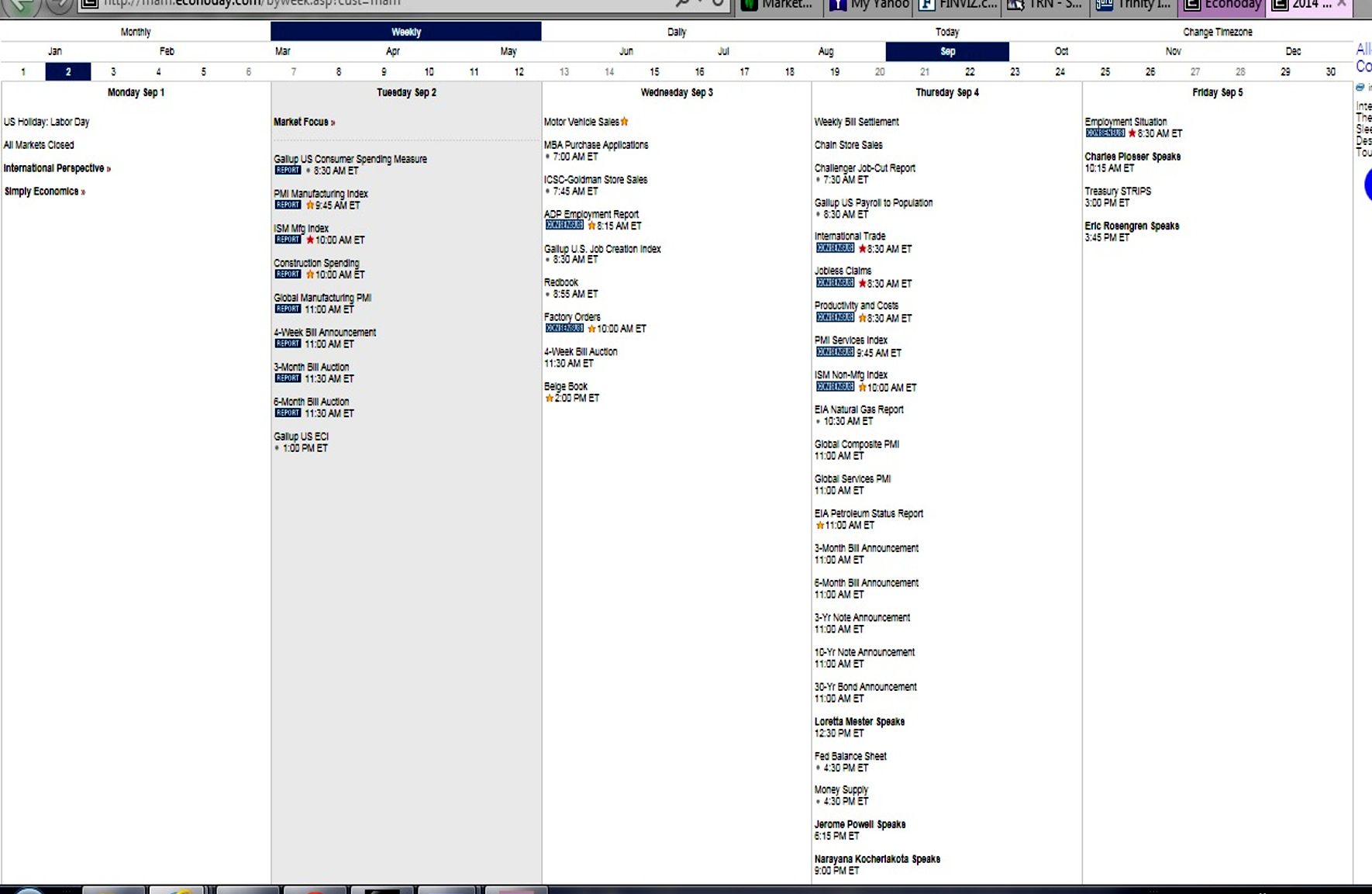
The week ahead — Economic data from Econoday.com:
Tags: Ebola GSK
Posted in Weekly Summary | No Comments »
August 25th, 2014
“Michael Marcus taught me one other thing that is absolutely critical: You have to be willing to make mistakes regularly; there is nothing wrong with it. Michael taught me about making your best judgment, being wrong, making your next best judgment, being wrong, making your third best judgment, and then doubling your money.” – Bruce Kovner
1. Warren Buffett Pulls Back On Oil Company Investments — FuelFix reported Warren Buffett selling off the vast majority of his stake in ConocoPhillips (NYSE:COP) and dumping some of his holdings in Phillips 66 (NYSE:PSX) and National Oilwell Varco (NYSE:NOV). The move looks prescient, as U.S. crude prices have dropped from ~$107/bll in mid-June to less than $94, and energy stocks went from being among the best performers on Wall Street to the middle of the pack.
2. Argentina Aims To Skirt U.S. Court, Bring Debt Under National Law — Reuters, Argentina is looking to push bondholders to swap defaulted debt for new notes, in order to dodge a U.S. ruling that prevents the government from paying creditors. last interest payment of $539M was blocked by a NY court, resulting in the country’s sovereign default on July 30.
3. Bank of America (BAC) in $16.5 Billion Deal with U.S. Gov’t Over Mortgage Bonds — Reuters, Bank of America is expected to pay around $9B in cash and provide customer relief valued at approximately $7B in a settlement with federal and state authorities over its role in mortgages leading up to the financial crisis. The record $16.5B payout is the largest in a series of increasing penalties against banks, and requires BofA (NYSE:BAC) to acknowledge the misrepresentations of the quality of MBSs of companies BofA acquired (Countrywide and Merrill Lynch).
4. Toyota To Cut Prices of Lexus Auto Parts in China Amid Anti-Trust Concerns — Toyota is now the latest automaker to cut its auto parts prices in China, reducing parts on its Lexus models by an average of 26%. In recent months, many foreign automakers have lowered price tags due to the ongoing anti-trust investigation in the country’s auto sector. Toyota’s (NYSE:TM) price cuts come just one day after China’s anti-monopoly regulator issued a $201M fine on 12 Japanese companies over price manipulation.
5. U.S. Eyes Wider Action on Islamic State — WSJ, the U.S. has indicated that it will be expanding its international campaign to combat extremists of the Islamic State, and will likely extend its fight from Iraq into neighboring Syria. The Obama administration has outlined several different fronts to combat ISIS, including continued airstrikes, support for the new Iraqi central government and influencing Persian Gulf states to halt the funding their citizens may be providing the extremist forces.
6. Federal Reserve Chairwoman Janet Yellen in No Rush to End Easy Money But Admits Risks — the Fed Chairwoman Yellen defended the need for extraordinary monetary policy as unprecedented dangers to the economy swirled. She acknowledged progress in the labor market and gains toward healthy inflation. Oversall, she seemed committed to leaving rates near zero for some time.
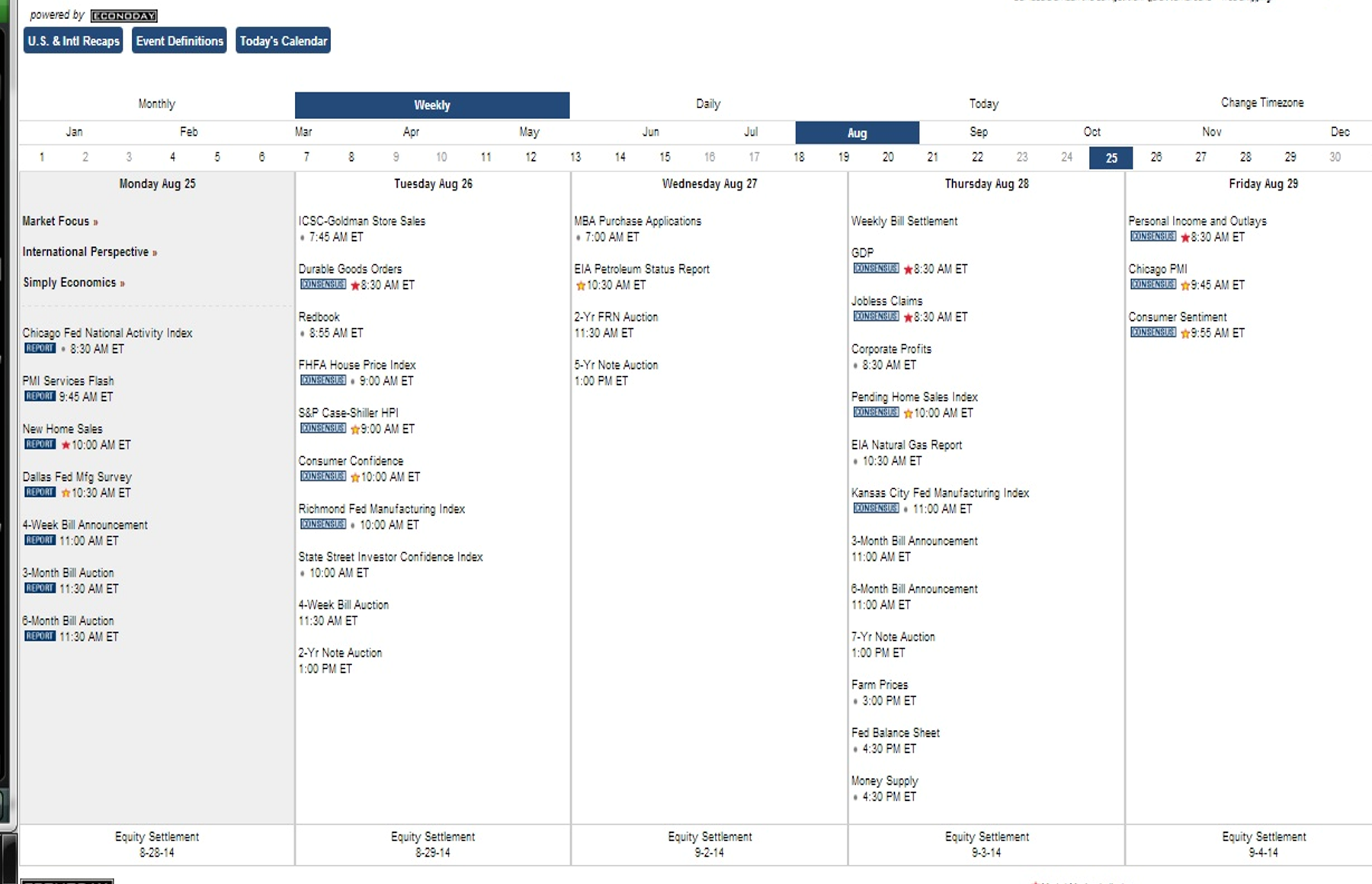
The week ahead — Economic data from Econoday.com:
Tags: Argentina Bankruptcy, Buffett 2Q, GM
Posted in Weekly Summary | No Comments »
August 18th, 2014
“A great trader is like a great athlete . You have to have natural skills, but you have to train yourself how to use them.” – Marty Schwartz
1. Clinical Trial to Start Soon on GlaxoSmithKline (GSK) Ebola Vaccine — A clinical trial of an experimental vaccine against the deadly Ebola virus is set to start shortly, according to British drugmaker GlaxoSmithKline (GSK). There is no proven cure or vaccine to prevent infection with Ebola and the scale of the current outbreak has prompted the World Health Organisation to declare it an international health emergency. Glaxo’s (NYSE:GSK) new vaccine will not be ready for widespread deployment before 2015 – even assuming it works as well as hoped.
2. US Retail Sales Flat in July, Stoke Growth Fears — Reuters, the Commerce Department said retail sales, which had increased 0.2 percent in June, were held back by a second straight month of declines in receipts at auto dealers, as well as weak sales of furniture and electronics and appliances. “Core sales”, which strip out automobiles, gasoline, building materials and food services, and correspond most closely with the consumer spending component of gross domestic product, edged up 0.1 percent in July. That suggested a moderation in consumer spending early in the third quarter.
3. Chinese Home Sales Fall 10.5% As Market Weakens — Home sales in China fell 10.5% in the first seven months of the year to 2.98 trillion yuan ($484 billion), data released by the National Bureau of Statistics. To lure home buyers back to the market, around 30 local governments have loosened property restrictions such as limits on second home purchases. However, there has yet to be any meaningful pickup in sales, as home buyers stay away due to expectations of further price falls and rising inventories. Average home prices in 100 Chinese cities fell for the third straight month in July on a month over month basis, according to data tracker China Real Estate Index System.
4. Euro-Zone GDP Fails to Grow in Second Quarter — Euro-Zone GDP failed to grow in the second quarter following 12 months of weak growth, causing European equity markets to fall and increasing pressure on the ECB to do more to boost growth and inflation. The data released by the European Union’s statistics office translates into 0.2% growth in annualized terms, down from the first quarter’s 0.8% pace.
5. U.S. Energy Dept Finalizes Overhaul of Natural Gas Export Reviews — Reuters, the U.S. Energy Department has finalized a plan to revamp its process for approving liquefied natural gas exports. The biggest winners under the new approach are Cheniere Energy (NYSEMKT:LNG) and Exxon’s (NYSE:XOM) Golden Pass project.
6. Coca-Cola (KO) Acquired a 16.7% Stake in Monster Beverage (MNST) as Part of a Strategic Alliance — Coke (NYSE:KO) will make a $2.15B net cash payment to Monster (NASDAQ:MNST) at the time of the deal’s closing, which is expected in late 2014 or early 2015. As part of the deal, Monster will transfer its non-energy businesses to Coke, and “enter into expanded distribution agreements.” In return, Coke will “transfer ownership of its worldwide energy business” to Monster.
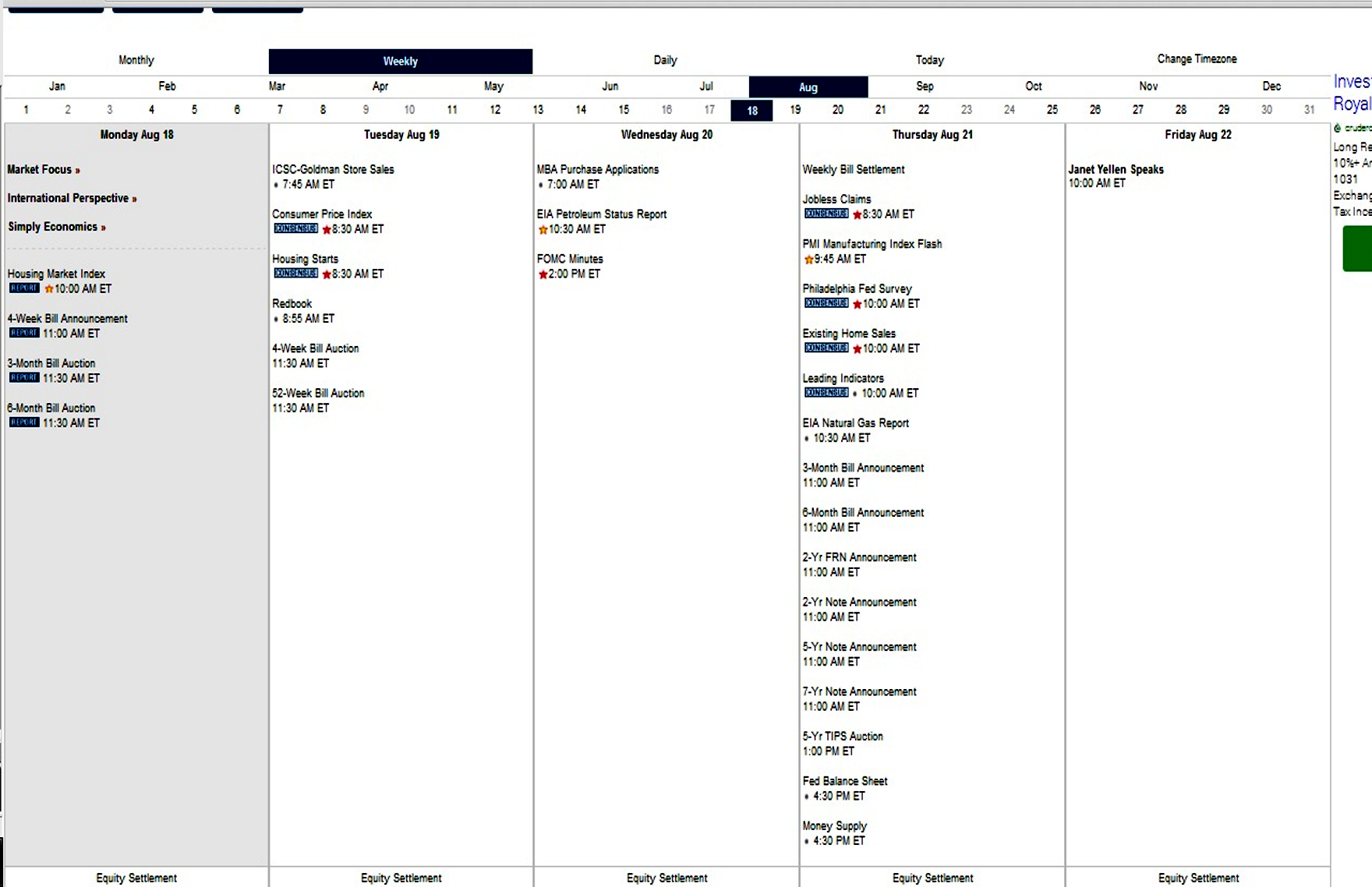
The week ahead — Economic data from Econoday.com:
Posted in Weekly Summary | No Comments »
August 11th, 2014
“Bull markets are born on pessimism, grow on skepticism, mature on optimism, and die on euphoria. The time of maximum pessimism is the best time to buy, and the time of maximum optimism is the best time to sell. If you want to have a better performance than the crowd, you must do things differently from the crowd.” – Sir John Templeton
1. Portugal Spent $6.6B to Rescue Banco Espirito Santo — Portugal is splitting Banco Espirito Santo Bank into a “good bank”, to be renamed Novo Banco, and a “bad bank”, which will house Banco Espirito’s exposures to the troubled Espirito Santo business empire. The bad bank’s losses will be borne by the bank’s shareholders, including the Espirito Santo Financial Group (OTC:ESFHF), one of the holding companies of the Espirito Santo family, and Credit Agricole (OTCPK:CRARY) which owns a 14.6% stake.
2. GM Financial Says DOJ is Examining Subprime Loan Records — Bloomberg, the Dep. of Justice (DOJ) is subpoenaing GM in the midst of a resurgence in U.S. auto sales fueled partly by a subprime lending boom. The Justice Department is seeking documents on underwriting criteria, origination, warranties and securitization of subprime loans since 2007, GM Financial said in a filing last week.
3. China Suspends Work at Hundreds of Aluminium and Magnesium Factories After Deadly Blast — Reuters, China has suspended work at more than 200 aluminium and magnesium processing factories in an eastern province for safety checks as part of a nationwide review following an explosion at an auto parts plant that killed 75 people. The Zhongrong factory supplied auto parts to GM (NYSE:GM) and many other companies, and the new closure will greatly affect international supply chains.
4. Cameron LNG Project Gets Final Investment Approval-Japanese Partners — Reuters, Japanese partners in the Cameron LNG terminal say the project has secured its last investment approval by obtaining $7.4B in financing. The move brings Japan a step closer to importing significant amounts of LNG from the U.S.’s abundant supply of shale gas. The Cameron project is owned by Sempra Energy (NYSE:SRE), GDF Suez (OTCPK:GDFZY), Mitsui & Co. (OTCPK:MITSY), and a joint venture between Mitsubishi Corp. (OTCPK:MSBHY) and Nippon Yusen KK (OTCPK:NPNYY).
4. World Health Organization (WHO) Declares Ebola Outbreak An International Health Emergency — The World Health Organization has declared the “extraordinary” outbreak of Ebola in West Africa an international public-health emergency. Late last week, it called for a “coordinated international response” to the outbreak, the largest ever, which has claimed 932 lives and spread from Guinea to Liberia, Nigeria and Sierra Leone since it began in December. Ebola is known to be incurable. Currently, there are a few pharma companies working on vaccines, drugs and other treatments for Ebola. These are Tekmira (TKMR), BioCryst (BCRX) and Sarepta (SRPT).
5. U.S. military strikes ISIL artillery in Iraq — MarketWatch, The U.S. military has entered the conflict in Irag and struck an ISIL artillery that had been used against Kurdish forces defending Erbil, the Pentagon reported. Reports said two Navy F-18s dropped laser-guided missiles on the mobile artillery sites.
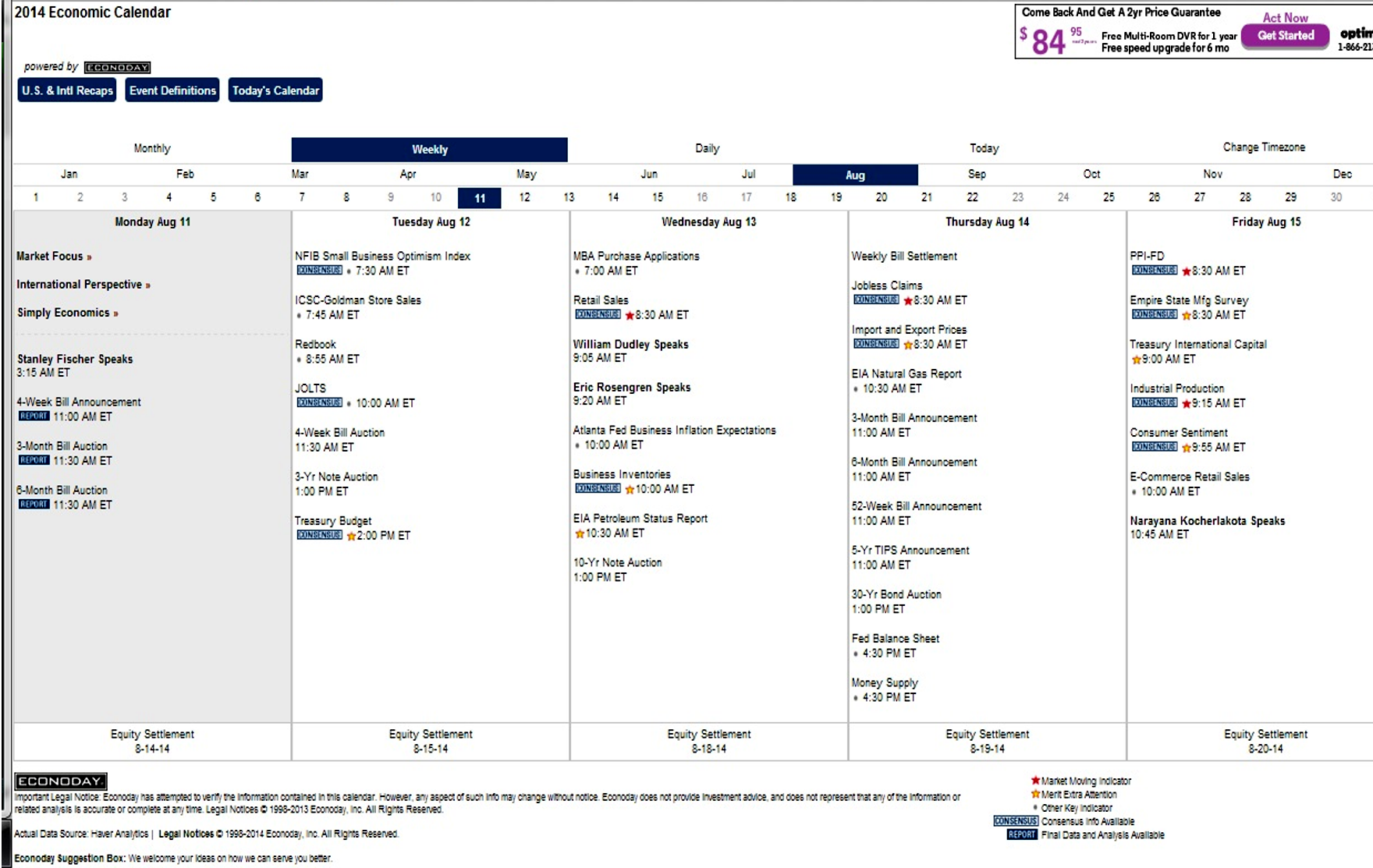
The week ahead — Economic data from Econoday.com:
Tags: Ebola
Posted in Weekly Summary | No Comments »