March 3rd, 2015
“I believe the very best money is made at the market turns. Everyone says you get killed trying to pick tops and bottoms and you make all your money by playing the trend in the middle. Well for twelve years I have been missing the meat in the middle but I have made a lot of money at tops and bottoms.” – Paul Tudor Jones.
1. Possible Homeland Security Shutdown — Homeland Security spending authority expired last Friday, leading to a partial shutdown of the department unless Congress approves new funding. The $39.7B budget is stalled in Congress over Obama’s recent executive orders that lift the threat of deportation from millions of undocumented immigrants.
2. European Commission Accepts Greek Economic Measures After Review — Bloomberg, Euro-region finance ministers approved Greece’s package of new economic measures and paved the way for an extension to the country’s bailout agreement. Greece will secure a four-month extension to euro zone funding, keeping its financial system afloat.
3. Banks Face U.S. Manipulation Probe Over Metals Pricing — U.S. officials are probing at least 10 major banks for the possible rigging of precious-metals markets, even though European regulators shelved a similar investigation after finding no evidence of wrongdoing. The DOJ is scrutinizing the price-setting process for gold, silver, platinum and palladium in London, while the Commodity Futures Trading Commission has opened a civil investigation.
4. Obama Vetoes Keystone Pipeline Bill — President Obama swiftly vetoed a bill approving TransCanada’s (NYSE:TRP) Keystone XL oil pipeline, leaving the long-debated project in limbo for another indefinite period. Immediately after receiving the veto message, Senate Majority Leader Mitch McConnell, countered by announcing the Republican-led chamber would attempt to override it by March 3.
5. China drops Apple, Cisco from Government Purchases — MarketWatch, China has systematically removed several leading foreign technology brands from its list of suppliers for government contracts over the past two years. Some of the companies are – Cisco Systems Inc. (CSCO), Apple Inc. (AAPL), Citrix Systems Inc. (CTXS) and Intel Corp.’s (INTC).
6. Q4 GDP Revised to 2.2%, Versus Expected Growth of 2.1% — CNBC, Gross domestic product expanded by a 2.2% annual clip in the final three months of 2014, down from an initial read of 2.6%. Consumer spending was very strong as outlays jumped a revised 4.2% in the fourth quarter, down from a preliminary estimate of 4.3%. That was the largest gain since 2010.
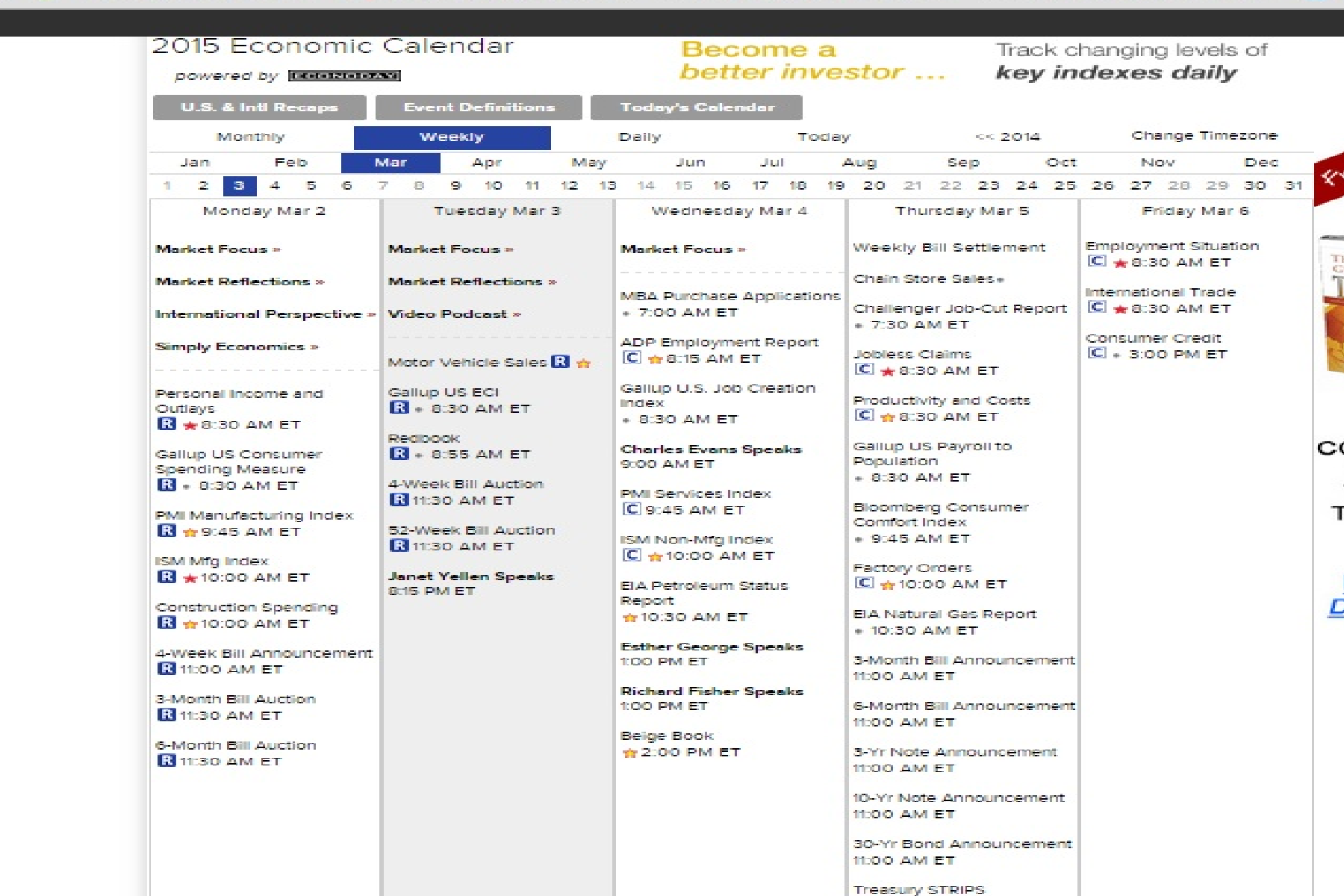
The week ahead — Economic data from Econoday.com:
Posted in Weekly Summary | No Comments »
February 23rd, 2015
“I have learned through the years that after a good run of profits in the markets, it`s very important to take a few days off as a reward. The natural tendency is to keep pushing until the streak ends. But experience has taught me that a rest in the middle of the streak can often extend it.”– Martin Schwartz
1. Greek Debt Talks Break Down — MarketWatch, talks among eurozone finance ministers over a new financing arrangement for Greece broke down abruptly. The breakdown came after Greece rejected an extension of its current 240-billion-euro ($272 billion) bailout program under the conditions being offered by other ministers.
2. Oil Tanker Derails, Explodes in West Virginia — a CSX (NYSE:CSX)train carrying more than 100 tankers of crude oil has derailed and burst into a huge fireball in West Virginia, igniting at least 14 tankers. One tanker car and perhaps more fell into the Kanawha River, prompting concerns about potential contamination of water treatment facilities that serve local communities.
3. BOE Keep Interest Rates Unchange — Bank of England officials voted unanimously to leave the central bank’s benchmark interest rate unchanged at 0.5% this month and the stock of assets purchased under its bond-buying program unchanged at £375B.
4. Germany Rejects Greece’s Loan-Extension Proposal — MarketWatch, Germany has rejected Greece’s request for a six-month loan-extension agreement, saying the letter is not a “a substantial proposal” for a solution.” The Greek PM had ask the eurozone ministers to extend by 6-months its 240-bil-euro bailout, without austerity terms.
5. Moody’s Downgrades Russia Sovereign Debt to Junk — CNBC, Moody’s Investors Service downgraded Russia’s sovereign debt to junk status last Friday, citing the crisis in Ukraine and the falling price of oil. Moody’s cut Russia’s rating to Ba1 from Baa3, with a negative outlook.
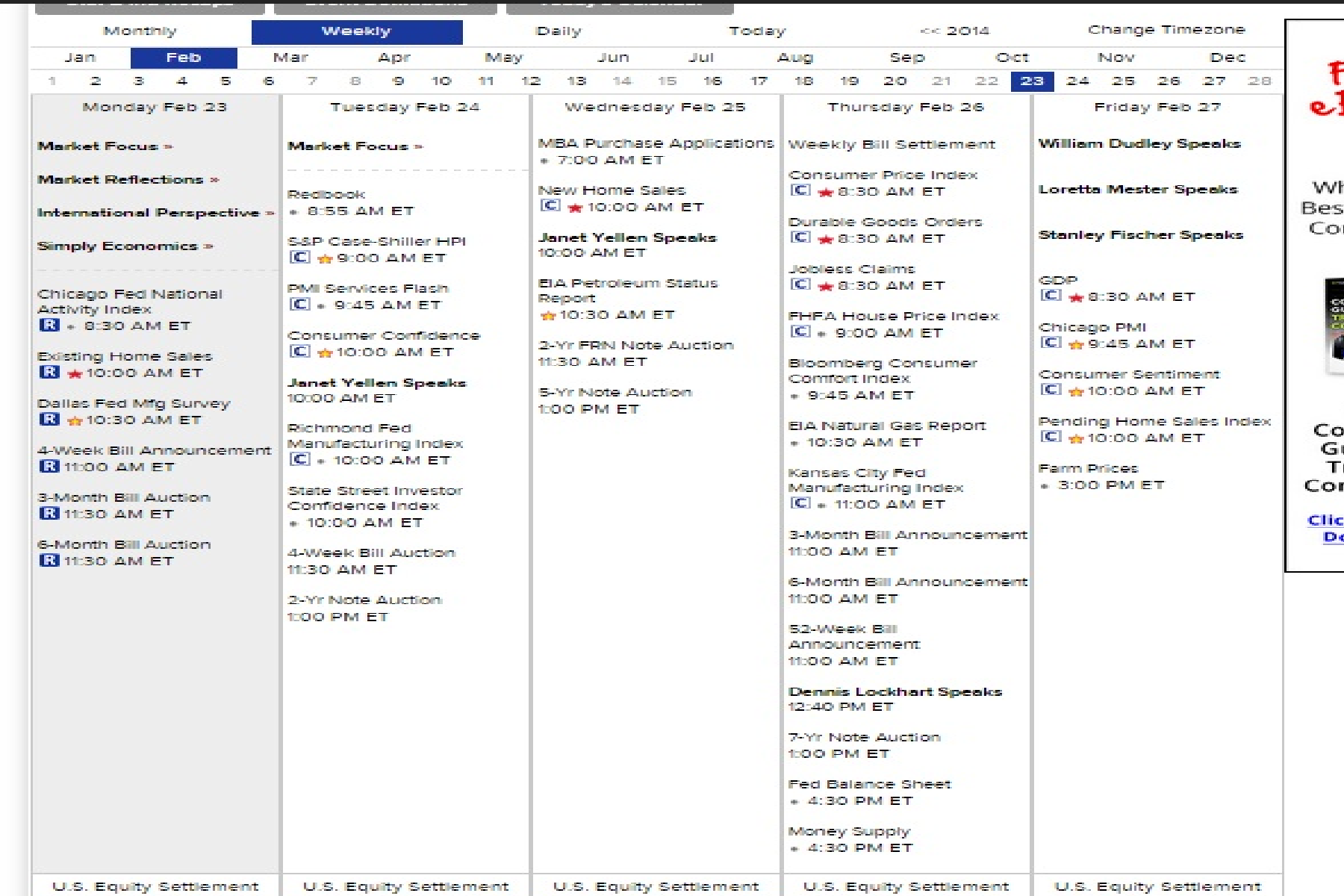
The week ahead — Economic data from Econoday.com:
Tags: Grexit, Russia Junk Status
Posted in Weekly Summary | No Comments »
February 16th, 2015
“I’m more concerned about controlling the downside. Learn to take the losses. The most important thing about making money is not to let your losses get out of hand.” – Marty Schwartz
1. Chinese Economy Weakens — according to the latest data, China’s exports slipping 3.3% from year-ago levels while imports plunged by 19.9%. The slide in imports is the sharpest since May 2009, while exports have not produced a negative annual reading since March 2014. Many are expecting China to lower its GDP target to around 7% this year, after posting 7.4% in 2014, its lowest annual growth rate in 24 year.
2. FBI Probes Fake TurboTax Filings — WSJ reported the FBI is examining how fraudulent tax returns were filed in 19 states through Intuit’s (NASDAQ:INTU) tax-preparation software TurboTax and whether a computer data breach allowed access to personal information. Intuit halted e-filings of state returns last week after spotting criminal attempts to get refunds through its systems, but resumed filing after steps were taken to combat the activity.
3. Halliburton to Cut Workforce by 6.5%-8% Due to Challenging Market — Halliburton (NYSE:HAL) has announced that it will cut 5,000-6,5000 jobs, due to slumping oil prices and the resulting decline in oil and gas exploration and production. CEO Lesar previously warned that 2015 would be a “tough year” for the company.
4. ECB Raises Limit on Emergency Funding for Greek Banks — MarketWatch, the European Central Bank boosted the amount of emergency assistance that can be provided to Greek banks by 5 billion euros ($5.7 billion), according to German news reports. That lifts the total amount of funding Greek banks can access through a program known as emergency liquidity assistance, or ELA, to 65 billion euros. The ECB earlier this month said it would no longer accept junk-rated Greek government debt as collateral from Greek banks in return for cheap ECB funding loans, but said the banks could continue to tap funding via ELA, which is administered by the Greek central bank.
5. House Passes Keystone Pipeline Bill, Set for Showdown with Obama — the House has again voted for a bill approving construction of TransCanada’s (NYSE:TRP) Keystone XL pipeline, setting up a political showdown with President Obama, who has vowed to veto the bill.
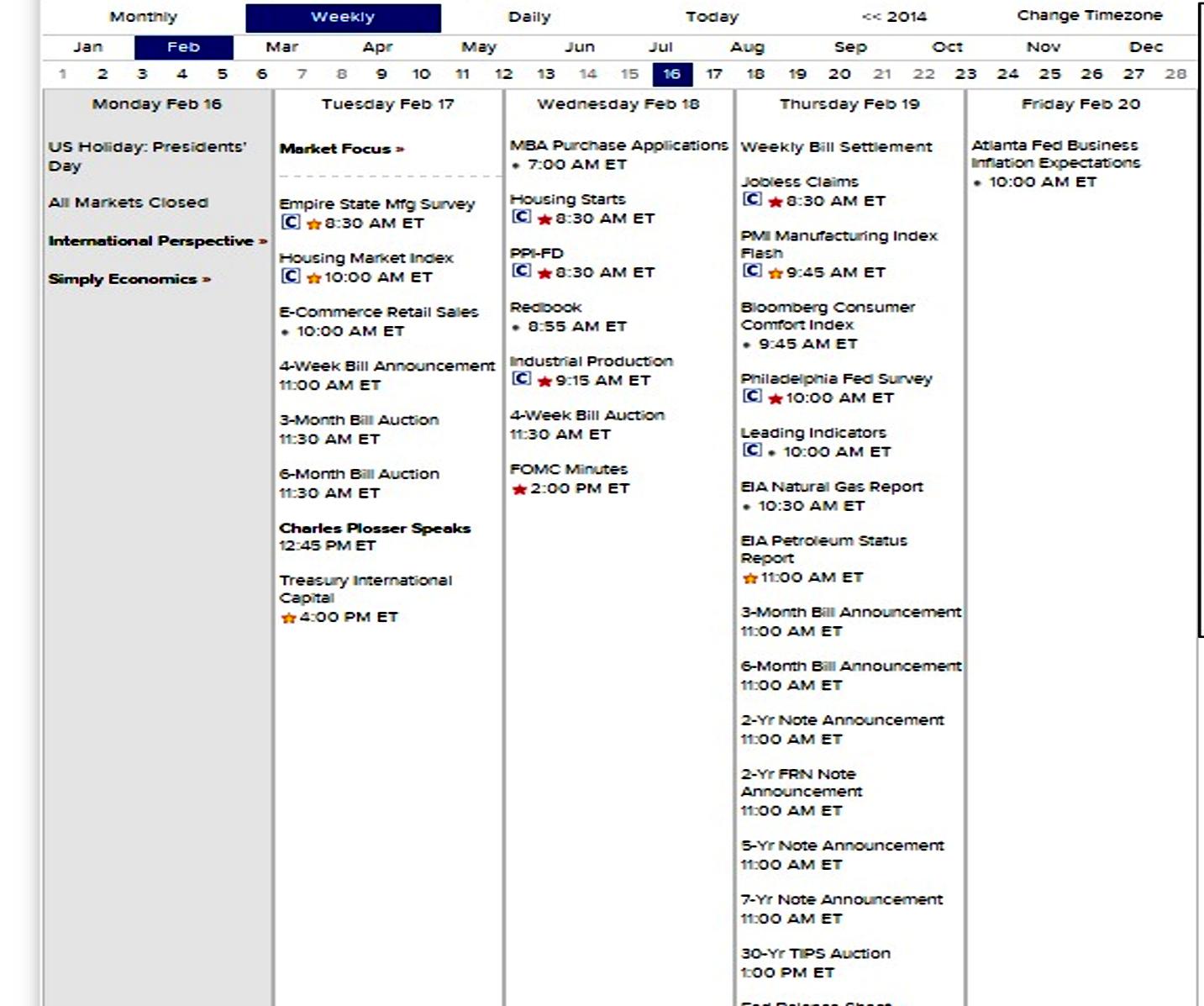
The week ahead — Economic data from Econoday.com:
Tags: Grexit, Keystone
Posted in Weekly Summary | No Comments »
February 9th, 2015
“I skate to where the puck is going to be, not where it has been.” – Wayne Gretzky
1. Australia Cuts Rates to Record Low — the Reserve Bank of Australia has jumped on the easing bandwagon, becoming the latest global central bank to cut interest rates in response to slowing inflation and concerns over economic growth. The RBA lowered its benchmark rate by 25 bps – its first change since August 2013 – to a new record low of 2.25%.
2. ECB Says No to Greek Debt — the ECB put more pressure on the country by revoking a waiver that allowed banks to use Greek government debt as collateral for loans. Greek lenders will have to seek funding from their own central bank on less generous terms.
3. China Cuts Bank Reserves — the central bank cut the amount banks must hold in reserves, the first step in more than 2 years, as concerns mount over an economic slowdown. China’s economy slowed to 7.4% in 2014, its lowest annual growth rate in a quarter century.
4. RadioShack filed Chapter 11 Bankruptcy — RadioShack has filed for Chapter 11 bankruptcy in Delaware, saying it has $1.2B in assets and $1.39B in debts. The plan reportedly includes an asset-buy deal with Standard General (its largest shareholder) and Sprint (NYSE:S) for a “store-in-store” model that would allow the RadioShack (NYSE:RSH) name to exist in some of the acquired shops.
5. S&P Cut Its Rating on Greece’s sovereign Debt — S&P has cut its sovereign debt to B- from B with a negative outlook, citing a “narrowed” time frame to reach a deal with its official creditors before running out of cash. Moody’s also put Greece on review for another downgrade.
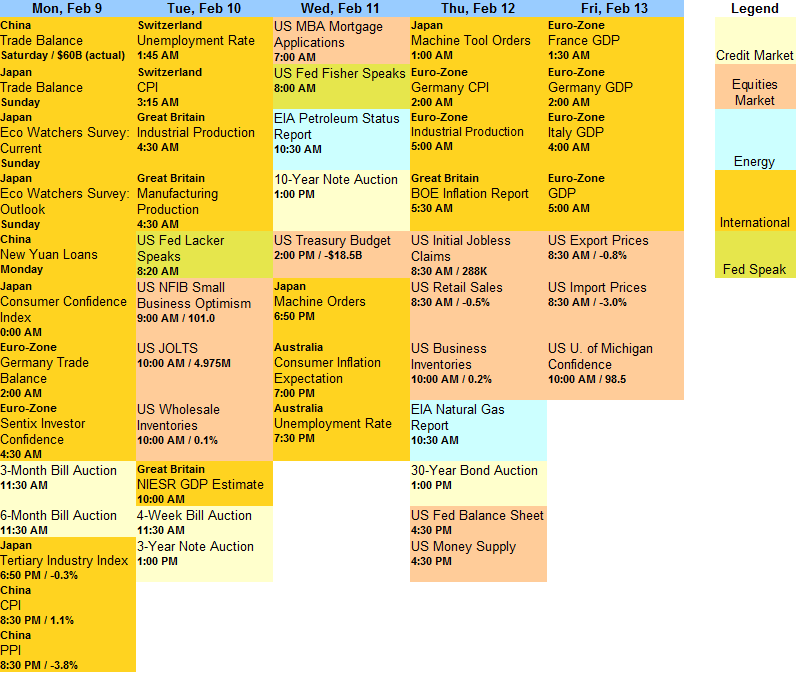
The week ahead — Economic data from Econoday.com:
Tags: Grexit
Posted in Weekly Summary | No Comments »
February 3rd, 2015
“A peak performance trader is totally committed to being the best and doing whatever it takes to be the best. He feels totally responsible for whatever happens and thus can learn from mistakes. These people typically have a working business plan for trading because they treat trading as a business” – Van K Tharp
1. Greece Anti-Austerity Syriza Party Win — Party leader Alexis Tsipras has already moved to form a coalition that will work to reverse years of austerity measures imposed on Greece by the Troika. The euro dropped to a fresh 11-year low after initial results came out, falling as far as $1.1098 vs. the dollar, although it is now up 0.4% at $1.1244 amid speculation that the victory won’t push the nation to exit the currency bloc.
2. S&P Cuts Russia’s Rating to Junk — Bloomberg, Russia’s foreign-currency credit rating was cut to junk by Standard & Poor’s, putting it below investment grade for the first time in a decade. The penalties have locked Russian corporate borrowers out of international debt markets and curbed investor appetite for the ruble, stocks and bonds.
3. Denmark Cuts Deposit Rate for Third Time in Two Weeks — MarketWatch, the Danish National Bank late last week cut its deposit rate by 15 basis points to negative 0.5% in an effort to prevent the krone from strengthening too much against the euro. It’s the third time in less than two weeks the central bank has slashed its deposit rate, following persistent upward pressure on the krone’s peg to the euro resulted from European Central Bank launched a quantitative-easing program and the Swiss National Bank ditched its euro cap.
4. US GDP Downshifts to 2.6% Rate in the Fourth Quarter — MarketWatch, the value of all goods and services produced by the U.S. — grew at a 2.6% annual clip in the fourth quarter. For all of 2014, the U.S. economy grew at a 2.4% rate, slightly faster than the 2.2% gain in the prior year. Consumer spending was a major positive in the fourth quarter, expanding 4.3%, the fastest pace since before the financial crisis. However, growth was pulled down by weaker business spending, a drop in federal government spending and net exports.
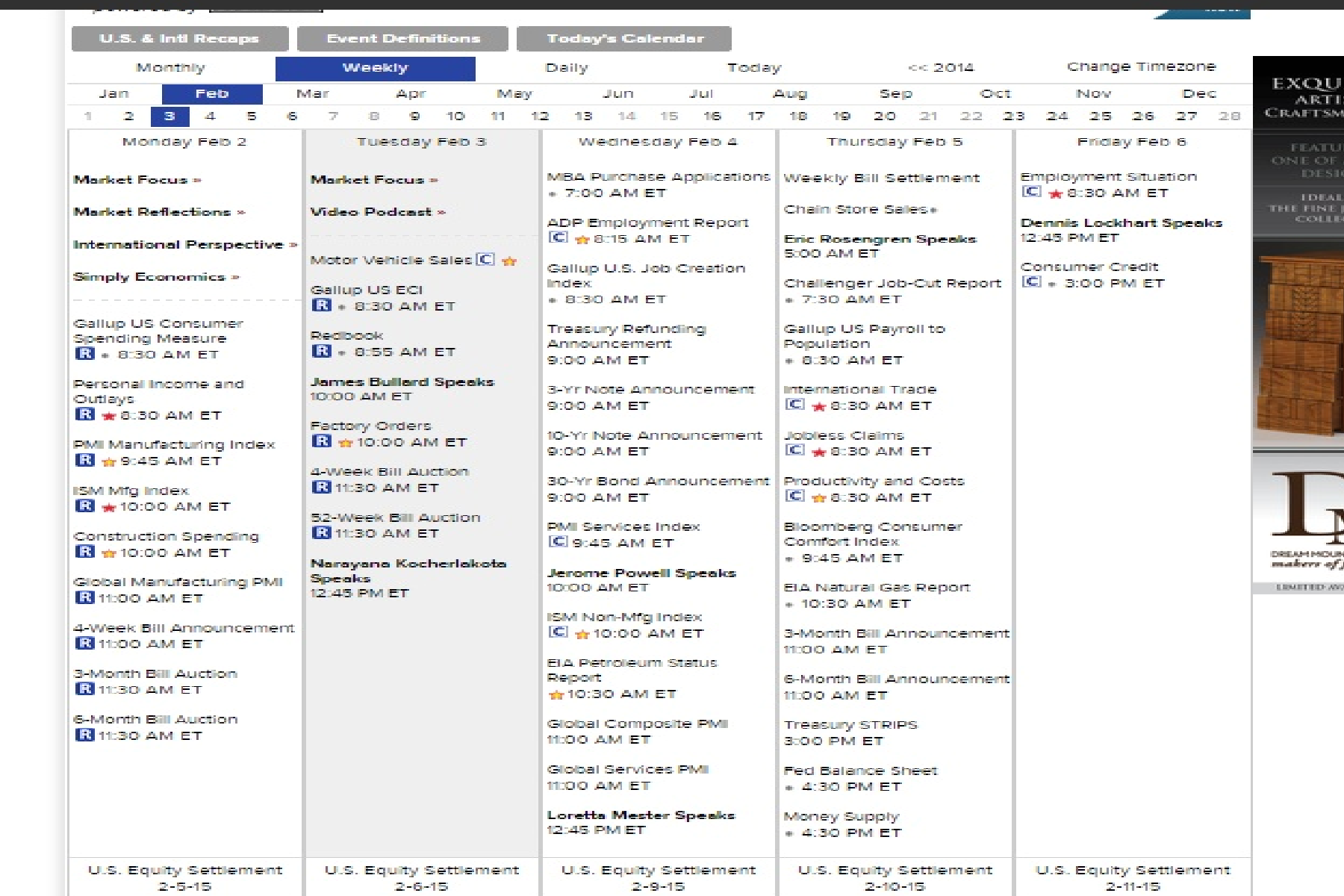
The week ahead — Economic data from Econoday.com:
Tags: Grexit, Russia Junk
Posted in Weekly Summary | No Comments »
January 27th, 2015
“The best traders have no ego. You have to swallow your pride and get out of the losses.” – Tom Baldwin
1. China’s 2014 Economic Growth Expanded 7.4% in 2014, Hits 24-Year Low — Reuters, China’s economy grew at its slowest pace in 24 years in 2014 as property prices cooled and companies and local governments struggled under heavy debt burdens, keeping pressure on Beijing to take aggressive steps to avoid a sharper downturn. Growth in the world’s second biggest economy has not fallen below 7.6% since 1990, when it grew 3.8% as a result of international sanctions in the wake of the Tiananmen Square massacre.
2. IBM Gives Disappointing Forecast — IBM (IBM) revenue fell 12% in Q4 and it’s the 11th consecutive quarter IBM has failed to report a revenue increase, while net income sunk 11%. The drop costs the “Oracle of Omaha” (Buffett) some $397 million, based on his 70,478,012 shares as of September 30, 2014.
3. ECB Board Proposes Roughly €50 Billion in Bond Buys Each Month — MarketWatch, the European Central Bank (ECB) Executive Board has proposed quantitative easing of 50 billion euros ($58 billion) a month until the end of 2016. The proposal to inject as much as 1.1 trillion euros reflects President Mario Draghi’s determination to expand the ECB’s balance sheet to stave off the threat of deflation and put the 19-nation economy back on the path to health.
4. AmEx (AXP) to Cut More Than 4,000 Jobs This Year After Unit Sale — American Express (NYSE:AXP) announced plans to cut more than 4,000 jobs this year as part of a restructuring, while taking a $313M charge this quarter “to improve operating efficiencies.” The credit-card issuer’s fourth quarter net income came in at $1.447B or $1.39 per share vs. $1.308B and $1.21 one year ago. Warren Buffett’s portfolio owns 151,610,700 shares as of Sept 30, 2014.
5. Saudi King’s Death Spurs Policy Speculation About Oil — Bloomberg, Saudi royal court announced the death of King Abdullah, who died at about the age of 91. A key indicator of future Saudi oil policy will now be whether Salman, who will replace King Abdullah, retains oil minister Ali Al-Naimi since 1995.
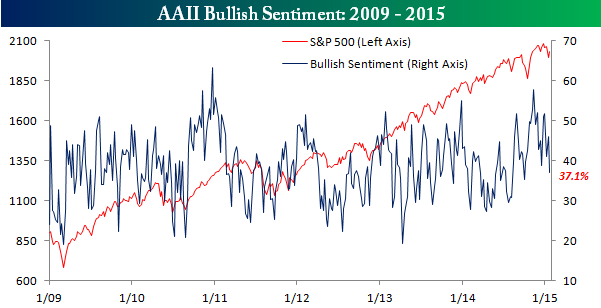
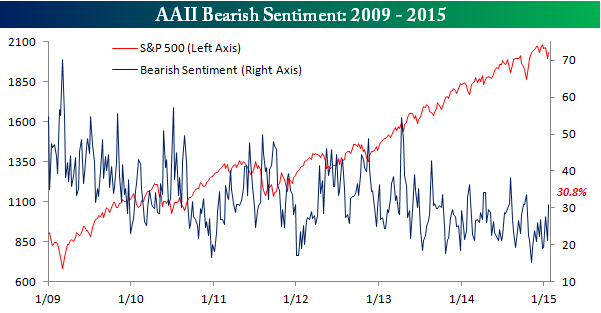
6. Bullish Sentiment Decreased in the Latest Survey — courtesy of BIG, cccording to the weekly survey from the American Association of Individual Investors (AAII), bullish sentiment dropped from 46.11% down to 37.1%. That 9 percentage point drop took bullish sentiment down to its lowest level since 10/2 and back below the bull market average of 38.8%.
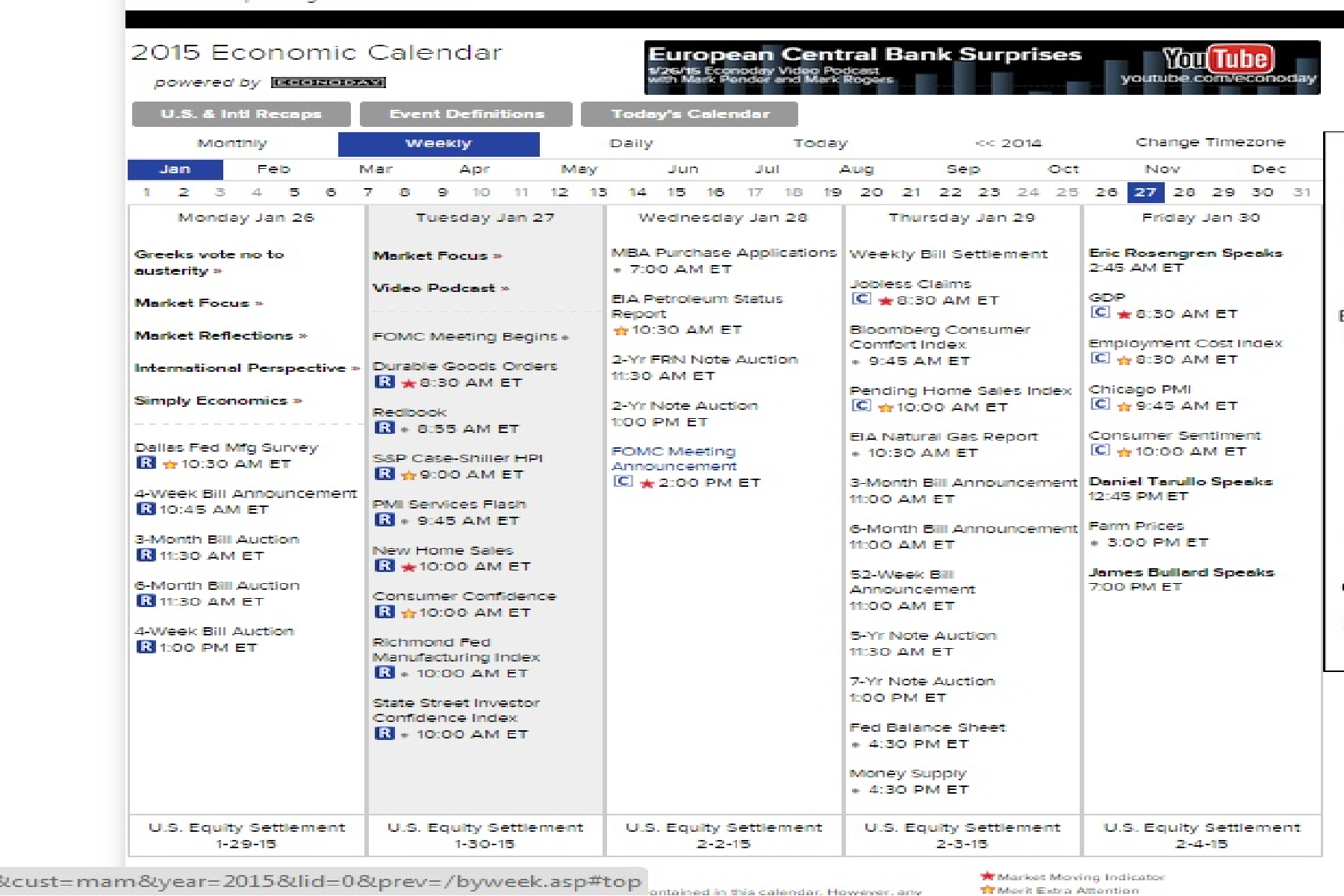
The week ahead — Economic data from Econoday.com:
Posted in Weekly Summary | No Comments »
January 9th, 2015
There will not be any posting for this week. We are away for some needed R&R. Happy New Year!!!
Posted in Weekly Summary | No Comments »
January 9th, 2015
“Mr. Market is kind of a drunken psycho. Some days he gets very enthused, some days he gets very depressed. And when he get really enthused… you sell to him, and if he gets depressed, you buy from him. There’s no moral taint attached to that.” — Warren Buffett
1. J&J started a trial of its experimental Ebola vaccine — Johnson & Johnson (JNJ) has started a trial of its experimental Ebola vaccine in the U.K., saying it will produce 2M courses of the shot this year.
2. White House issues veto threat over Keystone pipeline bill — the White House has made it clear that President Obama would veto a bill authorizing construction of the Keystone XL oil pipeline (NYSE:TRP), setting up a likely showdown with the Republican-controlled Congress in the coming weeks. Senators Hoeven and Manchin, a Republican and Democrat respectively, say the bill now has 60 co-sponsors, but no one is saying yet that there’s enough support to override a presidential veto.
3. ECB warns Greek funding access hinges on keeping bailout — Greek banks’ access to ECB funding beyond February will depend on Athens successfully completing a final bailout review and reaching a deal on a follow-up plan with its EU/IMF lenders, announced the European Central Bank this morning. The statement was the clearest warning yet that Athens cannot expect to rely on ECB funding if it backs out of its obligations under the €240B bailout program.
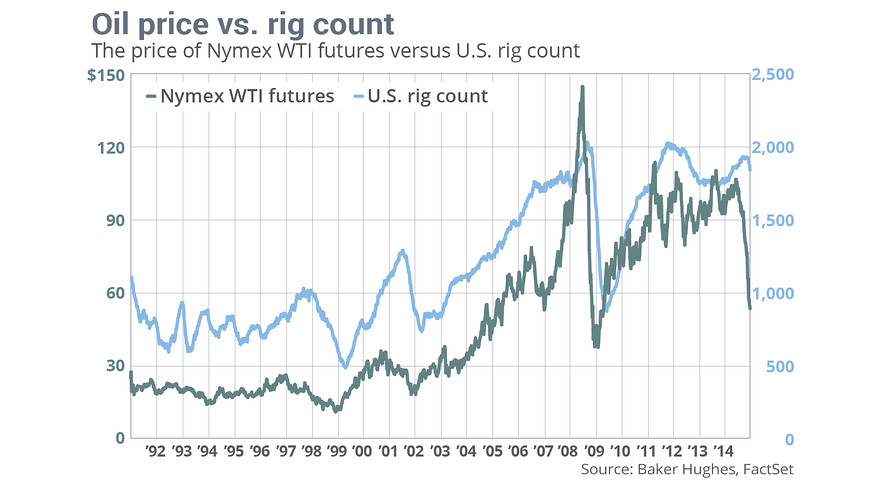
4. U.S. Oil Producers Cut Rigs as Price Declines —NYTimes, producers are beginning to slash the number of drilling rigs around the country as oil prices collapsed. Helmerich & Payne (NYSE:HP) announced late last week that it plans to idle up to 50 rigs over the next month. (See blog from Jan 3, 2015 for historical chart of oil prices vs. rig counts.)
5. AbbVie (ABBV) Predicts Sharp Increase in Earnings — WSJ, ie Inc. predicted sharply higher earnings for the new year, driven by rheumatoid-arthritis drug Humira and the launch of its new hepatitis C virus treatment – Viekira Pak. AbbVie’s (NYSE:ABBV) current estimate for 2015 earnings, excluding items, is $4.25 to $4.45 a share, in line with the consensus. The midpoint of that range marks a jump of more than 30% over the company’s 2014 guidance.
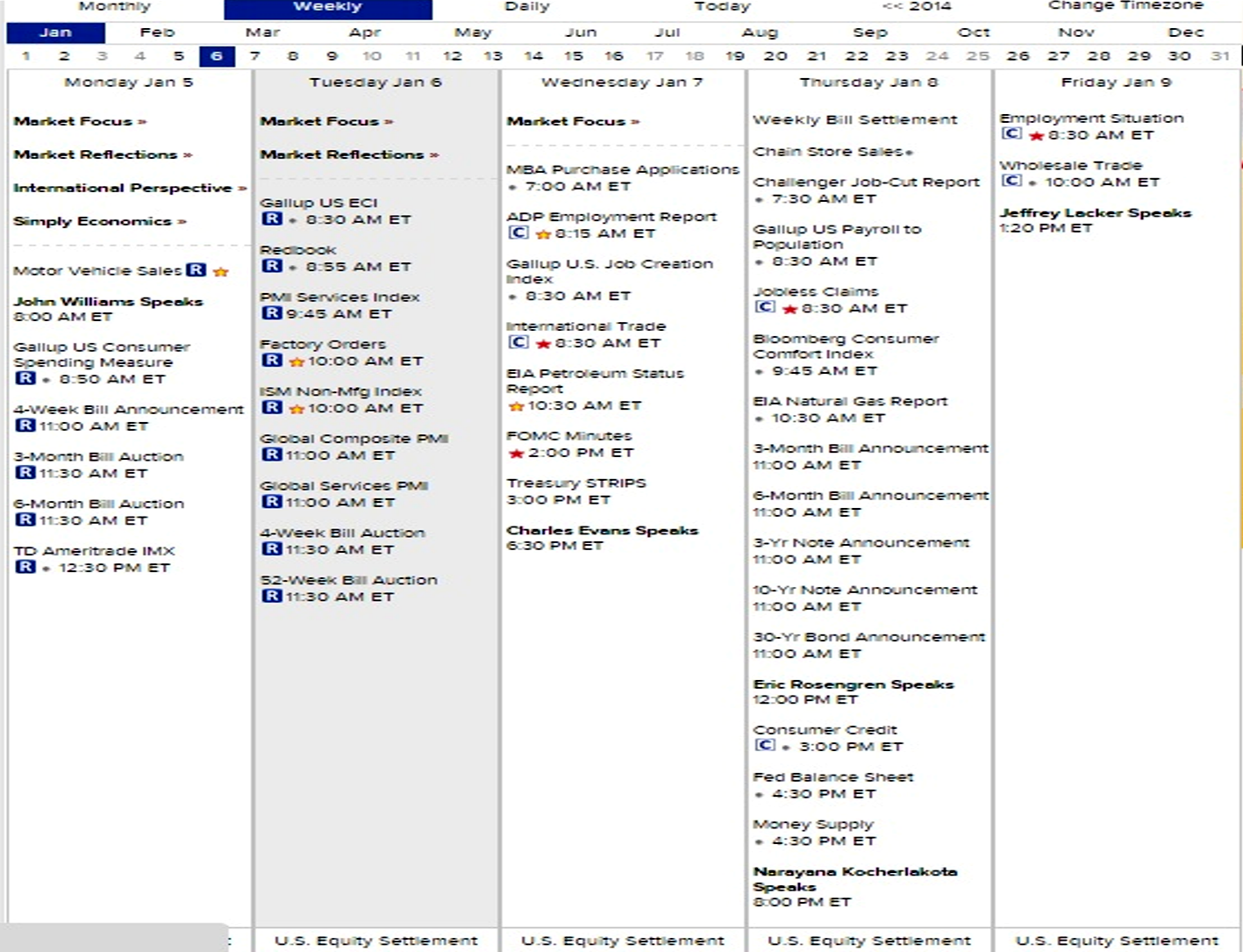
The week ahead — Economic data from Econoday.com:
Tags: oil rigs
Posted in Weekly Summary | No Comments »
January 6th, 2015
“Only when the tide goes out do you discover who’s been swimming naked.” – Warren Buffett
1. Greek Politicians Failed to Elect a President — Greece snap election is scheduled in early 2015. Greece’s main stock market fell over 10% on the news, while the country’s 10-year bond yields spiked above 9%.
2. Japan Govt Approves $29 Billion Stimulus Spending — Reuters, Japan’s government authorized a ¥3.5T ($29B) stimulus package last Saturday aimed at boosting the country’s lagging regions and households with subsidies, merchandise vouchers and other steps. Japan’s economy contracted for two consecutive quarters after a sales tax increase in April. Coming on top of a recent $29B stimulus package, the plan will likely cut the overall effective corporate tax rate by 2.51 percentage points to 32.1% – confirming a pledge made by Abe in June to lower the corporate tax rate to below 30% in the coming years.
3. Oil Falls Further, With Prices Down 50% Since June — Brent crude plunged to its lowest level since May 15, 2009. Nymex crude also settled at its lowest value since May 2009, losing over 50% since it touched a 52-week high of $107.26 in June.
4. U.S. Bureau of Industry and Security Will Allow Companies to Sell Oil Condensate to Oversea Markets — BIS, the U.S. Bureau of Industry and Security said it will allow companies to sell oil condensate that has been processed through a basic distillation tower, giving them a green light for export without violating a four-decade-old-ban.
5. Chart of Oil Price vs. Rig Count from 1990 to Present — below is a chart of oil price vs rig count of Baker Hughes courtesy from FactSet. It shows that rig counts will continue to decline, but the impact on supply will likely take “weeks if not months” to be reflected in hard production figures.
Oil Price vs Rig Count
The week ahead — Economic data from Econoday.com:
Posted in Weekly Summary | No Comments »
December 29th, 2014
“Successful investing is anticipating the anticipations of others.” – John Maynard Keynes
1. ECB’s Draghi Starts Squaring QE Circle in Month of Persuasion — bloomberg, as European officials prepare to consider sovereign-bond purchases on Jan. 22, ECB president Mario Draghi is busy working to get as many policy makers as possible on his side. One concession being debated is to require national central banks to be responsible for at least some of their own credit risk, according to people familiar with the talks. The stimulus is intended to expand the ECB’s balance sheet by as much as €1T ($1.2T).
2. Abbvie (ABBV) New Hepatitis C Drug Gets Helping Hand — WSJ, the price war over hepatitis C drugs continues, after Express Scripts (NASDAQ:ESRX) announced that it will only cover AbbVie’s (NYSE:ABBV) newly approved Viekira Pak, which received clearance from the FDA on Friday. The move will help the drug maker take market share away from Gilead Sciences (NASDAQ:GILD) and J&J (NYSE:JNJ), which make blockbuster hep C drugs, including Sovaldi, Harvoni and Olysio. AbbVie’s Viekira Pak will have a price of $83,319, although the agreement with Express Scripts involves a significant discount to that price.
3. Russia Tells State Exporters to Sell Forex Revenues to Help Ruble — CNBC, Russian Prime Minister Dmitry Medvedev has signed an order forcing the country’s largest state exporters to sell part of their foreign currency revenues to help stabilize the ruble. Orders were sent to gas firm Gazprom (OTCPK:OGZPY), oil firms Rosneft (OTC:RNFTF) and Zarubezhneft and diamond producer Alrosa.
4. Russia on Verge of Junk as S&P Puts Rating on Negative Watch — Bloomberg, Russia may lose its investment-grade credit rating for the first time in a decade after Standard & Poor’s placed the country on CreditWatch Negative. The move “stems from what we view as a rapid deterioration of Russia’s monetary flexibility and the impact of the weakening economy on its financial system,” the agency said in a statement.
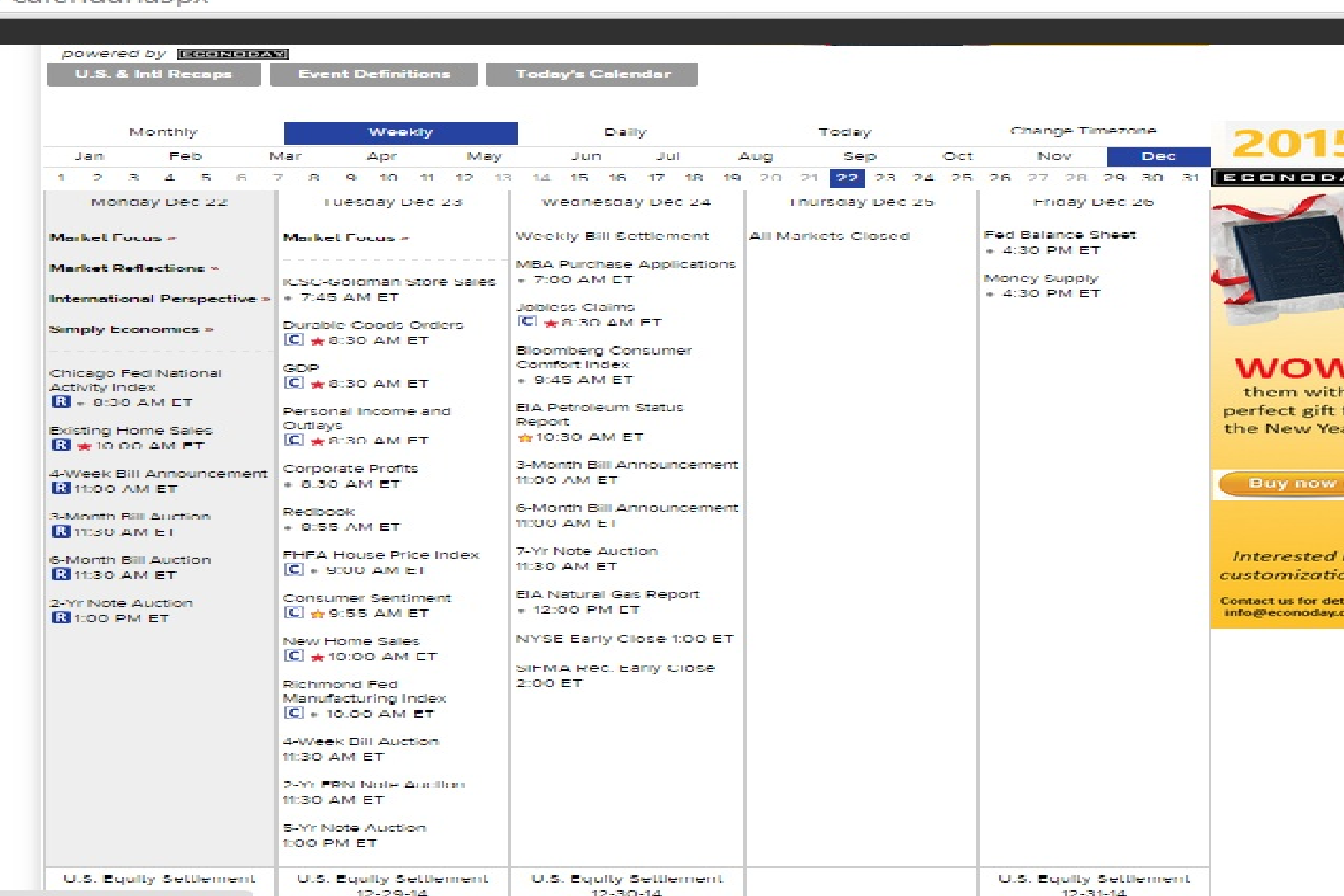
The week ahead — Economic data from Econoday.com:
Tags: Hep-C, Russian Ruble
Posted in Weekly Summary | No Comments »