February 13th, 2017
“In matters of style, swim with the current; in matters of principle, stand like a rock.” — Thomas Jefferson
1. Trump Border Wall Could Cost $21.6B — President Trump’s “wall” along the U.S.-Mexico border would be a series of fences and walls that would cost as much as $21.6B, and take more than three years to construct, based on a U.S. Department of Homeland Security internal report. The price tag is much higher than a $12B figure cited by Trump in his campaign and estimates of as high as $15B from Republican Congressional leaders. Companies that might benefit from “Trump Border Wall” include: ACM, CX, CXW, EXP, FLIR, FLR, GEO, GVA, KBR, MLM, NUE, STLD, SUM, TPC, TTEK, USCR, USG, VMC, WMS, X.
2. Army Corps Will Give Easement For Dakota Access Pipeline — the U.S. Army will grant the final permit for the controversial Dakota Access oil pipeline after an order from President Trump to expedite the project despite opposition from Native American tribes and climate activists. It would allow the final section of the line to tunnel under North Dakota’s Lake Oahe, part of the Missouri River system, enabling the $3.8B pipeline to begin operations as soon as June.
3. China Forex Reserves Fall Below $3T — China’s foreign exchange reserves have dropped below the $3T level for the first time since 2011, marking the seventh straight monthly decline as capital continues to flow out of the world’s second-largest economy. Data from the PBOC showed reserves falling by over $12B in January, despite government efforts to tighten capital movement controls and stabilize the yuan’s exchange rate.
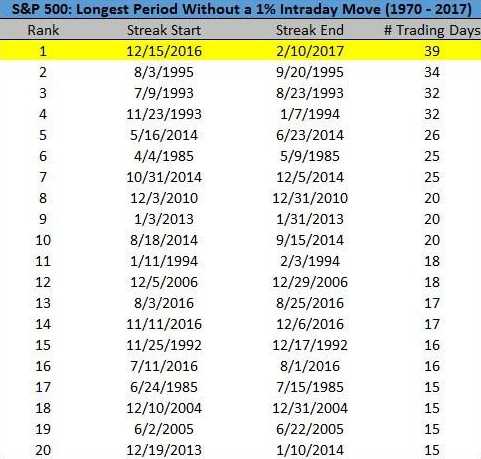
4. S&P500 Intra-Day Moved Within 1% Set Record Since Dec 14 — the S&P 500 (NYSEARCA:SPY) hasn’t had a 1% intraday move since December 14. Chart below courtesy of Charlie Biello.
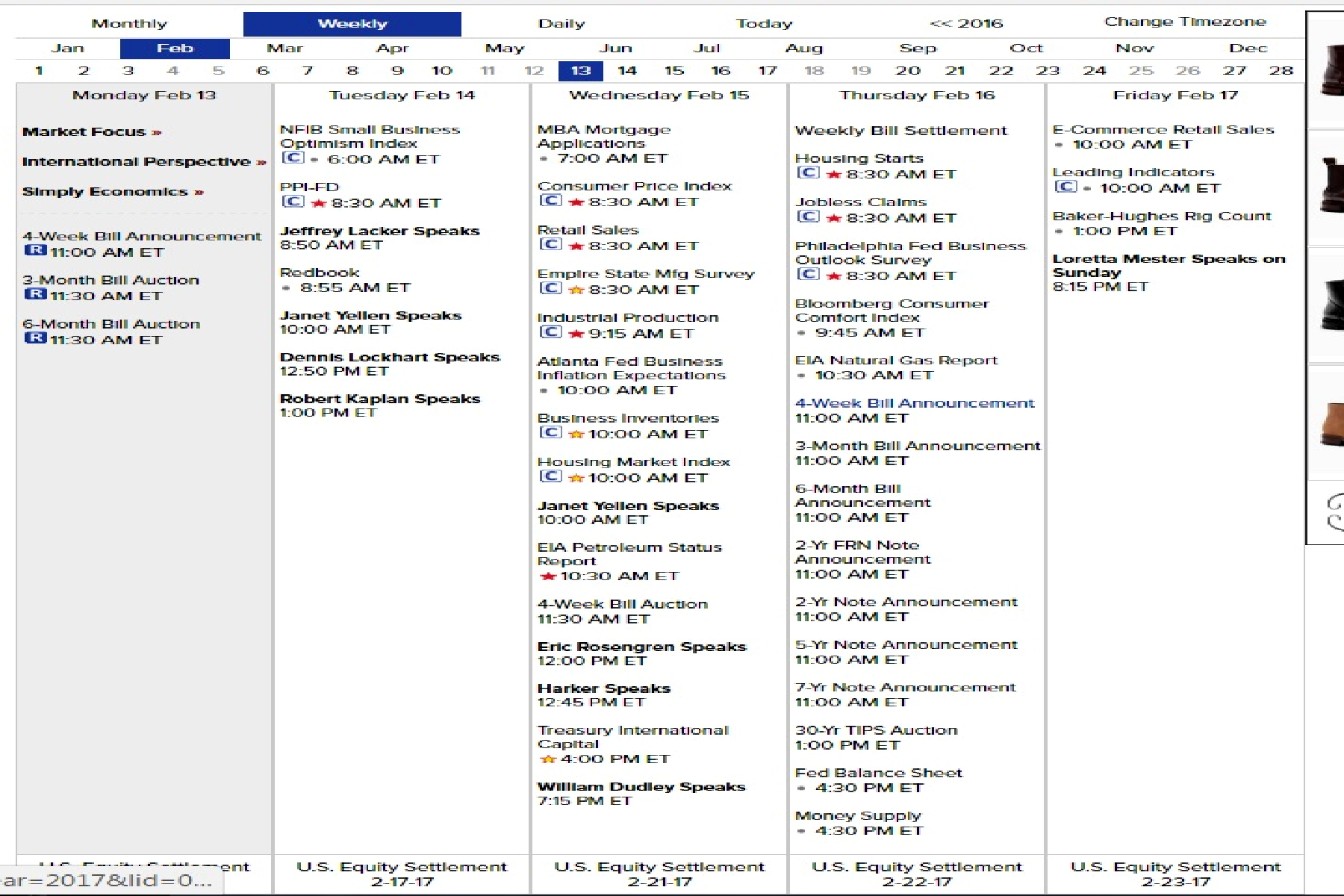
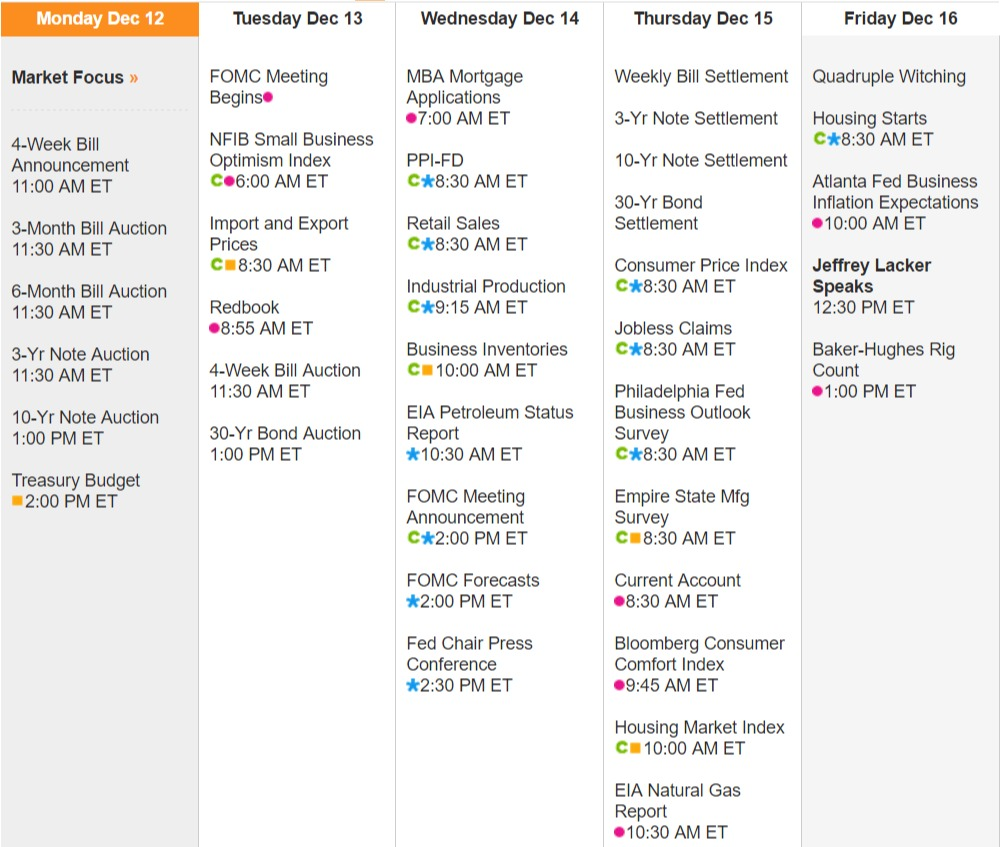
The week ahead — Economic data from Econoday.com:
Tags: Trump 's "Wall"
Posted in Weekly Summary | No Comments »
February 3rd, 2017
“Given the lift off — which I totally missed — it’s going to be tough to break the markets down.” — Jeff Saut
1. Chinese Markets Closed for Lunar New Year — Chinese markets will remain closed for most of the week as Lunar New Year celebrations kick off for much of Asia. The PBOC pumped 1.13T yuan (roughly $165B) into domestic money markets last week via its routine operations as consumers prepared for shopping sprees and to hand out red packets filled with fresh notes to friends and relatives.
2. Iran Tests Another Ballistic Missile & White House Puts Iran ‘On Notice’ — Iran has conducted its first ballistic missile test since Donald Trump took over as President, in another apparent violation of a United Nations resolution. As a result, the UN will hold an urgent meeting today at the request of the U.S. President Trump was a sharp critic of the Iran nuclear deal during last year’s campaign and has suggested he may seek to renegotiate its terms. National Security Adviser Mike Flynn has officially put Iran “on notice” and warned of new U.S. sanctions following the country’s weekend ballistic missile test. The pronouncement marks a pivot away from the Obama administration’s policy of diplomatic engagement, which led to a 2015 multinational nuclear deal that has been denounced repeatedly by President Trump.
3. Insulin Makers Sued Over High Prices — three of the biggest makers of diabetes treatments, Sanofi (NYSE:SNY), Novo Nordisk (NYSE:NVO) and Eli Lilly (NYSE:LLY), were named in a proposed class action lawsuit by a group of patients alleging price-fixing. The suit accuses the companies of exploiting the U.S. drug pricing system that benefits them and pharmacy benefit managers, and claims they simultaneously hiked the price of insulin by over 150% during the past five years.
4. Amazon Plans First Air Cargo Hub — Looking to accommodate its growing fleet of planes, Amazon (NASDAQ:AMZN) plans to invest $1.5B to build a large air cargo hub in northern Kentucky, signaling an expansion into transporting, sorting and delivering its own packages. The move, which is expected to create more than 2,000 jobs, will lessen its dependence on traditional carriers, including UPS and FedEx (NYSE:FDX), both of whose largest hubs are nearby.
5. Federal Open Market Committee (FOMC) Stands Pat in Feb — the FOMC announced no change in the Feb meeting and reiterated plans to raise rates gradually and leave the federal funds rate target range at 0.5 percent to 0.75 percent. Officials have penciled in three quarter-point rate hikes this year, according to the median quarterly estimate submitted by officials in December. Investors see the central bank taking its time, with a roughly 70 percent probability of a quarter-point hike by the June FOMC meeting.
6. Trump To Undo Dodd-Frank, Fiduciary Rule — removing some of the regulatory burdens on banks, President Trump plans to sign executive actions seeking a review of the 2010 Dodd-Frank law and a rollback of the so-called fiduciary rule – set to take effect in April. Trump is scheduled to issue the directives following a meeting of more than a dozen top corporate executives led by Blackstone (NYSE:BX) CEO Steve Schwarzman.
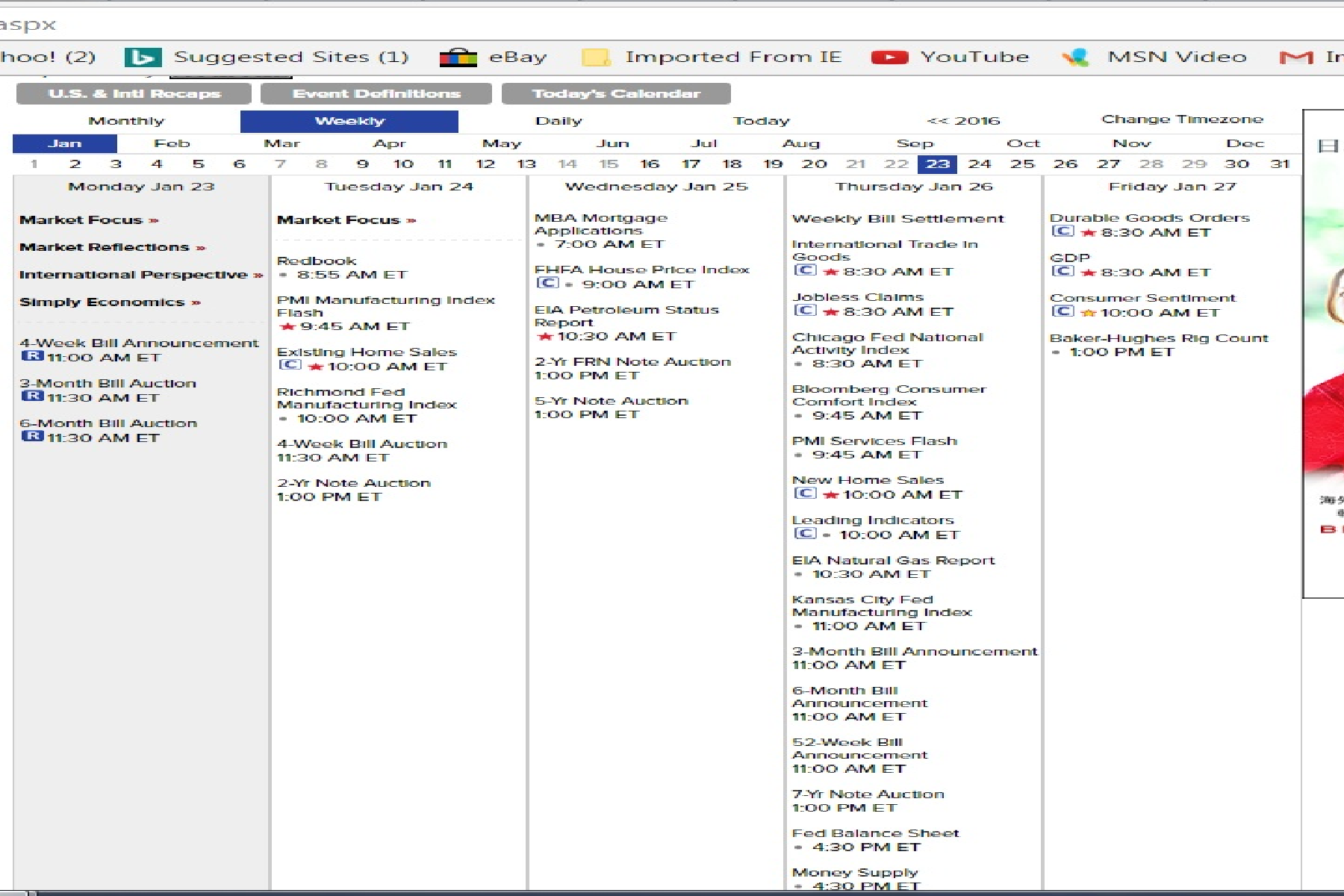
The week ahead — Economic data from Econoday.com:
Tags: Dodd-Frank
Posted in Weekly Summary | No Comments »
January 30th, 2017
“The two most powerful warriors are patience and time.” – Leo Tolstoy
1. Trump Signed Executive Order to Renegotiate NAFTA and Intent to Leave TPP — President Donald Trump signed an executive order formally withdrawing the United States from the 12-nation Trans-Pacific Partnership trade deal. In an Oval Office ceremony, Trump also signed an order imposing a federal hiring freeze and a directive banning U.S. non-governmental organizations receive federal funding from providing abortions abroad. Trump is also looking to begin NAFTA negotiations with Canadian Prime Minister Justin Trudeau.
2. Dow Crosses 20,000 — the Dow took almost 103 years to reach 10,000 in March 1999, and another 17 years to double to reach 20,000. However, the last 1,000 points to reach the 20,000 milestone took just 42 trading days. The blue-chip index has been propelled by President Trump’s moves to promote infrastructure projects and cut regulation, while recording the all-time high during his first week in office. As a whole, the U.S. stock market has gained $2T in wealth since Election Day.
3. Mexico’s President Cancel Meeting With Trump — Mexican President Enrique Pena Nieto canceled his meeting with Trump after he formally announced plans to build a border wall. The U.S. President also slashed funding to so-called sanctuary cities in the start of a strategy to tighten immigration controls. Construction of the wall will begin within “months,” according to Trump, stating Mexico would reimburse the U.S. for the cost “100%.”. President Trump also impose a temporary ban as early as today on virtually all refugee admissions to the U.S. from “countries that have tremendous terror.” “Our country has enough problems without allowing people to come in who, in many cases or in some cases, are looking to do tremendous destruction,”.
4. 4Q GDP U.S. Growth Cools on Trade Drag as Business Spending Rises — Gross domestic product, the value of all goods and services produced, rose at a 1.9 percent annualized rate following the prior quarter’s 3.5 percent gain that was the largest increase in two years, Commerce Department reported. The results cap growth of 1.9 percent for the full year and reinforce the leading role of household purchases while showing that businesses are starting to spend again. The strong job market and optimism among consumers and companies for President Donald Trump’s policies are likely to keep growth humming along in 2017, though tensions over trade could temper any gains.
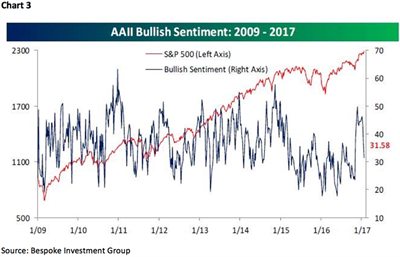
5. AAII Bullish Sentiment — last week’s AAII bullish sentiment figures, which showed that bullish sentiment fell by roughly five points (37.01% to 31.58%) for the second five-point decline in the last two weeks. That has not happened since May 2016 right before the S&P 500 (SPX/2294.69) fell 6.0%. Jeffrey Hirsch, editor at Stock Trader’s Almanac noted:
“Since 1950, January S&P 500 gains of 2% or more corrected or consolidated in February 62.1% of the time. In the 20 years that the S&P 500 gained 4% or more in January, 65.0% of the time the S&P declined or finished flat (less than 1% gain) in February.”
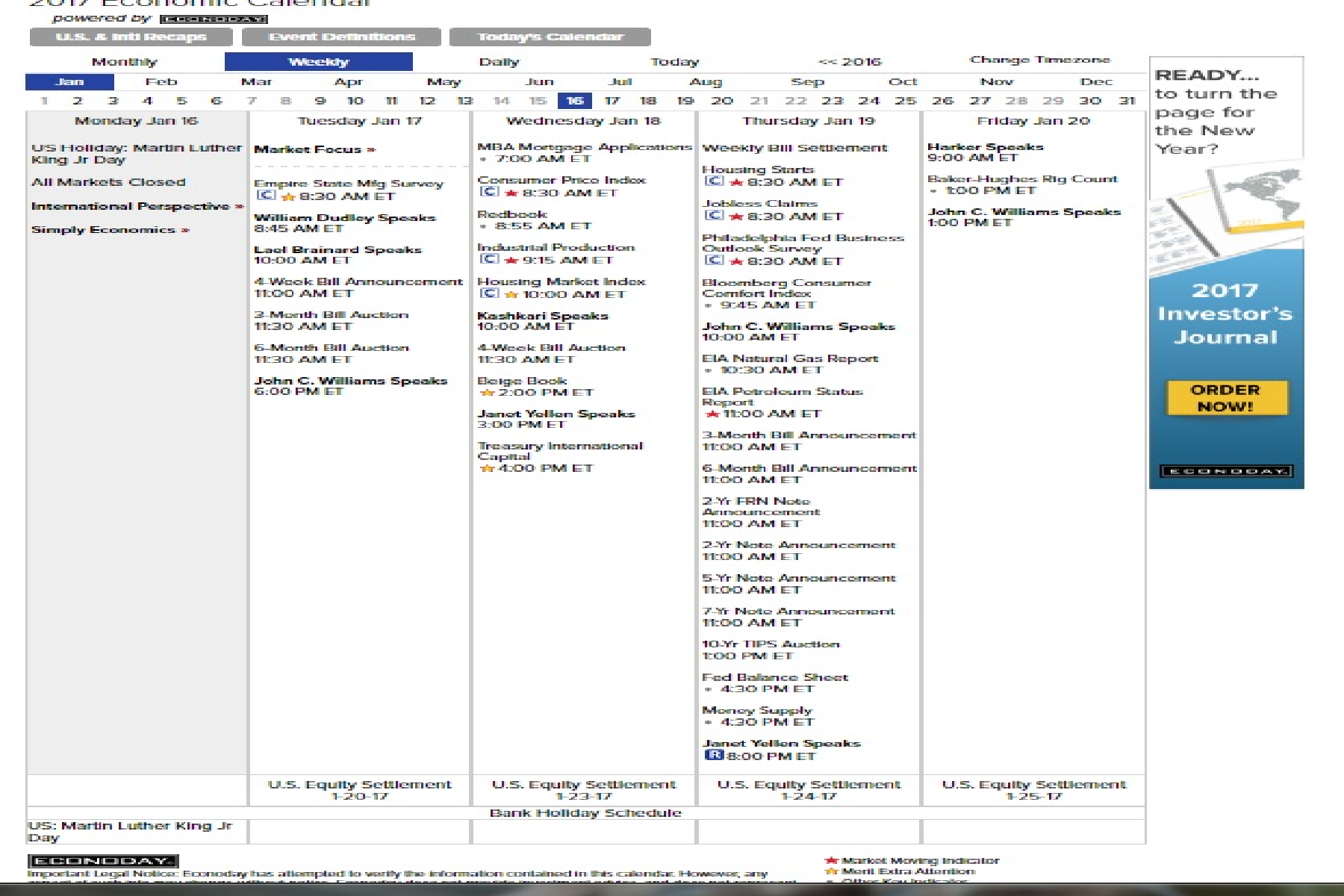
The week ahead — Economic data from Econoday.com:
Tags: 000, AAII Bullish Sentiment, Dow 20
Posted in Weekly Summary | No Comments »
January 23rd, 2017
“Change is the law of life. And those who look only to the past or present are certain to miss the future” — John F. Kennedy.
1. Britain ‘s PM May Sets Out Brexit Vision With Pledge to Quit EU Single Market — Britain will not seek a Brexit deal that leaves it “half in, half out” of the EU, Prime Minister Theresa May said in a speech outlining her 12 priorities for upcoming divorce talks with the bloc. Those will likely include leaving the EU’s single market and regaining full control of Britain’s borders. May said she wanted an agreement about the nature of the future relationship with the EU by the time the Article 50 exit negotiation process completes in early 2019. That would be followed by “a phased process of implementation, in which both Britain and the EU institutions and member states prepare for the new arrangements.”
2. Trump Vows Health ‘Insurance For Everybody’ — Trump has pledged to provide “insurance to everybody” under his plan to replace Obamacare, The Washington Post reported. He also promised to force pharmaceutical companies to directly negotiate drug prices with the government for Medicare and Medicaid, stating “they’re politically protected, but not anymore.”
3. Amazon Patents Autonomous Vehicle Lane Assignment System — Amazon (AMZN) recently filed a new patent designed to help self-driving vehicles identify the driving lanes best-suited for their individual needs based on things like speed and destination, or time of day and traffic flow. The new system could also help autonomous cars spot reversible lanes, which let vehicles travel in either direction depending on the displayed overhead signal.
4. Turkcell Tests 5G Mobile Internet with Ericsson — 5G mobile internet technology marks the beginning of the “fourth industrial revolution,” Turkcell (NYSE:TKC) CEO Kaan Terzioglu told CNBC. He also said the telecom completed a test in partnership with Ericsson (NASDAQ:ERIC) this past week, using the next-generation internet. 5G is largely viewed as a medium that can support the industrial and “Internet of Things” space, while 4G revolutionized the consumer market.
5. Donald Trump Sworned In As 45th president, Promising ‘Only America First’ — Donald Trump was sworn in as the 45th president of the United States and delivered a fiery attack on the Washington establishment. Trump’s speech was aimed squarely at supporters who felt aggrieved and overlooked during the Barack Obama presidency. With Obama sitting steps away, he described an America riven by crime and social tumult. Trump pledged that U.S. interests would be at the center of his presidency, even at the expense of longstanding foreign relationships.
The week ahead — Economic data from Econoday.com:
Tags: Trump 45th President
Posted in Weekly Summary | No Comments »
January 16th, 2017
“A 60:40 allocation to passive long-only equities and bonds has been a great proposition for the last 35 years,” …”We are profoundly worried that this could be a risky allocation over the next 10.” — Sanford C. Bernstein & Company Analysts on Diversification
1. China Forex Reserves Drop To The Lowest Level Since March 2011 — China’s foreign exchange reserves fell for the sixth the consecutive month in December, but held just above the critical $3T level, as authorities stepped in to support the weakening yuan. According to PBOC data, the world’s largest stockpile of foreign currency plunged by $41.08B to $3.01T, the lowest level since March 2011.
2. Self-Driving Cars Are a Focus for Major Auto Makers — self-driving cars are a big theme at the North American International Auto Show, which kicked off late last week in Detroit. Alphabet’s (GOOG, GOOGL) Waymo revealed that it has built all of its sensor hardware in-house and was ready to offer its autonomous-drive technology in “millions” of vehicles at a competitive price. A package of LIDAR sensors and radar, which used to run approximately $75,000 a few years ago, has fallen by more than 90%.
3. Oil Discoveries Seen Recovering After Crashing to 65-Year Low — oil companies found only 3.7 billion barrels of so-called conventional crude in 2016, 14 percent less than the previous year and the lowest amount since 1952, according to Bloomberg. Oil companies reduced spending on exploration to about $40 billion last year from $100 billion in 2014, and could invest as little as $35 billion this year. Lower budgets meant fewer wells drilled: 431 in 2016, or about a third of the activity two years earlier. Total expenditure on exploration could rise to $40 billion to $45 billion in 2018 and further in 2019 if the oil price recovery endures.
4. Apple Sets Its Sights on Hollywood With Plans for Original Content — WSJ reported that Apple is planning to build a significant new business in original television shows and movies, in a move that could make it a bigger player in Hollywood and offset slowing sales of iPhones and iPads. Programming would be available to subscribers of Apple Music (NASDAQ:AAPL), which already includes a limited number of documentary-style segments on musicians, but nothing like the premium programming the company is now seeking.
5. Trans Mountain Pipeline Expansion Gets Approval from British Columbia — British Columbia has given the green light to Kinder Morgan’s (NYSE:KMI) plan to nearly triple its Trans Mountain oil pipeline, which runs from Canada’s oil sands through the province to a marine terminal on the Pacific Coast. The federal government approved the $6.8B expansion in November after the National Energy Board recommended moving ahead with the project based on the fulfillment of 157 conditions.
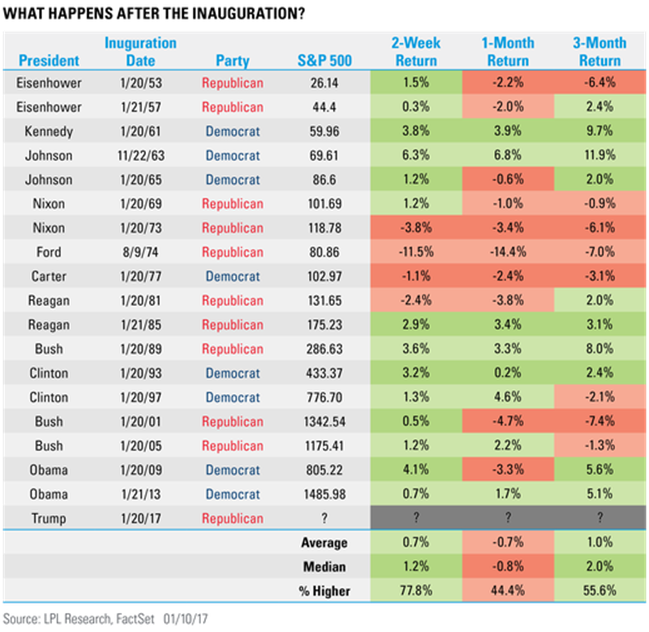
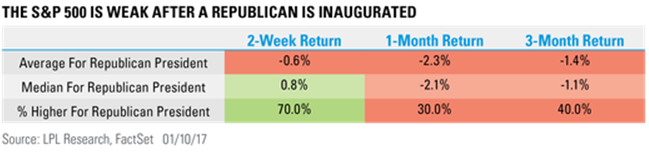
6. Stocks Market May Weaken After Trump Swearing-in Ceremony — based on historical records, the market rally that has followed a new President election victory has already factored in potential upside, leaving the market ripe for at least a near-term downturn. In post-inauguration, stock-market performance since Dwight D. Eisenhower’s first oath of office in 1953 found that the S&P 500 (SPX) index, +0.17% or its predecessor, the index actually tended to strengthen in the two weeks after a new term had begun. However, the one-month return has tended to be negative for the last 11 Republican inaugurations (see charts below)
The week ahead — Economic data from Econoday.com:
Tags: post-inauguration stats
Posted in Weekly Summary | No Comments »
January 9th, 2017
“It’s what you learn after you know it all that counts.” — Earl Weaver
1. OPEC Starts Oil Production Cuts — the official start of the deal agreed by OPEC and non-OPEC member countries in November begin in Jan. 1, 2017 to reduce production by almost 1.8M barrels per day. Officials from Oman and Kuwait told local media they’re cutting oil production in January, fulfilling pledges that they and 22 other producers made on Dec. 10.
2. Ford Details EV Plans, Cancels Mexico Plant Project — by canceling plans to build a new $1.6B plant in Mexico, Ford (NYSE:F) said it will invest $700M in Michigan instead. Michigan plant will create 700 new U.S. jobs. CEO Mark Fields said the investment is a “vote of confidence” in the pro-business environment being created by Donald Trump, but stressed Ford didn’t cut a special deal with the President-elect. The automaker was a frequent target of Trump’s election campaign for its “south of the border” manufacturing and payment of low tariffs.
3. Retail Names Warnings Of Weak Christmas Sales from Macy’s and Kohl’s — the retail sector is on watch after Macy’s (NYSE:M) and Kohl’s (NYSE:KSS) cut earnings estimates due to weak holiday sales. Macy’s also added details on its previous announcement to close 100 stores, saying the moves will result in 10K job cuts and a $575M reduction in 2017 sales. Department store names Nordstrom (NYSE:JWN), J.C. Penney (NYSE:JCP), Dillard’s (NYSE:DDS) and Sears Holdings (NASDAQ:SHLD) are all lower premarket, while Coach (NYSE:COH), Michael Kors (NYSE:KORS), Kate Spade (NYSE:KATE), Target (NYSE:TGT) and Ross Stores (NASDAQ:ROST) could also see selling pressure.
4. China’s Central Bank Lifted the Exchange Rate Against the USD — China’s central bank lifted the exchange rate against the greenback by the most since 2005, stepping up efforts to support the currency amid concerns over capital outflows from the world’s second-largest economy. The PBOC set the official midpoint for the yuan at 6.8668 per dollar prior to the market opening, 639 pips or 0.9% firmer.
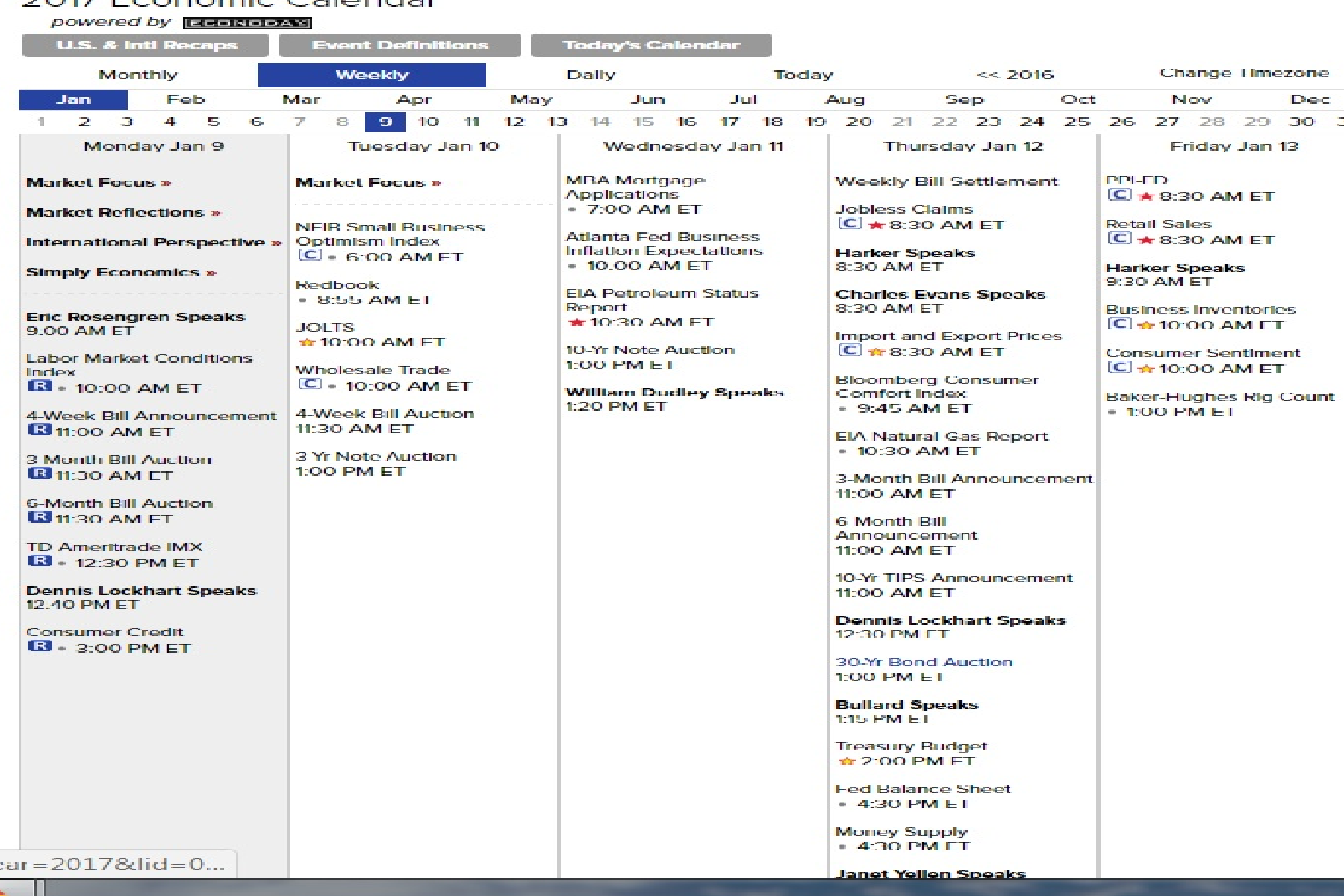
The week ahead — Economic data from Econoday.com:
Posted in Weekly Summary | No Comments »
January 2nd, 2017
”Money cannot consistently be made trading every day or every week during the year” – Jesse Livermore
HAPPY NEW YEAR & WISHING YOU A PROSPEROUS 2017
1. Tesla to Manufacture Solar Cells in Buffalo NY — as part of a solar partnership first announced in October, Panasonic (OTCPK:PCRFY) and Tesla Motors (NASDAQ:TSLA) have agreed to begin production of photovoltaic cells and modules at a factory in Buffalo, New York. The two companies plan to start manufacturing in the summer of 2017 and increase to one gigawatt of module production by 2019.
2. Qualcomm Hit With Antitrust Fine In South Korea — the Korea Fair Trade Commission has fined Qualcomm (NASDAQ:QCOM) 1.03T won ($854M) for what it called unfair business practices in patent licensing and modem chip sales. Qualcomm said it would challenge the antitrust regulator’s decision in the Seoul High Court. The fine is the largest ever levied in South Korea.
3. Ford to Triple Size of Autonomous Test Fleet — it’s been three years since Ford (NYSE:F) launched its fleet of 10 first-generation Fusion Hybrid autonomous research vehicles, which have seen advancements like driving on snow-covered roads and operating in the dark without headlights. Joining the team in 2017 will be 20 next-generation autos (featuring new hardware, electrical controls and sensor technology) that will triple the Blue Oval’s stable of self-driving vehicles.
4. Twitter Starts 360-Degree Live Video Streaming — Twitter (NYSE:TWTR) has joined YouTube (GOOG, GOOGL), Facebook (NASDAQ:FB) and others in offering panoramic live views, marking a greater use of real-time video that is part of a broader trend of immersive experiences and virtual reality. Twitter (NYSE:TWTR) has joined YouTube (GOOGL), Facebook (NASDAQ:FB) and others in offering panoramic live views, but not everyone can post for now. Live 360-degree videos will be marked with a “LIVE 360” badge and users can change the angle of their view by either moving their phones or swiping their screens.
5. GOP Readies Swift Obamacare Repeal With No Replacement Ready — the first major act of the unified Republican government in 2017 will be a vote in Congress to begin tearing down Obamacare. However, the Republicans and President-elect Donald Trump have no agreement thus far on how to replace coverage for about 20 million people who gained insurance under the health-care law. Republicans are debating how long to delay implementing the repeal. Aides involved in the deliberations said some parts of the law may be ended quickly, such as its regulations affecting insurer health plans and businesses. Other pieces may be maintained for up to three or four years, such as insurance subsidies and the Medicaid expansion. Some parts of the law may never be repealed, such as the provision letting people under age 26 remain on a parent’s plan.
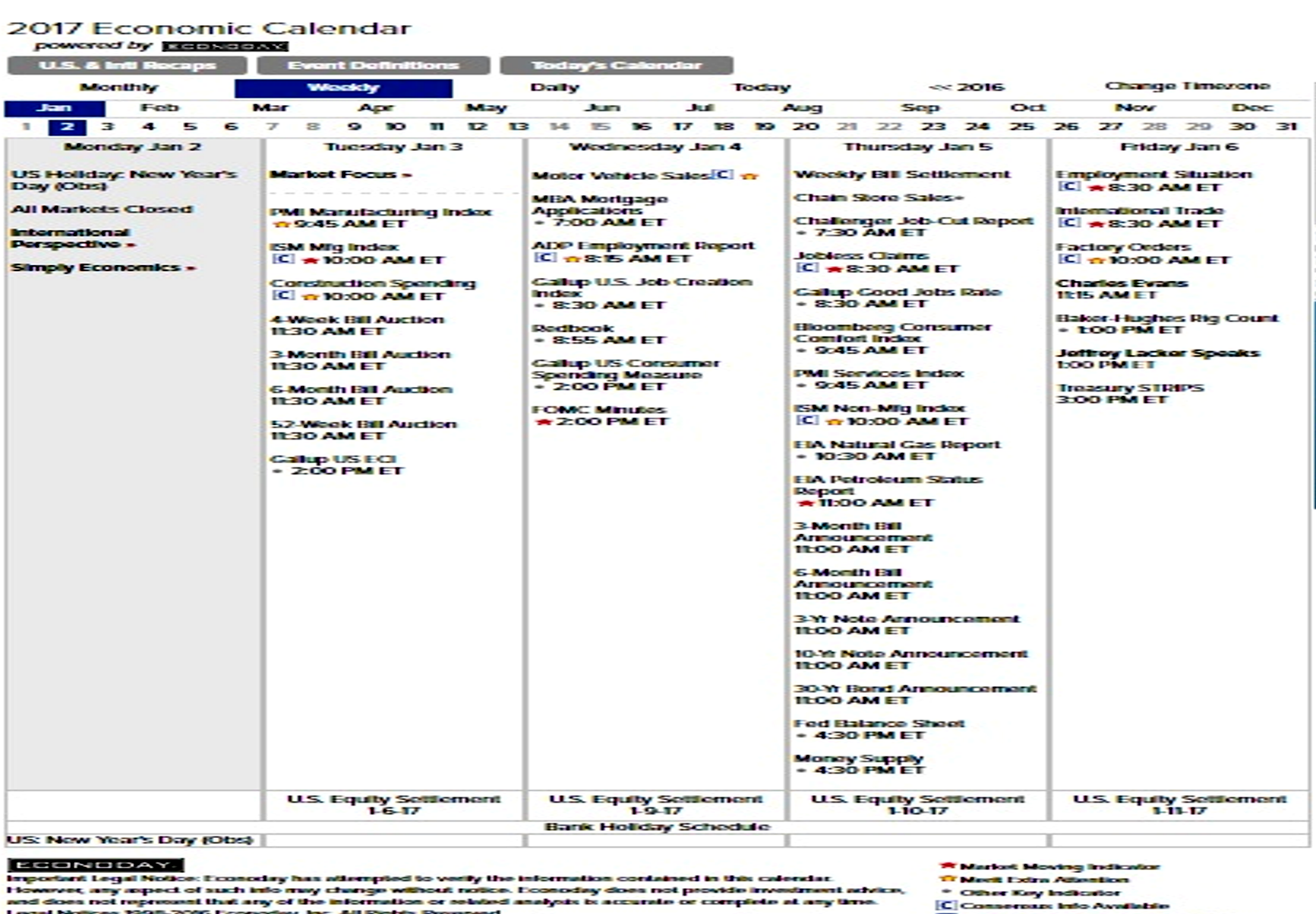
The week ahead — Economic data from Econoday.com:
Tags: Obama Care Repeal
Posted in Weekly Summary | No Comments »
December 27th, 2016
“The Market Can Remain Irrational Longer Than You Can Remain Solvent” — John Maynard Keynes
1. Scotland’s Plan to Stay in European Single Market — in trying to avoid the “national disaster” of a “hard Brexit,” Scotland will publish proposals for how it can remain in the European single market after Britain leaves the EU. The plans are expected to outline new and substantial powers for the devolved parliament in Edinburgh, allowing for free movement of goods, services and people.
2. IMF Leadership in Question as Lagarde Found Guilty — IMF Managing Director Christine Lagarde won’t face punishment and will keep her job, despite being convicted of negligence charges relating to a state payment made during her time as French finance minister in 2008. The court ruled that Lagarde failed to contest a €400M award to billionaire tycoon Bernard Tapie, but decided against sentencing owing to her preoccupation with the 2008-09 financial crisis and strong international reputation.
3. Apple in Talks to Manufacture in India — Apple is discussing with the Indian government the possibility of manufacturing its products in the country. In a letter last month, the company outlined its plans and sought financial incentives to move ahead, the WSJ reported. Making goods such as iPhones locally would allow Apple (NASDAQ:AAPL) to open its own stores in India, helping build its brand in a country where it has just a tiny slice of less than 5% – of a booming smartphone market.
4. Italy/World Oldest Bank Monte dei Paschi Moves Closer to Collapse — Italy’s parliament has approved a government request for a 20 billion euro rescue loan to prop up the country’s ailing banking sector, including Banca Monte dei Paschi di Siena SpA. Italy third biggest Italian lender after it warned that it would run out of cash in 4 months. Monte dei Paschi had previously said that its 10.6 billion euro ($11.5 billion) liquidity position could last for 11 months.
5. U.S. GDP Growth Revised Up to 3.5% Rate in Third Quarter — the Commerce Department said the economy expanded at a seasonally adjusted 3.5% annualized rate in the third quarter. This is above the government’s prior estimate of 3.2% due to upward revisions in consumer spending and business investment. Consumer spending, which added 2 percentage points to GDP, rose at a 3% annual rate, up from the prior estimate of 2.8%. Business investments rose at a revised 1.4% rate, much stronger than the previous estimate of a 0.1% rise. The trade sector was a big positive for growth in the third quarter. Exports spiked 10% helped by a temporary boom in U.S. soybean shipments.
6. Deutsche Bank, Credit Suisse Settle U.S. Subprime Probes — the DOJ has reached a $7.2B provisional deal with Deutsche Bank (NYSE:DB) and a $5.3B agreement in principle with Credit Suisse (NYSE:CS). Barclays (NYSE:BCS) is also feeling the heat from U.S. federal prosecutors after the British lender balked at paying the amount the government sought in negotiations.
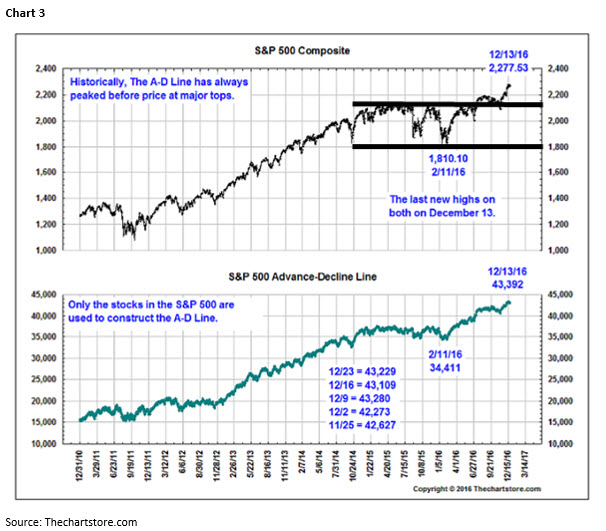
7. S&P 500 Index Broke-out of 2-Year Trading Range — chart below shows the S&P 500 Index broke out of a 2-year consolidation. Courtesy of BIG.
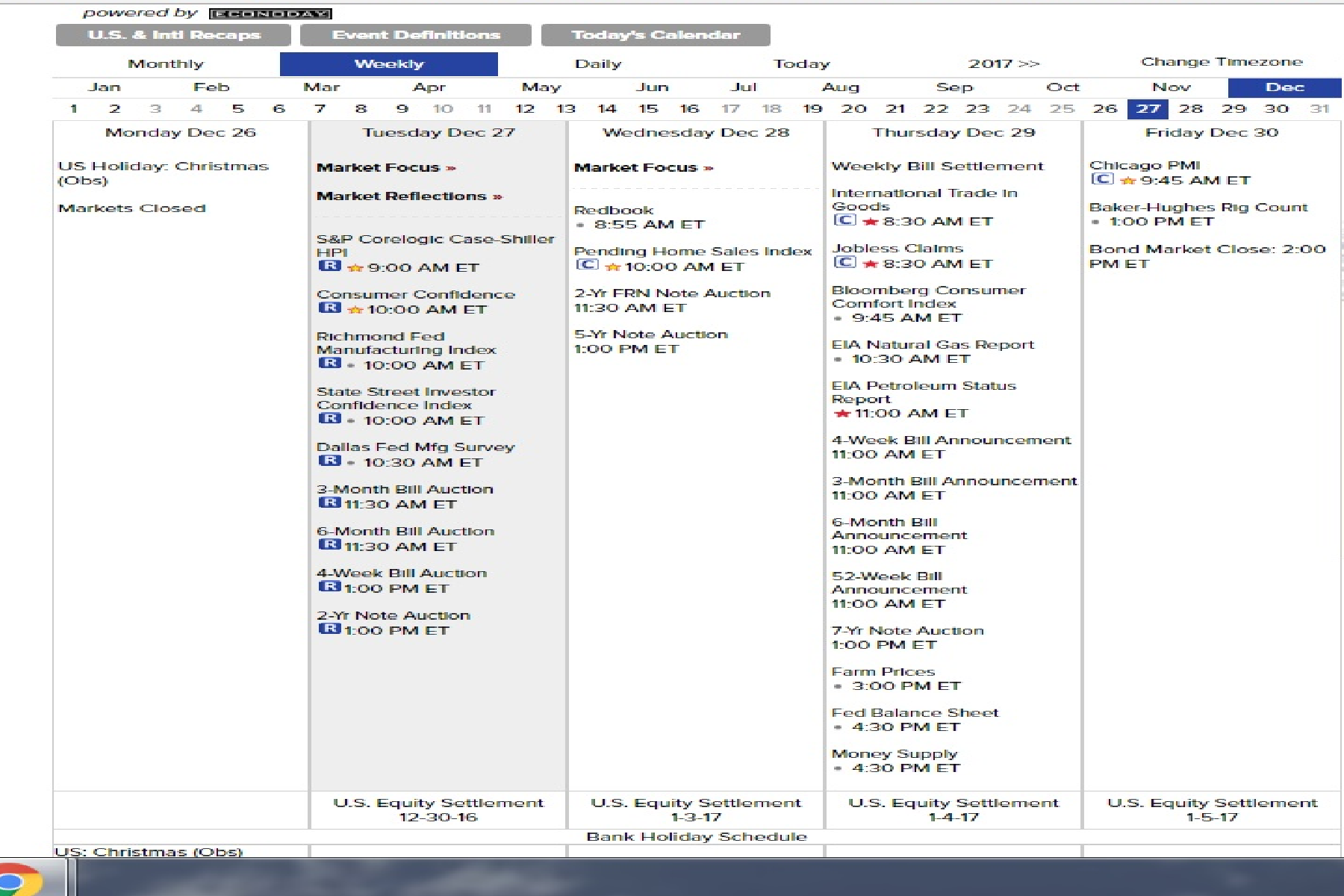
The week ahead — Economic data from Econoday.com:
Tags: SP500 Broke Out
Posted in Weekly Summary | No Comments »
December 19th, 2016
“Buy when others are despondently selling and sell when others are greedily buying” — Mark Mobius
1. Saudis Eye Deeper Cuts While Non-OPEC Joins Deal — OPEC and non-OPEC producers signed their first deal to cut output since 2001. Led by Russia, non-OPEC nations agreed to reduce production by 558K barrels per day, falling just short of the 600K target envisioned by OPEC. But following the meeting in Vienna, the Saudi Energy minister Khalid Al-Falih said everyone is committed to making sure the levels are enforced.
2. Bill Gates Pushes Green Energy on Call With Trump, While Building $1 Billion Fund — Bill Gates starts a new investment fund he and other billionaires started called Breakthrough Energy Ventures. Gates has tapped his vast network of technology and energy bigwigs to raise more than $1 billion that will be at the fund’s disposal, starting in 2017. The goal is to increase investments in energy-related technologies that will reduce, if not eliminate, greenhouse gas emissions. Investors in Breakthrough Energy Ventures include Jeff Bezos, chief executive officer of Amazon.com Inc., Richard Branson, the founder of Virgin Group Ltd., and Michael Bloomberg, the founder of Bloomberg LP. There are also prominent venture capitalists like John Doerr and Vinod Khosla, who have pumped a lot of money into green tech companies in the past.
3. Fed Raises Rates, Boosts Outlook for Borrowing Costs in 2017 — Bloomberg, Federal Reserve officials raised interest rates for the first time this year and forecast a steeper path for borrowing costs in 2017, saying inflation expectations have increased “considerably” and suggesting the labor market is tightening. New projections show central bankers expect three quarter-point rate increases in 2017, up from the two seen in the previous forecasts in September, based on median estimates.
4. U.S. Challenges China’s Grain Import Quotas at WTO — the U.S. has launched a challenge to China’s use of tariff-rate quotas for rice, wheat and corn at the WTO, charging that China’s administration of the program breached its WTO commitments and hurt U.S. farm exports. The tariff-rate quotas for rice, wheat and corn were worth $7B-plus in 2015, and China would have imported up to an additional $3.5B of the crops last year if the quotas had been fully used, the Office of the U.S. Trade Representative said. It was the second challenge to China’s agricultural policies by the U.S. Trade Representative since September and the latest in an escalating number of trade disputes between the two countries.
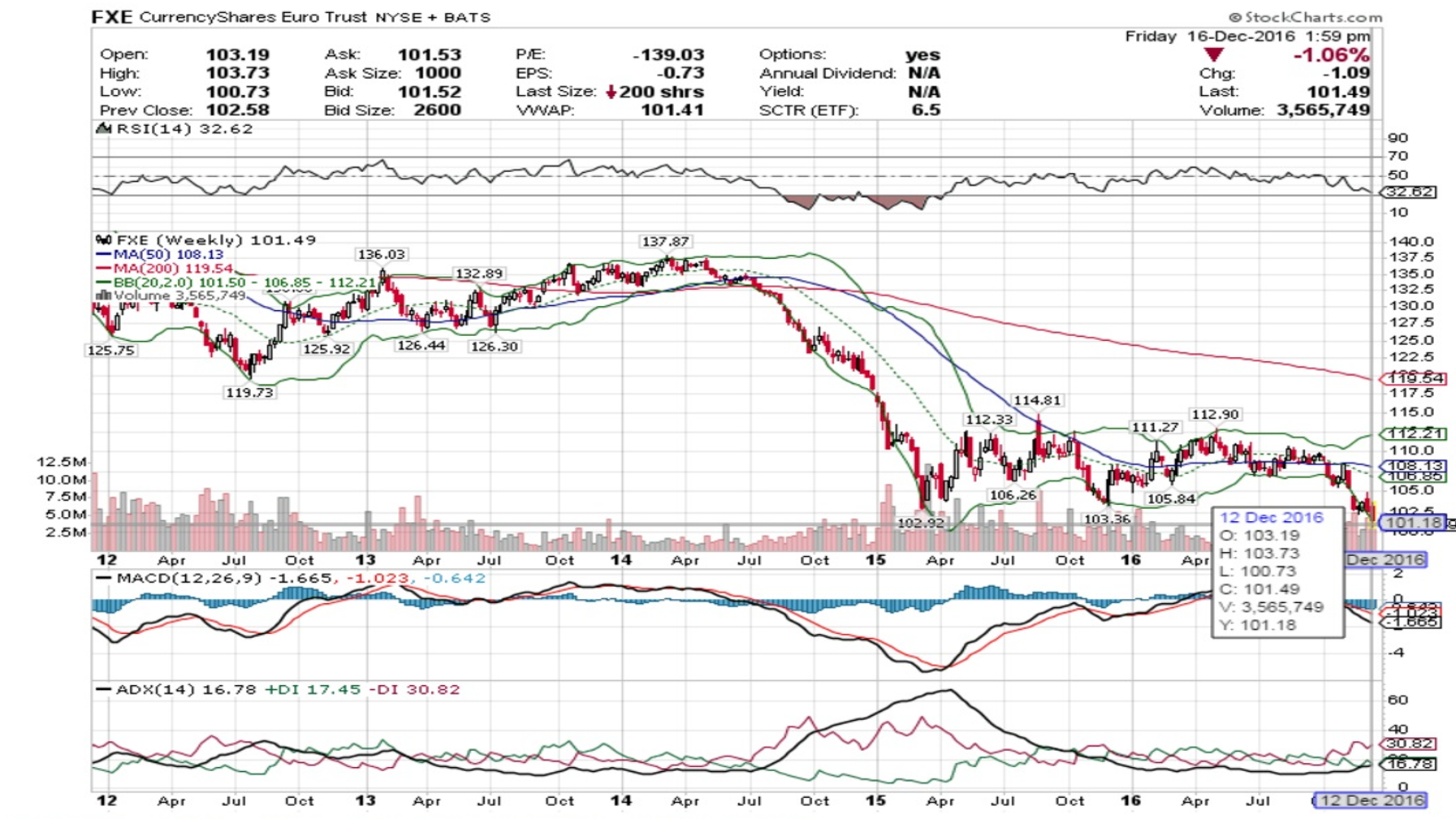
5. Euro Currency Recorded a 13-year Low Versus the USD — the euro recorded a 13-year low, just above $101.51, but has remained above $1.0. The US rate premium is also consolidating. The US two-year premium rose this week above 200 bp for the first time since 2000. The Euro/USD is targeted to reach par in early 2017. Below is the weekly chart going back to Dec 2011 to Dec 16 2016.
The week ahead — Economic data from Econoday.com:
Posted in Weekly Summary | No Comments »
December 12th, 2016
“Michael Marcus taught me one other thing that is absolutely critical: You have to be willing to make mistakes regularly; there is nothing wrong with it. Michael taught me about making your best judgment, being wrong, making your next best judgment, being wrong, making your third best judgment, and then doubling your money.” – Bruce Kovner
1. Renzi Quits as Italy Referendum Defeat Deepens Europe’s Turmoil — with virtually all the ballots counted, 59.6% of Italians voted to block the Prime Minister’s constitutional reform plans in a closely-watched referendum. Among the biggest winners of the referendum is the anti-establishment 5 Star Movement, which has called for a nonbinding plebiscite on Italy’s euro membership and might favor printing a parallel currency. The nation has already seen 63 governments in just 70 years.
2. AT&T Starts 5G Business Customer Trial — AT&T (NYSE:T) has started testing the technology inside of one of Intel’s (NASDAQ:INTC) offices in Austin, TX. The company is particularly interested in how the new network will stand up to streaming 4K video, but will also test a wide variety of uses, including VPN, VoIP, “unified communications applications” and good old internet access. However, AT&T stated that 5G and its multi-gigabit cellular speeds probably won’t hit the market until 2020.
3. China’s Forex Reserves Fell to New Lows — another blow to China’s foreign exchange reserves fell for a fifth straight month in November, tumbling $69.06B to $3.052T – the lowest since March 2011. Authorities struggled to shore up the sliding yuan in the face of a relentlessly rising dollar. Adding to pressure on the currency, President-elect Trump has vowed to label China a currency manipulator on his first day in office and threatened to impose huge tariffs on Chinese goods.
4. Moody’s Affirms Italy’s Rating at ‘Baa2’, Revises Outlook To Negative — Moody’s Investors Service affirmed Italy at Baa2 but revised down the outlook on the country’s rating to negative from stable after Italian voters rejected a referendum on constitutional changes over the weekend. Moody’s cited “the slow and halting progress on economic and fiscal reform in Italy, the prospects for which have diminished further following the ‘no’ vote in Sunday’s constitutional referendum” as the main driver behind its decision. The ratings agency also expressed concerns that Italy may be exposed to “unforeseen shocks” for an extended period due to its tepid growth outlook and the recent deterioration in its fiscal position.
5. U.K. Parliament Backs Timetable To Trigger Article 50 (process of leaving the EU) — British MPs have voted in favor of government plans to trigger Article 50 by March 31, 2017, meaning Britain will formally initiate the process of leaving the EU before that date. However, both the government and opposition said the motion didn’t affect a case at the Supreme Court over whether the government has the authority to start negotiations without legislation in parliament.
6. Microsoft Chip Pact with Qualcomm Expands Efforts in Mobile — Microsoft is working with Qualcomm to spawn a new breed of tablets and notebooks that promise to diversify the software giant’s tech base and give the chip maker access to new markets. The partnership will result in an update of Windows 10 (NASDAQ:MSFT) that runs on a chip in Qualcomm’s (NASDAQ:QCOM) widely used Snapdragon line of processors, the first Windows 10-Snapdragon pairing.
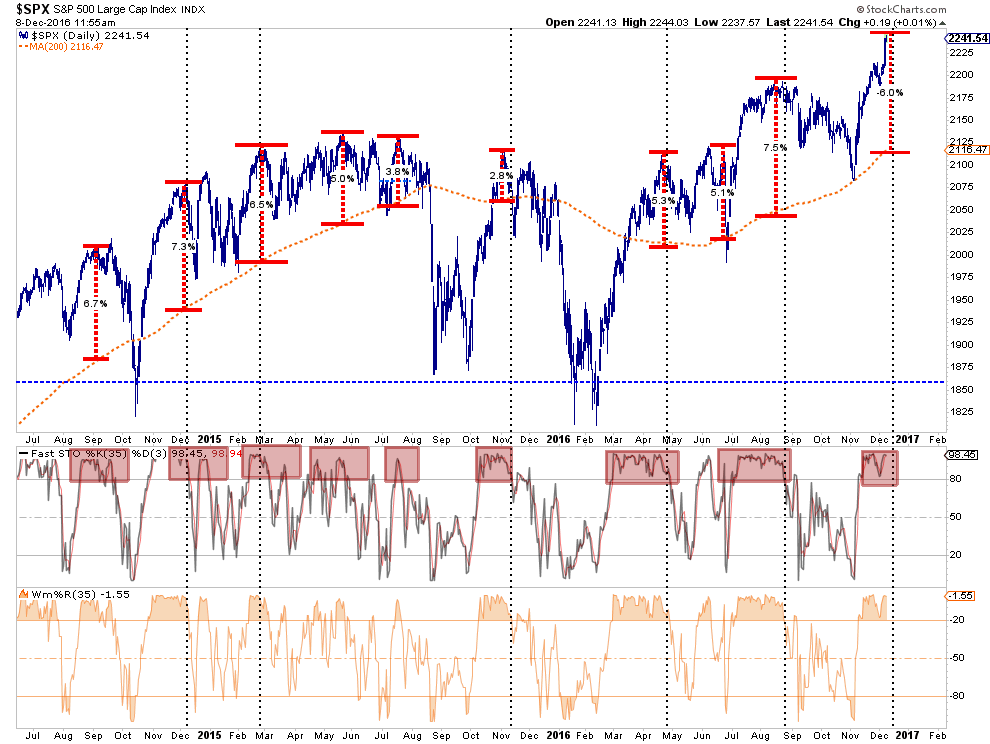
7. S&P 500 Index Overbought — chart below shows the S&P500 weekly is overbought. Pullback in the index is expected.
The week ahead — Economic data from Econoday.com:
Tags: 5G
Posted in Weekly Summary | No Comments »