July 3rd, 2017
“I think investment psychology is by far the more important element, followed by risk control, with the least important consideration being the question of where you buy and sell.” – Tom Basso
1. EU Slaps Google With €2.4B Fine — Google has been hit with a record €2.4B fine after EU antitrust regulators ruled the company had abused its power by promoting its own shopping comparison service at the top of search results. The penalty is the largest doled out by Brussels for a monopoly abuse case and follows a seven-year-long investigation into the search group’s practices.
2. Sears Canada to Delist from Nasdaq After Filing Bankruptcy — After filing for bankruptcy last week, Sears Canada (NASDAQ:SRSC) has received notice from Nasdaq stating it will delist the company’s shares on July 3, 2017. The firm, which is closing about a quarter of its stores, has been struggling with years of losses and falling sales due to competition from big-box retailers and online merchants.
3. Bank Get Fed’s Blessing to Unleash Big Buybacks, Dividends — the central bank did not object to any of the buybacks or dividend hikes from the 34 banks it reviewed during the second phase of its annual stress test. This is the first time in the seven-year history of the tests implemented in the wake of the financial crisis that all banks have passed. JPMorgan announced a repurchase program of up to $19.4 billion, its biggest since the financial crisis. Citigroup unleashed its largest ever buyback program — worth up to $15.6 billion — and doubled its dividend. Bank of America and Morgan Stanley hiked their quarterly dividends to 12 cents a share and 25 cents a share, respectively.
4. Facebook Crosses 2 Billion-User Line — Facebook has now hit 2B monthly active users, representing a doubling of its user base in just the past five years. It hit the 1B user mark in October 2012, the year it went public. It’s the latest of a few metric milestones for Facebook (NASDAQ:FB), which celebrated 250M daily users of Instagram Stories last week, and Instagram overall hitting 700M MAUs in April.
5. American Airlines (NASDAQ:AAL) Buying New 3-D Carry-On Bag Screeners To Speed Up Airport Security — American Airlines (NASDAQ:AAL) is buying new 3-D carry-on bag screeners that it will deploy at eight U.S. airports once the machines get fully certified by the TSA. 3-D scanners not only give TSA agents a clearer view of potential problems, but the machines – built by Analogic (NASDAQ:ALOG) – are designed to go twice as fast checking carry-on bags.
The week ahead — Economic data from Econoday.com:

Posted in Weekly Summary | No Comments »
June 27th, 2017
…“People somehow think you must buy at the bottom and sell at the top to be successful in the market. That’s nonsense! The idea is to buy when the probability is greatest that the market is going to advance”… Jesse Livermore
1. James Clinger Nominated for FDIC Chair — taking a big step towards loosening the shackles on Wall Street, President Trump has nominated James Clinger as chairman of the FDIC, one of the U.S.’s most powerful bank regulators. If confirmed by the Senate, he would begin his term in November. Clinger currently serves as chief counsel for the House Financial Services Committee and has been involved in efforts to rip up Dodd-Frank.
2. UPS Adopts Peak Time Charges for 2017 Holiday Season — UPS plans to charge retailers extra fees to deliver packages during the busiest weeks before Christmas, creating a new challenge for an industry seek to offset declining foot traffic to shopping centers. UPS’s fees will force retailers like Amazon (AMZN) and Wal-Mart (NYSE:WMT) to decide over the next few months whether to raise prices, a difficult to do when online shoppers are reluctant to pay shipping fees.
3. MSCI Will Include China’s A shares In the MSCI Emerging Markets Index — the long-awaited China’s A-shares will be included in the MSCI Emerging Markets Index in what was seen as a major milestone. “International investors have embraced the positive changes in accessibility… over the last few years,” said Remy Briand, Chairman of the MSCI Index Policy Committee.
4. Oil To Flow Through Dakota Access Pipeline as Summer Hearings Proceed — a U.S. District Court judge has set up a series of hearings through the summer to determine what will happen to the Dakota Access Pipeline while authorities conduct an additional review of the project’s environmental impact. Project developer Energy Transfer Partners (NYSE:ETP) is “pleased with the decision” as oil will continue to flow through the pipeline during the hearings.
5. All US Banks Pass This Year’s Stress Tests — The 34 largest U.S. lenders have all cleared the first stage of the Fed’s annual stress test, showing they would be able to maintain enough capital in an extreme recession to meet regulatory requirements. Banks are still subject to a second portion of the test in which the Fed approves or denies their capital plans, which will be released next week.
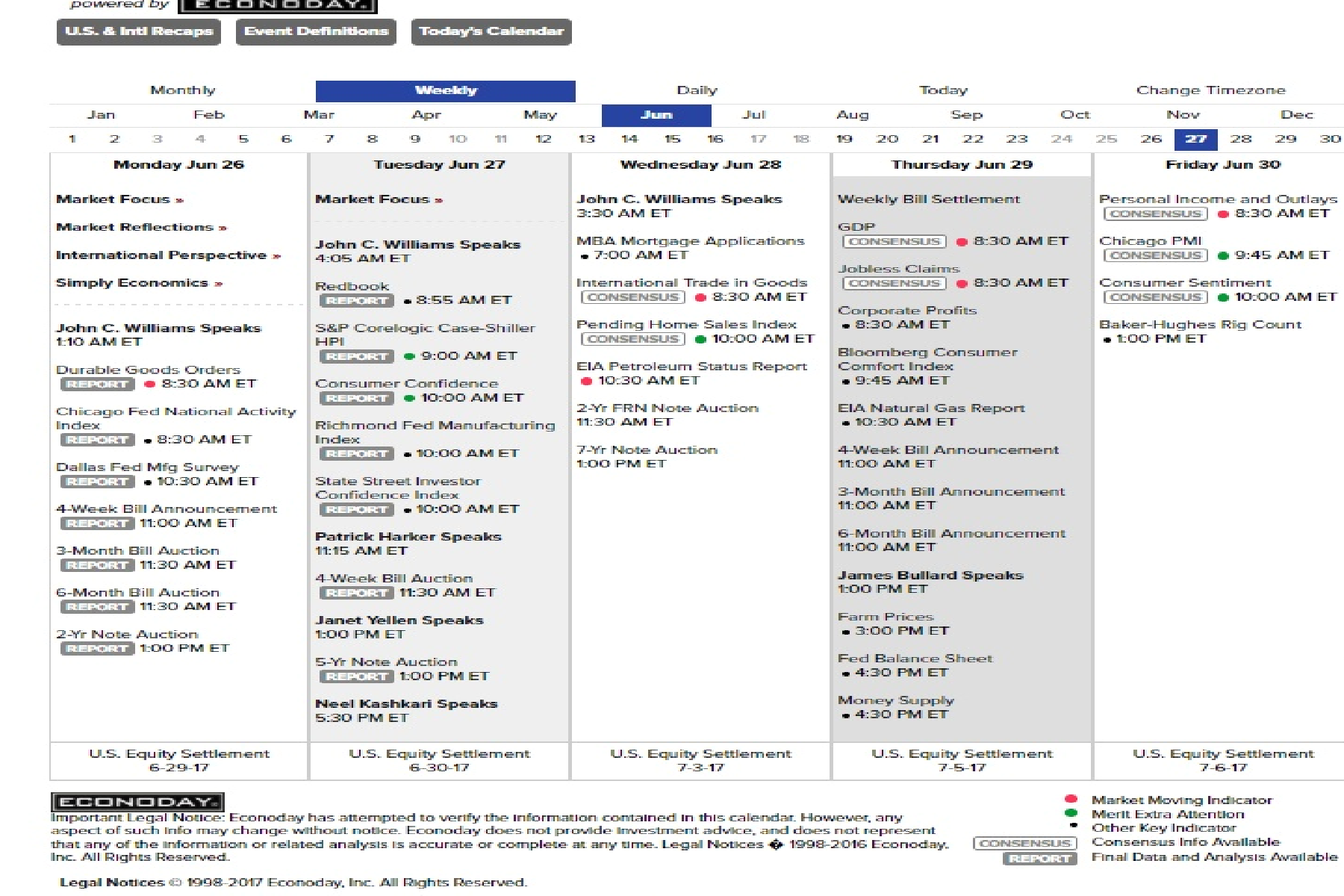
The week ahead — Economic data from Econoday.com:
Posted in Weekly Summary | No Comments »
June 19th, 2017
“That cotton trade was almost the deal breaker for me. It was at that point that I said, ‘Mr. Stupid, why risk everything on one trade? Why not make your life a pursuit of happiness rather than pain?’” – Paul Tudor Jones
1. Jeff Immelt to Step Down as CEO of GE; John Flannery Takes Role — General Electric Co. (GE) Chief Executive Jeff Immelt will step aside this summer, and replace by John Flannery, head of the company’s health-care business and retire as chairman of the board on Dec. 31. Under Immelt ‘s term, GE shares have vastly underperformed the stock market during his tenure.
2. U.S. Retail Sales Fell 0.3% in May — retail sales which reflecting consumer spending at stores, restaurants and websites—fell 0.3% in May from a month earlier, the Commerce Department reported. That marked the steepest drop since January 2016. A big factor was cheaper gasoline, which translated into less spending at service stations. But consumers also cut spending at big-box stores, electronics retailers and restaurants. Car sales, after hitting a record in 2016, have fallen nearly 2% over the past three months. Retail sales are a big component of consumer spending, which in turn accounts for roughly two-thirds of U.S. economic output.
3. Quantitative Investing Based on Computer Formulas Accounts for About 90% of All Trades — JPMorgan’s Marko Kolanovic stated that “The majority of equity investors today don’t buy or sell stocks based on stock specific fundamentals,” which estimates “fundamental discretionary traders” account for only about 10% of trading volume in equities.
4. Fed Raises Interest Rates and Sets Plan to Shrink $4.5 Trillion Balance Sheet ‘this year’ — the Fed as expected on Wednesday last week raised its benchmark federal-funds rate by a quarter percentage point to between 1% and 1.25% — the third increase in a year and a half. The Federal Reserve lifted a key U.S. interest rate and laid out a plan to shrink its massive $4.5 trillion balance sheet starting “this year,” a pair of moves reflecting its view that an economic expansion now entering its ninth year no longer needs so much propping up. Under the plan, the Fed will initially allow $6 billion a month in principal from maturing Treasury securities to runoff. That will increase in steps of $6 billion each quarter over a year until it reaches $30 billion a month. For mortgage-backed securities and federal agency debt, the Fed set an initial cap of $4 billion. That will increase in quarterly steps of $4 billion each quarter until it reaches $20 billion a month.
5. U.S. Stock ETF Inflows Surge — Investors raced into exchange-traded funds this past week despite market jitters, according to Lipper, delivering the most cash to those funds since late last year. Stock ETFs listed in the U.S. attracted $17.7B during the week ended June 14, while their mutual fund counterparts recorded $6.8B of outflows in their largest week of withdrawals since April.
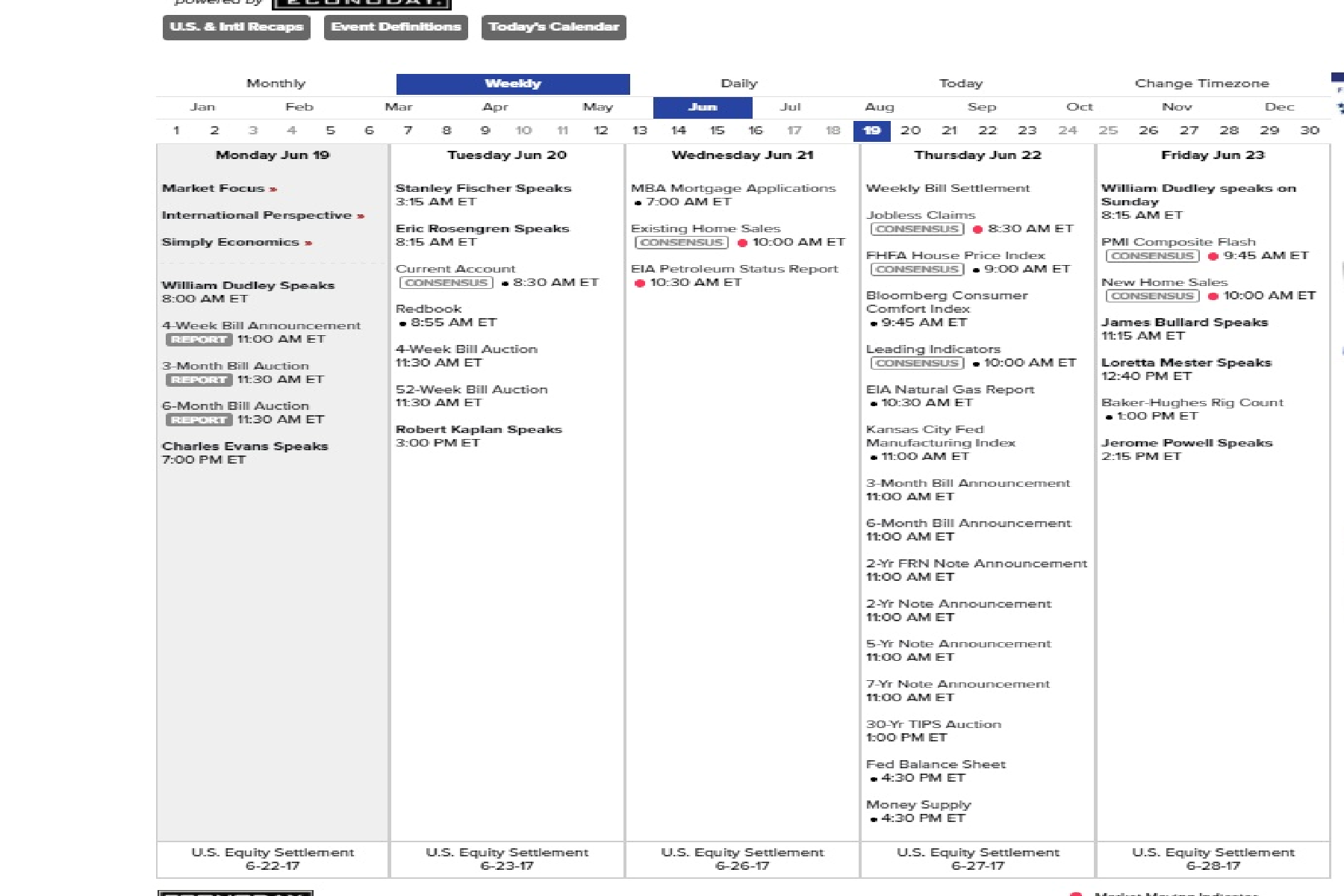
The week ahead — Economic data from Econoday.com:
Tags: FOMC Meeting
Posted in Weekly Summary | No Comments »
June 12th, 2017
“Success if getting what you want. Happiness is wanting what you get.” — Dale Carnegie
1. Arab Nations Sever Ties with Qatar — four Arab states have cut off diplomatic ties with Qatar, as well as closing air and sea routes, pointing to Doha’s ties to terrorism. The coordinated move by Saudi Arabia, Egypt, the UAE and Bahrain marks a sharp escalation of a rift between the Persian Gulf states since late last month.
2. Global Market for Natural Gas Has Finally Arrived — the U.S. and China are working on a trade deal that could send vast quantities of gas pumped in Texas and Pennsylvania to factories in Shanghai and Guangdong. Improved access for U.S. exporters to China’s giant energy markets could boost overall global shipments. Thirty-nine countries now import LNG, up from 17 a decade ago, according to data and analytics firm IHS Markit. Several more, among them Uruguay, Bahrain and Bangladesh, are expected to lift the total to 46 in the next couple of years. The price differences also shrink. In 2012, Asia spot prices for LNG were $5.74 per million British thermal units higher than natural-gas prices in Europe, according to S&P Global Platts. This year so far, the difference has averaged less than $1.
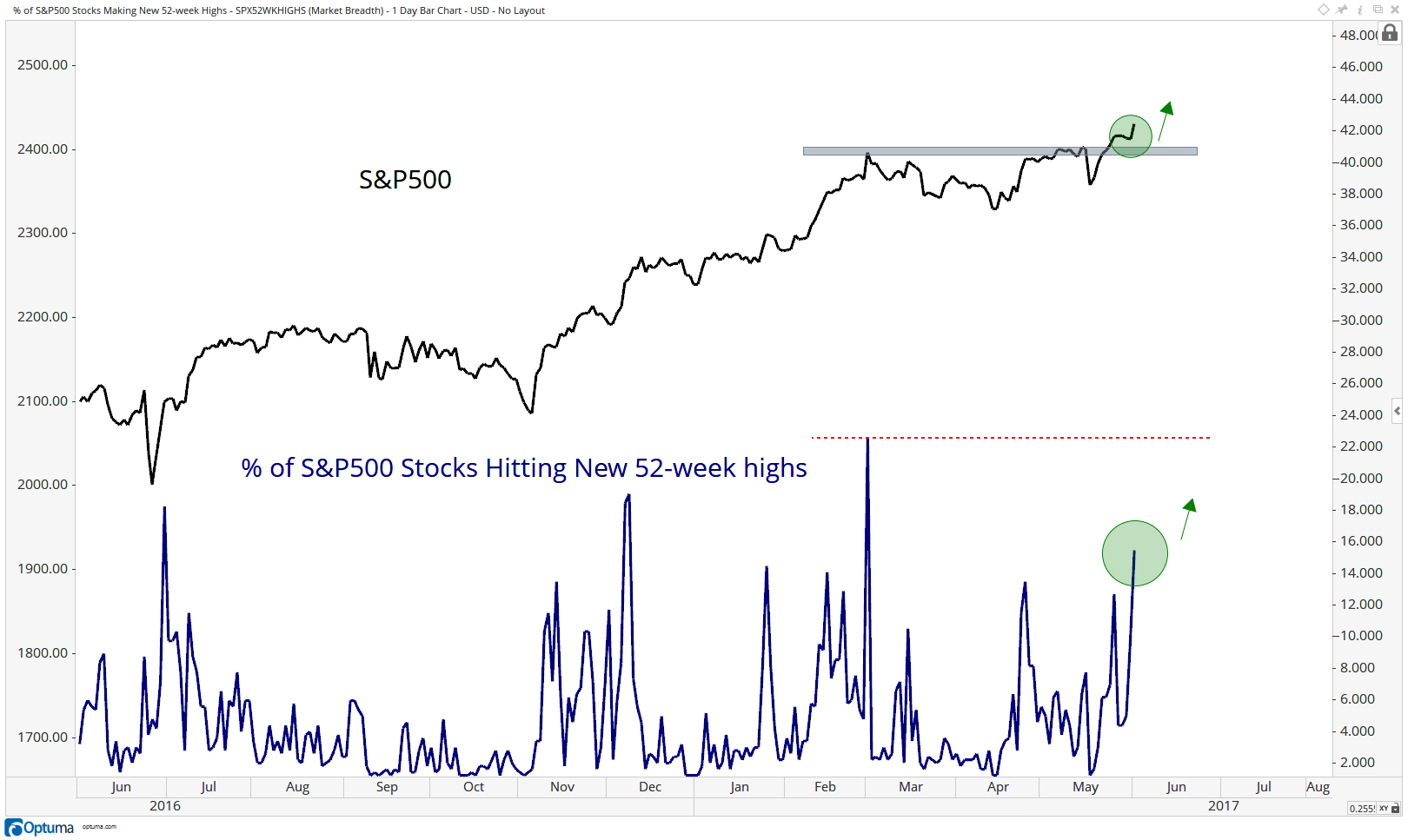
3. S&P500 Brokeout to New All-time Highs — the S&P500 broke above the upper end of this consolidation from the past 3 months. Meanwhile, the list of stocks in the S&P500 also making new highs also broke out to the highest level since those March highs. According to to a research note by Sam Stovall of CFRA, “So far, 2017 has seen 17 new all-time closing highs for the S&P 500 and just 10 days where the index moved more than 1 percent in either direction. That kind of higher highs with low volatility always – yes, always – has been positive for the market, according to Sam Stovall, chief investment strategist at CFRA. The previous 17 times that has happened, the market has averaged a 19.4 percent gain, with advances happening 100 percent of the time.”
4. British PM Theresa May Looks to Form New Government — Prime Minister Theresa May will seek permission from the Queen to form a new government, according to a spokesperson, despite calls for her to resign after a bruising election. Her Conservative party lost its majority, with Labour gaining significant ground, resulting in a hung parliament. Furthermore, The U.K. could suffer another ratings downgrade after a general election led to a hung parliament, according to S&P Global. The country lost its AAA rating last June following its vote to leave the EU. S&P said at the time it was worried the decision would lead to a deterioration of Britain’s economic performance and institutional framework.
5. FDA Wants Endo’s Opana ER Off the Market Due to Abuse Potential — in an unprecedented move, the FDA has notified Endo International’s (NASDAQ:ENDP) Pharmaceuticals unit that it wants opioid pain med OPANA ER (oxymorphone HCl) removed from the market due to its abuse potential. It comes after a panel of advisers concluded in March that the drug’s benefits did not outweigh the risks – opioids were involved in more than 33,000 deaths in 2015.
6. Technology darlings Stocks Reversed Hard in the Last 2-day — most notable being the NASDAQ (-1.8%) and the Philadelphia Semiconductor Index (- 4.23%), as can be seen in the attendant chart below.

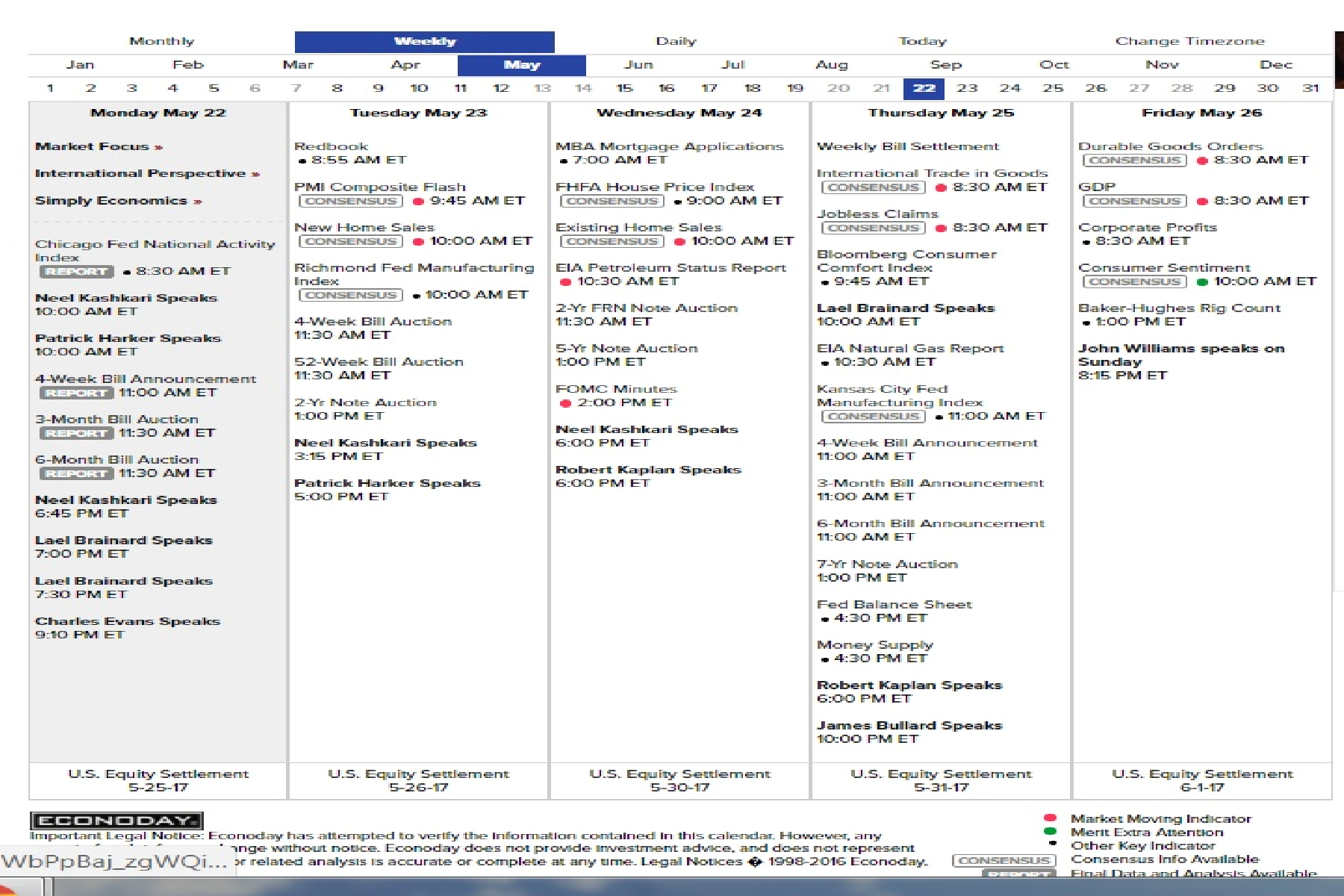
The week ahead — Economic data from Econoday.com:
Posted in Weekly Summary | No Comments »
June 5th, 2017
There will not be any re-cap for the week of June 2 2017. We are away for some needed R&R.
Have a good week.
The staffs at EGS.
Posted in Weekly Summary | No Comments »
May 29th, 2017
“The key to trading success is emotional discipline. If intelligence were the key, there would be a lot more people making money trading… I know this will sound like a cliché, but the single most important reason that people lose money in the financial markets is that they don’t cut their losses short.” – Victor Sperandeo
1. TPP Nations Pursue Deal Without U.S. — the 11 members of the Trans-Pacific Partnership have agreed to pursue their trade deal without the U.S. at a forum of the Asia-Pacific Economic Cooperation. U.S. Trade Representative Robert Lighthizer said at the conference. “Bilateral negotiations are better for the U.S. than multilateral negotiations.”
2. Trump’s Unveils First Budget Proposal — President Trump’s first full budget proposal lands on lawmakers’ desks this past week, with an estimated $3.6T in spending cuts over the next decade. Congress will still be allowed to spend $4.1T in 2018, including a big boost to defense, border security and infrastructure, while cutting Medicaid, food stamps and other social programs. The plan also calls for selling half of the nation’s Strategic Petroleum Reserve and permitting drilling in the Alaska refuge.
3. MSCI Sets Date for Chinese A-shares Decision — MSCI will announce on June 20 whether it will finally include China’s domestic A-shares in its $1.5T Emerging Markets Index (ETF: EEM) as Beijing tries to open up its markets and attract foreign capital. The index provider last June delayed the decision for a third straight year, citing regulation worries and accessibility for global investors.
4. Moody’s Downgrades China Rating to A1 from Aa3, Citing Concerns Over a Slowing Economy and Growing Debt — Moody’s Investors Service downgraded China’s credit rating to A1 from Aa3, changing its outlook to stable from negative, citing concerns efforts to support growth will spur debt growth across the economy. Moody stated that the catalyst for the downgrade was a combination of factors, including expectations that potential growth would fall to 5 percent by the end of the decade. It was Moody’s first downgrade for the country since 1989, according to Reuters.
5. OPEC Agrees to Extend Crude Output Caps — OPEC renewed an agreement to withhold some crude-oil supplies into March 2018. With over a dozen other countries expected to join the cartel’s efforts, the agreement is likely to cut off about 2% of the world’s oil supply through March 2018, extending a decision the OPEC-led coalition reached last year.
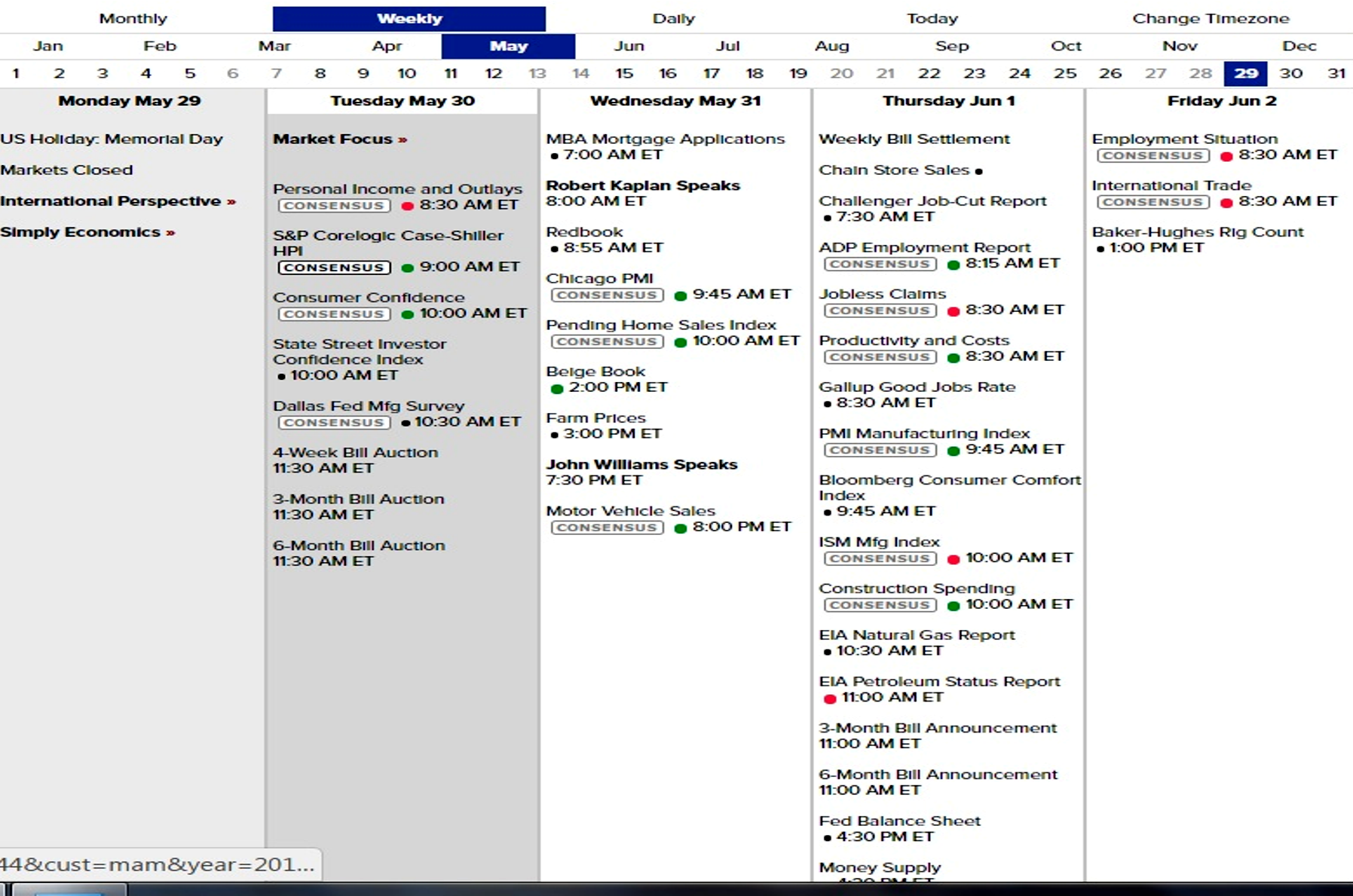
The week ahead — Economic data from Econoday.com:
Posted in Weekly Summary | No Comments »
May 22nd, 2017
“Investors tend to confuse short-term volatility with long-term risk. The longer the time period, the lower the risk of holding equities. People focus too much on the short term, week-to-week and month-to-month price changes, and don’t pay enough attention to the long-term potential.” — Richard Driehaus
1. Saudi Arabia and Russia Agreed to Crude Production Cut — Saudi Arabia and Russia, the world’s top two producers, said that a crude production cut would be extended from the middle of this year until March 2018. While the output cut will initially be on the same volume terms as before, they hope other producers will join in their efforts. OPEC is due to meet in Vienna on May 25.
2. Ford Planning Major Job Cuts — Looking to boost profits and its sliding stock price, Ford (NYSE:F) plans to slash its global workforce (currently 200K) by about 10%, WSJ reported. The job cuts are expected to be outlined as early as this week. Ford shares have suffered during CEO Mark Fields’s three-year tenure and the company’s market value has slipped far behind those of Tesla (TSLA) and General Motors (NYSE:GM).
3. Brazil Sinks Deeper Into Political Crisis — a fresh political crisis is hitting Brazil, reminiscent of last year’s impeachment saga, following reports that President Temer was secretly recorded discussing hush money pay-offs to a jailed associate. According to Brazil’s O Globo, the tapes were presented to prosecutors as part of a plea bargain by Joesley and Wesley Batista, brothers who run the country’s biggest meat-packing firm JBS.
4. Greece Adopts More Austerity Measures — Greece’s parliament has approved a raft of fresh austerity measures, including pension cuts and tax hikes sought by the nation’s foreign creditors. The step paves the way for eurozone finance ministers to clear the next disbursement of funds to Athens when they meet to discuss ways to lighten the country’s debt burden.
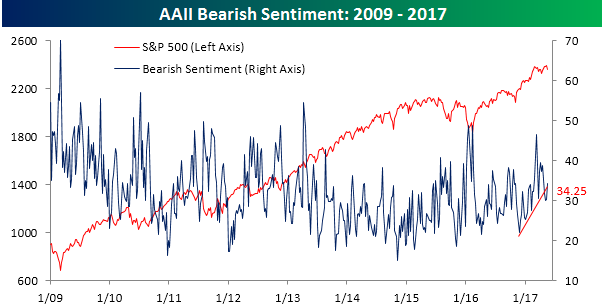
5. AAII Bullish Sentiment Crashes — according to the latest weekly AAII survey, bullish sentiment dropped from 32.73% down to 23.85%. That drop is the largest one-week decline since July 2015 and takes bullish sentiment down to its lowest level since last November’s election. Bullish sentiment has now been below 50% for a record 124 straight weeks.
Meanwhile, bearish sentiment increased by less than half as much as bullish sentiment declined. However, at a level of 34.25%, more than a third of individual investors consider themselves bearish.
The week ahead — Economic data from Econoday.com:
Posted in Weekly Summary | No Comments »
May 15th, 2017
“Any idiot can face a crisis – it’s day to day living that wears you out.” – Anton Chekhov
1. Landslide Win for Emmanuel Macron in France — Emmanuel Macron is set to become the youngest president in French history after winning 66% of Sunday’s runoff vote vs. National Front leader Marine Le Pen. He declared “I will fight with all my strength against the divisions that are undermining us,”. While his victory strengthens France’s place in the EU, he’ll soon have to prove his fledgling political party, En Marche, is capable of winning a majority in June’s legislative elections.
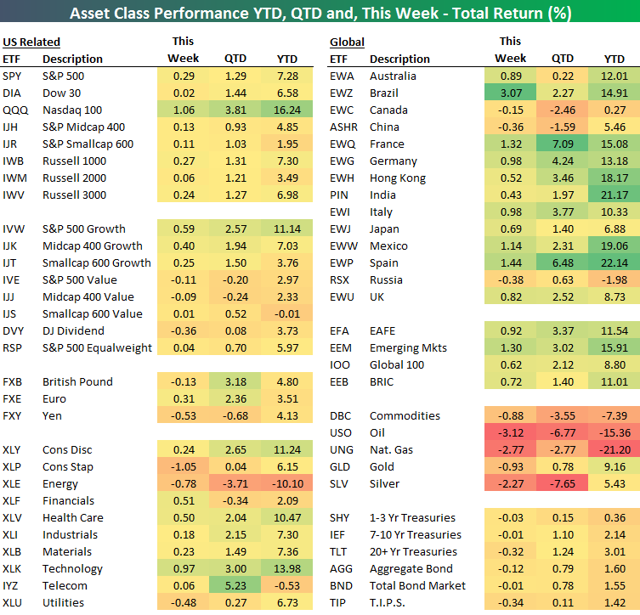
2. Key ETFs Asset Class Performance Matrix for May — the star of 2017 for US equity indices has been the Nasdaq 100 (NASDAQ:QQQ), which is up 16.24% YTD. Both the S&P 500 (NYSEARCA:SPY) and Dow 30 (NYSEARCA:DIA) are up around 6%. Meanwhile, Energy (NYSEARCA:XLE) is down more than 10%.
3. VIX (Fear Index) Back to It’s Pre-Crash Lows — the VIX fell to the lowest level since December 1993, including Monday’s 9.77 close, a finish in the single digits has only been managed 11 times for the VIX. The VIX, which is built using the implied volatilities of a wide range of S&P 500 index options, is meant to be forward-looking and is calculated from both calls and puts. It’s often referred to as the “investor fear gauge.”
4. Tesla Updates on Solar Roof initiative on Musk’s Grand Idea — Elon Musk’s vision for a grand unification of his clean-energy ambitions—combining solar power, home batteries, and electric cars in transformative of new solar roof project. Tesla’s first two styles of its solar roof – “black glass smooth” and “textured” – will be priced at about $21.85 per square foot. That’s more expensive than a typical roof, but less pricey than a roof with traditional solar and back-up batteries. The product will come “with a warranty for the lifetime of your house, or infinity, whichever comes first,” as Tesla reported.
5. China Unveiled ‘One Belt, One Road’ — China’s President Xi unveiled detail plans for his “Belt and Road Initiative”. Over fifty agreements signed to advance the project, which aims to build a new Silk Road connecting Asia, Europe, the Middle East and Africa. The vast logistics and transport network would involve 65 nations that together account for one-third of global GDP.
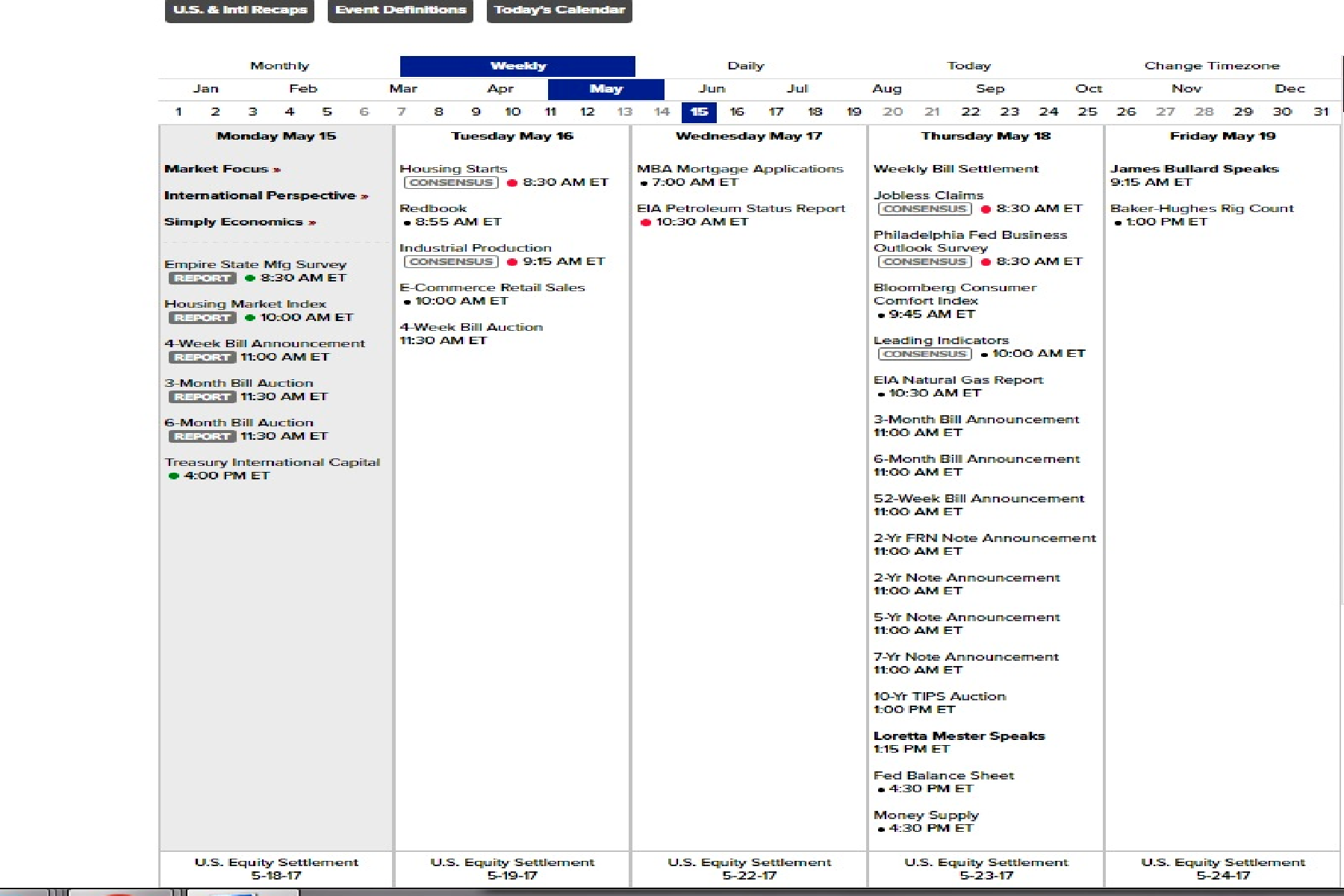
The week ahead — Economic data from Econoday.com:
Posted in Weekly Summary | No Comments »
May 8th, 2017
“Move on, understand what happened in the past but do not have an emotional attachment to it.” — unknown
1. Venezuela Hikes Minimum Wage Again Amid Crisis — responding to protests and an economic crisis, Venezuela’s Nicolas Maduro has raised the nation’s minimum wage by another 60%. It’s the third pay hike he’s ordered this year and the 15th since he became president in 2013. Still, none of the increases will come close to keeping up with the nation’s inflation, which is expected to rise by more than 1,600% in 2017.
2. Target Continues Urban Expansion in NY Lower East Side — the NY lower east side is about to get its first Target (NYSE:TGT). The retailer has signed a lease to open a 22,500 square-foot store at the 1.9M-square-foot development stretching across several Manhattan blocks called Essex Crossing. Target, which had 32 small format locations at the end of 2016, expects to have more than 130 in cities and dense areas by the end of 2019.
3. 5G Network In the Work by 2020 Plan by T-Mobile — helped by the airwaves it acquired for $8B in last month’s FCC spectrum auction, T-Mobile (NASDAQ:TMUS) expects to deploy a 5G network nationwide by 2020. The pledge comes as AT&T (NYSE:T) and Verizon (NYSE:VZ) pour billions of dollars into wireless airwave licenses that might support the technology.
4. Puerto Rico Files for Historic $70 Billion Debt Restructuring – Puerto Rico’s federal oversight board filed with a U.S. court to use bankruptcy-like proceedings to slash the island’s $70 billion debt after failing to strike an agreement with bondholders. The process called Title III, created by a U.S. law enacted last year to help Puerto Rico emerge from its debt crisis, allows the government to use the courts to cut debt amassed by more than a dozen agencies.
5. FOMC Stays on Hold, Rate Hikes Remain on Tap — the Fed kept interest rates on hold at its May meeting at 0.75%-1%, but maintained expectations for further 2017 rate hikes. In a unanimous statement – the committee said it “views the slowing in growth during the first quarter as likely to be transitory” and believes the “fundamentals… remain solid.”.
6. The House passed the American Health Care Act To Replace of Obamacare — President Trump said in the Rose Garden after the House passed the American Health Care Act by a slim margin of 217 to 213. The legislation now faces an uphill battle in the Senate, where several Republican members have signaled it could see major revisions. Reports also indicate that the chamber could write its own version of a bill.
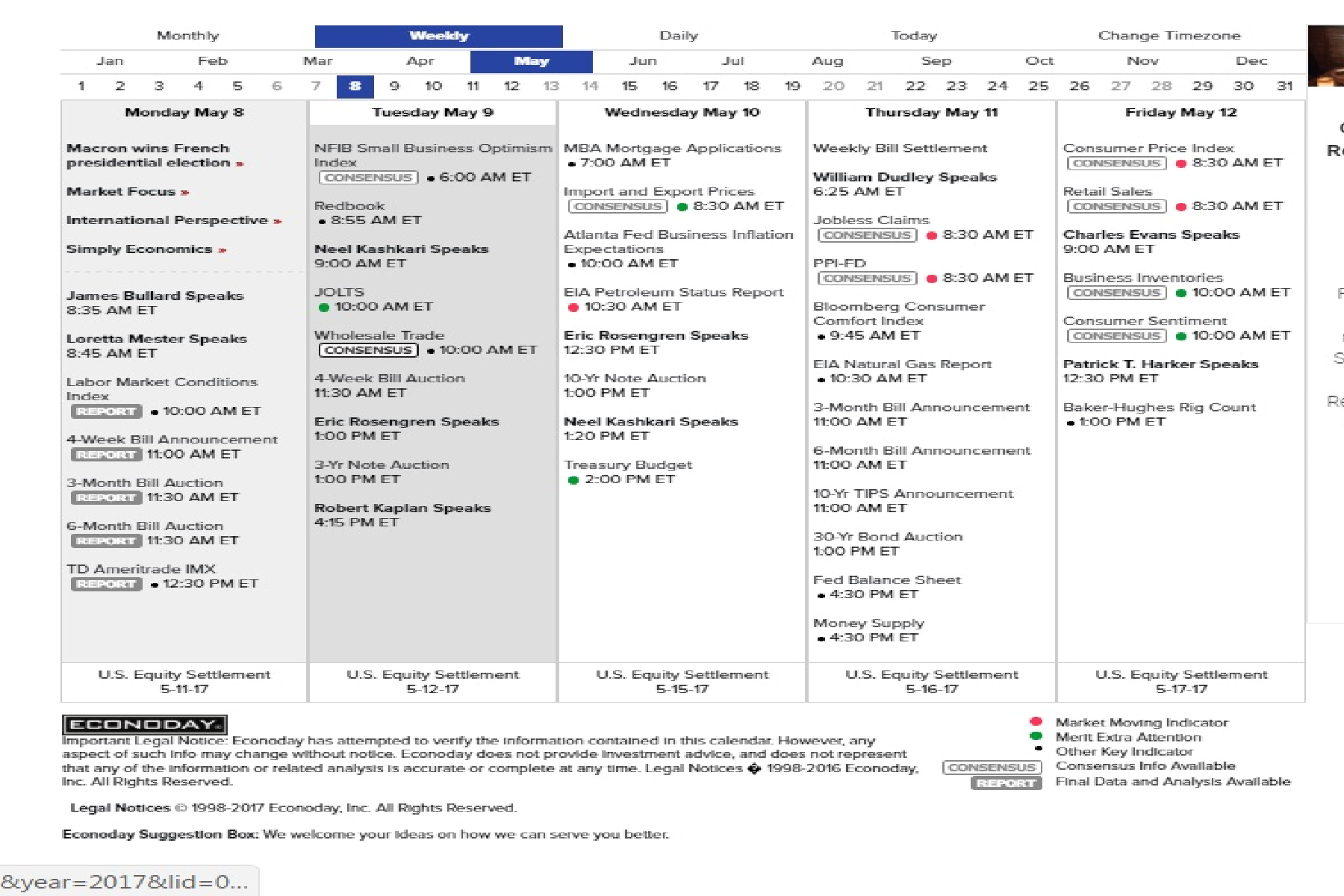
The week ahead — Economic data from Econoday.com:
Tags: Target
Posted in Weekly Summary | No Comments »
May 2nd, 2017
“Know what you own, and know why you own it.” – Peter Lynch
1. U.S. Moves to Impose 20% Tariff on Canadian Lumber — the Trump administration has taken a first step toward imposing a 20% tariff on Canadian softwood timber – the type of wood used for residential home construction. About $5B of Canadian exports to the U.S. will be subject to the tax. The decision is preliminary and still has to go through a couple of bureaucracies before any tariff is collected.
2. East Coast Refiners Eye Texas Oil Delivery Via Ship — U.S. East Coast refiners, including Phillips 66 (NYSE:PSX) and Monroe Energy (NYSE:DAL), are looking to move more crude by ship from Texas into the Philadelphia area. It’s the latest twist in a trade flow upheaval resulting from the opening of more pipelines in North Dakota; as the discounts of Bakken crude disappeared, so did the rail cars that transported the commodity.
3. Retail Store “Brick-and-Mortar” Closings at Record Pace — american retailers are closing stores at a record pace, with 2,880 retail closing announcements this year, more than double the number from the same period in 2016. Just last week, Bebe Stores (NASDAQ:BEBE) said it would close its remaining 170 shops and sell only online, while Rue21 announced plans to close about 400 of its 1,100 locations. If the pace continues, more retailers will close shop than during the 2008 recession.
4. South Korea Deploys Parts of THAAD System in a Deterrent of N. Korea — amid high tensions on the Peninsula, the U.S. military has started moving key parts of its controversial THAAD anti-missile defense system to a deployment site in South Korea. The move, which has angered North Korea, China and Russia, prompted protests by hundreds of local residents and was denounced by the frontrunner in South Korea’s presidential election.
5. China Concerned by U.S. Aluminum Probe — China is concerned by the second U.S. national security trade probe into imports of aluminum and hopes to resolve the dispute through talks, according to Commerce Ministry spokesman Sun Jiwen. “It’s very, very dangerous, obviously, from a national defense point of view” only to have one producer of a material needed for defense, U.S. Commerce Secretary Wilbur Ross declared, citing applications in armor and advanced aircraft.
6. 1Q GDP Weakest in Three Years, as Consumer Spending Falters — gross domestic product increased at a 0.7 percent annual rate also as the government cut back on defense spending. A measure of private domestic demand increased at a 2.2 percent rate last quarter. First-quarter GDP tends to under-perform because of difficulties with the calculation of data that the government has acknowledged regarding the seasonal quirk and temporary restraints.
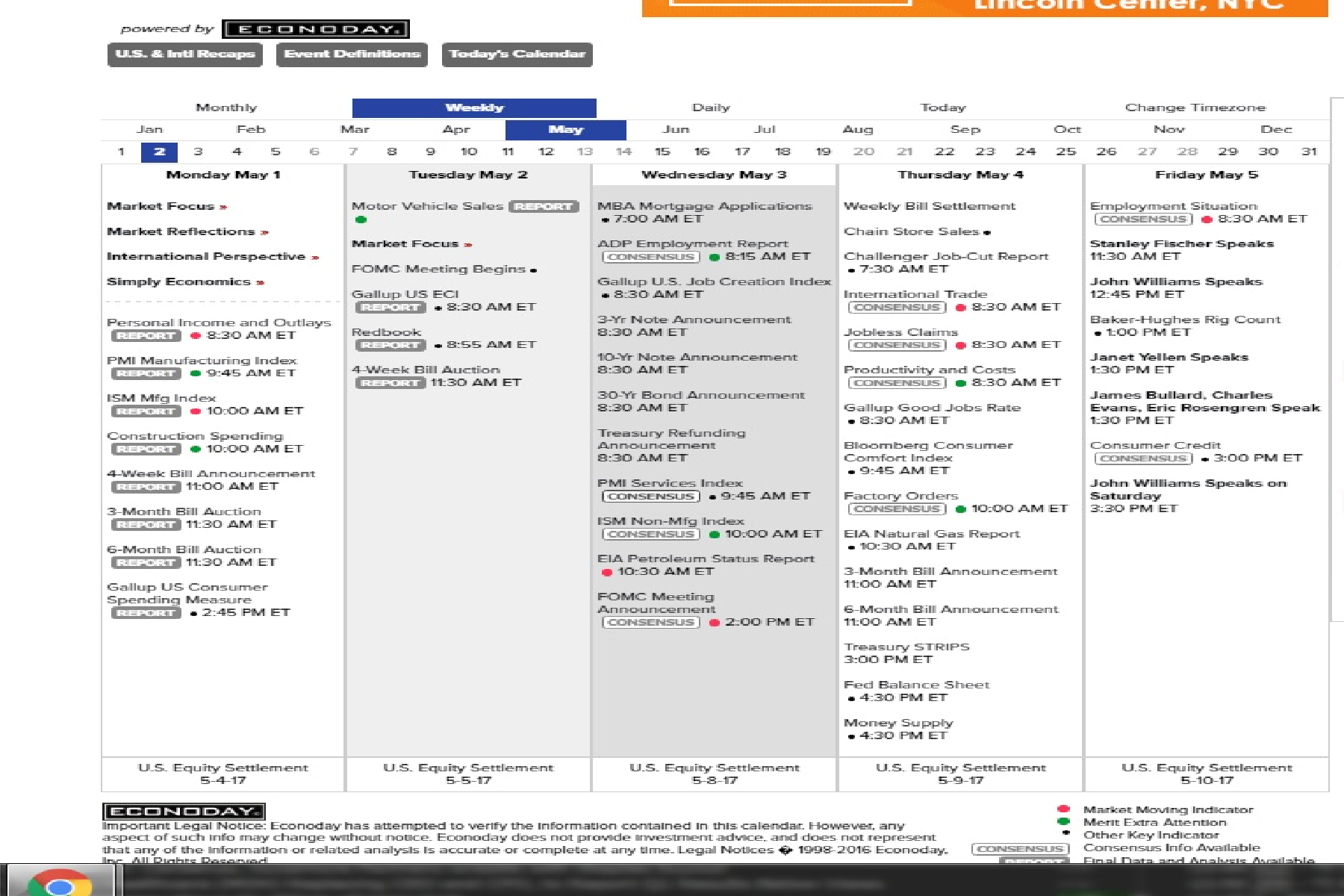
The week ahead — Economic data from Econoday.com:
Posted in Weekly Summary | No Comments »