Search

Week of Mar 30 2018 Weekly Recap & The Week Ahead

April 2nd, 2018

“All truth passes through three stages. First, it is ridiculed. Second, it is violently opposed. Third, it is accepted as being self-evident.” – Arthur Schopenhauer

1. U.S., South Korea Revise Trade Deal — South Korea is next to escape President Trump’s metal tariffs after revising its six-year-old bilateral trade deal with the U.S. It will see Seoul double its import quota for American-made cars and reduce the amount of steel it sends into the United States. South Korea will also allow the U.S. to keep its 25% tariffs on pickup trucks in place for 20 more years.
2. Remington Seeks Bankruptcy Protection — America’s oldest gunmaker has filed for Chapter 11 bankruptcy protection after reporting negative operating cash flow as of March 25 of $7.4M. Like other gun manufacturers, Remington Outdoor saw sharp sales declines following the 2016 presidential election, as customers apparently saw less urgency to stockpile firearms under President Trump.
3. North, South Korea to Meet April 27 — North and South Korea will hold their first summit in more than a decade on April 27 after Kim Jong-un pledged his commitment to denuclearization. The meeting will take place on the southern side of the Demilitarized Zone. Japan has also sounded out the North Korean government about a bilateral summit, while Kim is scheduled to meet President Trump some time in May.
4. Walmart to Reduce Emissions in China — With President Xi Jinping vowing to slash pollution and prioritize living standards, Walmart (NYSE:WMT) has committed to cutting 50M metric tons of carbon emissions from its Chinese operations by 2030. That’s the equivalent of annual electricity consumption for 40M Chinese households. The plan involves retrofitting factories with energy-efficient facilities and lighting, and working with suppliers to switch to renewable energy.

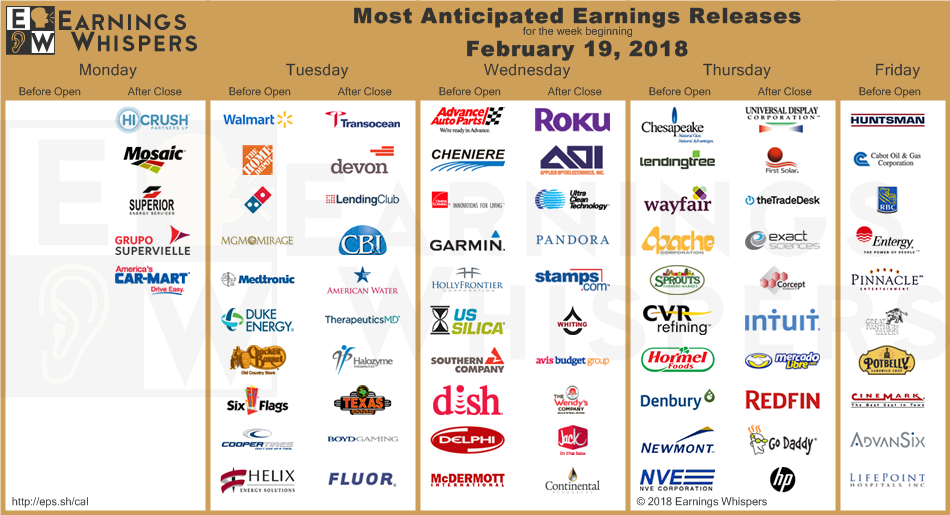
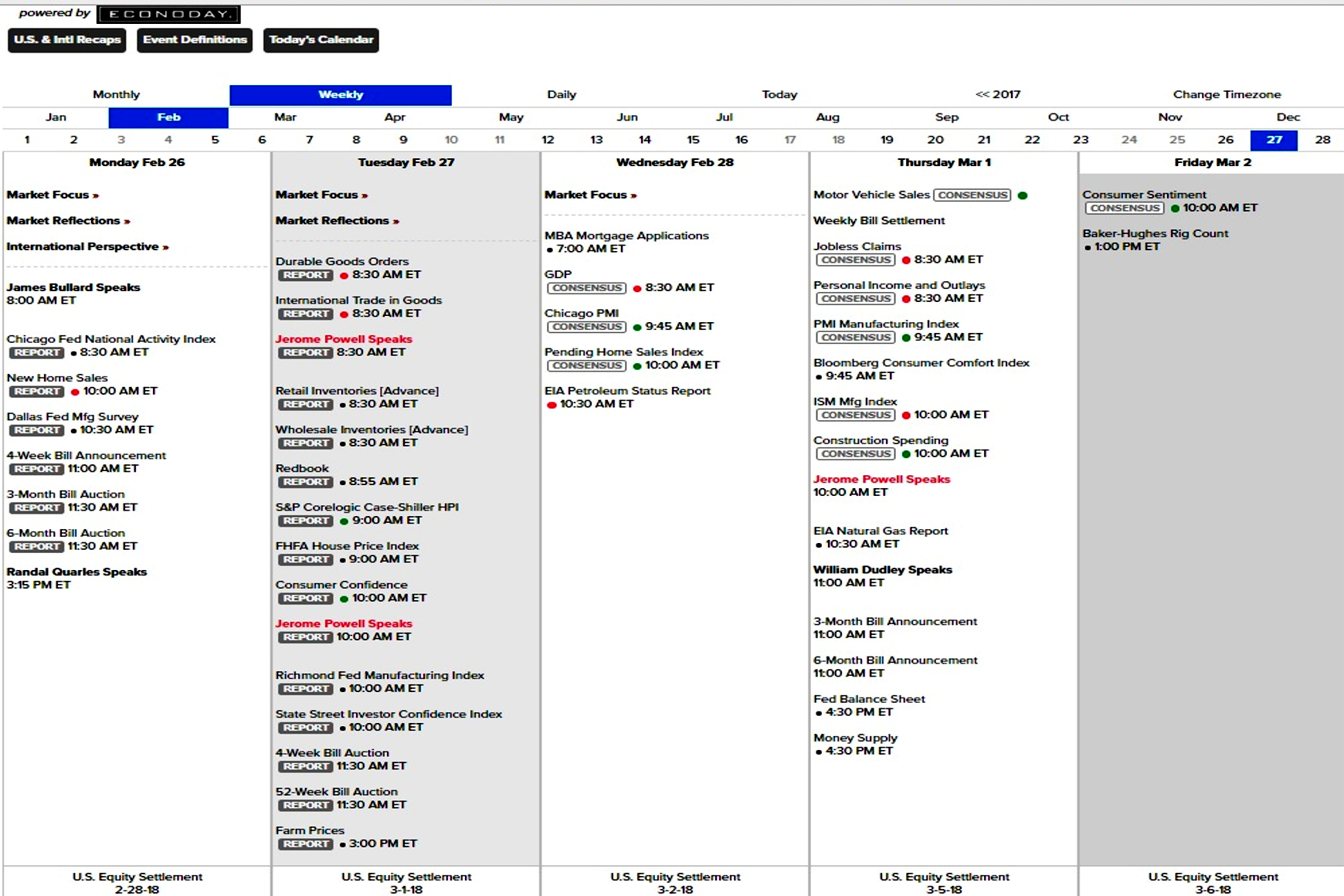
The week ahead — Economic data from Econoday.com:
Week of Mar 23 2018 Weekly Recap & The Week Ahead

March 27th, 2018

“I measure what’s going on, and I adapt to it. I try to get my ego out of the way. The market is smarter than I am so I bend.” – Martin Zweig

1. Apple is Developing MicroLED Screens — Apple has made a “significant investment in the development of next-generation MicroLED screens” at a facility near its California headquarters, but consumers will “probably have to wait a few years before seeing the results.” MicroLED screens use different light-emitting compounds than the current OLED displays and promise to make future gadgets slimmer, brighter and less power-hungry. Its move into displays has the long-term potential to hurt a range of suppliers, from screen makers like Samsung Electronics Co., Japan Display Inc., Sharp Corp. and LG Display Co. to companies like Synaptics Inc. that produce chip-screen interfaces.
2. France Expects EU Tariff Exemption — the EU is expected to obtain a full exemption from new U.S. steel and aluminum tariffs that are due to kick in on March 23, according to French finance minister Bruno Le Maire. The European Commission has said that, if the bloc is not exempted, it could set duties of 25% on a range of U.S. products, whose annual imports to the EU are worth €2.8B.
3. U.S. Air Force to Test Fighter-Mounted Laser — the U.S. Air Force is set to begin testing a laser this summer that will be mounted on an F-15 warplane. With an output of about 50 kilowatts, the system will review abilities to zap drones or cruise missiles. The Pentagon awarded the $26M contract to Lockheed Martin (NYSE:LMT) last year for the laser program called SHiELD (Self-protect High Energy Laser Demonstrator).
4. Saudi Crown Prince meets with Lockheed, Boeing — Saudi Crown Prince Mohammed bin Salman will meet with officials from Boeing (NYSE:BA) and Lockheed Martin (NYSE:LMT) as part of a trip across the U.S. that could see $35B in deals signed. It follows Salman’s visit to the U.K., where Riyadh inked a military equipment MOU with the British government for 48 Typhoon jets from BAE Systems (OTCPK:BAESY).
5. Fed Raises Rates, Steepens Path of Hikes as Outlook Strengthens— the Federal Reserve raised rates for a sixth time since the policymaking Federal Open Market Committee began raising rates off near-zero in December 2015. “The economic outlook has strengthened in recent months,” the committee said in its post-meeting statement, a sentence that had not been in previous releases. Fed officials also raised their forecast for 2017 GDP growth from 2.5 percent in December to 2.7 percent, and increased the 2018 expectation from 2.1 percent to 2.4 percent.
6. Trump’s Plan to Impose Stiff Tariffs on China — President Trump signed a memorandum “targeting China’s economic aggression.” Tariffs on Chinese imports worth as much as up to $60B could be unveiled, stoking fears of a global trade war. Beijing noted it will take measures against the 128 U.S. products in two stages – that cover about $3B and $1.9B, respectively – if it cannot reach an agreement with Washington. Legal action under WTO rules will also be considered.
7. Trump Fired National Security Adviser McMaster, Replaced with John Bolton — President Trump has named John Bolton as his new national security adviser, succeeding Lt. Gen. H.R. McMaster. The move follows fresh appointments to the roles of national economic advisor and Secretary of State. Bolton was the former U.S. ambassador to the United Nations under President George W. Bush.

The week ahead — Economic data from Econoday.com:

Week of Mar 16 2018 Weekly Recap & The Week Ahead

March 19th, 2018

“when the facts change, you must change your mind” – unknown

1. China Scraps Presidential Term Limits, Clearing Way for Xi’s Indefinite Rule — China’s parliament voted to repeal presidential term limits, allowing President Xi Jinping to keep power indefinitely in a formal break from succession rules set up after Mao Zedong’s turbulent rule. The votes gives Xi more time to enact plans to centralize party control, increase global clout and curb financial and environmental risks. It comes after the U.S. reportedly asked China to import more cars, aircraft, soybeans and natural gas as part of a plan to cut its bilateral trade deficit by $100B and avoid placing tariffs on Chinese imports.
2. Trump Issues Order to Block Broadcom Takeover of Qualcomm — President Trump has issued an order to block Broadcom’s (NASDAQ:AVGO) hostile takeover of Qualcomm (NASDAQ:QCOM). The order states “There is credible evidence that leads me to believe that Broadcom … through exercising control of Qualcomm … might take action that threatens to impair the national security of the United States,” .
3. Democrat Conor Lamb Apparent Winner of Pennsylvania Special Election — Democrat Conor Lamb is the apparent winner of a House seat in Pennsylvania’s 18th congressional district, a region President Trump won by 20 percentage points in 2016. The election was watched nationwide as a sign of political tides eight months ahead of congressional elections.
4. Facebook, Google Cracks Down on Crypto Advertising — following a similar hard-line approach taken by Facebook (NASDAQ:FB), Google (GOOG, GOOGL) will ban crypto-related advertising starting in June, including ICOs, wallets, and trading advice across any of its platforms. Google’s director of sustainable ads stated “We don’t have a crystal ball to know where the future is going to go with cryptocurrencies, but we’ve seen enough consumer harm or potential for consumer harm,” .
5. GE Begins Flight Trials for World’s Largest Jet Engine — General Electric has begun flight trials of the world’s largest jet engine after several delays caused by technical problems. The GE9X will power the Boeing (NYSE:BA) 777-9 and 777-8, which are scheduled to enter service in 2020 and 2022, respectively. Despite the problems, GE feels “very confident” it will meet a 2019 target date for safety certification, said spokeman.
6. Ford Sets Aggressive Hybrid Timetable — Ford (NYSE:F) announced it’s going all-in on hybrids. 75% of its lineup will be replaced in the hybrid push, while the automaker will add four new trucks and SUVs. The news comes as UBER discusses the possibility of installing its self-driving systems in Toyota (NYSE:TM) minivan models, expanding its partnerships with outside companies.

The week ahead — Economic data from Econoday.com:
Week of Mar 9 2018 Weekly Recap & The Week Ahead

March 12th, 2018

“Be fearful when others are greedy and be greedy when others fearful.” — Warren Buffett

1. China Sets Growth Target at ‘about 6.5%’ — China’s National People’s Congress has officially kicked off with over 3,000 lawmakers descending on Beijing, where the country’s rubber-stamp parliament is expected to eliminate the two-term limit for the presidency. Continuing a campaign to reduce risks in China’s financial system, Premier Li Keqiang also set a target for economic growth for 2018 at “about 6.5%,” a slight recalibration from last year’s objective of “around 6.5% or higher if possible.”.
2. Senate to Vote on Dodd-Frank Rollback — Senate Majority Leader Mitch McConnell has filed a motion to have a procedural vote on a bill, sponsored by Senate Banking Committee Chairman Mike Crapo, that would roll back key regulations of Dodd-Frank. The measure spikes the asset level at which a bank becomes “systemically important” from $50B to $250B, freeing dozens of regional banks from stringent rules like additional capital buffers and stress tests.
3. Gary Cohn Announced His Resignation as Top Economic Adviser to President Trump — widely viewed as a voice for Wall Street in the White House, Gary Cohn has announced his resignation as the top economic adviser to President Trump, fanning fears of protectionist tariffs and a full-blown trade war. Trump tweeted he “will be making a decision soon” on replacing Cohn, who oversaw a major revamp of the U.S. tax code and pushed for a significant rewrite of financial rules.
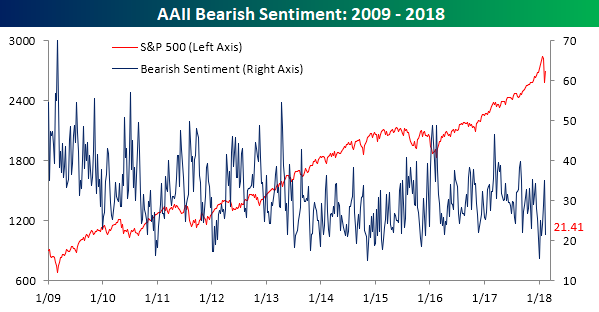
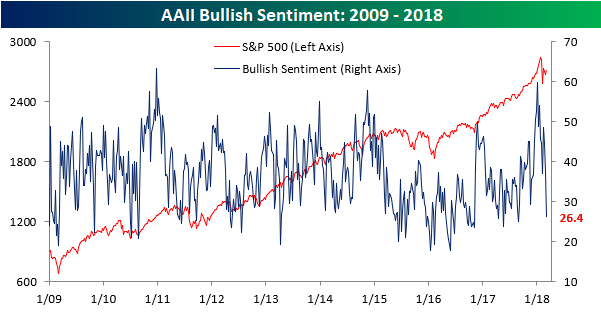
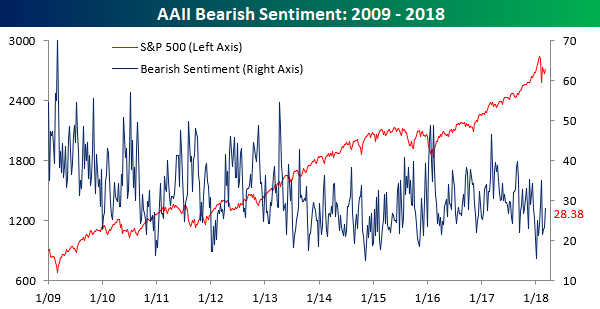
4. AAII Weekly Sentiment Survey — in this week’s sentiment survey from AAII, bullish sentiment dropped nearly 11 percentage points falling from 37.28% down to 26.4%. That’s the lowest weekly reading since the end of August and the largest two-week decline since June 2013.

However, bearish sentiment hasn’t seen much of a bounce. At 28.38%, it is slightly higher than bullish sentiment, but it has been higher as recently as early February.

5. Trump Agrees to Meet N. Korean Leader on De-nuclearization Talks — President Trump has agreed to an invitation from North Korean leader Kim Jong-un to meet to discuss denuclearization. Kim made the invitation for Trump to come to North Korea in a letter hand delivered by South Korea’s national security adviser Chung Eui-yong, and Trump said he would meet by May, though the White House is now saying the time and place of the meeting is yet to be determined. Kim says he’s prepared to suspend nuclear and missile tests in the meantime.

The week ahead — Economic data from Econoday.com:
Week of Mar 2 2018 Weekly Recap & The Week Ahead

March 5th, 2018

“We learn from history that we do not learn from history,” — George Wilhelm Friedrich Hege

1. Apple is Launching Medical Clinics — Apple is launching a group of medical clinics called AC Wellness to deliver the “world’s best healthcare experience” to its employees and their families, CNBC reports. A quietly published website, acwellness.com, said the Apple (NASDAQ:AAPL) initiative will begin this spring. The news comes as Amazon announced an effort with Berkshire Hathaway (BRK.A, BRK.B) and JPMorgan (NYSE:JPM) to improve the healthcare of their employees.
2. GE to Restate Two Years of Earnings — General Electric plans to restate the last two years of corporate profits, resulting in a cut of $0.13 in reported earnings per share for 2016 and $0.16 per share for 2017. The reduction comes as the conglomerate adopts new accounting standards for recognizing revenue from long-term contracts amid an SEC investigation into the method. GE will make the restatements on April 20.
3. U.S. to Imposed Heavy Duties on Aluminum Foil from China — the U.S. Commerce Department has imposed duties as high as 106% on aluminum foil from China after concluding that the country’s producers are dumping the product in the U.S. and receiving unfair government subsidies. In response, China’s Ministry of Commerce expressed “strong dissatisfaction” with the action and will take necessary measures to protect its legal rights and interests.
4. Energy ETF Closes February with Worst Monthly Drop Since December 2015 — the largest energy ETF (XLE) fell 10.8% for February, its worst monthly showing since December 2015. Prices for the April WTI contract settled 4.8% lower in February, the first monthly loss since August, while Brent crude fell 4.7% for the month in its first monthly loss since June. Also, Sundial Capital Research’s Jason Goepfert notes that “this is the first time since December 2015 that the S&P 500 has gained 1% or more for two straight days only to drop 1% or more on each of the next two days. That doesn’t happen very often, just 23 times since 1928. Here’s the rub: “All but 3 of them occurred during bear markets,” Goepfert writes. “Because it tended to occur in downtrends, future returns were poor, with declines over the next 30 days 65% of the time averaging -1.9%,” Goepfert writes.
5. SEC Launches Sweeping Probe Into Cryptocurrencies — the SEC has issued scores of subpoenas and information requests in a sweeping probe of technology companies and advisers involved in the booming market for digital tokens, the Wall Street Journal reports. The investigation significantly ratchets up the regulatory pressure on the booming U.S. market for raising funds in cryptocurrencies. Coin offerings raised $6.5B in 2017 and more than $1.6B so far this year despite a crash in the price of Bitcoin and other cryptocurrencies.
6. Trump’s Announcement Tariffs on Steel and Aluminum — Trump plans to impose tariffs of 25 percent on steel imports and 10 percent on aluminum. However, he didn’t elaborate on the details, saying the formal announcement will come next week. The EU said that it could target imports of Harley Davidson Inc. motorbikes, Levi Strauss & Co. jeans and bourbon whiskey as part of its response. Many nations are making a last-ditch attempt to have their nation’s steel and aluminum exempt from the action, a targeted strategy the U.S. Defense Department had voiced support for. Meanwhile, Canadian and Brazilian steel comprised a respective 16% and 13% of U.S. steel imports as of September 2017, while China, frequently criticized politically for dumping cheap steel on trade partners, is not one of the top 10 exporters of steel to the U.S., the report said. Meanwhile, top foreign sources of aluminum during 2013-16 included Canada (56%), Russia (8%) and the United Arab Emirates (7%).

The week ahead — Economic data from Econoday.com:
Warren Buffett Annual Letter to Shareholders Highlights

February 27th, 2018

See the link below for the annual investor letters.

Here are some of the highlights:

1. Deal-making CEOs
In explaining why he thinks it’s so difficult to find stand-alone companies to buy at a “sensible” price, Buffett blames a buying frenzy driven in part by overly eager corporate managers who are egged on by their boards:
“If Wall Street analysts or board members urge that brand of CEO to consider possible acquisitions, it’s a bit like telling your ripening teenager to be sure to have a normal sex life.”

2. On leverage and sleeping well
“Our aversion to leverage has dampened our returns over the years. But Charlie and I sleep well. Both of us believe it is insane to risk what you have and need in order to obtain what you don’t need.”

3. Stop on in
Buffett touts one of the deals Berkshire did get done in 2017, its acquisition of a 38.6% partnership interest in travel-center operator Pilot Flying J, or PFJ. He offers this plug:
“When driving on the Interstate, drop in. PFJ sells gasoline as well as diesel fuel, and the food is good. If it’s been a long day, remember, too, that our properties have 5,200 showers.”

4. Liquidity and the ‘kindness of strangers’
In a discussion of Berkshire’s insurance float—the pool of money collected from premiums but not yet paid out in claims—Buffett talks about the desire for ample liquidity:
“Charlie and I never will operate Berkshire in a manner that depends on the kindness of strangers—or even—that of friends who may be facing liquidity problems of their own. During the 2008-2009 crisis, we liked having Treasury bills—loads of Treasury bills—that protected us from having to rely on funding sources such as bank lines or commercial paper.
“We have intentionally constructed Berkshire in a manner that will allow it to comfortably withstand economic discontinuities, including such extremes as extended market closures.”

5. ‘In America…’
Buffett regularly argues that the very long-term outlook for the U.S. economy—and stocks SPX, -1.27% —is undeniably bullish:
“Charlie and I view the marketable common stocks that Berkshire owns as interests in businesses, not as ticker symbols to be bought or sold based on their ‘chart’ patterns, the ‘target’ prices of analysts or the opinions of media pundits. Instead, we simply believe that if the businesses of the investees are successful (as we believe most will be) our investments will be successful as well. Sometimes the payoffs to us will be modest; occasionally the cash register will ring loudly. And sometimes I will make expensive mistakes.
“Overall—and over time—we should get decent results. In America, equity investors have the wind at their back.”

6. Watch those fees
Buffett is a stock picker, but he’s adamant most investors are better off sticking with passive, low-cost, index-tracking products. In a section where he again bashes Wall Street and hedge funds, he reminds:
“Performance comes, performance goes. Fees never falter.”

7. ‘Willingness to look foolish’
“Though markets are generally rational, they occasionally do crazy things. Seizing the opportunities then offered does not require great intelligence, a degree in economics or a familiarity with Wall Street jargon such as alpha and beta. What investors then need instead is an ability to both disregard mob fears or enthusiasms and to focus on a few simple fundamentals. A willingness to look unimaginative for a sustained period—or even to look foolish—is also essential.”

Here is the full annual Buffett 2017 Letter.

Week of Feb 23 2018 Weekly Recap & The Week Ahead

February 27th, 2018

“Volatility is greatest at turning points, diminishing as a new trend becomes established.” George Soros

1. China to Retaliate Against U.S. Metal Tariffs — It’s the latest trade tension escalation between the world’s top two economies. China has threatened retaliation after the Trump administration received a green light to impose steep tariffs on aluminum and steel imports on national security grounds. “If the final decision from the U.S. hurts China’s interests, we will definitely take necessary measures to protect our rights,” said Wang Hejun, a senior official at China’s Commerce Ministry.
2. Apple Looks to Buy Cobalt Directly from Miners — Apple is in talks to buy long-term supplies of cobalt directly from miners for the first time, seeking to procure “several thousand” metric tons of cobalt per year for a period of at least five years, Bloomberg reports. The strategy is designed to buffer Apple’s (NASDAQ:AAPL) reserves of the key lithium ion battery ingredient amid industry fears of a shortage driven by the electric vehicle boom.
3. United Technologies to Consider Breakup Decision in 2018 — United Technologies (UTX) is studying a plan to split up a portfolio that includes aerospace, elevators and air conditioners, with a decision to be announced by the end of this year. “The real question is do you get a significant multiple expansion by having separate companies,” CEO Greg Hayes told the Barclays investor conference in Miami.
4. Chinese Regulator Seizes Control of Anbang Insurance Group— the Chinese government has seized control of Anbang Insurance Group and said its chairman had been prosecuted, in a striking move that highlights Beijing’s willingness to crack down on financial risk and curtail debt-laden conglomerates. Anbang is said to have violated laws and regulations that “may seriously endanger the solvency of the company,” following acquisitions including the Waldorf Astoria and insurers in Europe and Asia.

The week ahead — Economic data from Econoday.com:
Week of Feb 16 2018 Weekly Recap & The Week Ahead

February 19th, 2018

“If I have positions going against me, I get right out; if they are going for me, I keep them… Risk control is the most important thing in trading. If you have a losing position that is making you uncomfortable, the solution is very simple: Get out, because you can always get back in.” Paul Tudor Jones

1. OxyContin Maker Stops Promoting Opioids — OxyContin maker Purdue Pharma is stopping to promote the drug and other opioids to doctors amid a series of state and municipal lawsuits that blame the company for contributing to the opioid epidemic. It will also cut its U.S. sales force by more than 50%, to about 200 people, while remaining representatives “will no longer be visiting offices to engage in discussions about opioid products.”
2. ‘5G.Connected’ Debuts at Olympics — attendees of the Winter Olympic games in Pyeongchang are experiencing the future of wireless technology. The “5G.Connected” showcase, engineered by KT Corp. (NYSE:KT), uses technology from Intel (NASDAQ:INTC), Ericsson (NASDAQ:ERIC) and Samsung Electronics (OTC:SSNLF), for the world’s first broad-scale 5G network. At 10 gigabits a second, it’s about 100 times faster than 4G.
3. Trump To Endorse $0.25/gallon Gasoline Tax Hike — Pres. Trump stated late last week that he would support a $0.25/gallon increase in federal gasoline and diesel taxes to help pay for upgrading U.S. roads, bridges and other public works. The government has not raised the gas tax since 1993, under the Clinton administration. The current federal levy is 18.4 cents a gallon on retail gasoline and 24.4 cents for a gallon of diesel.
4. Big Investor Moves in Latest 4Q 13-F filings — Warren Buffett’s Berkshire Hathaway (BRK.A, BRK.B) reported a new fourth quarter stake in Teva (NYSE:TEVA), and bought more shares of Apple (NASDAQ:AAPL), which surpassed Wells Fargo (NYSE:WFC) as its largest common stock investment. Dan Loeb’s Third Point took a 2M share stake in Netflix (NASDAQ:NFLX), while David Einhorn’s Greenlight Capital showed several new big retailer holdings in J.C. Penney (NYSE:JCP), Nordstrom (NYSE:JWN), Kohl’s (NYSE:KSS) and Under Armour (NYSE:UAA).
5. Senate Blocks Immigration Plans — the Senate blocked four immigration-related proposals late last week, including a bipartisan plan that would have provided $25B for border security and a path to citizenship for 1.8M young, undocumented immigrants. A separate measure that lost by a large margin would’ve ended a diversity visa lottery program and imposed strict limits on family-based migration.
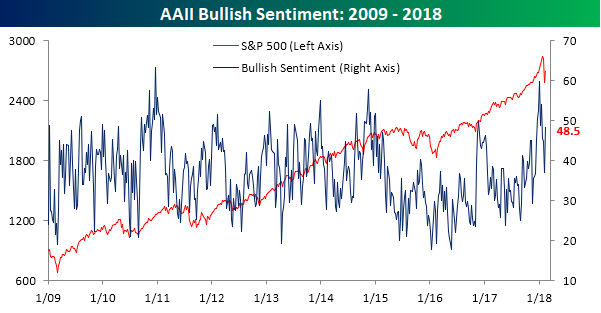
6. Latest Weekly AAII Sentiment — In this week’s survey, bullish sentiment increased from 37.0% up to 48.5% for a gain of 11.5 percentage points. That’s the largest weekly increase since last September.

Bearish sentiment plunged from 35.0% down to 21.4%. That’s the largest weekly decline in two years!

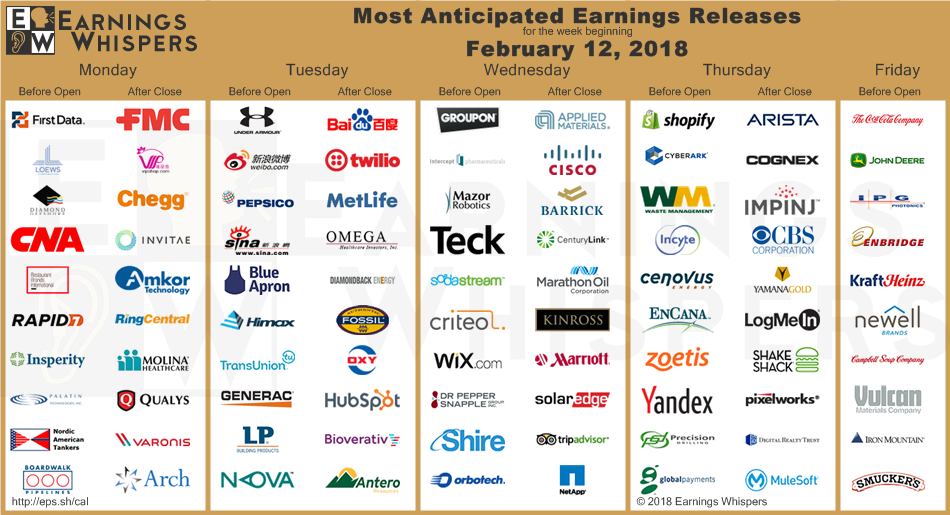
The week ahead — Economic data from Econoday.com:
Week of Feb 10 2018 Weekly Recap & The Week Ahead

February 12th, 2018

“But, like Cinderella at the ball, you must heed one warning or everything will turn into pumpkins and mice: Mr. Market is there to serve you, not to guide you. It is his pocketbook, not his wisdom, that you will find useful. If he shows up some day in a particularly foolish mood, you are free to either ignore him or to take advantage of him, but it will be disastrous if you fall under his influence. Indeed, if you aren’t certain that you understand and can value your business far better than Mr. Market, you don’t belong in the game. As they say in poker, “If you’ve been in the game 30 minutes and you don’t know who the patsy is, you’re the patsy.'” — Warren Buffett

1. The SEC and CFTC Plan to Ask Congress for Federal Oversight of Digital-Currency & Credit Card Ban on Buying Crypto-currencies — worries over a global regulatory clampdown led bitcoin – which is still trading below $8,000 – last week to record its biggest weekly loss since December 2013. Lloyds (NYSE:LYG) is barring its credit card customers from buying bitcoin and other cryptocurrencies. It follows similar moves by U.S. rivals JPMorgan (NYSE:JPM), BofA (NYSE:BAC) and Citigroup (NYSE:C), which all announced similar bans on crypto purchases via credit cards. In addition, the SEC and CFTC plan to ask Congress to consider federal oversight for digital-currency trading platforms, many of which have been operating in a regulatory gray zone.
2. Steve Wynn Steps Down as Wynn Resorts Chairman, CEO — Steve Wynn has resigned as CEO and Chairman of Wynn Resorts (NASDAQ:WYNN) in the wake of allegations of sexual misconduct that surfaced in recent weeks. “I have reached the conclusion I cannot continue to be effective in my current roles,” he declared. The company has named current President Matt Maddox as its new CEO and Boone Wayson as Non-Executive Chairman.
3. CBOE Announced No major Impact from VIX products’ Demise — CBOE Global Markets does not expect any significant impact on trading volumes at the exchange following the collapse of two popular exchange-traded products (ETPs) that let traders bet that volatility will fall. The Chicago exchange addressed analysts’ questions after markets closed late last week, following an almost 15% decline in CBOE’s share price in the last three days.
4. Gun Maker Remington Seeks Financing for Bankruptcy Filing — one of the biggest U.S. gun manufacturers is taking steps toward filing for bankruptcy, according to Reuters. Remington has “reached out to banks and credit investment funds” in search of “debtor-in-possession financing” that would let the company continue operations once it went bankrupt.
5. Congress Ends Brief Government Shutdown — Just hours after the government stumbled into another shutdown, Congress passed a budget agreement early Friday that would extend the current level of federal funding until March 23. The bill would also bump limits on defense and non-defense spending by about $300B over the next two years.
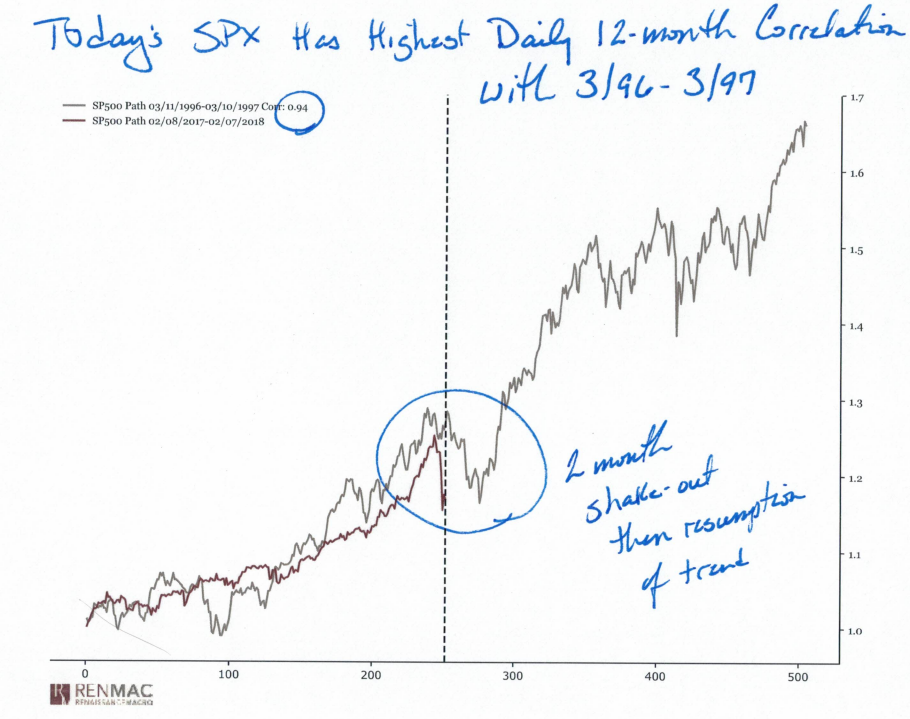
6. Stock-market Correction Looks a lot like 1996-1997 — according to Jeff deGraaf of Reinaissance Macro Research, the current market trend for the past 12-month shows similar pattern from the 1996-1997. Noted ““Today’s price action is weaker over a shorter period of time than that of ‘96, and then, as we suspect happens today, the market needed a few weeks to convalesce before resuming its uptrend. When we aggregate the price paths of the top 25 correlations with today, the picture suggests a pause of a few weeks and resumption of trend,”. See the chart below.

The week ahead — Economic data from Econoday.com:
Week of Feb 3 2018 Weekly Recap & The Week Ahead

February 5th, 2018

“My attitude is that I always want to be better prepared than someone I’m competing against. The way I prepare myself is by doing my work each night.” — Marty Schwartz

1. President Trump team Considers Nationalizing 5G Network — national security officials in the Trump administration are looking at options where the U.S. government could take over part of the country’s mobile network as a way of guarding against “dominant malicious actor” China. The report from Axios describes two options: The U.S. government pays for and builds the single network – an unprecedented nationalization of private infrastructure – or an alternative where U.S. wireless providers build their own 5G networks, which would be less commercially disruptive to the industry.
2. Amazon, Berkshire, JPMorgan Link Up to Form New Health-Care Company — Amazon (AMZN) rocked the healthcare sector after announcing that it has partnered with Warren Buffett’s Berkshire Hathaway (NYSE: BRK-A) and Jamie Dimon’s JPMorgan Chase & Co. (NYSE: JPM) to start a new company to address rising healthcare costs for their U.S. employees, that may potentially be rolled out to all Americans. The new entity will be an independent company that will be “free from profit-making incentives and constraints”. Its initial focus will be on technology solutions that will provide U.S. employees and their families with simplified, high-quality and transparent healthcare at a reasonable cost.
3. Boeing Buys Stake in Battery Technology Start-up — Boeing HorizonX Ventures (NYSE:BA) has taken a minority stake in startup Cuberg, which is seeking to develop next-generation battery technology for potential aerospace and industrial applications. “Battery technology is still heavy,” so you can’t make it for a plane of current commercial aircraft size, Cuberg CEO Richard Wang addressed in a recent interview on CNBC.
4. FOMC Stays On Hold, Expects Further Gradual Hikes — the Federal Reserve held its Fed Funds target range at 1.25-1.5% in its recent meeting as Janet Yellen gets ready to depart the central bank. The economy continues to strengthen, and inflation is expected to move up, according to the policy statement, while the FOMC continues to anticipate further gradual increases in short-term rates. Rate markets have about fully priced in March as the next move.
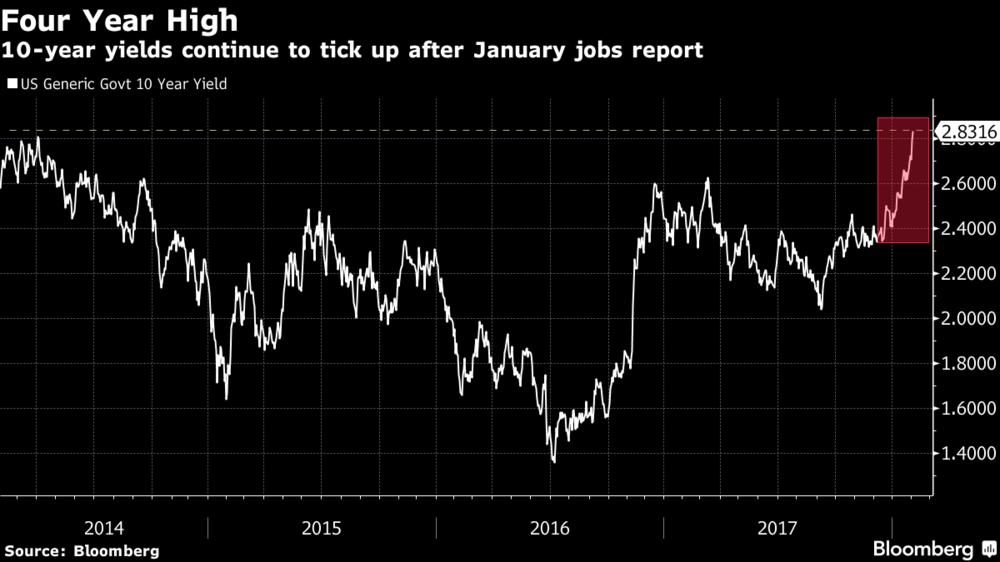
5. Treasury Yields Spike – 10-year yield surpassing 2.8 percent and the 30-year bond yield rising above 3 percent for the first time in eight months — The S&P 500 Index’s slumped nearly 5% last week after the 10-year Treasury yield popped above 2.85 percent for the first time since January 2014.

The week ahead — Economic data from Econoday.com:
Search
Calendar
June 2026
M T W T F S S
« May    
1234567
891011121314
15161718192021
22232425262728
2930  
Archives
Categories
The information provided by The EGS Blog is based on sources believed to be reliable, but it is not guaranteed to be accurate. There is no guarantee that the recommendations of The EGS Blog will be profitable or will not be subject to losses. The information provided by The EGS Blog is not a recommendation or a solicitation that any particular investor should purchase or sell any particular security in any amount, or at all. The investments discussed or recommended herein may be unsuitable for investors depending on their specific investment objectives and financial position. At any time EGS LLC and its principals may maintain positions that are contrary to positions announced within the subscription service. In no event will The EGS Blog be liable to you or anyone else for any incidental, consequential, special, or indirect damage (including but not limited to lost profits or trading losses). PAST PERFORMANCE IS NO GUARANTEE OF FUTURE RESULTS

© Copyright 2026 Market Outlook All Rights Reserved
Design by EGS Sponsored by Equity Guidance LLC