April 15th, 2019
“One of the frustrating things for people who miss the first rally in a bull market is that they wait for the big correction and it never comes. The market just keeps climbing and climbing. It feeds on itself in frenzied fashion and propels prices considerably higher for six months or so, and sometimes longer.” — Martin Zweig
1. China Wants to Eliminate Bitcoin Mining — China’s state planner has labeled Bitcoin (BTC-USD) mining as an “undesirable” industry in a draft proposal, recommending local governments eliminate the sector in the country. The public will have until May 7 to share feedback on proposed amendments, after which the final version will be published and become effective. Last week, the price of Bitcoin soared nearly 20% in its best day since the height of the 2017 bubble, breaking $5,000 for the first time since mid-November.
2. EU Leaders to Grant the U.K. Deadline to Oct. 31 — Theresa May managed to convince EU leaders to grant the U.K. more time before it leaves the bloc, extending the deadline to Oct. 31, but some experts are now saying her days in office are numbered. “A six-month period is clearly enough for the Conservative Party to contemplate a change in leadership while still allowing some time for the incoming PM to seek to negotiate with the EU,” JPMorgan economist Malcolm Barr said in a research note. “One could even cram a general election into that time frame too if PM May were to resign by roughly the end of May.”
3. Tesla Gigafactory Expansion Freeze — Tesla (NASDAQ:TSLA) and Panasonic (OTCPK:PCRFY) are suspending plans to expand the capacity of their $4.5B U.S. plant in the face of uncertain demand for electric vehicles, the Nikkei reports. The two had intended to raise capacity 50% by 2020 to the equivalent of 54 gigawatt-hours, but financial problems forced a re-think. Panasonic also intends to suspend planned investment in Tesla’s battery and EV plant in Shanghai, and instead provide technical support and a small number of batteries from the existing Gigafactory.
4. Chevron to Buy Anadarko in $33B Cash and Stock Deal — Chevron (NYSE:CVX) plans to acquire Anadarko Petroleum (NYSE:APC) in a stock and cash transaction valued at $33B, or $65 per share, enhancing its Upstream portfolio and strengthening its shale, deepwater and natural gas resource basins. Anadarko shareholders will receive 0.3869 shares of Chevron and $16.25 in cash for each APC share. The deal anticipates annual run-rate synergies of approximately $2B, and will be accretive to free cash flow and earnings one year after close. If approved, Chevron said it also plans to boost its annual share buyback program to $5B from $4B.
5. EU Green Lights U.S. Trade Talks — Europe is set to start trade talks with the U.S. after EU ambassadors gave a green light to a proposed mandate for the European Commission to conduct the negotiations on behalf of the 28 EU member countries. The talks commence despite opposition from France, which expressed concerns over the U.S. intention to withdraw from the Paris Agreement on climate change. EU ministers still need to give their rubber stamp, which is due on April 15.
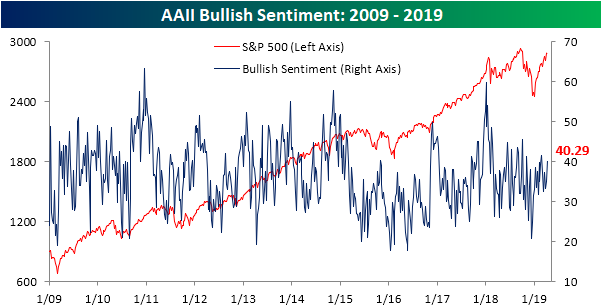
6. AAII Weekly Investor Sentiment Survey — AAII Weekly Sentiments the results are very similar to the final days of February with bullish sentiment around 40%, bearish down near 20%, and neutral once again in the upper 30’s. Up from 35.02% last week, bullish sentiment has crossed back over the 40% threshold; the first time it has done so since the previously mentioned week in February.
While bullish sentiment is sitting a couple of points above the historical average, this is still several percentage points from reaching any sort of extreme level (more than one standard deviation above the aforementioned average).
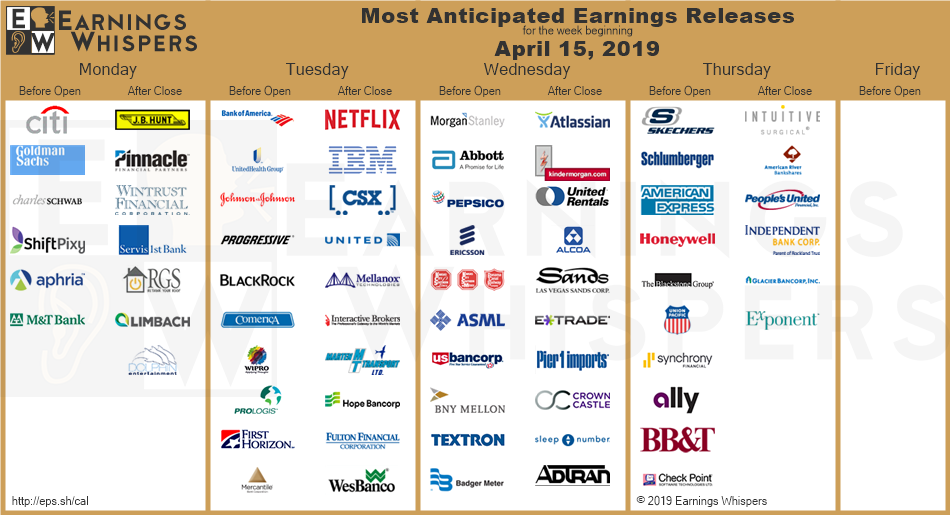
Bearish sentiment, on the other hand, fell all the way back down to 20.38% this week, the lowest since its 20% reading on February 28th. That is around 10% less than the historical average for bearish sentiment. That is also at the lower end of the range bearish sentiment has stayed within in the past decade.
The week ahead — Economic data from Econoday.com:
Posted in Weekly Summary | No Comments »
April 8th, 2019
1. Boeing Admits MCAS Played Role in 737 Max Crashes — “With the release of the preliminary report of the Ethiopian Airlines flight 302 accident investigation it’s apparent that in both flights the Maneuvering Characteristics Augmentation System, known as MCAS, activated in response to erroneous angle of attack information,” Boeing (NYSE:BA) CEO Dennis Muilenburg said in a statement. However, an update will “add additional layers of protection and will prevent erroneous data from causing MCAS activation. Flight crews will always have the ability to override MCAS and manually control the airplane.”
2. Tesla Deliveries Tumble 31% — the EV maker reported a 31% drop in Q1 deliveries to 63K vehicles (51K Model 3 and 12K Model S and X). While sales were hit by a reduction in U.S. federal tax credits and by difficulties in delivering to Europe and China, Tesla said it finished the quarter with “sufficient” cash. The automaker also reaffirmed its full-year forecast of 360K to 400K deliveries, but investors are asking if that big increase will be possible.
3. 5G Era for Smartphones Has Begun — Verizon (NYSE:VZ) has launched 5G wireless service in parts of Chicago and Minneapolis, while carriers in South Korea – SK Telecom (NYSE:SKM) and KT Corp. (NYSE:KT) – deployed their service in the Seoul metropolitan area. To access the network, Verizon subscribers for now will be limited to the Motorola Z3 (with an accessory clip-on), while Korean early adopters will have to use Samsung’s Galaxy S10. 4G helped reshape the way people hail taxis and order takeout and the mobile industry is hoping the faster speeds provided by 5G will enable self-driving cars, smart cities and will birth immersive digital worlds.
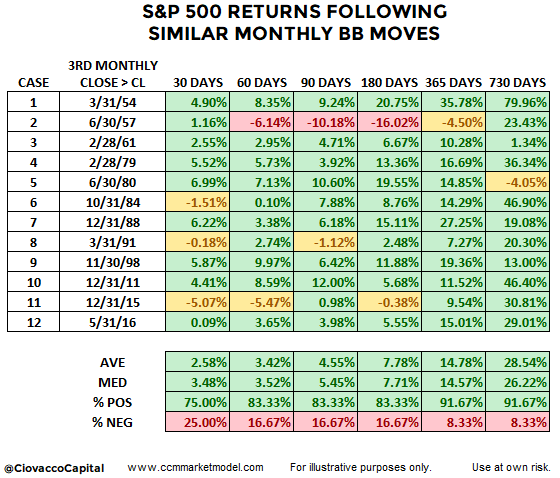
4. Third Consecutive Monthly Close Statistics — the S&P 500 (SPY) closed above the monthly Bollinger Band centerline at the end of January, it aligned the present day with favorable historical probabilities and also provided some distance from setups in the 1974, 2001, and 2008 bear markets. Twelve of the 13 similar historical cases, covered on Feb. 20, also went on to print three consecutive closes above the monthly Bollinger Band centerline. The exception was the 6/30/1960 case, which gave up the centerline in the second month. The table below shows S&P 500 (VOO) performance in the remaining 12 historical cases following the third consecutive close above the monthly Bollinger Band centerline (similar to what occurred at the end of March 2019).
The week ahead — Economic data from Econoday.com:
Posted in Weekly Summary | No Comments »
April 3rd, 2019
“When investors hear yield curve inversion, they automatically think ‘recession.’ That’s because every recession since 1962 has been preceded by an inversion. But, not every inversion has been followed by a recession, so keep that in mind.” — BIG
1. DOJ Moves to Strike Down Entire ACA — the U.S. Department of Justice has filed a motion calling for ObamaCare to be struck down in its entirety, siding with a Texas federal district court that had decided the individual mandate was unconstitutional. Hospital and health insurer stocks plunged following that ruling in December. Previously the DOJ was focused on eliminating mandatory coverage for people with pre-existing conditions, but under Attorney General William Barr the federal government’s position has now changed.
2. Aaple Unveils New Products — Apple Inc. (AAPL) unveiled new products for entertainment, financial services, news and videogames last week to extend push into new territory. It plans to make its TV app, which will carry that content, available on competitors’ televisions and other devices as well as its own. Apple also announced Apple Card, a mainly digital credit card launched in partnership with Goldman Sachs Group Inc. that aims to challenge incumbents by offering low interest rates and eliminating both late fees and annual fees. In addition, It unveiled Apple News+, a $9.99 monthly service that provides access to 300-plus magazines as well as newspapers, including The Wall Street Journal through an agreement with parent Dow Jones & Co. And it showed off Apple Arcade, a gaming subscription service offering access to 100-plus exclusive games for an unspecified monthly fee.
3. U.K. Parliament Fails to Get a Majority On Any Brexit Option — U.K. Prime Minister Theresa May pledged to quit in a bid to salvage her deal to leave the EU, but the move appeared to backfire as her political ally, Northern Ireland’s Democratic Unionist Party, said it would continue to reject her agreement. Lawmakers also failed to find a majority for any alternative Brexit arrangement to May’s pact, but overwhelmingly agreed that they opposed leaving the bloc without one. Britain has until April 12 to agree on a strategy./>
4. Lyft Prices IPO at $72/Share — tt’s the first IPO in the ride-hailing market ticker “LYFT,” and the first in a string of tech companies that are planning to go public in 2019. With over $2B raised so far, Lyft priced shares at $72 (at the high end of its range), putting its valuation at over $24B.
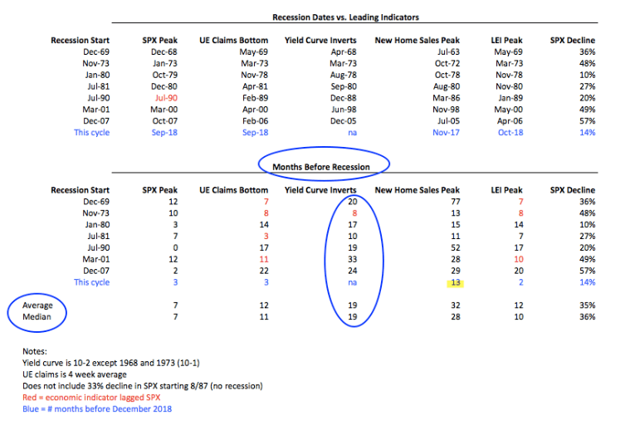
5. Yield Curve Inversion Statistics — based on the recent media chatter about the Yield Curve Inversion, the graph below shows that the standard 10yr/2yr yield curve has inverted on average 19 months before a recession, going back to 1968, whereas a top in the SPX has preceded recession by only an average of 7 months.
The week ahead — Economic data from Econoday.com:
Posted in Weekly Summary | No Comments »
March 25th, 2019
“I always define my risk, and I don’t have to worry about it.” – Tony Saliba
1. France ‘Yellow Vest’ Protests Flare Anew — as a series of national French debates on government policy ended last week, “Yellow Vest” protesters celebrated their 18th weekend with violence on the streets of Paris. More than 80 businesses on the Champs-Elysees were vandalized or torched, with an estimated 10,000 people participating in the demonstrations. The protests have shaved 0.2 percentage points off economic growth since they started, Finance Minister Bruno Le Maire said in late February.
2. Apple is Poised to Unveil its Long-Rumored TV Service — Apple is poised to unveil its long-rumored TV service, and ahead of the event, Netflix (NASDAQ:NFLX) confirmed it won’t be joining the company’s streaming offering. “While Apple (NASDAQ:AAPL) is a great company, we prefer to let our customers watch our content on our service,” CEO Reed Hastings told reporters at the company’s offices in Hollywood.
3. The U.S. Air Force Outlined a Five-Year Plan to Bring back Boeing’s F-15 Fighter — the U.S. Air Force has outlined a five-year plan that showed the extent of the Pentagon’s push to bring back Boeing’s (NYSE:BA) F-15 fighter in an upgraded version. The $7.8B investment would see a jump in eight of the planes next year to 18 each year through 2024. While Lockheed Martin’s (NYSE:LMT) F-35 would get $37.5B over the five years, the more advanced plane would still take a hit (48 F-35s are planned to be purchased each year from fiscal 2021-2023 instead of the 54 previously planned).
4. Britain Says EU Could Offer Brexit extension — the European Union decided to give the United Kingdom an extension on negotiating an exit from the EU – but it won’t be a long reprieve if UK Prime Minister Theresa May can’t get a win in Parliament. European Council President Donald Tusk said Article 50 would be extended to May 22 if Parliament can reach a withdrawal agreement next week; but failing that, the deadline is extended only to April 12.
5. FOMC Meeting Announcement — the Fed decided to hold interest rates steady, as expected, and indicated it would keep rates at current levels for the rest of 2019. The central bank currently holds its benchmark funds rate in a range of 2.25 percent to 2.5 percent. Speaking after the Fed’s decision, Powell said that weakening Chinese and European economies are acting as a deterrent to growth at home even as policymakers see the overall outlook in the U.S. as good. Fed Chairman Jerome Powell also announced that the central bank would end the so-called runoff of bonds from its balance sheet sooner than most expected. That caused the yield on the 10-year Treasury to tumble.
The week ahead — Economic data from Econoday.com:
Posted in Weekly Summary | No Comments »
March 18th, 2019
“The key to trading success is emotional discipline. If intelligence were the key, there would be a lot more people making money trading… I know this will sound like a cliche, but the single most important reason that people lose money in the financial markets is that they don’t cut their losses short.” — Victor Sperandeo
1. Trump’s Budget Proposal Features $8.6B for Wall, Increased Defense Spending — the White House proposed a $4.7T fiscal 2020 budget that called for cutting regular non-defense discretionary spending by 9%, while increasing defense spending and including $8.6B for a border wall. Under the blueprint, the budget doesn’t balance in 10 years and shows a $202B deficit in 2029, assuming economic growth at an average of 3% for the decade. The proposal is likely to be dismissed by Congress and increases the threat of another government shutdown in the fall.
2. Boeing Grounds Global 737 MAX Fleet — Boeing has decided to temporarily suspend its entire fleet of 737 MAX planes “out of an abundance of caution and in order to reassure the flying public of the aircraft’s safety.” The FAA reversed course and grounded the jet after evidence emerged showing a flight that crashed in Ethiopia may have experienced the same problem as a plane that went down five months ago off Indonesia. Analysts say the initial impact of the grounded Boeing (NYSE:BA) jets will be contained, but may escalate if the fleet is not permitted to fly for a longer period.
3. UK Parliament Rejects a Second Brexit Referendum — U.K. lawmakers voted to delay Britain’s departure from the EU, sending Theresa May back to Brussels to request an extension. Her pact with the trading bloc is also expected to be voted on in the House of Commons for a third time next week, after being soundly rejected twice. Parliament further blocked a motion yesterday seeking a second Brexit referendum, though Labour leader Jeremy Corbyn said his team is still working on plans for another public vote.
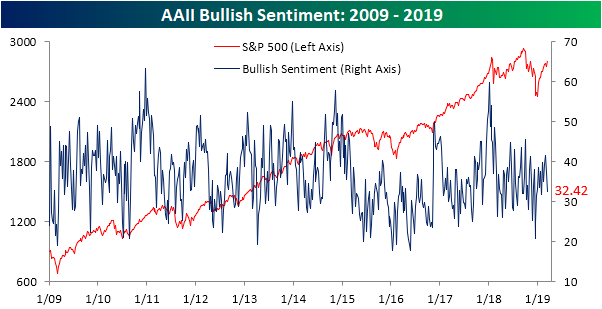
4. AAII’s Weekly Survey of Individual Investors — in the latest Bullish sentiment, it shows another drop in bullish sentiment. This comes following the first weekly decline that equities have seen so far in 2019. The percentage of investors expressing optimism dropped to 32.42% from 37.39% last week. The week prior to that was a recent high, and the highest since early November, at 41.63%.
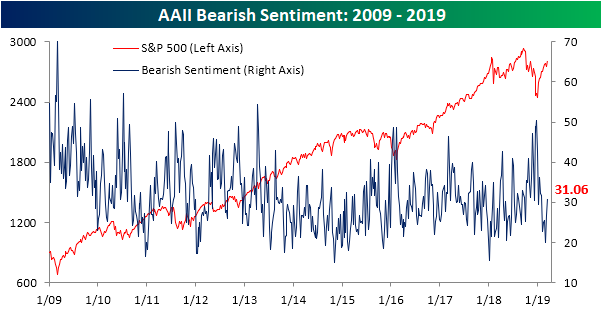
Conversely, bearish sentiment rose to its highest level since the final days of January coming in at 31.06% versus 26.75% last week. Bearish sentiment has come well off of its lows of 20% only a couple of weeks ago. Where it currently sits is much more in line with its historic average of 30.5%.
5. Tesla Announced Model Y Event — Completing the EV lineup that Elon Musk has dubbed “S3XY,” Tesla (NASDAQ:TSLA) took the wraps off its Model Y, with prices starting at $39,000. The crossover is larger than the entry-level Model 3 but smaller than the Model X, Tesla’s full-size SUV. With a 0-to-60 mph acceleration time of 3.5 seconds and a standard range of 230 miles, the first Model Ys are due for release in fall 2020.
The week ahead — Economic data from Econoday.com:
Tags: BA Grounds 737 Max Fleet
Posted in Weekly Summary | No Comments »
March 12th, 2019
“If it stinks, doesn’t work, is incomprehensible and doesn’t make sense – it’s either economics or philosophy.” — . . . Raymond DeVoe
1. Moody’s Upgrade Greek Debt — Moody’s disclosed a two-notch upgrade (to B1 from B3) on the country’s sovereign debt rating. The nation’s reform program is now “firmly established and is likely to be sustained,” according to the agency, as “most of the fiscal improvement is due to structural measures.” Greek 10-year bond yields fell to their lowest level since early 2006, down 3.3 bps to 3.609%.
2. U.K. Crucial Votes Next Week — crucial votes are scheduled in the U.K. next week that will determine the immediate course of Brexit and the U.K.’s relationship with the EU. If lawmakers vote against Prime Minister Theresa May’s Brexit deal, they will then vote on leaving the 28-member bloc without a deal (hard Brexit). JPMorgan doubts May can achieve victory at this stage, predicting an extension of Article 50 by two or three months with May securing passage of the deal by early April. May and other Brexit officials are in Brussels in a last-ditch effort to score more concessions from European Union leaders before the key votes.
3. Huawei Sues U.S., Calling Equipment Ban Unconstitutional — Huawei has filed suit against the United States, claiming that a ban on government procurement from the world’s largest network equipment maker is unconstitutional. The part of the National Defense Authorization Act with the ban makes it a “bill of attainder,” Huawei says – an unconstitutional singling-out of a group or individual without due process. A court could invalidate just the section involving Huawei, but expect a national security defense to come up.
4. FDA OKs J&J’s Esketamine Nasal Spray for Depression — the FDA has approved the first drug to treat depression in decades, paving the way for Johnson & Johnson (NYSE:JNJ) to sell a nasal spray based on ketamine, which is often used as a party drug with the nickname “Special K”. Esketamine, which will be sold under the brand name Spravato, will be available for adults who have already tried at least two other antidepressant treatments. The fast-acting drug will cost between $590 and $885 (before discounts and rebates) depending on the dosage.
5. German Factory Orders Slump — German factory orders unexpectedly fell in January, adding to the evidence that Europe’s largest economy is continuing to lose momentum. Orders were down 2.6%, the most since June, defying expectations for a 0.5% gain. The Bundesbank’s latest assessment is that Germany is seeing a dent in momentum and that growth this year will be below potential (the economy barely avoided a recession at the end of 2018).
6. Trump Administration Exploring Price Disclosure Requirement for Hospitals and Doctors — the Trump administration is reaching out to the medical industry for feedback on requiring hospitals, doctors and other healthcare providers to publicly disclose the heretofore confidential prices they charge insurers for services. Needless to say, health insurers, hospitals and most doctors will most certainly push back on the proposal. The public comment period will close Friday, May 3.
The week ahead — Economic data from Econoday.com:
Tags: JNJ Depression Nasal Spray
Posted in Weekly Summary | No Comments »
March 4th, 2019
“He who knows when he can fight and when he cannot will be victorious.” – Sun Tzu
1. California Crackdown On Single-Use Plastics — California lawmakers have introduced legislation to phase out single-use non-recyclable plastic food containers and other packaging by 2030. If the legislation becomes law, some experts believe it could lead to other states taking similar steps. Last year, California became the first in the nation to restrict the use of plastic straws in restaurants, and the Golden State banned the use of single-use plastic bags at grocery stores in 2014.
2. Iranian Stocks Plunge on Foreign Minister Resignation — Iran’s stock market dropped around 2,000 points overnight following the surprise resignation of Foreign Minister Javad Zarif. President Hassan Rouhani hasn’t yet accepted Zarif’s resignation, but indications suggest he was undermined in his role. Zarif was the architect of the 2015 nuclear deal, which the U.S. pulled out of in May last year, leaving the pact on shaky ground.
3. China/US Trade Talks Shaky — statements from U.S. Trade Representative Robert Lighthizer are weighing on Chinese investor sentiment, with the Shanghai Composite falling 0.4% during the session. He said it was too early to predict an outcome in trade talks and the U.S. will need to maintain the threat of tariffs on Chinese goods for years, even if Washington and Beijing strike a deal. China’s manufacturing PMI for February also fell to 49.2, highlighting another contraction and deepening cracks in the country’s economy.
4. Vietnamese Carriers Sign Deals for 110 Boeing Jets — during President Trump’s visit to Hanoi, Vietnam’s Bamboo Airways and VietJet Aviation signed deals to buy 110 aircraft from Boeing (NYSE:BA) worth more than $15B as the fast-growing companies look to expand their operations. Earlier this month, the FAA said Vietnam complied with international aviation standards, allowing Vietnamese carriers to fly to the United States for the first time and codeshare with U.S. airlines.
5. Gap Spinning Off Old Navy — Gap (NYSE:GPS) announced restructuring plans which will include the spin-off of Old Navy. The company also plans the closing of about 230 Gap speciality stores over the next two years. The shutterings should hit annual sales by about $625M and result in pretax costs of $250M-$300M. Annualized pretax savings are seen at roughly $90M.
The week ahead — Economic data from Econoday.com:
Posted in Weekly Summary | No Comments »
February 25th, 2019
“ . . . A man has rigged up a turkey trap with a trail of corn leading into a big box with a hinged door. The man holds a long piece of twine connected to the door that he can use to pull the door shut once enough turkeys have wandered into the box. However, once he shuts the door, he can’t open it again without going back into the box, which would scare away any turkeys lurking on the outside. One day he had a dozen turkeys in his box. Then one walked out, leaving eleven. ‘I should have pulled the string when there were twelve inside,’ he thought, ‘but maybe if I wait, he will walk back in.’ While he was waiting for his twelfth turkey to return, two more turkeys walked out. ‘I should have been satisfied with the eleven,’ he thought. ‘If just one of them walks back, I will pull the string.’ While he was waiting, three more turkeys walked out. Eventually, he was left empty-handed. His problem was that he couldn’t give up the idea that some of the original turkeys would return . . . ” — Fred C. Kelly
1. Europe Trans-Atlantic Trade in Question — European Commission chief Jean-Claude Juncker spoke in Stuttgart – the hometown of Daimler (OTCPK:DDAIF) – after the U.S. Commerce Department sent a report to President Trump that could unleash steep tariffs on imported vehicles. “Trump has given me his word that there will be no car tariffs for the time being,” Juncker declared. “I believe him. However, should he renege on that commitment, we will no longer feel bound by our commitments to buy more U.S. soya and liquid gas.”
2. Payless Bankruptcy to Begins shuttering U.S. stores — Payless ShoeSource began closing its 2,700 U.S. stores on Sunday and filed for its second bankruptcy in two years. The latest retail victim may point to storm clouds hovering over the industry, or possible positive developments for Caleres (NYSE:CAL) and DSW (NYSE:DSW) due to a narrowed shoe store field. Toys “R” Us, Shopko, FullBeauty Brands, Charlotte Russe, Things Remembered and Gymboree (OTC:GMBEQ) have all filed for bankruptcy in the past year.
3. Facebook Plans to Develop AI Chips — FB also wants to develop its own artificial intelligence chips that go beyond what’s currently on the market, according to Yann LeCun, Facebook’s (FB) chief AI scientist. While the company is already creating its own custom ASIC (application-specific integrated circuit) chip, the idea is to provide faster computing that Facebook (needs in order to achieve new AI breakthroughs including digital assistants imbued with enough “common sense.”
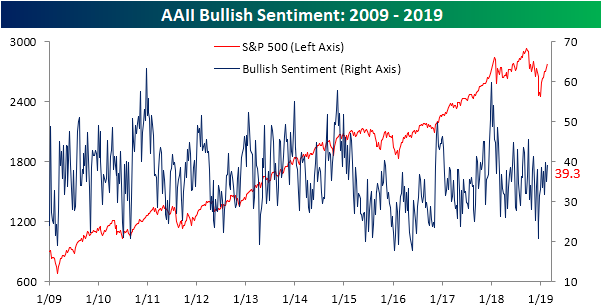
4. AAII Investor Sentiment Latest Survey — in the latest survey, investor sentiment showed growing optimism but nothing extreme. Bullish sentiment was up a little over 4% to 39.32%, and while not particularly high, the percentage of bulls now sits at the upper end of the range the sentiment reading has been at over the past couple months.
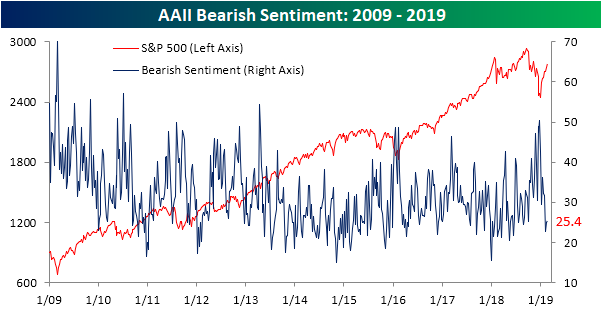
Meanwhile, bearish sentiment held steady, rising ever so slightly to 25.39% from 25.07% last week. The percentage of bearish investors has come way off of its highs from the late 2018 sell-off and is sitting at the lower end of the range that has been observed in the past year.
5. Latest Fed Minutes Show Division on Rate Hikes — the latest minutes from the Fed’s last meeting reaffirmed that the U.S. central bank would be “patient” with respect to further interest rate hikes. Most FOMC officials also indicated they were ready to stop shrinking the central bank’s $4.1T asset portfolio this year and believed an action plan should be released soon.
The week ahead — Economic data from Econoday.com:
Tags: Fed Minutes
Posted in Weekly Summary | No Comments »
February 18th, 2019
“A peak performance trader is totally committed to being the best and doing whatever it takes to be the best. He feels totally responsible for whatever happens and thus can learn from mistakes. These people typically have a working business plan for trading because they treat trading as a business.” — Van K. Tharp
1. S.Korea to Pay More for U.S. Troops — South Korea will shell out $920M this year for the 28,500 U.S. military personnel stationed in the country, representing an increase of about 8% from what Seoul paid in 2018 and about half of the overall cost. “Most of our contributions for the cost-sharing is returned to the Korean economy by helping create jobs, boost domestic consumption and develop regional economy,” according to the Ministry of Defense.
2. U.S. Lawmakers Reached a $1.38B Border Security Funding Deal — U.S. lawmakers reached a tentative $1.38B border security deal that could help avert another government shutdown. Democrats kept funding for physical barriers along the border far below President Trump’s $5.7B request. The deal headed to Trump’s desk for approval.
3. Trump Considers Extending March 2nd Deadline U.S.-China Deals — President Trump said he was willing to “let slide” a March 2 deadline for resolving the U.S.-China trade conflict if negotiations were progressing well. The softer tone suggests the two sides are making headway on key issues like intellectual property theft and force technology transfers.
4. Germany Avoids Recession With 0% Growth — the German economy narrowly escaped recession in the final quarter of 2018, recording output growth of just 0.02%, following a 0.2% contraction in the previous quarter. Fallout from global trade disputes and Brexit are threatening to derail a decade-long expansion in Europe’s economic powerhouse. Morale is also being depressed by weaker demand for German products in China, the eurozone and emerging markets.
5. Amazon Cancels NY HQ — Amazon (NASDAQ:AMZN) is canceling plans to build its HQ2 in New York City, blaming opposition from local leaders upset by the nearly $3B in incentives promised by state and city politicians. The facility was intended to create 25,000 jobs in Long Island City. General Electric (NYSE:GE) has also scrapped a 12-story headquarters office tower on Boston’s waterfront, choosing instead to lease smaller buildings nearby.
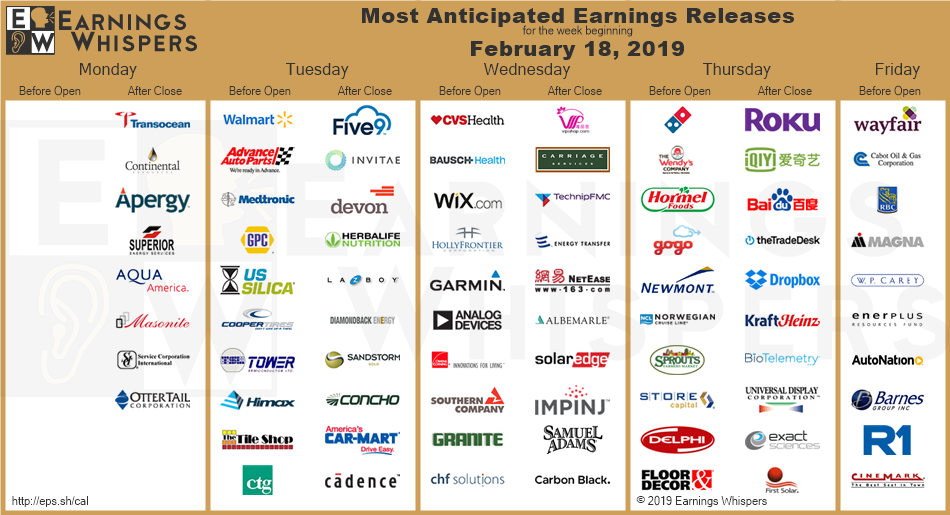
6. Buffett’s Berkshire 4Q 2018 Holdings — New 13F filings show Berkshire Hathaway (BRK.A, BRK.B) took a new stake in software maker Red Hat (NYSE:RHT) valued at $733M at the end of December and reduced its holdings in Apple (NASDAQ:AAPL) by about 1%. The group also dumped its entire stake in Oracle (NYSE:ORCL) only months after revealing its $2B investment, and reduced holdings in United Continental (NASDAQ:UAL) and Phillips 66 (NYSE:PSX).
The week ahead — Economic data from Econoday.com:
Tags: Buffetts 4Q 18 Holdings
Posted in Weekly Summary | No Comments »
February 11th, 2019
“Watch the December closing low for the D-J Industrials. If that low is violated in the first quarter of the New Year, watch out.” — Lucien Hooper
1. U.S., Russia Suspend Nuclear Treaty — the U.S. and Russia suspended a 1987 nuclear weapons treaty on Saturday, which banned land-based missiles with a range between 300 and 3,400 miles, and kept nuclear-tipped cruise missiles off the European continent for three decades. Arms race? Putin said Moscow would follow Washington in pursuing research and development of intermediate-range missiles, but said he wouldn’t deploy them in Europe or elsewhere unless the U.S. did so.
2. Puerto Rico $18B Bond Restructuring Deal Gets Court Approval — Puerto Rico’s restructuring deal that wipes out a third of its $18B in sales-tax bond debt received court approval, making headway in fixing its broken finances, the Wall Street Journal reports. The write-downs on the revenue bonds known as Cofinas will save the island’s government $17B in interest and principal payments in the coming decades. Creditors holding over $14.5B in Cofina debt supported the deal. The settlement is tied to a split of the sales taxes pledged to Cofina that releases 46% of the money back to the island’s government, giving it an average of $456M a year that otherwise would have been set aside for bondholders.
3. Trump Delivered State of the Union — President Trump delivered the State of the Union address to Congress. Trump said the administration is seeking fair trade, cheaper prescription drug prices, and an improvement in the nation’s infrastructure. Trump also disclosed that he plans to meet with North Korean leader Kim Jong Un on February 27-28 in Vietnam. Illegal immigration was a major topic as expected, with Trump announcing that he’s ordered an additional 3,750 troops to the southern border. “Congress has 10 days left to pass a bill that will fund our government, protect our homeland, and secure our Southern Border,” he stated without directly threatening another shutdown. No great surprise, but Trump also maintained that the unfair trade practices of China must end. While maintaining his prior positions, there didn’t appear to be any ratcheting up of the trade rhetoric.
4. U.S. Trade Reps to Meet in China Next Week — the Trump administration is reportedly sending U.S. Trade Representative Robert Lighthizer and Treasury Secretary Steven Mnuchin to Beijing early next week to continue trade talks. A meeting between the two officials with their Chinese counterparts is seen as a step toward bringing President Trump and Chinese President Xi Jinping together to close a deal. The trade war truce between the U.S. and China expires on March 1.
5. Britian PM Theresa May heads to EU for Backstop Talks — U.K. Prime Minister Theresa May heads to Brussels to meet with EU officials with 50 days left until Brexit. May will discuss potential changes to the Irish “backstop” that would allow Northern Ireland to remain tied to EU trading rules. The U.K. can’t leave the agreement without EU permission, which has made the backstop unpopular in the U.K. parliament. If the talks aren’t successful, the U.K. could be one step closer to a hard Brexit.
6. Trump Set to Sign Exec Order Banning Chinese Telecom Equipment — Pres. Trump is set to sign an executive order banning Chinese telecom equipment from U.S. wireless networks, in a move aimed at protecting the U.S. from cyber threats, Politico reports. The administration reportedly plans to release the directive before the Feb. 25-28 MWC Barcelona conference to send a signal that future contracts for cutting-edge technology must prioritize cybersecurity. Many countries seek to deploy next-generation 5G wireless networks to power the rapidly proliferating IoT, and Chinese firms such as Huawei and ZTE (OTCPK:ZTCOY) are aggressively pushing to build these networks at a lower cost than their competitors.
The week ahead — Economic data from Econoday.com:
Posted in Weekly Summary | No Comments »