Search

Week of April 22, 2022 Weekly Recap & The Week Ahead

April 25th, 2022

“Patient opportunism, buttressed by a contrarian attitude and a strong balance sheet, can yield amazing profits during meltdowns.”
― Howard Marks

1. U.S. Home Prices Hit a Record of $375,300 in March — U.S. home prices soared to a new record in March while mortgage rates continued to rise rapidly, slowing home sales in what has been the hottest housing market in more than 15 years. The rise of remote work and the pursuit of more space unleashed a powerful wave of home buying when Covid-19-related lockdowns started to ease in the middle of 2020. The frenzied housing market, supported by ultralow interest rates at the time, lifted home prices throughout the country. Homes for sale often stayed on the market for less than a month, and sometimes only days, while open houses could draw lines around the block.
Now, that frenzy is starting to ease and the volume of home sales is reverting to pre-pandemic levels, said Lawrence Yun, chief economist for the National Association of Realtors. With mortgage rates at 5% and back to their highest level since 2011, Mr. Yun said he expects home sales in 2022 to decline 10% from last year.
2. Florida Bill to End Disney’s Special Tax District Heads to Gov. DeSantis for Signature — Florida lawmakers gave final approval to a bill that would end a special tax district that allows Walt Disney Co. DIS 0.07% ▲ to govern the land housing its theme parks, sending the measure to Republican Gov. Ron DeSantis, who has made clear he would sign it. The move marks a significant setback for Disney’s Florida operations. The special district, created in 1967 and known as the Reedy Creek Improvement District, exempts Disney from numerous regulations and certain taxes and fees. It has permitted the company to manage its theme parks and resorts in the state with little red tape for more than 50 years.
3. Fed’s Jerome Powell Seals Expectations of Half-Point Rate Rise in May — Federal Reserve Chairman Jerome Powell signaled the central bank was likely to raise interest rates by a half percentage point at its meeting next month and indicated similar rate rises could be warranted after that. The Fed has indicated it is also set to begin shrinking its $9 trillion asset portfolio.
4. Mortgage Rates Continue to Rise — the average rate for a 30-year fixed-rate mortgage rose to 5.11%, mortgage-finance giant Freddie Mac said Thursday. The rate hit 5% last week for the first time since 2011, up from 3.22% at the beginning of 2022. The Federal Reserve’s pullback from the mortgage-bond market has helped drive up interest rates on home loans in recent months. So too has its posture on interest rates. The Fed is expected to raise its benchmark rate again at its meeting early next month, and it has signaled that more increases are likely this year. That has driven up yields on the 10-year Treasury note, to which mortgage rates are closely tied.
The combination of rising rates and record home prices has started to weigh on demand. Sales of existing homes dropped 4.5% in March from a year earlier, according to the National Association of Realtors. Purchase mortgage applications last week fell 3% from the prior week and 14% from a year earlier, according to the Mortgage Bankers Association.
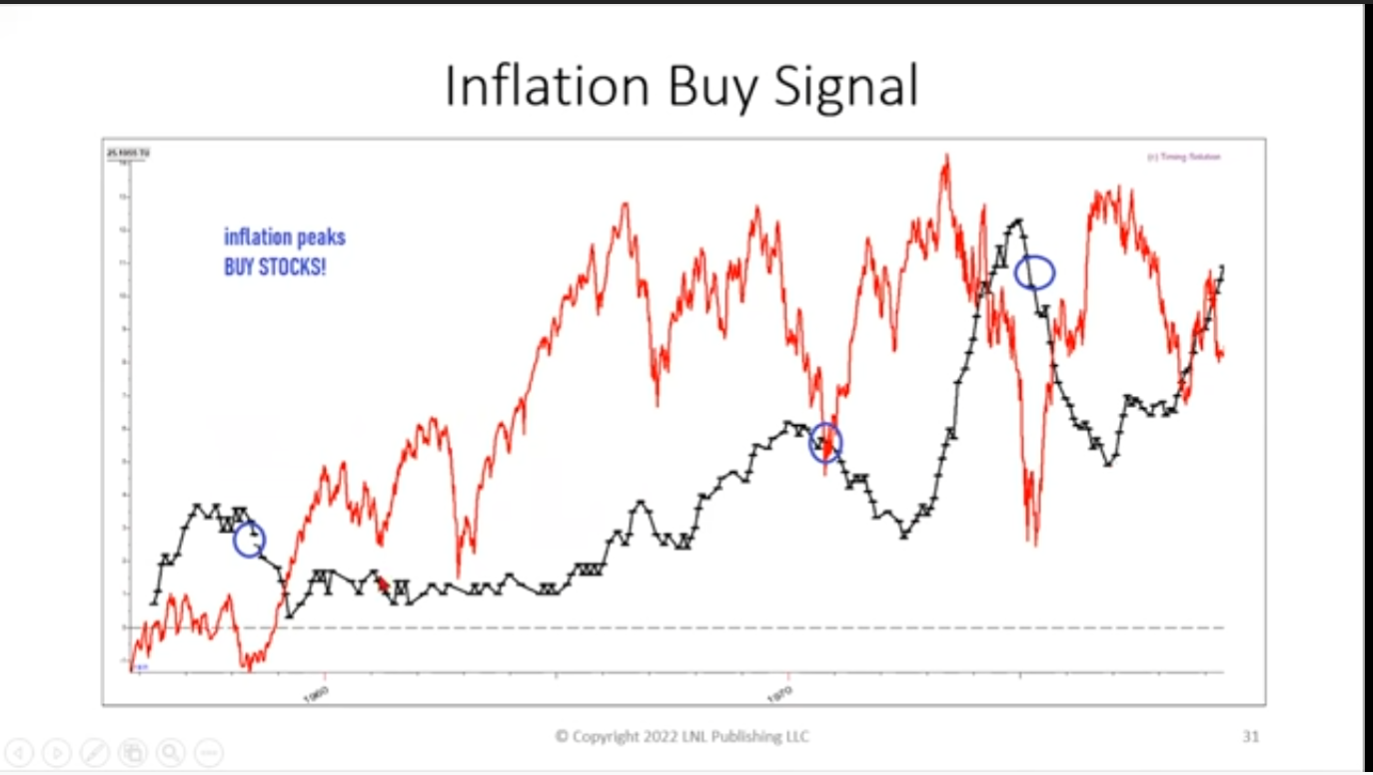
5. Past History of Inflation — based on past history, as inflation tops and starts to rollover, stock market will start to rally as inflation is discounted.
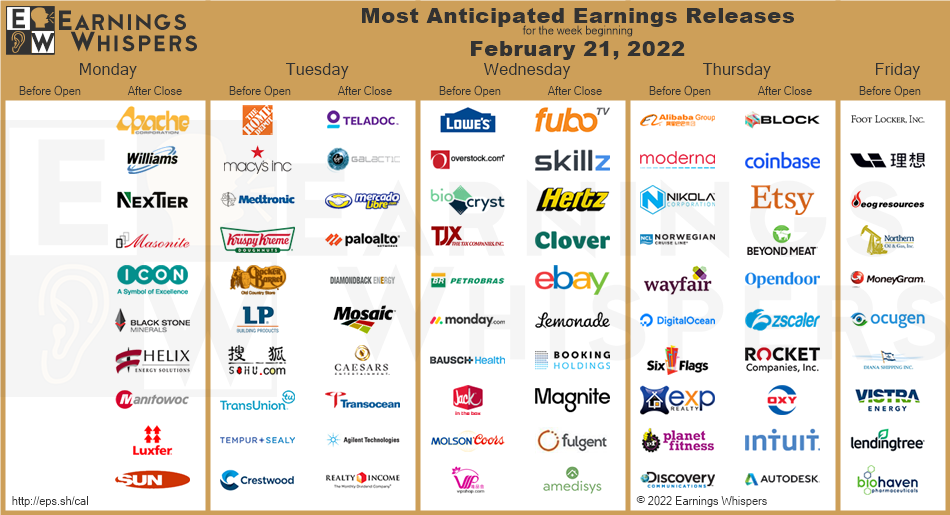
The week ahead — Economic data from Econoday.com:
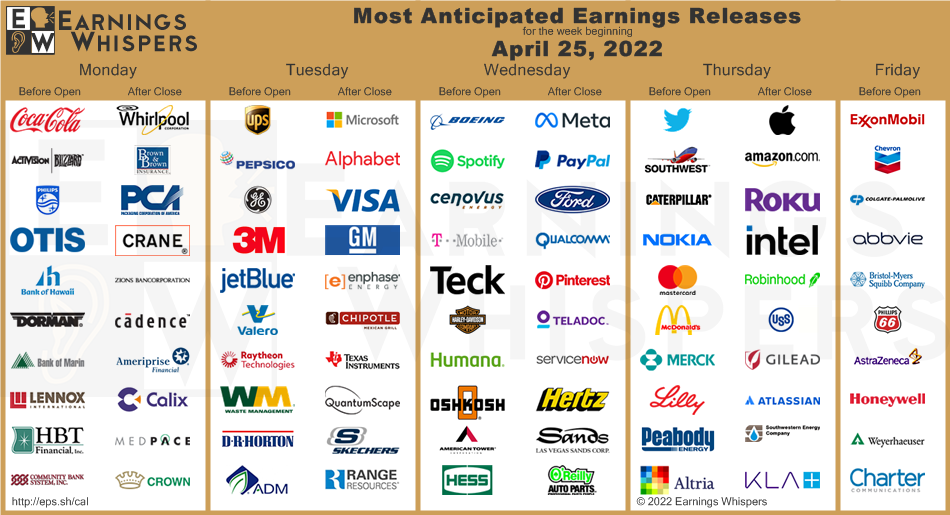
Week of April 15, 2022 Weekly Recap & The Week Ahead

April 18th, 2022

“Patient opportunism, buttressed by a contrarian attitude and a strong balance sheet, can yield amazing profits during meltdowns.” ― Howard Marks,

1. U.S. Inflation Accelerated to 8.5% in March, Hitting Four-Decade High — U.S. inflation surged to a new four-decade high of 8.5% in March from the same month a year ago, driven by skyrocketing energy and food costs, supply constraints and strong consumer demand. The Labor Department reported the consumer-price index—which measures what consumers pay for goods and services—last month rose at its fastest annual pace since December 1981, up from the 7.9% annual rate in February. Rising prices have been unrelenting, with six straight months of inflation above 6% that is well above the Federal Reserve’s average 2% target.
2. Chinese Stockpile Food as Covid-19 Concerns Ripple Out From Shanghai — As Shanghai battles the country’s worst Covid-19 outbreak in two years, people across the rest of China are stockpiling necessities as they brace for the prospect of similar lockdowns. In Beijing, where some residential districts have been closed in recent weeks as infections have been discovered, supermarket shelves in some parts of the city have been picked clean of toilet paper, canned foods, instant noodles and rice in recent days.
In Suzhou, an industrial hub roughly two hours’ drive west of Shanghai, residents swarmed supermarkets to fill their grocery baskets with instant noodles and other food on Tuesday morning, hours after local officials said they would conduct districtwide testing in one section of the city.
3. Supplier Prices Rose Sharply in March — the Labor Department on Wednesday said the producer-price index, which generally reflects supply conditions in the economy, increased a seasonally adjusted 1.4% in March from the prior month, a pickup from an upwardly revised 0.9% gain in February. Producer prices rose 11.2% on a 12-month basis, compared with an upwardly revised 10.3% increase in February. That marked the fourth consecutive month with a double-digit gain and was the highest since records began in 2010.
4. Mortgage Rates Hit 5% for First Time Since 2011 — the interest rate on America’s most popular mortgage hit 5% for the first time in more than a decade, extending a sharp rise that has yet to significantly slow the red-hot housing market. Rates’ fastest three-month increase since 1987 has made the housing market ground zero for the Federal Reserve’s efforts to tame inflation. Home buyers, already facing surging house prices, are now contending with a substantial increase in financing expenses, further lifting monthly payments. A year ago, buying the median American home at prevailing rates meant a monthly mortgage bill of about $1,223 after a 20% down payment, according to calculations by George Ratiu, an economist at Realtor.com. At recent rates, such a purchase would require a monthly payment of nearly $1,700—a 38% increase, he estimated.
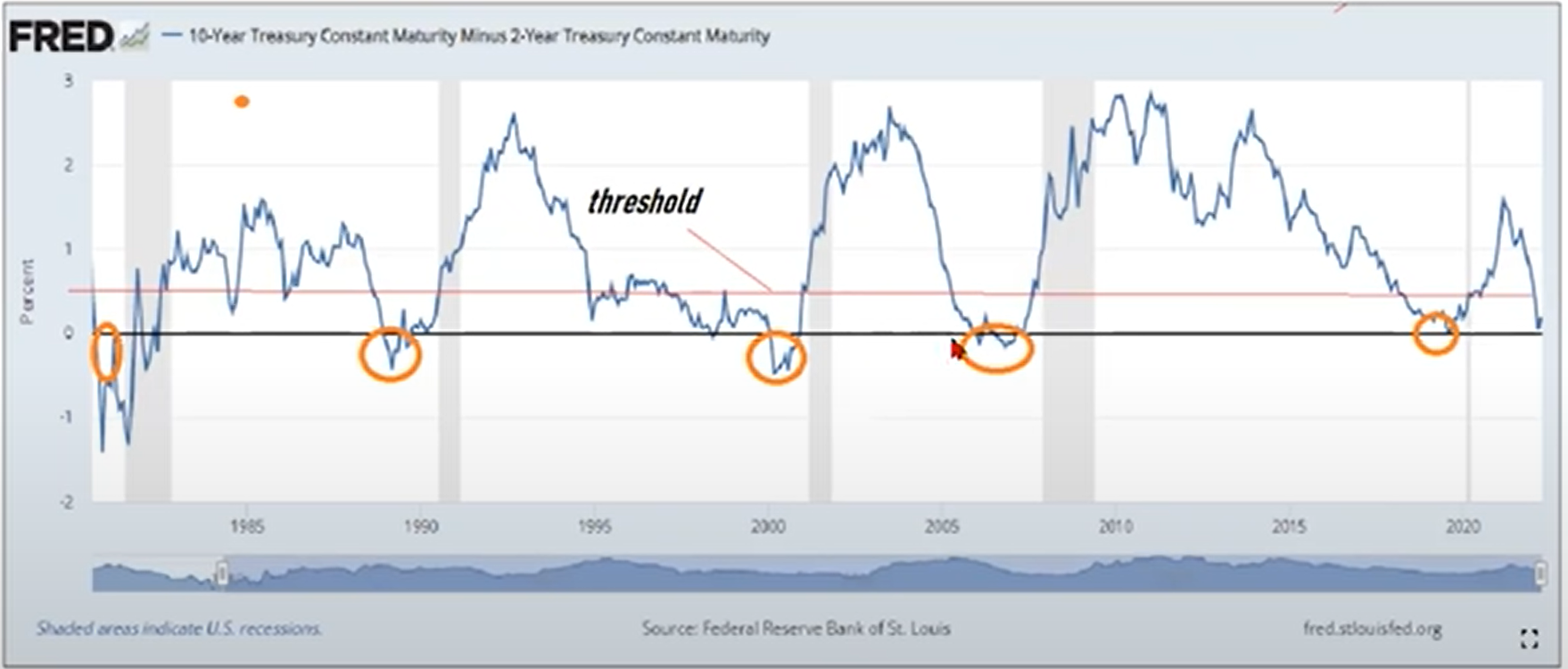
5. Inverted Yield Curve Follows by Recession — chart below from the Fed Reserve Bank of St. Louis shows the yield curve inversion follows by the recession usually precedes the market lead in the range of 10 to 34 months.

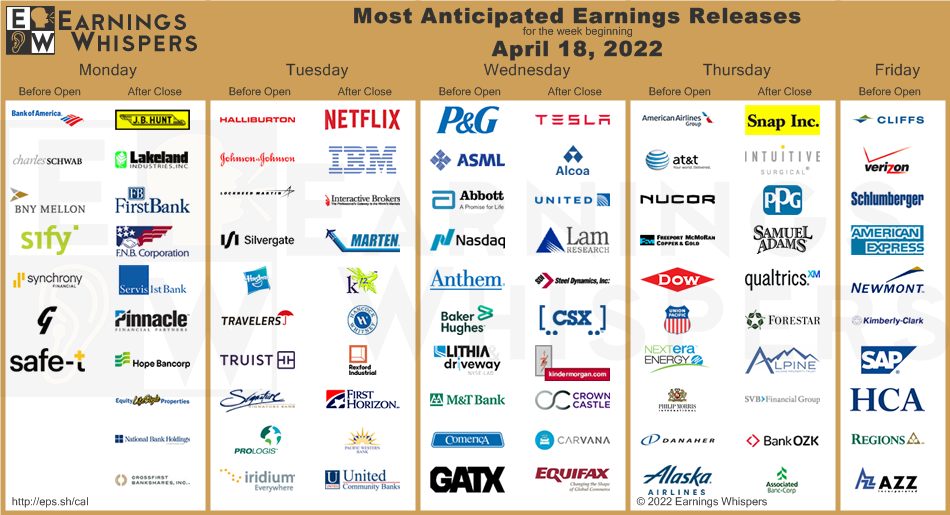
The week ahead — Economic data from Econoday.com:
Week of April 8, 2022 Weekly Recap & The Week Ahead

April 11th, 2022

“Willingness and ability to hold funds uninvested while waiting real opportunities is the key to success in the battle for investment survival” — Gerald Loeb

1. Congressional Negotiators Settle on $10 Billion for Covid-19 Tests, Treatments — the package will allow the U.S. to purchase supplies, including more tests and vaccines, that the Biden administration said would be needed to continue to fight the virus. The $10 billion pulls from unused money in earlier bills passed by Congress, rather than representing new spending. Top U.S. health officials have been closely monitoring the Omicron BA.2 variant, which has triggered a surge in cases in parts of Europe and Asia, and now represents more than half of new Covid-19 cases in the U.S. President Biden said last week that without more federal dollars, another wave of the virus could lead to testing shortages similar to those experienced during the winter’s Omicron surge.
2. Fed Lays Out Plan to Prune Balance Sheet by $1.1 Trillion a Year — Federal Reserve officials laid out a long-awaited plan to shrink their balance sheet by more than $1 trillion a year while raising interest rates “expeditiously” to counter the hottest inflation in four decades. The roadmap for reducing the assets they bought during the pandemic was spelled out on Wednesday in minutes of their March meeting, when officials raised rates by a quarter point. They debated going bigger but chose caution in light of the uncertainty caused by Russia’s invasion of Ukraine, the record of their discussion showed.
3. U.S. Allies to Release Close to 60 Million Barrels of Oil From Reserves — U.S. allies are planning to release close to 60 million additional barrels of oil from their reserves, officials familiar with the matter said, joining the Biden administration in an effort to tame prices after they rose sharply when Russia invaded Ukraine.
The 31-member nations of the International Energy Agency—which include the U.S., most of Europe, Australia, Japan, Mexico and others—are planning to announce a new reserve release totaling 120 million barrels, officials said, the largest release in the IEA’s 47-year history. Around half of that amount will come from U.S. reserves, which were included in Washington’s previously announced decision to release 180 million barrels of oil over six months. That leaves around 60 million barrels of additional oil that will hit the market because of the IEA decision, which is expected to be announced by the end of the week. Those barrels are expected to be released over six months to track the U.S. schedule, an official said. IEA nations on March 1 announced the release of 60 million barrels—including 30 million barrels from the U.S.—in what was then the agency’s biggest-ever release of reserves.
4. Manufacturers Grind to a Halt in China as Covid Lockdowns Expand — manufacturers are struggling to keep some of their China operations going as extended and widening Covid-19 lockdowns choke off supplies and clog up truck routes and ports, heaping more pressure on the stretched global supply chain. Stringent government measures to contain the country’s Covid-19 outbreak, the worst in more than two years, are locking down tens of millions of people, mostly in and around the industrial heartland of Shanghai. The curbs are keeping many workers at home, restricting output at some factories and closing others, including component makers for Apple Inc. and Tesla Inc. Tesla, which suspended work at its factory in Shanghai on March 28, still hasn’t set a date for restarting production, according to people familiar with the matter. The electric-vehicle giant said it is implementing Covid-19 control requirements and setting work arrangements according to government policies.

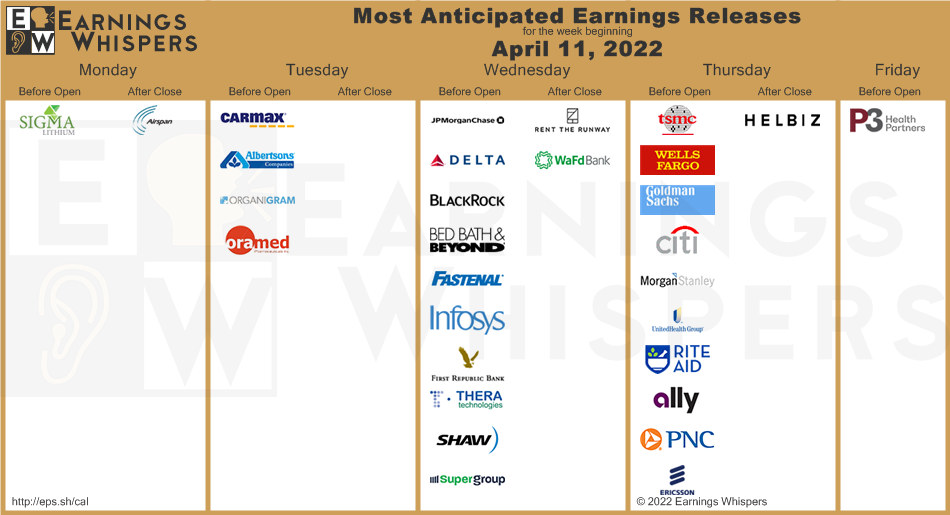
The week ahead — Economic data from Econoday.com:
Week of March 28, 2022 Weekly Recap & The Week Ahead

April 4th, 2022

“Accepting losses is the most important investment device to ensure safety of capital” — Gerard Loeb

1. Second Covid-19 Booster Shot Endorsed by FDA, CDC for Adults 50 and Older — the Food and Drug Administration said Tuesday it had cleared extra shots of Pfizer Inc. and its partner BioNTech SE and from Moderna Inc. for adults 50 years and older. The Centers for Disease Control and Prevention followed up by endorsing the second booster shots.
The extra doses are “especially important for those 65 and older and those 50 and older with underlying medical conditions that increase their risk for severe disease from Covid-19 as they are the most likely to benefit from receiving an additional booster dose at this time,” CDC Director Rochelle Walensky said.
2. Shanghai Lockdown Adds to China’s Economic Woes — the lockdown of one of China’s largest and most prosperous cities is the latest blow to the country’s economic fortunes, adding new risks to Beijing’s ambitious growth target in a politically sensitive year for leader Xi Jinping. The economic toll is only starting to come into view. Production at Shanghai-area factories operated by electric-vehicle maker Tesla Inc. and some other companies has been halted while domestic logistics networks have jammed up, slowing global supply chains, according to exporters and business owners. Meanwhile, hundreds of restaurants, retailers and other service-sector businesses have been shut down temporarily. The megacity of more than 25 million people, which accounts for roughly 4% of China’s total economic output and which is home to the country’s largest port and the regional headquarters of hundreds of multinational companies, initially sought to avoid a citywide lockdown. Instead, it systematically tested residents while blocking off some office towers in a bid to minimize disruptions to the economy and people’s daily lives, in line with Mr. Xi’s call this month “to achieve the biggest prevention and control effect with the smallest cost.”
3. Biden Considers Invoking Defense Production Act to Boost Minerals for EV Batteries — President Biden is considering invoking the Defense Production Act as soon as this week to boost domestic production of minerals used in batteries needed for electric vehicles, a person familiar with his plans said. The administration would include minerals like lithium, nickel and graphite, cobalt and manganese under the Korean War-era national security mobilization law, the person said. The designation could help mining companies access government funding for feasibility studies on mining development, productivity and safety improvements, or on how to wring more of these metals out of ore already produced at facilities operating in the U.S. It could also prompt Congress to dedicate more money to such efforts, the person said.
4. Biden to Draw Down Oil Reserves in Bid to Ease Gas Prices — President Biden will tap up to 180 million barrels of government oil reserves to help tamp down near-record high fuel prices, an unprecedented government intervention into oil markets following Russia’s invasion of Ukraine. In remarks from the White House late last week, Mr. Biden framed high energy prices as a wartime issue that requires a robust and wide-ranging response. The oil release—about 1 million barrels a day for six months starting in May—would be the Biden administration’s third, and by far the biggest-ever drawdown from the country’s emergency stockpile of roughly 568 million barrels.

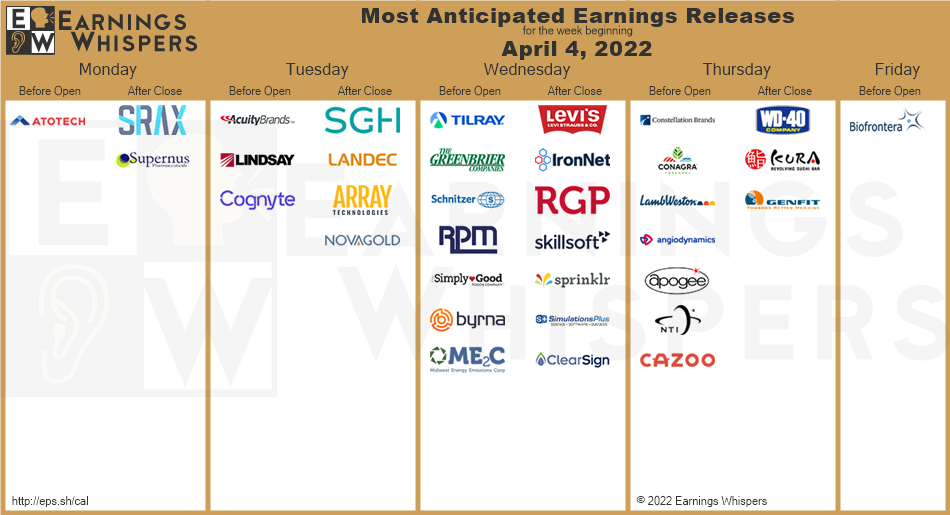
The week ahead — Economic data from Econoday.com:
Week of March 25, 2022 Weekly Recap & The Week Ahead

March 28th, 2022

“Accepting losses is the most single important device to ensure safety of capital” — Gerald Loeb

1. Biden to Sanction Hundreds of Russian Lawmakers — President Biden intends to announce the sanctions on more than 300 members of the Russian State Duma during his trip to Europe, where he will meet with allies from the North Atlantic Treaty Organization to formulate their next steps, according to U.S. officials and internal documents viewed by The Wall Street Journal. The Duma, while far less powerful than the Russian president, has acquired expanded constitutional responsibilities in recent years, particularly regarding the country’s economic affairs. It also serves as a link between various segments of the population and the government, relaying grievances and concerns upward, and distributing state assistance to the public.
2. Russian Stock Market to Partially Reopen — the challenge for Moscow is that the resumption of trading could simply send Russian stocks back into free fall. On Feb. 24, the day when President Vladimir Putin began the assault on Ukraine, the main Russian stock index tumbled 33%. While the index regained a fraction of those losses on Feb. 25—its last day of trading—that was before Western sanctions hammered the ruble and sent the country into an economic crisis.
To limit the fallout, Moscow has turned to some heavy-handed policies. It blocked foreign investors from dumping local stocks—a move that some market participants saw as retaliation for a Western freeze on Russian central bank assets since a big chunk of the Russian market is owned by foreigners. The Russian government ordered its main sovereign-wealth fund to buy billions of dollars worth of shares.
3. Biden Calls for Russia to Be Expelled From G-20 — President Biden said Russia should be expelled from the Group of 20 major economies and pledged the U.S. would take in up to 100,000 refugees fleeing Ukraine as he met Thursday with world leaders to discuss new sanctions and humanitarian aid in response to Moscow’s invasion. With Russian forces facing unexpectedly strong and lethal opposition from Ukrainian forces, Western leaders say they are worried Mr. Putin might resort to using weapons of mass destruction. NATO officials are grappling with the question of what actions by Russia would count as red lines that could prompt more-direct involvement by the alliance. Officials said Russia’s potential use of chemical weapons was part of the discussion among NATO leaders.
4. U.S. to Boost Gas Deliveries to Europe Amid Scramble for New Supplies — The U.S. is ramping up shipments of liquefied natural gas to Europe this year as the continent mounts a world-wide hunt for new supplies to phase out its reliance on Russian energy after the invasion of Ukraine. The globe-spanning effort to wean Europe off Russian energy supplies was at the center of President Biden’s summit with European Union leaders this week in Brussels. The U.S. aims to ship 50 billion cubic meters of LNG to Europe annually through at least 2030, officials said Friday, making up for about a third of the gas the EU receives from Russia. The EU imported a record 22 billion cubic meters of LNG from the U.S. last year. Officials across the continent are racing to sign new contracts with producers in the Middle East and Africa before next winter; EU leaders on Friday also decided to band together when negotiating supply agreements, using the bloc’s collective economic weight to get lower prices.

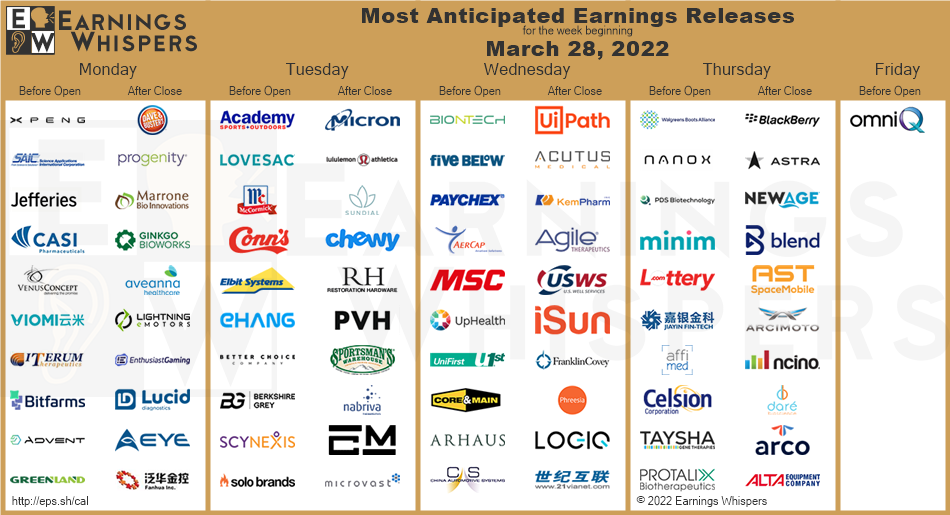
The week ahead — Economic data from Econoday.com:
Week of March 18, 2022 Weekly Recap & The Week Ahead

March 22nd, 2022

“In investing, there is nothing that always works, since the environment is always changing, and investors’ efforts to respond to the environment cause it to change further” ― Howard Marks

1. China’s Covid-19 Surge Shuts Down Plants in Manufacturing Hubs Shenzhen and Changchun — a surge in Covid-19 cases led Chinese manufacturing hubs Shenzhen and Changchun to lock down in recent days, halting production at many electronics and auto factories in the latest threat to the world’s battered supply chain. The government placed the city into lockdown for at least a week and said everyone in the city would have to undergo three rounds of testing after 86 new cases of domestic Covid-19 infections were detected Sunday. Over the past two years, the world’s second-biggest economy has repeatedly locked down entire cities or sections of them, ordering factories to suspend operations as people stay home. Foxconn’s sites in Shenzhen, in southern China, produce some iPhones as well as iPads and computers. The majority of iPhones, however, are made at a factory in central Henan province. Foxconn, formally known as Hon Hai Precision Industry Co., said it would aim to keep up production by shifting work to other plants in China.
Printed circuit-board maker Unimicron Technology Corp. said its Shenzhen subsidiary halted production Monday morning. Unimicron is also a major Apple supplier but doesn’t currently handle Apple-related orders in Shenzhen, according to Apple’s latest supplier list. Unimicron said the subsidiary accounts for less than 3% of its total revenue.
2. Bond Markets Forecast Long Financial Freeze for Russia — Russian government bonds fell below 10 cents on the dollar last week, putting the country’s debt on par with Venezuela, which collapsed into famine five years ago. The valuation is near the low-water mark on bonds set by serial defaulter Argentina, which took 15 years to repay creditors after a bitter legal battle with hedge funds. The country faces a key interest payment on dollar-denominated bonds Wednesday, and Russia’s Finance Ministry has sent investors conflicting messages about whether it intends to give them dollars or rubles. The uncertainty sparked concerns that a payment in rubles could result in a default and speculation about what legal remedies creditors might pursue. Russian bonds had investment-grade ratings and traded around 100 cents on the dollar until the country invaded Ukraine, triggering unprecedented financial sanctions by the U.S. and European countries. The Kremlin responded with measures including a block on bond payments in foreign currencies such as dollars and euros that stoked expectations of a default.
3. Intel Plans $36 Billion in European Chip Plant Investments — Intel Corp. said it would invest $36 billion in chip production and research across Europe, including a new chip-making complex in Germany, to keep pace with surging demand for semiconductors. Chief Executive Pat Gelsinger said Intel had selected the city of Magdeburg, Germany, to put up what would be one of the biggest and most advanced semiconductor manufacturing facilities on the Continent. The company plans a down payment of about $18.6 billion, the equivalent of about €17 billion, on that facility.
4. Fed Raises Interest Rates for First Time Since 2018 — the Fed will raise its benchmark federal-funds rate by a quarter percentage point to a range between 0.25% and 0.5%, the first rate increase since 2018. Officials signaled they expect to lift the rate to nearly 2% by the end of this year—slightly higher than the level that prevailed before the pandemic hit the U.S. economy two years ago, when they slashed rates to near zero. Their median projections show the rate rising to around 2.75% by the end of 2023, which would be the highest since 2008.
The Fed’s post meeting statement hinted at rising concern about inflation that initially appeared last year to be driven by pandemic-related bottlenecks but has since broadened.
5. House Passes Legislation to End Normal Trade Relations With Russia — the House easily passed legislation to end normal trade ties with Russia over its invasion of Ukraine, moving quickly to approve the measure after President Biden announced his support last week. The legislation would strip Russia and Belarus—a country closely aligned with Russia that has been used as a staging ground for its Ukraine invasion—of their most-favored-nation trade status, a step that would result in higher tariff rates on some imports from the countries. To maximize the pressure on Russia and Belarus, the bill would give Mr. Biden the authority to order additional increases in import duties for certain products, pushing them above the rates that would result from simply ending the most-favored-nation, or MFN, status. While the bill doesn’t specify those items, candidates would include non-energy products such as aluminum, wood and wood veneer products, and chemicals including fertilizer, according to Rep. Kevin Brady (R., Texas), a co-sponsor of the bill.

The week ahead — Economic data from Econoday.com:
Week of March 11, 2022 Weekly Recap & The Week Ahead

March 14th, 2022

“Prosperity brings expanded lending, which leads to unwise lending, which produces large losses, which makes lenders stop lending, which ends prosperity, and on and on.”
― Howard Marks

1. Biden Bans Imports of Russian Oil, Natural Gas — President Biden banned imported oil and other energy sources from Russia to punish the country as it intensified its military campaign in Ukraine, a move that will add pressure to already record U.S. gasoline prices and the economic recovery.
The U.S. immediately prohibited new Russian shipments of oil, certain petroleum products, liquefied natural gas and coal under an executive order Mr. Biden signed Tuesday. Washington will give companies 45 days to wind down existing contracts for Russian energy supplies, a senior Biden administration official said. The order also bars new U.S. investment in Russia’s energy sector and blocks Americans from financing foreign companies that invest in the sector.
2. Nickel Market Crisis Sends London Metal Exchange Scrambling to Prevent Damage — financial regulators and Chinese officials rushed to resolve a crisis in London’s nickel market, which remained on ice after an ill-fated trade sparked mammoth price gains and billions of dollars of losses. At the center of the action is Chinese nickel titan Tsingshan Holding Group, the world’s biggest producer of a metal used in stainless steel and electric-vehicle batteries. The company, sitting on $8 billion in trading losses, said Wednesday it had secured enough metal to settle all its loss-making positions, according to a state-run media outlet. The disorder has ramifications for miners, steelmakers and electric-vehicle makers because LME prices are used as a benchmark in the metals industry. Commodity markets were already in turmoil from the war in Ukraine and punishing sanctions, which have cut supply lines and stifled trading of metals, energy and food, essential to the running of the global economy.
3. Inflation Reached 7.9% in February; Consumer Prices Are the Highest in 40 Years — Rising energy, food and services prices pushed already elevated U.S. inflation to a 7.9% annual rate last month—another four-decade high—with oil and commodity market disruptions from the Ukraine crisis expected to add more cost pressures. The consumer-price index, which measures the cost of goods and services across the economy, hasn’t been this high since it was 8.4% in January 1982, when the nation was in recession and trying to tame what had been double-digit inflation. Higher energy prices, including gasoline price increases, helped push up the inflation reading, along with cost gains for groceries, restaurant food, transportation services and apparel, the Labor Department reported.
4. Biden Bans Iconic Russian Imports, Calls for Trade Downgrade — President Joe Biden said he would ban imports of Russian vodka, caviar and diamonds and called on U.S. lawmakers to join Western allies in revoking the country’s preferential trade status following the Ukraine invasion. Downgrading Russia’s trade status “is going to make it harder for Russia to do business with the United States,” Biden said in remarks at the White House, adding that it would “be another crushing blow to the Russian economy.”
The president can’t unilaterally remove what’s known as “permanent normal trade relations” status for Russia because that authority lies with Congress. House Speaker Nancy Pelosi said the House would consider legislation next week to revoke the designation, a move that has support from both Democratic and Republican lawmakers. Biden’s signature on the bill would clear the way for increased import tariffs, and Russia would join Cuba and North Korea as the only countries in the world without preferential trade status in the U.S.

The week ahead — Economic data from Econoday.com:
Week of March 4, 2022 Weekly Recap & The Week Ahead

March 8th, 2022

“There ‘s an old saying in poker that there’s a “fish” in every game, and if you’ve played for an hour without having figured out who the fish is, then it’s you.” — unknown

1. IEA Will Deploy Emergency Oil Stocks to Ease Soaring Prices — the U.S. and other major economies have agreed on a coordinated release of oil stockpiles after Russia’s invasion of Ukraine pushed crude above $100 a barrel. The International Energy Agency, which represents key industrialized consumers, will deploy 60 million barrels from stockpiles around the world. Half of that amount will come from the U.S. Strategic Petroleum Reserve, with the rest from IEA members in Europe and Asia, said a person familiar with the matter, who asked not to be named because the information isn’t public.
That will be the second release from American crude reserves within a few months as soaring fuel costs become a growing political problem for President Joe Biden.
2. As Russia Sanctions Intensify, Several Oligarchs Speak Out Against Ukraine War — in recent days a parade of Russian businessmen burnished their antiwar stances as governments tightened a noose around Kremlin-connected businesses and property. Oligarch Roman Abramovich, who hasn’t been sanctioned, said that he was helping Ukraine negotiate peace with Russia. Oleg Tinkov, the billionaire founder of Russia’s Tinkoff Bank, a unit of TCS Group Holding PLC, highlighted the work his foundation does to help children and his desire for no war. Mr. Tinkov also hasn’t been sanctioned. Oleg Deripaska, a raw-materials magnate who was previously sanctioned in the U.S., wrote on social media Sunday that peace “is very important.” The European Union said Monday night that it added 26 prominent Russians officials and businessmen to its sanctions list, freezing their assets and imposing travel bans. The U.K. is expected to sanction more oligarchs in the coming days. Even Monaco, famed for its generous tax rules and status as a playground for the well-heeled, said it was clamping down on sanctioned Russians.
3. Russia Keeps Stock Market Closed in Longest Pause Since 1998 — Russia will keep local stock trading closed for a third day as its wealth fund prepares to deploy billions of dollars to buy the country’s battered stocks following the invasion of Ukraine. The three-day shuttering of stock trading on the Moscow bourse is its longest closure for extraordinary circumstances since October 1998, according to the exchange. The halt came after the U.S. and Europe imposed harsher sanctions on Russia over the war in Ukraine, sending the country’s assets plunging. As much as half of Russia’s international reserves may have been frozen abroad as punishment for Putin’s invasion of Ukraine. In response, the central bank has introduced capital controls and banned foreigners from selling securities locally, effectively shutting the exits for investors. European Union ambassadors have also agreed to exclude seven Russian banks from the SWIFT financial-messaging system.
4. Fed’s Powell Says Ukraine War Creates Risks of Higher Inflation — Federal Reserve Chairman Jerome Powell said that Russia’s invasion of Ukraine was likely to push up inflation, a setback to central bank expectations that price pressures would diminish in the coming months. Because of Russia’s role in global energy and other commodity markets, “we’re going to see upward pressure on inflation at least for a while,” Mr. Powell told the Senate Banking Committee on Thursday. Consumer prices in January rose 6.1% from a year earlier, according to the Fed’s preferred gauge. Excluding volatile food and energy categories, so-called core inflation rose 5.2%, close to a 40-year high.
5. Strong Hiring, Low Unemployment Point to Economy Making Post-Pandemic Pivot — employers added 678,000 workers to their payrolls in February, the biggest gain in seven months, the Labor Department said Friday. The jobless rate fell to 3.8% from 4.0% a month earlier, edging closer to the 50-year low of 3.5% hit just before the pandemic. Hotels, restaurants, amusement parks and other hospitality industries led the way in hiring as firms sought to accommodate a growing number of vacationers, convention attendees and business travelers. Big states and cities in recent days have lifted some of the remaining Covid restrictions, which could further boost business and hiring. However, big threats loom, including a sharp run-up in oil prices that could crimp household spending and ultimately nick the economic and labor market recovery, economists said.
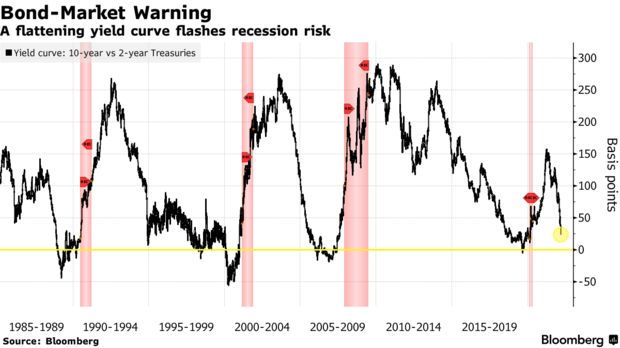
6. Bond Market Warning — from Bloomberg, the specter of stagflation, a rare combination of surging prices in a constricting economy, is showing in the bond market. Ten-year inflation breakevens just increased to the highest level since 2005, while the yield curve — the spread of 10- over two-year Treasury yields — narrowed to levels not seen since the pandemic recession. History shows an outright inversion, as happened in 2019, would signal an imminent contraction.

The week ahead — Economic data from Econoday.com:
Week of Feb 25, 2022 Weekly Recap & The Week Ahead

February 28th, 2022

‘Don’t fight the tape, don’t fight the Fed’ — Martin Zweig

1. U.S. Adds Sanctions on Moscow After Concluding Russia Invaded Ukraine — U.S. President Joe Biden unveiled sanctions targeting Russia’s sale of sovereign debt abroad and the country’s elites, responding to what he described as the start of Vladimir Putin’s invasion of neighboring Ukraine. The sanctions come after Russia’s President Putin recognized two self-proclaimed separatist republics in eastern Ukraine as independent, a dramatic escalation in his standoff with Ukraine and its supporters in the West. Putin has denied Russia intends to invade Ukraine. the penalties targeted state-owned banks VEB.RF and Promsvyazbank, which the U.S. said hold more than $80 billion in assets and finance the Russian defense sector and economic development.
The U.S. measures will freeze the banks’ U.S. assets, ban Americans from doing business with them, cut them off from the global financial system and eliminate their access to the dollar. Meanwhile, The S&P 500 declined 44.11 points to 4304.76, leaving the index down more than 10% from its Jan. 3 high and marking its first correction since the onset of the Covid-19 pandemic in February 2020.
2. Ukraine Crisis Kicks Off New Superpower Struggle Among U.S., Russia and China — the challenges are different than those the U.S. and its network of alliances faced in the Cold War. Russia and China have built a thriving partnership based in part on a shared interest in diminishing U.S. power. Unlike the Sino-Soviet bloc of the 1950s, Russia is a critical gas supplier to Europe, while China isn’t an impoverished, war-ravaged partner but the world’s manufacturing powerhouse with an expanding military. This emerging order leaves the U.S. contending with two adversaries at once in geographically disparate parts of the world where America has close partners and deep economic and political interests. The Biden administration now faces big decisions on whether to regear its priorities, step up military spending, demand allies contribute more, station additional forces abroad and develop more diverse energy sources to reduce Europe’s dependence on Moscow.
3. Fast-Spreading Covid-19 Omicron Type Revives Questions About Opening Up — A more infectious type of the Omicron variant has surged to account for more than a third of global Covid-19 cases sequenced recently, adding to the debate about whether countries are ready for full reopening. Health authorities are examining whether the subvariant of Omicron, known as BA.2, could extend the length of Covid-19 waves that have peaked recently in Europe, Japan and some other places. Other countries have had more trouble shrugging off Omicron. In Denmark, where an estimated 92% of cases were BA.2 as of mid-February, a peak at the end of January was followed by another two weeks later.
Evidence so far suggests BA.2 is some 30% more infectious than its cousin, the BA.1 subvariant that kicked off the Omicron wave in southern Africa in November 2021. In South Africa, BA.2 has accounted for 82% of cases so far in February, according to health authorities in that country.
4. U.S. Sanctions Against VTB and Sberbank Aim to Disrupt Russia’s Economy — the U.S. on cut Russia’s two largest banks from direct access to the U.S. dollar, curtailing their activities and posing a threat to Russia’s exporting economy. State-controlled Sberbank and VTB together hold roughly half of all of the banking system’s assets, and are big lenders and service providers to companies in the country. One in every two companies in Russia has an account at Sberbank, the country’s largest bank says.
The moves, coordinated with allies in the U.K. and European Union in response to the invasion of Ukraine, however, fall short of a total shutdown. In effect, the actions will be more like sand in the gears of the Russian financial machine.
5. U.S. Consumer Spending Rose 2.1% in January and Inflation Accelerated Amid Omicron Wave — spending rose a seasonally adjusted 2.1% in January from the previous month, rebounding from a revised 0.8% decline in December, the Commerce Department reported Friday. Personal income was unchanged on the month, following the expiration of the federal government’s monthly child tax credit. The department’s measure of inflation—the personal-consumption-expenditures price index—rose to 6.1% in January from a year earlier, the fastest pace in four decades. After adjusting for inflation, consumer spending was up 1.5% in January while household income after taxes was down 0.5%.
6. Fed’s Preferred Inflation Measure Reaches Fastest Pace Since 1983 — the Commerce Department’s personal-consumption-expenditures index measure of core inflation, which excludes volatile food and energy costs, rose 5.2% in January from a year ago, up from 4.9% in December. That marks the sharpest 12-month increase since April 1983. On a monthly basis, the core PCE price index climbed a seasonally adjusted 0.5% in January from the prior month, the same pace as in the previous three months.
The Commerce Department’s measure of overall consumer inflation increased 6.1% from a year earlier, the fastest pace since 1982. The data reflect prices in January, before Ukraine-Russia tensions pushed oil prices to seven-year highs. The most-widely held futures for Brent crude, which call for delivery of oil in May, exceeded $100 a barrel on Thursday after Russia’s invasion of Ukraine threatened to scramble the region’s exports.

The week ahead — Economic data from Econoday.com:

Week of Feb 18, 2022 Weekly Recap & The Week Ahead

February 21st, 2022

Only when the tide goes out do you discover who’s been swimming naked. — Warren Buffett

1. U.S. Producer-Price Inflation Stays Hot, Reinforcing Fed’s Plan to Start Raising Rates — the producer price index for final demand increased 9.7% from January of last year and 1% from the prior month, latest Labor Department data showed. The gain from December was the largest in eight months. The median forecasts in a Bloomberg survey of economists called for a 9.1% year-over-year increase and a 0.5% monthly advance. The figures, which reflected broad increases across categories, may bolster the case for the Federal Reserve to be more aggressive on raising interest rates and shrinking its bond holdings in the coming months. Transportation bottlenecks, robust demand and labor constraints experienced through 2021 have carried over into this year and risk keeping price pressures well-elevated.
2. U.S. Retail Sales Grew by 3.8% in January — sales at retail stores, online and restaurants rose by seasonally adjusted 3.8% in January from the prior month, the Commerce Department reported. That marked the strongest monthly gain since last March when pandemic-related stimulus was being distributed to households. The jump in retail spending last month also represented a rebound from December, when sales fell by a revised 2.5%.
Increased spending was broad-based, with large gains for purchases of vehicles, furniture and building materials. Online sales also rose sharply. Restaurant and bar receipts dropped last month as consumers limited in-person services during the latest Covid outbreak. Retail spending has been choppy in recent months as consumers face rising inflation and supply-chain disruptions because of the Covid-19 pandemic, despite relatively robust household finances and a strong labor market. Unlike other economic-data reports produced by the U.S. government, retail sales aren’t adjusted for inflation. That means higher retail-sales figures can reflect higher prices rather than more purchases.
3. Mortgage Rates Approaching 4% — the average fixed rate for a 30-year mortgage was 3.92% for the week, the highest since late May 2019, according to Freddie Mac’s Primary Mortgage Market Survey. The rise is in response to inflation and higher-than-expected consumer spending, Freddie Mac chief economist Sam Khater said. The climb has occurred in tandem with the 10-year Treasury yield’s rise. Year to date, the yield has increased roughly 0.8 percentage point, crossing the 2% mark for the first time since 2019 last Thursday.
4. Nasdaq Sinks Into Death Cross After 16% Drop From November Peak — the Nasdaq Composite Index tumbled into an ominous “death cross” technical formation Friday for the first time since April 2020, when the pandemic battered the global economy and U.S. equity markets swooned. Following Friday’s 1.2% decline, the index has now shed 16% since touching a record high on Nov. 19. The pattern, which is used by some investors to assess longer-term trends, has at times presaged further weakness. It appears when an index’s short-term 50-day moving average crosses below its longer-term 200-day moving average. With inflation surging, the Federal Reserve is preparing for its sharpest monetary policy tightening in decades in an attempt to bring down prices. This has sparked wild swings among the rate-sensitive tech, Internet and growth stocks that fill the Nasdaq Composite, since their elevated valuations become targets as borrowing costs rise.

The week ahead — Economic data from Econoday.com:
Search
Calendar
February 2026
M T W T F S S
« Jan    
 1
2345678
9101112131415
16171819202122
232425262728  
Archives
Categories
The information provided by The EGS Blog is based on sources believed to be reliable, but it is not guaranteed to be accurate. There is no guarantee that the recommendations of The EGS Blog will be profitable or will not be subject to losses. The information provided by The EGS Blog is not a recommendation or a solicitation that any particular investor should purchase or sell any particular security in any amount, or at all. The investments discussed or recommended herein may be unsuitable for investors depending on their specific investment objectives and financial position. At any time EGS LLC and its principals may maintain positions that are contrary to positions announced within the subscription service. In no event will The EGS Blog be liable to you or anyone else for any incidental, consequential, special, or indirect damage (including but not limited to lost profits or trading losses). PAST PERFORMANCE IS NO GUARANTEE OF FUTURE RESULTS

© Copyright 2026 Market Outlook All Rights Reserved
Design by EGS Sponsored by Equity Guidance LLC