February 21st, 2011
“There are two kinds of people who lose money: those who know nothing and those who know everything” — Henry Kaufman (Economist)
1. Japan’s GDP shrinks less than expected — Japan’s GDP fell an annualized 1.1% in Q4, as exports slowed and government stimulus programs faded. The contraction was less severe than the 2% drop economists had expected, and the pullback may prove to be temporary as foreign demand lifts Japan’s domestic production.
2. 2012 budget skirts big debt decisions — President Obama submitted a $3.7T budget for 2012 that contains spending cuts and increases along with tax cuts and increases intended to trim $1.1T over a decade from projected deficits. But it does not address Social Security nor rising health care costs via Medicare and Medicaid, and proposes only tiny cuts in military spending.
3.China inflation jumps almost 5% as food prices soar — China’s consumer price index rose 4.9% in January from a year ago, vs. a 4.6% gain in December and 5.1% in November.
4. Euro-zone to double its rescue fund to €500B — beginning in 2013, a permanent euro rescue mechanism will total €500B ($675B) as part of a package eurozone finance ministers hope will resolve the area’s debt woes. The European Stability Mechanism (ESM) is intended to replace the temporary euro rescue fund hurriedly set up in May to avert a collapse of the single currency in the wake of the Greek debt crisis.
5. Moody’s places Australia’s big four banks on review — Moody’s Investors Service placed Australia’s four largest banks under review for possible downgrades and reiterated a negative outlook for them Wednesday, warning the proportion of wholesale funding that the banks raise in offshore markets remains high in relation to their size.
6. China hikes reserve requirements — China raised its reserve requirements by 0.5% to 19.5%, the second hike this year. China raised its key interest rate by 0.25% last week, and is trying to tamp down inflation that appears to be accelerating.
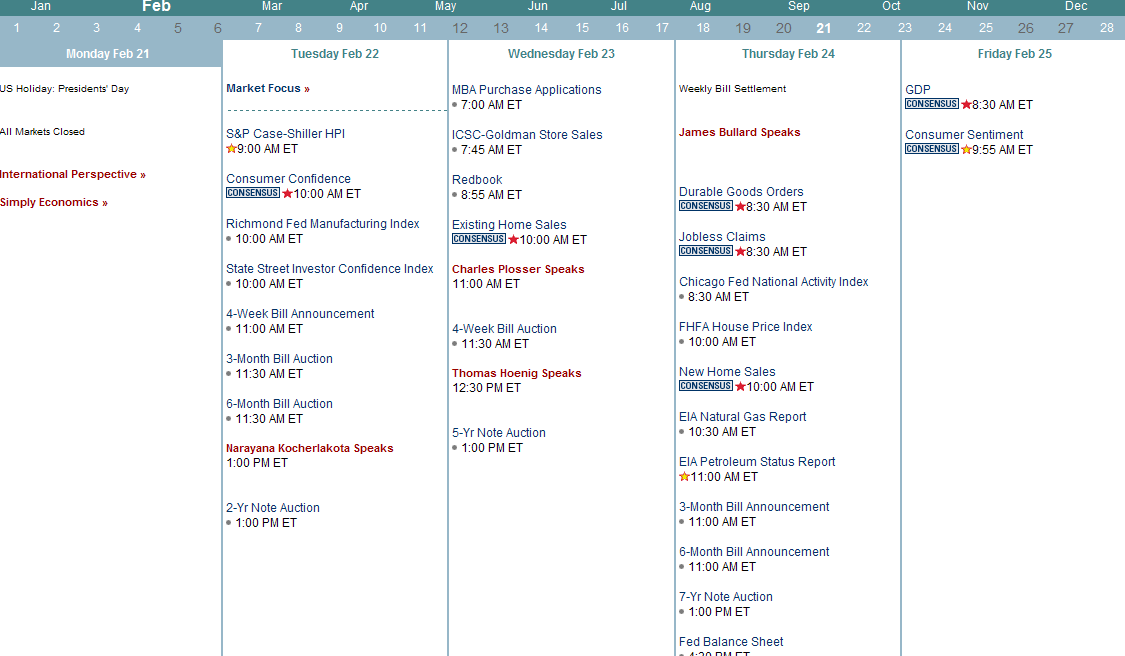
The week ahead — Economic data from Econoday.com:
Posted in Weekly Summary | No Comments »
February 14th, 2011
“If the models are telling you to sell, sell, sell, but only buyers are out there, don’t be a jerk. BUY!!!” — William Silber, Ph.D.
1. China hikes interest rates — China raised its key interest rates for the third time since October, as inflation remained above 4% for the third month in a row. The benchmark one-year lending rate will increase to 6.06% percent from 5.81%, effective 2/9/11. The one-year deposit rate will rise to 3% from 2.75%.
2. Treasury readies housing solutions — the Treasury is set to release a report today laying out three possible solutions for winding down Fannie Mae (FNMA.OB) and Freddie Mac (FMCC.OB), but won’t endorse any specific option. The decision to present the three solutions without backing any one in particular came from the White House, which hopes to jumpstart a discussion on the topic without locking President Obama into a single course of action. The report’s three scenarios are: 1) No government role in housing, except for existing agencies like the FHA; 2) An explicit government guarantee of mortgages only when the market is in trouble; and, 3) A government role in the housing market at all times, but not through government-sponsored entities.
3. Ford to cut debt — Ford (F) announced it will cut its debt by another $3B by redeeming all of its outstanding 6.5% cumulative convertible trust preferred securities on March 15.
4. U.S. consumer sentiment rises in February — A gauge of consumer sentiment rose in February, reaching the highest level since June, according to poll results released Friday by Thomson Reuters and the University of Michigan.
The gauge hit 75.1, up from a final January reading of 74.2.
5. Egypt’s President Mubarak steps down — A day after refusing to step down, Egypt’s President Hosni Mubarak has resigned, according to media reports Friday. Mubarak has delegated Egypt’s affairs to the army, the Wall Street Journal reported, citing Vice President Omar Suleiman.
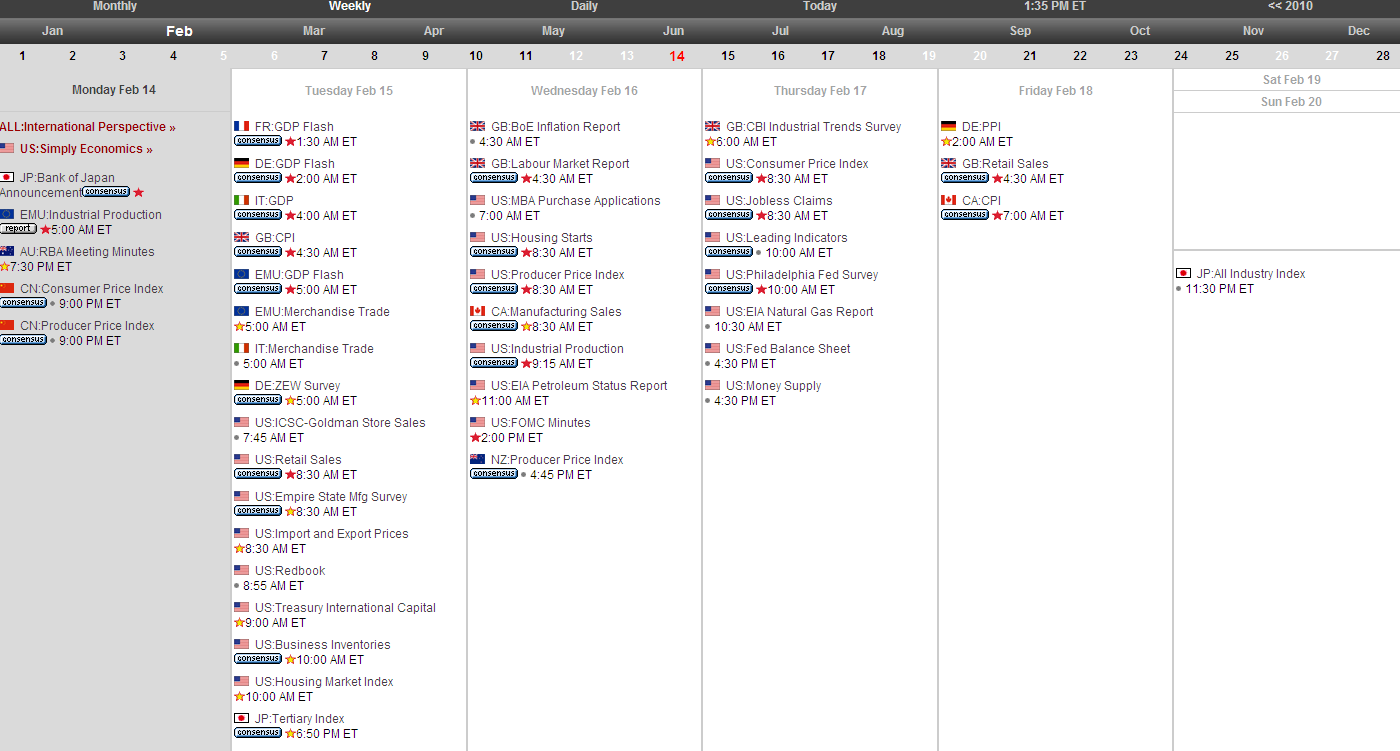
The week ahead — Economic data from Econoday.com:
Posted in Weekly Summary | No Comments »
February 7th, 2011
“The greatest safety lies in putting all your eggs in one basket and watching the basket” — Gerald M. Loeb
1. Moody’s downgrades Egypt’s bond ratings — Moody’s Investors Service on Monday downgraded Egypt’s government bond ratings, citing the sharp increase in political risk following several days of anti-government protests.
2. Court rules against healthcare reform — a federal judge in Florida became the second U.S. judge to declare the healthcare reform law unconstitutional, marking the biggest legal challenge yet to federal authority to enact the law.
3. S&P cuts Ireland — S&P cut Ireland’s credit rating to A-/A-2 from A/A-1 this morning, and maintains a negative outlook uncertainty over how much additional capital the country’s banks will need.
4. Fed passes China on Treasury holdings — the Federal Reserve is now the top holder of Treasury securities, pushing China to the number two slot. According to recent data, the New York Fed’s holdings of Treasurys in its System Open Market Account total $1.1T vs. China’s $896B holdings and Japan’s $877B.
5. Debt ceiling debacle delayed, a little — the U.S. is on track to hit its $14.29T debt limit by the end of May, slightly later than originally forecast because tax revenues have been stronger than expected. Lawmakers from both sides of the aisle agree a default would be a ‘financial disaster,’ and an increase in the debt ceiling is nearly guaranteed, but Republicans (and some Democrats) are demanding cuts in government spending as the price of approving an increase.
6. Fitch downgrades Egypt credit ratings — Fitch’s more pessimistic stance on the Egyptian government’s ability to pay its sovereign creditors follows ratings cuts by Standard & Poor’s and Moody’s Investors Service. Fitch now pegs Egypt’s long-term foreign-currency issuer-default rating at double-B instead of double-B-plus. The outlook is negative.
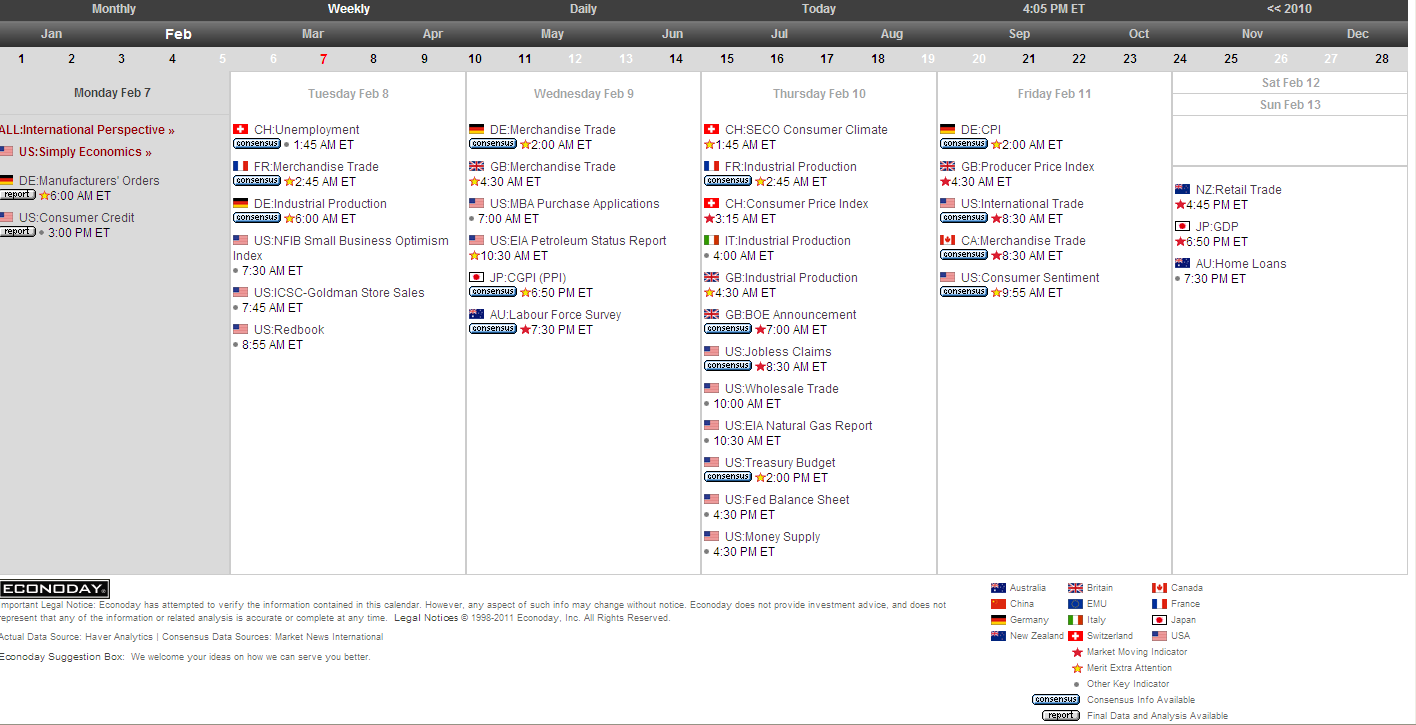
The week ahead — Economic data from Econoday.com:
Posted in Weekly Summary | No Comments »
January 31st, 2011
“A market is the combined behavior of thousands of people responding to information, misinformation and whim”. — Kenneth Chang (NYT journalist)
1. India raises interest rates by quarter-point — The Reserve Bank of India raised its benchmark interest rate by 0.25 percentage point on Tuesday, marking its seventh such increase since the beginning of 2010 to cool soaring prices.
2. British economy unexpectedly shrinks to 0.5% in fourth-quarter GDP — British economic output shrank in the final quarter of 2010, shocking economists and raising questions about the resilience of the economy as the government prepares to implement far-reaching austerity measures.
3. BoJ raises outlook — the Bank of Japan kept its interest rate unchanged, as expected, but raised its forecasts for the year through March to 3.3% from 2.1%. The board believes “the economy will probably emerge from its slump soon and return to a moderate recovery path.”
4. Consumer Confidence Index Hits 8-Month High — The Conference Board said Tuesday its Consumer Confidence Index climbed to 60.6 this month, up from 53.3 in December. While that reading was better than economists had expected, confidence is still far from the 90 level that signals a healthy consumer mindset.
5. S&P cuts Japan’s credit rating — Standard & Poor’s on Thursday cut Japan’s long-term sovereign-credit rating, with the news sending the yen sharply lower against its major rivals.
6. China crackdown on property — the Chinese government, faced with a losing battle against rising home prices, launched a new set of measures to make housing more affordable to the masses.
7. Deficit spirals ever higher — the U.S. budget deficit is on track to rise to $1.48T, or 9.8% of GDP, by the end of the current fiscal year, largely because of the extension of lower tax rates and the economy’s continued weakness, reported the Congressional Budget Office. That’s $60B more than the White House projected last summer, and a notable increase from 2010’s $1.29T deficit.
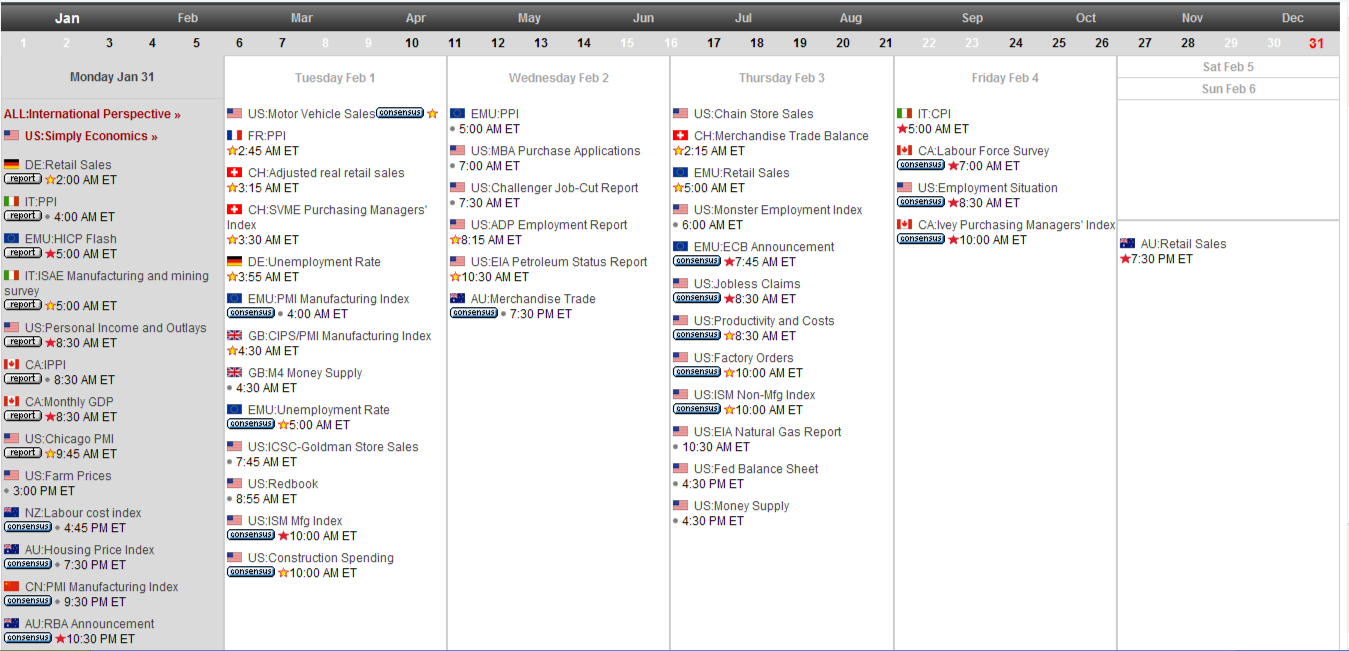
The week ahead — Economic data from Econoday.com:
Posted in Weekly Summary | No Comments »
January 21st, 2011
“Experience is helpful, but it is judgement that matters” — General Colin Powell
1. FDIC approves rule on creditors — the FDIC voted to approve regulation that outlines how the government will treat creditors in situations where large, failing financial firms have been seized and liquidated.
2. Apple’s Jobs takes medical leave — Apple (AAPL) CEO Steve Jobs unexpectedly announced that he’s taking a medical leave from the company, his second in as many years and his third absence over the last decade.
3. Eyeing growth, Obama launches regulatory review — President Obama is launching a broad regulatory review, aiming to eliminate federal rules that hamper economic growth.
4. China quarterly growth surges, inflation eases — Gross domestic product was up 9.8% year-on-year in the December-ended quarter and rose 10.3% for all of 2010, according to data released Thursday by the National Bureau of Statistics. Consumer inflation hit 4.6% year-on-year in December
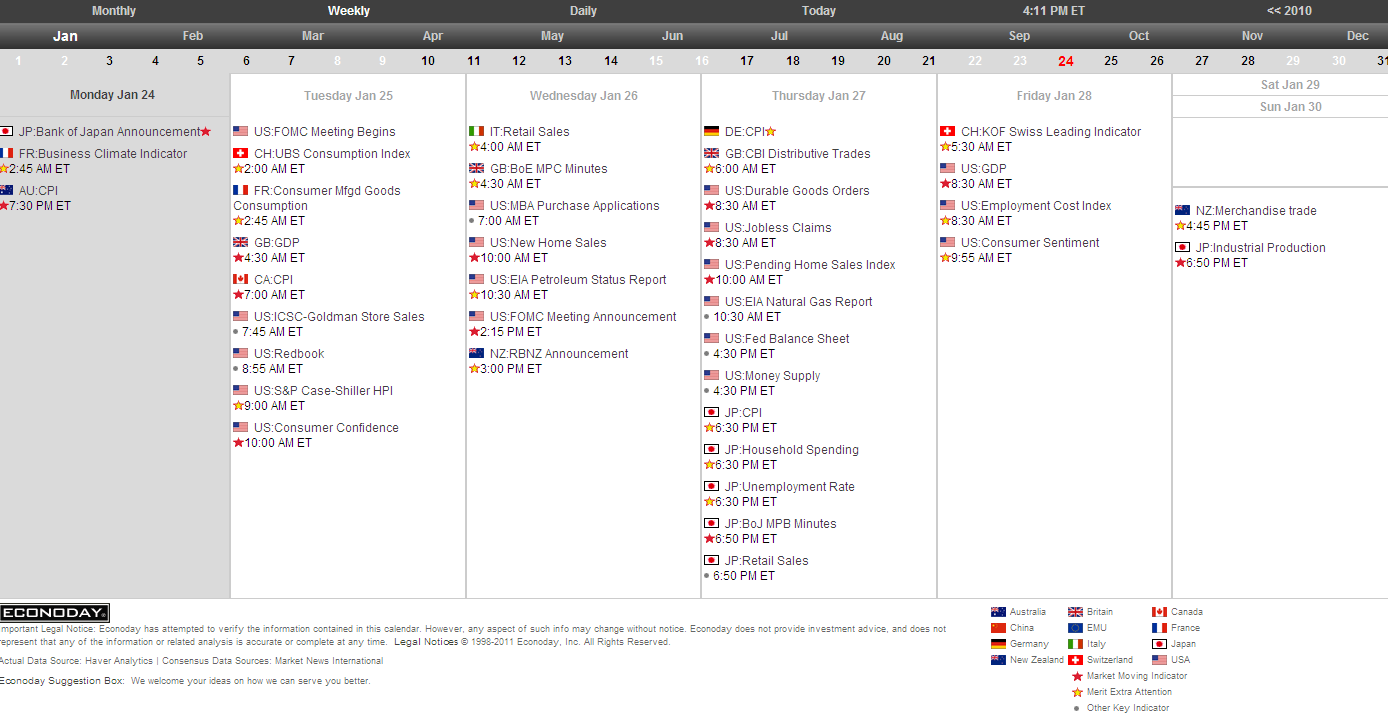
The week ahead — Economic data from Econoday.com:
Posted in Weekly Summary | No Comments »
January 17th, 2011
“[A contrarian’s opportunity]. If everybody is thinking alike, then somebody isn’t thinking” — General George S. Patton
1. FDIC weighs mortgage disclosure rules — The FDIC is reportedly considering whether to impose new rules that would require increased disclosures from major banks seeking to package and sell mortgage securities to investors.
2. China’s shrinking trade surplus — China’s trade surplus came in 40% smaller than expected in December, as export growth showed softness. The surplus for the month was $13.08B, down from $22.9B in November and vs. economists’ expectations of $21.7B. Exports were up 17.9% Y/Y vs. a 34.9% rise in November, while imports climbed 25.6% vs. 37.7% previously.
3. Bailout expectations wrack Portugal debt — news reports over the weekend and on Monday said the Portuguese government was under pressure from European Union partners to tap the rescue fund established by the EU and the International Monetary Fund in hopes such a move would quell the ongoing turmoil in European sovereign-debt markets.
4. Floods hit Rio Tinto output — Rio Tinto’s (RIO) Alcan division declared a force majeure event impacting the supply of aluminum from Boyne Smelters Ltd. in Australia as a result of severe flooding.
5. South Korea’s surprise rate hike — Bank of Korea raised its key interest rate 25 bps to 2.75%. Economists had expected the bank to leave its rates unchanged.
6. Crop forecast falls short — the U.S. Department of Agriculture surprised investors yesterday by cutting stock forecasts for key crops, sending corn and soybean prices to 30-month highs.
7. China raises reserve ratio — China raised its reserve ratio for the fourth time in two months, ordering banks to increase their reserves by 50 bps effective Jan. 20.
8. Muni bond market in turmoil — the market for municipal bonds is coming under growing pressure, as borrowers scramble to refinance tens of billions of dollars of debt and investors show lukewarm interest. Most recently, a New Jersey agency was forced yesterday to cut the size of a bond issue by 40% and pay a higher rate than expected because of tepid demand; the news sent the muni bond market to its lowest level since the financial crisis.
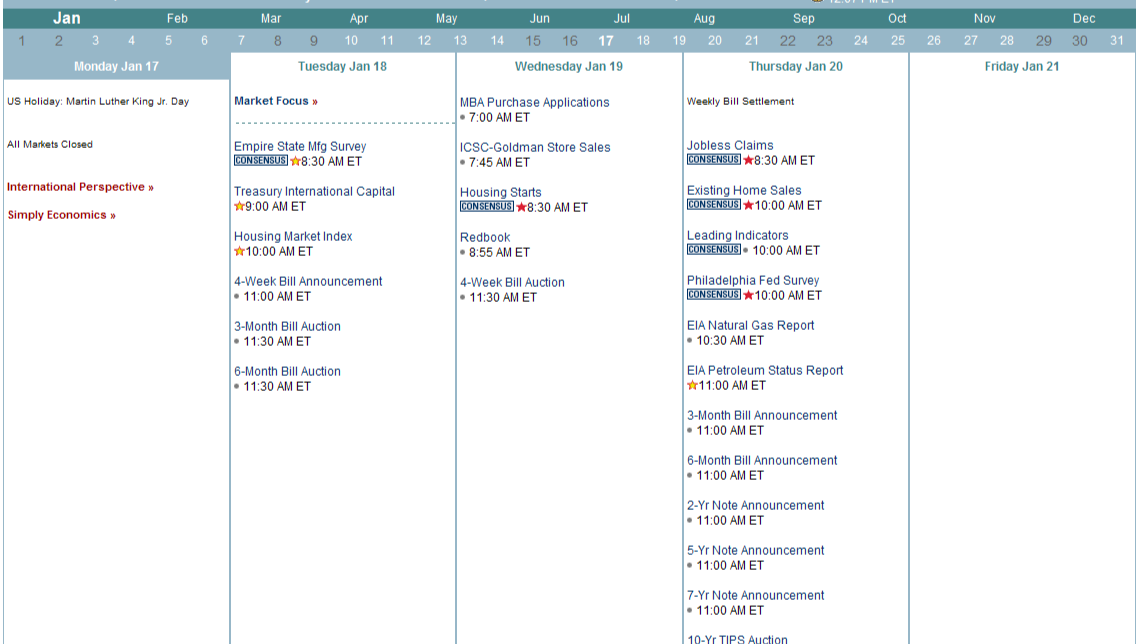
The week ahead — Economic data from Econoday.com:
Posted in Weekly Summary | No Comments »
January 10th, 2011
“I skate to where the puck is going to be, not where it was” — Wayne Gretsky.
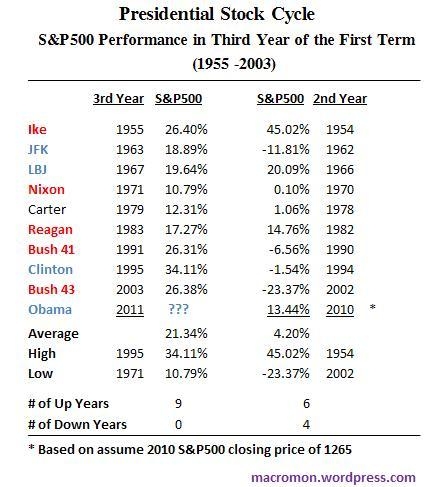
1. Presidential 3rd Year — S&P500 performance in third year (1955-2003)
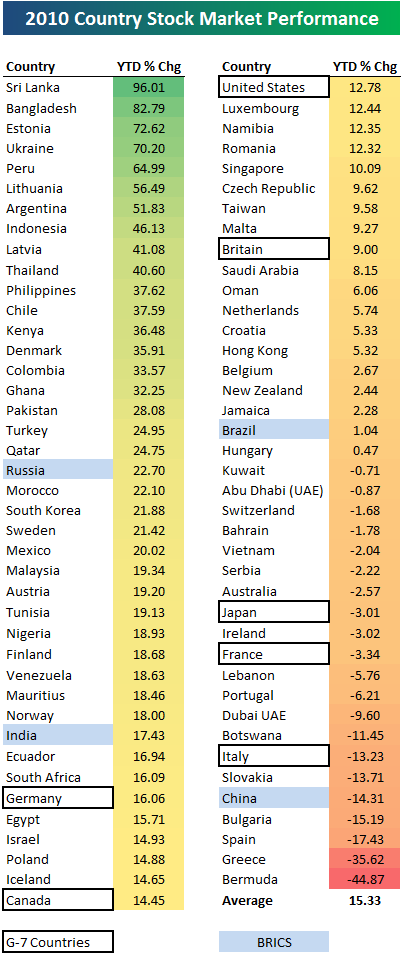
2. Below highlights the 2010 returns (in local currencies) for equity markets around the world — courtesy from the Bespoke Investment Group. As shown, the average country saw its major equity market index gain 15.33% in 2010.
3. Auto sales climb — All automakers except Toyota (TM) enjoyed gains as U.S. sales rose for the 11th consecutive month. December sales were up 11%, equivalent to an annualized sales pace of 12.6M vehicles when seasonal factors are accounted for. Overall, 2010 sales came in at 11.6M vehicles. Analysts believe 2011 sales could reach 13M, an important macro data point for the overall economy. Among December’s highlights: GM (GM) +7.5% to 223,932 vehicles, its best month of 2010. Ford (F) +6.7% to 190,976 vehicles. Chrysler (FIATY.PK) +16% to 100,702 vehicles. Toyota (TM) -5.5% to 177,488 vehicles.
4. FOMC stands by QE2 — Fed officials stood behind their bond purchases as long-term interest rates rose, saying: “While the economic outlook was seen as improving, members generally felt that the change in the outlook was not sufficient to warrant any adjustments to the asset-purchase program.”
5. Gulf spill blamed on BP, industry, regulators — The presidential commission charged with investigating the Gulf of Mexico spill has concluded that everyone is to blame, at least to some degree. The report, which will be released in full next week, slams BP (BP) and two of its contractors, Transocean (RIG) and Halliburton (HAL), for various missteps that led to an avoidable disaster.
6. U.S. inches towards debt limit of $14.3 Trillions — Economists believe the U.S. will hit its $14.3T debt limit by the end of March or sometime in April unless Congress takes action to raise the limit. Hitting the debt ceiling could force shutdowns of federal offices, as happened in 1995, jeopardize federal benefits programs or potentially cause a default on federal debt payments.
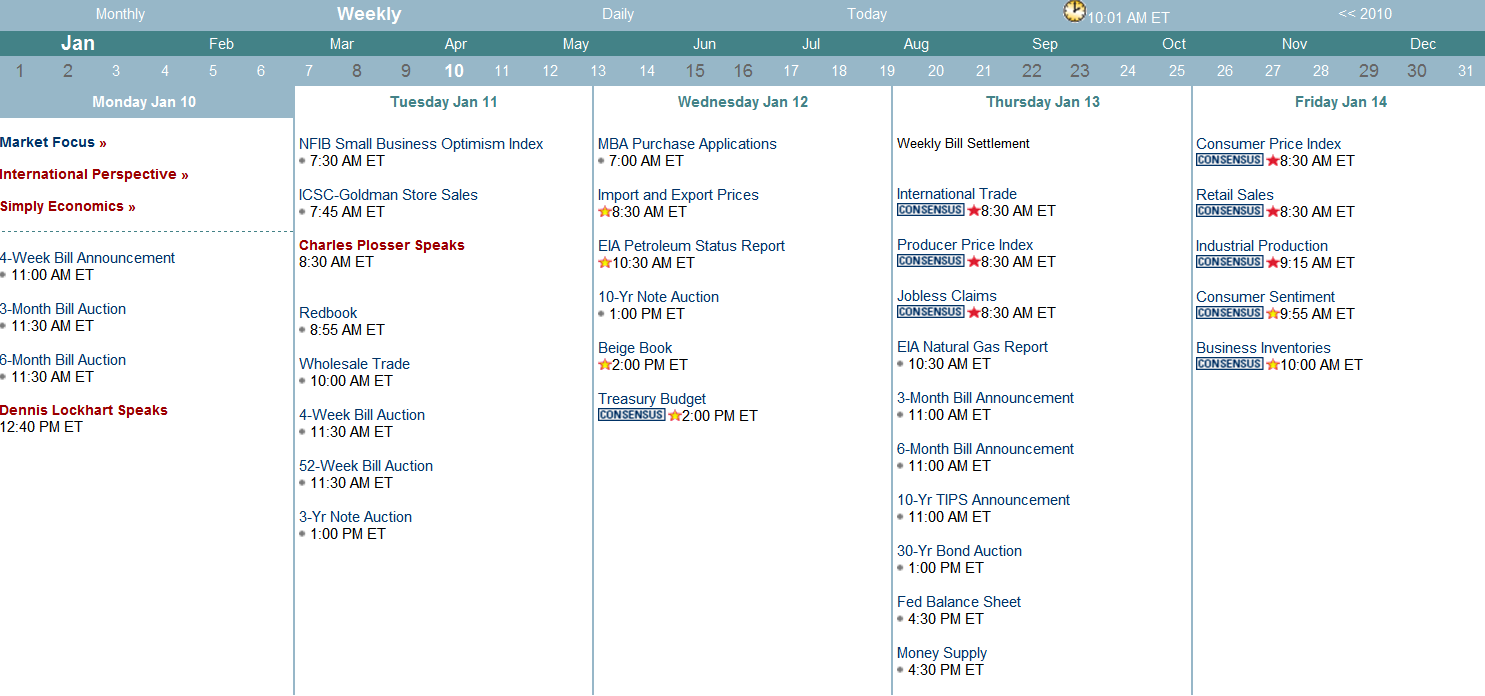
The week ahead — Economic data from Econoday.com:
Posted in Weekly Summary | No Comments »
January 3rd, 2011
“News on stock is not important. How the stocks reacts to it is!” — Michael L. Burke
1. China’s Christmas rate hike — China raised interest rates by 25 basis points on Saturday. The one-year lending rate will now be 5.81% and the one-year deposit rate will be 2.75%. It’s the second hike since mid-October as the country moves to combat inflation and slow credit growth, and some analysts believe China may front-load its monetary tightening to the first half of 2011.
2. China cuts rare earth exports — China has once again reduced its rare earth export quota, with its first round of permits for 2011 allotting 14,446 metric tons of rare earth exports split between 31 companies. This is 11% less than 2010’s first round of exports.
3. China opens anti-dumping probe — China said it will begin an anti-dumping probe into U.S. sales of livestock feed. The feed in question, known as distiller’s dried grains, is a byproduct of ethanol production from corn, and is expected to be a key new export for U.S. farmers.
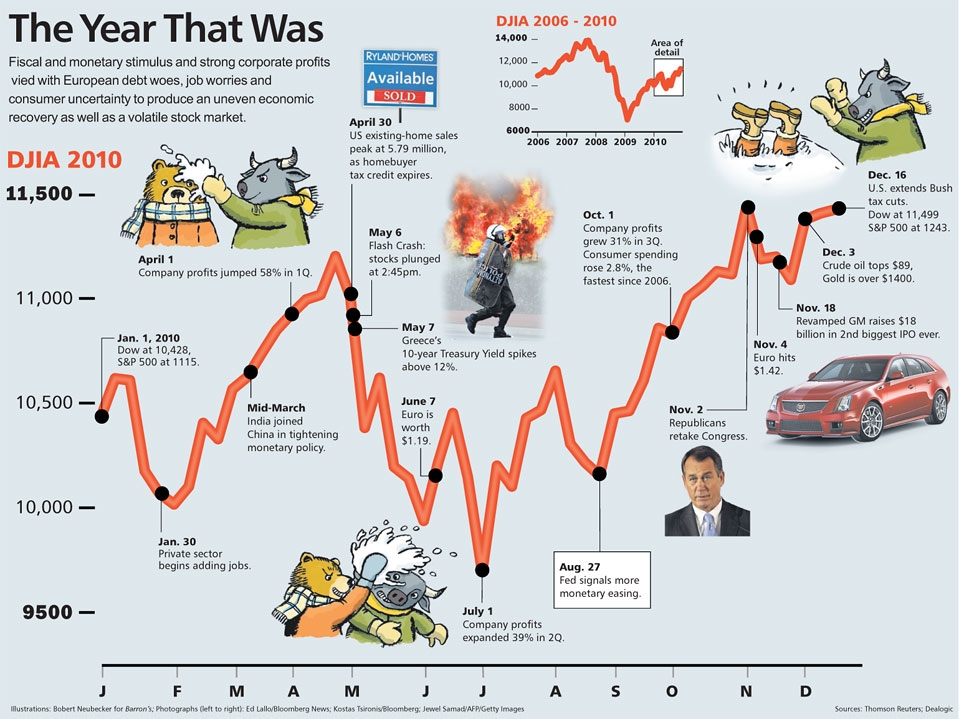
4. Barron ‘s Outlook for 2011 and 2010 Recap — http://online.barrons.com/article/SB50001424052970203319504576019660899709744.html#articleTabs_panel_article%3D1
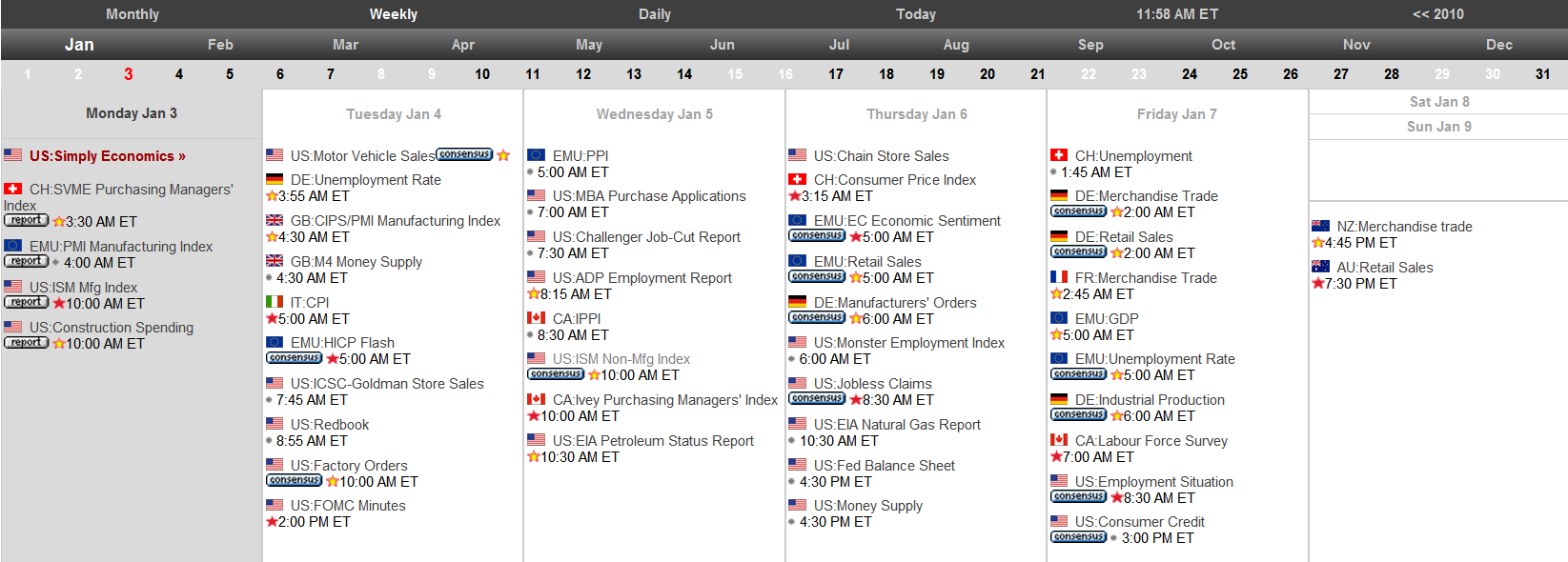
The week ahead — Economic data from Econoday.com:
Posted in Weekly Summary | No Comments »
December 27th, 2010
“Change is the law of life. And those who look only to the past or present are certain to miss the future” — John F. Kennedy.
1. FCC rolls out net neutrality rules — the FCC voted 3-to-2 in favor of launching net neutrality rules, which would go into effect early next year.
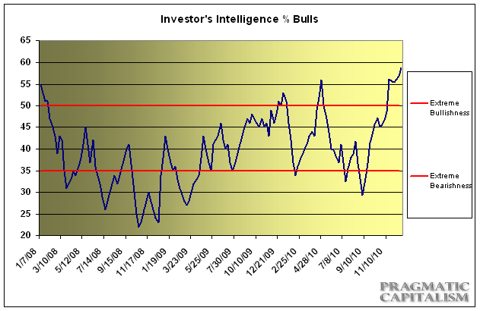
2. Bullishness Hits a Fresh High — Investor’s Intelligence survey on Dec 22 showed a fresh high bullish reading of 58.8%. This is the highest reading since the second week of October 2007 – just one week shy of the all-time market high of 1565 on the S&P 500.
3. Ireland to inject $4.9 billion into AIB — The Irish government on Thursday effectively nationalized Allied Irish Banks PLC after the nation’s High Court approved the finance ministry’s request to allow it to inject an additional 3.7 billion euros ($4.9 billion) of capital into the troubled lender.
4. China auto shares sputter as car policy unveiled — investors reacted to the Beijing municipal government’s new, aggressive measures to address traffic congestion by curbing growth in car ownership.
Officials are planning to issue about 240,000 new vehicle licenses next year, compared to 700,000 registered so far this year, Zhou Zhengyu, deputy secretary-general of the Beijing municipal government, told reporters Thursday.
The week ahead — Economic data from Econoday.com:

Posted in Weekly Summary | No Comments »
December 21st, 2010
“An investment operation is one which, upon thorough analysis, promises safety of principal and an adequate return. Operations not meeting these requirements are speculative.” – Benjamin Graham
1. Part of Obamacare ruled unconstitutional — A federal judge ruled yesterday that a key part of President Obama’s healthcare overhaul is unconstitutional, marking a significant but not necessarily fatal setback to the major legislative accomplishment. The ruling took issue with the law’s requirement that most Americans buy insurance or pay a penalty, but didn’t go so far as to say states or the federal government should stop implementing the law.
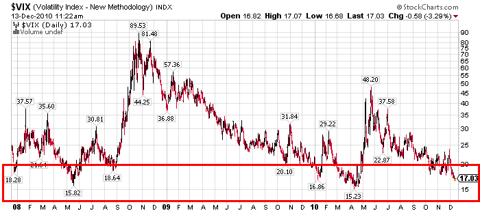
2. VIX hits low — the VIX is fast approaching levels that are consistent with very high complacency.
3. Moody’s may downgrade Spain — Moody’s warned it may downgrade Spain’s Aa1 credit rating. The country’s high refinancing needs in 2011 and the possibility of a further rise in Spain’s public debt ratio were contributing factors to the warning.
4. No surprises from FOMC — There were no surprises in yesterday’s FOMC announcement, as the committee maintained its near-zero rates, expects no rate changes for an ‘extended period,’ and stuck to its bond-buying plan. Kansas. The committee noted that the economic recovery is continuing, but not fast enough to cut unemployment. Household and business spending is rising moderately. Employers remain reluctant to hire, housing is still depressed, and underlying inflation measures are still trending down.
5. Senate approves tax deal — the Senate voted 81-19 to approve the $858B tax deal hammered out by President Obama and Republican leadership. The bill now goes to the House, where it’s expected to face stronger opposition. Lawmakers are rushing to reach a resolution before the Bush-era tax cuts expire on Dec. 31.
6. S&P boosts China’s rating — S&P raised China’s long-term sovereign credit rating to AA- from A+ this morning. S&P cited the country’s strong foreign reserves and fiscal position, adding “we believe the Chinese authorities would respond to future threats to financial stability with timely measures, based on our observations over the past two years.”
7. Moody’s cuts Irish credit rating by five notches — Moody’s Investors Service said Friday it has cut its rating on Irish government bonds by five notches to Baa1 from Aa2. The credit rating agency said the outlook for the rating is negative.
The week ahead — Economic data from Econoday.com:

Posted in Weekly Summary | No Comments »