April 22nd, 2013
“Never test the depth of the river with both feet”. — Warren Buffet
1. Precious metals in vicious sell-off — Gold continued a sell-off that began last week and has turned into a full-scale stampede. A number of reasons have been given for gold’s free-fall, chief among them the ECB’s pressurization of Cyprus’ central bank to sell its gold reserves to help pay for the country’s bailout.
2. China first quarter GDP falls short — Reuters, the world’s second-biggest economy grew 7.7 percent in the first quarter from a year ago, slower than 7.9 percent hit in Q4 2012. Industrial production data for March also disappointed, coming in at +8.9% vs consensus of +10%, although retail sales beat forecasts with an increase of 12.6%.
3. Moody’s lowers China outlook — Moody’s cut its outlook on China’s government bonds to stable from positive citing risks tied to local government borrowing. The action by the agency follows a similar measure by Fitch Ratings last week.
4. European car sales continue to plunge — European car registrations dropped for the 18th consecutive month in March, slumping 10% to 1.35M vehicles. Germany led the way as sales skidded 17%, while Spain, Italy and France all fell, although the U.K. rose 5.9%. GM’s (GM) registrations dropped 13%, Ford’s (F) 16% and Toyota’s (TM) 17%, although Honda’s (HMC) rose 17%.
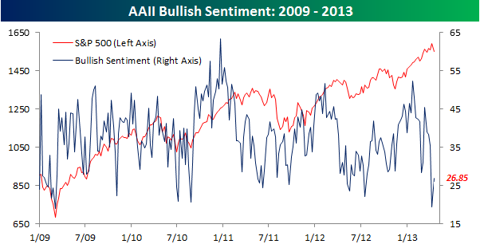
5. AAII Bullish Sentiment Update — courtesy from BIG, the sentiment survey from the American Association of Individual Investors (AAII), bullish sentiment rose from 19.3% up to 26.9%. Even at this week’s level though, there have only been 12 weeks out of 215 in the current bull market where bullish sentiment was lower.
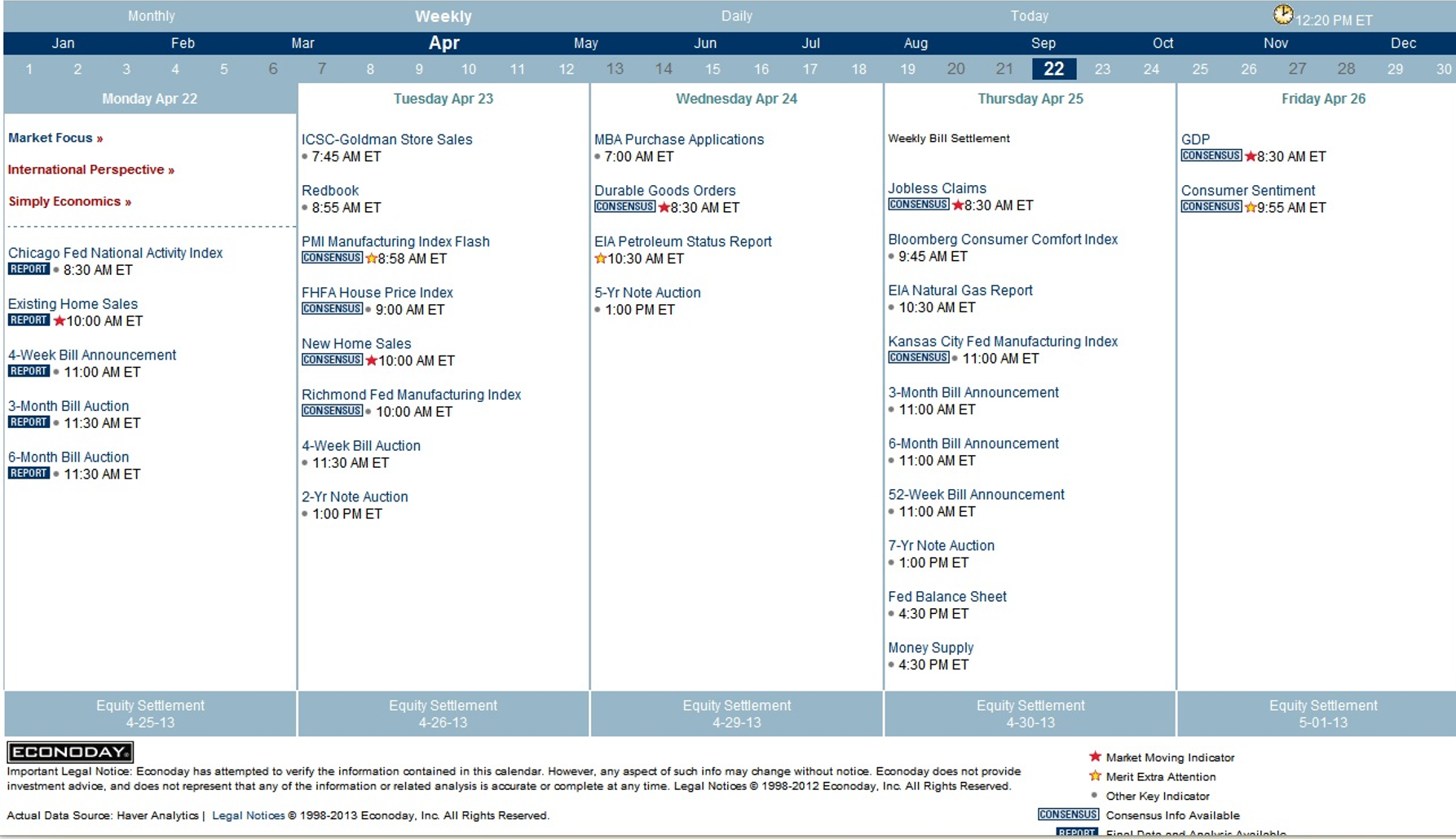
The week ahead — Economic data from Econoday.com:
Posted in Weekly Summary | No Comments »
April 15th, 2013
“Bull markets are born on pessimism, grown on skepticism, mature on optimism and die on euphoria.” — Sir John Templeton
1. Disability claims spike following recession — the number of people receiving disability benefits has jumped from 7.1M in December 2007 to an estimated 8.9M in March, or 5.4% of the civilian workforce. That compares with just 1.7% in 1970. The latest trend costs 0.6% of national output, or equivalent to around $95B a year.
2. Chinese imports suggest solid demand — China swung to a shocking trade deficit of $884M in March from a surplus of $15.25B in February, badly missing forecasts for a surplus of $14.7B. Imports rose 14% and beat consensus, helping to reduce worries over the strength of domestic demand, while exports climbed 10%. However, questions have been raised about the data, especially with exports to Hong Kong rising by what researcher IHS says is an “astounding” 92.9%.
3. Facebook to roll out new targeted ad tool — per WSJ, in an attempt to win more advertising dollars, Facebook Inc. (FB) is using new ways to cull personal information from outside the social network and match it with data submitted by its billion-plus users. Facebook launched a new last week that will help advertisers directly target its members based on their non-Facebook activity, including their Web surfing, email subscriptions and spending. The tool combines the social network’s data with that from third-party marketers such as Acxiom (ACXM) and Alliance Data Systems (ADS).
4. Japan Return from 1994 to Present —
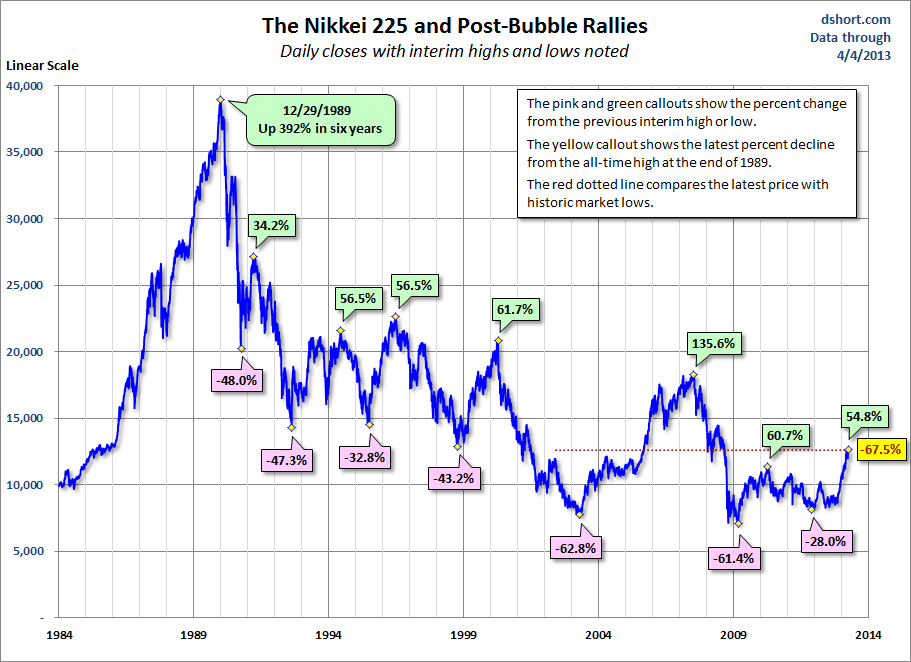
5. Obama signs order for $109 billion in 2014 sequester cuts — President Barack Obama signs order for the next $109 billion of the reductions to military and domestic programs for the year starting on October 1, 2013.
6. Retail sales post biggest drop in 9 months — Marketwatch, spending falls by 0.4% in March as most stores take a hit. Sales for January were also revised to show a 0.1% drop instead of a 0.2% increase, suggesting that first-quarter growth might not be as strong as forecast.
7. Cost of Cyprus bailout ‘rises to 23bn euros’ — The cost of the bailout for Cyprus has increased to 23bn euros ($30bn; £19.5bn), according to a draft document prepared by the country’s creditors. Cyprus will have to find 13bn euros to secure 10bn euros from the European Union and the IMF.
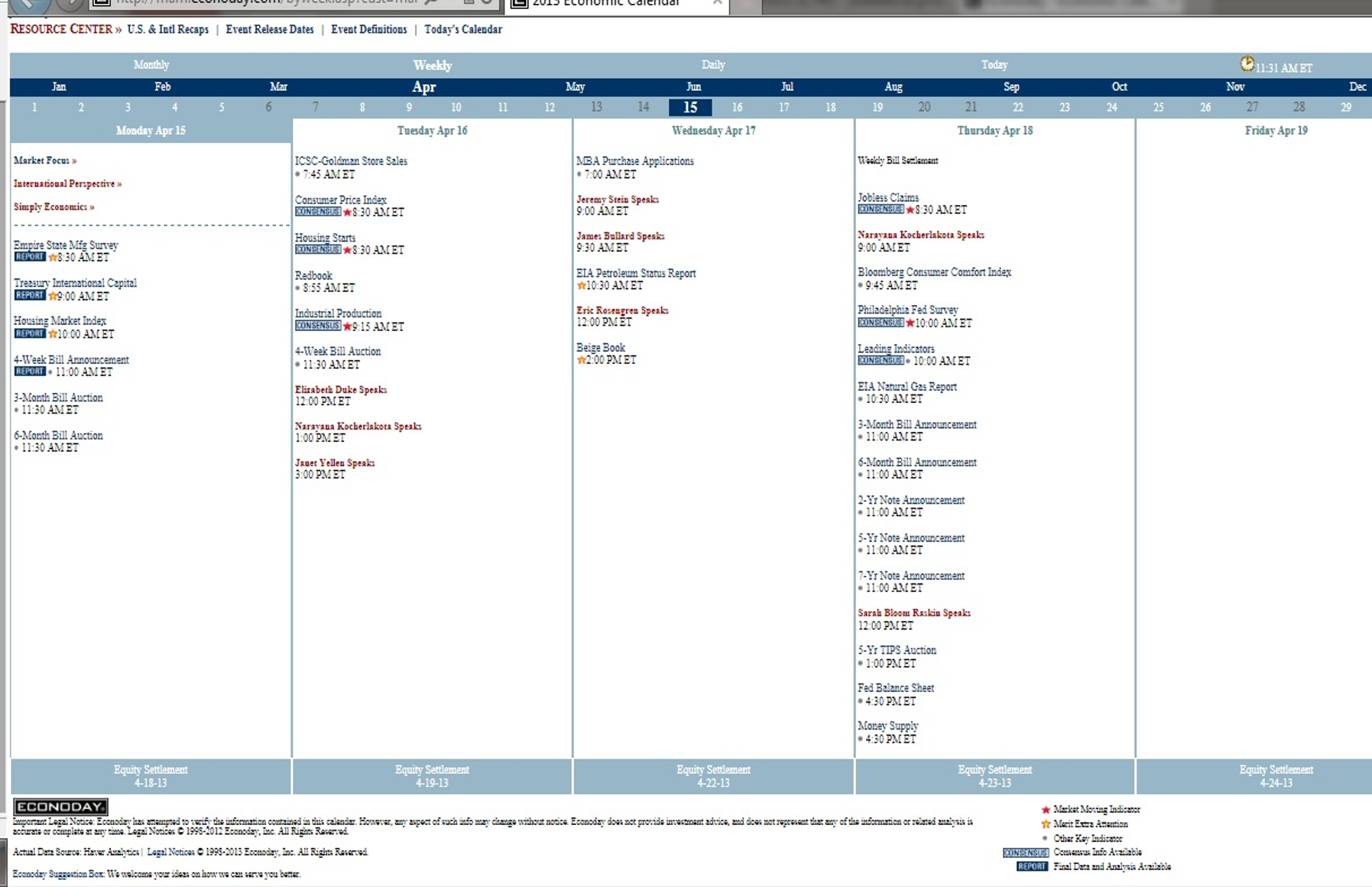
The week ahead — Economic data from Econoday.com:
Posted in Weekly Summary | No Comments »
April 8th, 2013
“All truth passes through three stages. First, it is ridiculed. Second, it is violently opposed. Third, it is accepted as being self-evident.” —Arthur Schopenhauer
1. China unveils new property curbs — China trying to cool the again-bubbly property market, Beijing banned single-person households in the city from buying more than one residence and increased the minimum down-payment required for all buyers of 2nd homes.
2. Factories Cool Off As Possible Spring Slowdown Looms — ISM’s manufacturing gauge fell 2.9% to 51.3 in March, signaling a slower pace than expected. It shows a possible sign of another economic slowdown this spring according to IBD.
3. Stockton cleared for bankruptcy protection — in a blow to municipal bondholders, a judge has ruled that Stockton in California is eligible for bankruptcy protection. The decision allows the city to keep its pensions intact while imposing losses on those holding its paper. Jefferson County in Alabama and San Bernardino in California – along with other municipalities – are watching closely.
4. Court tells holdouts to respond to Argentina’s bond offer — A U.S. appeals court ordered holdout creditors to respond to Argentina’s proposal to offer them restructured bonds that either discount the original debt’s face value or extend the final payout years into the future. Argentina had been trying to avoid returning the full amount, sparking fears it could default, as it did in 2001.
5. Japan unveils massive stimulus plan (EWJ) — the Bank of Japan (BOJ) said it would increase its purchase of government bonds by 50 trillion yen ($520bn; £350bn) per year in its most aggressive steps to date to battle deflation and a stagnant economy. The BOJ will buy $79 bil in bonds a month, that is the equivalent of almost 10% of Japan’s annual gross domestic product.
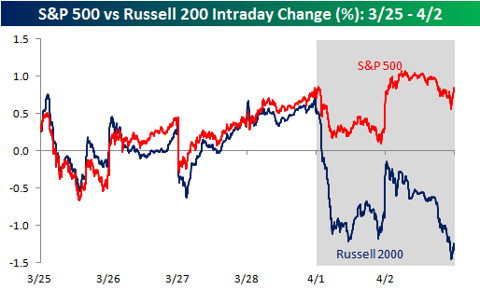
6. Russell 2000 Vs. S&P 500 Divergence — is it a warning sign of things to come for small caps and the broader market? Below is the chart of the two indexes courtesy of BIG.
7. Hong Kong hit by bird flu fears — Hong Kong stocks suffered their worst drop in more than eight months last week as worries about the impact from a new strain of avian flu in China hurt sentiment, airline shares were hit the most. Below is the chart of the HangSeng during the last bird flu crisis. 
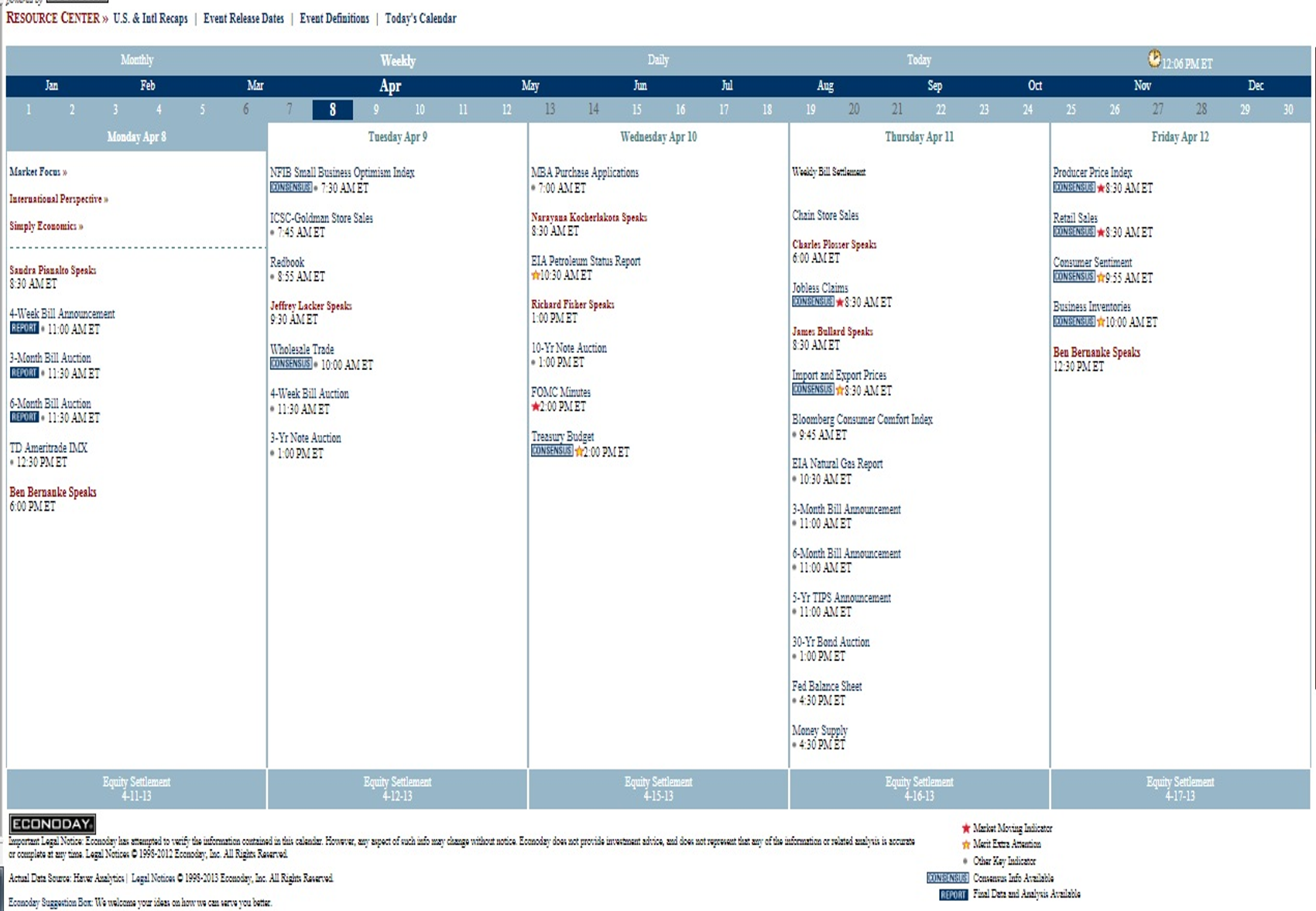
The week ahead — Economic data from Econoday.com:
Tags: Bird Flu Crisis, Divergence
Posted in Weekly Summary | No Comments »
April 1st, 2013
“If something anticipated arrives too late it finds us numb, wrung out from waiting, and we feel – nothing at all. The best things arrive on time.” – Dorothy Gilman
1. Senate backs online sales tax measure — the Senate has voted 75-24 to allow states to collect sales taxes from online retailers with $1M+ in annual revenues and no presence within a given state’s borders. While the vote was non-binding, the margin of victory suggests a filibuster shouldn’t be a problem when a binding vote is held. Amazon (AMZN) and eBay (EBAY) have already begun collecting in a number of large states, and many investors assume that collections will expand in time.
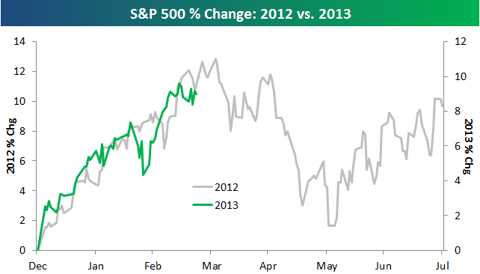
2. S&P500 Comparison between 2012 versus 2013 — courtesy of BIG, below is a chart showing the performance of the S&P 500 in 2013 overlaid on a chart of its performance in 2012 through the end of July. As shown, while the S&P 500 was up slightly more in the first quarter of 2012, the index has tracked its 2012 pattern pretty closely in the first quarter of this year.
3. Cyprus works to avert run on banks — Cyprus prepared capital controls to prevent a run on the banks after being closed for almost two weeks. Russia has warned Cyprus not to make the controls too onerous. Uninsured depositors at Laiki bank, which is being shut down, will probably lose 80% of their cash, the rest of which could take years to return, while those at Bank of Cyprus could take a haircut of up to 40%.
4. JPMorgan Chase Faces Full-Court Press of Federal Investigations — from DealBook, Federal prosecutors are reportedly investigating whether JPMorgan (JPM) breached the law by not fully alerting authorities about suspicions related to Bernard Madoff. The probe adds to several others JPMorgan is facing. At least eight federal agencies are investigating the bank, including the Federal Deposit Insurance Corporation, the Commodity Futures Trading Commission and the Securities and Exchange Commission. Federal prosecutors and the F.B.I. in New York are also examining potential wrongdoing at JPMorgan.
5. Government funded until September — President Barack Obama yesterday signed the FY 2013 funding bill into law, one day before the previous financing measure was due to expire. The package includes the $85B of sequestration and ensures that the government will be financed until the end of the fiscal year in September, with spending projected at $984B.
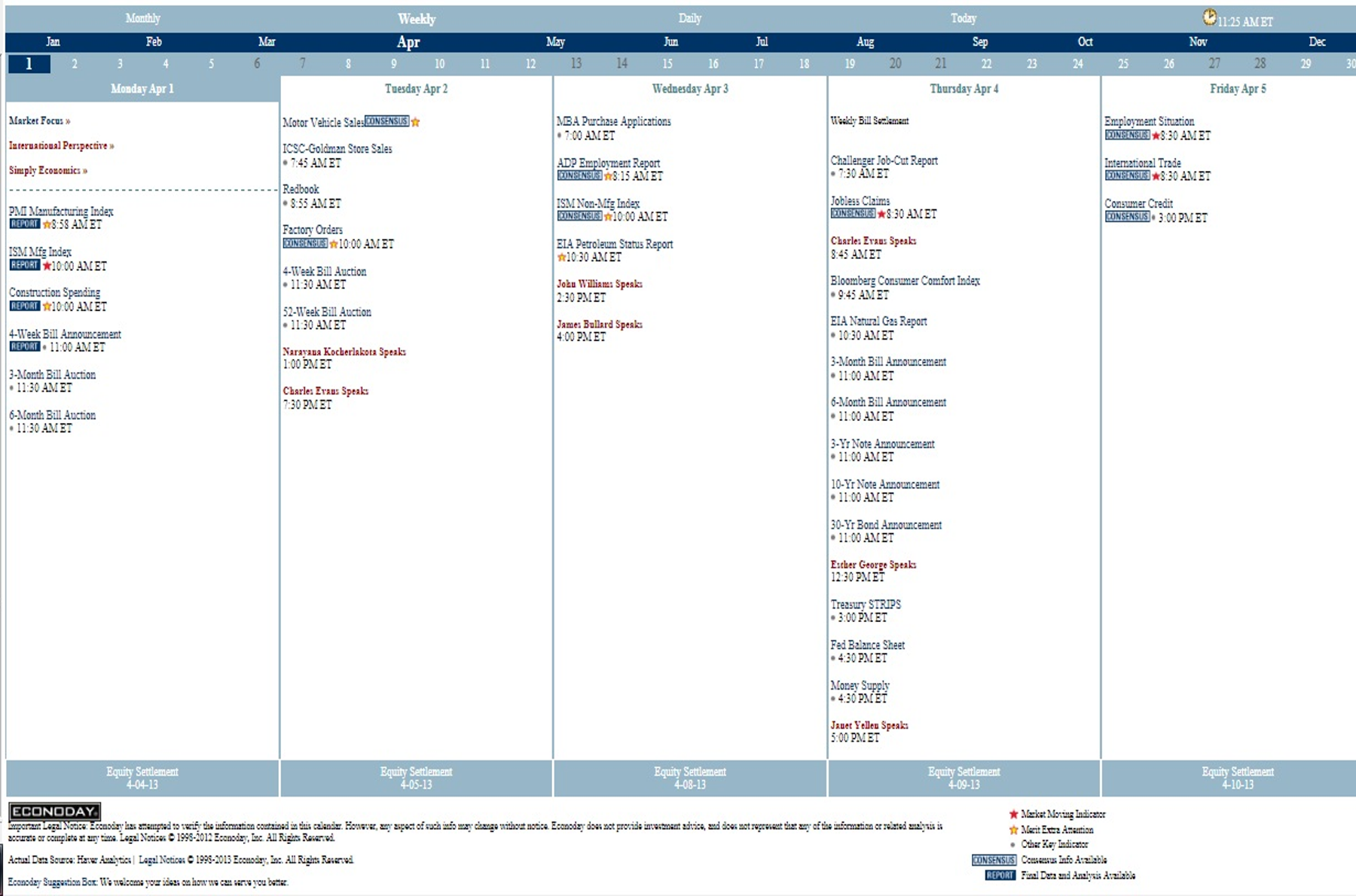
The week ahead — Economic data from Econoday.com:
Posted in Weekly Summary | No Comments »
March 25th, 2013
1. Creditors and Large Depositors to take Large Loss in Cyprus Rescue from the EU — hours before a possible financial meltdown in Cyprus, the eurozone agreed to a €10B bailout in which the country’s second-largest bank, Laiki, will be closed and its operations folded into Bank of Cyprus. Deposits of over €100,000 will be hit with a large tax, perhaps 30% or more, while those below that level will be left untouched. Laiki’s senior bondholders will be wiped out, while Bank of Cyprus’s creditors will also be affected.
2. Fears Arise that Farming is Heading for a Bust — NYTimes, Rising crop prices, particularly corn, have sent the cost of farmland soaring, with prices in Iowa, for example, doubling to an average of $8,296 an acre since 2009. The trend has prompted farmers to expand and has attracted investment companies, but with data about rural debt incomplete, economists fear that the boom will at some point turn into a bust, leaving a trail of bankruptcies and out-of-pocket creditors.
3. Freddie Mac sues 15 banks over Libor Rigging Scandal — Freddie Mac (FMCC.OB) has sued Bank of America (BAC), JPMorgan (JPM), Citigroup (C) and 12 other banks for losses caused by the manipulation of the Libor rate. Freddie, which invested in mortgage bonds and swaps tied to U.S. dollar Libor, is seeking a whole gamut of damages. The FHFA has already calculated that Freddie and Fannie Mae (FNMA.OB) lost a combined $3B because of the Libor manipulation.
4. Bank of England (BOE) voted 6-3 to reject more Quantitative Easing (QE)– The Bank of England’s monetary policy committee voted unanimously to keep interest rates on hold at a meeting earlier this month and 6-3 against more quantitative easing. As in February, Governor Mervyn King was among those wanting the bank to increase the program by another £25B to £400B.
5. FOMC Maintains Its Current Policy of Bond Buy — the Federal Reserve has left its $85B-a-month QE program in place, saying that the economy has returned to moderate growth even as fiscal policy has become more restrictive. Notable among the revised economic projections was an expected improvement in the unemployment rate.
6. Household net worth drops 36% in six years — WSJ, the median net worth of American households dropped to $69,000 in 2011 from $82,000 in 2000 and $107,000 in 2005, a census report shows. Meanwhile, debt in households headed by older people more than doubled during the decade to a median $26,000 from $12,000, largely because of mortgage loans. The trend increases worries about the financial well-being of older Americans, whose retirement funds have been hit by the recession and rock-bottom interest rates.
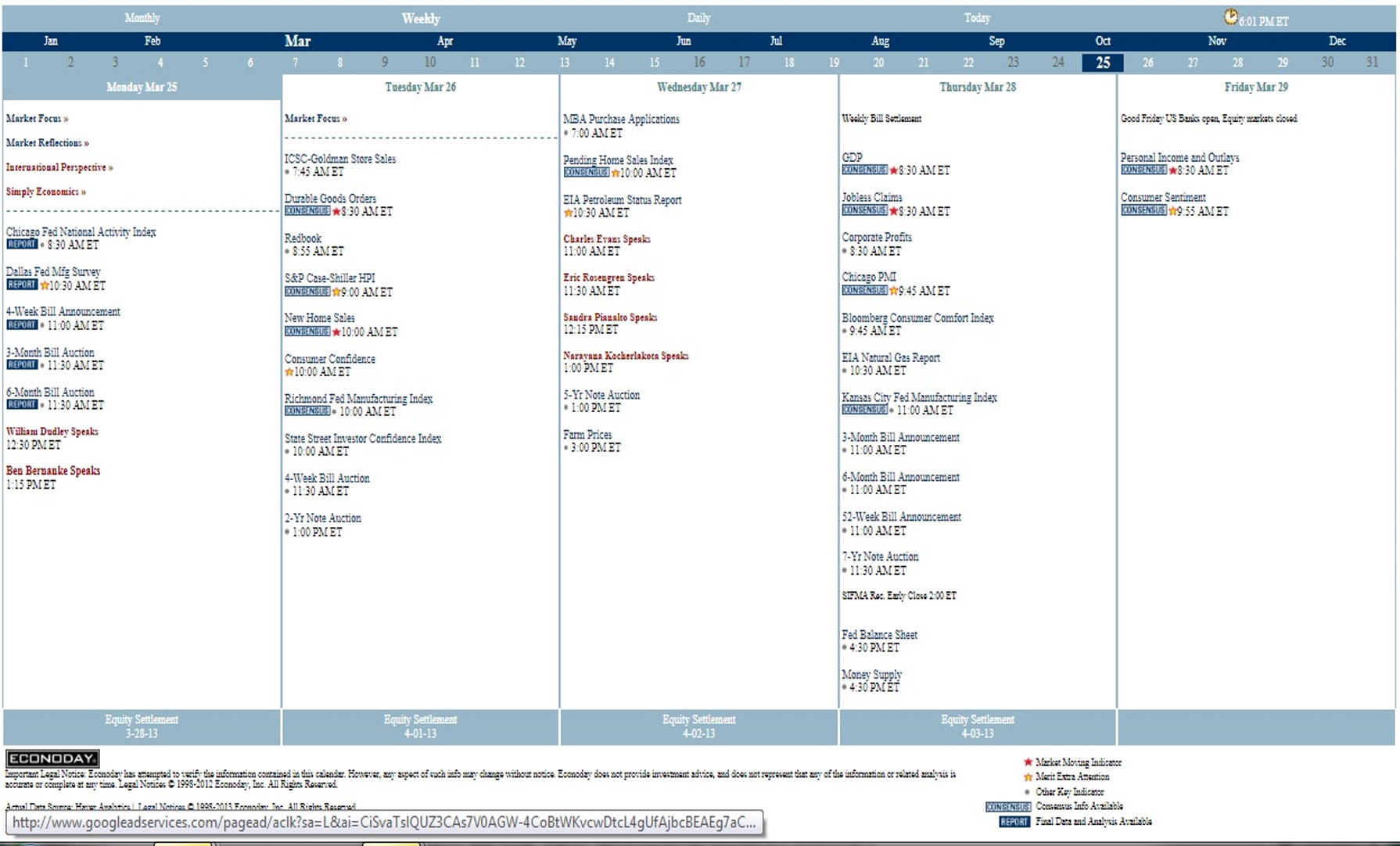
The week ahead — Economic data from Econoday.com:
Posted in Weekly Summary | No Comments »
March 18th, 2013
“I always keep these seasonal patterns in the back of my mind. My antennae start to purr at certain times of the year” — Kenneth Ward
1. UK manufacturing slump raises risk of triple-dip — per theguardian, U.K. manufacturing and industrial production unexpectedly fell in January, renewing fears that Britain will enter a triple-dip recession. Manufacturing output dropped 1.5% on month and industrial production 1.2%, with the latter hurt by the suspension of a North Sea oil platform.
2. U.S. retail sales climb 1.1% in February — U.S. consumers boosted purchases at retail stores in February. Excluding autos and gas, sales rose a smaller 0.4% while other sectors did not fare as well. Sales dropped 1.6% at home-furnishing stores, 1.0% at department stores, 0.9% at sporting goods and hobby stores, and 0.7% at bars and restaurants.
3. China’s Stocks Slump to Two-Month Low on Property Curbs Concern — Bloomberg, Chinese stocks fell, dragging the benchmark index to a two-month low, as real estate and construction companies tumbled on concern policy makers will step up property curbs. Zhou Xiaochuan, the Governor of the People’s Bank of China, has said the country should be on “high alert” over inflation after February’s price increases topped expectations. Monetary-policy is “no longer relaxed” and is “neutral,” he said. Zhou’s remarks add to signs that China is tightening policy even as its recovery may be hitting a bump, including the city of Shenzen banning property developers from raising home prices.
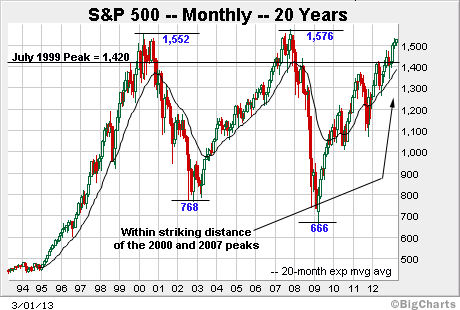
4. S&P eyes record high — the S&P 500 up to make a fresh challenge on its all-time high after it closed just 11 points shy of the mark last Friday, and the Dow Jones to continue its record run. Below is a repost of the S&P500 chart of all time high.
5. CFTC looks at possible gold and silver manipulation6. Fed OKs 16 bank capital-return programs but rejects two — The Federal Reserve has approved the capital return plans of 14 banks and rejected two – those of Ally and BB&T (BBT). Goldman Sachs (GS) and JPMorgan (JPM) received conditional approval and were asked to resubmit their programs by the end of Q3 to “address weaknesses in their capital planning processes.” JPM wants to raise its dividend to $0.38 from $0.30 and repurchase $6B in shares.
7. China appoints Li Keqiang as Premier — China’s National People’s Congress has appointed Li Keqiang as the country’s first ever premier with a doctorate in economics. The selection of Li, who replaces Wen Jiabao, follows the election of Xi Jinping as President. The legislature will complete China’s once-a-decade transfer of power tomorrow with ministerial and other appointments.
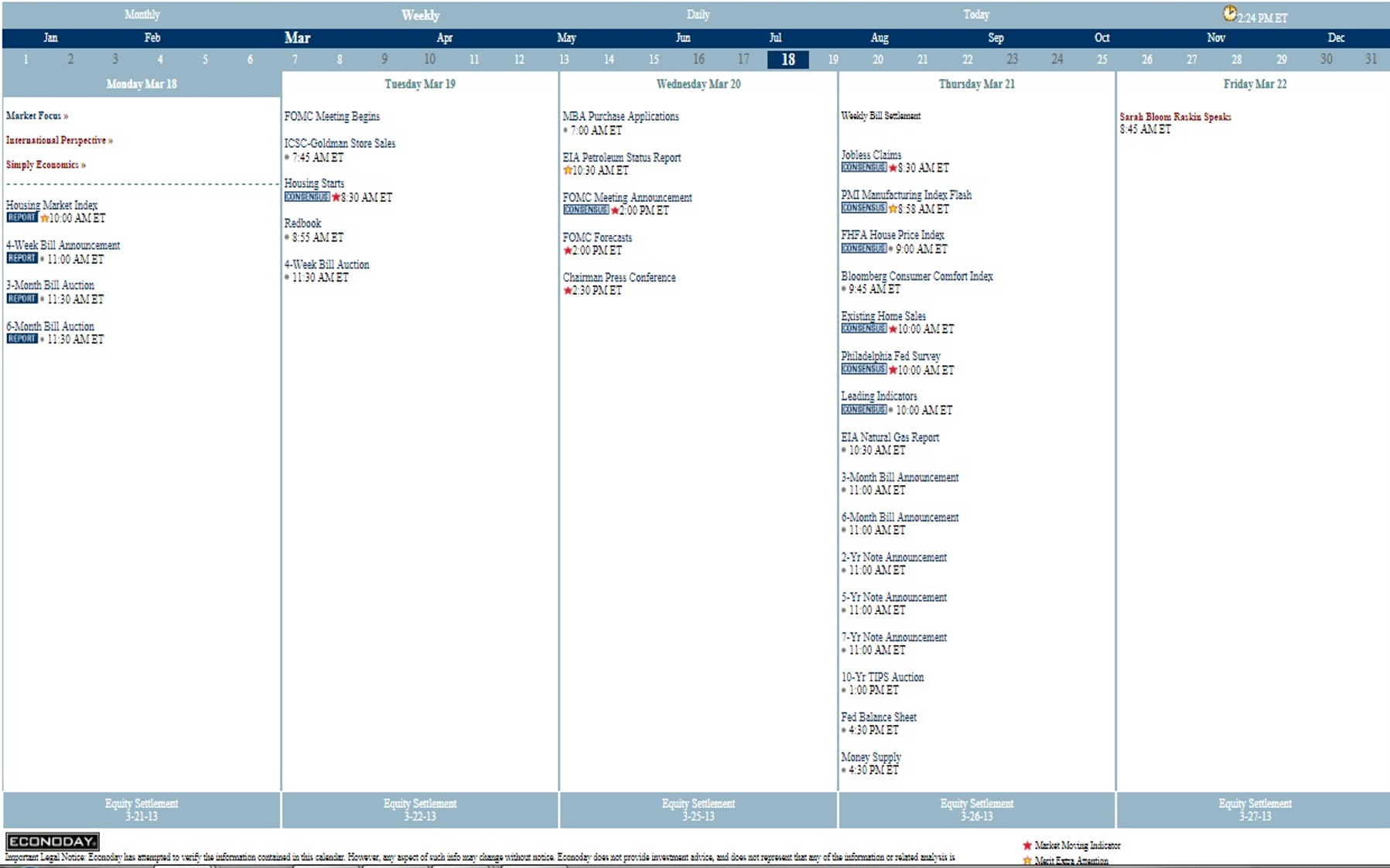
The week ahead — Economic data from Econoday.com:
Posted in Weekly Summary | No Comments »
March 11th, 2013
“He who fights and runs away, lives to fight another day” — Unknown
1. Chinese shares tumbled on government property action — Chinese shares closed sharply lower, led by real-estate developers, after Beijing intensified its three-year campaign to curb rising property prices by ordering larger deposits and a stricter enforcement of sales taxes.
2. China passes U.S. as world’s top oil importer — China has tentatively passed the U.S. as the biggest importer of oil in the world, with EIA data showing that China’s incoming shipments hit 6.12M bpd in December and those of the U.S. fell to 5.98M bpd, the lowest since February 1992. It’s worth pointing out that tax maneuvering may have distorted December data, while U.S. imports tend to recover in January.
3. China Puts Focus on Consumers to Drive Growth — China has given itself a GDP growth target of 7.5% for 2013, which would be below last year’s 7.8%. At the opening of the annual National People’s Congress, the finance ministry said it plans to increase the country’s budget deficit to 1.2T yuan ($192.8B), or about 2% of GDP from 1.6% in 2012. Much of the increased spending will go on social programs as China looks to shift the focus of its economy towards the consumer and away from exports and infrastructure.
4. Shell plans LNG plants in Louisiana and Canada — Shell (RDS.A) announced plan to construct facilities in Louisiana and Canada that will produce LNG for heavy trucks and large ships, with the idea being to increase the demand for the glut of natural gas in North America. A Great Lakes cargo-ship operator has already pledged itself as a customer, while Shell plans to run three vessels in the Gulf of Mexico on natural gas.
5. Euro Zone to Bail Out Cyprus, No Details Available — per CNBC, Eurozone finance ministers intend to agree on a bailout for Cyprus – which is seen as systemically important to the eurozone despite its small size – by the end of the month, although it’s not clear how the rescue would be financed. Cyprus needs up to €17B, an amount that would lift its debt-GDP ratio to 145%.
6. Time Warner to spin off magazine operations — Time Warner (TWX) plans to spin off Time Inc. into a publicly-traded company, with the goal being to complete the transaction by the year-end. Division CEO Laura Lang will leave after the process is completed. Time Inc. publishes the namesake magazine, Sports Illustrated, Fortune, and dozens of other titles, along with related web sites and mobile apps.
7. Fed Stress Tests for Banks — eighteen major banks have passed the Fed’s stress tests, showing they’d have a Tier 1 Common Ratio of over 5% in the central bank’s “severely adverse” economic scenario. That includes GDP slumping 5%, unemployment of 12%, a 50% fall in stocks and recessions overseas. Only Ally Financial failed, while Citigroup (C) came out as the most overcapitalized of the largest banks with an 8.3% common ratio.
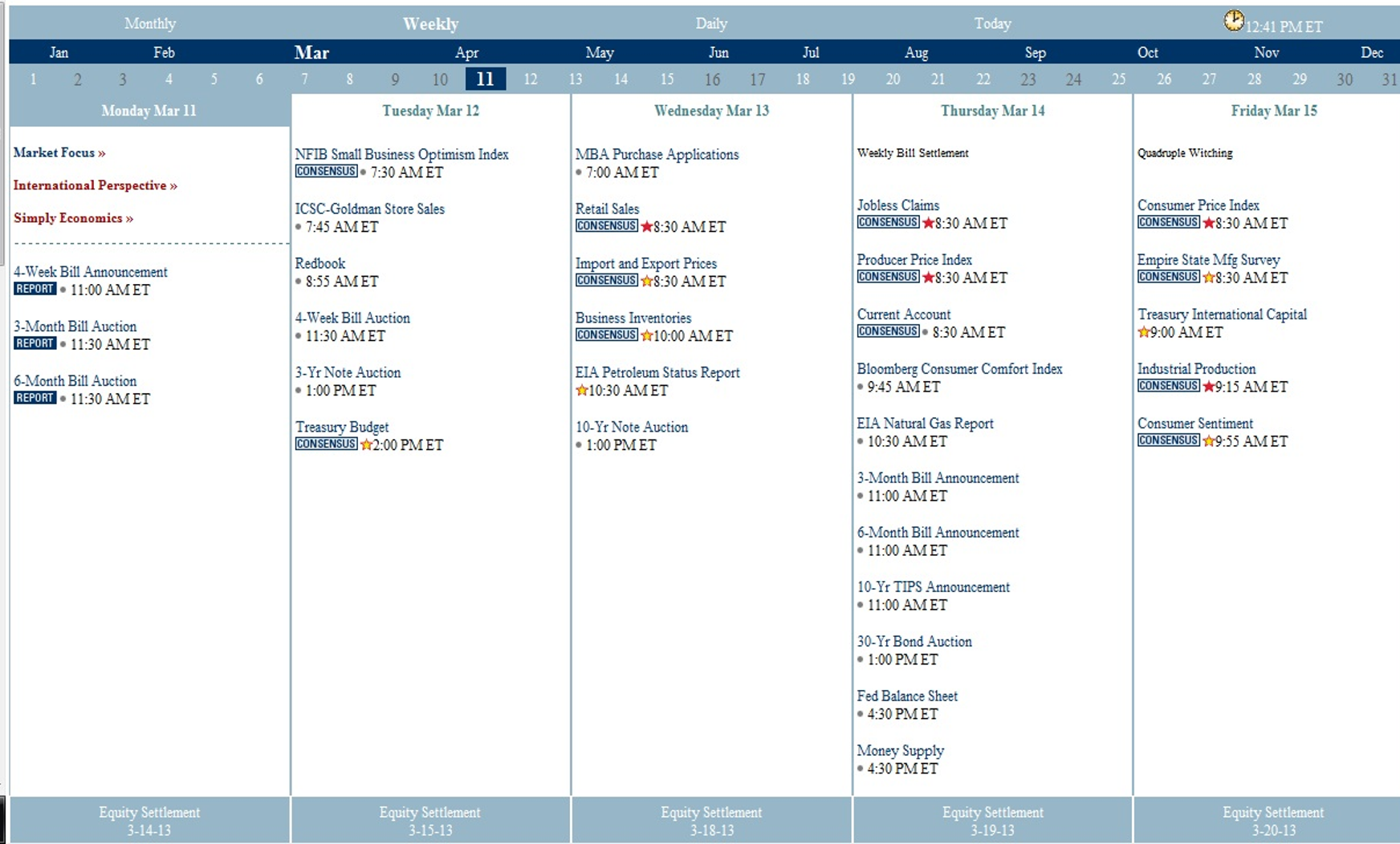
The week ahead — Economic data from Econoday.com:
Posted in Weekly Summary | No Comments »
March 6th, 2013
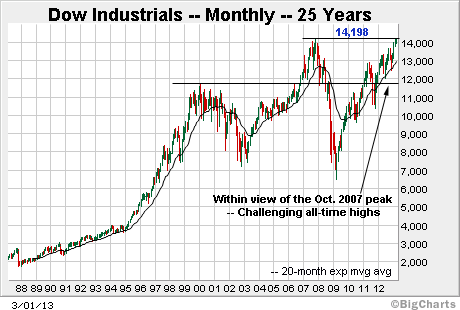
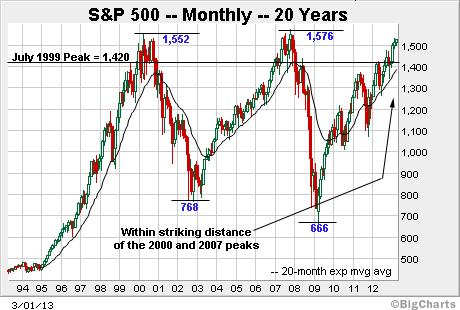
DJIA Set New Record Highs Since 2007 — the Dow Jones closed +0.83% at a record high of 14246 and surpassed 2007. Below are the charts of the DJIA (past 25 years) and the S&P500 (last 20 years).
Posted in Uncategorized | No Comments »
March 4th, 2013
“In investing, the return you want should depend on whether you want to eat well or sleep well.” — J. Kenfield Morley
1. Italy Bond yields rise to 4-month high as it sells 6-month debt — the results of the Italian election have immediately hit the government where it hurts, with yields jumping to 1.24% in an auction of €8.75B in 6-month sovereign bonds from 0.73% in a sale in January. The bid-to-cover ratio fell to 1.44 from 1.65.
2. 4Q GDP Revised up — per Marketwatch, the nation’s entire output of goods and services, known as gross domestic product, expanded at an annual 0.1% pace in the fourth quarter, the Commerce Department reported. Initially the government said last month that the economy contracted by 0.1%, which would have marked the first decline since the second quarter of 2009. The revised GDP report showed that construction spending rose faster than previously estimated while exports fell less than the government thought. That nudged GDP into positive territory.
3. Sequester cuts set to kick-in as Senate bills fail — Automatic federal budget cuts of $85 billion looked certain to kick in Friday after a pair of bills to replace them failed in the Senate. The budget cuts for fiscal 2013 would not take effect all at once on Friday. Instead, they would go into effect gradually through the end of the fiscal year on Sept. 30. In total, the sequester would cut about $1 trillion over nine years.
4. Chinese manufacturing slows in February — China’s factory activity weakened last month as the official PMI, which focuses on larger state-owned companies, unexpectedly fell to 50.1 from 50.4 in January. HSBC’s PMI, which concentrates on smaller private firms, dropped to 50.4 from 52.3. The timing of the Chinese New Year may have affected the figures.
5. Default worries send Argentine markets into turmoil — fears that Argentina will default hit the country’s markets yesterday, with the Merval stock index tumbling 3.5% and the cost to insure $10M of its debt for one year rising to a whopping $6.6M. The turmoil came after a lawyer representing Argentina’s government told a U.S. court on Wednesday that it would choose to default rather than pay bondholders who won’t accept restructured debt that was issued following the 2001 crisis.
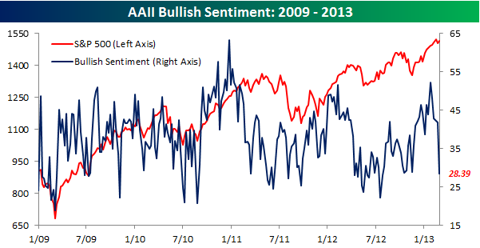
6. AAII Plummeted — according to the weekly sentiment survey from the American Association of Individual Investors (AAII), chart courtesy from the Bespoke Investment Group, bullish sentiment plummeted from 41.79 down to 28.39. This was the largest weekly decline since November 2010, and it was the lowest weekly reading since last July.
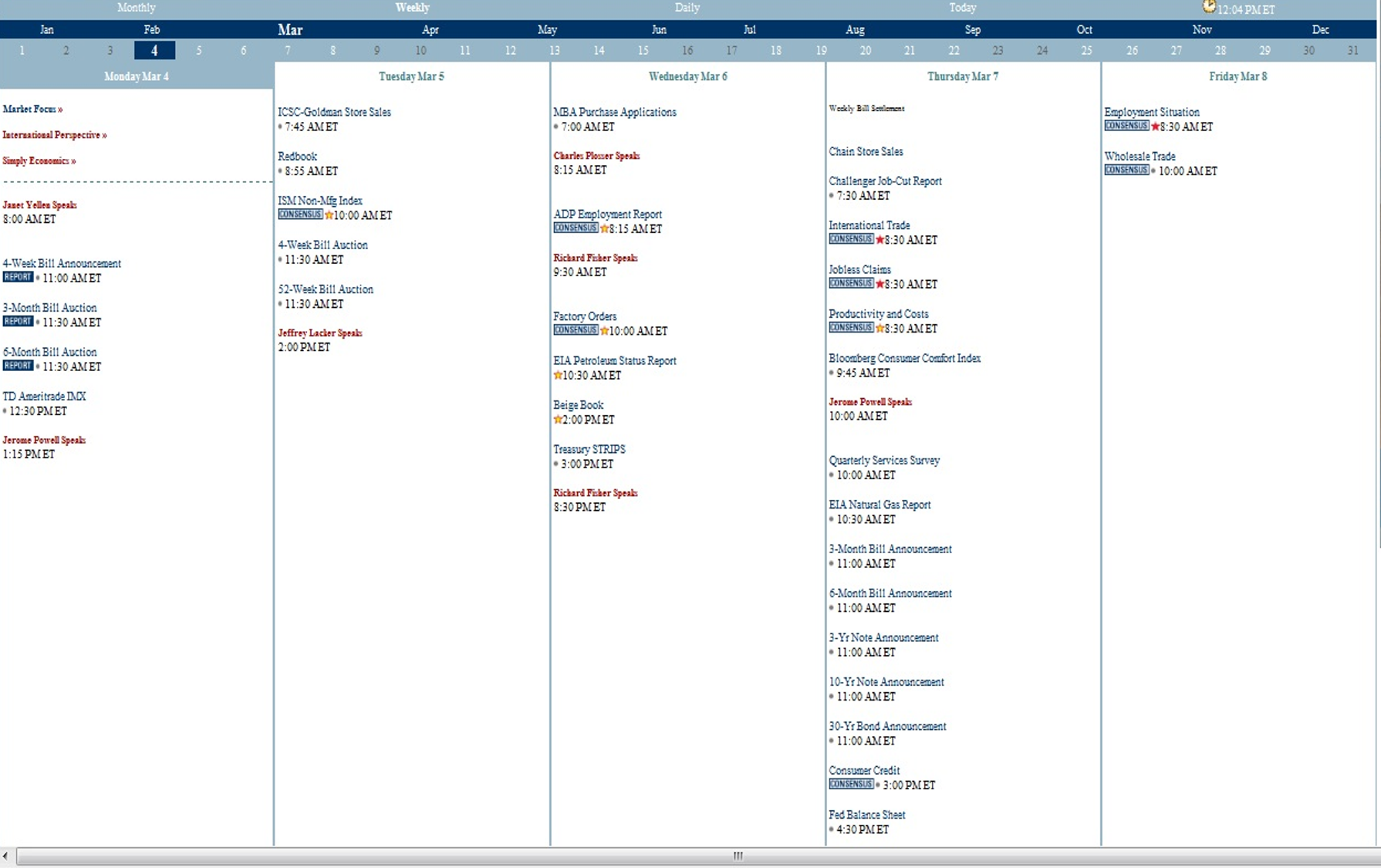
The week ahead — Economic data from Econoday.com:
Posted in Weekly Summary | No Comments »
February 25th, 2013
‘If you are going to be wrong, be wrong quickly with a de minimis loss of capital’.” — unknown
1. Chinese Army Unit Is Seen as Tied to Hacking Against U.S. — according to NYT , Chinese army unit 61398, also known as “Comment Crew,” has been identified as most probably responsible for numerous cyberattacks on U.S. targets, security company Mandiant has alleged in a report. While Mandiant didn’t name specific targets, victims include Coca Cola (KO) and VMware’s (VMW) RSA, as well as a firm with access to over 60% of oil and gas pipelines in North America.
2. NY Fed wants to let BofA off over AIG assets — the NY Fed is apparently trying to let Bank of America (BAC) off the hook for possible sizable legal claims related to former AIG (AIG) mortgage securities held by Maiden Lane II following the insurer’s bailout in 2008. AIG has sued BofA to recover some of the $18B losses it suffered on the assets, but the bank argues that AIG gave its right to sue to the NY Fed when it sold the assets.
3. Bank of England chief wanting more asset buying — Bank of England Governor Mervyn King and two other officials voted to restart government-bond buying earlier this month, showing the bank closer than expected to taking more action to lift economic growth.
4. Japan’s trade deficit hits fresh record — Japan’s trade deficit increased to a record ¥1.63T ($17.4B) in January from ¥641.5B in December, due to the sharply weaker yen and higher energy imports. However, exports climbed for the first time in eight months, growing 6.4% on year to ¥4.8T, with sales to China increasing for the first time since May. Exports to the U.S. were +10.9% but to the EU -4.5%. Imports rose 7.3% to ¥6.43T.
5. Euro-zone Feb. PMI signals steeper downturn — the euro-zone downturn appeared to steepen in February, with the preliminary composite purchasing-managers’ index, or PMI, for the region slumping to a two-month low of 47.3 from a January reading of 48.6, according to Markit. A reading of less than 50 indicates a contraction in activity.
6. Moody’s Investors Service cut the U.K.’s AAA credit rating — the pound fell to its weakest level in almost 16 months as Moody’s cited weakness in the nation’s growth outlook and challenges to the government’s fiscal consolidation program.
7. S&P500 Trend Lines Support — below is the chart of the trend lines support for the S&P500 (SPX)after last week losses in the major indexes .

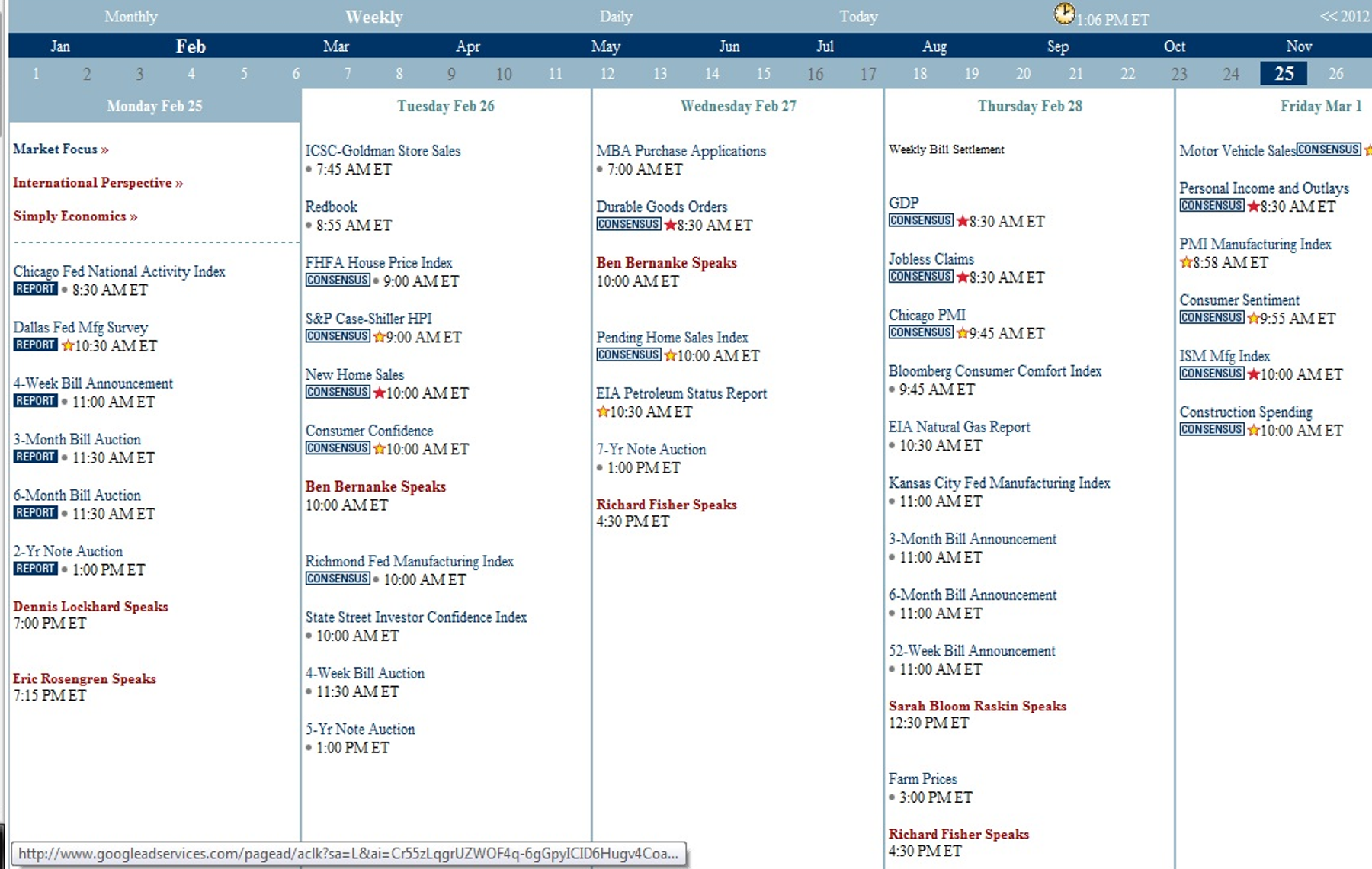
The week ahead — Economic data from Econoday.com:
Posted in Weekly Summary | No Comments »