July 1st, 2013
“The difference between perception and reality is where our opportunities lie.” — unknown
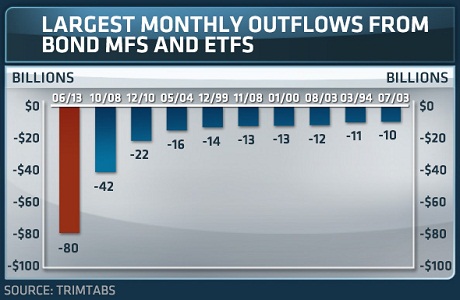
1. Bond Fund Outflows Hit Record Level on the Fed Tapering Fears — CNBC, “Mutual and exchange-traded funds are unloading bonds at a record pace. The combined outflow of $47.2 billion in Junes is the highest in any month on record, handily eclipsing the previous record of $41.8 billion in October 2008,” reported by TrimTabs Investment Research.
2. EU Finance Mininsters agree on rules for bank rescues — EU Finance Ministers have agreed on measures to deal with failing banks. The proposals include imposing losses of up to 8% of a bank’s total liabilities on shareholders, creditors and then deposits of over €100,000, after which governments will be able to supply funds of up to 5% of liabilities.
3. New Rules Expected for Insurance Accounting May Lead to Erratic Earnings — NYTimes, The Financial Accounting Standards Board (FASB) stated that it will propose new rules for insurance accounting that seem likely to increase volatility in reported profits for many insurers and lower reported revenue for rapidly growing companies. Under the new rule, Insurers would have to recognize premium revenue over time, when insurance is being provided, rather than when it is received, while the reporting of costs might be delayed as well.
4. China Credit crunch spreads to China’s “Main Street.” — WSJ reported businesses turn to alternatives such as bankers’ acceptances to pay their bills instead of cash despite efforts by the People’s Bank of China to ease the credit crunch in the country’s financial markets.
5. Rising bond yields hurt bank balance sheets — falling bond prices and rising yields are threatening the recovery in the balance sheets of global banks, which have built up huge portfolios of liquid securities. i.e. Bank of America’s (BAC) $315B portfolio comprises of 90% in mortgage bonds and Treasurys. However some analysts believe that QE tapering should lead to an increase in interest margins and offset the one-time hit to book values because of rising bond yields.
6. EU agrees to the first budget cut in its history — The EU has agreed a seven-year €960B budget that represents the first spending cut in its history. The bloc also approved plans to invest €6B on tackling youth unemployment and for the European Investment Bank to lend hundreds of billions of euros to small and medium-sized businesses.
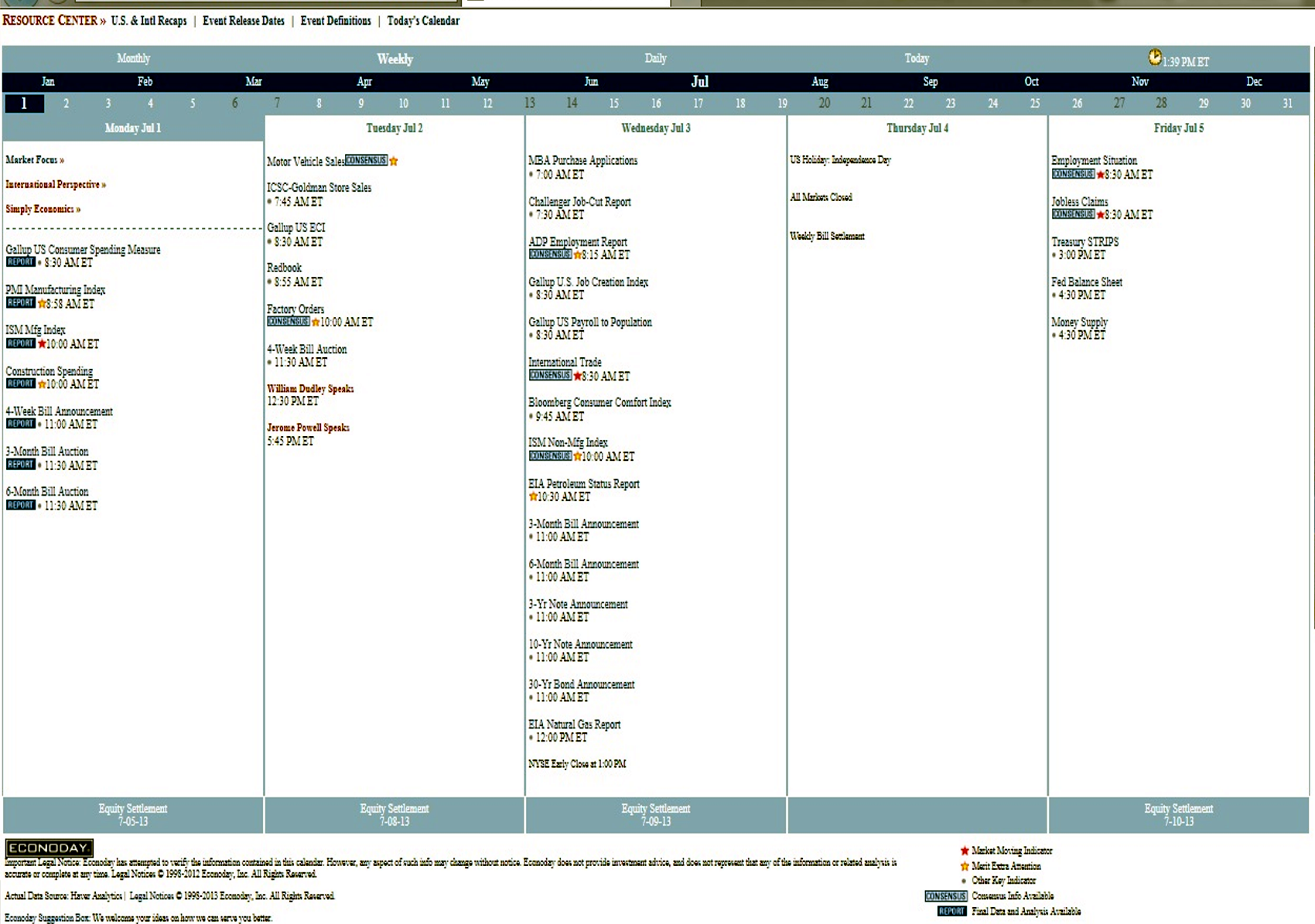
The week ahead — Economic data from Econoday.com:
Posted in Weekly Summary | No Comments »
June 24th, 2013
“Sometimes paranoia’s just having all the facts.” — William S. Burroughs
1. Weyerhaeuser (WY), forest products comp., names new CEO — Weyerhaeuser (WY) appointed Doyle Simons, the former head of Temple-Inland, to replace retiring CEO Dan Fulton. Weyerhaeuser is also acquiring 645,000 acres of high-quality timberlands in Washington and Oregon from Brookfield Asset Management (BAM) for $2.65B. Weyerhaeuser will explore “strategic alternatives” for WRECO, its homebuilding and real-estate development business, including a merger, sale, or spin-off.
2. Obama indicates that FOMC Chief Bernanke’s time is drawing to an end — Bloomberg, reported President Obama told Charlie Rose that the chairman has already stayed “a lot longer than he wanted or he was supposed to.” Bernanke’s second four-year stint at the central bank is due to end on January 31.
3. Japan Exports Surge Most Since 2010 — Bloomberg, Japan’s exports rose more than forecast in May as a weaker yen boosted the value of overseas sales, underscoring the profit boon for manufacturers from Prime Minister Shinzo Abe’s reflation campaign. With imports climbing 10%, Japan generated a trade deficit for the 11th consecutive month as the figure widened 13% on month to ¥993.9B ($10.4B).
4. Chinese manufacturing PMI shrinks further — HSBC Chinese manufacturing PMI has fallen to a nine-month low of 48.3 in June from 49.2 in May and vs consensus of 49.4. “Manufacturing sectors are weighed down by deteriorating external demand, moderating domestic demand and rising de-stocking,” says HSBC. Because of Beijing’s preference for reform over stimulus, the bank expects “slightly weaker growth in Q2.”
5. More trouble in store for mortgage-bond investors — Holders of mortgage bonds may be facing billions of dollars of undisclosed losses after a review of investor documents showed that individual houses are being reported as being in foreclosure long after they’ve been sold or the loans paid off. The reporting lag has enabled banks and servicers to continue charging investors monthly fees, and could lead to new litigation. The companies involved include Bank of New York Mellon (BK), Wells Fargo (WFC), Ocwen Financial (OCN) and Bank of America (BAC).
6. FOMC Chairman Bernanke signals the end of QE — Reuter, Global markets across multiple sectors sold off after Ben Bernanke signaled that the Fed may soon start turning down the money printing presses, saying that the bond-buying could end in mid-2014.
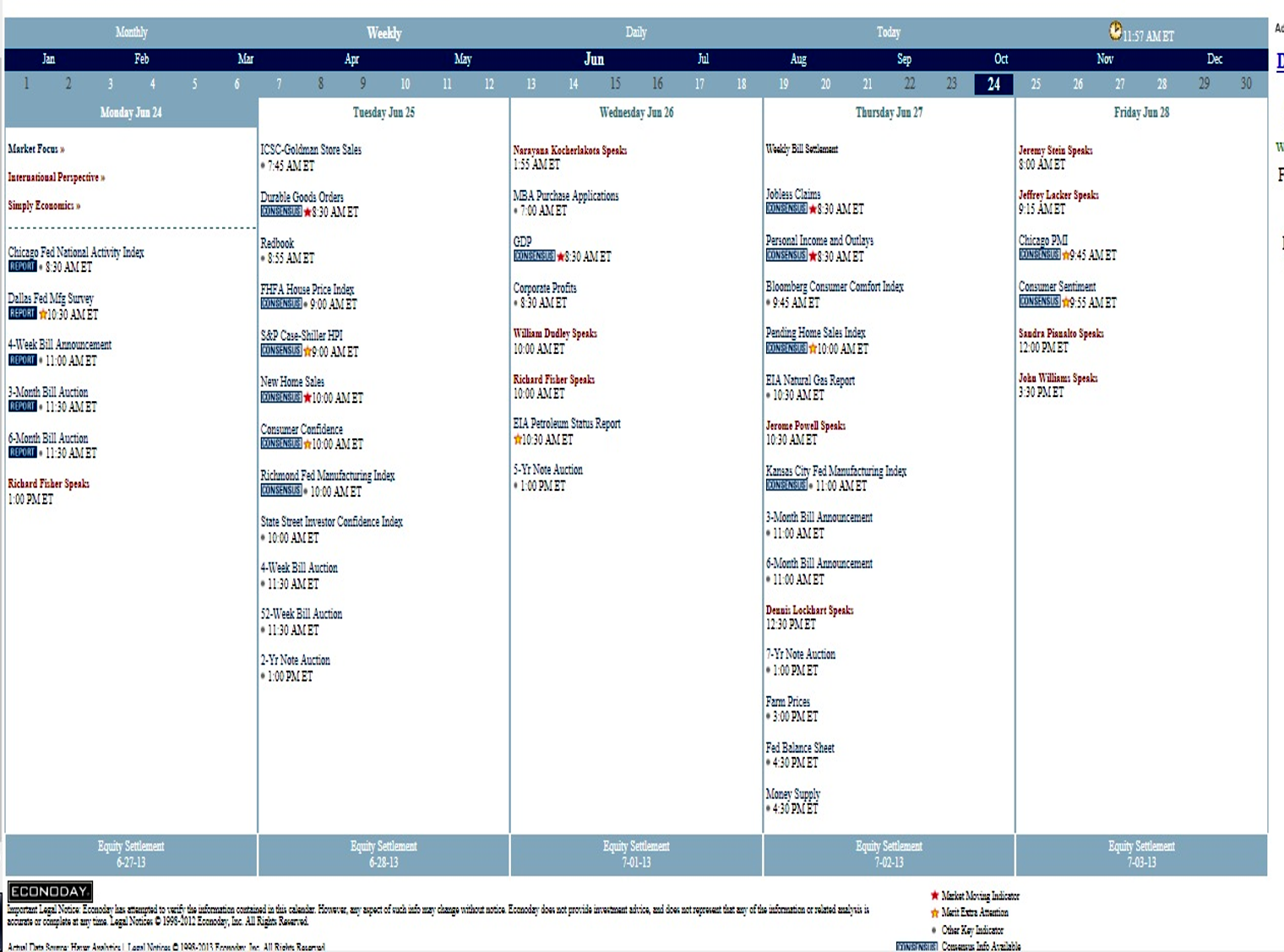
The week ahead — Economic data from Econoday.com:
Posted in Weekly Summary | No Comments »
June 17th, 2013
“To win you have to risk loss.” — Jean-Claude Killy (skier)
1. S&P revises U.S. outlook to stable from negative — MarketWatch, Standard & Poor’s revised its long-term outlook on its U.S. credit rating to stable from negative. The rating agency downgraded the sovereign rating to AA+ from its top rating of AAA in 2011. The rating agency cited economic strength and the dollar’s status as a reserve currency as the primary drivers of the outlook revision.
2. Germany’s top court weighs ECB bond buys — Germany’s Federal Constitutional Court has started a two-day hearing today over the compatibility of the ECB’s Outright Monetary Transactions (OMT) program, which allows the bank to buy government bonds in the secondary market, with German law.
3. Senate Passes Bill to End Direct Payments to Farmers — the Senate overwhelmingly passed a $955B agriculture bill that would reduce farm spending by $18B over the next decade, partly by ending the practice of making direct payments to farmers irrespective of crop yields, market prices and the economy.
4. Nikkei (DXJ) plunges into bear market — The Nikkei’s 6.4% drop put it 21.9% off from its intraday peak reached on May 23. Uncertainty about the Fed’s QE program continues to grip global markets.
5. Fed Likely to Push Back on Market Expectations of Rate Increase — WSJ’s Hilsenrath, quoted officials as saying that a tapering of asset purchases doesn’t mean an end to asset purchases, and a hike in short-term interest rates isn’t anywhere close to being on the radar at this point.
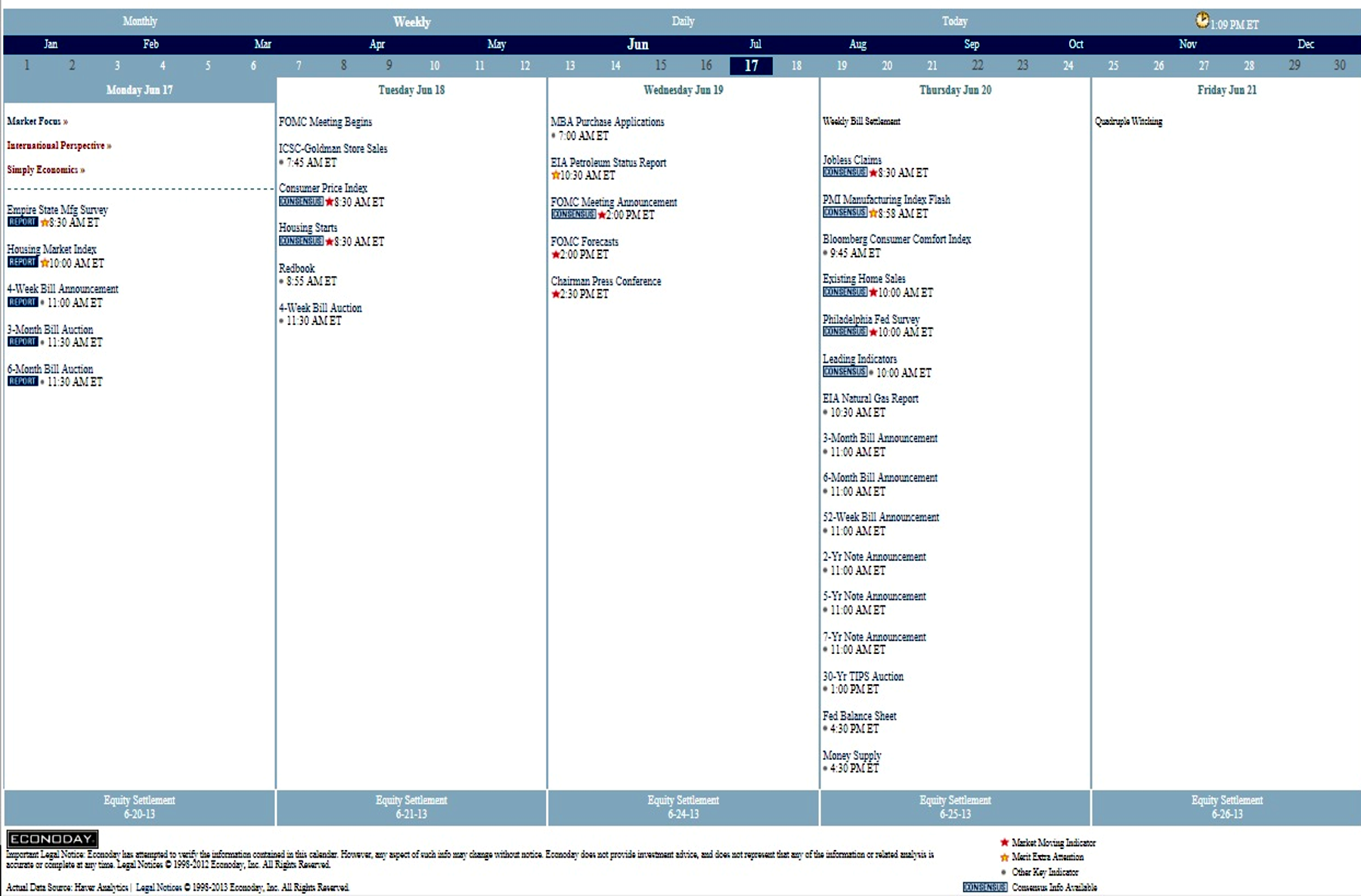
The week ahead — Economic data from Econoday.com:
Posted in Weekly Summary | No Comments »
June 10th, 2013
“Volatility is greatest at turning points, diminishing as a new trend becomes established.” — George Soros
1. Nikkei sinks towards bear territory — the Nikkei (EWJ) has lost over 19% since hitting a 52-week high on May 23 – a drop of 20% would put the index in a technical bear market.
2. Chinese PMI (Purchasing Manager Index) comes in mixed — China’s HSBC PMI for May fell a bit more than the “flash” read — at 49.2 vs. 50.4 in April. The downward revision “suggests a marginal weakening of activities towards the end of last month, due to deteriorating domestic demand conditions,” says HSBC.
3. Turkish markets plunge after protests continued — the Istanbul National 30 index down 6.6%; Turkish shares (TUR) have plummeted after demonstrations in Istanbul over the preservation of a park turned into a vehicle for an outpouring of anti-government anger amid accusations that it has become increasingly authoritarian.
4. Japan’s Premier Lines Up New Overhauls — WSJ, Abe’s ‘Three Arrows’ Aim for Long-Term Economic Boost, With New Policies on Industry, Investment and Taxes to pull his country out of deflation. The program includes allowing Japan’s massive public pension funds to buy more stocks, the creation of special economic zones, free-trade agreements, privatization, and power-market reform. The hope is to raise average income by 3%, which is greater than the two-year inflation target of 2%.
5. U.S. oil output surpasses imports — WSJ, U.S. crude oil production exceeded imports last week for the first time in 16 years. Since January 1997, weekly U.S. crude imports averaged around 9.2M bpd, topping domestic output by 3.5M bpd. But by late 2014, U.S. crude oil output should surpass imports by nearly 2.5M bpd.
6. NSA taps in to user data of Google, Skype and others, secret files reveal — theguardian reported government electronic surveillance have widened to include several of the country’s largest technology companies under a program called PRISM. A National Security Agency document reportedly shows that it has “direct access” to the servers of Microsoft (MSFT), Yahoo (YHOO), Google (GOOG), Facebook (FB), Paltalk, AOL (AOL), Skype, YouTube and Apple (AAPL).
7. Japan’s $1 trln public pension cuts govt bond weighting, lifts stocks — Reuters, Japan’s public pension fund, the world’s largest with a pool of $1.1 trillion, announced the most significant shift in its asset allocation since 2006 so it can take on greater risk by shifting into stocks and away from Japanese government bonds. It is increasing its Japanese stocks allocation to 12 percent of its portfolio from 11 percent, while lowering its JGB weighting to 60 percent from 67 percent.
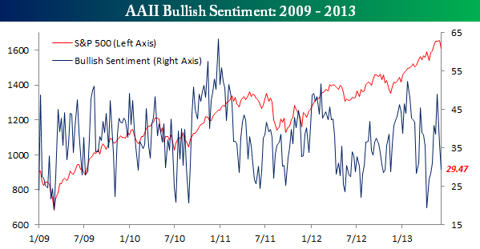
8. AAII Bullish Sentiment Falls — bullish sentiment declined to 29.5% from last week’s reading of 36.0%. After reaching a short term peak of 49% two weeks ago, bullish sentiment has now declined by 19.5 percentage points in just the last two weeks.
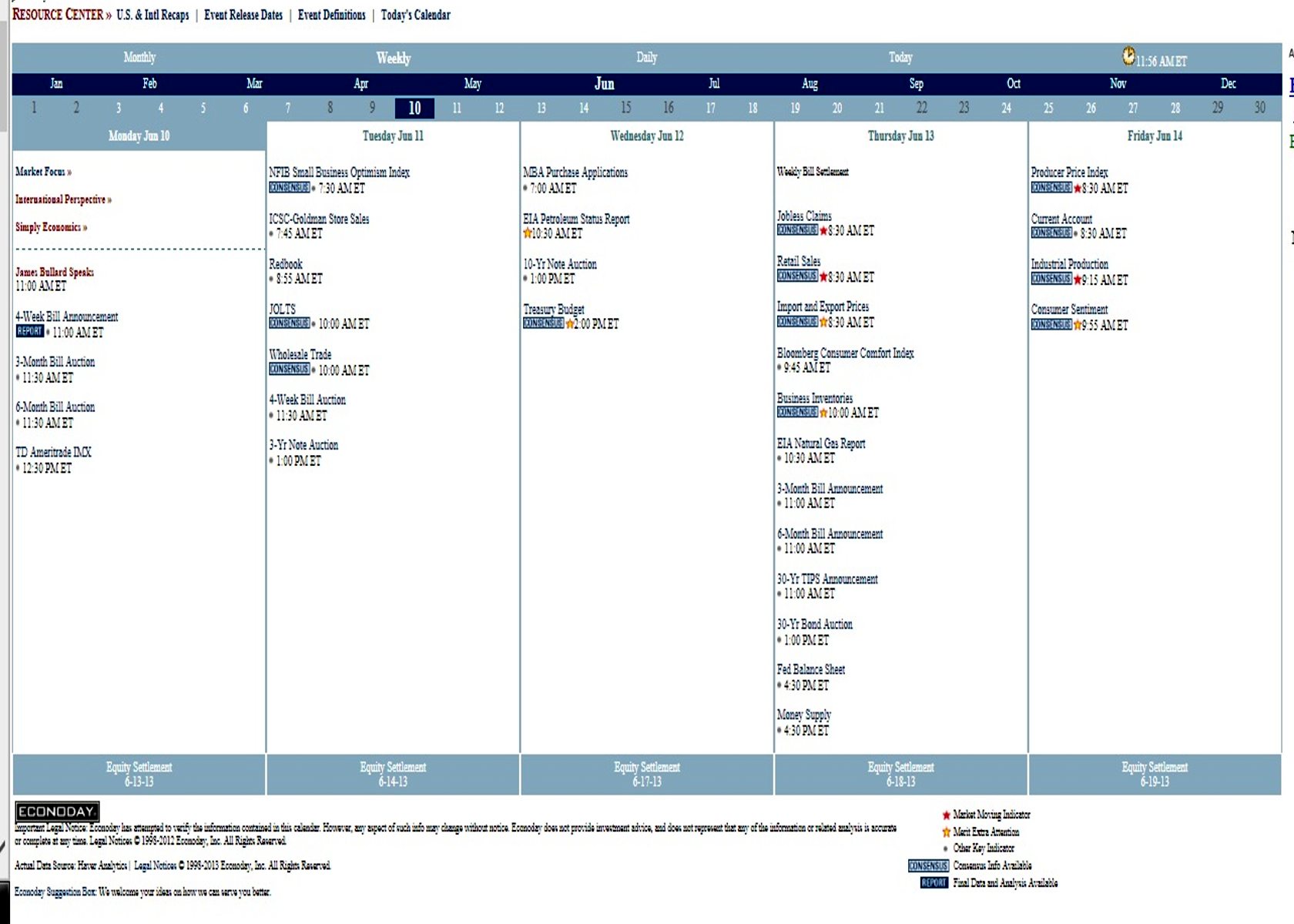
The week ahead — Economic data from Econoday.com:
Posted in Weekly Summary | No Comments »
June 6th, 2013
There will not be any re-cap for the week of May 31 2013. We are away for some needed R&R.
Have a good week.
The staffs at EGS.
Posted in Weekly Summary | No Comments »
June 6th, 2013
There will not be any re-cap for the week of May 24 2013. We are away for some needed R&R.
Have a good week.
The staffs at EGS.
Posted in Uncategorized, Weekly Summary | No Comments »
May 20th, 2013
“Now this is not the end. It is not even the beginning of the end. But it is, perhaps, the end of the beginning.” — Winston Churchill
1. CBO slashes deficit estimate — WSJ, The federal deficit will narrow to $642B in the fiscal year ending in September, the CBO reported — a meaningful improvement from February’s projection of $845B. The revision comes courtesy of higher tax receipts and dividend payments to the Treasury from Fannie (FNMA.OB) and Freddie (FMCC.OB).
2. Buffett Latest 13F Filings (Dated May 15, 2013) Holdings — Berkshire Hathaway’s (BRK.A) 13F filing shows Warren Buffett’s conglomerate upped its equity holdings by nearly $10B Q/Q in the January-March period. Notable moves include a new 6.5M share position in Chicago Bridge & Iron (CBI) worth ~$400M, divestitures of stakes in Archer Daniels Midland (ADM) and General Dynamics (GD), and additions to existing stakes in Wells Fargo (WFC), IBM, Davita Health Care (DVA), and DirecTV (DTV).
3. Hedge Funds Dump Apple, Jump into Hess in Q1 — CNBC, based on the latest 13F filing, David Tepper’s Appaloosa Management reduced its stake in the iPhone maker by 40% during Q1 while Julian Robertson’s Tiger Management sold-off its entire position. Meanwhile, David Einhorn’s Greenlight Capital boosted its stake by 84%.
4. Eurozone Slump Dragging On — the currency union’s economy fell 0.2% in Q1, easing from Q4’s 0.6% drop but marking the 6th straight sequential contraction. Germany barely rebounded from a prior fall with a 0.1% uptick. France fell back in recession while Italy and Spain extended their downturns.
5. Nikkei rallies to New Highs — the yen (FXY) continued its slide early last week, falling to a new four-and-a-half year low against the dollar (before recovering), helping the Nikkei (NKY) post another triple-digit gain on the session, rising 1.2% to 14782, its highest level since January 2008. The weak yen comes on the heels of the G7’s reportedly amicable meeting over the weekend.
6. Gold down nearly 5% for week — Marketwatch, the precious metal is down 4.8% as the week comes to a close, having dropped under $1,390 an ounce this week, the lowest level since April 17. Multiple factors have conspired to weigh on prices, including comments from San Francisco Fed Chief John Williams regarding a possible late summer pull back in the pace of the Fed’s asset purchases and data showing George Soros was a seller in Q1.
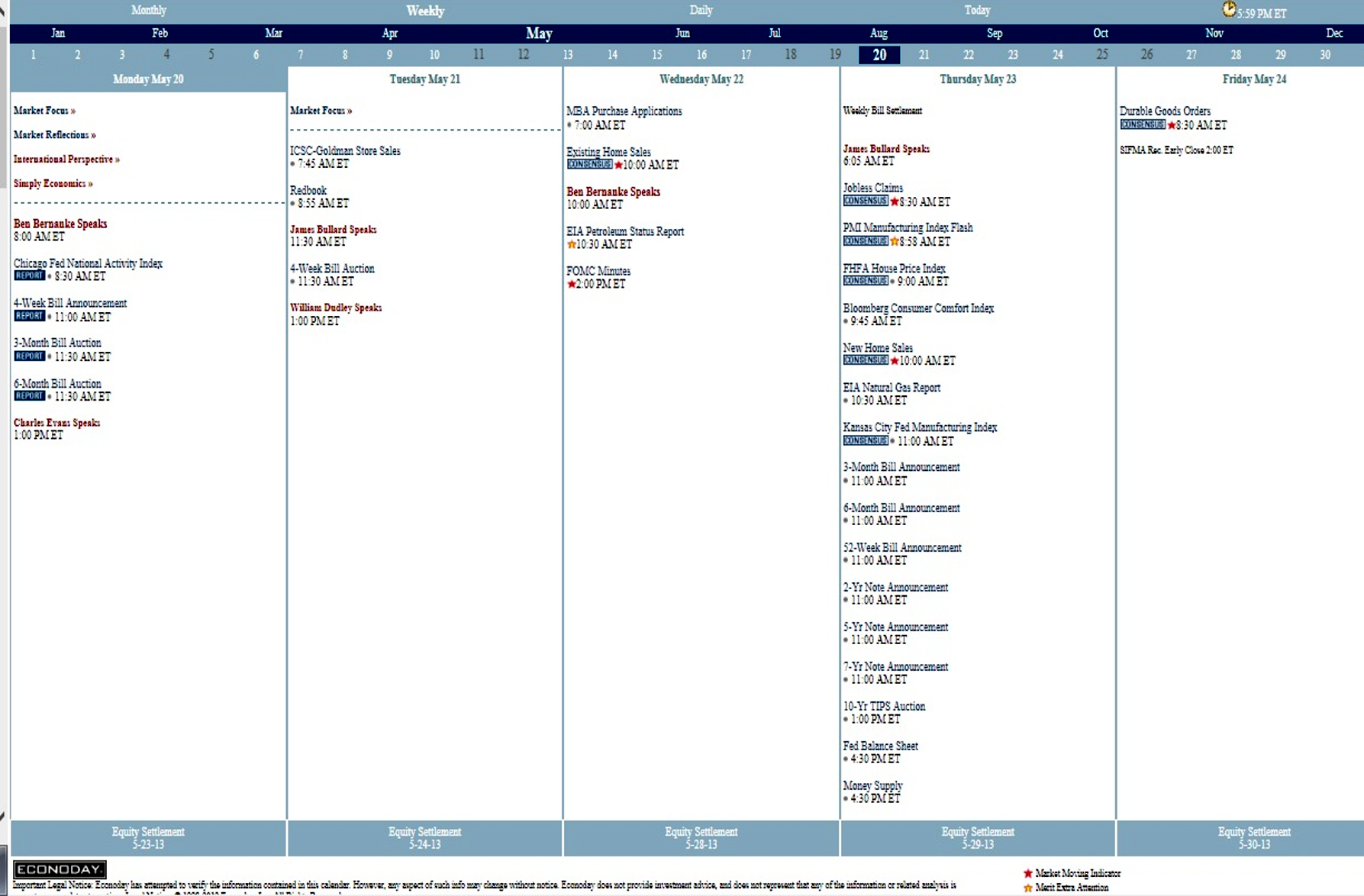
The week ahead — Economic data from Econoday.com:
Posted in Weekly Summary | No Comments »
May 13th, 2013
“The news just seems to follow the markets.” ~ Jeff Saut
1. GM to invest $16B in U.S. over next three years — GM announcement would add to the $8.5B spent since 2009 and would be well above the $11B that GM and its joint-venture partners plan to invest in China over the next three years.
2. Chinese services PMI falls to 21-month low — Chinese HSBC services PMI has declined to its lowest level since August 2011, falling to 51.1 in April from 54.3 in March. The growth in new orders dropped to the slowest rate in 20 months, while staffing declined for the first time in over four years. The stumble in the services sector, which accounts for almost half of GDP, has added to a deceleration in manufacturing, and has increased concerns about China’s economic recovery.
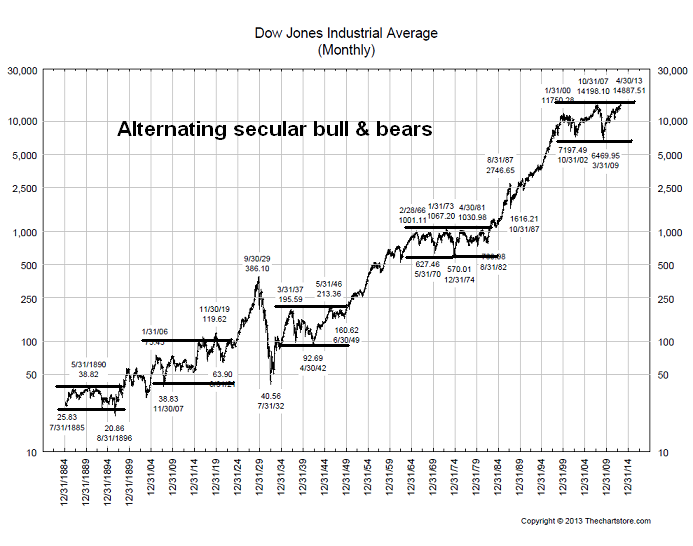
3. Secular Bull Or Secular Bear Market — below is the chart of the DJIA going back to 1884 as the market rallied to new highs. The question remains is – “Are We in a Secular Bull Or Secular Bear Market”?
3. Australia’s central bank cuts rates — the Reserve Bank of Australia cut rates for the seventh time in 18 months last week, taking the benchmark cash-rate down 25 basis points to a record low 2.75%.
4. German industrial production posts surprise gain — German industrial output rose 1.2% in March, beating economists’ expectations of a small decline, and posting an increase for the second straight month. The breakdown shows manufacturing output climbed 1.4% and energy production rose 4%.
5. Rio Tinto Says China Iron Ore Sales Strong –Rio Tinto’s (RIO) CEO Alan Smith said at a conference last Wednesday that China’s demand for steel will be robust and will continue to expand until 2030 despite fears of an economic slowdown. As a result, Smith expects his company’s iron ore sales to the country will top 147M tons this year, eclipsing last year’s record.
6. Yields on Junk Bonds Reach New Low — WSJ, for the first time ever, the yield on junk bonds (HYG, JNK) has fallen below 5%. The Barclays U.S. Corporate High Yield index fell to 4.97% earlier this week, capping a more than 100 basis point compression YTD, as investors’ insatiable appetite for income in a stingy ZIRP environment has fueled robust demand for relatively riskier assets.
7. Margin debt hits pre-crisis levels — NYSE margin debt hit $379.5B in March, a 28% Y/Y increase as investors borrow money to buy into what has become a famously resilient rally. The concern is that a steep sell-off could snowball if leveraged investors are forced to unwind positions to meet margin calls. Borrowing to buy shares is of course one sign of unbridled optimism, although some believe levering up makes sense in the current environment.
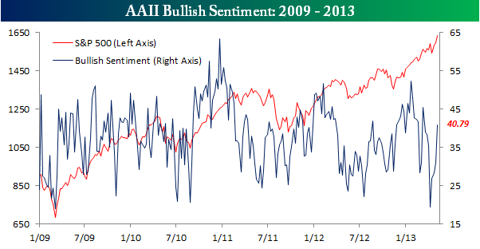
8. AAII Bullish Sentiment Rises For 4th Straight Week — per BIG, last week’s reading of 40.79% represents an increase of 9.8 percentage points from the previous week and is the highest reading since March 14.
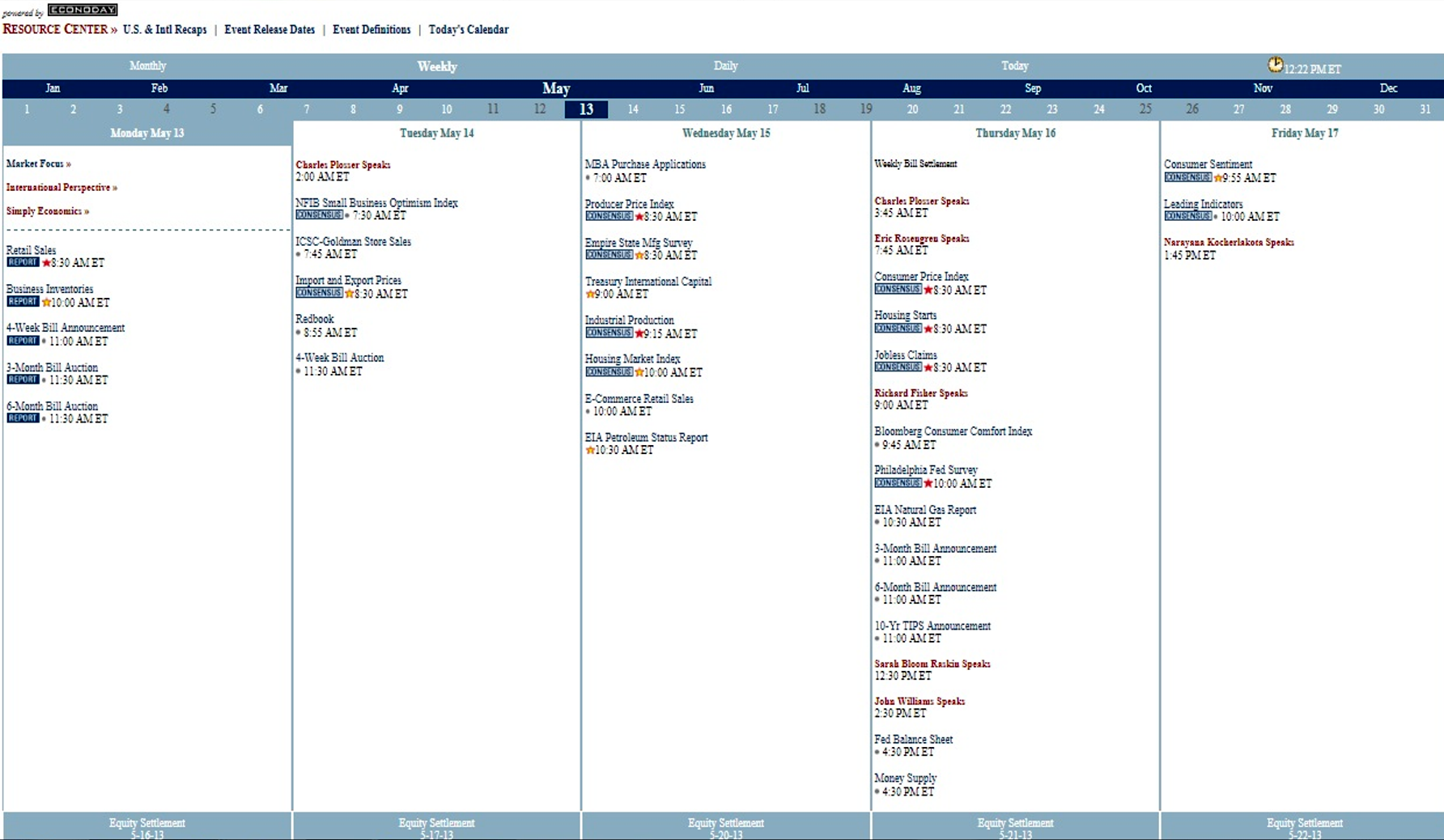
The week ahead — Economic data from Econoday.com:
Posted in Weekly Summary | No Comments »
May 6th, 2013
“Every tomorrow has been uncertain. America’s destiny, however, has always been clear: ever-increasing abundance.” – Warren Buffett
1. Greece to get new aid — European officials are set to approve a long-delayed €2.8B tranche of bailout money for Greece after the country’s parliament passed a reform late last week which calls for the dismissal of 15,000 workers by the end of 2014 and the extension of a property tax assessed through citizens’ electric bills. The next obstacle for Greece is winning approval for a €6B disbursement it needs by May 20 in order to repay a maturing bond held by the ECB.
2. Treasury to Pay Down Debt For First Time in Six Years — WSJ, the U.S. government will retire $35B in bonds, notes, and bills during the second quarter, as spending cuts and higher tax receipts allow the Treasury to defy projections which showed net debt outstanding rising by over $100B during the three month period.
3. Apple’s debt offering is largest in history — WSJ, Apple’s (AAPL) first debt offering in nearly two decades was also the largest corporate bond deal in the history of the market. Goldman Sachs (GS) Deutsche Bank AG (DBK) sold the debt for Apple to investors in all corners of the credit markets, from buyers overseas to municipal-bond investors to portfolio managers who typically prefer ultrasafe government debt. Pension funds, insurance companies and hedge funds also joined in the scramble.
4. China PMI slips. China’s official PMI for April slipped to 50.6 from 50.9 in March — analysts polled by Reuters expected a reading of 51.0. Both reports cited weakness in new export orders, a reflection of tepid global demand.
5. ECB cuts interest rate — the ECB’s governing council said it decided to lower its main refinancing rate by 25 basis points to 0.50%. The ECB also said the interest rate on the marginal lending facility will be cut by 50 basis points to 1.00%.
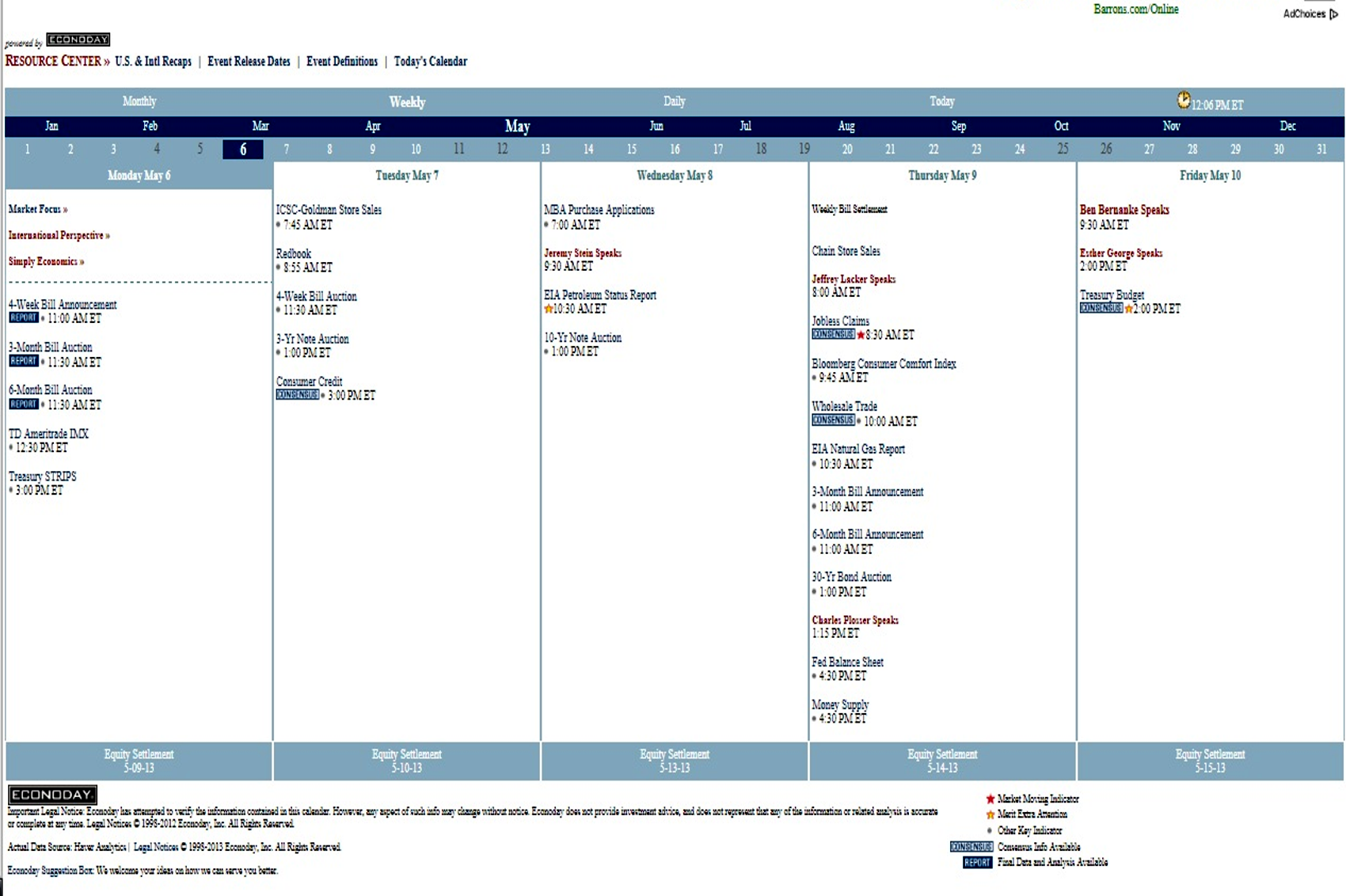
The week ahead — Economic data from Econoday.com:
Posted in Weekly Summary | No Comments »