March 31st, 2014
“If you take emotion – would be, could be, should be – out of it, and look at what is, and quantify it, I think you have a big advantage over most human beings.” — John Henry
1. Chinese factory activity contracted for the fifth straight month in March — “flash” manufacturing PMI slipped to 48.1 from 48.5 in February. This figure misses consensus of 48.7. HSBC stated “Weakness is broadly based with domestic demand softening further,”.
2. U.S. lawmakers to weigh speeding up LNG exports to help Europe, Ukraine — Reuters, U.S. lawmakers will hear testimony on loosening restrictions on liquefied natural gas exports so that abundant American supplies could help reduce Ukraine and Europe’s dependence on Russian gas. Currently, the U.S. Department of Energy must give permission to export natural gas to all but a handful of countries with free trade agreements with the United States.
3. U.S. fourth-quarter GDP nudged up to 2.6% — MarketWatch, the economy’s growth in the final three months of 2013 was bumped up to a 2.6% annual pace from 2.4%, mainly because of higher spending on health care. Final sales of U.S.-produced goods and services were also lifted to show a 2.7% advance instead of 2.3%.
4. Federal Reserve approved 25 out of 30 Banks capital-allocation plans — the Fed rejected those from Citigroup (C), Zions Bancorp (ZION), RBS’s (RBS) Citizens subsidiary – which could affect the divestiture of the unit – HSBC North America (HSBC) and Santander Holdings (SAN). Most banks announced repurchase programs and dividends.
5. Baxter International (BAX) announced plans to split into two companies – Baxter (BAX) will split into a biopharmaceuticals and the other on medical products. The biopharma operation – developing treatments for hemophilia and other bleeding disorders, immune deficiencies, burns and shock. This unit generated revenue of $6B in 2013. Baxter (BAX) expects to make a tax-free distribution of shares in the business by mid-2015.
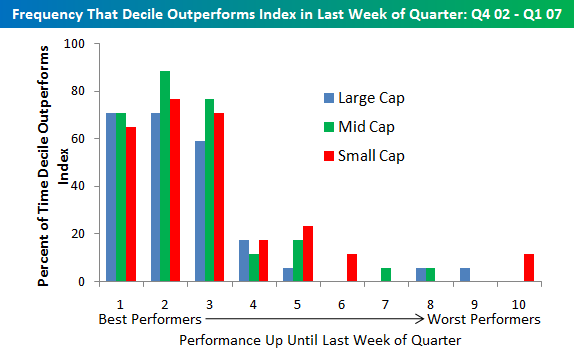
6. End-Of-Quarter “Window Dressing” — courtesy of Bespoke, about 70% of the best performing stocks outperform the indexes in the last week of the quarter based on a 5-year study. Fund managers typically buy best performing stocks right before end-of-quarter to show off winners in its fund holdings.
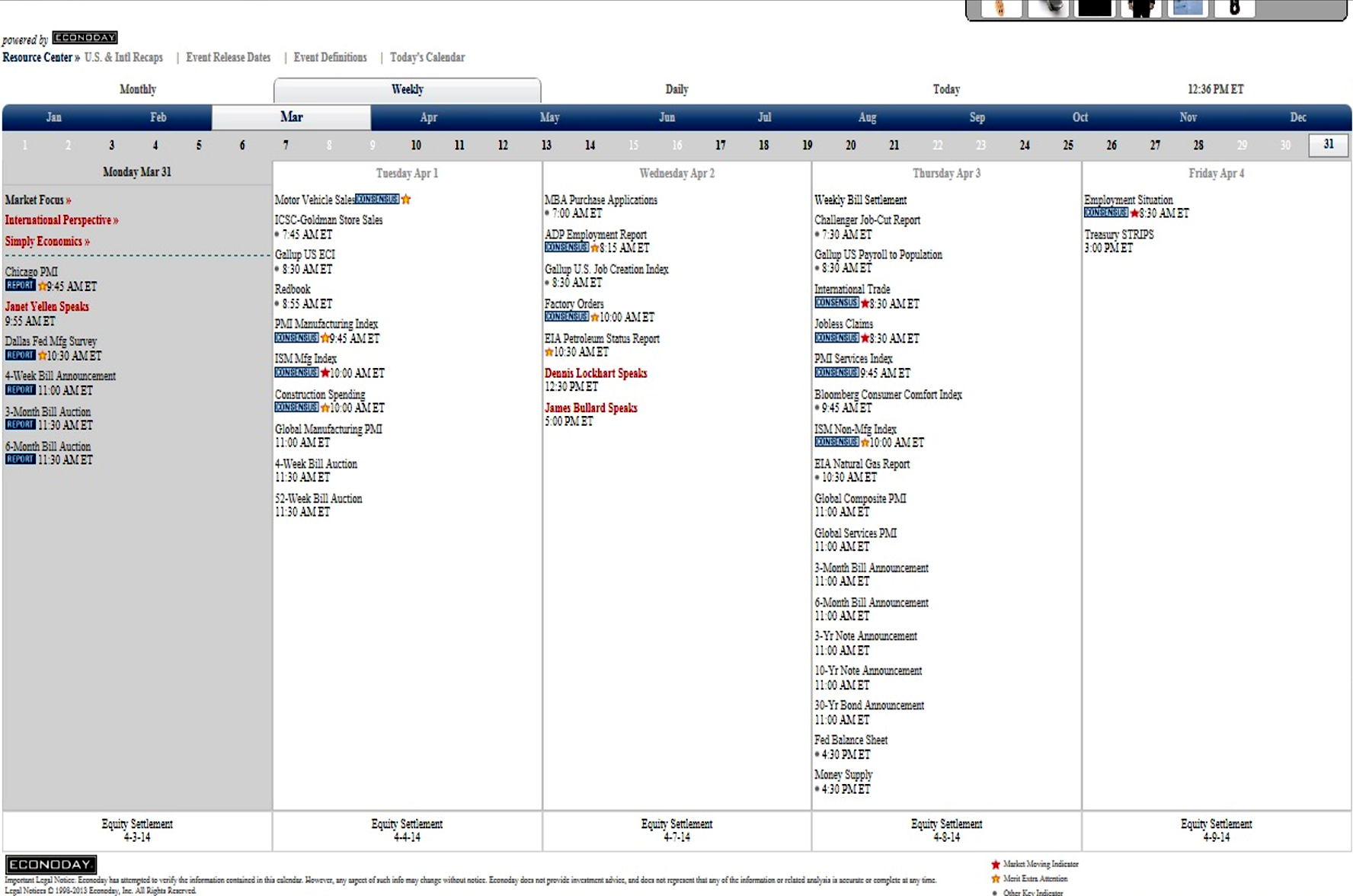
The week ahead — Economic data from Econoday.com:
Tags: Window Dressing
Posted in Weekly Summary | No Comments »
March 24th, 2014
“Those who cannot remember the past are condemned to repeat it.” — Santayana
1. Ukraine Region Joined Russia — WSJ, More than 96% of Crimean voters cast their ballots to break away from Ukraine and rejoin Russia, in a referendum that raises the stakes in the most acute East-West confrontation since the Cold War.
2. Sears’ board approved the spin off of Lands’ End to take place on April 4 — Sears (SHLD) owners of record as of March 24 will receive 0.3 shares of Lands’ End – to trade on the Nasdaq under the symbol “LE” – for each share of Sears they hold. Prior to the spin-off, Lands’ End will pay a debt-financed $500M dividend to Sears.
3. CB&I’s joint venture with Japan’s Chiyoda has won a $6B contract to construct a 13.5M metric tons/year export plant in Hackberry in Louisiana for Sempra Energy (SRE) unit Cameron LNG — the deal for CB&I (CBI) and Chiyoda comes after Cameron LNG last month received conditional authorization from the Department of Energy to export domestically produced LNG to countries without a free trade agreement with the U.S.
4. FOMC ‘s Janet Yellen Rate Guidance Relies Less On Jobless — Fed Reserve policymakers broaden the scope of considerations for raising benchmark rates, using more measures of labor market conditions, inflation and financial developments while abandoning the 6.5% unemployment threshold. She also suggested a rate increase for early 2015.
5. China to Accelerate Measures to Stabilize Growth — Bloomberg, China will speed up construction projects and other measures to expand domestic demand after a slowdown in industrial-output and investment growth boosted risks of missing this year’s expansion target.
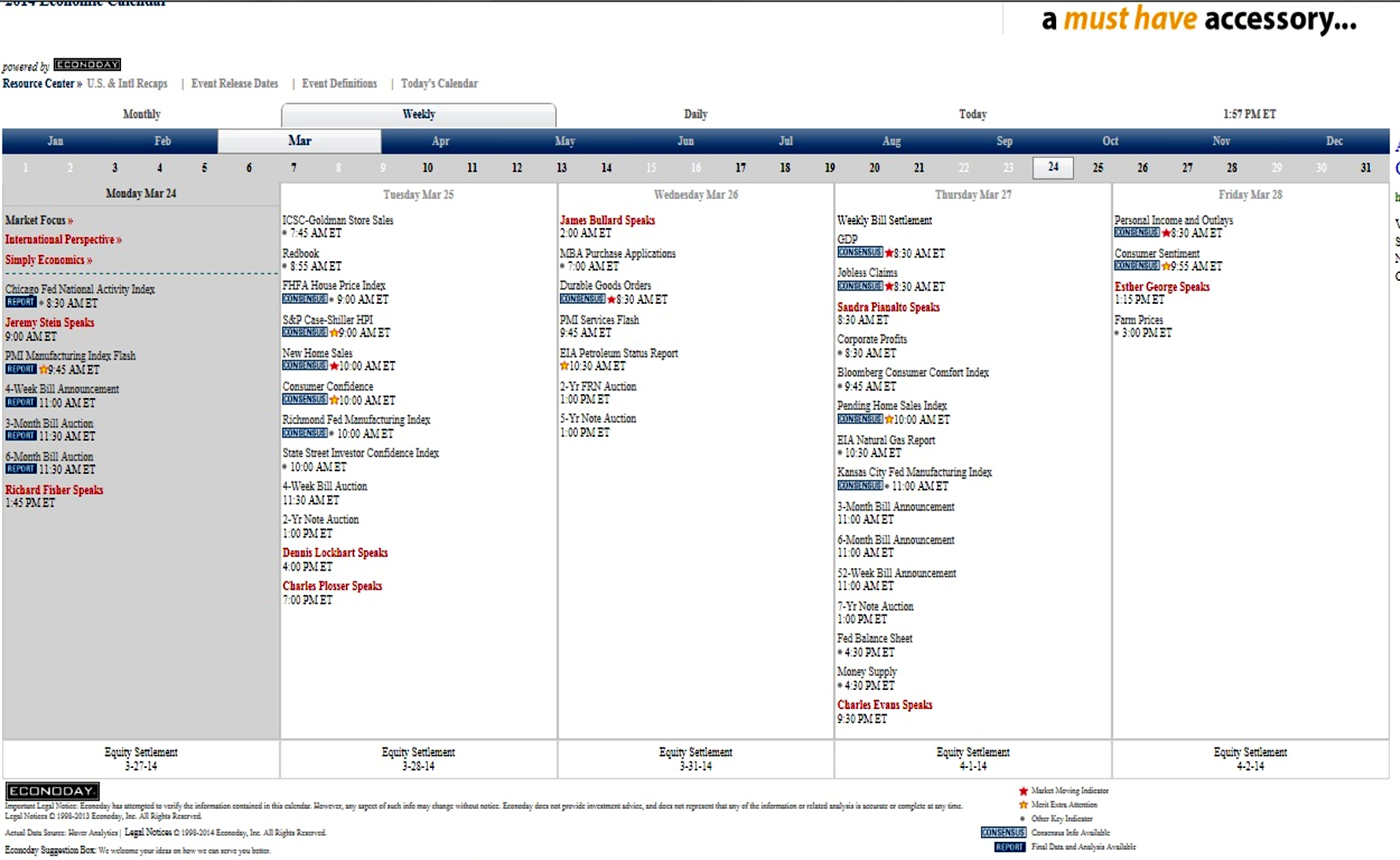
The week ahead — Economic data from Econoday.com:
Posted in Weekly Summary | No Comments »
March 17th, 2014
”Look at market fluctuations as your friend rather than your enemy; profit from folly rather than participate in it” — Warren Buffett
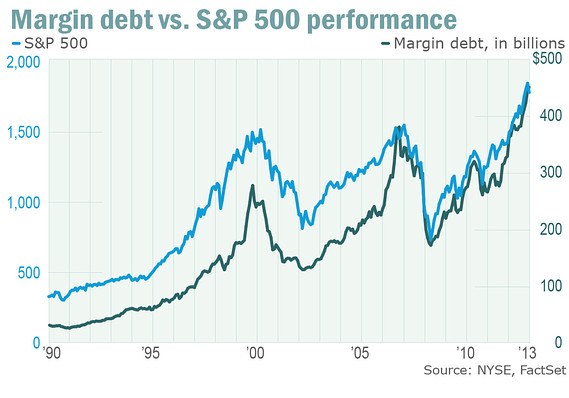
1. Stock caution urged as margin debt levels hit new highs — via MarketWatch, Margin debt, which tends to spike alongside stock rallies and pullbacks, has been rattling investors. While not indicative of an imminent crash, they’re telling investors to exercise caution, say market strategists.
2. BOJ kept key interest at record low — the Bank of Japan (BOJ) has left its key interest rate at 0.1% and maintained its program of expanding the monetary base by ¥60-70T a year. The BOJ upgraded its assessment of industrial output and investment but cut its analysis for exports.
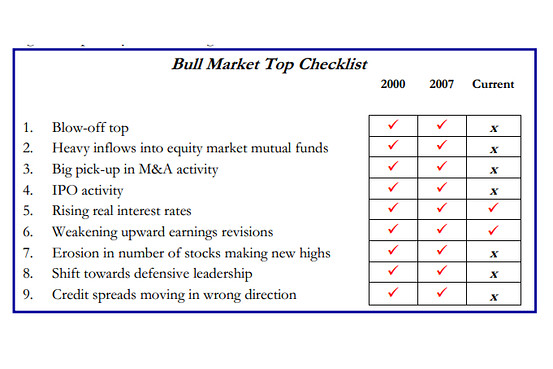
3. Bull Market CheckList — following the bull market’s five-year anniversary, plenty of chatter has ensued about how much longer the rally will last. The million dollar question is now “Just how much higher can it go?”. Below is a “checklist” courtesy of Strategas in order to figure when the rally may be poised to peak.
4. Senate proposal to wind Fannie Mae (OTCQB:FNMA)& Freddie Mac (OTCQB:FMCC)— a Fannie Mae-Freddie Mac overhaul deal was tentatively reached between the Senate Banking Committee’s top-Democrat and Republican, with the White House also signaling support. Both shares of the government controlled mortgage finance giant plunged.
5. China (FXI) released more data indicating that its economy is slowing — China industrial production growth slowed to 8.6% on year in January and February from 9.7% previously. This figure missed consensus of 9.5%. Retail sales softened to +11.8% from +13.6%, while urban fixed-asset investment also weakened.
6. U.S. safety watchdog says 303 deaths linked to recalled GM cars — Reuters, U.S. safety regulators have recorded 303 deaths when airbags failed to deploy in 1.6 million compact cars recalled last month by General Motors Co. (GM). The number is far greater than the 13 people whose deaths the company has acknowledged were linked to the switches.
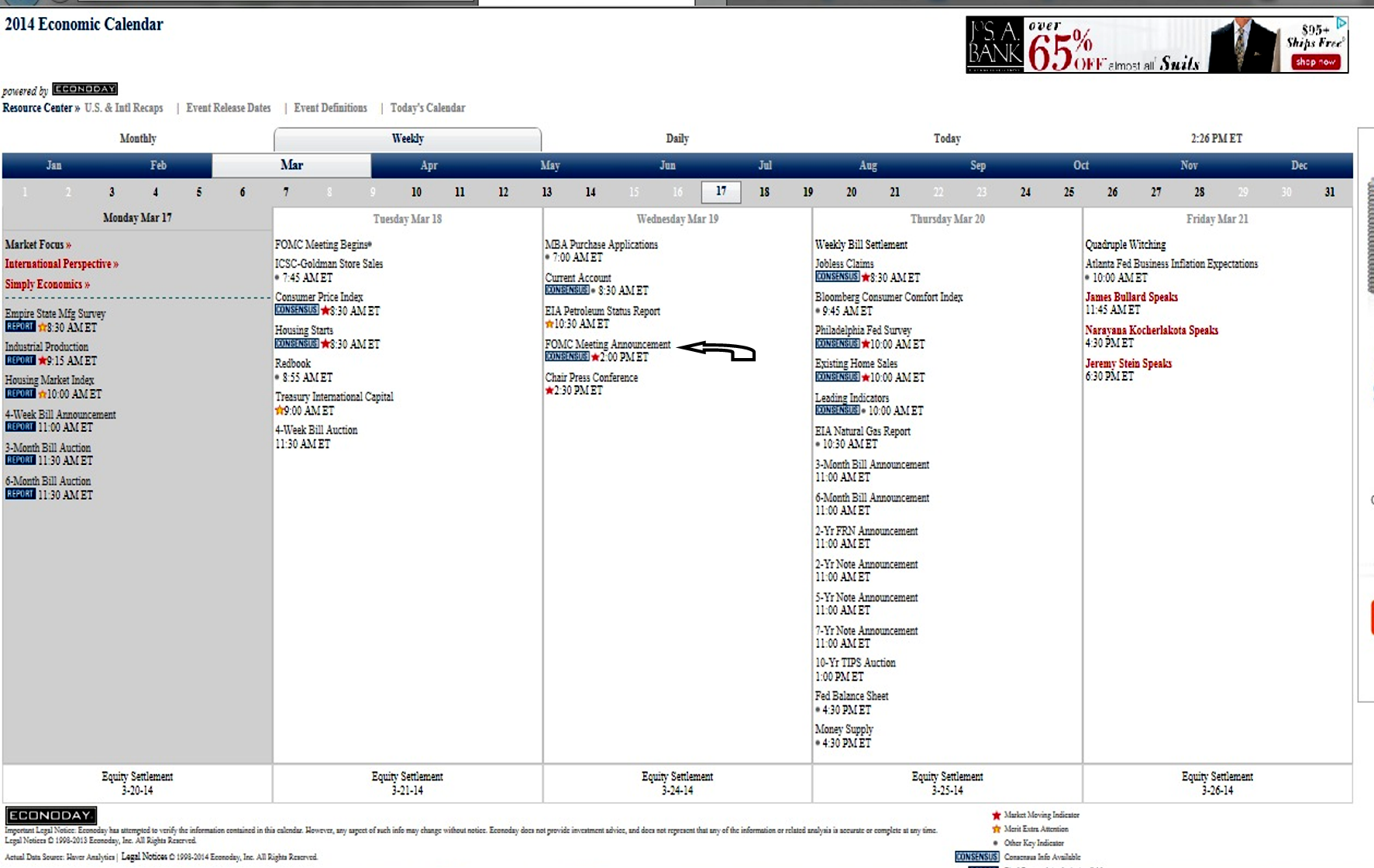
The week ahead — Economic data from Econoday.com:
Tags: bullmarket checklist
Posted in Weekly Summary | No Comments »
March 10th, 2014
“You cannot ignore the market – ignoring a source of investment opportunities would obviously be a mistake – but you must think for yourself and not allow the market to direct you.” — Seth Klarman
1. World stocks recover as Putin downshift tensions — Global equity markets recovered from sharp losses early in the week in what could be interpreted as a de-escalation of tensions by the Russian as some military units are back to their bases after a surprise training exercise. Some of the drills took place near the border with Ukraine, exacerbating fears about a possible Russian invasion of its neighbor.
2. Obama looks to expand tax break for the low-paid — President Obama is due to propose expanding the Earned Income Tax Credit to 13.5M childless workers when he unveils his annual $1.014T budget plan today. The 10-year $60B cost would be met by closing two tax loopholes for some self-employed professionals and investment-fund managers. Obama also wants to spend $302B on highways, bridges and transit projects, and increase the minimum wage.
3. China maintains growth goal of 7.5% — Reuters, in an address to the annual meeting of the National People’s Congress, Chinese Premier Li Keqiang reiterated his commitment to reform to make growth more sustainable to the goal of 7.5%. The government main goals were to focus on reforming the economy and reining in the ‘shadowing banking’ system.
4. Ukraine Crisis Pressures U.S. on Gas Exports — WSJ, the crisis in Ukraine has sparked renewed calls among Republicans and energy state Democrats for an easing of restrictions on foreign sales of natural gas. Russia supplies Europe with 30% of its gas, so there are those who are wary of imposing major sanctions on the country. Increasing U.S. gas exports could reduce that reliance and give the West a freer hand in dealing with Russia, particularly in the long term.
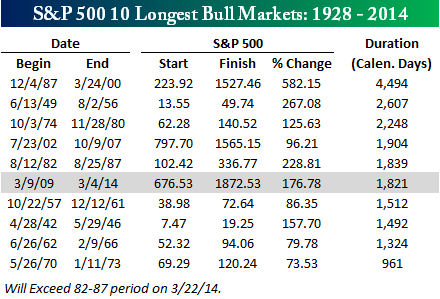
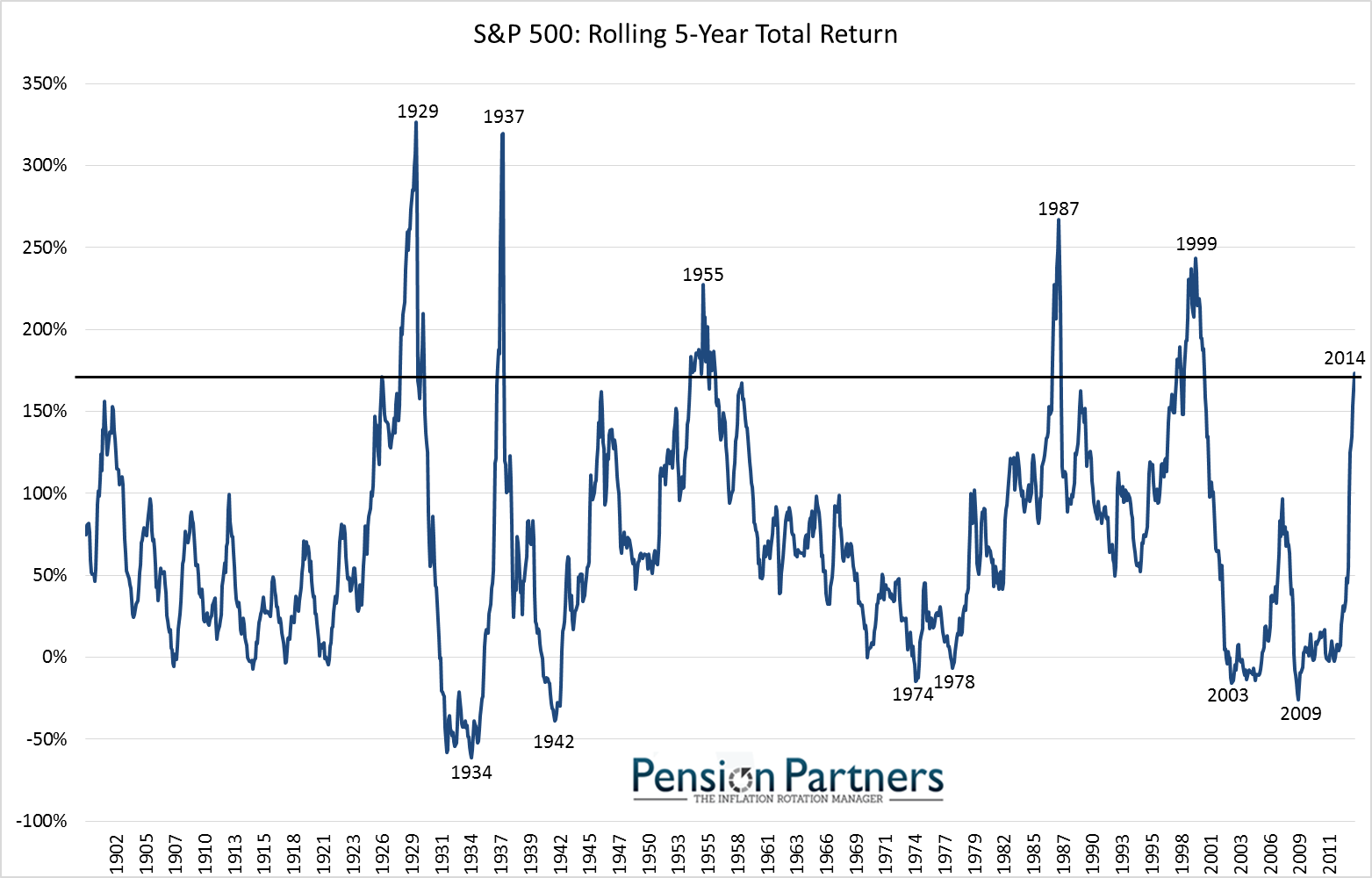
5. Histical Bull Markets — courtesy of BIG, and PensionPartners, the tables below provide an update of where the current bull market stands in comparison to prior bull markets in terms of duration and magnitude. The S&P500 is less than three weeks away from taking out the 1982 – 1987 period as the fifth longest bull market of all time.
6. China suffers first corporate-bond default — Bloomberg, China’s onshore bond market experienced its first default as a solar-cell maker failed to pay full interest on its bonds. The number of Chinese companies whose debt is double their equity has surged since the global financial crisis, suggesting this first onshore bond default won’t be the nation’s last. Publicly traded non-financial companies with debt-to-equity ratios exceeding 200 percent have jumped 57 percent since 2007.
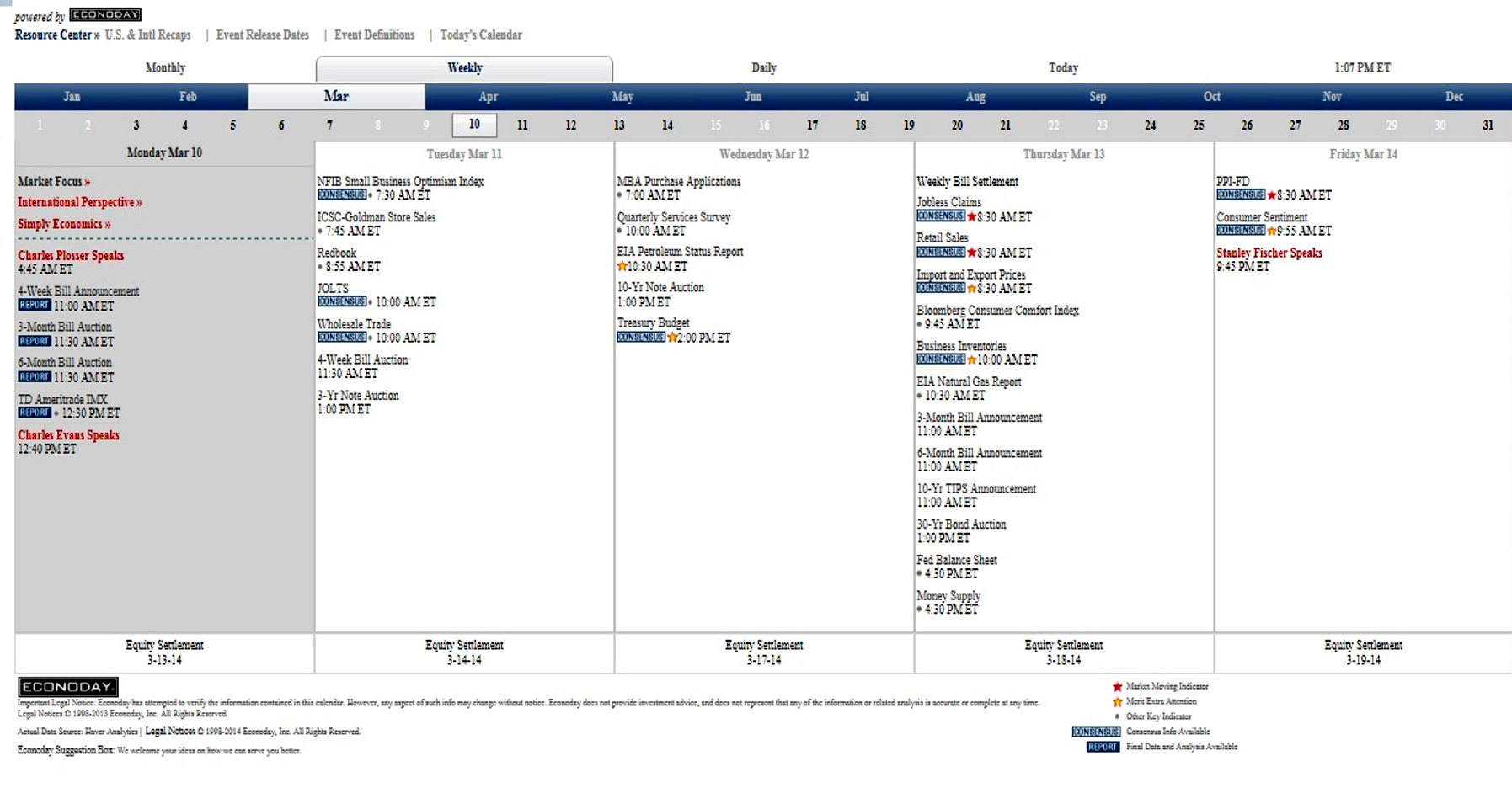
The week ahead — Economic data from Econoday.com:
Posted in Weekly Summary | No Comments »
March 3rd, 2014
“‘A bull market is like sex. It feels best just before it ends.'” — Barton Biggs
1. Ukraine calls for urgent aid after Yanukovich ousted — per Reuters, cash-strapped Ukraine appealed for urgent financial assistance to prevent a default, saying it needed $35 billion over two years to stop the economy “heading into the abyss”. Ukraine has called for a donor’s conference that will involve the EU, the U.S. and the IMF. The plea for a bailout comes after parliament ousted President Viktor Yanukovych. A warrant has been put out for Yanukovych’s arrest after he fled the capital before his removal. Acting President Oleksandr Turchinov said yesterday that Ukraine was close to default, with the economy facing an abyss.
2. JPMorgan (JPM) to cut thousands of extra jobs at its mortgage business — FT reports JPMorgan (JPM) plans to slash thousands more jobs at its mortgage business and at its branches amid plummeting demand for home loans and the increased automation of clerical jobs,. The cuts would be part of a new efficiency program and would add to the 10,000-15,000 positions that JPMorgan has already axed.
3. Japan Sees Key Role for Nuclear Power — WSJ, Japan intends to revive nuclear energy as a major source of electricity, the government disclosed in a draft document about its long-term energy strategy. Japan’s nuclear plants were idled following the Fukushima disaster almost three years ago, which has caused the country to significantly increase its energy imports.
4. Russian troops put on alert amid Ukraine crisis — MarketWatch, Russian President Vladimir Putin ordered a test of combat readiness for troops stationed in a region that touches Ukraine’s northern border. The move comes amid growing tension between Russia and Ukraine, whose pro-Russian president, Viktor Yanukovych, was ousted by European-leaning protesters at the weekend following violence in which more than 80 people were killed. A warrant for his arrest was issued this week.
5. Japanese economic activity bumps up ahead of sales-tax hike. Japanese industrial production grew at the fastest pace since June 2011 in January, jumping 4% on month after a drop of 0.9% in December. Retail sales leapt 4.4% vs +2.5%. The strong figures are not a total surprise, as a bump in economic activity has been expected ahead of a rise in sales tax in April, which is forecast to then drag on the economy. Core inflation held steady at 1.3% on year in January, while the unemployment rate was unchanged at 3.7%.
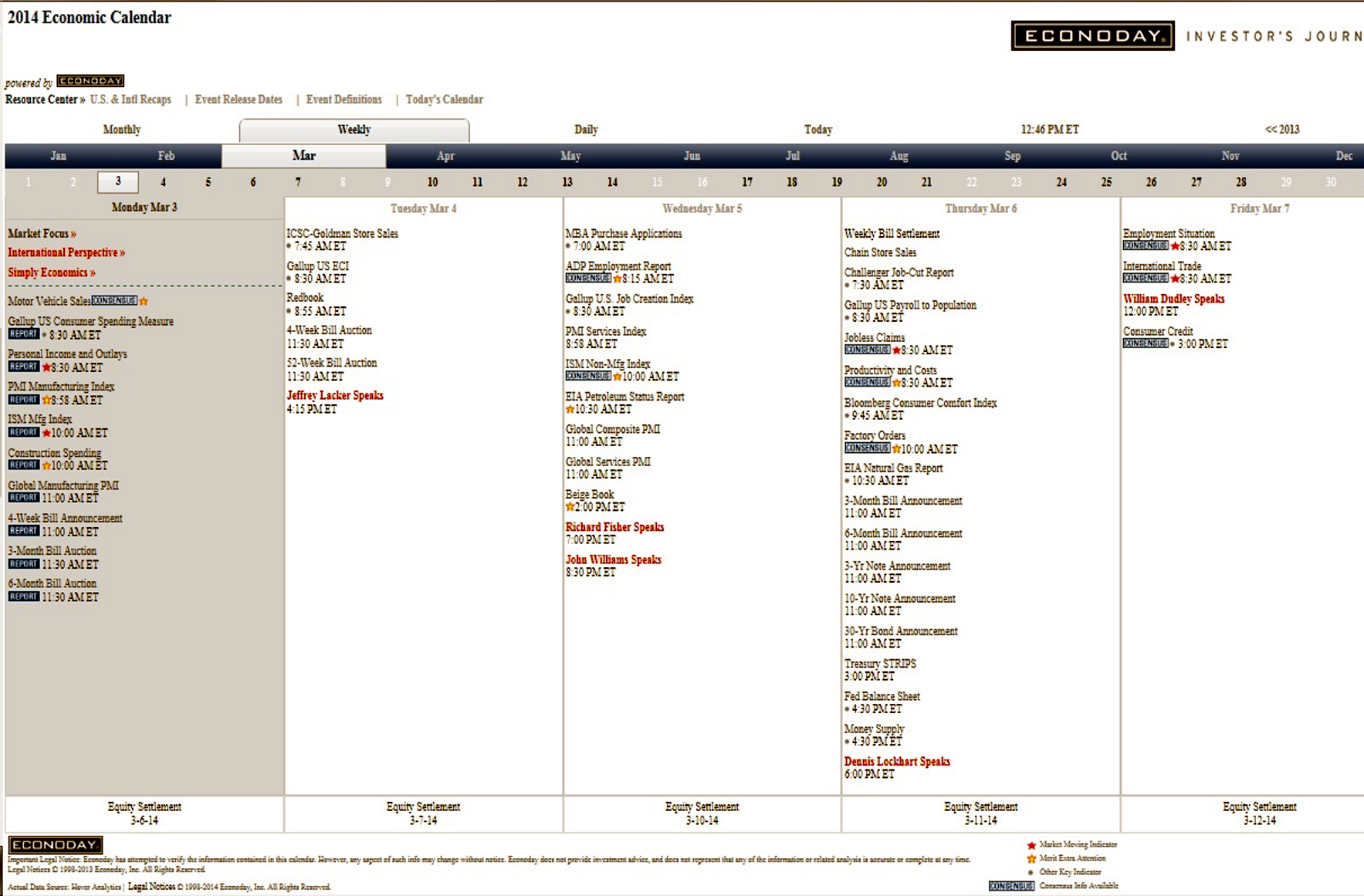
The week ahead — Economic data from Econoday.com:
Posted in Weekly Summary | No Comments »
February 25th, 2014
“Rule No.1: Never lose money. Rule No.2: Never forget rule No.1.” — Warren Buffett
1. PBOC drains $7.9B from financial system — the People’s Bank of China has drained $7.9B from the country’s financial system by selling 48B yuan in repurchase contracts, the first such transaction since June of 2013. The PBOC made the tightening move after the recent data showed that aggregate financing soared to a record 2.58T yuan ($425B) in January from 1.23T yuan in December despite the bank’s attempts to rein in lending.
2. Fed Reserve Sets Rules for Foreign Banks — the Federal Reserve has passed regulations for foreign banks on capital, debt levels and annual “stress tests” that could force 15-20 of them to raise billions of dollars in capital. Overseas banks with U.S. assets of over $50B would have to form special holding companies in the country and maintain higher capital buffers than other nations require.
3. U.S. Household Debt Begins to Rise Again — NYTimes, total household debt in the U.S. increased 2.1 percent, the largest quarterly increase since before the recession, according to a new report from the Federal Reserve Bank of New York. Mortgages rose by $16B on year to $8.05T following four consecutive years of declines. Retail analyst David Strasser says “We’re still over-leveraged by any historical measure.”
4. Chinese factory activity contracts at faster pace — China’s flash manufacturing PMI tumbled to a seven-month low of 48.3 in February from 49.5 in January and missed consensus of 49.4. The sub-indexes for output, new orders, new export orders and employment contracted. The fall in overall PMI adds to other data that provides a mixed picture of China’s economy. The latest figures may have been hampered by the Lunar New Year holiday.
5. Latest FOMC minutes — in the latest FOMC meeting chaired by Ben Bernanke, a few policy makers saw a chance of rate hikes “relatively soon.”
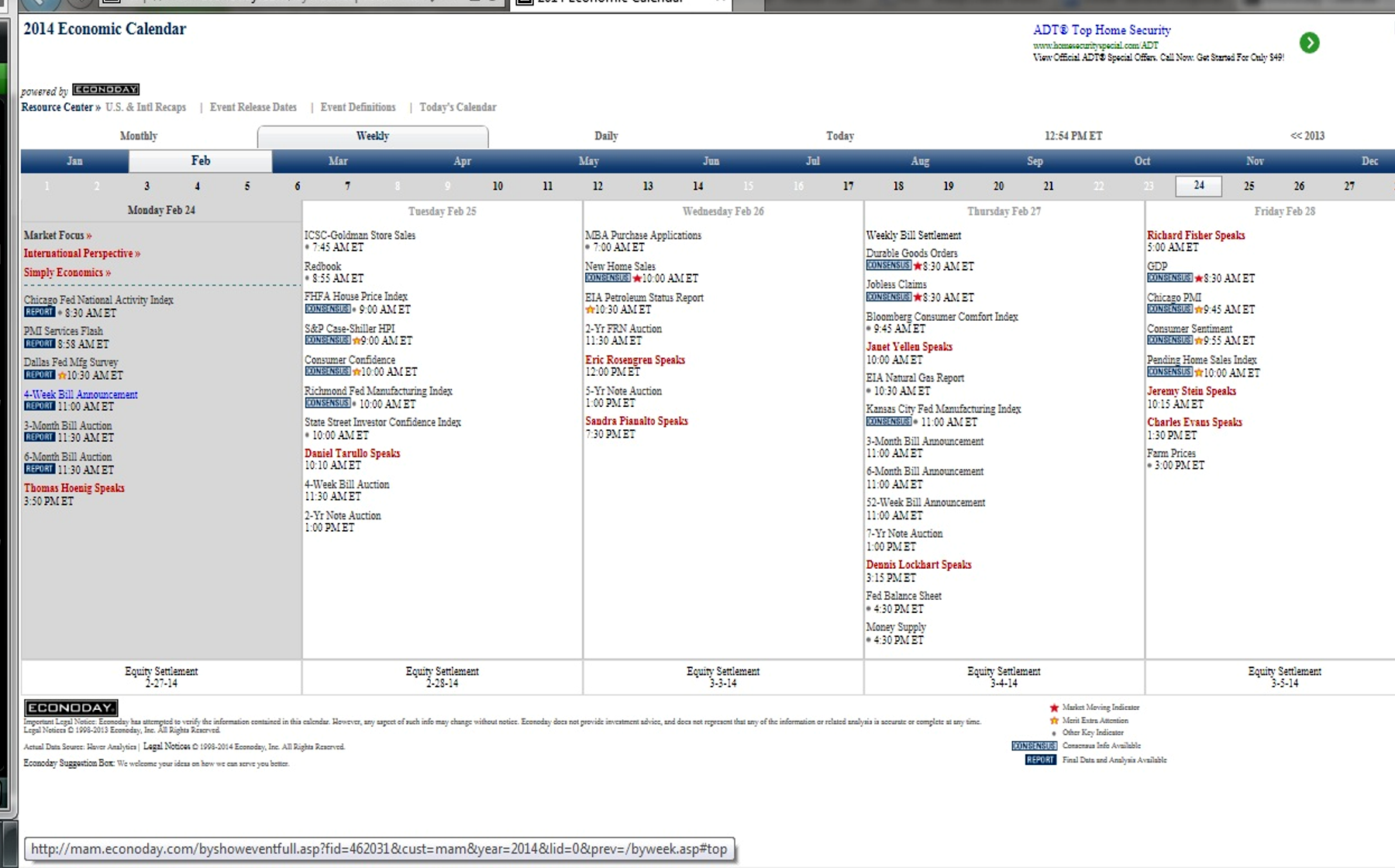
The week ahead — Economic data from Econoday.com:
Posted in Weekly Summary | No Comments »
February 18th, 2014
“The test of success is not what you do when you are on top. Success is how high you bounce when you hit bottom.” – George S. Patton
1. Millions Trapped in Health-Law Coverage Gap — WSJ reported that millions of Americans earn too tittle for health-law subsidies but ineligible for benefits under Existing Medicaid Programs. Around 4.8M people aged 18-64 get no government help to buy medical insurance – because they earn too little to qualify for federal subsidies. However, they earn too much to receive benefits under state programs. The gap is the result of 24 states deciding not to expand Medicaid coverage under the Affordable Care Act.
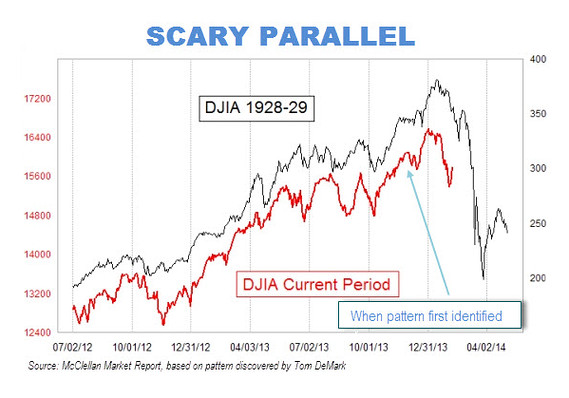
2. Dow Jones Average (DJIA) Chart Similar to 1929?? — below is a chart of the DJIA which displays a scary correlation to the 1928-1929 depression courtesy of McClellan Market Report. Will the pattern repeat is anyone guess???
3. White House again delays healthcare mandate for employers — Reuters, the government has announced yet another delay to a crucial part of Obamacare. The latest is that businesses with 50-99 full-time workers won’t have to provide health insurance to their workers until 2016. Larger firms will have to cover at least 70% of employees by 2015 and 95% a year later. The original plan was for companies to offer coverage in July 2014. That was delayed until 2015.
4. House approved suspension of debt limit for a year until March 16, 2015 — the House has authorized a one-year extension to the government’s borrowing authority – until March 16, 2015 – without any conditions by a vote of 221-201. There had been plans to link the debt-cap vote to restoring cuts to military pensions, but the battle-fatigued Republican leadership dropped its demands in order to keep the political focus on Obamacare.
5. German CPI in deflation territory — German CPI fell 0.6% on month in January following an increase of 0.4% in December. The drop in prices comes amid increasing concern that the eurozone faces the threat of deflation, although European Central Bank chief Mario Draghi has so far been sanguine about the prospect.
6. China’s Inflation Rate Holds Steady — WSJ, China’s CPI held steady at +2.5% on year in January, while PPI dropped for the 23rd consecutive month with a fall of 1.6%. The benign inflation could give the People’s Bank of China room to loosen monetary policy should the economy slow further, although the PBOC is also concerned about reining in soaring debt.
7. Twitter (TWTR) Insiders Get First Chance to Sell Shares as Lockup Ends — Bloombers, about 9.87 million of non-executive employees’ shares will become eligible for sale as agreements that locked them up after the IPO expire, according to filings with the U.S. Securities and Exchange Commission. That would boost the number of shares available for trading by 12 percent to about 90 million, according to data compiled by Bloomberg. More stock will start to become available for trading in May.
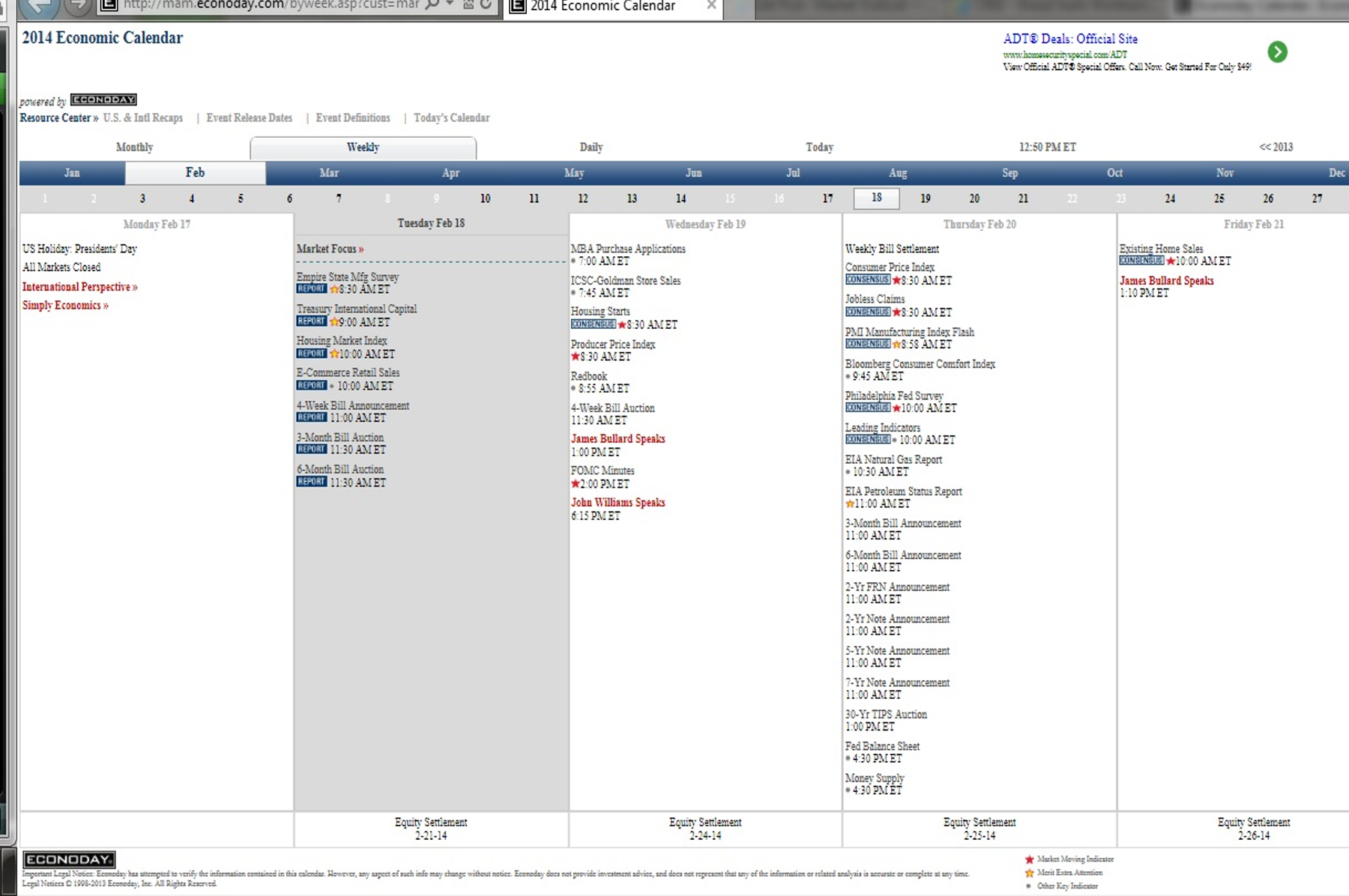
The week ahead — Economic data from Econoday.com:
Posted in Weekly Summary | No Comments »
February 10th, 2014
There will not be any re-cap for the week of Feb 7 2014. We are away for some needed R&R.
Have a good week.
The staffs at EGS.
Posted in Weekly Summary | No Comments »
February 3rd, 2014
“Only when the tide goes out do you discover who’s been swimming naked.” — Warren Buffett
1. Apple building mobile-payments business — WSJ reported Apple (AAPL) is working to expand its mobile-payments service to enable users to buy goods and services. AAPL ‘S iTunes havE 575M registered users, it poses a serious threat to the likes of PayPal (EBAY) and Square.
2. British economy grows at fastest pace since financial crisis — U.K. GDP increased 1.9% in 2013 in what was the quickest growth since 2007. However, GDP slowed a bit to +0.7% on quarter in Q4 from +0.8% in Q3 and the economy was still 1.3% below its pre-recession peak.
3. Congress forges deal on farm bill — Bloomberg reported the House and Senate negotiators have agreed to a five-year farm bill that would save up to $24B over the next ten years. The bill will reduce spending on food stamps by $8B and ending direct payments to farmers. That’s the third bill that legislators have negotiated in recent weeks.
4. FOMC Maintains QE Tapering Pace — Policymakers scaled back the bond purchase program by another $10bil a month, matching the prior cut despite the weak Dec. jobs report and upheaval in emerging markets. Central bankers noted mixed labor data and some slowing in housing.
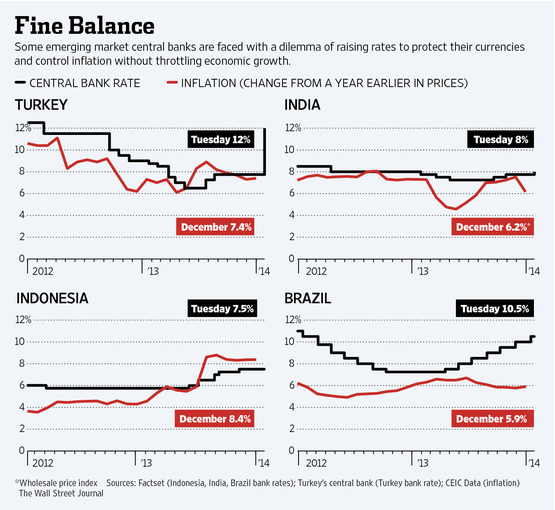
5. Emerging Markets raised interest rates to calm market — Turkey raised rate on one-week Interbank Rates, from 4.5% all the way to 10% as an attempts to get it’s plummeting currency and runaway inflation under control. Others did the same, see chart below courtesy of the WSJ.
6. Investors yank $9 billion from emerging market funds — Reuters, investors yanked $9 billion from emerging stock and bond funds during a turbulent past week, with equities seeing their biggest outflow in 2-1/2 years according to Boston-based fund tracker EPFR Global. This past week has seen some major falls in emerging currencies’ exchange rates, with central banks forced into rate rises or market interventions to limit the swings. Those currency losses and rate rises have put pressure on bond and stock holdings, forcing exits.
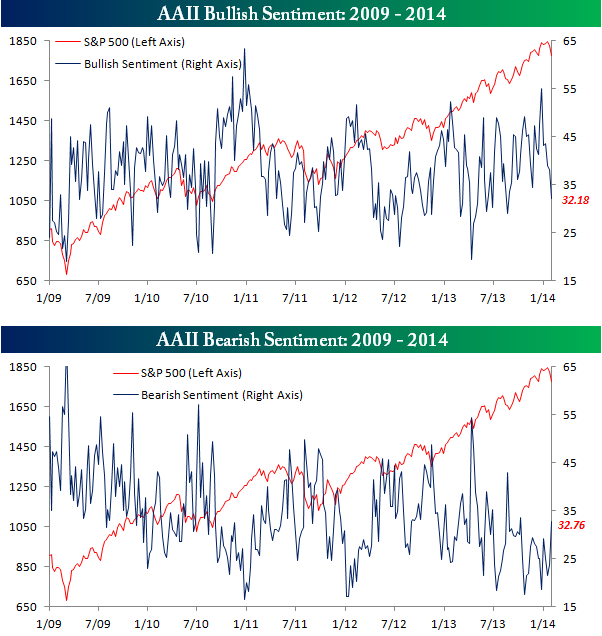
7. Individual Investors Rushed for the Exit — courtesy of BIG, According to the American Association of Individual Investors(AAII), bearish sentiment is now greater than bullish sentiment for the first time since mid-August. The last time bullish sentiment was above the 50% mark was back in late January. This represents the fourth weekly decline in the five weeks since bullish sentiment peaked on 12/26/13 at 55.06%. While bullish sentiment declined, the bearish camp became more crowded rising from 23.76% to 32.76%.
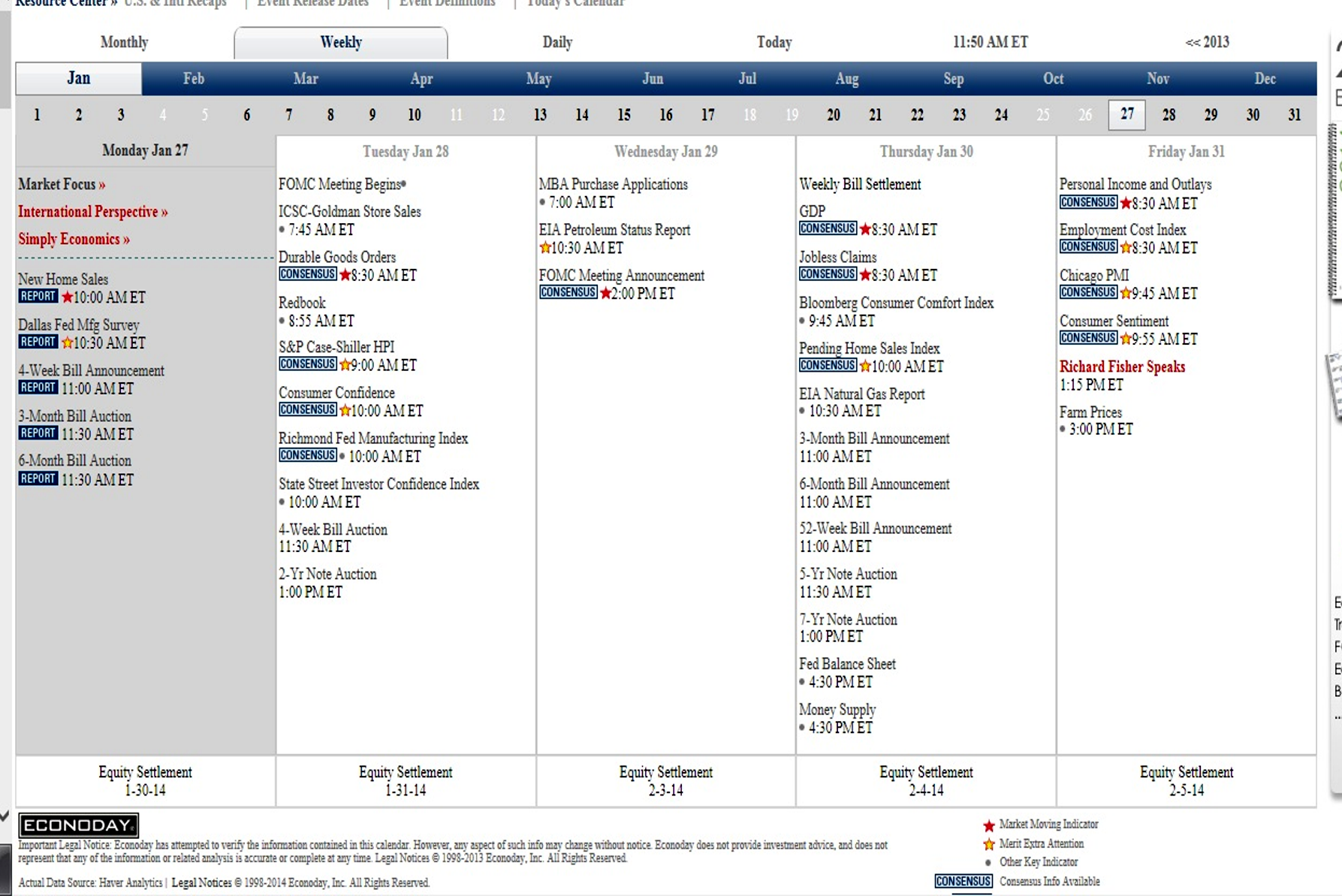
The week ahead — Economic data from Econoday.com:
Posted in Weekly Summary | No Comments »
January 27th, 2014
“Any idiot can face a crisis – it’s day to day living that wears you out.” – Anton Chekhov
1. Fed could cut bond-buying even further — Jon Hilsenrath from WSJ, reported that the Federal Reserve could reduce its monthly bond purchases to $65B from $75B at a next FOMC meeting. The Fed cut $10B from the QE program in December. Despite a weak jobs report last month, policy makers still bullish about the U.S.’s economic prospects.
2. Bank of Japan keeps ultra-loose policy unchanged — as expected, the Bank of Japan has left its key interest rate at 0.1%, and maintained its program of expanding the monetary base by ¥60-70T a year. The BOJ expects the economy to continue recovering moderately, although it will be affected by an upcoming hike in sales tax.
3. China (FXI) factory contraction shows weak start for economy in 2014 — Reuters, activity in China’s factory sector contracted in January for the first time in six months. It points to a weak start for the economy in 2014 as policymakers seek to curb high debt levels to head off financial risks. The flash Markit/HSBC Purchasing Managers’ Index (PM) fell to 49.6 in January from December’s final reading of 50.5, dropping below the 50 line which separates expansion of activity from contraction.
4. U.S. has until late February to increase debt limit — Congress has until late February to lift the $16.7T debt ceiling and avert a U.S. default, Treasury Secretary Jacob Lew stated. The cap is suspended until February 7, after which the Treasury can juggle the money about for a bit before running out of cash.
5. China’s Industrial & Commercial Bank of China Ltd concern of a default — Bloomberg, Chinese investors were asked to sink at least 3 million yuan ($496,000) in the 3 billion-yuan Credit Equals Gold No. 1 product amid guarantees that it was “100 percent safe,”. However, the owner was arrested after its coal mining company that collapsed.
6. Emerging-market currencies deepen drop — Marketwatch, Emerging-market currencies such as the Turkish lira, South African rand, Argentina Peso fell further against the dollar. Also, worries about a Chinese slowdown and prospects of rising U.S. rates triggered a broad flight out of emerging-markets assets.
The week ahead — Economic data from Econoday.com:
Posted in Weekly Summary | No Comments »