March 14th, 2016
“Amateurs want to be right. Professionals want to make money.” — unknown
1. BOE Chief Stated Foreign investment In the U.K. At Risk if ‘Brexit’ Hits — the head of the Bank of England stated Britons should expect a drop in foreign direct investment into their country if the U.K. decides to cut membership ties with the European Union. The U.K. logged net FDI inflows of £44 billion ($62 billion) in 2014, according to a U.K. Trade & Investment department report published in June 2015. FDI is investments from overseas entities in a variety of assets, such as property, equipment and stock purchases. The U.S. and Europe are the largest investors in the U.K., according to a U.K. Trade & Investment department report published in June 2015. U.S. investors held the largest share of FDI stock at 27%, followed by the Netherlands and France, at 15% and 8%, respectively.
2. SEC’s Chairwoman: Stock-Market Overhaul Won’t Happen This Year — SEC Chairwoman Mary Jo White said the agency won’t advance any major changes this year to the fragmented system of trading U.S. stocks, after undertaking a “holistic review” of rules, including whether stock exchanges should retain the power to regulate their members.
3. ECB Cuts Rates and Expands Stimulus — the European Central Bank (ECB) delivered a surprise package of measures to kickstart Europe’s economy, cutting its main interest rates and expanding its massive bond-buying program. The ECB cut its main refinancing rate to 0.0 percent and its deposit rate to minus-0.4 percent. The bank also extended its monthly asset purchases to 80 billion euros ($87 billion), to take effect in April. In addition, the ECB will add corporate bonds to the assets it can buy — specifically, investment grade euro-denominated bonds issued by non-bank corporations. These purchases will start towards end of the first half of 2016.
4. Deutsche Bank Warns : First quarter Challenging for Entire Sector — Deutsche Bank (NYSE:DB) has warned that volatile financial markets in the first quarter, normally a strong season for banks, posed a challenge for the entire sector. Chief Executive John Cryan said in the lender’s annual report “Deutsche Bank is no exception to this,”.
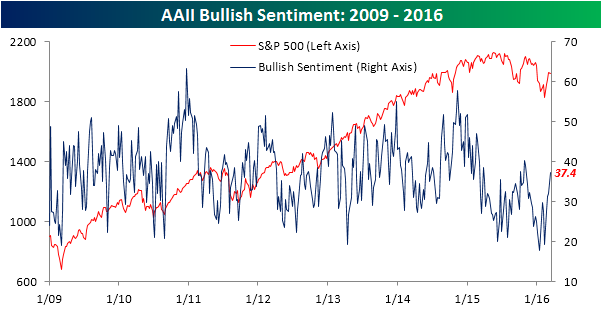
5. Latest AAII Bullish Sentiment — in the latest sentiment survey, bullish sentiment from increased from 32% up to 37.4%. While this is still below the bull market average, it is actually the highest weekly reading since November and represents the fourth straight week of increases. The last time bullish sentiment increased for four straight weeks was back in October 2013, and if sentiment manages to tick higher again next week, it would be the longest streak of increases since December 2012.
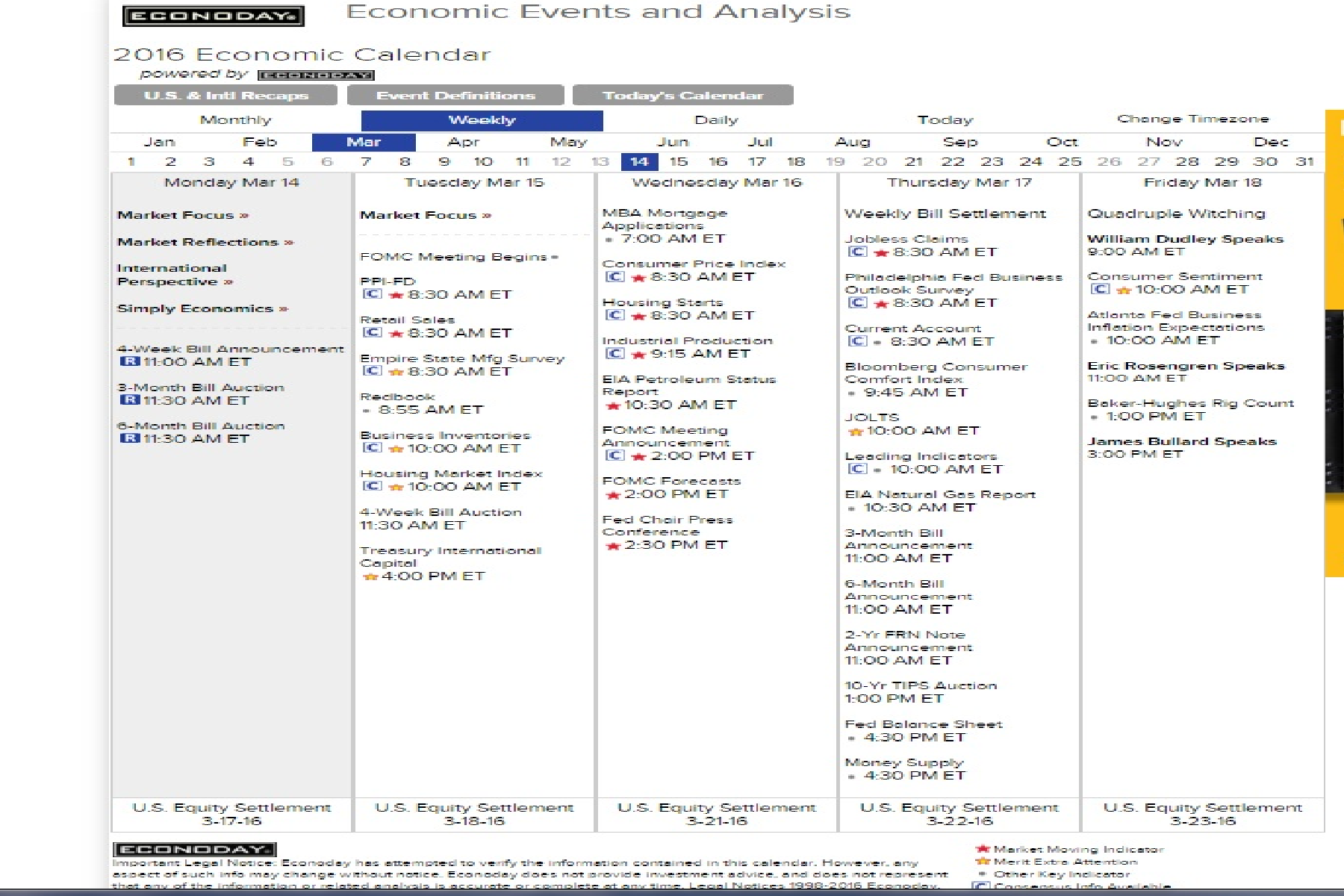
The week ahead — Economic data from Econoday.com:
Posted in Weekly Summary | No Comments »
March 7th, 2016
“The key to investing success is emotional discipline. If intelligent were the key, there would be a lot more people making money in trading” — Victor Sperandeo
1. G20 Meeting Conference in Shanghai Concluded — leaders from the world’s top economies declared “Monetary policies will continue to support economic activity and ensure price stability…but monetary policy alone cannot lead to balanced growth,”. Participants also repeated previous pledges not to engage in competitive currency devaluations and promised to “consult closely” on exchange markets.
2. China Eases Bank Lending — China’s central bank cut its reserve-requirement ration by another 0.5% point — its 5th cut in the past 12 months. The move shows further weakening of the yuan, which hit its weakest level vs. the US dollar in 3 weeks.
3. Moody’s Cuts China Outlook to Negative — Moody’s Investors Service has lowered the outlook on China’s credit rating from stable to negative, citing a weakening of fiscal metrics and a continuing fall in foreign exchange reserves. Moody’s current Aa3 rating on China is still seven notches above junk, so even if the agency were to follow up on its warning, investors wouldn’t have to suddenly start selling the country’s bonds.
4. Eurozone Recovery Loses Momentum – more deflationary pressures in the euro-zone are surfacing, raising the chances ECB President Mario Draghi will increase stimulus at a central bank meeting next week. Markit’s composite Purchasing Managers Index fell to 53 from 53.6 in January – its lowest level in 13 months – while the firm’s measure of output prices across manufacturing and services fell further below the key 50 level.
5. Auto Loans ‘s Size Hits Record — the avg amount financed for a new car or truck in Q4 rose 4.1% from last year to a record $29,551 per Experian Automotive. The avg monthly payment rose 2.3% TO $493, also a record, even as as loan terms got longer. New car loans for subprime lenders rose as well.
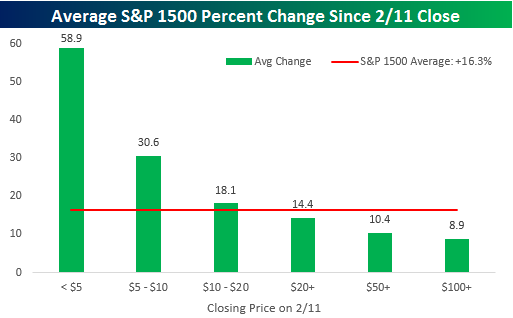
6. Low Priced Stocks Surge — courtesy of BIG, since 2/11, the average stock in the S&P 1500 is up an impressive 16.3%, but the performance of low priced stocks has trounced that. For example, on 2/11, there were 52 stocks in the S&P 1500 trading for less than $5 per share. Since then, the average return of those stocks is a gain of 58.9% with a median gain of 45%!
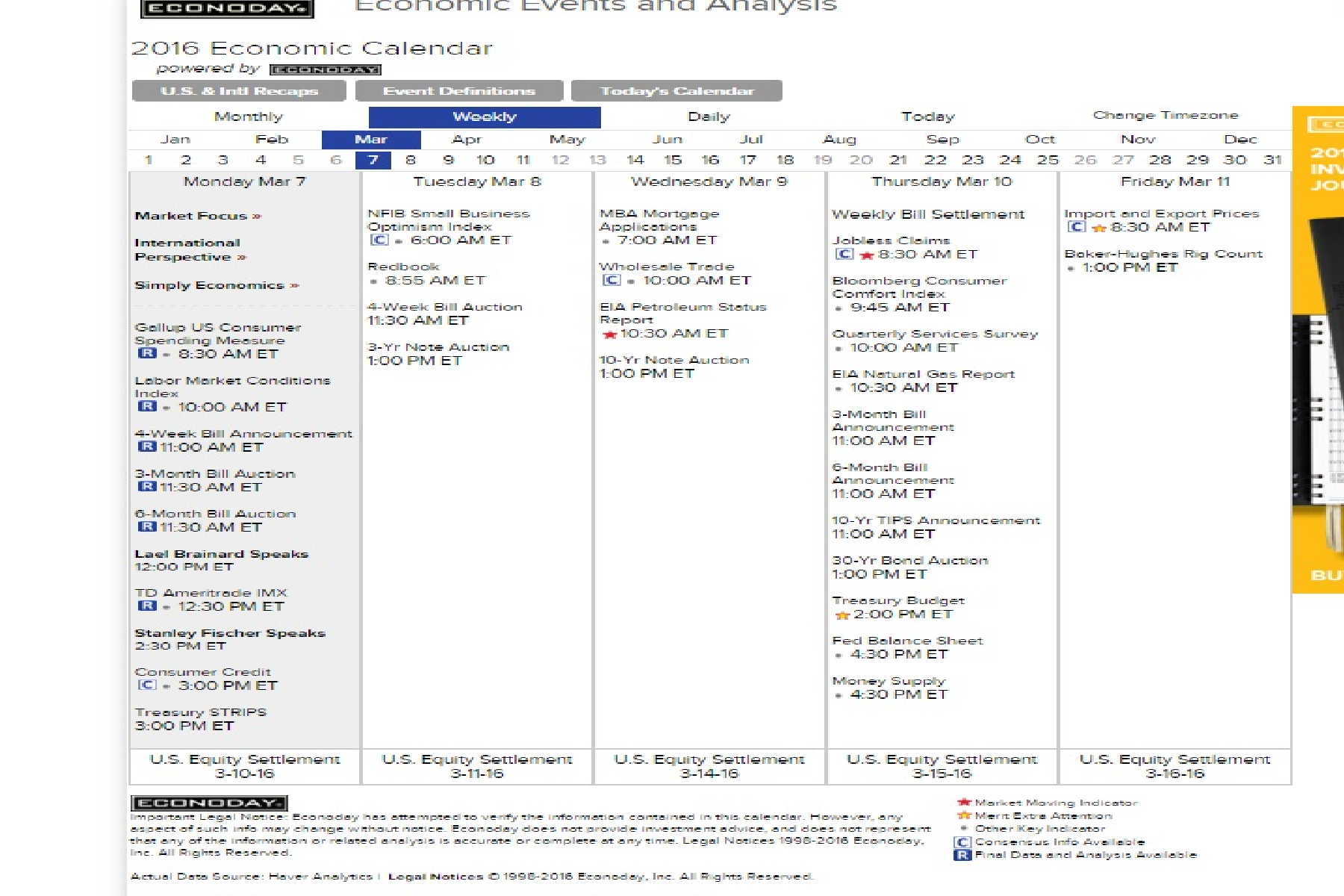
The week ahead — Economic data from Econoday.com:
Tags: G20 Meeting
Posted in Weekly Summary | No Comments »
February 29th, 2016
“I’m more concerned about controlling the downside. Learn to take the losses. The most important thing about making money is not to let your losses get out of hand.” – Marty Schwartz.
1. Trump Wins Nevada GOP Caucuses — Donald Trump won the Nevada caucuses last Tuesday night, adding a third straight victory in his drive for the Republican presidential nomination. “Markets are in a state of suspended disbelief. I don’t think they’ve seen anything like this. No one has seen anything like this,” said Mike Thompson, Chairman at S&P’s Investment Advisory Services.
2. JPMorgan (JPM) Warns On Energy Bad Loans — JPMorgan is adding another $500M to energy-related loan-loss reserves. This followed a $67M provision in Q4, which at the time brought total oil and gas loss reserves to $815M (vs. a portfolio with book value of $44B).In addition, the bank said it could need to add another $1.5B to reserves should oil hang around $25 per barrel over the next 18 months.
3. China Stocks Dive 6.4% Ahead of G20 Meeting — the Chinese market index dropped 6.4% late last week, extending its fall this year to 22%, as surging money-market rates signaled tighter liquidity and the offshore yuan weakened for a fifth day, while the country’s vice finance minister warned of pressure on exports. The plunge comes as world leaders gather for a G20 meeting in Shanghai, where current market turmoil and a global economic slowdown are expected to be key topics of discussion.
4. Moody’s Cuts Brazil’s Rating to Junk — Moody’s cuts Brazil’s sovereign credit rating to Ba2 from Baa3, two notches into junk territory, with a negative outlook, citing uncertainty over the effort to impeach Pres. President Rousseff and the corruption scandal that has paralyzed the country’s leadership and slowed efforts to shore up its crumbling finances. Samar Maziad, Moody’s lead analyst for Brazil stated “There’s very little visibility on what the future will be.”
5. 4Q GDP Revised to 1% from 0.7% — the U.S. economic growth in the fourth quarter was marked up slightly to 1%, but that was mainly because of a bigger stockpiling of inventories. The initial report was 0.7% rate. The value of inventories, which adds to GDP, rose by $81.7 billion instead of $68.6 billion as initially reported. Consumers boosted spending by 2% in the fourth quarter, but that was down from an initial 2.2% estimate and was much weaker compared with the spring and fall.
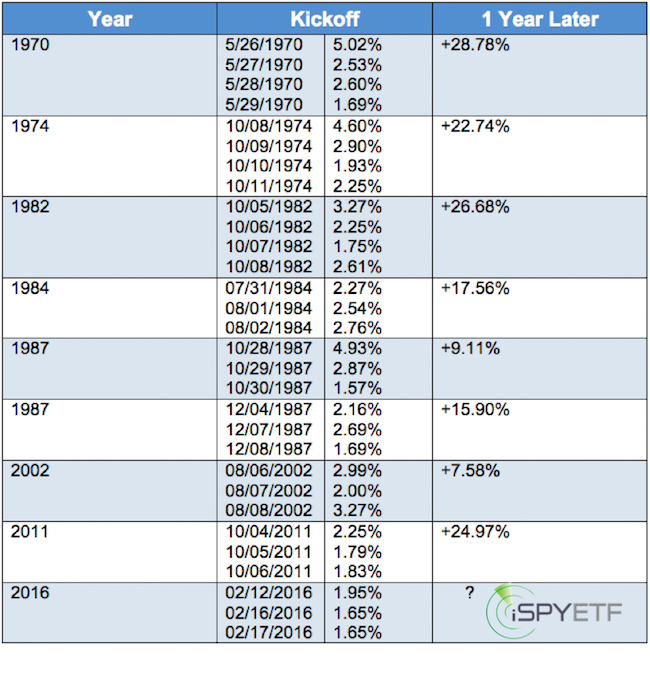
6. S&P 500 Gained More Than 1.5% a Day for Three Consecutive Days Historical Pattern — the chart below provides a snapshot of each kickoff rally (dashed green line) and how the S&P 500 did 60 trading days (about three months) prior, and 255 trading days (above one year) thereafter.
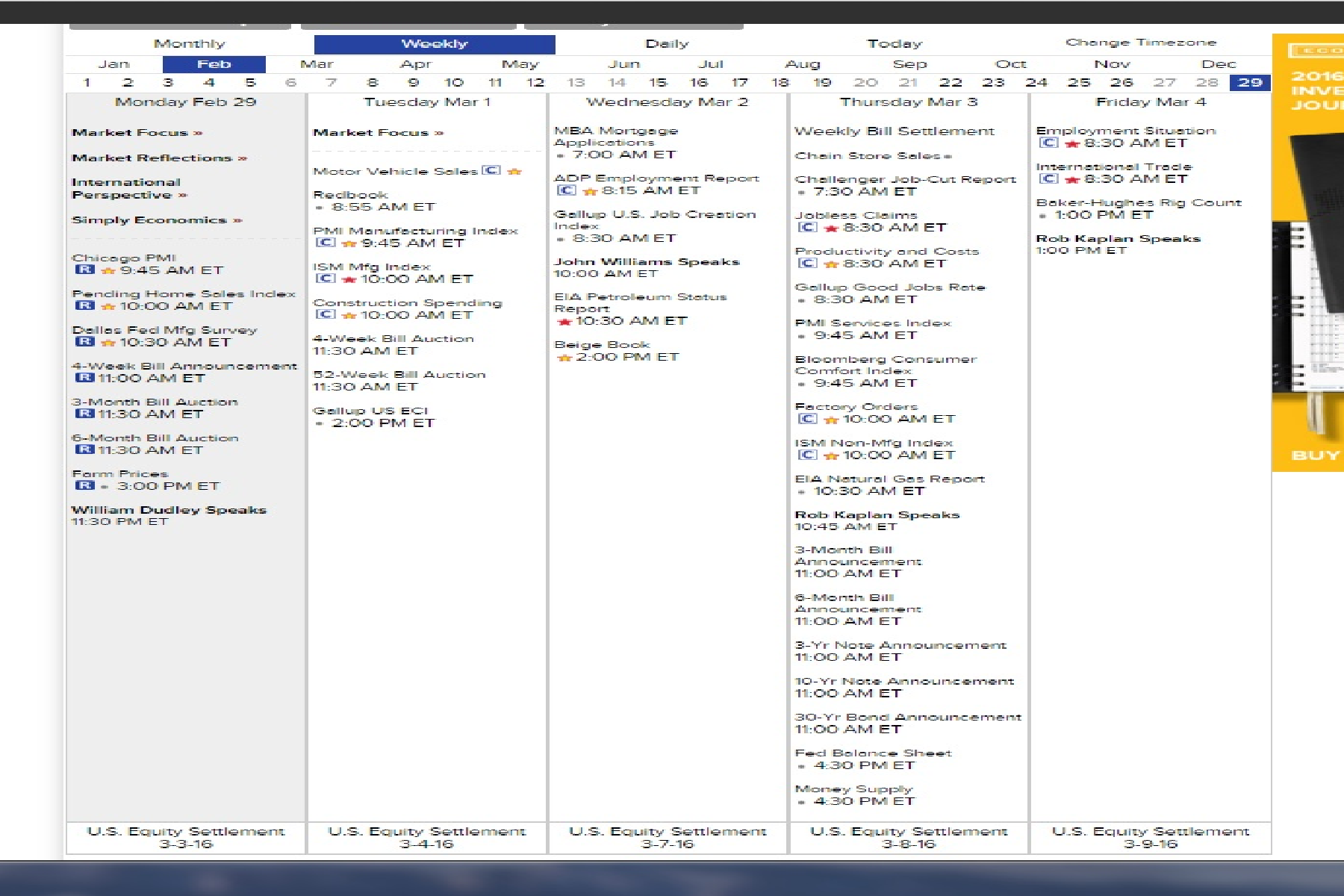
The week ahead — Economic data from Econoday.com:
Tags: 4Q GDP, Q1 GDP
Posted in Weekly Summary | No Comments »
February 24th, 2016
“I have been trading for decades and I am still standing. I have seen a lot of traders come and go. They have a system or a program that works in some specific environments and fails in others. In contrast, my strategy is dynamic and ever evolving. I constantly learn and change.” – Thomas Busby
1. Saudi Arabia, Russia, Qatar, Venezuela Agree to Freeze Oil Production — Saudi Arabia, Russia, Qatar and Venezuela reported that they wouldn’t increase crude-oil output above January’s levels as long as other major oil producers followed suit, in the first coordinated move to boost oil prices in years. The agreement came with a significant caveat: Iran and Iraq must also halt production increases.
2. Venezuela Hikes Fuel Prices, Devalues Bolivar — cash-strapped Venezuela has finally taken action to address its ailing economy, raising the price of the world’s cheapest gasoline and devaluing its currency by 37%. President Nicolas Maduro said the government would also “simplify” the country’s complex three-tier exchange rate system to just two rates: a protected official rate for food/medicine imports and a parallel “floating” rate for other transactions. The measures are meant to help shore up the OPEC nation’s finances as it battles a severe recession, triple-digit inflation and chronic product shortages.
3. Buffett Discloses Stake in Pipeline Operator Kinder Morgan (NYSE:KMI) — Berkshire Hathaway (BRK.A, BRK.B) opened a new 26.5M share stake in the energy infrastructure company during Q4, translating into stock worth roughly $395.9M at year end. This is a new investment in pipeline operator. George Soros also added 50.7K shares of Kinder Morgan (KMI) during the fourth quarter.
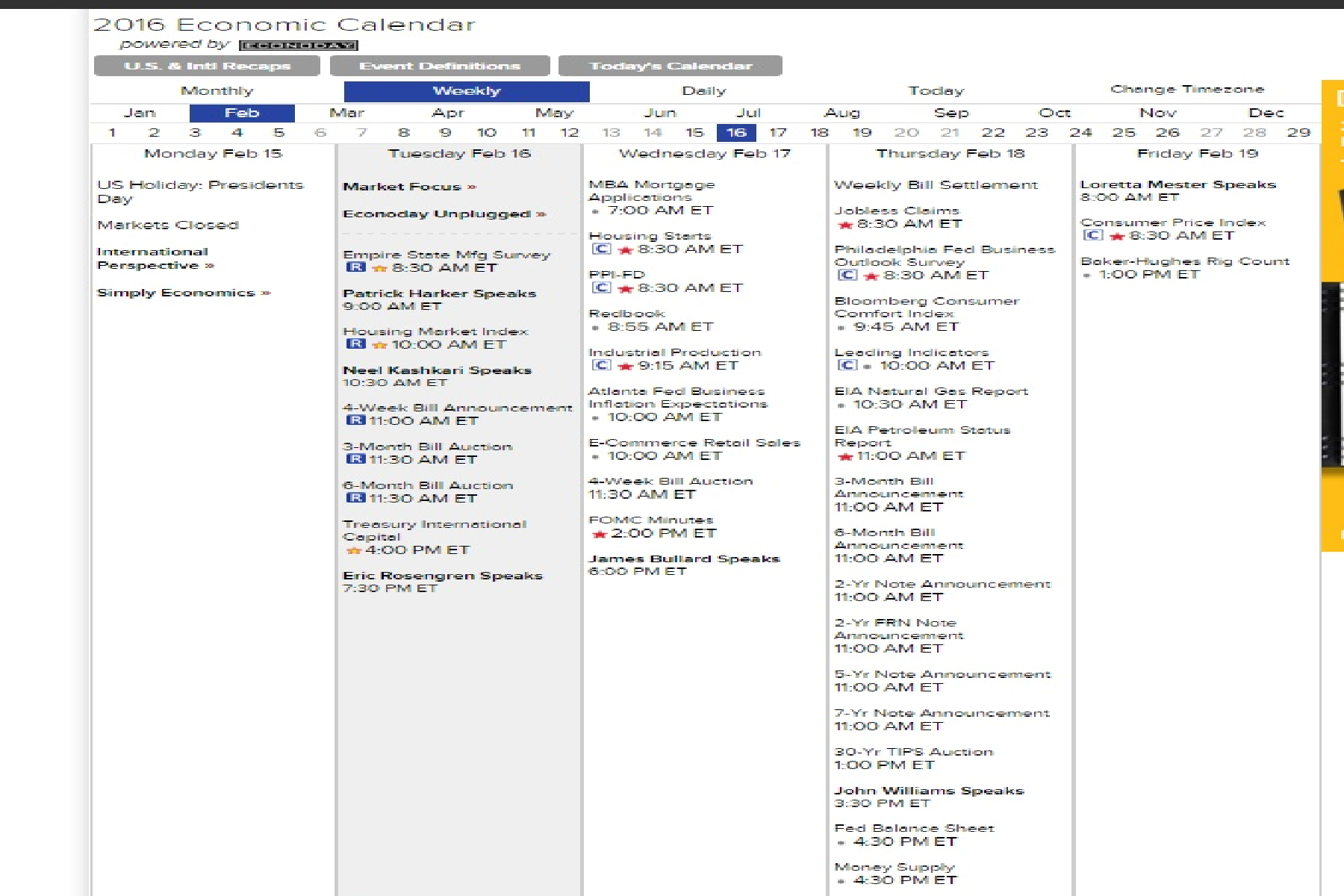
The week ahead — Economic data from Econoday.com:
Tags: Buffetts 4Q
Posted in Weekly Summary | No Comments »
February 16th, 2016
‘If you are going to be wrong, be wrong quickly with a de minimis loss of capital’.” — unknown
1. China Dips Into Foreign-Exchange Reserves By $99.5B in January — the Peoples Bank of China discloses that its foreign-exchange reserves fell by almost $100B in January. The reserve drop in January to $3.23T, marking the lowest level since 2012. Beijing has been fiercely struggling to underpin the yuan amid slower economic growth, plunging stocks and increasing capital outflows that have been burning through the reserves.
2. S&P Lowers Ratings On Four Banks With Big Oil Loan Exposure — four regional banks had their ratings cut by Standard & Poor’s last week on their exposure to loans in the energy sector amid falling oil prices. S&P lowered ratings by one notch on BOK Financial Corp. (BOKF) to “BBB+”, Comerica Inc. (CMA) to “BBB+”, Cullen/Frost Bankers Inc. (CFR) to “A-“, and Texas Capital Bancshares Inc. (TCBI) to “BB+”.
3. Trump, Sanders Captured New Hampshire — Republican Donald Trump and Democrat Bernie Sanders swept to convincing victories in the New Hampshire primaries las Tuesday night, providing them momentum for future contests and sending shock waves through both parties. With voters putting their faith in anti-establishment politics, New Hampshire’s verdict sets up a tough fight for Republicans in South Carolina on Feb. 20 and for Democrats there on Feb. 27.
4. Sweden Cuts Main Interest Rate Further Below Zero — Sweden’s central bank cut its main interest rate even further below zero as it sought to hold down the national currency to support a recovery in the inflation rate toward a 2% target. The bank, known as Sweden’s Riksbank, lowered its main repurchase rate to minus 0.5% from minus 0.35% and said it still had scope to drop it further if needed. The Riksbank, along with the Swiss, Danish, European and most recently Japanese central banks have now all gone lower. Negative interest rates in a country discourage foreign investors from holding that country’s currency and that pushes the value of the currency down. That in turn pushes import prices up, giving the inflation rate a further boost.
5. OPEC Ready for Output Cut — Reuter reported that UAE’s oil minister said “OPEC members are ready to cooperate on a cut”. Saudi Arabia signaled it may limit output but won’t commit unless Iran does the same. US crude hits 13-year lows earlier this week at around $26.00 a barrel.
The week ahead — Economic data from Econoday.com:
Tags: OPEC Cuts, Sweden Rate Below Zero
Posted in Weekly Summary | No Comments »
February 8th, 2016
“The essence of portfolio management is the management of RISKS, not the management of RETURNS.” — Benjamin Graham
1. Berkshire Ups Stake in Phillips 66 (NYSE:PSX) — Berkshire Hathaway has resumed its purchases of Phillips 66 (NYSE:PSX), spending roughly $832M in January to boost its stake even as the oil refiner’s profit margins narrowed. According to a regulatory filing, the conglomerate paid about $198M last week for 2.54M shares of PSX, giving it 72.29M overall, or a roughly 13.7% stake in the company. Phillips 66 is Berkshire’s (BRK.A, BRK.B) sixth-largest stock holding.
2. S&P Cuts Ratings of 10 U.S. Oil Companies — S&P ratings cut a number of energy companies by one notch: Chevron (NYSE:CVX), Apache (NYSE:APA), Continental Resources (NYSE:CLR), Devon Energy (NYSE:DVN), EOG Resources (NYSE:EOG), Hess (NYSE:HES), Hunt Oil, Marathon Oil (NYSE:MRO), Murphy Oil (NYSE:MUR) and Southwestern Energy (NYSE:SWN).
3. Florida Governor Declares Zika Health Emergency — Florida Governor Rick Scott has declared a state of emergency in four counties where people have been diagnosed with the Zika virus. While nine cases of the mosquito-borne illness have been detected in the state, health officials believe all of the viruses were contracted while traveling to affected countries. The disease, for which there is no vaccine and no specific cure, has been linked to a recent surge of birth defects in Brazil.
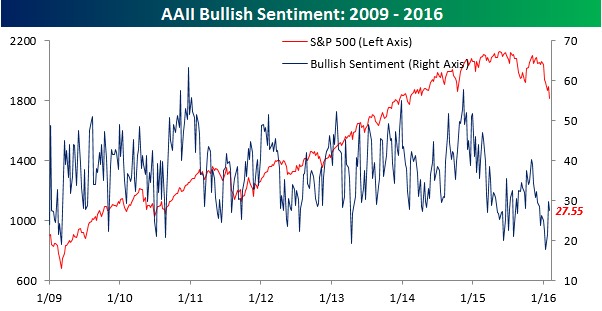
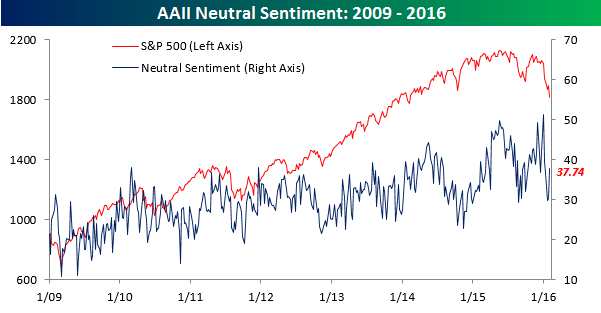
4. American Association of Individual Investors (AAII) Bullish Sentiment Declined — according to the weekly sentiment survey from the American Association of Individual Investors (AAII), bullish sentiment declined from 29.75% down to 27.55%. That makes 48 weeks out of 48 where bullish sentiment has been below 40%. Even as bullish sentiment declined, bearish sentiment also declined falling from 39.96% down to 34.72%.
The week ahead — Economic data from Econoday.com:
Tags: AAII Sentiment
Posted in Weekly Summary | No Comments »
February 2nd, 2016
“When a falling stock becomes a screaming buy because it cannot conceivably drop further, try to buy it thirty percent lower.” – Al Rizzo
1. Energy Sector Debt Review Loom — Moody’s put ratings of 175 energy and mining companies on review for downgrade. Overall, 120 companies in the oil sector and 55 companies in the mining sector are on negative watch. Any credit downgrades may worsen its liquidity crunch among energy companies, which have had to rely more on bank loans as oil revenue dries up.
2. China Stocks Finish At More Than Year Low — China’s volatile shares tumbled last week, taking losses this month to about 25% or 13T yuan ($2T), while state media insisted that the market ructions did not reflect the real economy. The People’s Bank of China also auctioned 340B yuan ($51.7B) of reverse-repurchase agreements during the session, after offering a record 440B yuan two days earlier. Policy makers are hoping to prevent a cash crunch before the week-long Lunar New Year holiday.
3. FOMC Meeting Recap — the Fed kept interest rates unchanged and said it was “closely monitoring” global economic developments, signaling it had accounted for a stock market selloff but was not ready to abandon a plan to tighten monetary policy this year.
4. Obama Calls for Rapid Zika Research — President Obama is calling for the rapid development of tests, vaccines and treatments to fight the mosquito-transmitted Zika virus, which has been linked to brain damage in thousands of Brazilian babies. American health officials are eager to step up efforts studying the link between Zika infections and birth defects, citing a recent study estimating the virus could reach regions where 60% of the U.S. population lives.
5. Bank of Japan (BOJ) Adopts Unprecedented Negative Interest Rate — the BOJ said it would adopt a negative interest rate policy for the first time, as a sputtering economy, stubbornly low inflation and turbulent global financial markets threaten to undermine Prime Minister Shinzo Abe’s economic-revival plan. The central bank said it cut the deposit rate it pays on cash parked at the BOJ by commercial banks in excess of legally required reserves, to minus 0.1% from the previous plus 0.1%. The goal was to push down borrowing costs across a broad time spectrum to stimulate inflation.
The week ahead — Economic data from Econoday.com:
Tags: BOJ Negative Rate, Energy Debt Review
Posted in Weekly Summary | No Comments »
January 25th, 2016
“When the fear of losing money overcomes the fear of looking stupid . . . that’s a bottom!” — Arthur Cashin
1. China GDP Growth Sinks to 25-Year Low — China’s Q4 gross domestic product eased to 6.8% from a year earlier, while full-year growth slipped to 6.9%, adding to the troubling economic picture that’s unsettling traders around the world. Experts expect Beijing may do more to stimulate its economy.
2. Iranian Sanctions Come to An End — July’s nuclear deal between Iran and six world powers came into effect, triggering an end to years of sweeping sanctions on Tehran. $100B worth of Iranian assets are set to be unfrozen and many global companies will now be permitted to do business with the Islamic Republic. Iran has also said it plans to scale up oil production and exports by 500K bpd – a move that comes as crude prices languish below $30/bbl and amid deteriorating relations with Saudi Arabia.
3. Saudi Arabia Warns Banks Against Riyal Speculation — the Saudi Arabian central bank has warned commercial banks against betting on depreciation of the riyal as tumbling oil prices put pressure on the Saudi currency. Banks and hedge funds are also speculating that low oil prices might eventually prompt Riyadh to scrap its peg to the U.S. dollar (which has been linked since 1986). Bets for a devaluation of the riyal reached their highest in almost two decades this month, driving 12-month forward contracts to their highest since at least December 1996.
4. Russia Ruble’s Dramatic Plunge Continues — Russia’s ruble fell more than 5% late last week, to hit a new record low of 85.97 per dollar amid a global crash in crude prices. The country is suffering considerably from the oil slump, which has sparked widespread predictions of a second straight year of recession.
5. Venezuela Fears of Default Grows — the plunge in the price of oil is causing more investors to bet that Venezuela will default on its $120B pile of foreign debt, an event that would trigger a messy battle over the country’s oil shipments and deepen its economic and political crisis. Oil accounts for 96% of Venezuela’s export earnings.
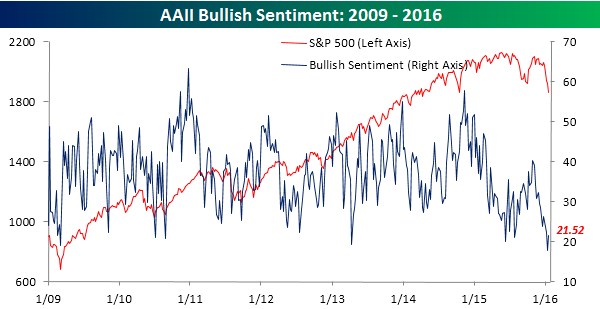
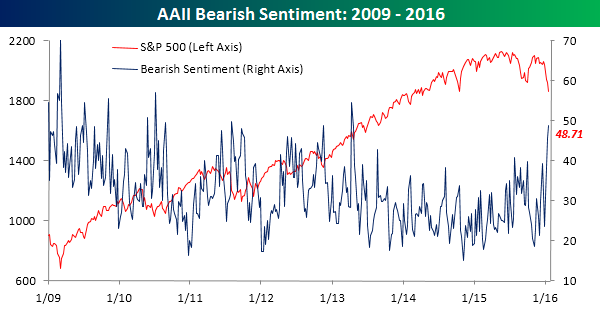
6. AAII Bullish Sentiment Ticks Higher — according to the weekly survey from the American Association of Individual Investors (AAII), bullish sentiment increased from last week’s depressed reading of 17.9% up to 21.52%. Even at that level, though, sentiment remains extremely bearish.
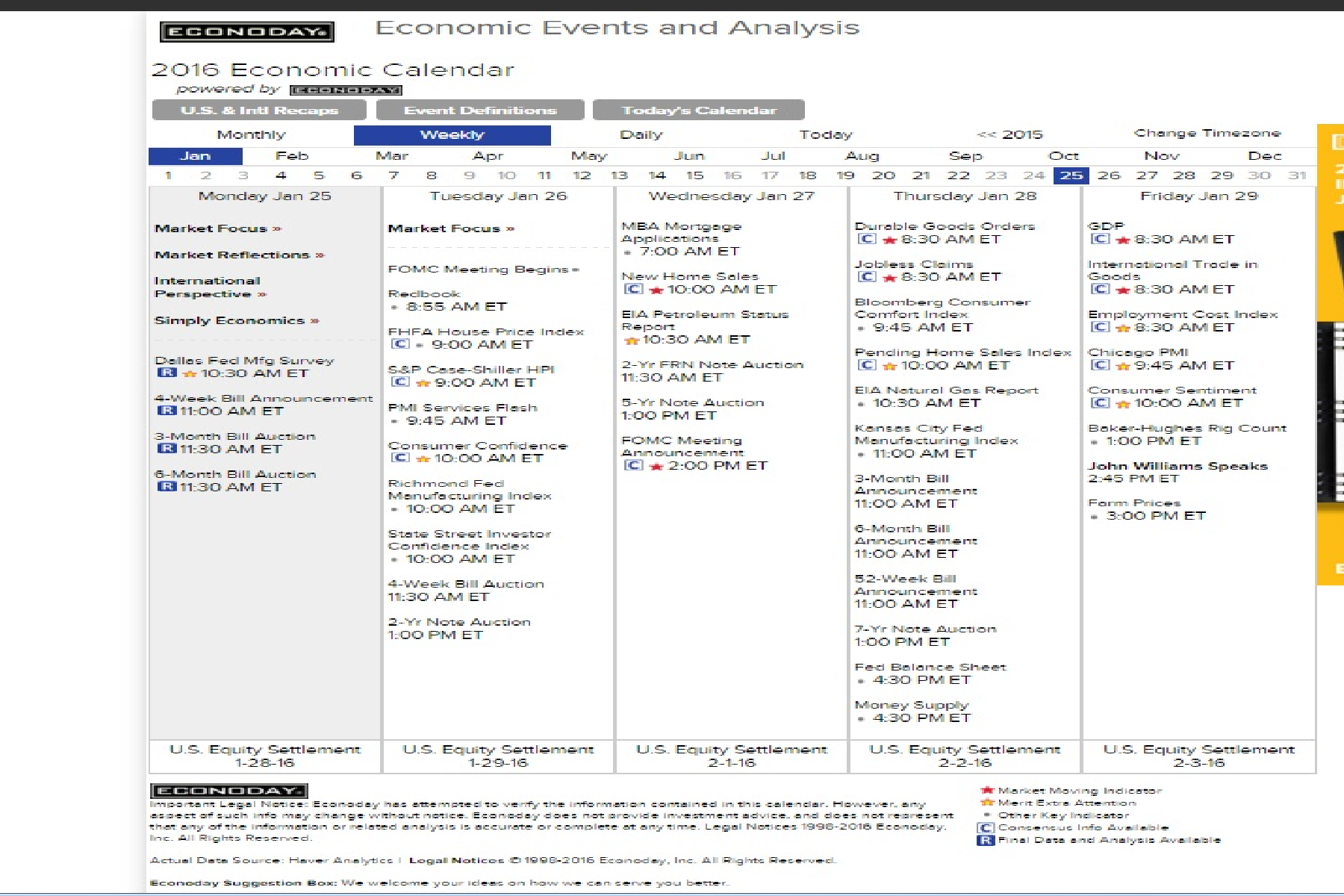
The week ahead — Economic data from Econoday.com:
Tags: AAII Sentiment, China GDP Slow, Iran Sanction End
Posted in Weekly Summary | No Comments »
January 18th, 2016
“In bear markets, stocks usually open strong and close weak. In bull markets, they tend to open weak and close strong.” – William J. O’Neill
1. China Auto Sales Slowest Pace Since 2012 — auto sales in China rose 4.7% to 24.6M units last year to mark the slowest pace of sales growth since 2012, according to data from the China Association of Automobile Manufacturers. A sizable tax cut from Beijing during the last quarter wasn’t enough to help lift sales past the growth rate seen in the bustling U.S. auto market. General Motors (NYSE:GM) and Ford (NYSE:F) outpaced major domestic automakers in China through their local joint ventures.
2. Amazon’s Chinese Unit Gets License to Provide Ocean Freight Services — Amazon supplies its own trucks, drones and maybe some planes, but ships are now seen as the next horizon. The company’s China subsidiary has received a license in the U.S. to operate as an ocean freight forwarder – an entity that organizes the shipment of goods from a supplier or factory in one region to a company or customer somewhere else. UPS might be hurt by Amazon new strategy of providing its own transportation services.
3. Berkshire Hathaway (BRK.A, BRK.B) Bought an Additional 5.1M shares of Phillips 66 (NYSE:PSX) — according to regulatory filings, Berkshire Hathaway (BRK.A, BRK.B) bought an additional 5.1M shares of Phillips 66 (NYSE:PSX) between Jan. 4 to Jan. 11. The purchases boost Berkshire’s Phillips 66 investment to 65.68M shares, or about 12.3% of those outstanding. Buffett fans, and perhaps some crude oil watchers, likely are wondering if he is calling a bottom in the oil price rout.
4. Brent Briefly Slips Below $30 — brent oil prices briefly dipped below $30/bbl, hitting a new 12-year low and putting the benchmark at a discount to U.S. crude. Prices have already tanked 20% this year and analysts vary greatly over the level and when the commodity will hit a bottom.
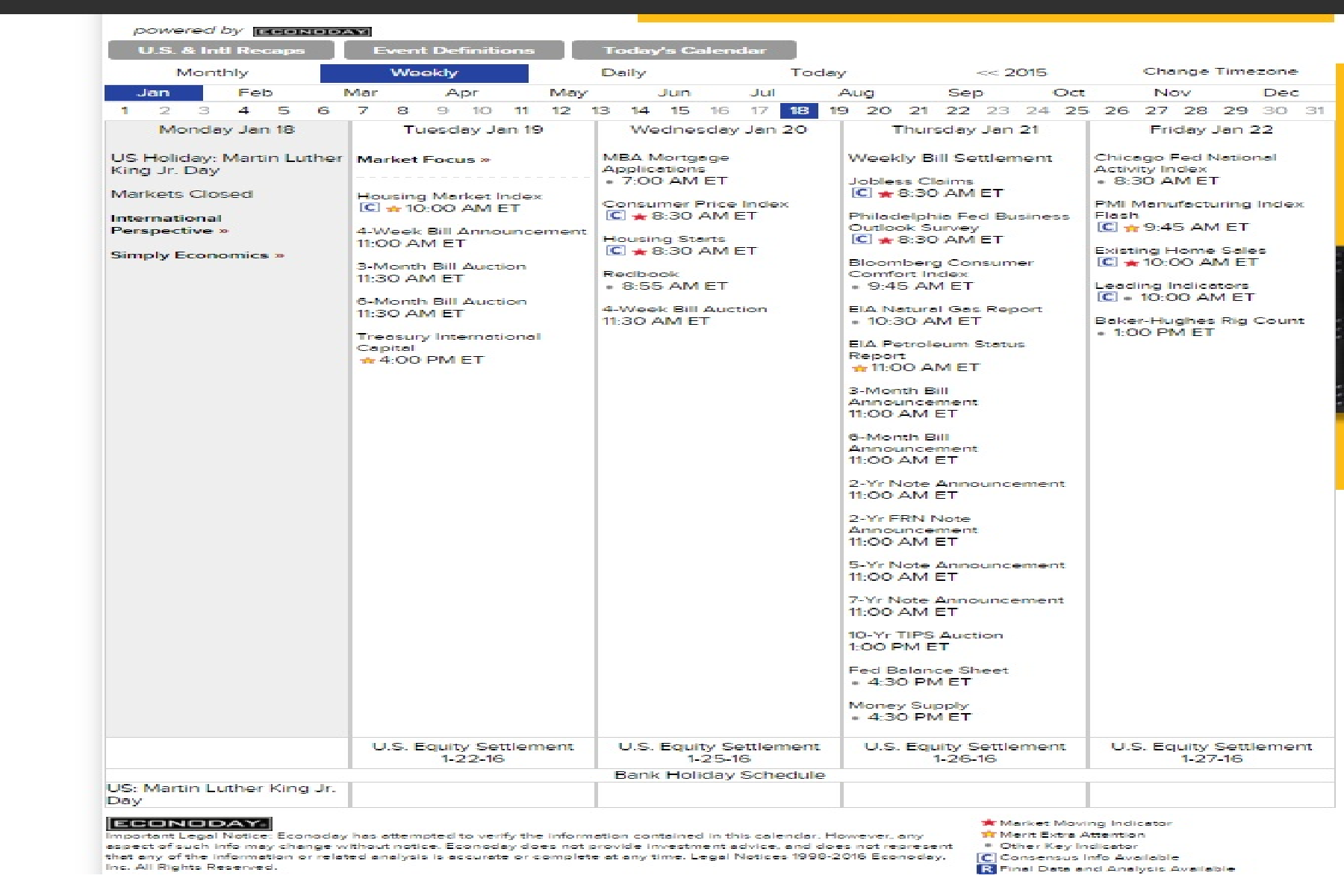
The week ahead — Economic data from Econoday.com:
Posted in Weekly Summary | No Comments »
January 11th, 2016
“As goes January, so goes the market” — Trader Almanac
“The December Low Indicator” — “Forget all the noise you hear about the January Barometer; pay much more attention to the December low. That would be the lowest closing price for the Dow Jones Industrial Average during the month of December. If that low is violated during the first quarter of the New Year, watch out!” “— Lucien Hooper
1. First U.S. Crude Export Leaves Texas — the first oil tanker of freely traded American crude oil launched from the Port of Corpus Christi, marking the end of a long-standing U.S. ban put in place in the 1970s. ConocoPhillips (NYSE:COP) and NuStar Energy (NYSE:NS) loaded the tanker with crude pumped from Eagle Ford, skipping ahead of Enterprise Products Partners (NYSE:EPD). The buyer is Dutch oil-trading powerhouse Vitol Group. The company has a subsidiary that owns a refinery in Switzerland.
2. US Files Civil Suit Vs VW(OTCPK:VLKAY) — the U.S. Justice Department has finally filed a civil lawsuit against the automaker for allegedly violating the Clean Air Act by installing illegal defeat devices in nearly 600K vehicles. The German auto giant faces fines in excess of $90 bil or up to $37,500 per vehicle.
3. European Banks Poised for More Job Cuts In Asia — European banks are set to cut back equities trading and research teams in Asia, as global cost-cutting reaches a region where a drop in Chinese trading volumes and local competition have hit profits. Bankers and headhunters told Reuters that BNP Paribas (OTCQX:BNPQF), Deutsche Bank (NYSE:DB) and Barclays (NYSE:BCS) are among lenders likely to slash their workforce, setting the tone for a tough 2016. Ten of Europe’s largest banks already announced 130K job cuts since last June.
4. Pershing Square Leads Hedge Fund Industry Losses in 2015 — Bill Ackman’s Pershing Square ended 2015 with a major 20.5% loss, the worst year in its 11-year history, following a knockout 40% return in 2014. That put the closely watched activist investor into the same league as rival billionaire hedge fund manager David Einhorn, whose Greenlight Capital finished the year with a 20% drop.
5. U.S. Adds 292,000 New Jobs in December — the United States labor market gained almost 300,000 new jobs in December, capping off the fifth straight year in which employment grew by at least 2 million to power a steadily growing economy. Traders who bet on rate hikes using fed funds futures contracts now project greater-than-even odds of a March rate hike, according to CME FedWatch.
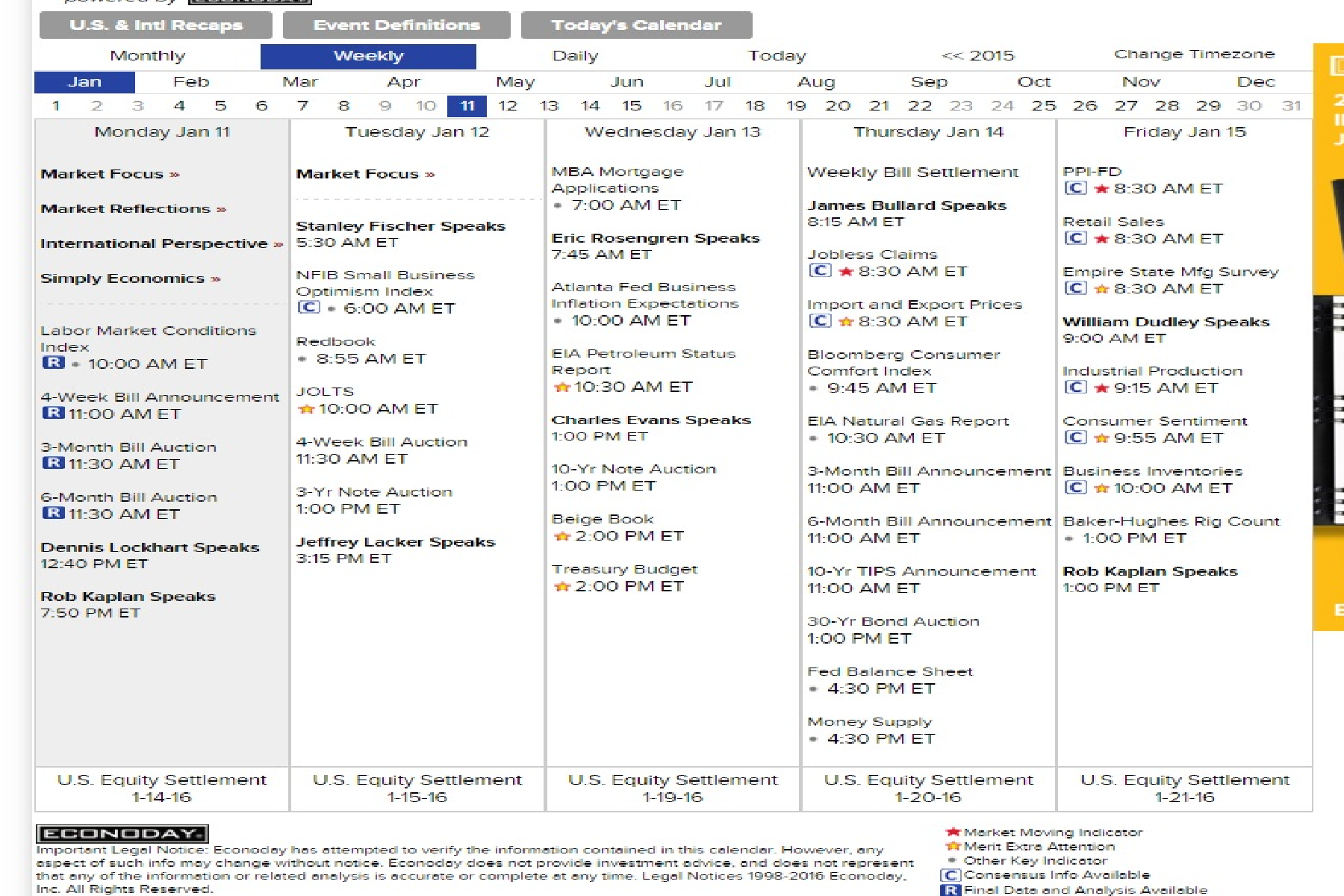
The week ahead — Economic data from Econoday.com:
Tags: Dec Low Ind
Posted in Weekly Summary | No Comments »