August 8th, 2016
“If you want to catch a wave you need to grab a board and get in the water!” — strategist Stan Salvigsen
1. Japan Cabinet Approves $130 Billion In Fiscal Steps As Part Of Stimulus — Japanese Prime Minister Shinzo Abe’s cabinet approved 13.5 trillion yen ($132.04 billion) in fiscal measures as part of efforts to revive the flagging economy. The stimulus package ranks among Japan’s biggest since the global financial crisis, and to increase GDP by 1.4%, include childcare benefits, provide $150 handouts to 22M low income people, loan ¥10.7T for infrastructure and provide ¥7.5T for direct fiscal spending.
2. New Zika Cases Prompt Miami Travel Warning — Federal health officials have advised pregnant women to avoid a Miami neighborhood – marking the first time the CDC has warned against travel to any area within the continental U.S. – as a Zika outbreak led to 10 more local cases. CDC Director Tom Frieden said that extensive spraying of insecticides in the area over the past several weeks has not reduced the local population of mosquitoes capable of transmitting the virus.
3. BOE Cuts Key Rate For The First Time In Over Seven Years to 0.25% — the central Bank Of England has made its biggest quarterly downgrade of growth forecasts, reducing expectations for 2017 growth from 2.3 percent to 0.8 percent, citing “substantial uncertainty” after the referendum on the U.K.’s membership of the European Union (EU) in June. The bank also slashed growth forecasts and launched a new monetary policy weapon in the battle to stop a post-Brexit slump in the U.K.
4. US Created 255,000 Jobs In July vs. 180,000 Jobs Expected — the economy added 255,000 positions, according to the Labor Department. The headline unemployment rate held steady at 4.9 percent, though a more encompassing measure that includes those not actively looking for work and those working part-time for economic reasons moved up a notch to 9.7 percent. Economists had been looking for an increase of 180,000 and a decline of the unemployment rate to 4.8 percent.
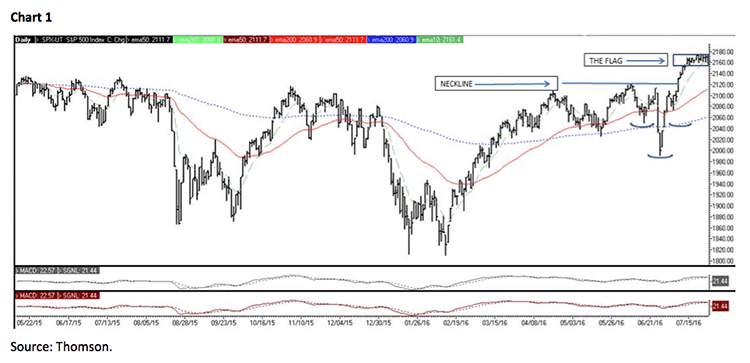
5. S&P 500 Index Traded To New All-Time Highs — chart below shows the index breaking out to the upside of a reverse head-and-shoulders bottoming formation. In the process it has traced out a bullish “flag” formation in the charts.
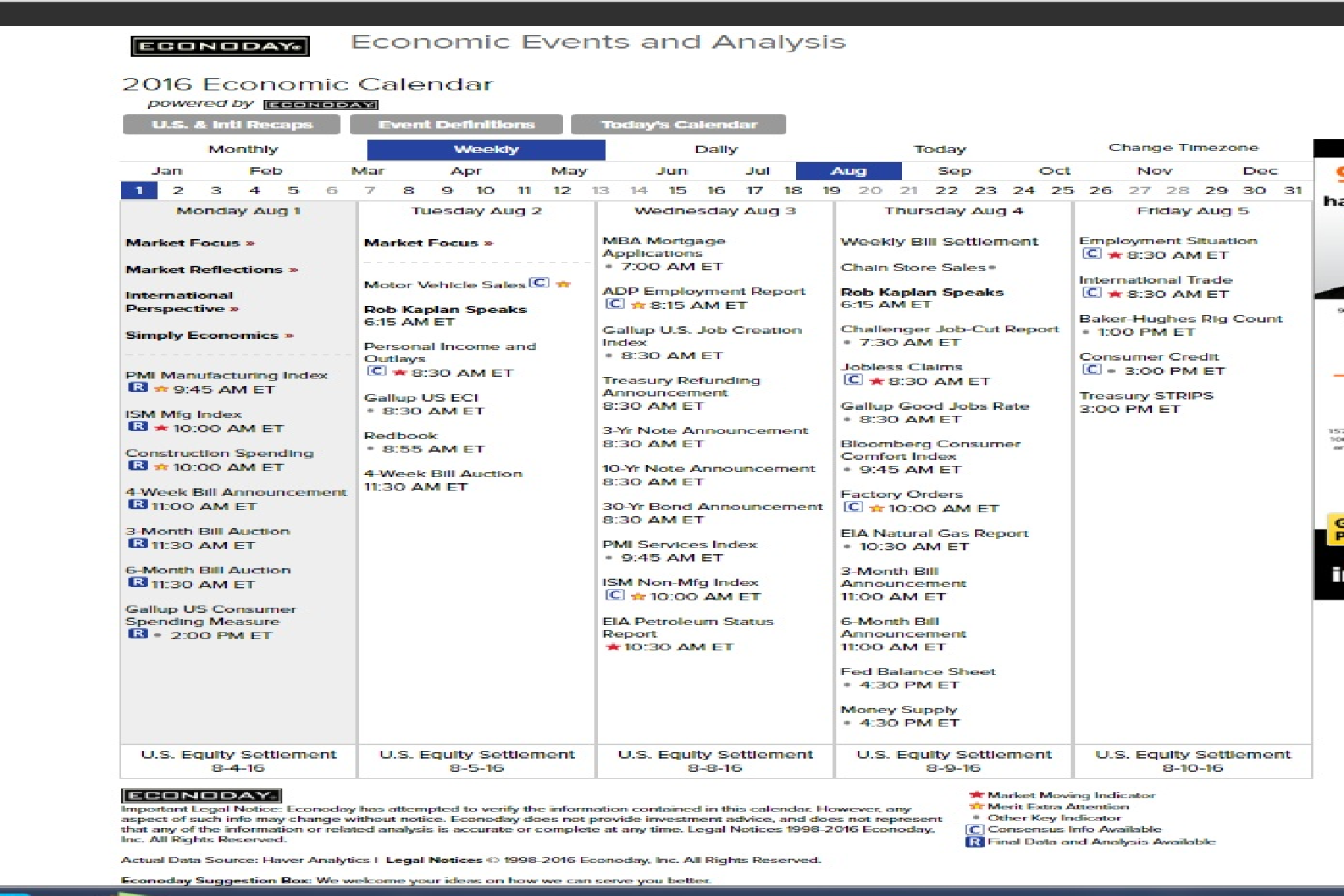
The week ahead — Economic data from Econoday.com:
Posted in Weekly Summary | No Comments »
August 1st, 2016
..“It cost me millions to learn that another dangerous enemy to a trader is his susceptibility to the urgings of a magnetic personality when plausibly expressed by a brilliant mind.”… Jesse Livermore
1. Oil Makes A Series of Lower Highs & Lower Lows So Far This Summer — the commodity has been under steady pressure, with a series of lower highs and lower lows since making its high in May. Normally, prices tend to rally in the early months of the year, then peak and level off around Memorial Day, before a late-year decline post Labor Day. Chart is courtesy of BIG.

2. Terror Attacks Weigh on Europe’s Travel Companies — a series of terrorist attacks in Europe is driving away tourists at the height of the summer rush, casting a pall over hotel chains, airline companies and luxury retailers that are already grappling with Britain’s vote to leave the EU. Germany was the latest country to get hit by a series of violent incidents over the last weekend, including a suicide bombing and stabbing by two Syrian refugees and a German-Iranian teenager that shot and killed nine people at a mall in Munich.
3. Fed Appears More Willing to Lift Interest Rates In September — the Federal Reserve on last Wed. meeting opened the door a crack to lifting interest rates at its next meeting in September. The statement said “Near-term risks to the economic outlook have diminished,”. The Fed kept its benchmark fed-funds rate unchanged in a range between 0.25 and 0.5%.
4. Crude Nears Fresh Bear Market — since crude prices hit a year-high above $52 a barrel in June they have slipped almost 20%, leaving them on the cusp of a new bear market. The latest EIA data unexpectedly showed a 1.7M barrel rise in U.S. crude inventories vs. what had been steady declines in previous weeks. “The improvement in oil fundamentals remains fragile and continues to feature large offsetting forces,” Goldman Sachs said in a research note overnight, but predicted oil prices to remain in the $45-$50 range until mid-2017.
5. US Q2 Prelim GDP 1.2% vs 2.6% Expected –U.S. economic growth sputtered this spring—growing a meager 1.2% in the second quarter—with cautious business investment largely offsetting more robust consumer spending. Consumer spending, which accounts for more than two-thirds of U.S. economic activity, increased at a 4.2 percent rate. That was the fastest pace since the fourth quarter of 2014. Inventory accumulation by businesses fell $8.1 billion in the second quarter, the first drop since the third quarter of 2011.
The week ahead — Economic data from Econoday.com:
Tags: Oil Bear Market
Posted in Weekly Summary | No Comments »
August 1st, 2016
“The essence of portfolio management is the management of risks, not the management of returns. All good portfolio management begins and ends with this premise.” — Benjamin Graham
1. Singapore Confirms Locally Transmitted Zika Cases — Singapore authorities have identified 41 Zika cases that were transmitted locally, and cautioned that they expect to find more. The cases appear to be the largest single beachhead the virus has made in Asia in the current epidemic, which has also been detected in countries like Bangladesh, Malaysia and the Philippines. Also, China added the U.S. to a list of Zika-infected countries, worrying U.S. exporters, who fear they will be required to fumigate containers destined for Chinese ports. Furthermore, the FDA has issued an Emergency Use Authorization for Roche’s (OTCQX:RHHBY) “Lightmix Zika” test, a quick diagnostic check that allows healthcare professionals to quickly detect the virus.
2. Apple Received $14.5B In Illegal Irish Tax Benefits — EU antitrust regulators have ordered Apple (NASDAQ:AAPL) to pay up to €13B ($14.5B) in taxes to the Irish government after ruling that a special scheme to route profits through the country was illegal state aid. Apple and Ireland said they would appeal the decision.
3. U.S. Banks Log the Most Profitable Quarter Ever — according to figures from SNL Financial and S&P Global Market Intelligence, U.S. banking industry just logged its most profitable quarter ever Despite an increasing regulatory burden and lackluster share performance. Earnings for the three-month period totaled $43.6B, compared to the $43.01B in Q2 of 2015, a 1.4% beat. On a sequential basis, the April-to-June period topped the previous quarter by $4.56B, an 11.7% rise.
4. Job Report – US created 151,000 jobs in August vs. 180,000 jobs expected — Nonfarm payrolls increased just 151,000 for the month as Wall Street economists were expecting the nonfarm payrolls report to show a gain of 180,000 in August, with the unemployment rate ticking down one-tenth to 4.8 percent. Wage growth slowed and the probability of a September hike drops from 27 percent to 12 percent.
5. World Leaders Prepare for G20 Summit — World leaders descended upon Hangzhou for the G20 summit to reaffirm their dedication to global growth. Developing an open financial system, promoting an economic recovery and coordinating monetary policies are among the main topics to be discussed under this year’s theme of “building an innovative, invigorated, interconnected and inclusive world economy.”
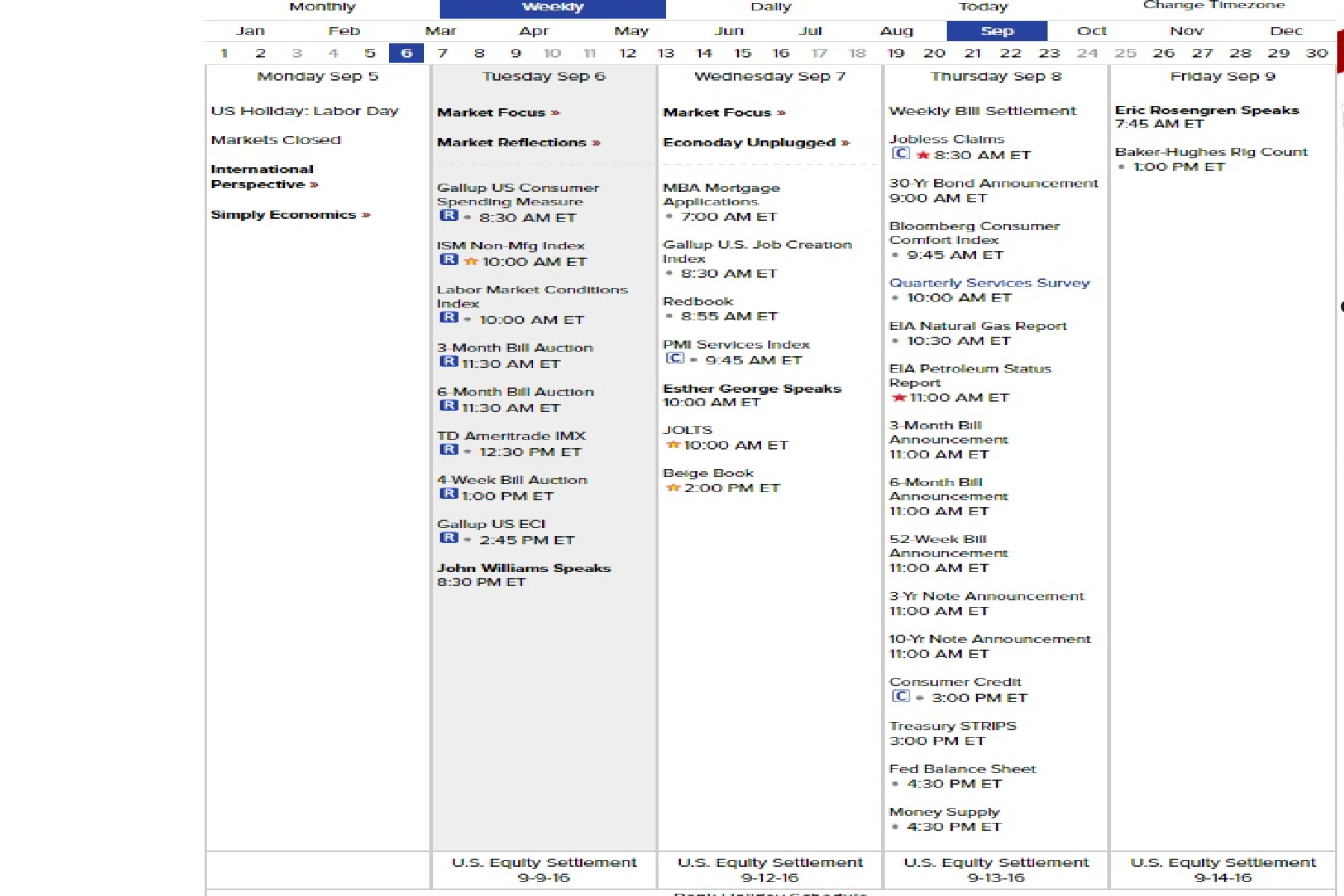
The week ahead — Economic data from Econoday.com:
Tags: G20 Meeting
Posted in Weekly Summary | No Comments »
July 25th, 2016
“In this business if you’re good, you’re right six times out of ten. You’re never going to be right nine times out of ten.” -Peter Lynch
1. Turkish Stocks Fall, Currency Rebounds After Failed Coup — the Istanbul 100 Index dropped sharply last week, while the Turkish lira rebounded 3% to 2.9274 vs. the dollar, following Friday’s failed coup attempt that left 290 people dead and over 6,000 arrested. NATO allies have thrown their support behind President Erdogan, but tension is still high over his demand to extradite a U.S.-based cleric whom he blamed for the overthrow attempt.
2. Trump Formally Wins GOP Presidential Nomination — Donald Trump officially clinched the Republican presidential nomination after securing enough delegates during the roll call vote at the GOP convention. “Such a great honor… I will work hard and never let you down! AMERICA FIRST!” Trump wrote on Twitter. The U.S. Federal Election Commission will separately release its June report today, with fundraising details of both the Trump and Clinton campaigns.
3. Florida May Have First Local Zika Case in U.S. — Florida health officials are investigating a possible case of Zika that wasn’t carried back by a traveler. If it’s confirmed, it would be the first evidence the virus has spread to mosquitoes in the continental U.S. All 1,306 American cases up to now have been in people who traveled to Zika-affected regions or who have been infected by their sexual partners.
4. ECB’s Draghi Signals ECB May Boost Stimulus Later This Year — Mario Draghi said the European Central Bank won’t hesitate to add fresh stimulus if needed once it has a clearer picture of the economic impact from the U.K.’s vote to leave the European Union. Draghi spoke after the 25-member Governing Council kept its main refinancing rate at zero, the deposit rate at minus 0.4 percent and asset purchases at around 80 billion euros ($88 billion) a month. Economists foresee the central bank waiting until its next monetary-policy meeting on Sept. 8 to add stimulus, most likely by extending quantitative easing.
5. IMF Calls For Urgent Fiscal Action From G20 –the IMF painted a dark outlook for the global economy, issuing an “urgent” call for the world’s largest economies to roll out more growth-boosting policies and act more aggressively. “I don’t think this is a moment that calls for the kind of coordinated action that occurred during the ‘great recession’ in 2008 and 2009,” said U.S. Treasury Secretary Jacob Lew.
The week ahead — Economic data from Econoday.com:

Tags: G20
Posted in Weekly Summary | No Comments »
July 18th, 2016
“Change is the law of life. And those who look only to the past or present are certain to miss the future.” – John F. Kennedy
1. Prime Minister Shinzo Abe’s Liberal Democratic Party’s Landslide Victory — Prime Minister Shinzo Abe’s Liberal Democratic Party and its Komeito allies won a stronger majority in Japan’s Upper House election, in a development that will make it far easier to push through his economic agenda. “It is likely that a large-scale economic stimulus program, in the magnitude of at least ¥10T (2% of GDP), will be implemented,” Societe Generale said in a research note.
2. BoE Weighs Curbs On Property Funds — the Bank of England is weighing a raft of emergency measures to stem the flood of money out of Britain’s biggest property funds that caused fresh market panic last week, the Sunday Telegraph reports. These could include “enforced notice periods before redemptions, slashing the price for investors who rush to the door, or additional liquidity requirements for funds.”
3. Hague Tribunal Rejects Beijing’s Claims in South China Sea — backing a case brought by the Philippines, an international tribunal has ruled against Chinese claims to rights in the South China Sea, citing a lack of evidence that the country “historically exercised exclusive control over the waters or their resources.”. Although no U.N. peacekeeping forces are expected in the region, it can tarnish Beijing’s image as it will be looked at as a unilateral actor if it goes against the international community. Beijing has reiterated it will ignore an unfavorable court ruling on its South China Sea maritime claims, warning neighbors it would “take all necessary measures” to protect interests there.
4. Germany Sells First Negative Yield 10-year Bunds — Germany has sold 10-year Bunds with a zero percent coupon, issuing benchmark debt with a negative yield for the first time in history. The €4.038B sale came with a yield of -0.05%, meaning that investors who hold the paper until maturity in August 2026 will receive back less money than they paid.
5. Theresa May Elected as New UK Prime Minister, Assembles Her New Cabinet — Theresa May appointed Chancellor of the Exchequer Philip Hammond said the country will move swiftly to set broad goals for its new relationship with the EU. Former London Mayor Boris Johnson has been appointed as foreign secretary, fellow Brexiteer David Davis will be May’s Brexit “Tsar,” while former Defense Secretary Liam Fox has been handed the job of establishing new trade links.
6. AAII Bullish Sentiment Increased As Index Makes New High — AAII bullish sentiment increased this week from 31.1% up to 36.9%. It’s the highest weekly reading since early March. At 36.9%, bullish sentiment is still below its bull market average of 39.95%, and has been below 40% for 37 straight weeks! Also, S&P 500 has made a new all-time high and historical average return over the next 12 months courtesy of BIG.


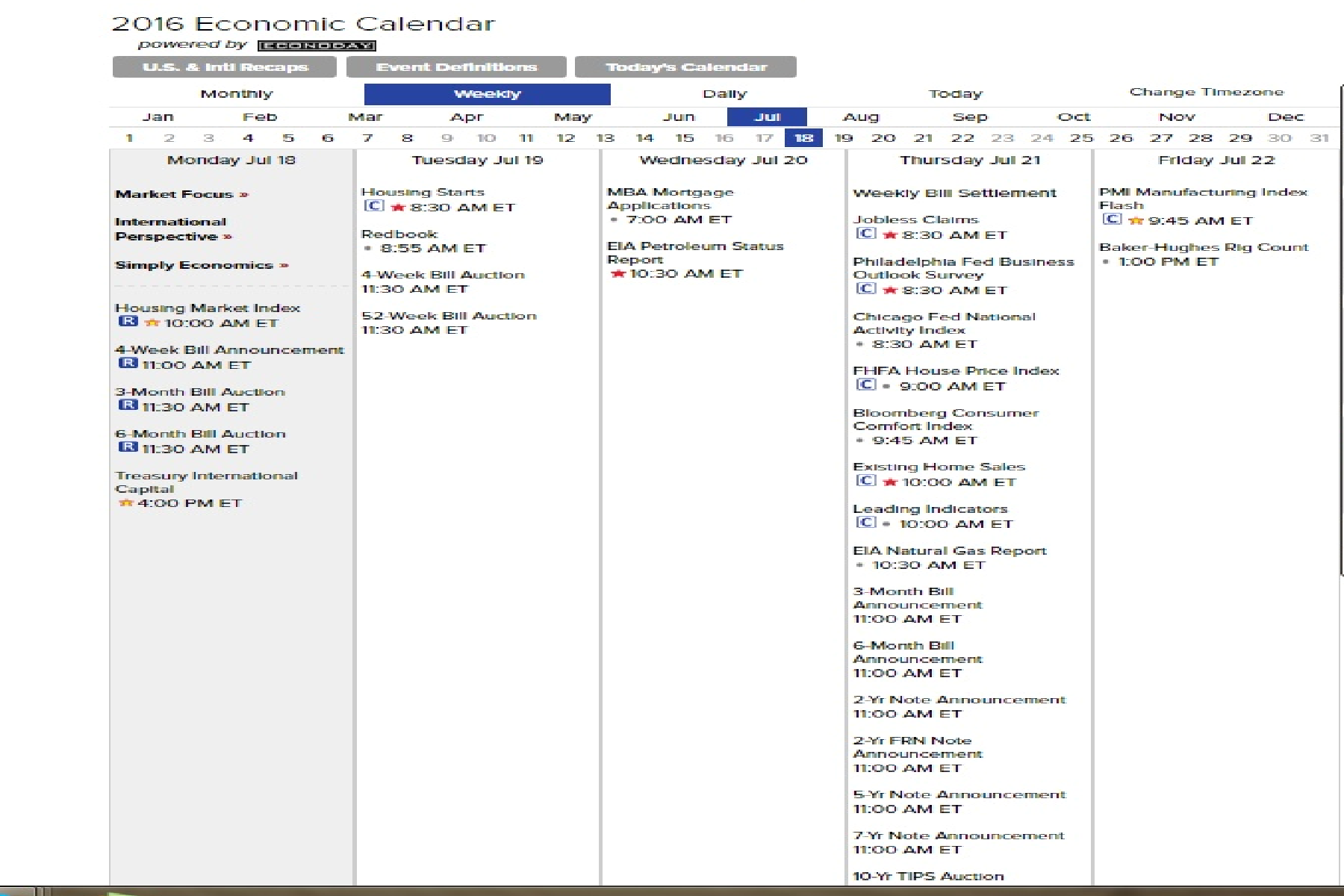
The week ahead — Economic data from Econoday.com:
Tags: AAII Bullish Sentiment, New High
Posted in Weekly Summary | No Comments »
July 12th, 2016
“I buy fear and sell greed.” Then he was queried, “How do you determine when there is fear or greed?” He responded, “I wait until prices start gapping in the charts!” –Jim Roger
1. U.K.Chancellor Osborne Floats 15% Corporate Tax Rate — U.K. Chancellor George Osborne has proposed slashing the corporate tax to less than 15% (down from 20% now) in an effort to woo businesses deterred from investing in a post-Brexit Britain. Such a sharp cut in business taxes would also take Britain close to the 12.5% tax rate in Ireland.
2. FBI Won’t Recommend Criminal Charges Against Hillary Clinton — the FBI recommended last week that no criminal charges be filed over Hillary Clinton’s use of private email servers while she was secretary of state, but rebuked the Democratic presidential candidate for “extremely careless” handling of classified information. FBI Director James Comey told reporters that “Although the DOJ makes final decisions on matters like this, we are expressing to Justice our view that no charges are appropriate in this case,”.
3. FOMC May Minutes “Weak May Jobs Report” — according to the the minutes of the FOMC’s June meeting, “Almost all participants judged that the surprisingly weak May employment report increased their uncertainty about the outlook for the labor market,” even before the Brexit vote. The outlook continues what has become a familiar pattern at the Fed: The central bank enters the year predicting stronger growth and a gradual return to higher interest rates, but then pares its forecasts as data disappoints.
4. Seventh U.K. Property Fund Freezes Redemptions — four more U.K. property funds have frozen withdrawals as investors look to dump real estate holdings in the aftermath of the Brexit vote. Columbia Threadneedle, Henderson and Canada Life have suspended trading in the investment vehicles, while Aberdeen Fund Managers cut the value of its U.K. Property Fund by 17% and halted redemptions for 24 hours. The development leaves £18B frozen in the biggest seizing up of funds since the 2008 financial crisis.
5. Gap Sales Higher At Old Navy Pick Up — Gap reported sales in June rose 2% year over year to $1.57B. Comparable store sales were up during the month by the same rate. The company cited improved traffic trends during the month, led by the Old Navy chain which recorded a +5% comp. The strong month from Gap (NYSE:GPS) stood out after several other mall retailers posted weak sales reports.
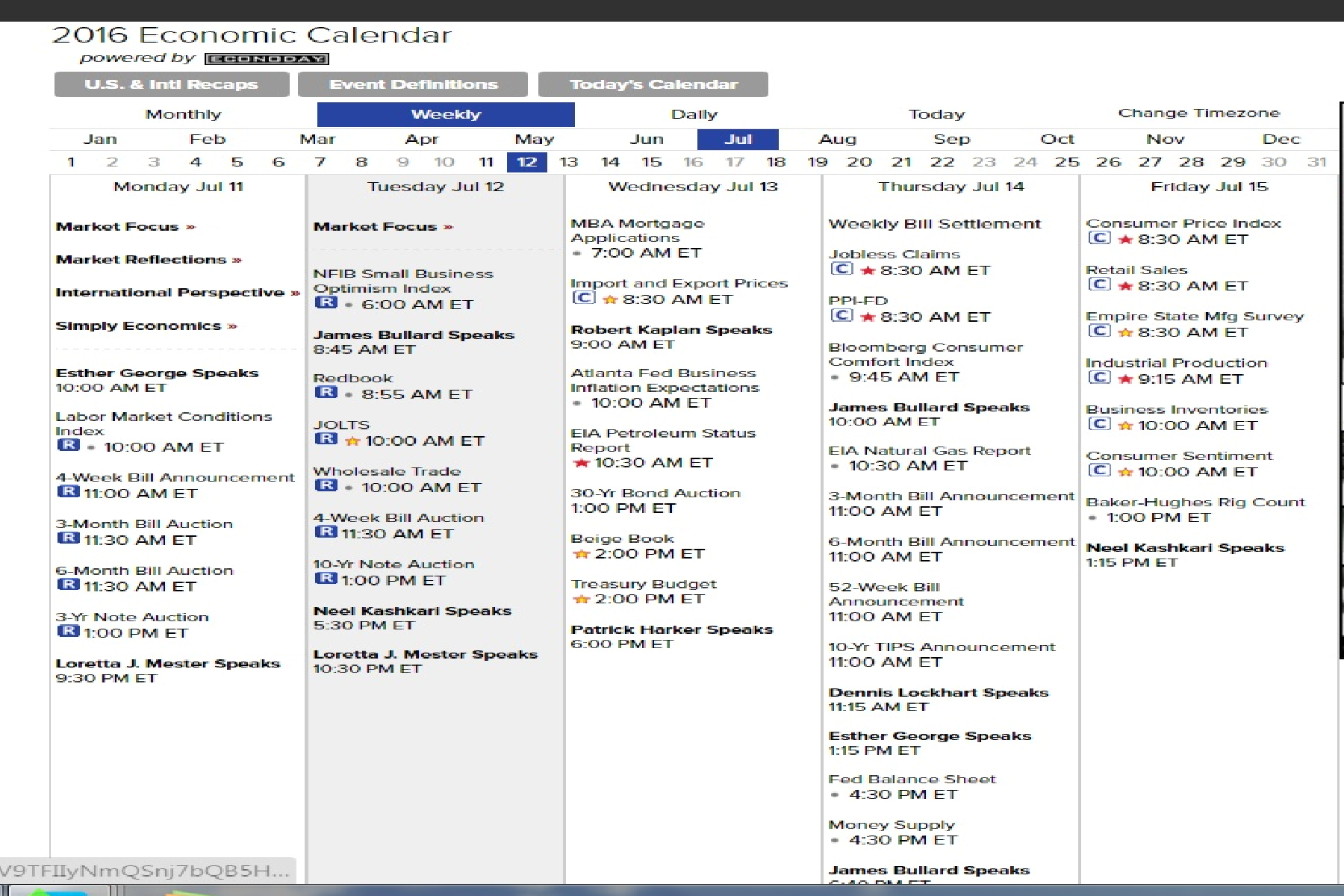
The week ahead — Economic data from Econoday.com:
Posted in Weekly Summary | No Comments »
June 27th, 2016
“If you can keep your wits about you while all others are losing theirs, and blaming you. . . . The world will be yours and everything in it, what’s more, you’ll be a man, my son.” — Rudyard Kipling
1. IEX Wins Approval to Launch Stock Exchange — the SEC has finally given approval to IEX Group to challenge the NYSE (NYSE:ICE), Nasdaq (NASDAQ:NDAQ), and Bats Global (BATS:BATS) as the nation’s 13th national stock exchange. IEX’s “speed bump” delays orders by 350 millionths-of-a-second, but it’s enough to protect investors from high-frequency trading which can front-run slower orders on other exchanges.
2. Facebook (FB) Shareholders OK Stock Shift That Keeps Zuckerberg In Charge — Facebook (NASDAQ:FB) shareholders approved a proposal to create a new class of non-voting shares, a move aimed at allowing CEO Mark Zuckerberg to give away his wealth without relinquishing control of the company he founded. FB will now move ahead with its plan to issue two Class C shares for each Class A and Class B share held by shareholders, in what effectively is a 3-for-1 stock split; Creation of the Class C shares will allow Zuckerberg to sell the non-voting stock, but keep the voting Class A and Class B shares that would let him retain control of the company.
3. ECB Restores Greece’s Access to Cheap Funding — the ECB will start accepting junk-rated Greek government debt as collateral for its regular bank lending operations. According to economists, the decision to open a funding facility that had been shut for 16 months could lead to the partial lifting of capital controls in the coming days.
4. Britain Voted To Leave The EU — With all 382 U.K. areas reporting, the ‘Leave’ camp won 51.9% of vote vs. ‘Remain’s 48.1%. Voter turnout was 72.2%. David Cameron has resigned as U.K. Prime Minister in an emotional speech outside 10 Downing Street stating “I do not think it would be right for me to be the captain that steers our country to its next destination,”. As a next step, Article 50 of the Lisbon Treaty will be invoked to begin the formal process for leaving the EU. That would start a series of negotiations for how to disentangle the U.K. from its many union structures, and could take up to 2 years (or more if both Britain and the European Council agree to extend the discussion period).
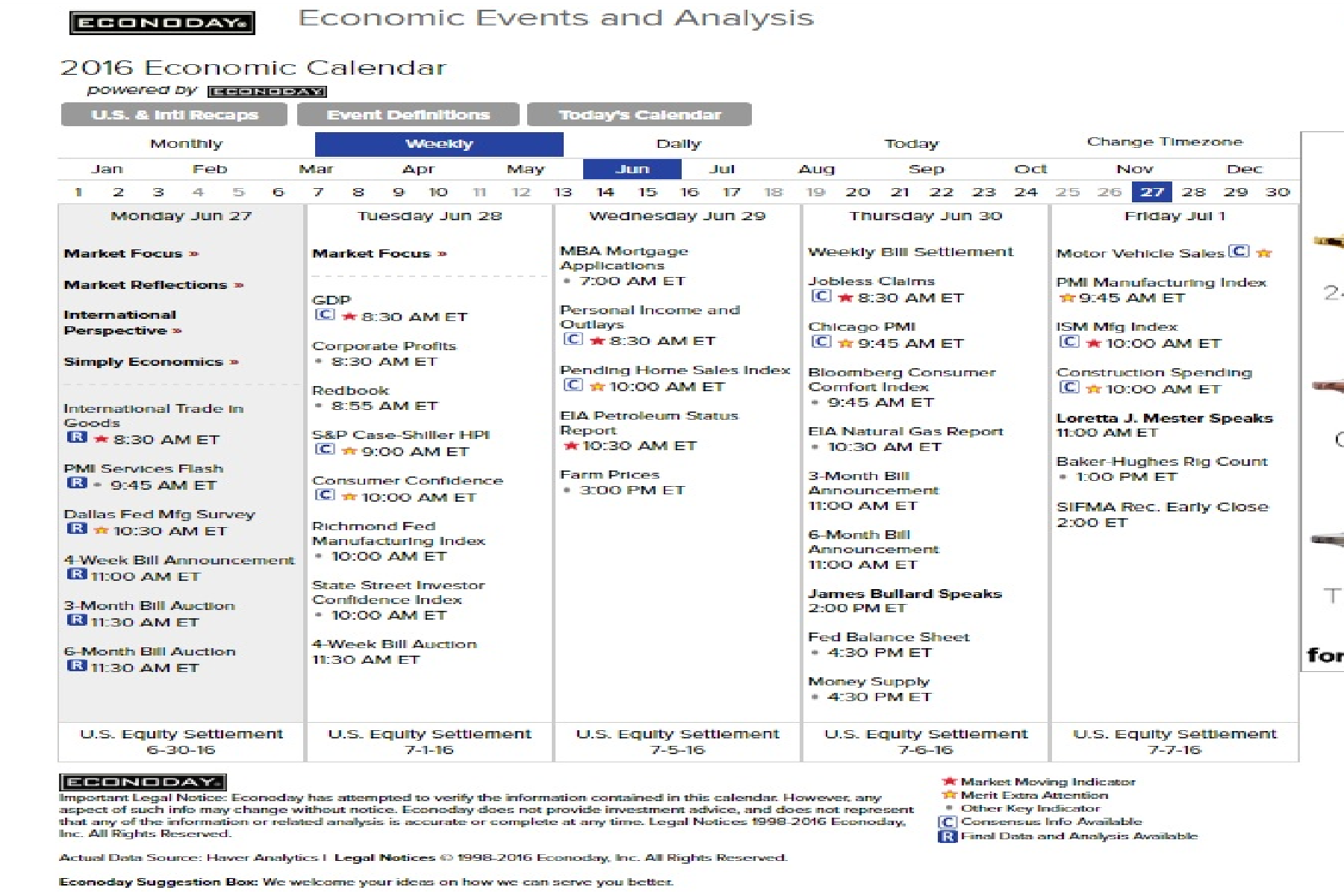
The week ahead — Economic data from Econoday.com:
Tags: Brexit, IEX Exchange
Posted in Weekly Summary | No Comments »
June 20th, 2016
“Buy Fear, Sell Greed” — unknown
1. German 10-year Sovereign Bond Yields Turn Negative For First Time — the yield on the 10-year benchmark German bund fell into negative territory for the first time ever last week, amid global growth concerns and jitters over the U.K.’s upcoming referendum on its European Union membership. The move comes as the European Central Bank has ramped up its bond buying program in recent months as well as investor uncertainty over whether the U.K. will stay in the European Union.
2. MSCI Rebuffs Chinese Equities for Third Time — China’s domestic equities were denied entry into MSCI Inc.’s benchmark indexes for a third time, a setback for President Xi Jinping’s efforts to raise the profile of mainland markets and turn the yuan into an international currency. China was rejected despite a flurry of measures this year to address MSCI’s concerns, including curbs on arbitrary trading halts and looser restrictions on cross-border capital flows. The decision suggests international investors are still uncomfortable putting their money in the $6 trillion market after a botched government campaign to prop up share prices roiled global equities last year.
3. World Health Organization (WHO) Panel Elevated the Zika Virus To A Public Health Emergency — A WHO panel has elevated the Zika virus to a public health emergency, but spurned calls to postpone or move the 2016 Olympic Games, which are scheduled to begin in Rio de Janeiro in six weeks. Brazil is hosting the Games during its winter, when the concentration of mosquitoes that spread Zika and other viruses is low, the committee noted.
4. FOMC Meeting — the FOMC left its target for the Fed Funds rate unchanged at 0.25-0.5%, while the “dots” took a sizable shift. U.S. Federal Reserve scaled back its outlook for interest-rate increases and Janet Yellen signaled rates may stay lower for longer. Also, the Bank of England is also expected to maintain interest rates – at the 0.5% level it’s been for over seven years.
5. Lumber Liquidators Settles With Regulator — the U.S. Consumer Product Safety Commission has ended its probe of Lumber Liquidators (NYSE:LL) for selling formaldehyde-laden flooring without issuing a product recall, while calling for corrective measures it has already largely undertaken. The stock is still down more than 70% since the devastating 60 Minutes report in March last year that plunged the retailer into losses and led to the exit of top executives.
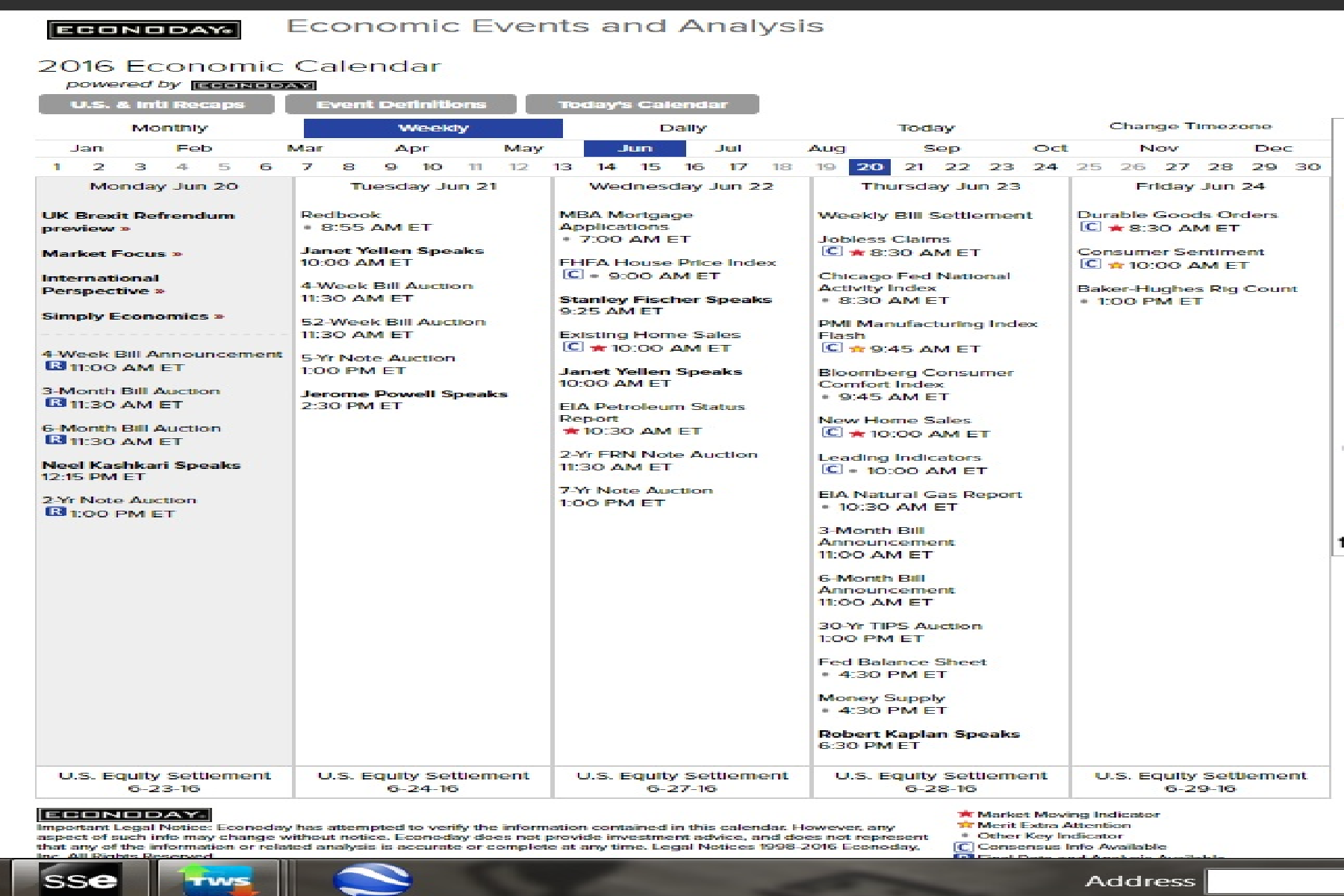
The week ahead — Economic data from Econoday.com:
Posted in Weekly Summary | No Comments »
June 13th, 2016
“I have learned through the years that after a good run of profits in the markets, it`s very important to take a few days off as a reward. The natural tendency is to keep pushing until the streak ends. But experience has taught me that a rest in the middle of the streak can often extend it.”– Martin Schwartz
1. International Tankers Help Ship Iranian Fuel — more than 25 European and Asian-owned supertankers are now shipping Iranian crude, allowing the Islamic Republic to ramp up exports much faster than expected following the lifting of sanctions in January. Tehran was struggling as recently as April to find partners to ship its oil, but after an agreement on a temporary insurance fix, more than a third of Iran’s crude shipments are now being handled by foreign vessels.
2. Eurozone GDP Growth Revised Back Up — the first estimate was 0.6%, which was revised down to 0.5% in the second round, and now in the third report – which includes details on GDP components – the figure has been revised back to its original estimate. Annual growth was 1.7%, unchanged from the fourth quarter, driven by a jump in consumer spending and investment.
3. Hillary Clinton Wins California, Bolstering Claim to Nomination — Hillary Clinton claimed the Democratic presidential nomination last Tuesday night after decisive victories in the California, New Jersey and New Mexico primaries. However, Senator Bernie Sanders refused to yield, insisting that he would continue his campaign.
4. ECB Kicks Off Corporate Bond Buying — the European Central Bank has formally started its corporate sector purchase program, with the official buying list to be released on July 18. The criteria for the plan are as follows: Bonds have to be active, euro denominated, have an investment grade rating and be issued within the eurozone. Along with other measures such as ultra-cheap long term loans and government bond-buying, the program aims to kickstart the region’s economy and lift inflation back to the bank’s 2% target.
5. Soros Is Back to Trading & He’s Bearish — George Soros has returned to trading, lured by opportunities to profit from what he sees as coming economic troubles. Soros Fund Management, which manages $30B for the billionaire and his family, sold stocks and bought gold and shares of gold miners, anticipating weakness in various markets. The last time George Soros got closely involved in his firm’s trading was just prior to the financial crisis in 2008. Per WSJ, Soros noted particular concerns over China, Greek challenges and a potential Brexit that could lead to the EU’s collapse.\
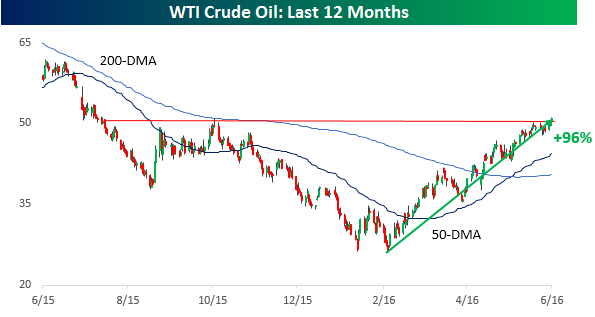
6. Crude Oil Broke Above $50 Per Barrell — crude oil has taken the price of WTI above $50 per barrel to $51.10. At this level, crude oil has now taken out its highs from last October and is trading at its best levels since 7/15/15. It has certainly been an amazing rally for oil prices over the last four months, with prices rising 96% off their lows in February.
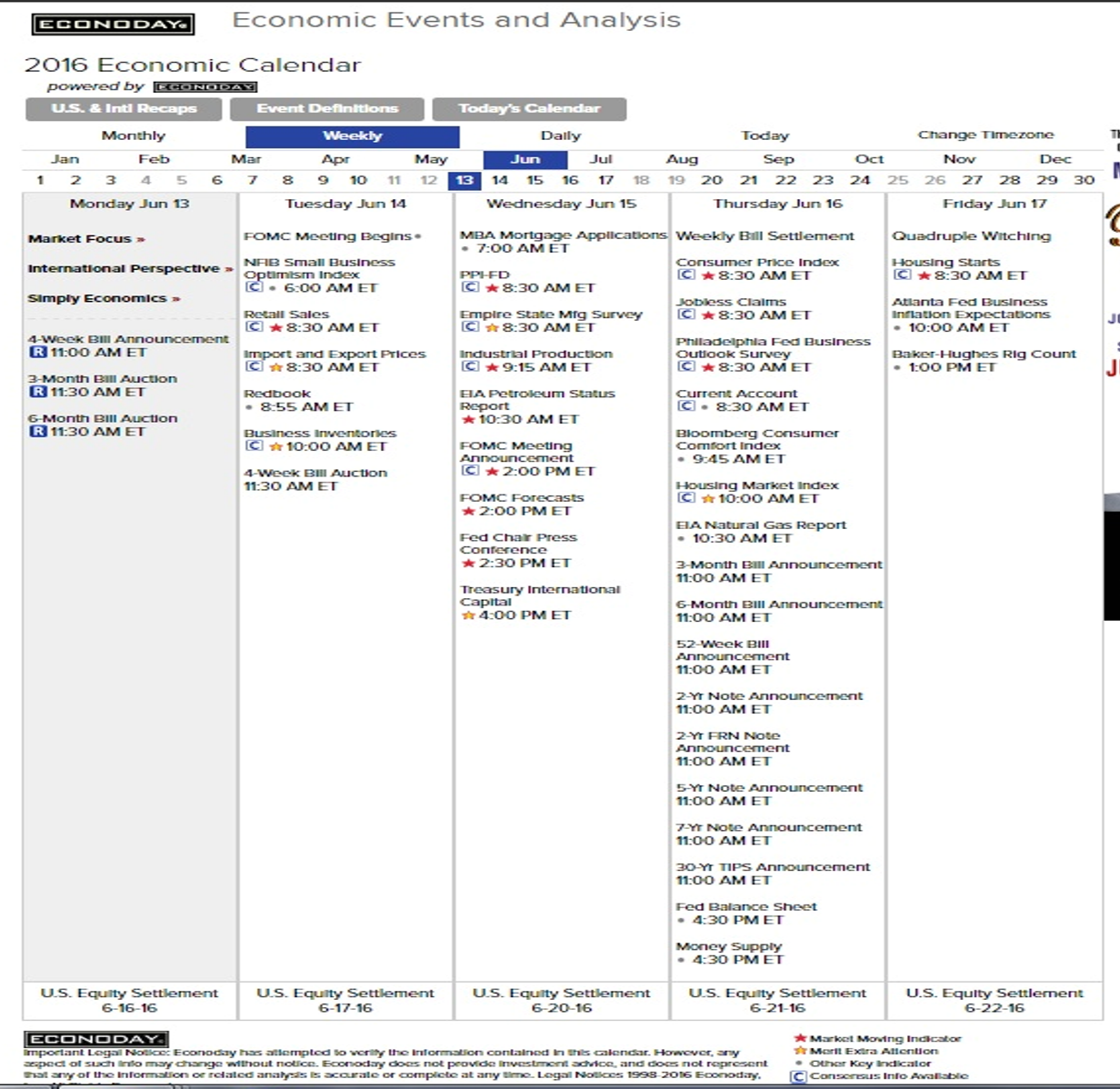
The week ahead — Economic data from Econoday.com:
Tags: Oil Prices
Posted in Weekly Summary | No Comments »
June 1st, 2016
“The easiest thing to do is prepare. If you don’t, on behalf of the other market participants, we thank you.” – unknown
1. Bank Shares See More Brexit Fallout — global banks across the globe are taking another serious beating post-Brexit. The sector is getting battered on fears that fragile recoveries at many financial institutions will be delayed and that volatile markets could claim scalps. Sources have also revealed that Italy is considering a €40B capital infusion into its banks.
2. Panama Set For Opening of Canal Expansion — Panama officially opened an addition to its legendary sea canal last week, capping a nine-year, $5.4B expansion project that will double shipping capacity and affect global trade routes. A third lane has been added to the waterway that can accommodate a new generation of super cargo ships large enough to carry up to 14K containers, compared with around 5K currently.
3. S&P Strips U.K.’s AAA Credit Rating On Brexit Vote — the U.K. was stripped of its AAA credit rating by S&P Global Ratings last Monday after British voters last week voted to pull the country out of the European Union. S&P lowered the rating to AA. The downgrade also reflects worries about the risks of a “marked deterioration” in the U.K.’s external financing conditions given the country’s already elevated gross external financing requirements, S&P said. Competing ratings firms Moody’s and Fitch had lowered the U.K. credit rating ahead of last week’s referendum.
4. Oil Set For Best Quarter Since 2009 — oil is headed for its biggest quarterly advance since 2009, rising 29% in the last three months as falling American supply adds to speculation that the global surplus is easing. The latest data from the EIA showed U.S. crude stockpiles dropping to the lowest since March and output falling for a third week. Furthermore, supply disruptions in Nigeria and Canada, as well as fears over strike outages in Norway, have also given the commodity a big lift.
5. Driverless Car Collaboration Between BMW, Intel & Mobileye (MBLY) — BMW AG, Intel Corp.(INTC) and Mobileye NV (MBLY) are working to develop autonomous-car technology. BMW has been a client of Mobileye, along with General Motors Co. and Tesla Motors Inc. As automakers and their suppliers race to create systems to replace human drivers, most companies are betting on some form of artificial intelligence, which requires powerful processing. Senior executives from each company will hold an event on Friday to discuss the driverless-vehicle initiative.
6. Puerto Rico Set For Its Largest Default to Date as Obama Signs Rescue Bill — Puerto Rico is set for its largest default to date as $1.9B in debt payments come last friday, including more than $1B in general obligation bonds, the island’s highest tiered credit that carries a constitutional lien on revenues. Governor Alejandro Garcia Padilla declared the moratorium on GO debt payments just minutes after President Obama signed a law giving the territory access to a restructuring process that will put its finances under a federal oversight board.
The week ahead — Economic data from Econoday.com:
Tags: Brexit
Posted in Weekly Summary | No Comments »