July 9th, 2018
“If you take emotion – would be, could be, should be – out of it, and look at what is, and quantify it, I think you have a big advantage over most human beings.” — John Henry
1. EU Warns U.S. of $300B in Tariffs — the EU warns that if the U.S. goes ahead with punitive tariffs against EU car imports, the European Commission will likely apply countermeasures worth as much as $294B – about 19% of U.S. goods exports in 2017. The measures risk plunging the global economy into a full-scale trade war, as it will harm employment in the U.S. auto sector, which accounts for more than 4M jobs.
2. Trump Warns the WTO — A statement by President Trump that the administration won’t take any action against the World Trade Organization unless the organization is “unfair” to the U.S. While the latest rhetoric is a downshift in tone, concerns of a standoff still remain. Height Capital Markets warned of the “immense” economic downside from U.S. action against the WTO. The investment firm noted that while Trump cannot roll back the U.S statute agreeing to the WTO, he can signal U.S. withdrawal under the structure of the WTO agreement. “However, this quirk of US law – enabling the President to claim the U.S. is withdrawing even as U.S. law differs – does not guarantee that other nations would still grant the US the protections afforded to a member of the WTO,” .
3. Feds Expand Data Probe into Facebook — Federal agencies are reportedly turning up the heat on Facebook (NASDAQ:FB), with the FBI, SEC and FTC joining the Justice Dept. in probing the company’s response to the Cambridge Analytica data sharing scandal. The focus of the agencies is on squaring Facebook’s statements about the affair with the underlying facts, as well as how forthcoming and prompt the company has been in cooperating.
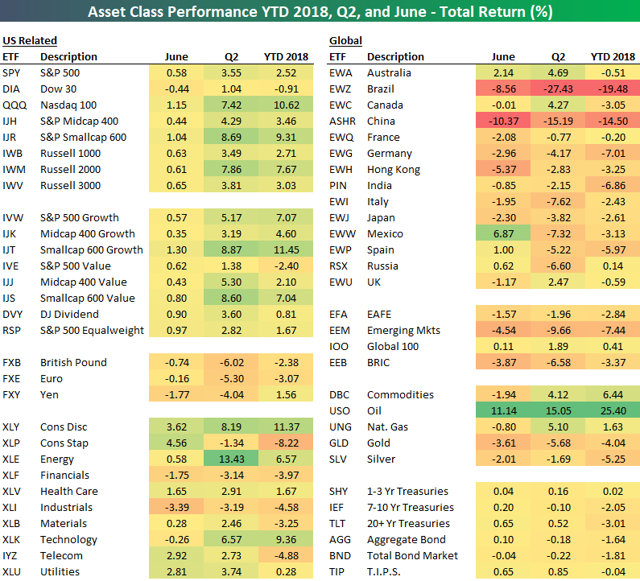
4. First Half 2018 Asset Class Performance Matrix — courtesy of BIG, below highlights the performance of various asset classes of ETFs during the first half of 2018.
At the halfway point of 2018, small-caps have trumped large-caps, while growth has crushed value. Looking at sectors, Consumer Discretionary (NYSEARCA:XLY), Technology (NYSEARCA:XLK), and Energy (NYSEARCA:XLE) have been the best performers so far this year, while Consumer Staples (NYSEARCA:XLP), Financials (NYSEARCA:XLF), Materials (NYSEARCA:XLB), and Industrials (NYSEARCA:XLI) are solidly in the red.
5. U.S. Offers German Carmakers ‘Zero Tariffs’ Solution — Germany’s big three automakers – BMW (OTCPK:BAMXF), Volkswagen (OTCPK:VLKAF) and Mercedes-parent Daimler (OTCPK:DDAIF) – met with U.S. Ambassador to Germany Richard Grenell, stating they would support the elimination of EU tariffs on imported American cars provided the U.S. did the same. While EU tariffs on passenger cars are 10%, versus 2.5% in the U.S., the latter imposes import duties of 25% on European vans and pick-up trucks.
6. U.S.-China Trade War Started — Accusing the U.S. of “launching the largest trade war in economic history to date,” Beijing has implemented retaliatory tariffs on 545 items worth $34B in response to the comparable U.S. duties that were enacted at midnight. Another $16B in tariffs are expected to go into effect in two weeks, and President Trump has warned of additional levies on $500B in Chinese goods.
The week ahead — Economic data from Econoday.com:
Tags: US-China TradeWars
Posted in Weekly Summary | No Comments »
July 2nd, 2018
“I always define my risk, and I don’t have to worry about it.” – Tony Saliba
1. EU Responds to U.S. Auto Tariff Threat — after President Trump threatened to impose a 20% tariff on all imports of EU-assembled cars, EU Commission Vice President Jyrki Katainen told French newspaper Le Monde “If they decide to raise their import tariffs, we’ll have no choice, again, but to react,”.
2. GE Plans Healthcare Spinoff, Baker Hughes Stake Sale — the once industrial conglomerate is spinning off its healthcare business and unloading ownership in its oil services company Baker Hughes (NYSE:BHGE). The final turnaround plan from CEO John Flannery. GE will focus on its power, aviation and renewable-energy divisions. The company was booted out of the Dow Jones Index and was replaced by Walgreen Boots.
3. Canada Prepares Moves to Block Chinese Steel Diverted from U.S. — Canada is preparing tariffs and quotas on steel from China and other countries to prevent a potential flood of imports from global producers seeking to avoid U.S. tariffs. The Bloomberg report follows warnings from the Canadian steel industry and the EU’s decision to ward off the dumping of steel that would have been sent to the U.S.
4. Amazon’s New Last-Mile Delivery Service — Amazon is building out its own last-mile delivery service, pushing further onto the turf of shipping partners UPS and FedEx (NYSE:FDX). The new program, called Delivery Service Partners, will let entrepreneurs run their own local delivery networks of up to 40 delivery vans emblazoned with Prime logos. “This is all about scaling cost effectively,” said Dave Clark, SVP of Amazon Worldwide Operations (NASDAQ:AMZN).
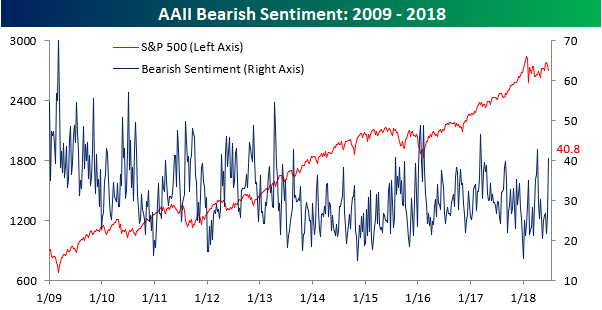
5. AAII Weekly Bearish Sentiment Surges — according to the latest weekly sentiment survey from AAII, bullish sentiment dropped more than ten percentage points, falling from 38.7% down to 28.4% in what was the largest one week decline since early March.
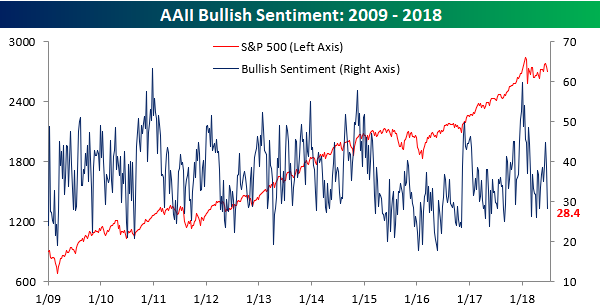
Meanwhile, bearish sentiment surged, rising from 26.2% up to 40.8% in what is only the second week in the last year where bearish sentiment has been above 40%. More importantly, though, it was the largest one week increase in negative sentiment since January 2016, which also happens to be another time when a plunging Chinese stock market was in the headlines.
The week ahead — Economic data from Econoday.com:
Tags: AAII Weekly Sentiment
Posted in Weekly Summary | No Comments »
June 25th, 2018
“If you personalize losses, you can’t trade.” — Bruce Kovner
1. Trump Directs More Tariffs at China — Trump asked the United States Trade Representative to identify $200 billion worth of Chinese goods for additional tariffs, at a rate of 10 percent. If China “refuses to change its practices” and insists on continuing with the new tariffs it recently declared, then the additional levies would be imposed on Beijing. However, the Chinese Commerce Ministry issued a response, stating that the latest threat of more tariffs violates previous negotiations and consensus reached between both the U.S. and China. Furthermore, President Trump has threatened a further $200B in tariffs on Chinese products should Beijing hit back again, bringing to $450B the potential amount that could be targeted. That sum approaches the roughly $500B in total annual Chinese exports to the U.S. As the trade war unfolds, the Trump administration is also working on measures that protect agriculture and other critical industries from retaliatory tariffs being threatened by China.
2. New York Sues 3M Over Toxic Foam — New York state is going after 3M (NYSE:MMM) and five other manufacturers for the almost $39M the government has spent to protect residents from the toxic firefighting foams made by the companies. Their use at five military and civilian airports in the state caused “extensive contamination” to nearby fish, soil and water, and increased the risk to people of immune system damage and other health problems.
3. China Threatens to Strike Dow-Listed Firms — China’s state-controlled Global Times reported that “If Trump continues to escalate trade tensions with China, we cannot rule out the possibility that China will strike back by adopting a hard-line approach targeting Dow Jones index giants,”. “Beijing will further open up China’s financial markets to the world, a move that may draw funds from U.S. stock markets as global investors increasingly add Chinese stocks to their portfolios.”
4. Dow Jones Removes GE from Index — the Dow Jones Index dropped GE and replaced with Walgreens (NASDAQ:WBA). GE released a statement saying that “Today’s announcement does nothing to change those commitments or our focus in creating a stronger, simpler GE.” The industrial conglomerate has been the worst performing stock in the index – where it was an original member in 1896 and a member continuously since 1907 – falling 55% over the last 12 months, and more than 25% YTD.
5. OPEC Ministers Agree to Raise Oil Production by 1 Million Barrels a Day — OPEC members agreed to start pumping more oil, though the agreement will not end the group’s 18-month-old deal to limit output. Instead the producers are seeking to cut no deeper than 1.2 million bpd, the target they set in November 2016. Expecting a large oil deficit in the second half of this year – due to outages in Venezuela and Libya – as well as calls from top consumers to cool down prices, consensus among the group is to raise production by a combined 1M barrels per day.
The week ahead — Economic data from Econoday.com:
Tags: China Trade War, OPEC Raised Oil Production
Posted in Weekly Summary | No Comments »
June 18th, 2018
…“People somehow think you must buy at the bottom and sell at the top to be successful in the market. That’s nonsense! The idea is to buy when the probability is greatest that the market is going to advance”… Jesse Livermore
1. Trump Drops G7 Communique Endorsement — President Trump refused to endorse a G7 statement pledging to “fight protectionism and reduce tariff barriers,” saying trade among the G7 nations should be free of tariffs and other barriers. “Based on the fact that Canada is charging massive Tariffs to our U.S. farmers, workers and companies, I have instructed our U.S. Reps not to endorse the Communique as we look at Tariffs on automobiles flooding the U.S. Market!”.
2. Trump, Kim Sign ‘Comprehensive’ Document — the meeting between President Trump and Kim Jong-un signed a “comprehensive” and “historic” document that included the following four points: Establishing new US-DPRK relations, building a lasting and stable peace regime, reaffirming commitments to work toward complete denuclearization and recovering POW/MIA remains. U.S. sanctions will remain in effect for the time being and American forces will not be reduced on the Korean peninsula.
3. Lithium Revival Across the U.S. — In North Carolina, Nevada and half a dozen other states, miners are working to revive the U.S. lithium industry, once the world’s largest until it fell off in the 1990s. According to Reuters, Piedmont Lithium (NASDAQ:PLLL), Albemarle (NYSE:ALB) and Lithium Americas (NYSE:LAC) all see opportunity amid a surging EV market and increased battery demand. The U.S. produced only about 2% of the world’s lithium last year, but has around 13% of the world’s identified resources.
4. AT&T prevails in Time Warner merger trial — U.S. District Court Judge Richard Leon has approved AT&T’s (NYSE:T) $85.4B purchase of Time Warner (NYSE:TWX) without conditions, giving the pay-TV provider ownership of cable channels HBO and CNN, as well as film studio Warner Bros. The outcome could spur a wave of deals in the telecom and media industries, as well as clear the way for future vertical mergers.
5. Fed Raises Interest Rates and Signals 2 More Increases Are Coming — the Federal Reserve raised interest rates last Wednesday and signaled that two additional increases were on the way this year. Jerome H. Powell, the Fed chairman, said the economy had strengthened significantly since the 2008 financial crisis and was approaching a “normal” level that could allow the Fed to soon step back and play less of a hands-on role in encouraging economic activity. The Fed’s optimism about the state of the economy is likely to translate into higher borrowing costs for cars, home mortgages and credit cards over the next year as the central bank raises interest rates more quickly than was anticipated
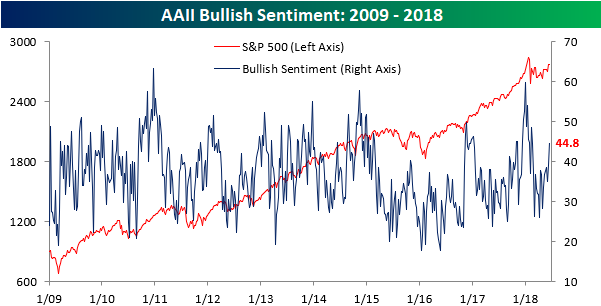
6. Latest AAII Weekly Sentiment — based on the latest Weekly Sentiment, the Bulls are on the offensive this week as AAII Bullish sentiment jumped to 44.78% from 38.93% last week, which is the highest level since mid-February.
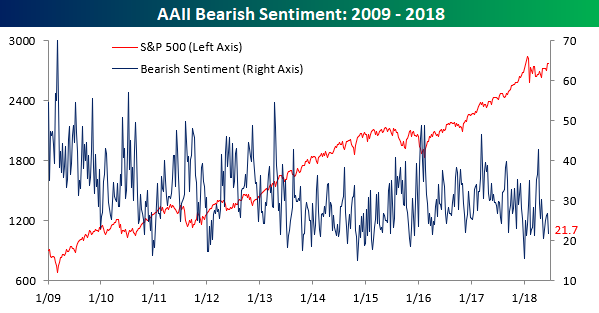
While bullish sentiment spiked higher, bearish sentiment did not see as big of a move to the downside. As shown in the chart below, negative sentiment declined from 26.72% down to 21.70%.
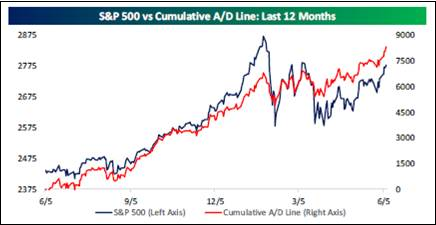
7. New High Cumulative A/D Line Versus S&P500 — below displays the chart of the S&P500 ‘s underlying breadth which points to an eventual new high in price for the S&P 500.
The week ahead — Economic data from Econoday.com:

Tags: A/D High, AAII Weekly Sentiment
Posted in Weekly Summary | No Comments »
June 11th, 2018
“The secret to being successful from a trading perspective is to have an indefatigable and an undying and unquenchable thirst for information and knowledge.” — Paul Tudor Jones
1. China Launches Foreign Chipmaker Probe — Chinese regulators are investigating Micron Technology (NASDAQ:MU), Samsung Electronics (OTC:SSNLF) and SK Hynix (OTC:HXSCL) as the country tries to reduce dependency on foreign chips, WSJ reported. Some speculate the probe concerns the rising cost of DRAM chips – the three companies are dominant suppliers – or it might be seeking to use the current DRAM pricing environment to gain leverage for a technology transfer. Also, ZTE has signed an agreement in principle that would lift a U.S. Commerce Department ban on buying from American suppliers, sources told Reuters. The preliminary deal includes a $1B fine, plus $361 from an earlier settlement and $400M in escrow to cover any future violations
2. Primaries Shape Battle for Congress In Mid-Term Election — the battle for control of Congress is on the radar as voters across eight states choose nominees in a slew of hotly contested primaries. The California races have garnered the most attention because of that state’s open primary system, in which the top two vote-getters advance regardless of party affiliation. An oversupply of Democratic candidates could result in a splintered electorate, allowing two Republicans to advance to November’s midterm election.
3. U.S.-China Trade Developments Progress — China has offered to purchase nearly $70B of U.S. farm, manufacturing and energy products if the Trump administration abandons its threat for $50B in duties on China-made products. The White House, which is looking to reduce its trade deficit with China by $200B, has said it plans to move ahead with the tariffs shortly after June 15 as a way to pressure Beijing to make more sweeping changes in its economy.
4. EU Prepares tariffs against U.S. in July — the EU “expects to conclude the relevant procedure in coordination with member states before the end of June,” European Commission Vice-President Maros Sefcovic told a news briefing. From blue jeans to motorbikes and whiskey, the hit list of U.S. products targeted for tariffs reads like a catalog of emblematic American exports.
5. The Pentagon’s Hypersonic Weapons Project — Hypersonic weapons are among the technologies emphasized in the Senate’s newly released $716B defense authorization bill for FY 2019. But as Russia and China continue their march toward fielding hypersonics, the Pentagon and its largest weapons supplier have shared limited details about their own efforts. Lockheed (NYSE:LMT) will be responsible for designing, engineering, integration and logistical support on the $928M U.S. hypersonic project.
The week ahead — Economic data from Econoday.com:
Tags: Trade War
Posted in Weekly Summary | No Comments »
June 4th, 2018
“The financial markets generally are unpredictable. So that one has to have different scenarios… The idea that you can actually predict what’s going to happen contradicts my way of looking at the market.” – George Soros
1. Euro, Yield Worries Amid Turmoil in Italy — Italy’s anti-establishment parties have abandoned plans to form a coalition government after the country’s president refused to accept a controversial choice for economy minister, raising the possibility of snap polls. Investors fear the election will resemble a referendum on the EU and the euro, posing an existential threat for the bloc. That sparked the currency to slip below the $1.16 level, while the gap between Italian and German 10-year bond yields widened to its highest in over four years, putting pressure on banks and stocks across the region.
2. U.S. Moves Forward with China Tariffs — the White House is proceeding with its proposal to impose 25% tariffs on $50B worth of goods from China, and place new limits on Chinese investments in U.S. high-tech industries. “This statement is obviously in violation of the consensus reached in Washington recently by both China and the U.S,” China’s Commerce Ministry declared, pointing to the “trade war hold” announced by Treasury Secretary Steven Mnuchin less than 10 days ago.
3. US Allies Strike Back Against U.S. Tariffs — besides retaliatory tariffs from the European Union, the U.S. is facing “counter-balancing measures” from its northern (Canada) and southern neighbors (Mexico) after imposing duties on steel and aluminum. Canada’s levies will cover C$16.6B in imports, including whiskey, orange juice and other food products, alongside metal tariffs. Mexico’s reciprocal measures will also target steel, as well as pork legs, apples, grapes and cheeses.
4. China A-shares Join MSCI Indexes — more than 230 Chinese stocks, known as A-shares, have been finally added to MSCI’s Emerging Markets Index (ETF: EEM), giving ordinary U.S. investors greater access to mainland China. The move is expected to drive a surge of foreign money into local markets.
The week ahead — Economic data from Econoday.com:
Tags: China A-Shares, Trade Tariffs
Posted in Weekly Summary | No Comments »
May 29th, 2018
“Every trader has strengths and weakness. Some are good holders of winners, but may hold their losers a little too long. Others may cut their winners a little short, but are quick to take their losses. As long as you stick to your own style, you get the good and bad in your own approach.” — Michael Marcus
1. Venezuela’s Maduro Wins Re-Election — Venezuela’s Nicolas Maduro won a new six-year term in an election deemed illegitimate by the opposition and foreign governments, paving the way for heavier international sanctions. The economy has been in recession since 2014, with the bolivar currency down 99% in the past year and inflation at an annual 14,000%, according to the National Assembly.
2. Argentina Starts IMF Bailout Negotiations — with Argentina on the brink of a financial crisis, the IMF has formally begun bailout negotiations, without any objection from the Trump administration. Such measures rarely advance without U.S. support. The peso has fallen drastically against the dollar, while the nation has been dogged by persistent budget deficits, high inflation and trade imbalances.
3. China to Cut Import Duties On Cars — the easing of trade tensions between the U.S. and China is continuing, with the latter pledging to cut import tariffs on passenger vehicles to 15%, down from 25%. Import duties on car parts will be reduced to 6%. It comes after Washington froze its proposed Chinese tariffs and looked into lifting the ban on ZTE, while Beijing halted its probe into U.S. sorghum imports and restarted the review of the Qualcomm-NXP deal.
4. U.S. Launches Criminal Probe Into Crypto Manipulation — Bloomberg reports the DOJ is in the early stages of a criminal probe into whether traders are manipulating the price of bitcoin and other cryptocurrencies. It comes amid skepticism that exchanges are actively pursuing cheaters, wild price swings and a lack of regulations. Federal prosecutors are working with the CFTC, a financial regulator that oversees derivatives tied to bitcoin.
5. Trump Cancels Singapore Nuclear Summit with North Korean Leader Kim Jong Un — President Donald Trump canceled his historic nuclear summit with Kim Jong Un late last week, accusing North Korea of “tremendous anger and open hostility.” The news came as North Korea made a show of dismantling a nuclear test site, but also on the heels of some sharp words from the North Korean government about America denuclearization demands.
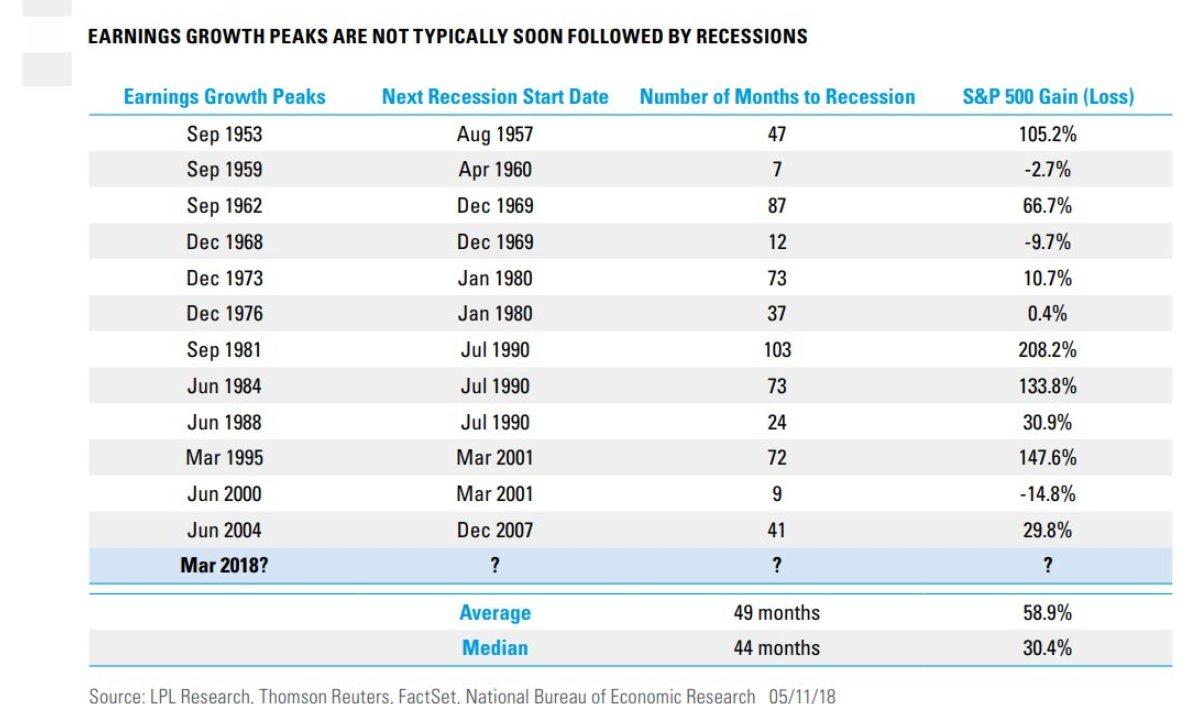
6. Peak Earnings Growth Follows by Recessions Statistics — courtesy of LPL Reseach (see table below), the average time the market proceeds to recession based on the last 12 earnings growth peaks since 1953 is about 4 years. If this hold true, we could expect a recession in mid-2022 which would make the current U.S. economic expansion the longest ever at 13 years old. Also note that the S&P 500 was up an average of 59% during these periods between the earnings growth peak and the start of the next recession.
The week ahead — Economic data from Econoday.com:

Tags: N Korean Denuclearization, Peak EArnings
Posted in Weekly Summary | No Comments »
May 21st, 2018
1. N.Korea Expands Threat to Cancel Summit & Plans To Destroy Nuclear Test Site — North Korea is expanding on its threat to cancel the June 12 summit between Kim Jong-un and President Trump. Besides protesting the joint air force drills taking place in South Korea, Pyongyang said the U.S. must stop insisting it “unilaterally” abandon its nuclear program and lashed out at national security advisor John Bolton, who talked about a disarmament similar to “Libya 2004.”. Also, Pyongyang plans to destroy all of the tunnels at the country’s northeastern testing ground with an explosion and remove observation facilities, research posts and ground-based guard units.
2. New Ebola Outbreak Hits Congo — the deadly hemorrhagic disease Ebola has resurfaced again, with the WHO revealing 32 potential cases of the disease (including 18 deaths) in the Democratic Republic of the Congo. Experimental Ebola vaccines are under development, such as leading candidate – Merck’s (NYSE:MRK) rVSV-ZEBOV – but they have not been fully tested for safety or effectiveness.
3. The Supreme Court Ruled New Jersey Can Legalize Sports Gambling — the Supreme Court announced late last week that New Jersey can legalize sports betting in what could be a landmark case in the gaming industry. It clears the way for states, if they choose, to allow gambling on athletic events by striking down the 1992 Professional and Amateur Sports Protection Act, a federal law that said states couldn’t “sponsor, operate, advertise, promote, license, or authorize” sports gambling.
4. More States Sue Over Opioid Epidemic Drug Makers — Litigation against OxyContin maker Purdue Pharma is intensifying as six more U.S. states – Nevada, Texas, Florida, North Carolina, North Dakota and Tennessee – announced lawsuits that accuse the company of fueling a national opioid epidemic. Florida also sued Endo Pharmaceuticals (NASDAQ:ENDP), Allergan (NYSE:AGN), units of Johnson & Johnson (NYSE:JNJ), Teva Pharmaceutical (NYSE:TEVA), and Mallinckrodt (NYSE:MNK), as well as AmerisourceBergen (NYSE:ABC), Cardinal Health (NYSE:CAH) and McKesson (NYSE:MCK).
5. AAII Weekly Sentiment Survey — In this week’s sentiment survey from AAII, bullish sentiment ticked up to 36.68% from last week’s level of 33.51%. The bulls are back above the average of 36.62% for the current bull market.
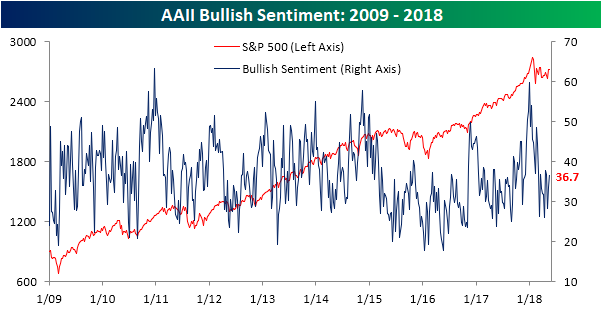
in bearish sentiment, which declined for the second straight week, falling from 25.5% down to 20.6%. Since its recent high in early April, bearish sentiment has now been more than cut in half. It’s also at the lowest level since the first week of the year.

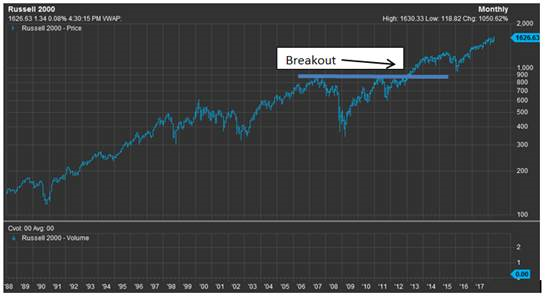
6. Small cap Russell 2000 Index and S&P 600 Small Cap Index Hit New All-Time Highs — over the past week, both the small cap Russell 2000 Index and S&P 600 Small Cap Index have recorded not only new bull market highs, but also new all-time highs. Historically, small caps have been among the first stocks to show developing weakness as a bull market enters its final stages; However, these new highs in both the small cap price indexes and Advance-Decline Lines suggest an ongoing and healthy primary uptrend showing few signs of age.
The week ahead — Economic data from Econoday.com:
Tags: AAII Weekly Sentiment, Legalized Gambling, Smallcap NewHigh
Posted in Weekly Summary | No Comments »
May 14th, 2018
“If you have an approach that makes money, then money management can make the difference between success and failure… … I try to be conservative in my risk management. I want to make sure I’ll be around to play tomorrow. Risk control is essential.” – Monroe Trout
1. Trump Set to Unveil Drug Price Policy — President Trump’s plan will reportedly require Medicare Part D plans to share a portion of discounts they receive from drug manufacturers with patients, as well as including ways to allow the government to better negotiate. Secretary of Health and Human Services (HHS) Alex Azar stated “We’ll be building on the proposals in the president’s budget, but he wants to go further,” Also, the White House said the HHS will take steps to end the gaming of regulatory and patent processes by drugmakers to unfairly protect monopolies, advance biosimilars and generics, consider whether to include prices in drugmaker ads, and accelerate the approval process for over-the-counter drugs.
2. U.S. Imposes More Sanctions on Venezuela — the U.S. has announced new sanctions on three Venezuelans and 20 companies with ties to President Maduro, whom it blames for a deep recession and hyperinflation that have caused food shortages across Venezuela. Vice President Mike Pence also called for more nations to increase pressure and urged Caracas to suspend a May 20 election he denounced as a “sham.”
3. California Approves Plan to Require Rooftop Solar Power for New Homes — California has become the first U.S. state to require solar panels on nearly all new homes built after Jan. 1, 2020, as part of new energy efficiency standards adopted by the California Energy Commission. While the move is a boost for the solar industry, critics say it will add $8K-$12K to the cost of buying a house in the state. Solar already provides 16% of California’s electricity.
4. President Trump Abandoned a Nuclear Deal with Iran — President Trump abandoned a nuclear deal with Iran and announced the “highest level” of sanctions against the OPEC member. Financial or business activities outlawed by August 6 include exports of airplanes and parts, dollar transactions, trade in gold and other metals, sovereign debt and the auto industry. By November 4, sanctions will ban oil purchases and transactions with the central bank. Furthermore, the U.S. Treasury has imposed penalties on nine Iranian companies and individuals for allegedly operating a currency exchange network that – with the help of Iran’s central bank – transferred millions of dollars to the Iranian Revolutionary Guard’s elite Quds Force.
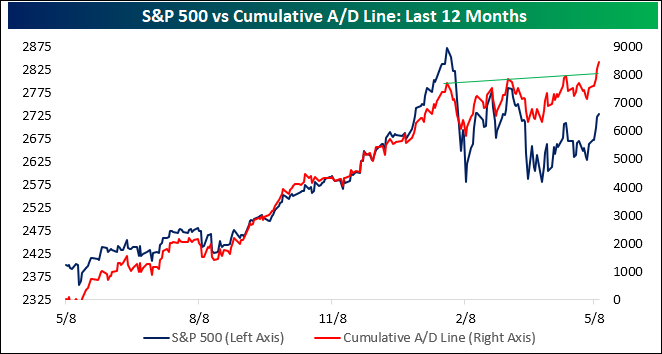
5. Cumulative Advance/Decline Line Made New All-Time High — the Advance/Decline Line has made a new all-time high with positive expansion in breath. Stocks recording new highs are also suggestive of higher prices even though the stock market is overbought on a near-term basis.
The week ahead — Economic data from Econoday.com:
Tags: A/D Line New High
Posted in Weekly Summary | No Comments »
May 7th, 2018
“The game of speculation is the most uniformly fascinating game in the world. But it is not a game for the stupid, the mentally lazy, the person of inferior emotional balance, or the get-rich-quick adventurer. They will die poor.” – Jesse Livermore
1. U.S. Delays Tariffs on European Union, Canada and Mexico for 30 days — the Trump administration is delaying a decision about whether to impose steel and aluminum tariffs on the EU, Canada and Mexico until June 1, giving key allies a reprieve as the countries carry out further negotiations. The Iran deal is also on watch.
2. CFTC Chair Comments on Crypto Currency Regulation — according to CFTC Chairman J. Christopher Giancarlo, Bitcoin has “elements of all of the different asset classes,” stating that the popular crypto-currency is part currency, part security and part digital coin. “At the end of the day, it’s for Congress, and not regulators, to decide whether new policies should be evolved for these new asset classes… I don’t see it being resolved any time soon.”.
3. U.S. Trade Team Heads to China — A U.S. delegation led by Treasury Secretary Steven Mnuchin is on its way to China to discuss economic matters and the trade deficit. “Very much like North Korea, this should have been fixed years ago,” President Trump wrote in a tweet. Some economists anticipate that a short-term bargain involving the automobile industry and other previously announced moves could be struck. The yuan has weakened against the U.S. dollar for the fourth straight day with the trade talks just getting started.
4. FOMC Meeting Recap — the Federal Reserve held interest rates steady after its two-day policy meeting and said it will monitor inflation. The policy-making committee used the word “symmetric” twice in relation to its inflation target, in a potential cue to bond traders that a small overshoot past the 2% inflation target will be tolerated. The Fed noted that risks to the economic outlook are roughly balanced. “The FOMC statement reinforced market expectation for another 25 basis points rate rise in its June meeting,” said JPMorgan chief market strategist Tai Hui.
5. Iran Won’t Renegotiate Nuclear Deal — President Trump warns that unless European allies rectify the 2015 nuclear deal’s “terrible flaws” by May 12, he will refuse to extend U.S. sanctions relief for the oil-producing Islamic Republic. Foreign Minister Mohammad Javad Zarif stated that “Iran will not renegotiate what was agreed years ago and has been implemented,”.
6. Berkshire Increased Apple Stake in Q1 by Adding an Additional 75M Apple Shares — Berkshire Hathaway bought 75M additional Apple (NASDAQ:AAPL) shares in Q1, with Warren Buffett outlining that the company “earns almost twice as much as the second most profitable company in the U.S.” The new investment brings its total stake in the tech giant to 240.3M shares worth $42.5B.
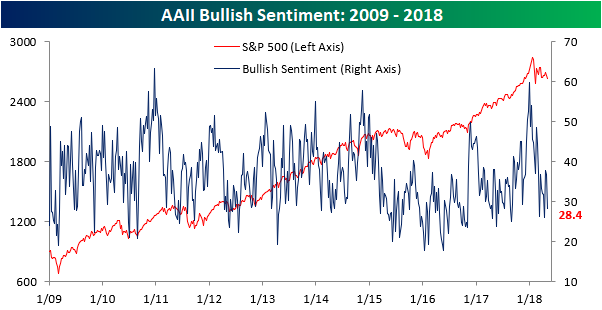
7. AAII Weekly Sentiment — according to this week’s sentiment survey from AAII, bullish sentiment declined from 36.91% down to 28.4%. While anything sub-30% is considered low, we actually saw a lower weekly print back in the first half of April, when bullish sentiment dropped down to 26.09%.
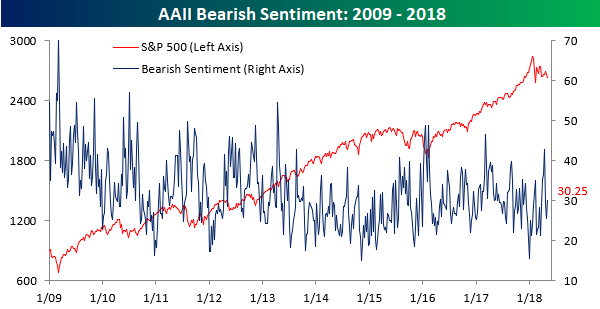
While bullish sentiment declined over 8 percentage points, bearish sentiment increased by less than 5 points. At the current level of 30.25%, it is nowhere near its recent high of over 40%.
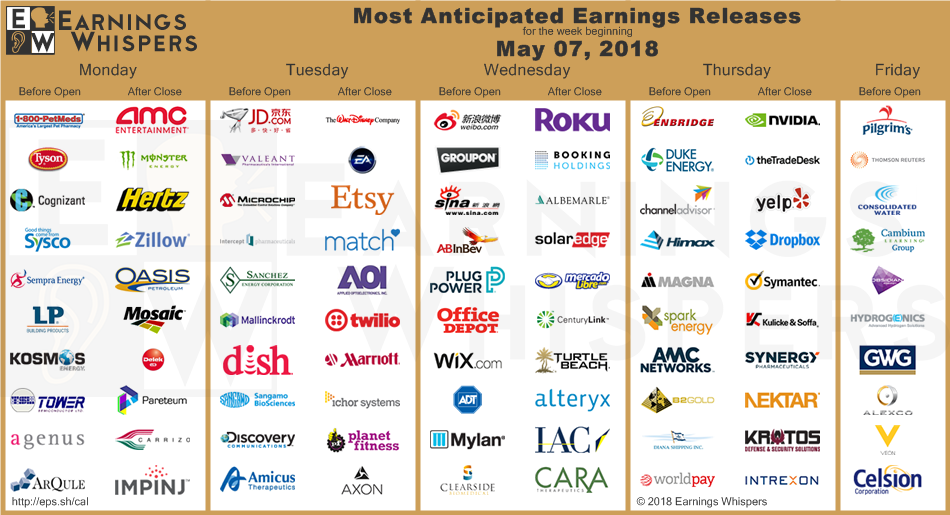
The week ahead — Economic data from Econoday.com:
Tags: AAII Sentiment, FOMC Meeting
Posted in Weekly Summary | No Comments »