Search

Week of Sept 24, 2021 Weekly Recap & The Week Ahead

September 28th, 2021

“No amount of sophistication is going to allay the fact that all your knowledge is about the past and all your decisions are about the future.” — Ian H. Wilson

1. Federal Reserve Signals Interest Rates Could Climb Sooner Than Expected — In its quarterly summary of economic projections, the Fed revealed that half of the Federal Open Market Committee’s 18 participants now expect to lift interest rates at least once in 2022. Two members moved their so-called dots forward to predict raising interest rates next year. The Fed has telegraphed it wouldn’t raise rates before 2024, but some policy makers have expressed rising concerns over inflation. The signal is a hawkish surprise that came as the Fed suggested it may in the coming months start reducing the emergency $120 billion in monthly Treasury and mortgage-backed securities purchase program it launched in response to the Covid-19 pandemic.
2. China Injects $18.6 Billion Into Banking System During Evergrande Crisis — China’s central bank boosted its gross injection of short-term cash into the financial system after concern over a debt crisis at China Evergrande Group roiled global markets. The People’s Bank of China pumped 120 billion yuan ($18.6 billion) into the banking system through reverse repurchase agreements, resulting in a net injection of 90 billion yuan. That matches the amount seen on Friday, and was just below that of Saturday. Sentiment was also boosted after Evergrande’s onshore property unit said it plans to repay interest due Thursday on its local bonds. That came after Evergrande missed interest payments due Monday to at least two of its largest bank creditors, people familiar with the matter said, asking not to be identified discussing private information.
3. CDC Panel Backs Pfizer Booster Dose for People Ages 65 and Older — the Centers for Disease Control and Prevention adopted the use of booster shots in the U.S. for people at high risk of contracting or falling seriously ill from Covid-19, overruling a narrower recommendation from the agency’s advisers and clearing the way for a widespread vaccination campaign. Millions of Americans who were immunized with the Pfizer Inc.-BioNTech SE vaccine at least six months ago should receive a booster dose, including those aged 65 or older, those in long-term health care facilities and those aged 50 to 64 with underlying medical conditions, the agency said in a statement. People aged 18 to 49 with medical conditions and those who are at high-risk for being exposed to the virus at their workplaces or elsewhere may also receive a third dose.
The endorsement from CDC Director Rochelle Walensky will allow shots to be given immediately. She said the decision, which aligns with the Food and Drug Administration rather than an expert team of reviewers at the CDC, was based on imperfect data and designed to protect those at highest risk as the delta variant continues to spread in the U.S.
4. China’s Casino Crackdown Part of Quest to Transform Macau — China ‘s announcement of revisions to the law governing casinos was one of the most definitive signs yet that there’s no turning back for Beijing. The proposed changes, which are now up for consultation with the public and industry, came just a week after the Chinese government released a plan to further integrate Macau with the Chinese mainland. The city is being encouraged to develop non-gaming industries in a special zone on the neighboring island of Hengqin — currently divided between Guangdong province and Macau — with a focus on high-tech manufacturing, cultural tourism, Chinese medicine, conventions and sports, according to a master plan released by Beijing earlier this month. Gambling won’t be allowed.
5. China Declares Cryptocurrency Transactions Illegal — the People’s Bank of China said the latest notice was to further prevent the risks surrounding crypto trading and to maintain national security and social stability. Naming bitcoin, ether and tether as examples, the central bank said cryptocurrencies are issued by nonmonetary authorities, use encryption technologies and exist in digital form, and shouldn’t be circulated and used in the market as currencies. China banned cryptocurrency exchanges from operating within its borders several years ago, but individuals in the country have continued to find ways to trade bitcoin and other digital currencies via over-the-counter or peer-to-peer transactions.

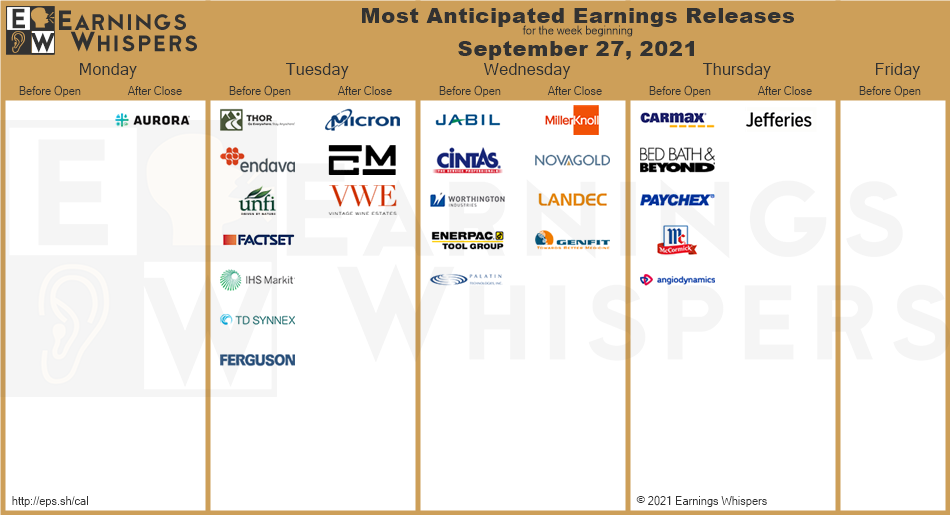
The week ahead — Economic data from Econoday.com:
Week of Sept 17, 2021 Weekly Recap & The Week Ahead

September 21st, 2021

“the first stage, when just a few thoughtful investors recognize that, despite the prevailing bullishness, things won’t always be rosy, the second stage, when most investors recognize that things are deteriorating, and the third stage, when everyone’s convinced things can only get worse.”
― Howard Marks

1. Apple Unveiled New iPhone 13 Pro and Watch Series 7 — the Cupertino, Calif., tech giant revealed the iPhone 13 and a smartwatch with a new look during its annual September event, which the company streamed live on its website rather than holding in person because of Covid-19 precautions. The company said the regular version of its iPhone 13 will get 2.5 hours more battery life compared with the previous model. New features include a “cinematic mode” that allows users to capture movie-style video with greater depth using their iPhone cameras.
2. Hard-Hit Industries Renew Calls for Covid-19 Aid Amid Economic Slowdown — restaurants, live-events businesses and gyms are among industries renewing calls for Congress to provide additional financial assistance amid signs the rise in Covid-19 cases is slowing U.S. economic activity. Lawmakers from both parties have signaled support for more aid, but the prospects for a package still likely face an uphill climb as Congress grapples with other legislative priorities. Those include a $1 trillion infrastructure proposal and Democrats’ $3.5 trillion healthcare, education and climate bill. Some Republicans have also previously expressed concern about additional government spending for aid programs.
3. Democratic Tax Plan Would Hit Million-Dollar Households Hardest — households making at least $1 million in income would face a 10.6% tax increase in 2023 under House Democrats’ plan, raising their average federal tax rate to 37.3% from 30.2%, according to the nonpartisan Joint Committee on Taxation.
The committee analysis, shows that low-income households would get significant tax cuts from the proposal for the first few years, largely because of the extension of the expanded child tax credit. The House Democrats’ plan would increase corporate taxes, capital-gains taxes and individual income taxes on high-income households, though the proposed increases don’t go as far in several areas as the Biden administration has sought. House Democrats didn’t propose taxing unrealized capital gains at death or taxing long-term capital gains at the same rates as other income. Instead, they are seeking a 3% surtax on income over $5 million, limits on a 20% deduction for business owners and expansion of a 3.8% tax to hit active business income.
4. Macau Casinos See $18 Billion Wipeout as China Tightens Grip — the Bloomberg Intelligence index of the six big casino operators fell a record 23%. American operators saw the worst selloffs, with Sands China Ltd. sinking as much as 33%, while Wynn Macau Ltd. plunged 34%, both the steepest declines ever. Galaxy Entertainment Group slumped 20%, its sharpest drop in a decade. Wynn Resorts Ltd., Las Vegas Sands Corp. and MGM Resorts International sank for a second day in U.S. trading. Officials said they would change casino regulations to tighten restrictions on operators, including appointing government representatives to “supervise” companies in the world’s biggest gaming hub.
5. FDA Advisory Panel Votes Against Covid-19 Booster Shots for General Population but Endorses It for Some Groups — A Food and Drug Administration advisory panel endorsed booster shots of the Covid-19 vaccine from Pfizer Inc. and BioNTech SE for adults older than 65 years and those at high risk of severe disease, bringing the Biden administration one step closer to starting a booster campaign for millions of Americans. The outside panel voted 16-2 against advising the FDA to approve a booster dose of the vaccine at least six months after the second shot for people 16 years and older. Many panel members said they had concerns about widening booster shots for the general population with limited data about whether the additional doses would be safe and effective. Members said they would potentially support recommending a third dose for certain high-risk groups of the population such as older adults but that there wasn’t enough data to justify giving it to the general population. They said that vaccines such as Pfizer’s are holding up against severe disease.

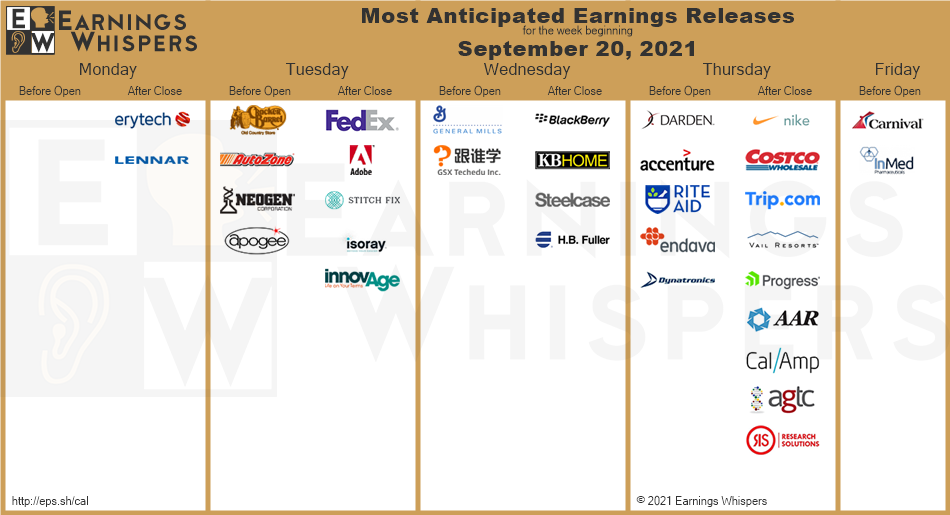
The week ahead — Economic data from Econoday.com:
Week of Sept 10, 2021 Weekly Recap & The Week Ahead

September 14th, 2021

“In business, financial and market cycles, most excesses on the upside — and the inevitable reactions to the downside, which also tend to overshoot — are the result of exaggerated swings of the pendulum of psychology. Thus understanding and being alert to excessive swings is an entry-level requirement for avoiding harm from cyclical extremes, and hopefully for profiting from them.” ― Howard Marks

1. Moderna Unveils Experimental Two-in-One Vaccine for Covid and the Flu — Moderna plans to announce the development of a vaccine candidate that will protect against Covid-19 and the flu, to be known as mRNA-1073. The company will also announce a pediatric vaccine called mRNA-1365, which combines its experimental respiratory syncytial virus vaccine with its experimental human metapneumovirus vaccine. The company also said it would discuss new data from a Phase 1 study of its respiratory syncytial virus vaccine. The company said interim data from the study showed that a single vaccination with the vaccine, known as mRNA-1345, boosted neutralizing antibody titers against the RSV-A virus by 14 times, and against the RSV-B virus by 10 times. The company tested three different dose levels, but said that there wasn’t a significant difference in antibody response between dose levels.
2. Biden Administration Unveils Plan to Cut Prescription-Drug Prices — a Biden administration plan to lower prescription-drug prices offers the first detailed road map of administrative actions the White House would support in addition to legislation aimed at driving down costs. Administrative measures include testing reimbursement for drugs in Medicare based on the clinical value they provide to patients and offering federal funding for research into new treatments.
3. The Flu Is Expected to Make a Comeback This Year, Threatening Hospitals Strained by Delta — the coming flu season is on track to be much worse than the last cycle, according to health experts, who fear an influx of cases could further strain hospitals already overwhelmed by the Delta surge.
The season could also strike earlier and more severely than usual, doctors and researchers said, because many people haven’t been able to build up their natural immune defenses while working from home and avoiding strangers. Many children will be back in school where they can pick up and spread infections, the health experts said. Many adults aren’t working in their offices where they typically get flu shots, or they don’t want another vaccination after getting their Covid-19 doses. And many people will no longer be protected by masking and other Covid-19 restrictions that have been eased.

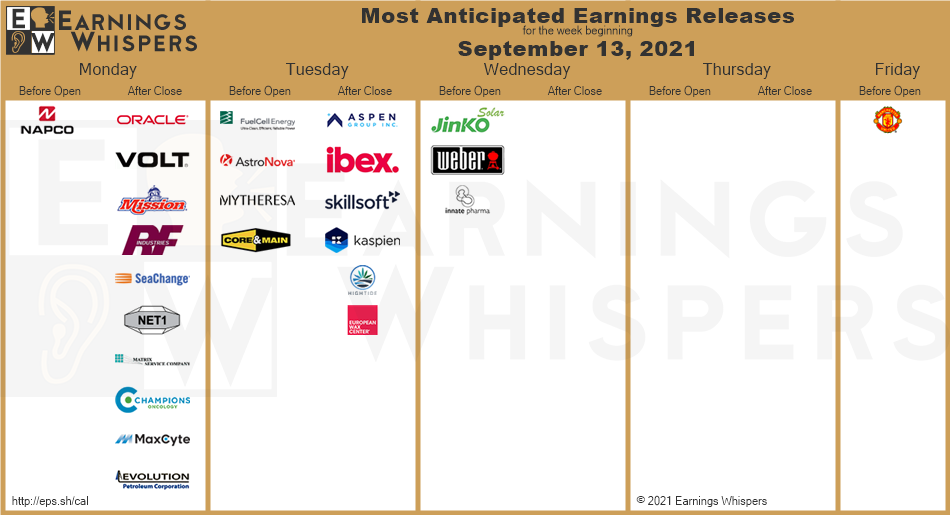
The week ahead — Economic data from Econoday.com:
Week of Sept 3, 2021 Weekly Recap & The Week Ahead

September 8th, 2021

“The speculator’s chief enemies are always boring from within. It is inseparable from human nature to hope and to fear. In speculation when the market goes against you hope that every day will be the last day – and you lose more than you should had you not listened to hope – the same ally that is so potent a success-bringer to empire builders and pioneers, big and little. And when the market goes your way you become fearful that the next day will take away your profit, and you get out – too soon. Fear keeps you from making as much money as you ought to. The successful trader has to fight these two deep-seated instincts . . . Instead of hoping he must fear; instead of fearing he must hope.” — Jesse Livermore

1. EU Recommends Halting Nonessential Travel From the U.S. Over Covid-19 — the European Union recommended halting nonessential travel from the U.S. because of the rise of Covid-19 cases, ending a summer-vacation reprieve for American tourists. Still, member states retain control over all the rules for tourist travel, such as whether to impose quarantines on unvaccinated travelers and which certificates to accept as proof of having received a vaccine. The EU also axed Israel, Lebanon, Kosovo, North Macedonia and Montenegro, leaving only 18 countries on its list of so-called safe countries. That includes China when and if Beijing permits EU citizens to visit China.
2. Bitcoin Breaks Back Above $50,000 in Crypto Rally — Bitcoin broached the $50,000 level once again as the wider cryptocurrency market continued its rally.
The largest cryptocurrency rose as high as $50,362, having briefly surpassed $50,000 on Aug. 23 as well — a level it hadn’t hit since mid-May. Ether, the second-largest crypto, rose as much as 3% to $3,843, continuing a strong run after its London upgrade early last month. Cryptocurrencies have surged this year amid increased institutional interest and acceleration of development in areas like decentralized finance, known as DeFi, and non-fungible tokens, or NFTs. In addition, Twitter Inc. may be laying the groundwork to allow for Bitcoin tips in its Tip Jar feature, according to a recent report from MacRumors. Meanwhile, El Salvador’s Bitcoin law takes effect Sept. 7.
3. Fed’s Williams Says 2021 Taper Start ‘Could Be Appropriate’ — Federal Reserve Bank of New York President John Williams said “It could be appropriate” for the U.S. central bank to begin tapering its bond-buying program before the year is out. The Fed cut its benchmark interest rate to nearly zero and aggressively bought bonds last year at the onset of the coronavirus pandemic. It has said it will continue the purchases at the current pace of $120 billion per month until the economy has made “substantial further progress” toward its maximum employment and price stability goals, a marker many officials have said they believe will be achieved this year.

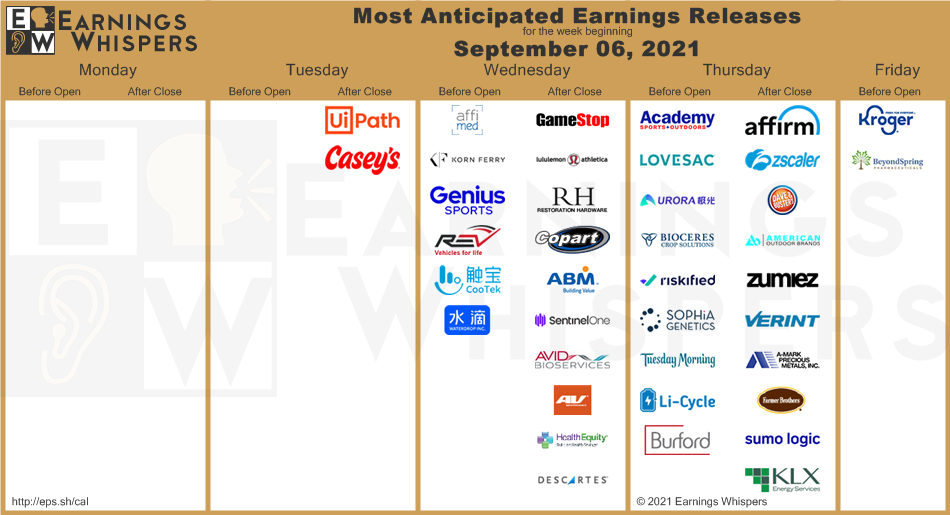
The week ahead — Economic data from Econoday.com:
Week of Aug 27, 2021 Weekly Recap & The Week Ahead

August 30th, 2021

…“People somehow think you must buy at the bottom and sell at the top to be successful in the market. That’s nonsense! The idea is to buy when the probability is greatest that the market is going to advance”… Jesse Livermore

1. Delta Air Lines to Impose Monthly Surcharge on Unvaccinated Employees — Delta Air Lines Inc. will impose a $200 monthly surcharge on employees who aren’t vaccinated against Covid-19, becoming the first major U.S. company to levy a penalty to encourage workers to get protected. The fee applies to employees in the airline’s health-care plan who haven’t received shots by Nov. 1. The company also will require weekly testing for employees who aren’t vaccinated by mid-September.
2. Fed’s Chairman Powell Says Taper Could Start in 2021, With No Rush on Rate Hike — Federal Reserve Chair Jerome Powell said the central bank could begin reducing its monthly bond purchases this year, though it won’t be in a hurry to begin raising interest rates thereafter.
The economy has now met the test of “substantial further progress” toward the Fed’s inflation objective that Powell and his colleagues said would be a precondition for tapering the bond purchases, while the labor market has also made “clear progress,” the Fed chief said Friday in the prepared text of a virtual speech at the Kansas City Fed’s annual Jackson Hole symposium.
3. China Could Ban Some U.S. IPOs — the latest reports that China plans to ban data-heavy technology firms from U.S. IPOs confirms what many feared a couple of weeks ago.
Chinese stock regulators, according to The Wall Street Journal on Friday, have alerted some foreign investors and companies that new rules could ban internet companies with a lot of user-related data from listing in the U.S. The moves are the latest in a crackdown by China as it tries to wrest more control over businesses and society more broadly. Among authorities’ top concern, money managers say, is data security and control, as well as more technology independence, as U.S.-China tensions escalate. Another priority: Addressing growing inequality after years of breakneck growth in the digital economy and creating a more level playing field for smaller businesses.
4. Peloton Says U.S. Government Has Subpoenaed Company –the U.S. government has subpoenaed the company for information on its reporting of injuries related to its products.
Both the U.S. Department of Homeland Security and the U.S. Department of Justice have issued subpoenas, Peloton said in its annual filing with the Securities and Exchange Commission. Additionally, it said the SEC is investigating the company’s public disclosures over these issues. The Consumer Product Safety Commission earlier this year warned people with pets or children to cease using the company’s treadmills after it investigated a child dying from being pulled under one of them. Peloton initially pushed back against the regulator, but later apologized and agreed to recall its treadmills.
5. Supreme Court Blocks Biden Administration’s New Eviction Moratorium — The Supreme Court on Thursday lifted the latest federal ban on evictions during the Covid-19 pandemic, siding with landlords against a moratorium the Biden administration imposed this month despite questions about its legality. “The moratorium has put…millions of landlords across the country, at risk of irreparable harm by depriving them of rent payments with no guarantee of eventual recovery,” the court said. “Many landlords have modest means. And preventing them from evicting tenants who breach their leases intrudes on one of the most fundamental elements of property ownership—the right to exclude.”

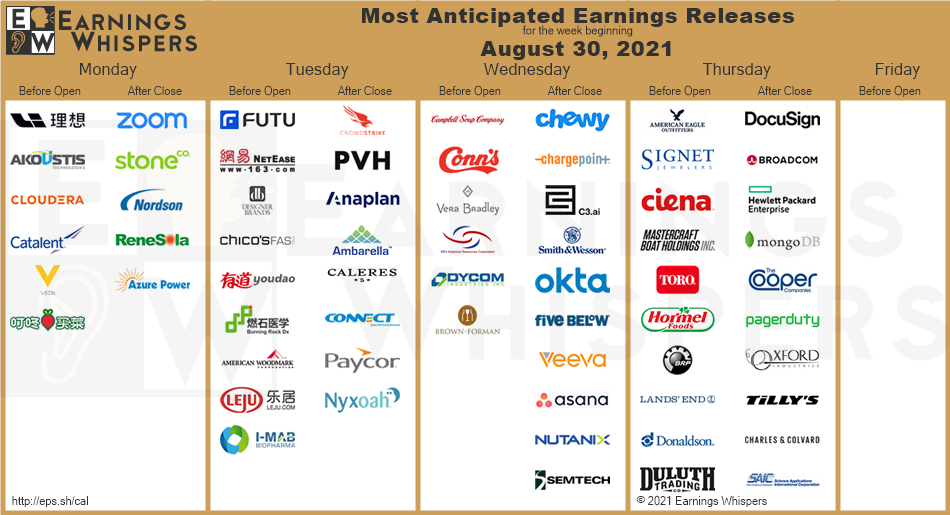
The week ahead — Economic data from Econoday.com:
Week of Aug 20, 2021 Weekly Recap & The Week Ahead

August 24th, 2021

“In business, financial and market cycles, most excesses on the upside — and the inevitable reactions to the downside, which also tend to overshoot — are the result of exaggerated swings of the pendulum of psychology. Thus understanding and being alert to excessive swings is an entry-level requirement for avoiding harm from cyclical extremes, and hopefully for profiting from them.” ― Howard Marks

1. U.S. Retail Sales Fell 1.1% in July — Retail sales—a measure of purchases at stores, at restaurants and online—fell 1.1% last month compared with June, the Commerce Department reported Tuesday. Excluding autos—a category where supply-chain issues have limited available inventory—sales declined 0.4%. Restaurants and bars were a bright spot, with sales rising 1.7% over the month, while sales at nonstore retailers—a proxy for online retail sales—fell 3.1%.
Retail sales rose briskly earlier in the summer, as shoppers boosted spending on services, such as dining out, and away from goods. That shift occurred as more Americans became vaccinated and state and local governments eliminated many Covid-19-related restrictions, some of which have now been reimposed with the recent rise in coronavirus cases.
2. Fed Signals Asset Purchases Likely to Slow This Year — minutes of the FOMC July 27-28 Fed meeting, shed light on an emerging consensus to begin scaling back their $120 billion in monthly purchases of Treasury and mortgage securities at any of their three remaining policy meetings this year. “Most participants noted that, provided that the economy were to evolve broadly as they anticipated, they judged that it could be appropriate to start reducing the pace of asset purchases this year,” the minutes said. Fed officials expected a temporary burst in inflation as the economy struggles to supply enough goods and services to keep up with demand this year. But the spurt has been stronger and broader based than officials expected. On a 12-month basis, the Fed’s preferred inflation gauge, after excluding volatile food and energy categories, rose 3.5% in June, a 30-year high.
3. China Passes One of the World’s Strictest Data-Privacy Laws — China has approved a sweeping privacy law that will curb data collection by technology companies, but that policy analysts say is unlikely to limit the state’s widespread use of surveillance. The national privacy law, China’s first, closely resembles the world’s most robust framework for online privacy protections, Europe’s General Data Protection Regulation, and contains provisions that require any organization or individual handling Chinese citizens’ personal data to minimize data collection and to obtain prior consent. However, unlike in Europe, where governments face more public pressure over data collection, Beijing is expected to maintain broad access to data.
Though the new privacy rules could allow China’s central government to control how lower-level agencies use and share data, nothing suggests “anything resembling legal limits on government surveillance,” said Karman Lucero, a fellow at the Yale Law School Paul Tsai China Center.
4. Passenger Dies of COVID-19 Amid Outbreak on Carnival Cruise Ship — the Carnival Vista cruise ship sailing out of Galveston, Texas, reported 27 people testing positive over two weeks in late July and early August, the highest number of cases since cruises started sailing again. A 77-year-old woman has died from COVID-19 after testing positive while sailing on a Carnival cruise to Belize, marking the first reported death since cruises restarted in the Caribbean and United States in June. Carnival has updated its vaccination policy so that starting on Saturday, most guests will be required to be vaccinated and must also present negative results of a COVID-19 test taken within three days before boarding a ship. Carnival also implemented a mask mandate on Aug. 7 for all passengers in indoor areas.
5. Pentagon Orders Airlines to Help With Afghan Evacuees as U.S. Weighs New Exit Deadline — the president spoke as U.S. airlines were positioning aircraft to comply with a Pentagon order, announced Sunday morning under a rarely invoked law, that compelled six airlines to contribute 18 planes to help with the evacuation. Officials said the commercial aircraft wouldn’t fly in and out of Kabul, the Afghan capital, but would ferry evacuees to the U.S. from bases in Germany, Qatar and Bahrain to ease transport bottlenecks. The escalated activity came as thousands attempted to penetrate the Kabul airport in an effort to flee, fearing retribution from the Taliban, which seized the capital a week ago. Mr. Biden and U.S. officials also warned that Islamic State terrorists posed a threat to Americans in Afghanistan, and that U.S. officials were working to stop potential attacks and defend the airport.

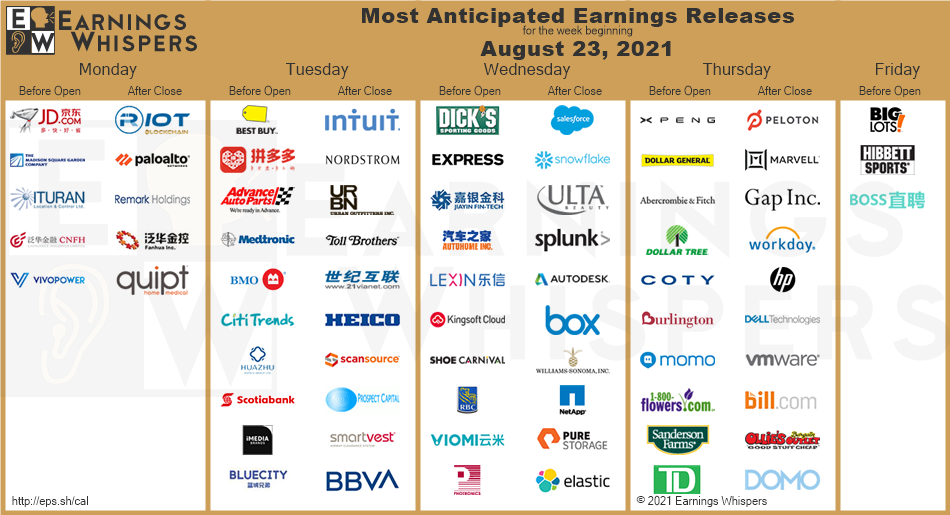
The week ahead — Economic data from Econoday.com:
Week of Aug 13, 2021 Weekly Recap & The Week Ahead

August 17th, 2021

“It ain’t what you don’t know that gets you into trouble. It’s what you know for sure that just ain’t so.”
― Howard Marks

1. Pentagon to Mandate Covid-19 Vaccine for U.S. Service Members — Secretary of Defense Lloyd Austin said he would make Covid-19 vaccination mandatory for U.S. service members effective mid-September. The Covid-19 vaccine hasn’t been granted full approval by the U.S. Food and Drug Administration, but has been offered to Americans under an emergency authorization. That provisional status has hindered Mr. Austin’s ability to make it mandatory for U.S. troops.
2. Senate Democrats Outline $3.5 Trillion Antipoverty, Climate Plan — Senate Democrats released an outline of the $3.5 trillion antipoverty and climate plan, further detailing their ambitions for a major overhaul of the nation’s education and healthcare systems that they hope to advance alongside a bipartisan infrastructure bill. The antipoverty plan is set to offer universal prekindergarten, two free years of community college, and expanded Medicare to cover hearing, dental and vision care, among other provisions.To cover the cost, Democrats are seeking to raise taxes on corporations and high-income households. The plan outlined by Senate Majority Leader Chuck Schumer (D., N.Y.) on Monday also includes offering a pathway to lawful permanent status for certain migrants to the U.S. and lowering the price of prescription drugs. It calls for a federal paid leave benefit, a series of energy tax incentives and a program to push the U.S. to receive 80% of its electricity from clean sources by 2030.
3. Texas Hospitals Are Near Capacity as Covid-19 Surges Again — Texas Gov. Greg Abbott asked hospitals to delay elective medical procedures, as rising Covid-19 cases bring hospitals in many parts of the nation’s second-largest state to capacity. In Austin, city and county officials used an emergency alert system over the weekend to text and call residents with the warning that the hospital situation is critical, as the number of available intensive care unit beds in a metro area of more than two million residents dwindled to single digits. In Houston, hospitals are into surge capacity and local officials tracking the city’s wastewater system are finding evidence of higher-than-ever levels of Covid-19. In Arkansas, Gov. Asa Hutchinson said in a tweet late Monday afternoon the state had eight intensive-care beds available after the largest one-day increase in hospitalizations. “Vaccinations reduce hospitalizations,” the governor said. Roughly 43% of the state’s eligible population is fully immunized, according to Arkansas Department of Health data.
4. California Teachers Must Be Vaccinated or Tested Weekly for Covid-19 — California will require schoolteachers and staff to show proof of vaccination or submit to regular coronavirus testing, Gov. Gavin Newsom announced. Under California’s public-health order, public and private school personnel will need to prove they are fully inoculated by Oct. 15 or agree to weekly testing for the virus. Exceptions will be made for those who have medical reasons not to receive the shot.
Several local districts, including New York City, Oakland and San Francisco, have recently enacted similar rules.
5. Global ETF Assets Hit $9 Trillion — Investors poured $705 billion into exchange-traded funds through the first seven months of the year, pushing 2021’s world-wide tally to a record $9.1 trillion, according to data from Morningstar Inc. Net flows so far this year have nearly eclipsed the $736.5 billion investors had moved into ETFs globally in all of 2020. Most of the cash has gone into cheap, index-tracking funds, with large-cap and short-term bond ETFs, as well as products offering inflation protection, attracting significant investor interest, according to the data.

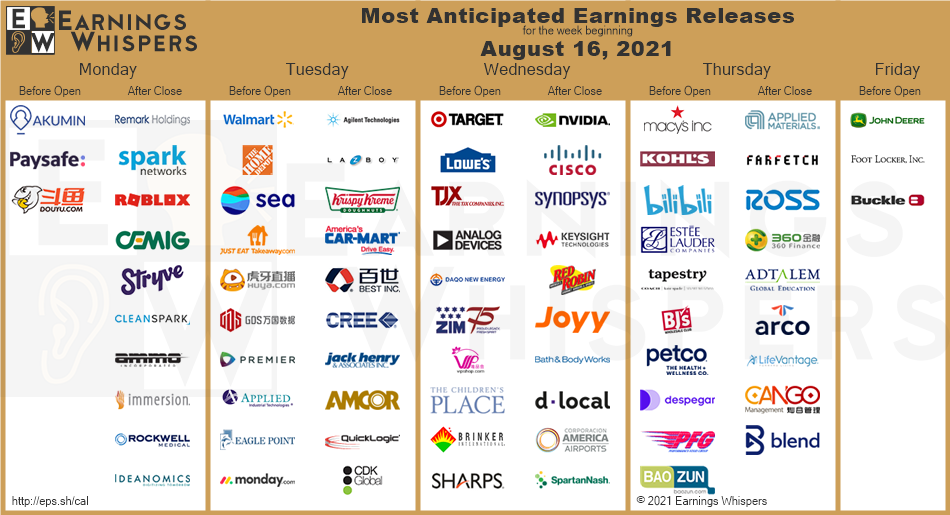
The week ahead — Economic data from Econoday.com:
Week of Aug 6, 2021 Weekly Recap & The Week Ahead

August 9th, 2021

“The desire for more, the fear of missing out (FOMO), the tendency to compare against others, the influence of the crowd and the dream of the sure thing—these factors are near universal. Thus they have a profound collective impact on most investors and most markets. The result is mistakes, and those mistakes are frequent, widespread and recurring.”
― Howard Marks

1. NYC to Require Vaccination for Many Indoor Activities Such as Restaurants and Gyms — New York City will require people to show proof of vaccination for indoor activities, such as dining, gyms and events, Mayor Bill de Blasio said Tuesday.
The new policy will be phased in the coming weeks and will be implemented Aug. 16. By the week of Sept. 13, the city will begin inspections and enforcement. Businesses will ask patrons to present their vaccination details in the form of the physical card or via a digital app, such as the Excelsior Pass.
The seven-day average number of confirmed and probable daily coronavirus cases is now over 1,200 in New York City, according to figures this week. That figure was less than 250 at the start of July and peaked at more than 6,400 in early January, according to city statistics.
2. Auto Makers Warn Chip Shortage Will Continue to Impact Vehicle Production — Stellantis STLA 5.24% NV, the maker of Jeep, Ram and Chrysler, reported strong first-half earnings on Tuesday and raised its profitability goal for the year, boosted by a rise in demand and pricing. But the world’s third-largest car company by sales also warned that increases in raw-materials prices are likely to get worse in the second half of the year and the semiconductor shortage would continue to hit production. Rival General Motors Co. separately said Tuesday that the chip shortage will lead next week to idle three North American factories that make large pickup trucks, the company’s biggest moneymakers. The semiconductors are critical for vehicles, used in everything from engines and air bags to touch-screen displays.
3. Biden Sets U.S. Goal for Clean Cars to Be Half of 2030 Sales — Biden unveils an executive order establishing the goal for half of all cars sold to be battery-electric, plug-in hybrid or fuel cell-powered by 2030. “These new actions — paired with the investments in the president’s Build Back Better Agenda — will strengthen American leadership in clean cars and trucks by accelerating innovation and manufacturing in the auto sector, bolstering the auto sector domestic supply chain, and growing auto jobs with good pay and benefits,” the White House said in a statement. The mandates are a centerpiece of Biden’s climate plans and mark his administration’s first major effort to use regulation to stem planet-warming greenhouse gases. Federal agencies are developing additional rules targeting methane emissions from oil wells and carbon dioxide releases from power plants after the Trump administration relaxed requirements.
4. Democrats Release Budget Enabling Biden’s $3.5 Trillion Plan — The budget blueprint is expected to be voted on this week in the Senate soon after final passage of Biden’s bipartisan $550 billion infrastructure package. It allows Democrats to bypass Republicans to expand the social safety net and address climate change, paid for by raising taxes on the wealthy and corporations.
The Democratic plan gives the Senate Finance Committee wide latitude to draft policies that would increase taxes on corporations and those making more than $400,000 a year, and instructs lawmakers to provide tax cuts for those making less. In addition the resolution asks the committee to find additional revenue to pay for the $3.5 trillion in spending from health care savings and a new fee on carbon polluters.

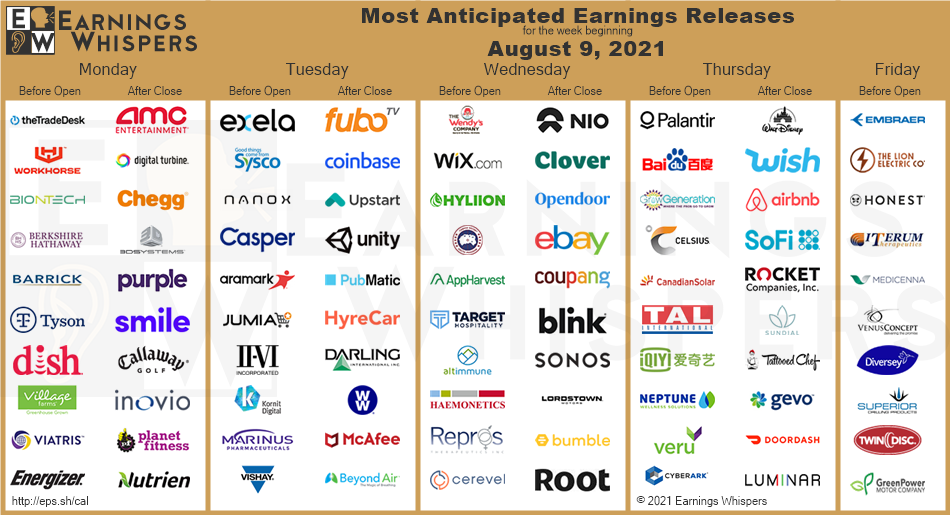
The week ahead — Economic data from Econoday.com:
Week of July 30, 2021 Weekly Recap & The Week Ahead

August 3rd, 2021

For a piece of information to be desirable, it has to satisfy two criteria: it has to be important, and it has to be knowable. – Warren Buffett

1. GOP Senators Say Agreement Reached on Infrastructure Plan — a bipartisan group of senators and the White House reached a tentative agreement on a $550 billion infrastructure package, a significant breakthrough in the drive to muscle through Congress a massive infusion of spending for roads, bridges and other critical projects. Among the projects getting money, according to the White House:
— $110 billion for roads, bridges and major projects
— $73 billion for electric grid upgrades
— $66 billion for rail and Amtrak improvements
— $65 billion for broadband expansion
— $55 billion for clean drinking water
— $39 billion for transit
— $17 billion for ports and $25 billion for airports
— $7.5 billion for electric vehicle chargers
2. Fed Says Economy Has Made Progress Toward Its Goals, Teeing Up Bond Taper — the Federal Reserve indicated that the economy has made progress toward the central bank’s employment and inflation goals, and officials offered a hint they could begin to reduce their asset purchases later this year.
The Fed since the end of last year has said its monthly purchases of $120 billion in bonds would continue until the economy achieves “substantial further progress” toward the Fed’s goals of low unemployment and inflation reaching 2%. Some officials are concerned that a burst of inflation this year from bottlenecks associated with reopening the economy will prove more durable than previously anticipated. These policy makers are eager to start the taper, in part because they and their colleagues have said they aren’t likely to consider raising interest rates until they are done tapering the asset purchases.
3. U.S. GDP Grows at 6.5% Annual Rate, Less Than 8.4% Estimate — Gross domestic product expanded at a 6.5% annualized rate following a revised 6.3% pace in the first quarter, the Commerce Department’s preliminary estimate. The report underscores the robust bounce back in household demand as well as the challenges companies are facing keeping pace with that demand. Firms’ inability to keep merchandise stocked and bottlenecks in production have capped the speed at which the U.S. pandemic recovery can grow. Personal consumption exceeded forecasts as Americans had both the wherewithal and the opportunity to ramp up spending on services such as dining out. Vaccinations, government aid and a broader reopening of the economy helped drive an annualized 11.8% gain, the second-largest advance since 1952.
4. Robinhood Sold IPO Shares to More Than 300,000 of Its Customers — Robinhood said 301,573 users participated in the IPO, which raised about $2 billion and valued the company at $32 billion. That represents about 1.3% of the company’s 22.5 million funded accounts as of June 30. Breaking with recent Wall Street tradition, the company sold a big chunk of the shares in its hotly anticipated debut to the small-time investors who trade on its app. As much of 25% of the IPO shares went to Robinhood customers, The Wall Street Journal earlier reported. In a typical IPO, individual investors get well under 10%.

The week ahead — Economic data from Econoday.com:
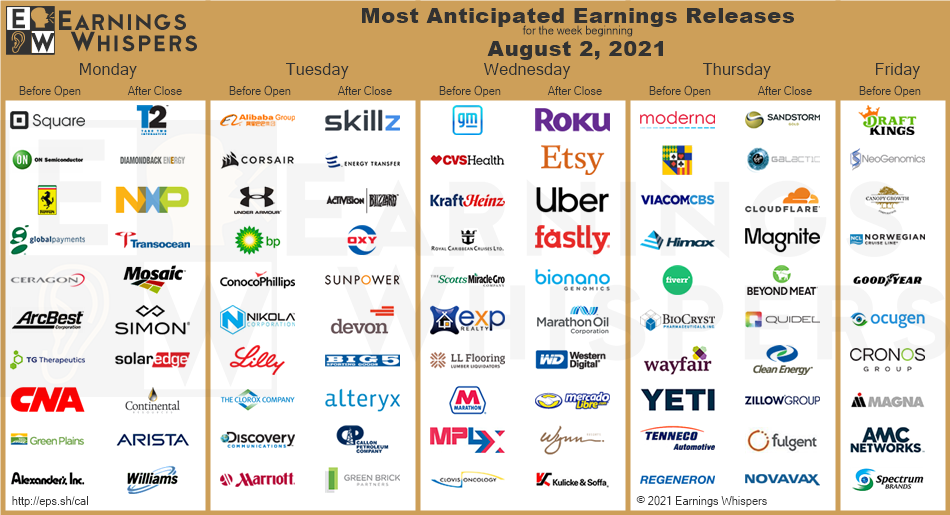
Week of July 23, 2021 Weekly Recap & The Week Ahead

July 27th, 2021

“the first stage, when just a few thoughtful investors recognize that, despite the prevailing bullishness, things won’t always be rosy, the second stage, when most investors recognize that things are deteriorating, and the third stage, when everyone’s convinced things can only get worse.”
― Howard Marks

1. States Announce $26 Billion Settlement to Resolve Opioid Lawsuits — the nation’s three largest drug distributors— McKesson Corp. , AmerisourceBergen Corp. , and Cardinal Health Inc.—and drugmaker Johnson & Johnson have been negotiating the deal for more than two years, but recent s announcement signifies an important milestone that could clear the way for money to be received by states as soon as early next year. An opioid crisis that has claimed half a million lives in the U.S. has triggered more than 3,000 lawsuits filed by states, local governments, Native American tribes, hospital groups and others against players in the pharmaceutical industry. The lawsuits allege drugmakers pushed their painkillers for uses far beyond what was medically necessary and that distributors and pharmacies didn’t do enough to halt masses of pills from flowing into communities.
2. Senate Republicans Block Infrastructure Bill but Talks to Continue — Senate Republicans blocked an effort to begin debate on a bipartisan infrastructure deal still under negotiation Wednesday, but lawmakers said they expected to close in on a final agreement by early next week. The infrastructure bill has been mired in disagreements over how to find sources of revenue to offset its cost. The bill is expected to spend roughly $600 billion over projected federal spending on roads, bridges and broadband access, among others. Over the weekend, lawmakers agreed to drop a provision disliked by Republicans to raise money by beefing up the Internal Revenue Service’s collection of unpaid taxes.
3. U.S. Vaccine Panel Signals Preliminary Support for Covid-19 Booster Shots — a work group of the Advisory Committee on Immunization Practices panel also endorsed the continued use of J&J’s vaccine, despite a recent warning about a low risk of a rare neurological disorder among people taking the shot. About 2.7% of adults in the U.S. are considered immunocompromised, according to the CDC, including transplant recipients, some cancer survivors and people living with HIV. That makes them less responsive to vaccines, which require stimulation of the immune system to provide protection.
4. Intel CEO Says Chip Shortage Could Stretch Into 2023 — The world-wide shortage has fueled rising prices for some consumer gadgets. Meanwhile, the auto industry has been particularly hard-hit as the lack of a key component causes production delays. German car maker Volkswagen AG VOW -1.89% this month warned the global shortage could worsen over the next six months. Others have said they were bracing for problems through next year. Supply shortages should start showing signs of easing later this year, Mr. Gelsinger said, echoing comments from Taiwan Semiconductor Manufacturing Co., the world’s largest contract chip maker. TSMC last week said the chip shortage that has hampered car makers could start to ease in the next few months after it ramped up its production of auto chips. TSMC and Intel are adding new chip-production plants, though some of that capacity won’t be ready for about two more years.

The week ahead — Economic data from Econoday.com:
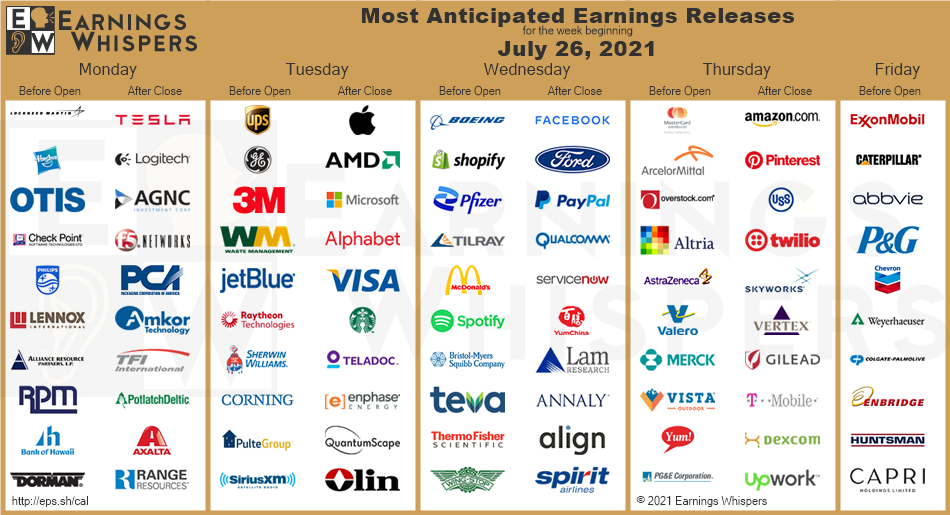
Search
Calendar
February 2026
M T W T F S S
« Jan    
 1
2345678
9101112131415
16171819202122
232425262728  
Archives
Categories
The information provided by The EGS Blog is based on sources believed to be reliable, but it is not guaranteed to be accurate. There is no guarantee that the recommendations of The EGS Blog will be profitable or will not be subject to losses. The information provided by The EGS Blog is not a recommendation or a solicitation that any particular investor should purchase or sell any particular security in any amount, or at all. The investments discussed or recommended herein may be unsuitable for investors depending on their specific investment objectives and financial position. At any time EGS LLC and its principals may maintain positions that are contrary to positions announced within the subscription service. In no event will The EGS Blog be liable to you or anyone else for any incidental, consequential, special, or indirect damage (including but not limited to lost profits or trading losses). PAST PERFORMANCE IS NO GUARANTEE OF FUTURE RESULTS

© Copyright 2026 Market Outlook All Rights Reserved
Design by EGS Sponsored by Equity Guidance LLC