December 7th, 2021
“The fact that a thesis is flawed does not mean that we should not invest in it as long as other people believe in it and there is a large group of people left to be convinced. The point was made by John Maynard Keynes when he compared the stock market to a beauty contest where the winner is not the most beautiful contestant but the one whom the greatest number of people consider beautiful. Where I have something significant to add is in pointing out that it pays to look for the flaws; if we find them, we are ahead of the game because we can limit our losses when the market also discovers what we already know. It is when we are unaware of what could go wrong that we have to worry.” ― George Soros
1. Powell Weighs Earlier End to Bond Tapering Amid Hot Inflation — Federal Reserve Chair Jerome Powell said officials should weigh removing pandemic support at a faster pace and he retired the word “transitory” to describe stubbornly high inflation, though a new Covid-19 strain remains a risk. The U.S. central bank is currently scheduled to complete its asset-purchase program in mid-2022 under a plan announced at the start of November to slow buying by $15 billion a month. The next gathering of the policy-setting Federal Open Market Committee is Dec. 14-15, where they could make a decision to accelerate the tapering.
2. House Approves Funding Bill in Bid to Avert Government Shutdown — The House passed an extension of government funding through Feb. 18 to avoid a partial shutdown this weekend, but a hangup in the Senate over vaccine rules threatened to slow the bill’s progress to President Biden’s desk. With current funding set to lapse at 12:01 a.m. on Saturday, Dec. 4, the legislation would also have to rapidly clear the Senate to avert a shutdown. Top Democrats and Republicans reached an agreement on the terms of the extension early Thursday. However, some Republicans are pushing to amend the bill so that it bars the Biden administration from enacting rules requiring many employers to ensure that their workers are vaccinated or tested weekly for Covid-19. The Republican demand to change the bill has raised the possibility of a drawn-out procedural process that could take several days and cause a brief shutdown. Lawmakers indicated Thursday that an amendment vote on the vaccine issue would likely clear the way to an accelerated process for the funding extension.
3. China Sets Boeing 737 MAX Directive for Flight Resumption — the Civil Aviation Administration of China required in an order released Thursday certain software installation and a revision of the jet’s flight manual, among other changes. It didn’t specify when China would allow MAX flights to resume. China was the first to ground the plane in the wake of the second of two fatal MAX crashes in March 2019. Boeing has said it hopes to resume deliveries of new MAX jets to China in the first quarter of next year, making final approval crucial to its plans to increase production and generate cash to cut its debt. While Chinese regulators are bringing the country’s current 737 MAX fleet closer to again carrying passengers, Boeing still faces other hurdles in handing over built aircraft awaiting delivery to the country’s airlines.
Despite actions by China’s aviation authority, a Chinese official with knowledge of the matter said approval from Beijing’s top economic planning agency, the National Development and Reform Commission, will also be required for the country’s airlines to take Boeing jet.
4. Omicron Variant Detected in at Least Nine U.S. States — the new Omicron variant was identified in more than a dozen people in at least nine states, early evidence of its presence across the U.S. While some of the people in the U.S. who have contracted the Omicron variant of the coronavirus that causes Covid-19 had recently traveled to southern Africa, where it was first identified last week, at least two states reported community spread of the new variant. States to report Omicron cases span the country from Hawaii to California and New York. Drug researchers and health authorities have been racing to figure out how the new variant could affect people, drugs and vaccines. Studies into those matters will take days to weeks, scientists have said. The World Health Organization has said preliminary evidence showed that people previously infected with Covid-19 may be at greater risk of re-infection with Omicron than with other variants. The variant also could be more transmissible than o5. Didi Hunts for Way to Delist in New Yorkthers, the WHO said.
5. DIDI Looks to Delists in the US, Rocking Other Chinese ADRs — the Chinese ride-hailing giant’s decision to delist its American depositary shares from the New York Stock Exchange and pursue a listing in Hong Kong marked a new stage in the decoupling of Chinese companies from U.S. markets. Didi didn’t give any rationale for the delisting, which it said has received support from its board and would later require a shareholder vote. The company ran into trouble with Beijing almost immediately after its $4.4 billion initial public offering. The IPO blindsided Chinese regulators, who launched a data-security review, pulled Didi products from Chinese app stores and began a broader overhaul of the framework for international listings by Chinese companies. Didi’s announcement came as Washington has been taking a hawkish stance on Chinese companies listed in the U.S. and Beijing is calling its companies to return home. The U.S. Securities and Exchange Commission adopted rules that will formalize the process for Chinese companies to be expelled from the U.S. stock market, if they fail to hand over their audit working papers for three years in a row.
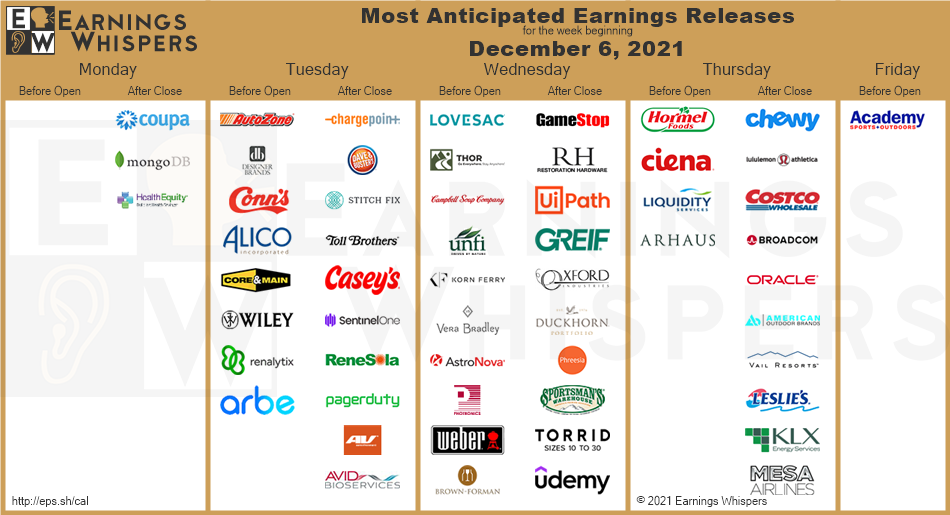
The week ahead — Economic data from Econoday.com:
Posted in Weekly Summary | No Comments »
November 29th, 2021
“Achieving gains usually has something to do with being right about events that are on the come, whereas losses can be minimized by ascertaining that tangible value is present, the herd’s expectations are moderate and prices are low. My experience tells me the latter can be done with greater consistency.” ― Howard Marks
1. Biden Keeps Powell as Fed Chief, Names Brainard Vice Chair — President Joe Biden selected Jerome Powell for a second four-year term as U.S. Federal Reserve chair and elevated Governor Lael Brainard to vice chair, maintaining consistency at the central bank as it grapples with the fastest inflation in three decades and the lingering effects of the coronavirus. Brainard would replace Richard Clarida in the vice chair slot and may face opposition from Senate Republicans for her confirmation given her tough line on bank regulation. She was interviewed by Biden for the chair position and was seen as a strong contender for the separate job of vice chair for supervision, which remains vacant.
2. Biden Orders Release of U.S. Oil Reserves in Challenge to OPEC+ — the U.S. will release 50 million barrels of crude from its strategic reserves in concert with China, Japan, India, South Korea and the U.K. — an unprecedented, coordinated attempt by the world’s largest oil consumers to tame prices that risks a backlash by OPEC+. Of the 50 million barrels, 32 million will be issued from the U.S. Strategic Petroleum Reserve as an exchange over the next several months, while 18 million will come from an accelerated release from previously authorized sales, the White House said in a statement Tuesday. It represents one of the biggest drawdowns ever from the reserve, surpassing U.S. interventions amid Libyan unrest in 2011 and Operation Desert Storm in 1991.
3. WHO Identifies New Covid-19 ‘Variant of Concern’ Omicron as Strain Triggers Global Fears — the World Health Organization said a new strain of the coronavirus first detected in southern Africa was a global “variant of concern” and that preliminary evidence suggested that it presented a higher risk of a person falling ill with Covid-19 for a second time. The WHO also said that the variant’s fast spread in South Africa indicated that it may be more transmissible than other strains of the virus and that more research was being done to understand the full effects of its many mutations. Dozens of countries have already restricted travel to and from South Africa and neighboring nations, hoping to contain the spread of the new variant. The Biden administration will restrict travel to the U.S. from South Africa and seven other countries beginning Monday, according to senior officials.
4. China Asks Didi to Delist From U.S. On Security Fears — Chinese regulators have asked Didi Global Inc.’s top executives to devise a plan to delist from U.S. bourses, people familiar with the matter said, an unprecedented request that’s likely to revive fears about Beijing’s intentions for its giant tech industry.
The country’s tech watchdog wants management to take the company off the New York Stock Exchange because of concerns about leakage of sensitive data, the people said, asking not to be identified discussing a sensitive matter. The Cyberspace Administration of China, the agency responsible for data security in the country, has directed Didi to work out precise details, subject to government approval, they said.
5. Merck’s Covid-19 Pill Was 30% Effective in Final Analysis — Merck MRK -3.79% & Co. and Ridgeback Biotherapeutics LP said a final analysis of their experimental Covid-19 pill found the drug less effective than an early look, prompting U.S. health regulators to continue a staff review of the drug’s application days before an outside panel meets. The FDA said it is still conducting its review of molnupiravir, after the companies told the agency earlier this week the pill was 30% effective in a final analysis of the late-stage study results. After taking an early look at results, the companies had reported in October that molnupiravir was 50% effective.
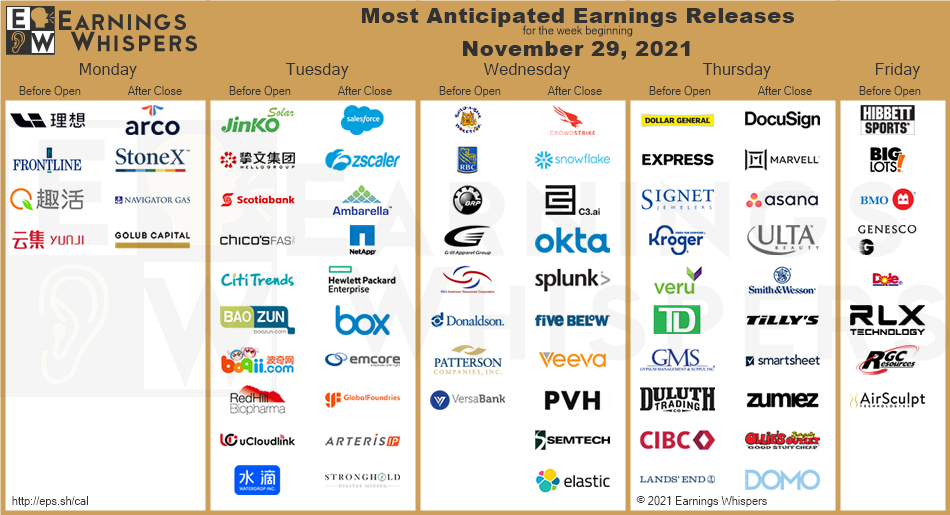
The week ahead — Economic data from Econoday.com:
Posted in Weekly Summary | No Comments »
November 23rd, 2021
“It’s not whether you’re right or wrong, but how much money you make when you’re right and how much you lose when you’re wrong.” — George Soros
1. Biden Signs $1 Trillion Infrastructure Bill Into Law — President Biden signed into law a roughly $1 trillion infrastructure bill to repair the nation’s aging roads and bridges, upgrade the electrical grid and expand access to broadband internet. State transportation agencies will likely see the first infusion of highway funds from the infrastructure package by the beginning of December, said Jeff Davis, senior fellow at the Eno Center for Transportation, a think tank. The infrastructure legislation included a roughly 30% increase in highway formula funding. The measure sets aside $50 billion to bolster infrastructure against climate change and cyberattacks. Another $55 billion will go toward clean drinking water and $65 billion will go toward broadband infrastructure and development. The legislation invests $21 billion in removing pollution from soil and groundwater, job creation in energy communities and a focus on economic and environmental justice. The legislation will include $73 billion to update and expand the power grid.
2. Pfizer Moves to Allow Cheap Versions of Promising Covid Pill — Pfizer Inc. reached a licensing agreement that will allow generic-drug manufacturers to produce inexpensive versions of its Covid-19 pill for 95 low- and middle-income countries, following a similar move by Merck & Co. Pfizer won’t receive royalties from sales in low-income countries, and won’t get royalties from sales to middle-income countries covered by the pact as long as Covid-19 is classified as a public-health emergency, according to the statement.
3. U.S. Buys 10 Million Treatment Courses of Pfizer’s Covid-19 Pill for $5.29 Billion — Pfizer Inc. PFE -0.48% said Thursday it agreed to a $5.29 billion deal with the U.S. to provide enough supplies of its promising Covid-19 pill to treat 10 million people, should health regulators give it the green light. The company’s antiviral drug, Paxlovid, is under review by the U.S. Food and Drug Administration, and a decision could come before the end of the year. Under the terms of the deal, the government will pay about $529 for each course of treatment consisting of 30 pills over five days. Twice a day, patients would take two pills of Paxlovid and one pill of another antiviral called ritonavir.
The Paxlovid price is below the approximate $700 per course of treatment the U.S. agreed to pay for molnupiravir, an oral antiviral from Merck MRK -0.38% & Co. and Ridgeback Biotherapeutics LP that is also under review by the FDA. The U.S. has agreed to purchase 3.1 million courses of molnupiraivir for about $2.2 billion.
4. Covid Boosters Cleared for All Adults as FDA Widens Access — Covid-19 booster shots from Moderna Inc. and the partnership of Pfizer Inc. and BioNTech SE were cleared by U.S. regulators for all Americans 18 and older, making millions more people eligible for extra protection as concern about a potential winter wave of infections grows. Adults who received their second dose of the drugmakers’ shots at least six months ago are now eligible to receive a third, according to separate statements from the companies and the the U.S. Food and Drug Administration
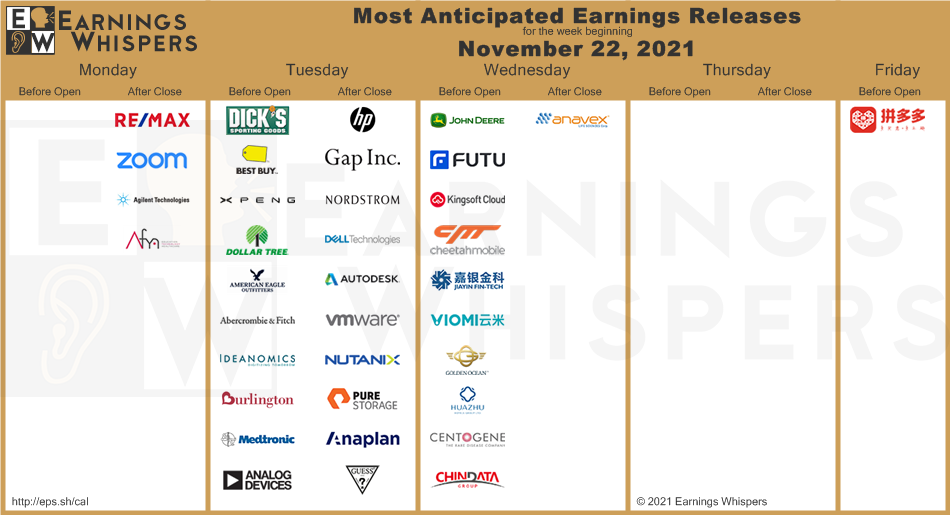
The week ahead — Economic data from Econoday.com:
Posted in Weekly Summary | No Comments »
November 15th, 2021
“Michael Marcus taught me one other thing that is absolutely critical: You have to be willing to make mistakes regularly; there is nothing wrong with it. Michael taught me about making your best judgment, being wrong, making your next best judgment, being wrong, making your third best judgment, and then doubling your money.” – Bruce Kovner
1. General Electric to Split Into Three Public Companies — the plan is being unveiled three years after Larry Culp took over the troubled company and tried to stabilize its operations by selling off business units and paying down the company’s debt load. But GE’s stock price, despite a 1-for-8 reverse split, has lagged behind the S&P 500 and rivals. What remains today are three businesses—aviation, healthcare and power. The company will now spin them off into separate publicly traded companies. GE said it is spinning off GE Healthcare, which makes MRIs and other hospital equipment, in early 2023, with GE expecting to retain a stake of 19.9% that it plans to sell over time. In 2020, the unit had about $17 billion in revenue.GE plans to combine its power unit and renewable energy unit, which make turbines for power plants and wind farms, respectively, and spin off that operation in early 2024. The company’s remaining digital division will also be moved into the power business. Those units together had about $33 billion in revenue in 2020.
That would leave behind a GE focused on making and servicing jet engines.
2. Pfizer, BioNTech Ask FDA to Expand Covid-19 Booster Use to All Adults — Pfizer Inc. and partner BioNTech asked U.S. health regulators to expand the authorization of their Covid-19 booster to people as young as 18 years old, as the government explores expanding access to extra doses. The application opens the door for authorization of the extra dose potentially before the end of the year, which could provide millions of people with another layer of security as winter drives many indoors where the risk of transmission is higher.
The Food and Drug Administration in September cleared a third dose of the Pfizer-BioNTech vaccine for adults who are 65 years and older or are at risk of severe disease and death, including because of their jobs or where they live. The government has also cleared booster shots of vaccines from Moderna Inc. and Johnson & Johnson, and is backing mixing-and-matching the extra doses.
3. U.S. Inflation Hit 30-Year High in October as Consumer Prices Jump 6.2% — the Labor Department said the consumer-price index—which measures what consumers pay for goods and services—increased in October by 6.2% from a year ago. That was the fastest 12-month pace since 1990 and the fifth straight month of inflation above 5%. The core price index, which excludes the often-volatile categories of food and energy, climbed 4.6% in October from a year earlier, higher than September’s 4% rise and the largest increase since 1991. The inflation surge is complicating the Federal Reserve’s strategy for unwinding easy-money policies the central bank imposed early in the pandemic. It has also emerged as a political factor affecting the Biden administration’s economic agenda.
4. Elon Musk Sells About $5 Billion in Tesla Stock — Elon Musk sold about $5 billion in Tesla Inc. shares this week as he exercised stock options that he received as part of his compensation package, according to regulatory filings made public late Wednesday. After selling less than 1% of his holdings Monday, he sold about 2% over the subsequent two days, the regulatory notices show. He sold around 4.5 million shares in total over the three days, shrinking the size of his stockholdings in Tesla even after exercising the options.
5. Beijing Cancels Events as Covid Cluster Hits 17-Month Record — Beijing is hunkering down after experiencing more Covid infections in the current cluster than at any time in the past 17 months, with officials asking for events and activities to be moved online. Organizers of the winter Olympic games to be held in February said that two foreign athletes tested positive for the virus in the test events underway in China, the Associated Press reported Friday. The organizers didn’t share more details, according to the report.
Beijing has detected 45 cases in the latest wave, the most since June 2020. The country is struggling to contain its fourth outbreak with the more infectious delta variant in the past five months. With more than 1,000 locally-transmitted infections spread across 21 provinces, it is already the broadest flare-up since the virus first emerged in Wuhan.
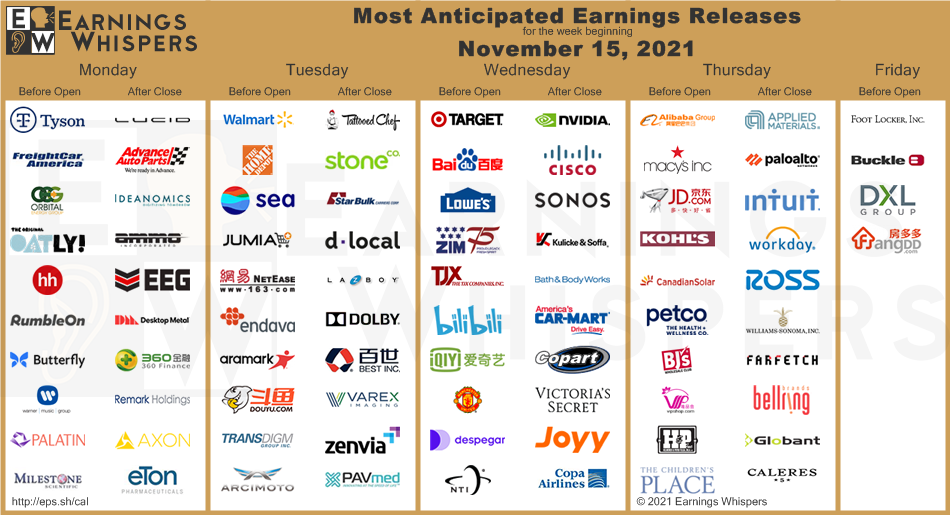
The week ahead — Economic data from Econoday.com:
Posted in Weekly Summary | No Comments »
November 9th, 2021
“Achieving gains usually has something to do with being right about events that are on the come, whereas losses can be minimized by ascertaining that tangible value is present, the herd’s expectations are moderate and prices are low. My experience tells me the latter can be done with greater consistency.” ― Howard Marks
1. Fed Dials Back Bond Purchases, Plots End to Stimulus by June — the Federal Reserve approved plans to begin scaling back its bond-buying stimulus program this month and end it by June, a major step toward withdrawing its aggressive, pandemic-driven economic support amid a recent inflation surge. The Fed will reduce its bond purchases by $15 billion a month in November and by a further $15 billion in December, the central bank said Wednesday. It said similar reductions in the pace of net purchases “will likely be appropriate each month,” though officials would be prepared to adjust that pace “if warranted by changes in the economic outlook.” It also has been buying at least $120 billion a month in Treasury and mortgage securities—initially to stabilize financial markets and later to hold down longer-term interest rates.
2. Zillow Quits Home-Flipping Business, Cites Inability to Forecast Prices — the firm’s termination of its tech-enabled home-flipping business, known as “iBuying,” follows Zillow’s announcement about two weeks ago that it was halting all new home purchases for the rest of the year. At the time, Zillow pointed to labor and supply shortages for its inability to renovate and flip houses fast enough. Chief Executive Rich Barton said Zillow had failed to predict the pace of home-price appreciation accurately, marking an end to a venture the company once said could generate $20 billion a year. Instead, the company said it now plans to cut 25% of its workforce. Zillow and other tech-powered house flippers, known as iBuyers, purchase homes, renovate them and then try to sell them quickly, making money on transaction fees and home-price appreciation. Zillow used an algorithm to make home price estimates, called the “Zestimate,” and determine what it would pay home sellers.
3. Pfizer Says Covid-19 Pill Is 89% Effective in Preliminary Assessment — Pfizer Inc. announced in a preliminary look at study results found that its experimental pill was highly effective at preventing people at high risk of severe Covid-19 from needing hospitalization or dying, the latest encouraging performance for an early virus treatment.
The company’s drug cut the risk of hospitalization or death in study subjects with mild to moderate Covid-19 by about 89% if they took the pill within three days of diagnosis, Pfizer said Friday. The drug, called Paxlovid, was also found to be generally safe and well-tolerated in the early look at ongoing study results, the company said. Pfizer plans to ask the Food and Drug Administration to authorize the drug’s use this month, and the company could deliver doses this year. If authorized, there could be two Covid-19 pills that people could take at home before the end of the year to keep them out of the hospital. An antiviral from Merck & Co. and Ridgeback Biotherapeutics LP was cleared for use in the U.K. this week and is up for U.S. authorization.
4. Biden Wins Infrastructure Deal — the legislation will inject $110 billion in funding for roads, bridges and major projects, along with another $39 billion to modernize and make public transit more accessible to elderly commuters and the disabled. Major city transit systems, such as New York City’s, will see significant increases in funding based on federal funding formulas.
The spending will be paid for with a variety of revenue streams, including more than $200 billion in repurposed funds originally intended for coronavirus relief but left unused; about $50 billion from delaying a Trump-era rule on Medicare rebates; and $50 billion from certain states returning unused unemployment insurance supplemental funds.
The week ahead — Economic data from Econoday.com:
Posted in Weekly Summary | No Comments »
November 3rd, 2021
There will not be any Weekly Re-Cap for the week of Oct 29, 2021. We are away for some needed R&R.
The staffs at EGS.
The week ahead — Economic data from Econoday.com:
Posted in Weekly Summary | No Comments »
October 25th, 2021
“The superior investor is mature, rational, analytical, objective and unemotional.” ― Howard Marks
1. Covid-19 Vaccine for Kids Ages 5-11 to Be Given at Pediatric Offices, Schools Once Authorized — the Biden administration is preparing to distribute shots to children at doctors’ offices, pharmacies and schools should federal regulators clear the inoculations for kids ages 5-11. The Biden administration said it has procured enough doses to vaccinate the nation’s children and will begin shipping supplies if and when the shots are cleared for use. Officials aim to have a plan in place as soon as young children are eligible in hopes of getting as many as possible vaccinated quickly. Rates of hospitalization among children are higher than earlier in the pandemic due to the highly transmissible Delta variant, and public-health authorities plan to offer shots in settings more familiar for children than the mass sites used for many adults. Pfizer Inc. and BioNTech SE submitted data to the Food and Drug Administration this month seeking emergency authorization of their vaccine.
2. Russia Orders People Not to Go to Work as Covid-19 Deaths Mount — Mr. Putin signed a decree Wednesday approving a period of nonworking days, as the government calls them, beginning Oct. 30 and stretching to Nov. 7 to encourage people to stay home and slow the spread of the virus. Regional governments where infection rates are especially virulent can speed up or prolong the measures, with employers continuing to pay their staffs as they stay home.
Latvia, which until recently had outperformed other European countries in containing the virus, on Monday announced a slate of strict measures, including a nationwide 8 p.m. to 5 a.m. curfew and closures of schools and nonessential retail after the seven-day average of deaths in the tiny Baltic state more than doubled last week.
3. Trump-Linked SPAC Steadies Near $100 — Digital World Acquisition Corp. surge 846% as retail traders piled in after it announced a merger with Trump Media & Technology Group and the former president said he was planning a new social media platform called Truth Social. Now shares of the Donald Trump-linked special purpose acquisition company are trading at around the $100, or nearly 10 times the SPAC’s $10 debut in September.
4. Apple Now All-In on In-House M1 Chips — the new line of MacBook Pro models that Apple announced are the last of the Mac laptops to get the company’s in-house processor called the M1. That comes less than a year after the company first unveiled the chip, which replaces the Core family from Intel Corp. Apple is now selling only four models of its desktop computers that still use Intel processors. Three of those—two older iMacs and a Mac Mini—are available in newer generations with the M1 chip. The other is the Mac Pro, a workstation level beast that starts at $6,000 and actually runs on Intel’s Xeon processors that are normally used to power servers. Apple’s lack of a server-level chip might keep that machine in Intel’s camp for a while, but its nosebleed price severely limits the market.
The week ahead — Economic data from Econoday.com:

Posted in Weekly Summary | No Comments »
October 19th, 2021
“The economy is growing, and the economic reports are positive. Corporate earnings are rising and beating expectations. The media carry only good news. Securities markets strengthen. Investors grow increasingly confident and optimistic. Risk is perceived as being scarce and benign. Investors think of risk-bearing as a sure route to profit. Greed motivates behavior. Demand for investment opportunities exceeds supply. Asset prices rise beyond intrinsic value. Capital markets are wide open, making it easy to raise money or roll over debt. Defaults are few. Skepticism is low and faith is high, meaning risky deals can be done. No one can imagine things going wrong. No favorable development seems improbable. Everyone assumes things will get better forever. Investors ignore the possibility of loss and worry only about missing opportunities, No one can think of a reason to sell, and no one is forced to sell. Buyers outnumber sellers. Investors would be happy to buy if the market dips. Prices reach new highs. Media celebrate this exciting event. Investors become euphoric and carefree. Security holders marvel at their own intelligence; perhaps they buy more. Those who’ve remained on the sidelines feel remorse; thus they capitulate and buy. Prospective returns are low (or negative). Risk is high. Investors should forget about missing opportunity and worry only about losing money. This is the time for caution!” ― Howard Marks
1. Fed Officials Saw Taper Starting in Mid-November or Mid-December — Federal Reserve officials broadly agreed last month they should start reducing emergency pandemic support for the economy in mid-November or mid-December amid increasing concern over inflation. Fed officials last month left interest rates near zero but signaled they were close to beginning to scale back their $120 billion in monthly asset purchases. Chair Jerome Powell told reporters during a post-meeting press conference the process could start as soon as November and would likely end around mid-2022.
2. L.A. Port to Operate Around the Clock to Ease Cargo Logjams — one of the country’s busiest ports will operate around the clock in an effort to ease cargo bottlenecks that have led to shortages and higher consumer costs, a change announced by the White House as it seeks to alleviate supply-chain issues ahead of the holidays. By going to 24/7, the Port of Los Angeles will join the neighboring Port of Long Beach, Calif., which started doing a similar thing last month. Major ports in Asia and Europe have operated around the clock for years. The Port of Long Beach struggled to increase cargo flows after it extended its opening hours, with truckers complaining that restrictions put on them for picking up and dropping off containers were too onerous. Shortages of truck drivers and warehouse workers have also posed problems across supply chains. It remains unclear how many of the terminals in Los Angeles will operate 24/7 and when those operations will begin.
3. Moderna Booster Shot Backed by FDA Advisory Panel — Vaccine experts advising the Food and Drug Administration voted 19 to 0 Thursday to recommend authorization of an extra dose of Moderna Inc.’s Covid-19 shot, a key step in making booster doses available to millions more people. An advisory panel voted in favor of giving a Moderna booster shot at least six months after the second dose, to adults 65 years and older, as well as adults under 65 who are at high risk of severe Covid-19 or serious complications because of their jobs, living conditions or underlying medical conditions. The FDA has authorized the vaccine from Pfizer Inc. and partner BioNTech SE for adolescents. The agency also has already greenlighted booster doses of the Pfizer-BioNTech vaccine for seniors and adults at high risk of Covid-19 who received the shots already and are at least six months past their first vaccination.
4. J&J Covid-19 Booster Shot Endorsed by FDA Advisers — the panel of outside doctors and experts voted 19-0 to recommend that all adults who received a first dose of the J&J vaccine should get the second dose at least two months later. J&J had requested that the FDA authorization recommend people wait six months, though they could get the booster as early as two months after the first dose. The company presented evidence showing varying effects when the booster is given between two and six months after the first dose.
The meeting is the latest by experts whose counsel the FDA has sought before making authorization decisions.
The week ahead — Economic data from Econoday.com:
Posted in Weekly Summary | No Comments »
October 11th, 2021
“But most investors do capitulate eventually. They simply run out of the resolve needed to hold out. Once the asset has doubled or tripled in price on the way up — or halved on the way down — many people feel so stupid and wrong, and are so envious of those who’ve profited from the fad or side-stepped the decline, that they lose the will to resist further. My favorite quote on this subject is from Charles Kindleberger: “There is nothing as disturbing to one’s well-being and judgment as to see a friend get rich” (Manias, Panics, and Crashes: A History of Financial Crises, 1989). Market participants are pained by the money that others have made and they’ve missed out on, and they’re afraid the trend (and the pain) will continue further. They conclude that joining the herd will stop the pain, so they surrender. Eventually they buy the asset well into its rise or sell after it has fallen a great deal. In other words, after failing to do the right thing in stage one, they compound the error by taking that action in stage three, when it has become the wrong thing to do. That’s capitulation. It’s a highly destructive aspect of investor behavior during cycles, and a great example of psychology-induced error at its worst.” ― Howard Marks
1. SEC Chief Says the U.S. Won’t Ban Cryptocurrencies — Securities and Exchange Commission Chair Gary Gensler said last week that the government’s focus is on ensuring that the industry adheres to investor and consumer protection rules, anti-money laundering regulations and tax laws. He made the comments at a House hearing after a Republican lawmaker asked if a China-like prohibition was on the table in the U.S. He added that any ban would probably have to be legislated by Congress.
China issued its sweeping ultimatum against crypto trading last month, saying all transactions were off limits and that it would move aggressively to root out token mining. The announcement followed months of escalating Chinese warnings about virtual currencies.
2. McConnell Offers Democrats a Short-Term Debt Ceiling Increase — McConnell’s proposal would increase the limit on federal borrowing by a fixed dollar amount that would be sufficient to tide the Treasury over until December, when Congress would have to vote again to avoid a default. That vote could come at about the same time that Democrats are attempting to move a massive tax and spending package. That’s also when Congress will have to act again to fund the government as part of regular fiscal-year spending, and avert a shutdown. McConnell is putting his offer out as a compromise, but it also would tie Democrats to raising a specific level of debt — rather than a suspension as done under the Trump administration — and that number can then be used in political attack ads in congressional election campaigns.
3. Pfizer Asks FDA to Authorize Covid-19 Vaccine in Young Children — Pfizer Inc. and BioNTech have asked U.S. health regulators to green light their Covid-19 vaccine for children 5 to 11 years old, setting up the shot to potentially be available to millions of youngsters in a matter of weeks. The FDA may clear the shot for use in the youths before November, which would mean pediatrician offices, schools and other locations could get doses to give as early as Halloween. There are more than 28 million children ages 5 to 11 in the U.S., according to the American Academy of Pediatrics.
The FDA has already scheduled for a panel of outside experts to review the data Oct. 26. The agency doesn’t have to follow the panel’s recommendation, but normally does.
4. U.S. Job Growth Falls to Slowest Pace of Year — The economy created 194,000 jobs in September, the smallest gain since December 2020 and down from 366,000 jobs added in August, the Labor Department said Friday. Many workers gave up a job search and exited the labor force last month. The smaller pool of labor meant that despite the slowdown in hiring, the unemployment rate fell to 4.8% last month from 5.2% in August. The figures add to evidence that fears about the coronavirus and global supply constraints continue to hold back the economic recovery. The biggest factor behind last month’s weak payroll gain was a decline in public-sector jobs, mainly at schools.
The week ahead — Economic data from Econoday.com:
Posted in Weekly Summary | No Comments »
October 4th, 2021
“The mood swings of the securities markets resemble the movement of a pendulum. Although the midpoint of its arc best describes the location of the pendulum “on average,” it actually spends very little of its time there. Instead, it is almost always swinging toward or away from the extremes of its arc. But whenever the pendulum is near either extreme, it is inevitable that it will move back toward the midpoint sooner or later. In fact, it is the movement toward an extreme itself that supplies the energy for the swing back. Investment markets make the same pendulum-like swing: between euphoria and depression, between celebrating positive developments and obsessing over negatives, and thus between being overpriced and underpriced. This oscillation is one of the most dependable features of the investment world, and investor psychology seems to spend much more time at the extremes than it does at a “happy medium.” ― Howard Marks
1. Yellen Warns Congress of Cash Supply Running Out Around Oct. 18 — Treasury Secretary Janet Yellen warned that her department will effectively run out of cash around Oct. 18 unless legislative action is taken to suspend or increase the federal debt limit, putting pressure on lawmakers to avert a default on U.S. obligations. Republican lawmakers have used the debt-limit debate to help them portray Biden’s proposed fiscal expansion — spanning expanded child tax credits, paid family leave and new benefits for Medicare recipients — as out-of-control government spending. An eventual Democrat-only vote to raise the debt limit would provide fodder for election attack ads.
2. Congress Clears Government Funding Bill to Avert Shutdown — The House passed a nine-week spending bill to avert a U.S. government shutdown hours before it was set to begin on an 254 to 175 vote. The legislation passed the Senate earlier Thursday and now heads to President Joe Biden’s desk.
The bill passed both chambers after Democrats dropped an earlier attempt to attach a debt-ceiling suspension to the bill in face of implacable Republican opposition to that measure. GOP senators blocked a version of the bill containing the debt ceiling language on Monday.
The federal government would be kept open through Dec. 3 under the legislation. The bill also contains $28.6 billion for states recovering from hurricanes and wildfires as well as $6.3 billion to resettle refugees from the U.S. war in Afghanistan.
3. Moderna Is Likely to Get FDA Approval for Smaller Booster — the Food and Drug Administration is likely to authorize a booster dose of Moderna ‘s Covid-19 vaccine, and will do so at a dose level that is half as large as what was used for the prime doses, according to a report out late Tuesday from Bloomberg.
It isn’t yet clear when the FDA might issue the authorization, according to Bloomberg. The FDA’s vaccines advisory committee, which may be asked to weigh in on the booster, is scheduled to meet on Thursday, but the meeting’s agenda doesn’t include a discussion of Covid-19 vaccine boosters. The committee isn’t currently scheduled to meet again this year.
The Centers for Disease Control and Prevention vaccines advisory committee, which will also likely consider the Moderna booster, is scheduled to meet again on Oct. 20.
4. Merck Pill Intended to Treat Covid-19 Succeeds in Key Study — the pill cut the risk of hospitalization or death in study subjects with mild to moderate Covid-19 by about 50%, the companies said reported. The drug, called molnupiravir, was performing so well in its late-stage trial that Merck and Ridgeback said they stopped enrolling subjects after discussions with the U.S. Food and Drug Administration. The results put molnupiravir on track to potentially be authorized by the end of the year and to finally provide an option for doctors who have spent the pandemic seeking a drug that infected people could easily take at home to prevent them from becoming hospitalized.
5. Biden Signs Government Funding Bill to Avert a Shutdown — President Joe Biden on Thursday signed a nine-week stopgap funding bill that averts a government shutdown but fails to resolve the threat of a U.S. default linked to the debt limit. The legislation was hastily passed by both chambers of Congress earlier in the day, and keeps funding levels for government departments and agencies flat until Dec. 3. Had it not been approved, parts of the U.S. government would have begun suspending operations on Friday.
The measure, however, doesn’t include a provision sought by Democrats to suspend the nation’s debt limit, after Republicans in the Senate blocked a version of the bill that included the debt provision. Treasury Secretary Janet Yellen has said that if lawmakers fail to raise the debt limit by about Oct. 18, the government may not be able to pay its bills, posing a dire risk to the U.S. economy.
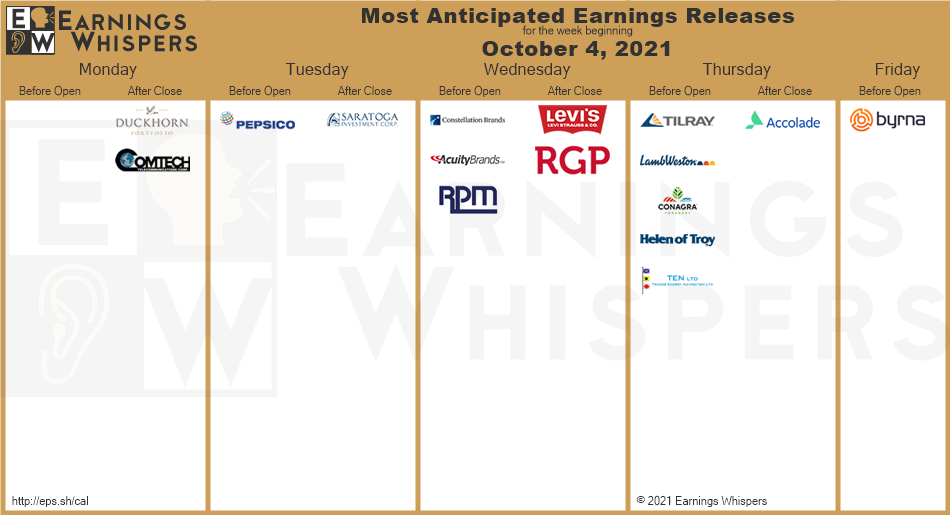
The week ahead — Economic data from Econoday.com:
Posted in Weekly Summary | No Comments »