Archive for the ‘Weekly Summary’ Category

Week Sept 21 2012 – Weekly Recap & The Week Ahead

Monday, September 24th, 2012

“There are two kinds of people who lose money: those who know nothing and those who know everything”Henry Kaufman (Economist)

1. China/Japan Disputes over Shenkaku Island Continues — tensions continued to flare between China and Japan as protests reportedly coalesced in at least 100 Chinese cities in the wake of a recent territorial dispute; The two countries’ worst diplomatic crisis in years puts at risk a trade relationship estimated at $340B.
2. Bank of Japan adds to stimulus — expand asset purchases by another ¥10 trillion — The Bank of Japan last week said it will provide more monetary stimulus in response to a slowing in domestic economic activity, increasing the size of its asset purchases by 10 trillion yen ($126.7 billion) to about ¥80 trillion. The central bank also left its policy-interest-rate target unchanged, in a range of zero to 0.1%.
3. Sales of existing homes surge in August, best of activity best since May 2010 — according MarketWatch, the National Association of Realtors reported sales of existing homes surged 7.8% in August and rose to a seasonally adjusted annual rate of 4.82 million from July’s 4.47 million. Fueled by low interest rates and pent-up demand, home sales have improved considerably from their recession-era lows, but still are well below the 2005 peak of just over 7 million.
4. Chinese PMI improves but still continues to shrink — China’s flash HSBC PMI rose to 47.8 in September from 47.6 in August, which, if confirmed, would represent the 11th straight month of contraction in the country’s manufacturing sector.
5. Another Californian city heads for bankruptcy — per Merced Sun-Star Atwater is the latest Californian city facing bankruptcy protection after racking up a deficit of over $3M. Council members held a meeting late last week to discuss declaring a fiscal emergency, which would allow Atwater to file for Chapter 9.
6. EU in talks over Spanish rescue plan — according to FT,
EU authorities are working behind the scenes to pave the way for a new Spanish rescue programme and unlimited bond buying by the European Central Bank, by helping Madrid craft an economic reform programme that will be unveiled next week.
7. Russia may limit grain exports if prices jump — Russian Economy Minister Andrei Belousov has warned that the country may restrict grain exports – as it did in 2010 – if domestic prices increase too sharply. The government had previously said it wouldn’t limit exports despite a drought that will cause output to fall to an estimated 72M-73M metric tons from a record 94.2M tons last year.

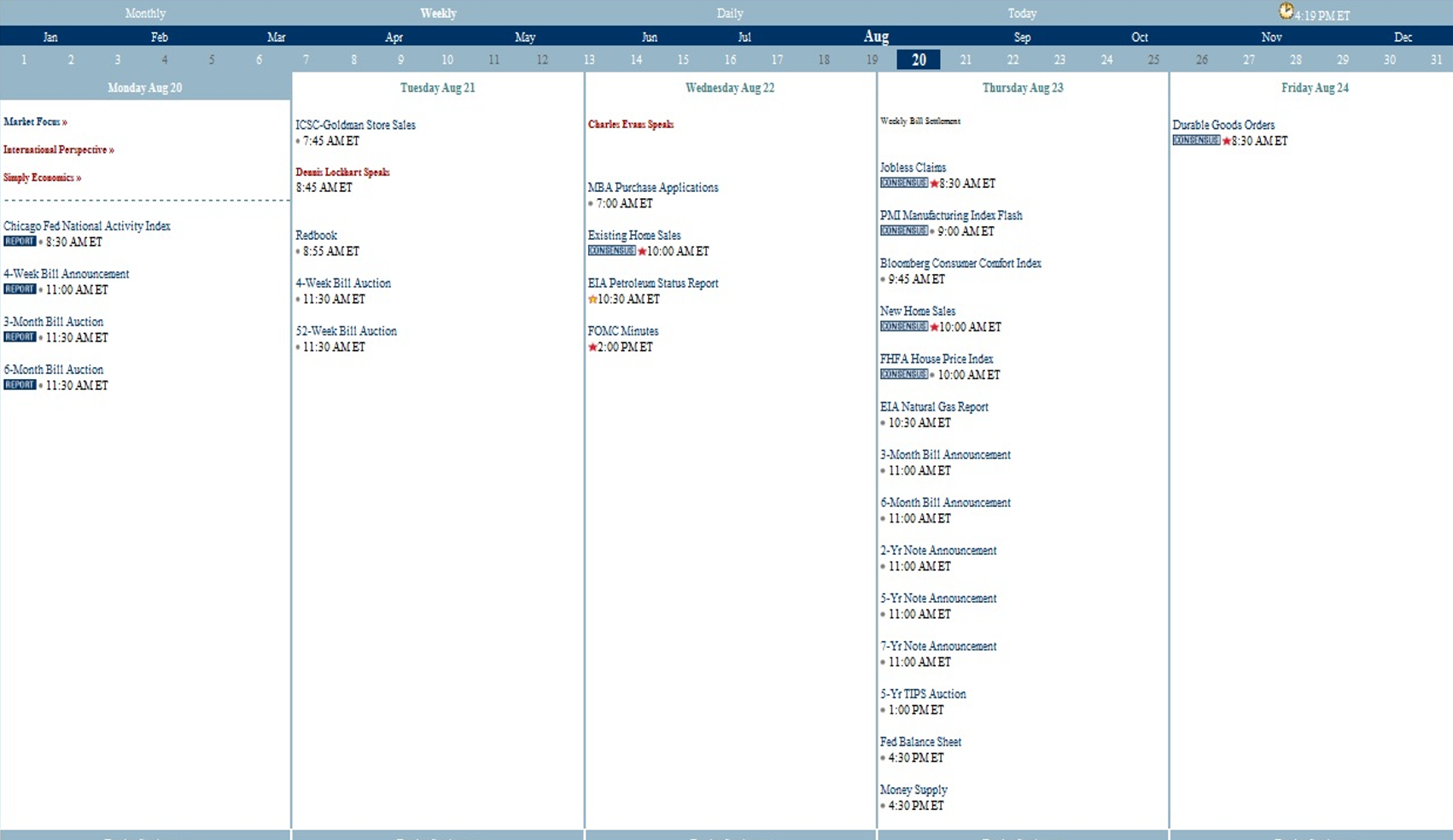
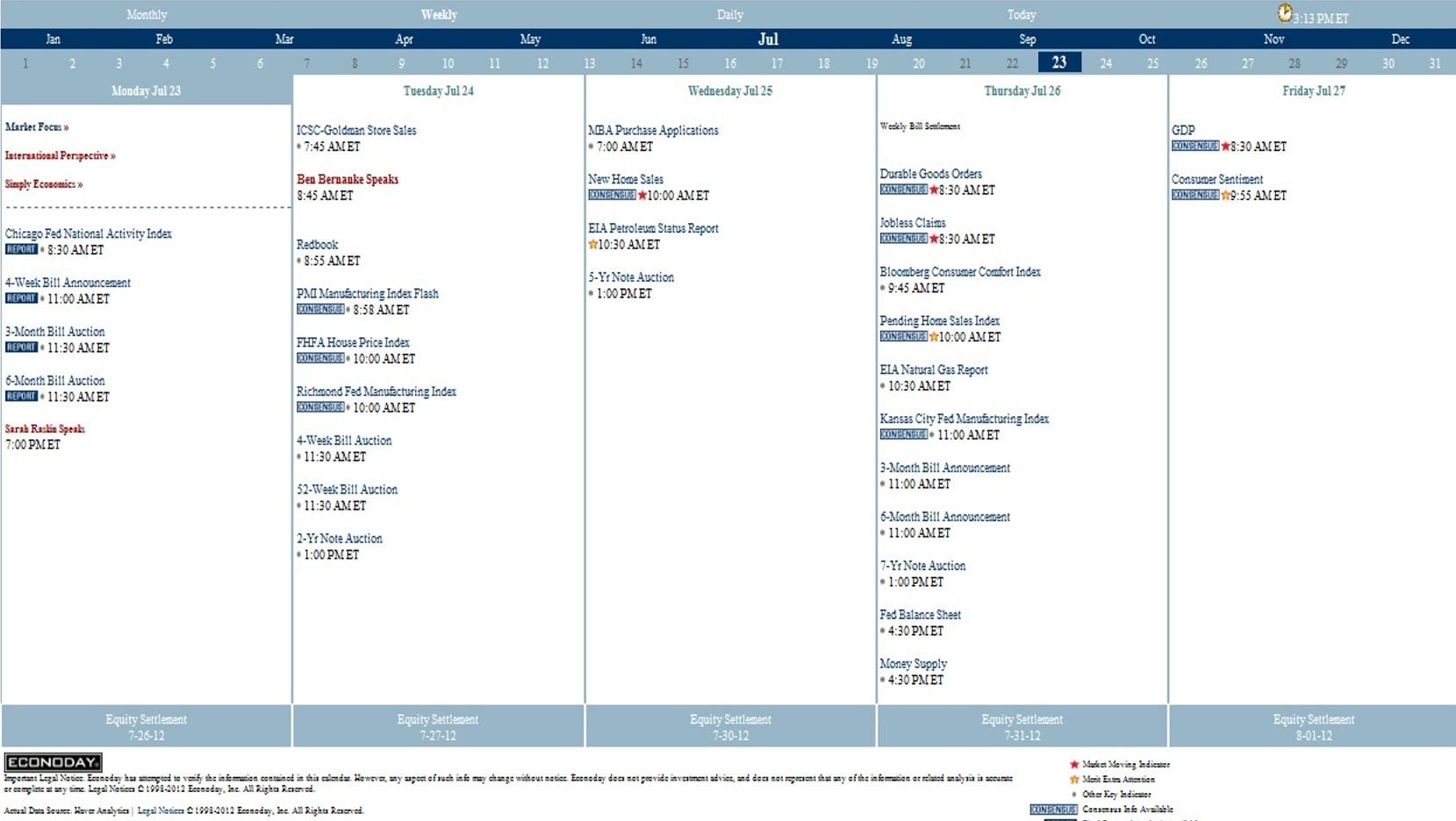
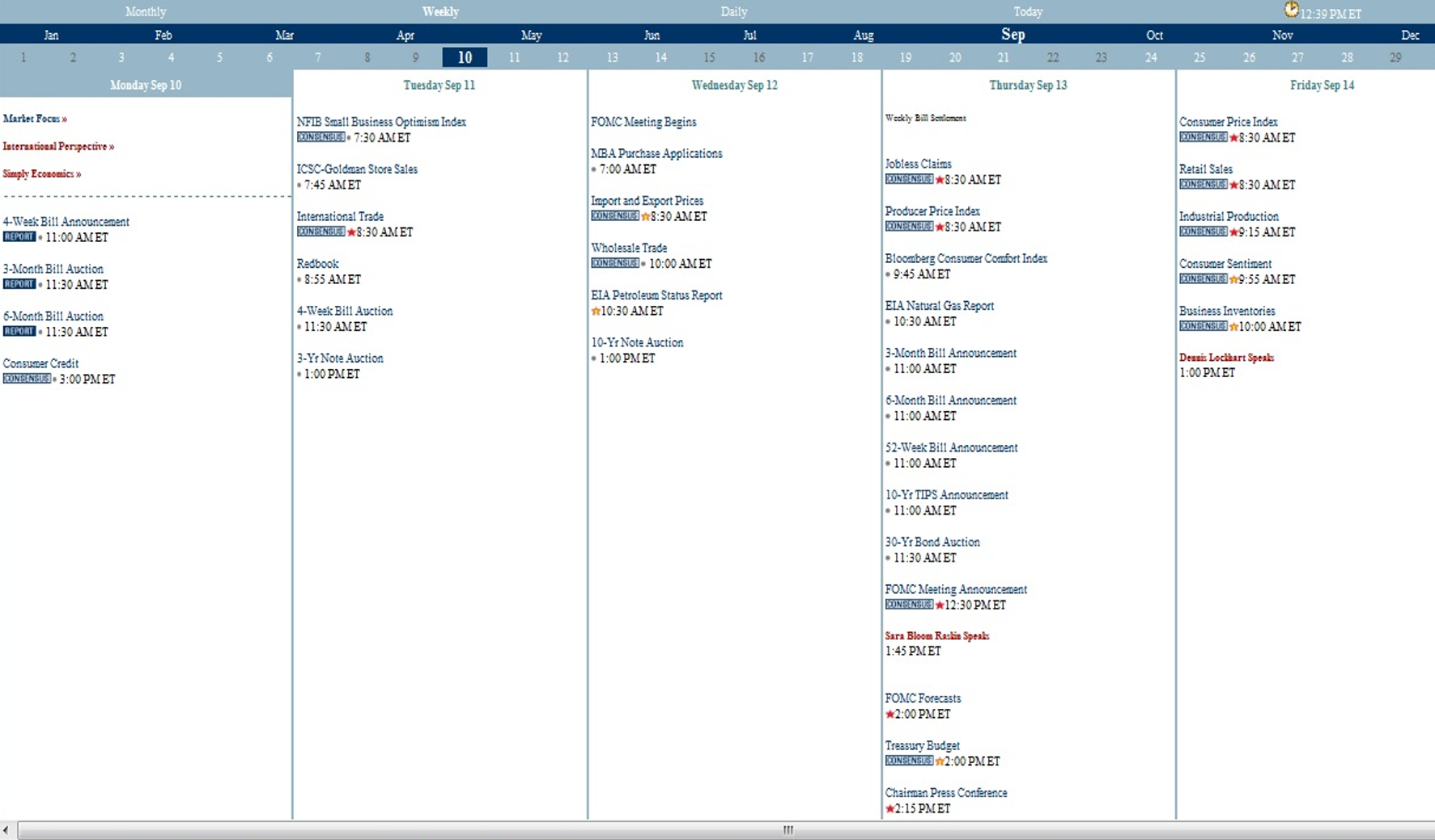
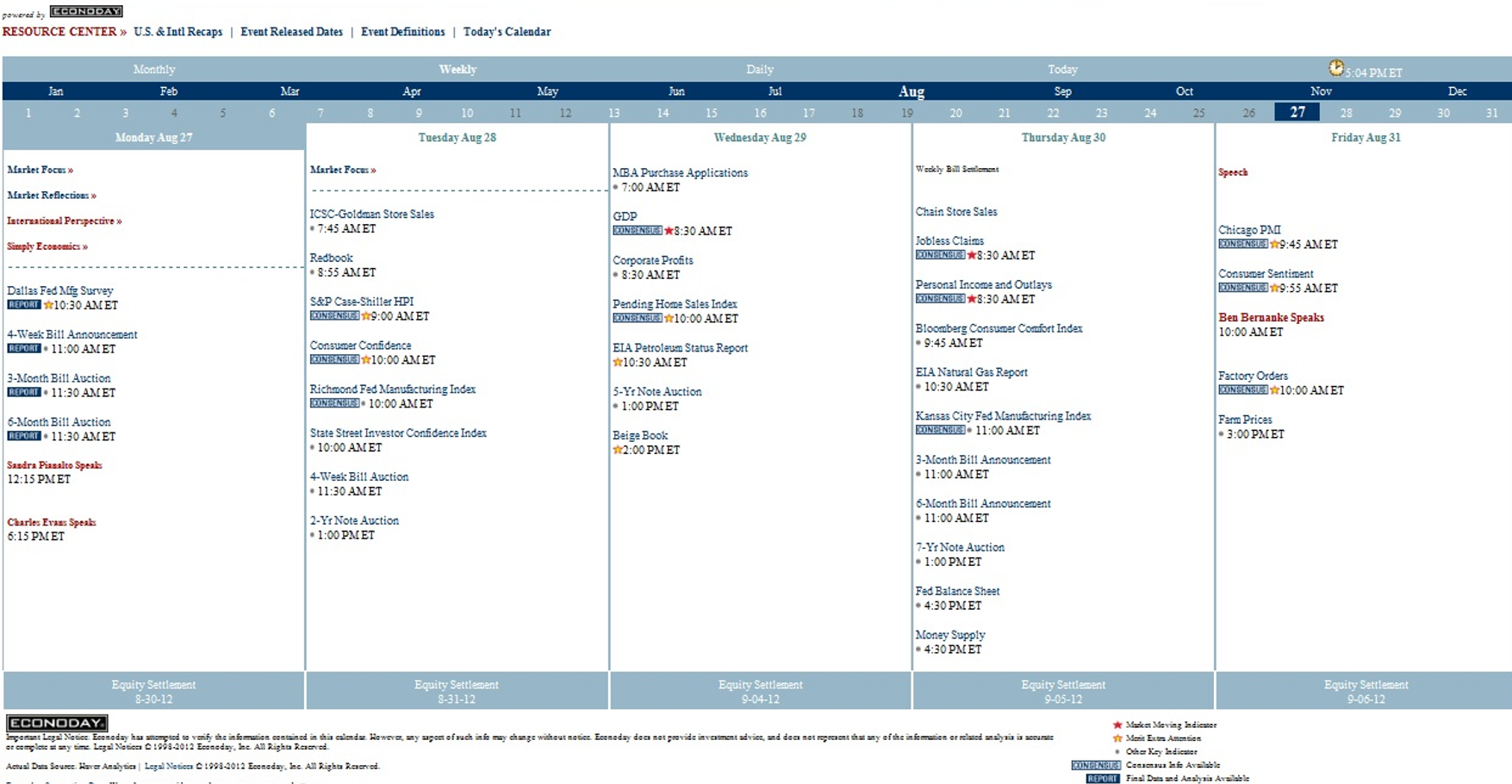
The week ahead — Economic data from Econoday.com:
Week Sept 14 2012 – Weekly Recap & The Week Ahead

Monday, September 17th, 2012

“Don’t fight the Fed” — unknown

1. German Court Opens Door for Rescue Fund — Germany’s Constitutional Court has ruled that the eurozone’s ESM rescue fund and the “fiscal compact” are constitutional, opening the way for the country’s president to sign the proposals into law. However, the court said that German liability must not surpass €190B without the Bundestag providing further authorization.
2. Spain considers request for ECB bond purchases — as reported by Reuter, Spain is considering asking for assistance from the ECB’s bond-buying program, PM Mariano Rajoy has told Finnish newspapers. His comments indicated Spain may apply for a precautionary assistance program under which the euro zone’s rescue funds could buy Spanish bonds as they are auctioned without the country being taken off the credit markets, rather than the kind of full sovereign bailout granted to Greece, Portugal and Ireland.
3. EU unveils new powers for ECB — European Commission President Jose Manuel Barroso today outlined EU plans to turn the ECB into the eurozone’s banking supervisor, the first step towards a banking union. The ECB would begin overseeing the bloc’s largest banks from July 2013 and smaller institutions six months later, although national authorities would retain control of daily supervision. Giving the ECB supervisory power will also enable the ESM to provide aid directly to banks.
4. Ford, GM mull European factory closures — the WSJ reported, Ford (F) is preparing to restructure its operations in the region and close a factory, possibly a 4,000-staff facility in Genk in Belgium. Meanwhile, GM (GM) is in talks with labor unions about shutting an aging plant in Bochum in Germany as it also struggles to turn around major losses.
5. Draghi’s planned bond-buying scheme lower yields for Italy & Spain — Yields dropped at an Italian auction of €6.5B of government paper, including €4B of 3-year debt which carried a rate of 2.75%. That’s down from 4.65% in July and the lowest since October 2010. The falling yields were attributed to the ECB’s planned bond-buying scheme, but it’s early days yet to see how long Italian yields will stay low, not to mention those of Spain.
6. Fed bets big in QE3 to rescue economy — per Reuter, the Federal Reserve launched another aggressive stimulus program last Thursday, saying it would pump $40 billion into the U.S. economy each month until it saw a sustained upturn in the weak jobs market. The dollar has taken a dive as well as Treasurys.
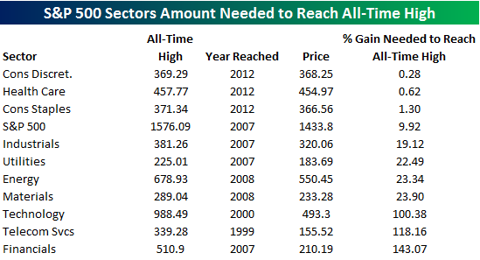
7. S&P 500 Sectors Distance From All-Time Highs — courtesy from the Bespoke Investment Group, the S&P500 index is currently just 9% below its all-time high; However, the ten S&P 500 sectors would need to rally in order to trade to an all-time high(see chart below).

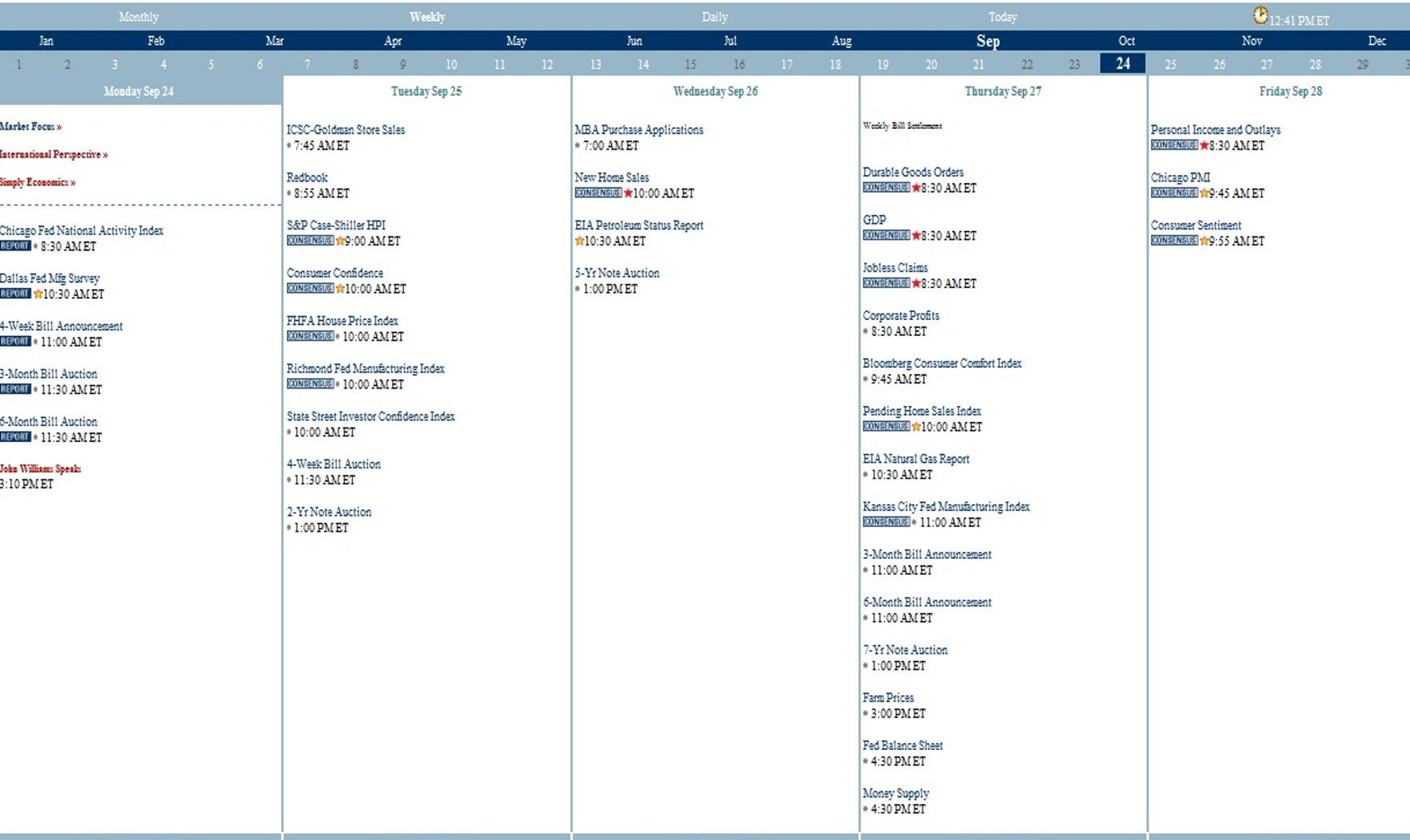
The week ahead — Economic data from Econoday.com:
Week Sept 7 2012 – Weekly Recap & The Week Ahead

Monday, September 10th, 2012

“The market can stay irrational longer than you can stay solvent.” John Maynard Keynes.

1. Spanish, Italian yields fall on Draghi bond comments — ECB President Mario Draghi indicated that the bank would be open to buying government bonds with a maturity of 2-3 years, telling the European Parliament that doing so wouldn’t contravene EU treaties.
2. Moody’s Changes Euro Zone Rating Outlook to ‘Negative’ NYTimes reported Moody’s Investors Service cut the European Union’s credit outlook to negative on Monday, reflecting the risks to Germany, France, Britain and the Netherlands, the four countries in the group with AAA ratings, which account for about 45 percent of the group’s budget revenue.
Moody’s also lowered the outlook on the union’s AAA long-term bond rating from stable.
3. DOJ accuses BP of “gross negligence” — the Department of Justice sharpened its rhetoric against BP (BP) and Transocean (RIG) over the Deepwater Horizon oil spill, accusing the companies of “gross negligence” in deciphering a key pressure test.
4. Spain plays game of chicken with ECB –knowing that the ECB is set to start bond purchases, Spain has begun a game of chicken: Finance Minister Luis de Guindos said the country isn’t so sure it will submit to a full-blown bailout if the terms are too harsh. Germany thought it had a deal – forcing Spain and Italy into Greek-like austerity in exchange for allowing the ECB to buy government debt.
5. Bank of England and the ECB left interest-rate unchanged — The BOE kept its interest rate unchanged at 0.5% and made no changed to its 375 billion pounds ($596.5 billion) asset-purchase program. The ECB kept its key lending rate at 0.75% as the ECB President Mario Draghi stated that ECB would engage in outright monetary transactions, or OMTs, to address “severe distortions” in government bond markets based on “unfounded fears”.
6. China unleashes $158B infrastructure stimulus — according to CNN, China is ramping up the stimulus as it seeks to boost its slowing growth, disclosing plans for 13 highway construction projects, nine sewage-treatment plants, seven waterway schemes, and five port and warehouse projects. That’s on top of the 25 subway projects China announced earlier this week, and takes total spending to 1T yuan ($158B).

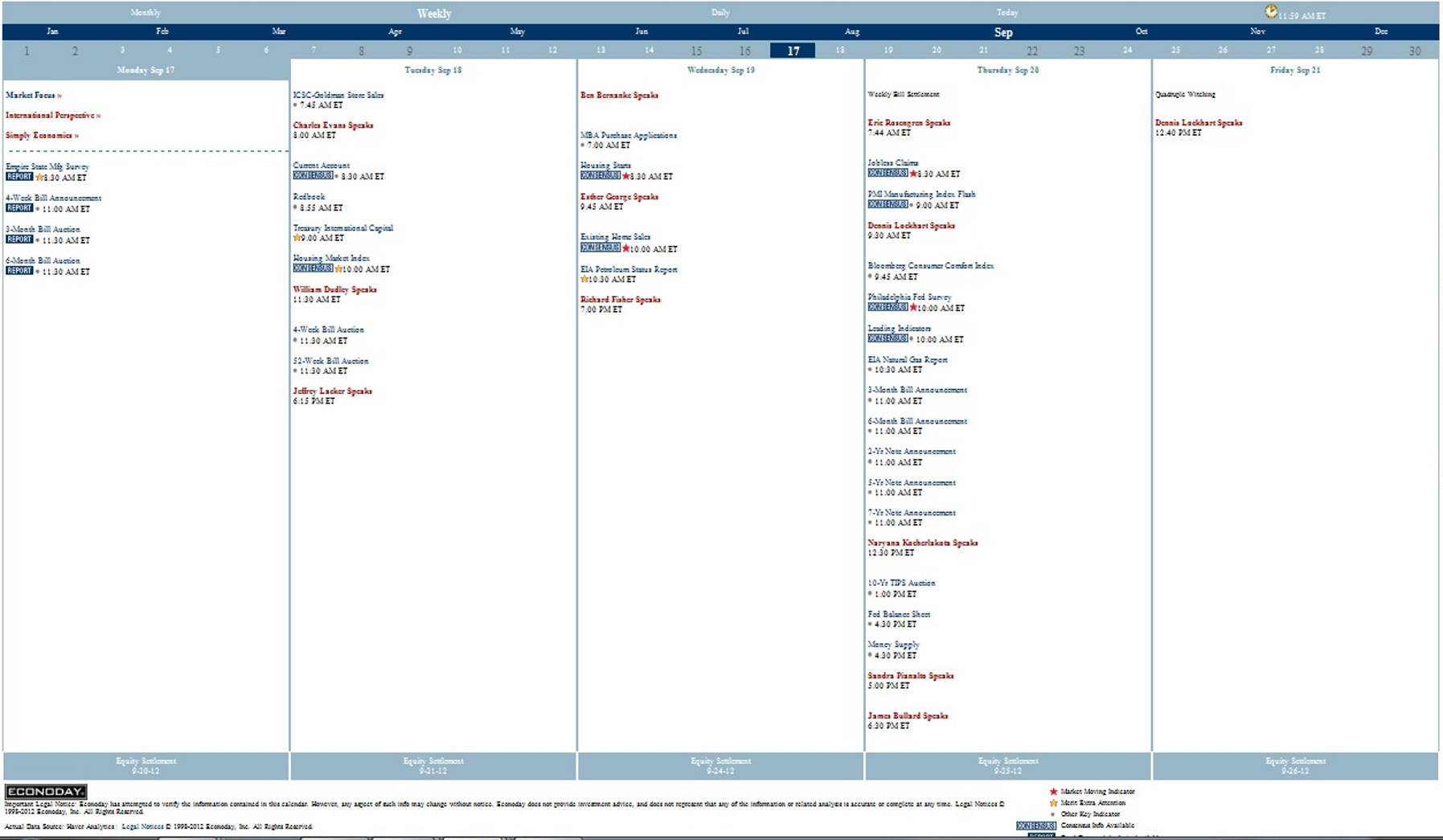
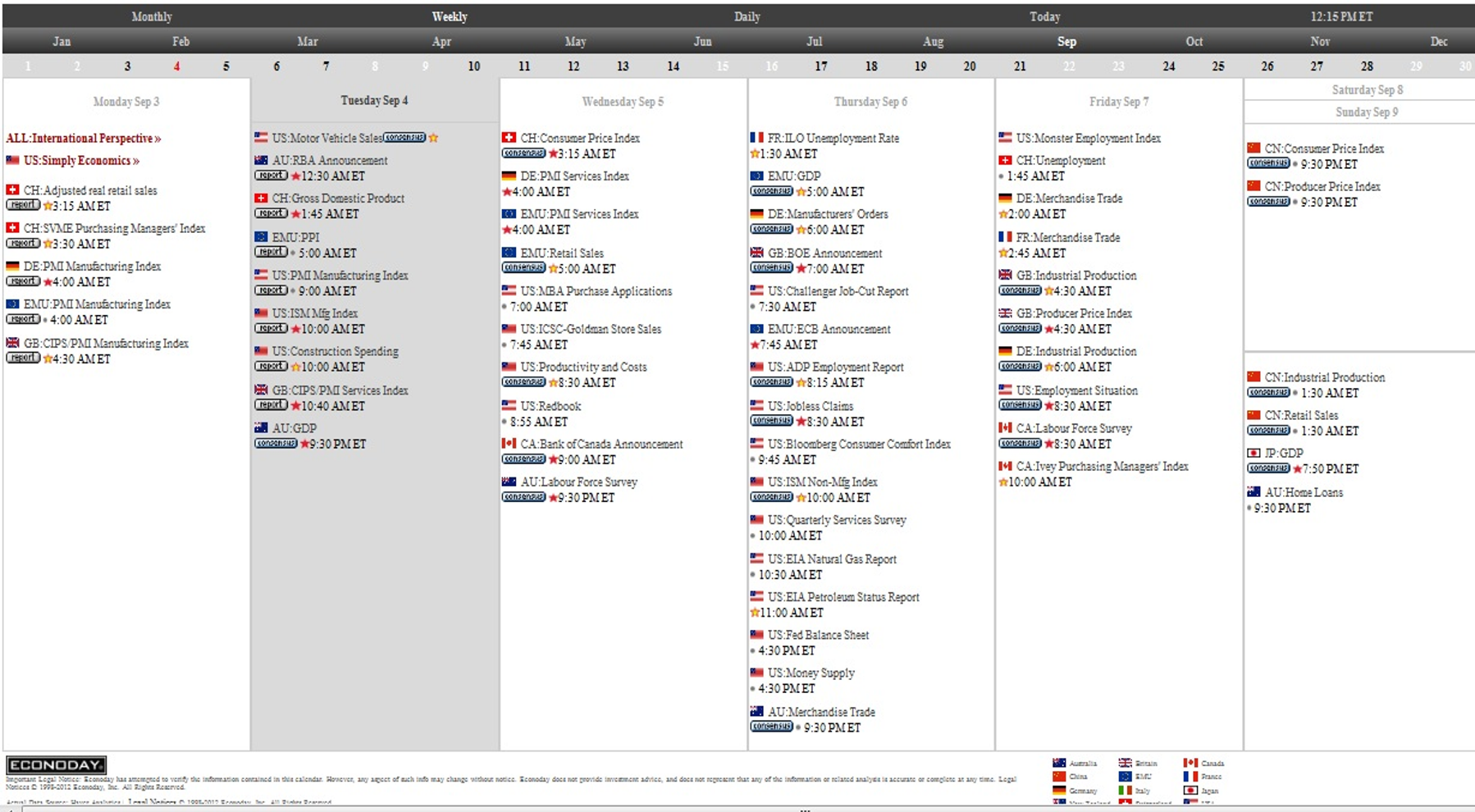
The week ahead — Economic data from Econoday.com:
Week Aug 31 2012 – Weekly Recap & The Week Ahead

Tuesday, September 4th, 2012

“The facts are unimportant! It’s what they are perceived to be that determines the course of events” — R. Earl Hadaly

1. Spain will probably need €60B of bailout according to Economy Minister — Spain expected to use approximately €60B of the €100B available for its bank rescue, Economy Minister Luis de Guindos has told the NYTimes.
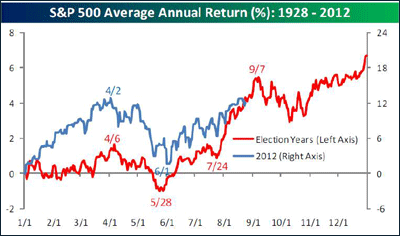
2. Election Years chart pattern — the S&P500 (SPX) continues to track the typical election year chart pattern, courtesy of the Bespoke Investment Group. If the correlation continues to hold, the equity markets should track higher into the beginning of September before a pre-election correction.

3. Borrowing costs drop as Spain sells 3- and 6-month debt — Spain saw borrowing costs collapse at an auction of three- and six-month government bonds, amid growing expectations the European Central Bank will implement policy measures to help stabilize the euro zone’s sovereign debt markets at its next policy meeting in early September.
4. Hurricane Isaac Hits Louisiana — Hurricane Isaac arrived in New Orleans seven years to the day that Katrina struck, although Isaac is less powerful. Still, hundreds of thousands have been left without power, while nearly all oil output and two-thirds of gas production in the Gulf of Mexico have been shut down.
5. Catalonia Seeks Spain Rescue — the semi-autonomous NE region, which accounts for about 1/5th of national GDP, said it needs 5 bil euro. Catalomia is the 2nd province to ask for a Madrid bailout as Spain mulls requesting a national sovereign bailout.
6. Bundesbank chief considered resigning — Germany’s Bild reported Bundesbank President Jens Weidmann has thought about resigning in recent weeks, due to his opposition to Mario Draghi’s plans for the ECB to resume the buying of eurozone government debt.
7. Bernanke Speech at Jackson Hole — In a speech at the Fed’s Jackson Hole retreat last Friday, Bernanke did not pre-commit to taking action. However, he did reinforce the case for more asset purchases.

The week ahead — Economic data from Econoday.com:
Week Aug 24 2012 – Weekly Recap & The Week Ahead

Monday, August 27th, 2012

“If you do not know who you are, the stock market is an expensive to find out.” — George Goodman

1. Germany dampens ECB bond-buying speculation — Germany’s Bundesbank stepped up its opposition to the European Central Bank’s plan to buy more government bonds, warning that any move to share “solvency risks” across the euro zone should be decided by governments and not the ECB. The speculation has sent Spanish yields plummeting.
2. BHP shelves $20B copper expansion as China slowdown — in one of the biggest signs of how China’s falling growth has stalled the global mining boom, BHP Billiton (BHP) is abandoning a $20B expansion of its Olympic Dam copper project in Australia and will look at a “less capital intensive option” instead reported by Reuters.
3. Greece stalls on making tough cuts — as reported by the BBC, Greece’s Prime Minister, Antonis Samaras, is preparing for the first of a series of meetings in which he will ask the country’s lenders for more time to implement spending cuts and reforms. At issue is whether Greece has done enough to receive its next instalment of loans worth 31.5bn euros ($39.3bn; £24.7bn) that it needs to avoid defaulting on its vast public debts, and possibly even leaving the euro.
4. Fed minutes show active discussion of QE3 — Members of the Federal Reserve got closer to decide on a new round of bond purchases even as a less-aggressive step of altering language on a low-rate pledge seems to be in the works, according to the latest FOMC meeting minutes.
5. Chinese factory activity contracts at faster pace in August — the August preliminary HSBC PMI for China fell to a nine-month low of 47.8 from 49.3 in July. New orders and new export orders contracted at a faster rate than in July, while inventories rose at a speedier pace.
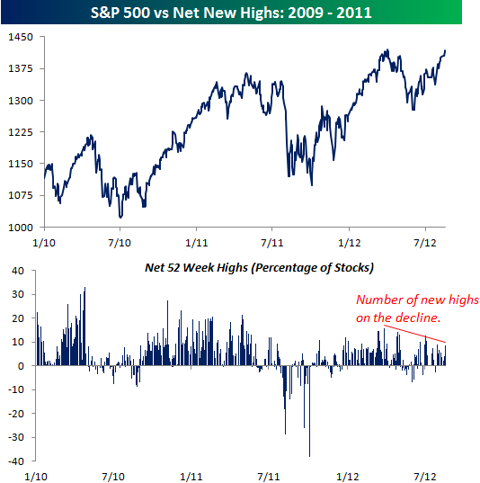
6. S&P500 Performance YTD vs. Net New Highs — stocks with smaller market caps have lagged in this rally and being led by megacaps (like AAPL). Chart courtesy of the Bespoke Investment Group.

The week ahead — Economic data from Econoday.com:
Week Aug 17 2012 – Weekly Recap & The Week Ahead

Monday, August 20th, 2012

“I don’t look to jump over 7-foot bars: I look around for 1-foot bars that I can step over.” — Warren Buffett

1. Eurozone risks double-dip recession looms as euro economy contracts — Eurozone GDP fell a quarterly 0.2% in Q2, which was in line with forecasts but was down from unchanged in Q1. Germany’s GDP growth slowed to 0.3% from 0.5%, with the meager growth helped by exports and private and public consumption.
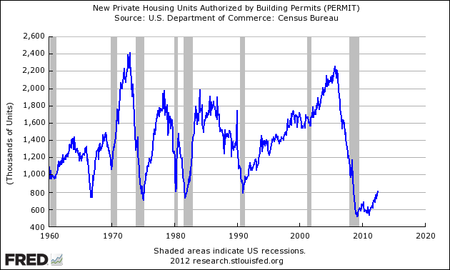
2. Housing Building Permits Rebound — below is the chart depictings a rebound in housing.
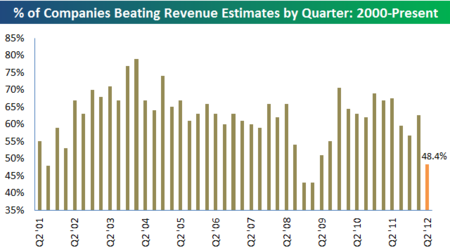
3. Second quarter earnings beat rate slow — chart courtesy of the Bespoke Investment Group showing percent of companies beating revenue estimates from 2000 to present.

4. Peregrine CEO Russell Wasendorf Indicted on 31 Counts per Bloomberg, Russell R. Wasendorf Sr., chief executive officer of the collapsed commodity firm Peregrine Financial Group Inc., was indicted by a federal grand jury on 31 counts of making false statements to regulators. Wasendorf, who allegedly stole as much as $215M from customers over a 20-year period, was arrested in early July after attempting suicide and is facing up to 155 years in prison and a $7.8M fine.
5. Government proposes restricted drilling for Alaska — Interior Secretary Ken Salazar proposed opening 12M acres of Alaska’s National Petroleum Reserve for oil and natural-gas drilling but restricting production on the remaining 11M acres due to conservation reasons. The area for drilling is thought to contain 550M barrels of economically recoverable oil and 8.7T cubic feet of natural gas.
6. Buffett’s Berkshire exits Intel, buys more banksbased on the latest disclosure, Berkshire sold 7.7M Intel (INTC) shares just nine months after buying into the chipmaker. Berkshire also significantly reduced its holdings in Johnson & Johnson (JNJ), Kraft (KFT) and Procter & Gamble (PG), while buying into Phillips 66 (PSX) and National Oilwell Varco (NOV).
7. China Bad Loans Rise for Third Quarter as Economy Slows — per Bloomberg, Non-performing loans rose by 18.2 billion yuan ($2.86 billion) in the three months ended June 30 to 456.4 billion yuan, the China Banking Regulatory Commission reported. Bad loans increased for a third straight quarter, the longest streak of deterioration in eight years.
8. China’s Premier Wen Jia Bao indicates that more easing in the near future — Chinese Premier Wen Jiabao has struck an upbeat note about the economy, saying that while downward pressure is “relatively large,” there have been “some positive changes” recently, especially in July.
9. Spain’s bank bad loans hit record high in June — according to Reuters, Spanish banks’ bad loans rose to a record high in June as assets tied to the country’s deflating property market soured further. In the same month that Spain sought a European bailout of up to 100 billion euros for its struggling lenders, their non-performing loans rose to 9.42 percent of outstanding portfolios from 8.95 percent in May.

The week ahead — Economic data from Econoday.com:
Week Aug 10 2012 – Weekly Recap & The Week Ahead

Monday, August 13th, 2012

“Wall Street never changes. The pockets change, the suckers change, the stocks change, but Wall Street never changes because human nature never changes.” – Jesse Livermore

1. Germany and Italy near blows over euro per The Telegraph, German politicians from across the spectrum have reacted furiously to warnings by Italy’s Mario Monti that Bundestag control over EU debt policies threatens to bring about the “disintegration” of the European project.
2. Eurozone gets ever tougher with Greece — Greece plans to raise about €6bn of short-term funds this week from local banks after its eurozone partners turned down a request for a bridge loan to repay a bond held by the European Central Bank that matures later this month.
3. S&P lowers its outlook on Greece to negative — S&P has revised its outlook on Greece’s long-term rating to negative, reflecting the potential for a downgrade if the country fails to secure the next disbursement from the EU/IMF financing program.
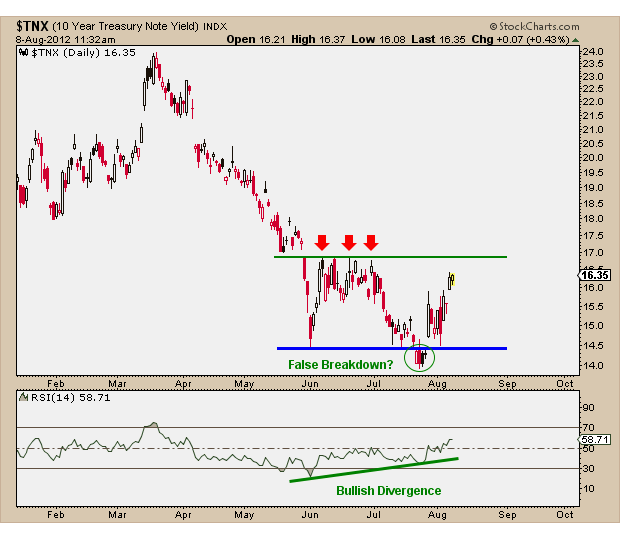
4. US 10-year yields — yields have a positive correlation with risk assets. Below is the chart that depicts perhaps a false breakdowns in bond that typically provides enough fuel for equity to rally.

5. Saudi cuts oil output to 9.8 mln bpd in July — per Reuter, top oil exporter Saudi Arabia pumped 9.8 million barrels per day (bpd) of crude oil in July, cutting output by 300,000 bpd from June.
6. U.S. corn crops suffer, global food prices rise — the UN’s index of global food prices increased 6% in July, its largest rise since November 2009, boosted by too much rain in Brazil, not enough rain in the U.S., and a hot summer in Russia.

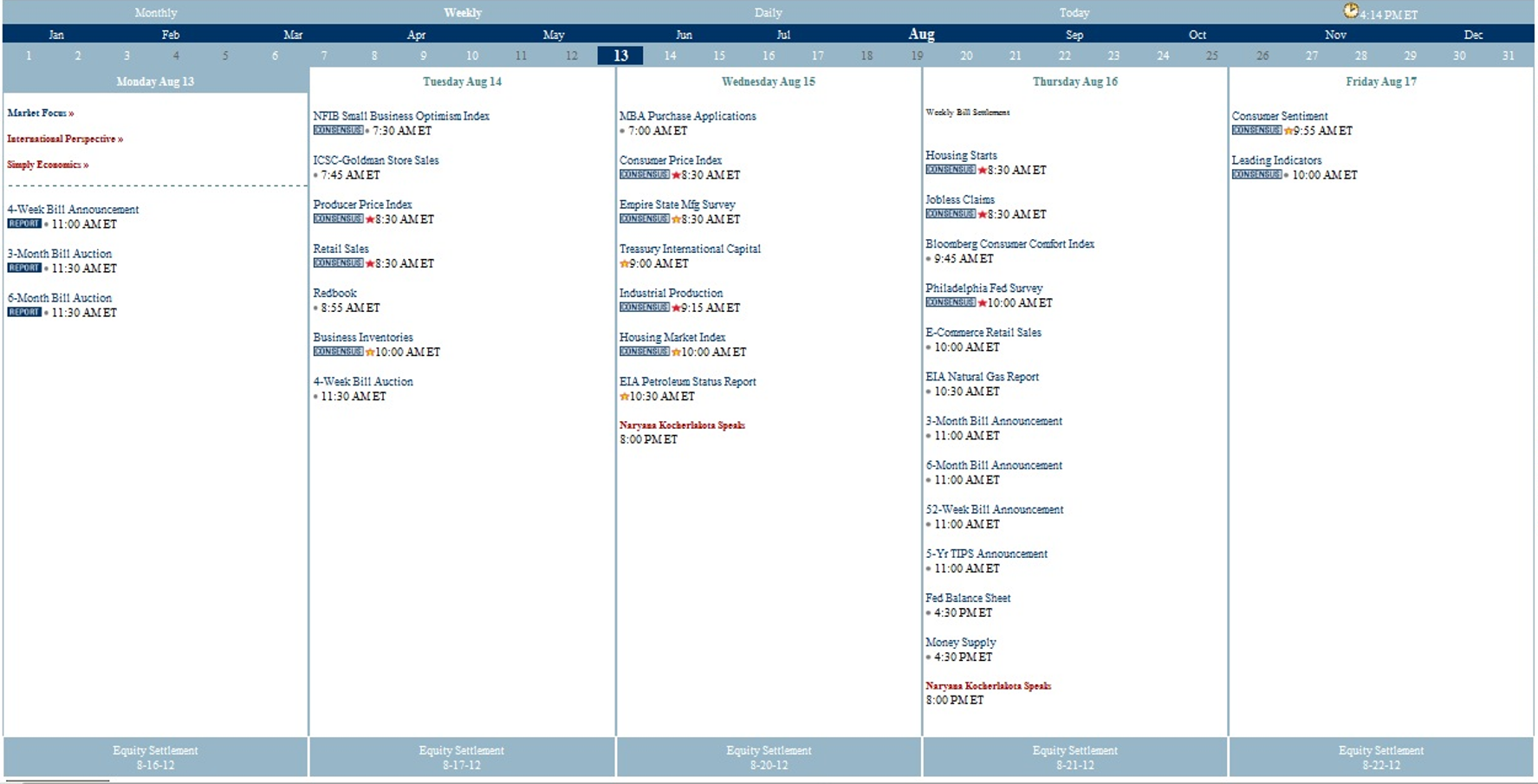
The week ahead — Economic data from Econoday.com:
Week Aug 3 2012 – Weekly Recap & The Week Ahead

Monday, August 6th, 2012

“Who can be patient in extremes?” — William Shakespeare

1. Consumer spending falls again in June — according to MarketWatch, U.S. consumers reduced spending for the second straight month despite a sharp increase in wages, boosting their savings rate to the highest level in a year. The savings rate jumped to 4.4% from 4.0% in May.
2. Massive India power outage affects 600 million — A massive power outage in northern and eastern India left 600 million people, about half the country’s population, without electricity last Tuesday. The outage, which further aggravated a grid failure that had disrupted life in the country’s north for several hours the day before, reportedly stranded travelers and commuters, trapped miners and caused traffic jams.
3. India GDP growth forecast cut, but inflation view raised — GDP growth for the year ending March 31, 2013 was cut to 6.5% from the central bank’s previous estimate of 7.3%. At the same time, the RBI raised its wholesale price index-based inflation target for the current financial year to 7% from 6.5%.
4. Congress set to extend government funding for six monthsReuter reported that the House and Senate leaders have struck a deal to fund the U.S. government for the first six months of FY 2013. If passed by Congress, the deal for a six-month spending extension eliminates one layer of difficult year-end wrangling for Congress just after the election as it deals with the “fiscal cliff” of expiring tax cuts, automatic spending cuts, a debt-limit increase and other fiscal deadlines.
5. FOMC stands pat — The FOMC did even less than expected and announced neither additional stimulus, nor an extension of the low-rate pledge past late-2014. The Fed did talk about closely monitoring the economy, which is a bit of a change from the previous statements.
6. U.S. Oil Reserves Jumped in 2010according to the IEA, the U.S.’s proven oil reserves jumped 13% in 2010 to 25.2B barrels and those of natural gas 12% to 318T cubic feet, the EIA said in its annual report, with the gains the largest since the agency started keeping records in 1977. Horizontal drilling and fracking played a major role in the increases.
7. San Bernardino files for bankruptcy with over $1 billion in debtsSan Bernardino filed for bankruptcy protection citing more than $1 billion of debts and making it the third California city to seek protection from creditors. In the past two months, the cities of Stockton and Mammoth Lakes have also filed for Chapter 9 bankruptcy protection, a special bankruptcy provision for municipalities.

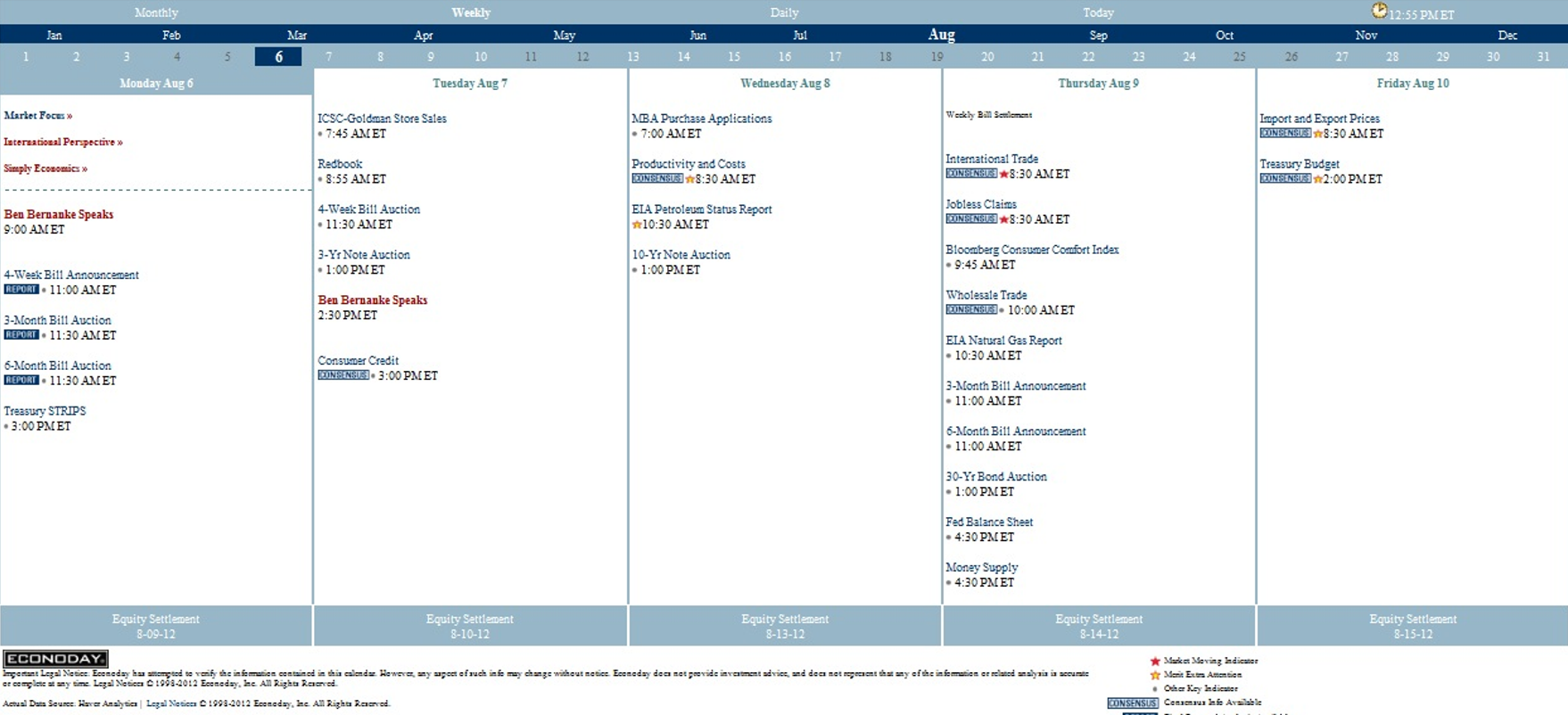
The week ahead — Economic data from Econoday.com:
Week July 27 2012 – Weekly Recap & The Week Ahead

Monday, July 30th, 2012

“Stocks take the stairs up and the elevator down.” – unknown

1. Greece reportedly faces IMF aid cut-off — The International Monetary Fund is set to stop aid payments to Greece, raising the odds that the nation will become insolvent as early as September as reported by Der Spiegel.
2. Moody’s Investors Service revising its outlook on Germany Moody’s Investors Service has lowered its outlook on Germany, Holland, and Luxembourg to Negative, while affirming Finland’s Stable outlook and AAA credit rating. The agency cited the usual fears related to the eurozone’s debt crisis, along with the “increasing likelihood that greater collective support” will be needed for Spain and Italy.
3. Fed mulls more action to spur economy — WSJ reported Federal Reserve officials, impatient with the economy’s sluggish growth and high unemployment, are moving closer to taking new steps to spur activity and hiring. Purchases of mortgage-backed securities, a pledge to keep rates low for longer, or even a move to further push down the nearly microscopic short rates are among the choices available to the FOMC.
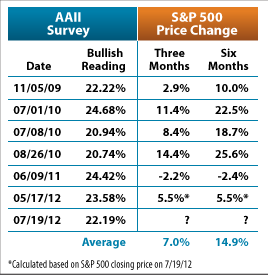
4. AAII latest sentiment readings — AAII latest bullish sentiment dropped to below 22; In prior bull market when the bullish sentiment dropped below 25%, the market rally over the next 3-month and 6-month;
5. U.S. growth slows to 1.5% in second quarter Marketwatched reported The U.S. economy took a turn for the worse in the spring as consumers pared spending and businesses invested at a slower pace, with little sign growth will sharply accelerate anytime soon.
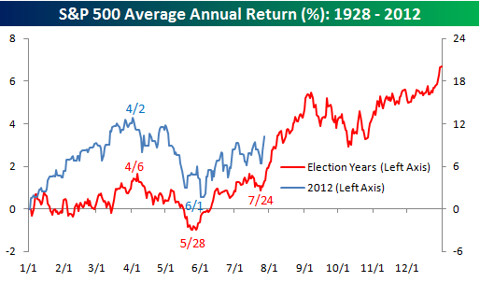
6. President Election Cycle — below is the chart (courtesy of the Bespoke Inv’t Group) which highlights the similarities between this year and prior Presidential Election years numerous times. If the pattern continues, the S&P 500 could be set up for a nice rally to end the Summer.

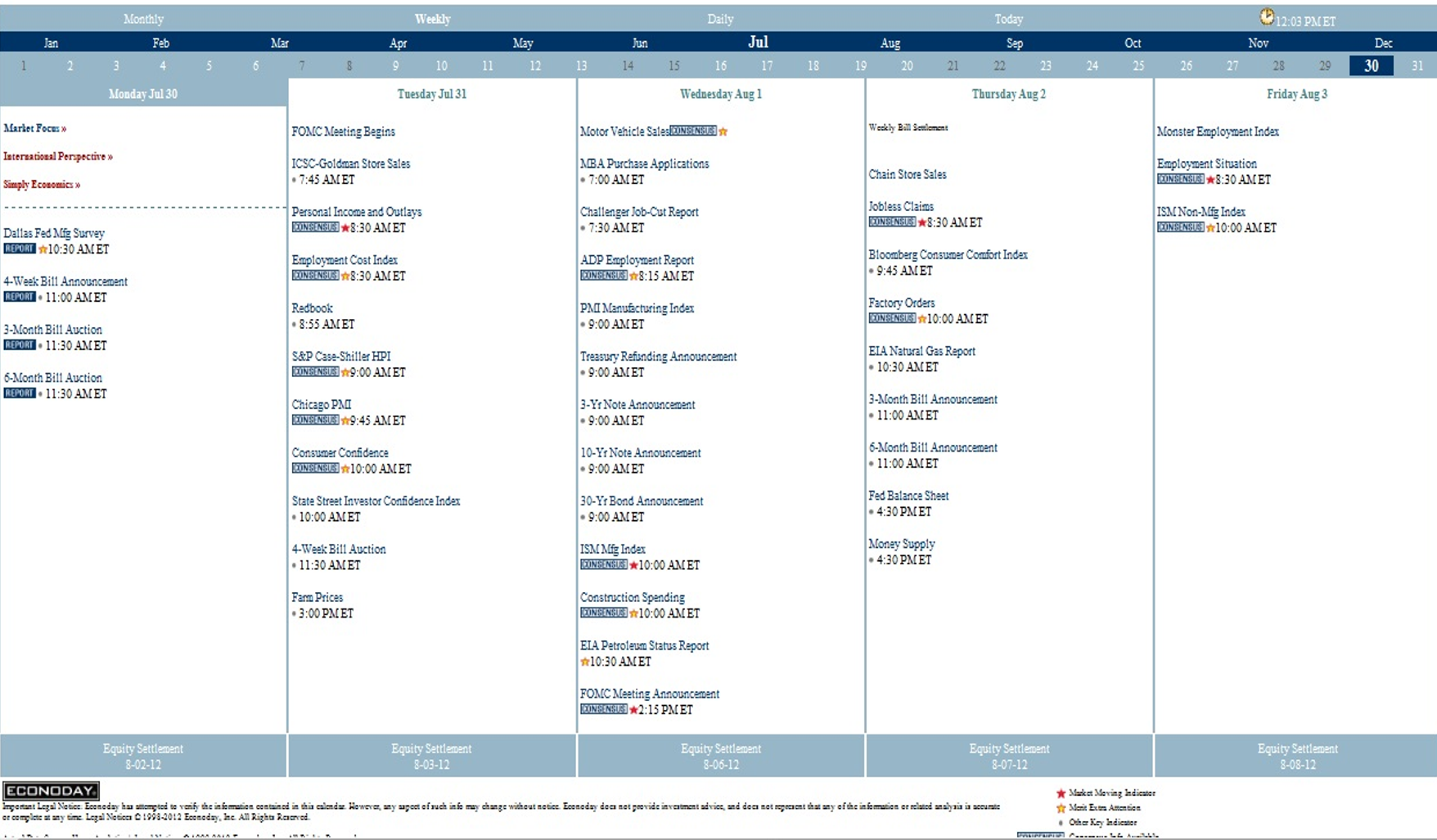
The week ahead — Economic data from Econoday.com:
Week July 20 2012 – Weekly Recap & The Week Ahead

Monday, July 23rd, 2012

“Short term volatility is greatest at turning points and diminishes as a trend becomes established.” – George Soros.

1. U.S. opens criminal probe in Libor scandal — The U.S. Justice Department is building a criminal case against big banks and individuals who manipulated a key global interest rate. Barclays, other banks including Citigroup Inc. (C), J.P. Morgan Chase & Co. (JPM), the Royal Bank of Scotland (RBS) and Deutsche Bank AG (DB) have said they also are being probed.
2. Saudi Arabia, UAE bypass the Strait of HormuzSaudi Arabia and the United Arab Emirates have opened new pipelines bypassing the Strait of Hormuz, the shipping lane that Iran has repeatedly threatened to close, in a move that will reduce Tehran’s power over oil markets.
3. Moody cuts rating of 13 Italian Banks — Moody’s has cut the ratings of 13 Italian banks, citing the weakening of the Italian government’s credit profile. The move followed the downgrade of Italy to Baa2 from A3 last week.
4. Libor probe now focuses on links between banksthe FT reported regulators are focusing on HSBC (HBC), Deutsche Bank (DB), Societe Generale (SCGLY.PK) and Credit Agricole (CRARY.PK) in their Libor investigation, the FT reports.
5. U.S. Post Office Might Miss Retirees’ Payment on August 1WSJ reported While many are counting on Congress to avert the “fiscal cliff” in January 2013, The Postal Service stated that without congressional action, it will default—a first in its long history, a spokesman said—on a legally required annual $5.5 billion payment, due Aug. 1, into a health-benefits fund for future retirees.
6. Eurogroup approves Spain bank bailout — Euro-zone finance ministers formally approved an agreement with Spain that will allow the country’s government to borrow as much as 100 billion euros ($123 billion) from the euro zone’s rescue funds to recapitalize its ailing banking sector.

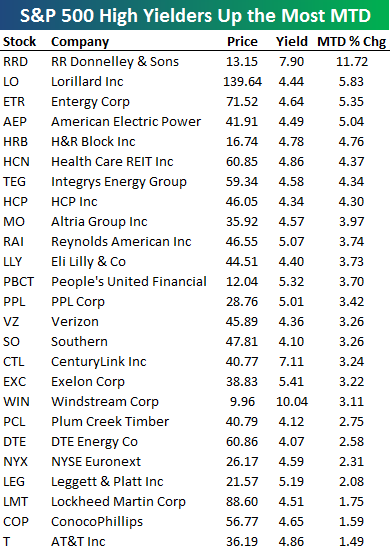
The Bespoke Invt. Group posted a list of high yielders:

The week ahead — Economic data from Econoday.com:
Search
Calendar
February 2026
M T W T F S S
« Jan    
 1
2345678
9101112131415
16171819202122
232425262728  
Archives
Categories
The information provided by The EGS Blog is based on sources believed to be reliable, but it is not guaranteed to be accurate. There is no guarantee that the recommendations of The EGS Blog will be profitable or will not be subject to losses. The information provided by The EGS Blog is not a recommendation or a solicitation that any particular investor should purchase or sell any particular security in any amount, or at all. The investments discussed or recommended herein may be unsuitable for investors depending on their specific investment objectives and financial position. At any time EGS LLC and its principals may maintain positions that are contrary to positions announced within the subscription service. In no event will The EGS Blog be liable to you or anyone else for any incidental, consequential, special, or indirect damage (including but not limited to lost profits or trading losses). PAST PERFORMANCE IS NO GUARANTEE OF FUTURE RESULTS

© Copyright 2026 Market Outlook All Rights Reserved
Design by EGS Sponsored by Equity Guidance LLC