Archive for the ‘Weekly Summary’ Category

Week of Apr 16, 2021 Weekly Recap & The Week Ahead

Monday, April 19th, 2021

“There are three ingredients for success—aggressiveness, timing and skill—and if you have enough aggressiveness at the right time, you don’t need that much skill.” ― Howard Marks

1. U.S. Seeks to Pause J&J Covid-19 Vaccine Use After Rare Blood-Clot Cases — the U.S. Food and Drug Administration and the U.S. Centers for Disease Control and Prevention announced the move Tuesday, after finding that six women between the ages of 18 and 48 years who got the vaccine had developed blood clots and one died. More than 6.8 million doses have been administered in the U.S., the agencies said.. The Johnson & Johnson vaccine is one of three approved for emergency use in the U.S. along with a vaccine from Moderna as well as another from Pfizer and BioNTech. AstraZeneca ran into problems in Europe, with several countries halting use while investigating reports of blood clots. European health officials later declared the vaccine “safe and effective.”
2. Biden Says He’s ‘Prepared to Negotiate’ as Infrastructure Debate Heats Up — President Joe Biden said he is “prepared to negotiate” the size and scope of his nearly $2.3 trillion infrastructure proposal as well as how to pay for it.
Republicans argue it funds things outside the scope of infrastructure and oppose raising the corporate tax rate to fund spending. Some Democrats, such as Sen. Joe Manchin, who was not at Monday’s meeting, also oppose the higher tax rate. Others are pushing to expand the size and scope of the proposal.
3. Pfizer CEO Announces Annual Covid-19 Vaccine Booster Shots Likely Needed — Pfizer Inc. PFE 1.16% Chief Executive Albert Bourla said it is likely that people who receive Covid-19 vaccines will need booster shots within a year afterward, and then annual vaccinations, to maintain protection against the virus as it evolves. Pfizer and its partner, BioNTech SE, said recently that the shot remains highly effective six months after its second dose, and they hope to provide more information on protection beyond six months in the coming weeks.

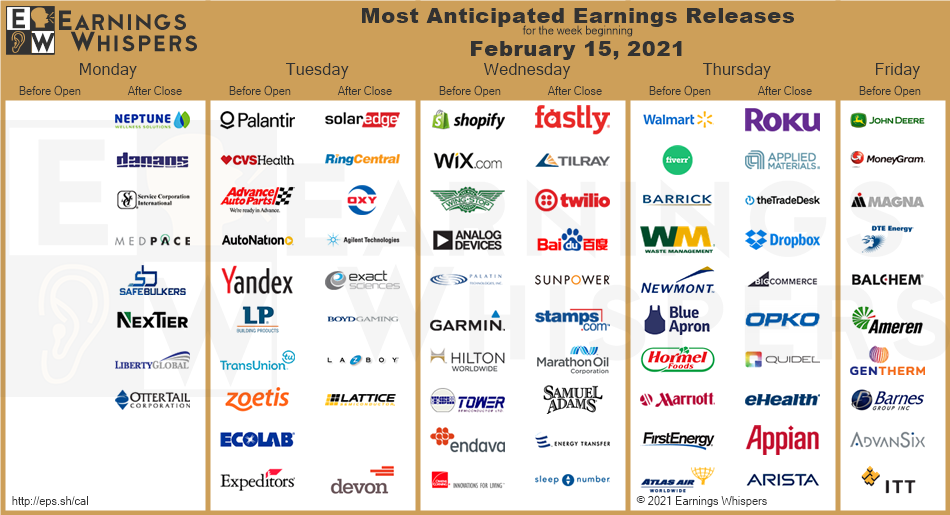
The week ahead — Economic data from Econoday.com:
Week of Apr 10, 2021 Weekly Recap & The Week Ahead

Tuesday, April 13th, 2021

“The economy is growing, and the economic reports are positive. Corporate earnings are rising and beating expectations. The media carry only good news. Securities markets strengthen. Investors grow increasingly confident and optimistic. Risk is perceived as being scarce and benign. Investors think of risk-bearing as a sure route to profit. Greed motivates behavior. Demand for investment opportunities exceeds supply. Asset prices rise beyond intrinsic value. Capital markets are wide open, making it easy to raise money or roll over debt. Defaults are few. Skepticism is low and faith is high, meaning risky deals can be done. No one can imagine things going wrong. No favorable development seems improbable. Everyone assumes things will get better forever. Investors ignore the possibility of loss and worry only about missing opportunities, No one can think of a reason to sell, and no one is forced to sell. Buyers outnumber sellers. Investors would be happy to buy if the market dips. Prices reach new highs. Media celebrate this exciting event. Investors become euphoric and carefree. Security holders marvel at their own intelligence; perhaps they buy more. Those who’ve remained on the sidelines feel remorse; thus they capitulate and buy. Prospective returns are low (or negative). Risk is high. Investors should forget about missing opportunity and worry only about losing money. This is the time for caution!” ― Howard Marks

1. Credit Suisse Takes $4.7 Billion Hit on Archegos Meltdown — Credit Suisse reported a $4.7 billion hit from the meltdown of Archegos Capital Management, slashed its dividend and said its investment banking and risk chiefs would leave the bank. The Swiss lender has been the hardest hit by the collapse late last month of Archegos, a U.S. family investment firm, suffering a major loss in its unit that services hedge funds. The Archegos crisis emerged just weeks after Greensill Capital, a U.K. finance firm that was deeply entangled with Credit Suisse, CS 0.92% filed for insolvency and left the bank on the hook for losses.
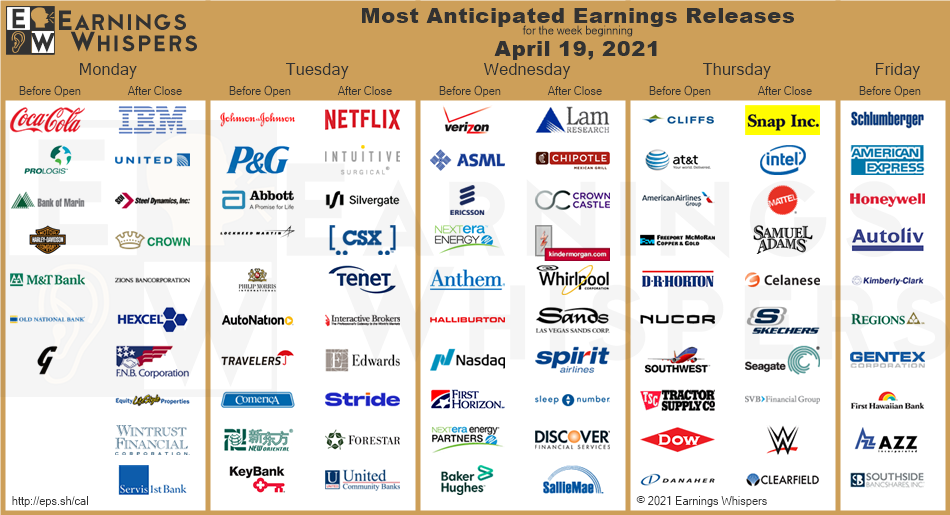
2. EV Related Stocks for “Green Energy” — below lists EV Stocks for consideration for “Biden Infrastructure Plan”

3. Get Ready for a ‘Golden Age of Travel’ — travel appears to be taking off in a V-shaped recovery. Domestic passenger traffic hit 1.5 million passengers a day in early April versus 108,000 last April. It’s down just 38% from April 2019 levels of around 2.4 million daily passengers. Carriers are now adding back flight capacity and staffing up to handle more bookings for the summer and fall. The industry is also encouraging travel with more lenient cancellation and change-fee policies, along with ongoing efforts to reassure passengers that health safety on planes is relatively strong.
4. G20 Takes Step Toward Agreement on Minimum Corporate Tax Rate — Finance ministers from the world’s most developed economies said they hoped to agree on an overhaul of the way multinationals are taxed as well as on a minimum tax rate by the end of the year. Long-running multilateral talks on the question were given a boost this week when Treasury Secretary Janet Yellen signaled the U.S. support for the idea of a global minimum tax rate that would help end the “thirty-year race to the bottom” on corporate taxation. The U.S. also put forward this week its own proposal on how to tax the world’s largest multinationals, along lines similar to the OECD’s suggestions. It aims to raise the global minimum rate to 21% although the OECD has suggest it could be closer to 15%.
5. GM to Halt Production at Several North American Plants Due to Chip Shortage — GM said that three plants previously unaffected by semiconductor supply problems will be idled or have output reduced for one or two weeks, including a factory in Tennessee and another in Michigan that make popular midsize sport-utility vehicles. Models affected include the Chevrolet Traverse SUV and the Cadillac XT5 and XT6 SUVs.
The moves follow news last week that Ford Motor Co. would deepen production cuts in North America, including idling for two weeks a factory near its headquarters in Dearborn, Mich., that makes the F-150 pickup truck, its biggest moneymaker.
Auto makers since late last year have been grappling with a shortage of semiconductor chips, which go into software modules used to control everything from brakes to dashboard touch screens. The companies have been cutting production for months as they move to line up chip supplies, with executives saying the shortage could last several more months.

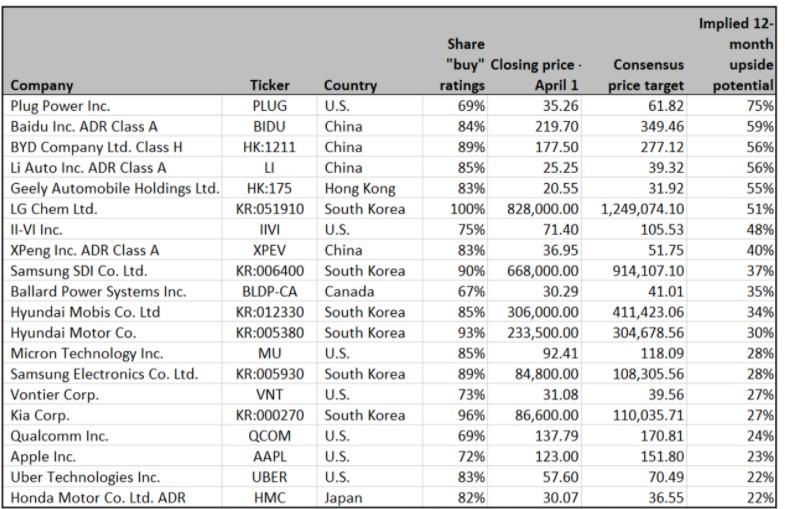
The week ahead — Economic data from Econoday.com:
Week of Apr 3, 2021 Weekly Recap & The Week Ahead

Monday, April 5th, 2021

“But most investors do capitulate eventually. They simply run out of the resolve needed to hold out. Once the asset has doubled or tripled in price on the way up — or halved on the way down — many people feel so stupid and wrong, and are so envious of those who’ve profited from the fad or side-stepped the decline, that they lose the will to resist further. My favorite quote on this subject is from Charles Kindleberger: “There is nothing as disturbing to one’s well-being and judgment as to see a friend get rich” (Manias, Panics, and Crashes: A History of Financial Crises, 1989). Market participants are pained by the money that others have made and they’ve missed out on, and they’re afraid the trend (and the pain) will continue further. They conclude that joining the herd will stop the pain, so they surrender. Eventually they buy the asset well into its rise or sell after it has fallen a great deal. In other words, after failing to do the right thing in stage one, they compound the error by taking that action in stage three, when it has become the wrong thing to do. That’s capitulation. It’s a highly destructive aspect of investor behavior during cycles, and a great example of psychology-induced error at its worst.” ― Howard Marks

1. Credit Suisse, Nomura Warn of Major Losses After Archegos Debacle — Nomura said in a statement over the weekend that “The estimated amount of the claim against the client is approximately $2 billion,” . Credit Suisse said the selloff could be highly significant and material to its first-quarter results. Major banks including Goldman Sachs and Morgan Stanley last week unloaded some $30 billion worth of shares in U.S. media and Chinese tech companies linked to Tiger Asia manager Bill Hwang’s Archegos Capital Management.
2. Biden Will Unveil His Economic Recovery Plan in Two Parts — the president is planning to split his $3 trillion “Build Back Better” recovery plan into two separate bills, starting with a focus on infrastructure.
The biggest beneficiaries should be electric-vehicle makers and clean-energy providers. Biden’s plan includes additional incentives to buy electric vehicles in the form of tax credits and rebates.
The second part of Biden’s plan, which will include healthcare and child care, will be released “later in April,” Press Secretary Jen Psaki said Sunday. Biden proposed a $775 billion “caregiving economy” proposal while campaigning, which would include free prekindergarten, subsidies for after-school programs and increased pay for child-care workers.
This second part is expected to meet the most resistance from Republicans, who would rather use tax incentives for things like paid family leave and let states make changes instead of authorizing additional federal spending, The Wall Street Journal reported.
3. Universal Studios Hollywood Is the Latest Theme Park to Announce Its Reopening — Universal Studios Hollywood announced its official reopening date later this month, along with a new ride called “The Secret Life of Pets.”
The Southern California theme park will open its gates on April 16 at an expected reduced capacity of 25% of its 40,000 person maximum. It will require visitors to wear face coverings and prohibit anyone with a temperature above 100.4 degrees from entering. Tickets go on sale April 8.
The restrictions are part of California’s new health guidelines, issued over the weekend, which also limit park visitors to in-state residents only.
4. Pfizer Trials Show Vaccine Is Effective for At Least Six Months — Pfizer and BioNTech’s Covid-19 vaccine remains highly effective against coronavirus for at least six months after recipients get their second dose and may work just as well against the variant first identified in South Africa, the companies said Thursday. The vaccine was found 91.3% effective among 46,307 people in a Phase 3 trial, with consistent protection across age, gender, race and ethnicity, as well as among individuals with underlying health conditions. On Wednesday, the companies reported the vaccine was 100% effective at preventing Covid-19 among children ages 12 to 15, which could pave the way for its authorization for use in that age group as early as May. Pfizer’s vaccine, currently approved for use in those 16 and older, has distributed more than 200 million doses around the world and expects to produce 2.5 billion doses this year.

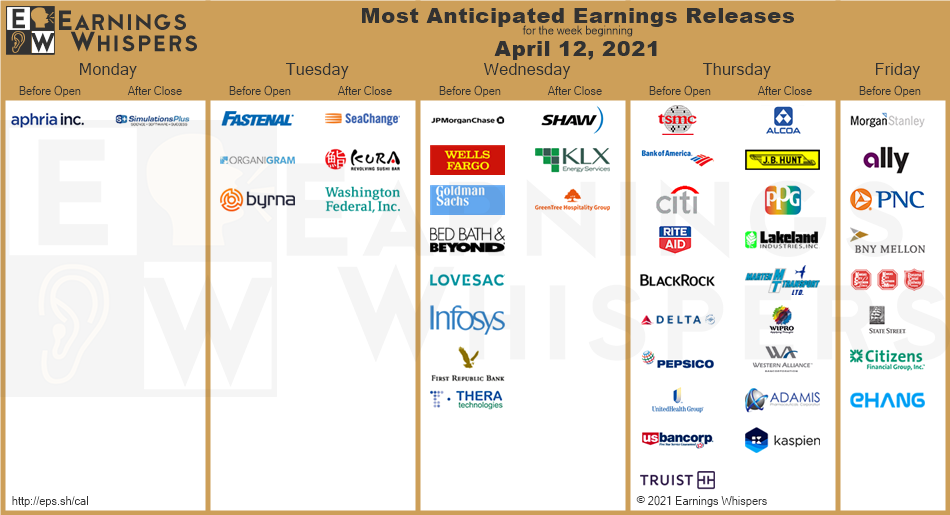
The week ahead — Economic data from Econoday.com:
Week of Mar 25, 2021 Weekly Recap & The Week Ahead

Tuesday, March 30th, 2021

“the first stage, when only a few unusually perceptive people believe things will get better, the second stage, when most investors realize that improvement is actually taking place, and the third stage, when everyone concludes things will get better forever.” ― Howard Marks

1. Germany Locks Down Again — Germany will lock down its economy during the coming Easter holiday as it tries to control another surge in coronavirus cases. In the U.S., new Covid-19 case data have decoupled from hospitalizations—in the best possible way. About 40,000 Americans are currently hospitalized with Covid-19 symptoms, down from about 47,000 a week ago. U.S. hospitalizations were north of 130,000 at the beginning of the year. Deaths have been declining too.
2. U.S. Officials Raise Doubts About AstraZeneca Vaccine Trial — the National Institute of Allergy and Infectious Diseases said in a statement that the Data Safety Monitoring Board, an independent body overseeing the Covid vaccine trials, had informed it that the U.K.-based pharmaceuticals group had provided outdated information to U.S. regulators. The news throws into doubt AstraZeneca’s ability to obtain swift approval for emergency use authorization by the U.S. regulator. The vaccine maker published the results of its U.S. trial, showing 79% efficacy against Covid-19 symptoms and 100% efficacy in preventing its most serious developments. The AstraZeneca vaccine, developed with Oxford University, was approved three months ago in the U.K. and Europe and has been the most widely used jab in the world since then.
It has been marred by safety concerns raised by several European governments, and EU officials’ anger over the company’s inability to fulfill its supply contract with the European Commission. Both the U.K. and EU medicines regulators insisted last week after new reviews that the vaccine was safe and should continue to be used.
3. Biden Advisers to Propose $3 Trillion Public Investment Plan — President Joe Biden’s economic advisers are in the process of putting together a multipart $3 trillion plan to boost spending on infrastructure and education, fight against climate change and reduce inequalities. The first part of the package would focus on infrastructure projects Biden touted in his “Build Back Better” plan that was released during his presidential campaign. That plan included funding for roads and bridges as well as climate-change initiatives.
The second part of the proposal would focus more on education and people. It would include extending the expanded child tax credit, tuition-free community college, universal prekindergarten, and a national paid leave program.
The Biden team is expected to recommend breaking up the plan to help it pass more quickly, according to the New York Times, which first reported details of the legislative strategy. Some White House officials believe the first set of proposals might be more appealing to Republicans. The strategy is still preliminary and under discussion.
Still, the proposal is likely to be fiercely debated, notably over its cost and eventual financing. The proposal would come days after Biden’s $1.9 trillion fiscal stimulus package was approved by Congress.
4. Intel’s New CEO Is Spending $20 Billion to Double Down on Chip Manufacturing — Intel CEO Gelsinger said that Intel planned to spend $20 billion to build two manufacturing plants in Arizona. The decision to do so comes amid increased U.S. government interest in securing domestic semiconductor manufacturing supply. Intel also said it plans to launch a stand-alone business unit called Intel Foundry Services that will offer advanced manufacturing capabilities to companies that design chips but don’t fabricate the semiconductors themselves.
Gelsinger, who assumed the CEO duties Feb. 15, said Intel plans to expand its use of third-party manufacturing plants—including for products at the core of Intel’s business, such as chips for personal computers and data centers—beginning in 2023. Some investors had speculated that Intel might leave the chip-making side of the business altogether.
5. New York Gets Ready to Legalize Marijuana for Recreational Use — New York is poised to join 14 other states that have already legalized the sale of recreational marijuana when lawmakers take up the measure next week. Under the proposed deal, anyone 21 and older could possess up to three ounces of pot as well as grow marijuana for personal use. A new Office of Cannabis Management would issue licenses to grow or sell cannabis. Local jurisdictions could also allow businesses to let people consume weed on site.

The week ahead — Economic data from Econoday.com:
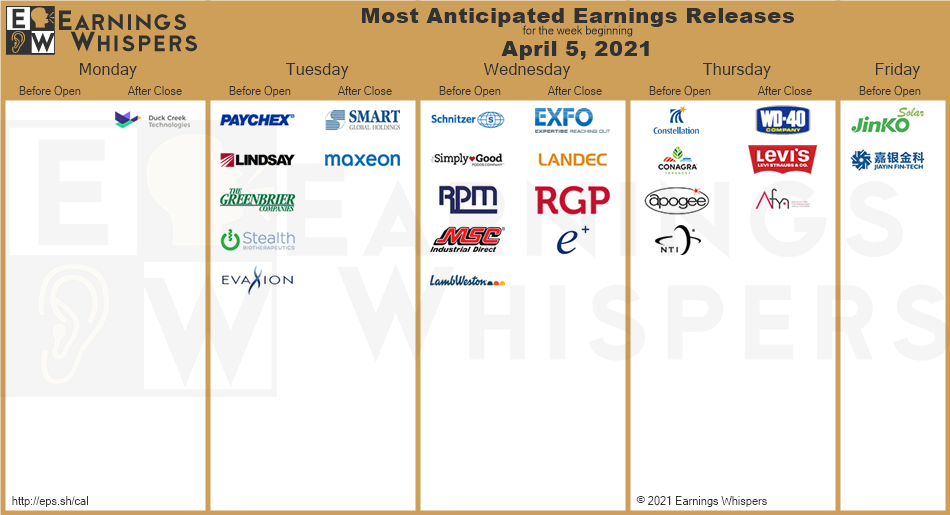
Week of Mar 18, 2021 Weekly Recap & The Week Ahead

Monday, March 22nd, 2021

“How? Try to travel into the future and look back. In 2023, do you think you’re more likely to say, “Back in 2018, I wish I’d been more aggressive” or “Back in 2018, I wish I’d been more defensive”? And is there anything today about which you’d be likely to say, “In 2018, I missed the chance of a lifetime to buy xyz”? What you think you might say a few years down the road can help you figure out what you should do today. ― Howard Marks

1. Germany Suspends Use of AstraZeneca Covid-19 Vaccine — Germany said it is temporarily stopping the administration of Covid-19 vaccines made by AstraZeneca. The Netherlands, Ireland and northern Italy became the latest places to temporarily halt the use of the AstraZeneca vaccine—which was developed with the University of Oxford and has been given to more than 17 million people in Europe—as concerns grow about its safety and effectiveness. Reports of blood clots in people who took the AstraZeneca vaccine have caused several countries—including the Netherlands, Ireland, Denmark, Austria, Estonia, Lithuania, Norway, Iceland, Bulgaria, Thailand—to stop or suspend its use. South Africa switched to the Johnson & Johnson vaccine after trials showed the AstraZeneca formula was less effective there.
2. Biden Looks for Ways to Finance Infrastructure, Push Economic Growth — Growing concerns about the U.S.’s rising deficit mean President Joe Biden will need to consider other financing options for future economic proposals—including his infrastructure spending package—like raising taxes. Biden is planning a tax increase that could raise both the corporate tax rate and the individual tax rate for people earning more than $400,000 a year, Bloomberg News reported. Treasury Secretary Janet Yellen said Sunday that the administration “will be putting forth proposals to get deficits under control.”
3. Fed Holds Steady on Interest Rates and Bond Purchases — The Fed said Wednesday that it would keep current policy unchanged but increased its forecasts for economic growth, prompting more officials to predict rate increases in 2023. In response to a question about winding down the central bank’s bond-buying program, Powell said that it is “not yet” time to start considering tapering its purchases. The central bank said in its latest statement that it would keep rates steady near zero, and reiterated it would keep buying $120 billion of Treasuries and mortgage-backed securities until “substantial further progress” is made toward the central bank’s goals of maximum employment
4. World-Wide Streaming Subscriptions Pass One Billion During Pandemic — The number of subscriptions to online video streaming services around the world reached 1.1 billion in 2020, according to data released by the Motion Picture Association. Meanwhile, global box-office revenues plunged by more than $30 billion in the year to $12 billion, as movie theaters were shut in the U.S. and in other parts of the world, according to the association. As new streaming services enter the U.S. market— Comcast Corp.and ViacomCBS Inc. have also launched platforms— Amazon. and AT&T Inc.’s HBO Max are following in Disney and Netflix’s footsteps by ramping up efforts to boost their share of international markets.

The week ahead — Economic data from Econoday.com:
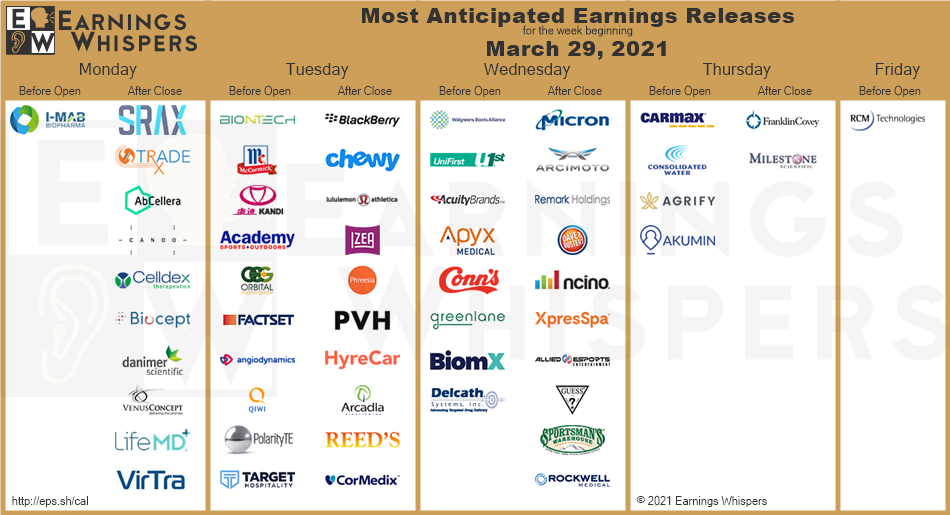
Week of Mar 12, 2021 Weekly Recap & The Week Ahead

Monday, March 15th, 2021

“In investing, it’s easy to achieve performance that is equal to that of the average investor or a market benchmark. Since it’s easy to be average, real investment success must consist of outperforming other investors and the averages. Investment success is largely a relative concept, measured on the basis of relative performance. Simply being right about a coming event isn’t enough to ensure superior relative performance if everyone holds the same view and as a result everyone is equally right. Thus success doesn’t lie in being right, but rather in being more right than others. Similarly, one doesn’t have to be right in order to be successful: just less wrong than others. Success doesn’t come from having a correct forecast, but from having a superior forecast. Can such forecasts be obtained?” ― Howard Marks

1. CDC Announces Vaccinated Americans Can Socialize Without Masks — People who have been fully vaccinated against Covid-19 can socialize in small groups without wearing masks or social distancing, the CDC said Monday. They can also visit unvaccinated people from a single household who are at low risk for the disease without masking.
Vaccinated adults should still keep their distance, wear masks and take other precautions in public, however, since less than 10% of Americans have been fully vaccinated to date. With new infections falling more slowly over the past few weeks and more dangerous variants taking hold, worries are rising over a resurgence just as young, mostly unvaccinated people are set to head to spring break hot spots in places like Florida, which has never had a statewide mask mandate.
2. A Likely Consumer Spending Boom with a Bigger Stimulus Checks & Reopenings — The third round of stimulus more directly targets lower earners, who are also more likely to spend their checks than others. Considering that consumer spending rose 2.4% in January after checks were issued, the larger, $1,400 checks could increase spending even more.
A rise in personal income, paired with more reopenings, could “unleash substantial pent-up demand” in service sector consumption, Jefferies chief economist Aneta Markowska said. She expects personal consumption spending to rise 7% in 2021 and 4.1% in 2022. However, a third of respondents said they planned to save more of their third stimulus check, with just 5% saying they planned to use it for a vacation or trip.
3. GE Announced Plans for an 8-for-1 Reverse Stock Split — company’s shares outstanding to roughly 1.1 billion from almost 9 billion, resulting in a stock price of about $112 a share, from $14. A scan of GE’s peers shows stock prices roughly between $100 and $200 a share and share counts in the hundreds of millions. GE also sold its jet-leasing business to AerCap and financial forecasts for 2021.
4. Biden to Sign Third Stimulus Package Into Law Friday, With Checks Following Soon — The House approved the bill Wednesday by a vote of 220-211, with all but one Democrat, Maine’s Jared Golden, supporting the bill and all Republicans opposing it. The $1,400 stimulus checks will start arriving this month and will not include Biden’s signature. The bill also extends supplemental federal unemployment benefits and provides $350 billion in aid to state and local governments. A proposed increase in the federal minimum wage didn’t make it into the final bill. Biden also said Wednesday that the U.S. plans to buy 100 million more doses of Johnson & Johnson’s one-shot vaccine and that it will share any surplus with the rest of the world. The U.S. is also giving $4 billion to an international program aimed at vaccinating the poorest countries.
5. Moderna Tests Booster Aimed at South African Variant on First Human — Moderna has started giving booster doses using a formula aimed specifically at targeting a coronavirus variant first found in South Africa. The variant appears to be 50% more contagious than earlier forms of the virus and Moderna has said its current vaccine is six times less effective at neutralizing it.
Pfizer, whose vaccine was shown to be two-thirds less potent against the same strain in a study published in the New England Journal of Medicine in February, is studying the effectiveness of giving patients a third dose of its existing vaccine. A study released this week found the Pfizer vaccine was highly effective against a strain first found in Brazil. The Food and Drug Administration recently revised its rules to let pharmaceutical companies run smaller trials to shorten the time for modified vaccines to get authorized for widespread use, which could shave months off the approval process.

The week ahead — Economic data from Econoday.com:
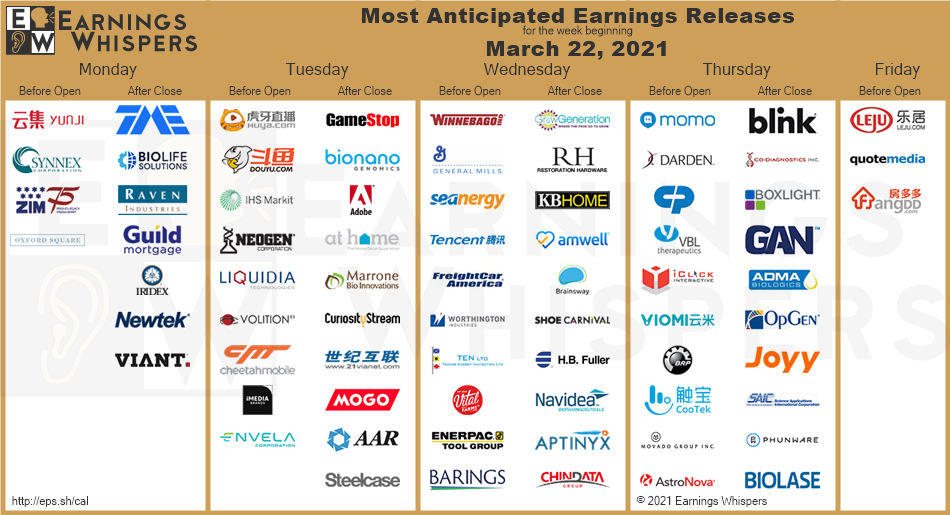
Week of Mar 5, 2021 Weekly Recap & The Week Ahead

Monday, March 8th, 2021

“It’s particularly important in this vein to note the extent to which economic expectations can be self-fulfilling. If people (and companies) believe the future will be good, they’ll spend more and invest more . . . and the future will be good, and vice versa. It’s my belief that most companies concluded that the Crisis of 2008 wouldn’t be followed by a V-shaped recovery, as had been the rule in the last few recessions. Thus they declined to expand factories or workforces, and the resulting recovery was modest and gradual in the U.S. (and even more anemic elsewhere).”
― Howard Marks

1. Democrats Can Get Stimulus Signed Into Law by March 14 — the Senate will introduce its version of President Joe Biden’s $1.9 trillion stimulus plan as soon as Wednesday, kicking off the final push to get the legislation signed into law before federal unemployment benefits expire for millions of Americans. Senate Majority Leader Chuck Schumer (D, N.Y.) will present the bill—which includes $1,400 direct payments to most Americans, aid to state and local governments, and other spending measures—on the Senate floor. That starts the clock on 20 hours of debate followed by time for senators to introduce amendments and challenges. A floor vote could happen Friday morning, and is expected to fall along party lines with Vice President Kamala Harris casting the deciding vote in favor of the bill.
2. Biden Says U.S. Could Have Enough Vaccine Doses for Every American in May — President Joe Biden announced that the U.S. will have enough coronavirus vaccine doses for every American by the end of May thanks in part to Merck working with Johnson & Johnson to ramp up vaccine supplies after production delays caused the company to miss its initial target. The U.S. has a $1 billion contract with J&J for 100 million doses at a price of $10 per dose, about half of what it is paying for the Pfizer drug. J&J now expects to have 20 million doses ready by the end of March and 100 million by June.
3. Tighter Eligibility for Stimulus Payments Could Exclude 12 Million More Americans — unlike the House bill approved last week, which lets individuals earning up to $100,000 and married couples making $200,000 receive reduced payments, the Senate version will give nothing to individuals who make more than $80,000 or couples making more than $160,000. The change, which has Biden’s support, means as many as 12 million fewer adults will get checks, according to the Institute on Taxation and Economic Policy, and could shave $15 billion to $20 billion off the bill’s total cost, which must come in under $1.9 trillion.
4. 30-Year Mortgage Rate Tops 3% for First Time Since July — The average rate on a 30-year fixed-rate mortgage rose to 3.02%, mortgage-finance giant Freddie Mac said Thursday. It is the first time the rate on America’s most popular home loan has risen above 3% since July and the fifth consecutive week it has increased or held steady. Mortgage rates tend to move in the same direction as the yield on the 10-year Treasury, which has been rising. Treasury yields rise when investors feel confident enough in the economy to forgo safe-haven assets such as bonds for riskier ones including stocks.

The week ahead — Economic data from Econoday.com:
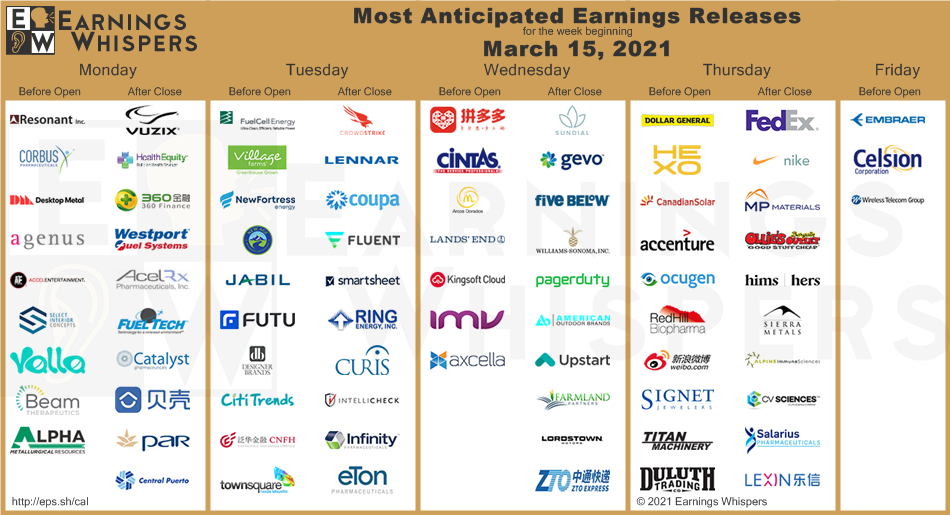
Week of Feb 26, 2021 Weekly Recap & The Week Ahead

Monday, March 1st, 2021

“One of the great sayings about poker is that “in every game there’s a fish. If you’ve played for 45 minutes and haven’t figured out who the fish is, then it’s you.” The same is certainly true of inefficient market investing.” ― Howard Marks

1. J&J Vaccine a Step Closer to Authorization — the FDA is currently considering the company’s application for emergency-use authorization for the vaccine, which would be the third Covid-19 vaccine to receive FDA authorization. Efficacy against moderate to severe Covid-19 was 66.1% after 28 days, but efficacy against severe Covid-19 was far better, at 85.4% after 28 days. What’s more, across the entire study, there were only two cases of Covid-19 hospitalization in the vaccine group, and none after 28 days, compared with 29 cases in the placebo group. There were no Covid-19-related deaths in the vaccine group, compared with seven in the placebo group.
2. Moderna Says Covid-19 Vaccine for South Africa Strain Is Ready for Human Testing — Moderna said it shipped the new shots to the National Institutes of Health to conduct the first human study of the variant vaccine, which could start within weeks. The new vaccine, code-named mRNA-1273.351, is designed to better match the virus variant that was first identified in South Africa but has since spread elsewhere. Other companies including Pfizer Inc. and Johnson & Johnson have said they are tweaking their vaccines or working on boosters that better match variants. Older vaccines don’t appear to work as well against the strain first identified in South Africa, and difficult new strains could also emerge.
3. Ten-year Treasury Yields Reach the Highest In a Year — ten-year Treasury yields spiked after tepid demand at an auction for government bonds, surging as much as 23 basis points to 1.6%, the highest since last February. The increase forced a crucial group of investors such as holders of mortgage securities to sell Treasuries, which in turn led to further increases in yields. The 10-year U.S. yield adjusted for inflation rose to its highest level since June, a warning sign for riskier assets that have benefited from exceptionally loose financial conditions amid the pandemic.
4. J&J’s One-Shot Covid Vaccine Receives FDA Advisers’ Backing — experts advising the U.S. Food and Drug Administration voted 22-0, with no abstentions, that the benefits of the vaccine outweigh its risks in adults 18 and older, a decision that could help bolster the vaccine supply as new variants continue to spread. The J&J shot is highly anticipated because it can be kept in a refrigerator for three months, an advantage over the mRNA vaccines that must be frozen when stored for longer periods, and its single-shot regime. Overall, the rate of side effects was low. However, there were more cases of deep vein thrombosis and pulmonary embolism in people who got the vaccine compared to the placebo group, said Yosefa Hefter, a medical officer in FDA’s Center for Biologics Evaluation and Research.
5. Senate Democrats to Drop Minimum Wage From Relief Package — Senate Democrats will drop a plan to introduce an amendment to the Senate stimulus bill that would have used tax penalties and incentives to raise wages for the lowest-paid workers at big companies. Lawmakers are aiming to the pass the relief package before federal unemployment benefits run out on March 14. That was too tight of a time frame to try to use the tax code to raise wages, according to sources The Wall Street Journal spoke with.

The week ahead — Economic data from Econoday.com:
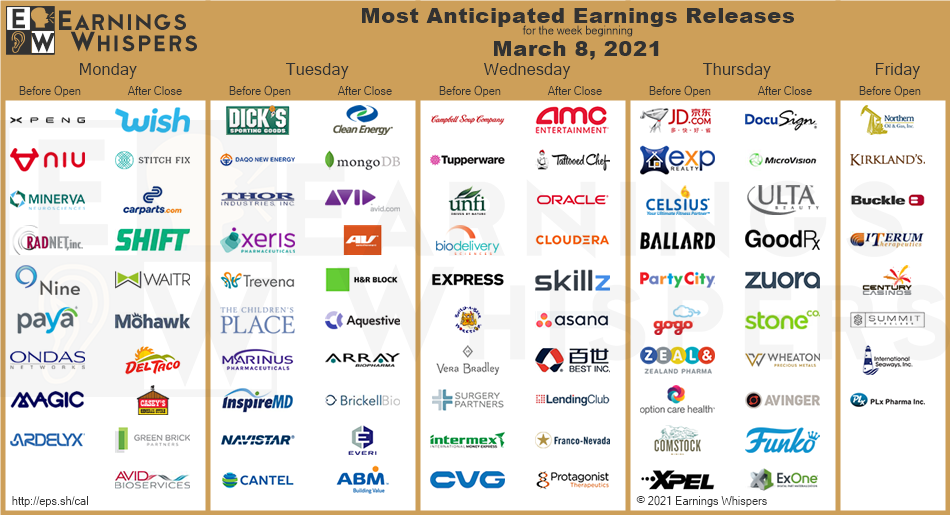
Week of Feb 19, 2021 Weekly Recap & The Week Ahead

Tuesday, February 23rd, 2021

1. AstraZeneca Vaccine Gains Wider Acceptance — the vaccine developed jointly by Oxford University and AstraZeneca is being approved by a rising number of regulators, paving the way for its generalized use. The Australian medicine regulator gave provisional approval for the Oxford/AstraZeneca Covid-19 vaccine on Tuesday, ahead of a national vaccination campaign due to start next week. The World Health Organization on Monday approved the vaccine for emergency use, which should allow developing countries a wide access to the jab. AstraZeneca has pledged not to profit from the sale of the vaccine, which is sold at the cheapest price of any available vaccine—at €1.80 ($2.20) a dose, for example, in the European Union, compared to €18 a dose for the Moderna vaccine and €12 for the Pfizer jab.
2. Covid-19 Was Spreading in China Before First Confirmed Cases — new evidence from China is affirming what epidemiologists have long suspected: The coronavirus likely began spreading unnoticed around the Wuhan area in November 2019, before it exploded in multiple different locations throughout the city in December. Chinese authorities declined to give the WHO team raw data on these cases and potential earlier ones. In examining 13 genetic sequences of the virus from December, Chinese authorities found similar sequences among those linked to the market, but slight differences in those of people without any link to it, according to the WHO investigators.
3. U.S. Retail Sales Rose Strongly on Stimulus in January — The U.S. economy’s recovery picked up as consumers used stimulus checks to boost retail spending in January to its largest increase in seven months. The Federal Reserve Bank of Atlanta’s GDPNow model on Wednesday predicted the economy will grow at a 9.5% seasonally adjusted annual rate in the first quarter, up sharply from a 4.5% estimate a week ago. Minutes from the Fed’s January policy meeting separately showed that policy makers expected the end-of-year federal stimulus package and progress toward widespread vaccinations would improve the outlook for the economy.
4. Saudi Arabia Set to Raise Oil Output Amid Recovery in Pricesthe Kingdom plans to announce a reversal of those cuts when a coalition of oil producers meet next month, the advisers said, in light of the recent recovery in prices. The output rise won’t kick in until April, given the Saudis already have committed to stick to cuts through March. Brent crude, the international oil benchmark, has hit $64 a barrel, while West Texas Intermediate, the main grade of U.S. crude, crossed $60.

The week ahead — Economic data from Econoday.com:
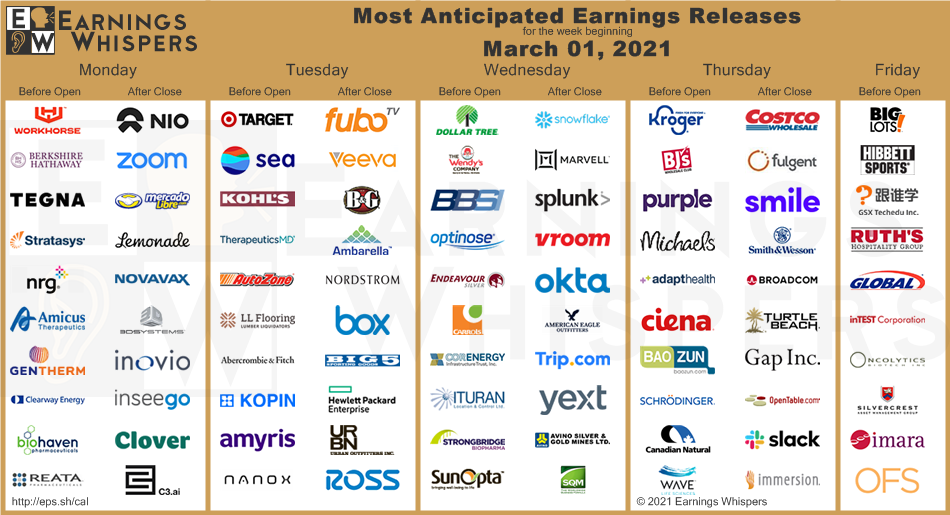
Week of Feb 12, 2021 Weekly Recap & The Week Ahead

Monday, February 15th, 2021

“The desire for more, the fear of missing out, the tendency to compare against others, the influence of the crowd and the dream of the sure thing—these factors are near universal. Thus they have a profound collective impact on most investors and most markets. This is especially true at the market extremes. The result is mistakes—frequent, widespread, recurring, expensive mistakes.” ― Howard Marks

1. Elon Musk Announced that Tesla had bought $1.5 billion in Bitcoin — Tesla, which announced that it bought $1.5 billion worth of Bitcoin to hold on its balance sheet, and that it plans to allow car buyers to pay in Bitcoin. For Tesla, one big reason for the investment appears to be the enthusiasm of its chief executive, Elon Musk. Alsok, Mastercard said Wednesday it will start allowing businesses to accept some crypto payments, though they’ll be converted into standard currencies before they hit the register. On Thursday, BNY Mellon, founded by Alexander Hamilton, said it will hold and transfer cryptocurrencies for customers, just like it does with other assets.
2. U.S., France Flex Muscles in South China Sea — Two U.S. carrier groups are conducting exercises in the waters disputed by China, raising Beijing’s ire as France announced one of its attack submarines had sailed through the zone. French Defense Minister Florence Parly said that a French attack submarine and its support vessel had just sailed through the South China Sea to reaffirm, together with Australia, Japan and the U.S., that “international law is the only rule that matters.”
International powers have contested China’s ambitions on most of the resource-rich area, after Beijing built military outposts on reefs and sandbars transformed into man-made islands in order to claim sovereignty on the 12-miles zone of territorial waters.
3. Bitcoin to Come to America’s Oldest Bank, BNY Mellon — the custody bank said late last week that it will hold, transfer and issue bitcoin and other cryptocurrencies on behalf of its asset-management clients. Custodians like BNY Mellon keep track of money managers’ assets—whether they are physical things like real estate or cash housed in an account with another bank—storing some themselves while attesting to the existence of others. BNY Mellon said it would allow digital assets to pass through the same plumbing used by managers’ other, more traditional holdings—from Treasurys to technology stocks—using a platform that is now in prototype. The bank is already discussing plans with clients to bri Tesla, which announced on Monday that it bought $1.5 billion worth of Bitcoin to hold on its balance sheet, and that it plans to allow car buyers to pay in Bitcoin. For Tesla, one big reason for the investment appears to be the enthusiasm of its chief executive, Elon Muskng their digital currencies into the fold.
4. Biden, China’s Xi Hold Talks Over Human Rights, Trade, Climate — President Biden spoke with Chinese President Xi Jinping for the first time since taking office in a call in which he said he raised issues of human rights, trade policy and international security that divide the two countries while also holding open the possibility of working together on climate change and nuclear proliferation. Mr. Biden in recent days spoke with a host of allies in Europe and Asia, signaling that he seeks to deal with China as the leader of the world’s democracies rather than solely an American president. The U.S. needs to “join together with others to hold China accountable for its abuses and to shape China’s choices going forward,” said a senior administration official.
5. Trump Acquitted of Inciting Insurrection, Even as Bipartisan Majority Votes ‘Guilty’ — the 57-to-43 tally fell 10 votes short of the two-thirds majority needed to convict, and allow the Senate to move to disqualify him from holding future office. Among the Republicans breaking ranks to find guilty the man who led their party for four tumultuous years, demanding absolute loyalty, were Senators Richard Burr of North Carolina, Bill Cassidy of Louisiana, Susan Collins of Maine, Lisa Murkowski of Alaska, Mitt Romney of Utah, Ben Sasse of Nebraska and Patrick J. Toomey of Pennsylvania.

The week ahead — Economic data from Econoday.com:
Search
Calendar
February 2026
M T W T F S S
« Jan    
 1
2345678
9101112131415
16171819202122
232425262728  
Archives
Categories
The information provided by The EGS Blog is based on sources believed to be reliable, but it is not guaranteed to be accurate. There is no guarantee that the recommendations of The EGS Blog will be profitable or will not be subject to losses. The information provided by The EGS Blog is not a recommendation or a solicitation that any particular investor should purchase or sell any particular security in any amount, or at all. The investments discussed or recommended herein may be unsuitable for investors depending on their specific investment objectives and financial position. At any time EGS LLC and its principals may maintain positions that are contrary to positions announced within the subscription service. In no event will The EGS Blog be liable to you or anyone else for any incidental, consequential, special, or indirect damage (including but not limited to lost profits or trading losses). PAST PERFORMANCE IS NO GUARANTEE OF FUTURE RESULTS

© Copyright 2026 Market Outlook All Rights Reserved
Design by EGS Sponsored by Equity Guidance LLC