Archive for the ‘Weekly Summary’ Category

Week of Mar 22, 2024 Weekly Recap & The Week Ahead

Tuesday, March 26th, 2024

“My attitude is that I always want to be better prepared than someone I’m competing against. …” — unknown

1. Fed Officials Still See Three Interest-Rate Cuts This Year — Federal Reserve Chair Jerome Powell indicated that stronger growth and firmer-than-anticipated inflation in recent months hadn’t changed his expectation that the central bank would be able to cut interest rates this year. New projections released Wednesday reinforced that view by showing most of his colleagues expect to cut rates two or three times this year, with a narrow majority penciling in three cuts, the same as in December. The central bank held steady its benchmark federal-funds rate in a range between 5.25% and 5.5%, a 23-year high. Expectations that the Fed would cut rates by June rose to around 75% in futures markets later Wednesday, up from closer to 50% earlier this week, according to CME Group.
2. February home sales spike 9.5%, the largest monthly gain in a year, as supply improves — Sales of existing homes surged 9.5% in February from January to 4.38 million units, on a seasonally adjusted annualized basis, according to the National Association of Realtors. Housing analysts had been expecting a slight drop. Sales were down 3.3% year over year, but it was the largest monthly gain since February 2023. Sales surged the most in the West, up 19.4%, and the South, up 16.4%. Sales in the Northeast were unchanged. Inventory rose 10.3% year over year to 1.07 million homes for sale at the end of February. That represents a still low 2.9-month supply at the current sales pace.
Higher demand continued to push the median price higher, up 5.7% from the year before to $384,500 — the eighth straight month of annual gains. Competition was stiff, with 20% of homes selling above list price.
3. Swiss central bank becomes first major bank to cut rates as Fed and ECB edge closer to taking action — The global rate-cutting cycle was started on Thursday when the Swiss National Bank made a quarter-point reduction in rates that took markets by surprise. Officials of other central banks, including Fed Chair Jerome Powell and European Central Bank President Christine Lagarde, said rate cuts could be coming in just a few months’ time. Lagarde said a June cut was “likely,” while Powell said the base case was that there would be three reductions this year, which markets interpret to mean that a June reduction is highly likely.
Some suggested the Bank of England could cut rates as early as May, after two voting members changed their minds on the need to hike, and as minutes suggested that the bank’s policy would be restrictive even if reductions were made. The Bank of Canada also is planning rate cuts.

The week ahead — Economic data from Econoday.com:
Week of Mar 15, 2024 Weekly Recap & The Week Ahead

Tuesday, March 19th, 2024

“The purpose of trading is not being right, the purpose is to make money, and I think that’s my number-one rule. Don’t get hung up on your current positions.” -Dana Allen.

1. Inflation Picks Up to 3.2%, Slightly Hotter Than Expected — Consumer prices rose 3.2% in February from a year earlier, the Labor Department said Tuesday, up slightly from economists’ expectations of 3.1%. The second straight month of firmer-than-expected inflation is likely to reinforce the central bank’s wait-and-see posture toward rate reductions when officials meet next week. Still, officials are focused on when to cut rates rather than whether to raise them again. Inflation has declined notably from 40-year highs following the most rapid rate increases in four decades. Still, the report didn’t make the Fed’s coming deliberations easier. Core prices, which exclude food and energy items in an effort to better track inflation’s underlying trend, rose more than expected, both when measured from a year ago and a month ago.
2. Microsoft to Launch AI Assistant for Security Products — Microsoft will make its artificial intelligence product Copilot for Security available worldwide next month, its latest foray into integrating AI with its products. Microsoft’s previous launches in AI have been met with mixed reactions. The company’s launch of Copilot for Microsoft 365, which allowed the chatbot to integrate with Word, Outlook and Teams, was deemed useful by users, but some said it didn’t live up to the price. Copilot for Security can process prompts and respond in eight languages. The program also has a multilingual interface for 25 different languages.
Microsoft said Copilot for Security would be available in a standalone portal and embedded in existing security products from the company.
3. Wholesale inflation rose 0.6% in February, much more than expected — The producer price index, which measures pipeline costs for raw, intermediate and finished goods, jumped 0.6% on the month, the Labor Department’s Bureau of Labor Statistics reported Thursday. That was higher than the 0.3% forecast from Dow Jones and comes after a 0.3% increase in January.
Excluding food and energy, the core PPI accelerated by 0.3%, compared with the estimate for a 0.2% increase. Another measure that also excludes trade services rose 0.4%, compared with the 0.6% gain in January, and was above the estimate for a 0.2% advance. Also, initial filings for unemployment insurance nudged lower to 209,000 last week, a decrease of 1,000 and below the estimate for 218,000, the Labor Department reported. Continuing claims edged higher to 1.81 million, though the previous week’s count was revised sharply lower.
4. U.S. Retail Sales Rose 0.6% in February — excluding autos, sales were up 0.3%. Economists had expected an increase of 0.4%, sans autos.
The monthly report on how consumers are spending or pulling back is viewed as a harbinger for the state of the U.S. economy. Many economists believe that Americans are close to spending down their pandemic-buffered savings and are feeling stretched by inflation, which has impacted the prices of everyday essentials from groceries to rent. Still, the Commerce Department said that the drop in January sales was sharper than previous calculations. January sales were revised from down 0.8% to down 1.1%.

The week ahead — Economic data from Econoday.com:

/>

Week of Mar 8, 2024 Weekly Recap & The Week Ahead

Tuesday, March 12th, 2024

“Do more of what works and less of what doesn’t.” – Steve Clark
1. Fed Jerome Powell Says Fed on Track to Cut Rates This Year — Federal Reserve Chair Jerome Powell reiterated that he expects interest rates to start coming down this year, but is not ready yet to say when. Rate cuts won’t be warranted until officials have “gained greater confidence that inflation is moving sustainably” toward the central bank’s 2% goal, Powell told the House Financial Services Committee on Wednesday during the start of two days of testimony on Capitol Hill. Fed officials are trying to balance two risks: One is that they move too slowly to ease policy and the economy crumples under the weight of higher interest rates. The other is that they ease prematurely, allowing inflation to become entrenched at a level well above their 2% goal.
2. ECB Keeps Rates Steady – a June Cut Is Possible — the European Central Bank left interest rates unchanged on Thursday and kept the door open for cuts later this year. As with the U.S. Federal Reserve, the question for ECB President Christine Lagarde is how soon rates can start going lower. Economists widely predict a quarter-point reduction in June. Like the Fed, the ECB raised borrowing costs aggressively from 2022 to 2023 and has been on hold for about half a year now. Also similar to the U.S., inflation in Europe has continued to slow—the last reading for the euro zone was 2.6% in February. That’s still higher than the ECB’s target of 2%, but it has come down dramatically from a peak of more than 10% in October 2022. the big difference between Europe and the U.S. is the poor performance of the economy on the other side of the Atlantic. Growth flatlined in the second half. Germany, the biggest economy among the 20 countries sharing the euro, is in recession.
3. U.S. economy adds 275,000 jobs in February — outpacing forecasts — as unemployment rate hits 3.9%, even with downward revisions in December and January, the economy had added an average of 228,00 new jobs a month since last August. That’s very strong. In February, the household survey showed a sharp increase in the number of unemployed people and a decline in employment. As a result, the jobless rate climbed to a 25-month high of 3.9% from 3.7%. Employment growth in the previous two months were revised 167,000 lower than previously reported. That made the increase in February not quite as strong as it appeared.
4. White House Revives Plan to Save Homeowners Money on Closing Costs — the initiative aims to reduce one of the biggest costs associated with closing on a mortgage: title insurance. Under a pilot program, government-controlled mortgage giant Fannie Mae will waive a requirement for title insurance on mortgage refinancings it purchases from certain lenders.
The move reignites a fight with the industry over the cost, and necessity, of the insurance, part of the White House’s broader aim to chip away barriers to homeownership. The administration announced the program hours ahead of President Biden’s State of the Union address. The industry is dominated by a few big players, including the publicly traded First American Financial. The American Land Title Association, an industry group, criticized the plan as “a purely political gesture offering a false promise of savings for homeowners.” The group said it would expose consumers, lenders and taxpayers to greater financial risk.

The week ahead — Economic data from Econoday.com:
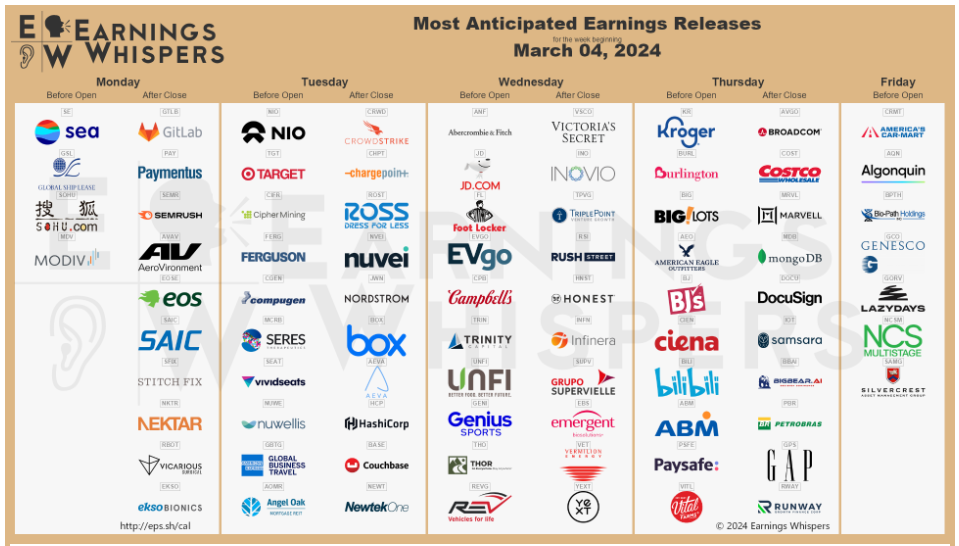
Week of Mar 1, 2024 Weekly Recap & The Week Ahead

Friday, March 1st, 2024

“Being too far ahead of your time is indistinguishable from being wrong.” So” ― Howard Marks

1. US GDP Revised Slightly Lower Despite Stronger Consumer Spending — Gross domestic product rose at a revised 3.2% annualized pace in the fourth quarter, compared with a prior estimate of 3.3%. Consumer spending advanced at a 3% rate, faster than initially estimated, Bureau of Economic Analysis figures showed Wednesday. Inflation was revised higher. Last year the economy expanded 2.5%, marking an acceleration from 2022 and far outperforming the broader eurozone and Japan. The Fed’s preferred inflation metric — the personal consumption expenditures price index — rose at a 1.8% annual rate in the fourth quarter. Excluding food and energy, the gauge increased at a 2.1% pace, the Bureau of Economic Analysis report showed. Both were marginally higher than initially estimated.
2. PCE shows biggest rise in U.S. inflation in four months — The PCE index rose 0.3% last month, the government said Wednesday. That matched the forecast of economists polled by The Wall Street Journal. The more closely followed core rate that strips out food and energy rose a sharper 0.4%, the largest increase in a year. The core index is viewed as a better predictor of future inflation. The yearly rate of inflation, meanwhile, still fell a few ticks to 2.4% from 2.6%. The rate of core inflation in the 12 months ended in January slowed to 2.8% from 2.9%.
3. AI Startup Making Humanoid Robots Raises $675 Million With Bezos, Nvidia in Funding Round — Tech companies are pouring cash into AI at a breakneck pace, with investors and analysts increasingly believing the AI boom is sustainable. More than $29 billion was invested in generative AI companies last year, according to research firm PitchBook. Nvidia, the chip maker at the heart of the AI craze, has a market cap around $2 trillion, making it one of the biggest companies in the U.S.
AI has powered the technology behind chatbots like OpenAI’s ChatGPT and the humanoid robots designed by Figure. The startup said it was working with OpenAI on developing new AI models for humanoid robots. Figure said the investment would speed up the commercial deployment of its robots. The startup has said it signed an agreement with BMW to use its robots for automotive manufacturing.
4. Congress votes to avert government shutdown — Facing an end-of-the-week deadline, the House of Representatives passed a bill to temporarily fund one set of federal agencies through March 8 and another set through March 22. It quickly moved to the Senate, which passed it Thursday evening, on a 77-13 vote. The bill now goes to President Joe Biden to be signed into law ahead of a Saturday deadline. Without action, a handful of agencies, including the Department of Agriculture, would partially close early Saturday. The remaining agencies, including the Pentagon, would partly shutter after March 8.

The week ahead — Economic data from Econoday.com:
Week of Feb 23, 2024 Weekly Recap & The Week Ahead

Wednesday, February 28th, 2024

There will not be any re-cap for the week of Feb 19 through Feb 23, 2024. We are away for some needed R&R.

Have a good week.

The staffs at EGS.

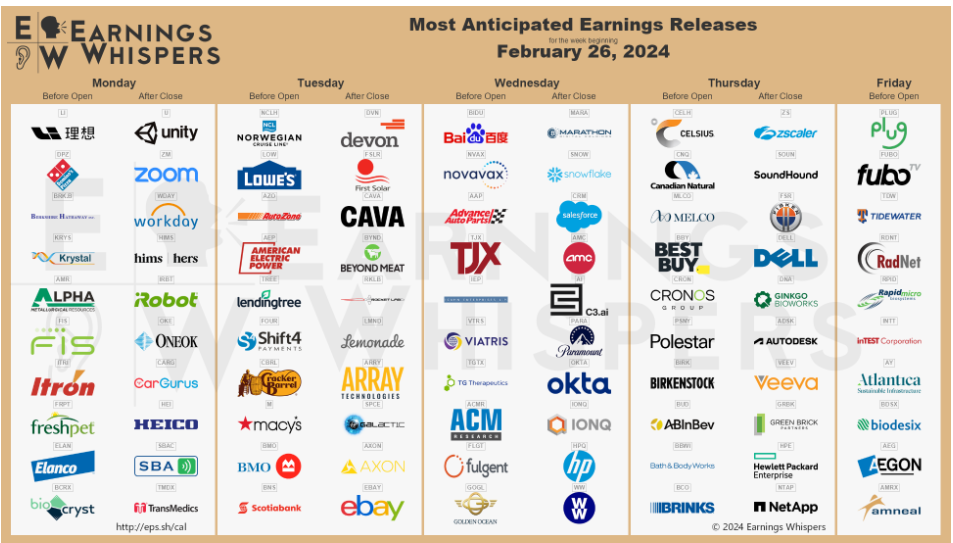
The week ahead — Economic data from Econoday.com:
Week of Feb 16, 2024 Weekly Recap & The Week Ahead

Tuesday, February 20th, 2024

“Hope is [a] bogus emotion that only costs you money.”

1. Inflation at 3.1% Reflects Stubborn Pricing Pressure, Clouding Outlook for Fed Rate Cuts — the Labor Department reported Tuesday that consumer prices rose 3.1% in January from a year earlier, versus a December gain of 3.4%. That marked the lowest reading since June. Still, the consumer-price index was higher than the predicted 2.9%, a disappointment for investors who hope the Fed will cut rates sooner rather than later. Rate cuts tend to help stock prices by boosting economic activity and reducing competition from bonds for investor dollars. But Tuesday’s inflation report underscores why Fed officials have been dismissive of such expectations, and it could provide ammunition to officials who want to wait until the middle of the year before cutting interest rates. Some Fed officials have suggested that the pace of improvement over the past six months might overstate underlying progress in containing price pressures.
2. US Producer Prices Increased by More Than Forecast in January — the producer price index for final demand increased 0.3% from December, Labor Department data showed Friday. The gauge rose 0.9% from a year earlier, also exceeding forecasts. The so-called core PPI, which excludes volatile food and energy categories, climbed 0.5% from the prior month, and 2% from a year ago — both topping expectations. The advance reflected increases in services categories, including hospital outpatient care and portfolio management.
3. Housing starts post sharpest drop since April 2020 — housing starts fell to a 1.33 million annual pace from 1.56 million in December, the government said Friday. That’s how many houses would be built over an entire year if construction took place at the same rate every month as it did in January. Housing starts fell to the lowest level since August 2023.
The drop in January was the sharpest since April 2020, during the coronavirus pandemic, when starts fell by nearly 27%. Not including that pandemic drop, housing starts fell by the most since 2015.
4. New OpenAI Technology Can Create Realistic Video From a Line of Text — OpenAI calls the new system Sora. It takes a written prompt and, through AI, renders a richly detailed video. OpenAI is one of many companies like Alphabet’s Google and Meta Platforms seeking to capitalize on new AI-video developments. Microsoft-backed OpenAI, maker of the ChatGPT AI chatbot, said it is sharing the text-to-video technology with a select group of researchers and academics who will study it to find ways the AI program could be misused. It hasn’t been released to the public. OpenAI previously released a program called Dall-E 2 that produces still images based on text descriptions.

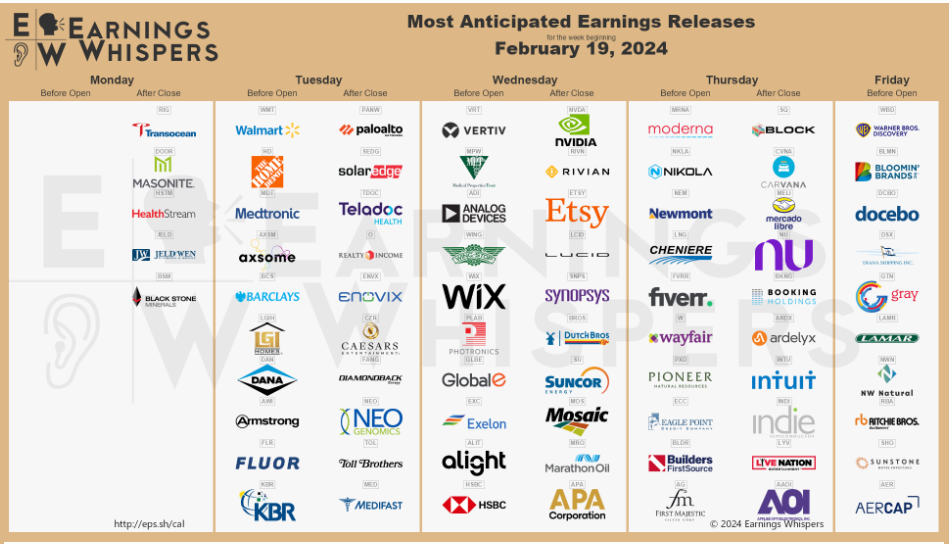
The week ahead — Economic data from Econoday.com:
Week of Feb 9, 2024 Weekly Recap & The Week Ahead

Tuesday, February 13th, 2024

“Trading is very competitive and you have to be able to handle getting your butt kicked.” — unknown

1. Biden Administration Explores Raising Tariffs on Chinese EVs — Biden administration officials, long divided over trade policy, have left in place Trump-era tariffs on roughly $300 billion of Chinese goods. But officials at the White House and other agencies are debating the levies again, the people said, with an eye on wrapping up a long-running review of the tariffs early next year. Chinese EVs are already subject to a 25% tariff, which has helped prevent subsidized Chinese automakers from making inroads into the U.S. market. Raising that tariff, which comes on top of a 2.5% tariff on auto imports, likely would have little immediate impact on U.S. consumers. Other targets for potential tariff-rate increases are Chinese solar products and EV battery packs, the people said. While the U.S. now primarily imports solar material from Southeast Asian countries, China is still an important supplier of EV batteries.
2. In China, Deflation Tightens Its Grip — the latest data suggest China faces a growing risk of slipping into a longer-term spell of falling prices that becomes harder to reverse the longer it lasts. That presents a special challenge for the rest of the world. While cheaper goods from China might help ease inflation elsewhere, it means the global economy can also expect a flood of cut-price imports as Chinese factories search out buyers overseas for products they can’t sell at home. That risks squeezing other countries’ domestic manufacturing, stoking already acute tensions over trade between China and the U.S.-led West. China’s sinking prices add to a litany of economic challenges in the country this year. Growth is projected to slow from last year’s underwhelming pace. A drawn-out real-estate crunch is throttling consumer spending, with China Evergrande Group—the poster child for the sector’s woes—ordered into liquidation by a Hong Kong court. Exports are struggling and foreign investors are fleeing. Beijing on Wednesday replaced the country’s top securities regulator after an epic stock-market rout.
3. S&P 500 Tops 5,000 — the S&P 500 closed at a record level on Friday, finishing above 5,000 for the first time ever as investors looked to next week’s inflation data for a confirmation of easing price pressures. So far this year, investors have largely focused on the positive signs for markets: Economic data, including the latest readings on labor and gross domestic product, have boosted hopes that the Federal Reserve monetary policy actions won’t hamper growth. Recent earnings results from Palantir Technologies and IBM have also lifted hype about artificial intelligence. These themes have carried the S&P 500 upwards in 14 out of the past 15 weeks–something which hasn’t happened since 1972.

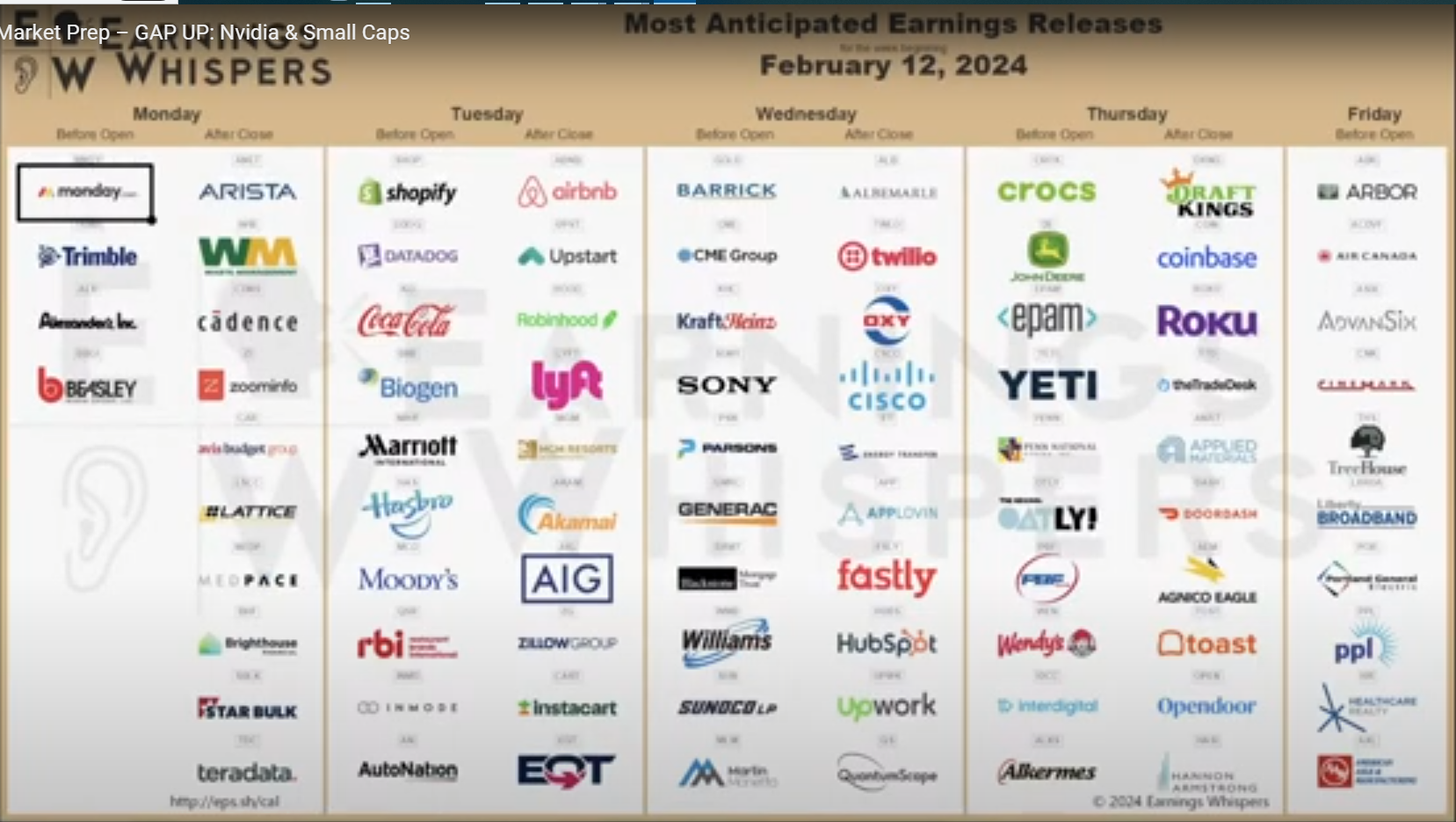
The week ahead — Economic data from Econoday.com:
Week of Feb 2, 2024 Weekly Recap & The Week Ahead

Thursday, February 1st, 2024

“If you can learn to create a state of mind that is not affected by the market’s behaviour, the struggle will cease to exist.” -Mark Douglas

1. Job Quitting Fell 12% Last Year — workers called it quits less frequently in 2023, a sign confidence in the labor market is falling as the U.S. economy is expected to slow and Americans are taking longer to find new jobs. Americans quit 6.1 million fewer jobs last year than in 2022—a decline of 12%, the Labor Department said Tuesday. In December alone, quits fell to the lowest monthly level in nearly three years, after adjusting for seasonal fluctuations. In more recent months, prospective job seekers have seen news of high-profile layoffs, smaller pay bumps and sharp slowdowns in hiring in certain industries. Those pockets of weakness stand in contrast to years of consistent overall job growth and a historically low 3.7% unemployment rate at the end of last year.
2. Private payroll growth slowed to just 107,000 in January, below expectations — Private payroll growth declined sharply in January, a possible sign that the U.S. labor market is heading for a slowdown this year, ADP reported Wednesday. Companies added 107,000 workers in the first month of 2024, off from the downwardly revised 158,000 in December and below the Dow Jones estimate for 150,000, according to the payrolls processing firm. Leisure and hospitality posted the biggest increase, with an addition of 28,000 workers, while trade, transportation and utilities added 23,000, and construction rose by 22,000. Services-providing companies were responsible for 77,000 jobs, with goods producers adding the rest.
3. Fed Keeps Rates Steady While Powell Says March Cut Unlikely — the Federal Reserve held interest rates steady for a fourth straight meeting and signaled an openness to cutting them, though Fed Chair Jerome Powell threw cold water on investors’ hopes that reductions would begin in March. The central bank’s policy-making Federal Open Market Committee showed it is in no rush to reduce rates, noting in a statement Wednesday that it “does not expect it will be appropriate to reduce the target range until it has gained greater confidence that inflation is moving sustainably toward 2%.” While Powell acknowledged the dramatic inflation progress seen in recent months, he repeatedly emphasized the need to see “more” data confirming that downward trend. Powell spoke just after the Fed issued a statement following their two-day meeting, where officials dropped their previous assertion that a rate hike was possible and instead adopted a more even-handed assessment of the future policy path.
4. January hiring was the lowest for the month on record as layoffs surged — the report follows news Wednesday from ADP that private payrolls increased by just 107,000 for the month. On Friday, the Labor Department will be releasing its nonfarm payrolls count, which is expected to show growth of 185,000. The job outplacement firm said planned layoffs totaled 82,307 for the month, a jump of 136% from December though still down 20% from the same period a year ago. It was the second-highest layoff total and the lowest planned hiring level for the month of January in data going back to 2009.
5. Jobs Growth of 353,000 Blasts Past Expectations as Labor Market Stays Hot — employers added 353,000 jobs last month, the Labor Department reported Friday. That was the strongest in a year and nearly double what economists surveyed by The Wall Street Journal expected. December’s payroll gains were also revised upward to 333,000 from 216,000, further undercutting the widely held view among economists and investors that it was becoming harder to find a job.
The unemployment rate in January held steady at 3.7% instead of rising to 3.8% as economists had forecast. Wages outpaced expectations, jumping 4.5% last month from a year earlier, though the large increase may have reflected a big drop in hours worked—a possible result of bad winter weather, some analysts said.

The week ahead — Economic data from Econoday.com:
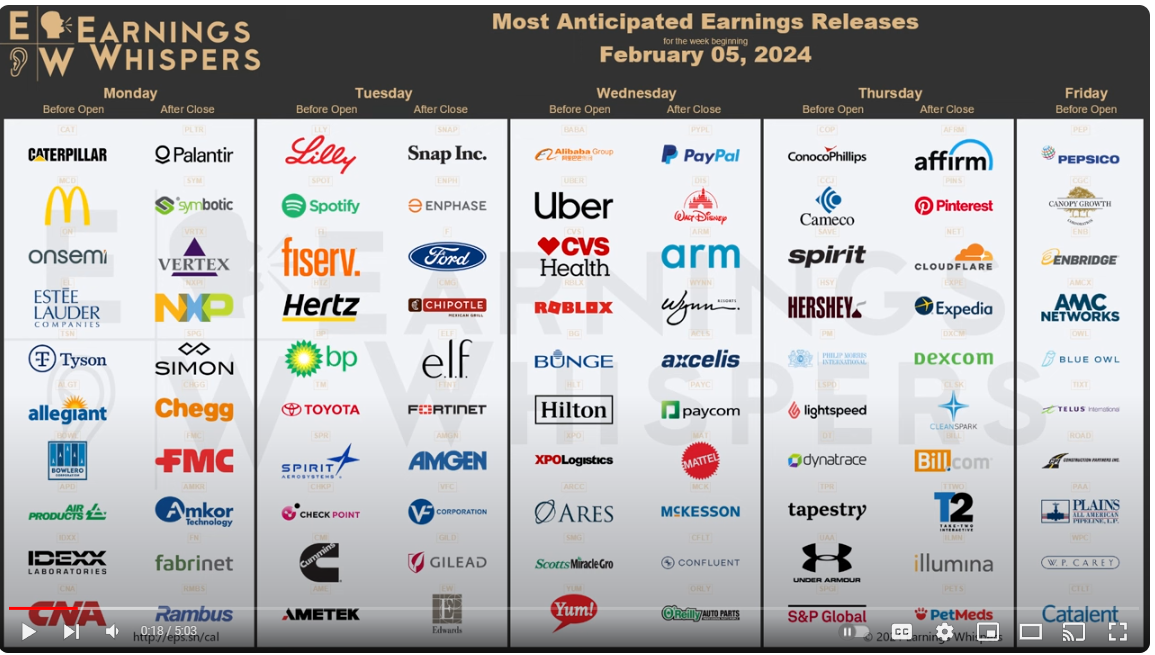
Week of Jan 26, 2024 Weekly Recap & The Week Ahead

Tuesday, January 30th, 2024

I know where I’m getting out before I get in. — Bruce Kovner

1. Donald Trump Scores Decisive Win in New Hampshire Republican Primary — with his convincing win over Nikki Haley in the GOP primary, the former president showed that a dominating share of the Republican Party’s core voters are still with him and that his momentum toward the party nomination grows. With 77% of the estimated vote counted, Trump led Haley 55% to 44%, according to the Associated Press. But the New Hampshire results also signaled that Trump risks losing enough Republicans—as well as a substantial share of independent voters—to create a problem for him as a general-election candidate in November. The first task for any candidate is to unify the party. But 21% of Republicans who cast ballots in New Hampshire said they would be so dissatisfied with Trump as the nominee that they wouldn’t vote for him in November, according to AP VoteCast, a survey of primary voters. Similarly, 15% of Republicans who participated in Iowa’s caucuses last week said they wouldn’t support Trump in the general election.
2. US GDP Grew 3.3% Last Quarter, Capping Unexpectedly Strong Year — Gross domestic product increased at a 3.3% annualized rate, according to the government’s preliminary estimate out Thursday. For all of 2023, the economy expanded 2.5%. A closely watched measure of underlying inflation rose 2% for a second straight quarter, in line with the Federal Reserve’s target, the Bureau of Economic Analysis report showed. The S&P 500 opened higher while Treasury yields were lower as traders focused on the inflation figures and boosted the odds of a March rate cut.
3. Inflation’s Cooling Trend Extends Ahead of Fed Meeting — The Fed’s preferred inflation measure, the personal-consumption expenditures price index, rose 0.2% in December from the previous month, the Commerce Department said Friday. That was up from a 0.1% decline in November but still consistent with subdued inflation.
December closed out a year in which inflation declined markedly. Prices were up 2.6% on the year—well down from the 5.4% increase at the end of 2022. Core prices, which exclude volatile food and energy costs, rose 2.9% on the year, a slowdown from the prior month.
On a three-month annualized basis, core PCE inflation slipped to 1.5% in December from 2.2% in November. On a six-month basis, it was 1.9%, unchanged from November. Both figures are below the Fed’s 2% target.

The week ahead — Economic data from Econoday.com:
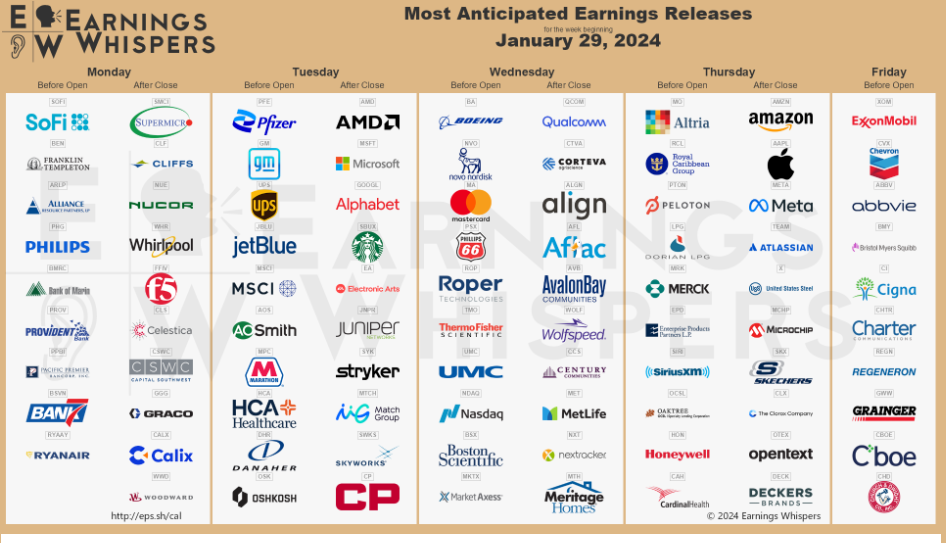
Week of Jan 19, 2024 Weekly Recap & The Week Ahead

Wednesday, January 24th, 2024

“Trade the market you got, NOT the one you wish you got” — LP

1. Retail sales rise 0.6% in December, topping expectations for holiday shopping — Retail sales increased 0.6% for the month, buoyed by a pickup in clothing and accessory stores as well as online nonstore businesses. The results were better than the 0.4% Dow Jones estimate. Excluding autos, sales rose 0.4%, which also topped the 0.2% estimate. On a year-over-year basis, retail sales ended 2023 up 5.6%. The numbers are not adjusted for inflation, so sales show that consumers are more than keeping up with an annual inflation rate of 3.4% as measured by the consumer price index. The CPI increased 0.3% in December, also lower than the retail sales increase.
Another measure of retail sales strength that excludes sales from auto dealers, building materials stores, gas stations, office suppliers, mobile homes and tobacco stores rose 0.8% for the month. The Commerce Department uses this so-called control group when computing gross domestic product.
2. Congress Passes Bill Keeping Government Open as Border, Spending Fights Rage — Congress cleared legislation extending government funding into March, a step that ensures federal workers will remain on the job but does nothing to alleviate underlying political pressures stemming from high U.S. debt levels, record crossings at the southern border and an enduring war in Ukraine. The Senate easily passed the measure 77 to 18, followed by the House, which approved the bill 314 to 108, sending it to President Biden’s desk with time to spare ahead of the weekend deadline. In a replay of recent votes that underscore the fragility of the GOP majority, House Speaker Mike Johnson (R., La.) relied heavily on Democrats to bring the continuing resolution across the finish line, with almost half of Republicans declining to back the measure. Thursday’s bill provides funding for the Transportation Department, the Energy Department, Agriculture Department, the Food and Drug Administration, and Veterans Affairs and military construction through March 1. The rest of the government would be funded through March 8. Under current law, funding was set to run out on Jan. 19 and Feb. 2, respectively.
3. December home sales slump to close out worst year since 1995 — Sales of previously owned homes fell 1% in December compared with November to a seasonally adjusted annualized rate of 3.78 million units, according to the National Association of Realtors. Sales were 6.2% lower than in December 2022, marking the lowest level since August 2010. Full-year sales for 2023 came in at 4.09 million units, the lowest tally since 1995.Regionally, on a month-to-month basis, sales were unchanged in the Northeast and fell 4.3% in the Midwest. Sales were down 2.8% in the South but rebounded 7.8% in the West. On a year-over-year basis, sales were lower in all regions.
4. US Consumer Sentiment Jumps, Price Outlook Hits Three-Year Low — Consumer sentiment surged 29% since November, the biggest two-month increase since 1991, the University of Michigan reported, adding to gauges showing improving moods. It’s a sharp turn after persistently high inflation, the lingering shock from the pandemic’s destruction and fears that a recession was around the corner had put a damper on feelings about the economy in recent years, despite solid growth and consistent hiring. Consumer sentiment leapt 13% in the first half of January from December, the Michigan survey said, after a sharp rise the prior month. The pickup in sentiment was broad-based, spanning consumers of different age, income, education and geography.

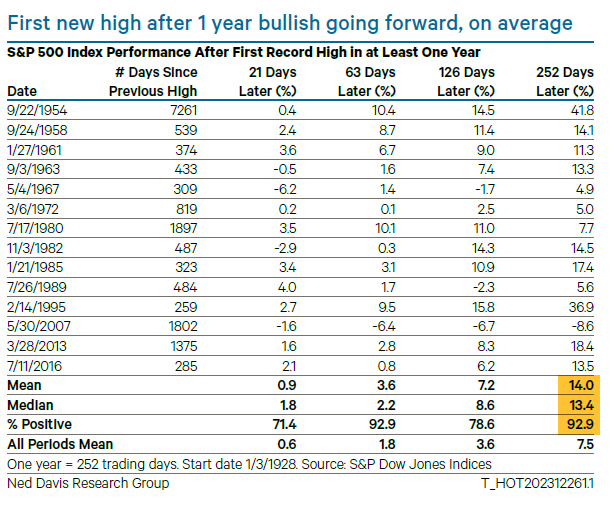
Market made a new high this week. History sides with further gains ahead. The S&P 500 went 512 trading days without a record through Thursday, which ranks as the sixth-longest streak since 1928, according to Ed Clissold, chief US strategist at Ned Davis Research. One year after hitting new highs, the index has risen 13 out of 14 times by a median of 13% in that span.
Below is the research from Ned Davis Research showing the stats on first new high after 1 year bullish going fowrard, on average:

The week ahead — Economic data from Econoday.com:
Search
Calendar
February 2026
M T W T F S S
« Jan    
 1
2345678
9101112131415
16171819202122
232425262728  
Archives
Categories
The information provided by The EGS Blog is based on sources believed to be reliable, but it is not guaranteed to be accurate. There is no guarantee that the recommendations of The EGS Blog will be profitable or will not be subject to losses. The information provided by The EGS Blog is not a recommendation or a solicitation that any particular investor should purchase or sell any particular security in any amount, or at all. The investments discussed or recommended herein may be unsuitable for investors depending on their specific investment objectives and financial position. At any time EGS LLC and its principals may maintain positions that are contrary to positions announced within the subscription service. In no event will The EGS Blog be liable to you or anyone else for any incidental, consequential, special, or indirect damage (including but not limited to lost profits or trading losses). PAST PERFORMANCE IS NO GUARANTEE OF FUTURE RESULTS

© Copyright 2026 Market Outlook All Rights Reserved
Design by EGS Sponsored by Equity Guidance LLC