Search

Week June 8 2012 – Weekly Recap & The Week Ahead

June 11th, 2012

“When I have to depend upon hope in a trade, I get out of it” — Jesse Livermore

1. Spanish government sends out mayday signal — Spanish Treasury Minister Cristobal Montoro announced because of the risk premium, Spain is shut out of the markets to finance its bond.
2. JPMorgan’s loss could hit $4.2B estimate — International Strategy & Investment Group reported JPMorgan (JPM) may report a $4.2B trading loss.
3. G7 to hold emergency call to discuss EU problems — with fears that a capital flight from Spain could turn into a full bank run, G7 finance minsters and central bank governors have arranged an emergency conference call to discuss the eurozone crisis.
4. Portugal to inject over €6.6B in three banks — the Portuguese government is using more than €6.6B of its international bailout money to inject €1.65B into state-controlled Caixa Geral de Depositos, up to €3.5B into Banco Comercial Portugues, and €1.5B into Banco BPI (BBSPY.PK). The rescue comes as the banks face fast-rising loan losses.
5. China’s PBOC cuts interest rates — The People’s Bank of China lowers benchmark one-year lending and deposit rates by 0.25 percentage point on loans and deposits, and moved to allow rates to float more freely, in a bid to support economic growth and advance reform of the financial system.
6. Fed moves forward with Basil III capital rules — banks will be required to hold the strictest form of common-equity capital at 7% of their risk-based assets, up from 2% currently. The regulation will be phased in between January 2013 and January 2019. America’s 19 biggest banks are at least $50B short of meeting Basel III requirements under new rules that the Fed approved.

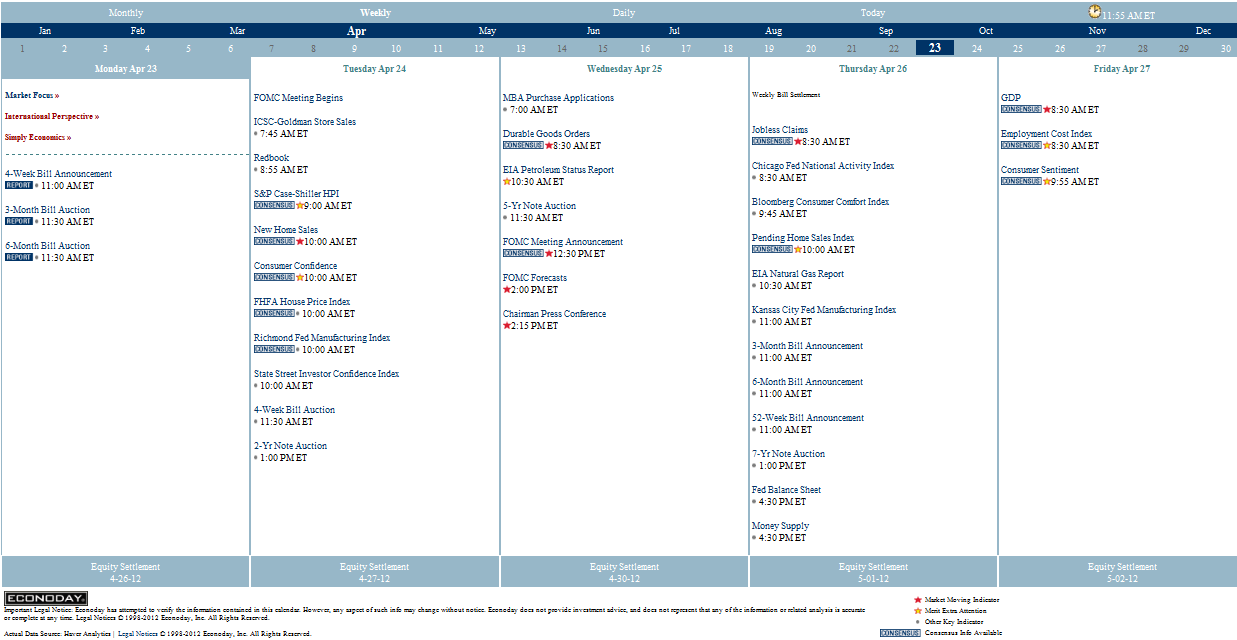
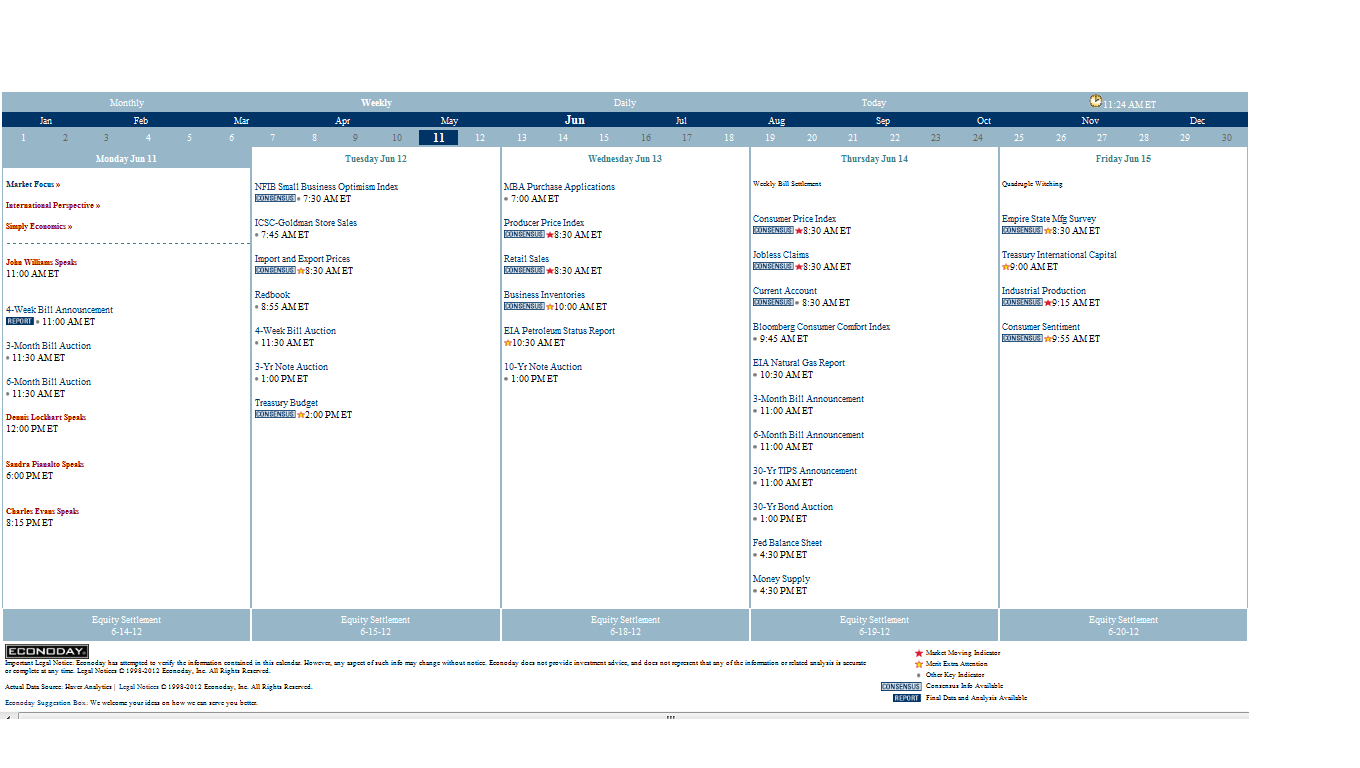
The week ahead — Economic data from Econoday.com:

Week May 25 2012 – Weekly Recap & The Week Ahead

May 22nd, 2012

There will not be any re-cap for the week of May 25 2012. We are away for some needed R&R.

Have a good week.

The staffs at EGS.

Week May 18 2012 – Weekly Recap & The Week Ahead

May 21st, 2012

“Wide diversification is only required when investors do not understand what they are doing”Buffett

1. Greek Politicians Fail to Agree on Government, Talks EndCNBC reported Greek politicians failed to agree on a government, nine days after an inconclusive election.
2. Moody’s Downgrades Italian Banks, Outlook Negative — Moody’s Investors Service downgraded the long-term debt and deposit ratings for 26 Italian banks, citing the country’s recession and rising bad debt levels.
3. Feds crack down on “pump and dump” scamsters — Regulators halted trading in nearly 400 microcap stocks in one of the SEC’s biggest efforts yet to crack down on potential fraudsters using “pump and dump” tactics before they occur.
4. Industrial production rebound strongly in AprilOverall production at the nation’s factories, mines and utilities rose 1.1% in April, the strongest gain since December 2010 and well above expectations. Also, the government reported that housing starts climbed in April and beat expectations.
5. Moody’s hits Spain banks — Moody’s Investors Service downgraded 16 Spanish banks and Santander UK PLC, a U.K.-domiciled subsidiary of Banco Santander SA (STD, SAN.MC), the latest blow for a country already facing economic recession, surging unemployment and a five-year property bust. Also, Customers of troubled Spanish bank Bankia, nationalized last week, have taken out over 1 billion euros ($1.3 billion) from their accounts over the past week, El Mundo newspaper reported .
6. Facebook IPO with record $104B market cap — Facebook (FB) debuted on Nasdaq last Friday with a market cap of $104B, the highest ever for a firm at the time of its IPO.
7. JPM’s CIO holds $100B of risky bonds — the FT reports JPMorgan’s (JPM) Chief Investment Office has built up over $100B of positions in complex, risky bonds and structured products, with the CIO’s “non-vanilla” portfolio now over $150B.

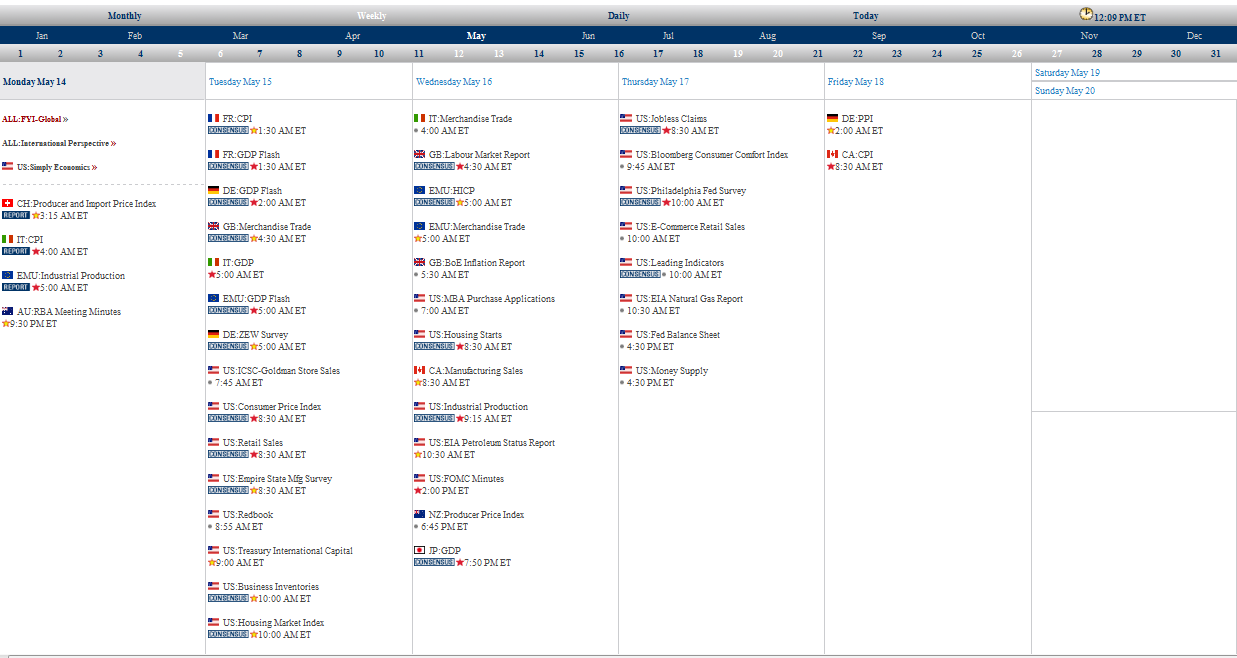
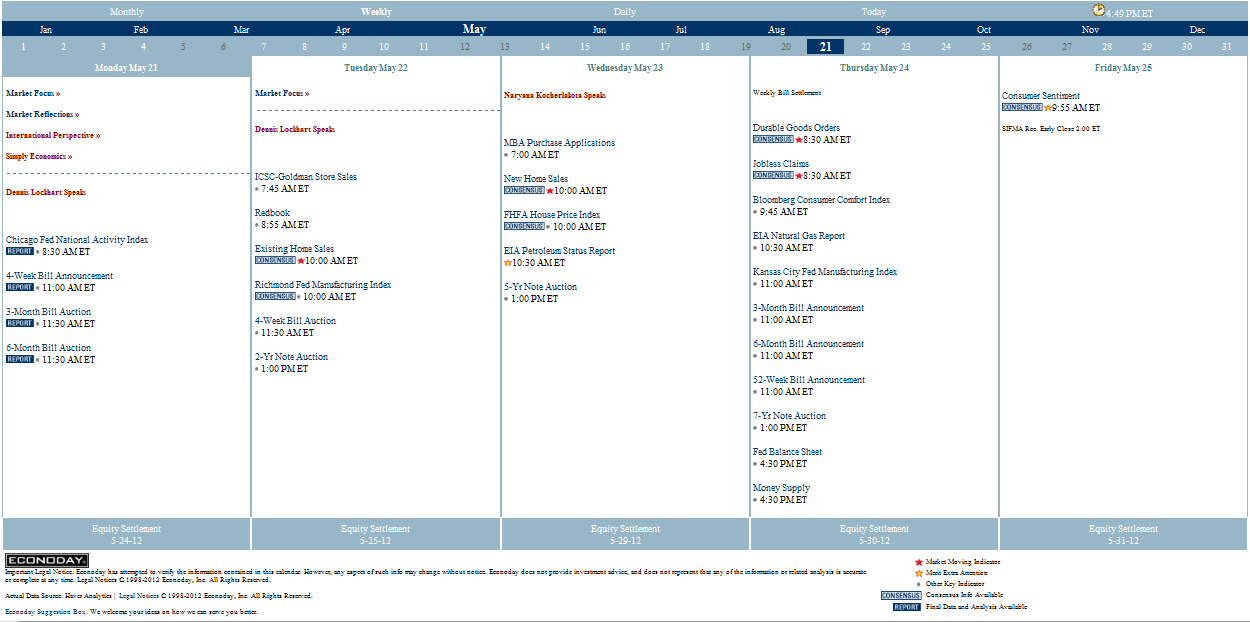
The week ahead — Economic data from Econoday.com:

Week May 11 2012 – Weekly Recap & The Week Ahead

May 14th, 2012

“THE STOCK MARKET IS A NO-CALLED-STRIKE GAME. YOU DON’T HAVE TO SWING AT EVERYTHING – YOU CAN WAIT FOR YOUR PITCH. THE PROBLEM WHEN YOU’RE A MONEY MANAGER IS THAT YOUR FANS KEEP YELLING, ‘SWING, YOU BUM!’”— Warren Buffett

1. U.S. set to make profit on AIG bailout — the taxpayer could make a profit of $15.1B on the $182B bailout of AIG (AIG) in 2008, the Government Accountability Office has estimated. The latest return will come from the Treasury’s sale of $5.8B worth of AIG shares for $30.50 each, above its break-even price of $28.72
2. Spanish Bank Worries — Spain will require its banks to raise an additional 35 billion euros ($45.5 billion) in provisions against property loans, Reuters reported. The amount is in addition to the €54 billion banks must already raise to protect against exposure to property loans in the wake of the country’s burst housing bubble.
3. Chinese Trade Data Show Surprising Weakness — according to MarketWatch, Chinese trade data showed a sharp drop in activity in April, with both export and import growth falling well short of expectations. Exports rose 4.9% in April from a year earlier, while imports rose just 0.3%, data released by China’s General Administration of Customs showed.
4. Spain nationalizes Bankia bank — The Bank of Spain confirmed the partial nationalization of Bankia after it was unable to repay €4.47B it owed the government. The loan will instead be converted into shares.
5. J.P. Morgan Chase & Co. announced $2 billion trading loss — JPMorgan (JPM) held discussions with U.K. regulators after revealing that its Chief Investment Office, headed by “London Whale” Bruno Iksil, took $2B in losses from a failed hedging strategy and could take another $1B in Q2.
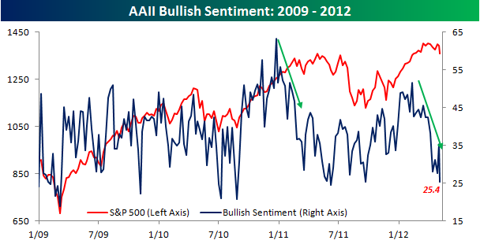
6. AAII Sentiment Survey — survey of bullish sentiment from the American Association of Individual Investors (AAII), bullish sentiment dropped from 35.4% down to 25.4%. This puts bullish sentiment at the lowest level since September.

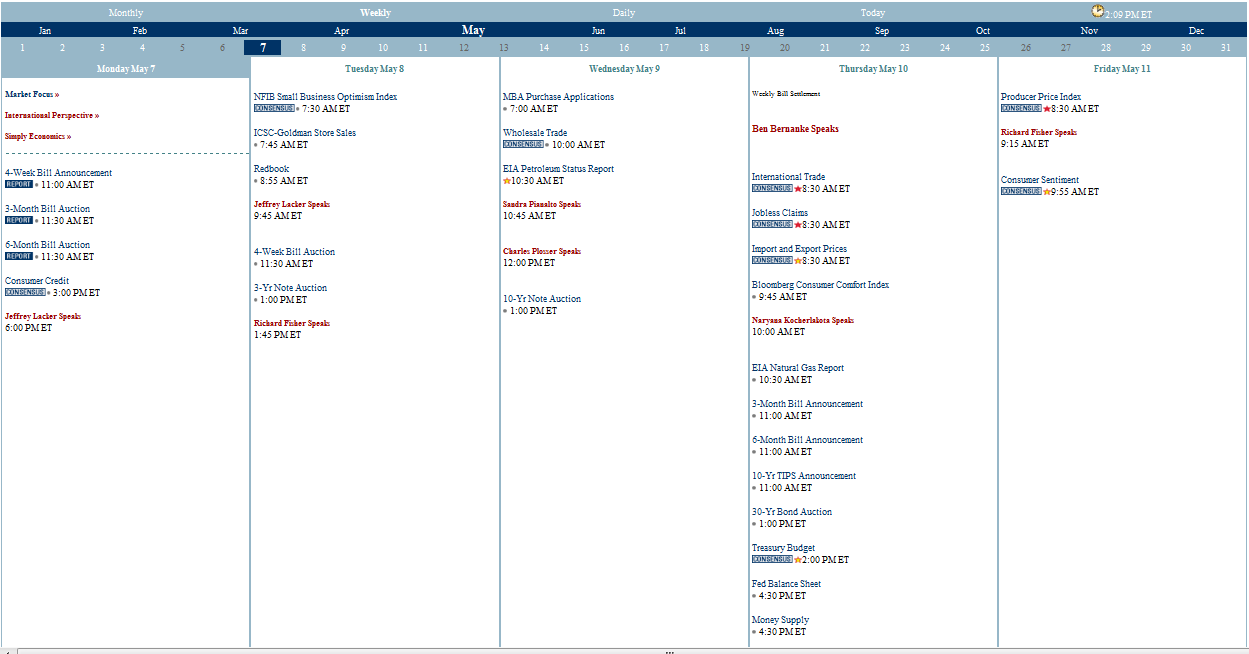
The week ahead — Economic data from Econoday.com:

Week May 4 2012 – Weekly Recap & The Week Ahead

May 7th, 2012

“Pullbacks near the 30-week moving average are often good times to take action”Michael Burke

1. Spain enters recession, S&P downgrades banks — Spain entered recession in Q1 for the second time since the financial crisis as GDP shrank 0.3% on quarter, although that was better than forecasts of -0.4%.
2. Growth among U.S. manufacturers expanded in April at the fastest pace in 10 months — Institute for Supply Management (ISM) rose to 54.8% from 53.4% in March, the highest reading since June 2011. The new-orders index, an indication of future demand, jumped to 58.2% from 54.5% in March. The production index also rose, up 2.7 percentage points to 61.0%.
3. Chinese factory activity sends out positive signal — China’s official PMI rose to a 13-month high of 53.3 in April from 53.1 in March and was well above last week’s HSBC “flash” PMI of 49.1, although the reading fell short of expectations of 53.5.
4. Facebook IPO valued at almost 100X profit — Facebook (FB) may sell up to $13.6B in stock, including with the over-allotment option, after pricing its IPO at $28-$35 a share. That would give it a market cap of $77B-$96B, or as much as 96X its 2011 net profit of $1B.
5. Hollande ousts Sarkozy in French vote — French President Nicolas Sarkozy on Sunday became the latest in a long line of European leaders to lose his job in the wake of the euro-zone debt crisis, conceding defeat to Socialist challenger François Hollande.

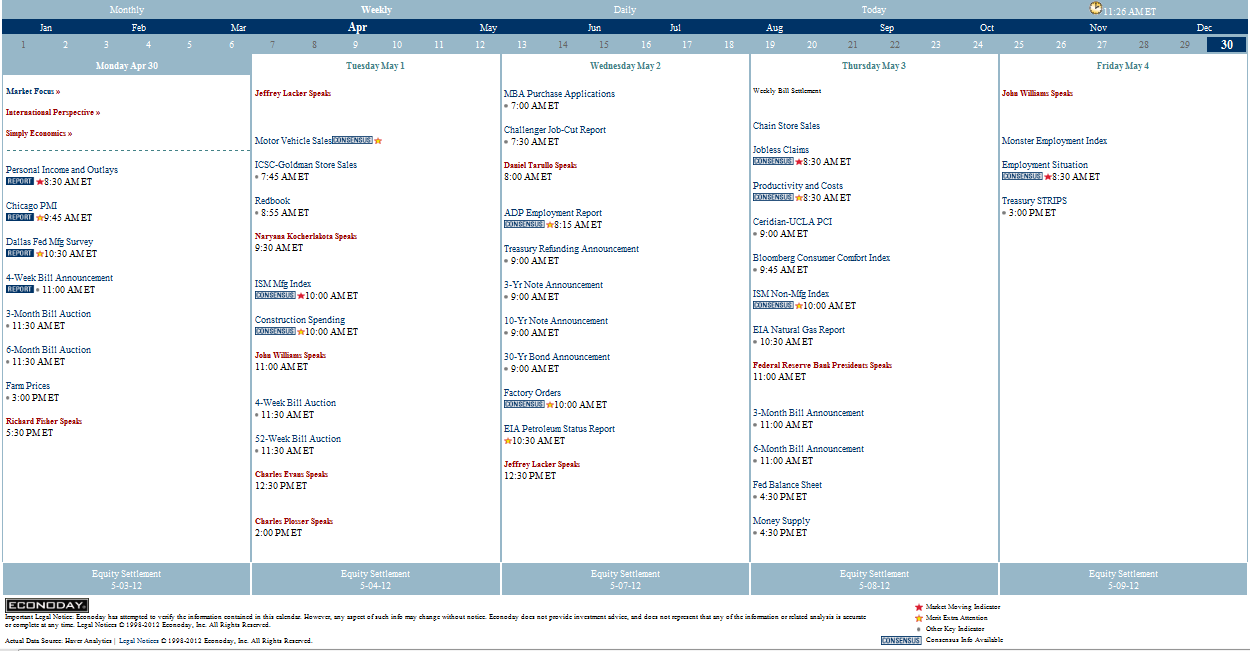
The week ahead — Economic data from Econoday.com:

Week Apr 27 2012 – Weekly Recap & The Week Ahead

April 30th, 2012

“If a battered stock refuses to sink any lower no matter how many negative articles appear in the papers, that stock is worth a close look” — J. Fraser.

1. Sarkozy and Hollande win through to final round — Nicolas Sarkozy and left-wing challenger Francois Hollande will face off against each other in two weeks’ time after they received the most number of votes in the first round of France’s presidential election. Run-off is scheduled for May 6.
2. Eurozone looks to be sinking deeper into recesson — Eurozone factory activity continued to contract in April as PMI fell to a preliminary 46 in April from 47.7 in March and vs. expectations of 48.1.
3. FOMC stays the course — the FOMC announced no major change in policy. The committee sees moderate growth with strains in global financial markets providing a big downside risk. Revised 2012 forecasts: jobless rate at 7.8-8.0% from 8.2-8.5%; inflation at 1.9-2.0% from 1.4-1.8%; GDP growth at 2.4-2.9% from 2.2-2.7%.
4. U.K. sinks into double-dip recession — the U.K. has slid back into recession for the second time since the financial crisis after Q1 GDP unexpectedly fell a preliminary 0.2% on a quarterly basis following a fall of 0.3% in Q4.
5. Banks scramble to prevent ratings cuts — the WSJ reported five major banks facing potential downgrades from Moody’s – and $22B in extra costs – CEOs are pushing back against the ratings agency with an aggressiveness not seen since before the financial crisis.
6. Business spending drop limits U.S. growth to 2.2%Marketwatch reported that GDP misses economic estimates after surprise drop from business sector. The Commerce Department said gross domestic product rose at a 2.2% annual rate between January and March, slower than the 3.0% pace in the prior three months.
7. Standard & Poor’s downgrades Spain for the second time this year— S&P slashed Spain’s sovereign debt rating to BBB+ from A with a negative outlook. The ratings agency said the downgrade reflects worries about increased risks of the country’s government debt balanced against difficult economic conditions, as well as the potential need of more support for the banking sector.
8. AAII Sentiment Survey — according the the latest survey from AAII, Bullish Sentiment fell to a 7-month low to 27.6%. This is also the fourth consecutive week that bullish sentiment has been below its historical average of 39%.

This week’s AAII Sentiment Survey results:
Bullish: 27.6%, down 3.5 percentage points
Neutral: 35.0%, unchanged
Bearish: 37.4%, up 3.6 percentage points

Historical averages:
Bullish: 39%
Neutral: 31%
Bearish: 30%

The week ahead — Economic data from Econoday.com:

Week Apr 20 2012 – Weekly Recap & The Week Ahead

April 23rd, 2012

“I keep hearing “Should I buy?” – When I start hearing “Should I sell?” that’s the bottom.” — Nick Moore (PM).

1. $60B pledge from Japan to help IMF reach $400B goal — While Spanish borrowing costs soar, IMF chief Christine Lagarde hopes the IMF will reach “critical mass” in raising more than $400B from contributing governments.
2. Buffett Rule falls in the Senate — with a 51-45 vote, Senate Republicans blocked the “Buffett Rule” to make those earning $2M annually pay federal tax of at least 30%. The measure fell nine votes short of the 60 required for the debate to continue.
3. China home prices fall in March, raising concerns of a major slowdown — according to MarketWatch — out of the 70 cities surveyed by the National Bureau of Statistics, 46 reported weaker prices from the previous month, up slightly from 45 cities that reported declines in February. Dariusz Kowalczyk, Credit Agricole CIB economist, said in a note “sliding home prices will lead to weakness in residential land prices, which will in turn add to the financial strains already weighing on local governments”.
4. Facebook aims to IPO in May — Facebook (FB) plans to carry out its IPO on May 17, TechCrunch reports, as long as the SEC signs off on the company’s paperwork in time. As expected, Facebook will aim to raise under $10B at a market cap of $100B, reflecting recent trading on secondary markets.
5. China set for further easing — The People’s Bank of China might cut banks’ required reserve ratios, among other easing measures, in order to boost liquidity and bank lending, Xinhua reports.
6. France votes, investors fret — France held a Presidential election this past Sunday, with polls showing that the left-wing Francois Hollande to beat Nicolas Sarkozy but only after a run-off on May 6. Hollande has pledged to renegotiate the EU fiscal compact to tilt it away from austerity and towards growth, putting him on a collision course with Angela Merkel and providing the potential for further market chaos.

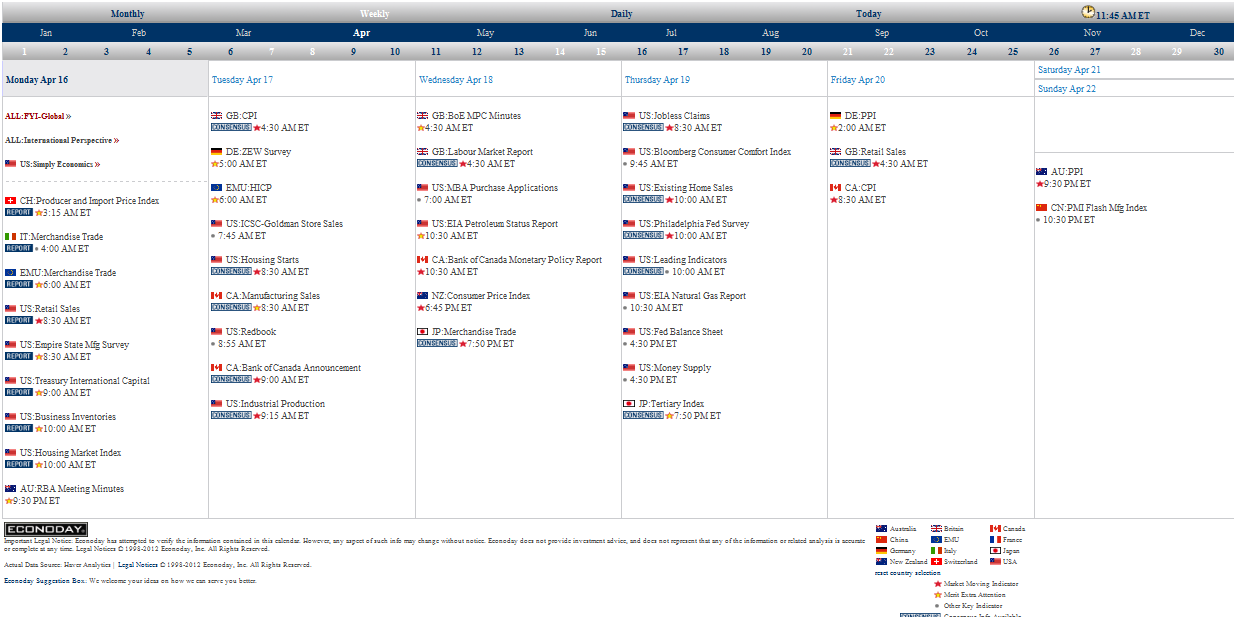
The week ahead — Economic data from Econoday.com:

Diversification — Is it Bunk?

April 16th, 2012

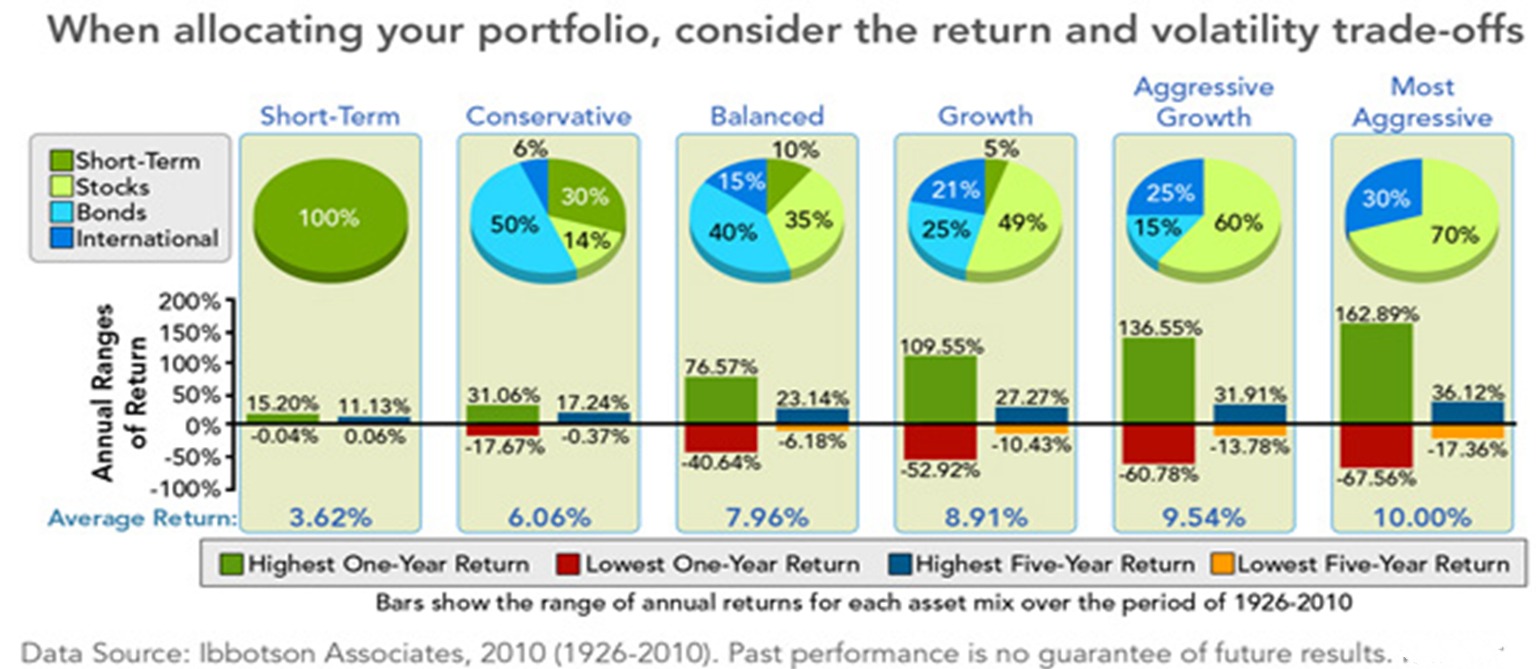
Investment houses espouse an investor’s portfolio should be fully invested at all times and allocated across multiple asset classes; domestic stocks (large-cap, mid-cap, small-cap), foreign, commodities, emerging markets, bonds, etc…

Below is an excerpt from one of the biggest investment companies,

“The goal of diversification is not to boost performance but to help manage risk. Diversification doesn’t ensure a profit or guarantee against a loss. And while it won’t maximize returns in up markets—in fact it will likely reduce them—it can help you ride out swings in the market, because as one part of your portfolio struggles, another may be performing well. That can be very important, particularly for people in or nearing retirement who depend on their portfolios for income.”
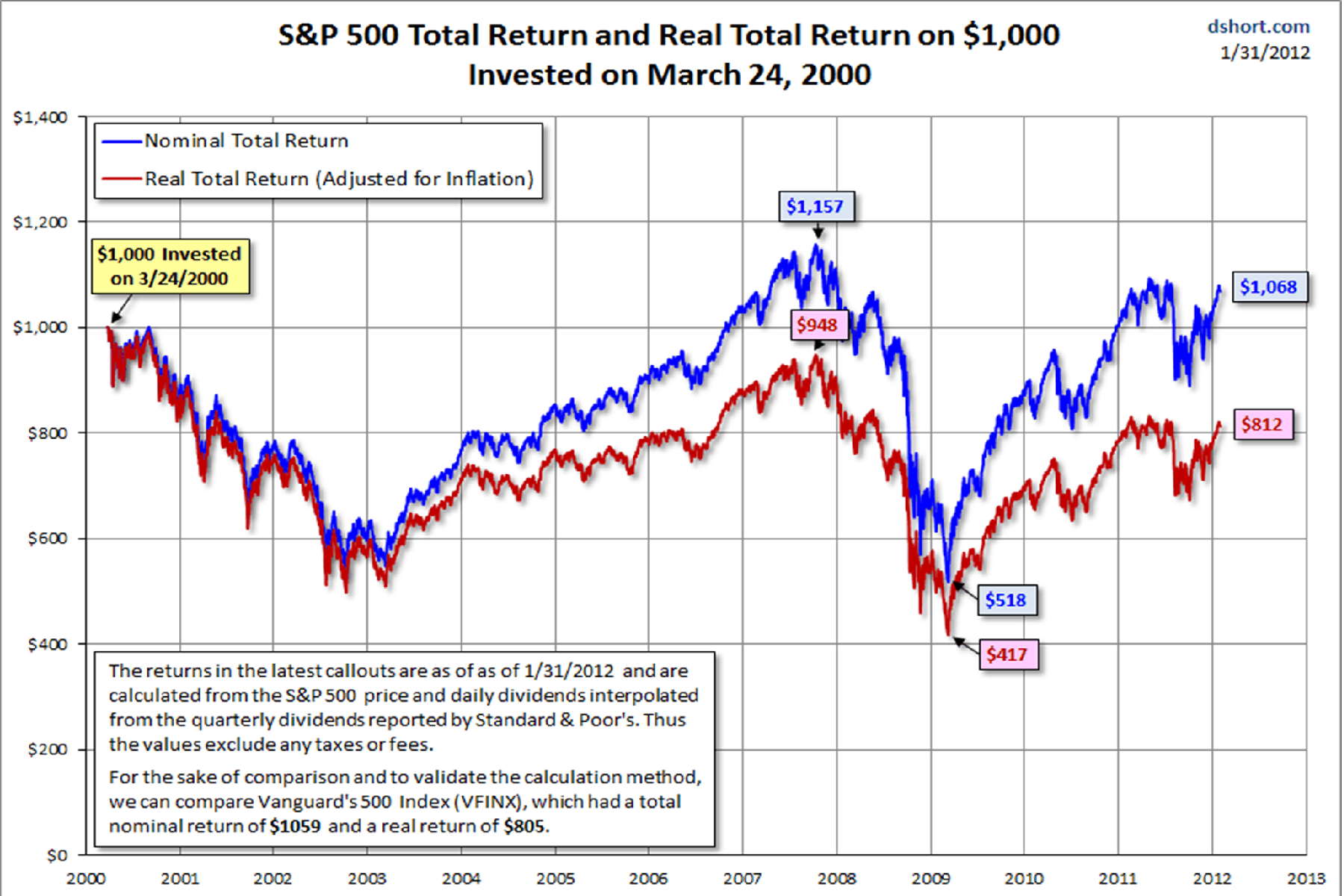
From 2000 to present, major market index returns are nearly flat. During the market crash in 2008, investments of all asset classes suffered major losses; stock funds, corporate-bond funds, real-estate stocks, commodities. One important measure of the broad market index is the S&P500. The S&P500 declined by nearly 56% in 2008. The simple math is that for an investor to break even from a 50% decline, he would need to gain 100%. A chart of the S&P500 (courtesy from Doug Short) depicts the timeframe from March 24, 2000 to the present. It shows $1,000 invested in the S&P500 would be diminished in value to $812 as of 1/31/2012 when adjusted for inflation.
An unspoken secret of investment company ‘s is that fees are collected by the investment of assets. As an economy of scale, the more assets under management actively invested, the more fees collected. A managed account typically charges somewhere between 1%-to-3% per account. A $1,000,000.00 account generates $10,000-$30,000 in revenue. Multiplied by many accounts one can see that this fee is substantial. This fee is charged regardless of whether an investor makes or loses money in any given quarter or annually. During the 2008 market collapse, managed fees from one ‘s portfolio would further decrease the principal balance of the account.

Some major brokerage institutions during the recent 2008 housing debacle, were trading against the customers whom they were advising. One large institution was accused of overcharging for two sets of mortgage-backed securities that it sold to a hedge fund client. This institution was accused of lying about the securities’ expected performance; not providing timely, accurate information about the securities’ true value; and failing to disclose that the firm was actively betting against the securities at the time of the transaction

Based on the past decade, we have learned that world stock markets become more inter-related and that changes in one country/market will have a ripple effect across all other markets. Additionally, the rise of ETFs (Exchange Traded Funds) that bundle stocks together coupled with the depedence on leverage forces fund managers to liquidate positions quickly to cover losses. Institutions have also increased usage of High Frequency Trading contributing to stock market volatility.

An example of this market dependency is the 2008 US housing crisis. During this period, the U.S. housing market not only affected the US market, but it also brought down major institutions around the world. Case in point, before the 2008 collapse and the general financial crisis, RBS Group was very briefly the largest bank in the world and for some time was the second largest bank in the UK and Europe (fifth in stock market value), and fifth largest in the world by market capitalisation. Subsequently, with a slumping share price and major loss of confidence, the bank fell sharply in the rankings and had to be rescued by the UK government. Lehman Brothers Holdings Inc. , the fourth largest investment bank in the USA (behind Goldman Sachs, Morgan Stanley, and Merrill Lynch) declared bankrupcy in the fall of 2008.

Since 2000 (aka, the lost decade), the 2000 – 2002 dot bomb, the 2008 Financial Crisis, Euro-quake, the Flash Crash, Flash Trading in general, Dark Pools; the average investor may be left with the feeling the game is rigged. As a result, investors have withdrawn a record amount of money from mutual funds as the market lurched from one event to another. Based on a recent note from the venerable Investment Company Institute, a staggering $75 billion has been withdrawn from equity mutual funds.

Recommendations:
What ‘s an investor to do in this time of uncertainty? As one of the greatest investors of our generation Warren Buffet stresses “Capital Preservation”. He is famous for his 2-rules; Rule No. 1 “Protect Your Capital” and Rule no. 2 “Go Back and See Rule no.1”.

We recommend one should invest based on the current economic cycle and NOT be fully-invested at all times as preached by the investment companies. By investing based on the business cycle, investors are likely able to produce better average returns. This approach also helps long-term investors to identify when to buy or sell. Click here for the link to “Sectors and the Business Cycle: A Primer” by Bob Johnson for additional details.

In times of major economic uncertainty, “capital preservation” is key to one ‘s portfolio and cash or short-term money markets are best to preserve capital while waiting for better opportunities.
Week Apr 13 2012 – Weekly Recap & The Week Ahead

April 16th, 2012

“I always keep these seasonal patterns in the back of my mind. My antennae start to purr at certain times of the year.” Kenneth Ward.

1. China Consumer Prices Rise Faster-Than-Estimated 3.6%Bloomberg News reported that China’s inflation accelerated more than forecast in March on a pickup in food prices, signaling that policy makers may exercise caution in adding stimulus to boost growth.
2. Servicers Face More Rules WSJ reported that The Consumer Financial Protection Bureau plans to propose new rules that would force mortgage servicers to be far more transparent about the costs faced by homeowners and to provide warnings before any interest rate changes. The rules, if approved, would affect such giants as Wells Fargo (WFC), Citigroup (C), BofA (BAC) and JPMorgan (JPM), as well as the smaller mortgage servicers.
3. Santorum quits White House race — trailing in polls and fundraising, the conservative former Pennsylvania senator suspended his campaign and cleared the way for Romney to clinch the nomination to face President Barack Obama in the November 6 general election.
4. Germany, Italy suffer poor bond auctions — Germany has experienced very weak demand at an auction of 10-year Bunds, able to move just €3.87B of paper vs. a target of €5B. The bid-cover ratio was just 1.1. The notes were priced to yield 1.77% – a record-low for an auction. Italian yields jumped in an auction of €11B of 12- and 3-month paper as Spain’s budget woes hit other vulnerable countries.
5. Spain Default Insurance Costs Hit Record — the cost of insuring Spanish government debt against default via instruments known as credit default swaps, or CDS, hit an all-time high Friday as worries mounted over the country’s banking sector. The spread on five-year Spanish CDS widened to 505 basis points from 476 basis points, according to data provider Markit. Spanish banks’ borrowings from the ECB jumped nearly 50% in March to €227.6B, as they took up 29% of the central bank’s late-February LTRO. “A consequence of the (LTRO) is that the correlation between sovereign risk and banking risk increased all over Europe.”
6. Growth in China cools down — Chinese Q1 GDP grows 8.1% Y/Y vs. expectations for 8.3% and 8.9% growth in 2011 Q4. Industrial production: +11.9% Y/Y vs. estimates of 11.4%, and retail sales +15.2% vs. 15.1%.

The week ahead — Economic data from Econoday.com:

Week Apr 6 2012 – Weekly Recap & The Week Ahead

April 9th, 2012

“The market is voting machine, whereon countless individuals register choices which are the product partly of reason and partly of emotion.” — Graham & Dodd

1. Euro zone unemployment reaches new high in February — according to Reuter, Unemployment in the 17 nation euro zone rose to 10.8 percent in February, highest in almost 15 years – as expected by economists’ polled by Reuters – and compared to 10.7 percent in January.
2. SEC poised to charge Goldman over another mortgage bond deal — the SEC is likely to soon bring charges against Goldman Sachs (GS) over a mortgage-bond deal called the Fremont Home Loan Trust.
3. Regulators Move Closer to Oversight of Nonbanks — according to NYTimes, The Financial Stability Oversight Council, the country’s top financial regulatory body, moved closer to increasing its oversight of nonbank financial institutions, like hedge funds, private equity firms and insurers. Possible candidates include BlackRock (BLK), GE Capital (GE) and Berkshire Hathaway (BRK.A).
4. FOMC gets more hawkish over QE — Fed policy makers expressed less interest in another round of bond buys at their March 13 meeting, with only a couple of members suggesting more easing could become necessary if the economy lost momentum.
5. Spanish yields jump above 5.7%; Italian yields up — Spanish and Italian bond yields continued to rise on last week, as the broader European equity market declined. Yields on 10-year Spanish government bonds added 5 basis to 5.71%, the highest level since December last year. Yields on 10-year Italian government bonds jumped 11 basis points to 5.4%

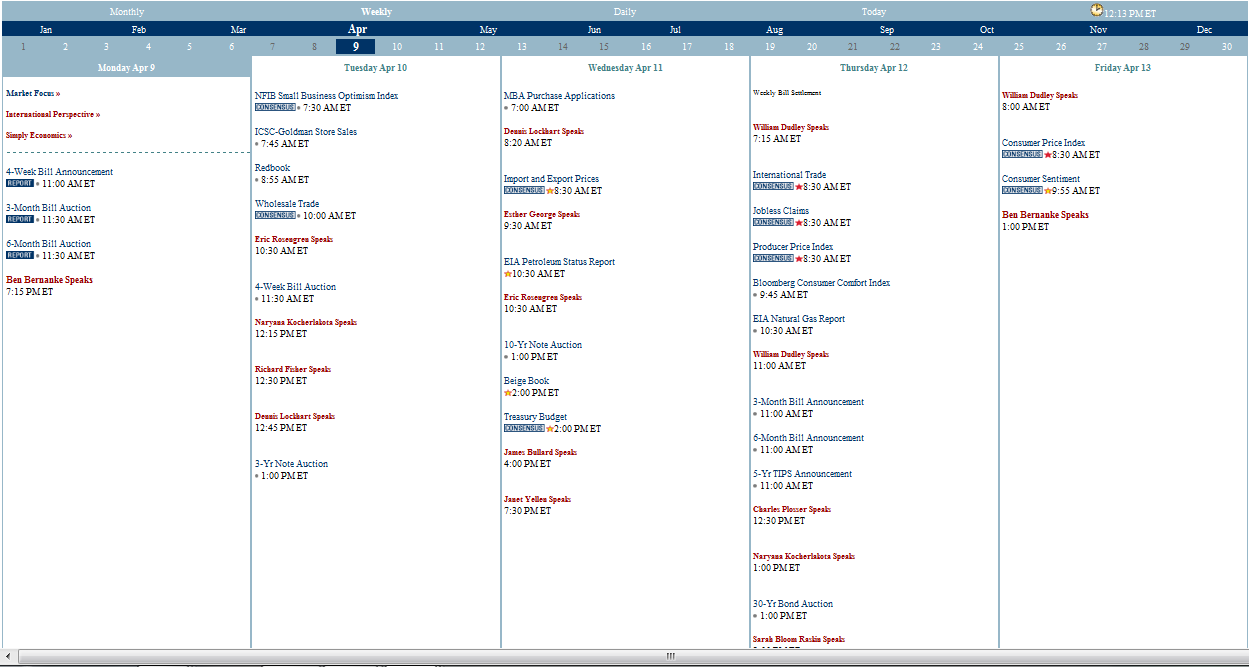
The week ahead — Economic data from Econoday.com:

Search
Calendar
February 2026
M T W T F S S
« Jan    
 1
2345678
9101112131415
16171819202122
232425262728  
Archives
Categories
The information provided by The EGS Blog is based on sources believed to be reliable, but it is not guaranteed to be accurate. There is no guarantee that the recommendations of The EGS Blog will be profitable or will not be subject to losses. The information provided by The EGS Blog is not a recommendation or a solicitation that any particular investor should purchase or sell any particular security in any amount, or at all. The investments discussed or recommended herein may be unsuitable for investors depending on their specific investment objectives and financial position. At any time EGS LLC and its principals may maintain positions that are contrary to positions announced within the subscription service. In no event will The EGS Blog be liable to you or anyone else for any incidental, consequential, special, or indirect damage (including but not limited to lost profits or trading losses). PAST PERFORMANCE IS NO GUARANTEE OF FUTURE RESULTS

© Copyright 2026 Market Outlook All Rights Reserved
Design by EGS Sponsored by Equity Guidance LLC