May 28th, 2020
“Investment success doesn’t come from “buying good things,” but rather from “buying things well.” – Howard Marks
1. Moderna Covonavirus Caccine Shows Early Signs of Viral Immune Response — the results are just a sample from the small, first study designed to look at the safety of the shot in human volunteers, and should be viewed with caution. But they showed no major safety worries, a key first hurdle since a vaccine would be given to millions of otherwise healthy people. A vaccine is considered a crucial step toward lifting social-distancing measures and safely reopening economies, schools and events around the globe. The new coronavirus, known as SARS-CoV-2, has infected more than 4.7 million people and killed over 300,000, spurring a global race by drugmakers, academic institutions and governments to find a vaccine. The company is moving ahead with plans for a larger test to pick a dose of the vaccine and further study its effectiveness, as well as a phase 3 test with many thousands of patients.
2. U.S. Raises Ante in Vaccine Race With $1.2 Billion for Astra — the U.S. pledges as much as $1.2 billion to AstraZeneca Plc to help make the University of Oxford’s Covid vaccine. The U.S. has backed projects underway at Johnson & Johnson, Moderna Inc. and France’s Sanofi, fueling concerns that other parts of the world could fall behind. Some doubts have been raised about the potential effectiveness of the Oxford vaccine after early results in monkeys were released. While the shot may have protected animals against severe infections, the results were weak compared with those of a test of a vaccine under development by Sinovac Biotech in Beijing.
3. Millions More American Filed for Unemployment Benefits — jobless claims for regular state programs totaled 2.44 million in the week ended May 16, Labor Department reported. The prior week’s figure was revised down by 294,000 to 2.69 million after a clerical error by Connecticut labor officials inflated the overall nationwide figure. The median estimate in a Bloomberg survey of economists called for 2.4 million claims in the latest week. That means nationwide claims under the program — which expands unemployment benefits to those not traditionally eligible, such the self-employed and gig workers — were actually about half of the reported 2.23 million figure.
4. Argentina Braces for Ninth Default — after five months in office grappling with recession, 50% inflation and a crash in the unofficial peso rate, Fernandez is trying to strike a deal with bondholders over the coming weeks to prevent even worse chaos. Although there’s no 2001-style panic, Argentines have been quietly preparing for the worst. Savers have withdrawn $1.2 billion in dollar deposits over the past 20 business days. Demand for dollars is so high that the illegal exchange rate has widened to nearly twice the official rate, which is anchored by currency controls.
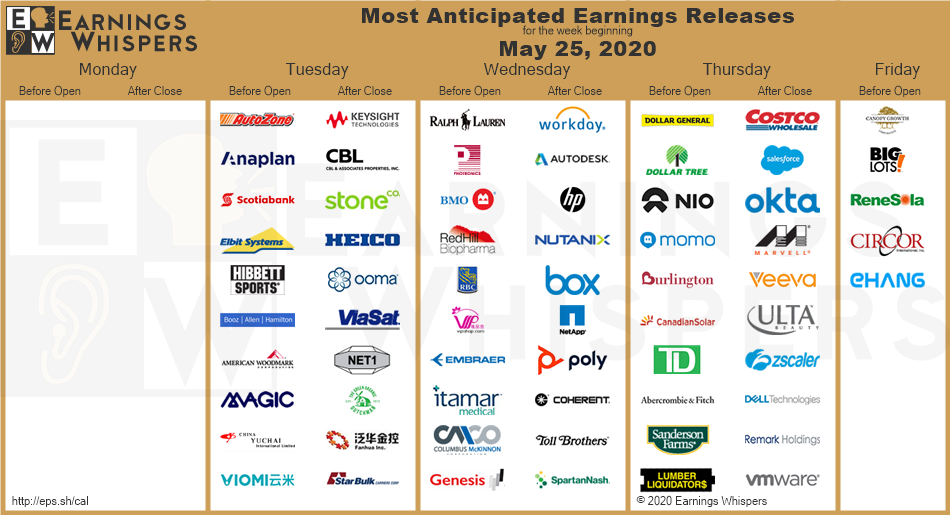
The week ahead — Economic data from Econoday.com:
Posted in Weekly Summary | No Comments »
May 18th, 2020
“Prices are too high” is far from synonymous with “the next move will be downward.” Things can be overpriced and stay that way for a long time . . . or become far more so.” – Howard Marks
1. New Jersey, Connecticut Moves Toward Reopening — Retail businesses will be allowed to offer curbside pickup starting May 18, and restrictions will lift on non-essential construction work, Governor Murphy stated. Also, Connecticut will begin to reopen May 20 and test 42,000 a week. Connecticut Governor Ned Lamont said the chief executives of some large companies have told him that telecommuting could help them save money by cutting office space by as much as 30%, signaling what may be a national shift by businesses.
2. Fed Chairman Powell Warns of Broad Virus Danger, Discourages Negative Rates — Federal Reserve Chair Jerome Powell stated The U.S. economy faces unprecedented risks from the coronavirus if fiscal and monetary policy makers don’t rise to the challenge. Powell and his colleagues on the policy-setting Federal Open Market Committee have taken dramatic measures to shelter the U.S. economy during the coronavirus pandemic. They have cut their benchmark interest rate to nearly zero, engaged in open-ended bond buying and begun rolling out emergency lending programs as U.S. unemployment has soared to levels not seen since the 1930s Great Depression. Powell acknowledged the negative rate speculation but said such a move was not being considered, though he stopped short of completely ruling the tool out as an option in the future.
3. U.S. Jobless Claims Climbs to 2.98 Million Brings Virus Sum to 36.5 Million — Initial jobless claims in state programs totaled 2.98 million in the week ended May 9, Labor Department figures showed Thursday, following 3.18 million the prior week. With the latest numbers, a total of 36.5 million applications for unemployment insurance have been filed since the virus began shutting down businesses in mid-March. Connecticut reported a surge to about 298,700 from 36,100 the prior week — dwarfing any other state change.
4. Retail Sales Crater by a Record 16.4% as Spending Slumps Amid Coronavirus Lockdowns — revenue at retailers and restaurants fell 16.4% from the prior month, almost double the 8.3% drop in March which was previously the worst in data back to 1992, according to a Commerce Department report. With the coronavirus pandemic keeping most Americans stuck at home and unemployment the highest since the Great Depression era, people sharply reduced their spending in the month. The retail sales report, meantime, showed all but one of 13 major categories decreased, led by a 78.8% drop at clothing stores and a 60.6% decline at electronics and appliance outlets. The only category to record a gain was nonstore sales — including online sellers such as Amazon.com — which increased 8.4%.
5. Trump Administration Moves to Cut Huawei Off From Global Chip Suppliers — the Trump administration moved to block shipments of semiconductors to Huawei Technologies from global chipmakers, in an action that could ramp up tensions with China. The rule change is a blow to Huawei, the world’s no. 2 smartphone maker, as well as to Taiwan’s TSMC, a major producer of chips for Huawei’s HiSilicon unit as well as mobile phone rivals Apple and Qualcomm. The United States is trying to convince allies to exclude Huawei gear from next-generation 5G networks on grounds its equipment could be used by China for spying.
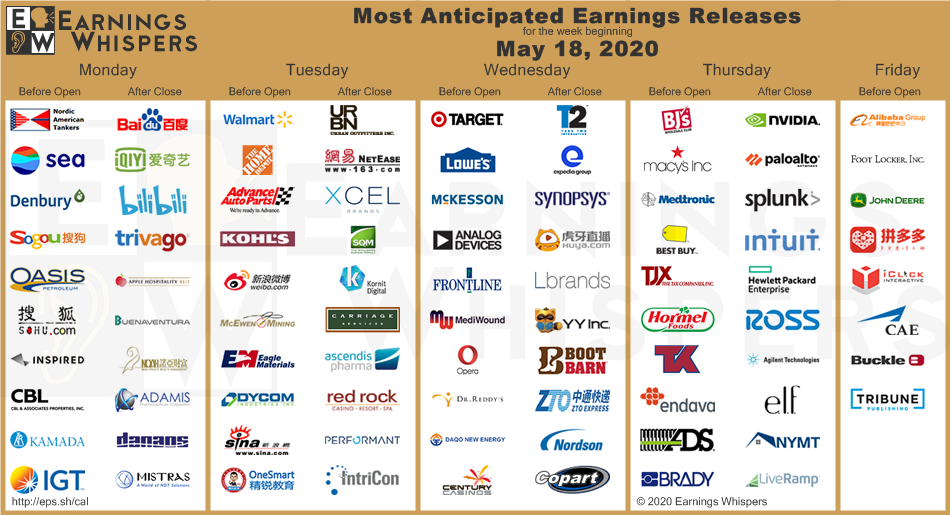
The week ahead — Economic data from Econoday.com:
Posted in Weekly Summary | No Comments »
May 11th, 2020
“Being too far ahead of your time is indistinguishable from being wrong.” – Howard Marks
1. Hertz May File for Bankruptcy — Hertz may file for bankruptcy as talks with creditors go down to the wire, people familiar said. The company added FTI Consulting, a bankruptcy specialist, to its roster of advisers. Shares dropped 21% pre-market. Neiman Marcus is close to a bankruptcy deal with lenders led by PIMCO that would slash its debt load by more than half in exchange for control of the company, people familiar said. Also, JC Penney has filed for bankruptcy protection.
2. American Meat Workers Are Starting to Quit With Plants Reopening — At a JBS USA plant in Greeley, Colorado, absenteeism is running as high as 30%. Before the pandemic, it was about 13%. The company is paying about 10% of the workforce — people deemed vulnerable — to stay home. Meat plants have been at the nexus of coronavirus hot spots across America’s rural heartland. The disease spread through plants in March and April as companies struggled to adapt their workplaces to new rules dictated by the pandemic. As absenteeism persists, the U.S. is at risk of continued meat shortages and higher prices, even after President Donald Trump signed an executive order to keep plants running.
3. U.S., China Trade Chiefs to Speak on Progress in Implementing a Phase-One Deal — the planned phone call will be the first time Liu and Lighthizer speak officially about the agreement since it was signed in January, just before the global coronavirus pandemic hit the world’s two biggest economies and upended global supply chains. The deal called for Liu and Lighthizer to meet every six months, making next week’s call slightly ahead of schedule. According to the text of the agreement signed earlier this year, China has agreed to buy an additional $200 billion in U.S. goods and services over two years compared with 2017’s level.
4. U.S. Jobless Rate Surges to 14.7% in Worst-Ever Labor Reversal — employers cut an unprecedented 20.5 million jobs in April and the unemployment rate more than tripled to 14.7%.
Joblessness now stands at the most since the Great Depression era of the 1930s after the coronavirus pandemic brought the U.S. economy to a standstill. As recently as February, the rate stood at just 3.5%, the lowest level in five decades. White House adviser Kevin Hassett stated unemployment may peak “north of” 20% in May or June before the economy starts to come back from coronavirus-related shutdowns in the second half of 2020.
5. FDA Approves New Covid-19 Antigen Test — the emergency use authorization, the first ever by the FDA for a Covid-19 antigen test — was granted to San Diego-based Quidel Corp. late Friday, according to a notice from the agency. “It’s a very rapid test that could be used in a doctor’s office,” former FDA Commissioner Scott Gottlieb said Sunday on CBS’s “Face the Nation.” “Doctors now have about 40,000 of these Sophia machines already installed in their offices” where they are used to test for strep throat and flu. Each test will probably cost about $5, with results available within minutes
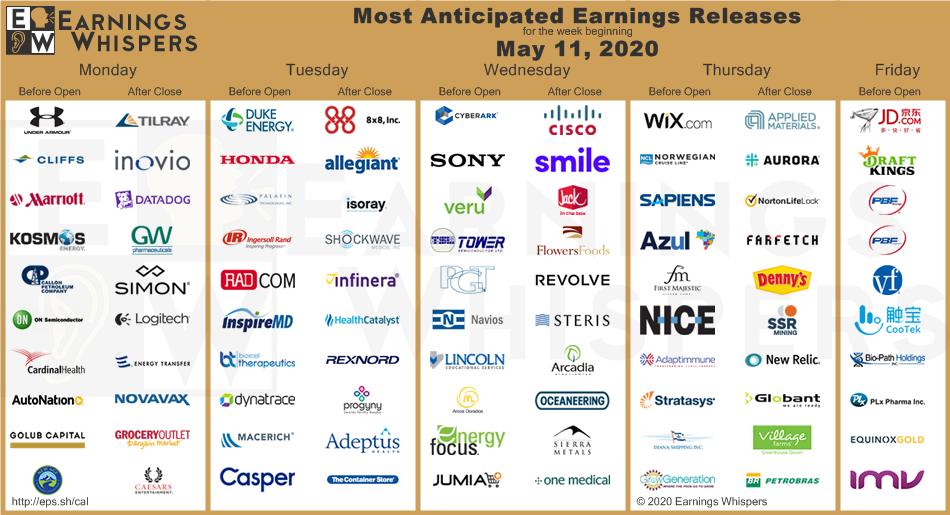
The week ahead — Economic data from Econoday.com:
Posted in Weekly Summary | No Comments »
May 4th, 2020
“The desire for more, the fear of missing out, the tendency to compare against others, the influence of the crowd and the dream of the sure thing—these factors are near universal. Thus they have a profound collective impact on most investors and most markets. The result is mistakes, and those mistakes are frequent, widespread and recurring.”
― Howard Marks
1. Data From Gilead Virus-Drug Trial ‘Good News’ — Gilead gave a shot in the arm to markets with positive data from a drug trial for its Covid-19 treatment, remdesivir. Infectious-disease expert Anthony Fauci said the early results offered “quite good news.” The FDA plans to announce emergency-use authorization for the drug as early as Wednesday, the NYT said. As for a vaccine, the Trump administration is organizing a Manhattan Project-style effort to develop one and have 100 million doses ready by year-end, people familiar said.
Operation Warp Speed will unite pharmaceutical companies, government agencies and the military in an aim to cut the development time by as much as eight months.
2. Job Losses Deepen in Pandemic With U.S. Tally Topping 30 Million — Millions more Americans filed for unemployment benefits last week, sending the six-week total above 30 million since the coronavirus pandemic began to shutter businesses across the country. Initial jobless claims totaled 3.84 million in the week ended April 25 following 4.44 million in the prior week, according to Labor Department figures Thursday. Economists had projected 3.5 million claims.
3. Roche Covid-19 Antibody Test Gets Emergency FDA Approval — The Swiss giant expects production of the test to reach the high double-digit millions by June and pass the 100 million monthly threshold later this year. The test looks for antibodies in blood that have been raised to fight off the virus that causes Covid-19. Roche’s version runs on a high-volume instrument that can produce a single result in 18 minutes and as many as 300 results in an hour, the company said in a statement Sunday after receiving emergency authorization from the U.S. Food and Drug Administration.
4. Trump Presses to Reopen U.S. — Trump repeated his aim that the U.S. would have a coronavirus vaccine by year’s end, an extremely ambitious deadline that the president said doctors have urged him not to promote. He also said the economy would fully rebound in the fourth quarter of 2020 and the beginning of next year. In a virtual town hall staged symbolically at the Lincoln Memorial Sunday evening, Trump said he hopes to return to his raucous political rallies in packed arenas in the final months of his campaign for re-election. He complained that some states “aren’t going fast enough” to ease public health restrictions.
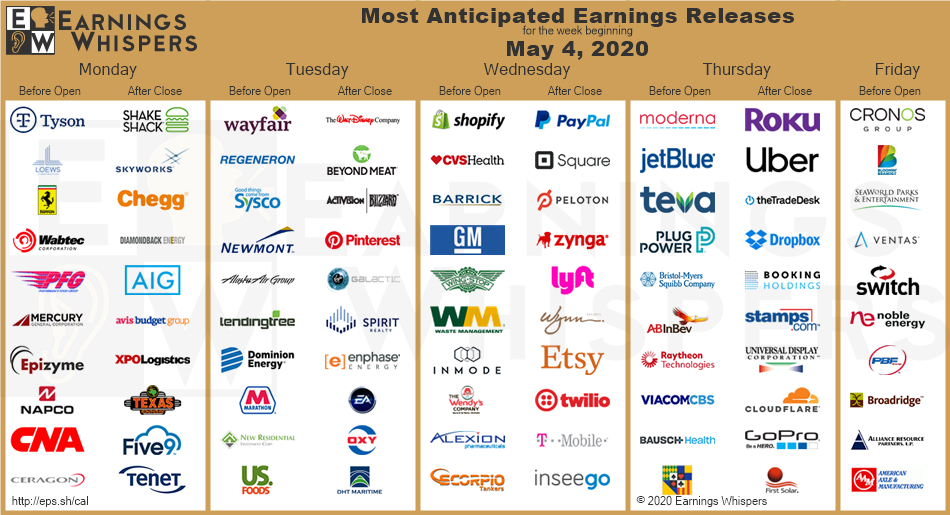
The week ahead — Economic data from Econoday.com:
Posted in Weekly Summary | No Comments »
April 28th, 2020
“The biggest investing errors come not from factors that are informational or analytical, but from those that are psychological.” – Howard Marks
1. Oil Plunges Below Zero for First Time in Unprecedented Wipeout — the current May futures contract, which expires April 21 20, dropped to minus $37.63 a barrel. Underscoring just how acute the concern over the lack of storage is, June’s contract settled at $20.43. That gap between the two contracts is by far the biggest ever. This means that oil for delivery next month has essentially been deemed worthless, suggesting sellers may have to instead pay someone to take it off their hands.
2. First U.S. Virus Death Came Weeks Before Previously Thought — Two residents of Santa Clara County, California, who died at home on Feb. 6 and Feb. 17 were infected with the virus. The first death is 20 days earlier than what was previously thought to be the first U.S. fatality, and about three weeks before health officials identified the first Covid-19 infection without a known tie to other cases. The deaths were also weeks before cities and states began implementing widespread social-distancing measures. U.S. attempts to track the virus at the time were hampered by shortages of tests and highly limited criteria for who could be tested. In early February, the U.S. was still relying on the CDC for all testing of potential cases. Tests sent out by the agency to state and local health labs later that month turned out to be unusable, and widespread testing only became available weeks later.
3. House Ratifies $484 Billion in Aid for Pandemic Relief — Donald Trump signed a $484 billion spending package that includes more money for small businesses. The new law will also deliver tens of billions of dollars in aid to health care providers and grant $25 billion to expand virus testing. It’s unlikely to be enough, though, with lawmakers already discussing the next phase of virus rescue legislation. The news comes as the CBO said the federal budget deficit may more than triple to a record $3.7 trillion this fiscal year.
4. Cuomo announces phased plan to reopen New York — Andrew Cuomo sketched out a phased reopening beginning with construction and manufacturing, possibly on May 15, and probably upstate before NYC. Other businesses would reopen based on how essential they are. New hospitalizations must have dropped for two weeks. Bill de Blasio said in that event he’ll relax the lockdown and open up schools, companies and cultural institutions. New York had 367 deaths on Sunday, the lowest number in almost a month. Almost one-third of business economists expect operations at their companies will return to normal in five to eight weeks, though almost as many say it may be three to six months, a NABE survey showed. Georgia restaurants and movie theaters can reopen. Follow the developments with our Virus Update.
The week ahead — Economic data from Econoday.com:
Posted in Weekly Summary | No Comments »
April 20th, 2020
“Only when the tide goes out do you discover who’s been swimming naked.” — Buffett
1. Airlines, Treasury Reach Tentative Accord to Tap Billions in Aid — U.S. airlines reached preliminary agreements with the Treasury Department to access billions of dollars in aid as the government attempts to shore up one of the industries hardest hit by the coronavirus pandemic. The aid represents a temporary lifeline for airlines after the outbreak and government travel restrictions erased all but 5% of daily passenger demand in the U.S. Forced in some cases to pay more in refunds than they were taking in from new ticket sales and fees, carriers have cut capacity as much as 80% and parked thousands of planes in the industry’s worst-ever disruption.
2. U.S. Economic Data Show Deep Hit in March, Collapse in April — the value of overall retail sales fell 8.7% from the prior month, the biggest decline in records dating back to 1992, according to Commerce Department data released Wednesday. Federal Reserve figures showed U.S. factory output dropped in March by the most since 1946, just after World War II ended. But surveys in April looked even worse, with manufacturing in New York state and sentiment among U.S. homebuilders plummeting by previously unthinkable amounts. Coronavirus containment measures escalated quickly in the month as states began closing restaurants and bars to dine-in customers and urging residents to stay home. Now, almost every state has issued a stay-at-home order and many businesses have temporarily shuttered in the wake. The month was also defined by millions of layoffs, which have continued into April, and sharply reduced spending power.
3. U.S. Jobless Claims Top 5.2 Million, Erasing a Decade of Gains — more than 5 million Americans filed for unemployment benefits last week, bringing the total in the month since the coronavirus pandemic throttled the U.S. economy to 22 million and effectively erasing a decade worth of job creation. The latest figures suggest an unemployment rate currently around at least 17% — far above the 10% reached in the wake of the recession that ended in 2009 — in a sign that the effects of shutdowns have spread well beyond an initial wave of restaurants, hotels and other businesses.
4. China Suffers Historic Economic Slump — Gross domestic product shrank 6.8% from a year ago, the worst performance since at least 1992 when official releases of quarterly GDP started and missing the median forecast of a 6% drop. The economy hasn’t contracted on a full-year basis since the end of the Mao era in the 1970s. Both retailing and factory output showed improvement from the nadir in the first two months, suggesting a stabilization in economic activity. But the data overall indicated an uphill struggle awaits the world’s second largest economy and its experience will be monitored elsewhere for clues as to how fast other economies will emerge from lockdowns.
5. Big Banks’ Profits Sink as They Brace for Loan Defaults — US banks are setting aside billions of dollars to cover bad loans after the coronavirus outbreak. JP Morgan boosted its reserves for potentially bad loans by nearly $7 billion. The bank warned it could boost those reserves even further in the April-June period. Meanwhile, Bank of America ’s allowance for loan losses is now almost $7 billion higher than it was in December. The reserve for credit-card losses is double what it was at the end of 2019.
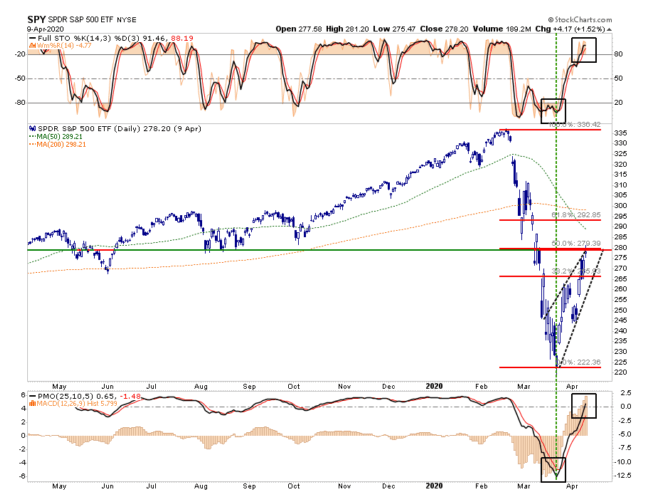
6. Market Completes A 50% ‘Bear Market’ Retracement — Over the last couple of weeks, we have indeed had an extremely strong “oversold,” reflexive rally, that has now reversed the conditions that “fueled” the advance. The next level of resistance for the SPY is around 292 which shows a retrace of 61.8;
The week ahead — Economic data from Econoday.com:
Posted in Weekly Summary | No Comments »
April 6th, 2020
“Most people view risk taking primarily as a way to make money. Bearing higher risk generally produces higher returns…But it can’t always work that way, or else risk investments wouldn’t be risky. And when risk bearing doesn’t work, it really doesn’t work, and people are reminded what risk’s all about.” ― Howard Marks
1. U.K. prime minister moved to intensive care — Boris Johnson, who is fighting a serious coronavirus infection, was admitted to an ICU in London. He deputized his foreign secretary, Dominic Raab, to run the government. More than 10,000 people in the U.S. have been killed by the coronavirus. The U.S. has more than double the number of coronavirus infections of any other nation. Meanwhile, there are signs that social distancing has helped slow the spread of the disease in other regions, such as Europe.
2. Exxon slashed capital spending — Exxon slashed capital spending by 30% to $23 billion and CEO Darren Woods said the company has capacity to further increase cuts if required. The Permian Basin will bear the largest share of the reduction, which exceeded the expectations of some analysts. Exxon aims to meet its projected investment of $20 billion on Gulf Coast manufacturing facilities. Continental Resources is also cutting production and suspending its dividend.
3. Joe Biden is the presumptive Democratic presidential nominee — Bernie Sanders dropped out of the race after suffering a series of primary defeats across the country, clearing the field for the former VP. Biden must now bring together often discordant factions within the party to try and defeat President Trump during a national health crisis that has all but eliminated public events and dramatically curtailed in-person voting.
Howard Marks Memo regarding the Corona-19 Bear Market
Howard_Marks_Calibrating
The week ahead — Economic data from Econoday.com:
Tags: Howard Marks
Posted in Weekly Summary | No Comments »
March 30th, 2020
“The biggest investing errors come not from factors that are informational or analytical, but from those that are psychological. Investor”
― Howard Marks
1. U.S. Domestic Flights Could Virtually Shut Down — major U.S. airlines are drafting plans for a potential voluntary shutdown of virtually all passenger flights across the U.S., according to industry and federal officials, as government agencies also consider ordering such a move and the nation’s air-traffic control system continues to be ravaged by the coronavirus contagion. U.S. airlines have already eliminated the vast majority of international flying and have announced plans to cut back domestic flying by as much as 40%. Travelers are staying home at even greater rates. The Transportation Security Administration reported that passenger flow at its checkpoints was down more than 80% Sunday from the same day a year earlier.
2. The U.S. Has the Third-Highest Number of Coronavirus Infections, China is Lifting Quarantine Measures in Hubei Province — the U.S. reported more than 13,000 new cases yesterday, according to data compiled by Johns Hopkins University. With 46,450 reported infections, the U.S. has the third-highest number of cases after China and Italy. In China, Chinese authorities are planning to lift the quarantine on healthy people in Hubei province, the initial center of the coronavirus pandemic. Hubei authorities will end restrictions on outbound traffic starting tomorrow, with the exception of its capital city of Wuhan, which will block departures for two more weeks.
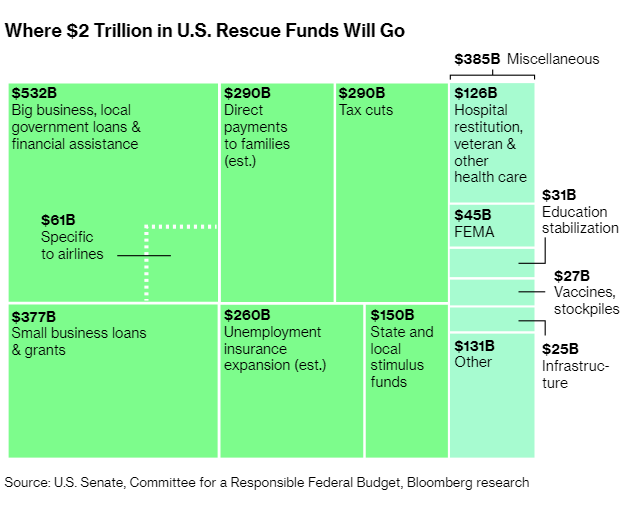
3. Deal Reached on $2 Trillion Coronavirus Rescue Bill — lawmakers and the Trump administration have struck a preliminary agreement on a sweeping stimulus package. It will provide direct checks to many Americans, drastically expand unemployment insurance, offer hundreds of billions in loans to businesses and give additional resources to health-care providers.
The bill, designed to offer relief to individuals, the health-care system and even an entire corporate sector ravaged by the outbreak, would:
4. The U.S. Now Has the World’s Most Coronavirus Cases / Updates– the U.S. has surpassed China and Italy to become the nation with the most confirmed coronavirus cases, marking a new milestone in the fight against the pandemic. There were nearly 86,000 infections in the U.S., according to data compiled by Johns Hopkins University. New York state’s 39,140 infections–tens of thousands more than in any other state–accounted for almost half of all U.S. cases. The country’s death toll stood at 1,300, according to Johns Hopkins.
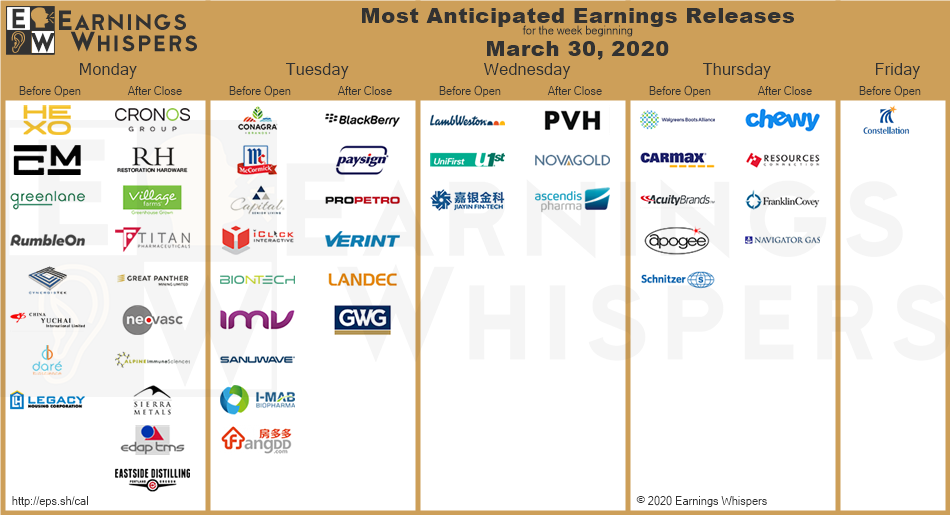
The week ahead — Economic data from Econoday.com:
Posted in Weekly Summary | No Comments »
March 24th, 2020
Blog for the week of Mar 20 20 will not be posted due to the Market Extreme Volatility!!! STAY SAFE
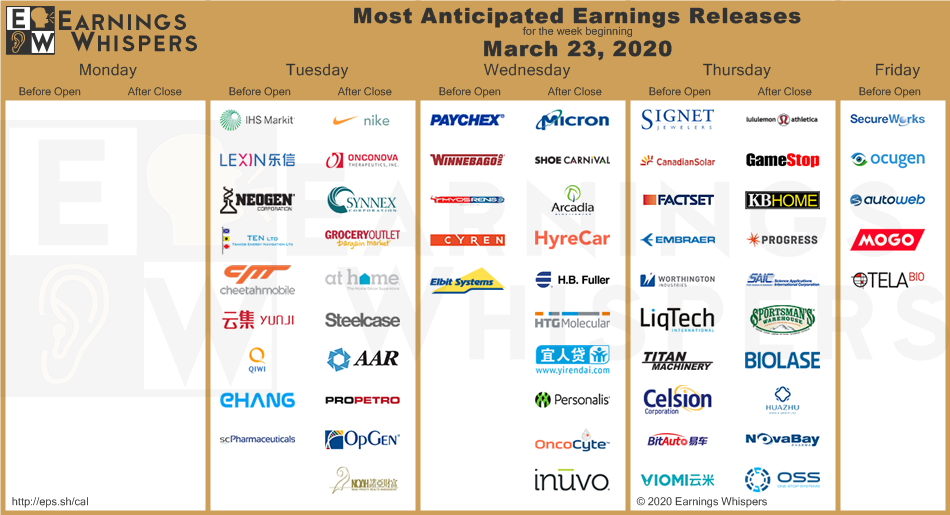
The week ahead — Economic data from Econoday.com:
Posted in Weekly Summary | No Comments »
March 18th, 2020
“Investor psychology can cause a security to be priced just about anywhere in the short run, regardless of its fundamentals” — Howard Marks
1. The World Health Organization has declared the new coronavirus a pandemic — The virus has spread to more than 100 countries. Confirmed cases outside of China have tripled over the past week and officials today locked down all of Italy, where the virus is currently killing more people than anywhere else, even as a wave of rioting in its prisons broke out. Israel announced restrictions requiring all arrivals on international flights to place themselves in quarantine for two weeks. Japan also imposed a two-week quarantine on visitors from China and South Korea.
WHO Director-General Tedros Adhanom Ghebreyesus said that the virus will be stoppable, even if the agency does declare a pandemic. Of 110 countries that have reported the disease, 79 have had 100 or fewer cases, Dr. Tedros said, and 43 countries have fewer than 10 cases. Roughly 80% of cases tend to be mild, but those who are older or have underlying health conditions are at a higher risk. In the U.S., the number of confirmed cases grew to 603, with 22 deaths, across 34 states and Washington, D.C. The executive director of the Port Authority of New York and New Jersey tested positive for the virus.
2. Oil Prices Collapse After Saudi Pledge to Boost Output to Battle Russia — Oil prices recorded their biggest one-day crash since the first Gulf War in 1991 on Monday, tumbling as traders bet that a clash between oil giants Saudi Arabia and Russia could flood a world already hobbled by the coronavirus outbreak with a glut of crude. Saudi Arabian state oil giant Aramco’s move over the weekend to cut most of its official selling prices triggered the oil-price crash, with a barrel of Brent crude, the global gauge of prices, closing down 24% at $34.36. Saudi officials said the kingdom also plans to boost crude output. The tumble puts oil at its lowest level in four years and 50% below a peak hit Jan. 6. U.S. crude futures fell 25% to $31.13 a barrel, also posting their worst day since 1991 and ending the day at a four-year low.
3. Joe Biden won several primaries Tuesday, including the day’s top delegate prize, Michigan — The former vice president easily won Michigan’s primary, the most closely watched among the round of six nominating contests. Mr. Biden’s victory delivered a punishing blow to the prospects of Vermont Sen. Bernie Sanders, who had won Michigan in 2016. The Midwest state was the biggest delegate prize on a day when Mr. Biden also scored wins in Idaho, Mississippi and Missouri. Mr. Biden built his delegate lead over Bernie Sanders with a coalition of African-Americans, suburbanites and older voters.
4. President Trump declared a national emergency to confront the coronavirus crisis— the declaration will release billions of dollars in federal aid — Mr. Trump also called for every state to establish emergency centers and said the government would partner with private industry to speed up virus testing. Centers for Medicare and Medicaid Services Administrator Seema Verma said she was taking action to temporarily restrict all visitors and nonessential personnel from nursing homes. Mr. Trump also said he would waive interest on all student loans held by federal agencies until further notice and instruct the Energy Secretary to purchase “large quantities” of oil for the U.S. Strategic Petroleum Reserve.
5. Stocks in the U.S. continuing a haywire period on Wall Street and avoiding becoming one of the worst weeks in the stock market’s history — the market indexes recovered some ground on the heels of Wall Street’s worst day in more than three decades, when the Dow plunged 10%. But even with late week gains, the Dow is on pace to decline about 15% this week, which would register as the worst week since 2008 and one of the worst in its history. Also, the world’s four biggest cruise lines said they were cutting short voyages and suspending much of their operations until April, an unprecedented shutdown of a $38 billion industry in the wake of the coronavirus pandemic. Hotels hit from the outbreak are cutting room rates and starting to reduce staff, an effort to stabilize the business after plunging revenue, canceled group events and sharp declines in corporate travel.
In Hollywood, the entertainment industry is reeling: Television shows are going on emergency hiatus, movie releases are being delayed, and there is talk of shutting down production entirely.
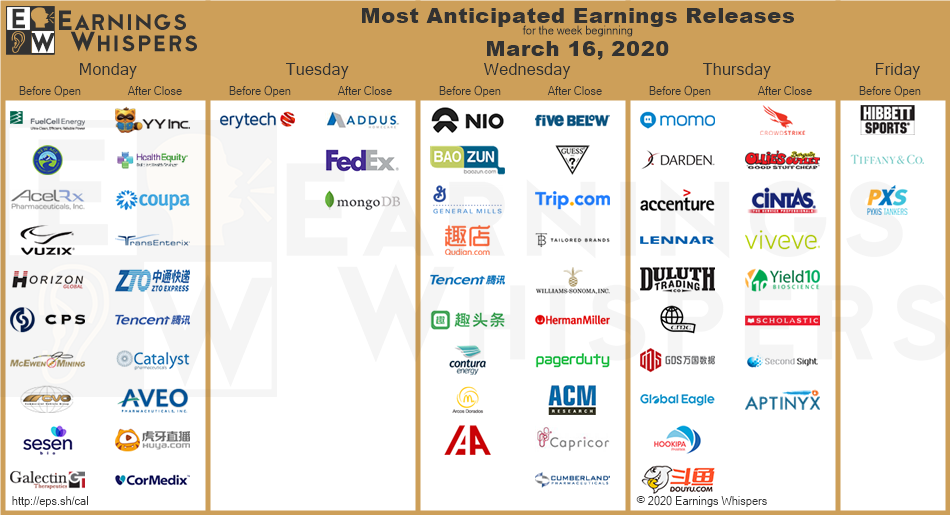
The week ahead — Economic data from Econoday.com:
Posted in Weekly Summary | No Comments »