August 3rd, 2020
“The process of intelligently building a portfolio consists of buying the best investments, making room for them by selling lesser ones, and staying clear of the worst.” – Howard Marks
1. Violence Erupts Around Protests Across U.S. — large demonstrations turned violent around the country over the weekend as tens of thousands of Americans continued a monthslong wave of civil unrest protesting racism and police tactics. Police officials in Portland and Seattle declared some demonstrations in their cities “riots” and used pepper spray and other crowd-control tools to disperse gatherings. President Trump sent federal agents to Portland earlier this month and is now sending federal resources into other cities to quell protests and suppress surges in crime.
2. Trump Administration to Halt New DACA Applicants — the Trump administration announced rollbacks of an Obama-era program that benefited immigrants who have lived in the U.S. illegally since childhood, including a prohibition on new applicants. The administration had been hinting for weeks that it would again move to end DACA, but it chose not cancel the program entirely right now for fear that a rush to do so would run afoul of the Supreme Court’s instruction to take a more considered approach.
3. AMC, Universal Agree to Trim Theatrical Window Before Movies Go Online — under the deal, the “theatrical window” will shorten to 17 days, from the current 75, at least when it comes to movies made by Comcast Corp. ’s Universal that play at AMC theaters, the world’s biggest movie-theater chain. That means that instead of waiting 2½ months to watch a new movie at home, viewers will be able to see at least some titles just 2½ weeks after they premiere in theaters. Movie theaters have long considered it essential for their businesses to be able to play movies exclusively before consumers can watch them other ways.
4. 2Q GDP Contracted at Record Rate Last Quarter — the Commerce Department reported U.S. gross domestic product—the value of all goods and services produced across the economy—fell at a 32.9% annual rate in the second quarter, or a 9.5% drop compared with the same quarter a year ago. Both figures were the steepest in records dating to 1947. A surge in virus infections since mid-June appears to be slowing the recovery in some states, according to some private-sector real-time data.
5. Sanofi, GlaxoSmithKline Ink Coronavirus Vaccine Deal With U.S. — the U.S. government will pay up to $2.1 billion to Sanofi and GlaxoSmithKline to fund the development of a coronavirus vaccine and guarantee supply of 100 million doses, if proven safe and effective in clinical trials. The contract is the latest in a series of deals—potentially worth more than $8 billion—struck by the U.S. government aimed at accelerating development of Covid-19 vaccines and securing large supplies before potential product approvals.
The U.S. has reached deals worth over $1 billion each with vaccine makers including Pfizer Inc. and partner BioNTech SE, AstraZeneca PLC and its partner the University of Oxford, and Novavax Inc., a biotech company in Gaithersburg, Md. Each of the deals guarantees the U.S. 100 million doses or more, if the vaccines are approved by regulators.
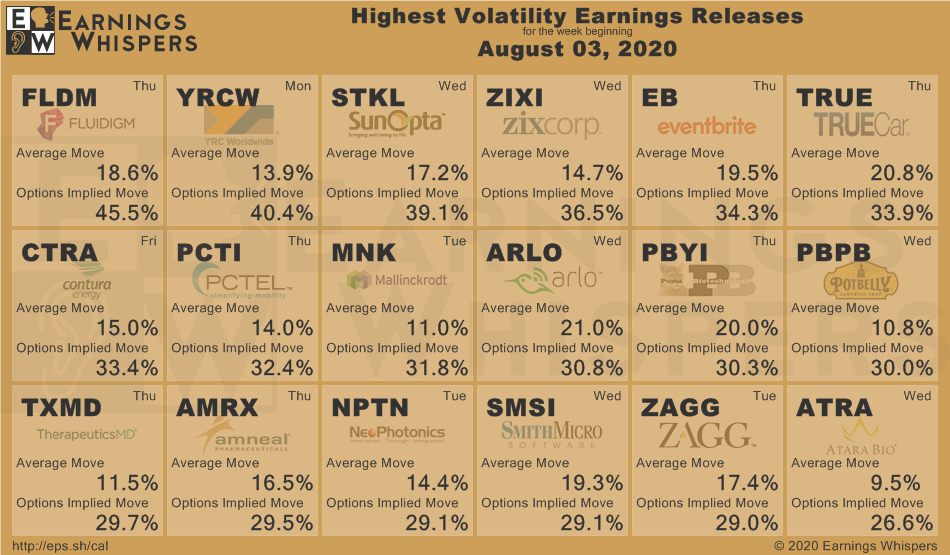
The week ahead — Economic data from Econoday.com:
Posted in Weekly Summary | No Comments »
July 27th, 2020
‘This market is setting up to be one of the great short opportunities of all time. Trouble’s coming, I don’t know when, but it’s coming.’ — Jim Chanos
1. U.S. Orders China to Close Houston Consulate — the U.S. ordered China to shut its consulate in Houston, with officials accusing it and other Chinese diplomatic missions of economic espionage and visa fraud. FBI agents have interviewed Chinese researchers suspected of being undeclared members of the People’s Liberation Army in more than 25 cities, according to some U.S. officials. In some instances, staff at Chinese consulates helped instruct some researchers on security, reminding them to delete information from their electronic devices. The Chinese retaliates with Beijing set a 72-hour limit for the Chengdu Consulate to shut down, according to people briefed on the matter, the same amount of time Washington gave Chinese diplomats to vacate the Houston Consulate. U.S. diplomats at the Chengdu Consulate were given 30 days to leave China, the people said.
2. Weekly Unemployment Rises for First Time in Nearly Four Months — initial unemployment claims rose by a seasonally adjusted 109,000 to 1.4 million for the week ended July 18, the Labor Department reported, halting what had been a steady descent from a peak of 6.9 million in late March, when the pandemic and business closures shut down parts of the U.S. economy. Last week’s increase in applications came after several states imposed new restrictions on businesses such as bars and restaurants when coronavirus cases rose.
3. Pfizer, BioNTech Get $1.95 Billion Covid-19 Vaccine Order From U.S. Government — the U.S. has agreed to pay Pfizer Inc. PFE -2.47% and BioNTech SE nearly $2 billion to secure 100 million doses of their experimental Covid-19 vaccine to provide to Americans free of charge. No Covid-19 vaccine in development has proven to work safely yet, although dozens are being studied. The U.S. and other governments are spending billions of dollars to secure potential Covid-19 vaccines and treatments should they prove safe and effective.
4. Senate Republicans Prepare to Unveil Their Coronavirus Relief Package — Senate Republicans prepared to roll out their opening offer for a fifth coronavirus relief package after ironing out differences with the White House. The plan will include $16 billion in new funding for testing, a compromise between Senate Republicans who had sought more money and the White House, which had opposed any new funding. More than $100 billion will go toward schools, with some of that money only available to K-12 schools that plan to physically reopen. It wasn’t immediately known if a payroll-tax cut would be included in the GOP plan. Lawmakers are racing to reach an agreement before a $600 weekly supplement to the unemployment benefits expires on July 31. Republicans were looking at several options, including continuing the federal supplement at a lower flat rate until states can scale the benefit based on previous income.
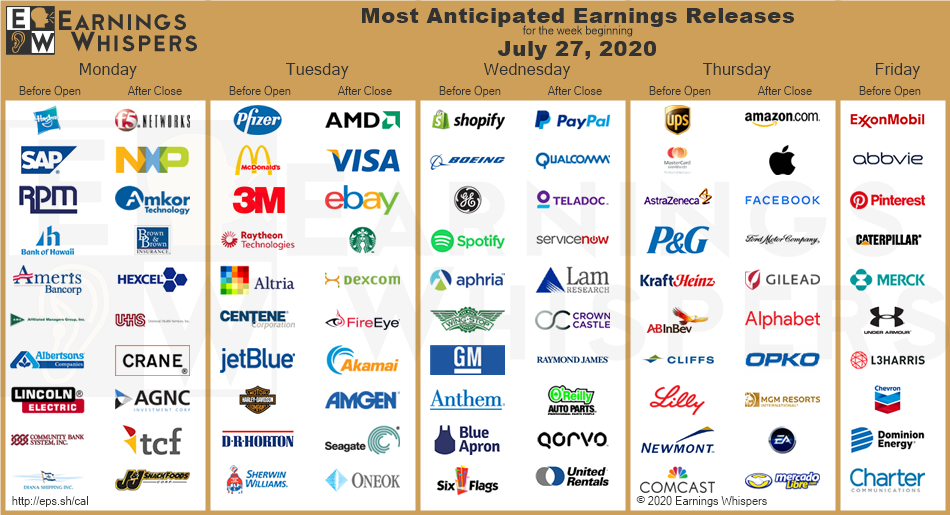
The week ahead — Economic data from Econoday.com:
Posted in Weekly Summary | No Comments »
July 21st, 2020
There will not be any re-cap for the week of July 18 2020. We are away for some needed R&R.
Have a good week.
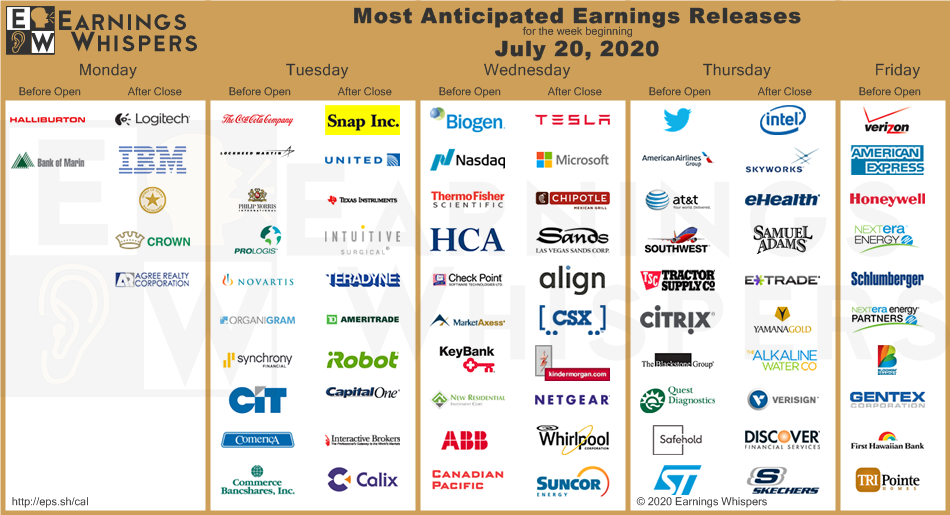
The week ahead — Economic data from Econoday.com:
Posted in Weekly Summary | No Comments »
July 14th, 2020
“There are three ingredients for success—aggressiveness, timing and skill—and if you have enough aggressiveness at the right time, you don’t need that much skill.”
― Howard Marks
1. Novavax, Regeneron are awarded $2 Billion for Covid-19 Vaccine, Drug Supplies — Novavax would receive $1.6 billion from the federal government’ to fund clinical studies of its experimental coronavirus vaccine and establish large-scale manufacturing of doses. With the funding, Novavax said it would deliver 100 million doses of its vaccine, possibly by the end of this year. Regeneron received a $450 million federal contract to manufacture thousands of doses of its experimental Covid-19 treatment that the government will distribute at no cost to the public if the drug is authorized for use by regulators.
2. Trump Moves to Pull U.S. Out of World Health Organization — the U.S. has formally notified the World Health Organization it will withdraw from the United Nations agency over President Trump’s criticism of its ties to China. The exit won’t take effect until next July, leaving it contingent on Mr. Trump’s re-election. His rival for the White House, presumptive Democratic presidential nominee Joe Biden, said Tuesday the U.S. would remain a member if he wins.
3. Recession Forces Spending Cuts on States, Cities Hit by Coronavirus — governments have cut 1.5 million jobs since March, mostly in education, and more reductions are likely barring a quick economic recovery. In addition, State and local governments from Georgia to California are cutting money for schools, universities and other services as the coronavirus-induced recession wreaks havoc on their finances. Almost all states and local governments require balanced budgets. For now, they have largely avoided raising taxes to plug budget holes, opting instead to cut spending or dip into reserves.
4. Supreme Court Paves the Way for N.Y. Prosecutor to View Trump Taxes — The Supreme Court paved the way for a New York prosecutor to enforce a subpoena for President Trump’s financial and tax records. The decision send the cases back to lower courts, where Mr. Trump can raise additional objections to the subpoenas. The rulings put off, likely until after the November election, any ability to see Mr. Trump’s financial records.
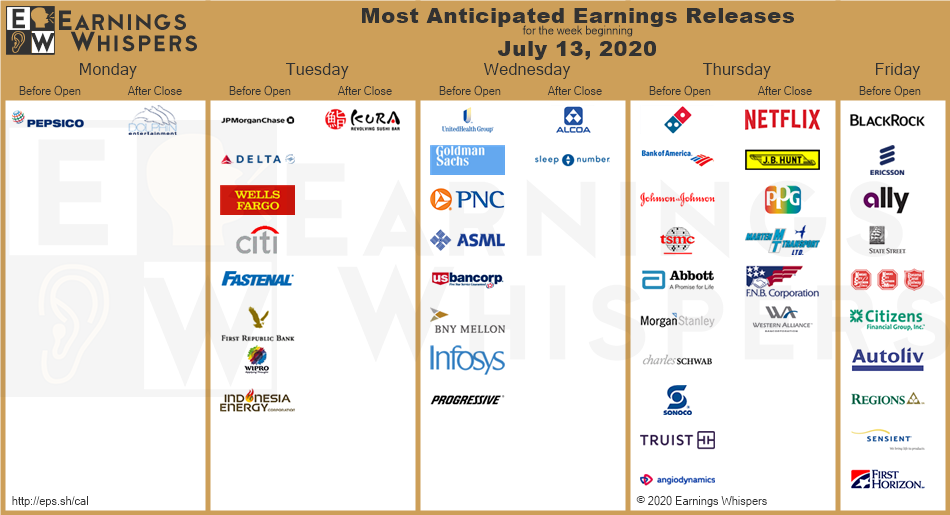
The week ahead — Economic data from Econoday.com:
Posted in Weekly Summary | No Comments »
July 7th, 2020
“The desire for more, the fear of missing out (FOMO), the tendency to compare against others, the influence of the crowd and the dream of the sure thing—these factors are near universal. Thus they have a profound collective impact on most investors and most markets. The result is mistakes, and those mistakes are frequent, widespread and recurring.”
― Howard Marks
1. Covid-19 Drug Remdesivir to Cost $3,120 — Gilead disclosed its pricing plans as it prepares to begin charging for the drug in July. The U.S. has been distributing remdesivir donated by Gilead since the drug was authorized for emergency use in May. it will charge U.S. hospitals $3,120 for a typical patient. Remdesivir is the first antiviral drug shown to be effective at treating Covid-19 in a major clinical trial, reducing patients’ recovery times by four days compared with the placebo group in a large study funded by the National Institute of Allergy and Infectious Diseases.
2. U.S. Daily Coronavirus-Case Count Crosses 50,000 — new coronavirus cases in the U.S. passed 50,000 for the first time to reach a single-day record, as some cities and businesses reversed course on reopenings ahead of the July Fourth holiday weekend. Cases and hospitalizations have jumped in a number of areas. In Texas, 6,904 Covid-19 patients were in hospitals, according to the state’s Department of Health. For most of April and May, that number hovered between 1,100 and 1,800. It broke the 2,000 mark on June 8. The percentage of occupied intensive-care-unit beds in Arizona, another hot spot, remained at a high of 89% for a second day. On Thursday, the state reported nearly 3,300 new cases, for a total of 87,425. More than 10% of its daily tests were positive.
In California, where hospitalizations are up more than 40% from two weeks ago, Gov. Gavin Newsomannounced new restrictions, including the mandatory closure of bars, indoor restaurants, movie theaters, zoos and museums in 19 counties where 70% of the state’s population lives.
3. U.S. Stocks Finish Best Quarter in More Than 20 Years — The S&P 500 finished the second quarter up 515.70 points, or 20%, to 3100.29, its biggest percentage gain since the last three months of 1998. The Dow Jones Industrial Average added 3895.72 points, or 18%, to 25812.88, its best quarter since 1987. The rally has cut the indexes’ losses for the year to 4% and 9.6%, respectively. The Nasdaq Composite up 31% in the past three months and 12% for this year. The stock market’s performance in the months ahead of the election could have a big impact on the outcome of the race. Data going back to 1928 show the incumbent party has won the contest 87% of the time if the S&P 500 is positive over the three months ahead of the election and lost it when it is negative.
4. Uber in Talks to Buy Postmates for About $2.6 Billion — A combination would augment Uber’s food-delivery arm, Uber Eats, which already has an international footprint and the second-largest market share in the U.S. after DoorDash Inc. Its competitor includes Grubhub Inc. agreed this month to be bought by Just Eat Takeaway.com NV for more than $7 billion, besting a bid from Uber, which had been in talks to combine with Grubhub for months.
The week ahead — Economic data from Econoday.com:
Posted in Weekly Summary | No Comments »
June 29th, 2020
“The desire for more, the fear of missing out, the tendency to compare against others, the influence of the crowd and the dream of the sure thing—these factors are near universal. Thus they have a profound collective impact on most investors and most markets. The result is mistakes, and those mistakes are frequent, widespread and recurring.”
― Howard Marks,
1. New York, New Jersey and Connecticut Will Impose a 14-day Quarantine on Travelers from Coronavirus Hotspot States — the governors of New York, New Jersey and Connecticut told travelers to their states coming from states with high rates of Covid-19 cases to self-quarantine for 14 days. That restriction would apply to travelers coming from Florida, Texas, Arizona and a handful of other states throughout the South and Southwest that are experiencing a surge in Covid-19 cases. The announcement comes as the hard-hit tri-state region has seen large declines in cases after experiencing the worst outbreak in the U.S. over the spring.
2. Fauci and Other Health OfficialsRreturned Tesfified in Congress — Dr Fauci expressed concerns as a trio of states with Republican governors who are bullish on reopening — Arizona, Florida and Texas — are among those seeing worrisome increases in cases. He further said “We will be doing more testing,” told a House committee. Todate, the U.S. has tested more than 27 million people, with about 2.3 million – or 8.4% – testing positive; About 2.3 million Americans have been sickened in the pandemic, and some 120,000 have died, according to data from Johns Hopkins University.
3. U.S. first-quarter GDP declines at 5% — the pace of contraction in the economy was left at 5% in the first quarter in the final estimate from the Commerce Department. Using more complete source data, the government found that consumer spending was weaker than previously estimated. This was offset by upward revisions to business fixed investment. The data for the first was dragged down by the impact from the coronavirus pandemic that hit hard at the end of the period.
The week ahead — Economic data from Econoday.com:
Posted in Weekly Summary | No Comments »
June 22nd, 2020
“The process of intelligently building a portfolio consists of buying the best investments, making room for them by selling lesser ones, and staying clear of the worst.” – Howard Marks
1. The Fed Says it is Going to Start Buying Individual Corporate Bonds — as part of a continuing effort to support market functioning and ease credit conditions, the Fed added functions to its Secondary Market Corporate Credit Facility. The program has the ability to buy up to $750 billion worth of corporate credit. Its March 23 initial announcement is largely considered a watershed moment for the financial markets, reeling from the coronavirus threat spread. Under the latest guidelines, the Fed said it will buy, on the secondary market, individual bonds that have remaining maturities of five years or less. Those purchases will go along with the ETFs the Fed already has been buying, which are balanced toward investment-grade indexes but also include some junk bond funds that track debt which had been investment grade before the crisis but had been downgraded after.
2. Beijing Shuts Schools to Stem Virus as Cases Spread Beyond City — the Chinese capital on Tuesday lifted its emergency response to level two and said that people will have to be tested for the virus before being allowed to leave the city. The stakes are higher in Beijing, where the country’s business and political elite reside, and an aggressive lockdown risks undoing China’s economic re-opening and nascent moves to restart travel with other countries. Beijing on Tuesday closed another food market located near the financial district after a case linked to the original cluster was discovered. Eleven other food markets have been shuttered and almost 300 others sanitized, while nearly 30 housing compounds have been put under lockdown, local officials said.
3. Retail Sales Surges 17.7% in May — The 17.7% advance from the prior month, to $485 billion in receipts, was the biggest gain in data going back to 1992, following unprecedented declines in the prior two months, according to Commerce Department data. All retail categories increased in May, including a 44% surge in sales of motor vehicles and a 29% jump in restaurant receipts. Together, those categories accounted for more than half the overall gain in sales. Among other categories, sales at clothing stores nearly tripled in May from a month earlier, while purchases at building materials outlets climbed about 11% and non-store sales, which consist mainly of Internet purchases, rose another 9%.
4. Tulsa Prepares for Unrest as Protesters March Nationwide — Tulsa officials prepared Friday for up to 100,000 anti-police protesters and Trump supporters to descend on the city, by boarding up stores and setting up metal fences around the BOK Center where President Trump will hold a rally Saturday. Trump declares “Any protesters, anarchists, agitators, looters or low-lifes who are going to Oklahoma please understand, you will not be treated like you have been in New York, Seattle, or Minneapolis. It will be a much different scene!” he wrote on Twitter Friday morning.
The week ahead — Economic data from Econoday.com:
Posted in Weekly Summary | No Comments »
June 16th, 2020
1. U.S. Consumer Prices Declined in May for a Third Straight Month — the consumer price index fell 0.1% from the prior month after a 0.8% drop in April that was the biggest since 2008. While the government figures show prices are falling, households expect to be paying more for goods and services a year from now. According to data from the University of Michigan’s consumer sentiment report, year-ahead inflation is seen at 3.2%, 2 percentage points higher than the latest read on annual core prices.Prices for clothing, gasoline, car insurance, and airfares showed another month of declines, despite some states reopening activity. Apparel prices dropped another 2.3%, motor vehicle insurance costs plummeted a record 8.9% and airfares were down 4.9%.
2. Fed Sees Interest Rates Staying Near Zero Through 2022 — the Federal Reserve pledged to maintain asset purchases at “at least” the present pace and projected interest rates will remain near zero through 2022 as policy makers attempt to support the economy’s recovery from the coronavirus recession. Along with the rate decision, central bankers projected Wednesday that the economy will shrink 6.5% in 2020, a year that saw an unprecedented halting of business activity in an effort to combat the coronavirus pandemic. However, 2021 is expected to show a 5% gain followed by 3.5% in 2022.
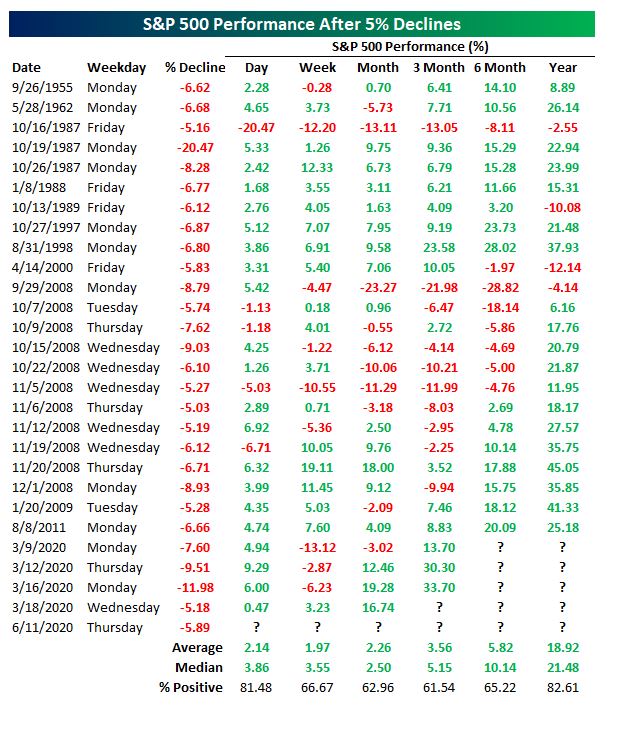
3. S&P 500 tumbled 5.9% and Historical Statistics — according to the Bespoke Investment Group, when the index tumbled sub 5%, was only the 28th time since 1952. Five of those declines have been in the past three months alone. The investment and research provider also noted that an unraveling of the market on a Thursday is also a rarity, with all such previous Thursday 5%+ drops occurring amid the 2008 financial crisis and none before that, going back to 1952. All that said, declines of this magnitude have historically been followed by sizable rebounds in the days, weeks and months to follow (see table below).
4. Hertz Wants to Sell $1 Billion More of Its Shares of Potentially ‘Worthless’ Stock — Hertz Global Holdings Inc., whose stock appears destined to be wiped out when its bankruptcy case is finished, wants to sell $1 billion more of its shares. The car renter wants to take advantage of the quixotic rally in its stock by offering as many as 246.78 million common shares, according to a court filing. Hertz said it would warn any potential buyers that “the common stock could ultimately be worthless” and protect Jefferies LLC, the firm managing the potential sale, against lawsuits that could result from the offering.
The week ahead — Economic data from Econoday.com:
Posted in Weekly Summary | No Comments »
June 9th, 2020
“But most investors do capitulate eventually. They simply run out of the resolve needed to hold out. Once the asset has doubled or tripled in price on the way up — or halved on the way down — many people feel so stupid and wrong, and are so envious of those who’ve profited from the fad or side-stepped the decline, that they lose the will to resist further. My favorite quote on this subject is from Charles Kindleberger: “There is nothing as disturbing to one’s well-being and judgment as to see a friend get rich” (Manias, Panics, and Crashes: A History of Financial Crises, 1989). Market participants are pained by the money that others have made and they’ve missed out on, and they’re afraid the trend (and the pain) will continue further. They conclude that joining the herd will stop the pain, so they surrender. Eventually they buy the asset well into its rise or sell after it has fallen a great deal. In other words, after failing to do the right thing in stage one, they compound the error by taking that action in stage three, when it has become the wrong thing to do. That’s capitulation. It’s a highly destructive aspect of investor behavior during cycles, and a great example of psychology-induced error at its worst.”
― Howard Marks
1. Trump Threatens to Use Troops to Crush Unrest in U.S. Cities — Trump on Monday night called on governors and mayors to “dominate the streets” and announced that he was sending thousands of heavily armed military personnel into the nation’s capital after days of violent outbursts following the death of George Floyd, an unarmed black man, at the hands of Minneapolis police. Trump was considering invoking the Insurrection Act. That 1807 law, previously used to intervene during the 1992 Los Angeles riots, allows the president to federalize the National Guard and bring in the U.S. military if states are unable to safeguard constitutionally protected civil rights.
2. Roche Test for Severe Covid-19 Gets Emergency FDA Approval — the blood test, called Elecsys IL-6, can identify patients who carry the virus and who may develop respiratory distress and require intubation within 18 minutes. Some patients develop a severe inflammatory response called a cytokine storm, which can be deadly. The test attempts to pinpoint those most at-risk people early by measuring levels of interleukin 6 in the blood, a marker for acute inflammation. The protein acts as a messenger from some immune cells to rouse others against the infection.
3. U.S. Job Cuts Shows a Drop of 2.76 million in payrolls is one-third of forecast — The 2.76 million decline in business payrolls last month followed a revised 19.6 million decrease in April, according to ADP Research Institute data released Wednesday. The drop in May was smaller than all but one estimate in a Bloomberg survey of 39 economists. The median projection called for a decline of 9 million.
4. U.S. regains 2.5 million jobs in May, unemployment falls to 13.3% — The U.S. regained 2.5 million jobs in May and the unemployment rate fell to 13.3%, confounding Wall Street expectations for another big wave of layoffs and signaling the economy began to revive last month after probably the worst economic crisis in American history since the Great Depression of the 1930s. Those jobs tilted toward full-time, which added 2.2 million , while part-time workers gaining jobs numbered 1.6 million. Leisure and hospitality workers made up almost half the increase last month, with 1.2 million going back to work after a reported loss of 7.5 million in April. Jobs in bars and restaurants increased by 1.4 million as states began to relax social distancing measures. Construction was the next biggest gainer with 464,000, making up for about half of April’s losses. Education and health services rose by 424,000 and retail surged by 368,000 after plunging by 2.3 million a month previous.
The week ahead — Economic data from Econoday.com:
Posted in Weekly Summary | No Comments »
June 2nd, 2020
“The process of intelligently building a portfolio consists of buying the best investments, making room for them by selling lesser ones, and staying clear of the worst.” – Howard Marks
1. U.S. economy shrank at 5% annual rate in the first quarter — The Commerce Department reported Thursday that the gross domestic product, the broadest measure of economic health, fell at an annual rate of 5% in the first quarter, a bigger decline than the 4.8% drop first estimated a month ago. Economists believe the lockdowns that shut wide swaths of the economy and triggered the layoffs of millions of workers will send the GDP sinking at an annual rate of 40% in the current quarter. That would be the biggest quarterly decline on records that go back to 1947. It would be four times the size of the previous decline set back in 1958.
2. U.S. Announced Hong Kong’s No Longer Autonomous — the Trump administration said it could no longer certify Hong Kong’s political autonomy from China, a move that could trigger sanctions and have far-reaching consequences on the former British colony’s special trading status with the U.S. The move comes as tensions between the world’s two largest economies continue to escalate, fueled by accusations from President Donald Trump that China was slow to disclose the peril of coronavirus.
3. Americans on Jobless Benefits Post First Drop of Pandemic — Labor Department figures reported continuing claims, which tally Americans’ ongoing benefit claims in state programs, fell to 21.1 million for the week ended May 16. Initial jobless claims for regular state programs totaled 2.12 million in the week ended May 23, to bring the 2 1/2-month total above 40 million.
4. Protests Hammer U.S. Cities Still Recovering From Lockdown — Violence erupted in dozens of places following the death of George Floyd, a black Minneapolis man who died after a white police officer pressed a knee into his neck for more than eight minutes. Demonstrators rampaged through shopping districts including Rodeo Drive in Beverly Hills, California, and Chicago’s Michigan Avenue, and set fire to police cars and municipal buildings. Meanwhile, Donald Trump demanded governors crack down, saying “most of you are weak” and urging them to “dominate” rioters. “You have to put them in jail for 10 years and you’ll never see this stuff again,” the president said during a conference call with governors and law enforcement.
The week ahead — Economic data from Econoday.com:
Posted in Uncategorized | No Comments »