October 15th, 2020
The degree of risk present in a market derives from the behavior of the participants, not from securities, strategies, and institutions. — Howard Marks
1. Trump Returns to White House — President Donald Trump left Walter Reed Medical Center early last week and returned to the White House, where he will continue to be attended by physicians around the clock. The president continues to receive dexamethasone, the steroid that has shown to provide significant benefit to patients with severe cases of Covid-19. Trump received his fourth dose of the antiviral remdesivir before leaving and will receive his fifth and final dose outside the hospital.
2. Schools in New York City Hot Spots Will Close — with Covid-19 infections rising in some New York City neighborhoods, Gov. Andrew Cuomo said Monday that schools in several parts of Brooklyn and Queens would shutter in-person classes on Tuesday and move to fully remote instruction. The governor’s decision applies to nine of the city’s 146 ZIP Codes in parts of Far Rockaway and Kew Gardens in Queens, and Borough Park, Midwood, Gravesend, Bensonhurst, and Sheepshead Bay in Brooklyn. Gov. Cuomo also said that the state would start enforcing mask orders with fines, one of a number of items where he and the mayor appear to disagree.
3. Apple Expected to Unveil 5G Phones Next Week — Apple said that it would host a virtual event live from its Cupertino, Calif., headquarters on Tuesday, Oct. 12. The company didn’t say what precisely the event would focus on, but it is widely expected to roll out new 5G phones. Some analysts are calling the soon-to-be unveiled generation of Apple phones the iPhone 12, but the company might not stick with its numbering system. The new iPhone lineup is expected to include a 5.4-inch iPhone, a 6.1-inch iPhone Max, a 6.1-inch iPhone Pro, and a 6.7-inch iPhone Pro Max.
4. Judges Rule That Manhattan D.A. Can Obtain Trump Tax Records — Manhattan District Attorney Cyrus Vance can enforce a subpoena for President Donald Trump’s personal and business tax returns, according to a unanimous ruling from a three-judge appeal panel. The district attorney’s subpoena covers not just Trump’s personal and corporate tax records, but also communication he had with his accounting firm, Mazars. Early this summer, the Supreme Court rejected the president’s claim that he should have immunity from criminal investigation but left the door open for him to continue his fight against the wide scope and possible relevance of the documents covered by the subpoena.
5. Trump Raises Coronavirus Stimulus Offer to $1.8 Trillion — the White House will increase its coronavirus stimulus offer to $1.8 trillion, about $400 billion less than the $2.2 trillion bill Democrats previously passed. The plan would mark an increase from the $1.6 trillion the Trump administration previously proposed. House Democrats passed a $2.2 trillion bill earlier this month, and the sides have struggled to find a consensus in between those figures.
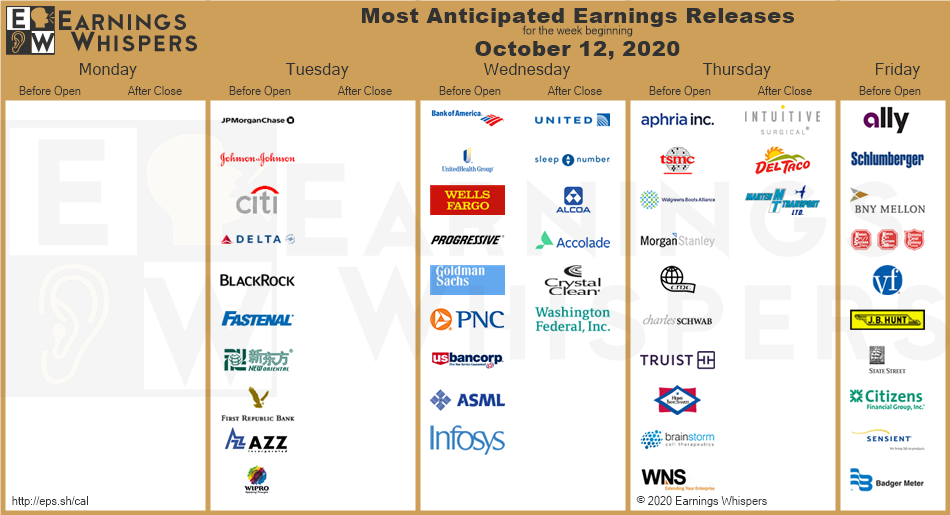
The week ahead — Economic data from Econoday.com:
Posted in Weekly Summary | No Comments »
October 6th, 2020
In dealing with the future, we must think about two things: (a) what might happen and (b) the probability that it will happen. — Howard Mark
1. Disney Will Lay Off 28,000 Staff at Theme Parks — Walt Disney Co. said it would lay off about 28,000 employees at its domestic theme parks, making the announcement shortly after the state of California signaled that Disneyland Resort would likely have to remain closed for the foreseeable future due to Covid-19 concerns. Disneyland and California Adventure in Anaheim, Calif., remain shuttered while theme parks in Florida, Paris, Shanghai, Japan, and Hong Kong have reopened to limited capacity. The California Department of Public Health moved some counties to new “tiers” Tuesday allowing some businesses to reopen, but Disneyland’s home of Orange County did not make the cut due to a late spike in cases.
2. Boeing Readies to Consolidate Dreamliner Production to South Carolina — Boeing Co. will set plans this week to consolidate 787 Dreamliner assembly in South Carolina, people familiar with the matter said, ending production of that jetliner in Washington state as the coronavirus pandemic saps demand for aircraft. The decision carries significant implications for the Seattle-area economy and Boeing’s unionized workforce around Puget Sound. It wasn’t clear over what period of time the consolidation would play out, or how many employees might be affected by the move. Boeing could announce the plans. Furthermore, Boeing opted for a more muted come-back approach after a public scolding by the U.S. Federal Aviation Administration and private criticism from airlines over its handling of the Max crisis, the people said. With its reputation in tatters, Boeing is leaning on the FAA, pilots and airlines to assure travelers that the revamped Max is safe to fly. FAA Administrator Steve Dickson, a licensed 737 pilot, plans to flying a Max himself.
3. U.S. Airlines Started to Furloughing Employees — United Airlines, which is set to furlough about 16,000 employees, announced the move in mid-September, while urging Congress to extend the payroll support program for an additional six months. American Airlines is set to furlough about 19,000 workers. Delta and Southwest haven’t disclosed plans Relief payments from the federal government, doled out in April, were conditioned on the airlines refraining from conducting involuntary layoffs until the end of September. Delta, for instance, received more than $5 billion.
4. President Trump Tests Positive for Coronavirus — the president tweeted that he and first lady Melania Trump tested positive for the virus, a development that will upend the final month of the 2020 campaign. They plan to remain at the White House while they recover, and Mr. Trump will need to cancel in-person events in the coming weeks, possibly including the next debate against Joe Biden on Oct. 15 in Miami. Furthermore, Vice President Pence and his wife Karen both tested negative for coronavirus on Friday morning, according to a statement from Devin O’Malley, the vice president’s secretary. Pence is scheduled to have a debate with Democratic VP candidate Sen. Kamala Harris in Salt Lake City on Oct. 7.
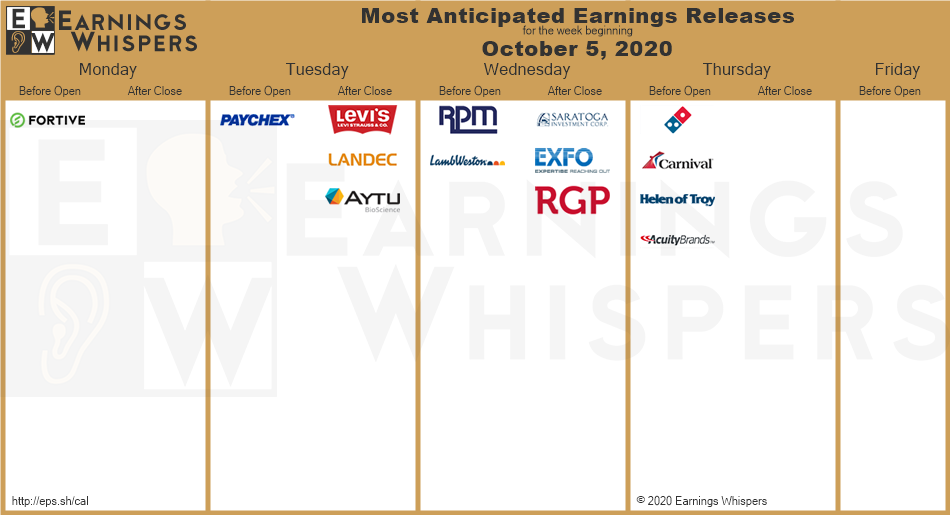
The week ahead — Economic data from Econoday.com:
Posted in Weekly Summary | No Comments »
September 30th, 2020
“Being too far ahead of your time is indistinguishable from being wrong.” So”
― Howard Marks
1. Details of TikTok Deal as Chinese Might Reject Deals — a state-run Chinese news outlet said Monday that the Chinese government would not approve the deal between Oracle, Walmart, and ByteDance, the parent company of popular video-sharing app TikTok. The deal under consideration would result in American investors owning 53% of TikTok Global, The Wall Street Journal reported. ByteDance, however, insists that it would retain about 80% ownership of the newly created company.
2. A ‘Super V-Shaped’ Recovery in Housing — existing home sales hit their highest level in nearly 14 years in August, with the seasonally-adjusted annual rate reaching 6 million for the first time since December 2006, data released Tuesday by the National Association of Realtors showed. Those buyers are mostly looking for bigger houses—a dynamic driven by increased work-from-home arrangements as well as children doing remote classwork.
3. Trump Signs Executive Orders on Health Care — President Trump signed two executive orders late on Thursday, which he said would provide better protection for people with pre-existing health problems, at a lower cost than provided for under the Affordable Care Act. Trump also said that 33 million Medicare recipients would be sent cards in the mail to cover up to $200 in prescription drug costs. Details of the plan were light.
4. U.S. New-Home Sales Climb to 1 Million Rate, Fastest Since 2006 — Sales of new homes in the U.S. unexpectedly advanced for a fourth month in August to the highest level in almost 14 years as record-low mortgage rates continued to entice buyers into a market with ever-shrinking supply. Purchases of new single-family houses increased 4.8% to a 1 million annualized pace, led by a flurry of demand in the South, after an upwardly revised 14.7% surge in July, government data showed. The median selling price decreased from a year earlier to $312,800 and the number of homes for sale dropped to an almost three-year low.
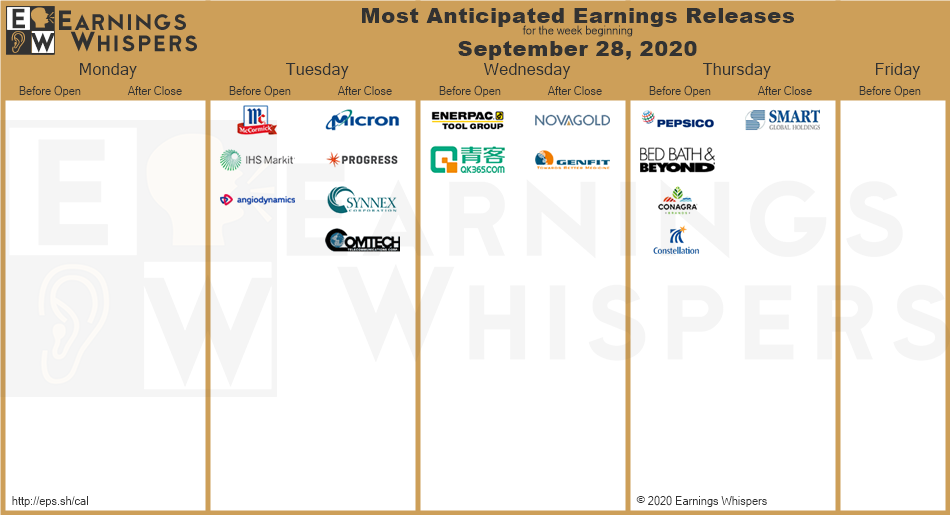
The week ahead — Economic data from Econoday.com:
Posted in Weekly Summary | No Comments »
September 22nd, 2020
Most people are driven by greed, fear, envy, and other emotions that render objectivity impossible and open the door for significant mistakes. — Howard Marks
1. House to Introduce Bipartisan Stimulus Bill — after months of failed negotiations, 50 moderate House Republicans and Democrats will unveil a $1.5 trillion coronavirus stimulus plan. According to The Wall Street Journal, moderate Democrats have urged Pelosi to resume negotiations with the White House. Pelosi has not ruled out a deal and the Journal reports that the White House would accept a package with a $1.5 trillion price tag. The House bill from the bipartisan group is expected to include around $500 billion for state and local governments, per Bloomberg. It will also include additional unemployment benefits and another round of stimulus payments for most Americans.
2. Amazon Expands Its Pandemic-Era Hiring Spree — Amazon will hire 100,000 warehouse workers in the U.S. and Canada to help keep up with surging demand due to the Covid-19 pandemic.
Amazon says hiring is already under way and that the jobs pay at least $15 an hour with benefits and come with a $1,000 signing bonus in some locations. Separately, the company is hiring for some 30,000 corporate and technology jobs, with an average compensation of $150,000. Other retailers that have profited during the pandemic are hiring as well. For example, Walmart has hired 200,000 new employees and Chipotle announced in July that it will hire 10,000 workers to open new locations and staff drive-thru lanes for online orders.
3. U.S. Retail Spending Grew at Slower Pace in August — U.S. retail spending rose 0.6% in August for the fourth straight monthly increase, but at a slower pace as some extra unemployment benefits ran out. Consumers spent more on clothing, electronics and furniture in August as students went back to school, many for online classes because of the pandemic. Spending fell on groceries and sporting goods. Some retailers say that consumers who are still working from home have continued spending on home improvement, including their workspaces, and purchased big-ticket items with money saved from not dining out or traveling.
4. Fed Signals Rates Will Stay Near Zero for at Least Three Years — the Federal Reserve left interest rates near zero and signaled it would hold them there through at least 2023 to help the U.S. economy recover from the coronavirus pandemic. The Federal Open Market Committee “expects to maintain an accommodative stance of monetary policy” until it achieves inflation averaging 2% over time and longer-term inflation expectations remain well anchored at 2%. In addition to slashing borrowing costs in March, the central bank has pumped trillions of dollars into the financial system through bond purchases and launched a slew of emergency lending facilities to keep businesses afloat. The economy has partly recovered from the steepest downturn on record and some sectors such as housing are doing well, but Covid-19 continues to kill thousands of Americans each week, unemployment remains high and industries like hospitality and travel are depressed.
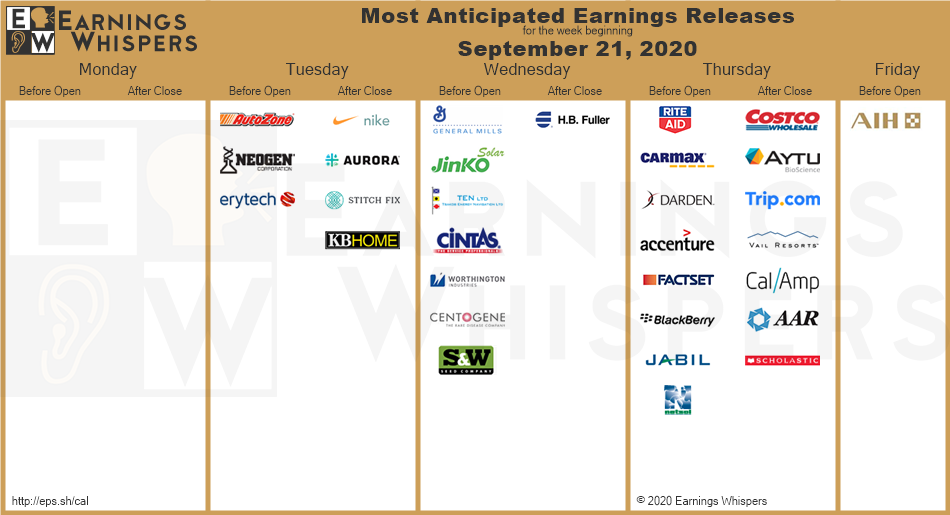
The week ahead — Economic data from Econoday.com:
Posted in Weekly Summary | No Comments »
September 15th, 2020
“Every once in a while, an up-or-down-leg goes on for a long time and/or to a great extreme and people start to say “this time it’s different.” They cite the changes in geopolitics, institutions, technology or behaviour that have rendered the “old rules” obsolete. They make investment decisions that extrapolate the recent trend. And then it turns out that the old rules still apply and the cycle resumes. In the end, trees don’t grow to the sky, and few things go to zero.”
― Howard Marks
1. Citigroup’s Jane Fraser to Succeed Michael Corbat as CEO — Jane Fraser will become the first woman to run a major Wall Street bank, succeeding Michael Corbat as Citigroup Inc. C -0.88% chief executive when he retires in February. During the financial crisis, she ran the bank’s strategy division, laying the groundwork to sell units like the Smith Barney brokerage and shrink the overall bank. In 2015, she was sent to run the bank’s important Latin America divisions.
2. U.S. Unemployment Claims Held Steady Last Week — Unemployment claims were unchanged at 884,000 last week, the Labor Department reported. The number of people seeking and collecting unemployment benefits has remained at historically high levels in recent weeks, a sign the labor-market recovery is losing steam six months after the pandemic struck the U.S.The total number of workers receiving assistance from state and federal programs also remained high in late August, as more workers turned to pandemic-related programs for assistance. The total of about 29.6 million people, which isn’t seasonally adjusted and lags two weeks behind new state claims figures, includes temporary pandemic programs for self-employed and gig workers in addition to those receiving regular state benefits.
3. Century 21 Files for Bankruptcy, to Close All 13 Stores — Century 21, where generations of New Yorkers shopped for deep discounts on everything from Prada handbags to Jerry Garcia ties, filed for bankruptcy, the latest retailer to fall victim to disruptions caused by the coronavirus pandemic. Century 21 Department Stores LLC said Thursday that it is closing all 13 of its department stores and that it plans to liquidate its assets under chapter 11 protection in U.S. Bankruptcy Court in New York. In recent years, Century 21 expanded beyond its roots in New York City to open stores in New Jersey, Pennsylvania and Florida. Going-out-of-business sales are set to start soon.
4. China Injects Hundreds of Thousands With Experimental Covid-19 Vaccines — China National Biotec Group Co., a subsidiary of state-owned Sinopharm, has given two experimental vaccine candidates to hundreds of thousands of people under an emergency-use condition approved by Beijing in July, the company said this week. Separately, Chinese drugmaker Sinovac Biotech Ltd. said it has inoculated around 3,000 of its employees and their family members, including the firm’s chief executive, with its experimental coronavirus vaccine. The three vaccine candidates are still undergoing Phase 3 clinical trials, which involve testing a vaccine’s safety and effectiveness on thousands of people. Six other leading Covid-19 vaccine candidates are also in this final phase, according to the World Health Organization.
The week ahead — Economic data from Econoday.com:
Posted in Weekly Summary | No Comments »
September 8th, 2020
When the Facts Change, I Change My Mind. What Do You Do, Sir?
John Maynard Keynes
1. Insurance Firms Gain Early Lead in Coronavirus Legal Fight With Businesses — U.S. property insurers have won a flurry of judicial rulings backing up their rejections of claims for businesses’ lost income during government-ordered shutdowns, dimming policyholders’ hopes of payments to help them rebound. Across the U.S., restaurants, hair salons, retailers and other businesses are seeking policy proceeds to deal with the huge economic cost of the shutdowns, in one of the biggest fights the insurance industry has ever waged with its policyholders. So far insurers have prevailed in state courts in California, Michigan and the District of Columbia, and in federal courts in Texas and California, according to a Covid-19 litigation-tracking effort at the University of Pennsylvania Carey Law School.
2. New York City Delays Reopening of Schools — the largest school district in the U.S. delayed the start of in-person teaching after Mayor Bill de Blasio and the teachers union reached an agreement and averted the threat of a strike over classroom safety concerns amid the coronavirus pandemic. The school district, with about 1.1 million students, has a hybrid model, in which some students will take online classes daily while others take remote classes for part of the week and attend school in person the other days. The district is the only major U.S. school system moving forward with a return to in-person learning in September.
3. U.S. Debt Is Set to Surpass the Size of the Economy — U.S. government debt will exceed the size of the economy, at $3.311 trillion, for the first time since World War II. Federal debt is projected to reach or exceed 100% of U.S. gross domestic product, according to the nonpartisan Congressional Budget Office, for the fiscal year, which ends Sept. 30. The last time U.S. debt was higher than economic output was in 1946, when it was 106% after financing military operations to help end World War II, The Wall Street Journal reported.
4. U.S. Stocks Routed Amid Decline in Tech Shares — the tech-heavy Nasdaq Composite dropped nearly 5% to 11458, its biggest one-day percentage decline since June 11, in a reversal of a rally that had taken it and the S&P 500 to new highs. The S&P 500 lost 3.5% to 3455, with all 11 sectors showing losses. The uptick in market volatility could be due to a large number of call options, which confer the right to buy shares, on technology stocks such as Apple and Tesla, according to Saxo Bank. Market makers have been forced to take the other side of such trades, buying the underlying stocks to hedge their positions.
The week ahead — Economic data from Econoday.com:
Posted in Weekly Summary | No Comments »
September 1st, 2020
“Do more of what works and less of what doesn’t.” – Steve Clark
1. Dow Jones Industrial Average (DJIA) Shuffles Members — Salesforce, Amgen and Honeywell to be added to DJIA while Exxon, Pfizer and Raytheon will be removed; The changes will take place Aug. 31 and were prompted by Apple Inc.’s AAPL, -1.86% decision to carry out a 4-for-1 stock split, reducing the index’s tech-sector weighting. “The announced changes help offset that reduction.
2. U.S. Sanctions Chinese Firms and Executives Active in Contested South China Sea — The U.S. unveiled a set of visa and export restrictions targeting Chinese state-owned companies and their executives involved in advancing Beijing’s territorial claims in the contested South China Sea, a new challenge to China involving the strategic waters. The U.S. added 24 Chinese companies active in the South China Sea—including five CCCC subsidiaries—to a Commerce Department list that restricts U.S. companies from supplying U.S.-origin technology to them without a license.
3. Fed Approves Shift on Inflation Goal, Ushering in Longer Era of Low Rates— The Federal Reserve announced a major policy shift, saying that it is willing to allow inflation to run hotter than normal in order to support the labor market and broader economy. The central bank formally agreed to a policy of “average inflation targeting.” That means it will allow inflation to run “moderately” above the Fed’s 2% goal “for some time” following periods when it has run below that objective.
4. Trump to Announce Deal With Abbott Laboratories for 150 Million Rapid Covid-19 Tests — President Trump is expected to announce a $750 million deal to buy 150 million rapid Covid-19 tests from Abbott Laboratories, a move that would substantially expand the nation’s capacity for rapid testing. The Food and Drug Administration on Wednesday granted emergency-use authorization to the company for a $5 rapid-response Covid-19 antigen test that is roughly the size of a credit card. The test could be administered in a doctor’s or school nurse’s office and uses technology similar to home pregnancy tests. It returns results in about 15 minutes. Abbott said Wednesday it plans to ship tens of millions of the tests in September and expects to increase production to 50 million tests in October. The October total would be roughly double the number of tests performed in the U.S. in July. Abbott said its data show the new antigen test has demonstrated sensitivity—the percent of positive cases a test accurately detects—of about 97%. Rapid antigen tests are generally thought to be less sensitive than lab-based PCR tests.
The week ahead — Economic data from Econoday.com:
Posted in Weekly Summary | No Comments »
August 24th, 2020
‘They know that overstaying the festivities — that is, continuing to speculate in companies that have gigantic valuations relative to the cash they are likely to generate in the future — will eventually bring on pumpkins and mice. But they nevertheless hate to miss a single minute of what is one helluva party. Therefore, the giddy participants all plan to leave just seconds before midnight. There’s a problem, though: They are dancing in a room in which the clocks have no hands.’ — Warren Buffett
1. U.S. Further Tightens Huawei Restrictions — the Commerce Department said that it was restricting Chinese tech-giant Huawei’s access to foreign chips made using U.S. technology on the grounds that it could be used to spy on Americans. The new rule requires non-U.S. firms to get a special license to sell any chips, including off-the-shelf chips, made using U.S. technology to Huawei. A previous rule, imposed by the Trump administration on Huawei in May, was aimed largely at limiting the ability of Huawei’s HiSilicon unit from importing chips made by Taiwan Semiconductor Manufacturing using American chip-making technology. Huawei has already said it would stop making its top-end cellphone chip in mid-September because it can’t get the components. The new rule, which takes effect on Sept. 15, will further curtail Huawei’s ability to source parts for its products.
2. Democrats Nominate Joe Biden in Virtual Roll Call — Democrats formally made Joe Biden their presidential nominee, a role he has sought for more than three decades, capping a come-from-behind victory in the primaries he secured with a broad coalition of his party’s voters. The program included remarks from former Presidents Bill Clinton and Jimmy Carter, and former Secretary of State John Kerry, who was also the Democratic presidential nominee in 2004. “Our party is united in offering you a very different choice: a go-to-work president,” Clinton said.
3. Regeneron and Roche Team Up on Antibody Treatment — Regeneron Pharmaceuticals is partnering with rival drug maker Roche Holding to develop and manufacture Regeneron’s experimental Covid-19 antibody treatment. The treatment, which has not yet been approved by the Food and Drug Administration, is based on a cocktail of two antibodies that neutralize the virus in a manner similar to the way HIV and hepatitis C drug cocktails work. The cocktail is being tested as a treatment for people already infected with the virus and as a prophylactic for those likely to be exposed to the virus, such as front-line health care workers. It is currently in final Phase II/III human trials. In related news, the FDA has delayed an emergency use authorization for a Covid-19 treatment that uses blood plasma of recovered Covid-19 patients after top health officials concluded that clinical trials failed to show it worked.
4. FDA Authorizes Convalescent Plasma for Covid-19 Use — the FDA called an emergency-use authorization, permits use of the treatment on hospitalized Covid-19 patients. For Covid-19 patients and the doctors who treat them, the designation opens up the possibility for faster and easier access to a promising treatment. But the FDA said more clinical studies are necessary for definitive proof of the therapy’s effectiveness. Doctors have been looking for validated coronavirus treatments. Until now, only one other drug, remdesivir from Gilead Sciences Inc., has the FDA’s emergency-use OK. Hospitalized patients who received the plasma within three days of diagnosis, are under the age of 80 and not on mechanical ventilation, benefited the most, with a 35% improvement in survival 30 days after receiving the transfusion compared with patients who got plasma with low antibody levels, according to Dr. Marks.
The week ahead — Economic data from Econoday.com:
href=”http://s317550275.onlinehome.us/Blog/admin/2020/08/24/week-of-aug-22-2020-weekly-recap-the-week-ahead/earnings_weekaug282020-2/” rel=”attachment wp-att-11766″>
Posted in Weekly Summary | No Comments »
August 17th, 2020
“Maybe they’ll get more overvalued. I think that’s the argument for being long today is that …continued overvaluation and [they can] get even more so. But they’re overvalued and this is the setup up for left tail events in stock markets,” — trader Mark Spitznagel
1. Trump Authorizes Extending Special Unemployment Benefit at $400 a Week — President Trump directed the federal government Saturday to provide $300 a week in additional payments to the unemployed and called on states to fund an extra $100 in weekly benefits. The measure was one of four the president signed to extend coronavirus aid after negotiators for the White House and Democrats in Congress failed to reach an accord. The order signed by Mr. Trump authorized states to pay $400 a week in added benefits, but only funded 75% of that. It was uncertain how states would respond. Many have seen revenues fall amid fallout from the pandemic and have asked Congress for help to avoid cuts to services and more layoffs of first responders.
2. Joe Biden Picks Kamala Harris as Running Mate — Joe Biden named Sen. Kamala Harris of California as his running mate, picking his former Democratic primary opponent to be the first Black woman nominated for vice president by a major party. Harris, 55, is the first Black woman and the first person of Indian descent ever nominated for national office by a major political party.
3. Weekly Jobless Claims Drop Below One Million for First Time Since March — New applications for unemployment benefits dropped to seasonally adjusted 963,000 in the week ended Aug. 8, the Labor Department reported. Claims are down significantly from a peak of near seven million in March, but remain at historically high levels and higher than the pre-pandemic record of 695,000. President Trump signed an executive action Saturday that authorized states to extend a federally funded $300 in benefits and provide an extra $100 in state-funded benefits. States likely won’t start implementing the supplemental benefits for weeks, as they must apply for the federal funds and set up new programs.
4. Retail Sales Point to a Rocky Economic Recovery — Total retail sales rose a seasonally adjusted 1.2% last month from June, the Department of Commerce said Friday. That follows month-over-month gains of 8.4% and 18% in the preceding months, after retail sales plummeted 15% in April. Excluding more volatile categories like gasoline, motor vehicles and building materials, retail sales rose 1.4% in July, better than economists’ 1.1% estimate but slower than the 6% and 10% rates in June and May. Gains were strongest at electronics and appliance stores (up 23% from a month earlier), while sales at gas stations and clothing stores rose 6% and restaurant and bar sales increased 5%.
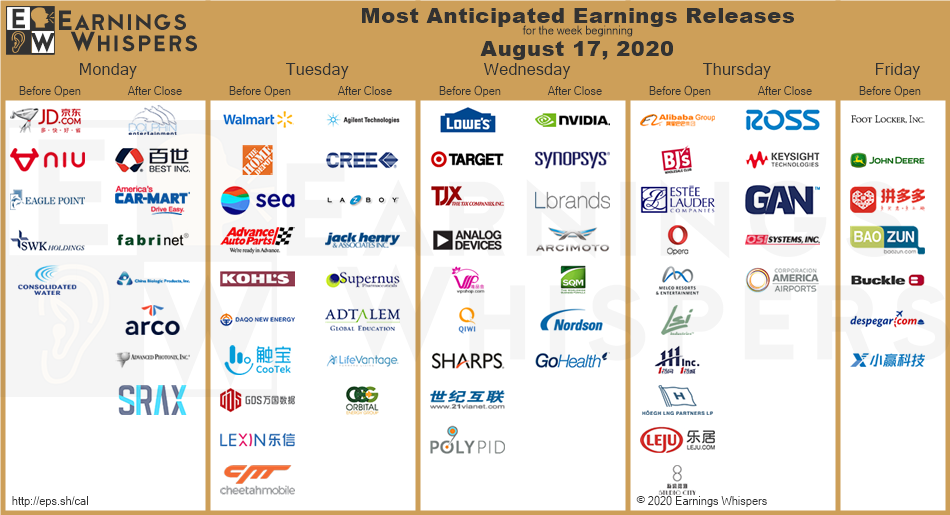
The week ahead — Economic data from Econoday.com:
Posted in Weekly Summary | No Comments »
August 11th, 2020
There will not be any re-cap for the week of August 7 2020 due to power outages.
Have a good week.
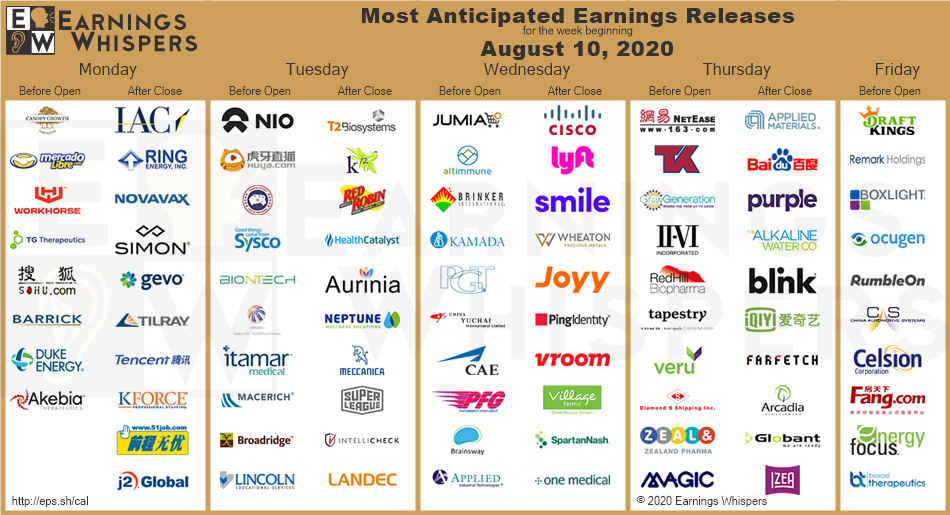
The week ahead — Economic data from Econoday.com:
Posted in Weekly Summary | No Comments »