Search

Week of Feb 26, 2021 Weekly Recap & The Week Ahead

March 1st, 2021

“One of the great sayings about poker is that “in every game there’s a fish. If you’ve played for 45 minutes and haven’t figured out who the fish is, then it’s you.” The same is certainly true of inefficient market investing.” ― Howard Marks

1. J&J Vaccine a Step Closer to Authorization — the FDA is currently considering the company’s application for emergency-use authorization for the vaccine, which would be the third Covid-19 vaccine to receive FDA authorization. Efficacy against moderate to severe Covid-19 was 66.1% after 28 days, but efficacy against severe Covid-19 was far better, at 85.4% after 28 days. What’s more, across the entire study, there were only two cases of Covid-19 hospitalization in the vaccine group, and none after 28 days, compared with 29 cases in the placebo group. There were no Covid-19-related deaths in the vaccine group, compared with seven in the placebo group.
2. Moderna Says Covid-19 Vaccine for South Africa Strain Is Ready for Human Testing — Moderna said it shipped the new shots to the National Institutes of Health to conduct the first human study of the variant vaccine, which could start within weeks. The new vaccine, code-named mRNA-1273.351, is designed to better match the virus variant that was first identified in South Africa but has since spread elsewhere. Other companies including Pfizer Inc. and Johnson & Johnson have said they are tweaking their vaccines or working on boosters that better match variants. Older vaccines don’t appear to work as well against the strain first identified in South Africa, and difficult new strains could also emerge.
3. Ten-year Treasury Yields Reach the Highest In a Year — ten-year Treasury yields spiked after tepid demand at an auction for government bonds, surging as much as 23 basis points to 1.6%, the highest since last February. The increase forced a crucial group of investors such as holders of mortgage securities to sell Treasuries, which in turn led to further increases in yields. The 10-year U.S. yield adjusted for inflation rose to its highest level since June, a warning sign for riskier assets that have benefited from exceptionally loose financial conditions amid the pandemic.
4. J&J’s One-Shot Covid Vaccine Receives FDA Advisers’ Backing — experts advising the U.S. Food and Drug Administration voted 22-0, with no abstentions, that the benefits of the vaccine outweigh its risks in adults 18 and older, a decision that could help bolster the vaccine supply as new variants continue to spread. The J&J shot is highly anticipated because it can be kept in a refrigerator for three months, an advantage over the mRNA vaccines that must be frozen when stored for longer periods, and its single-shot regime. Overall, the rate of side effects was low. However, there were more cases of deep vein thrombosis and pulmonary embolism in people who got the vaccine compared to the placebo group, said Yosefa Hefter, a medical officer in FDA’s Center for Biologics Evaluation and Research.
5. Senate Democrats to Drop Minimum Wage From Relief Package — Senate Democrats will drop a plan to introduce an amendment to the Senate stimulus bill that would have used tax penalties and incentives to raise wages for the lowest-paid workers at big companies. Lawmakers are aiming to the pass the relief package before federal unemployment benefits run out on March 14. That was too tight of a time frame to try to use the tax code to raise wages, according to sources The Wall Street Journal spoke with.

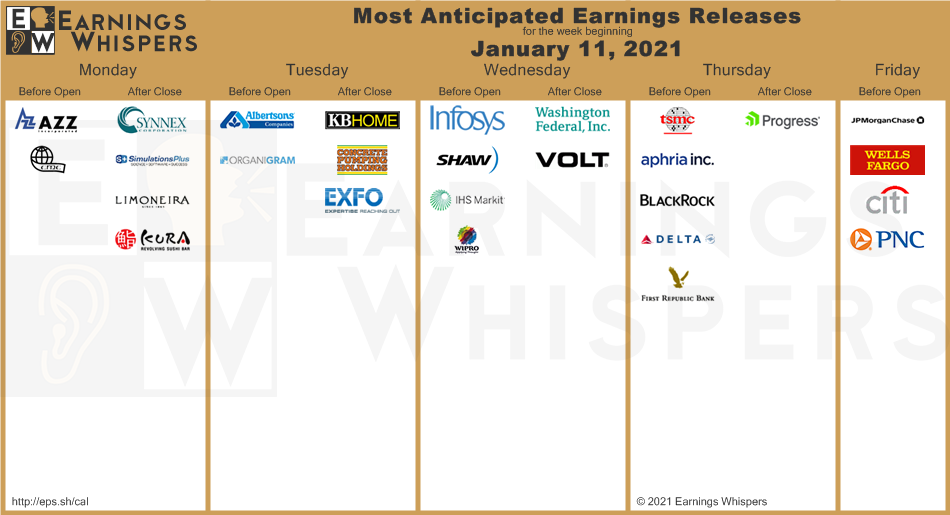
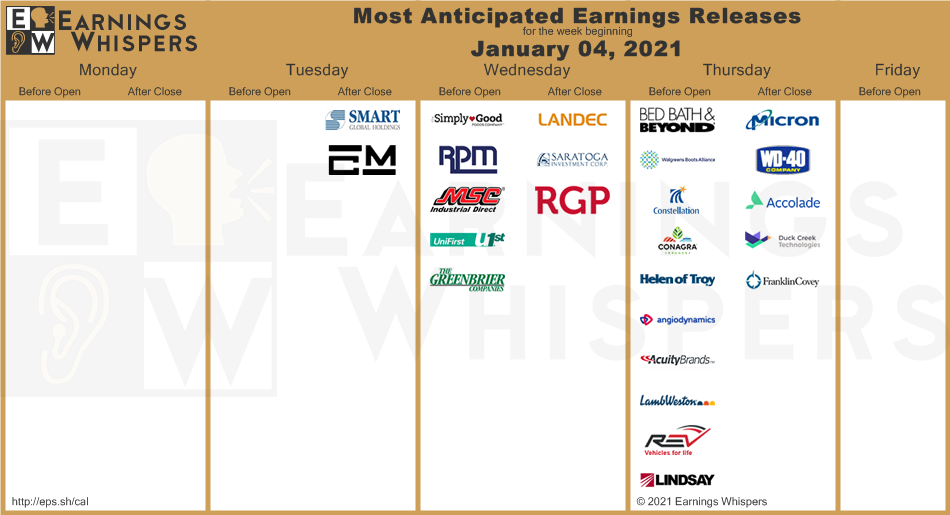
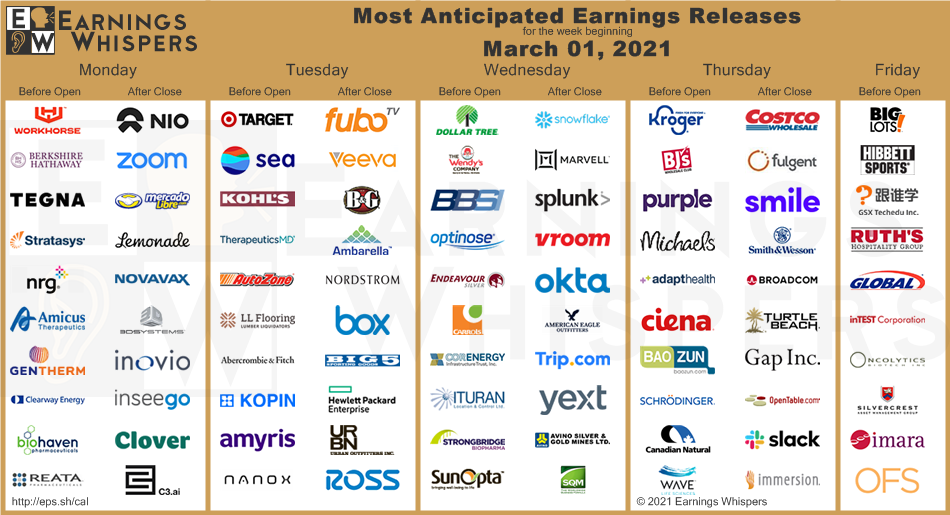
The week ahead — Economic data from Econoday.com:
Week of Feb 19, 2021 Weekly Recap & The Week Ahead

February 23rd, 2021

1. AstraZeneca Vaccine Gains Wider Acceptance — the vaccine developed jointly by Oxford University and AstraZeneca is being approved by a rising number of regulators, paving the way for its generalized use. The Australian medicine regulator gave provisional approval for the Oxford/AstraZeneca Covid-19 vaccine on Tuesday, ahead of a national vaccination campaign due to start next week. The World Health Organization on Monday approved the vaccine for emergency use, which should allow developing countries a wide access to the jab. AstraZeneca has pledged not to profit from the sale of the vaccine, which is sold at the cheapest price of any available vaccine—at €1.80 ($2.20) a dose, for example, in the European Union, compared to €18 a dose for the Moderna vaccine and €12 for the Pfizer jab.
2. Covid-19 Was Spreading in China Before First Confirmed Cases — new evidence from China is affirming what epidemiologists have long suspected: The coronavirus likely began spreading unnoticed around the Wuhan area in November 2019, before it exploded in multiple different locations throughout the city in December. Chinese authorities declined to give the WHO team raw data on these cases and potential earlier ones. In examining 13 genetic sequences of the virus from December, Chinese authorities found similar sequences among those linked to the market, but slight differences in those of people without any link to it, according to the WHO investigators.
3. U.S. Retail Sales Rose Strongly on Stimulus in January — The U.S. economy’s recovery picked up as consumers used stimulus checks to boost retail spending in January to its largest increase in seven months. The Federal Reserve Bank of Atlanta’s GDPNow model on Wednesday predicted the economy will grow at a 9.5% seasonally adjusted annual rate in the first quarter, up sharply from a 4.5% estimate a week ago. Minutes from the Fed’s January policy meeting separately showed that policy makers expected the end-of-year federal stimulus package and progress toward widespread vaccinations would improve the outlook for the economy.
4. Saudi Arabia Set to Raise Oil Output Amid Recovery in Pricesthe Kingdom plans to announce a reversal of those cuts when a coalition of oil producers meet next month, the advisers said, in light of the recent recovery in prices. The output rise won’t kick in until April, given the Saudis already have committed to stick to cuts through March. Brent crude, the international oil benchmark, has hit $64 a barrel, while West Texas Intermediate, the main grade of U.S. crude, crossed $60.

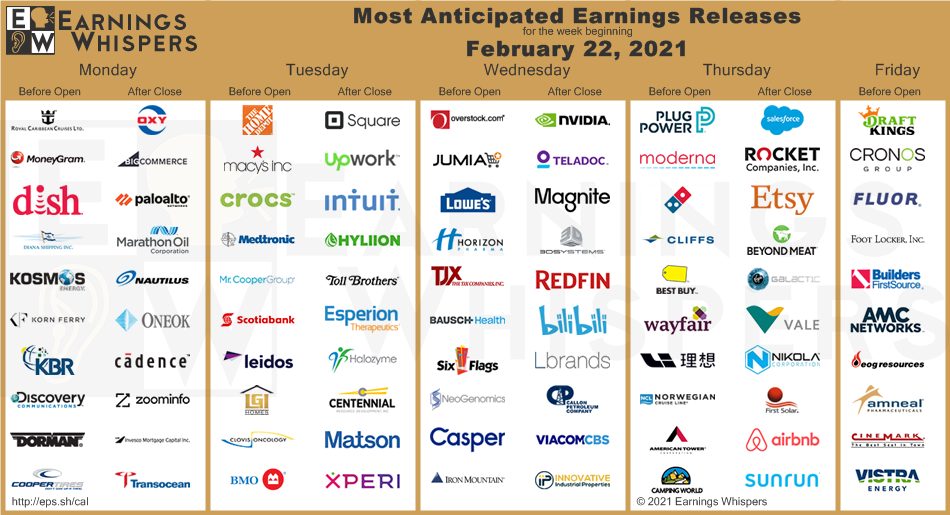
The week ahead — Economic data from Econoday.com:
Week of Feb 12, 2021 Weekly Recap & The Week Ahead

February 15th, 2021

“The desire for more, the fear of missing out, the tendency to compare against others, the influence of the crowd and the dream of the sure thing—these factors are near universal. Thus they have a profound collective impact on most investors and most markets. This is especially true at the market extremes. The result is mistakes—frequent, widespread, recurring, expensive mistakes.” ― Howard Marks

1. Elon Musk Announced that Tesla had bought $1.5 billion in Bitcoin — Tesla, which announced that it bought $1.5 billion worth of Bitcoin to hold on its balance sheet, and that it plans to allow car buyers to pay in Bitcoin. For Tesla, one big reason for the investment appears to be the enthusiasm of its chief executive, Elon Musk. Alsok, Mastercard said Wednesday it will start allowing businesses to accept some crypto payments, though they’ll be converted into standard currencies before they hit the register. On Thursday, BNY Mellon, founded by Alexander Hamilton, said it will hold and transfer cryptocurrencies for customers, just like it does with other assets.
2. U.S., France Flex Muscles in South China Sea — Two U.S. carrier groups are conducting exercises in the waters disputed by China, raising Beijing’s ire as France announced one of its attack submarines had sailed through the zone. French Defense Minister Florence Parly said that a French attack submarine and its support vessel had just sailed through the South China Sea to reaffirm, together with Australia, Japan and the U.S., that “international law is the only rule that matters.”
International powers have contested China’s ambitions on most of the resource-rich area, after Beijing built military outposts on reefs and sandbars transformed into man-made islands in order to claim sovereignty on the 12-miles zone of territorial waters.
3. Bitcoin to Come to America’s Oldest Bank, BNY Mellon — the custody bank said late last week that it will hold, transfer and issue bitcoin and other cryptocurrencies on behalf of its asset-management clients. Custodians like BNY Mellon keep track of money managers’ assets—whether they are physical things like real estate or cash housed in an account with another bank—storing some themselves while attesting to the existence of others. BNY Mellon said it would allow digital assets to pass through the same plumbing used by managers’ other, more traditional holdings—from Treasurys to technology stocks—using a platform that is now in prototype. The bank is already discussing plans with clients to bri Tesla, which announced on Monday that it bought $1.5 billion worth of Bitcoin to hold on its balance sheet, and that it plans to allow car buyers to pay in Bitcoin. For Tesla, one big reason for the investment appears to be the enthusiasm of its chief executive, Elon Muskng their digital currencies into the fold.
4. Biden, China’s Xi Hold Talks Over Human Rights, Trade, Climate — President Biden spoke with Chinese President Xi Jinping for the first time since taking office in a call in which he said he raised issues of human rights, trade policy and international security that divide the two countries while also holding open the possibility of working together on climate change and nuclear proliferation. Mr. Biden in recent days spoke with a host of allies in Europe and Asia, signaling that he seeks to deal with China as the leader of the world’s democracies rather than solely an American president. The U.S. needs to “join together with others to hold China accountable for its abuses and to shape China’s choices going forward,” said a senior administration official.
5. Trump Acquitted of Inciting Insurrection, Even as Bipartisan Majority Votes ‘Guilty’ — the 57-to-43 tally fell 10 votes short of the two-thirds majority needed to convict, and allow the Senate to move to disqualify him from holding future office. Among the Republicans breaking ranks to find guilty the man who led their party for four tumultuous years, demanding absolute loyalty, were Senators Richard Burr of North Carolina, Bill Cassidy of Louisiana, Susan Collins of Maine, Lisa Murkowski of Alaska, Mitt Romney of Utah, Ben Sasse of Nebraska and Patrick J. Toomey of Pennsylvania.

The week ahead — Economic data from Econoday.com:
Week of Feb 5, 2021 Weekly Recap & The Week Ahead

February 8th, 2021

“What the wise man does in the beginning, the fool does in the end.” ― Howard Marks

1. AWS Chief Andy Jassy Named New Amazon CEO — CEO Jeff Bezos will be succeeded by Andy Jassy, who heads Amazon Web Services, the cloud-computing business. The company said Jassy will take over as CEO in the third quarter of this year. Bezos will stay with the company he founded as the board’s executive chair. Bezos said in a letter to employees that following the transition, he will focus on new products and early initiatives. He will also have more time with his personal endeavors, such as the nonprofit Day 1 Fund, the Bezos Earth Fund, his aerospace firm Blue Origin, and The Washington Post.
2. Democrats Set Stage to Move Forward on Stimulus Package Without GOP — Congressional Democrats took the first step toward passing their $1.9 trillion plan after President Joe Biden made it clear that he won’t settle for what he views as an insufficient Covid-19 stimulus package proposed by a group of 10 Senate Republicans earlier in the week. Democrats are moving forward with plans to pass their stimulus package using a budgetary process called reconciliation. The Senate passed a budget resolution on morning for President Joe Biden’s $1.9 trillion aid package, setting up the bill to be passed by a simple majority in the upper chamber. The votes to advance the resolution were split along party lines, with Vice President Kamala Harris breaking the tie. The resolution now goes to the Democrat-controlled House. Separately, a group of Congressional Democrats, including Senate Majority Leader Chuck Schumer, on Thursday called on President Biden to cancel up to $50,000 in student loan debt by executive order. Biden has said he does not support an executive order canceling student debt. Instead, the White House reiterated Thursday that the president supports eliminating up to $10,000 per borrower in student debt through legislation passed by Congress.
3. Johnson & Johnson Seeks Emergency Authorization for Covid Vaccine — Johnson & Johnson said Thursday it submitted its vaccine to the U.S. Food and Drug Administration for emergency use authorization. J&J said it plans to distribute the vaccine to the U.S. government following authorization. It expects to supply 100 million doses to the U.S. in the first half of the year. Paul Stoffels, the company’s chief scientist, said in a news release that the company is prepared to begin shipping upon authorization. Last week, the company said its single-dose vaccine was 66% effective in preventing moderate to severe Covid-19. A Phase 3 trial of more than 43,000 participants showed it was 85% effective at preventing severe disease. It also prevented hospitalization and death from Covid-19 completely at 28 days following vaccination.
The 85% effective rate was consistent even in South Africa, where a new strain of Covid-19 has worried experts.
4. Europe Moving Toward Vaccine Passport Scheme — a few European Union countries have taken steps to distribute special passes to allow citizens inoculated against the coronavirus to travel freely. Others, such as the U.K., are considering such a measure. Denmark said Wednesday it would go ahead and develop by the end of the month a digital Covid passport that would help its citizens travel to countries requiring a vaccination, and also allow them to visit restaurants or attend mass events. Sweden also announced this week that it would launch such a pass in time for the summer season, if some form of international standard is in place by then. According to the Times of London, the U.K.’s Foreign Office and the ministries of Transport and Health are preparing a certification system that would allow vaccinated British tourists to travel abroad this summer.
Other European countries such as France and Germany have voiced their concerns about the so-called vaccine passport, on the grounds that it would mean special treatment for a privileged class of citizens—notably to the detriment of the younger population.

The week ahead — Economic data from Econoday.com:
Week of Jan 29, 2021 Weekly Recap & The Week Ahead

February 1st, 2021

“Investing is a popularity contest, and the most dangerous thing is to buy something at the peak of its popularity. At that point, all favorable facts and opinions are already factored into its price, and no new buyers are left to emerge.” ― Howard Marks,

1. Merck Ends Covid-19 Vaccine Programs as U.S. Cases Top 25 Million — Merck announced that it will stop the development of its Covid-19 vaccines after early trial data showed the experimental shots did not boost immunity to the virus when compared with natural infection. The company will instead focus on two therapeutic candidates.
Merck’s news comes as the total number of reported Covid-19 cases in the U.S. tops 25 million and the Biden administration and U.S. health officials ratchet up their criticism of President Trump’s handling of the vaccine rollout.
2. Millions of Americans Face Tough Choices as Mortgage Protections May End — since early November, about 2.7 million, or 5.5%, of American mortgage holders have been putting off payments, according to weekly data released by the Mortgage Bankers Association. That’s down from a peak of just over 8.5% in early June. The ability of homeowners to pause mortgage payments was itself a product of the CARES Act signed into law last March. It allowed borrowers with federally-backed mortgages, which account for about three-quarters of U.S. home loans, to postpone payments for up to a year. President Biden has signed an executive order extending a federal moratorium on evictions and foreclosures through March 31. He has also asked federal agencies to extend the deadline for accepting new applications for forbearance at least until then.
3. Xi Warns U.S. as Biden Pushes Ahead With Buy American Initiative — Biden is expected to continue some of the work done by his predecessor to blunt China’s rise, marking a continued departure from several decades of U.S. policy that favored increased ties and an overall friendly relationship with Beijing. President Biden has pointedly said he would not remove tariffs on Chinese goods put in place by his predecessor. He also signed an executive order Monday aimed at strengthening American manufacturing. While not a direct blow to China, the implication of a preference for American goods over Chinese ones is clear. The order tightens the rules for federal government procurement to increase purchases of American-made products. Meanwhile, Chinese President Xi Jinping sent an indirect but clear warning to the Biden administration, which is preparing to enlist allies in efforts to contain China’s economic and diplomatic influence.
4. Biden’s Climate Policies Could Hit the U.S. Oil Industry— the U.S. oil industry is likely to be an early target of President Joe Biden’s policies to fight climate change, beginning with a ban on new drilling leases on federal land. Biden is set to sign an executive order Wednesday halting new oil and gas leases on federal lands, The Wall Street Journal reports. While drilling on those lands accounts for just under 10% of U.S. onshore oil and gas production, fossil fuel companies want to maximize their access to those reserves. The president has also proposed spending several trillions of dollars investing in U.S. infrastructure, with an eye to pushing clear energy items, and has vowed to spend $20 billion replacing the entire fleet of federal government vehicles with electric cars.
4. U.S. Economy Shrank in 2020 Despite Fourth-Quarter Growth — despite a strong rebound in the second half of last year, the economy contracted 3.5% in 2020, measured year over year, the first decline since the financial crisis and the largest since 1946. U.S. gross domestic product rose at a 4.0% seasonally and inflation adjusted annual rate in the final quarter of last year
5. Johnson & Johnson Vaccine Shown Effective as South African Variant Emerges in U.S. — Johnson & Johnson reported its vaccine was 66% effective against moderate to severe cases. the company said that the Phase 3 trial, involving more than 43,000 participants, had shown that the vaccine is 85% effective at preventing severe disease, and completely prevented hospitalization and death from Covid-19 at 28 days after vaccination. The company will seek authorization from U.S. regulators in early February. Novavax said that early trials of its vaccine candidate indicate it is 90% effective overall and 50% effective against the South African strain. Moderna has said its vaccine would likely produce a weaker immune response against the South African strain and that it’s working on a booster shot. Pfizer reported more promising findings, saying that results from a study that has yet to be peer-reviewed found its Covid-19 vaccine is effective against both the South African and U.K. strain and “do not indicate the need for a new vaccine to address the emerging variants.”

The week ahead — Economic data from Econoday.com:
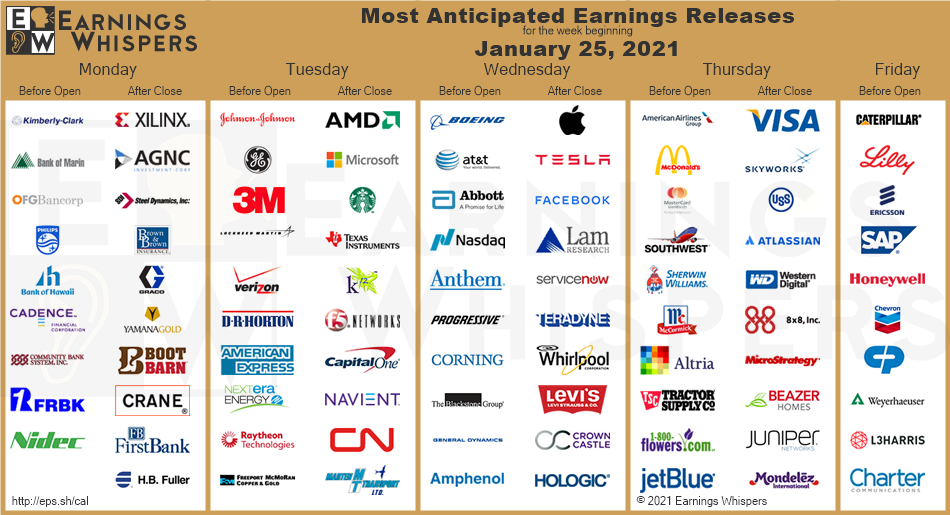
Week of Jan 21, 2021 Weekly Recap & The Week Ahead

January 25th, 2021

“The Market Can Remain Irrational Longer Than You Can Remain Solvent” — John Maynard Keynes

1. Gene-Editing Stocks Are Biotech’s New Cutting Edge — In October, two scientists won the Nobel Prize for their 2012 discovery and development of Crispr-Cas9. Now, the promise of that technology—effectively molecular scissors that can find and edit almost any part of a cell’s DNA—is causing shares of companies looking to commercialize gene-editing therapies to surge. Crispr-Cas9 is the second generation Crispr technology, which has the potential to alter specific portions of the genetic code in ways that could provide treatments for a number of inherited genetic disorders and many kinds of cancer. New Crispr technology is being commercialized at an incredibly rapid pace. Beam Therapeutics, which is developing a next-generation gene-editing tool called base editing, has seen its shares rise sixfold since its initial public offering in February 2020.
2. Biden Takes Office as 46th President & Issues First Round of Executive Orders — President Joe Biden signed 15 executive orders and two executive actions early last week on issues ranging from a mask mandate to rejoining the Paris climate accord. “I thought there’s no time to wait. To immediately address the pandemic, Biden signed an order mandating masks on federal property as well as on all planes, trains, and other transit systems between states. He also created a new office of White House Covid-19 response that reports directly to him.
As promised during the campaign, Biden lifted the controversial ban on travel from several majority-Muslim countries that had been put in place by the Trump administration. He also ordered an end to construction of the Mexico-U.S. border wall and a moratorium on deportations.
He is also calling for an extension of the federal eviction moratorium through March 31 and freezing student loan payments on direct federal loans through Sept. 30.
In addition to rejoining the Paris climate accord, Biden took executive action to stop the U.S. withdrawal from the World Health Organization, reinstate rules limiting methane emissions, and revoke a permit for construction of the Keystone XL oil pipeline.
3. Europe Mulling Stringent New Travel Bans as Virus Variants Keep Spreading — European Union leaders convene in a video summit to discuss ways to restrict travels into the region, as new, aggressive variants of the coronavirus threaten to overwhelm many countries’ health care systems. Most governments already require a recent negative test before allowing in foreign visitors, and France or the U.K. then require a second test within days of arrival. Countries such as France or the Netherlands have banned all incoming visitors from the U.K., save for essential travel, on account of the highly infectious new virus variant fast spreading in Britain.
4. Bitcoin Price Plunges — The world’s biggest cryptocurrency by market value dropped about 12% over the past day to just over $31,000 as of Friday morning. Janet Yellen, the nominee for Treasury Secretary in the Biden administration, did mention the risks of crime and fraud that Bitcoin poses in a hearing, but the selling pressure didn’t really coincide with her comments.

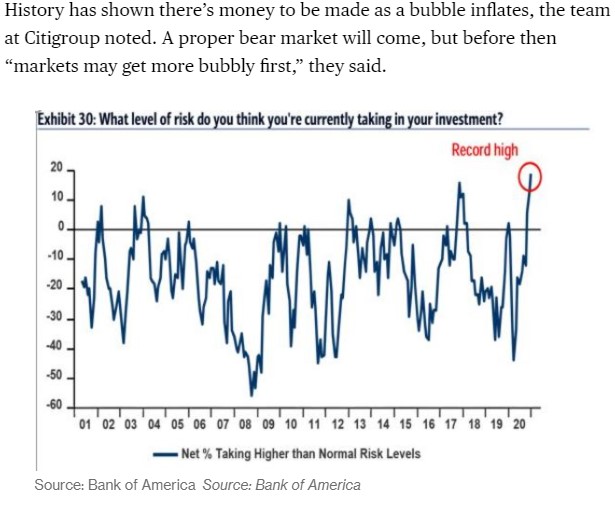
On a related note, Bank of America noted that the market has reached bubble territory ….

The week ahead — Economic data from Econoday.com:
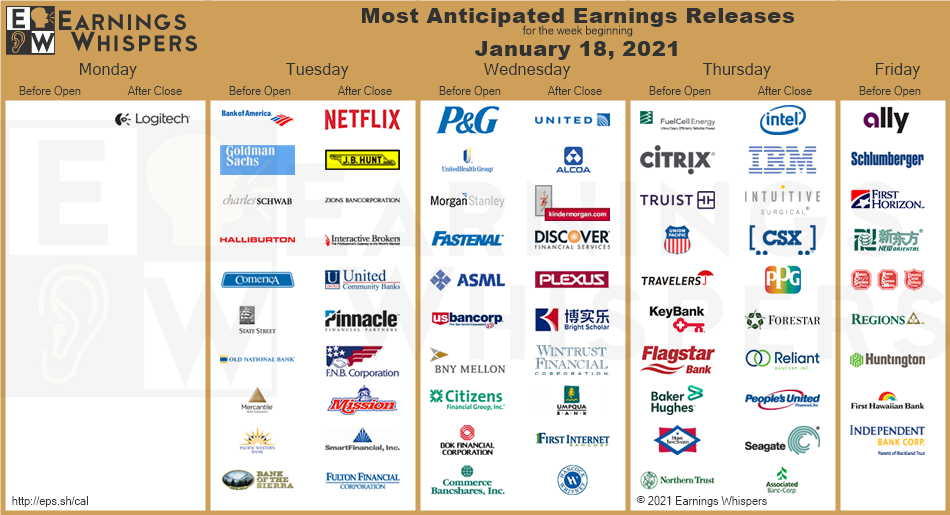
Week of Jan 15, 2021 Weekly Recap & The Week Ahead

January 18th, 2021

“Prosperity brings expanded lending, which leads to unwise lending, which produces large losses, which makes lenders stop lending, which ends prosperity, and on and on. . . . Look around the next time there’s a crisis; you’ll probably find a lender.” ― Howard Marks

1. Corporate America Reacts to Capitol Hill Riot With Donation Pause — a growing list of U.S. companies are suspending or re-evaluating how they choose to make contributions to political candidates as pressure grows on them to distance themselves from the mob that stormed Capitol Hill. Among the companies that paused political giving was America’s largest bank by assets, JPMorgan Chase, which gave $5.3 million to candidates over the course of the 2020 election cycle, according to federal filings.
Marriott and Dow said that they will stop donations to Republicans who objected to President-elect Joe Biden’s victory being certified. Hallmark is asking Senators Josh Hawley of Missouri and Roger Marshall of Kansas, both of whom objected to Biden’s certification, to return the $7,000 and $5,000 the company donated to their respective campaigns.
2. Europe Steps Up Defenses Against New Covid Variants — new, aggressive mutations of the coronavirus first discovered in the U.K. and South Africa are forcing governments to increase the severity of lockdowns and other restrictions, and prompt a clampdown on rulebreakers. The new variant has already been detected in countries such as Germany, France, Spain, Ireland and Denmark, with some requiring negative Covid tests from inbound travelers. The French prime minister refused to rule out the possibility of a third national lockdown. The government has so far stopped short or such a step, contrary to most other EU countries. But a national curfew is already in place, along with the closure of bars, restaurants and public venues.
3. President Trump Impeached for the Second Time — the House voted 232 to 197 to impeach President Donald Trump for “incitement of insurrection” in connection with the Capitol riot that left five people dead. The vote was largely along party lines, with 10 Republicans joining House Democrats in support of the resolution.
This is the first time in American history that a president has been impeached twice. Trump was impeached on Dec. 19, 2019, for abuse of power and obstruction of justice related to his actions to pressure Ukraine to investigate the business dealings of Hunter Biden, the son of now President-elect Joseph Biden. The Senate will wait until after Joe Biden is inaugurated to begin its trial. “There is simply no chance that a fair or serious trial could conclude before President-elect Biden is sworn in next week,” Senate Majority Leader Mitch McConnell said in a statement.
4. Biden Set to Announce 100 Million Shot Plan — President-elect Joe Biden on Thursday will unveil details of his plan to deliver 100 million Covid-19 vaccine shots during the first 100 days of his term Thursday, as the U.S. remains far behind its rollout plan. Over 10 million Covid-19 vaccine doses have been administered to Americans so far, putting the U.S. on track to fall well below the 50 million doses by the end of January that the Trump administration had aimed for. To increase the pace, Biden has said that he wants to invoke the Defense Production Act to boost vaccine production, establish mass vaccine sites run by the federal government, and increase the funding being sent to state and local governments to help pay for their rollout efforts.
5. Biden Outlines $1.9 Trillion Stimulus and Vaccine Program — President-elect Joe Biden unveiled a $1.9 trillion stimulus and vaccine distribution plan in a Thursday night address from Wilmington, Del. “A crisis of deep human suffering is in plain sight,” said Biden, who drew attention to the growing divide between the wealthiest Americans and everyone else. “We have to act and we have to act now.” To that end, his American Rescue Plan includes direct payments of $1,400 sent to most Americans, bringing the total delivered in a second round of checks to $2,000 including the $600 payments passed in December. It also extends federal unemployment insurance through September, increases them to $400 a week and raises the federal minimum wage to $15 an hour. Biden is also calling for $350 billion in aid for state and local governments, $170 billion for schools, and $70 billion to fund Covid-19 testing and vaccination. To support small business, he is proposing a new $15 billion grant program plus $35 billion for low-interest loans and early-stage capital for entrepreneurs.
6. Taiwan Semi Is Betting Chip Demand Will Keep Rising — chip maker Taiwan Semiconductor said it would spend $28 billion to boost production capacity to meet the growing demand for its chips. 5G smartphone launches and Taiwan Semi’s next-generation processor technology, which Apple uses in several of its computers, helped the company report fourth-quarter net income of $5.01 billion with sales rising 22% to $12.7 billion. Executives’ comments on an earnings call suggest that the company would increase capacity investments by about 50% compared with 2020. A weak 2019 saw low levels of production investment in the industry last year that, combined with Covid-19 shutdowns and surging demand from videogame consoles to cars, led to global shortages.

The week ahead — Economic data from Econoday.com:
Week of Jan 8, 2021 Weekly Recap & The Week Ahead

January 11th, 2021

1. Europe Braces for Another Fiscal Push to Support Economy Through New Lockdowns — British Chancellor of the Exchequer Rishi Sunak announced on Tuesday a £4.6 billion ($6.2 billion) package of “top-up grants” for some 600,000 businesses in the retail and hospitality industries. The announcement comes after several government-financed measures since the beginning of the pandemic in March 2020, including a “furlough” job support scheme due to expire at the end of March.
The U.K. government spent the equivalent of more than 8% of GDP in immediate direct fiscal spending in 2020 to counter the pandemic’s consequences. That’s roughly the same amount as Germany, and significantly more than France, Italy or Spain. Other European governments are now considering other rounds of fiscal stimulus to take into account the unexpected severity of the pandemic’s second wave. German Finance Minister Olaf Scholz last month announced a doubling of Germany’s borrowing plans for 2021 and has stated that he would be ready to spend more if needed.
2. Congress Certify Biden’s Win — after a day of turmoil, when a violent mob halted the ratification of President-elect Joe Biden’s electoral college victory, the joint session completed the count and affirmed Biden’s defeat of President Trump, with 306 electors to the incumbent’s 232. See more below. Trump commits to orderly transition of power. The president issued a statement early this morning committing to an orderly transition of power to Biden on Jan. 20, but said he continued to “totally disagree with the outcome of the election.”
3. Democrat Jon Ossoff Wins Georgia Senate Runoff — Democrats Jon Ossoff and Raphael Warnock won both Senate runoff races in Georgia, giving Democrats control of the U.S. Senate and easing the path for President-elect Joe Biden’s appointments and legislative agenda. Mr. Warnock defeated Republican Sen. Kelly Loeffler, while Mr. Ossoff took the seat held by former Republican Sen. David Perdue, whose term expired over the weekend. The new Senate will be evenly split between the two parties at 50-50, with Vice President-elect Kamala Harris serving as the tiebreaker vote, if it comes to that.
4. Pelosi Lays Out Plan for Impeachment of President Trump — Speaker Pelosi said Democrats will bring a resolution on Monday calling on Vice President Mike Pence and cabinet members to remove the president using the 25th Amendment under unanimous consent. If that fails, it will be brought for a full vote Tuesday. Pence would then have until Wednesday to respond or “we will proceed with bringing impeachment legislation to the Floor,” Pelosi said in a letter to Democratic lawmakers. So far only one Republican, Sen. Pat Toomey of Pennsylvania, has explicitly said that Trump “committed impeachable offenses.” Both Toomey and Sen. Lisa Murkowski (R., Ak.) have called President Trump to resign and Sen. Ben Sasse (R., Neb.) has said he would consider voting to remove the president from office.

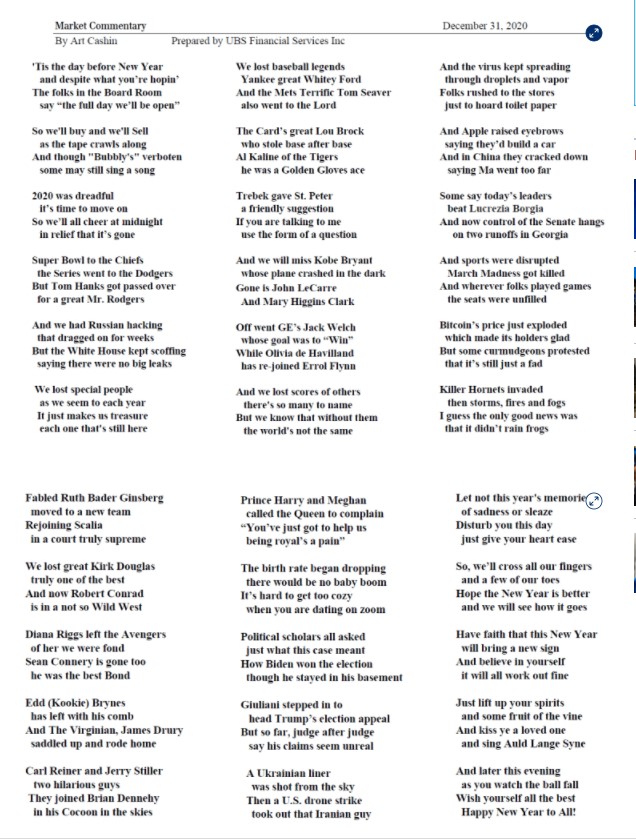
Below is the Year End poem that recap the major Events of 2020

The week ahead — Economic data from Econoday.com:
Week of Dec 31st, 2020 Weekly Recap & The Week Ahead

January 5th, 2021

“The biggest investing errors come not from factors that are informational or analytical, but from those that are psychological. Investor” ― Howard Marks
HAPPY NEW YEAR

1. House Approves $2,000 Stimulus Checks, Overrides Trump Defense Bill Veto — the House of Representatives passed legislation Monday night to increase stimulus payments to Americans earning $75,000 or less from the current $600 per person included in the latest relief aid package to $2,000, as requested by President Donald Trump. The increased payments would cost the U.S. $464 billion, up from $160 billion, according to a Congressional estimate—a key concern of those opposed to the higher payments. Senate Minority Leader Chuck Schumer called on the president to get Senate Republicans to support the $2,000 payments. Schumer is expected to attempt to pass the bill by unanimous consent on Tuesday. If all 100 Senators do not approve it, a roll call vote will need 60 votes in the Republican-controlled chamber. The House also voted 322 to 87 to override the president’s veto of a $740.5 billion defense bill that includes 3% pay raises for U.S. troops. Trump criticized the bill for proposing to rename military bases that honor Confederate officers and failing to include “critical national security measures.”
2. Three More Coronavirus Vaccines Expected by Early 2021 — Pfizer and Moderna were first out of the gate with approved vaccines for Covid-19, but three other drugmakers are following close on their heels. Novavax is launching a 30,000-person trial in the U.S. and Mexico for its vaccine, which could be approved as soon as spring 2021. The Novavax vaccine uses proteins to trigger an immune response after it is injected, as well as a substance derived from Chilean evergreen trees to enhance that response. Vaccines in development from AstraZeneca and Johnson & Johnson use viral-vector technology, in which a modified virus triggers an immune response. AstraZeneca’s drug is expected to be approved in the United Kingdom this week, and the company has said its vaccine “should remain effective” on the variant first discovered there.
3. Covid Second Wave Deadlier in France Than the First, With No Sign of Abating — Covid Second Wave Deadlier in France Than the First, With No Sign of Abating. According to French official numbers, the second wave of the coronavirus pandemic has claimed nearly 32,500 deaths in the last five months, versus 30,300 in the February-to-July period. The number of daily new infections in France has jumped up to around 15,000, three times the goal set by French president Emmanuel Macron when he enacted a new national lockdown in November. The government is mulling new restrictions, on top of the closure of bars and restaurants and public spaces, a ban of non-essential travel, and a nightly curfew.
In the U.K., where a new, aggressive variant of the coronavirus was first detected a few weeks ago, the government is publicly debating whether or not to re-open schools on Jan. 4 at the end of the Christmas recess. The mass vaccination campaign that started throughout the EU over the weekend, two weeks after the UK, is lagging behind the rapid progression of the virus, increasing the likelihood of another major economic shock in Europe in the first half of 2021.
4. AstraZeneca-Oxford Covid Vaccine Gains First Clearance From U.K — AstraZeneca Plc and the University of Oxford’s Covid-19 vaccine won U.K. clearance, marking the first approval worldwide for a shot that will be key to mass immunizations despite continuing questions over its efficacy. The vaccine will be prioritized for the country’s most vulnerable groups, with shots starting Monday, according to the government. It’s the second coronavirus injection to be cleared for emergency use in the U.K., after one from Pfizer Inc. and BioNTech SE was authorized in early December.
5. The Boeing 737 Max Is Finally Back in the U.S. — after being grounded in March 2019 following two deadly crashes killing a total of 346 people, the Boeing 737 Max has taken flight again in the United States. American Airlines used the jet to fly from Miami to New York and back Tuesday without incident. The single aisle plane has better fuel efficiency than its predecessors and is used mostly on domestic or short international flights. While Boeing has received new orders for the Max, demand may be affected by the dearth of air travelers during the pandemic. American Airlines said Tuesday it plans to fly less than half the number of flights between now and February than it did during the same period in 2019.

The week ahead — Economic data from Econoday.com:
Week of Dec 26, 2020 Weekly Recap & The Week Ahead

December 28th, 2020

“Be Patient – There’s the Rarest Thing On Wall Street” – Jeff Saut

1. Congress Passes $900 Billion Aid Package That Includes Stimulus Checks — Congress approved $900 billion in economic relief for Americans and businesses hit hard by the coronavirus pandemic. The relief package, attached to the $1.4 trillion spending bill that will fund the federal government through September, includes stimulus payments for Americans, federal unemployment benefits, relief for small businesses, among other things. Americans who earned $75,000 or less in 2019 will receive $600 checks. Starting Dec. 27, those receiving unemployment benefits will receive an additional $300 a week in federal benefits through March. An eviction moratorium is also extended through January 2021.
Additional relief includes about $325 billion for small businesses, $55 billion into funding for vaccines, testing and tracing, $82 billion for schools, and $45 billion for transportation. The bill also extends a tax credit for businesses that retain employees.
2. Walmart Accused in Lawsuit of Fueling Opioid Crisis — The U.S. Justice Department is suing Walmart, alleging the company helped fuel the opioid crisis.
The civil complaint claims Walmart violated rules for dispensing opioids and its duty to detect and report suspicious orders. Walmart was “woefully understaffed” to review such orders, and managers put “enormous pressure on pharmacists to fill prescriptions,” according to the suit.
Walmart’s violations of the Controlled Substances Act as both a pharmacy and a distributor “had disastrous results, harming individuals who filled prescriptions at Walmart and then abused the drugs,” the lawsuit claims. “Given the nationwide scale of those violations, Walmart’s failures to follow basic legal rules helped fuel a national crisis.”
3. More Than 1 Million People in the U.S. Have Gotten Covid Vaccine Doses — three states have now vaccinated more than 1% of their populations: North Dakota, West Virginia, and Alaska. California leads in total vaccinations at 128,000 shots. The numbers fall short of a U.S. goal to administer 20 million shots in 2020. Shots are rolling out from Pfizer Inc. and Moderna Inc., focused at first on hundreds of thousands of health-care workers around the country who have been battling the virus on the front lines in hospitals. The vaccines require two shots weeks apart to deliver the highest level of protection. Urgency is rising as a wave of winter infections washes over the northern hemisphere. New variants of the disease have been detected in the U.K. and South Africa. The mutations appear to make the virus more contagious and may be increasing infections among healthy young people. In the U.S., more than 2,500 people are dying every day.
4. Trump Signs Relief Package, Calls on Congress to Increase Stimulus Checks to $2,000 Per Person — Sunday night, President Donald Trump signed a relief package that he previously objected to that includes $900 billion in pandemic relief and $1.4 trillion to fund the government through September. The legislation passed in Congress last week with bipartisan support. Trump rejected the package, saying the proposed $600 direct payments to Americans should be increased to $2,000 per person.

Search
Calendar
February 2026
M T W T F S S
« Jan    
 1
2345678
9101112131415
16171819202122
232425262728  
Archives
Categories
The information provided by The EGS Blog is based on sources believed to be reliable, but it is not guaranteed to be accurate. There is no guarantee that the recommendations of The EGS Blog will be profitable or will not be subject to losses. The information provided by The EGS Blog is not a recommendation or a solicitation that any particular investor should purchase or sell any particular security in any amount, or at all. The investments discussed or recommended herein may be unsuitable for investors depending on their specific investment objectives and financial position. At any time EGS LLC and its principals may maintain positions that are contrary to positions announced within the subscription service. In no event will The EGS Blog be liable to you or anyone else for any incidental, consequential, special, or indirect damage (including but not limited to lost profits or trading losses). PAST PERFORMANCE IS NO GUARANTEE OF FUTURE RESULTS

© Copyright 2026 Market Outlook All Rights Reserved
Design by EGS Sponsored by Equity Guidance LLC