February 14th, 2022
“It’s frightening to think that you might not know something, but more frightening to think that, by and large, the world is run by people who have faith that they know exactly what’s going on.” ― Howard Marks
1. New York to Lift Mask Mandate for Businesses as Omicron Ebbs — New York Governor Kathy Hochul is lifting a mask mandate for businesses that don’t check Covid-19 vaccination status, citing high inoculation rates and low transmissions across the state. Mask mandates will remain in place in schools, health-care facilities and nursing homes, although Hochul said dropping masks in March is a “strong possibility.”. Local municipalities can continue to determine their own rules, including New York City, which requires vaccination for theaters, restaurants and other businesses. A spokesperson for New York City Mayor Eric Adams said the city will continue these requirements.
2. Disney+ Subscriptions Near 130 Million — Disney+ reported 129.8 million subscribers at the end of the holiday quarter, up from 118.1 million subscribers in the prior quarter. Analysts polled by FactSet expected 124.7 million subscribers to the platform. Sales at its theme parks and consumer products division—which includes Walt Disney World and Disneyland resorts—were $7.23 billion, buoyed by increasing strength in outdoor travel. Analysts expected $6.36 billion. The company said its domestic parks and resorts reported record revenue and operating income.
3. U.S. Households Took On $1 Trillion in New Debt in 2021 — Americans took on more new debt in 2021 than in any year since before the 2008-09 financial crisis.
Total household debt rose by $1.02 trillion last year, boosted by higher balances on home and auto loans, the Federal Reserve Bank of New York reported. It was the largest increase since a $1.06 trillion jump in 2007. Total consumer debt now sits at around $15.6 trillion, compared with $14.6 trillion a year earlier. The increase is largely a function of a sharp rise in prices for homes and cars. The price of the average U.S. home rose close to 20% in 2021, boosting mortgage balances and pricing out many middle-class buyers. Rising prices for new and used cars drove auto-loan originations to a record $734 billion.
4. U.S. Inflation Rate Accelerates to a 40-Year High of 7.5% — The Labor Department reported the consumer-price index—which measures what consumers pay for goods and services—in January reached its highest level since February 1982, when compared with the same month a year ago. That put inflation above December’s 7% annual rate and well above the 1.8% annual rate for inflation in 2019 ahead of the pandemic.
The so-called core price index, which excludes the often volatile categories of food and energy, climbed 6% in January from a year earlier. That was a sharper rise than December’s 5.5% increase and the highest rate in nearly 40 years. High inflation is the dark side of the unusually strong economy that has been powered in part by government stimulus to counter the pandemic’s impact. January’s continued acceleration increased the likelihood that Federal Reserve officials could speed up a series of interest-rate increases this spring to ease surging prices and cool the economy.
5. Turkey’s Sovereign-Debt Rating Cut Further Into Junk by Fitch — Fitch lowered Turkey’s score to B+ from BB-, making it four notches below investment grade and on par with Egypt and Bahrain. The outlook for Turkey is negative, the rating company said. The lira lost as much as half its value against the dollar before the government intervened at the end of December to stem the currency’s decline. Some of the government measures — including a lira deposit plan that protects savers from swift bouts of depreciation — introduced a level of stability to the lira but inflation climbed to 48.7% in January, the fastest pace of increases in two decades.
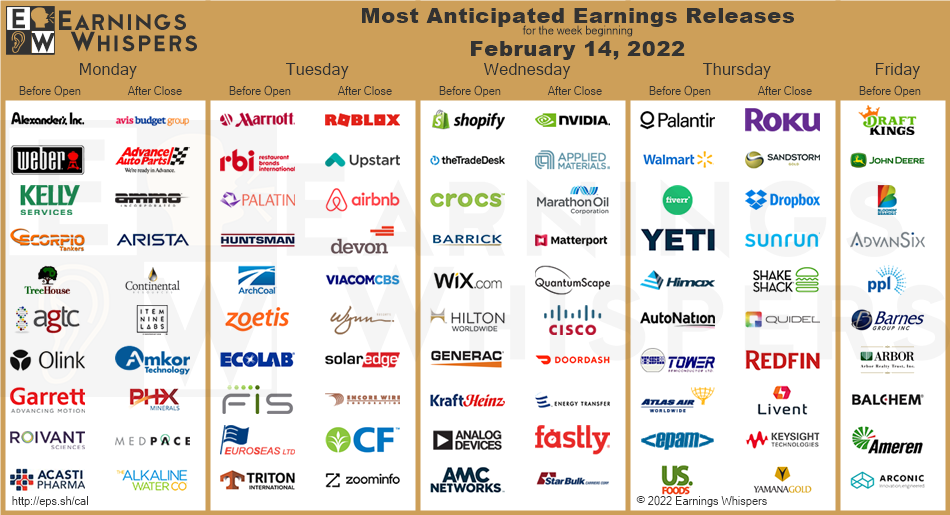
The week ahead — Economic data from Econoday.com:
Posted in Weekly Summary | No Comments »
February 8th, 2022
“Achieving gains usually has something to do with being right about events that are on the come, whereas losses can be minimized by ascertaining that tangible value is present, the herd’s expectations are moderate and prices are low. My experience tells me the latter can be done with greater consistency. ― Howard Marks
1. Omicron Sub-Variant May Cause New Surge of Infections in Current Wave – a sub-variant of the omicron coronavirus strain, known as BA.2, is spreading rapidly in South Africa and may cause a second surge of infections in the current wave, one of the country’s top scientists said. BA.2 is causing concern as studies show that it appears to be more transmissible than the original omicron strain, the discovery of which was announced by South Africa and Botswana in November.
Research also shows that getting a mild infection with either of the two strains may not give a robust enough immune response to protect against another omicron infection. There’s no indication that the sub-variant causes more severe disease from infection surges seen in Denmark and the U.K.
2. Meta Faces Historic Stock Rout After Facebook Growth Stalled — the catalyst was startling news that for the first time ever, Facebook’s user growth seems to have hit a ceiling and its momentum is stalling. Thursday’s collapse wiped out more than $230 billion of market value in an instant — a figure unprecedented in stock-market history. Zuckerberg acknowledged that Meta is facing serious competition for user time and attention, particularly from viral video-sharing app TikTok. The report marks a dramatic turnaround for a company that has posted share gains in every year but one since its 2012 initial public offering, stoking concern that Meta Platforms’ flagship product and core advertising moneymaker has plateaued after years of consistent gains.
3. U.S. Covid-19 Hospitalizations Continue Tracking Downward — Hospitalizations for Covid-19 in the U.S. continued to fall, with the seven-day average of patients with confirmed or suspected cases easing to 134,000 last Wednesday, down 16% from a Jan. 20 high, according to data from the Department of Health and Human Services. Deaths, a lagging indicator, are ticking upward, reaching a seven-day average of 2,530, according to data from Johns Hopkins University, though they are off the highs recorded in January last year. Public health experts say that while the more contagious Omicron variant of the virus is less likely to cause severe illness than previous variants, the large number of infections this winter means it is continuing to cause a large and growing number of fatalities.
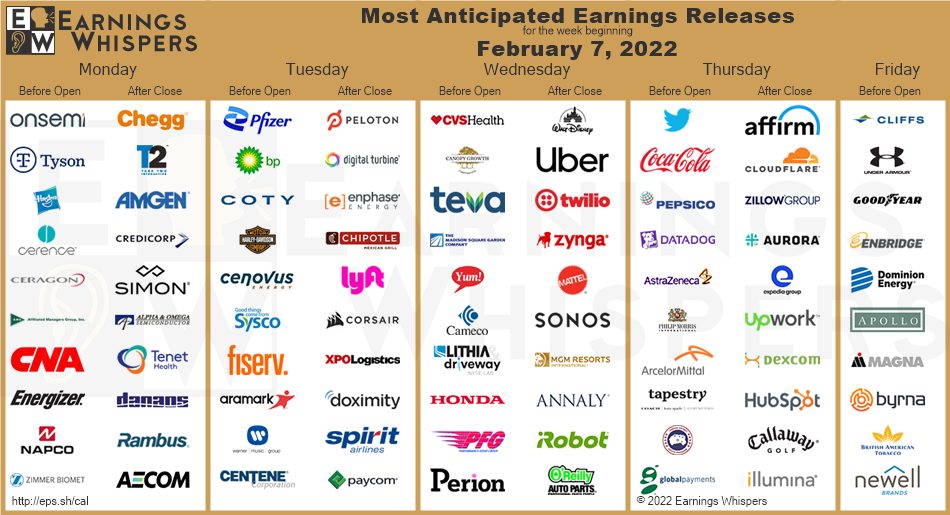
The week ahead — Economic data from Econoday.com:
Posted in Weekly Summary | No Comments »
February 1st, 2022
“There are two kinds of forecasters: those who don’t know, and those who don’t know they don’t know.” — John Kenneth Galbraith
1. GM Plans Multibillion-Dollar EV Push With Michigan Plants — GM said it would convert a suburban Detroit factory into a center for the production of electric pickup trucks and build a battery-cell plant in Lansing, Mich. It plans to spend $4 billion to convert its Orion Assembly factory to build plug-in trucks and will split the cost of the $2.6 billion battery factory with partner LG Energy Solution. On top of this spending, GM plans to invest about $500 million into two assembly plants near Lansing.
Altogether, GM plans to contribute nearly $6 billion of the $7 billion in the total costs for the projects, a figure that the car company says is its single largest investment in history. The spending is expected to create 4,000 jobs in the state, the auto maker said. Plans for the Orion revamp and the new battery-cell plant were first reported last month by The Wall Street Journal.
2. Federal Reserve Tees Up March Interest-Rate Increase — Fed Chairman Jerome Powell said the central bank’s rate-setting committee was ready to raise rates at its March 15-16 meeting. “The economy no longer needs sustained monetary-policy support,” he said. The central bank approved one final round of asset purchases, which will bring that stimulus program to a conclusion by March. Officials continued deliberations at their two-day meeting over how and when to shrink the Fed’s $9 trillion securities portfolio, which has more than doubled since March 2020. The Fed cut short-term interest rates to near zero and started buying bonds to lower long-term rates in 2020 as the coronavirus pandemic hit the U.S. economy, triggering financial-market volatility and a deep, short recession.
3. Tesla Posts Record Annual Profit — Elon Musk’s electric-vehicle maker posted a $5.5 billion annual profit on $53.8 billion of sales last year, after increasing vehicle deliveries at its fastest pace in years. That is up from $721 million in profit and $31.5 billion in sales in 2020, when Tesla generated its first full-year profit, and ahead of Wall Street’s expectations. Tesla delivered more than 936,000 vehicles globally last year, up 87% from 2020, despite global computer-chip shortages that constrained vehicle production across the auto industry.
4. U.S. Economy Grows as Fourth-Quarter GDP Shows Strongest Year in Decades — Gross domestic product, the broadest measure of goods and services, in the fourth quarter grew to 6.9% annual rate. The gain reflected solid spending by households, much of it occurring early in the quarter, and companies pushed to restock their shelves to overcome persistent supply shortages. Output grew 5.5% in all of 2021, when comparing the fourth quarter to the same period a year earlier. The economy hasn’t grown that fast since 1984, during President Ronald Reagan’s first term, when the country was rebounding from a double-dip recession and an era of high inflation.
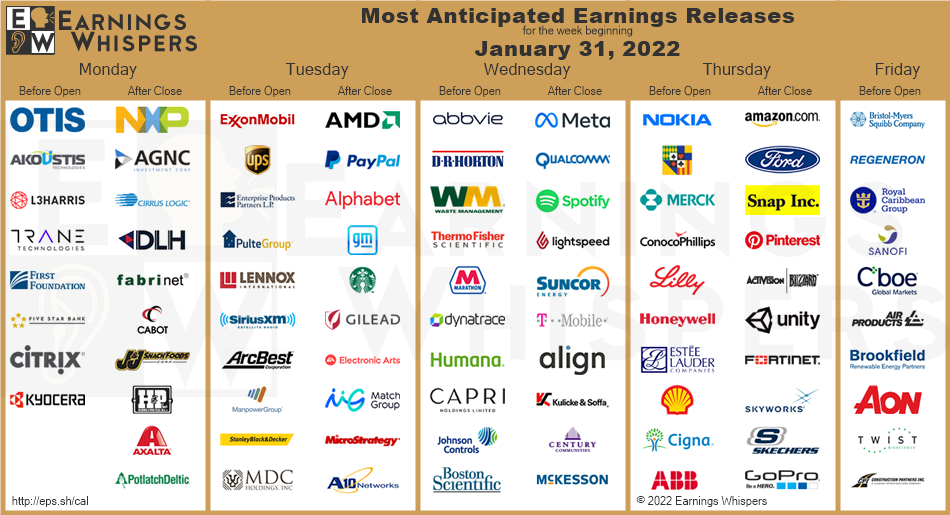
The week ahead — Economic data from Econoday.com:
Posted in Weekly Summary | No Comments »
January 24th, 2022
“The percentage you’re paying is too high priced – While you’re living beyond all your means – And the man in the suit has just bought a new car – From the profit he’s made on your dreams.” — Steve Winwood
1. Biggest Bitcoin Fund Sinks Near 30% Discount in Crypto Rout — the $27 billion fund (ticker GBTC) has plunged nearly 17% so far in 2022, outpacing Bitcoin’s nearly 9% decline. As a result, GBTC’s price closed 26.5% below the value of the Bitcoin it holds on Tuesday, widening GBTC’s so-called discount to record levels, according to Bloomberg data. It’s a dynamic that’s plagued GBTC for months. The trust doesn’t allow for share redemptions in the same manner as an exchange-traded fund, meaning that the supply of shares can’t be created and destroyed with shifting demand. As a result, the shares tumbled deeply as investors pulled sharply back from cryptocurrencies, exacerbating the discount in the share price.
2. Nasdaq Entered Correction Territory — the Nasdaq finished the week 12.7% below its all-time closing high, set in November. A decline of greater than 10% is considered a correction for a stock index. Investors have stepped up bets that the Federal Reserve and other major central banks will tighten monetary policy in the coming months, withdrawing a pillar of support for markets. Mounting expectations of interest-rate rises follow evidence that the drivers of inflation have broadened beyond the supply-chain shock that fueled price gains for much of 2021. That has led to big swings, leaving many stocks in a bear market and stoking giant rotations among different sectors.
3. U.S. Existing-Home Sales Reached a 15-Year High of 6.1 Million Last Year — U.S. home sales surged to a 15-year high in 2021, powered by low borrowing rates and an intense buyer demand that are expected to keep the market hot during the first months of 2022. Existing-home sales rose 8.5% from a year earlier to 6.12 million, the National Association of Realtors said Thursday. Home prices grew at a record pace across the country last year. Low mortgage rates in 2021 increased housing demand from all types of buyers, including first-time homeowners, luxury vacation-home buyers and investors. Many households saved more money during the pandemic and benefited from a rising stock market. Employees who could work remotely were willing to live farther from their offices. A large generation of millennials is entering their early and mid-30s, which are common home-buying years.
4. Crypto Crash Erases More Than $1 Trillion in Market Value — Bitcoin, the largest digital asset, lost as much as 8.7% Friday and dropped below $38,000 to its lowest level in six months. Since its peak in November, it has lost 40% of its value. Other digital currencies have suffered just as much, if not more, with Ether and meme coins mired in similar drawdowns. Bitcoin’s decline since that November high has wiped out more than $570 billion in market value, and roughly $1.17 trillion has been lost from the aggregate crypto market. While there have been much larger percentage drawdowns for both Bitcoin and the aggregate market, this marks the second-largest ever decline in dollar terms for both, according to Bespoke Investment Group.
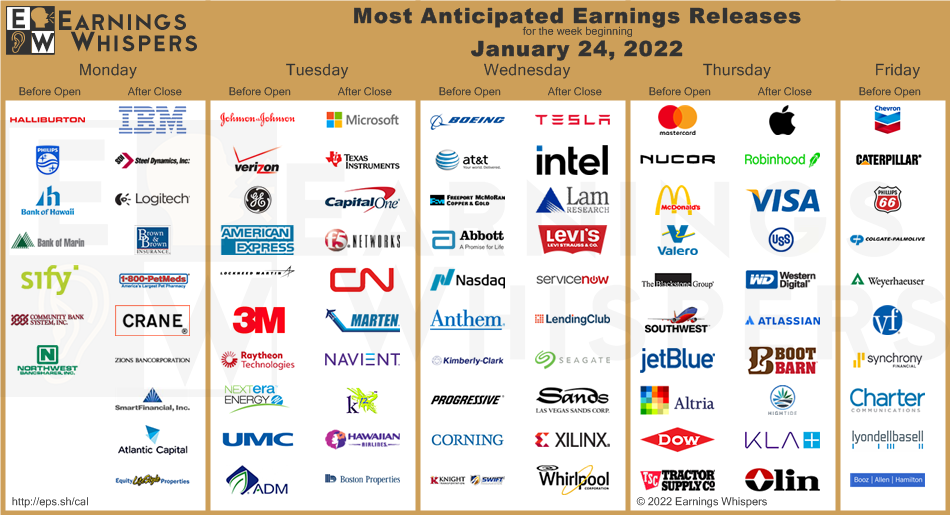
The week ahead — Economic data from Econoday.com:
Posted in Weekly Summary | No Comments »
January 18th, 2022
“Stocks take the stairs up and the Elevator down!!” — unknown
1. China Covid-19 Lockdowns Hit Factories, Ports in Latest Knock to Supply Chains — with Covid-19 flaring up across China, major manufacturers are shutting factories, ports are clogging up and workers are in short supply as officials impose city lockdowns and mass testing on a scale unseen in nearly two years. The prospect of continued disruptions in the world’s second-largest economy, which has a zero-tolerance strategy for combating the pandemic, is heightening fears that the disruptions will ripple through the global economy. Already, companies including memory-chip maker Samsung Electronics Co., German auto maker Volkswagen AG and a textiles company that supplies Nike Inc. and Adidas AG are suffering production hitches.
2. U.S. Inflation Hits 39-Year High of 7%, Sets Stage for Fed Hike — the consumer price index climbed 7% in 2021, the largest 12-month gain since June 1982, according to Labor Department data released Wednesday. The widely followed inflation gauge rose 0.5% from November, exceeding forecasts. Excluding the volatile food and energy components, so-called core prices accelerated from a month earlier, rising by a larger-than-forecast 0.6%. The measure jumped 5.5% from a year earlier, the biggest advance since 1991.
The increase in the CPI was led by higher prices for shelter and used vehicles. Food costs also contributed. Energy prices, which were a key driver of inflation through most of 2021, fell last month.
3. Supreme Court Halts Biden’s Vaccine Mandate for Businesses — The U.S. Supreme Court on Thursday blocked the federal government from enforcing a vaccine-or-testing rule for large private employers but let stand a vaccine mandate for most healthcare workers. The 6-3 decision in the case regarding businesses dealt a setback to the Biden administration’s efforts to curb the spread of the coronavirus amid a record surge in infections and hospitalizations and as the economy returns to more normal conditions.
The ruling does not prevent private employers, states or colleges and universities from instituting their own mandates. The Court allowed New York and Maine to require their healthcare workers to be vaccinated and has upheld college vaccination requirements. And Citigroup is one big employer that has told its U.S. workers they will lose their jobs if they don’t get the vaccine, unless they get an exemption.
The week ahead — Economic data from Econoday.com:
Posted in Weekly Summary | No Comments »
January 10th, 2022
HAPPY NEW YEAR!!!
“The key turning point in my investment management career came when I concluded that because the notion of market efficiency has relevance, I should limit my efforts to relatively inefficient markets where hard work and skill would pay off best.” ― Howard Marks
1. FDA Authorizes Pfizer-BioNTech Booster for 12- to 15-Year-Olds — U.S. health regulators cleared use of a Covid-19 booster from Pfizer Inc. PFE -3.62% and BioNTech SE BNTX -6.99% in adolescents 12 to 15 years old, expanding access to an extra dose that could bolster the fight against the Omicron variant.
For anyone now eligible to get the extra dose, the U.S. Food and Drug Administration said the boosters could be administered five months after their second shot, instead of the six months previously set. The agency also cleared a third dose for certain children with compromised immune systems age 5 to 11. “With the current wave of the Omicron variant, it’s critical that we continue to take effective, lifesaving preventative measures such as primary vaccination and boosters, mask wearing and social distancing,” said acting FDA Commissioner Dr. Janet Woodcock.
2. U.S. Covid-19 Infections Top One Million After Holiday Backlog — the U.S. reported a record 1.08 million Covid-19 infections on Monday as most states worked to clear backlogs after pausing during the New Year’s holiday. The reports pushed the seven-day average of daily reported infections to 480,273, according to a Wall Street Journal analysis of Johns Hopkins University data. That level is nearly double the peak reached at the height of last winter’s case surge. Hospitalizations for confirmed or suspected Covid-19 cases reached a seven-day average of 105,138 on Tuesday, according to data posted by the U.S. Department of Health and Human Services. That is up 51% in the past two weeks but below the pandemic peak of 137,510 on Jan. 10, 2021. While Covid-19 tests remain in short supply in much of the U.S., testing was less robust last year, complicating comparisons between pandemic surges.
3. Fed Minutes Point to Possible Rate Increase in March — Minutes of their Dec. 14-15 meeting, released Wednesday, showed officials believed that rising inflation and a very tight labor market could call for lifting short-term rates “sooner or at a faster pace than participants had earlier anticipated.” Most central bank officials, in projections released after that meeting, penciled in at least three quarter-percentage-point rate increases this year. In September, around half of those officials thought rate increases could wait until 2023.
The week ahead — Economic data from Econoday.com:
Posted in Weekly Summary | No Comments »
January 3rd, 2022
There will not be any Weekly Re-Cap for the week of Dec 31 2021. Happy New Year!!!
The staffs at EGS.
The week ahead — Economic data from Econoday.com:
Posted in Weekly Summary | No Comments »
December 28th, 2021
“You only learn who has been swimming naked when the tide goes out.” — Warren Buffett
1. Turkey Rolls Out Economic Rescue Plan, Reversing Lira’s Spiral — Turkey’s currency mounted a dramatic, partial reversal from a monthslong collapse after President Recep Tayyip Erdogan announced a rescue plan to encourage Turks to put their money back into the lira. Economists and investors said the plan was a risky strategy to stabilize the currency, one that will use government funds to motivate investments in the lira. The government also hasn’t specified how it will pay for the new policy over the long term and some fear the effort will require heavy government borrowing or de facto money printing from the central bank.
2. Biden Administration to Combat Omicron By Distributing 500 Million At-Home Covid-19 Test Kits — The Biden administration is preparing to distribute 500 million free at-home Covid-19 testing kits to Americans and deploy military doctors and nurses to overburdened hospitals this winter, as the Omicron variant becomes the dominant form of the virus in the U.S. His remarks came as the Centers for Disease Control and Prevention said Omicron had overtaken the Delta variant of the coronavirus in the U.S., accounting for an estimated 73% of infections for the week ending Dec. 18.
3. FDA Authorizes Pfizer Antiviral Pill to Fight Covid — The Food and Drug Administration authorized the Covid-19 antiviral pill from Pfizer , adding a new weapon against the pandemic as the Omicron wave crashes into the U.S. Pfizer ‘s (ticker: PFE) drug, called Paxlovid, decreased the risk of hospitalization and death in a trial of unvaccinated, high-risk adults by 89% when taken within three days of when symptoms began. The FDA said that the pill was authorized for treatment of mild-to-moderate Covid-19 in adults and children aged 12 and up at high risk for progressing to severe Covid-19. The drug is not authorized for post-exposure prevention, or in people who are hospitalized, and treatment must be started within five days of when symptoms begin.
4. Omicron Starts to Slow U.S. Economy as Consumer Spending Flags — signs are mounting that the U.S. economy is losing some steam as the Omicron variant of the Covid-19 virus spreads rapidly through parts of the country. The number of diners seated at restaurants nationwide was down 15% in the week ended Dec. 22 from the same period in 2019, a steeper decline than in late November, data from reservations site OpenTable show. U.S. hotel occupancy was at 53.8% for the week ended Dec. 18, slightly below the previous week’s level, according to STR, a global hospitality data and analytics company.
Rising case numbers are leading many businesses to close for a short period, entertainment venues to cancel shows, universities to shift classes online and offices to delay or reverse reopening plans.
Posted in Weekly Summary | No Comments »
December 20th, 2021
“Seen through the lens of human perception, cycles are often viewed as less symmetrical than they are. Negative price fluctuations are called “volatility,” while positive price fluctuations are called “profit.” Collapsing markets are called “selling panics,” while surges receive more benign descriptions (but I think they may best be seen as “buying panics”; see tech stocks in 1999, for example). Commentators talk about “investor capitulation” at the bottom of market cycles, while I also see capitulation at the top, when previously prudent investors throw in the towel and buy.” ― Howard Marks
1. Fed Project Three Interest Rate Rises in 2022 and Accelerate Stimulus Wind Down — most Federal Reserve officials signaled Wednesday they were prepared to raise their short-term benchmark rate at least three times next year to cool high inflation. Fed officials in early November agreed to reduce their then-$120-billion-a-month in bond purchases by $15 billion a month, to $90 billion this month. Officials said they would accelerate that wind down beginning next month, reducing purchases by $30 billion a month. As a result, they will purchase $60 billion in Treasury and mortgage securities in January, putting the program on track to end by March.
2. U.S. Retail Sales Slow With Holiday Shoppers Facing Inflation, Shortages — Sales at U.S. retail stores, online sellers, and restaurants rose by a seasonally-adjusted 0.3% in November from the previous month, the Commerce Department said Wednesday. That was smaller than last month’s increase in consumer prices, and a slowdown from October’s robust 1.8% sales increase. Broadly consumer demand is strong, and well above last year’s levels. Retail sales rose 18.2% in November from a year earlier, showing low unemployment, rising wages and savings from stimulus payments are giving Americans the capacity to spend more this year. That gain well outpaced the 6.8% increase in consumer prices in November from a year earlier, according to the Labor Department.
3. CDC Advisors Recommend Pfizer and Moderna’s Vaccines Over J&J’s — the 15 members voted in support of a resolution Thursday that stated the messenger RNA-based vaccines “are preferred” over J&J’s shot. The updated guidance came amid new findings from the agency about cases of a rare but serious blood clotting condition that has occurred in a small number of people who received the vaccine. In the U.S., 54 people are known to have developed the condition, known as thrombosis with thrombocytopenia, after receiving the J&J vaccine between early March and the end of August, according to a presentation made to the expert panel by CDC staffers. All of those people were hospitalized, 36 were admitted to an intensive care unit, and eight died.
4. Bitcoin Drop Risks Extending Slide to a Fifth Consecutive Week — Bitcoin fell as much as 4.3% to $46,501, and is down about 32% since reaching a record of almost $69,000 on Nov. 10. It has still gained about 60% this year. Ether, which is also coming off an all-time high set last month, declined for a second day. Central banks globally are prioritizing the fight against elevated inflation by tightening monetary settings, while also keeping a wary eye on the impact of omicron. That backdrop has investors questioning whether so-called risk assets such as cryptocurrencies and technology shares are due for a rougher patch after surging from pandemic lows.
The week ahead — Economic data from Econoday.com:
Posted in Weekly Summary | No Comments »
December 13th, 2021
“The key to building wealth is to preserve capital and wait patiently for the right opportunity to make the extraordinary gains.” — Victor Sperandeo
1. Early Lab Test Shows Omicron Weakening Vaccine Effectiveness — the Omicron variant of coronavirus can partially evade the protection afforded by vaccines, according to laboratory tests conducted in South Africa that give one of the first indications of vaccine effectiveness against the variant, but scientists say the shots should still defend those inoculated from severe disease. They found the vaccine generated one-fortieth of the infection-fighting antibodies against Omicron compared with its performance against the original version of the virus. That is a big reduction but doesn’t mean the variant can escape vaccines completely, said Alex Sigal, the virologist who led the study.
2. Pfizer Says Booster Neutralized Omicron but Variant May Elude Two Doses — Pfizer Inc. and BioNTech said that a third dose of their Covid-19 vaccine neutralized the Omicron variant in lab tests but that the two-dose regimen was significantly less effective at blocking the virus. A third dose increased antibodies 25-fold compared with two doses against the Omicron variant, the companies said. Still, two doses may prove effective in preventing severe illness from Covid-19, they said, because immune cells are able to recognize 80% of parts of the spike protein that the vaccine targets.
3. Turkey’s Economic Turmoil Sends Desperation and Inflation Soaring — the Turkish lira has lost as much as 45% of its value this year, making ordinary Turks poorer. The pandemic-era consumer-price increases that have plagued economies across the world are supersize in Turkey, where inflation stands at more than 21%. People here are rushing to trade their shrinking wages for dollars and gold, are eating out less and are having more trouble finding imported goods, including medicine. Mr. Erdogan has successfully pressured the central bank to slash interest rates despite rapid inflation. Normally, central banks raise rates to encourage saving, discourage borrowing and cool off inflation. But Mr. Erdogan has called for lower interest rates and blamed rising costs on foreign interests.
4. Evergrande Declared in Default as Huge Restructuring Looms — China Evergrande Group has officially been labeled a defaulter for the first time, the latest milestone in months-long financial drama that’s likely to culminate in a massive restructuring of the world’s most indebted developer. The downgrade came just minutes after Fitch applied the same default label to Kaisa Group Holdings Ltd., which failed to repay a $400 million dollar bond that matured Tuesday. Together, the two companies account for about 15% of outstanding dollar bonds sold by Chinese developers. Long considered by many investors as too big to fail, Evergrande has now become the largest casualty of Chinese President Xi Jinping’s campaign to tame the country’s overindebted conglomerates and overheated property market. Before this week, Chinese borrowers had defaulted on $10.2 billion of offshore bonds in 2021, with real estate firms making up 36% of the total, according to data compiled by Bloomberg.
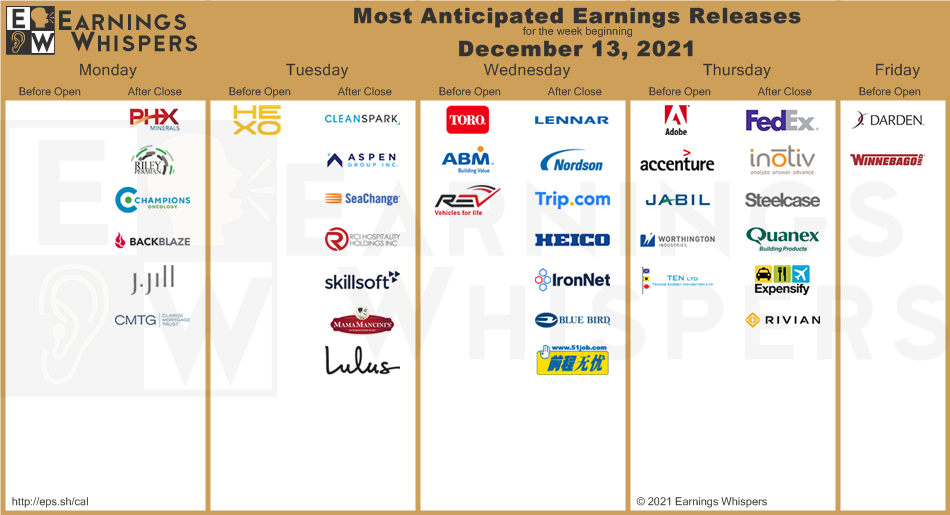
The week ahead — Economic data from Econoday.com:
Posted in Weekly Summary | No Comments »