September 12th, 2022
“The stock market is never obvious. It is designed to fool most of the people, most of the time- Jesse Livermore” ― Jesse Livermore
1. Liz Truss to Become Next U.K. Prime Minister, Succeeding Boris Johnson — U.K. Foreign Secretary Liz Truss won the race to lead the ruling Conservative Party and become Britain’s next prime minister, taking the helm of a nation heading into an economic storm. The new prime minister faces a daunting array of challenges. The U.K. economy is spiraling toward recession as inflation ramps up. Ms. Truss has only a narrow base of loyalists within the Conservative Party and polls show limited support for her across the country at-large.
2. U.S. Plans Shift to Annual Covid Shots as New Boosters Roll Out — U.S. health authorities plan to recommend that people get Covid-19 boosters once a year, starting with the new shots now rolling out, a shift from their current practice of issuing new advice every several months.
The annual cadence would be similar to that of flu shots, White House officials said Tuesday, though elderly people and those with weakened immune systems may need more frequent inoculations. To date, health authorities had recommended the extra doses based on the ebbs and flows of the virus’s evolution and new insights into people’s waning immunity. Yet the authorities wound up making recommendations for booster doses to different groups every several months.
3. Fed on Path for Another 0.75-Point Interest-Rate Lift After Powell’s Inflation Pledge — the Federal Reserve appears to be on a path to raise interest rates by another 0.75 percentage point this month in the wake of Chairman Jerome Powell’s public pledge to reduce inflation even if it increases unemployment. St. Louis Fed President James Bullard said in an Aug. 18 interview he was leaning in favor of a 0.75-point rate increase at the coming Fed meeting. “We should continue to move expeditiously to a level of the policy rate that will put significant downward pressure on inflation,” he said. Fed officials have raised rates this year at the fastest clip since the early 1980s, taking their benchmark federal-funds rate from near zero in March to a range between 2.25% and 2.5% in July.
4. ECB Raises Interest Rates by a Historic 0.75 Point as Europe Stares at Recession — the ECB Bank said in a statement that it would increase its key rate to 0.75% from zero—its second hike this year following a 50-basis-point rise in July—and signaled that further rises were likely this year. The increase mirrors recent moves by other major central banks, including the Federal Reserve, which is expected to unveil a third successive 0.75-point rate rise later this month. Canada’s central bank raised its policy rate on Wednesday by 0.75 percentage point to 3.25%, a 14-year high.
Rising borrowing costs will likely increase the risk of a slide into recession for Europe’s currency union, which is wrestling with surging energy costs and sagging confidence among households and businesses, driven by the war in neighboring Ukraine. With governments piling on debt to shield consumers and businesses from the impact of rising prices, a national election in Italy later this month could exacerbate strains in the region’s bond markets.
5. Queen Elizabeth II, Longest-Reigning British Monarch, Dies — Queen Elizabeth II, the longest-reigning monarch in British history and a symbol of stability in an era of sweeping social and political change, has died at age 96. During her seven decades on the throne, the British Empire was dismantled and the U.K.’s role in the world shrank dramatically. Growing pressure for independence in Scotland and arguments for Irish unification threatened to redraw the U.K.’s own borders, and ruptures within her family raised questions about the monarchy’s future role.
But at the end, Queen Elizabeth remained head of state of 14 countries in addition to the U.K., and the leader of a Commonwealth that now includes 54 countries with a combined population of over two billion people. The new monarch is her eldest son, Charles, whose son, William, becomes next in line for the throne.
The week ahead — Economic data from Econoday.com:
Posted in Weekly Summary | No Comments »
September 5th, 2022
THERE WILL NOT BE ANY POSTING FOR THE WEEK OF SEPT 2ND 2022 — WE ARE AWAY FOR THE LONG WEEKEND.
The week ahead — Economic data from Econoday.com:
Posted in Weekly Summary | No Comments »
August 29th, 2022
“You don’t need to trade often. If you can catch one or two moves to the targets during the day with good size, you can make a good living and keep trading costs down” — unknown
1. Covid-19 Booster Campaign Is Expected to Launch Next Month — the Biden administration has completed plans for a fall Covid-19 booster campaign that would launch in September with 175 million updated vaccine doses provided to states, pharmacies and other vaccination sites.
The administration is procuring the doses, which drugmakers are updating to target the newest versions of the virus. The administration has also informed states, pharmacies and other entities they can begin preordering now through the end of August, according to the administration’s fall vaccination planning guide.
2. Biden’s Student Loan Forgiveness Plan to Cancel Up to $20,000 in Debt for Millions — President Biden will forgive up to $20,000 in federal student loan debt for tens of millions of Americans, a move that will provide unprecedented relief for borrowers but is certain to draw legal challenges and political pushback. Following more than a year of internal debate, the president said Wednesday that he will cancel $10,000 in federal student loan debt for borrowers making under $125,000 a year or couples making less than $250,000 a year. In addition, those who receive federal Pell Grants and make less than $125,000 a year would be eligible for total forgiveness of $20,000.
3. Mortgage Rates Rise to Two-Month High at 5.55% — the average rate on a 30-year fixed mortgage climbed to 5.55% this week, according to a Freddie Mac survey of lenders released Thursday. That is nearly double the rate on offer a year ago, though it is down slightly from June levels, which were the highest since 2008.
The higher mortgage rate is causing some prospective buyers to shelve purchase plans, real-estate agents say, because it adds hundreds of dollars or more to the monthly cost of owning a home. Sales of existing U.S. homes fell for a sixth straight month in July, the longest stretch of declines in over eight years. Elevated mortgage rates are also posing a financial threat to mortgage companies that revolve around refinancing homeowners into lower-rate loans. Some lenders are losing money, laying off employees or closing shop.
4. Fed Chair Powell Warns Rates Are Going to Stay High for Some Time — Federal Reserve Chair Jerome Powell signaled the US central bank is likely to keep raising interest rates and leave them elevated for a while to stamp out inflation, and he pushed back against any idea that the Fed would soon reverse course.
“Restoring price stability will likely require maintaining a restrictive policy stance for some time,” Powell said Friday in remarks at the Kansas City Fed’s annual policy forum in Jackson Hole, Wyoming. “The historical record cautions strongly against prematurely loosening policy.” He said restoring inflation to the 2% target is the central bank’s “overarching focus right now” even though consumers and businesses will feel economic pain. He reiterated that another “unusually large” increase in the benchmark lending rate could be appropriate when officials gather next month, though he stopped short of committing to one.
The week ahead — Economic data from Econoday.com:
Posted in Weekly Summary | No Comments »
August 22nd, 2022
“It is not the strongest or the most intelligent who will survive but those who can best manage change.” – Charles Darwin
1. Biden Signs Bill Aimed at Lowering Drug Costs, Boosting Renewable Energy — President Biden signed into law sweeping legislation to lower prescription drug prices, boost the renewable energy sector and impose new taxes on large corporations. The package includes hundreds of billions of dollars in subsidies for investing in renewable-energy projects and producing energy from renewable sources—and includes credits to help factories retool to turn out electric vehicles or other products needed in a low-carbon economy. It also includes tax credits to help homeowners upgrade their homes with more energy-efficient products. It gives a $7,500 tax credit for purchasing electric vehicles, although with conditions that could make it hard to qualify. The law creates a new 15% corporate minimum tax and a 1% excise tax on companies’ stock buybacks and sets aside roughly $300 billion for reducing the deficit. And it spends $80 billion over a decade on new workers and technology at the Internal Revenue Service.
2. Fed Minutes Show Fed Sees Interest Rate Hikes Continuing Until Inflation Eases Substantially — Federal Reserve officials at their July meeting indicated they likely would not consider pulling back on interest rate hikes until inflation came down substantially, according to minutes from the session released last week. They did not provide specific guidance for future increases and said they would be watching data closely before making that decision. Market pricing is for a half-point rate hike at the September meeting, though that remains a close call.
Meeting participants noted that the 2.25%-2.50% range for the federal funds rate was around the “neutral” level that is neither supportive nor restrictive on activity. Some officials said a restrictive stance likely will be appropriate, indicating more rate hikes to come.
3. U.S. Home Sales Dropped in July for Sixth Straight Month — U.S. existing home sales fell in July for the sixth straight month, the longest streak of declines in more than eight years, as higher mortgage rates and a shortage of homes for sale are cooling this once red-hot market.
Sales of previously owned homes dipped 5.9% in July from the previous month to a seasonally adjusted annual rate of 4.81 million, the National Association of Realtors said Thursday. That was the weakest pace of sales since November 2015, excluding the three-month pandemic-related drop in the spring of 2020. July sales tumbled 20.2% from a year ago. sales are slowing and the relentless rise in home prices is showing some signs of easing after repeated new highs. The median sales price of an existing home fell to $403,800 from a record $413,800 in June, the first decline since January, according to NAR.
4. U.S. Plans to Shift Bill for Covid Shots and Treatments to Insurers, Patients — The Biden administration is planning for an end to its practice of paying for Covid-19 shots and treatments, shifting more control of pricing and coverage to the healthcare industry in ways that could generate sales for companies—and costs for consumers—for years to come.
The Department of Health and Human Services intends to hold a planning session on Aug. 30 that would bring together representatives from drugmakers, pharmacies and state health departments with a stake in a Covid-19 treatment industry. Shifting payments for Covid-19 drugs and vaccines to the commercial market is expected to take months, an HHS spokesman said. At the meeting this month, officials and company representatives are expected to discuss reimbursement and coverage, regulatory issues and access to vaccines and treatment for the uninsured.
The week ahead — Economic data from Econoday.com:
Posted in Weekly Summary | No Comments »
August 15th, 2022
“The biggest risk is not taking a risk. In a world that’s changing really quickly, the only strategy that is guaranteed to fail is not taking risks.” – Mark Zuckerberg
1. U.S. Productivity Falls for Second Straight Quarter — U.S. nonfarm labor productivity—a measure of goods and services produced in the U.S. per hour worked—fell at a seasonally adjusted annual rate of 4.6% in the second quarter from the prior quarter, the Labor Department reported. Economists surveyed by The Wall Street Journal had estimated a drop of 5%. Quarterly productivity figures are volatile, but the weak second-quarter number follows a 7.4% pullback in the first quarter, the sharpest drop in 74 years. Together with rising labor costs, the report points to the challenges for the Federal Reserve’s efforts to tamp down inflation that is running at a four-decade high.
2. House Passes Democrats’ Climate, Healthcare and Tax Package — the House passed a climate and healthcare bill Friday that will soon head to President Biden’s desk, the culmination of a yearlong push Democrats hope will motivate their voters in the midterm elections but that Republicans cast as harmful government overreach.
The party-line 220-207 vote comes less than a week after the Senate passed the measure. It imposes new taxes on large, profitable corporations, spends $87 billion over a decade on new workers and technology at the Internal Revenue Service, caps insulin costs for Medicare recipients, puts Medicare on course to negotiate drug prices and funds hundreds of billions in tax subsidies intended to combat climate change.
3. Pace of U.S. Inflation Eased in July as Energy Costs Dropped — the Labor Department reported the consumer-price index, a measure of what consumers pay for goods and services, rose 8.5% in July from the same month a year ago, down from 9.1% in June. June marked the fastest pace of inflation since November 1981. On a monthly basis, the CPI was flat in July after rising for 25 consecutive months, the result of falling energy prices such as gasoline. Core CPI, which excludes often volatile energy and food prices, eased to 0.3% last month, down sharply from June’s 0.7% gain. Price pressures abated across energy categories, with gasoline down 7.7% in July from the prior month. Used-car prices, up sharply earlier in the pandemic, also dropped on a month-to-month basis, as did airline fares and apparel.
4. U.S. Jobless Claims Rise Slightly to New 2022 High — initial jobless claims, a proxy for layoffs, increased to a seasonally adjusted 262,000 last week from a revised 248,000 the previous week, the Labor Department reported. The weekly number has been on an upward trend since reaching a 50-year low in March. ontinuing claims, a proxy for the number of people receiving government unemployment payments, increased by 8,000 to 1.43 million in the week ended July 30. Continuing claims are reported with a one-week lag.
The new figures come as other signs indicate that the U.S. labor market remains strong even though the U.S. economy shrank in the first two quarters of this year, according to the Commerce Department, as rising interest rates and inflation took steam out of business and consumer spending.
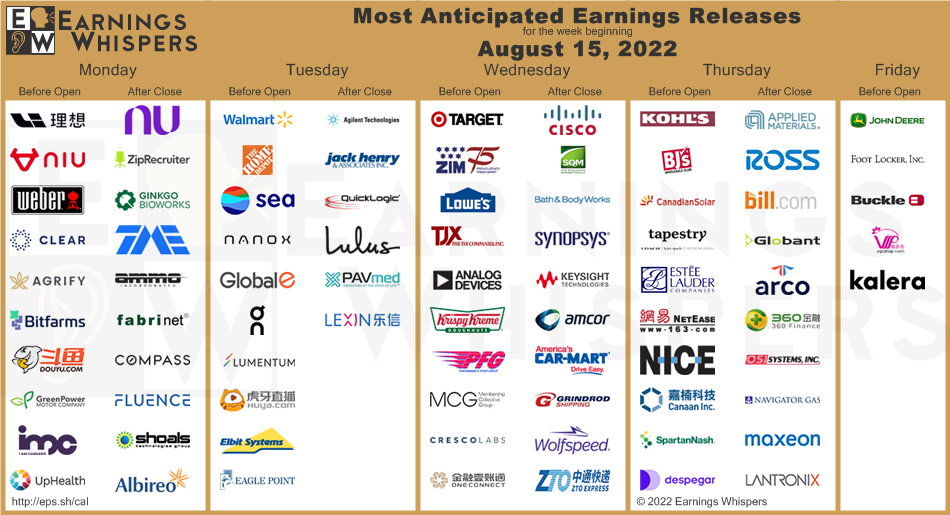
The week ahead — Economic data from Econoday.com:
Posted in Weekly Summary | No Comments »
August 8th, 2022
THERE WILL NOT BE ANY POSTING FOR THE WEEK OF JULY 29TH 2022 — WE ARE AWAY FOR SOME NEEDED R&R
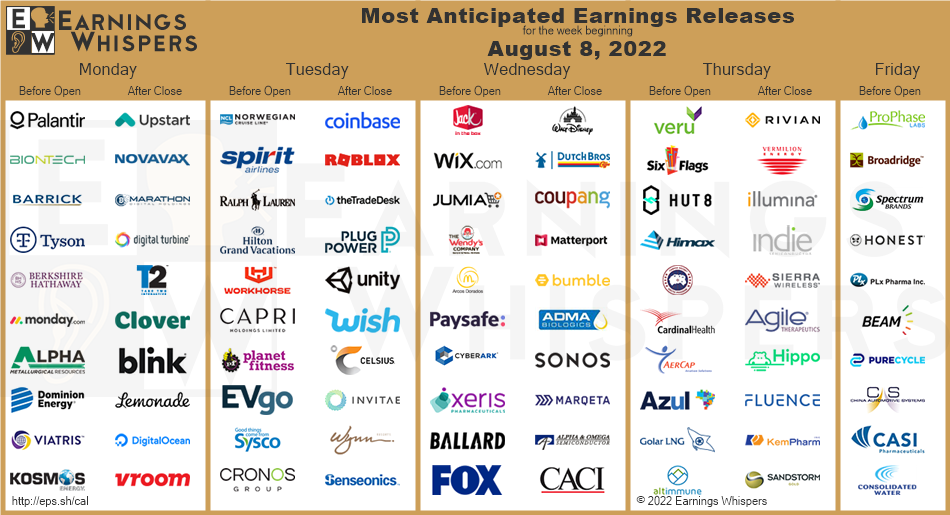
The week ahead — Economic data from Econoday.com:
Posted in Weekly Summary | No Comments »
August 1st, 2022
The elements of good trading are: (1) cutting losses, (2) cutting losses, and (3) cutting losses. If you can follow these three rules, you may have a chance. — Ed Seykota
1. Senate Advances $280 Billion Bill Subsidizing Chip Manufacturing, Technology — the Senate voted 64 to 32 last week to advance a $280 billion package of subsidies and research funding to boost U.S. competitiveness in semiconductors and advanced technology. The package is set to give a big boost to domestic chip production, seen by the White House and leaders in both parties as critical to the U.S. supply chain and national security, as most semiconductors are imported from overseas. Shortages have also helped drive prices sharply higher for cars and other goods in recent years, and proponents say the bill will help cool consumer costs. The bill combines about $52 billion in subsidy funding to boost semiconductor production in the U.S., along with about $24 billion in advanced manufacturing tax credits that would also support the industry.
The package would authorize about $200 billion in spending, mainly for federally backed scientific research over the next decade. It would fund about $1.5 billion for next-generation wireless research and establish new long-term policies for the nation’s space program.
2. Fed Raises Interest Rates by 0.75 Percentage Point — officials agreed to a 0.75-percentage-point rate rise, which will lift their benchmark federal-funds rate to a range between 2.25% and 2.5%. The rate increase won unanimous backing from the 12-member rate-setting committee. The statement repeated language from previous meetings that said officials anticipate additional rate increases will be appropriate. “The labor market is extremely tight and inflation is much too high,” Fed Chairman Jerome Powell said at a news conference late last week.
3. U.S. GDP Fell at 0.9% Annual Rate in Second Quarter — Gross domestic product, a broad measure of the goods and services produced across the economy, fell at an inflation and seasonally adjusted annual rate of 0.9% in the second quarter, the Commerce Department said Thursday. That marked a deterioration from the 1.6% rate of contraction recorded in the first three months of 2022. The GDP report offered some discouraging signs, and underscored the challenges facing U.S. businesses, consumers and policy makers—including high inflation, weakening consumer sentiment and supply-chain volatility.
Consumer spending accounts for roughly two-thirds of total economic output, and Thursday’s report showed Americans spent at a cooler clip in the second quarter. Business investment worsened slightly. The housing sector slowed as borrowing costs rose.
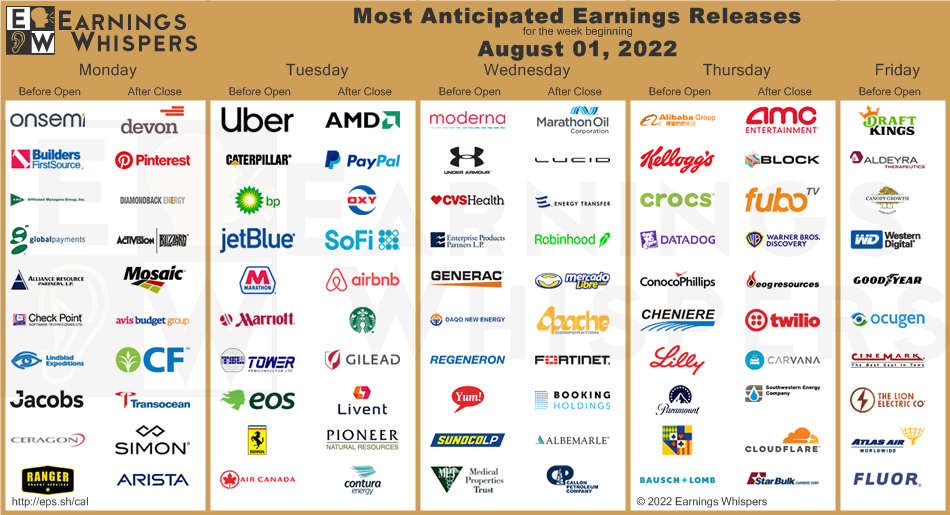
The week ahead — Economic data from Econoday.com:
Posted in Weekly Summary | No Comments »
July 25th, 2022
“Knowledge born from actual experience is the answer to why one profits; lack of it is the reason one loses” — Gerald M. Loeb
1. Market Rout Shows Dangers of Margin Lending, Crypto Style — margin loans are one of the most common sources of the borrowed money, or leverage, that underlies the zigs and zags of financial markets. During the current winter for crypto firms and their investors, leverage is exposing crypto lenders’ risk-management failures and exposing many of their customers to significant losses and stressful uncertainty. In crypto, the legal and regulatory structures are far less developed. It isn’t always clear what a crypto lender can do with a counterparty’s collateral once it moves to liquidate. Lenders and the investment firms that borrow from them tend to have a much less-complete picture of each others’ finances than, say, a big bank like Goldman Sachs Group Inc. and its hedge-fund clients, said Richard Lee, a partner at Crowell & Moring LLP.
2. EU Seeks 15% Cut in Gas Use on Russian Supply Squeeze — the European Union proposed that the bloc cut its natural gas consumption by 15% over the next eight months in a plan that would affect all households, power producers and industry. The move reflects mounting concern that Russia will halt gas exports to the region in retaliation for sanctions following its invasion of Ukraine. A cutoff would threaten EU efforts to replenish stockpiles ahead of winter, potentially jeopardizing security of supply to key sectors and crippling the region’s economy well into next year.
3. Russia Resumes Nord Stream Natural-Gas Supply to Europe — Russian natural gas began flowing again at a reduced volume through a critical pipeline into Europe on Thursday, buying time for governments to decouple from the Kremlin’s exports amid what they expect will be an increasingly unreliable supply of energy from Moscow heading into the winter.
The Nord Stream pipeline connecting Russia with Germany under the Baltic Sea resumed operation after its annual maintenance, ending 10 days of tense speculation about whether President Vladimir Putin’s regime would cut off the gas flow to Europe in retaliation for Western sanctions after his invasion of Ukraine.
Gas-flow data showed the pipeline was operating at its premaintenance level of around 40% of total capacity.
4. ECB Raises Rates by Half-Percentage Point in First Hike Since 2011 — the European Central Bank raised interest rates by a larger-than-expected half-percentage point and unveiled a new plan to buy the debt of Europe’s most vulnerable economies, seeking to protect the currency union as it navigates the twin threats of skyrocketing inflation and slowing economic growth. The rate increase comes despite rapidly accumulating challenges facing Europe’s economy and the currency union’s cohesion—from a looming energy crisis to a protracted war next door, mounting political instability at home, and what many economists think has become an inevitable recession. Some of these could make it difficult for the ECB to focus on combating inflation.
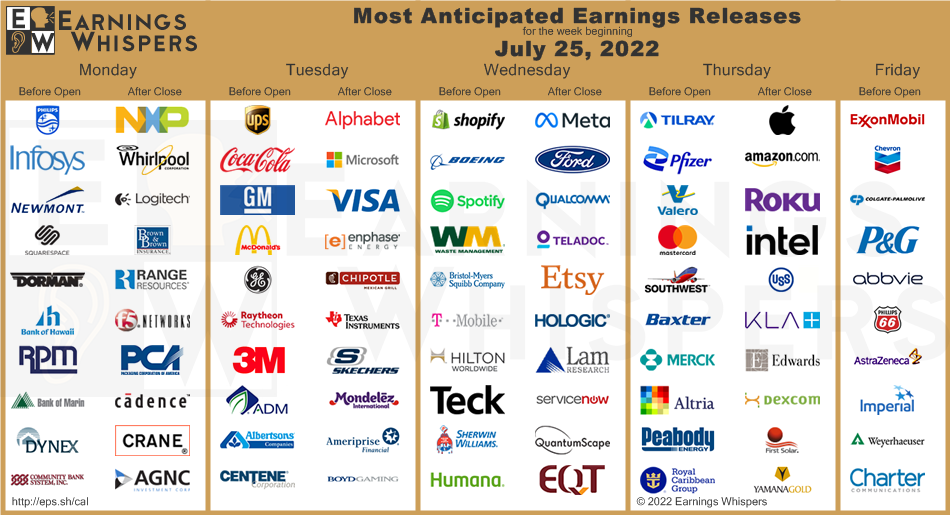
The week ahead — Economic data from Econoday.com:
Posted in Weekly Summary | No Comments »
July 18th, 2022
“The key during a crisis is to be (a) insulated from the forces that require selling and (b) positioned to be a buyer instead.” ― Howard Marks
1. Housing Could Provide More Fuel for Inflation — Overall annual inflation rose to 8.6% in May, while core inflation, which excludes volatile food and energy costs, hit 6%, according to the Labor Department’s consumer-price index. The June figures are set to be released Wednesday. Rising fuel costs and supply-chain disruptions from Russia’s war against Ukraine added to inflation that was already high due to surging demand from the economy’s reopening and aggressive government stimulus. Annual housing inflation, as measured in the CPI, hit a recent low in early 2021 at 1.4% and it has since rebounded, to 5.4% in May, well above the annual average of 3.5% between 2015 and 2019.
2. U.S. Inflation Hits New Four-Decade High of 9.1% — U.S. consumer inflation rose to a new four-decade high at an annual rate of 9.1% in June, extending a year and a half stretch of persistently higher prices.
The consumer-price index’s rate of increase last month was the highest since December 1981, the Labor Department reported. It also eclipsed May’s annual rate of 8.6% that led Federal Reserve officials to shift to a faster pace of benchmark interest-rate increases in its campaign to bring down inflation. Core prices, which exclude volatile food and energy components, increased by 5.9% in June from a year earlier, slightly less than May’s 6.0% gain, the Labor Department said. The report likely keeps the Fed on track to raise its benchmark interest rate by 0.75 percentage point at its meeting later this month.
3. Euro Slips Below Dollar as Europe’s Economic Fortunes Slump — the euro’s slide below parity with the U.S. dollar reflects Europe’s sinking economic fortunes in the face of the war in Ukraine. But unlike the last time the euro was this weak 20 years ago, nobody is coming to the common currency’s rescue. Reaching parity—when two currencies are equal in value—is largely symbolic for investors, and is expected to have a limited impact on financial markets. But a weak euro does affect the region’s economy. It drives up the cost of imports and fans Europe’s already high inflation rate while making what Europe exports cheaper in international markets.
4. U.S. Retail Sales Rose 1% in June — consumers spent more last month across a range of goods that also surged in price, including gasoline, groceries and furniture. They also spent more at restaurants, as dining out became more expensive. Recent economic figures paint a mixed picture on the state of the economy, fueling an uncertain outlook and growing fears that a recession is looming. The Federal Reserve is also under pressure to raise rates aggressively to bring down high inflation. Manufacturing output fell for the second straight month in June, the Fed said Friday. Consumer sentiment in early July held near the lowest level on records, with nearly half of surveyed consumers blaming inflation for eroding their living standards, the University of Michigan’s index of consumer sentiment said. Home construction is also slowing.
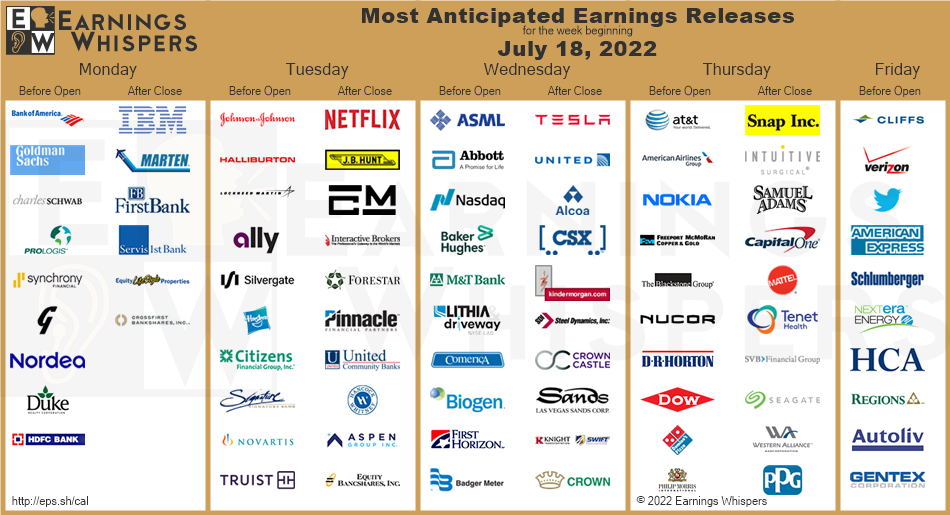
The week ahead — Economic data from Econoday.com:
Posted in Weekly Summary | No Comments »
July 11th, 2022
“Amateurs think about how much money they can make. Professionals think about how much money they could lose.” –Jack Schwager
1. Latest Fed Minutes Could Bolster Bets for 75 Basis-Point Hike in July — Chair Jerome Powell has said the Fed could hike by either 50 basis points or 75 basis points in July. He made the remarks at a June 15 press conference after policy makers raised rates by 75 basis points in the largest hike since 1994. Updated quarterly projections of the 18 policy makers show the median participant on the Federal Open Market Committee sees rates rising to 3.4% at year’s end and 3.8% next year, from a current target range of 1.5% to 1.75%.
2. Mortgage Rates Fall by Most Since 2008 on Recession Fears — the 30-year fixed-rate mortgage averaged 5.3% for the last week, according to according to data released by Freddie Mac. The drop in rates, alongside a a 5.4% drop in mortgage applications for the week ending July 1, reveals a broader cooling in the housing market.
3. Crypto Broker Voyager’s Marketing on Safety of Customer Accounts Draws FDIC Scrutiny — Voyager Digital Ltd. VOYG 0.00%▲ marketed its deposit accounts for cryptocurrency purchases as safe, protected by the nation’s banking insurance system in the event of a failure. Voyager froze all activity, including withdrawals on $350 million in customer deposits that are stored at Metropolitan Commercial Bank, a small New York bank. Voyager said customers would be able to access those dollars after “a reconciliation and fraud prevention process is completed.” Still, some customers online said they were only just learning their deposits weren’t insured by the Federal Deposit Insurance Corp. in the way they thought. Voyager had marketed the accounts as protected by that national safety net, an attractive pitch in the volatile world of cryptocurrency.
4. U.S. Added 372,000 Jobs in June — the U.S. economy added 372,000 jobs in June, the Labor Department said Friday. Hiring gains last month held near the previous three months, when companies added an average of nearly 400,000 workers, but slipped from higher totals early in the year. Employers hired across industries, with the government the only major category to shed jobs in June. Hiring continued in industries vulnerable to interest-rate increases and shifting consumer habits. For instance, construction firms, susceptible to a faltering housing market and higher mortgage rates, added jobs last month. Transportation and warehousing companies hired workers despite a spring pullback of consumer spending on goods. The strong employment figures released Friday keep the Federal Reserve on track to raise interest rates by 0.75 percentage point at its meeting later this month to cool high inflation.
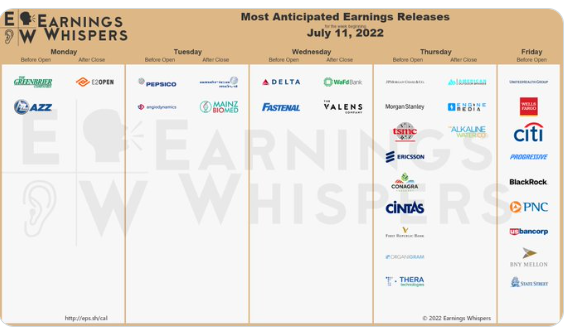
The week ahead — Economic data from Econoday.com:
Posted in Weekly Summary | No Comments »