June 27th, 2023
“Soros is the best loss taker I’ve ever seen. He doesn’t care whether he wins or loses on a trade. If a trade doesn’t work, he’s confident enough about his ability to win on other trades that he can easily walk away from the position.” — Druckenmiller
1. Fed’s Powell Says Interest-Rate Pause Is Expected to Be Temporary — Fed officials left rates unchanged last week after lifting them at 10 straight policy meetings to combat inflation. But investors, consumers and borrowers shouldn’t think they were done, Powell told the House Financial Services Committee on Wednesday. Inflation and economic activity haven’t slowed as much as many officials anticipated this year, casting more uncertainty over how high they might lift rates this year.
Fed officials see a risk that their past rate increases, together with recent banking-industry stresses, will eventually create a sharper-than-anticipated slowdown. They are trying to balance that against the risk that the economy proves more resilient than expected and inflation stays too high, requiring them to increase rates higher than otherwise.
2. Submersible Passengers Died in Implosion — the five men onboard the missing submersible in the North Atlantic died in a catastrophic implosion, the U.S. Coast Guard said, after searchers found debris from the craft near the Titanic shipwreck that ended a desperate search to find them alive. The submersible, known as the Titan, had left Sunday morning for what was supposed to be an hours long excursion to the Titanic site more than 2 miles underwater, but it lost contact with the outside world. The disappearance set off an urgent international search effort to find them alive. The Coast Guard said earlier Thursday that crews had identified debris near the Titanic shipwreck about 900 miles off Cape Cod.
3. Bank of England Outpaces Peers With Rate Rise of Half Percentage Point — The Bank of England raised its key interest rate by half a percentage point Thursday, a more aggressive rate rise than its peers as it seeks to curb the highest inflation rate in the Group of Seven wealthy countries.
The move to raise the lending rate to 5%, its highest level since April 2008, revived fears that the central bank may have to push the U.K. economy into a recession later this year in an effort to contain price increases. Across rich economies, inflation has proved tougher to tame than central banks had expected only months ago, dashing hopes that borrowing costs might stop rising soon. Norway’s central bank also increased its core lending rate by half a percentage point Thursday, while Switzerland hiked its benchmark rate by a quarter point. Both warned of further increases in the coming months.
4. Higher Interest Rates Hit Home Prices Again — U.S. existing-home prices posted their biggest year-over-year decline in more than 11 years last month as rising interest rates continued to weigh on the housing market. The national median existing-home price fell 3.1% in May from a year earlier to $396,100, the largest drop since December 2011, the National Association of Realtors reported.
Existing-home sales, which make up most of the housing market, increased 0.2% in May from the prior month to a seasonally adjusted annual rate of 4.3 million, the National Association of Realtors reported. May sales fell 20.4% from a year earlier.
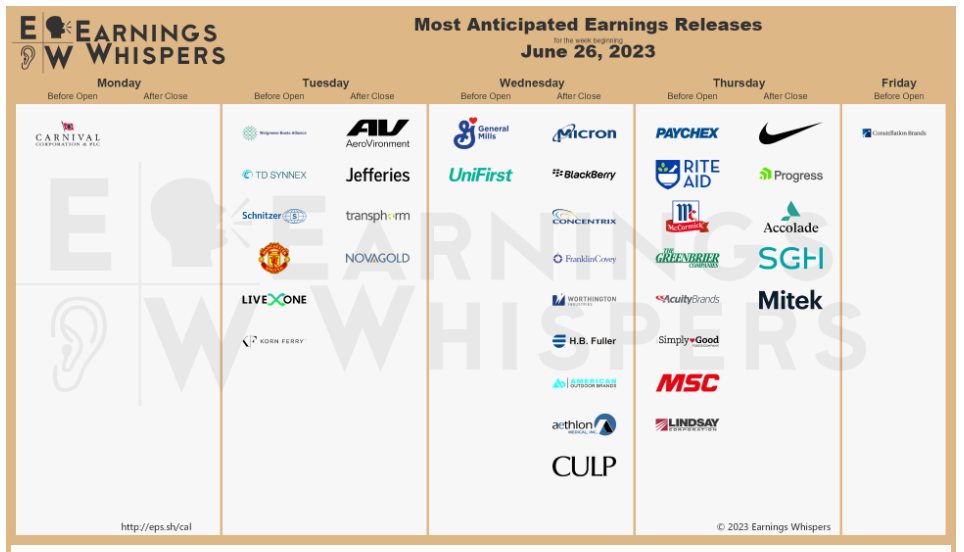
The week ahead — Economic data from Econoday.com:
Posted in Weekly Summary | No Comments »
June 20th, 2023
“Success if getting what you want. Happiness is wanting what you get.” — Dale Carnegie
1. Inflation rose at a 4% annual rate in May, the lowest in 2 years — The consumer price index, which measures changes in a multitude of goods and services, increased just 0.1% for the month, bringing the annual level down to 4%. That 12-month increase was the smallest since March 2021, when inflation was just beginning to rise to what would become the highest in 41 years. A 3.6% slide in energy prices helped keep the CPI gain in check for the month. Food prices rose just 0.2%.
However, a 0.6% increase in shelter prices was the biggest contributor to the increase for the all-items, or headline, CPI reading. Housing-related costs make up about one-third of the index’s weighting.
2. Fed Holds Rates Steady but Expects More Increases — Federal Reserve officials agreed to hold interest rates steady after 10 consecutive increases, but signaled they are leaning toward raising them next month if the economy and inflation don’t cool more. In a statement, the Fed said the decision to maintain the benchmark federal-funds rate in a range between 5% and 5.25%, a 16-year high, might be short-lived. “Holding the target range steady at this meeting allows the committee to assess additional information,” the committee said in the statement. Officials approved the rate decision unanimously.
3. European Central Bank Raises Rates, Signals More Hikes to Come — The European Central Bank nudged up interest rates by a quarter percentage point and indicated it will continue to push them higher, sending the euro surging higher. The ECB’s assertiveness, which took markets aback, stands in contrast to the Federal Reserve’s decision on Wednesday to keep interest rates steady. At a news conference, ECB President Christine Lagarde said officials are unhappy with the outlook for inflation and will continue to raise rates unless economic data change substantially. The ECB said in a statement it would increase its key deposit rate to 3.5%, the highest level in more than 20 years. That move, the bank’s eighth consecutive rate increase, was widely anticipated by investors. But in an unexpected hawkish twist, Lagarde strongly indicated it will raise rates again next month, and the bank sharply raised its forecasts for underlying inflation through 2025.
4. Retail sales rose 0.3% in May after a strong April gain — consumers spent a seasonally adjusted 0.3% more in May at retail stores, restaurants and online, following April’s strong 0.4% advance, the Commerce Department said Thursday. That growth reflected robust hiring and rising wages that pumped up incomes in recent months, further defying recession predictions in early 2023. Consumers spent more at grocery, furniture and electronics stores last month, Tuesday’s report showed. They also appeared to shrug off higher interest rates in May. Sales climbed at auto dealerships and home-improvement stores, places where customers often borrow to pay for big-ticket purchases.
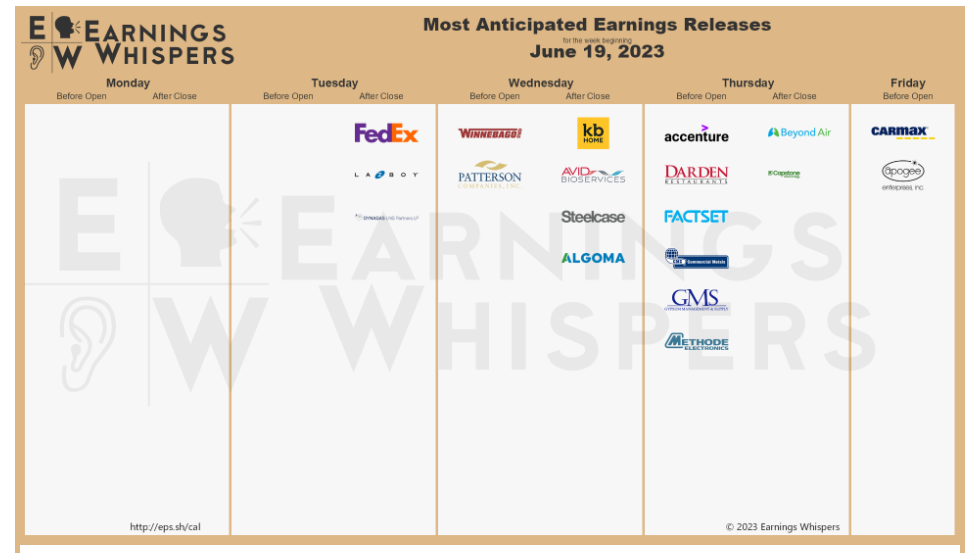
The week ahead — Economic data from Econoday.com:
Posted in Weekly Summary | No Comments »
June 12th, 2023
“The whole secret to winning and losing in the stock market is to lose the least amount possible when you’re not right.” – William J. O’Neil
1. Treasury’s $1 Trillion Debt Deluge Threatens Market Calm — Investors are bracing for a flood of more than $1 trillion of Treasury bills in the wake of the debt-ceiling fight, potentially sparking a new bout of volatility in financial markets.
Some on Wall Street fear that roughly $850 billion in bond issuance that was shelved until a debt-ceiling deal was passed—sales expected between now and the end of September, according to JPMorgan analysts—will overwhelm buyers, jolting markets and raising short-term borrowing costs.
2. China’s Share of U.S. Goods Imports Falls to Lowest Since 2006 — The share of goods shipments the U.S. receives from China has declined to the lowest level since 2006. In recent years, imports from other countries in Asia have grown to meet the healthy demand for foreign products.
In April, U.S. businesses brought in more cars, cell phones and industrial supplies, the Commerce Department said Wednesday. Exports decreased as global growth ebbed. China’s share of trade with the U.S. dipped again, continuing a downward trend. China accounted for 15.4% of U.S. goods imports for the 12 months ended April, the smallest share since October 2006.
U.S. companies have been looking for alternatives to Chinese manufacturers in recent years. Amid geopolitical tensions between the two world powers, the Trump administration imposed tariffs on thousands of goods from China, which the Biden administration has continued.
3. GM EV Owners to Tap Tesla’s Supercharger Network — General Motors said its future electric vehicles will use the same charging hardware as Tesla TSLA a move aimed at giving GM owners more access to charging and further endorsing Tesla’s charging-port technology as the industry standard. GM reported that Tesla agreed to give GM customers access to 12,000 of Tesla’s fast chargers, known as Superchargers, starting next year. Those GM customers will need an adapter to use the chargers, because the GM vehicles use a different charge port. Starting in 2025, GM will start making EVs with the Tesla charge port instead. GM Chief Executive Mary Barra said that giving the company’s customers access to Superchargers will accelerate EV adoption and that switching to the Tesla charge port on future models “could help move the industry toward a single North American charging standard.”
4. Democrats Push for Debt-Ceiling Overhaul Bill After Default Scare — Democrats in the House and Senate introduced a bill Friday that would overhaul the debt-ceiling process, eager to capitalize on widespread anxiety in the party regarding the regular brinkmanship over the country’s borrowing limit.
Backers argue that using the full faith and credit of the U.S. as leverage is irresponsible and tantamount to taking the U.S. economy hostage. But many Republicans in Congress see the debt limit as a pressure point that can be used to extract concessions from Democrats on spending.
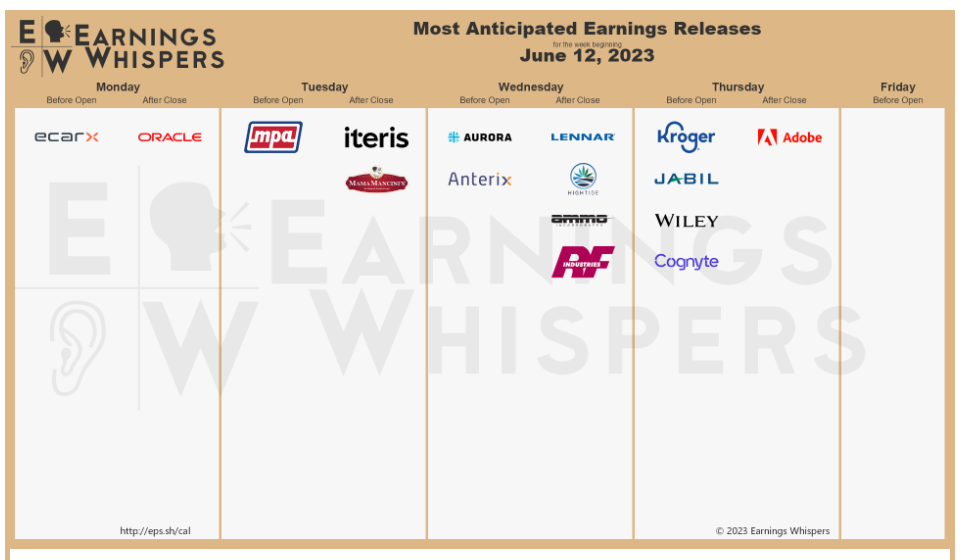
The week ahead — Economic data from Econoday.com:
Posted in Weekly Summary | No Comments »
June 5th, 2023
There will not be any re-cap for the week of May 26th through June 2nd, 2023. We are away for some needed R&R.
Have a good week.
The staffs at EGS.
Posted in Weekly Summary | No Comments »
May 22nd, 2023
“The mind is a fascinating instrument that can make or break you.” ― yvan Byeajee
1. Home Prices Posted Largest Annual Drop in More Than 11 Years in April — U.S. existing home sales, which make up most of the housing market, fell 3.4% in April from the prior month to a seasonally adjusted annual rate of 4.28 million, the National Association of Realtors reported. April sales fell 23.2% from a year earlier.
The national median existing-home price fell 1.7% in April from a year earlier to $388,800, the biggest year-over-year price decline since January 2012, NAR said. Median prices, which aren’t seasonally adjusted, were down 6% from a record $413,800 in June. Home prices have fallen the most in the western half of the U.S., while prices continue to rise from a year earlier in many eastern markets.
2. Risks Posed by AI Technology Spur Calls for New Regulatory Agency — Rising concern in Congress over the risks posed by powerful artificial- intelligence tools in the hands of consumers is giving momentum to a long-simmering idea: Creating a federal agency to regulate technology platforms including AI systems. The agency could be charged with granting licenses for AI platforms, setting operating standards and enforcing compliance with the rules, according to proponents including Sam Altman, chief executive of ChatGPT creator OpenAI. It is one of many ideas being kicked around in Washington as lawmakers contend with a new technology with humanlike abilities to complete an array of tasks, including holding conversations and creating videos—but which also could be used to commit sophisticated crimes and spread false information.
3. Tokyo Meeting Highlights Democracies’ Push to Secure Chip Supplies — top executives from the biggest chip makers in the U.S., Taiwan and South Korea met the Japanese prime minister on Thursday as the world’s industrial democracies look to deepen cooperation in the production of components they increasingly see as central to national security. Japan’s Fumio Kishida met representatives of Intel, TSMC, Samsung and other chip companies, part of Tokyo’s push to step up its domestic manufacturing of computer chips. Kishida said it was essential to tackle “the global issue of stabilizing supply chains” as the U.S. and its partners look to exclude China from a global chip alliance.
The meeting featuring business executives and officials from what are sometimes called the “Fab Four” chip-making powers—the U.S., Taiwan, South Korea and Japan—came on the eve of a summit of leaders of the Group of Seven nations in Hiroshima, Japan, where bolstering strategies to contain China is a top agenda item.
4. Fed Chair Jerome Powell Keeps June Interest-Rate Pause in Play — federal Reserve Chair Jerome Powell suggested he was open to holding interest rates steady at the central bank’s meeting next month, saying that the current banking stress could mean rates may not need to rise as high as otherwise to slow the economy. The Fed has raised its benchmark federal-funds rate rapidly over the past year to fight inflation, most recently this month to a range between 5% and 5.25%, a 16-year high.
Officials have indicated that their decision on whether to raise rates again at their June 13-14 policy meeting could be a close call. A handful have said inflation and economic activity aren’t slowing enough to justify leaving rates unchanged. But others, including Powell, have hinted that they might skip a rate rise to assess the effects of their past increases and the banking-sector strains.
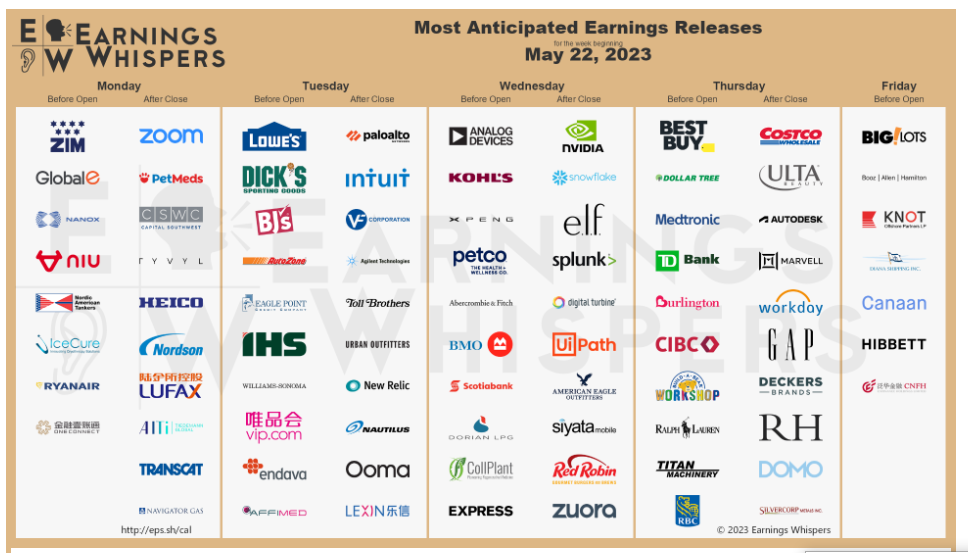
The week ahead — Economic data from Econoday.com:
Posted in Weekly Summary | No Comments »
May 17th, 2023
There will not be any re-cap for the week of May 12th, 2023. We are away due to a urgency family matter.
Have a good week.
The staffs at EGS.
Posted in Weekly Summary | No Comments »
May 8th, 2023
The key to trading success is emotional discipline. If intelligence were the key, there would be a lot more people making money trading… I know this will sound like a cliché, but the single most important reason that people lose money in the financial markets is that they don’t cut their losses short. — Victor Spandereo
1. Biden to Deploy Active-Duty Troops to Southern Border as Title 42 Ends — President Biden is sending 1,500 active-duty troops to the southern border, while cities across the country are declaring states of emergency and asking for federal support as the country prepares for a surge of migration expected to accompany the lifting of Title 42 border restrictions next week. A large number of migrants have already been illegally entering El Paso, Texas, in recent days. Hundreds unable to find spots in shelters gathered in the past few days around downtown churches in the border city looking for help, according to photos and videos of the scene.
2. Federal Reserve Raises Rates, Signals Potential Pause — the Federal Reserve approved another quarter-percentage-point interest-rate rise and signaled it could be done lifting rates after that. officials said in their new statement Wednesday they would monitor economic and financial-market developments and the effects of their earlier rate increases “in determining the extent to which additional policy firming may be appropriate to return inflation to 2% over time.”
The statement used language broadly similar to how officials concluded their interest-rate increases in 2006, with officials indicating any further change in rates was more likely to be an increase than a decrease.
3. Robust Hiring in April Shows U.S. Job Market Remains Hot in Cooling Economy — employers added 253,000 jobs in April, the best gain since January, the Labor Department said Friday. Job growth was revised lower in February and March. The jobless rate fell to 3.4% last month, matching the lowest reading since 1969. The low unemployment rate keeps upward pressure on wages, which grew 4.4% in April from a year earlier. That was slightly higher than a 4.3% annual increase in March. Over the past year, inflation hit historic highs, economic growth slowed, the Federal Reserve rapidly raised interest rates and stress emerged in the banking sector. Many economists anticipated those challenges would trigger the labor market to crack.
4. Scrambling to Avoid Default, White House Weighs Debt-Limit Fallback Options — The Biden administration and Capitol Hill leaders are scrambling to avoid a first-ever government default that could arrive as soon as June 1, taking potential alternative strategies more seriously after months of deadlock over raising the country’s borrowing limit.
Publicly, both Republicans and Democrats are still sticking to their demands as the clock ticks. GOP lawmakers are seeking to force cuts to federal spending in exchange for supporting raising the debt limit, while Democrats continue to call for a debt-limit increase without any other policy conditions. The new, accelerated timeline means lawmakers may not have the time to negotiate a broad agreement on contentious budget questions. One way to meet the rapidly approaching deadline would be to raise the debt limit enough to allow the government to keep paying its bills for a few more months, rather than a longer-term solution.
The week ahead — Economic data from Econoday.com:
Posted in Weekly Summary | No Comments »
May 1st, 2023
“The main purpose of the stock market is to make fools of as many men as possible.” ― Bernard M. Baruch
1. Home Prices Rose in February for First Time Since June — The S&P CoreLogic Case-Shiller National Home Price Index, which measures home prices across the nation, rose 0.2% in February compared with January on a seasonally adjusted basis. On a year-over-year basis, the index rose 2% in February, down from a 3.7% annual rate the prior month. The annual increase was the smallest since July 2012.
2. Republicans Pass Debt-Ceiling Bill Aiming to Spark Talks With Biden — House Republicans passed a bill proposing to raise the nation’s $31.4 trillion borrowing limit in exchange for deep cuts in government spending, aiming to jump-start talks with President Biden ahead of an approaching deadline for the federal government to avoid default. The Republicans’ Limit, Save, Grow Act of 2023, which has no chance of passing the Democratic-controlled Senate, serves as the GOP’s opening bid as it heads into expected negotiations with Mr. Biden and congressional Democrats. Republicans want the spending reductions in exchange for agreeing to raise the debt ceiling. Mr. Biden wants an increase with no conditions attached but has said he would negotiate separately on fiscal policy.
3. GDP Report Shows Economic Growth Slowed in First Quarter — U.S. economic growth decelerated to a 1.1% annual rate in the first quarter as consumers faced high inflation, rising interest rates and the onset of banking problems. The rise in U.S. gross domestic product in the first three months of the year marked a slowdown from inflation- and seasonally adjusted 2.6% growth in the fourth quarter, the Commerce Department reported. Consumers cut retail spending in February and March. Home sales and manufacturing output dropped last month, and robust hiring growth eased gradually.
4. Wage Gains Pick Up as Fed Contemplates Next Rate Decision — wage growth stayed elevated to start the year and inflation remained high, likely keeping Federal Reserve policy makers on track to raise rates again next week. Employers spent 1.2% more on wages and benefits in the first quarter from the prior three months, a slight uptick from an upwardly revised 1.1% increase in the fourth quarter, the Labor Department said Friday. The employment-cost index advanced 4.8% last quarter from a year earlier, an easing from the 5.1% gain at the end of last year. The Fed’s preferred gauge of consumer inflation, the personal-consumption expenditures price index, cooled to 4.2% in March from a year earlier, a separate Commerce Department report said. That was down from the previous month’s 5.1% gain and a peak last June, but still well above the central bank’s 2% target.
5. First Republic Bank Is Seized and Sold to JPMorgan — regulators seized First Republic Bank FRC -43.30%decrease; red down pointing triangle and struck a deal to sell the bulk of its operations to JPMorgan Chase JPM 3.09%increase; green up pointing triangle & Co., heading off a chaotic collapse that threatened to reignite the recent banking crisis. JPMorgan said it will assume all of First Republic’s $92 billion in deposits—insured and uninsured. It is also buying most of the bank’s assets, including about $173 billion in loans and $30 billion in securities.
As part of the agreement, the Federal Deposit Insurance Corp. will share losses with JPMorgan on First Republic’s loans. The agency estimated that its insurance fund would take a hit of $13 billion in the deal. JPMorgan also said it would receive $50 billion in financing from the FDIC. San Francisco-based First Republic, the second-largest bank to fail in U.S. history, lost $100 billion in deposits in a March run following the collapse of fellow Bay Area lender Silicon Valley Bank. It limped along for weeks after a group of America’s biggest banks came to its rescue with a $30 billion deposit. Those deposits will be repaid after the deal closes, JPMorgan said.
The week ahead — Economic data from Econoday.com:
Posted in Weekly Summary | No Comments »
April 24th, 2023
“Something that everyone knows isn’t worth anything.” ― Bernard Baruch
1. Single Dose of Omicron-Targeting Vaccines to Become Main Covid-19 Shot in U.S. — the Food and Drug Administration also authorized a second booster of the updated shots for people at high risk of Covid-19, specifically people 65 years and older or people who have weak immune systems.
The agency’s actions mark the latest tweaks to Covid-19 vaccines, and could be followed up by further efforts to simplify the complicated vaccination regimen, perhaps by enshrining plans for a once-a-year shot for most people.
2. Home Prices in March Posted Biggest Annual Decline in 11 Years — U.S. existing-home sales decreased 2.4% in March from the prior month to a seasonally adjusted annual rate of 4.44 million, the National Association of Realtors reported. March sales fell 22% from a year earlier. March marked the 13th time in the previous 14 months that sales have slowed. The housing market had a surprisingly strong February, when sales rose a revised 13.75% from the previous month. But after mortgage rates ticked higher, March sales resumed the extended period of declines.
3. Auto Dealers Feel the Squeeze — AutoNation said late last week that on a same-store basis, it sold 2.8% fewer new vehicles and 17.5% fewer used cars in the first quarter compared with a year earlier. Lithia LAD -0.08%decrease; red down pointing triangle Motors on Wednesday said it sold 6.3% fewer new vehicles and 2.4% fewer used vehicles over the same period. Cars are sitting on lots for longer as a result: Lithia said there were about 52 days of supply of new vehicles in the first quarter, up from 47 days a quarter earlier. AutoNation is carrying 25 days’ worth of new vehicle supply, up from 19 days from the prior quarter. Rising rates aren’t only a problem when it comes to selling cars. With so many more of them idling on lots, rising interest rates are adding up to higher floor plan financing expenses, eroding profits: Lithia Motors and AutoNations’ floor plan interest expenses last quarter were more than five times what they were a year earlier.
4. U.S. Begins Planning for 6G Wireless Communications — the White House will meet with corporate, government and academic experts to begin developing goals and strategies for the new 6G communications technology, which would have the ability to take cloud computing and the mobile internet to true global ubiquity, among other improvements.
The next generation of telecom is still years away from deployment, but it could pave the way for global internet access still unavailable with the current 5G standard, which makes smartphone downloads and wireless hot-spot connections faster. Expanding access to the internet has been a priority for the Biden administration as part of its infrastructure
The week ahead — Economic data from Econoday.com:
Posted in Weekly Summary | No Comments »
April 17th, 2023
“Do more of what works and less of what doesn’t.” — unknown
1. U.S. Inflation Eased to 5% in March — the consumer-price index, a closely watched inflation gauge that measures what consumers pay for goods and services, rose 5% last month from a year earlier, down from February’s 6% increase and the smallest gain since May 2021, Consumers saw lower prices last month for groceries, gasoline, medical care and utilities and high prices for shelter, airline fares and insurance, the department said. Core prices, a measure of underlying inflation that excludes volatile energy and food categories, increased 5.6% in March from a year earlier, accelerating slightly from 5.5% the prior month. Core inflation, which economists see as a better predictor of future inflation, has stayed stubbornly high in part because of inflationary pressures from shelter costs.
2. I Bonds Lose Their Luster With Yield Set to Plunge Below 4% — yields on the popular Series I savings bonds are set to slump after a key measure of inflation showed signs of softening on Wednesday. Just a few months ago, they offered an historic 9.62% rate. Now that figure is expected to fall to 3.8%, putting the return closer to what you can get on certificates of deposit, high-yield savings accounts and money-market funds. Low-risk, inflation-linked I bonds soared in popularity over the past two years as investors looked for ways to shield their cash from rising prices. In the 15-month stretch beginning in November 2021, when I bond rates rose above 7% for the first time since 2000, sales topped $40 billion, according to the US Treasury Department.
3. US Producer Prices Fell in March by Most Since Start of Pandemic — the producer price index for final demand decreased 0.5% from a month earlier, according to data out Thursday from the Bureau of Labor Statistics. The figure was below all estimates in a Bloomberg survey of economists. The PPI slowed on an annual basis, rising 2.7% from a year ago, the smallest gain in more than two years.
Excluding the volatile food and energy components, the so-called core PPI fell 0.1% from February and increased 3.4% from a year ago. Most of the monthly decline in the overall PPI was due to goods, with 80% of that decrease tied to a drop in gasoline. Margins for machinery and vehicle wholesaling were a major factor in the 0.3% slide in services costs. Those prices slid by the most since April 2020.
4. Retail Sales Fell in March — Shoppers pulled back on purchases of items such as vehicles, furniture and appliances amid climbing interest rates. Overall purchases at stores, restaurants and online declined a seasonally adjusted 1% in March from the prior month, the Commerce Department said Friday. Consumers also spent less on gasoline, reflecting a downward trend in prices. Manufacturing output, which is also sensitive to interest rates, declined 0.5% in March from the prior month, and is down from a year earlier, the Fed said in a separate report Friday. And after a strong start to the year, hiring has eased for two straight months and the number of job openings has declined, signs the red-hot labor market is also cooling.
The week ahead — Economic data from Econoday.com:
Posted in Weekly Summary | No Comments »