Archive for the ‘Weekly Summary’ Category

Week of June 14, 2024 Weekly Recap & The Week Ahead

Tuesday, June 18th, 2024

“Yesterday’s home runs don’t win today’s games.”

1. Inflation slows in May, with consumer prices up 3.3% from a year ago — The CPI, a broad inflation gauge that measures a basket of goods and services costs across the U.S. economy, held flat on the month though it increased 3.3% from a year ago, according to the department’s Bureau of Labor Statistics. Excluding volatile food and energy prices, core CPI increased 0.2% on the month and 3.4% from a year ago, compared with respective estimates of 0.3% and 3.5%. Though the top-line inflation numbers were lower for both the all-items and core measures, shelter inflation increased 0.4% on the month and was up 5.4% from a year ago. Housing-related numbers have been a sticking point in the Federal Reserve’s inflation battle and make up a heavy share of the CPI weighting.
Price increases were held in check, though, by a 2% drop in the energy index and just a 0.1% increase in food. Within the energy component, gas prices tumbled 3.6%. Another nettlesome inflation component, motor vehicle insurance, saw a 0.1% monthly decline though was still up more than 20% on an annual basis.
2. Fed Projects Just One Cut This Year Despite Mild Inflation Report — Federal Reserve officials penciled in just one interest-rate cut for this year, indicating most are in no hurry to lower rates, even after a widely watched report Wednesday showed inflation improved last month. The central bank also held its benchmark rate steady, in a range between 5.25% and 5.5%, a move that was widely expected. New economic projections showed 15 of 19 officials expect the Fed to cut rates this year, with that group roughly split between one or two rate cuts. The median, or midpoint, of those projections reflected expectations of one rate cut.
3. Import prices fall sharply in another sign of fading U.S. inflation — The import price index dropped 0.4% last month. Economists polled by the Wall Street Journal has forecast no change. Lower gasoline prices played a big role, but if energy is excluded, import prices still fell 0.3, the government said. The cost of imports shot up in the first four months of the year after a long period of decline, contributing to a mini-surge in U.S. inflation.

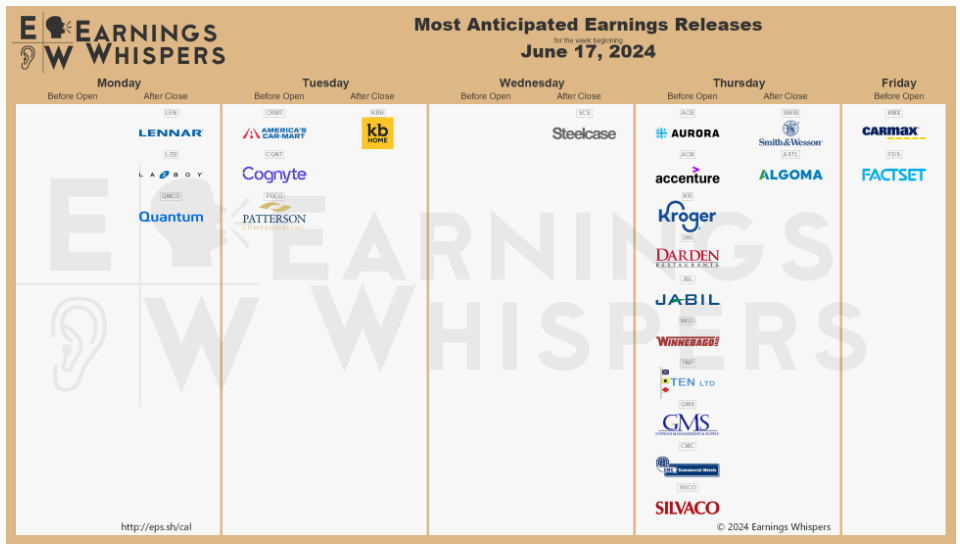
The week ahead — Economic data from Econoday.com:
Week of June 7, 2024 Weekly Recap & The Week Ahead

Tuesday, June 11th, 2024

“Wide diversification is only required when investors do not understand what they are doing.” – Warren Buffett

1. Job openings fall to lowest level since February 2021 — latest data from the Bureau of Labor Statistics released Tuesday showed there were 8.06 million jobs open at the end of April, a decrease from the 8.35 million job openings in March. March’s figure was revised lower from the 8.48 million open jobs initially reported. Economists surveyed by Bloomberg had expected the report to show 8.35 million openings in April. The Job Openings and Labor Turnover Survey (JOLTS) survey also showed 5.6 million hires were made during the month, little changed from March.
2. Boeing’s Starliner Launches NASA Astronauts After Setbacks — the space capsule, carrying astronauts Barry Wilmore and Sunita Williams, was launched Wednesday at 10:52 a.m. ET from Cape Canaveral, Fla. A NASA livestream showed Starliner shooting toward space after the flight began. The launch marked a major step forward for a program that had been slowed by repeated technical problems, and exacted a financial toll on Boeing. A successful mission would pave the way for NASA to have a second U.S. option for handling astronaut missions to the International Space Station, with Elon Musk’s SpaceX carrying out crewed flights for the agency since 2020. Starliner’s next steps include docking with the space station and, as soon as June 14, returning to Earth under parachutes. “There’s a lot of phases to this mission, and we just completed the first one,” Mark Nappi, a Boeing vice president overseeing the Starliner program, said at the briefing.
3. ECB Cuts Interest Rates for First Time Since 2019 — the ECB said it would reduce its key interest rate to 3.75% from 4%, its first rate cut in almost five years. Future interest-rate decisions will be based on incoming economic data, the bank said in a statement. The ECB’s rate-setting committee “is not pre-committing to a particular rate path,” the bank said. The rate cut is a significant moment for investors and the world economy. It marks an inflection point in recent monetary policy and sends a signal that relief is on the way for households, indebted governments and businesses that have reined in investments in the face of high borrowing costs.
The cut also potentially puts the ECB and the Fed on different tracks and widens an existing gap in borrowing costs between the U.S. and Europe. While this could boost Europe’s growth in the short term, the gap could also complicate the work of policymakers, especially in Europe.
4. Hiring Defied Expectations in May, With 272,000 New Jobs — Total nonfarm U.S. jobs increased a seasonally adjusted 272,000 jobs in May, the Labor Department reported on Friday, more than in April and well above the 190,000 that economists had expected. Average hourly earnings also topped forecasts, rising 4.1% from a year earlier. In a report that was otherwise strong almost across the board, the one caveat was the unemployment rate, which ticked up from 3.9% in April. It was the first time in more than two years that the jobless rate hit 4%.

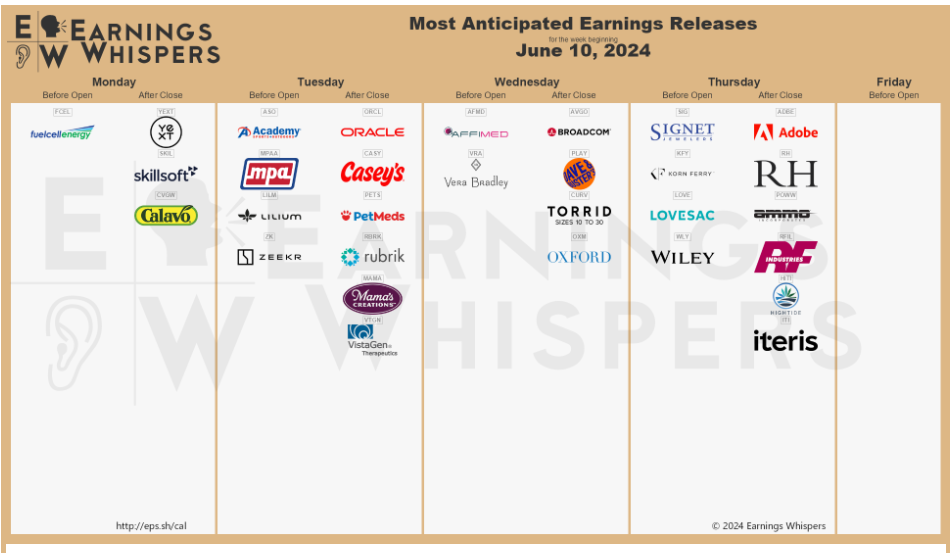
The week ahead — Economic data from Econoday.com:
Week of May 24-May 31, 2024 Weekly Recap & The Week Ahead

Tuesday, June 4th, 2024

There will not be any re-cap for the week of May 24th through May 31st, 2024. We are away for some needed R&R.

Have a good week.

The staffs at EGS.

Week of May 17, 2024 Weekly Recap & The Week Ahead

Monday, May 20th, 2024

“If you have an approach that makes money, then money management can make the difference between success and failure… … I try to be conservative in my risk management. I want to make sure I’ll be around to play tomorrow. Risk control is essential.” – Monroe Trout

1. Biden Announces Tariffs on $18 Billion of Chinese Imports — The Biden administration said it would impose new tariffs on $18 billion of Chinese imports—a move it says will protect U.S. businesses but could put new pressure on prices as the election looms. The tariff rate on certain steel and aluminum products will increase to 25% from a range of zero to 7.5%. Tariffs on semiconductors will double to 50% by 2025, while those on solar cells will do the same this year. The levy on Chinese electric vehicles will quadruple to 100% in 2024, while those on lithium-ion batteries will increase to 25% from 7.5%. Medical products, such as syringes and needles, and ship-to-shore cranes will also see new or increased tariffs.
2. US Producer Prices Top Forecasts — The producer price index for final demand increased 0.5% from a month earlier, driven largely by services and following a downwardly revised 0.1% drop in March, Bureau of Labor Statistics data showed Tuesday. Compared with a year ago, the PPI rose by the most since April 2023. Among those, the cost of hospital outpatient care fell 0.1% and airfares dropped 3.8%. Prices for physician care rose modestly. At the same time, prices for portfolio management services increased 3.9%. The April PCE price gauge is due later this month.
3. Inflation Eases as Core Index Hits Lowest Level Since 2021 — The consumer-price index, a gauge for goods and service costs across the U.S. economy, rose 3.4% in April from a year ago, the Labor Department said Wednesday. So-called core prices that exclude volatile food and energy items climbed 3.6% annually, the lowest increase since April 2021. Both figures were in line with economists’ expectations. Because it will likely take another two reports to shore up officials’ confidence that inflation can return to the lower levels that prevailed before the pandemic, the Fed might not be ready to cut interest rates before September. Price pressures remain for millions of Americans. Gasoline prices pushed up overall inflation, while consumers continued paying more for housing in April. But year-over-year rent increases slowed from a month earlier, a key sign for economists that a big driver of inflation in recent years is slowly easing.
Costs of groceries and vehicles also edged lower in April from the previous month, while price increases for medical care slowed.

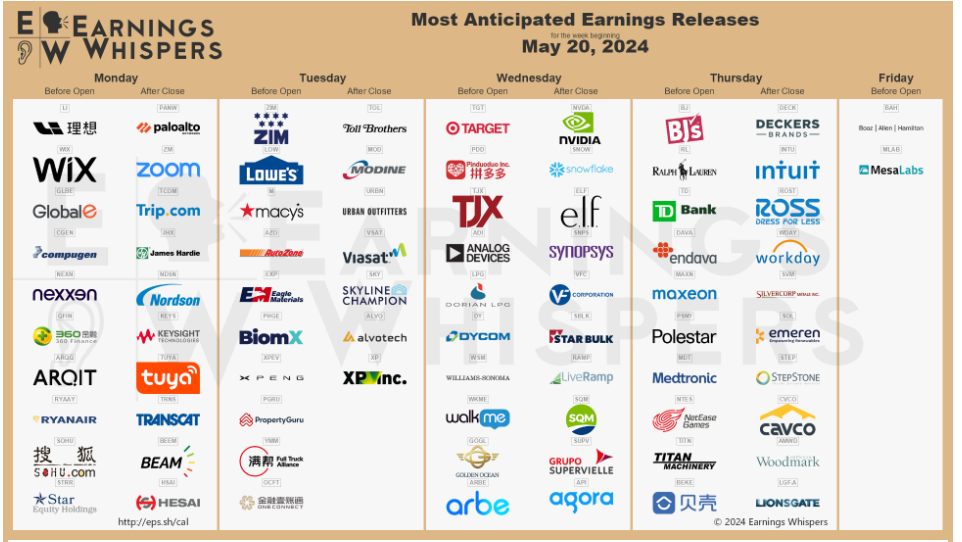
The week ahead — Economic data from Econoday.com:
Posted in Weekly Summary | No Comments »

Week of May 3, 2024 Weekly Recap & The Week Ahead

Tuesday, May 7th, 2024

“There is only one side of the market and it is not the bull side or the bear side, but the right side.” – Jesse Livermore

1. US consumer confidence hits lowest level since July 2022 — The Conference Board’s consumer confidence index retreated to 97 in April, below economists’ expectations for 104 and lower than March’s reading of 103.1. The Conference Board reasoned this was driven by a more pessimistic outlook for “future business conditions, labor market conditions, and income expectations.” Several months of inflation data have come in hotter-than-expected, as price pressure prove more persistent than some policymakers and economists had expected. New data showed the core Personal Consumption Expenditures (PCE) index, which strips out the cost of food and energy and is closely watched by the Federal Reserve, rose 2.8% over the prior year in March, above estimates for 2.7% and unchanged from the annual increase seen in February.
2. Fed Says Inflation Progress Has Stalled and Extends Wait-and-See Rate Stance — In their policy statement released Wednesday, officials highlighted a “lack of further progress” toward bringing inflation down in recent months. But Fed Chair Jerome Powell said at a news conference that he didn’t think it was likely the Fed would need to consider interest-rate increases, and he volunteered that rate cuts could begin if the labor market weakened unexpectedly. Separately, the central bank approved plans to slow the ongoing reduction of its $7.4 trillion asset portfolio in a bid to extend the wind-down of emergency pandemic stimulus efforts it launched four years ago. The Fed can reinvest the proceeds of its Treasury securities into new ones when they mature, but since 2022 it has been allowing up to $60 billion in Treasurys to roll off the portfolio every month. Starting in June, it will slow this monthly pace of decline to $25 billion.
3. US Jobs Post Smallest Gain in Six Months as Unemployment Rises — US employers scaled back hiring in April and the unemployment rate unexpectedly rose, suggesting some cooling is underway in the labor market after a strong start to the year. Nonfarm payrolls advanced 175,000 last month, the smallest gain in six months, a Bureau of Labor Statistics report showed Friday. A later release showed that business activity in the service sector — the largest part of the economy — unexpectedly weakened to the lowest level in four years, while prices climbed. Average hourly earnings climbed 0.2% from March and 3.9% from a year ago, the slowest pace since June 2021. Some economists were expecting a stronger increase in part due to a new California law mandating a $20 minimum wage for fast-food workers, which took effect April 1.
4. Dairy Workers Urged to Use Protection to Prevent Bird Flu — Dairy workers remain at risk for the H5N1 bird flu that’s spreading in cows and should wear protection to ward off the virus, US health officials said as they released details on one worker who experienced an eye infection.
The dairy worker underwent genetic testing of samples from both eyes and his nose, according to a letter to the New England Journal of Medicine from the US Centers for Disease Control and Prevention’s Tim Uyeki and Texas health officials, which confirmed the presence of the virus. The highly contagious strain of avian flu has spread across dairy cattle in 36 herds across nine states this year, and the US Food and Drug Administration said it found fragments in one out of every five commercial milk samples tested. The US Department of Agriculture is testing beef for the presence of H5N1 because of concerns about potential spread to humans. Pasteurized milk and cooked beef are safe to consume, the FDA has said.

The week ahead — Economic data from Econoday.com:

Posted in Weekly Summary | No Comments »

Week of April 26, 2024 Weekly Recap & The Week Ahead

Tuesday, April 30th, 2024

“If you can keep your wits about you while all others are losing theirs, and blaming you. . . . The world will be yours and everything in it, what’s more, you’ll be a man, my son.” — Rudyard Kipling

1. Senate Passes $95 Billion Package to Help Ukraine and Israel — the Senate passed a long-delayed $95.3 billion foreign-aid package sending much-needed ammunition and military equipment to beleaguered Ukrainian soldiers and fortifying Israel’s missile defense systems, while also forcing the sale of Chinese-controlled TikTok in the U.S. The 79-to-18 vote brought to a close months of wrenching debate over Ukraine that sharply split the Republican Party, with rank-and-file members openly rebelling against their leaders. The fight also called into question both how far the U.S. would go to defend the country, now in the third year of trying to repel Russia’s invasion, as well as America’s leadership role in the world.
The measure passed the House on Saturday and now goes to President Biden’s desk. Biden, who has been pushing for a big foreign-aid package since the fall, signed it into law Wednesday.
2. GDP growth slowed to a 1.6% rate in the first quarter, well below expectations — Gross domestic product, a broad measure of goods and services produced in the January-through-March period, increased at a 1.6% annualized pace when adjusted for seasonality and inflation, according to the department’s Bureau of Economic Analysis. Economists surveyed by Dow Jones had been looking for an increase of 2.4% following a 3.4% gain in the fourth quarter of 2023 and 4.9% in the previous period.
Consumer spending increased 2.5% in the period, down from a 3.3% gain in the fourth quarter and below the 3% Wall Street estimate. Fixed investment and government spending at the state and local level helped keep GDP positive on the quarter, while a decline in private inventory investment and an increase in imports subtracted. Net exports subtracted 0.86 percentage points from the growth rate while consumer spending contributed 1.68 percentage points.
3. Key Fed inflation measure rose 2.8% in March from a year ago, more than expected — the personal consumption expenditures price index excluding food and energy increased 2.8% from a year ago in March, the same as in February, the Commerce Department reported Friday. That was above the 2.7% estimate from the Dow Jones consensus. Including food and energy, the all-items PCE price gauge increased 2.7%, compared with the 2.6% estimate.
On a monthly basis, both measures increased 0.3%, as expected and equaling the increase from February. Consumers showed that they are still spending despite the elevated price levels. Personal spending rose 0.8% on the month, a touch higher even than the 0.7% estimate though the same as February. Personal income increased 0.5%, in line with expectations and higher than the 0.3% increase the previous month.

The week ahead — Economic data from Econoday.com:

Week of April 19, 2024 Weekly Recap & The Week Ahead

Tuesday, April 23rd, 2024

“He that can have patience can have what he will.” –Benjamin Franklin

1. Biden Calls for Steep Hike to Tariff on Chinese Steel — Biden, is asking his trade officials to more than triple a key tariff rate on Chinese steel and aluminum products to 25% from 7.5%. That higher levy would be in addition to a separate 25% tariff on steel and a 10% duty on aluminum imposed under the Trump administration. A senior administration official said the higher tariffs would only affect 0.6% of U.S. demand for steel. Biden’s move comes as the administration is studying raising tariffs on a range of Chinese exports to the U.S., including electric vehicles, batteries and solar products. The higher metal levies would go into effect as part of the Biden administration’s decision on how to adjust tariffs that date from former President Donald Trump’s time in the White House, senior Biden administration officials said.
2. Housing Market Slumps as Mortgage Rates Top 7% — the average rate on the standard 30-year fixed mortgage jumped by nearly a quarter percentage point to 7.1%, according to a survey of lenders released Thursday by mortgage-finance giant Freddie Mac. That is the highest level since late 2023 and the largest weekly increase in nearly a year. Existing home sales in March, meanwhile, fell 4.3% from February in what was the largest percentage decline on a monthly basis since November 2022, the National Association of Realtors said Thursday. The housing market’s recent turbulence is cutting short a positive start to the year. Sales tumbled to their lowest level in nearly 30 years in 2023. But they rose during the first two months of this year as a number of buyers took advantage of a decline in mortgage rates to resume their home search. Active listings ticked higher and real-estate showings picked up in January.
3. Israel Strikes Iran in Narrow Attack Amid Escalation Fears — the attack was a targeted strike in the area around Isfahan in central Iran, one of the people said. Iranian media and social media reported explosions near the city, where Iran has nuclear facilities and an air base, and the activation of air-defense systems in provinces across the country after suspicious flying objects were detected. The narrow Israeli attack and Iran’s soft rhetoric in response appeared to be an attempt by both sides to calm tensions after more than a week of concerns that Israel’s war with Hamas in Gaza would metastasize into a bigger regional conflict, though fears remain of a miscalculation. Israel has been under pressure from the U.S. and Europe to moderate its response and faced the challenge of delivering a blow that would punish Iran for the attack without provoking a response.
4. China Hits U.S. With Levy on Chemical as Trade Tensions Rise — China’s commerce ministry said imports of U.S.-made propionic acid would be subject to a levy of 43.5% after an investigation that began in July concluded the chemical was being dumped in China at rock-bottom prices and hurting Chinese producers as a result. The two U.S. companies accused of dumping in the investigation—Dow and Eastman Chemical—didn’t immediately respond to requests for comment. The move came just days after President Biden called for higher tariffs on Chinese steel and the U.S. began antidumping probes centered on China’s shipbuilding, maritime and logistics industries.

The week ahead — Economic data from Econoday.com:

Week of April 11, 2024 Weekly Recap & The Week Ahead

Tuesday, April 16th, 2024

“You must be shapeless, formless, like water. When you pour water in a cup, it becomes the cup. When you pour water in a bottle, it becomes the bottle. When you pour water in a teapot, it becomes the teapot. Water can drip and it can crash. Become like water my friend.” — Bruce Lee

1. Hot Inflation Report Derails Case for Fed’s June Rate Cut — the consumer-price index, a measure of goods and services prices across the economy, rose 3.5% in March from a year earlier, the Labor Department said Wednesday. That was a touch higher than economists had forecast and a pickup from February’s 3.2%. So-called core prices, which exclude volatile food and energy categories, also rose more than expected on a monthly and annual basis. Wednesday’s report had been hotly anticipated because Fed leaders had been willing to play down stronger-than-anticipated inflation readings in January and February as reflecting potential seasonal quirks. But a third straight month of above-expectations inflation data erodes that story and could lead Fed officials to postpone anticipated rate cuts until July or later.
2. Wholesale Prices Rose 0.2% in March, Less Than Expected — the producer price index rose 0.2% for the month, less than the 0.3% estimate from the Dow Jones consensus and not as much as the 0.6% increase in February, according to a release Thursday from the Labor Department’s Bureau of Labor Statistics. However, on a 12-month basis, the PPI climbed 2.1%, the biggest gain since April 2023, indicating pipeline pressures that could keep inflation elevated. Excluding food and energy, the core PPI also rose 0.2%, meeting expectations. Excluding trade services from the core level, the increase was 0.2% monthly but 2.8% from a year ago.
3. China Tells Telecom Carriers to Phase Out Foreign Chips in Blow to Intel, AMD — Officials earlier this year directed the nation’s largest telecom carriers to phase out foreign processors that are core to their networks by 2027, a move that would hit American chip giants Intel INTC -5.16%decrease; red down pointing triangle and Advanced Micro Devices AMD -4.23%decrease; red down pointing triangle, people familiar with the matter said. The deadline given by China’s Ministry of Industry and Information Technology aims to accelerate efforts by Beijing to halt the use of such core chips in its telecom infrastructure. The regulator ordered state-owned mobile operators to inspect their networks for the prevalence of non-Chinese semiconductors and draft timelines to replace them, the people said.
4. U.S. Moves Warships to Defend Israel in Case of Iranian Attack — The moves by the U.S. that are part of an effort to avoid a wider conflict in the Middle East came after a warning from a person familiar with the matter about the timing and location of the potential Iranian attack. A person briefed by the Iranian leadership, however, said that while plans to attack are being discussed, no final decision has been made. Army Gen. Erik Kurilla, the head of U.S. Central Command, discussed a possible Iranian attack with Israeli Defense Minister Yoav Gallant in Israel on Friday. “We are prepared to defend ourselves on the ground and in the air, in close cooperation with our partners, and we will know how to respond,” Gallant said, according to Israel’s Defense Ministry.

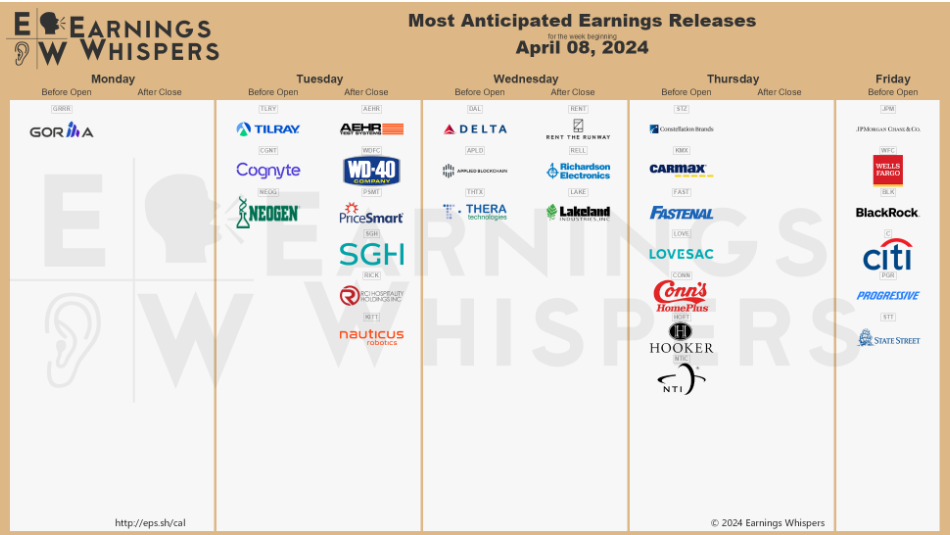
The week ahead — Economic data from Econoday.com:

Week of April 4, 2024 Weekly Recap & The Week Ahead

Wednesday, April 10th, 2024

“The most dangerous thing is to buy something at the peak of its popularity. At that point, all favourable facts and opinions are already factored into its price and no new buyers are left to emerge” ― Howard Marks

1. Tesla’s Quarterly Deliveries Fall for First Time Since 2020 — Elon Musk’s electric-vehicle maker delivered 386,810 vehicles globally in the first three months of 2024, down 8.5% from a year earlier. It was the company’s lowest quarterly performance since the third quarter of 2022. The result was enough for Tesla to reclaim the title from China’s BYD as the world’s top EV seller on a quarterly basis. Yet, it is a troubling sign for the broader electric-vehicle market, where growth is slowing and automakers including Ford Motor and General Motors are recalibrating investment plans after finding consumers to be less enthusiastic about going electric than the companies had expected.
2. Powell Still Sees Room for the Fed to Cut Rates This Year — Powell pointed to signs that labor-market conditions are less tight than they have been in recent years, a view that has eased concerns that paychecks and prices might rise in tandem. Meanwhile, signs of firmer-than-expected inflation in January and February haven’t shaken the Fed’s stance that price growth will continue to slow down despite some bumps, Powell said at a conference in Stanford, Calif. Fed officials raised rates rapidly over the past two years to address a surge in inflation, which hit a 40-year high. They have held their benchmark short-term rate in a range between 5.25% and 5.5% since July.
Measures of underlying inflation have cooled notably since the middle of 2023. That has allowed the Fed to shift its attention away from whether to keep raising rates and toward when to lower rates from a level that some officials thought was necessary to defend against inflation becoming stubbornly elevated.
3. Oil Is Hitting Its Highest Level in Months — The rally in crude picked up speed this week after an Israeli strike on an Iranian diplomatic building fanned worries of a broader regional war. Undergirding prices: a relative lack of crude in global markets thanks to production cuts from OPEC and its allies. Brent crude futures, the benchmark, have climbed 18% in 2024 to exceed $90 a barrel for the first time since October. That is feeding into gasoline, with average national prices measured by AAA up 15% this year at $3.57 a gallon. Gasoline supplies are a possible pinch point ahead of the busy summer driving season. Inventories in the U.S. are 3% below the recent average for this time of year, close to the lowest for this time of year in the past five years.
4. U.S. creates 303,000 jobs in March. Much bigger increase than expected — The U.S. created a larger-than-expected 303,000 new jobs in March and signaled the economy is still expanding at a solid pace, but the report won’t make it any easier for the Federal Reserve to decide when to cut interest rates. The increase in new jobs was the biggest since May 2023. Economists surveyed by The Wall Street Journal had forecast a 200,000 increase in new jobs last month.

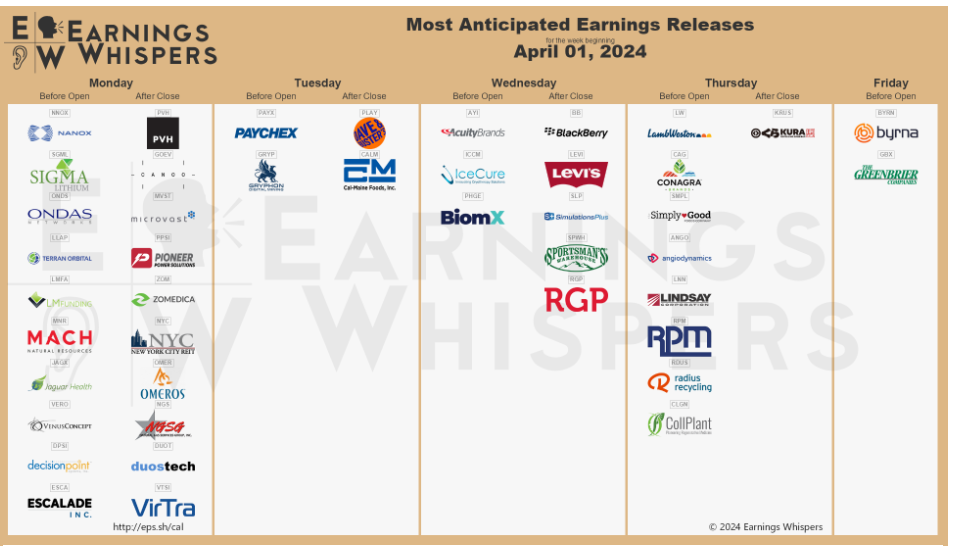
The week ahead — Economic data from Econoday.com:

Week of Mar 29, 2024 Weekly Recap & The Week Ahead

Tuesday, April 2nd, 2024

The road to long-term investment success runs through risk control more than through aggressiveness. — Howard Marks

1. Japan Amps Up Intervention Threat as Yen Hits Lowest Since 1990 — The nation’s currency dipped to 151.97 versus the greenback early on Wednesday in Tokyo — beyond the level at which policymakers stepped in during October 2022 — before comments from government officials on their readiness to act boosted the yen to its strongest level of the day. The yen’s rapid decline comes even after the Bank of Japan raised interest rates for the first time since 2007. A lack of guidance pointing to further near-term policy tightening, and the central bank’s insistence that financial conditions will remain easy, have instead pushed the yen in the opposite direction — something that traders have jumped on.
2. China Industrial Profits Return to Growth — Industrial profits jumped 10.2% in the first two months of 2024, compared with a 2.3% decline for all of 2023, the National Bureau of Statistics said Wednesday. The result was partially thanks to a low base last year.
China’s state-owned companies reported a 0.5% rise in profits for January and February, while profits at foreign companies jumped 31.2%. Private companies saw growth of 12.7%.
Profits in China’s manufacturing sector expanded 17.4% in the first two months of the year, while that of the utilities sector surged 63.1%. The mining sector was the main drag on overall profit growth, seeing its profit drop 21.1% in the January-February period.
The main contributor to overall profit growth was equipment manufacturing, which recorded a 28.9% expansion from a year ago.
3. GDP update boosts U.S. fourth-quarter economic growth rate to 3.4% — The final reading of U.S. growth in the 2023 fourth quarter was raised a few notches to a 3.4% annual pace, reflecting strong consumer spending and a surprisingly resilient economy. The government previously said gross domestic product had expanded at a 3.2% rate in the final three months of last year. The figure is adjusted for inflation. The growth rate of the economy is forecast to taper to a still-healthy 2% in the soon-ending first quarter.
4. Fed’s Favored Inflation Gauge Rose 2.5% in February — The overall personal-consumption expenditures price index rose 2.5% over the 12 months through February, the Commerce Department said Friday. That was in line with forecasts from economists polled by The Wall Street Journal. Core prices excluding volatile food and energy prices rose 2.8%, also in line with forecasts. From January to February, the PCE price index increased 0.3%, less than the 0.4% increase economists expected. The core index rose 0.3%, in line with expectations.
Another inflation gauge has shown price pressures were stickier than expected in the first two months of the year, while job growth remained strong. Fed governor Christopher Waller said earlier this week that recent data “reinforces my view that there is no rush to cut the policy rate.”

The week ahead — Economic data from Econoday.com:

Search
Calendar
February 2026
M T W T F S S
« Jan    
 1
2345678
9101112131415
16171819202122
232425262728  
Archives
Categories
The information provided by The EGS Blog is based on sources believed to be reliable, but it is not guaranteed to be accurate. There is no guarantee that the recommendations of The EGS Blog will be profitable or will not be subject to losses. The information provided by The EGS Blog is not a recommendation or a solicitation that any particular investor should purchase or sell any particular security in any amount, or at all. The investments discussed or recommended herein may be unsuitable for investors depending on their specific investment objectives and financial position. At any time EGS LLC and its principals may maintain positions that are contrary to positions announced within the subscription service. In no event will The EGS Blog be liable to you or anyone else for any incidental, consequential, special, or indirect damage (including but not limited to lost profits or trading losses). PAST PERFORMANCE IS NO GUARANTEE OF FUTURE RESULTS

© Copyright 2026 Market Outlook All Rights Reserved
Design by EGS Sponsored by Equity Guidance LLC