Archive for the ‘Weekly Summary’ Category

Week Nov 6 2010 – Weekly Recap & The Week Ahead

Monday, November 8th, 2010

1. Australia’s unexpected rate hike — the Reserve Bank of Australia unexpectedly raised its benchmark interest rate by a quarter percentage point to 4.75%, strengthening its currency toward parity with the U.S. dollar.
2. India also raised its benchmark rates — The Reserve Bank of India raised the repurchase rate by 25 bps to 6.25%, and raised the reverse repurchase rate by a similar margin to 5.25%. It’s India’s sixth rate hike this year as the country tries to pull inflation under control.
3. Mortgage insurer Ambac may declare bankruptcy by the end of the year — the bond insurer decided to skip an interest payment on senior notes due in 2023.
4. Republicans win House, Democrats keep Senate — The Republican Party took control of the House of Representatives in Tuesday’s election, but Democrats narrowly clung to a majority in the Senate.
5. FOMC rolls out QE2 — the Fed launched a second round of quantitative easing via $600B in purchases of longer-term Treasurys by the end of June, at the rate of around $75B/month. Continued POMO reinvestments could total $250B-300B during the same period, and the Fed reserved the right to take more action if growth and inflation don’t pick up.
6. GM files for IPO — General Motors filed its long-awaited IPO, and will offer 365M shares at $26-29 each. The move will cut the Treasury’s stake in the carmaker to 43% from 61%. GM also plans to sell around $3B of preferred shares that would convert to common shares under mandatory provision.
7. New chief for Fannie, Freddie — Spencer Bachus, the Republican expected to take over chairmanship of the House Financial Services Committee, said yesterday that mortgage giants Fannie Mae (FNMA.OB) and Freddie Mac (FMCC.OB) should be in liquidation, not conservatorship.

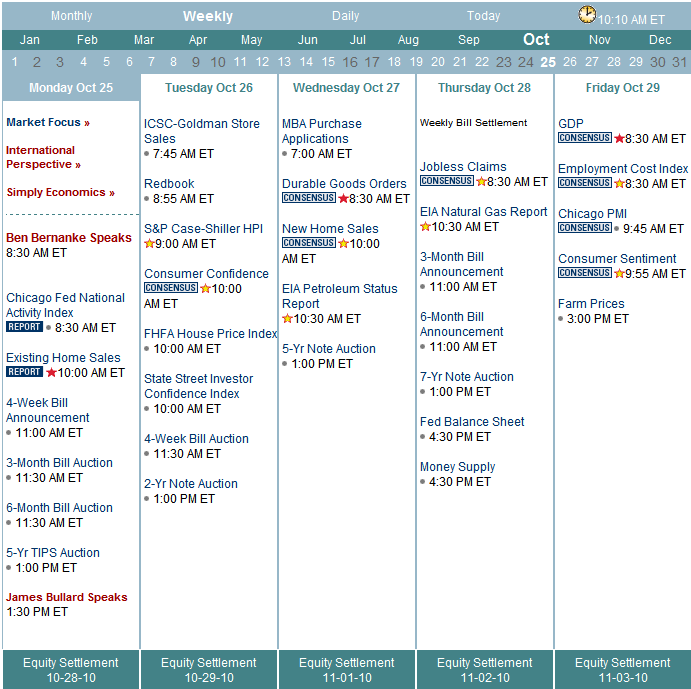
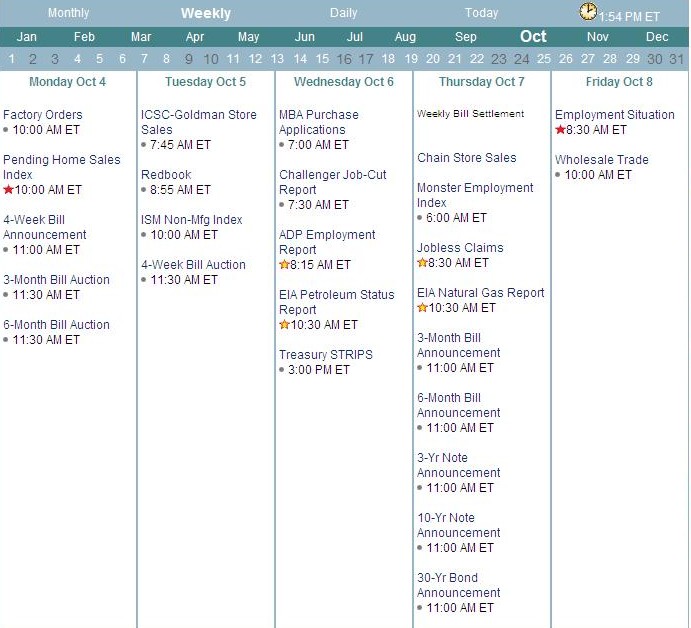
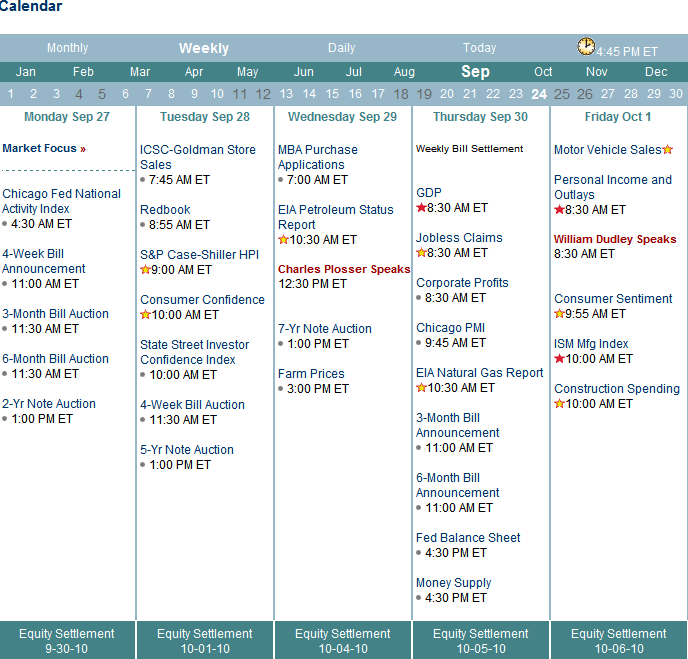
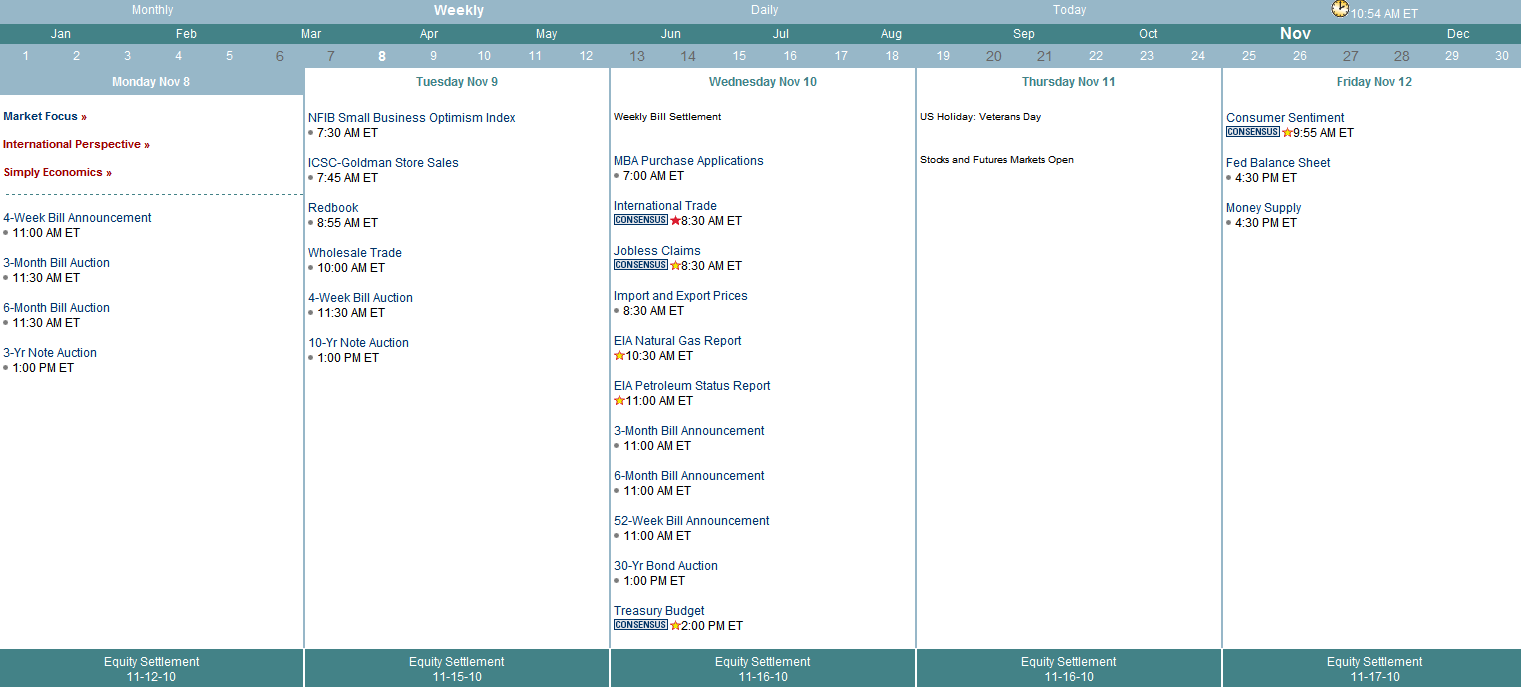
The week ahead — Economic data from Econoday.com:
Week Oct 29 2010 – Weekly Recap & The Week Ahead

Monday, November 1st, 2010

“The crowd is most enthusiastic and optimistic when it should be cautious and prudent; and is most fearful when it should be bold.” Humphrey Bancroft Neill

1. U.K. GDP grows twice as fast as expected — Britain’s economy grew twice as fast as economists had expected in Q3, posting 0.8% growth on the back of a sustained recovery in services and construction.
2. Q3 Earnings Season Statistics — courtesy from Bespoke Investment Group, below are charts highlighting the current and historical earnings season “beat rate,” which is the percentage of companies that beat earnings per share estimates. The first chart shows how the beat rate has progressed since the third quarter reporting period started on October 7th. The beat rate moved above 70% last Friday, hit a high of 76.6% yesterday, and dropped to 74.1% after all of this morning’s numbers came out.

The second chart highlights the quarterly earnings beat rate going back to 1999.

3. New 52-Week Highs by Sector — another article from Bespoke Investment Group highlights the new 52-Week Highs broken down by Sector.

4. Foreclosure ‘epidemic’ spreads — the foreclosure crisis is intensifying across a majority of large U.S. metropolitan areas, according to a report by RealtyTrac. Though California, Nevada, Florida and Arizona are still the states hardest-hit by foreclosures, cities like Chicago and Seattle saw a sharp increase in foreclosure warnings this summer. RealtyTrac’s Rick Sharga characterized the trend by saying “the epidemic is spreading from the states at the ground zero of the foreclosure problems out into areas that hadn’t been previously affected.”
5. BoJ holds rate steady — the Bank of Japan held its key overnight call rate unchanged, as expected, and cut its growth outlook. Economic growth for the fiscal year through March 2011 is now expected to come in at +2.1%, down from the +2.6% forecast issued three months ago. The bank also moved its next policy meeting to Nov. 4-5 from a previously scheduled Nov. 15-16, setting up the meeting to immediately follow an expected QE2 announcement from the U.S. Fed on Nov. 3.
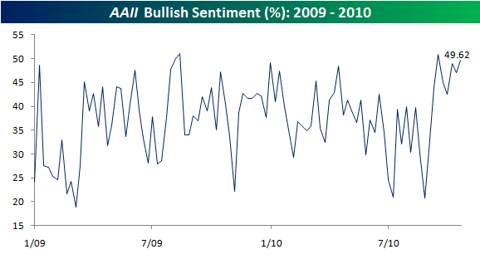
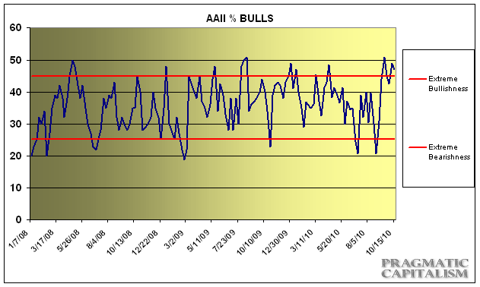
6. Bullish Sentiment Hits 2.5 Year High — The latest AAII sentiment survey showed a 2.5 year high in bullish sentiment at 51.6%. This is the highest reading since May 8th, 2008 and just shy of the all-time high in the S&P 500.

The week ahead — Economic data from Econoday.com:

Week Oct 22 2010 – Weekly Recap & The Week Ahead

Monday, October 25th, 2010

1. China Hikes Rates To Quell Inflation — China unexpectedly hiked its key lending rate by a quarter-point overnight, giving a clear signal that inflation has replaced economic growth as Beijing’s top concern.

2. China’s growth cools in 3Q — China’s economy grew 9.6% in Q3, the slowest pace in a year and roughly in-line with expectations. Following this week’s surprise rate hike and the moderation of China’s slowdown.
3. Germany sees higher growth — Germany revised higher its estimate for 2010 economic growth, forecasting the country’s GDP will expand 3.4% this year but slow to +1.8% in 2011.
4. Bullish Sentiment Nears 50% — today’s release of weekly sentiment figures from the American Association of Individual Investors (AAII) showed that bullish sentiment rose close to 50%, which is the highest level since early September. Prior to that, you have to go all the way back to the Summer of 2009 to find a bullish reading as high as it is now.

The week ahead — Economic data:

Week Oct 15 2010 – Weekly Recap & The Week Ahead

Friday, October 15th, 2010

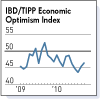
1. Optimism Rises Ahead Of Nov. Election — Consumer confidence hit a five-month high in early October and the six-month outlook shot up ahead of next month’s midterm elections, according to the IBD/TIPP Economic Optimism Index released Tuesday. The overall sentiment gauge rose 1.1 points to 46.4 as optimism rose among Republicans, who expect to make significant gains in the Nov. 2 polls.

2. FOMC suggests QE2 coming soon — The FOMC minutes, released yesterday, supported market speculation that a second round of quantitative easing will be coming soon, as “several” officials said the Fed would need to act soon unless inflation moves back towards a more consistent level. As expected, the committee cut its growth expectations for the rest of this year and next.
3. Consumer sentiment edges lower in October — The preliminary Reuters-University of Michigan consumer sentiment index edged lower in October, falling to 67.9. Economists polled by MarketWatch expected the index to rise to 69.8 in October from 68.2 last month.
4. U.S. retail sales rise 0.6% in September — Monthly increase is third in a row; August sales revised higher. Excluding motor vehicles, retail sales improved by 0.4% in September. August sales minus autos were also revised higher — up 1.0% from the 0.6% increase originally reported.
5. Foreclosure crisis catches up to bank stocks — all the renewed talk about the foreclosure crisis has finally taken a toll on banks’ shares, with U.S. financial stocks posting notable losses yesterday while the broader market was essentially flat. Bank bonds fell and banks’ credit-default swaps widened.
6. Bullish Sentiment Reaching Exuberant Levels — The latest AAII bullish reading came in at 47.1% – a slight decline from last week, however, still well above the historical average.

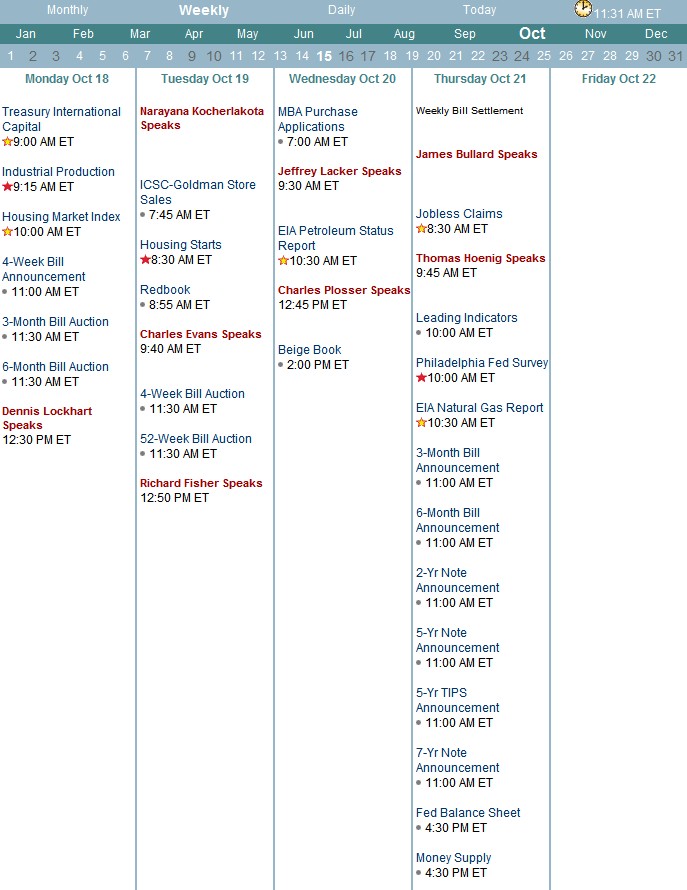
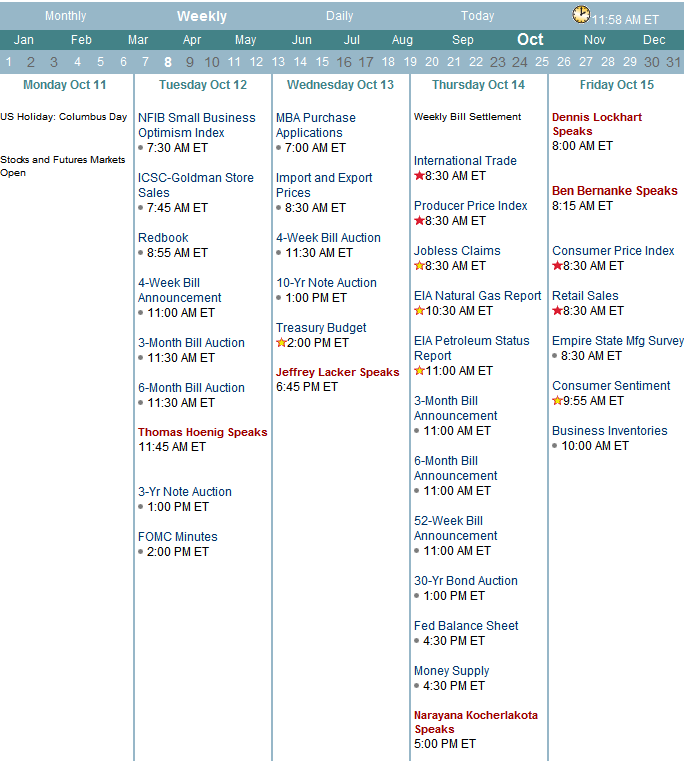
The week ahead — Economic data from Econoday.com:

Week Oct 8 2010 – Weekly Recap & The Week Ahead

Friday, October 8th, 2010

1. Bank of Japan cuts interest rate to near zero — the Bank of Japan surprisingly announced a $418 billion monetary easing program while cutting interest rates to virtually zero.
2. Q3 Profits Expected To Rise 24% — Alcoa provided a strong unofficial kickoff to earnings season late Thursday, reporting Q3 profit that more than doubled vs. a year earlier, beating views.

3. Retailers reported stronger-than-expected September sales Thursday, buoyed by a late surge in back-to-school buying.
4. Japan open to further forex intervention — Japanese Finance Minister Yoshihiko Noda said last month’s intervention in currency markets wasn’t a sign that Japan is prepared to conduct large-scale interventions to guide the yen to a specific level. However, he kept the door open to “firm measures, including intervention, when needed.”
5. Moody’s considers China upgrade — Moody’s said this morning it may upgrade its A1 rating on Chinese government debt, citing the nation’s growth outlook, the “determined and effective” stimulus program enacted during the financial crisis, and the “likely containment” of risks associated with 2009’s credit expansion.

The week ahead — Economic data from Econoday.com:

Week Oct 1 2010 – Weekly Recap & The Week Ahead

Friday, October 1st, 2010

In the stock market those who expect history to repeat itself exactly are doomed to failure — Yale Hirsch

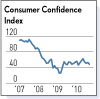
1. Confidence ebbed recently among both corporate heads and consumers
2. 2Q GDP growth slows to 1.7% — compared with 3.7% in the first quarter; A slight upward revision to its prior second-quarter estimate.
3. Moody’s downgrades Spanish debt to Aa1 from Aaa;
4. House passes bill targeting China’s yuan policy — The House easily passed legislation to penalize China’s foreign exchange practices, sending a powerful signal to Beijing to boost the value of its currency but risking a backlash that could harm U.S. companies and consumers.
5. U.S. Futures Rise Ahead Of Multiple Economic Reports — German Jobless Rate Just 7.5% As Much Of Europe Struggles — Germany’s unemployment in September fell to its lowest level since November 1992, the government said Thursday, but questions still swirl over whether Europe’s industrial engine can pull the region out of lingering gloom. Ireland on Thursday said it was readying a bailout of its No. 2 bank and would shore up two others, pushing its deficit to 32% of GDP this year.
6. Investor Intelligence’s survey found bullish advisers rose to 43.3% while bears fell to 27.8%

The week ahead — Economic data from Econoday.com:

Week Sept 24 2010 – Weekly Recap & The Week Ahead

Wednesday, September 22nd, 2010

In investing, the return you want should depend on whether you want to eat well or sleep well — J. Kenfield Moreley

1. Fed hints at QE 2.0 — The Fed reiterated its commitment to near-zero interest rates yesterday, as expected, but opened the door to the possibility of more QE in the near future.
2. BOJ official hints at further easing — Bank of Japan policy board member Ryuzo Miyao suggested today that the BOJ will continue to loosen its purse strings, saying the central bank would take “timely and appropriate” action if downside risks to the Japanese economy materialize.
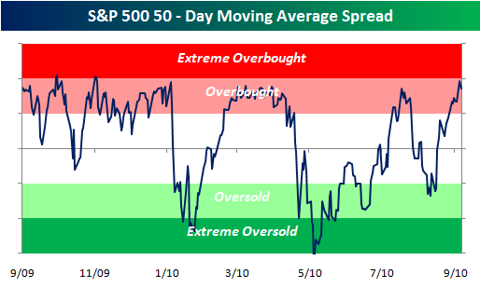
3. S&P500 Overbought — interesting chart from the Bespoke Investment Group depicting the S&P500 50-DMA spread measured in standard deviations. The chart shows the S&P500 is currently trading at an overbought levels similar to where it was in late April and early August.

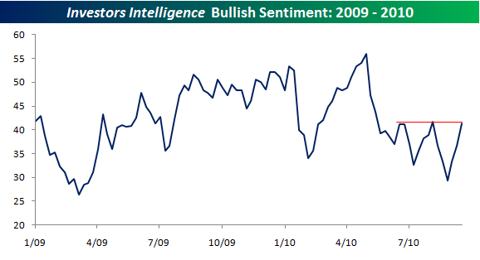
4. Bullish Sentiment Highest Since Early August — According to the Investors Intelligence weekly sentiment survey, bullish sentiment (41.4%) among advisors is currently at its highest level since early August.

5. According to the Dow Theory — primary trend of market is UP — Currently, the DOW is at 10,739 and the high for the Transport 4,540; Both indexes are up from their respective Aug 9th closing high of DOW 10,698.75 and Transport at 4,516.35.
6. Durable Goods — gains in machinery, computers and fabricated-metal products, as well as an upward revision to July’s durable-goods data. Also, a barometer of capital spending by businesses rose; orders for non-defense capital goods, excluding aircraft, increased by 4.1%.
7. Gold — Gold futures climbed above $1,300 an ounce; New high for the year.
8. David Tepper — HedgeFund Biggie Video on CNBC.

The week ahead — Economic data:

Week Sept 20 2010 – Weekly Recap & The Week Ahead

Monday, September 20th, 2010

The average man desires to be told specifically which particular stock to buy or sell. He wants to get something for nothing. He does not wish to work — William LeFevre

1. Basel III — Regulators who met in Basel agreed to raise the level of banks’ common equity to at least 7% of assets, up from 2%. But the rules give banks time to bulk up: The capital requirements won’t take full effect until Jan. 1, 2019.
2. China’s Economy Resumes Acceleration — Industrial production, a major gauge of overall activity in China’s manufacturing-driven economy, was up 13.9% from a year earlier in August, accelerating from 13.4% growth in July.
3. Japanese PM Naoto Kan re-elected president of the Democratic Party of Japan — Yen surged to highest level in 3-month; Mr. Kan defeated veteran power broker Ichiro Ozawa by a wide margin.
4. Yen plummets on Japanese intervention — The yen tumbled from a 15-year high against the dollar after Japanese monetary authorities intervened in international currency markets for the first time since 2004.

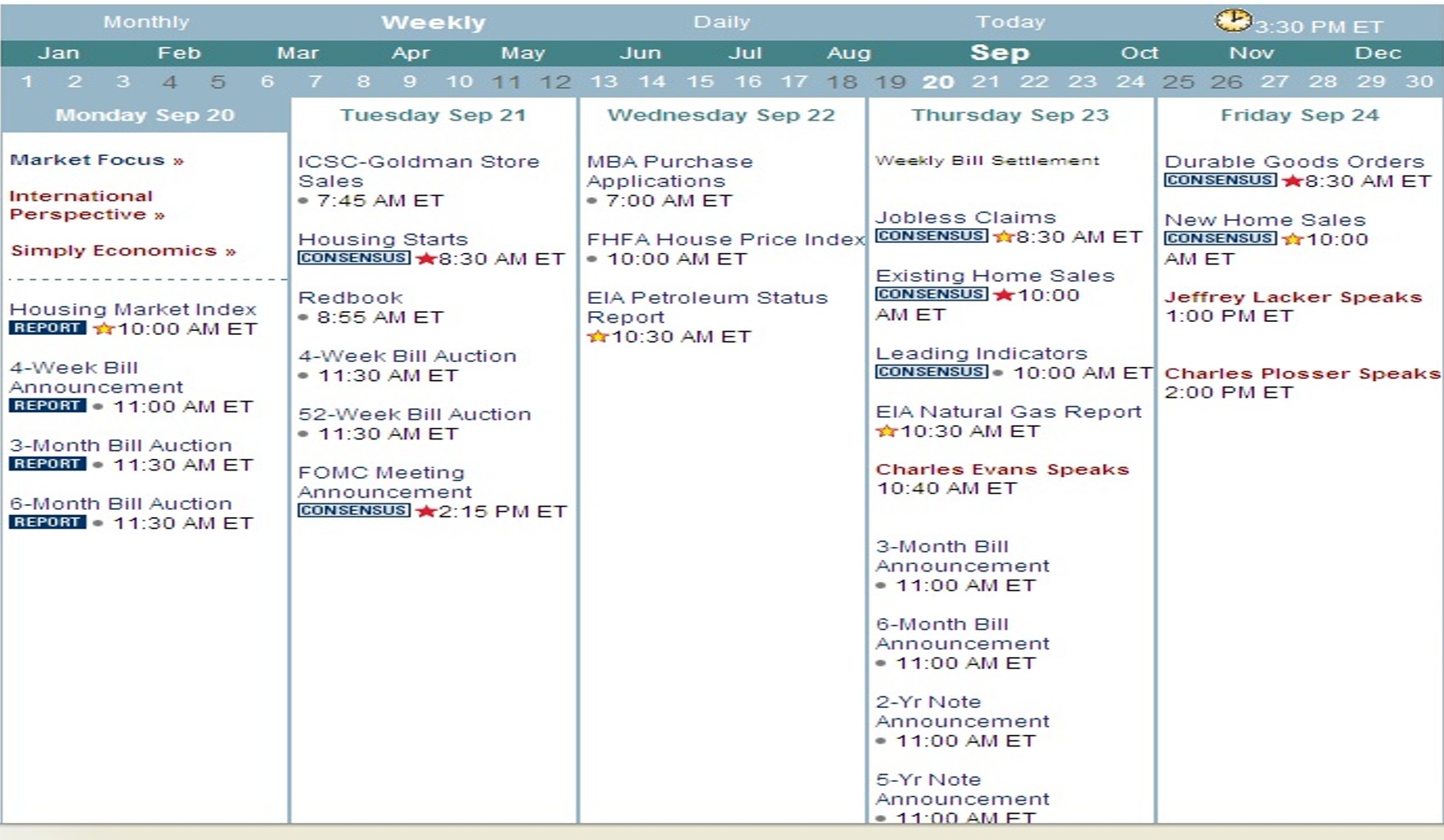
The week ahead — Economic data from Econoday.com:

Fri Sept 10 2010 – Weekly Recap & The Week Ahead

Sunday, September 12th, 2010

Financial markets will find and exploit hidden flaws, particularly in untested new innovations — and do so at a time that will inflict the most damage to the most people — Raymond F. DeVoe

The major indices settled with modest gains following a holiday-shortened week of light corporate news and economic reports.

1. Trade Deficit — the Commerce Department reported the nation’s trade deficit narrowed as imports fell and exports climbed to near two-year highs.
2. The Bank of England announced no change in interest rate — holding its key lending rate at a record low 0.5% and maintaining its bond-buying program at 200 billion pounds ($309 billion).
3. China’s August imports were up 35.2% year-on-year to $119.27 billion, against a 25% increase expected by economists surveyed by Dow Jones Newswires. Exports climbed 34.4% to $139.3 billion, against an expected 35% increase.
4. H-P Bribe Probe Widens — U.S. Investigators Are Looking at Multiple Transactions, some outside Russia; Hewlett-Packard Co. disclosed Thursday that a probe by the U.S. Department of Justice and the Securities and Exchange Commission of possible bribes the company paid in Russia is now wider than previously reported.

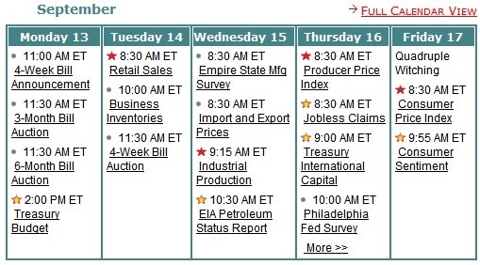
The week ahead — Economic data:

Fri Sept 3 2010 – Weekly Recap & The Week Ahead

Friday, September 3rd, 2010

Stock prices tend to discount what has been unanimously reported by the mass media — L. Ehrenkrantz

1. IMF rolls out precautionary credit line — the goal is to provide these countries with financial help before they reach a crisis point. The IMF is creating a new credit line that is expected to serve as a precautionary “insurance policy” for developing countries with sound fundamentals that may not meet the more stringent requirements of the IMF’s 2009 flexible credit line.
2. India’s economy rockets ahead — India’s economy expanded at the fastest pace in over two years, growing 8.8% in Q2 from a year earlier.
3. Factories’ Strength In U.S. And China Reassures Investors — U.S. manufacturing growth unexpectedly accelerated in August and the jobs gauge hit a 26-year high, an industry report said Wednesday, complementing bullish data from Asia that bode well for the global economic recovery.

4. Retail Sales — Retailers rang up solid August sales Thursday, beating views for the first time since March as deep discounts spurred shoppers to step up back-to-school buying.
5. Rare glimpse into China’s forex reserves — A report in the China Securities Journal, an official newspaper, cited unnamed reserve managers who said the holdings are the largest stockpile in the world at $2.45T, roughly in line with global averages. 65% allocated to dollars, 26% to euros, 5% to pounds and 3% to yen.
6. Russia Wheat ban extended, fears of a global food crisis — Russian Prime Minister Putin extended his country’s grain-export ban through at least Nov. 2011, after announcing last month that Russia would suspend grain exports until the end of this year.
7. Gov’t Income Supports Surging — A record 30 cents of every dollar in personal income comes directly from government, Commerce Department data show.

Economic Calendar for next week:
1. 9/8 — Beige Book and July Consumer Installment Credit;
2. 9/9 — trade deficit;
3. 9/10 — July wholesale;

Embedded is an interesting Video from WealthTrack — Bruce Berkowitz, portfolio manager of the Fairholme Fund (best Domestic Stock Fund Manager of the Year in 2009)

Search
Calendar
February 2026
M T W T F S S
« Jan    
 1
2345678
9101112131415
16171819202122
232425262728  
Archives
Categories
The information provided by The EGS Blog is based on sources believed to be reliable, but it is not guaranteed to be accurate. There is no guarantee that the recommendations of The EGS Blog will be profitable or will not be subject to losses. The information provided by The EGS Blog is not a recommendation or a solicitation that any particular investor should purchase or sell any particular security in any amount, or at all. The investments discussed or recommended herein may be unsuitable for investors depending on their specific investment objectives and financial position. At any time EGS LLC and its principals may maintain positions that are contrary to positions announced within the subscription service. In no event will The EGS Blog be liable to you or anyone else for any incidental, consequential, special, or indirect damage (including but not limited to lost profits or trading losses). PAST PERFORMANCE IS NO GUARANTEE OF FUTURE RESULTS

© Copyright 2026 Market Outlook All Rights Reserved
Design by EGS Sponsored by Equity Guidance LLC