Archive for the ‘Weekly Summary’ Category

Week Nov 30 2012 – Weekly Recap & The Week Ahead

Monday, December 3rd, 2012

“It wasn’t raining when Noah built the ark” — Warren Buffett

1. Euro zone, IMF secure deal on cutting Greek debt — per Reuter,Euro zone finance ministers and the International Monetary Fund clinched agreement on reducing Greece’s debt in a breakthrough to release urgently needed loans to keep the near-bankrupt economy afloat. Greece’s international lenders agreed on a package of measures to reduce Greek debt by 40 billion euros, cutting it to 124 percent of gross domestic product by 2020 and to reduce the debt pile, they agreed to cut the interest rate on official loans, extend their maturity by 15 years to 30 years, and grant Athens a 10-year interest repayment deferral.
2. Profits at Chinese firms provide more evidence of GDP recovery — profits at Chinese industrial companies jumped 20.5% on year in October to 500B yuan ($80.4B), with growth accelerating from a 7.8% rise in September and providing further evidence that the economy is rebounding.
3. Cyber Monday sales soar 26% — online retail sales jumped 26% from last year on Cyber Monday, IBM said late yesterday, adding that purchases from mobile devices, including tablets, rose 10.2%.
4. Italian 10-year yields fall to two-year low in auction — Italy has sold €2.98B of 10 year bonds at a yield of 4.45%, down from 4.92% in a previous auction and the lowest in two years, indicating how the market tumult over the eurozone debt crisis has somewhat subsided. The government also issued €3B of five-year paper at 3.23%, down from 3.8%. The total sale of €5.98B was at the top end of the government’s target of €4-6B.
5. Fed Likely to Keep Buying Bonds in 1Q 2013— per WSJ, frustrated with the lack of substantial job gains, many Fed officials want the bank to continue buying long-term Treasurys even after Operation Twist expires. The purchases would be in addition to the $40B a month of mortgage-backed securities that the Fed’s been scooping up.
6. Detroit on the Verge of Bankrupcy, Again — courtesy of WSJ, with 2-3 weeks to receive $30M of state aid from Michigan in order not to run out of cash, Detroit is again teetering on the brink of bankruptcy. The aid is contingent on the city implementing the provisions of a deal in April, when Michigan agreed to provide $137M, but those measures haven’t been enacted.
7. Indian FQ2 GDP slows to three-year low — India’s GDP growth declined to a three-year low of 5.3% on year in FQ2 vs +5.5% in Q2 and consensus of +5.2%. The slowing growth comes as the government battles to implement reforms that it sees as vital to reviving the economy.

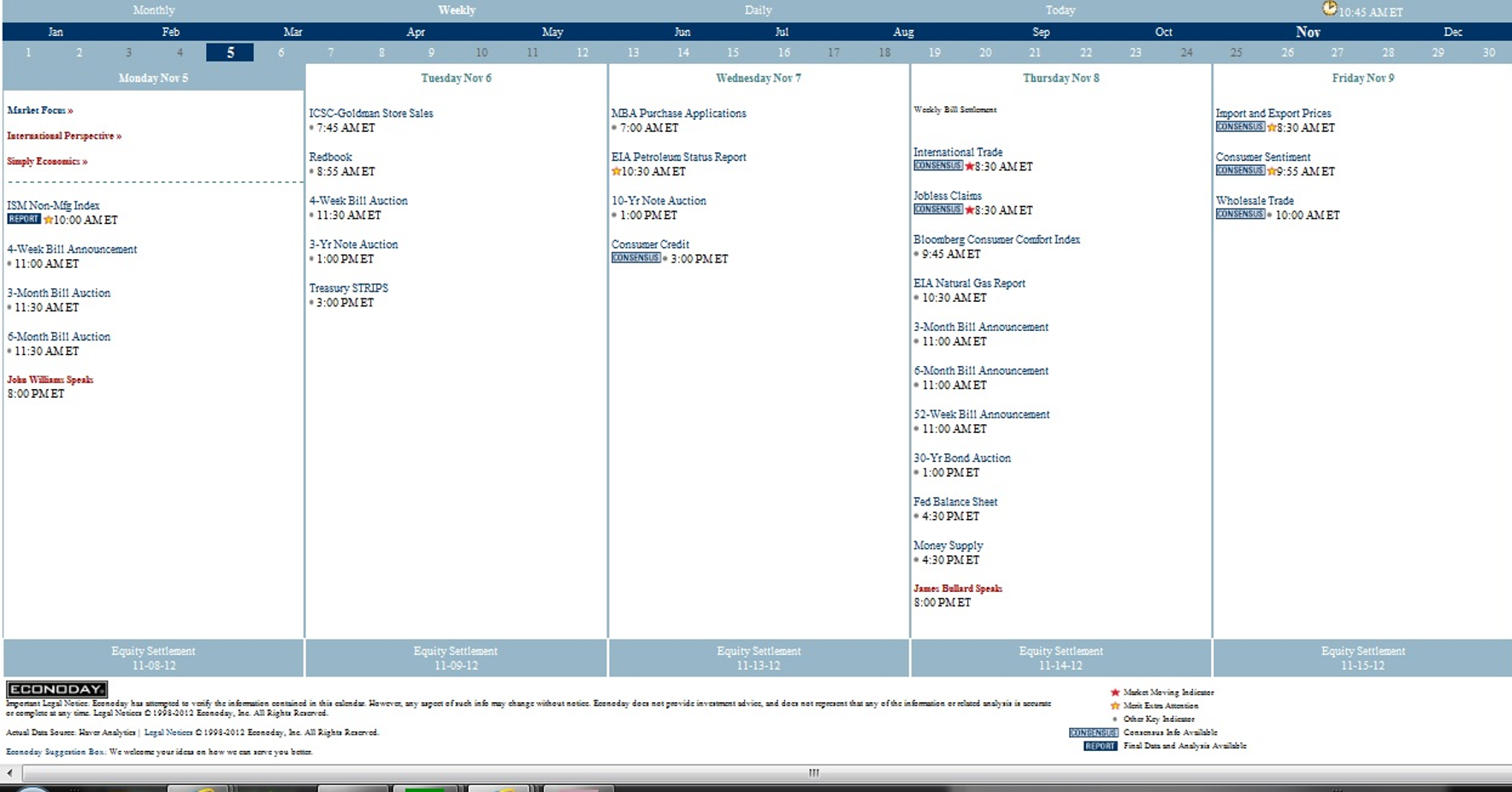
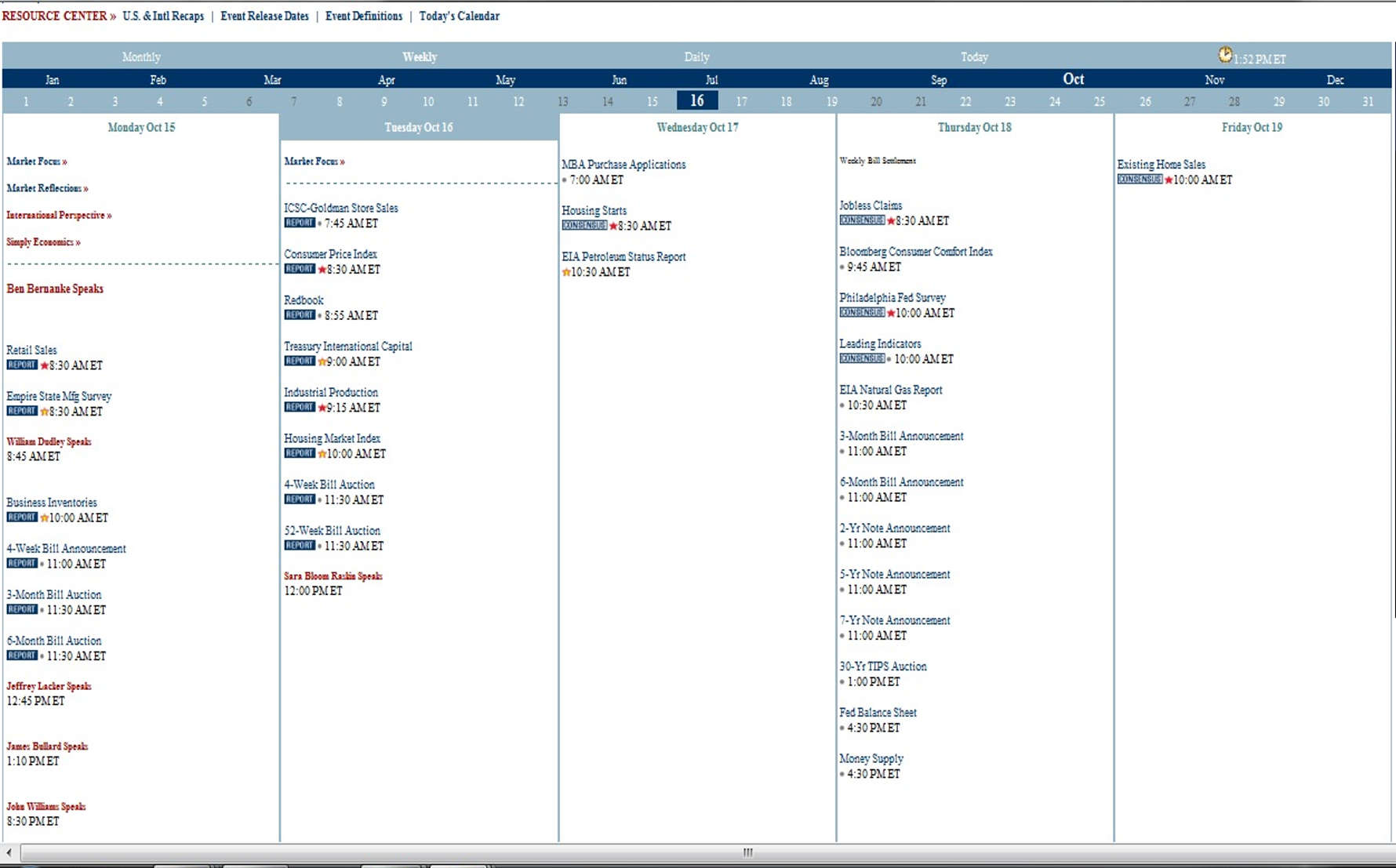
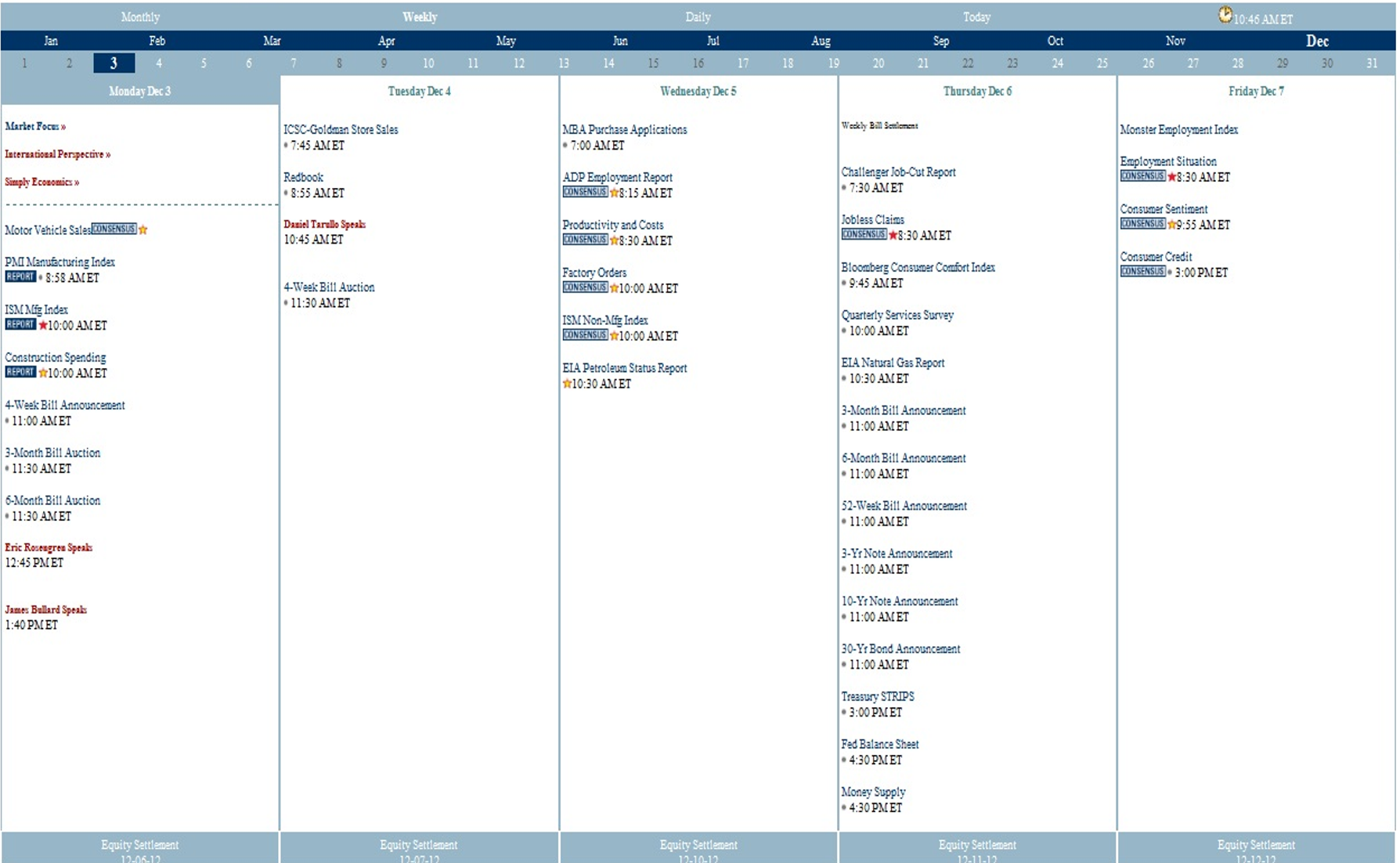
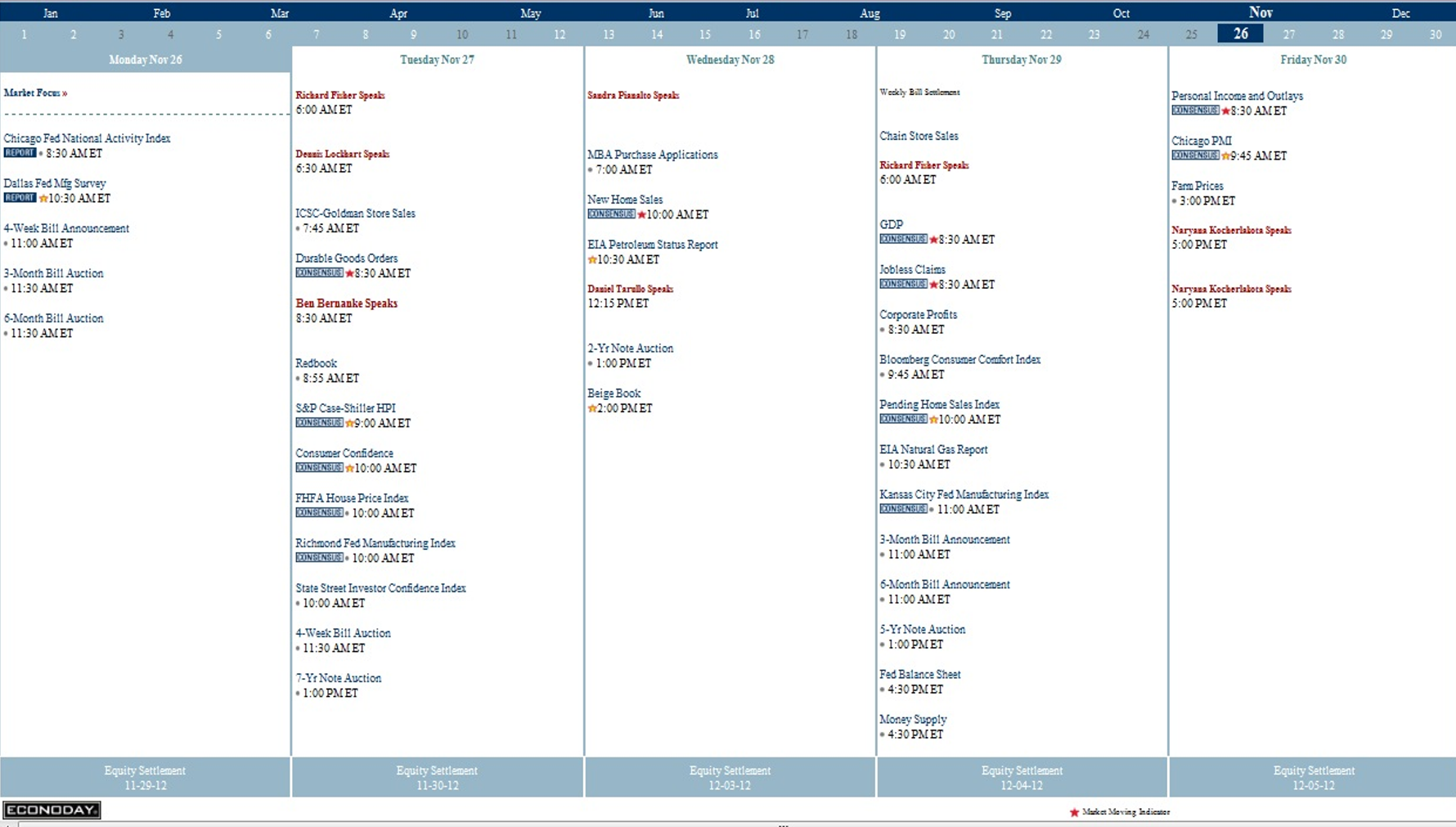
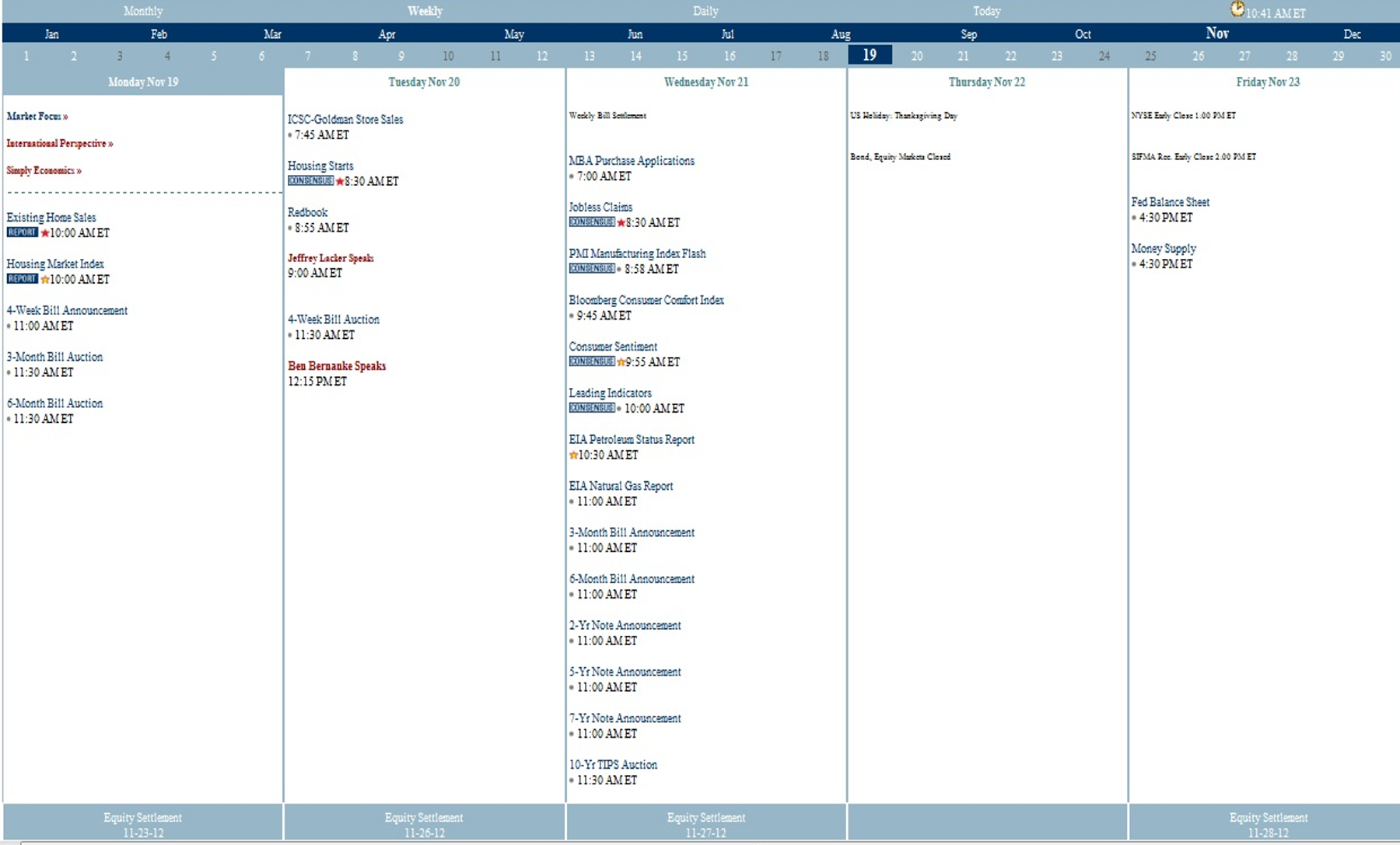
The week ahead — Economic data from Econoday.com:
Week Nov 23 2012 – Weekly Recap & The Week Ahead

Monday, November 26th, 2012

“I am always doing that which I cannot do, in order that I may learn how to do it” — Pablo Picasso

1. US tax breaks worth $150bn face axe — per ft, the Obama Administration has reportedly proposed axing $150B of tax breaks over ten years as part of negotiations to avert the fiscal cliff. These include $28B for fossil fuel companies, $77B connected to inventory valuation, and $13B in low capital-gains rates for P-E funds, VC firms, and real-estate transactions.
2. Moody Downgrades France Credit Rating — Moody downgraded France from Aaa to Aa1 with a negative outlook.
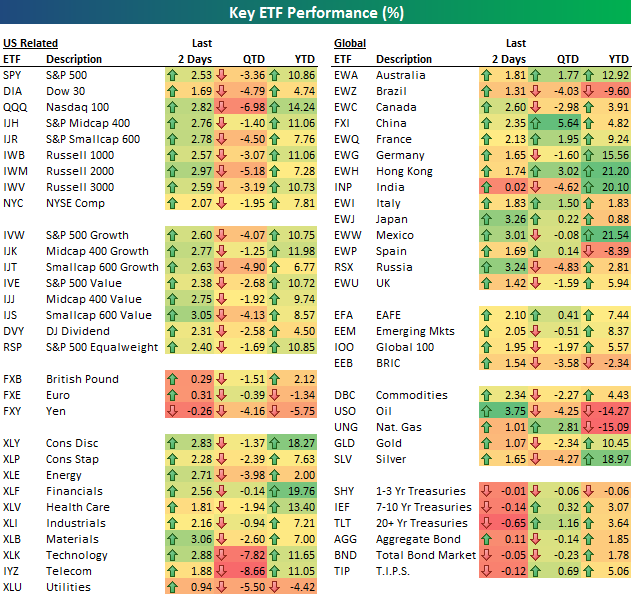
3. Key ETF Performance — via Bespoke, below is an updated look at recent performance numbers for key ETFs across all asset classes. Quarter-to-date numbers, stocks in the US remain down. The S&P 500 tracking SPY ETF is down 3.36% in the fourth quarter, while DIA and QQQ are down even more.

4. Eurozone finmins delay Greek aid once more — Eurozone finance ministers have again postponed approving the next tranche of Greece’s bailout after failing to reach an agreement on how to make the country’s debt more sustainable.
5. Superstorm Sandy Seen Boosting U.S. With as Much as $240 Billion Rebuilding — per Bloomberg, Reconstruction and related purchases and hiring may range from $140 billion to $240 billion and increase U.S. economic growth by 0.5 percentage point next year, assuming $50 billion in losses, according to Economic Outlook Group LLC, a Princeton, New Jersey-based forecasting firm.
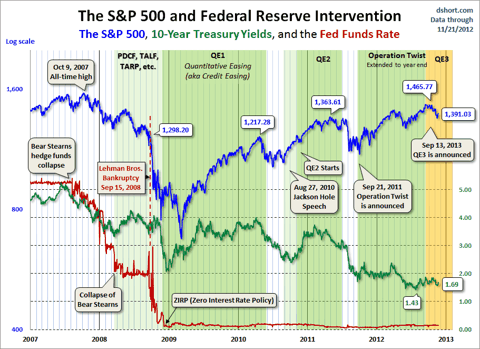
6. The S&P500 and Fed Intervention — below is a chart depicting the S&P500 performance as a result of the Quanlitative Easing (QE).

The week ahead — Economic data from Econoday.com:
Week Nov 16 2012 – Weekly Recap & The Week Ahead

Monday, November 19th, 2012

“Darn the wheel of the world! Why must it continually turn over? Where is the reverse gear?” — Jack London

1. Greece raised 4 bln euros ahead of debt rollover — per MarketWatch, Greece appeared on track to redeem 5 billion euros ($6.3 billion) in treasury bills that are due, after selling 4.06 billion euros of one- and three-month bills at auction.
2. China Picks New Economic Chiefs, Zhou Seen Leaving PBOC — according to Bloomberg, China began installing a new economic leadership by indicating that central bank Governor Zhou Xiaochuan will step aside and Vice Premier Wang Qishan, the top finance official, will move to a new role.
3. Facebook braces for biggest lockup wave — Facebook (FB) shares are set to emerge from a post-initial public offering lockup last Wednesday, making them available for sale in the open market and potentially doubling the size of the company’s share float — about 800 million of the company’s shares held by insiders become eligible for sale.
4. Anti-austerity strikes sweep Europe — millions of workers in Europe are on strike to protest austerity as part of a “European Day of Action and Solidarity.” Spanish and Portuguese unions are carrying out their first coordinated general strike, while organizations in Greece, Italy, France and Belgium planned stoppages or demonstrations.
5. China Unveiled New Leadersas expected, China unveiled the makeup of its top Communist Party leadership, elevating Vice President Xi Jinping to replace Hu Jintao. Vice Premier Li Keqiang was named the party’s No. 2, putting him on the path to take over as premier in March.
6. Euro zone slips into second recession since 2009Economic output in the 17-country euro zone fell 0.1 percent in the third quarter, the EU’s statistics office Eurostat said on Thursday, following a 0.2-percent drop in the second quarter.
Those two quarters of contraction put the euro zone’s 9.4 trillion euro ($12 trillion) economy officially in recession, although Italy and Spain have been contracting for a year already and Greece is suffering an outright depression.
7. Japan Election May Curtail Stimulus as Recession Looms — Japanese PM Yoshihiko Noda has called an election for December 16 after the upper house approved a bill to issue bonds that will fund government spending for the rest of the fiscal year and stop it from running out of money. Noda’s DPJ party is expected to lose to the opposition LDP, which favors uber-easing to help Japan get out of its deflationary black hole.
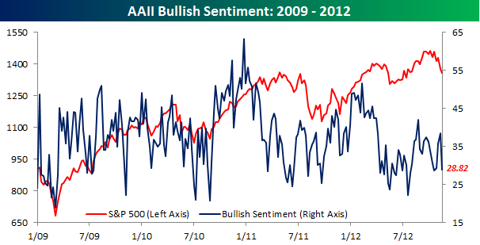
8. AAII latest sentiment readings – In prior bull market when the bullish sentiment dropped below 25%, the market rally over the next 3-month and 6-month;

The week ahead — Economic data from Econoday.com:
Week Nov 9 2012 – Weekly Recap & The Week Ahead

Monday, November 12th, 2012

“The four most expensive words in the English language, “This time it’s different”” — Sir John Templeton.

1. Germany Economy Heading for Contraction — the euro zone relies heavily on Germany, its largest economy, to generate growth. Germany’s composite PMI fell to 47.7 in October from 49.2 in September, which, says Markit, “raises the likelihood of an outright GDP contraction during the final quarter of the year.”
2. Obama Wins Second-Term – faces fresh challenge with ‘fiscal cliff’ — Barack Obama won re-election, but the U.S. president faces a fresh challenge confronting the “fiscal cliff,” a mix of tax increases and spending cuts due to extract some $600 billion from the economy barring a deal with Congress.
At stake are two separate issues – individual tax cuts due to expire at year’s end and tens of billions of dollars in across-the-board federal spending cuts due to kick in the day after New Year’s Day.
3. Greeks Government Approved Austerity Vote — thousands of Greeks held a second day of a general strike to protest the latest round of austerity, which the country’s parliament passed. The approval of the €13.5B of wage cuts and tax hikes by 2016 is vital for Greece to receive the latest €31B tranche of its bailout before it runs out of money.
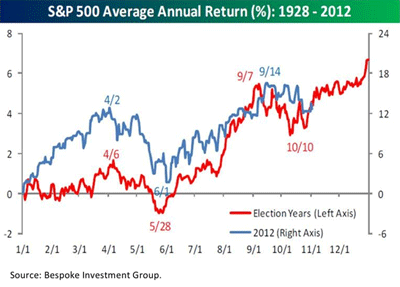
4. President Election Cycle Update — below is the updated chart (courtesy of the Bespoke Inv’t Group) which highlights the similarities between this year and prior Presidential Election years numerous times.

5. China begins congress to change leadership — outgoing Chinese President Hu Jintao has set his successor, who’s expected to be Vice President Xi Jinping, a target of doubling per-capita income by 2020.
6. Japan Data Show Signs Of Distress — per WSJ, Japan swung to its first current account deficit since 1981 in September, with the gap coming in at an adjusted ¥142B ($1.8B). The shortfall is a sign Japan is nearing the point at which it won’t be able to finance its mammoth debt from domestic sources only.

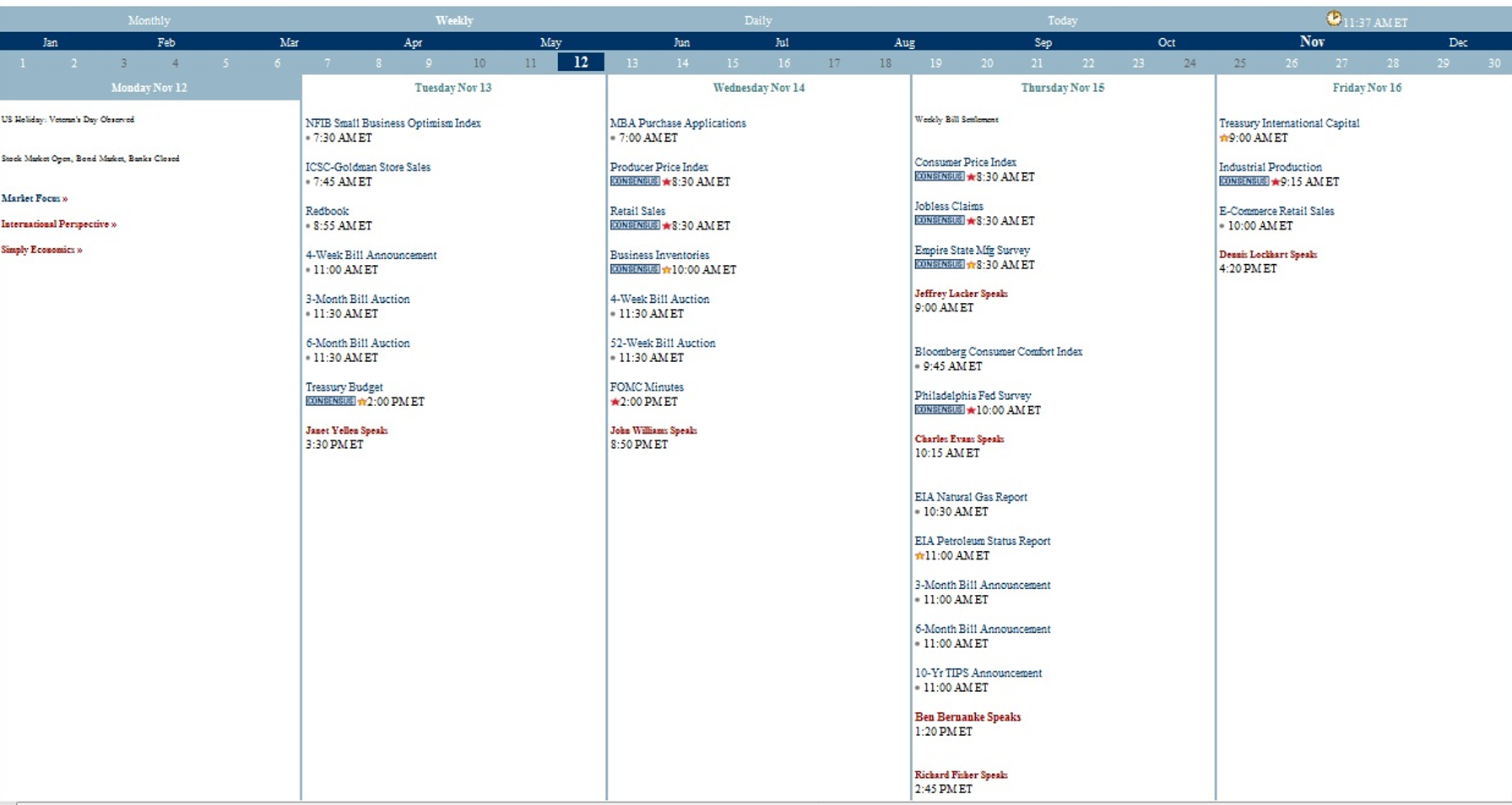
The week ahead — Economic data from Econoday.com:
Week Nov 1 2012 – Weekly Recap & The Week Ahead

Monday, November 5th, 2012

Due to Hurricane Sanday and power outages, Weekly Recap of Nov 1, 2012 will not be posted.

Thank you for your patience.

Week Oct 26 2012 – Weekly Recap & The Week Ahead

Monday, November 5th, 2012

“The test of a first-rate intelligence is the ability to hold two opposed ideas in mind at the same time and still retain the ability to function.” —F. Scott Fitzgerald

1. GE Refinances to Counteract ‘fiscal cliff’ fears — according to FT, General Electric (GE) has refinanced $5B worth of bonds that mature in February just in case Barack Obama or Mitt Romney are unable to avert the fiscal cliff. “If it’s choppy, we are prepared,” CFO Keith Sherin said.
2. Home values rise most since 2006 — the Zillow Home Value Index rose 1.3% on quarter to $153,800 in Q3, representing the biggest rise since Q1 2006, although the recovery is uneven across America due to differences in foreclosure conditions and employment.
3. Companies Are Sitting on More Cash Than Ever Before — amid a lackluster earning season that has featured many companies missing sales expectations, cash balances have swelled 14 percent and are on track toward $1.5 trillion for the Standard & Poor’s 500, according to JPMorgan. Both levels would be historic highs.

The week ahead — Economic data from Econoday.com:
Week Oct 17 2012 – Weekly Recap & The Week Ahead

Monday, October 22nd, 2012

“I’m always thinking about losing money as opposed to making money. Don’t focus on making money; focus on protecting what you have.” – Paul Tudor Jones

1. U.S. Postal Service hits borrowing limit for first time — per Reuters, the financially struggling United States Postal Service has hit its $15 billion borrowing limit for the first time ever, meaning it will have to rely on revenues from stamps and other products to fund operations.
2. BOE split on whether it might need to print more money — the Bank of England’s Monetary Policy Committee voted unanimously at a meeting earlier this month to leave its key lending rate unchanged at 0.5% and to maintain the size of its asset-purchase program at £375B, the minutes show.
3. China’s GDP growth slows but may mark bottom — according to MarketWatch, China’s economy cooled in July-September to its slowest pace of growth since the first quarter of 2009. China’s gross domestic product grew 7.4% in the third quarter compared to a year earlier, slowing from the second quarter’s 7.6%. However, data for September showed increasing retail sales, industrial production, and fixed-asset investment in urban areas, providing hope that China’s deceleration may be bottoming out.
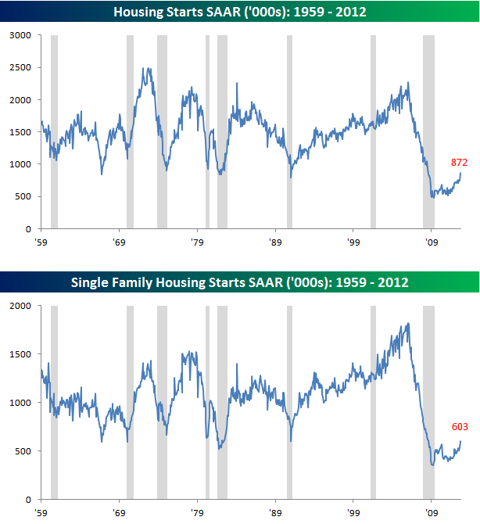
4. Housing Starts And Building Permits 1959 – 2012 — courtesy of BIG, Housing Starts and Building Permits for the month of September exceeded forecasts by a wide margin as both indicators rose to their highest levels since July 2008. At current levels, Housing Starts have risen 82% from their recession lows, while Building Permits have increased by 74%. Even after these big increases, however, both are still well below their pre-recession levels.

5. European Central Bank will take responsibility for overseeing euro zone banks in 2012cnbc reported that EU leaders have agreed to give the ECB oversight of eurozone banks starting from next year, a critical step that will allow the ESM to begin recapitalizing troubled institutions.
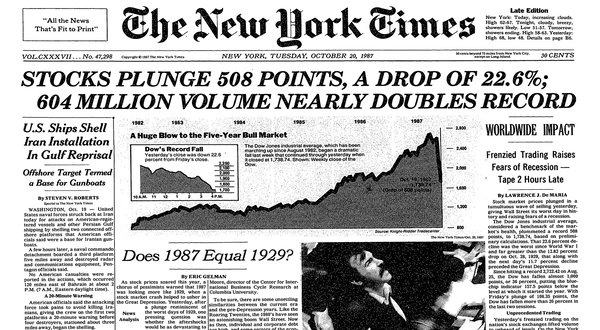
6. 25th Anniversary of the Oct. 19, 1987, stock market crash — the Dow Jones Averages crashed 508 points, or nearly 23%. The collapse sparked fears of another depression, although a recession didn’t come for two years and was relatively mild reported by the NYTimes.

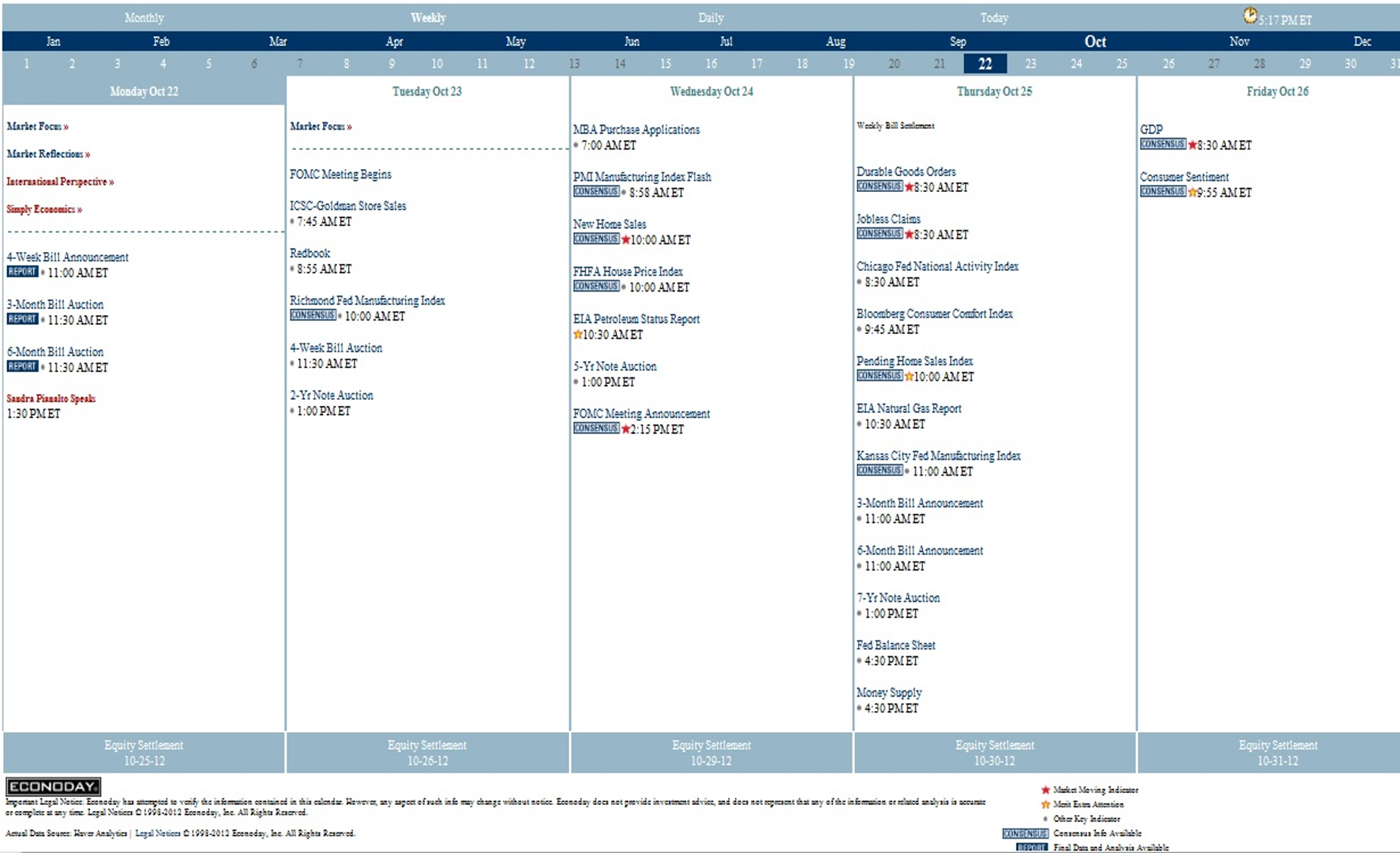
The week ahead — Economic data from Econoday.com:
Week Oct 12 2012 – Weekly Recap & The Week Ahead

Tuesday, October 16th, 2012

“Stock prices tend to discount what has been unanimously reported by the mass media”Louis Ehrenkrantz

1. IMF lowers global economic outlook — the IMF has cut its global growth estimates again, predicting a rise of 3.3% this year (down from 3.5%) and 3.6% in 2013 (down from 3.9%). The fund has raised its estimates for U.S. growth slightly to 2.2% in 2012 and 2.1% in 2013, but forecast that China will weaken to 7.8% this year and grow 8.2% next year.
2. Companies Took Advantage of Cheap Money — per WSJ, Firms lock in low interest rates for decades. Companies are not only exploiting rock-bottom interest rates to issue more debt, but are also taking advantage by offering long-term paper. Companies have sold $91.9B of 30-year bonds in 166 deals this year, up from $73.2B in 145 offerings in 2011 and the most in any full year since 1995. Those include GE (GE), Comcast (CMCSA) and UPS (UPS).
3. PBOC pumps more liquidity into markets — the People’s Bank of China has provided the money market with another liquidity rush, injecting 265B yuan ($42.14B) by offering reverse repurchase agreements. It’s the PBOC’s second-largest ever daily fund injection after the 290B yuan of reverse repos the bank offered on September 25.
4. U.S. panel to probe new wave of complaints against Chinese Telecommunication Companies (Huawei, ZTE) — per Reuters, a U.S. congressional report that urged American companies to stop doing business with Chinese telecom equipment makers Huawei and ZTE has triggered a fresh wave of complaints against the firms, opening a second phase to the panel’s investigation.
In a report issued last week after an 11-month investigation, the House committee warned U.S. industry that Beijing could use equipment made by the two companies to spy on certain communications and threaten vital systems through computerized links.
5. Standard & Poor’s Ratings Services Cuts Spain two notches to BBB-, with a negative outlook — In a statement, S&P said the downgrade could have a negative impact on several banks including: Banco Santander, Banco Popular Espanol, Bankia and Bankinter, among others.
6. Japan and China Agree to Hold Talks on Rift Over Island — Japan and China agreed to talks aimed at reducing tensions over a territorial dispute a day after Japanese Prime Minister Yoshihiko Noda warned that Asia’s two biggest economies would suffer without negotiations.

The week ahead — Economic data from Econoday.com:
Week Oct 5 2012 – Weekly Recap & The Week Ahead

Monday, October 8th, 2012

“When you get to the end of your rope, tie a knot and hang on” — Franklin D. Roosevelt

1. Spain ready for a bailout, Germany signals “wait” – according to Reuters, Spain is ready to request a euro zone bailout for its public finances as early as this week but Germany has signaled that it should hold off. Participants said there were tense exchanges at a euro zone ministerial meeting in Cyprus in mid-September when Schaeuble told his peers Berlin could not take another bailout for Spain to parliament so soon after lawmakers approved up to 100 billion euros ($129 billion) to help Spanish banks in July.
2. Postal Service defaults again while Congress campaigns — the Postal Service has defaulted on a $5.6B payment for its retiree funds, which was due at the end of September, adding to a $5.1B payment the USPS missed earlier this year. The agency also expects net operating losses of $15B for FY 2012.
3. Apple suppliers said to be making smaller tablet — WSJ reported that Apple Inc.’s (NASDAQ:AAPL) Asian component suppliers have started mass production of a new tablet computer smaller than the current iPad. The smaller tablet will have a 7.85-inch liquid crystal display with a lower resolution compared with the latest iPad model that came out in March. South Korea’s LG Display Co. and Taiwan’s AU Optronics Corp. last month started mass production of the LCD screens for the new device.
4. Spanish Bond Auction Eases Bailout Pressure — per WSJ, the Spanish Treasury sold two-year and five-year bonds at lower costs than at previous sales as the latest bank stress test and the European Central Bank’s much anticipated bond buying plan provided a benign backdrop to the auction. Yields fell on the five-year bond to 4.77% and 3.28% on the two-year variety.
5. Japan Auto Makers See Plunge in Chinese Sales — the Senkaku-Diaoyu islands dispute between Japan and China hit Japanese car makers hard in September, with Mitsubishi’s Chinese sales plunging 63% on year and those of Mazda (MZDAF.PK) by 35%. Toyota’s (TM) sales skidded 40%, the FT reports, adding that the company will cut production in China by over half and suspend Lexus exports. Non-Japanese car makers have been benefiting from the spat.
6. Greek PM says can’t manage beyond November without next aid tranche — according to Reuters, Greek leader Antonis Samaras told a German paper that his country could not manage beyond November without the next tranche of international aid and suggested the ECB could help by easing the terms of its Greek debt holdings.

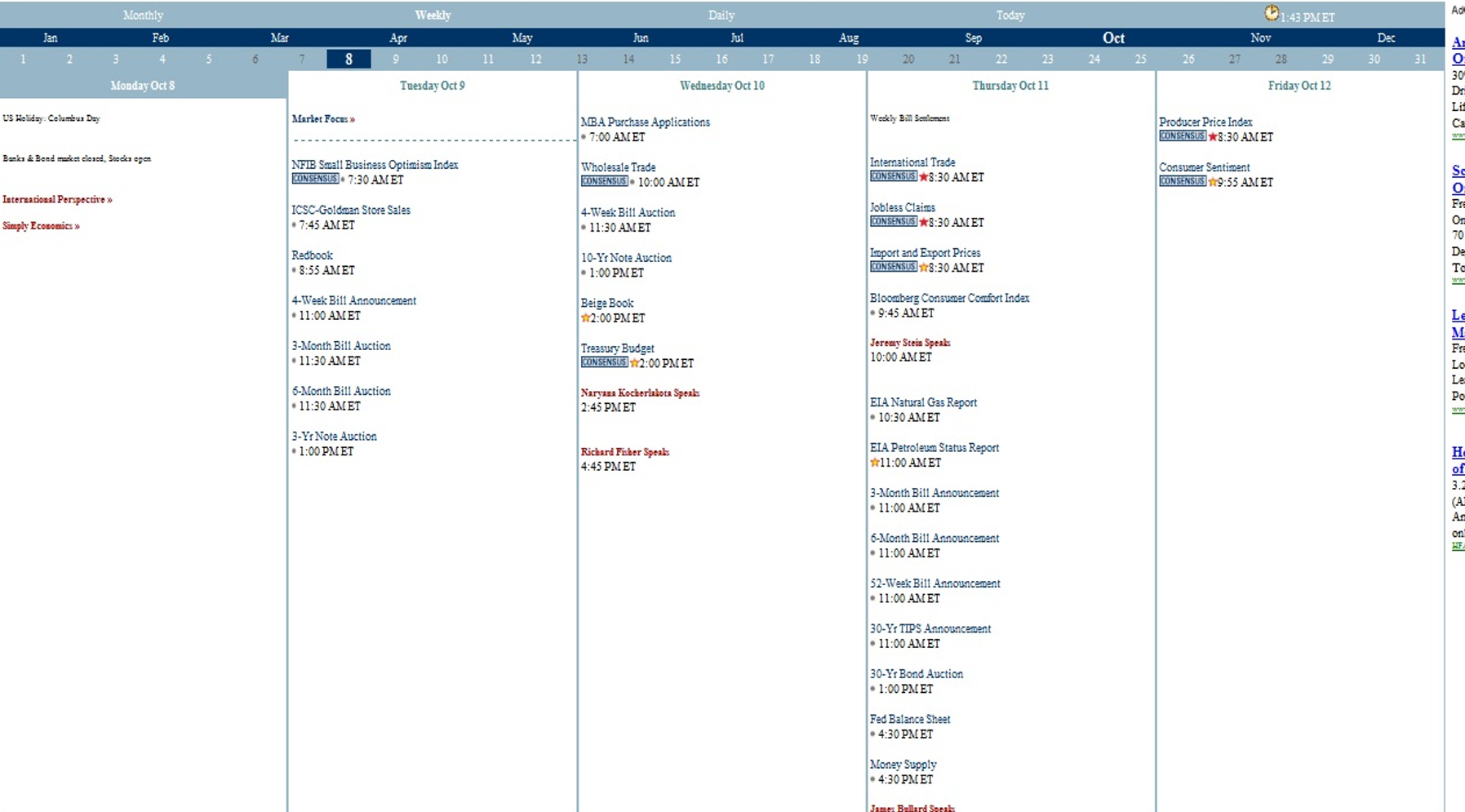
The week ahead — Economic data from Econoday.com:
Week Sept 28 2012 – Weekly Recap & The Week Ahead

Monday, October 1st, 2012

“When everybody thinks alike, everyone is likely to be wrong.” — Humphrey B. Neil

1. European Banks set to shed €20bn property loans — Europe’s banks are on track to dispose of €20bn worth of loans backed by offices, shops and hotels this year as lenders across the continent race to reduce exposure to the volatile real estate sector ahead of tough regulatory changes. Banks, including Lloyds, Santander and the Bundesbank, have already sold portfolios worth €7.5bn during 2012. Activity is set to accelerate though, with lenders working on offloading another €11bn before the end of the year, according to data from CBRE, the property services group.
2. Senate passes $500B spending package — the Senate authorized a $500B spending bill that will finance the government for half a year from October 1, adding to approval from the House. Congress has now broken up ahead of the elections on November 6.
3. Durable-goods orders sink 13.2% in August, largest drop in three years tied to lower airplane bookings — ex transportation, orders fell a much smaller 1.6% in August. The weaker level of orders reflects a global economic slowdown — U.S. exports to Europe and China have softened.
4. Data show China’s central bank injected $58 bln — according to MarketWatch, data showed the People’s Bank of China injected 365 billion yuan ($57.9 billion) into the financial system via open-market operations, marking its highest-ever level for a single week.
5. Spain unveiled more austerity amid protests — Spain announced €39B worth of more austerity and its 2013 budget. The reforms are expected to include a new tax oversight body, more tax hikes, extended wage freezes and early retirement limits.
6. Spain Banks Stress Tests Needs $77 Billion — per CNBC, Spanish banks need around 60 billion euros ($77 billion) to return to health, an independent audit showed last Friday. Spain, the euro zone’s fourth largest economy, replaced Greece, Ireland and Portugal earlier this year as the main threat to the survival of the euro currency project.
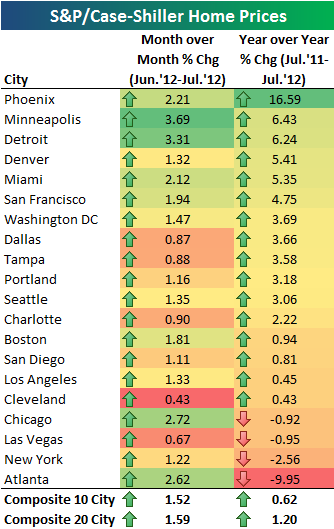
7. S&P/Case-Shiller home price indices for July — courtesy from BIG, On a month-over-month basis, every single one of the 20 cities tracked by Case-Shiller increased in July. And 16 of the 20 cities are up year-over-over year, with Phoenix up the most at 16.59%. Minneapolis, Detroit, Denver and Miami are the four other cities with YoY gains of more than 5%.

Search
Calendar
February 2026
M T W T F S S
« Jan    
 1
2345678
9101112131415
16171819202122
232425262728  
Archives
Categories
The information provided by The EGS Blog is based on sources believed to be reliable, but it is not guaranteed to be accurate. There is no guarantee that the recommendations of The EGS Blog will be profitable or will not be subject to losses. The information provided by The EGS Blog is not a recommendation or a solicitation that any particular investor should purchase or sell any particular security in any amount, or at all. The investments discussed or recommended herein may be unsuitable for investors depending on their specific investment objectives and financial position. At any time EGS LLC and its principals may maintain positions that are contrary to positions announced within the subscription service. In no event will The EGS Blog be liable to you or anyone else for any incidental, consequential, special, or indirect damage (including but not limited to lost profits or trading losses). PAST PERFORMANCE IS NO GUARANTEE OF FUTURE RESULTS

© Copyright 2026 Market Outlook All Rights Reserved
Design by EGS Sponsored by Equity Guidance LLC