Archive for the ‘Weekly Summary’ Category

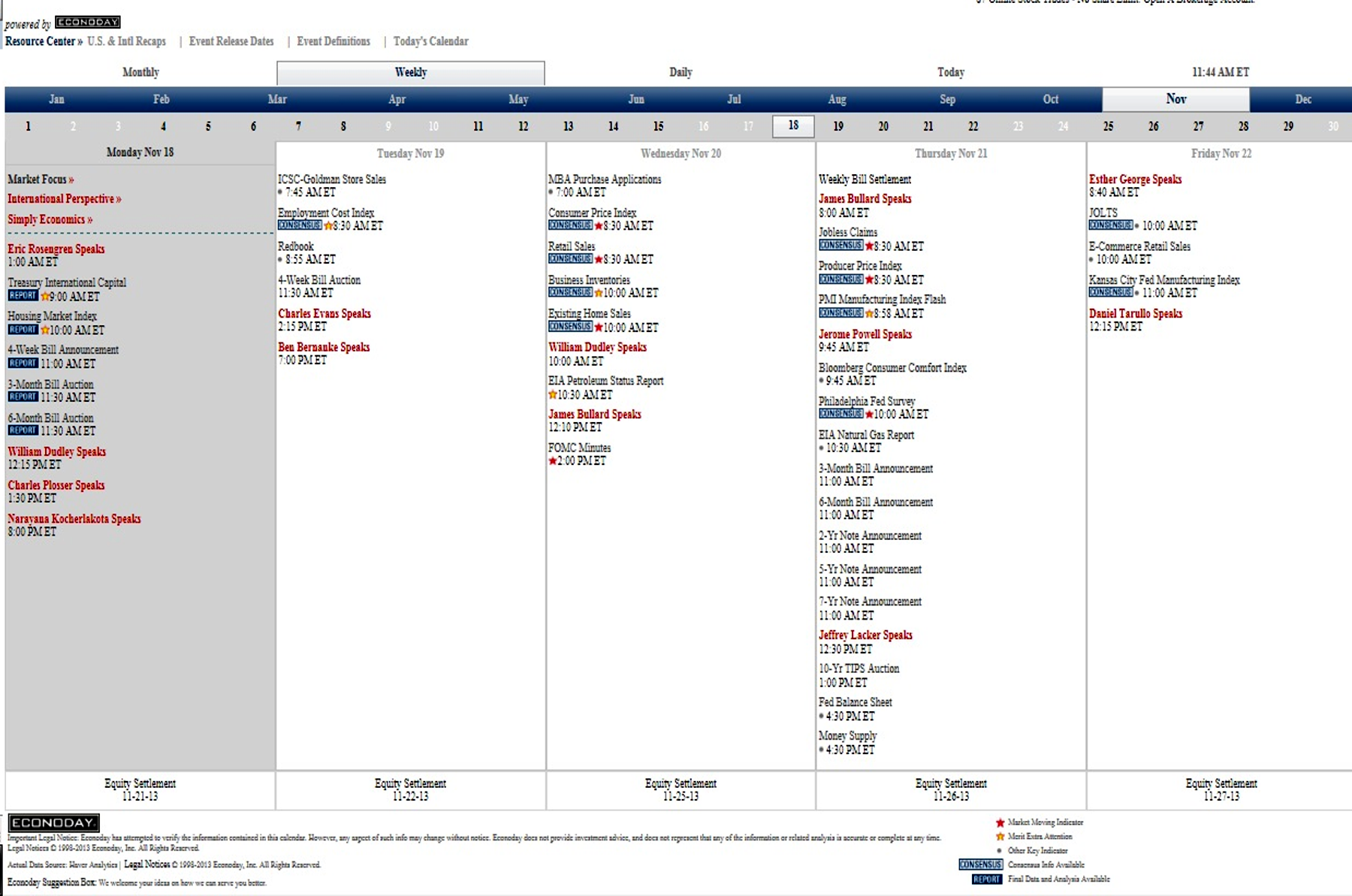
Week of Nov 15 2013 – Weekly Recap & The Week Ahead

Monday, November 18th, 2013

”Stock market bubbles don’t grow out of thin air. They have a solid basis in reality, but reality as distorted by a misconception” — George Soros

1. State-Run Obamacare Exchanges Reported 49,100 Enrollees versus initial target of 800,000Bloomberg, fewer than 50,000 people had reportedly managed to enroll in private insurance plans via the government’s problem-plagued HealthCare.gov Web site as of last week. The number represents less than 10% of the 500,000 people that had been projected. Twelve of the 14 states that are operating their own exchanges have signed up 49,000.
2. U.S. Investigates Currency Trades By Major Banks — nine of the largest banks in currency trading have announced they are facing inquiries by the United States Attorney General, Eric H. Holder Jr.,. AG Holder said in a rare interview discussing an active investigation. ”We’ve recognized that this is potentially an extremely consequential investigation.” Banks include Barclays, the Royal Bank of Scotland and Citigroup.
3. Obamacare fix puts insurers in a tough spot — President Obama will allow insurance companies to continue to offer existing policies in 2014 even if they fail to meet the standards set by the healthcare law. Obama’s U-turn follows pressure from the public and his own party after it emerged that his repeated pledge that people could keep their insurance plans if they wanted to contradicted the terms of the law.
4. Berkshire takes 40M-share stake in Exxon Mobil — Berkshire Hathaway (BRK.A, BRK.B) bought a 40.1M-share position in Exxon Mobil (XOM. Berkshire also added to existing stakes in Bank of New York Mellon (BK), DaVita HealthCare Partners (DVA), Suncor Energy (SU), U.S. Bancorp (USB) and VeriSign (VRSN); Berkshire lowered its holdings in ConocoPhillips (COP), DirecTV (DTV), GlaxoSmithKline (GSK) and Sanofi (SNY).
5. Japan Q3 GDP growth tops estimates — economic growth slowed in Japan during the July-September quarter, but at 1.9% (annualized), the economy still expanded faster than economists were expecting. Despite the headline beat, capex growth printed at just 0.2% for Q3, far below consensus estimates. Private consumption rose 0.1% while inventories chipped in 40 bps after pulling the overall figure 10 bps lower in Q2.
6. Janet Yellen, new FOMC Chairman leans dovish in prepared remarks — she stated ”We have made good progress, but we have farther to go to regain the ground lost in the crisis and the recession,” Janet Yellen told the Senate Banking Committee in her confirmation hearing that to continue supporting Bernanke accommodative policies.

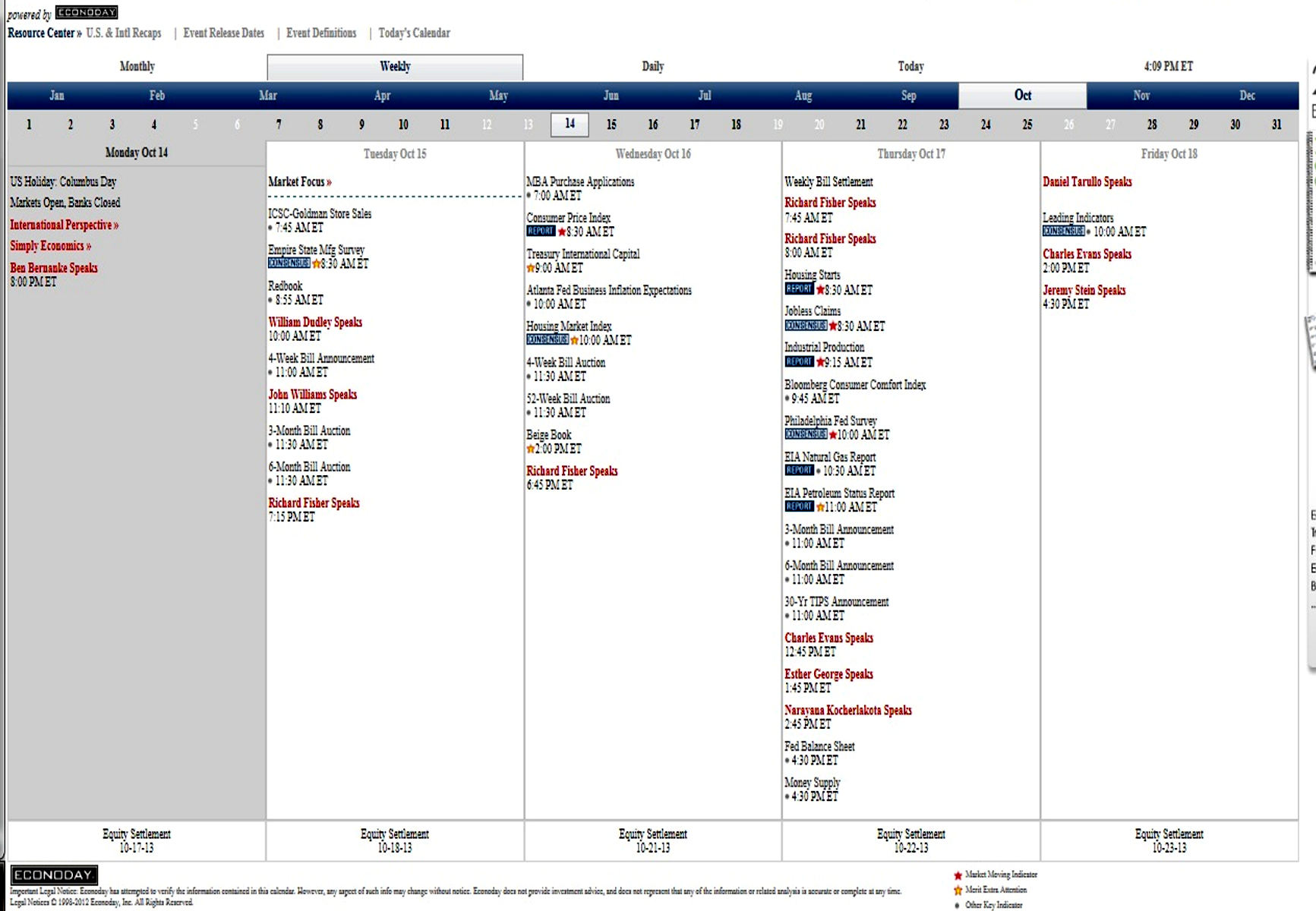
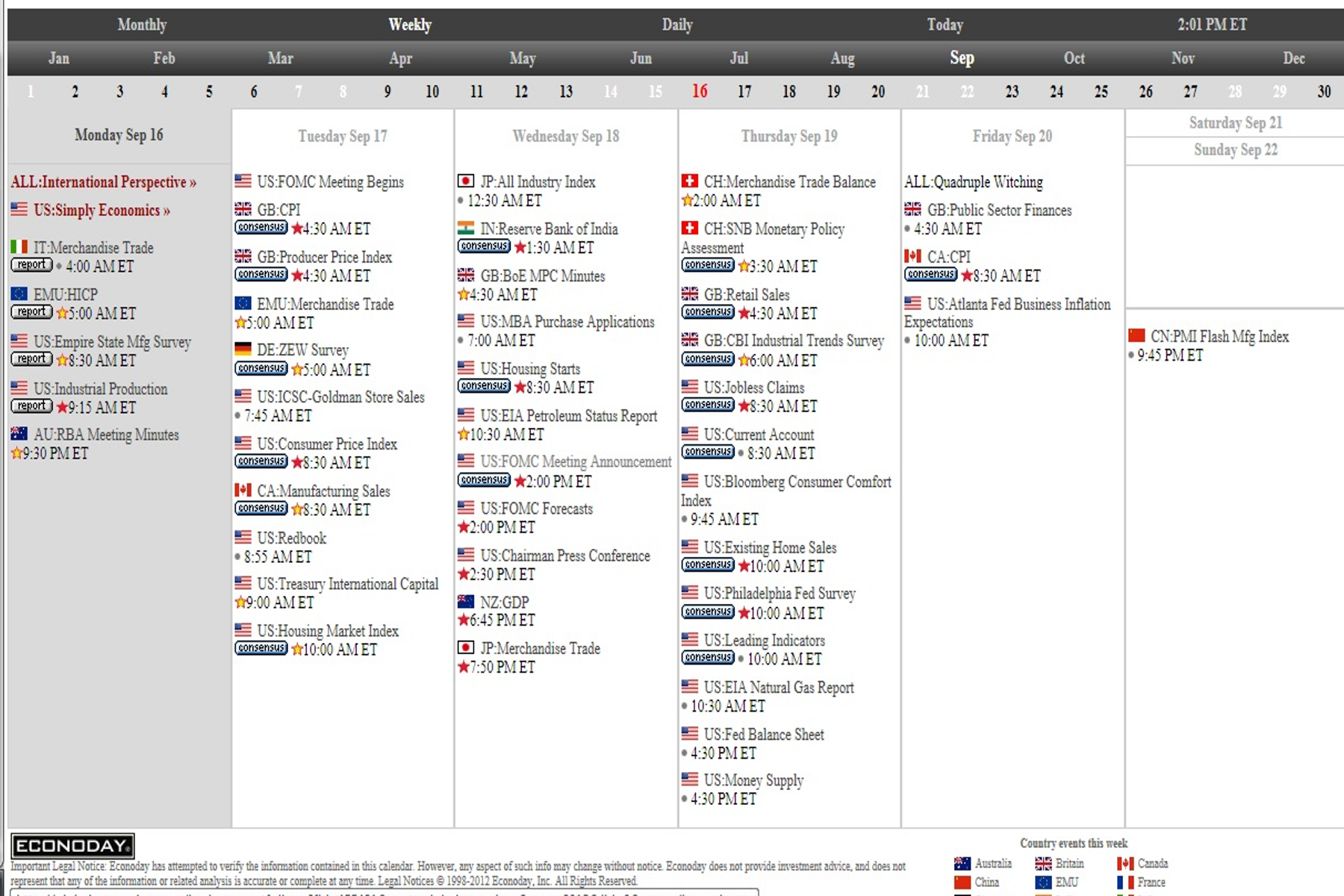
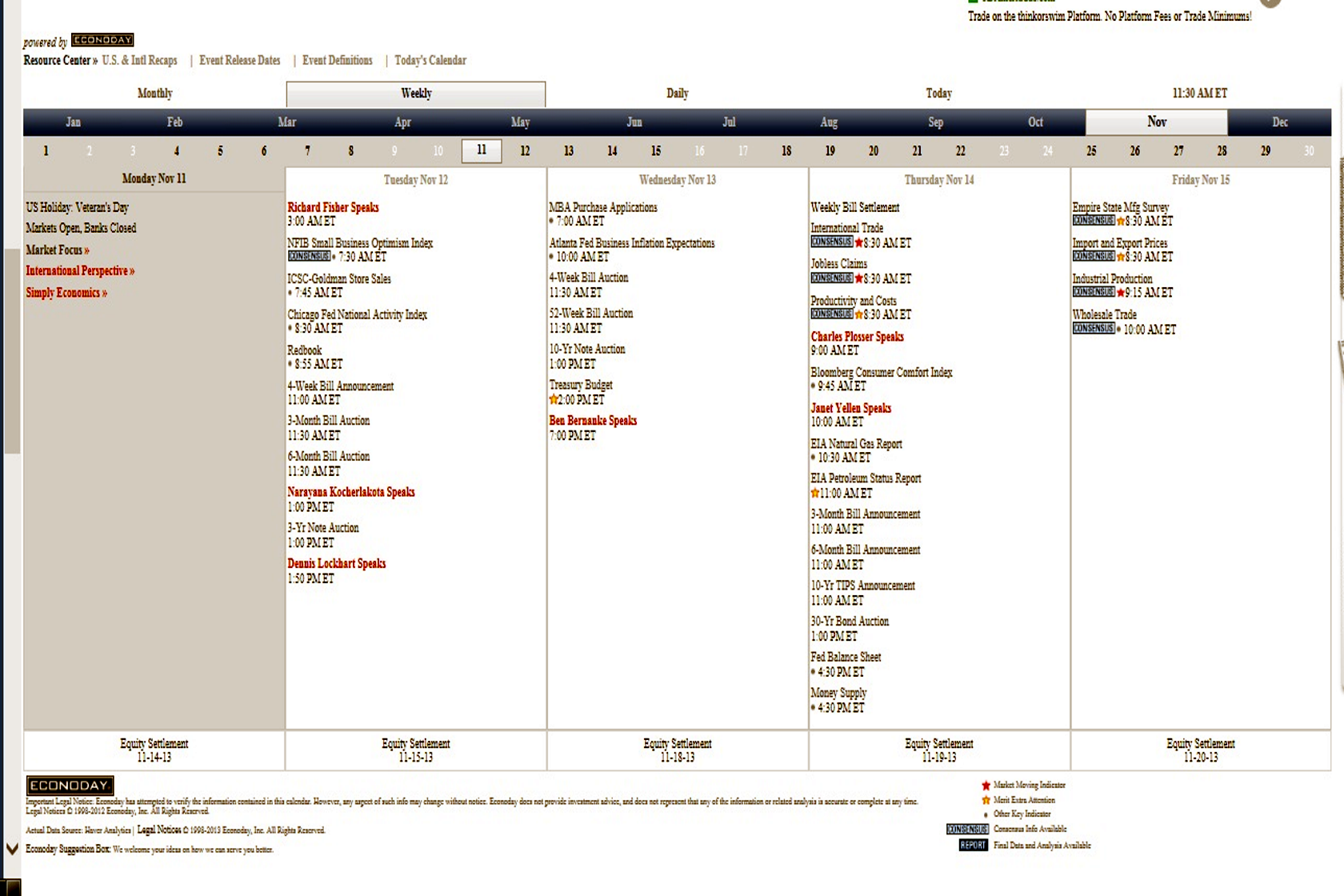
The week ahead — Economic data from Econoday.com:
Week of Nov 8 2013 – Weekly Recap & The Week Ahead

Monday, November 11th, 2013

“It is not the creation of wealth that is wrong, but the love of money for its own sake.” – Margaret Thatcher

1. China premier warns against loose money policies Reuters, China needs to sustain economic growth of 7.2 percent to ensure a stable job market, Premier Li Keqiang said as he warned the government against further expanding already loose money policies. The People’s Bank of China has also warned about inflation, saying that “upwards pressure on prices still exists.”
2. FDA to ban artery-clogging trans fats — The FDA stated that it will require the food industry to gradually phase out all trans fats, saying they are a threat to people’s health.
3. The US economy grew at an annualised pace of 2.8% in the third quarter — growth was lifted by rising exports, businesses restocking shelves and a pick-up in home construction.
However, the pace of growth in consumer spending – which accounts for about two-thirds of US economic activity – slowed from the previous quarter.
Consumer spending grew at annual pace of 1.5%, down from 1.7% in the April-to-June period and the slowest rate since 2011.
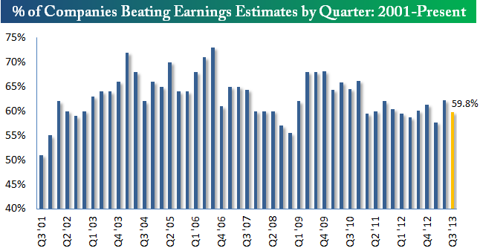
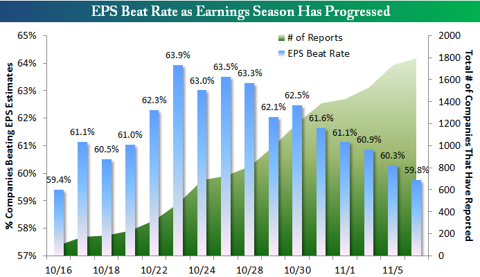
4. Q3 Earnings Beat Rate — courtesy of BIG, the percentage of companies that have beaten earnings estimates this season has dropped below the 60% mark (59.8%).


5. S&P cuts France’s sovereign credit ratingCNBC Ratings agency Standard and Poor’s cut France’s sovereign credit rating to AA from AA plus, citing lack of progress in government reforms of the country’s economy. However,the agency revised the country’s sovereign credit outlook up to stable from negative.

The week ahead — Economic data from Econoday.com:
Week of Nov 2 2013 – Weekly Recap & The Week Ahead

Monday, November 4th, 2013

“Don’t try to buy at the bottom and sell at the top. It can’t be done except by liars.” — Bernard Baruch

1. Obamacare helping health-insurance stocks — the Affordable Care Act appears to have so far proved beneficial to investors in health insurers Over the last 12 months. The top five publicly traded health insurance companies — Aetna(AET), WellPoint(WLP), UnitedHealth Group(UNH), Humana(HUM) and Cigna(CI) — have increased by an average of 32 percent versus the Standard & Poor’s 500-stock index (SPX)has risen by just 24 percent.
2. Oil’s $5 Trillion Permian Boom Threatened by $70 CrudeBloomberg, prices for West Texas crude have dropped below $100 a bbl. The Permian remains the largest U.S. oil producer, although it’s also the most expensive U.S. shale formation in which to drill, meaning the boom could become a bust if crude moves near $70 a bbl.
3. SAC Hedgefund to admit securities fraud and pay $1.2BWSJ, SAC Capital will reportedly pay a penalty of $1.2B and plead guilty to securities fraud to settle a criminal investigation into insider trading. The fine would be the largest ever for such misconduct and SAC will also stop managing external money.
4. Spain ends two-year recession with 0.1% growthBBC, Spain has seen its first quarterly economic growth since 2011, according to data from the country’s National Statistics agency INE. The country’s GDP grew 0.1% in the July-to-September period, after contracting for the previous nine quarters. The INE said an increasing number of exports supported the growth, with a boost to the tourist industry from holidaymakers avoiding northern Africa and the Middle East.
5. The latest Oct 29 – 30 Fed’s Policy Statement – December Taper Not Off the TableWSJ, the Federal Reserve emerged from its October meeting effectively in a wait-and-see mode on the economy and policy, making few substantive changes to its statement. the Fed isn’t taking a December adjustment to the bond-buying program off the table. But that comes with the strong caveat that it depends on whether the economy is living up to its expectations.
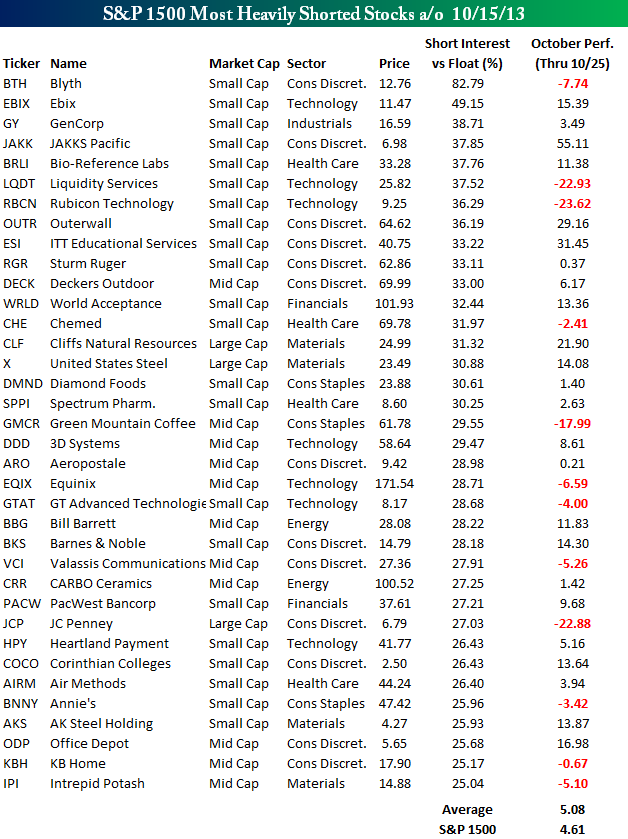
6. S&P 1500 Most Heavily Shorted Stocks — courtesy of BIG, the latest figure released on Oct 15, 2013 shows the 36 stocks in the S&P 1500 that have at least 25% of their free-floating shares sold short.

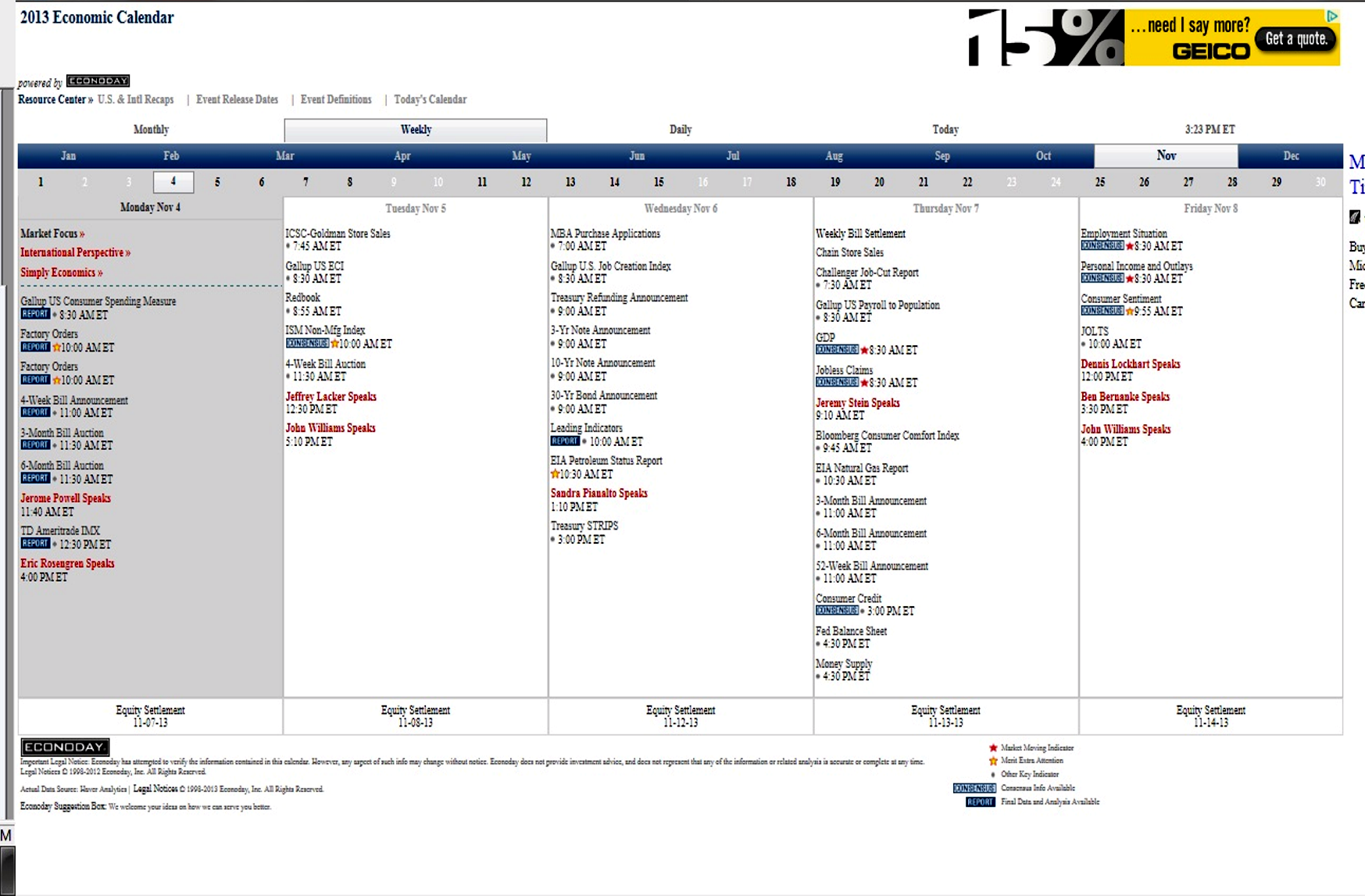
The week ahead — Economic data from Econoday.com:
Week of Oct 25 2013 – Weekly Recap & The Week Ahead

Monday, October 28th, 2013

‘Millions saw the apple fall, Newton was the only one who asked why?’ — Bernard Baruch

1. Jobs Report Keeps Fed on Hold for NowWSJ, the slow jobs report makes it harder for the Federal Reserve to make decisions about its $85 billion monthly bond-buying programs. This assures that the Fed won’t act at its Oct. 29-30 policy meeting. The next jobs report, for October, could be skewed by the government shutdown, which disrupted the data collection process and which will include the effects of government workers on furlough. The Fed will have an additional jobs report to go on by its Dec. 17-18 meeting; the Bureau of Labor Statistics reports November jobs data on Dec. 6.
2. China major banks write off 22.1 billion yuan ($3.65 billion)debt — from Bloomberg, stated that China’s five major banks have written off 22.1 billion yuan ($3.65 billion) of debt in the first six months of the year that couldn’t be collected, compared to 7.65 billion yuan a year earlier. The move is more than likely a cleaning-up process ahead of what may be a fresh wave of defaults in the world’s second-largest economy.
3. ECB to stress test top eurozone banks — the European Central Bank plans to carry out comprehensive stress tests on 128 top eurozone banks over the next year as it aims to build confidence in the financial sector by improving transparency and implementing “corrective action” where needed.
4. Department of Justice probes nine banks on mortgage-backed securities(MBS)FT, U.S. Department of Justice is probing at least 9-banks about their sales of mortgage-backed securities. The investigations, which span U.S. attorney’s offices from California to Massachusetts, include the largest banks that underwrote and sold residential mortgage-backed securities. They include Bank of America (BAC), Citigroup(C), Credit Suisse, Deutsche Bank(DB), Goldman Sachs(GS), Morgan Stanley(MS), Royal Bank of Scotland(RBS), (UBS) and Wells Fargo(WFC).
5. Countrywide (part of Bank of America) found guilty in U.S. mortgage suit — a federal jury has found Bank of America’s (BAC) Countrywide unit liable for defrauding Fannie Mae (OTC:FNMA) and Freddie Mac (OTC:FMCC) by selling them thousands of defective mortgages. The judge will determine the amount of the penalty – the U.S. has requested $848M, the gross loss to the GSEs as calculated by its expert witness.
6. Chinese shares fall as People Bank of China (PBOC) tightening continues — Chinese markets (FXI) continued to drop as short-term money market rates continued to rise after the Bank of China again refrained from injecting liquidity into the market. The overnight rate touched 7.5% at one point and the benchmark seven-day hit 6.94%.

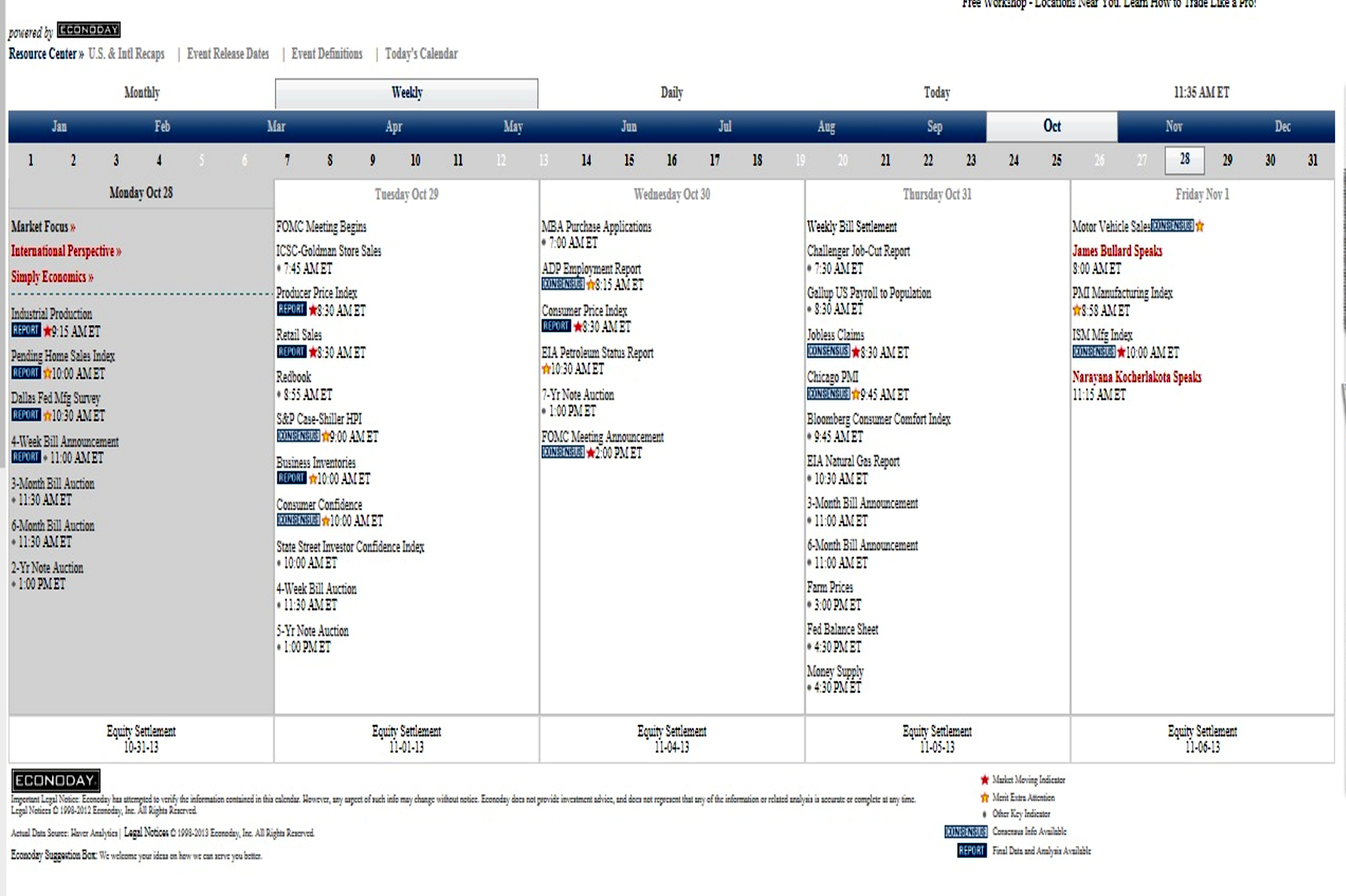
The week ahead — Economic data from Econoday.com:
Week of Oct 18 2013 – Weekly Recap & The Week Ahead

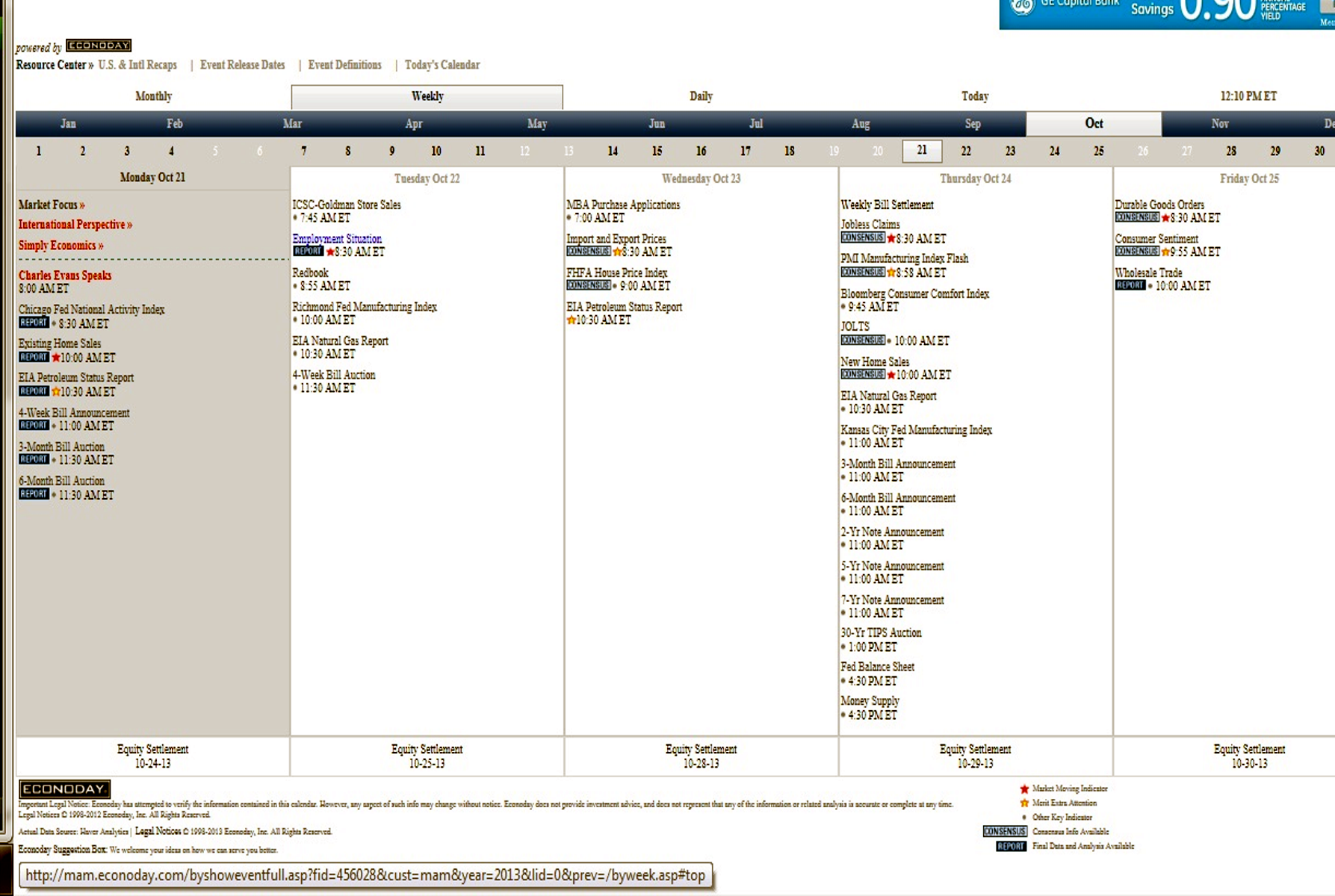
Monday, October 21st, 2013

“Be who you are and say what you feel, because those who mind don’t matter and those who matter don’t mind.” — Bernard Baruch

1. Forex Manipulation Probes at JPM TraderWSJ the U.K. – in its investigation of the potential manipulation of currency markets – is looking at the activities of former RBS (RBS) trader Richard Usher, who now works for JP Morgan (JPM).
2. Regeneron (REGN) drug slashes cholesterol in late-stage trial Reuters, a new type of cholesterol drug being developed by Regeneron Pharmaceuticals Inc (REGN) and Sanofi SA, when used by itself, cut levels of “bad” LDL cholesterol almost in half in the first of a dozen late-stage trials of the injectable medicine. Regeneron and Sanofi’s treatment, called Alirocumab, is part of a new class of injectable cholesterol medicines that block a protein called PCSK9. Analysts suggested drugs could each generate sales of $3B or more.
3. Congress Agreed to end Government Shutdown — Congress approved a deal to finance the U.S. government until January 15 and raise the debt limit so that the country can continue to increase its borrowing until February 7.
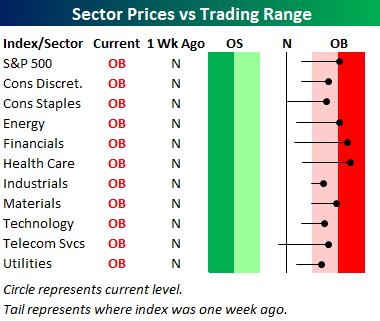
4. Stock Market Back to Overbought — from BIG, just from this time last week, the S&P 500 and all ten sectors closed out the day in overbought territory. Sectors such as Energy, Financials and Health Care at extreme over-bought levels (>2 standard deviations above the 50-day moving average).

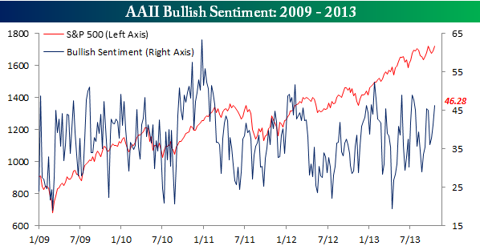
5. Latest AAII Bullish Sentiment — the lastest report from AAII shows investors have been growing increasingly bullish. Over the last week, bullish sentiment increased from 41.33% to 46.28%. This is the third straight week where bullish sentiment increased.

6. China’s GDP growth accelerates to 7.8% — China’s economy expanded at its fastest rate this year in Q3, rising 7.8% vs 7.5% in Q2. The growth reflected a “mini fiscal stimulus” that included railway spending and tax cuts.

The week ahead — Economic data from Econoday.com:
Week of Oct 12 2013 – Weekly Recap & The Week Ahead

Monday, October 14th, 2013

“The risk of a wrong decision is preferable to the terror of indecision.” – Maimonides

1. Obama Picks Janet Yellen as Fed chief Replacing Bernanke — President Obama nominated Janet Yellen as the first woman Chairperson of the Federal Reserve. The Senate still have to confirm the appointment of Yellen.
2. Refiners exporting record amounts of fuel — the U.S. energy boom has helped allow refiners to export more fuel than ever, with sales abroad hitting a record 3.8M barrels a day in July, almost 65% above the 2010 level. U.S. refiners are increasingly using locally produced crude that is cheaper than North Sea oil; they can then sell products such as gasoline, diesel and jet fuel to overseas customers at bargain prices. Companies that are benefiting include Marathon Petroleum (MPC), Valero Energy (VLO) and Enterprise Products Partners (EPD).
3. Chinese Premier Sees China Growth Topping 7.5% in First Nine MonthsBloomberg, Chinese Premier Li Keqiang said the nation’s economic growth probably exceeded 7.5 percent in the first nine months of the year
4. Japan’s machinery orders rise to highest since 2008 — Japan’s machinery orders, a leading capex indicator, reached the highest level in five years in August, climbing 5.4% on month to ¥819.3B ($8.4B) vs no growth in July. The increase is important for Japan’s government especially because one of its aims is to boost corporate investment as part of its economic reforms.
5. Most on FOMC members continue to see taper Bond Buy later this year — the minutes of the September 17-18 meeting show most members on the FOMC expect the tapering of the Fed’s QE program to start later this year. The decision not to reduce the bond-buying last month a “close call.” FOMC members were aware that the non-taper would be a surprise to the markets.
6. US overtaking Russia as top oil producerReuters, the US will become the world’s largest oil producer next year overtaking Russia, thanks to the American shale oil boom. The IEA said “With output of more than 10 million barrels per day for the last two quarters, its highest in decades, the nation is set to become the largest non-OPEC liquids producer by the second quarter of 2014, overtaking Russia. And that’s not even counting biofuels and refinery gains,”

The week ahead — Economic data from Econoday.com:
Week of Oct 5 2013 – Weekly Recap & The Week Ahead

Tuesday, October 8th, 2013

“October. This is one of the peculiarly dangerous months to speculate in stock. The others are, July, January, September, April, November, May, March, June, December, August and February” — Mark Twain

1. Earnings at top five banks seen taking major hit — analysts have cut their earnings estimates for the top five U.S. banks by over $1B in total, due to increasing fears about a sharp fall in trading revenue – especially from fixed-income operations – and higher legal costs. JPMorgan (JPM) has been particularly affected, with consensus for net income down $526M to below $5B. The company’s legal woes are seen adding $2B to expenses. Bank of America (BAC), Goldman Sachs (GS), Morgan Stanley (MS) and Citigroup (C) are the other banks to be affected.
2. Abe Orders Japan’s First Sales-Tax Increase Since ’97Bloomberg, Japan will go through with a plan to raise sales tax in April to 8% from 5%, a move that is set to raise ¥8T. To offset the economic impact of the hike, Prime Minister Shinzo Abe has unveiled a ¥5T ($51B) stimulus package that will include spending on public works and tax breaks to encourage companies to boost capital expenditures and wages.
3. ‘Obamacare’ launches amid government shutdown BBC, a central provision of President Barack Obama’s healthcare reform law has taken effect, having survived Republicans’ years-long effort to undermine it. The opening of the private health insurance marketplaces, or exchanges, was the culmination of more than three years of political combat in Washington over the Patient Protection and Affordable Care Act, signed into law by President Barack Obama in 2010 and known to both sides as Obamacare.
4. PMI surveys show eurozone recovery gaining momentum — Eurozone services PMI climbed to 52.2 in September from 50.7 in August, while composite output rose to 52.2 from 51.5. “The eurozone enjoyed its strongest quarter of expansion for just over two years in the third quarter,” says Markit, adding that this bodes well for further growth in Q4. Germany led the way, France returned to expansion, Spain stabilized, and Ireland and Italy impressed.

The week ahead — Economic data from Econoday.com:
Week of Sept 27 2013 – Weekly Recap & The Week Ahead

Monday, September 30th, 2013

I hated every minute of training, but I said, ‘Don’t quit. Suffer now and live the rest of your life as a champion.’ — Muhammad Ali

1. Chrysler files for $100M IPO amid valuation dispute with UnionWSJ reported that Chrysler Group LLC has filed to sell up to $100M in stock. Fiat SpA (FIATY.PK) owns 58.5% of the company and the United Auto Workers union health trust can’t agree on the value of their 41.5% stake.
2. China sovereign wealth fund takes 12.5% stake in potash producer — China Investment Corporation is now the second largest shareholder in Uralkali (URALL.PK), the potash producer whose exit from one of the world’s two potash cartels sparked fears of a price war and triggered a steep sell-off in the chemical’s price earlier this year.
3. Merkel Gets Biggest Victory Since Kohl’s Reunification VoteBloomberg reported Angela Merkel won an overwhelming endorsement from German voters, putting the country’s first female chancellor on course for the biggest election tally since Helmut Kohl’s post-reunification victory of 1990. Merkel will probably have to form a coalition with the left-of-center Social Democrats, which came in second, or the Greens.
4. Chinese manufacturing activity hits six-month high — China’s HSBC flash manufacturing PMI climbed to a six-month high of 51.2 in September from 50.1 in August, boosted by improvements in external and domestic demand. The reading adds to a string of data that indicate that China’s economy is bouncing back after a slowdown.
5. Average price of insurance under Obamacare $328 a month — the average cost of a mid-tier health-insurance plan under Obamacare is $328 a month, price data from the government showed. The figure released just a week before enrollment in the healthcare overhaul to begin on October 1. Insurers that intend to sell plans on exchanges include UnitedHealth (UNH), Aetna (AET), WellPoint (WLP) and Humana (HUM). Molina Healthcare (MOH) is also set to play a role.
6. Government shutdown looms as GOP, Democrats stand firm — Conservative Republicans and Democrats continued to hold their respective positions on the budget and debt-cap. In the House, GOP representatives won’t accept a six-week government spending bill that looks set to pass in the Senate today and would avert a shutdown on Tuesday. The legislation would add funding for Obamacare, which Republicans want to strip out.
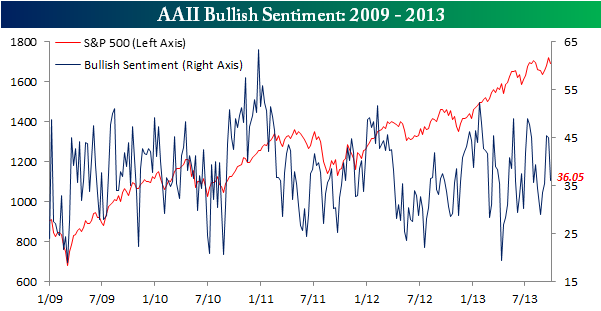
7. Bullish Sentiment Declines — courtesy of BIG, the latest sentiment survey from AAII shows bullish sentiment came in at a level of 36.05%, which was a 9.06 percentage point decline from last week’s level of 45.11%. This week’s decline was also the largest decline in bullish sentiment since Aug. 1.

The week ahead — Economic data from Econoday.com:
Week of Sept 20 2013 – Weekly Recap & The Week Ahead

Monday, September 23rd, 2013

‘An appeaser is one who feeds a crocodile, hoping it will eat him last.’Winston Churchill

1. Larry Summers withdraws from consideration for Fed Chief — Mr. Summers has dropped out from the race to become the next Chairman of the Federal Reserve, saying that “any possible confirmation process for me would be acrimonious,” and would not serve the interests of the Fed, the government or the economy. The remaining top contenders are Janet Yellen and Don Kohn, both of whom helped shape the Fed’s super easy money policy.
2. U.S., Russia agree to deal on Syrian chemical-weapons disarmamentReuters, the U.S. and Russia have reached a deal whereby Syria will have a week to provide information about its chemical weapons and then until the middle of next year to let international inspectors destroy them. Mr. Obama stressed that force remains an option if Assad reneges and U.S. forces remain in position. Russia still opposes military action but now backs possible U.N. sanctions for non-compliance.
3. North American shale boom could go globalFT reported that countries such as Argentina, Russia and Algeria hold shale oil deposits that could be even more bountiful than the regions at the center of the U.S.’s energy revolution. The 23 most promising “tight” oilfields outside the U.S. and Canada have the potential to extract 5M bpd in the 2020s, a report from research firm IHS has estimated.
4. Fed decides not to ‘taper’MarketWatch, the Federal Reserve stuck to its massive bond-buying strategy last Wednesday, citing softer U.S. growth in a move that stunned financial markets. By a 9-to-1 vote, the Fed chose to keep buying $85 billion a month in debt and said it would wait for more evidence of economic progress. The bank cited rising mortgage rates and reduced federal spending as headwinds that “could slow the pace of improvement in the economy”.
5. JPMorgan faces $900M in fines, will admit wrongdoing in Whale case — JPMorgan (JPM) will pay in excess of $900M in fines and admit to wrongdoing in an effort to settle multiple investigations into the whale-sized blunder that took place in Q1 2012 at the firm’s London CIO office, the NY Times’ Jessica Silver-Greenberg and Ben Protess reported. The government authorities across the settlement table reportedly are the SEC, the OCC, the Fed, and the Financial Conduct Authority in London.
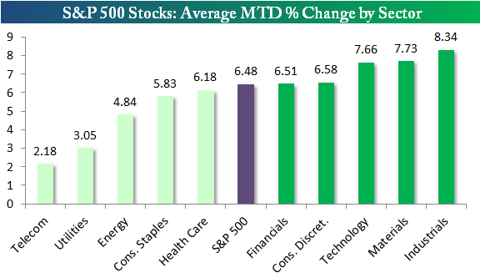
6. September Starts Strong — September has historically been the worst month of the year for stocks, but this year the month has bucked the trend. All of the cyclical sectors are doing even better, with Industrial stocks leading the way with an average MTD gain of 8.34%. Materials and Technology are averaging the second and third best gains.

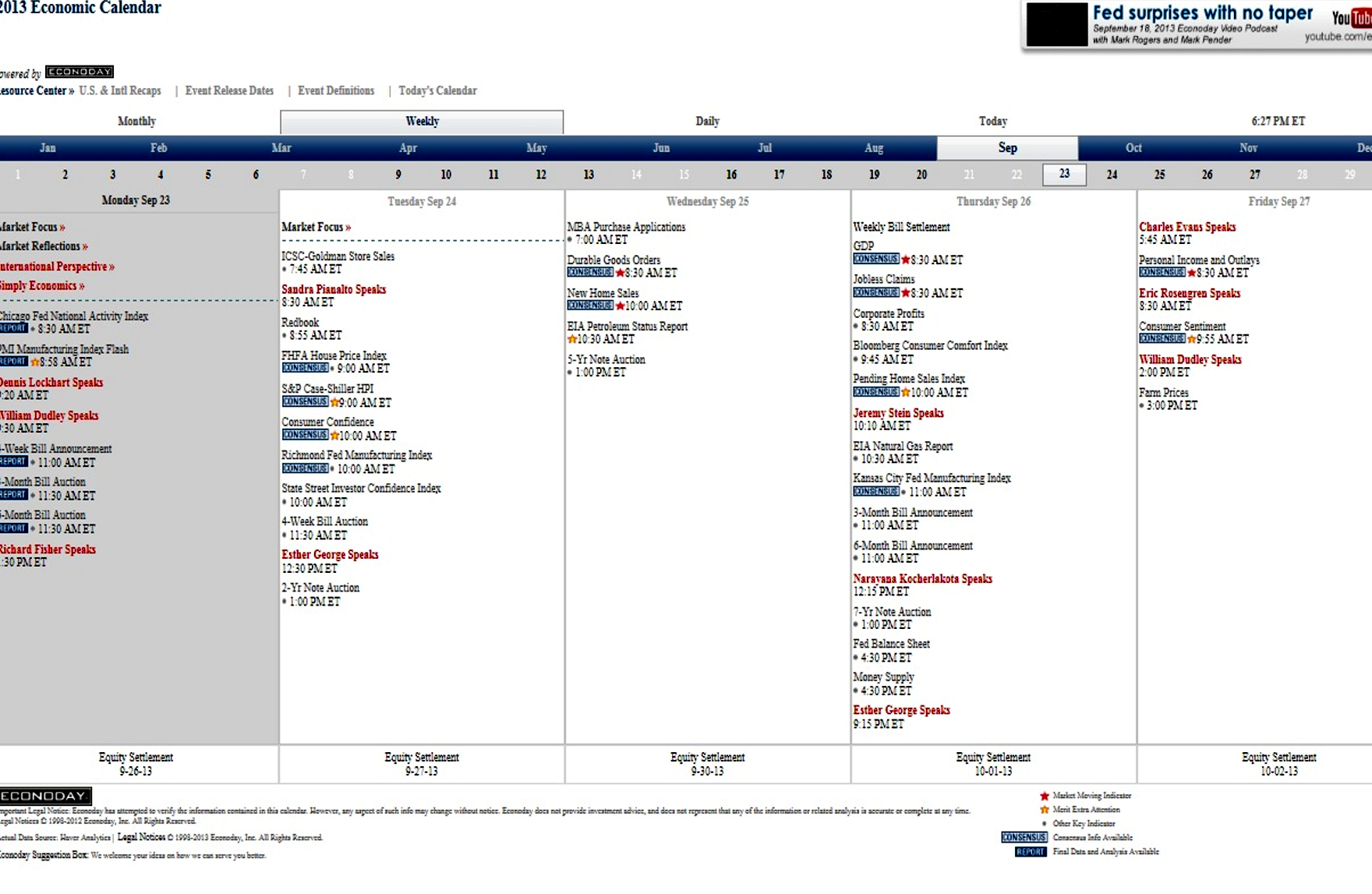
The week ahead — Economic data from Econoday.com:
Week of Sept 14 2013 – Weekly Recap & The Week Ahead

Monday, September 16th, 2013

“The first rule is not to lose. The second rule is not to forget the first rule.” — Warren Buffett

1. GE to IBM Ending Retiree Health Plans in Historic ShiftBloomberg, America’s biggest employers, from GE, IBM and Time Warner Inc. (TWX) are increasingly moving retirees to insurance exchanges where they select their own health plans, an historic shift that could push more costs onto U.S. taxpayers. While retiree health benefits have been shrinking for years, the newest cutbacks may quickly become the norm.
2. Japan Wins Olympic bid & GDP update sends Tokyo higher — the Nikkei jumped 2.5% after Q2 GDP growth was revised up to 3.8% from a prior reading of +2.6% and Tokyo won the bid for the 2020 Summer Olympics. The improved GDP number was fueled by a more positive read on capital expenditures, while it also increased the chances that the government will go through with a hike in sales tax. Also, the Olympics is forecast to boost the economy by ¥2.96T ($30B) over the next seven years and create 150,000 jobs.
3. Chinese industrial-output growth increase — the latest industrial data shows the country’s economy is stabilizing and will avoid a hard landing. The industrial-production growth accelerating to 10.4% on year in August from 9.7% in July and beating consensus of 9.9%.
4. Large Banks Face Physical Commodity CurbsWSJ, the Federal Reserve is expected to publish guidelines that would restrict banks’ involvement in physical-commodities businesses. The new rules, which would be designed to limit banks’ risky activities, could accelerate the withdrawal of JPMorgan (JPM), Morgan Stanley (MS) and Goldman Sachs (GS) from sectors such as metals warehousing and power generation.
5. Government shutdown begins to loom as funding bill delayed — the House Republican leaders postponed a vote that would have approved the financing of the government through December. The delay came because of opposition among conservative Republicans to parts of the legislation related to the funding of Obamacare, which they want to strip out. The government faces a shutdown if legislation isn’t approved by September 30. Democrats and Republicans also have until mid-October to agree on measures to lift the debt ceiling.
5. Druckenmiller, noted HedgeFund Manager on Bloomberg TV interviews

The week ahead — Economic data from Econoday.com:
Search
Calendar
February 2026
M T W T F S S
« Jan    
 1
2345678
9101112131415
16171819202122
232425262728  
Archives
Categories
The information provided by The EGS Blog is based on sources believed to be reliable, but it is not guaranteed to be accurate. There is no guarantee that the recommendations of The EGS Blog will be profitable or will not be subject to losses. The information provided by The EGS Blog is not a recommendation or a solicitation that any particular investor should purchase or sell any particular security in any amount, or at all. The investments discussed or recommended herein may be unsuitable for investors depending on their specific investment objectives and financial position. At any time EGS LLC and its principals may maintain positions that are contrary to positions announced within the subscription service. In no event will The EGS Blog be liable to you or anyone else for any incidental, consequential, special, or indirect damage (including but not limited to lost profits or trading losses). PAST PERFORMANCE IS NO GUARANTEE OF FUTURE RESULTS

© Copyright 2026 Market Outlook All Rights Reserved
Design by EGS Sponsored by Equity Guidance LLC