Archive for the ‘Weekly Summary’ Category

Week of Dec 29 2017 Weekly Recap & The Week Ahead

Tuesday, January 2nd, 2018

“The December Low Indicator — Forget all the noise you hear about the January Barometer; pay much more attention to the December low. That would be the lowest closing price for the Dow Jones Industrial Average during the month of December. If that low is violated during the first quarter of the New Year, watch out!” – Lucien Hooper

!!!HAPPY NEW YEAR !!!!

1. China Extends Tax Rebate For NEVs (New-Energy Vehicles) — China’s Finance Ministry will extend a tax rebate on purchases of new-energy vehicles from the end of this year until the end of 2020 amid a shift away from the internal combustion engine. The extension comes as automakers in China brace to meet strict quotas starting in 2019 that are sparking launches of NEV models and a flurry of new deals.
2. MasterCard (NYSE:MA) Released Strong Early Christmas Numbers — MasterCard (NYSE:MA) released strong early Christmas numbers. Excluding autos, sales rose 4.9% from Nov. 1 through Christmas Eve, marking the fastest pace since 2011. E-commerce naturally drove the gain, up 18.1%. Helping the figure was Christmas falling on a Monday, giving retailers a full weekend to reel in extra sales.
3. Israel Latest to Crack Down on Bitcoin — Israel has become the latest nation to crack down on cryptocurrencies, proposing regulation to ban companies trading in bitcoin from operating on the Tel Aviv stock exchange. The move follows last week’s warnings by FINRA against firms that “tout the potential of high returns associated with cryptocurrency-related activities,” as well as China’s decision to shutter bitcoin exchanges and ban ICOs in September.
4. Korea Also Crackdown on Cryptocurrency — S Korea eyed new regulations that would include prohibiting anonymous trading accounts and could give authorities the ability to shut down exchanges. The head of the country’s financial regulation agency also told reporters that the “bubble in bitcoin will burst later.” Bitcoin’s plunge comes after futures contracts started trading on CME Group’s exchange, giving investors new ways to bet on the digital coin’s price moves. Furthermore, India’s finance ministry is the latest global regulatory body to caution about the risks of trading in cryptocurrencies such as bitcoin, saying the investments are like “Ponzi schemes.”

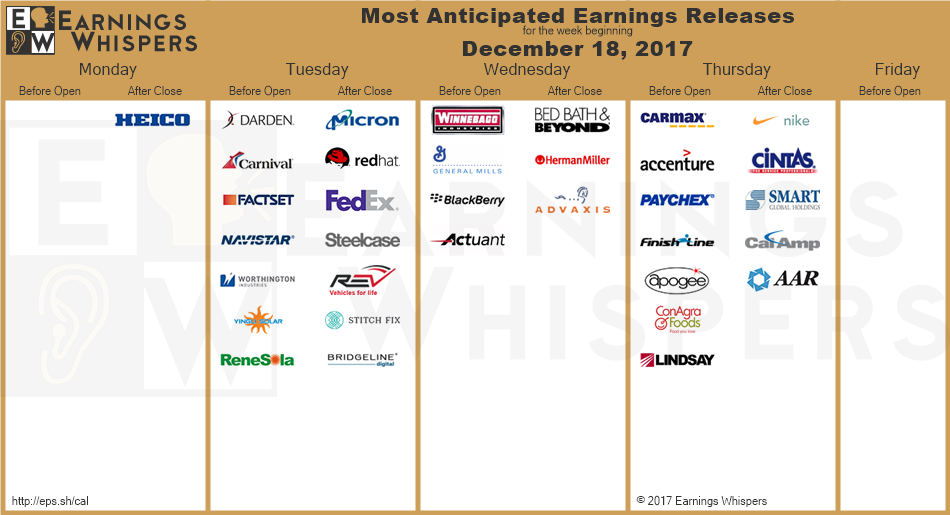
The week ahead — Economic data from Econoday.com:
Week of Dec 22 2017 Weekly Recap & The Week Ahead

Monday, December 25th, 2017

“Only when the tide goes out do you discover who’s been swimming naked.” — Warren Buffett
Merry Christmas and Happy New Year — from the staffs of EGS

1. Chile’s Corfo, SQM Seek Settlement of Lithium Mining Claims — Corfo and Pampa Calichera, a Chilean development agency that controls Sociedad Quimica y Minera de Chile (NYSE:SQM) stated that it had agreed to suspend its arbitration battle with SQM for 30 days as they try to solve a dispute over lithium mining claims. Chile will be able to expand its lithium production “significantly” if the negotiations are successful.
2. China Looks to Curb Greenhouse Emissions — China is planning to start a giant market to trade credits for the right to emit greenhouse gases. The program would initially cover the nation’s state-dominated power generation sector, which produced almost half of the country’s emissions from burning fossil fuels last year.
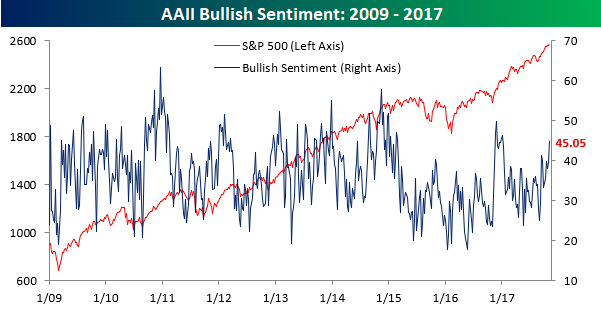
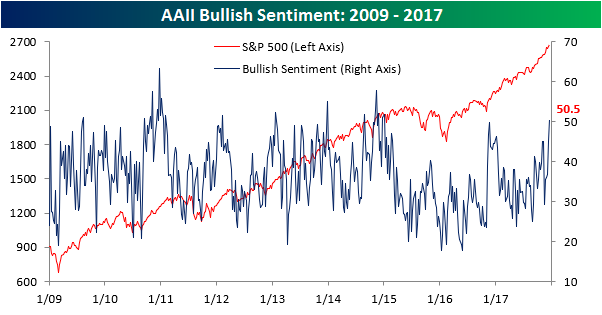
3. AAII Weekly Sentiment Survey — the weekly sentiment survey from the American Association of Individual Investors (AAII) showed that bullish sentiment increased from 45.0 up to 50.5%. That’s the first 50%+ reading since the first week of 2015! That streak of 154 weeks without a 50%+ reading was the longest in the history of the survey!

4. The Tax Cuts and Jobs Act Passed by Congress and Signed into Law by President Donald Trump — the new tax law will be a mixed bag of give-and-take for individual taxpayers, with benefits sharply skewed to the wealthy. The main component, the top corporate tax rate will drop from 35%—one of the highest top rates levied by developed nations—to 21% in 2018. Most taxpayers will see their tax burdens decline and their after-tax income rise in 2019, after the new law is fully in effect.
5. Congress Passes Stopgap Spending Bill — Congress has passed a stopgap spending bill that keeps the government funded through mid-January, punting thorny policy debates into next year. The most contentious part of the bill is what’s called a “pay-go” waiver. The provision suspends rules that bar the government from enacting expensive new programs, like the GOP tax cuts, unless there is enough money in the current year’s budget to pay for them.
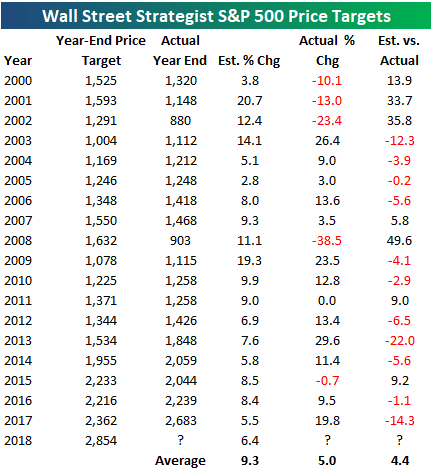
6. Wall Street Strategists’ Forecast Year-End Price Targets — according to Bloomberg, the consensus S&P 500 price target for the end of 2018 stands at 2,854. That would represent a 2018 gain of roughly 6%.
Below is a chart showing consensus year-end price targets for the S&P 500 for every year going back to 2000. For each year, we show where Wall Street strategists saw the S&P 500 trading at the end of the year, the estimated annual percentage change based on the price target, and the actual percentage change that the S&P 500 experienced that year.

The week ahead — Economic data from Econoday.com:
Week of Dec 15 2017 Weekly Recap & The Week Ahead

Monday, December 18th, 2017

“Bull markets are born on pessimism, grown on skepticism, mature on optimism, and die on euphoria.” — John Templeton

1. Bitcoin Debut on CBOE Futures Exchange — futures on the world’s most popular crypto-currency – trading under symbol(“XBT) – surged as much as 25% to $18,850 during their debut session on the CBOE Futures Exchange, triggering two temporary trading halts meant to cool volatility earlier this week. About 2,700 contracts for January changed hands. Also, the SEC has issued a warning to investors on the dangers of putting their money into cryptocurrencies. “There are tales of fortunes made and dreamed to be made,” said Chairman Jay Clayton. “We are hearing the familiar refrain, ‘this time is different.'”
2. WTO’s Ministerial Ramping Up Trade Pressure on China — the WTO’s ministerials, the EU, Japan and U.S. will announce a new alliance to take on China. The three economies will target “severe excess capacity” in important sectors like steel and commodities, the role of illegal subsidies and abusing intellectual property rules to acquire strategic technologies.
3. GOP Raising Corporate Rate to 21% — GOP negotiators have reached a tentative agreement to raise the corporate rate in their joint House-Senate tax bill from 20% to 21%, according to The Hill. The higher rate could pay for a reduction in the top individual rate, which Republicans are talking about lowering from 39.6% to 37%. It could also pay for keeping more deductions for taxpayers, particularly in high-tax states.
4. FOMC Raised Interest Rates but Sticks to Go-Slow Approach — the central bank raised its benchmark federal funds rate by a quarter percentage point to between 1.25% and 1.5% — the fourth increase in a year. In addition, the central bank made no change to its forecast for inflation and struck a wait-and-see stance in light of persistently low inflation and a pending change in leadership.
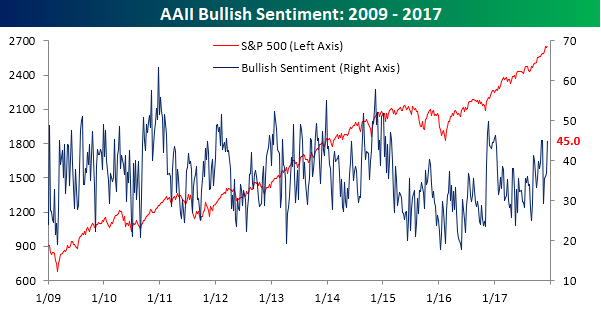
5. AAII Weekly Sentiment — courtesy of BIG, according to this week’s sentiment poll from the American Association of Individual Investors (AAII), bullish sentiment increased from 36.9% up to 45%. That’s the greatest weekly increase in three months and the fourth straight week of increased optimism. The last time bullish sentiment increased for four straight weeks was back in early 2016, and we haven’t seen five straight weeks of increased bullish sentiment since 2012. It has now been a record 154 straight weeks since bullish sentiment last eclipsed 50%.

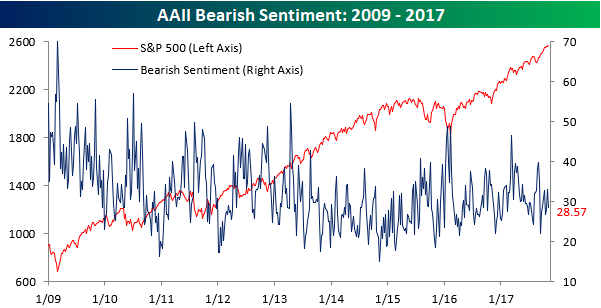
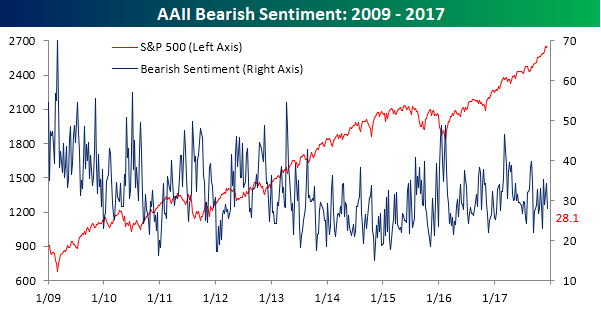
In addition, bearish sentiment saw a 6.1 percentage point decline this week, falling from 34.2% down to 28.1%. That’s the lowest weekly print for bearish sentiment in just over a month, but nowhere near the lowest levels of the year.

6. Final Version of the Republican Tax Bill Head to Congress This Week — If the tax bill is passed this week, the sectors that should benefit the most are: Financials, Retailers, Telecom, Transports, and smalll–cap stocks. Indeed, the small–cap Russell 2000 saw a big lift on Friday as it bounced off of its 50-day moving average. Copper’s recent rally is also suggestive of world–wide economic strength.
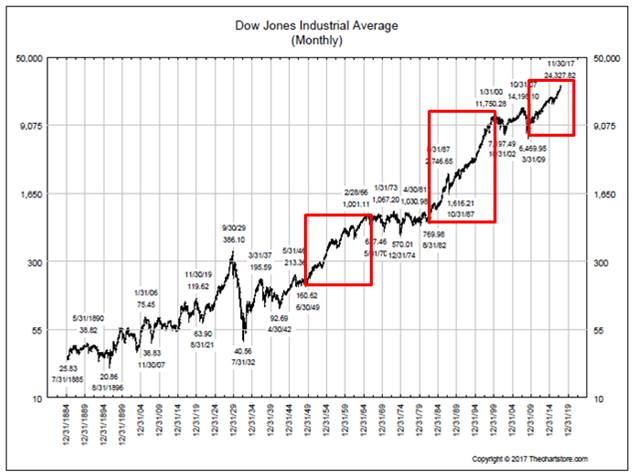
The chart below shows the three secular Bull Market since 1949.

The week ahead — Economic data from Econoday.com:
Week of Dec 8 2017 Weekly Recap & The Week Ahead

Monday, December 11th, 2017

“I’m always thinking about losing money as opposed to making money. Don’t focus on making money, focus on protecting what you have” – Paul Tudor Jones

1. Walgreens Rebranding Effort in Pharmacy Wars — Walgreens is taking a different approach to grow in the wake of CVS Health (NYSE:CVS) announcing plans to acquire Aetna (NYSE:AET). The company is re-positioning to reach two demographics of female shoppers – millennials and Gen X – with a big emphasis on beauty and food products.
2. Japan Wants Missiles that Could Strike N.Korea — Reuters reported Japan is preparing to acquire precision air-launched missiles that for the first time would give it the capability to strike North Korea. The country is exploring Lockheed Martin’s (NYSE:LMT) JASSM-ER, as well as missiles from Norway’s Kongsberg Defence & Aerospace. The report comes as UN chief diplomat Jeffrey Feltman travels to Pyongyang for rare, high-level, political talks to diffuse tension.
3. The Senate and House Passed the “Tax Cuts and Jobs Act Bill ” — the Senate and House lawmakers passed the “Tax Bill” and are now working to come up with a final version of the tax bill, and they still have some differences to resolve. Below is the summary of the Senate and House versions.

4. House Approves Two-Week Funding Extension, Avoiding Government Shutdown — the Senate has passed a stop-gap spending measure to continue funding the federal government for two weeks. President Trump would sign a stop-gap spending measure funding the government through Dec. 22, according to a statement from the White House. In addition, the White House said it will move forward with a massive infrastructure program in 2018.

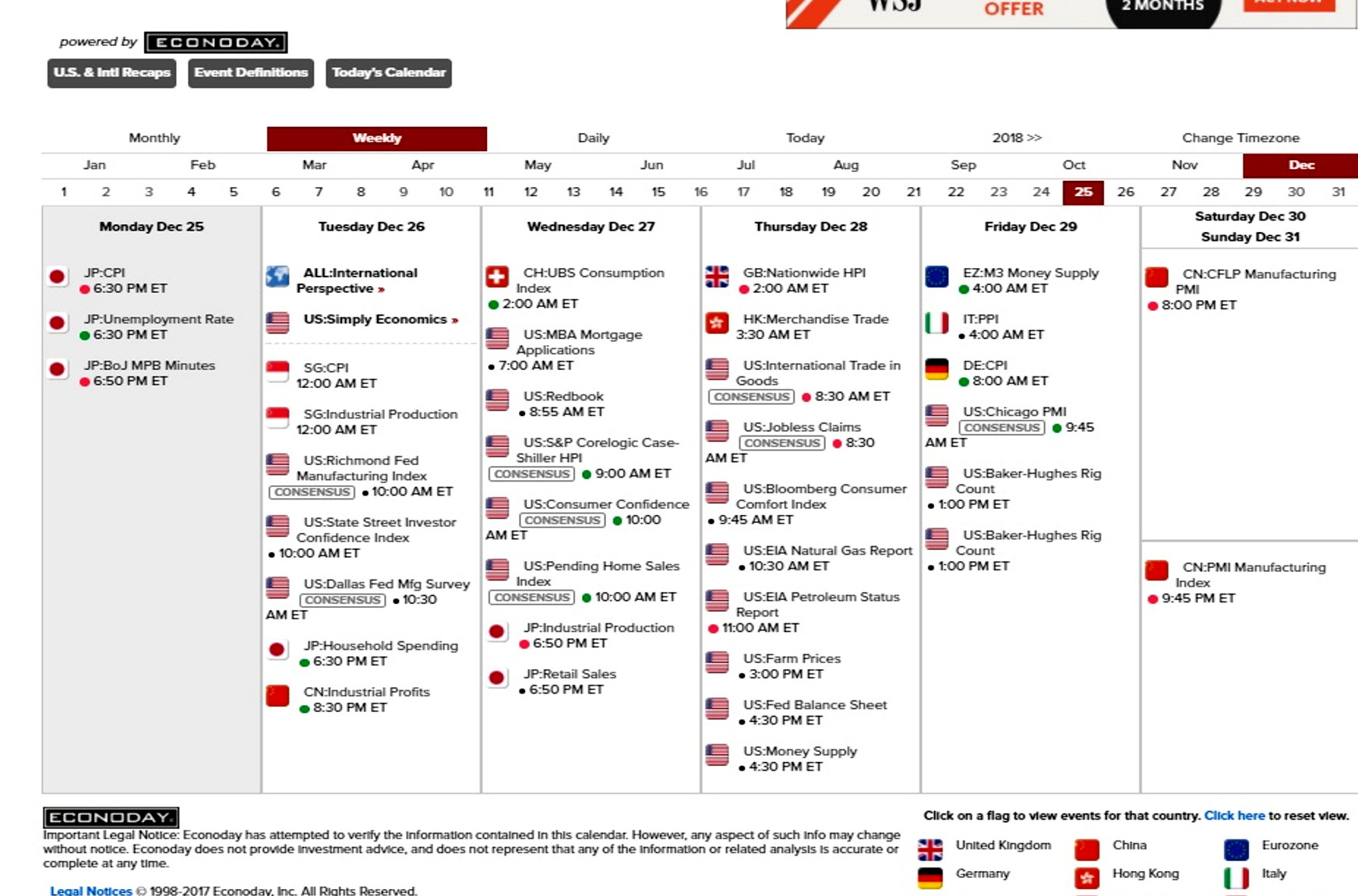
The week ahead — Economic data from Econoday.com:
Week of Dec 1 2017 Weekly Recap & The Week Ahead

Friday, December 1st, 2017

“Bulls make money, bears make money, pigs get slaughtered.” — unknown

1. Strong Start to Holiday Sales Season — Cyber Monday hit record revenues of $6.59B, making it the largest U.S. online sales day ever, in the latest report released. In comparison, Black Friday and Thanksgiving Day brought in $5.03B and $2.87B respectively. The internet holiday shopping season has so far (Nov. 1-27) driven a total of $50B in revenue, a 16.8% increase.
2. Bitcoin Shoots for $11,000 — a day after breaking above the $9,000 level, bitcoin has cracked $11,700, boosted by growing signs of mainstream adoption. About 100,000 Coin-base accounts were added over the Thanksgiving holiday, while CME will list bitcoin futures in the second week of December.
3. Samsung Develops Graphene-Based Battery, Quicker Charge than Lithium — Samsung Electronics has successfully developed a graphene-based battery that would take just 12 minutes to be fully charged, compared to current lithium-ion batteries, which take about an hour. Graphene has been dubbed a “miracle material” in the global electronics industry given its strength, electrical conductivity and elasticity.
4. OPEC/Russia Agree on Oil-Cuts Extension to End of 2018 — OPEC agreed to extend its oil-production cuts to the end of 2018. OPEC and other oil exporters led by Russia have kept 1.8 million barrels a day off the market since January, helping to boost crude prices about 40 percent from the lows of the year. Saudi Energy Minister Khalid Al-Falih told reporters “My preference is to go for nine months, we will meet again in June and we look at not only how we have done in first half of the year, but also our outlook for third and fourth quarters of 2018 and act accordingly.”
5. Amazon is in Exploratory Talks with Generic-Drug Makers — Amazon has held preliminary talks with makers of generic drugs about its potential entry into the pharmacy space, according to CNBC. The conversations, including with generics giants Mylan and Sandoz, a unit of Novartis. Stocks of drug distributors and others in the pharmaceutical supply chain, such as pharmacies and pharmacy benefits managers, have been pressured by the specter of Amazon entering the space.

The week ahead — Economic data from Econoday.com:
Week of Nov 24 2017 Weekly Recap & The Week Ahead

Tuesday, November 28th, 2017

“Throughout my financial career, I have continually witnessed examples of other people that I have known being ruined by a failure to respect risk. If you don’t take a hard look at risk, it will take you.” – Larry Hite

1. Governing Crisis in Germany — Germany’s Angela Merkel said she would prefer fresh elections to ruling with a minority government after talks on forming a three-way coalition collapsed. Subsequently, President Frank-Walter Steinmeier stated Germany is facing its worst governing crisis in the history of its post-WWII democracy and pressed all parties in parliament “to serve our country” and form a government.
2. Europe’s First Bitcoin Mutual Fund — a Paris-based asset manager has launched Europe’s first bitcoin mutual fund. Tobam is classifying it as an alternative investment fund since it’s not traded on an exchange, but it does have daily liquidity based on market closing prices. JPMorgan (NYSE:JPM) is also reportedly getting into bitcoin futures trading even though CEO Jamie Dimon believes it’s a fraud.
3. Russia-OPEC Agree on Framework to Extend Oil Cuts — OPEC and Russia have crafted the outline of a deal to extend their oil production cuts to the end of next year, although both sides are still hammering out crucial details. Moscow and Riyadh now agree they should announce an additional period of cuts at the Nov. 30 meeting. West Texas Intermediate crude extended gains to the highest level since July 2015. Futures for January delivery rose as much as 1.6 percent to $58.92.

The week ahead — Economic data from Econoday.com:
Week of Nov 17 2017 Weekly Recap & The Week Ahead

Monday, November 20th, 2017

“Only fools and liars buy at exact bottoms and sell at exact tops!” — unknown

1. S&P & ISDA Declare Venezuela in Default — S&P has downgraded Venezuela’s foreign currency sovereign credit rating to “selective default” after it failed to make $200M in payments on its global bonds. The decision capped off a day in which the government promised to keep paying its debts, but offered no firm proposals, at a conference in Caracas. Furthermore, the International Swaps and Derivatives Association (ISDA) has ruled that Venezuela and its state oil company PDVSA have defaulted on their debts. The decision will trigger credit-default swaps, with the details of how they will be settled to be determined by the committee on Nov. 20.
2. FDA Approves First Digital Pill — The FDA has approved the first digital pill – made by Otsuka Pharmaceutical (OTCPK:OTSKY) and Proteus Digital Health (Private:PRDI) – that is embedded with a sensor and can tell doctors whether, and when, patients take their medicine. While a patient can block transmissions via a smartphone app, the technology is still likely to prompt questions about privacy.
3. Norway, World’s Biggest Wealth Fund Wants Out of Oil and Gas — Norway finance ministry said it will study the proposal and decide what to do in “fall of 2018” that would entail the fund, which controls about 1.5 percent of global stocks, dumping as much as $40 billion of shares in international giants such as Exxon Mobil Corp. and Royal Dutch Shell Plc. Norway relies on oil and gas for a fifth of economic output, would be less vulnerable to declining crude prices without investments in the industry .
4. House Passes GOP Tax Reform Bill — the House of Representatives has passed a bill that would result in the biggest overhaul of the U.S. tax system in 31 years. It would reduce the number of individual brackets, increase the child tax credit, abolish the estate tax by 2025, chop the corporate tax rate to 20% and make other tweaks aiming to make businesses more competitive. But there are warning signs as the focus in Washington turns to the Senate’s companion bill.
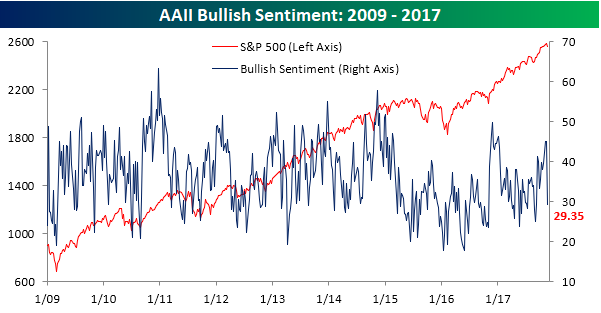
5. AAII Bullish Sentiment Crashes — AAII bullish sentiment from this week crashed from 45.1% down to 29.35%. That’s the largest one-week decline since April 2013!

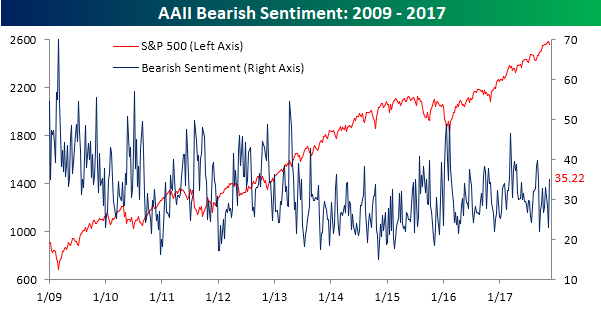
Meanwhile, Bearish sentiment didn’t see quite as big a move as bullish sentiment, but it did spike by 12 percentage points, and that’s the largest one-week increase since February 2016.

The week ahead — Economic data from Econoday.com:
Week of Nov 10 2017 Weekly Recap & The Week Ahead

Monday, November 13th, 2017

“While markets often make double bottoms, three pushes to a high is the most common topping patterns” — J. Bollinger

1. GE Considers More Asset Sale — General Electric is considering options for its aircraft leasing unit, including the sale of all or part of the business, as CEO John Flannery searches for new divestitures, Reuters reports. With a fleet of 1,339 planes worth an estimated $25B, GE Capital Aviation Services ranks only behind AerCap (NYSE:AER) as the globe’s largest lessor.
2. Saudi Arabia ‘s Princes, Businessmen, Officials Arrested in Anti-Graft Drive — Saudi Arabia announced a new wave of arrests of royals and ministers in a Saudi corruption probe. It was orchestrated by Crown Prince Mohammed bin Salman, who’s backed OPEC-led output cuts. The purge also led to the arrest of business billionaire Prince Al-Waleed, whose investment firm Kingdom Holding has big stakes in Citigroup (NYSE:C) and Twitter (NYSE:TWTR).
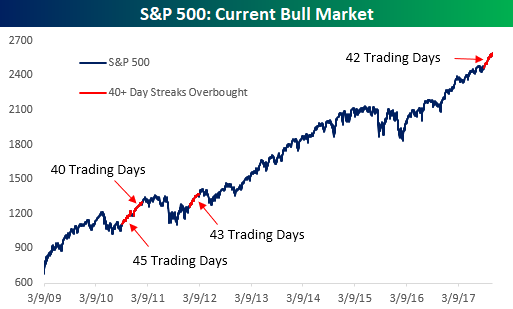
3. Longest Overbought Streak For S&P 500 Since 2012 — courtesy of BIG, looking further back at the current bull market, there have only been three other periods where the S&P 500 closed at overbought levels for 40 or more trading days. The chart below shows the S&P 500 through the course of the entire bull market dating back to March 2009. As shown, two of those prior streaks occurred within ten trading days of each other when a 45-trading-day streak ended on 11/12/10 and another one began on 12/1/00. In both the one and six months that followed these prior streaks coming to an end, the S&P 500 was up all three times.

4. Democrats Win Big in Elections — Democrats scored a number of closely watched elections last Tuesday, in what some called a referendum on President Trump. Republicans lost races for governorship in Virginia and New Jersey, as well as control of the Washington state Senate. Mayoral races, too, produced a string of Democratic victories, most notably in New York City, where Mayor Bill de Blasio cruised to a second term.
5. U.S. Oil Service Firms Face Big Write-offs as Venezuela Nears Default — As Venezuela teeters on the edge of default, U.S. oil service companies face the prospect of hundreds of millions of dollars in write-offs for overdue payments from the PDVSA state-run oil company. Halliburton (NYSE:HAL), Schlumberger (NYSE:SLB), Weatherford (NYSE:WFT) and Baker Hughes (NYSE:BHGE) all hold outstanding bills and receivables, according to Reuters, which cited the most recent financial reports.
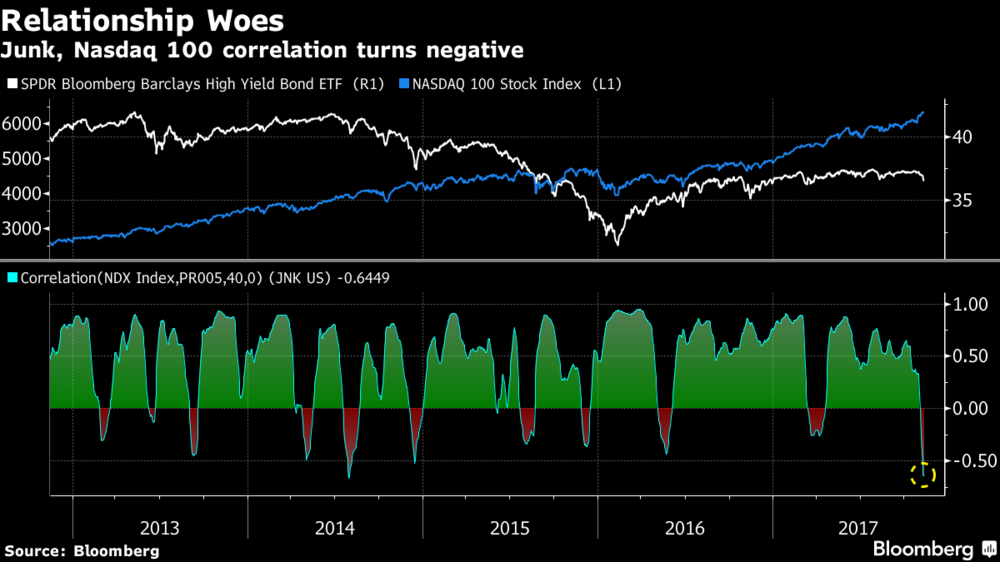
6. High-Yield Bond in Correction — The two largest junk bond ETFs, State Street’s (JNK) and BlackRock’s (HYG), are at their lowest levels in seven months as declines and fresh outflows inject volatility into the asset class. The downward movement has been intensified by lackluster quarterly results by some of the largest high-yield bond issuers, which are often among the biggest holdings of the popular ETFs. With high-yield bonds and the tech-heavy index of Nasdaq 100 stocks moving in tandem for most of their history, a recent breakdown in correlation suggests the selloff gripping junk is set to spread farther.

The week ahead — Economic data from Econoday.com:
Week of Nov 3 2017 Weekly Recap & The Week Ahead

Monday, November 6th, 2017

“Of course there is always a reason for fluctuations, but the tape does not concern itself with the why or wherefore. It doesn’t go into explanations. I didn’t ask the tape why when I was fourteen, and I don’t ask it today at forty…” — Jesse Livermore

1. GOP Unveils Overhaul the Tax System
— GOP unveils the tax overhaul plan that would reduce the number of income tax brackets, raise the child tax credit and preserve popular retirement savings plans. The GOP aims to permanently lower the corporate tax rate to 20 percent. The House bill would also slash the number of income tax brackets from seven to four: 12 percent, 25 percent, 35 percent and 39.6 percent. The bill is also expected to raise the child tax credit to $1,600 from its current maximum of $1,000. It’s also expected to preserve popular retirement savings plans like 401(k)s and Individual Retirement Accounts. However, the plan would cut a popular mortgage interest deduction in half. While it would maintain the current deduction of $1 million in mortgage debt for current homeowners, that cap would be slashed to $500,000 for newly purchased homes and allow taxpayers to write off up to $10,000 in state and local property taxes.
2. ITC Proposal for 35% Duty on Imported Solar Panels — the U.S. International Trade Commission has recommended the Trump administration impose an import tariff of up to 35% on solar panels to protect U.S. manufacturers. “That’s below the price that people have been hoarding panels for,” said Cowen analyst Jeffrey Osborne. “On the demand side, job cuts won’t be as bad as feared, but on the manufacturing side, job creation won’t be as big.
3. Apple Could Drop Qualcomm Components in Future iPhones — locked in an intensifying legal dispute with Qualcomm (NASDAQ:QCOM), Apple (NASDAQ:AAPL) is designing iPhones and iPads for next year that would jettison the chipmaker’s components, sources told WSJ. Modem chips from Intel (NASDAQ:INTC) and possibly MediaTek would be placed in the devices instead as Qualcomm is reportedly withholding software critical to testing its chips in Apple prototypes.
4. Powell Set to be Trump’s Fed pick Replacing Yellen — President Trump has settled on Fed Governor Jerome Powell as next Fed Chairman, WSJ reports. If confirmed, he would take up the reins at the central bank in February. He is seen as the “safe choice” because he’s not expected to veer drastically from current Fed policy. That would mean gradually raising short-term interest rates in quarter-percentage-point steps through 2020, while slowly shrinking the Fed’s $4.2T balance sheet.
5. Venezuela Seeks to Restructure Debt — Venezuela’s Nicolas Maduro has announced plans to make one final $1.1B principal payment for a bond issued by state-owned oil company PVSDA. The country would then aim for a restructuring and refinancing, although it has few avenues to do so because of U.S. sanctions. Estimates of Venezuela’s total outstanding debt vary, with some analysts putting the figure between $100B-$150B.
6. Weekly Sentiment Survey from AAII — in this latest week’s sentiment survey from AAII, bullish sentiment increased from 39.6% up to 45.1%. That’s the first 40%+ reading in six weeks and the highest level since the first week of January.

Meanwhile, Bearish sentiment dropped nearly 4.5% percentage points to 25.57%.

The week ahead — Economic data from Econoday.com:

Week of Oct 27 2017 Weekly Recap & The Week Ahead

Monday, October 30th, 2017

“If you take emotion – would be, could be, should be – out of it, and look at what is, and quantify it, I think you have a big advantage over most human beings.” — John Henry

1. Bitcoin Tops $6,100, A New Record High — Bitcoin hit an all-time high of $6,147.07 last week, according to CoinDesk, recording gains of over 500% this year, more than any other tradable asset class. Some are attributing the latest rise to another upcoming split in bitcoin known as a “fork,” which will lead to the creation of a new cryptocurrency called bitcoin gold.
2. Venezuela Missed $586M Debt Payments — Venezuela has now missed $586M in payments tied to the debt of the government, state oil giant PDVSA and utility Electricidad de Caracas, just days before the first of two can’t-miss debt deadlines. “I don’t see how any person who’s involved in Venezuelan debt can be anything except concerned, except for those who have credit default swaps,” said Russ Dallen, managing partner at Caracas Capital Markets.
3. Arbitration Rule Win for Wall Street to Block New Regulations Allowing U.S. Consumers to Sue Their Banks — Vice President Mike Pence cast a tie-breaking Senate vote to block new regulations allowing U.S. consumers to sue their banks, handing a big victory to Wall Street and other big financial institutions. By defeating the rule, Republicans are dismantling a major effort of the Consumer Financial Protection Bureau, the watchdog created by Congress in the aftermath of the financial crisis.

The week ahead — Economic data from Econoday.com:

Search
Calendar
February 2026
M T W T F S S
« Jan    
 1
2345678
9101112131415
16171819202122
232425262728  
Archives
Categories
The information provided by The EGS Blog is based on sources believed to be reliable, but it is not guaranteed to be accurate. There is no guarantee that the recommendations of The EGS Blog will be profitable or will not be subject to losses. The information provided by The EGS Blog is not a recommendation or a solicitation that any particular investor should purchase or sell any particular security in any amount, or at all. The investments discussed or recommended herein may be unsuitable for investors depending on their specific investment objectives and financial position. At any time EGS LLC and its principals may maintain positions that are contrary to positions announced within the subscription service. In no event will The EGS Blog be liable to you or anyone else for any incidental, consequential, special, or indirect damage (including but not limited to lost profits or trading losses). PAST PERFORMANCE IS NO GUARANTEE OF FUTURE RESULTS

© Copyright 2026 Market Outlook All Rights Reserved
Design by EGS Sponsored by Equity Guidance LLC