Archive for the ‘Weekly Summary’ Category

Week of June 21 2019 Weekly Recap & The Week Ahead

Monday, June 24th, 2019

“Bull markets are born on pessimism, grown on skepticism, mature on optimism, and die on euphoria.” — John Templeton

1. Facebook Releases Plan for Libra Crypto — it could amount to the biggest catalyst for digital assets in their decade-long existence. Facebook (NASDAQ:FB) has unveiled a consortium to create an open-source digital currency called Libra, set to launch in the first half of next year, which would allow consumers to send money around the world easily and for free. While Libra won’t be run by Facebook – but rather by a nonprofit association and backed by relatively stable government money – the company does have a plan to profit from it with a new subsidiary, Calibra, which is building a digital wallet for storing and exchanging the currency. Furthermore, U.S. lawmakers from both sides of the aisle are forming a growing group calling for hearings on Facebook’s (NASDAQ:FB) Libra cryptocurrency. Democrat Maxine Waters, chairwoman of the House Financial Services Committee, said she wants Facebook to testify about the plans and the company should put them on hold for a review, while she’s also received a letter from the committee’s top Republican, Patrick McHenry, calling for a hearing. Many have additionally cited concerns about the social network’s checkered past when it comes to trust and privacy.
2. Boeing Gets Zero New Orders at Paris Air Show Day One — Boeing (NYSE:BA) didn’t announce a single new order on the first day of the expo, while rival Airbus (OTCPK:EADSF) recorded orders and options for 123 planes, according to CNBC. The report reinforces Boeing CEO Dennis Muilenburg’s view that this year’s Paris Air Show would be less about orders and more about reassuring customers and suppliers that the company is making progress on getting the grounded 737 MAX back in the air.
3. Rocket Explodes Near Exxon Site in Iraq — a rocket struck the site of the residential and operational headquarters of several global major oil companies in southern Iraq early Wednesday, including ExxonMobil (NYSE:XOM), but had no effect on oil fields or exports, sources told Bloomberg. The incident in the Basra province injured three Iraqi workers, however, prompting Exxon to evacuate 20 foreign employees. While attacks on energy facilities, including a Saudi Arabian pipeline and several oil tankers, as well as a U.S. military buildup, are stoking concerns, a considerable ratcheting of tensions will likely be required to drive prices higher.
4. FOMC Monetary Policy Meeting — as the Fed latest FOMC meeting, the yield on the benchmark 10-year Treasury dropped below 2% overnight for the first time since November 2016. The FOMC left interest rates unchanged at its monetary policy meeting last Wednesday, dropped the word “patient” from its statement and said it would “act as appropriate” to sustain the economy. The Fed Funds Futures pointing to a 100% chance of monetary policy easing in July.

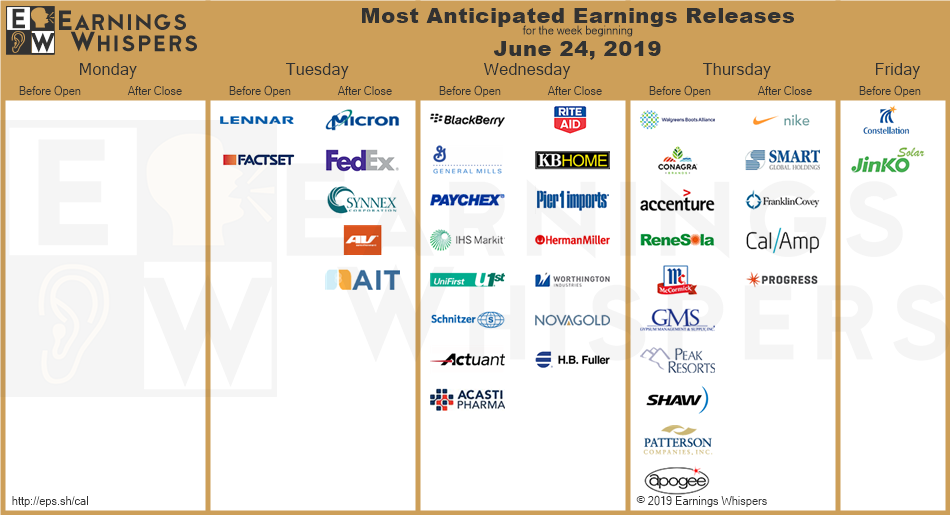
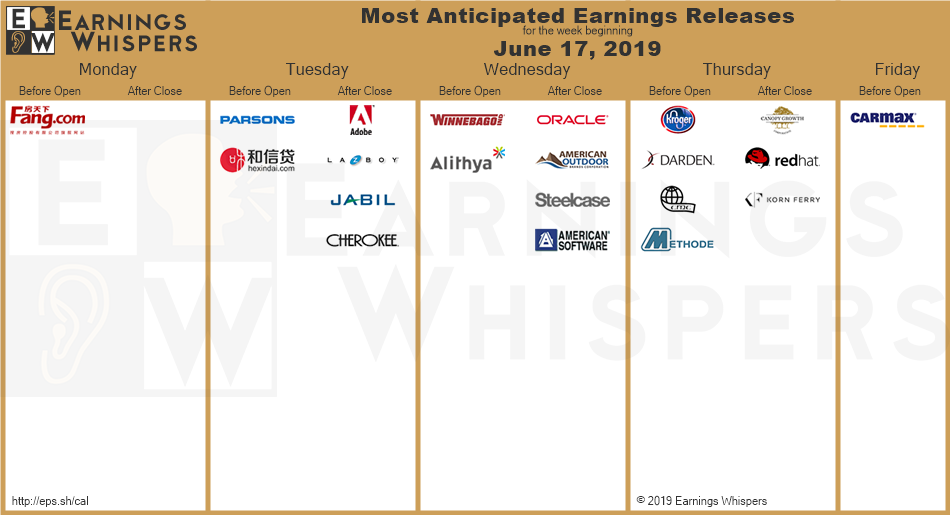
The week ahead — Economic data from Econoday.com:
Week of June 15 2019 Weekly Recap & The Week Ahead

Monday, June 24th, 2019

“One learns the most from mistakes, not successes.” — Paul Tudor Jones

1. Raytheon and United Technologies Agree to Merge — United Technologies and Raytheon have agreed to an all-stock merger, creating the second-largest defense-and-aerospace company in the U.S. after Boeing (NYSE:BA) with combined annual sales of around $74B. The deal won’t include United Tech’s (NYSE:UTX) elevator (Otis) and air conditioning units (Carrier), which it plans to spin off in 2020. Raytheon’s (NYSE:RTN) Tom Kennedy will become executive chairman of the combined company, to be called Raytheon Technologies, while UTX’s Greg Hayes will be named CEO. Two years after the deal closes, Hayes will assume the role of chairman and CEO.
2. Beijing Offers Support to Local Government — Beijing encouraged local governments to use special bonds for infrastructure projects in a bid to shore up economic growth. That helped offset President Trump’s threat to raise tariffs again if President Xi Jinping doesn’t meet with him at the G-20 summit at the end of June. The onshore yuan also bounced off its closing low of the year as the PBOC set its reference rate higher than forecast and announced plans to sell bills this month after the currency was hit in May.
3. Hong Kong Protests Intensify — Protests against Hong Kong’s controversial extradition law shut down key parts of the city, with police firing tear gas and rubber bullets to drive away thousands of demonstrators. Financial institutions also scrambled for liquid assets, triggering interbank interest rates in the territory to shoot up across the curve, with the one-month and two-month HIBOR reaching their highest level since late 2008. Hong Kong Chief Executive Carrie Lam argues the legislation is necessary to close a legal loophole that makes the city a refuge to criminals, but opponents say its approval would tear down the legal wall intended to keep Hong Kong’s justice system separate from China’s.
4. FTC Opposes Qualcomm Antitrust Request — the FTC has asked District Judge Lucy Koh to deny Qualcomm’s (NASDAQ:QCOM) request to delay enforcement of an antitrust ruling handed down in May, announcing that it was in the public interest because an appeal could take years. LG Electronics (OTC:LGEAF) reiterated the view of the FTC, saying it could be forced into signing another unfair deal unless Koh’s protections remain in place. On May 28, Qualcomm asked to put the sweeping antitrust decision on hold as it would “radically restructure its business relationships” in ways that would be impossible to reverse if it wins an appeal.
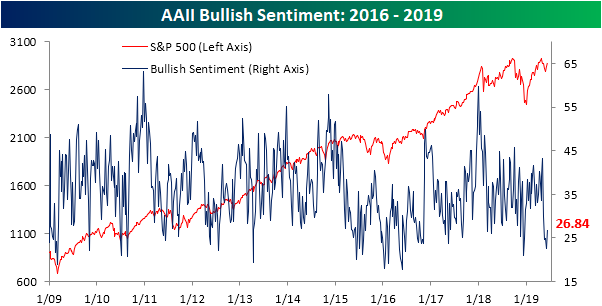
5. AAII Weekly Sentiment Survey — last week’s rally has reversed this build-up of bearish sentiment to a small degree, as the percentage of investors reporting as bulls in this week’s AAII survey grew to 26.84% from 22.53% last week. While this is an improvement, investors have been hesitant to rush back, as bullish sentiment remains low relative to history. This week’s reading is still over one standard deviation below the historical average of 38.19%.

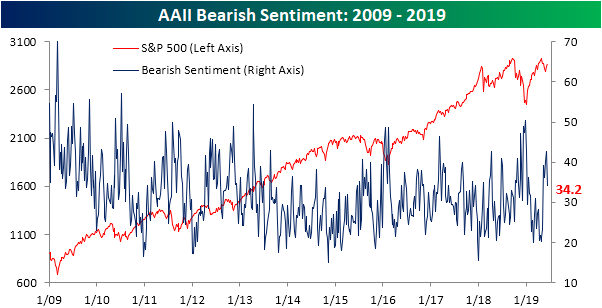
Bearish sentiment, on the other hand, saw a sharper move, falling to 34.2% versus 42.58% last week. That is the largest decline in bearish sentiment since February 7th of this year, when it had fallen just under 9%, from 31.76% to 22.78%. Similar to bulls, while this is an improvement, bearish sentiment remains elevated above its historical average.

The week ahead — Economic data from Econoday.com:
Week of June 7 2019 Weekly Recap & The Week Ahead

Monday, June 10th, 2019

“If it is abvious, it is obviously wrong” — Joe Granville

1. FTC Takes on Amazon, DOJ to Oversee Google — Amazon (NASDAQ:AMZN) could face heightened antitrust scrutiny under a new agreement between the government’s twin antitrust agencies that puts it under closer watch by the Federal Trade Commission, The Washington Post reported. The move would divvy up competition oversight of two of the country’s top tech companies, with the U.S. Justice Department having more jurisdiction over Google (GOOG, GOOGL) and paving the way for a potential investigation of the search-and-advertising giant.
2. Big Tech Faces Congressional Probe — the House Judiciary Committee unveiled a sweeping “top-to-bottom” review of unnamed tech companies early last week as reports surfaced of a dual effort from the DOJ and the FTC to tackle the perceived dominance and potential abuses of Big Tech. “The growth of monopoly power across our economy is one of the most pressing economic and political challenges we face today,” said David Cicilline, who chairs the Antitrust Subcommittee, adding that “market power in digital markets presents a whole new set of dangers.”
3. Trump Touted Progress in Mexico Talks — “Progress is being made” in talks with Mexico, according to President Trump, but “not nearly enough!” Discussions will continue , but “unless an agreement is reached a 5% tariff on Mexican goods would begin on Monday.” The peso slid as much as 1.3% as credit ratings agency Fitch downgraded the nation’s sovereign debt near junk status – citing risks posed by heavily indebted oil company Pemex and trade tensions – while Moody’s lowered its outlook to negative. Where would the levies hit hardest? Mexico is the world’s biggest exporter of beer (BUD, STZ), selling $3.6B worth to the U.S. last year, along with $2B in avocados (CVGW, FDP) and $2B in tomatoes. Corporations are also speaking out. Chipotle (NYSE:CMG) estimated a $15M hit, but said it could cover that by raising burrito prices by around 5 cents, while auto parts maker Aptiv (NYSE:APTV) said a 5% tariff would cost the company $17M per month.
4. US/China Trade War – China has lots of policy room according to PBOC — PBOC Governor Yi Gang declared if the trade war with the U.S. deepens, “we have plenty of room in interest rates, we have plenty of room in required reserve ratio rate, and also for the fiscal, monetary policy toolkit, I think the room for adjustment is tremendous,”. The yuan has stabilized in recent weeks as authorities voiced support for the currency, following a rapid selloff that pushed it near 7 per dollar – a level not breached since the global financial crisis.
5. Theresa May to step down as Tory leader — after 1,059 days in charge, U.K. Prime Minister Theresa May has officially stepped down as leader of the ruling Conservative Party. The race has already started to replace her, with 11 contenders and Boris Johnson the current favorite. Starting next week, the party’s 300 or so MPs will whittle down the field of candidates to two through successive rounds of voting. After that, the party’s rank-and-file members, an estimated 124K people, will decide which of those two finalists gets to be leader.

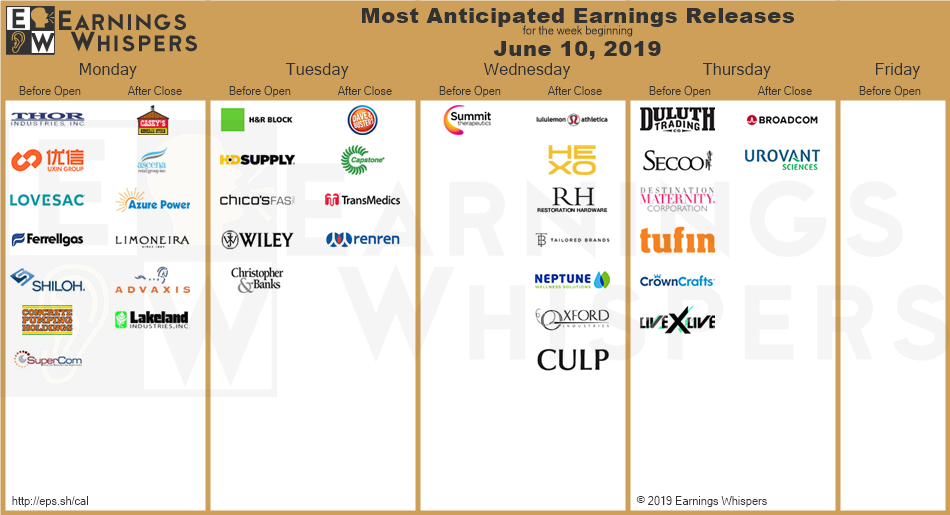
The week ahead — Economic data from Econoday.com:
Week of May 24 2019 Weekly Recap & The Week Ahead

Friday, May 31st, 2019

There will not be any re-cap for the week of May 24 to May 31 2019. We are away for some needed R&R.

Have a good week.

The staffs at EGS.

The week ahead — Economic data from Econoday.com:
Week of May 10 2019 Weekly Recap & The Week Ahead

Tuesday, May 21st, 2019

“Markets are constantly in a state of uncertainty and flux and money is made by discounting the obvious and betting on the unexpected.” — George Soros

1. Walmart Pushes Veterinary Clinic — with spending on pets in the U.S. estimated to exceed $75.3B this year, Walmart (NYSE:WMT) aims to have 100 veterinary clinics open in its stores within the next 12 months, growing from the 21 it has today. The retailer is also for the first time launching an online pet pharmacy, WalmartPetRX.com, rivaling Chewy.com. Walmart has seen a roughly 60% increase in the number of dog- and cat-related health-care items sold on its website over the past year, according to a company spokeswoman.
2. China Hardens Trade Stance as Talks Enter New Phase — the new hard line taken by China in trade talks—surprising the White House and threatening to derail negotiations—came after Beijing interpreted recent statements and actions by President Trump as a sign the U.S. was ready to make concessions, said people familiar with the thinking of the Chinese side. Adding to the pressure, the U.S. formally filed paperwork Wednesday to raise tariffs on $200 billion of Chinese goods to 25% from the current 10% at 12:01 a.m. Friday. Beijing’s Commerce Ministry responded by threatening to take unspecified countermeasures. At a campaign rally in Florida Wednesday night, Mr. Trump said Chinese leaders “broke the deal” in trade talks with the U.S.
3. BlackRock Pulls Out of Italian Bank Banca Carige Rescue — BlackRock’s (NYSE:BLK) withdrawal from the proposed deal increases the possibility that the Italian government may have to bail out Banca Carige (OTC:BCIGY). BlackRock, which was to have bought about half a 720M euro ($806M) share issue, rejected the proposed deal for reasons including excessive risk. The deal would have given BlackRock control of Italy’s 10th-largest bank.
4. Iran Begins Withdrawal from Nuclear Deal — a year after the U.S. pulled out of the Iran nuclear accord, Tehran declared it’s no longer committed to parts of the deal. President Hassan Rouhani said the remaining signatories – the U.K., France, Germany, China and Russia – had 60 days to implement their promises to protect Iran’s oil and banking sectors, giving them a choice of following President Trump or engaging with the Islamic Republic in violation of American sanctions. Iran will also begin to build up its stockpiles of low enriched uranium and heavy water, and threatened to resume construction of the Arak nuclear reactor.
5. U.S. Hits China with Tariff Increase — President Trump’s tariff increase on $200B worth of Chinese goods took effect last Friday after midnight. China’s Commerce Ministry immediately announced it would take countermeasures against the American move, but did not reveal what its response would entail. President Trump is already taking steps to impose a fresh round of tariffs on $325B in Chinese goods that aren’t currently taxed. If that happens, virtually all Chinese exports to the U.S. would face 25% tariffs, further ratcheting up tensions between the world’s two largest economies.

The week ahead — Economic data from Econoday.com:
Week of May 17 2019 Weekly Recap & The Week Ahead

Tuesday, May 21st, 2019

“The market is a device for transferring money from the impatient to the patient.”– Warren Buffet

1. U.S. Telecoms Prepare for Huawei Ban — paving the way for a ban on doing business with China’s Huawei, President Trump signed an executive order barring American companies from using telecom equipment made by firms posing a national security risk. The order would invoke the International Emergency Economic Powers Act and comes at a delicate time in relations between Beijing and Washington, with the two ratcheting up tariffs over what U.S. officials call China’s unfair trade practices.
2. Trade War Sees U.S. farmers Get $15B in Aid — the Trump administration is planning on providing about $15B in aid to help U.S. farmers whose products may be targeted by the newly unveiled Chinese tariffs. The group has been among the hardest hit in the trade war, with U.S. soybean futures falling to their lowest in a decade on Monday and shipments of the most valuable U.S. farm export to China dropping to a 16-year low in 2018. A new aid program would be the second round of assistance for American farmers, after the Department of Agriculture’s $12B compensation plan last year.
3. Teva, Drugmakers, Accused of Price-Fixing — forty-four U.S. states have filed a lawsuit accusing Teva Pharmaceuticals (NYSE:TEVA) of orchestrating a sweeping scheme with 19 other drugmakers to inflate drug prices – sometimes by more than 1,000% – and stifle competition for generic medicines. “We take these accusations seriously and we are going to defend ourselves,” CFO Mike McClellan declared. Soaring drug prices from both branded and generic manufacturers have sparked outrage across the political spectrum, from Republicans and Democrats alike.
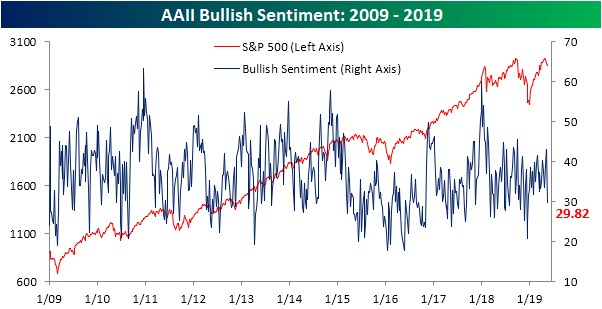
4. AAII Weekly Sentiment — One week after coming in at its highest level since October, bullish sentiment has fallen off of a cliff this week to 29.82% versus 43.12% last week. From a historical perspective, this is not at any kind of extreme, but it did bring optimism to its lowest level of 2019 and by a pretty wide margin at that. Additionally, this was the largest drop in bullish sentiment since December 13th of last year when it fell 17.04% in a week.

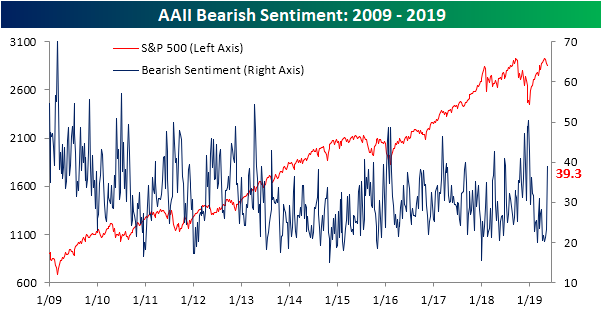
Bearish sentiment spiked up to 39.3% from 23.19% last week. While this was a massive spike higher, it is still well off of any sort of extreme, and we actually saw higher readings late last year. Investors Intelligence is echoing the AAII results, as that survey showed the highest percentage of respondents since February (31.1%) expecting a correction. Granted, bearish sentiment in this survey remains muted, as it actually fell to its lowest level since April of last year.

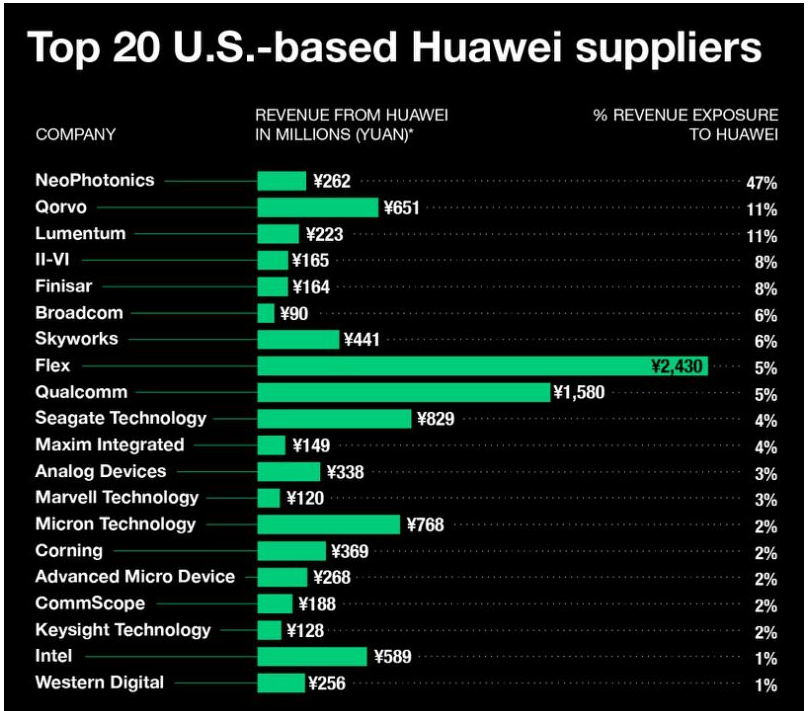
5. Chip Makers Get Caught in Huawei Crossfire WSJ, following the ban on Huawei, chip companies selling technology to the Chinese communications equipment giant must be granted a special license to do so. Among the hardest-hit chip stocks Thursday were Qualcomm , Broadcom , Qorvo and Skyworks Solutions —key makers of modem and radio-frequency processors used in smartphones. Xilinx is affected as well given its growing business in 5G equipment. Shares of memory suppliers Micron Technology and SanDisk parent Western Digital also slipped in the decision’s aftermath. Below shows a list of US companies effected by the ban.

The week ahead — Economic data from Econoday.com:
Week of May 3 2019 Weekly Recap & The Week Ahead

Tuesday, May 7th, 2019

“Letting losses run is the most serious mistake made by most investors.” – William O’Neil

1. Tesla to Slash Solar Panel Prices by 38% — losing its status as the nation’s leading rooftop solar company last year, Tesla (NASDAQ:TSLA) announced plans to begin selling solar panels and related equipment for up to 38% below the national average price, NYT reports. This will be achieved by standardizing systems and requiring customers to order them online. Homeowners will also photograph electric meters and send the images to the company, reducing the need for site visits.
2. Boeing CEO to Pitch 737 Max Comeback — Boeing (NYSE:BA) CEO Dennis Muilenburg held his first press conference since the worldwide grounding of the 737 MAX, which led to investigations, lawsuits and a sharp loss in shareholder value. While reports over the weekend suggested that pilots have warned draft 737 MAX training proposals did not go far enough to address their concerns, the FAA may clear the plane to fly in late May or the first part of June.
3. FOMC Meeting Recap— Fed officials agreed to hold their benchmark interest rate steady and signaled comfort that their wait-and-see posture had steadied the economy. the Fed refused to signal anything other than that it was still on pause, while Chair Jerome Powell said the factors dragging on inflation might be “transitory,” not “persistent.”
4. Merck Steps Up Meales Vaccine Production — Merck (NYSE:MRK), the sole U.S. supplier of measles vaccines, has increased output to meet an uptick in U.S. demand amid the country’s biggest outbreak in 25 years. “The demand side of the equation hasn’t been outstripping our underlying capacity,” Chief Marketing Officer Mike Nally said in an interview. The CDC reported 704 cases of measles as of April 26, a 1.3% increase since the 695 reported the week before, with the vast majority of cases occurring in children who have not received the MMR vaccine.

The week ahead — Economic data from Econoday.com:
Week of Apr 26 2019 Weekly Recap & The Week Ahead

Monday, April 29th, 2019

“The speculator’s chief enemies are always boring from within. It is inseparable from human nature to hope and to fear. In speculation when the market goes against you hope that every day will be the last day – and you lose more than you should had you not listened to hope – the same ally that is so potent a success-bringer to empire builders and pioneers, big and little. And when the market goes your way you become fearful that the next day will take away your profit, and you get out – too soon. Fear keeps you from making as much money as you ought to. The successful trader has to fight these two deep-seated instincts . . . Instead of hoping he must fear; instead of fearing he must hope.” — Jesse Livermore

1 Occidental Seeks to Buy Anadarko for $38 Billion, Topping Chevron’s Offer — Occidental Petroleum Corp. (OXY) offered to buy Anadarko Petroleum Corp. (APC) for $38 billion, launching a potential bidding war for a company that previously agreed to be purchased by Chevron Corp. (CVX) for about $33 billion.
2. Chip Stocks Volatile After TI, STM — Texas Instruments (NASDAQ:TXN) lost its post-earnings gains after the CFO said the cyclical downturn was likely still in its early stages. European semi peer STMicroelectronics (NYSE:STM) reported Q1 misses and said lower-than-expected FY19 plans would be addressed with inventory adjustments and spending cuts. European chip stocks shook off early losses, but the U.S. sector could still have a volatile day as investors seek clearer sector visibility.
3. Boeing Details Financial Hit From 737 MAX Grounding — The aerospace giant said that it was taking an initial hit of more than $1 billion while the plane is grounded and production of additional aircraft remains scaled back. Mr. Muilenburg, CEO said the Federal Aviation Administration would soon conduct certification flights to test the 737 MAX’s updated software, a key step to restarting commercial flights. Boeing is also working with airlines and pilots to restore trust among fliers. the plane maker reported first-quarter earnings of $2.15 billion. The profit demonstrated the resilience of Boeing’s broader portfolio, with sales of 787s and other jetliners as well as services and military hardware limiting the decline.
However, the company said it would suspend the huge share buybacks that have propelled its share price over the past three years and it dropped full-year profit and sales guidance for 2019.
4. Bank of Japan Leaves Policy Unchanged — the Bank of Japan left policy unchanged, as most economists expected, maintaining its policy balance rate at -0.1% and guiding to keep extremely low interest rates until at least spring 2020. That’s putting a date to policy guidance it had previously just said it would keep for an “extended period.” The BOJ’s target for the 10-year government bond yield is zero, and for the first time the bank projected economic growth for the year ending March 2022 (it expects 1.2% growth then). It sees core CPI rising at 1.6% in fiscal 2021; time’s running out for Gov. Haruhiko Kuroda to hit a 2% inflation rate before his term expires in 2023.
5. Japan Trade Talks Kick Off — U.S. Treasury Secretary Steven Mnuchin is scheduled to meet with Japanese Finance Minister Taro Aso to discuss provisions against currency manipulation and other trade issues. Economy Minister Toshimitsu Motegi is also set to meet with U.S. Trade Representative Robert Lighthizer to negotiate trade issues that could impact automobile manufacturers Honda (NYSE:HMC), Toyota (NYSE:TM), Mazda (OTCPK:MZDAY) and Nissan (OTCPK:NSANY). The meetings precede the planned summit between Prime Minister Shinzo Abe and President Donald Trump later in the week.

The week ahead — Economic data from Econoday.com:
Week of Apr 19 2019 Weekly Recap & The Week Ahead

Monday, April 22nd, 2019

“When you talk, you are telling people what you already know. When you listen, however, that’s how you learn something new.” — Dalai Lama

1. Deutsche Bank Subpoenaed Over Trump Business — Congressional investigators have subpoenaed Deutsche Bank (NYSE:DB) as Democrats step up their probes into President Trump and his longtime lender. The subpoenas from the U.S. House of Representatives Intelligence and Financial Services committees mark an escalation of Democratic-led probes into Trump’s business dealings. The committees also subpoenaed multiple other financial institutions, including JPMorgan (JPM), Bank of America (BAC) and Citigroup (C) as part of their investigations.
2. U.S.-China Trade Talks Near Final Round — U.S. Treasury Secretary Steven Mnuchin said a U.S.-China trade agreement would go “way beyond” previous efforts to open China’s markets to American companies and the two sides were “getting close to the final round of concluding issues.” “This is way beyond anything that looked like a bilateral investment treaty,” he added. U.S. negotiators have also reportedly tempered demands that China curb industrial subsidies as a condition for a trade deal after strong resistance from Beijing.
3. U.S., Turkey Deadlock over Russia Missile Dispute Continues — the U.S. and Turkey have failed to break their impasse over Turkey’s plan to deploy a Russian air defense system the Pentagon says could jeopardize U.S. fighter aircraft including Lockheed Martin’s (NYSE:LMT) F-35, which Turkish manufacturers helped build. Turkish officials repeated that the deal with Russia has been signed and is final, while the U.S. has threatened to impose sanctions under legislation that allows the punishment of entities doing business with Russia, and to expel Turkey from the F-35 program. The first batch of Russian S-400 missiles may be delivered as early as June.
4. Qualcomm, Apple Drop All Litigation — Qualcomm (NASDAQ:QCOM) and Apple (NASDAQ:AAPL) agreed to dismiss all litigation worldwide in a settlement that involves Apple paying QCOM. The companies also reached a six-year license agreement, effective April 1, with two one-year option periods plus a multiyear chipset supply agreement. In a regulatory filing Qualcomm says it expects incremental EPS of about $2 as product shipments ramp up.

The week ahead — Economic data from Econoday.com:
Week of Apr 12 2019 Weekly Recap & The Week Ahead

Monday, April 15th, 2019

“One of the frustrating things for people who miss the first rally in a bull market is that they wait for the big correction and it never comes. The market just keeps climbing and climbing. It feeds on itself in frenzied fashion and propels prices considerably higher for six months or so, and sometimes longer.” — Martin Zweig

1. China Wants to Eliminate Bitcoin Mining — China’s state planner has labeled Bitcoin (BTC-USD) mining as an “undesirable” industry in a draft proposal, recommending local governments eliminate the sector in the country. The public will have until May 7 to share feedback on proposed amendments, after which the final version will be published and become effective. Last week, the price of Bitcoin soared nearly 20% in its best day since the height of the 2017 bubble, breaking $5,000 for the first time since mid-November.
2. EU Leaders to Grant the U.K. Deadline to Oct. 31 — Theresa May managed to convince EU leaders to grant the U.K. more time before it leaves the bloc, extending the deadline to Oct. 31, but some experts are now saying her days in office are numbered. “A six-month period is clearly enough for the Conservative Party to contemplate a change in leadership while still allowing some time for the incoming PM to seek to negotiate with the EU,” JPMorgan economist Malcolm Barr said in a research note. “One could even cram a general election into that time frame too if PM May were to resign by roughly the end of May.”
3. Tesla Gigafactory Expansion Freeze — Tesla (NASDAQ:TSLA) and Panasonic (OTCPK:PCRFY) are suspending plans to expand the capacity of their $4.5B U.S. plant in the face of uncertain demand for electric vehicles, the Nikkei reports. The two had intended to raise capacity 50% by 2020 to the equivalent of 54 gigawatt-hours, but financial problems forced a re-think. Panasonic also intends to suspend planned investment in Tesla’s battery and EV plant in Shanghai, and instead provide technical support and a small number of batteries from the existing Gigafactory.
4. Chevron to Buy Anadarko in $33B Cash and Stock Deal — Chevron (NYSE:CVX) plans to acquire Anadarko Petroleum (NYSE:APC) in a stock and cash transaction valued at $33B, or $65 per share, enhancing its Upstream portfolio and strengthening its shale, deepwater and natural gas resource basins. Anadarko shareholders will receive 0.3869 shares of Chevron and $16.25 in cash for each APC share. The deal anticipates annual run-rate synergies of approximately $2B, and will be accretive to free cash flow and earnings one year after close. If approved, Chevron said it also plans to boost its annual share buyback program to $5B from $4B.
5. EU Green Lights U.S. Trade Talks — Europe is set to start trade talks with the U.S. after EU ambassadors gave a green light to a proposed mandate for the European Commission to conduct the negotiations on behalf of the 28 EU member countries. The talks commence despite opposition from France, which expressed concerns over the U.S. intention to withdraw from the Paris Agreement on climate change. EU ministers still need to give their rubber stamp, which is due on April 15.
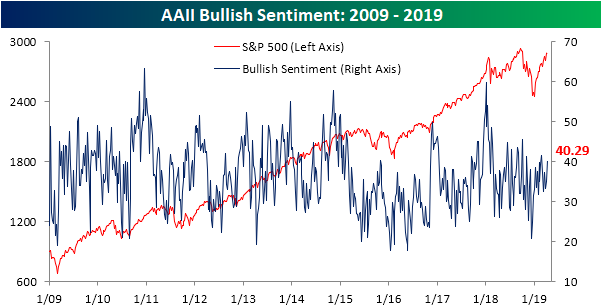
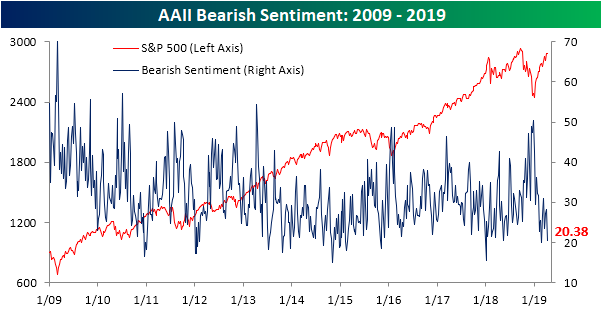
6. AAII Weekly Investor Sentiment Survey — AAII Weekly Sentiments the results are very similar to the final days of February with bullish sentiment around 40%, bearish down near 20%, and neutral once again in the upper 30’s. Up from 35.02% last week, bullish sentiment has crossed back over the 40% threshold; the first time it has done so since the previously mentioned week in February.
While bullish sentiment is sitting a couple of points above the historical average, this is still several percentage points from reaching any sort of extreme level (more than one standard deviation above the aforementioned average).

Bearish sentiment, on the other hand, fell all the way back down to 20.38% this week, the lowest since its 20% reading on February 28th. That is around 10% less than the historical average for bearish sentiment. That is also at the lower end of the range bearish sentiment has stayed within in the past decade.

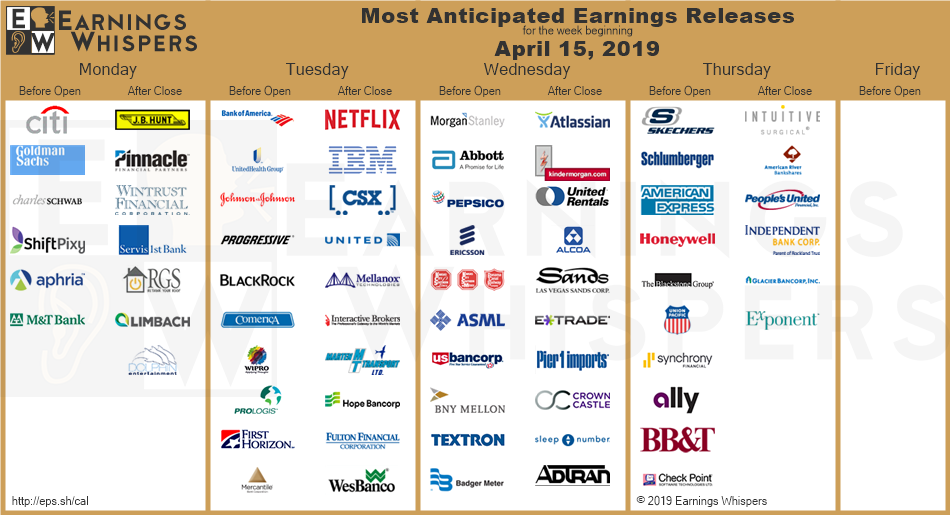
The week ahead — Economic data from Econoday.com:
Search
Calendar
February 2026
M T W T F S S
« Jan    
 1
2345678
9101112131415
16171819202122
232425262728  
Archives
Categories
The information provided by The EGS Blog is based on sources believed to be reliable, but it is not guaranteed to be accurate. There is no guarantee that the recommendations of The EGS Blog will be profitable or will not be subject to losses. The information provided by The EGS Blog is not a recommendation or a solicitation that any particular investor should purchase or sell any particular security in any amount, or at all. The investments discussed or recommended herein may be unsuitable for investors depending on their specific investment objectives and financial position. At any time EGS LLC and its principals may maintain positions that are contrary to positions announced within the subscription service. In no event will The EGS Blog be liable to you or anyone else for any incidental, consequential, special, or indirect damage (including but not limited to lost profits or trading losses). PAST PERFORMANCE IS NO GUARANTEE OF FUTURE RESULTS

© Copyright 2026 Market Outlook All Rights Reserved
Design by EGS Sponsored by Equity Guidance LLC