Archive for the ‘Weekly Summary’ Category

Week of Sept 7 2019 Weekly Recap & The Week Ahead

Monday, September 9th, 2019

“One of the funny things about the stock market is that every time one person buys, another sells, and both think they are astute” – William Feather

1. Trade War Between the U.S. and China Rippling Effect — new U.S. tariffs on clothing and other imports from China that went into effect Sunday are expected to hit consumers. President Trump has since told U.S. companies to look for alternatives to China. A round of retaliatory Chinese tariffs has now also taken effect, targeting imports of U.S. soybeans, crude oil and pharmaceuticals. It is crimping growth in Asian industrial giants such as Japan and South Korea and hitting factories as far from the front line as Germany. Global industrial production fell in the three months through June, as did trade flows, and a series of surveys of manufacturing companies in Asia and Europe suggests a rebound is unlikely over the coming months.
2. U.S., China Agree to Renew Trade Talks — China’s Ministry of Commerce says leaders of the U.S. and Chinese trade talks held a phone call and agreed to meet early next month in Washington, D.C., for another round of negotiations. Deputy-level officials will work together in mid-September to lay the groundwork for the meeting. On a related note, the markets already expect the Fed to cut interest rates modestly at the Sept. 17-18 policy meeting. Investors place a 90% probability on a quarter-percentage-point rate cut and a 10% probability on a larger, half-point cut, according to CME Group.
3. Apple Returns to Bond Market— taking advantage of the steep decline in benchmark interest rates, Apple (NASDAQ:AAPL) is joining U.S. companies including Deere (NYSE:DE) and Disney (NYSE:DIS) by launching its first bond deal since 2017 and selling $7B of debt. All three companies issued 30-year bonds with yields below 3%, a first for the corporate debt market. Bonds issued by big-name corporations give investors a relatively safe alternative that still pays more than government bonds.
4. Argentina Imposes Currency Controls — The spiraling economic crisis in Argentina has prompted the central bank to slap capital controls on businesses as the peso lost more than a quarter of its value since primary elections last month. Exporters will face limits of five days to repatriate foreign currency, while institutions will need authorization of the bank to buy dollars in the forex market, except in the case of foreign trade. The decision reverses one of the first big achievements of President Macri who removed strict capital controls after taking power in December 2015 (the restrictions had prompted the MSCI index to strip Argentina of its status as an emerging market, demoting it to a frontier market).

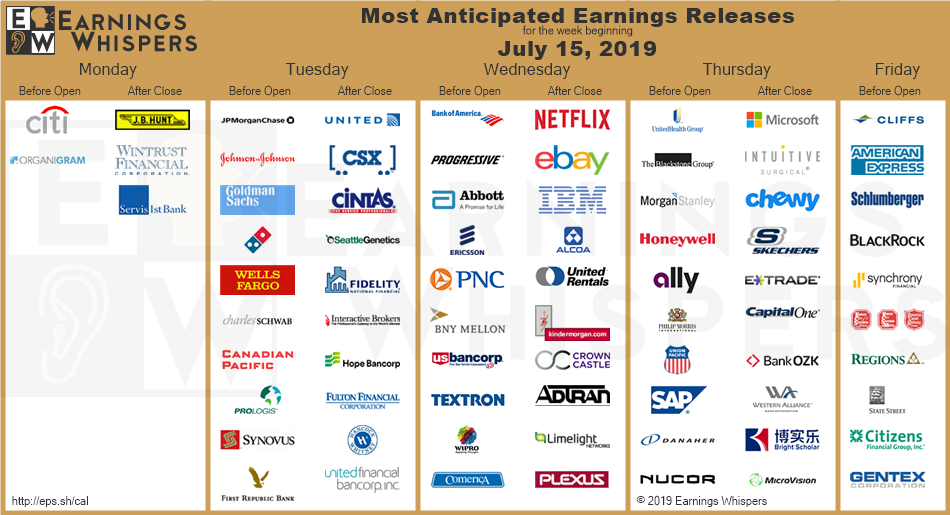
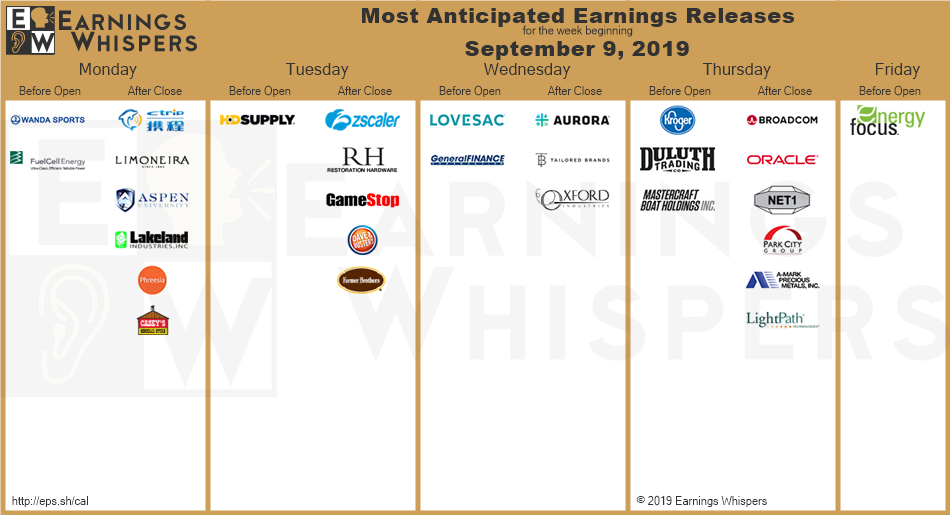
The week ahead — Economic data from Econoday.com:
Week of Aug 23 2019 Weekly Recap & The Week Ahead

Monday, September 2nd, 2019

“Michael Marcus taught me one other thing that is absolutely critical: You have to be willing to make mistakes regularly; there is nothing wrong with it. Michael taught me about making your best judgment, being wrong, making your next best judgment, being wrong, making your third best judgment, and then doubling your money.” – Bruce Kovner

1. Cigarette makers Philip Morris International and Altria Group Are in Advanced Talks to Merge — the potential blockbuster deal would reunite two tobacco giants struggling with shrinking demand. The two companies split in 2008 but hold the same portfolio of cigarettes, including Marlboro. The products are sold by Altria in the U.S. and Philip Morris elsewhere. A combination would create a company with a market value of roughly $200 billion.
2. Judge Ordered Johnson & Johnson Must Pay $572 Million for the Opioid-Addiction Crisis in Oklahoma — Judge Thad Balkman said the state proved the company launched a misleading marketing campaign to convince the public that opioids posed little addiction risk and were appropriate to treat a range of chronic pain. The verdict caps the first opioid case to go to trial among thousands brought by state and local municipalities and could signal further findings of liability for drug companies facing similar cases. The three major drug wholesalers – McKesson (NYSE:MCK), AmerisourceBergen (NYSE:ABC) and Cardinal Health (NYSE:CAH) – should see some action now that J&J’s exposure is clarified.
3. Impossible Whopper Goes on Sale Nationwide — Burger King (NYSE:QSR) will bring the Impossible Whopper to all of its 7,200 U.S. locations today after a successful test run in seven markets. The nation’s second-largest burger chain began testing the plant-based burger from Impossible Foods at locations in St. Louis in April. Those outlets saw traffic outperform national averages by 18.5% that month, according to a report from inMarket.
4. Retailer Forever 21 Weighs Bankruptcy Filing — things are getting harder in the retail landscape as Forever 21 reportedly considers filing for bankruptcy, in a move that could put pressure on mall owners Simon Property Group (NYSE:SPG) and Brookfield Property Partners (NASDAQ:BPY). Struggles also saw Hudson’s Bay (OTCPK:HBAYF) offload Lord & Taylor on Wednesday to clothing rental startup Le Tote for $100M. Not everything is so bleak, however, as sneaker retailer Puma (OTCPK:PUMSY) opened its first U.S. flagship store today on the corner of Fifth Avenue and 49th Street in Manhattan.
5. Florida Braces for Hurricane Dorian — Hurricane Dorian is strengthening and is forecast to hit Florida as a Category 4 storm during the busy Labor Day weekend, becoming the first major hurricane to hit the area in 15 years. American Airlines (NASDAQ:AAL) and Southwest (NYSE:LUV) are allowing travelers to change their Florida flights without fees ahead of the storm, potentially weighing on the carriers which have weathered a difficult summer. Some of the nation’s largest investor-owned hospitals are also gathering supplies in preparation, including Tenet Healthcare (NYSE:THC), HCA Healthcare (NYSE:HCA) and Universal Health Services (NYSE:UHS). There’s additional concern for insurers and orange juice farmers, while the oil industry watches if the storm will pass into the Gulf of Mexico.
6. S&P calls ‘default’ in Argentina — Argentina’s decision to “unilaterally” extend maturities on its short-term debt constitutes a “default,” according to Standard & Poor’s, which slashed the country’s long-term foreign and local currency issue ratings to CCC – “vulnerable to nonpayment.” The downgrade came after Argentine bond prices fell and country risk soared to levels not seen since 2005 on Thursday amid fears of a full-blown financial crisis.

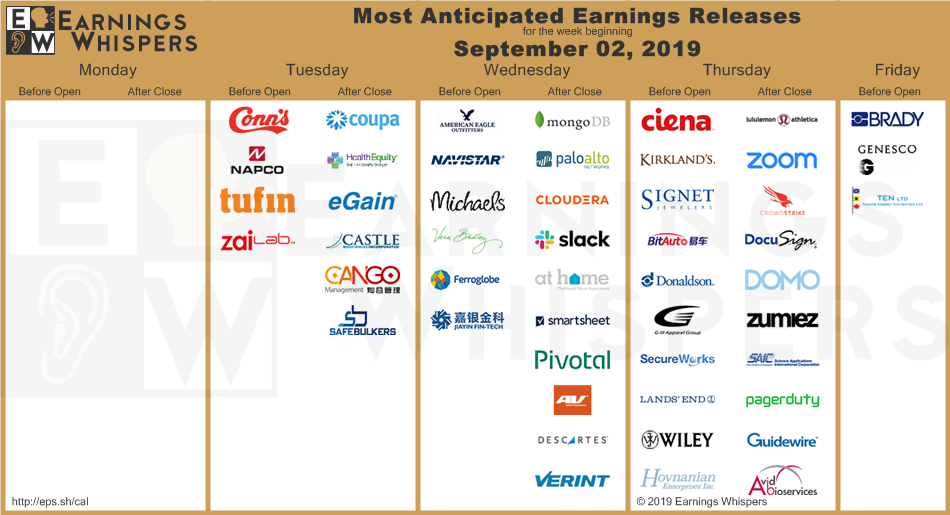
The week ahead — Economic data from Econoday.com:
Week of Aug 16 2019 Weekly Recap & The Week Ahead

Thursday, August 22nd, 2019

“It wasn’t raining when Noah built the ark.” — Howard Ruff

There will not be any Weekly Re-Cap for the week of Aug 12 to Aug 23 2019. We are away for some needed R&R.
Have a good week.
The staffs at EGS.

Week of Aug 9 2019 Weekly Recap & The Week Ahead

Tuesday, August 13th, 2019

“Reaching any goal in trading requires specific domain knowledge and technical skills. But then, after that, it’s all mindset management. Yet most people ignore that —they automatically think they have that last part all figured out, and it’s a mistake.”

1. FedEx Said It Would End its Contract to Deliver Amazon Packages — FedEx is gambling that it is better off filling its trucks with other customers’ goods. The company’s contract with Amazon expires at the end of this month. In June, FedEx said it was ending its air-shipping contract with Amazon in the U.S. The company would still handle international shipments. The decisions are evidence of escalating tensions between the longtime partners as Amazon builds its own delivery network.
2. White House to Move Forward With Ban on U.S. Government Business With Huawei — the White House is expected to start implementing provisions of a law that bars the U.S. government from doing business with Huawei. The planned move comes despite the Chinese tech giant’s efforts to block the rule in court. The Office of Management and Budget issued an interim rule this week laying out steps to ensure government agencies aren’t doing business with Huawei and several other Chinese companies. The rule is set to go into effect Aug. 13. Additionally, the White House is reportedly delaying a decision on whether to allow U.S. companies to do business with Huawei, while China released weaker economic data and pegged the yuan north of the $7 mark for the second consecutive session.
3. China Keeps Official Yuan Rate Just Stronger Than 7 Per Dollar — earlier in the week, Beijing let traded prices for its currency weaken past 7 per dollar, prompting the U.S. Treasury to designate it a currency manipulator. China currency at the weakest level since 2008, but again avoided moving this rate beyond the critical 7-yuan-to-the-dollar level. Asian stocks declined, while European stocks edged up against a backdrop of continuing worries about the U.S.-China trade war. The tensions are rising at a time when Chinese President Xi Jinping can ill afford to make concessions as he struggles with domestic issues. That raises the likelihood of a protracted trade conflict.
4. Britain, U.S. to Protect Shipping Through Strait of Hormuz From Iranian Threats — Britain joined the U.S. in forming an international mission to protect shipping through the Strait of Hormuz from Iranian threats, a decision that came after London struggled to build a European maritime coalition to safeguard ships in the region. The U.K. was dragged into the center of the simmering crisis between Iran and the West after Iran seized a tanker flying the British flag in July. The capture came after Britain seized an Iranian tanker the U.K. claimed was carrying oil to a sanctioned entity in Syria.
5. Facebook Introduces Facebook News Tab This Fall — set to launch this fall, Facebook (NASDAQ:FB) has confirmed that it’s working on a news tab to deliver “trustworthy news” to users. The announcement follows a WSJ report that said the social network had approached numerous news outlets like ABC News, Dow Jones, The Washington Post and Bloomberg about paying them as much as $3M annually to license their news articles. The tab would give news high prominence on Facebook, alongside core features like the News Feed (which includes updates from friends), Messenger and Watch (for videos).
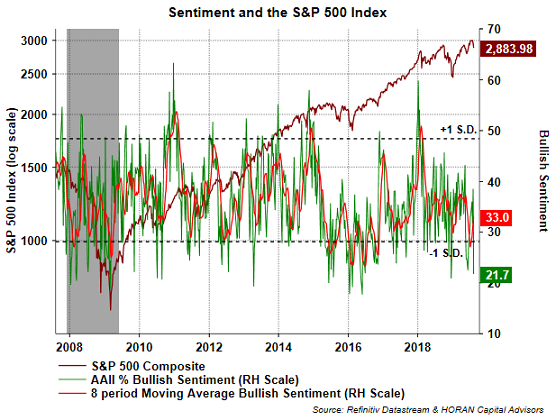
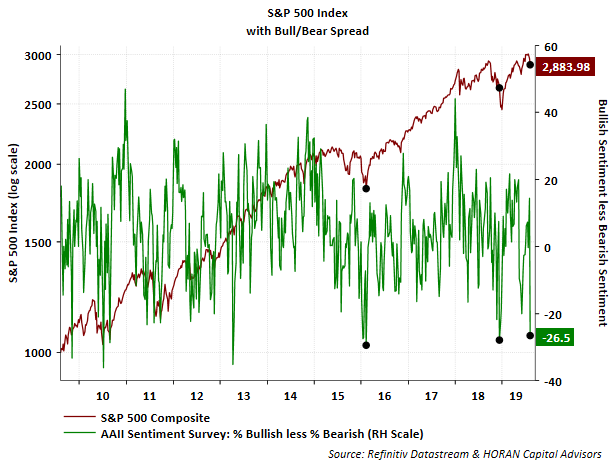
6. AAII Investor Sentiment — AAII is reporting individual investor bullish sentiment declined a sizable 16.8 percentage points to 21.7% in the week ending 8/7/2019. This is the lowest level since bullish sentiment reached 20.9% on December 13, 2018, a market bottom in the fourth quarter 2018 pullback. The low level of bullish sentiment certainly classifies this as an extreme level.

Neutral sentiment fell 7.4 percentage points, resulting in bearish sentiment spiking higher to 48.2%. This results in the bull/bear spread coming in at an extreme -26.5 as seen in the below chart. At this level of spread, historically, market lows have occurred at or near these levels.

The week ahead — Economic data from Econoday.com:
Week of Aug 2 2019 Weekly Recap & The Week Ahead

Tuesday, August 6th, 2019

“We want to perceive ourselves as winners, but successful traders are always focusing on their losses” – Peter Borish”

1. U.S. and China Are Set to Resume Trade Talks in Shanghai — negotiators will make another attempt to piece together a trade agreement amid considerably lowered expectations for a sweeping deal. People close to the talks say a major breakthrough is unlikely on points such as the U.S. insistence that China commit to legal changes to protect intellectual property and abandon state subsidies to business, or Beijing’s demands that the U.S. drop all tariffs as a condition for a deal. But more modest achievements may be possible, such as a commitment by China to purchase more agricultural products and action by the U.S. to relax its ban on U.S. companies selling to telecommunications giant Huawei Technologies.
2. Massive Data Breach at Capital One (COF) — CapitalOne disclosed a data breach exposed 140K Social Security numbers of its credit card customers, around 80K bank account records and 1M Canadian Social Insurance numbers. Additional information including names, addresses, phone numbers, credit scores and credit limits were also exposed, although credit card account numbers and log-in credentials were not taken. The suspect? Paige A. Thompson, a former employee of Amazon Web Services (NASDAQ:AMZN), where the bank had stored its customer data. Capital One (NYSE:COF) estimates the hack will cost the company approximately $100M-$150M in 2019.
3. Federal Borrowing Soars as Deficit Fear Fades — the U.S. government expects to borrow more than $1 trillion in 2019. Political support for taming deficits has faded in recent years, with Republicans supporting higher deficits in exchange for tax cuts and Democrats pushing for domestic-spending increases. Low borrowing costs suggest markets remain unfazed by all the red ink. Government debt has soared, but 10-year Treasury yields have fallen. Mainstream economists are increasingly questioning whether larger federal debt and deficits might be tolerable if put toward programs that would bolster long-term growth.
4. Hospitals May Be Forced to Disclose Discount Rates Negotiated With Insurer — The Trump administration proposed a rule requiring hospitals to disclose the discounted prices they negotiate with insurance companies, or face fines. The proposal could upend the $1 trillion hospital industry by revealing rates that have long been secret. The price-disclosure requirements would cover all of the more than 6,000 hospitals that accept Medicare, as well as some others. Hospitals that fail to share the discounted prices in an online form could be fined up to $300 a day, according to the proposal. The price-disclosure requirements would cover all the more than 6,000 hospitals that accept Medicare, as well as some others, and is likely to face fierce industry opposition. Comments on the proposal would be due in September and, if completed, the rule would take effect in January.
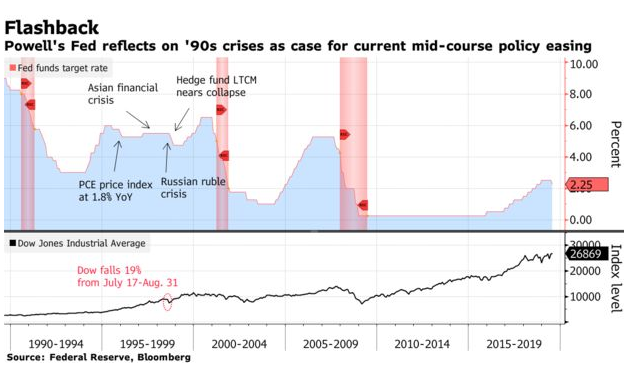
5. Fed Cuts Rates by a Quarter Point in Precautionary Move — the Federal Reserve cut interest rates by a quarter-percentage point—the first reduction since 2008—in a pre-emptive strike to cushion the economy from a global slowdown and escalating trade tensions. Officials also announced they would end the runoff of their $3.8 trillion asset portfolio on Thursday, two months earlier than previously planned. Fed Chairman Jerome Powell, at a news conference after the decision was released, called the rate cut a “mid-cycle adjustment” and didn’t rule out more reductions. But he also said it was “not the beginning of a long series of rate cuts” because that path is only followed at times of more severe economic distress. Powell’s remark raised comparisons to 1995-96 and 1998, when Alan Greenspan headed the Fed. In each instance, the central bank ended up cutting rates three times in a successful effort to prolong an economic upswing that until this year was the longest.

The week ahead — Economic data from Econoday.com:
Week of July 26 2019 Weekly Recap & The Week Ahead

Monday, July 29th, 2019

”Money cannot consistently be made trading every day or every week during the year” — Jesse Livermore

1. Brexit Leader Boris Johnson Wins Race for UK Prime Minister — Boris Johnson, the former foreign secretary and mayor of London who has pledged to take Britain out of the European Union on Oct. 31, is set to become British prime minister after winning the leadership of the ruling Conservative Party. His anointment will herald a period of intense political and economic uncertainty for the U.K., with the prospect of a sudden break from the EU and questions about how long his minority government will last.
2. Congress Moves Toward Ban on Buying Chinese Buses, Railcars Over Spy Fears — China’s push to gain a bigger foothold in U.S. public transit systems could derail in Congress, which is moving to bar use of federal funds to buy Chinese buses and railcars. The effort threatens to further fray trade talks with China, which wants to become a global player in transport and is already fuming over the U.S. decision to blacklist telecommunications giant Huawei Technologies Co. The U.S. House of Representatives passed its version of an annual defense-policy bill July 12 with language blocking transit agencies from using federal money to buy railcars made by Chinese state-owned, -controlled or -subsidized companies.
3. UPS to Join FedEx in Starting Seven-Day Delivery; Launches Drone Business — United Parcel Service (NYSE:UPS) will start delivering packages on Sundays starting in January, following FedEx’s (NYSE:FDX) announced move to seven-day delivery as the two work to meet the demands of online shopping. UPS also announced a new drone delivery subsidiary called UPS Flight Forward and said it has applied for FAA certifications needed to expand the business. Those would allow drone flights beyond an operator’s visual line of sight, at night and without limit to the number of drones or operators in command.
4. SK Hynix Cutting DRAM Production, NAND Input — SK Hynix (OTC:HXSCF,OTC:HXSCL) plans to cut its DRAM production capacity from Q4 due to the demand environment and tech migration. The company will also reduce its NAND wafer input by more than 15%, up from its previous plans to cut input 10% compared to last year. Competitors in these spaces include Micron (NASDAQ:MU), Intel (NASDAQ:INTC), and Western Digital (NASDAQ:WDC).
5. ECB Signals Rate Cut, Possible Stimulus Relaunch — the European Central Bank signaled it is preparing to cut short-term interest rates for the first time since early 2016 and possibly restart its giant bond-buying program. The ECB said in a statement Thursday that it expects to keep its key interest rate at its current level of minus 0.4% or lower through the first half of 2020, a clear signal that it is planning a rate cut.
The economic outlook “is getting worse and worse,” especially in manufacturing, ECB President Mario Draghi said at a press conference. “Basically we don’t like what we see on the inflation front.”

The week ahead — Economic data from Econoday.com:
Week of July 19 2019 Weekly Recap & The Week Ahead

Tuesday, July 23rd, 2019

“Skate To Where The Puck Is Going To Be” — Wayne Gretzky

1. 737 MAX Woes Hobble Budget Carrier Ryanair — Ryanair (NASDAQ:RYAAY) is taking the knife to its operations in Europe, blaming possible further delivery delays of Boeing’s (NYSE:BA) 737 MAX planes. It’s planning to cut back service at some airports and abandon others entirely because regulators may not return the grounded MAX to service until as late as December. Ryanair had planned its flight schedule based on the delivery of 58 of the aircraft by summer 2020, but Europe’s biggest budget carrier, which can only take delivery of up to eight aircraft per month, now expects to receive only 30. In addition, American Airlines (NASDAQ:AAL) has extended Boeing (NYSE:BA) 737 MAX cancellations for the fourth time, but “remains confident that impending software updates, along with the new training elements, will lead to recertification of the aircraft this year.” That’s despite being the next MAX operator to extend cancellations into early November.
2. China Posts Weakest Growth in 27 Years — China’s economic growth decelerated in the second quarter to its slowest pace since 1992, growing by 6.2% and prompting expectations of more stimulus. The data was weighed down by an impasse in negotiations that shattered hopes for a trade deal in late May, though President Trump and Xi Jinping got discussions back on track by the end of June. Separate economic figures handily topped forecasts as the country’s industrial output grew 6.3% in June from a year earlier, while retail sales surged 9.8%. The Shanghai Composite closed up 0.4% following the news.
3. Huawei May Soon Restart U.S. Sales — the U.S. may approve licenses for companies to re-start new sales to Huawei in as little as two weeks, according to Commerce Secretary Wilbur Ross. It’s a sign President Trump’s recent effort to ease restrictions on the Chinese telecom equipment supplier could move forward quickly amid chip industry lobbying, coupled with Chinese political pressure. Out of $70B that Huawei spent buying components in 2018, some $11B went to U.S. firms including Qualcomm (NASDAQ:QCOM), Intel (NASDAQ:INTC) and Micron Technology (NASDAQ:MU).
4. DoJ Seeks Pause of Antitrust Ruling Against Qualcomm — the U.S. Department of Justice asks a federal appeals court to pause enforcement of the May antitrust ruling that would force the company to change how it licenses its patents, citing support from the Energy Department and Defense Department. The Justice Department says QCOM likely will win its appeal of the May ruling because Judge Koh, who found the company’s license practices were anti-competitive, ignored established antitrust principles and imposed an overly broad remedy. Defense Under Secretary Ellen Lord wrote in a filing made in the 9th Circuit Court of Appeals “For DoD, Qualcomm is a key player both in terms of its trusted supply chain and as a leader in innovation, and it would be impossible to replace Qualcomm’s critical role in 5G technology in the short term,”. In a related note, Vodafone launches 5G in Germany.
5. WHO Declared Ebola Outbreak Global Health Emergency — the World Health Organization has declared the Ebola outbreak in Democratic Republic of Congo to be a “public health emergency of international concern” after the spread of the virus to the city of Goma and into Uganda. The designation signals risk that a disease could spread globally and is meant to corral political and financial support to stop it. Responders have been using an experimental vaccine made by Merck (NYSE:MRK) in an attempt to halt the spread of the virus, with more than 140,000 people in the DRC immunized so far.

The week ahead — Economic data from Econoday.com:
Week of July 12 2019 Weekly Recap & The Week Ahead

Monday, July 15th, 2019

” I learned early that there is nothing new in Wall Street. There can’t be because speculation is as old as the hills. Whatever happens in the stock market today has happened before and will happen again. I’ve never forgotten that.” –Jesse Livermore

1. Trump’s Rule Requiring ‘Drug Prices in TV Dds Blocked — U.S. District Judge Amit Mehta has blocked a Trump administration rule requiring drugmakers to put prices in TV ads, a central part of the president’s push to lower the cost of prescription medications. The rule of the Health and Human Services Department would violate free speech and exceeded the agency’s statutory authority, Mehta wrote, adding that “the responsibility rests with Congress to act in the first instance.” The lawsuit was brought by Merck (NYSE:MRK), Eli Lilly (NYSE:LLY) and Amgen (NASDAQ:AMGN), which have long argued that list prices do not reflect the actual cost of drugs as they do not take into account discounts and rebates negotiated with health insurers and PBMs.
2. Deutsche Bank Launches Makeover, Plans 18,000 Job Cuts — Deutsche Bank (NYSE:DB) is confirming a radical transformation, through a restructuring that will see it exit the global equities business and shed 18,000 jobs. The latest overhaul looks to charges of €7.4B through 2022, while it won’t pay a dividend this year or next. The German bank also expects to report a net loss of €2.8B for the second quarter, before it narrows its focus on serving European companies and retail-banking customers.
2. Fed Chairman Jerome Powell Sent a Strong Signal the Central Bank Could Cut Interest Rates Later This Month — In testimony before a House committee, Mr. Powell highlighted how the economic outlook hasn’t improved in recent weeks. He also warned of risks that weaker inflation readings could prove more persistent than previously anticipated. Mr. Powell will testify again today, this time in front of a Senate committee.
Stocks in the U.S. leapt after Mr. Powell’s testimony. The Nasdaq Composite closed at a record 8202.52. Energy and technology stocks led the S&P 500 higher as it briefly breached the 3000 level for the first time before ending the day at 2993.07.
3. Deutsche Bank is Being Investigated by the U.S. Justice Department — The U.S. Justice Department is investigating whether Deutsche Bank violated foreign corruption or anti-money-laundering laws in its work for 1Malaysia Development Bhd., which included helping it raise $1.2 billion in 2014 as concerns about the fund’s management and financials had begun to circulate.
“Deutsche Bank has cooperated fully with all regulatory and law-enforcement agencies that have made inquiries relating to 1MDB,” a spokesman for the bank said. He cited Justice Department documents saying 1MDB made “material misrepresentations and omissions to Deutsche Bank officials” in connection with 1MDB’s transactions with the bank. “This is consistent with the bank’s own findings in this matter,” he added.
4. President Voiced No Support for Bitcoin — “I am not a fan of Bitcoin (BTC-USD) and other cryptocurrencies, which are not money, and whose value is highly volatile and based on thin air,” President Trump tweeted last night. He also took a slap at Facebook (NASDAQ:FB) and its Libra crypto offering, which he said “will have little standing or dependability.” If Facebook and others want to become banks, he adds, they can stand in line and get banking charters like all the rest. “We have only one real currency in the USA, and it is stronger than ever, both dependable and reliable.”

The week ahead — Economic data from Econoday.com:
Week of July 5 2019 Weekly Recap & The Week Ahead

Tuesday, July 9th, 2019

“Obviously the thing to do was to be bullish in a bull market and bearish in a bear market… I came to learn that even when one is properly bearish at the very beginning of a bear market it is not well to begin selling in bulk until there is no danger of the engine back-firing.” – Jesse Livermore

1. U.S. Proposes More tariffs on EU Goods — Washington has turned its attention back to the EU. The U.S. Trade Representative has released a $4B list of additional goods that may be targeted with retaliatory tariffs as part of a long-running battle at the WTO over subsidies given to Airbus (OTCPK:EADSY) and Boeing (NYSE:BA). The list, which includes Italian cheese, Scotch whisky, chemicals and metals, adds to products valued at $21B that the USTR had identified in April as facing possible tariffs.
2. EU Open to Talks on Subsidies Dispute — the EU is open to talks with Washington in a dispute over aircraft subsidies, but it is also preparing retaliation after the U.S. added Italian cheese, Scotch whisky and other products to a list of goods in line for hefty tariffs. The WTO has found that Airbus (OTCPK:EADSY) and Boeing (NYSE:BA) received billions of dollars of harmful subsidies in a pair of cases marking the world’s largest-ever corporate trade dispute. Billions of dollars of tit-for-tat tariffs are on the line, with Washington first to seek the duties under the WTO timetable.
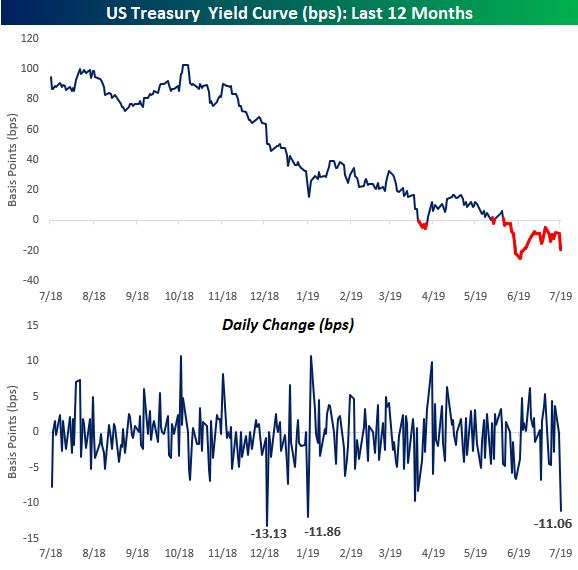
3. 10-year Yield Plummeting Below 2% — with the 10-year plummeting below 2% again and the 3-month yield spiking up by over 7 basis points, which is its biggest one day gain since December 2017. The 11-bps move further into inverted territory is the biggest one-day move since January 2nd (see second chart). While not back at new lows, today marks the 29th day that the curve has now been inverted. In Fedspeak news, Cleveland Fed President Loretta Mester (who leans hawkish but isn’t a voter) just noted in a speech that she’s in no hurry to cut. She argues that “Cutting rates at this juncture could reinforce negative sentiment about a deterioration in the outlook even if this is not the baseline view, and could encourage financial imbalances given the current level of interest rates, which would be counterproductive.”
Tuesday’s 11-bps move further into inverted territory is the biggest one-day move since January 2nd.

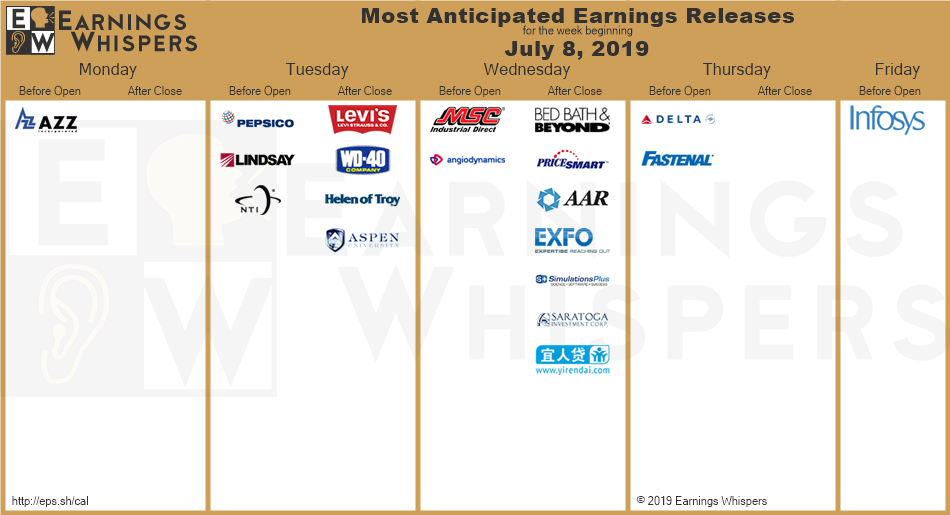
The week ahead — Economic data from Econoday.com:
Week of June 28 2019 Weekly Recap & The Week Ahead

Monday, July 1st, 2019

“Don’t look for the needle in the haystack. Just buy the haystack.” — John Bogle, founder of Vanguard

1. U.S. Weighs Ban on China-Made 5G Equipment — the Trump administration is examining whether to require that next-generation 5G cellular equipment used in the U.S. be designed and manufactured outside China, WSJ reports. The proposals could force telecom equipment giants Ericsson (NASDAQ:ERIC) and Nokia (NYSE:NOK) to reshuffle their production locations, with Citi analysts estimating that China represented 45% and 10% of their manufacturing-facility area in 2018. Washington has already essentially banned telecom equipment from Chinese companies, especially industry leader Huawei, over cybersecurity concerns.
2. China to Insist U.S. Lift Huawei Ban as Part of Trade Truce — ahead of their G20 meeting in Osaka, President Xi plans to present President Trump with a set of terms the U.S. should meet before China is ready to settle their market-rattling trade confrontation, WSJ reports. Among the preconditions, Beijing is insisting that Washington remove its ban on the sale of American technology to Huawei and also wants the U.S. to lift all punitive tariffs. The nation additionally wants the Trump administration to drop efforts to get China to buy even more U.S. exports than Beijing said it would when the two leaders last met in December.
3. FAA Identifies New Potential Risk on Boeing 737 MAX — following a Reuters report stating the FAA had found a new “potential risk” the company must fix before the 737 MAX can return to service. The risk was discovered during a simulator test last week, which likely will prevent BA from running a certification test flight until at least July 8. In an SEC filing, Boeing said the FAA has asked it to address a specific condition of flight not covered by planned software changes.
4. AbbVie Looks to Acquire Allergan for more than $60B –– bbVie’s (NYSE:ABBV) announced $63B deal for Allergan (NYSE:AGN), with the two drugmakers betting a combination will deliver new sources of growth. Buying Allergan would result in a major position in the $8B+ market for Botox and other beauty drugs, as well as a number of popular eye treatments, as AbbVie braces for the end of patent protection for the world’s top-selling drug, Humira.
5. U.S. Unveils “hard-hitting” Iran Sanctions — crude prices are on watch as the Trump administration ordered new sanctions against the assets of Ayatollah Ali Khamenei and several Iranian military commanders, as well as plans to target Foreign Minister Javad Zarif later this week. The penalties effectively freeze the business operations of the Supreme Leader’s office, which controls a global network of private companies that some experts estimate is worth between $100B-$200B. Tensions already worsened in May, when Washington ordered all countries to halt imports of Iranian oil, and then escalated following a series of apparent Iranian-backed skirmishes in the Middle East. “Imposing useless sanctions is the permanent closure of the path of diplomacy,” Foreign Ministry spokesman Abbas Mousavi wrote on Twitter.
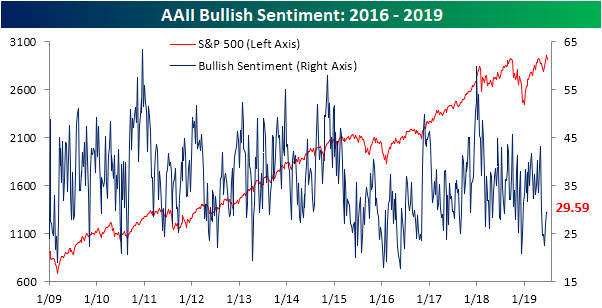
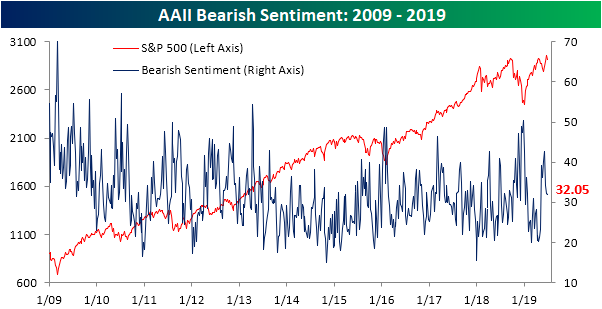
6. AAII Weekly Sentiment Survey — while S&P 500 moved up towards an all-time closing high, bullish sentiment levels were relatively muted in spite of this price action. The percentage of investors reporting as bullish rose only 0.08% to 29.59%. Bullish sentiment saw a similar sized move only one month ago when it had risen from 24.71% to 24.79% in the final week of May. Given these readings, bullish sentiment remains at the lower end of its normal range sitting over 8.5 percentage points from the historical mean.

Bearish sentiment perfectly mirrored bullish sentiment this week as the percentage of pessimistic investors fell by just 0.08% to 32.05% and still above the historical average of 30.32%.

The week ahead — Economic data from Econoday.com:
Search
Calendar
February 2026
M T W T F S S
« Jan    
 1
2345678
9101112131415
16171819202122
232425262728  
Archives
Categories
The information provided by The EGS Blog is based on sources believed to be reliable, but it is not guaranteed to be accurate. There is no guarantee that the recommendations of The EGS Blog will be profitable or will not be subject to losses. The information provided by The EGS Blog is not a recommendation or a solicitation that any particular investor should purchase or sell any particular security in any amount, or at all. The investments discussed or recommended herein may be unsuitable for investors depending on their specific investment objectives and financial position. At any time EGS LLC and its principals may maintain positions that are contrary to positions announced within the subscription service. In no event will The EGS Blog be liable to you or anyone else for any incidental, consequential, special, or indirect damage (including but not limited to lost profits or trading losses). PAST PERFORMANCE IS NO GUARANTEE OF FUTURE RESULTS

© Copyright 2026 Market Outlook All Rights Reserved
Design by EGS Sponsored by Equity Guidance LLC