Archive for the ‘Weekly Summary’ Category

Week of Nov 15 2019 Weekly Recap & The Week Ahead

Monday, November 18th, 2019

“When you learn to let go of the need to be right, being wrong gradually lose its power to disturb you.” Yvan Byeajee

1. Auto industry Seeks partnerships — Tata Group (NYSE:TTM), the owner of Jaguar Land Rover, has approached carmakers including China’s Geely (OTCPK:GELYY), the owner of Volvo Cars, and BMW (OTCPK:BMWYY) as it seeks partnerships to share the cost of a new generation of vehicles, Bloomberg reports. Scale has become increasingly critical in the auto industry as carmakers pool resources to tackle electrification and self-driving capabilities. Volkswagen (OTCPK:VWAGY) this year decided to team up with Ford (NYSE:F), while PSA Group (OTCPK:PEUGF) last month agreed to merge with Fiat Chrysler (NYSE:FCAU) to create the world’s fourth-largest automaker.
2. Boeing Announces MAX Deliveries Could Resume in December — the planemaker said deliveries of the 737 MAX could begin in December. The company has completed a test of flight control software with the FAA in a simulator, though regulators still must sign off on new pilot training and Boeing needs to conduct a certification flight with officials. Airlines have said they will need at least a month to complete training and install revised software before flights can resume.
3. Disney+ Finally Arrives in Streaming Wars — Disney+ has gone live, challenging the likes of Netflix (NASDAQ:NFLX), Apple TV Plus (NASDAQ:AAPL) and HBO Max (NYSE:T) with a low price of $6.99/month (or $69.99/year). It’ll also offer a triple bundle – including Hulu and ESPN Plus – for $12.99/month. Waves were already made after the Mouse House gave Verizon (NYSE:VZ) customers a free year of the service, as well as broadening device support to nearly every platform: Apple OS, Android, Fire TV, Roku, etc. Disney (NYSE:DIS) has called the service – which will be the exclusive home of Star Wars, Marvel and Pixar – the future of the company, and is building out a slate of original shows and movies based on those brands like The Mandalorian.
4. Goldman Faces ‘Sexist’ Probe Over Apple Card — New York’s Department of Financial Services has initiated a probe into the credit card practices of Goldman Sachs (NYSE:GS) following a series of tweets from David Heinemeier Hansson, the creator of Ruby on Rails. He slammed the Apple Card (NASDAQ:AAPL) for giving him 20x the credit limit than his wife – despite filing joint tax returns and his wife having a better credit score – and alleged that gender discrimination was present in algorithms that determined credit limits. Launched in August, the Apple Card is a joint venture between Apple and Goldman, which is responsible for all credit decisions related to the card.
5. U.S. to extend reprieve for Huawei — as the earlier reprieve expires, the Trump administration will issue another 90-day extension today of a license allowing U.S. companies to continue doing business with Huawei, sources told Reuters. The Chinese firm was added to an economic blacklist back in May on national security grounds. Out of $70B that Huawei spent buying components in 2018, some $11B went to U.S. firms including Qualcomm (NASDAQ:QCOM), Intel (NASDAQ:INTC) and Micron Technology (NASDAQ:MU).

The week ahead — Economic data from Econoday.com:
Week of Nov 8 2019 Weekly Recap & The Week Ahead

Tuesday, November 12th, 2019

“The intelligent investor is a realist who sells to optimists and buys from pessimists.” – Benjamin Graham

1. Trump Administration is Weighing to Drop Existing Tariffs with China — the Trump administration is weighing whether to drop existing tariffs on $112B of Chinese imports (which were introduced at a 15% rate on Sept. 1). “Phase One” of the pact would include Chinese purchases of American farm goods, rules to deter currency manipulation and some provisions to protect intellectual property and open up Chinese industries to U.S. firms.
2. European Union Aviation Safety Agency Stated Boeing’s MAX Likely to Return to European Service in Q1 2020 –Boeing’s (BA +1.7%) 737 MAX airliner likely will return to service in Europe in Q1 2020, says the head of the European Union Aviation Safety Agency. While the EASE expects to give its approval in January, preparations by national authorities and airlines may delay the resumption of commercial flights by as much as another two months, executive director Patrick Ky says.
3. Walgreens (WBA) Might Goes Private — reports suggested the U.S. drug store chain is exploring private equity interest. If a deal was struck, it would likely be one of the largest leveraged buyouts in history based off Walgreens’ $50B+ market cap. Several private equity firms would likely be involved, though many have long lost their appetite for teaming together on so-called club deals since the financial crisis.
4. U.S. Says Phase-One China Deal Would Include Tariff Rollback — China’s Ministry of Commerce said the world’s two largest economies had agreed to remove duties on each other’s goods in phases. “If China, U.S. reach a phase-one deal, both sides should roll back existing additional tariffs in the same proportion,” declared spokesman Gao Feng. That would potentially provide a road map to end the bruising trade war after reports yesterday suggested a meeting between President Trump and Xi Jinping could be postponed until December.
5. Facebook’s WhatsApp Eplores E-commerce via Catalog Feature — after buying the app for $19B in 2014, Facebook (NASDAQ:FB) is finally building out the service’s e-commerce tools by launching a catalog feature where businesses can display a “mobile storefront” showcasing their wares with images and prices. Facebook similarly added a shopping feature to Instagram in March that lets users click a “checkout” option on items tagged for sale (though transactions there happen directly within the app).

The week ahead — Economic data from Econoday.com:
Week of Nov 1 2019 Weekly Recap & The Week Ahead

Tuesday, November 5th, 2019

The investor of today does not profit from yesterday’s growth. — Warren Buffett

1. Fiat, PSA Confirmed Deal to Merge — Fiat Chrysler and Peugeot owner PSA have officially agreed to join forces through a 50-50 share swap, creating the world’s fourth-largest automaker. “In a rapidly changing environment, with new challenges in connected, electrified, shared and autonomous mobility, the combined entity would leverage its strong global R&D footprint and ecosystem,” the companies said in a statement. The deal calls for paying a special dividend of €5.5B to Fiat (NYSE:FCAU) investors and for PSA (OTCPK:PEUGF) to spin off to its shareholders a €3B stake in parts maker Faurecia (OTCPK:FURCF).
2. China Manufacturing Activity Shrinks Again in October — Factory activity in China contracted for the sixth straight month in October and by more than expected, while service sector growth eased as companies face the weakest economic growth in nearly 30 years. Weighed down by slowing global demand and the Sino-U.S. trade war, the manufacturing PMI fell to 49.3, versus 49.8 in September, according to the country’s statistics bureau. The figures will heap pressure on policymakers to roll out more stimulus to avoid a sharper slowdown and job losses.
3. Fed Cuts Rates for Third Meeting in a Row, Signals Pause — the Federal Reserve cut its benchmark interest rate for the third straight meeting and signaled it may pause before further changes to monetary policy to see whether these easing steps are enough to sustain the economic expansion. At the policy meeting on Wednesday, officials said they would lower the federal-funds target rate by a quarter percentage point, to between 1.5% and 1.75%. Chairman Powell said “Looking ahead, we will be monitoring the effects of our policy actions, along with other information bearing on the outlook, as we assess the appropriate path of the target range for the fed funds rate,” he said. “Of course, if developments emerge that cause a material reassessment of our outlook, we would respond accordingly. Policy is not on a preset course.”
3. LVMH Bids $120 a Share for Tiffany — Tiffany (NYSE:TIF) has received a $120/share offer from LVMH (OTCPK:LVMUY), valuing the company at $14.5B, 22% above Friday’s close. According to informed sources, it will need to sweeten the offer to get the deal done.
4. 5G Goes Online in China — China turned on its 5G networks ahead of schedule on Nov 2nd 2019 – after initially targeting a 2020 launch – amid an ongoing trade war with the U.S. that has turned into a battle over tech supremacy. President Trump said earlier this year that “the race to 5G is on and America must win,” and has been seeking to convince other countries to ban Huawei from their next-generation networks. China Telecom (NYSE:CHA), China Unicom (NYSE:CHU) and China Mobile (NYSE:CHL) all unveiled 5G plans that start at around 128 yuan ($18) per month, though experts have warned of challenges to adoption, including price and a lack of 5G capable handsets.
5. Lagarde Takes Reins of the ECB from Mario Draghi — Christine Lagarde begins her new job atop the European Central Bank today at a time when persistently low inflation and weak growth are showing the limits of monetary policy. Under a 2012 pledge to do “whatever it takes” to save the eurozone from collapse, predecessor Mario Draghi drove interest rates deep into negative territory and pumped trillions of euros into the economy through QE. With an almost exhausted ECB monetary toolkit, unprecedented dissent has broken out between those eurozone members who back this policy and those who are losing faith in further easing.

The week ahead — Economic data from Econoday.com:
Week of Oct 25 2019 Weekly Recap & The Week Ahead

Thursday, October 31st, 2019

There will not be any Weekly Re-Cap for the week of Oct 21 to Oct 25 2019. We are away for some needed R&R.

Have a good week.

The staffs at EGS.

Week of Oct 18 2019 Weekly Recap & The Week Ahead

Tuesday, October 22nd, 2019

“Big money is made on the stock market by being on the right side of major moves. The idea is to get in harmony with the market. It’s suicidal to fight trends. They have a higher probability of continuing than not.” – Martin Zweig

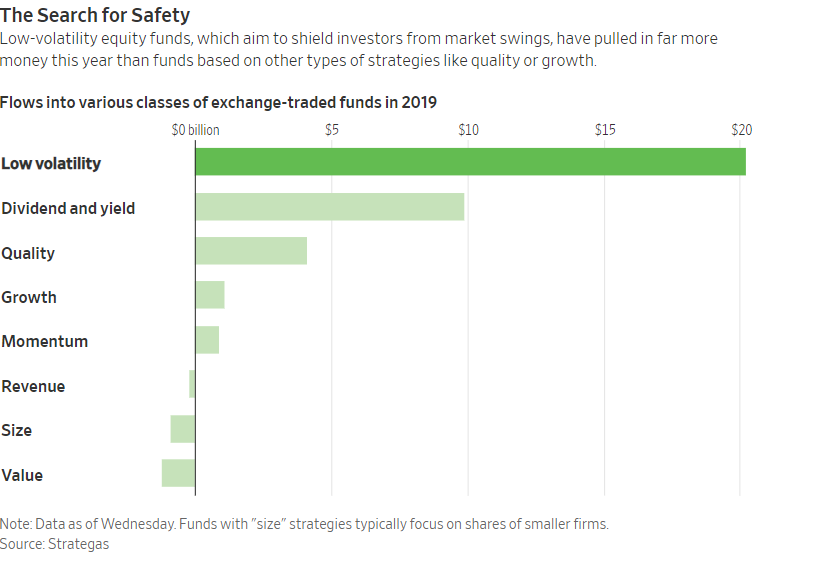
1. Stocks’ Path Toward Records Led by Defensive Plays — much of the gains over the past month have been driven by parts of the market that investors tend to gravitate toward when they are looking for safety, as well as an attractive yield. The S&P 500’s real-estate and utilities sectors, often considered bond-like because of their relatively hefty dividend payouts, have climbed 1.3% and 1.9% respectively over the past month while the broad index has fallen 1%. That makes them by far the best-performing groups in the broad index over that time, followed by technology shares. Exchange-traded funds that aim to minimize investors’ exposure to market swings have also gained popularity, with flows into low-volatility equity ETFs surpassing $20 billion this year—nearly 20 times that of growth stocks, according to Strategas.

2. The U.S. Imposed Sanctions and Raised Steel Tariffs on Turkey — President Trump threatened harsher financial penalties if Turkey continued its offensive in northern Syria, launched after he decided to withdraw U.S. troops from the region. The withdrawal decision was widely criticized on Capitol Hill for leaving Kurdish militias—allies in the U.S.-led fight against Islamic State—open to attack. Mr. Trump also spoke with Turkish President Recep Tayyip Erdogan, calling on him to stop the invasion and negotiate an end to the violence, Vice President Mike Pence said late Monday.
3. U.K., EU Agree on Draft Brexit Deal — Britain and the European Union agreed to new terms for the U.K.’s exit from the bloc late last week, paving the way for a high-stakes vote in the British Parliament.Following days of intense talks more than three years after Britain voted to leave the EU, the two sides struck a compromise intended to ensure a border doesn’t appear on the island of Ireland. It was the main sticking point in negotiations aimed at smoothing Britain’s split with its largest trading partner.
4. UAW Reaches Tentative Labor Deal With GM — the United Auto Workers struck a tentative labor deal with General Motors Co. GM -1.26% on Wednesday, a critical step in ending a monthlong strike that has brought more than 30 GM factories in the U.S. to a standstill. As part of the new deal, GM has committed to invest around $7.7 billion in its U.S. factories over the four-year contract period, which would create or preserve about 9,000 jobs, according to people familiar with the agreement. The company also separately has joined with outside companies to invest another roughly $1.3 billion in facilities near its Lordstown, Ohio, assembly plant, which the company hopes to sell to a startup electric-truck maker, the people said.

The week ahead — Economic data from Econoday.com:
Week of Oct 11 2019 Weekly Recap & The Week Ahead

Monday, October 14th, 2019

“I think investment psychology is by far the more important element, followed by risk control, with the least important consideration being the question of where you buy and sell.” — Tom Basso

1. US/China Up the Ante with Trade Dispute / Adds Chinese Firms to Blacklist — the U.S. added 28 Chinese entities to an export blacklist, citing their role in Beijing’s repression of Muslim minorities in northwest China. The decision came days before high-level trade talks are set to resume in Washington. The U.S. said the action isn’t related to trade talks, but it is likely to disturb Chinese officials already incensed over what Beijing sees as U.S. support for the pro-democracy movement in Hong Kong. Trade negotiations have made little progress since hitting an impasse in May. The one recent bright spot has been Chinese agricultural purchases, including more than 1.5 million metric tons of U.S. soybeans in the last week of September alone.
2. Boeing Suffers Setbacks — the effort to return 737 MAX jets to service has hit a new snag because of heightened European safety concerns about portions of proposed fixes to flight-control systems. Separately, the pilots’ union at Southwest Airlines sued Boeing, alleging that the plane maker rushed the 737 MAX to market and misrepresented the plane as safe. Boeing called the suit “meritless.”
3. US/China Trade Talks Resume — Senior U.S. and Chinese officials will square off for trade talks Thursday at a pivotal moment in the countries’ relationship, with higher tariffs looming if negotiators fail to break a five-month stalemate. China is looking to narrow the scope of its negotiations with the U.S. to trade matters only and put thornier issues—such as U.S. national security concerns over Chinese telecom giant Huawei Technologies Co.—on a separate track in a bid to break the deadlock. Business groups want Mr. Trump abandon plans to raise tariffs to 30%, which is set to happen Oct. 15. They also want him to drop plans to impose new tariffs of 15% on $156 billion in smartphones, apparel and other consumer goods starting Dec. 15.
4. Fed to Increase Supply of Bank Reserves — the Federal Reserve will soon increase its purchases of short-term Treasury securities to avoid a recurrence of the unexpected strains experienced in money markets last month, Fed Chairman Jerome Powell said in a speech in Denver. Fed officials stopped shrinking the assets on their balance sheet in August but never said when they would allow the balance sheet to grow again. As a result, bank deposits held at the Fed—a crucial liability on the balance sheet—have continued declining. Stresses in very-short-term funding markets recently suggested banks have grown reluctant to lend those reserves.
5. US/China Agreed to a Trade Truce — the US/China agreed to a initial tentative agreement on Friday. Mr. Trump said China will make some $40 billion to $50 billion more in agricultural purchases over two years and has promised to better protect intellectual property and welcome more foreign financial services. In return the U.S. won’t increase tariffs to 30% from 25% on $250 billion of Chinese goods next week as Mr. Trump had planned. The two countries also agreed to keep talking toward what Mr. Trump called a “phase two” agreement that would include the tougher issues such as Chinese technology theft and predatory regulation against American companies. There will also be a new consultation process to address disputes and monitor enforcement. The implication is that if progress continues, Mr. Trump will cancel the tariffs planned for December on more Chinese goods.

The week ahead — Economic data from Econoday.com:
Week of Oct 4 2019 Weekly Recap & The Week Ahead

Tuesday, October 8th, 2019

“Reaching any goal in trading requires specific domain knowledge and technical skills. But then, after that, it’s all mindset management. Yet most people ignore that —they automatically think they have that last part all figured out, and it’s a mistake.” ― Yvan Byeajee,

1. U.S. Factory Activity Contracted Again in September — the Institute for Supply Management reported earlier last week its U.S. manufacturing index fell to 47.8 in September from 49.1 in August. The reading is the lowest since June 2009 and represents a continuation of the slowdown seen in August, when the index contracted for the first time since August 2016. The deeper contraction in the manufacturing sector is the latest sign that the escalated trade war between the U.S. and China is taking a big bite from the economy. Manufacturing was once considered a big winner under the Trump administration with improvement in employment and activity over the past few years.
2. Charles Schwab Ending Online Trading Commissions on U.S.-Listed Products — Charles Schwab Corp. said it would eliminate commissions on trades made on its mobile and web channels, rattling the online brokerage industry. Charles Schwab said the move, which is effective Oct. 7, is aimed at making online investing more affordable. It noted that new firms entering the market often use zero or low commissions as a lever. Companies effected are: SCHW, AMTD, ETFC, IBKR.
3. U.S. Factory Activity Contracted — U.S. factory activity contracted for the second straight month in September, hitting a 10-year low and triggering concerns about the economy. Surveys of purchasing managers in Europe and Asia, also released Tuesday, pointed to deepening declines in factory activity last month, as a slowdown in exports hit factories.
4. Online Gaming Flutter Entertainment agreed to buy PokerStars owner Stars Group for about $6 billion — FanDuel owner Flutter Entertainment agreed to buy PokerStars owner Stars Group for about $6 billion. The deal creates an online-gambling giant as internet and app-based betting is taking hold in the U.S. It also connects FanDuel with Fox Corp., which owns a minority stake in Stars and recently launched its own betting app, Fox Bet. Fox Corp. and WSJ parent News Corp share common ownership.
Flutter, based in Dublin and listed in London, owns bookie brands in the U.K. including Paddy Power and Betfair. Flutter’s FanDuel, in addition to its fantasy-sports site, offers online and retail betting in New Jersey and Pennsylvania. Nasdaq-listed Stars Group, based in Toronto, owns popular online poker brands such as PokerStars and Sky Betting & Gaming.

The week ahead — Economic data from Econoday.com:
Week of Sept 28 2019 Weekly Recap & The Week Ahead

Tuesday, October 1st, 2019

If a speculator is correct half of the time, he is hitting a good average. Even being right 3 or 4 times out of 10 should yield a person a fortune if he has the sense to cut his losses quickly on the ventures where he is wrong. -Bernard Baruch

1. UK Court Decided Suspension of Parliament Unlawful — Prime Minister Boris Johnson acted unlawfully when he suspended Parliament this month for five weeks, according to the British Supreme court, opening the door to new challenges to his Brexit strategy. Sterling rose nearly 0.4% on the back of the decision to trade at $1.2478. The President of the Supreme Court, Brenda Hale, said there was no justification for the government taking such extreme action, but that it was for parliament to decide what to do next.
2. FAA Announces 737 Max Return Up to Individual Countries — each country will make “its own decision” on when the Boeing (NYSE:BA) 737 MAX returns to service, according to FAA Administrator Steve Dickson, who has not yet set a timeline on when to allow the jets back in U.S. skies. The planes have been grounded worldwide since mid-March after two crashes within five months of each other killed 346 people. On Monday, Boeing also announced that it will pay $144,500 to each of the victims’ families from a $50M financial assistance fund.
3. Juul Under Criminal Investigation — Federal prosecutors in California are conducting a criminal probe into e-cigarette maker Juul (JUUL), in which tobacco giant Altria (NYSE:MO) owns a 35% stake, WSJ reports. Regulators have criticized Juul for fueling a teen vaping “epidemic,” while lawmakers have urged the FDA to pull most e-cigarettes off the market. It follows an outbreak of a deadly lung disease linked to vaping that has sickened at least 530 people and killed eight. Massachusett is imposing a four-month ban on sales of all vaping products amid a national health emergency that so far has been linked to nine deaths and has sickened at least 530 people. T
4. Pelosi Announces Impeachment Inquiry into Trump Amid Alleged Abuses of Power — the House started an impeachment inquiry into President Donald Trump as a swell of Democrats denounce the president over alleged abuses of power, House Speaker Nancy Pelosi. Based on past history of Clinton impeachment, the S&P 500 fell as much as 4.9% on October 8, 1998, the day the House voted to begin impeachment proceedings against President Clinton, before trimming losses to end the day down 1.2%. By the time Clinton was acquitted by the Senate in February 1999, the index was up 28%. Markets shrugged off an impeachment inquiry against President Nixon on February 6, 1974, but the S&P 500 fell around 30% until his resignation. There were other forces at play, however, including Nixon’s decision to suspend the gold standard and a recession following the oil shock of late 1973.
5. Amazon Pilots Care Clinics — building on previous healthcare efforts, a new pilot is being launched for Amazon (NASDAQ:AMZN) workers in the Seattle area, offering a virtual primary care clinic with an option to send nurses to employees’ homes. Amazon has already partnered with JPMorgan (NYSE:JPM) and Berkshire Hathaway (BRK.A, BRK.B) – on an effort called Haven – which explores how to move the needle on healthcare expenses for their combined 1.2M employees. In addition, the company has a pharmacy division under PillPack and an R&D group sometimes referred to as Grand Challenge or 1492.
6. IPO Market Weakens — the IPO market took another hit as Endeavor Group Holdings yanked its planned offering and Peloton Interactive’s shares skidded on their first day of trading. The entertainment company became the second big casualty of the IPO market’s recent chill after WeWork’s parent company pulled its offering earlier this month. It is the second time Endeavor has hit the brakes on its IPO this year. Part of the reason Endeavor pulled its deal, according to people familiar with the matter, was the poor performance of Peloton in its debut. Investors soured on shares of Peloton, the startup known for its exercise bikes that allow users to join along in virtual spin classes from home, pushing them 11% below their IPO price of $29.

The week ahead — Economic data from Econoday.com:
Week of Sept 21 2019 Weekly Recap & The Week Ahead

Monday, September 23rd, 2019

“In this business if you’re good, you’re right six times out of ten. You’re never going to be right nine times out of ten.” -Peter Lynch

1. Index Funds Had More Assets by Value Than Stock-Picking Rivals — Funds that track broad U.S. equity indexes hit $4.27 trillion in assets as of Aug. 31, giving them more money than stock-picking rivals for the first-ever monthly reporting period. Funds that try to beat the market had $4.25 trillion as of that date. In the past decade, $1.32 trillion fled actively managed U.S. equity mutual funds and exchange-traded funds as nearly $1.36 trillion was added to low-cost funds that mimic market indexes. That shift lowered the price of investing for individuals, reduced the influence of stock pickers and turned a handful of Wall Street outsiders into the biggest power brokers in the industry.
2. General Motors Factory Workers Headed to Picket Lines in 10 States — the United Auto Workers union called on thousands of workers to walk off the job in an effort to secure better pay, more job security and other benefits. The walkout is one of the largest private-sector work stoppages in decades. The UAW further announced it will pay striking workers $250 a week, but that does not go very far, especially when they need to cover their own health insurance. GM’s credit rating could also topple into junk bond status if the strike lasts more than a week or two, according to Moody’s.
3. S.Korea Downgrades Japan Trade Status — South Korea is following through with plans to drop Japan from a list of countries receiving fast-track approvals in trade, a reaction to a similar move by Tokyo to downgrade Seoul’s trade status. The dispute between the nations began in July when Japan imposed tighter export controls on three chemicals South Korean companies use to produce semiconductors and displays for smartphones and TVs, which are major import items for South Korea. The escalating row is rooted in wartime history and could cast uncertainty into the global supply chain and economy.
4. The Federal Reserve Cut Its Benchmark Interest Rate — the Federal Reserve cut its benchmark interest rate by a quarter-percentage point for the second time in two months, as Chairman Jerome Powell left the door open to more cuts. Three officials voted against the decision, with two saying rates should have been left unchanged, and one supporting a bigger cut. Mr. Powell repeatedly cited the costs of rising trade-policy uncertainty.
5. NY Fed to Conduct Third Repo Operation — the New York Fed is offering an overnight repurchase agreement operation for the third day in a row, injecting $75B into a vital corner of finance to restore order in the banking system. The temporary liquidity follows the Fed’s reduction in the interest rate on excess reserves, or IOER, another attempt to quell money-market stresses. The prior operations have soothed markets, with repo rates declining Wednesday to more normal levels after jumping to 10% on Tuesday, four times where they were last week.
6. Pentagon Weighs Sending More Military Assets to Mideast — President Trump is weighing responses to the attacks on Saudi oil facilities, and U.S. military officials are considering sending more antimissile batteries, a squadron of jet fighters and added surveillance capabilities, as well as possibly committing an aircraft carrier and other warships to the region.

The week ahead — Economic data from Econoday.com:
Week of Sept 14 2019 Weekly Recap & The Week Ahead

Monday, September 16th, 2019

“Trading doesn’t just reveal your character, it also builds it if you stay in the game long enough.” — Unknown

1. Apple’s Unveiled New Products at Fall Event — the tech giant stucks with its three-device approach to its new iPhone lineup, rolling out a trio of devices in the iPhone 11 family featuring Apple’s A13 chip, which Apple says is the fastest ever to be in a smartphone. The cheapest of these three devices, the iPhone 11, has a dual-camera design that supports ultrawide shots and night-mode capabilities for low-light situations. The front-facing camera allows users to take slow-motion selfies, which Apple calls “slofies.” . The big surprise came when Apple (AAPL) revealed that it would charge $4.99 a month for its previously announced streaming video service, Apple TV+, which is now set to launch on Nov. 1. That price was lower than the $9.99 monthly fee that some analysts and reports had expected before the event, and it makes Apple’s offering cheaper than streaming services from Netflix Inc.
2. More Deaths Linked to Vaping, CDC Warns — three more deaths linked to vaping have been reported in Indiana, California and Minnesota, bringing the total number of such U.S. deaths to five. Some type of chemical irritation is likely associated with the illnesses, but more information is needed to determine the exact cause. U.S. health officials are now investigating more than 450 cases of possible vaping-related illnesses in 33 states, while last week, the governor of Michigan announced the state will become the first to ban flavored e-cigarettes. President Trump said the U.S. plans to pull most vaping products from the market. citing growing concerns about health hazards and rising use by teenagers of the alternative to cigarettes. The Food and Drug Administration intends to ban popular fruity flavors, as well as menthol and mint e-cigarettes, from stores and online sellers, leaving just tobacco-flavored products. The move poses a major threat to a fast-growing industry estimated to reach $9 billion in sales this year and dominated by startup Juul Labs.
3. Trump to Delay Tariffs on China by Two Weeks — President Trump said the U.S. will delay by two weeks a planned increase in tariffs on some Chinese imports, a move that could ease chilled relations between the two nations ahead of planned trade talks in Washington next month. The planned tariff increases were to cover largely nonconsumer items—materials businesses use to produce goods—with the levy going from 25% to 30%. In response, China’s Commerce Ministry said that it welcomed the postponement and that Chinese companies had started making price inquiries for U.S. agricultural goods including soybeans and pork. Beijing suspended purchases of the U.S. products in August. Ministry spokesman Gao Feng said that the possible resumption of agricultural products isn’t a bargaining chip in trade talks.
4. ECB Cuts Rates and Launches Sweeping Stimulus Package — the European Central Bank cut its key interest rate and launched a sweeping package of bond purchases Thursday that lays the ground work for what is likely to be a long period of ultraloose monetary policy, jolting European financial markets. Mr. Trump said the ECB was “trying, and succeeding, in depreciating the Euro against the VERY strong Dollar, hurting U.S. exports.” The ECB joins central banks around the world, including the Federal Reserve, that have been cutting interest rates in recent weeks amid a bitter trade dispute between the U.S. and China, a fall in trade volumes and a slowdown in global growth. Second-quarter figures released Thursday by the Organization for Economic Cooperation and Development showed year-to-year economic growth in the Group of 20 leading economies was at its weakest since the start of 2013.
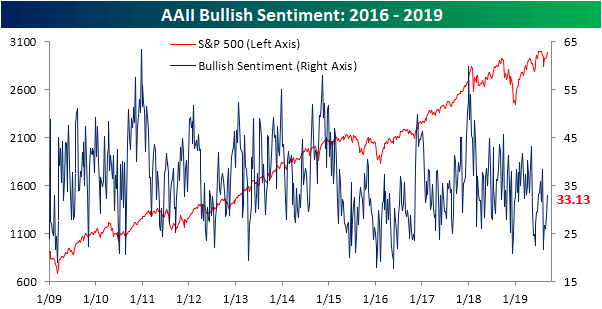
5. AAII’s weekly Sentiment — The percentage of investors reporting as bullish in AAII’s weekly survey rose from 28.64% last week up to 33.13%. That is the highest since August 1st when 38.44% reported bullish sentiment. With two consecutive weeks of improvements, bullish sentiment is now well off of its lows from the second week of August (21.66%) and is back within a normal range relative to its historical average of 38%.

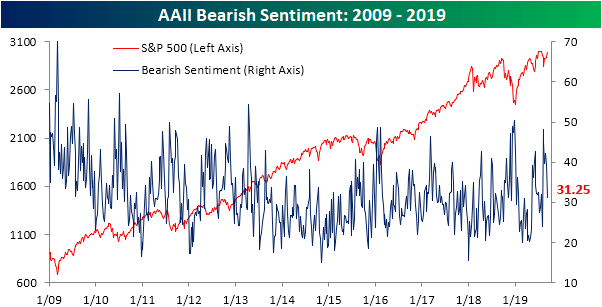
Meanwhile, bearish sentiment is now the lowest that it has been since the first week of August. With bearish sentiment falling 8.26 percentage points this week to 31.25%, it was the largest drop since June 13th’s 8.38-percentage point decline.

The week ahead — Economic data from Econoday.com:
Search
Calendar
February 2026
M T W T F S S
« Jan    
 1
2345678
9101112131415
16171819202122
232425262728  
Archives
Categories
The information provided by The EGS Blog is based on sources believed to be reliable, but it is not guaranteed to be accurate. There is no guarantee that the recommendations of The EGS Blog will be profitable or will not be subject to losses. The information provided by The EGS Blog is not a recommendation or a solicitation that any particular investor should purchase or sell any particular security in any amount, or at all. The investments discussed or recommended herein may be unsuitable for investors depending on their specific investment objectives and financial position. At any time EGS LLC and its principals may maintain positions that are contrary to positions announced within the subscription service. In no event will The EGS Blog be liable to you or anyone else for any incidental, consequential, special, or indirect damage (including but not limited to lost profits or trading losses). PAST PERFORMANCE IS NO GUARANTEE OF FUTURE RESULTS

© Copyright 2026 Market Outlook All Rights Reserved
Design by EGS Sponsored by Equity Guidance LLC