Archive for the ‘Weekly Summary’ Category

Week of Jan 31, 2020 Weekly Recap & The Week Ahead

Tuesday, February 4th, 2020

“The markets are always changing, and the successful trader needs to adapt to these changes” — Michael Stainhardt

1. Yield Curve Inverted — the U.S. Treasury yield curve, measured by the gap between yields on three-month and 10-year bonds, briefly inverted overnight for the first time since October as Treasuries rallied for a sixth day. The two-year/five-year curve already inverted on Monday, while the gap between two-year and 10-year yields – considered a recession signal – was at the flattest since Nov. 29. “If the signs were to multiply, there could be a more severe impact not just in China but globally,” said Philip Shaw, chief economist at Investec. “Markets are starting to speculate the Fed could bring rates down by summer.”
2. Flights To/From China Suspended as Coronavirus Spreads — British Airways became the first global airline to cancel all flights to and from the mainland as the virus spreads beyond Asia. The U.S. expanded passenger screenings for the virus to 20 airports and is considering suspending flights to China.
3. Corona Virus Updates — the coronavirus has killed at least 165 people while infecting more than 7,000. The vast majority of those infected are in China. Corona virus has a relatively high death rate compared with something like influenza (though less than the related SARS outbreak nearly two decades ago). And it is centered in a densely populated part of the world where international travel is increasingly common. It’s also new. Public health experts cannot say yet how long it will last, how far it will spread, and how deadly it could get. Public-health officials say the virus and the respiratory ailments it causes pose little risk in the U.S., where only 5 cases have been identified. And while there’s evidence it’s contagious even in the early stages before symptoms show, it appears to be far less contagious than SARS, whooping cough or measles. In addition, the outbreak is disrupting businesses around the world, from banks to retailers to airlines. Global firms are working to protect employees in or planning travel to China, while also dealing with dropping demand and its potential economic impact. Investors who began the year feeling largely sanguine about the stock market are struggling to make sense of whether the growing outbreak could upend their bets on a global economic recovery.
4. UPS Aims for Driverless, Electric Future — following in the footsteps of Amazon (AMZN), which recently inked a deal for 100,000 electric vehicles from Rivian, UPS (NYSE:UPS) has placed an order for 10,000 electric vans (with an option for 10,000 more) from U.K.-based Arrival. The contract, worth “hundreds of millions of euros,” will also see UPS take a minority stake in the startup. Besides joining the EV revolution, UPS has driverless dreams. A six-month test will begin with Alphabet’s (GOOG, GOOGL) Waymo next month, using the latter’s autonomous Chrysler Pacifica minivans to shuttle packages from Phoenix UPS stores to a nearby sorting center.
5. FOMC Meeting — the Federal Reserve left its benchmark interest rate unchanged and reaffirmed its make-no-moves posture. Officials repeated nearly verbatim the policy outlook expressed in December, and offered a mixed assessment of the economic outlook. They described consumer spending as moderate, a downgrade from “strong” last month, and said business investment had stayed weak. Fed officials have, however, signaled that they see greater risks of surprises that could force them to lower rates.

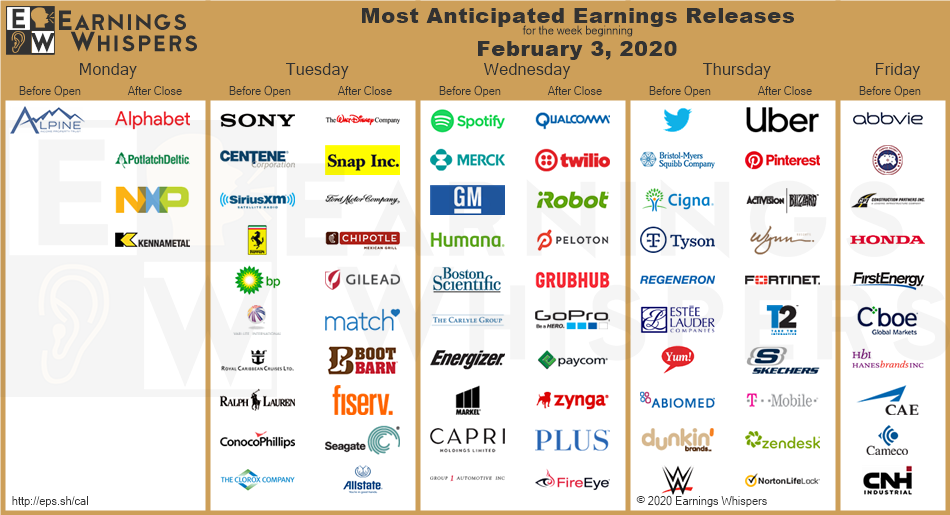
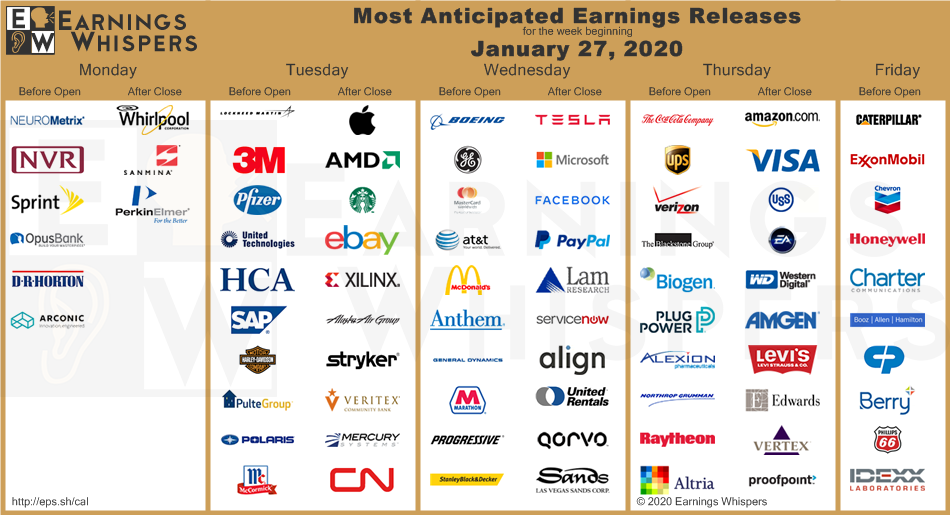
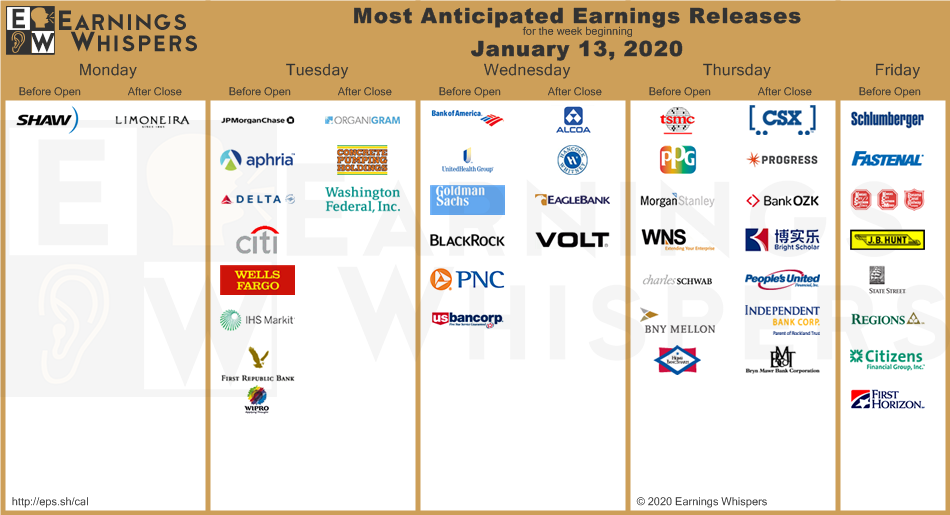
The week ahead — Economic data from Econoday.com:
Week of Jan 24, 2020 Weekly Recap & The Week Ahead

Tuesday, January 28th, 2020

“The secret to being successful from a trading perspective is to have an indefatigable and an undying and unquenchable thirst for information and knowledge.” — Paul Tudor Jones

1. A Newly Identified Virus Originating in Central China has Spread Between Humans — with a diagnostic test available, the number of confirmed cases more than tripled to 218—including in Beijing, Shanghai and Shenzhen—with three deaths from the pneumonia the virus causes. The prospect of human-to-human transmission, rather than just animal-to-human, comes as tens of millions of Chinese crisscross the country for the Lunar New Year holiday—commonly called the world’s largest annual human migration—though more are staying put this year. The virus has already spread outside China, and appeared in South Korea for the first time.
2. France, U.S. Declare Digital Tax Truce — averting another trade war – for now – the U.S. and France have agreed to put aside their digital tax dispute until the end of 2020. Negotiations at the OECD will continue during that period as France postpones the levy and the U.S. delays retaliatory tariffs. The measure had imposed a 3% tax on digital revenues of companies like Google (GOOG, GOOGL), Apple (NASDAQ:AAPL), Facebook (NASDAQ:FB) and Amazon (NASDAQ:AMZN) – which have more than €750M in global revenue, including at least €25M in France – while the U.S. had threatened to place duties of up to 100% on $2.4B of French imports.
3. The Chinese Government Locked Down Cities in an Effort to Stop the Spread of a New Coronavirus — the government locked down Wuhan, the city of 11 million people where the new virus originated. Authorities announced later that nearby Huanggang, with 7.5 million people, was slated for lockdown at midnight. Ezhou, another neighboring city with just over a million residents, said it would enact similar restrictions. Under the lockdowns, all outbound flights, trains, long-distance buses and ferries are halted, and public transportation is shut. Markets, movie theaters and other public places have been closed or had access restricted. The lockdowns constitute a dramatic escalation in the battle to contain a pneumonia outbreak that has killed at least 17 people.
4. Boeing CEO Updates — the new Boeing (NYSE:BA) CEO said the planemaker will not cut its dividend despite the extended grounding of the 737 MAX and expects to resume MAX production “months” before the mid-year return to service. The latest delay was triggered by the company’s recommendation that pilots should undergo simulator training. He’ll also “start with a clean sheet of paper” on a decision whether to launch a new midsize airplane seating 220-270 passengers, effectively halting current plans worth $15B-20B.
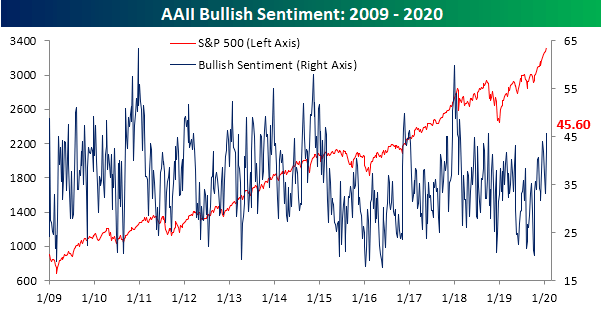
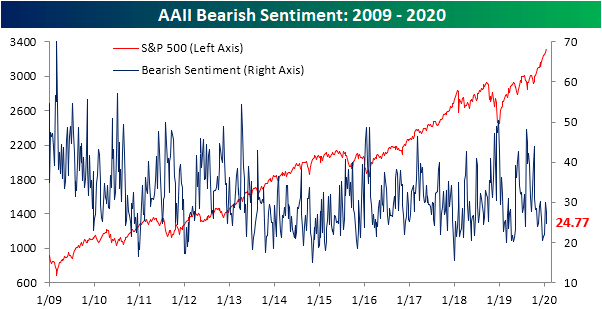
5. AAII’s Investor Sentiment Survey — In the span of just two weeks, the percentage of respondents in AAII’s investor sentiment survey reporting as bullish has risen from the middle of the past few years’ range of 33.07% to 45.6% (and from 41.83% last week), the highest reading since early October 2018. Back then, bullish sentiment peaked out just slightly higher at 45.66%, before turning lower as stocks sharply sold off.

In spite of the strong bullish reading, bearish sentiment was actually lower in the final weeks of 2019 and the first week of this year. Now at 24.77%, bearish sentiment is low but still within a normal range of one standard deviation of the past year’s average of 30.04%.

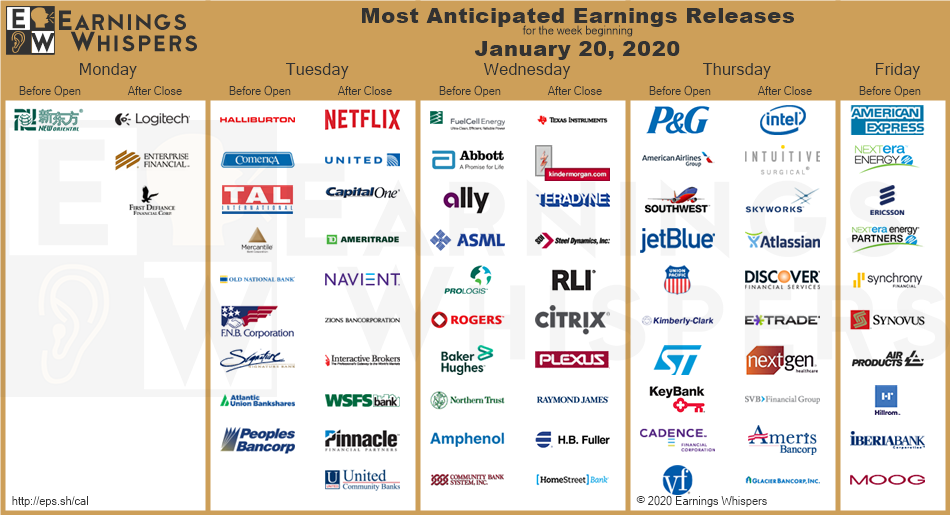
The week ahead — Economic data from Econoday.com:
Week of Jan 17, 2020 Weekly Recap & The Week Ahead

Monday, January 20th, 2020

“When you learn to let go of the need to be right, being wrong gradually lose its power to disturb you.” — unknown

1. Big Tech Dominates the S&P 500 — the recent Big Tech surge is good news for anyone chasing the sector higher, but several strategists highlight it’s a sign investors have lost their risk appetite. The top five publicly traded American companies – Apple (NASDAQ:AAPL), Microsoft (NASDAQ:MSFT), Alphabet (GOOG, GOOGL), Amazon (NASDAQ:AMZN) and Facebook (NASDAQ:FB) – now make up a record 18% share of the S&P 500 Index’s capitalization. That ratio is higher than the tech bubble, according to Morgan Stanley, amid fears the economic cycle will slow.
2. The U.S. and China signed a trade deal, calling a cease-fire in a two-year trade war — Officials said the eight-part agreement will lead to an increase in sales of U.S. goods and services to China, further open Chinese markets to foreign firms—especially in financial services—and provide strong new protections for trade secrets and intellectual property. But it leaves in place U.S. tariffs on about $370 billion in Chinese goods, and possible tariff reductions will be left to later negotiations that will also cover a host of difficult issues. U.S. business leaders generally applauded the pact, but stressed the need to keep negotiations going.
3. Change in Media Access to Market Data — the Trump administration plans to restrict the news media’s ability to prepare advance stories on sensitive U.S. economic data such as inflation and employment, Bloomberg reports. “Lockups” lasting 30 to 60 minutes are currently hosted in Washington for major reports, where journalists receive data in a secure room and transmit them when connections are restored at release time. The change, which could remove computers from the lockup room, would transform how critical market-moving information is distributed to investors and the public.
4. Nestle Spending Big on Recycled Plastic — vowing to make 100% of its packaging recyclable or reusable by 2025, Nestle (OTCPK:NSRGY) is investing as much as 2B Swiss francs to source more recycled plastics to package its products. It will also try to keep the plastic purchasing neutral on earnings through efficiencies. Rival Unilever (NYSE:UN) has further pledged to halve its use of newly made plastic by 2025 as food and beverage makers increasingly come under fire for polluting oceans and landfills.
5. Google parent Alphabet became the fourth U.S. company to achieve a $1 trillion market value — The milestone punctuated a powerful rally in shares of large internet stocks to start 2020. The search-engine giant joins tech peers Apple, Amazon and Microsoft as the only companies to reach the threshold during intraday trading. The biggest tech companies have continued to soar in value, highlighting how investors favor companies that steadily improve sales despite tepid global economic growth.

The week ahead — Economic data from Econoday.com:
Week of Jan 10, 2020 Weekly Recap & The Week Ahead

Monday, January 13th, 2020

“Commodities tend to zig when the equity markets zag.” – Jim Rogers

1. Boeing Eyes Raising More Debt as 737 MAX Costs Rise — Boeing is examining plans to issue more debt to bolster finances strained by the mounting fallout from the grounding and halted production of its 737 MAX, according to people familiar with the matter. The aerospace giant had about $20 billion in available funds at the end of the September quarter, but costs associated with the MAX crisis are rising. Analysts expect Boeing to raise as much as $5 billion to help cover expenditures that could top $15 billion in the first half of this year. In addition to spending on maintenance for the grounded MAX fleet and finished planes, the company plans to close its $4 billion acquisition of an 80% stake in the Brazilian plane maker Embraer’s commercial airliner business. Boeing also has to repay some existing debt and fund shareholder dividends. In addition, Boeing (NYSE:BA) is reassigning 3,000 workers to other jobs, but does not expect to furlough any staff, as it halts production of its grounded 737 MAX in mid-January. Major supplier Spirit AeroSystems (NYSE:SPR) meanwhile said it would offer voluntary layoffs to some employees due to a lack of “clarity on the timing for resuming MAX production.” The announcements come after American Airlines (NASDAQ:AAL) and Mexico’s Aeromexico disclosed they were the latest carriers to reach settlements with Boeing over losses resulting from the 737 MAX crisis.
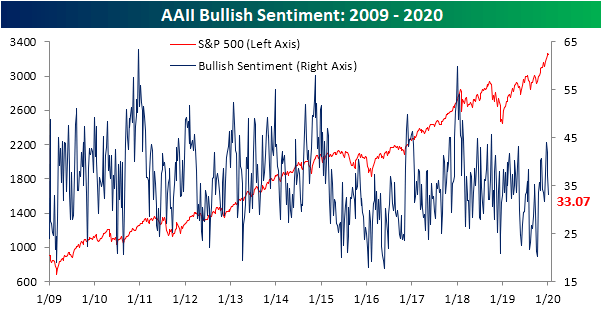
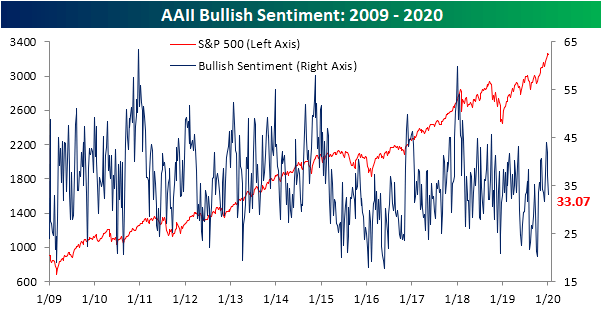
2. AAII Sentiment Survey — In the latest survey, the percentage of bullish investors in the weekly AAII survey has fallen for a third straight week down to 33.07%. This is the lowest level of bullish sentiment since the first week of December, when 31.72% of respondents were bullish. Granted, these declines have not brought bullish sentiment to any sort of extremely low level. In fact, it is now just about in line with the average reading of the past year, 33.41%.

Meanwhile, Nearly 30% of investors reported as bearish this week, which was an 8.01 percentage point increase from last week. That marked the third-largest one week jump in bearish sentiment of the past year. Granted, this increase was also about a third and half the size, respectively, of the past two larger increases of 24.14 percentage points in August and 16.11 percentage points in May. Despite the relatively large move higher, bearish sentiment is now right in line with its average of 30.3% over the past year.

3. Iran Admits to Shooting Down Jetliner — For days, Iran’s government had denied responsibility for the crash of a Boeing (NYSE:BA) 737-800 near Tehran, though it’s now calling the incident that killed 176 people a “disastrous mistake.” The country’s air defenses were fired in error while on alert after Iranian missile strikes targeted U.S. bases in Iraq. Local officials had previously pointed to an engine failure as the cause of the crash. The plane’s turbines were made by CFM International, a joint venture between General Electric (NYSE:GE) and France’s Safran (OTCPK:SAFRY).
4. SEC to Propose Exchanges Revamp Data Feed Policies — a proposal advanced by the SEC takes aim at a two-tier system that allows trading platforms like the New York Stock Exchange (NYSE:ICE) and Nasdaq (NASDAQ:NDAQ) to charge their largest customers higher fees for faster proprietary feeds, leaving smaller players to rely on a slower public stream. If the regulator decides to issue an order after receiving public input, the exchanges and FINRA would have to create a new governance plan, which would also be published for public comment before the SEC takes it into consideration.
5. Consumer Electronics Show 2020 Recap — Uber (NYSE:UBER) and Hyundai Motor (OTCPK:HYMLF) are partnering to develop electric air vehicles, joining the global race to make small self-flying cars to ease urban congestion. Samsung Electronics (OTC:SSNLF) demonstrated what it called the world’s first artificial human, Qualcomm (NASDAQ:QCOM) launched an autonomous driving computer and Toyota (NYSE:TM) said it’s building the prototype city of the future in Japan. Amazon (NASDAQ:AMZN) is also teaming up with Lamborghini and Rivian to offer its Alexa voice assistant in vehicles.

The week ahead — Economic data from Econoday.com:
Week of Jan 3, 2020 Weekly Recap & The Week Ahead

Tuesday, January 7th, 2020

“Don’t blindly follow someone, follow market and try to hear what it is telling you.” “You never know what kind of setup market will present to you, your objective should be to find opportunity where risk reward ratio is best.” — unknown

1. Market Highlights from 2019 — it was another exciting year for investors in 2019 amid a stock market rally that saw the S&P 500 surge 28%, for the biggest gain since 2013. Easing trade tensions with China, a shift in monetary policy at the Fed, and improving economic outlook all renewed investors’ faith, while safer assets like gold and bonds also soared. Other notable highlights: Tech domination, M&A activity, streaming wars, vaping crackdown, American energy independence, hot IPO market, the EV revolution, 737 MAX crisis, record holiday shopping and getting Brexit over the line.
2. Oil Service Firm McDermott in Bankruptcy Talks with Lenders — WSJ reported that the engineering firm is in talks with its lenders to file for bankruptcy within weeks. The group may provide an approximately $2B loan to keep the company’s operations running during bankruptcy, while the financing would afford McDermott the ability to provide letters of credit, most of which expire within a year and need to be renewed for the firm to continue its work on projects.
3. People’s Bank of China’s Injection of Fresh Liquidity into Banking System to Start the New Year — the festivities kicked off in Asia in the new year, where the PBOC slashed its required cash reserve ratio for commercial lenders by 50 basis points, unleashing about 800B yuan ($115B) of liquidity into the financial system. The move to shore up the local economy saw the Shanghai Composite Index end the session up 1.2%, adding to the overall positive sentiment ahead of the signing of a ‘Phase One’ U.S.-China trade deal on Jan. 15.
4. More Drugmakers Hike U.S. Prices as 2020 Begins — the drug price hike of 2020 has commenced, with costs rising for more than 250 medications, according to data analyzed by 3 Axis Advisors. Bristol-Myers Squibb (NYSE:BMY), Gilead Sciences (NASDAQ:GILD), and Biogen (NASDAQ:BIIB) hiked U.S. list prices on more than 50 drugs on New Year’s Day, adding to the couple hundred increases from drugmakers including Pfizer (NYSE:PFE), GlaxoSmithKline (NYSE:GSK) and Sanofi (NASDAQ:SNY). While nearly all of the price increases are below 10% and the median price increase is around 5%, more early year price increases could still be announced.

The week ahead — Economic data from Econoday.com:
Week of Dec 27 2019 Weekly Recap & The Week Ahead

Monday, December 30th, 2019

‘Taken together, conditions today are characteristic of those that precede a Minsky Moment, in which excessive speculation and taking on additional credit risk during stable markets leads to a tipping point that leads to a period of instability.’ — Scott Minerd, Guggenheim Partners
HAPPY HOLIDAY & WISHING OUR VIEWERS A HAPPY, HEALTHY AND PROPEROUS NEW YEAR

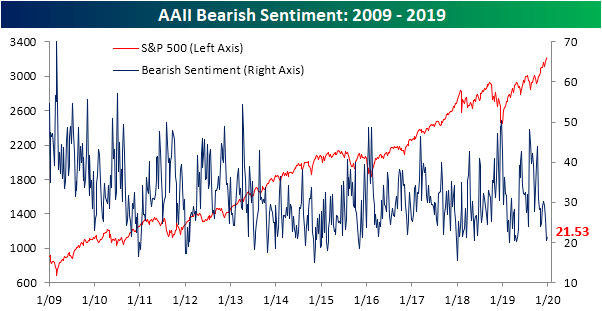
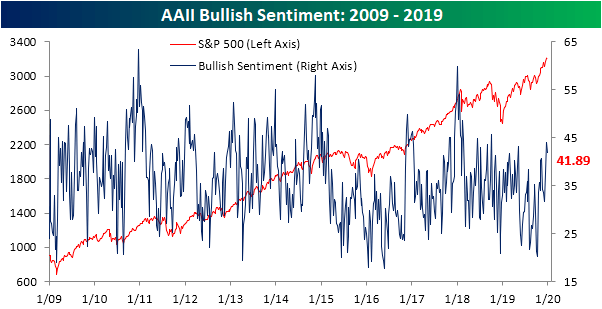
1. AAII Weekly Sentiment — as the major indices continue to establish fresh record highs in the past week with the Nasdaq eyeing an eleventh consecutive up day today, sentiment has actually not shared in moving higher. The reading on bullish sentiment from the AAII fell this week, down to 41.89% from 44.1% last week. Although it is still elevated, currently in the 96th percentile of the past year’s readings, bullish sentiment is less extended than last week and is now back within one standard deviation of its historical average.

Meanwhile, Bearish sentiment rose just about 1 percentage point this week to 21.53%. As with bullish sentiment, while off of the lowest levels, bearish sentiment is still low relative to where things have stood recently, with this week’s print in the bottom decile of the past year’s readings.

2. Boeing CEO Resigned, Counselor Retires — J. Michael Luttig, who has been managing legal matters associated with the Lion Air and Ethiopian Airlines crashes, will retire from Boeing (NYSE:BA) at year-end. Luttig served as the planemaker’s general counsel since 2006 and assumed his current responsibilities in May 2019. While earlier in the week, CEO Dennis Muilenburg resigned in the wake of the 737 MAX crisis. “The board decided that a change in leadership was necessary to restore confidence in the company moving forward as it works to repair relationships with regulators, customers, and all other stakeholders,” according to a press release. Muilenburg will be replaced by Boeing Chairman David Calhoun, effective January 13, 2020 (CFO Greg Smith will serve as interim CEO during the brief transition period).
3. Super Saturday Sales Top Black Friday by 10% — U.S. consumers are setting more holiday shopping records, as job growth and fatter wallets, along with stronger household finances, have put many in a buying mood this season. Marking the biggest single day in U.S. retail history, Super Saturday (12/21) sales reached $34.4B, topping Black Friday’s $31.2B by 10%, according to Customer Growth Partners. Figures were paced by the ‘Big Four’ mega retailers – Walmart (NYSE:WMT), Amazon (NASDAQ:AMZN), Costco (NASDAQ:COST) and Target (NYSE:TGT) – while online spending this season has so far accounted for 58% of sales growth from a year earlier.
4. China to Cut Tariffs on Range of Goods — China said it will reduce tariffs from Jan. 1 on more than 850 goods, including frozen pork, high-tech components and vital medicines, leading the Shanghai Composite Index to tumble 1.4% overnight. It will also cut import levies for more than 8,000 products for 23 countries and regions that have free-trade agreements with China, known as “most favored nation” rates. While the tariff reduction is not directly linked to the American trade war, it will likely guarantee that the coming Phase One trade deal with the U.S. doesn’t invite complaints from other trading partners.

The week ahead — Economic data from Econoday.com:
Week of Dec 13 2019 Weekly Recap & The Week Ahead

Thursday, December 19th, 2019

“Don’t blindly follow someone, follow market and try to hear what it is telling you.” “You never know what kind of setup market will present to you, your objective should be to find opportunity where risk reward ratio is best.” I do not know what you have received.” — unknown

1. China Makes Move Against Foreign Tech — China’s Communist Party has ordered all state offices to remove foreign hardware and software within three years, FT reported, in a move which could hit Microsoft (NASDAQ:MSFT), Dell (NYSE:DELL) and HP (NYSE:HPQ). Substitutions will take place at a pace of 30% in 2020, 50% in 2021, and 20% the year after, earning the policy the nickname “3-5-2.” Earlier this year, Washington banned U.S. companies from doing business with China’s Huawei, and expanded its blacklist in October to include a number of Chinese surveillance firms like Hikvision.
2. Chevron Gas Assets Take a $10 Billion Hit — in the largest write-down by an energy producer in years, Chevron said that it was cutting the value of a number of properties, notably its U.S. shale holdings in Appalachia, by a combined $10 billion to $11 billion.
3. Aramco Becomes World’s Largest Listed Company — in IPO history, Aramco (ARMCO) shares rose 10% (the daily limit) to 35.2 riyals in Riyadh, raising the company’s valuation to $1.88T and propelling the Saudi Tadawul exchange into the top ten global financial markets. The start of trading of the state-backed oil giant marks the end of a near four-year saga that’s been linked with Crown Prince Mohammed bin Salman’s Vision 2030. The plan hopes to diversify the economy away from energy by pumping funds into mega projects and industries like tourism and entertainment. Aramco valuation hits $2 trillion target. The oil giant’s share price jumped on its second day of trading to reach Saudi Crown Prince Mohammed bin Salman’s coveted valuation target.
4. U.K. Decides the Fate of Brexit — U.K. voters are heading to the polls for a general election that is being seen as a vote on Brexit and will likely shape the country for decades to come. Boris Johnson and his Conservative Party are aiming to win a majority in the 650-seat parliament that will enable them to pass their Brexit deal, formally known as the “Withdrawal Agreement,” and leave the EU by January 31, 2020. Strong short-term impacts are expected on trading floors, but the outcome will also have a long structural influence on U.K. financial asset classes like stocks, sterling and government bonds.
5. FOMC Meeting Recap — the Fed held rates steady and signaled little chance of a near-term move. “Our economic outlook remains a favorable one, despite global developments and ongoing risks,” Jerome Powell said in a statement. President Trump also meets his senior trade team in Washington today about planned Dec. 15 tariffs on nearly $160B in Chinese imports. Many had already expected a Phase One trade deal, but the question now appears to be whether Washington will delay the duties or let them take effect.

The week ahead — Economic data from Econoday.com:
Week of Dec 7 2019 Weekly Recap & The Week Ahead

Tuesday, December 10th, 2019

“Stocks take the stairs up and the elevator down.” – unknown

1. Trump Puts Tariffs on Brazil, Argentina, Citing Currencies — A barrage of trade actions was announced by the Trump administration, beginning with tariffs on steel and aluminum from Argentina and Brazil due to a “massive devaluation” of those countries’ currencies. The U.S. Trade Representative also said it would review hiking tariffs on EU products and adding new ones, because of what it called “lack of progress” in resolving a dispute over aircraft subsidies. After the markets closed, the USTR said it planned to slap punitive duties of up to 100% on $2.4B of French products – like Champagne, handbags and cheese – after concluding that a new French digital services tax (DST) would harm U.S. tech companies.
2. Black Friday Online Sales Hit Record $7.4B — online sales rose more than 19.6% to $7.4B on Black Friday, marking the day’s largest revenue grab ever, according to Adobe Analytics, which tracks transactions at 80 of the top 100 U.S. retailers. For Thanksgiving, it estimated web sales grew 14.5% to $4.2B, while Small Business Saturday and Super Sunday sales are projected to surpass $7.6B. Keep an eye today on the usual suspects like Amazon (NASDAQ:AMZN), Walmart (NYSE:WMT), Target (NYSE:TGT) and eBay (NASDAQ:EBAY), as Cyber Monday spending is expected to hit a record $9.4B, an 18.9% jump from a year ago.
3. U.S. Weighing $2.4B of Tariffs in Response to France’s Digital Services Tax — the USTR also threatened that such tariffs could be enacted in the future against Austria, Italy and Turkey, all of which have digital-services taxes. It added that French officials “repeatedly referred to the French DST as the ‘GAFA tax,’ which stands for Google (GOOG, GOOGL), Apple (NASDAQ:AAPL), Facebook (NASDAQ:FB) and Amazon (NASDAQ:AMZN).” Before moving forward with the levies, the agency will hold public hearings on the proposed tariffs on Jan. 7 and will accept public comments through at least Jan. 14,.
4. Aramco Valued at $1.7 Trillion in World’s Biggest IPO — Aramco valued at $1.7 trillion in world’s biggest IPO. Saudi Aramco priced its initial public offering at the high end of the targeted range to give the oil giant a total value of $1.7 trillion. While it ranks as the world’s biggest-ever IPO, the share sale falls well short of the initial $2 trillion valuation targeted by Saudi Crown Prince Mohammed bin Salman.

The week ahead — Economic data from Econoday.com:
Week of Nov 29 2019 Weekly Recap & The Week Ahead

Tuesday, December 3rd, 2019

There will not be any re-cap for the week of Nov 29 2019. We are away for some needed R&R.

Have a good week.

The staffs at EGS.

The week ahead — Economic data from Econoday.com:
Week of Nov 22 2019 Weekly Recap & The Week Ahead

Tuesday, November 26th, 2019

“When you learn to let go of the need to be right, being wrong gradually lose its power to disturb you.” — unknown

1. Boeing Tried for Deals at Dubai Air Show — Emirates and Boeing are reportedly on the verge of striking a compromise deal for the Middle East’s biggest carrier to order around 30 787 Dreamliners, but fewer 777X jets as part of a delayed order. Boeing (NYSE:BA) has only landed about a third of the orders scored by Airbus (OTCPK:EADSY, OTCPK:EADSF) at the biennial event. Meanwhile, FAA Administrator Steve Dickson stated on the sidelines of the show that the FAA will be tougher on the certification of the Boeing 777X and isn’t following any specific timeline for the return to service of the grounded 737 MAX model. Overall, Airbus (OTCPK:EADSY) scored 220 plane orders during the closely-watched industry event, while Boeing (NYSE:BA) lagged behind with 95 agreements for commercial jets. Boeing still managed to garner sales for its troubled 737 MAX, scoring a total of 50 deals from Air Astana, SunExpress and an unidentified customer. The French planemaker has been ahead for most of 2019. At the end of October, Airbus had posted 542 net orders vs. Boeing’s 45.
2. Disney Sees $100M ‘Frozen 2’ Debut — Disney (NYSE:DIS) is forecasting a hot debut for long-awaited sequel Frozen 2 when it opens on Friday. The company expects the film to draw $100M or so domestically in its first weekend, while some Hollywood estimates are ranging to as high as $105M. The film is set to debut in more than 4,400 theaters in North America. The first Frozen film is the 2nd highest-grossing animated movie of all-time with a global box office haul of $1.29B.
3. FCC Calls for Public C-band Auction — FCC Chairman Ajit Pai announced his support for a public auction to free up C-band spectrum, a key band currently used for delivering video content for next-generation 5G wireless networks. The news sent Intelsat’s (NYSE:I) stock crashing 40%. Major satellite service providers, which hold existing C-band licenses, had proposed selling the spectrum privately to wireless carriers, arguing a private sale would make the spectrum available for 5G faster.
4. China Invited U.S. for More Trade Talks — Beijing’s chief trade negotiator late last week proposed a new round of face-to-face talks, according to people briefed on the matter, as both sides are struggling to strike a limited deal to help de-escalate tensions.
5. FedEx Discontinues Pension for New Hires — Joining the growing ranks of large U.S. companies phasing out guaranteed retirement benefits, FedEx (NYSE:FDX) said it would close its pension plan to new U.S. hires starting in 2020. The shipping giant instead will launch a new 401(k) plan at the start of 2021 with a higher company match (contributing up to 8% of employee salaries, if employees provide 6% of their salary). Just 22% of Fortune 50 companies and 11% of transportation companies offer pensions to new employees.

The week ahead — Economic data from Econoday.com:
Search
Calendar
February 2026
M T W T F S S
« Jan    
 1
2345678
9101112131415
16171819202122
232425262728  
Archives
Categories
The information provided by The EGS Blog is based on sources believed to be reliable, but it is not guaranteed to be accurate. There is no guarantee that the recommendations of The EGS Blog will be profitable or will not be subject to losses. The information provided by The EGS Blog is not a recommendation or a solicitation that any particular investor should purchase or sell any particular security in any amount, or at all. The investments discussed or recommended herein may be unsuitable for investors depending on their specific investment objectives and financial position. At any time EGS LLC and its principals may maintain positions that are contrary to positions announced within the subscription service. In no event will The EGS Blog be liable to you or anyone else for any incidental, consequential, special, or indirect damage (including but not limited to lost profits or trading losses). PAST PERFORMANCE IS NO GUARANTEE OF FUTURE RESULTS

© Copyright 2026 Market Outlook All Rights Reserved
Design by EGS Sponsored by Equity Guidance LLC