Archive for the ‘Weekly Summary’ Category

Week of April 17, 2020 Weekly Recap & The Week Ahead

Monday, April 20th, 2020

“Only when the tide goes out do you discover who’s been swimming naked.” — Buffett

1. Airlines, Treasury Reach Tentative Accord to Tap Billions in Aid — U.S. airlines reached preliminary agreements with the Treasury Department to access billions of dollars in aid as the government attempts to shore up one of the industries hardest hit by the coronavirus pandemic. The aid represents a temporary lifeline for airlines after the outbreak and government travel restrictions erased all but 5% of daily passenger demand in the U.S. Forced in some cases to pay more in refunds than they were taking in from new ticket sales and fees, carriers have cut capacity as much as 80% and parked thousands of planes in the industry’s worst-ever disruption.
2. U.S. Economic Data Show Deep Hit in March, Collapse in April — the value of overall retail sales fell 8.7% from the prior month, the biggest decline in records dating back to 1992, according to Commerce Department data released Wednesday. Federal Reserve figures showed U.S. factory output dropped in March by the most since 1946, just after World War II ended. But surveys in April looked even worse, with manufacturing in New York state and sentiment among U.S. homebuilders plummeting by previously unthinkable amounts. Coronavirus containment measures escalated quickly in the month as states began closing restaurants and bars to dine-in customers and urging residents to stay home. Now, almost every state has issued a stay-at-home order and many businesses have temporarily shuttered in the wake. The month was also defined by millions of layoffs, which have continued into April, and sharply reduced spending power.
3. U.S. Jobless Claims Top 5.2 Million, Erasing a Decade of Gains — more than 5 million Americans filed for unemployment benefits last week, bringing the total in the month since the coronavirus pandemic throttled the U.S. economy to 22 million and effectively erasing a decade worth of job creation. The latest figures suggest an unemployment rate currently around at least 17% — far above the 10% reached in the wake of the recession that ended in 2009 — in a sign that the effects of shutdowns have spread well beyond an initial wave of restaurants, hotels and other businesses.
4. China Suffers Historic Economic Slump — Gross domestic product shrank 6.8% from a year ago, the worst performance since at least 1992 when official releases of quarterly GDP started and missing the median forecast of a 6% drop. The economy hasn’t contracted on a full-year basis since the end of the Mao era in the 1970s. Both retailing and factory output showed improvement from the nadir in the first two months, suggesting a stabilization in economic activity. But the data overall indicated an uphill struggle awaits the world’s second largest economy and its experience will be monitored elsewhere for clues as to how fast other economies will emerge from lockdowns.
5. Big Banks’ Profits Sink as They Brace for Loan Defaults — US banks are setting aside billions of dollars to cover bad loans after the coronavirus outbreak. JP Morgan boosted its reserves for potentially bad loans by nearly $7 billion. The bank warned it could boost those reserves even further in the April-June period. Meanwhile, Bank of America ’s allowance for loan losses is now almost $7 billion higher than it was in December. The reserve for credit-card losses is double what it was at the end of 2019.
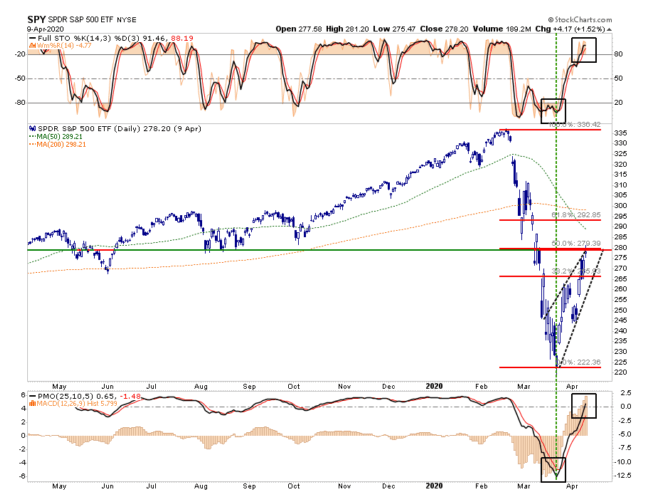
6. Market Completes A 50% ‘Bear Market’ Retracement — Over the last couple of weeks, we have indeed had an extremely strong “oversold,” reflexive rally, that has now reversed the conditions that “fueled” the advance. The next level of resistance for the SPY is around 292 which shows a retrace of 61.8;
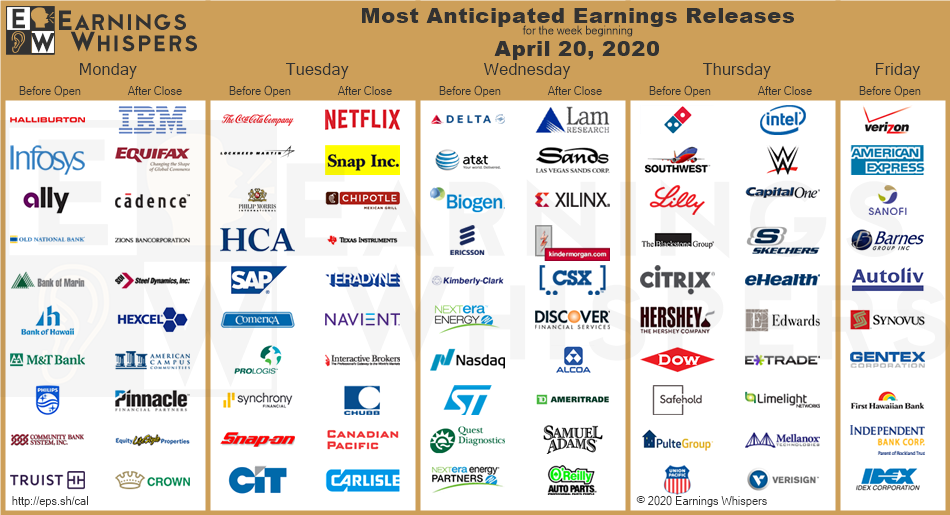
The week ahead — Economic data from Econoday.com:
Week of April 10, 2020 Weekly Recap & The Week Ahead

Monday, April 6th, 2020

“Most people view risk taking primarily as a way to make money. Bearing higher risk generally produces higher returns…But it can’t always work that way, or else risk investments wouldn’t be risky. And when risk bearing doesn’t work, it really doesn’t work, and people are reminded what risk’s all about.” ― Howard Marks

1. U.K. prime minister moved to intensive care — Boris Johnson, who is fighting a serious coronavirus infection, was admitted to an ICU in London. He deputized his foreign secretary, Dominic Raab, to run the government. More than 10,000 people in the U.S. have been killed by the coronavirus. The U.S. has more than double the number of coronavirus infections of any other nation. Meanwhile, there are signs that social distancing has helped slow the spread of the disease in other regions, such as Europe.
2. Exxon slashed capital spending — Exxon slashed capital spending by 30% to $23 billion and CEO Darren Woods said the company has capacity to further increase cuts if required. The Permian Basin will bear the largest share of the reduction, which exceeded the expectations of some analysts. Exxon aims to meet its projected investment of $20 billion on Gulf Coast manufacturing facilities. Continental Resources is also cutting production and suspending its dividend.
3. Joe Biden is the presumptive Democratic presidential nominee — Bernie Sanders dropped out of the race after suffering a series of primary defeats across the country, clearing the field for the former VP. Biden must now bring together often discordant factions within the party to try and defeat President Trump during a national health crisis that has all but eliminated public events and dramatically curtailed in-person voting.

Howard Marks Memo regarding the Corona-19 Bear Market
Howard_Marks_Calibrating

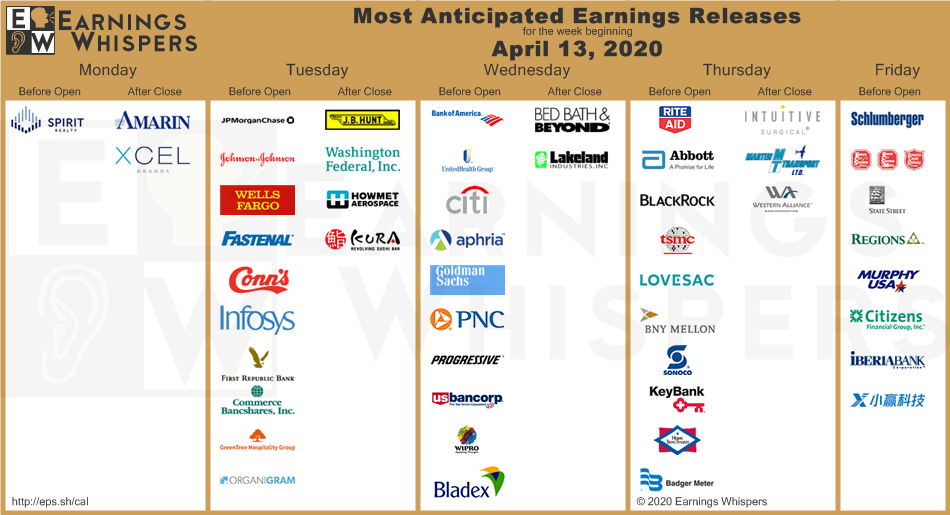
The week ahead — Economic data from Econoday.com:
Week of Mar 27, 2020 Weekly Recap & The Week Ahead

Monday, March 30th, 2020

“The biggest investing errors come not from factors that are informational or analytical, but from those that are psychological. Investor”
― Howard Marks

1. U.S. Domestic Flights Could Virtually Shut Down — major U.S. airlines are drafting plans for a potential voluntary shutdown of virtually all passenger flights across the U.S., according to industry and federal officials, as government agencies also consider ordering such a move and the nation’s air-traffic control system continues to be ravaged by the coronavirus contagion. U.S. airlines have already eliminated the vast majority of international flying and have announced plans to cut back domestic flying by as much as 40%. Travelers are staying home at even greater rates. The Transportation Security Administration reported that passenger flow at its checkpoints was down more than 80% Sunday from the same day a year earlier.
2. The U.S. Has the Third-Highest Number of Coronavirus Infections, China is Lifting Quarantine Measures in Hubei Province — the U.S. reported more than 13,000 new cases yesterday, according to data compiled by Johns Hopkins University. With 46,450 reported infections, the U.S. has the third-highest number of cases after China and Italy. In China, Chinese authorities are planning to lift the quarantine on healthy people in Hubei province, the initial center of the coronavirus pandemic. Hubei authorities will end restrictions on outbound traffic starting tomorrow, with the exception of its capital city of Wuhan, which will block departures for two more weeks.
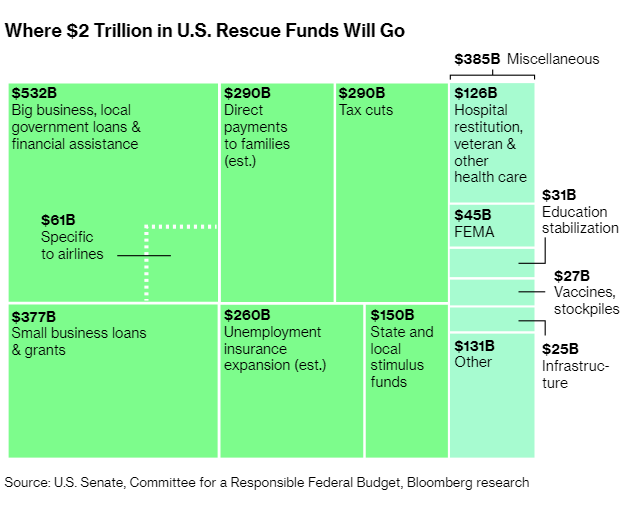
3. Deal Reached on $2 Trillion Coronavirus Rescue Bill — lawmakers and the Trump administration have struck a preliminary agreement on a sweeping stimulus package. It will provide direct checks to many Americans, drastically expand unemployment insurance, offer hundreds of billions in loans to businesses and give additional resources to health-care providers.
The bill, designed to offer relief to individuals, the health-care system and even an entire corporate sector ravaged by the outbreak, would:

4. The U.S. Now Has the World’s Most Coronavirus Cases / Updates– the U.S. has surpassed China and Italy to become the nation with the most confirmed coronavirus cases, marking a new milestone in the fight against the pandemic. There were nearly 86,000 infections in the U.S., according to data compiled by Johns Hopkins University. New York state’s 39,140 infections–tens of thousands more than in any other state–accounted for almost half of all U.S. cases. The country’s death toll stood at 1,300, according to Johns Hopkins.

The week ahead — Economic data from Econoday.com:
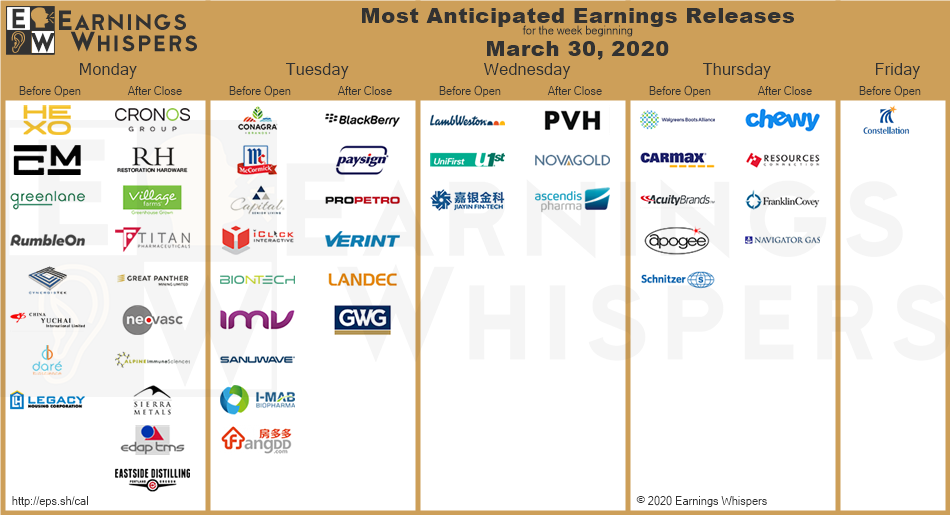
Week of Mar 20, 2020 Weekly Recap & The Week Ahead

Tuesday, March 24th, 2020

Blog for the week of Mar 20 20 will not be posted due to the Market Extreme Volatility!!! STAY SAFE

The week ahead — Economic data from Econoday.com:
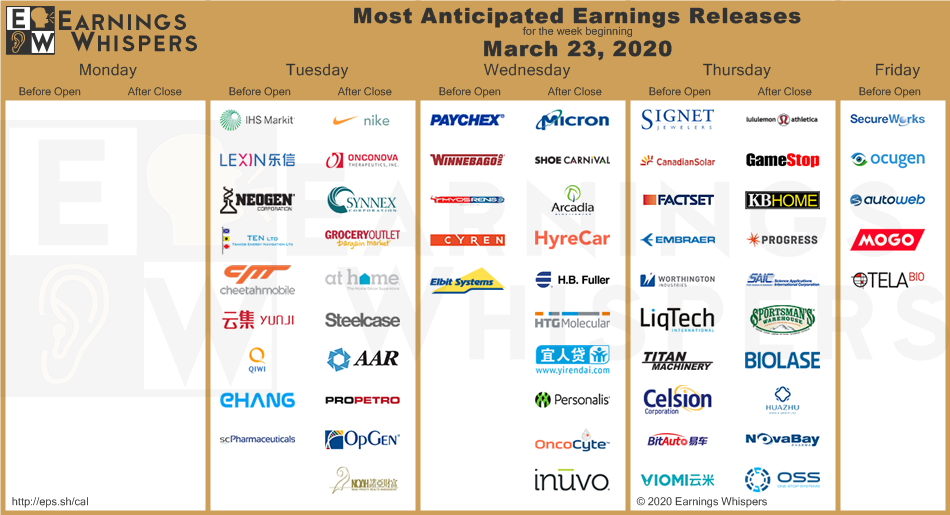
Week of Mar 15, 2020 Weekly Recap & The Week Ahead

Wednesday, March 18th, 2020

“Investor psychology can cause a security to be priced just about anywhere in the short run, regardless of its fundamentals” — Howard Marks

1. The World Health Organization has declared the new coronavirus a pandemic — The virus has spread to more than 100 countries. Confirmed cases outside of China have tripled over the past week and officials today locked down all of Italy, where the virus is currently killing more people than anywhere else, even as a wave of rioting in its prisons broke out. Israel announced restrictions requiring all arrivals on international flights to place themselves in quarantine for two weeks. Japan also imposed a two-week quarantine on visitors from China and South Korea.
WHO Director-General Tedros Adhanom Ghebreyesus said that the virus will be stoppable, even if the agency does declare a pandemic. Of 110 countries that have reported the disease, 79 have had 100 or fewer cases, Dr. Tedros said, and 43 countries have fewer than 10 cases. Roughly 80% of cases tend to be mild, but those who are older or have underlying health conditions are at a higher risk. In the U.S., the number of confirmed cases grew to 603, with 22 deaths, across 34 states and Washington, D.C. The executive director of the Port Authority of New York and New Jersey tested positive for the virus.
2. Oil Prices Collapse After Saudi Pledge to Boost Output to Battle Russia — Oil prices recorded their biggest one-day crash since the first Gulf War in 1991 on Monday, tumbling as traders bet that a clash between oil giants Saudi Arabia and Russia could flood a world already hobbled by the coronavirus outbreak with a glut of crude. Saudi Arabian state oil giant Aramco’s move over the weekend to cut most of its official selling prices triggered the oil-price crash, with a barrel of Brent crude, the global gauge of prices, closing down 24% at $34.36. Saudi officials said the kingdom also plans to boost crude output. The tumble puts oil at its lowest level in four years and 50% below a peak hit Jan. 6. U.S. crude futures fell 25% to $31.13 a barrel, also posting their worst day since 1991 and ending the day at a four-year low.
3. Joe Biden won several primaries Tuesday, including the day’s top delegate prize, Michigan — The former vice president easily won Michigan’s primary, the most closely watched among the round of six nominating contests. Mr. Biden’s victory delivered a punishing blow to the prospects of Vermont Sen. Bernie Sanders, who had won Michigan in 2016. The Midwest state was the biggest delegate prize on a day when Mr. Biden also scored wins in Idaho, Mississippi and Missouri. Mr. Biden built his delegate lead over Bernie Sanders with a coalition of African-Americans, suburbanites and older voters.
4. President Trump declared a national emergency to confront the coronavirus crisis— the declaration will release billions of dollars in federal aid — Mr. Trump also called for every state to establish emergency centers and said the government would partner with private industry to speed up virus testing. Centers for Medicare and Medicaid Services Administrator Seema Verma said she was taking action to temporarily restrict all visitors and nonessential personnel from nursing homes. Mr. Trump also said he would waive interest on all student loans held by federal agencies until further notice and instruct the Energy Secretary to purchase “large quantities” of oil for the U.S. Strategic Petroleum Reserve.
5. Stocks in the U.S. continuing a haywire period on Wall Street and avoiding becoming one of the worst weeks in the stock market’s history — the market indexes recovered some ground on the heels of Wall Street’s worst day in more than three decades, when the Dow plunged 10%. But even with late week gains, the Dow is on pace to decline about 15% this week, which would register as the worst week since 2008 and one of the worst in its history. Also, the world’s four biggest cruise lines said they were cutting short voyages and suspending much of their operations until April, an unprecedented shutdown of a $38 billion industry in the wake of the coronavirus pandemic. Hotels hit from the outbreak are cutting room rates and starting to reduce staff, an effort to stabilize the business after plunging revenue, canceled group events and sharp declines in corporate travel.
In Hollywood, the entertainment industry is reeling: Television shows are going on emergency hiatus, movie releases are being delayed, and there is talk of shutting down production entirely.

The week ahead — Economic data from Econoday.com:
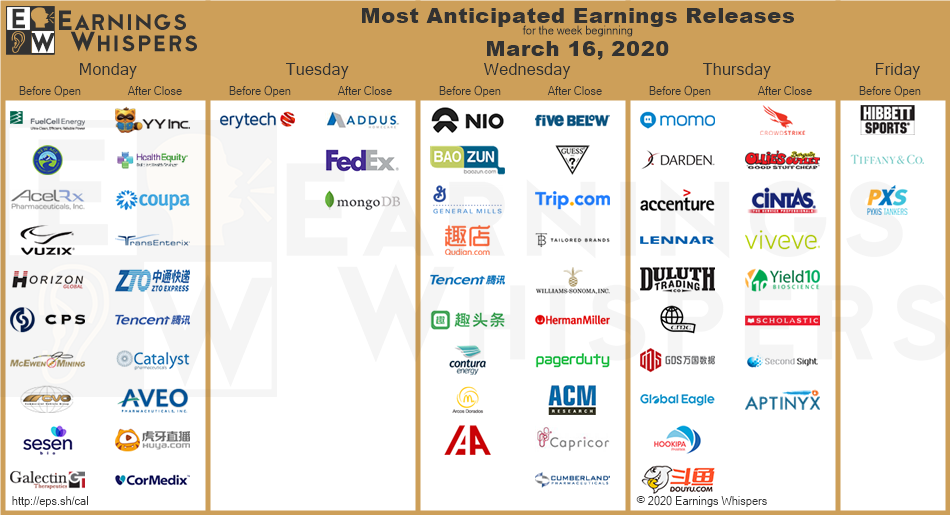
Week of Mar 7, 2020 Weekly Recap & The Week Ahead

Tuesday, March 10th, 2020

“An expert in any field will have an advantage over a rookie. But neither the veteran nor the rookie can be sure what the next flip will look like. The veteran will just have a better guess” — Howard Marks

1. Former Vice President Joe Biden Won the South Carolina Democratic Presidential Primary — Pete Buttigieg dropped out of the race, a day after Tom Steyer ended his bid. The rapid ascent of Mr. Sanders in the primaries confronts American business with the once unthinkable: The most powerful policy maker in the world could soon be a strident, lifelong critic of capitalism and big business. Also, SuperTuesday results in Biden sweeps the South, wins Texas; Sanders takes California. Joe Biden notched an impressive string of Super Tuesday victories, while Bernie Sanders won delegate-rich California, as the pair broke away from the field in the race for the Democratic presidential nomination. The Democratic nomination contest has narrowed to essentially a two-person race
2. Washington State Emerged as the U.S. Center of a Spreading Coronavirus — state health officials reported four additional deaths there and 18 confirmed cases, and a number of schools closed for disinfection. The OECD said global economic growth will slow sharply this year as governments attempt to contain the epidemic, although the scale of the setback is highly uncertain. Industries from airlines to oil and energy face weakened business.
3. Federal Reserve Cuts Rates by Half Percentage Point to Combat Virus Fear — the Fed made an emergency half-percentage-point rate cut, the first rate change between scheduled policy meetings since the 2008 financial crisis. But U.S. stock markets fell anyway, and the yield on the benchmark 10-year Treasury note slipped below 1% for the first time, reflecting fears of a coronavirus recession.
4. General Motors is Renewing Its Push to Convince Wall Street on Electric Cars — in a presentation at the company’s engineering center near Detroit, GM executives detailed their strategy, including plans for new battery technology that will allow its vehicles to travel up to 400 miles on a single charge. The company said it would spend $20 billion to develop electric and autonomous vehicles. Investors have so far been putting their money on Tesla as the company best positioned to capitalize on a big swing toward electric vehicles. Tesla’s valuation has soared to more than $130 billion, roughly three times GM’s.
5. The number of U.S. coronavirus cases has risen Rapidly — the number of U.S. coronavirus cases has risen to 206, with 11 deaths. Ten of those deaths are in Washington state. While many of the overall cases are linked to travel, a growing number in certain parts of the country is linked to what is known as community transmission. Community transmission is a milestone for any disease, given that the virus could be circulating among the general public. But U.S. health officials said the mortality rate for the virus was likely lower than what other health organizations have estimated, citing the probability of many unreported cases. Seattle-area companies and schools reacted swiftly. The Northshore School District shut its 33 campuses for up to 14 days, affecting over 23,500 students. Facebook, Amazon and Microsoft all asked many employees to work from home. In California, Gov. Gavin Newsom declared a state of emergency as the number of cases there rose to more than 50. Officials said two New York City residents and nine people in surrounding counties tested positive, bringing the total number of cases in the state to 22.

The week ahead — Economic data from Econoday.com:
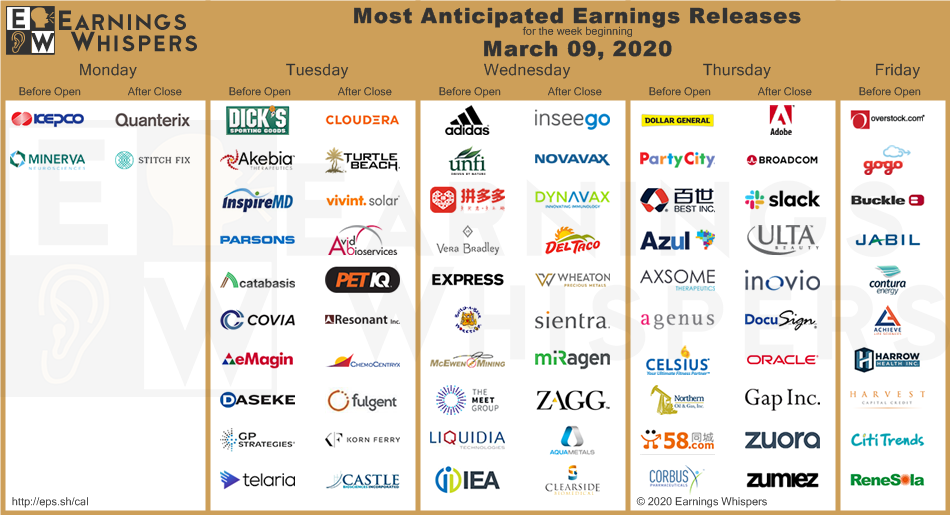
Week of Feb 28, 2020 Weekly Recap & The Week Ahead

Tuesday, March 3rd, 2020

There will not be any re-cap for the week of Feb 28 2020. We are away for some needed R&R.
Have a good week.

The week ahead — Economic data from Econoday.com:
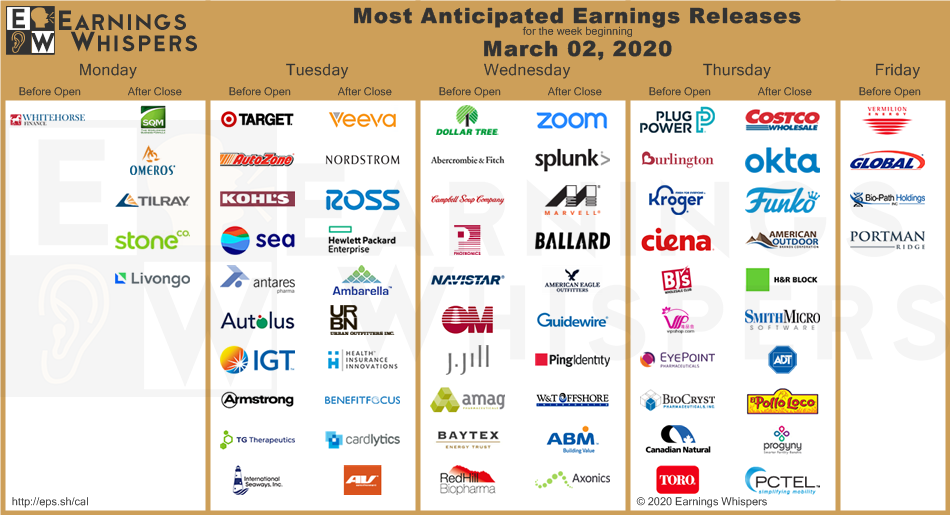

The staffs at EGS.

Week of Feb 21, 2020 Weekly Recap & The Week Ahead

Thursday, February 27th, 2020

There will not be any re-cap for the week of Feb 21 2020. We are away for some needed R&R.
Have a good week.

The week ahead — Economic data from Econoday.com:
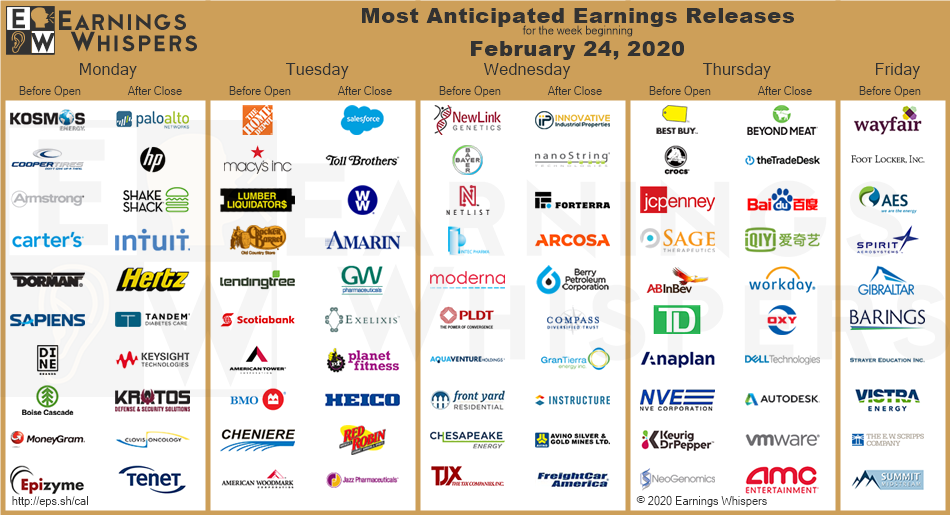
The staffs at EGS.

Week of Feb 14, 2020 Weekly Recap & The Week Ahead

Tuesday, February 18th, 2020

“The desire for constant action irrespective of underlying conditions is responsible for many losses in Wall Street even among the professionals, who feel that they must take home some money every day, as though they were working for regular wages.” – Jesse Livermore

1. T-Mobile, Sprint Deal Wins Approval, Reshaping Industry — a federal judge’s approval of T-Mobile’s takeover of Sprint will test whether three giants will compete as aggressively for cellphone users as four unequal players once did. The opinion will leave most of the country’s wireless customers with three major network operators: Verizon Communications Inc., AT&T Inc. and the new T-Mobile. New entrant Dish plans to use the deal as a springboard for its mobile ambitions, while U.S. cable companies are stuck with existing providers’ networks for their fledgling cellular services.
2. President Trump Unveilled $4.8 trillion budget — President Trump budget will propose steep reductions in social-safety-net programs and foreign aid and higher outlays for defense and veterans. The plan would increase military spending 0.3%, to $740.5 billion for fiscal year 2021, which begins Oct. 1. It will request $2 billion in new funding for border-wall construction, significantly less than the amount it sought last year. The proposal is unlikely to become law, however, as Democrats control the House and spending bills in the GOP-led Senate need bipartisan support.
3. FTC Expands Antitrust Investigation Into Big Tech — the Federal Trade Commission ordered five big tech companies to provide detailed information about their previous acquisitions of small companies, expanding the agency’s investigation into possible antitrust concerns in digital markets. The FTC ordered the companies— Amazon. com Inc., Apple Inc., Facebook Inc., Microsoft Corp. and Google owner Alphabet Inc. —to turn over information and documents relating to the scope, structure and purpose of their takeovers of smaller companies between 2010 and 2019.
4. Bernie Sanders Wins New Hampshire Primary — Sen. Bernie Sanders won the New Hampshire Democratic presidential primary Tuesday night in a narrow victory that ensures the race to challenge President Trump this November will remain heated.
With more than 85% of precincts reporting, Mr. Sanders, who is from neighboring Vermont, had 25.7% of the vote, followed by Pete Buttigieg with 24.4% and Sen. Amy Klobuchar of Minnesota with 19.7%. Sen. Elizabeth Warren of Massachusetts and former Vice President Joe Biden, who each have previously led the Democratic field in national polling, lagged well behind with less than 10% of the vote.
4. Mobile World Congress Called Off Amid Virus Worries — with swaths of individual companies pulling out of the exhibition over the past week, the GSMA telecoms association that hosts the get-together has called off the Feb. 24-27 event. Fears over the coronavirus outbreak were to blame despite assurances from local and national health officials that it would have been safe to hold it. The Mobile World Congress draws more than 100,000 visitors to Barcelona and is known as the year’s biggest event for the telecom industry.
5. Huawei Charged With Racketeering, Stealing Trade Secrets — Huawei Technologies Co. and two of its U.S. subsidiaries were charged with racketeering conspiracy and conspiracy to steal trade secrets in a federal indictment. Federal prosecutors in Brooklyn said the new charges related to a decadeslong effort by Huawei and its subsidiaries, in the U.S. and China, to steal intellectual property, including from six U.S. technology companies. Prosecutors said Huawei’s efforts were successful and resulted in the company obtaining nonpublic intellectual property about robotics, cellular-antenna technology and internet-router source code. The alleged thefts allowed the company to cut costs and research-and-development delays, giving it an unfair competitive advantage

The week ahead — Economic data from Econoday.com:
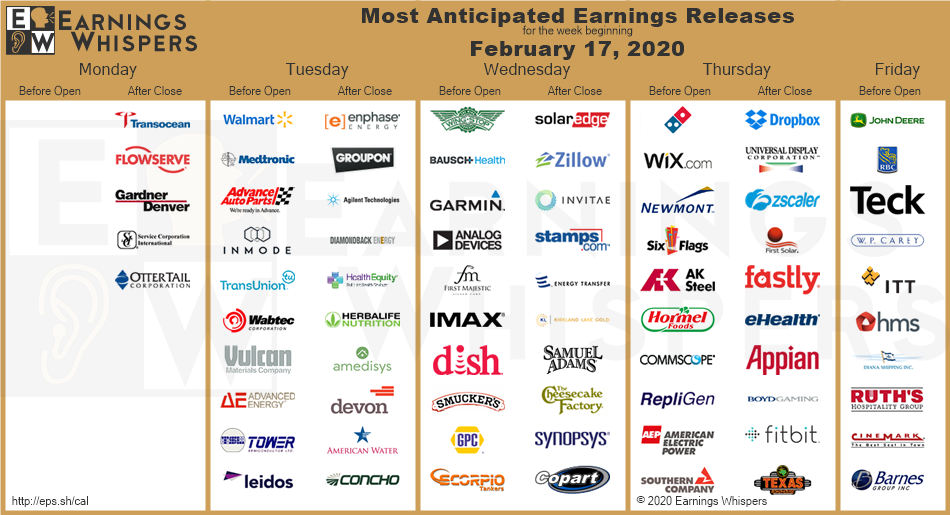
Week of Feb 7, 2020 Weekly Recap & The Week Ahead

Monday, February 10th, 2020

‘Look, everybody has a pain threshold, and you know when a stock becomes unmoored from valuations, [because] it has certain dynamic growth aspects to it and has cultlike aspects to it — you just have to walk away.’ — Steve Eisman about Tesla short

1. Chinese Leader Xi Jinping Called the Coronavirus a Major Test of China’s System of Governance — Mr. Xi told a special meeting of the Communist Party’s ruling Politburo Standing Committee there would be consequences for officials who shirk responsibility​ in tackling the crisis. the number of confirmed coronavirus cases in mainland China rose above 42,000. The death toll from the outbreak climbed above 1,000, while Hong Kong reported its first death from the pathogen. Macau moved to shut its casinos—whose revenues are more than six times that of the Las Vegas Strip—for two weeks. American health authorities reported a second case of passage from one person to another in the U.S., and raised the number of confirmed cases to 11. Companies, governments and schools are developing policies on the fly to try to halt the spread, creating a live global public-health experiment in containment.
2. State of the Union Address — President Trump touted his record in a lengthy and triumphal State of the Union. Ahead of today’s anticipated acquittal in his impeachment trial, the president used his annual address Tuesday to paint an optimistic picture of America’s future and present himself as the lead architect of the country’s economic boom. He avoided commenting on impeachment.The speech was punctuated by enthusiastic applause from Trump backers and mostly silence from Democrats; House Speaker Nancy Pelosi notably ripped her copy of the speech in half as Mr. Trump finished.
3. Disney Emerges as a Formidable Streaming Contender — the number of subscribers to the company’s new streaming service, Disney+, more than doubled in its first three months. CEO Robert Iger said older programming, ranging from classic Disney movies to seasons of “The Simpsons,” has been as popular with Disney+ subscribers as its new, original content such as “The Mandalorian.” Disney+ is already competing with Netflix, Amazon and Apple in the market. Netflix, the largest streaming platform, started offering streaming in 2007 and created a stand-alone streaming plan in 2010. It didn’t cross 28 million subscribers until late 2012, according to its financial statements.
4. Senate Acquits Trump on Both Impeachment Articles — the Republican-led Senate acquitted the president of charges stemming from his efforts to press Ukraine to announce investigations that would benefit him politically. The vote to acquit marked a clear victory for the president. GOP senators strongly supported his acquittal, but several said Democrats had proved that he acted improperly—though not in a manner deserving of impeachment—regarding Ukraine. Utah Sen. Mitt Romney was the lone Republican to vote to convict and remove Mr. Trump from office.
5. China to Cut in Half Tariffs on $75 Billion of U.S. Goods — China said it would cut tariffs on $75 billion of U.S. imports in half as part of efforts to implement a recently signed trade agreement with Washington. The tariff cuts set to take effect on Feb. 14 come amid growing doubts about Beijing’s ability to follow through on the phase-one trade deal, in which China has pledged to boost its purchases of American goods and services by $200 billion over two years.
The U.S. trade deficit narrowed in 2019 for the first time in six years, as disputes with China and other countries reduced the U.S.’s exports and imports while reshaping relationships with economic partners. Exports declined for the first time since 2016, dropping 0.1%, the Commerce Department said. But imports fell more sharply, decreasing 0.4%. That combination shrank the overall trade deficit 1.7%, to $616.8 billion. U.S. tariffs on roughly $370 billion in annual Chinese imports remain in place.

The week ahead — Economic data from Econoday.com:
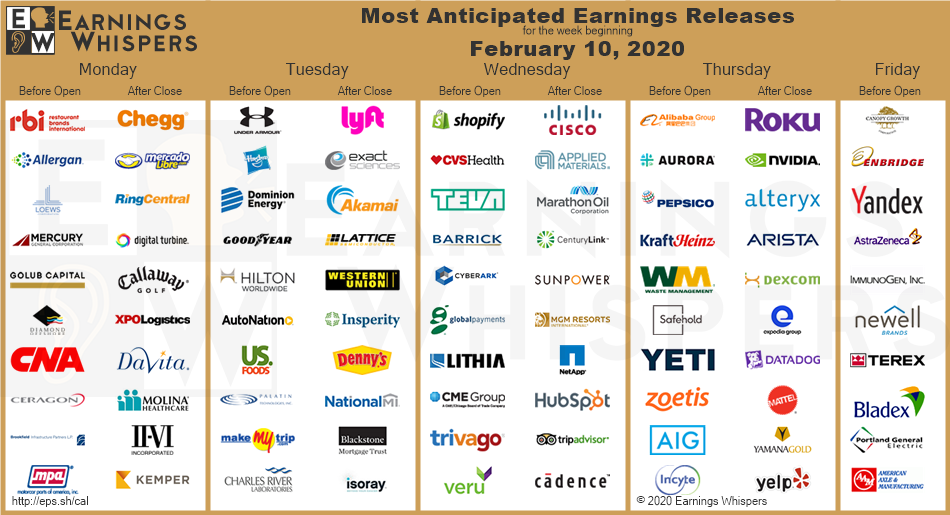
Search
Calendar
February 2026
M T W T F S S
« Jan    
 1
2345678
9101112131415
16171819202122
232425262728  
Archives
Categories
The information provided by The EGS Blog is based on sources believed to be reliable, but it is not guaranteed to be accurate. There is no guarantee that the recommendations of The EGS Blog will be profitable or will not be subject to losses. The information provided by The EGS Blog is not a recommendation or a solicitation that any particular investor should purchase or sell any particular security in any amount, or at all. The investments discussed or recommended herein may be unsuitable for investors depending on their specific investment objectives and financial position. At any time EGS LLC and its principals may maintain positions that are contrary to positions announced within the subscription service. In no event will The EGS Blog be liable to you or anyone else for any incidental, consequential, special, or indirect damage (including but not limited to lost profits or trading losses). PAST PERFORMANCE IS NO GUARANTEE OF FUTURE RESULTS

© Copyright 2026 Market Outlook All Rights Reserved
Design by EGS Sponsored by Equity Guidance LLC