Archive for the ‘Weekly Summary’ Category

Week of July 4, 2020 Weekly Recap & The Week Ahead

Tuesday, July 7th, 2020

“The desire for more, the fear of missing out (FOMO), the tendency to compare against others, the influence of the crowd and the dream of the sure thing—these factors are near universal. Thus they have a profound collective impact on most investors and most markets. The result is mistakes, and those mistakes are frequent, widespread and recurring.”
― Howard Marks
1. Covid-19 Drug Remdesivir to Cost $3,120 — Gilead disclosed its pricing plans as it prepares to begin charging for the drug in July. The U.S. has been distributing remdesivir donated by Gilead since the drug was authorized for emergency use in May. it will charge U.S. hospitals $3,120 for a typical patient. Remdesivir is the first antiviral drug shown to be effective at treating Covid-19 in a major clinical trial, reducing patients’ recovery times by four days compared with the placebo group in a large study funded by the National Institute of Allergy and Infectious Diseases.
2. U.S. Daily Coronavirus-Case Count Crosses 50,000 — new coronavirus cases in the U.S. passed 50,000 for the first time to reach a single-day record, as some cities and businesses reversed course on reopenings ahead of the July Fourth holiday weekend. Cases and hospitalizations have jumped in a number of areas. In Texas, 6,904 Covid-19 patients were in hospitals, according to the state’s Department of Health. For most of April and May, that number hovered between 1,100 and 1,800. It broke the 2,000 mark on June 8. The percentage of occupied intensive-care-unit beds in Arizona, another hot spot, remained at a high of 89% for a second day. On Thursday, the state reported nearly 3,300 new cases, for a total of 87,425. More than 10% of its daily tests were positive.
In California, where hospitalizations are up more than 40% from two weeks ago, Gov. Gavin Newsomannounced new restrictions, including the mandatory closure of bars, indoor restaurants, movie theaters, zoos and museums in 19 counties where 70% of the state’s population lives.
3. U.S. Stocks Finish Best Quarter in More Than 20 Years — The S&P 500 finished the second quarter up 515.70 points, or 20%, to 3100.29, its biggest percentage gain since the last three months of 1998. The Dow Jones Industrial Average added 3895.72 points, or 18%, to 25812.88, its best quarter since 1987. The rally has cut the indexes’ losses for the year to 4% and 9.6%, respectively. The Nasdaq Composite up 31% in the past three months and 12% for this year. The stock market’s performance in the months ahead of the election could have a big impact on the outcome of the race. Data going back to 1928 show the incumbent party has won the contest 87% of the time if the S&P 500 is positive over the three months ahead of the election and lost it when it is negative.
4. Uber in Talks to Buy Postmates for About $2.6 Billion — A combination would augment Uber’s food-delivery arm, Uber Eats, which already has an international footprint and the second-largest market share in the U.S. after DoorDash Inc. Its competitor includes Grubhub Inc. agreed this month to be bought by Just Eat Takeaway.com NV for more than $7 billion, besting a bid from Uber, which had been in talks to combine with Grubhub for months.

The week ahead — Economic data from Econoday.com:
Week of June 26, 2020 Weekly Recap & The Week Ahead

Monday, June 29th, 2020

“The desire for more, the fear of missing out, the tendency to compare against others, the influence of the crowd and the dream of the sure thing—these factors are near universal. Thus they have a profound collective impact on most investors and most markets. The result is mistakes, and those mistakes are frequent, widespread and recurring.”
― Howard Marks,

1. New York, New Jersey and Connecticut Will Impose a 14-day Quarantine on Travelers from Coronavirus Hotspot States — the governors of New York, New Jersey and Connecticut told travelers to their states coming from states with high rates of Covid-19 cases to self-quarantine for 14 days. That restriction would apply to travelers coming from Florida, Texas, Arizona and a handful of other states throughout the South and Southwest that are experiencing a surge in Covid-19 cases. The announcement comes as the hard-hit tri-state region has seen large declines in cases after experiencing the worst outbreak in the U.S. over the spring.
2. Fauci and Other Health OfficialsRreturned Tesfified in Congress — Dr Fauci expressed concerns as a trio of states with Republican governors who are bullish on reopening — Arizona, Florida and Texas — are among those seeing worrisome increases in cases. He further said “We will be doing more testing,” told a House committee. Todate, the U.S. has tested more than 27 million people, with about 2.3 million – or 8.4% – testing positive; About 2.3 million Americans have been sickened in the pandemic, and some 120,000 have died, according to data from Johns Hopkins University.
3. U.S. first-quarter GDP declines at 5% — the pace of contraction in the economy was left at 5% in the first quarter in the final estimate from the Commerce Department. Using more complete source data, the government found that consumer spending was weaker than previously estimated. This was offset by upward revisions to business fixed investment. The data for the first was dragged down by the impact from the coronavirus pandemic that hit hard at the end of the period.

The week ahead — Economic data from Econoday.com:
Week of June 19, 2020 Weekly Recap & The Week Ahead

Monday, June 22nd, 2020

“The process of intelligently building a portfolio consists of buying the best investments, making room for them by selling lesser ones, and staying clear of the worst.” – Howard Marks

1. The Fed Says it is Going to Start Buying Individual Corporate Bonds — as part of a continuing effort to support market functioning and ease credit conditions, the Fed added functions to its Secondary Market Corporate Credit Facility. The program has the ability to buy up to $750 billion worth of corporate credit. Its March 23 initial announcement is largely considered a watershed moment for the financial markets, reeling from the coronavirus threat spread. Under the latest guidelines, the Fed said it will buy, on the secondary market, individual bonds that have remaining maturities of five years or less. Those purchases will go along with the ETFs the Fed already has been buying, which are balanced toward investment-grade indexes but also include some junk bond funds that track debt which had been investment grade before the crisis but had been downgraded after.
2. Beijing Shuts Schools to Stem Virus as Cases Spread Beyond City — the Chinese capital on Tuesday lifted its emergency response to level two and said that people will have to be tested for the virus before being allowed to leave the city. The stakes are higher in Beijing, where the country’s business and political elite reside, and an aggressive lockdown risks undoing China’s economic re-opening and nascent moves to restart travel with other countries. Beijing on Tuesday closed another food market located near the financial district after a case linked to the original cluster was discovered. Eleven other food markets have been shuttered and almost 300 others sanitized, while nearly 30 housing compounds have been put under lockdown, local officials said.
3. Retail Sales Surges 17.7% in May — The 17.7% advance from the prior month, to $485 billion in receipts, was the biggest gain in data going back to 1992, following unprecedented declines in the prior two months, according to Commerce Department data. All retail categories increased in May, including a 44% surge in sales of motor vehicles and a 29% jump in restaurant receipts. Together, those categories accounted for more than half the overall gain in sales. Among other categories, sales at clothing stores nearly tripled in May from a month earlier, while purchases at building materials outlets climbed about 11% and non-store sales, which consist mainly of Internet purchases, rose another 9%.
4. Tulsa Prepares for Unrest as Protesters March Nationwide — Tulsa officials prepared Friday for up to 100,000 anti-police protesters and Trump supporters to descend on the city, by boarding up stores and setting up metal fences around the BOK Center where President Trump will hold a rally Saturday. Trump declares “Any protesters, anarchists, agitators, looters or low-lifes who are going to Oklahoma please understand, you will not be treated like you have been in New York, Seattle, or Minneapolis. It will be a much different scene!” he wrote on Twitter Friday morning.

The week ahead — Economic data from Econoday.com:
Week of June 12, 2020 Weekly Recap & The Week Ahead

Tuesday, June 16th, 2020

1. U.S. Consumer Prices Declined in May for a Third Straight Month — the consumer price index fell 0.1% from the prior month after a 0.8% drop in April that was the biggest since 2008. While the government figures show prices are falling, households expect to be paying more for goods and services a year from now. According to data from the University of Michigan’s consumer sentiment report, year-ahead inflation is seen at 3.2%, 2 percentage points higher than the latest read on annual core prices.Prices for clothing, gasoline, car insurance, and airfares showed another month of declines, despite some states reopening activity. Apparel prices dropped another 2.3%, motor vehicle insurance costs plummeted a record 8.9% and airfares were down 4.9%.
2. Fed Sees Interest Rates Staying Near Zero Through 2022 — the Federal Reserve pledged to maintain asset purchases at “at least” the present pace and projected interest rates will remain near zero through 2022 as policy makers attempt to support the economy’s recovery from the coronavirus recession. Along with the rate decision, central bankers projected Wednesday that the economy will shrink 6.5% in 2020, a year that saw an unprecedented halting of business activity in an effort to combat the coronavirus pandemic. However, 2021 is expected to show a 5% gain followed by 3.5% in 2022.
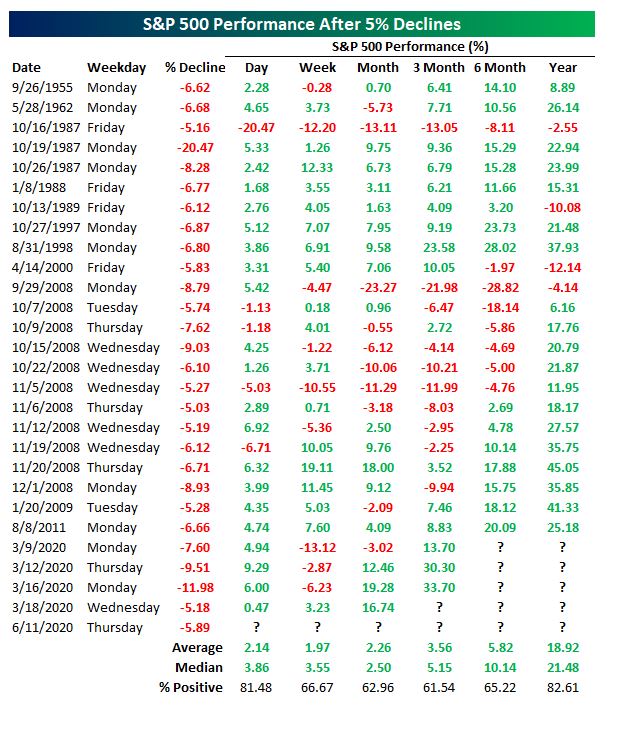
3. S&P 500 tumbled 5.9% and Historical Statistics — according to the Bespoke Investment Group, when the index tumbled sub 5%, was only the 28th time since 1952. Five of those declines have been in the past three months alone. The investment and research provider also noted that an unraveling of the market on a Thursday is also a rarity, with all such previous Thursday 5%+ drops occurring amid the 2008 financial crisis and none before that, going back to 1952. All that said, declines of this magnitude have historically been followed by sizable rebounds in the days, weeks and months to follow (see table below).

4. Hertz Wants to Sell $1 Billion More of Its Shares of Potentially ‘Worthless’ Stock — Hertz Global Holdings Inc., whose stock appears destined to be wiped out when its bankruptcy case is finished, wants to sell $1 billion more of its shares. The car renter wants to take advantage of the quixotic rally in its stock by offering as many as 246.78 million common shares, according to a court filing. Hertz said it would warn any potential buyers that “the common stock could ultimately be worthless” and protect Jefferies LLC, the firm managing the potential sale, against lawsuits that could result from the offering.

The week ahead — Economic data from Econoday.com:
Week of June 5, 2020 Weekly Recap & The Week Ahead

Tuesday, June 9th, 2020

“But most investors do capitulate eventually. They simply run out of the resolve needed to hold out. Once the asset has doubled or tripled in price on the way up — or halved on the way down — many people feel so stupid and wrong, and are so envious of those who’ve profited from the fad or side-stepped the decline, that they lose the will to resist further. My favorite quote on this subject is from Charles Kindleberger: “There is nothing as disturbing to one’s well-being and judgment as to see a friend get rich” (Manias, Panics, and Crashes: A History of Financial Crises, 1989). Market participants are pained by the money that others have made and they’ve missed out on, and they’re afraid the trend (and the pain) will continue further. They conclude that joining the herd will stop the pain, so they surrender. Eventually they buy the asset well into its rise or sell after it has fallen a great deal. In other words, after failing to do the right thing in stage one, they compound the error by taking that action in stage three, when it has become the wrong thing to do. That’s capitulation. It’s a highly destructive aspect of investor behavior during cycles, and a great example of psychology-induced error at its worst.”
― Howard Marks

1. Trump Threatens to Use Troops to Crush Unrest in U.S. Cities — Trump on Monday night called on governors and mayors to “dominate the streets” and announced that he was sending thousands of heavily armed military personnel into the nation’s capital after days of violent outbursts following the death of George Floyd, an unarmed black man, at the hands of Minneapolis police. Trump was considering invoking the Insurrection Act. That 1807 law, previously used to intervene during the 1992 Los Angeles riots, allows the president to federalize the National Guard and bring in the U.S. military if states are unable to safeguard constitutionally protected civil rights.
2. Roche Test for Severe Covid-19 Gets Emergency FDA Approval — the blood test, called Elecsys IL-6, can identify patients who carry the virus and who may develop respiratory distress and require intubation within 18 minutes. Some patients develop a severe inflammatory response called a cytokine storm, which can be deadly. The test attempts to pinpoint those most at-risk people early by measuring levels of interleukin 6 in the blood, a marker for acute inflammation. The protein acts as a messenger from some immune cells to rouse others against the infection.
3. U.S. Job Cuts Shows a Drop of 2.76 million in payrolls is one-third of forecast — The 2.76 million decline in business payrolls last month followed a revised 19.6 million decrease in April, according to ADP Research Institute data released Wednesday. The drop in May was smaller than all but one estimate in a Bloomberg survey of 39 economists. The median projection called for a decline of 9 million.
4. U.S. regains 2.5 million jobs in May, unemployment falls to 13.3% — The U.S. regained 2.5 million jobs in May and the unemployment rate fell to 13.3%, confounding Wall Street expectations for another big wave of layoffs and signaling the economy began to revive last month after probably the worst economic crisis in American history since the Great Depression of the 1930s. Those jobs tilted toward full-time, which added 2.2 million , while part-time workers gaining jobs numbered 1.6 million. Leisure and hospitality workers made up almost half the increase last month, with 1.2 million going back to work after a reported loss of 7.5 million in April. Jobs in bars and restaurants increased by 1.4 million as states began to relax social distancing measures. Construction was the next biggest gainer with 464,000, making up for about half of April’s losses. Education and health services rose by 424,000 and retail surged by 368,000 after plunging by 2.3 million a month previous.

The week ahead — Economic data from Econoday.com:
Week of May 22, 2020 Weekly Recap & The Week Ahead

Thursday, May 28th, 2020

“Investment success doesn’t come from “buying good things,” but rather from “buying things well.” – Howard Marks

1. Moderna Covonavirus Caccine Shows Early Signs of Viral Immune Response — the results are just a sample from the small, first study designed to look at the safety of the shot in human volunteers, and should be viewed with caution. But they showed no major safety worries, a key first hurdle since a vaccine would be given to millions of otherwise healthy people. A vaccine is considered a crucial step toward lifting social-distancing measures and safely reopening economies, schools and events around the globe. The new coronavirus, known as SARS-CoV-2, has infected more than 4.7 million people and killed over 300,000, spurring a global race by drugmakers, academic institutions and governments to find a vaccine. The company is moving ahead with plans for a larger test to pick a dose of the vaccine and further study its effectiveness, as well as a phase 3 test with many thousands of patients.
2. U.S. Raises Ante in Vaccine Race With $1.2 Billion for Astra — the U.S. pledges as much as $1.2 billion to AstraZeneca Plc to help make the University of Oxford’s Covid vaccine. The U.S. has backed projects underway at Johnson & Johnson, Moderna Inc. and France’s Sanofi, fueling concerns that other parts of the world could fall behind. Some doubts have been raised about the potential effectiveness of the Oxford vaccine after early results in monkeys were released. While the shot may have protected animals against severe infections, the results were weak compared with those of a test of a vaccine under development by Sinovac Biotech in Beijing.
3. Millions More American Filed for Unemployment Benefits — jobless claims for regular state programs totaled 2.44 million in the week ended May 16, Labor Department reported. The prior week’s figure was revised down by 294,000 to 2.69 million after a clerical error by Connecticut labor officials inflated the overall nationwide figure. The median estimate in a Bloomberg survey of economists called for 2.4 million claims in the latest week. That means nationwide claims under the program — which expands unemployment benefits to those not traditionally eligible, such the self-employed and gig workers — were actually about half of the reported 2.23 million figure.
4. Argentina Braces for Ninth Default — after five months in office grappling with recession, 50% inflation and a crash in the unofficial peso rate, Fernandez is trying to strike a deal with bondholders over the coming weeks to prevent even worse chaos. Although there’s no 2001-style panic, Argentines have been quietly preparing for the worst. Savers have withdrawn $1.2 billion in dollar deposits over the past 20 business days. Demand for dollars is so high that the illegal exchange rate has widened to nearly twice the official rate, which is anchored by currency controls.

The week ahead — Economic data from Econoday.com:
Week of May 15, 2020 Weekly Recap & The Week Ahead

Monday, May 18th, 2020

“Prices are too high” is far from synonymous with “the next move will be downward.” Things can be overpriced and stay that way for a long time . . . or become far more so.” – Howard Marks

1. New Jersey, Connecticut Moves Toward Reopening — Retail businesses will be allowed to offer curbside pickup starting May 18, and restrictions will lift on non-essential construction work, Governor Murphy stated. Also, Connecticut will begin to reopen May 20 and test 42,000 a week. Connecticut Governor Ned Lamont said the chief executives of some large companies have told him that telecommuting could help them save money by cutting office space by as much as 30%, signaling what may be a national shift by businesses.
2. Fed Chairman Powell Warns of Broad Virus Danger, Discourages Negative Rates — Federal Reserve Chair Jerome Powell stated The U.S. economy faces unprecedented risks from the coronavirus if fiscal and monetary policy makers don’t rise to the challenge. Powell and his colleagues on the policy-setting Federal Open Market Committee have taken dramatic measures to shelter the U.S. economy during the coronavirus pandemic. They have cut their benchmark interest rate to nearly zero, engaged in open-ended bond buying and begun rolling out emergency lending programs as U.S. unemployment has soared to levels not seen since the 1930s Great Depression. Powell acknowledged the negative rate speculation but said such a move was not being considered, though he stopped short of completely ruling the tool out as an option in the future.
3. U.S. Jobless Claims Climbs to 2.98 Million Brings Virus Sum to 36.5 Million — Initial jobless claims in state programs totaled 2.98 million in the week ended May 9, Labor Department figures showed Thursday, following 3.18 million the prior week. With the latest numbers, a total of 36.5 million applications for unemployment insurance have been filed since the virus began shutting down businesses in mid-March. Connecticut reported a surge to about 298,700 from 36,100 the prior week — dwarfing any other state change.
4. Retail Sales Crater by a Record 16.4% as Spending Slumps Amid Coronavirus Lockdowns — revenue at retailers and restaurants fell 16.4% from the prior month, almost double the 8.3% drop in March which was previously the worst in data back to 1992, according to a Commerce Department report. With the coronavirus pandemic keeping most Americans stuck at home and unemployment the highest since the Great Depression era, people sharply reduced their spending in the month. The retail sales report, meantime, showed all but one of 13 major categories decreased, led by a 78.8% drop at clothing stores and a 60.6% decline at electronics and appliance outlets. The only category to record a gain was nonstore sales — including online sellers such as Amazon.com — which increased 8.4%.
5. Trump Administration Moves to Cut Huawei Off From Global Chip Suppliers — the Trump administration moved to block shipments of semiconductors to Huawei Technologies from global chipmakers, in an action that could ramp up tensions with China. The rule change is a blow to Huawei, the world’s no. 2 smartphone maker, as well as to Taiwan’s TSMC, a major producer of chips for Huawei’s HiSilicon unit as well as mobile phone rivals Apple and Qualcomm. The United States is trying to convince allies to exclude Huawei gear from next-generation 5G networks on grounds its equipment could be used by China for spying.

The week ahead — Economic data from Econoday.com:
Week of May 8, 2020 Weekly Recap & The Week Ahead

Monday, May 11th, 2020

“Being too far ahead of your time is indistinguishable from being wrong.” – Howard Marks

1. Hertz May File for Bankruptcy — Hertz may file for bankruptcy as talks with creditors go down to the wire, people familiar said. The company added FTI Consulting, a bankruptcy specialist, to its roster of advisers. Shares dropped 21% pre-market. Neiman Marcus is close to a bankruptcy deal with lenders led by PIMCO that would slash its debt load by more than half in exchange for control of the company, people familiar said. Also, JC Penney has filed for bankruptcy protection.
2. American Meat Workers Are Starting to Quit With Plants Reopening — At a JBS USA plant in Greeley, Colorado, absenteeism is running as high as 30%. Before the pandemic, it was about 13%. The company is paying about 10% of the workforce — people deemed vulnerable — to stay home. Meat plants have been at the nexus of coronavirus hot spots across America’s rural heartland. The disease spread through plants in March and April as companies struggled to adapt their workplaces to new rules dictated by the pandemic. As absenteeism persists, the U.S. is at risk of continued meat shortages and higher prices, even after President Donald Trump signed an executive order to keep plants running.
3. U.S., China Trade Chiefs to Speak on Progress in Implementing a Phase-One Deal — the planned phone call will be the first time Liu and Lighthizer speak officially about the agreement since it was signed in January, just before the global coronavirus pandemic hit the world’s two biggest economies and upended global supply chains. The deal called for Liu and Lighthizer to meet every six months, making next week’s call slightly ahead of schedule. According to the text of the agreement signed earlier this year, China has agreed to buy an additional $200 billion in U.S. goods and services over two years compared with 2017’s level.
4. U.S. Jobless Rate Surges to 14.7% in Worst-Ever Labor Reversal — employers cut an unprecedented 20.5 million jobs in April and the unemployment rate more than tripled to 14.7%.
Joblessness now stands at the most since the Great Depression era of the 1930s after the coronavirus pandemic brought the U.S. economy to a standstill. As recently as February, the rate stood at just 3.5%, the lowest level in five decades. White House adviser Kevin Hassett stated unemployment may peak “north of” 20% in May or June before the economy starts to come back from coronavirus-related shutdowns in the second half of 2020.
5. FDA Approves New Covid-19 Antigen Test — the emergency use authorization, the first ever by the FDA for a Covid-19 antigen test — was granted to San Diego-based Quidel Corp. late Friday, according to a notice from the agency. “It’s a very rapid test that could be used in a doctor’s office,” former FDA Commissioner Scott Gottlieb said Sunday on CBS’s “Face the Nation.” “Doctors now have about 40,000 of these Sophia machines already installed in their offices” where they are used to test for strep throat and flu. Each test will probably cost about $5, with results available within minutes

The week ahead — Economic data from Econoday.com:
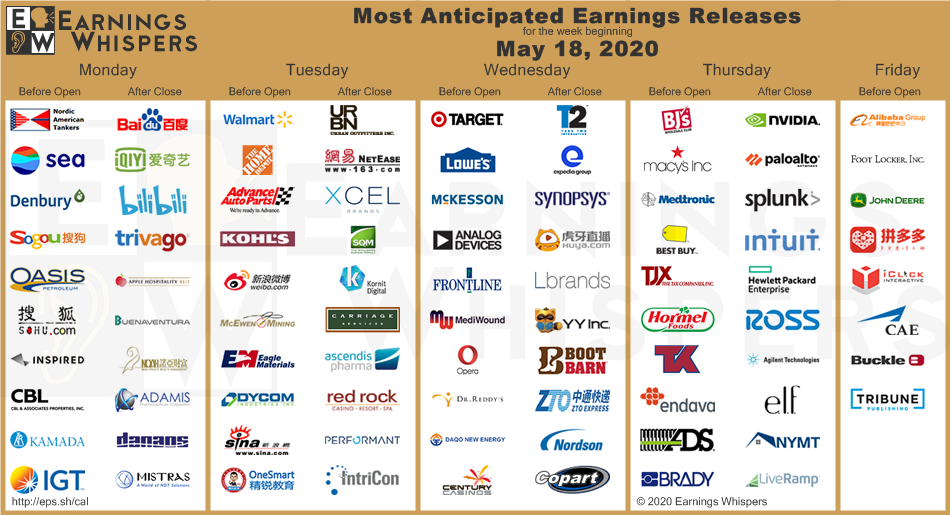
Week of April 31, 2020 Weekly Recap & The Week Ahead

Monday, May 4th, 2020

“The desire for more, the fear of missing out, the tendency to compare against others, the influence of the crowd and the dream of the sure thing—these factors are near universal. Thus they have a profound collective impact on most investors and most markets. The result is mistakes, and those mistakes are frequent, widespread and recurring.”
― Howard Marks

1. Data From Gilead Virus-Drug Trial ‘Good News’ — Gilead gave a shot in the arm to markets with positive data from a drug trial for its Covid-19 treatment, remdesivir. Infectious-disease expert Anthony Fauci said the early results offered “quite good news.” The FDA plans to announce emergency-use authorization for the drug as early as Wednesday, the NYT said. As for a vaccine, the Trump administration is organizing a Manhattan Project-style effort to develop one and have 100 million doses ready by year-end, people familiar said.
Operation Warp Speed will unite pharmaceutical companies, government agencies and the military in an aim to cut the development time by as much as eight months.
2. Job Losses Deepen in Pandemic With U.S. Tally Topping 30 Million — Millions more Americans filed for unemployment benefits last week, sending the six-week total above 30 million since the coronavirus pandemic began to shutter businesses across the country. Initial jobless claims totaled 3.84 million in the week ended April 25 following 4.44 million in the prior week, according to Labor Department figures Thursday. Economists had projected 3.5 million claims.
3. Roche Covid-19 Antibody Test Gets Emergency FDA Approval — The Swiss giant expects production of the test to reach the high double-digit millions by June and pass the 100 million monthly threshold later this year. The test looks for antibodies in blood that have been raised to fight off the virus that causes Covid-19. Roche’s version runs on a high-volume instrument that can produce a single result in 18 minutes and as many as 300 results in an hour, the company said in a statement Sunday after receiving emergency authorization from the U.S. Food and Drug Administration.
4. Trump Presses to Reopen U.S. — Trump repeated his aim that the U.S. would have a coronavirus vaccine by year’s end, an extremely ambitious deadline that the president said doctors have urged him not to promote. He also said the economy would fully rebound in the fourth quarter of 2020 and the beginning of next year. In a virtual town hall staged symbolically at the Lincoln Memorial Sunday evening, Trump said he hopes to return to his raucous political rallies in packed arenas in the final months of his campaign for re-election. He complained that some states “aren’t going fast enough” to ease public health restrictions.

The week ahead — Economic data from Econoday.com:
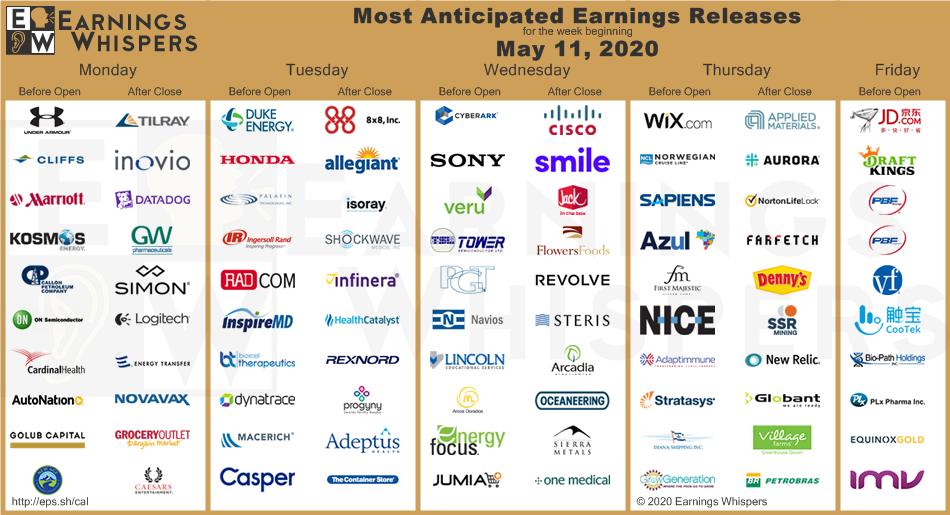
Week of April 25, 2020 Weekly Recap & The Week Ahead

Tuesday, April 28th, 2020

“The biggest investing errors come not from factors that are informational or analytical, but from those that are psychological.” – Howard Marks

1. Oil Plunges Below Zero for First Time in Unprecedented Wipeout — the current May futures contract, which expires April 21 20, dropped to minus $37.63 a barrel. Underscoring just how acute the concern over the lack of storage is, June’s contract settled at $20.43. That gap between the two contracts is by far the biggest ever. This means that oil for delivery next month has essentially been deemed worthless, suggesting sellers may have to instead pay someone to take it off their hands.
2. First U.S. Virus Death Came Weeks Before Previously Thought — Two residents of Santa Clara County, California, who died at home on Feb. 6 and Feb. 17 were infected with the virus. The first death is 20 days earlier than what was previously thought to be the first U.S. fatality, and about three weeks before health officials identified the first Covid-19 infection without a known tie to other cases. The deaths were also weeks before cities and states began implementing widespread social-distancing measures. U.S. attempts to track the virus at the time were hampered by shortages of tests and highly limited criteria for who could be tested. In early February, the U.S. was still relying on the CDC for all testing of potential cases. Tests sent out by the agency to state and local health labs later that month turned out to be unusable, and widespread testing only became available weeks later.
3. House Ratifies $484 Billion in Aid for Pandemic Relief — Donald Trump signed a $484 billion spending package that includes more money for small businesses. The new law will also deliver tens of billions of dollars in aid to health care providers and grant $25 billion to expand virus testing. It’s unlikely to be enough, though, with lawmakers already discussing the next phase of virus rescue legislation. The news comes as the CBO said the federal budget deficit may more than triple to a record $3.7 trillion this fiscal year.
4. Cuomo announces phased plan to reopen New York — Andrew Cuomo sketched out a phased reopening beginning with construction and manufacturing, possibly on May 15, and probably upstate before NYC. Other businesses would reopen based on how essential they are. New hospitalizations must have dropped for two weeks. Bill de Blasio said in that event he’ll relax the lockdown and open up schools, companies and cultural institutions. New York had 367 deaths on Sunday, the lowest number in almost a month. Almost one-third of business economists expect operations at their companies will return to normal in five to eight weeks, though almost as many say it may be three to six months, a NABE survey showed. Georgia restaurants and movie theaters can reopen. Follow the developments with our Virus Update.

The week ahead — Economic data from Econoday.com:
Search
Calendar
February 2026
M T W T F S S
« Jan    
 1
2345678
9101112131415
16171819202122
232425262728  
Archives
Categories
The information provided by The EGS Blog is based on sources believed to be reliable, but it is not guaranteed to be accurate. There is no guarantee that the recommendations of The EGS Blog will be profitable or will not be subject to losses. The information provided by The EGS Blog is not a recommendation or a solicitation that any particular investor should purchase or sell any particular security in any amount, or at all. The investments discussed or recommended herein may be unsuitable for investors depending on their specific investment objectives and financial position. At any time EGS LLC and its principals may maintain positions that are contrary to positions announced within the subscription service. In no event will The EGS Blog be liable to you or anyone else for any incidental, consequential, special, or indirect damage (including but not limited to lost profits or trading losses). PAST PERFORMANCE IS NO GUARANTEE OF FUTURE RESULTS

© Copyright 2026 Market Outlook All Rights Reserved
Design by EGS Sponsored by Equity Guidance LLC